Indian Statistical Institute (ISI) Act, 1959

Indian Statistical Institute (ISI) Act

Indian Statistical Institute (ISI) Act, 1959 Latest News

More than 1,500 academics have expressed grave concerns and held demonstrations in Kolkata to protest a Central government plan to repeal the Indian Statistical Institute (ISI) Act, 1959.

About Indian Statistical Institute (ISI) Act, 1959

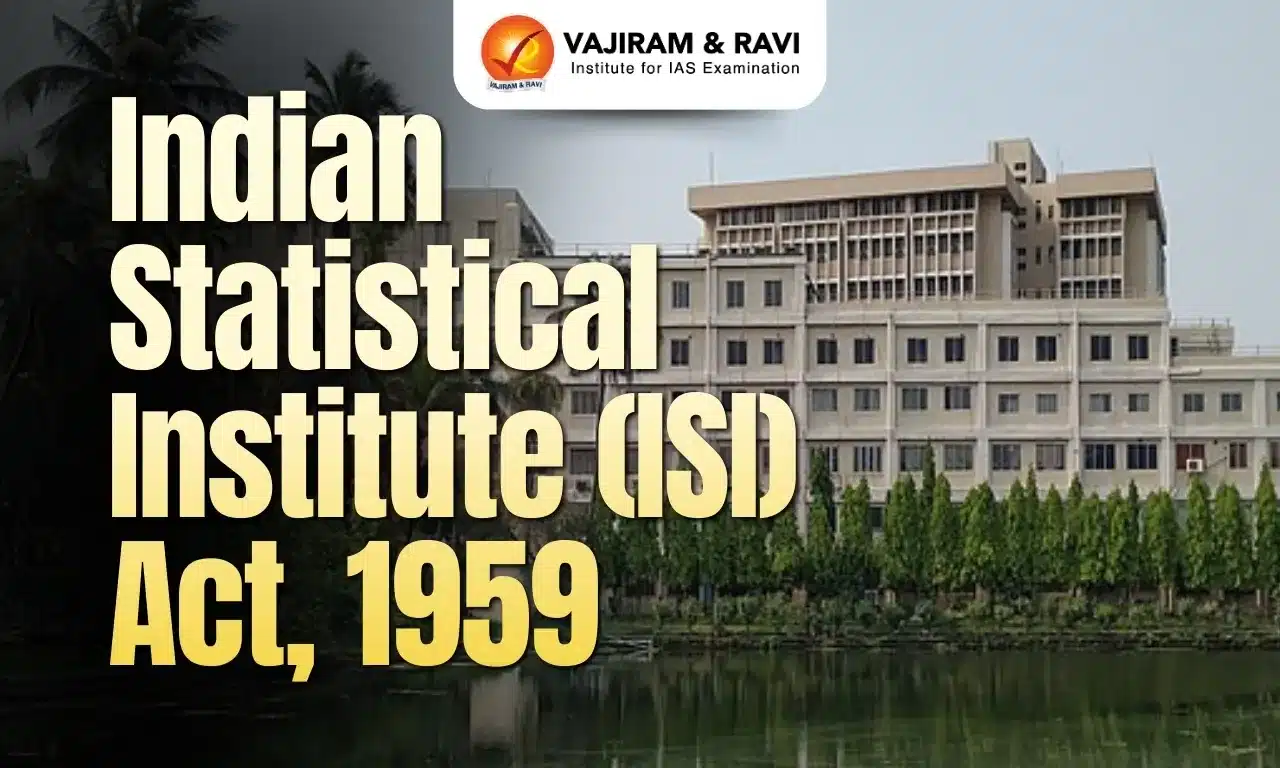
  • The Indian Statistical Institute was founded by Professor P.C. Mahalanobis in Kolkata on 17th December, 1931
  • The ISI, established earlier as a society, plays a crucial role in statistical research, education, and training in India. 
  • The ISI Act 1959 primarily applies to the ISI, its governing body, employees, and students
  • The Act aimed to recognize the ISI’s contributions to national development and provide it with the necessary autonomy and support to carry out its functions effectively. 
  • The ISA Act 1959 declared the ISI an institution of national importance. 
  • This Act falls under the Ministry of Statistics and Programme Implementation.

Salient Features of Indian Statistical Institute (ISI) Act, 1959

  • Empowers the ISI to grant degrees and diplomas in statistics, mathematics, quantitative economics, computer science, and related subjects.
  • Provides for grants, loans, and other financial assistance from the Central Government.
  • Mandates the audit of the Institute’s accounts by qualified auditors.
  • Requires prior approval from the Central Government for certain actions by the Institute, such as altering its objectives, amending its memorandum, or disposing of certain properties.
  • Provides for the constitution of committees by the Central Government to prepare the Institute’s program of work and review its activities.
  • Empowers the Central Government to issue directions to the Institute.
  • Allows the Central Government to assume control of the Institute under certain circumstances.

Source: TH

Indian Statistical Institute (ISI) Act, 1959 FAQs

Q1: When was the Indian Statistical Institute founded by P.C. Mahalanobis?

Ans: 17th December, 1931

Q2: In which city was the Indian Statistical Institute established in 1931?

Ans: Kolkata

Q3: What is the primary purpose of the ISI Act, 1959?

Ans: The primary purpose of the ISI Act, 1959 is to recognize the Indian Statistical Institute (ISI) as an institution of national importance.


Alaknanda Galaxy

Alaknanda Galaxy

Alaknanda Galaxy Latest News

Recently, researchers at National Centre for Radio Astrophysics - Tata Institute of Fundamental Research (NCRA–TIFR), Pune, have discovered a spiral galaxy and named it as Alaknanda.

About Alaknanda Galaxy

  • It is located about 12 billion light years away and has textbook spiral structure. 
  • It is named after a Himalayan river Alaknanda and the Hindi word for the Milky Way.
  • The galaxy has two well-defined spiral arms wrapping around a bright central bulge, spanning approximately 30,000 light-years in diameter.
  • It is a powerhouse of stellar birth, creating stars at a rate equivalent to about 60 solar masses annually.
  • It looks remarkably similar to our own Milky Way and formed when the Milky way was only 10 per cent of its current age.
  • It was discovered by using NASA’s James Webb Space Telescope.

 What is a Spiral Galaxy?

  • Spiral galaxies are twisted collections of stars and gas that often have beautiful shapes and are made up of hot, young stars.
  • In a spiral galaxy, the stars, gas, and dust are gathered in spiral arms that spread outward from the galaxy’s center.
  • Structure
    • Most spiral galaxies contain a central bulge surrounded by a flat, rotating disk of stars. 
    • The bulge in the center is made up of older, dimmer stars and is thought to contain a supermassive black hole.
    • Approximately two-thirds of spiral galaxies also contain a bar structure through their center, as does the Milky Way. 
    • The disk of stars orbiting the bulge separates into arms that circle the galaxy.
    • These spiral arms contain a wealth of gas and dust and younger stars that shine brightly before their quick demise.

Source: IE

Alaknanda Galaxy FAQs

Q1: What is a galaxy?

Ans: A group of stars, gas, and dust held together by gravity

Q2: What is the galaxy that contains our solar system?

Ans: Milky Way Galaxy

RBI Integrated Ombudsman Scheme

RBI Integrated Ombudsman Scheme

RBI Integrated Ombudsman Scheme Latest News

According to the RBI’s Annual Report, the complaints registered under the Reserve Bank of India’s Integrated Ombudsman Scheme (RB-IOS) were up by 13.55 per cent in FY25.

About RBI Integrated Ombudsman Scheme

  • It was launched on November 12, 2021.
  • It integrated the erstwhile three Ombudsman schemes of RBI namely: the Banking Ombudsman Scheme, 2006, the Ombudsman Scheme for Non-Banking Financial Companies, 2018 and the Ombudsman Scheme for Digital Transactions, 2019.
  • It adopted the ‘One Nation One Ombudsman’ approach by making the RBI Ombudsman mechanism jurisdiction neutral.
  • Objective: To provide customers of regulated entities (REs) a speedy, cost-effective and expeditious alternate grievance redress mechanism.

Features of RBI Integrated Ombudsman Scheme

  • It defines ‘deficiency in service’ as the ground for filing a complaint, with a specified list of exclusions.
  • Covered Banks: It covers all commercial banks, Non-Banking Financial Companies (NBFCs), RRBs, Payment System Participants, most Primary (Urban) Cooperative Banks with a deposit size of ₹50 crore and Credit Information Companies.
  • A Centralised Receipt and Processing Centre has been set up at RBI, Chandigarh, for receipt and initial processing of physical and email complaints in any language.
  • Under this scheme, compensation up to Rupees 20 lakh, in addition to, up to 1 lakh for the loss of the complainant’s time, expenses incurred and for harassment/mental anguish suffered by the complainant can be awarded.

Source: BS

RBI Integrated Ombudsman Scheme FAQs

Q1: What is the primary objective of the RBI Integrated Ombudsman Scheme?

Ans: To provide cost-free redressal of customer complaints

Q2: What is the maximum compensation for a complaint under the RBI Integrated Ombudsman Scheme?

Ans: ₹20 lakh

Caller Name Presentation

Caller Name Presentation

Caller Name Presentation Latest News

In the next few months, the Department of Telecommunications (DoT) will mandate telecom operators to show the KYC-registered name of all incoming callers using Indian phone numbers, a feature known as Caller Name Presentation (CNAP).

About Caller Name Presentation 

  • CNAP is a technology that enables mobile users to see an incoming caller’s name, similar to Truecaller. 
  • The system retrieves the caller’s name from a telecom operator’s database and displays it on the recipient’s phone. 
  • Unlike third-party apps, CNAP will rely on the official Customer Application Form (CAF) details provided during SIM registration.
  • How Will CNAP Work?
    • Each telecom provider will maintain a database of subscriber names linked to mobile numbers. 
    • When a call is made, the system will fetch the caller’s registered name and display it on the recipient’s screen. 
    • Initially, CNAP will work only within the same network, meaning an Airtel-to-Airtel call will display the caller’s name, but cross-operator name display, such as Jio-to-Vodafone, will require regulatory approval for data sharing between telecom providers.
  • In February 2024, the Telecom Regulatory Authority of India (TRAI) recommended the adoption of CNAP for all smartphones, urging telecom operators to introduce the feature. 
    • The aim is to reduce customer harassment from unknown or spam callers.

Source: TH

Caller Name Presentation FAQs

Q1: What is Caller Name Presentation (CNAP)?

Ans: It is a technology that enables mobile users to see an incoming caller’s name, similar to Truecaller.

Q2: From where does Caller Name Presentation (CNAP) retrieve the caller’s name?

Ans: Telecom operator’s subscriber database.

Q3: How does Caller Name Presentation (CNAP) differ from third-party caller ID apps like Truecaller?

Ans: Unlike third-party apps, CNAP will rely on the official Customer Application Form (CAF) details provided during SIM registration.

Dudhwa Tiger Reserve

Dudhwa Tiger Reserve

Dudhwa Tiger Reserve Latest News

A Rainbow Water Snake was recently spotted for the first time in Uttar Pradesh, with photographic evidence collected from the buffer area of Dudhwa Tiger Reserve.

About Dudhwa Tiger Reserve

  • It is located on the Indo-Nepal border in the district of Lakhimpur-Kheri in Uttar Pradesh.
  • It was established in 1988 and covers an area of 1,284 sq.km.
  • It includes the Dudhwa National Park and two nearby sanctuaries, viz. Kishanpur and Katerniaghat, besides forest areas of North Kheri, South Kheri, and Shahjahanpur forest divisions in its buffer.
  • Topography: It is a typical Tarai-Bhabar habitat of the upper Gangetic plains biogeographic province.
  • Rivers: The Sharda River flows by the Kishanpur WL Sanctuary, the Geruwa River flows through the Katerniaghat WL Sanctuary, and the Suheli and Mohana streams flow in the Dudhwa National Park, all of which are tributaries of the mighty Ghagra River.
  • Vegetation: The vegetation is of the North Indian Moist Deciduous type, containing some of the finest examples of Sal forests in India.
  • Flora: It consists of Sal Forest along with its associate tree species like Terminalia alata (Asna), Lagerstroemia parviflora (Asidha), Adina cordifolia (Haldu), Mitragyna parviflora (Faldu), Gmelina arborea (Gahmhar), Holoptelea intgrifolia (Kanju), etc.
  • Fauna
    • The main mammals spotted here are Tiger, leopard, Swamp deer, Rhinoceros, chital, hog deer, barking deer, Sambhar, wild boar, and Ratel.
    • There are about 400 species of birds in the park, such as the Florican and black-necked storks.

Key Facts about Rainbow Water Snake

  • It is a slightly venomous, fish-eating water snake.
  • Scientific Name: Enhydris enhydris
  • Distribution: It is found in southeastern China, Indonesia, Bangladesh, Cambodia, central and eastern India, Laos, Malaysia, Myanmar, Nepal, Pakistan, Singapore , Sri Lanka, Pulau Bangka, Thailand, and Vietnam.
  • Habitat: It inhabits freshwater habitats, including marshlands, rural ponds, and rice paddies.
  • Features
    • It grows as long as 130 cm. 
    • This snake is easily identified by the two pale stripes running down the full length of the body and tail on either side of the vertebral line: these two stripes converge on the crown.
    • The body is medium brown to greenish brown, and the head and neck are generally more olive-coloured than the body. 
    • The belly is pale, with a thin brown line running down the middle.
  • Conservation Status:
    • IUCN Red List: Least Concern

Source: HT

Dudhwa Tiger Reserve FAQs

Q1: Dudhwa Tiger Reserve is located along which international border?

Ans: It is located on the Indo-Nepal border.

Q2: Dudhwa Tiger Reserve is situated in which state?

Ans: Uttar Pradesh

Q3: What is the total area of Dudhwa Tiger Reserve?

Ans: It covers an area of 1,284 sq.km.

Q4: The vegetation of Dudhwa Tiger Reserve belongs mainly to which type?

Ans: North Indian Moist Deciduous type.

Humpback Whales

Humpback Whale

Humpback Whale Latest News

Recently, it was found that Humpback whale populations have surged from 10,000 to nearly 80,000 because of conservation efforts and the species incredible ability to adapt and switch food sources. 

About Humpback Whale

  • The Humpback whale (Megaptera novaeangliae) is a species of baleen whale.
  • It is a rorqual; a member of the family Balaenopteridae.
  • They undertake long migrations between polar feeding grounds in summer and tropical or subtropical breeding grounds in winter. 
  • Appearance
    • It has the distinctive hump on its back.
    • Its long pectoral fins inspired its scientific name, Megaptera, which means “big-winged” 
    • Humpback females are larger than males.
  • Distribution: They inhabit all major oceans from sub-polar latitudes to the equator
  • Behavior: Humpbacks use a unique method of feeding called bubble netting, in which bubbles are exhaled as the whale swims in a spiral below a patch of water dense with food.
  • Diet: They filter their food through baleen plates. They strain krill, anchovies, cod, sardines, mackerel, capelin, and other schooling fish from the waters.
  • Lifespan & Reproduction: Humpback whales reach sexual maturity between the ages of 4 and 10 years. Females produce a single calf every 2 to 3 years on average.
  • Conservation status: IUCN: Least concern

Source: India Today

Humpback Whale FAQs

Q1: What is the scientific name of the Humpback Whale?

Ans: Megaptera novaeangliae

Q2: What is the conservation status of Humpback Whales?

Ans: Least Concern

INS Aridhaman

INS Aridhaman

INS Aridhaman Latest News

Recently, the Indian Navy’s Chief Admiral said that India will soon induct its third nuclear-powered ballistic missile submarine (SSBN), INS Aridhaman.

About INS Aridhaman

  • It is India's third indigenously built nuclear-powered ballistic missile submarine.
  • It is the second submarine in the Arihant class.
  • It is being built under the Advanced Technology Vessel (ATV) project to build nuclear submarines at the Ship Building Centre in Visakhapatnam.

Features of INS Aridhaman

  • Displacement Capacity: It can displace 6,000 tonnes on the surface and 7,000 tonnes submerged.
  • It consists of an 83 MW pressurized water reactor supplied by the Bhabha Atomic Research Centre.
  • Armaments
    • It has four launch tubes capable of deploying up to 24 K-15 Sagarika submarine each with a 750 km range or
    • Longer-range K-4 missiles extending to 3,500 km for intercontinental strikes.
  • It also has anechoic tiles for acoustic damping and advanced sonar suites enhancing its survivability against detection.

History of India’s Nuclear Submarine

  • INS Arihant was the first vessel under the SSBN project.
  • INS Arihant is India's first home-made nuclear submarine. It was launched in July 2009 and was quietly commissioned in 2016.
  • The Navy commissioned its second indigenous SSBN, INS Arighaat, in August 2024.

Source: ET

INS Aridhaman FAQs

Q1: What is INS Aridhaman?

Ans: India's third Arihant-class nuclear-powered ballistic missile submarine.

Q2: What is the primary role of INS Aridhaman?

Ans: Sea-based nuclear deterrence

Ebola

What is Ebola?

Ebola Latest News

An Ebola outbreak in the Democratic Republic of Congo is now over, Congolese health officials and the U.N.'s World Health Organization said recently, after the country went 42 consecutive days without recording a new case.

About Ebola

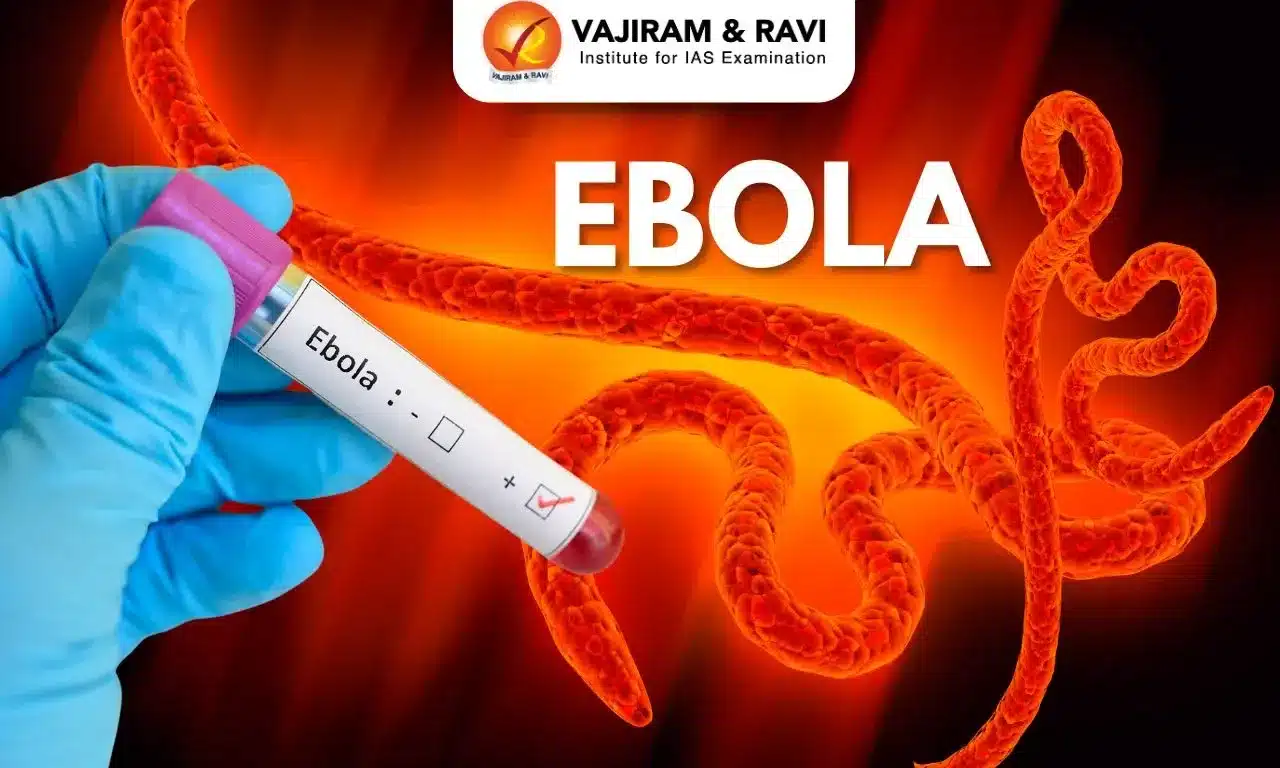
  • It is a severe and often deadly disease caused by a group of viruses known as orthoebolaviruses (formally ebolavirus).
  • Orthoebolaviruses were discovered in 1976 in the Democratic Republic of the Congo and are found primarily in sub-Saharan Africa.
  • It is known as a hemorrhagic fever virus because it can cause problems with the clotting system of the body and lead to internal bleeding as blood leaks from small blood vessels. 
  • Six different species of the virus have been found, but only four are known to cause disease in humans.
  • It gets its name from the Ebola River, which is near one of the villages in the Democratic Republic of Congo where the disease first appeared.
  • Ebola can occur in humans and other primates (gorillas, monkeys, and chimpanzees).
  • Transmission:
    • The virus is transmitted to people from wild animals (such as fruit bats, porcupines, and non-human primates) and then spreads in the human population through direct contact with the blood, secretions, organs, or other bodily fluids of infected people and with surfaces and materials (e.g., bedding, clothing) contaminated with these fluids.
    • Ebola cannot be transmitted by air. 
  • Symptoms:
    • It includes fever, diarrhea, vomiting, bleeding, and often, death.
    • The average Ebola disease case fatality rate is around 50%. Case fatality rates have varied from 25–90% in past outbreaks.
  • Treatment:
    • There is no known cure for Ebola. Experimental treatments have been used, but none have been fully tested to see if they work well and are safe.
    • For example, there are two FDA-approved monoclonal antibody treatments for the Ebola Zaire strain (Inmazeb and Ebanga).
    • Recovery seems to depend in part on how much virus a person was initially exposed to, how early treatment is started, and the patient’s age and immune response. 
    • Current therapy consists of maintenance of fluid and electrolyte balance and the administration of blood and plasma to control bleeding.

Source: LM

Ebola FAQs

Q1: What is Ebola?

Ans: It is a severe and often deadly disease caused by a group of viruses.

Q2: Ebola is caused by which group of viruses?

Ans: Ebola is caused by a group of viruses known as orthoebolaviruses (formally ebolavirus).

Q3: Can Ebola be transmitted through air?

Ans: No — Ebola cannot be transmitted through air.

Q4: What is the average case fatality rate of Ebola?

Ans: The average Ebola disease case fatality rate is around 50%.

Solar Flare

Solar Flare

Solar Flare Latest News

A huge sunspot that is more than 10 times bigger than Earth recently appeared on the surface of the sun, and scientists say it could lead to several strong solar flares in the coming weeks.

About Solar Flare

  • A solar flare is an intense burst of radiation coming from the release of magnetic energy associated with sunspots.
  • A flare appears as a sudden, intense brightening of a region on the Sun, lasting several minutes to hours.
  • Flares occur when intense magnetic fields on the Sun become too tangled. 
  • Like a rubber band that snaps when it is twisted too far, the tangled magnetic fields release energy when they snap. 
  • The energy emitted by a solar flare is more than a million times greater than the energy from a volcanic eruption on Earth.
  • Flares are our solar system’s largest explosive events. 
  • In a matter of just a few minutes, they heat the material to many millions of degrees and produce a burst of radiation across the electromagnetic spectrum, including from radio waves to x-rays and gamma rays.
  • Although solar flares can be visible in white light, they are often more readily noticed via their bright X-ray and ultraviolet emissions. 
  • The biggest flares occur in association with large sunspots that have sharp magnetic gradients and large currents, which are the source of the flare energy.
  • Solar flares burst forth from intense magnetic fields in the vicinity of active regions on the Sun and are most common during times of peak solar activity. 
  • Coronal mass ejections often accompany solar flares, though scientists are still trying to determine exactly how the two phenomena are related. 
  • Effect of Solar Flare on Earth:
    • The intense radiation emitted during a solar flare can affect satellite communications, disrupt radio signals, and even pose a risk to astronauts in space.
    • Additionally, the increased solar radiation can lead to geomagnetic storms, which may impact power grids and cause auroras (northern and southern lights) at lower latitudes.

What are Sunspots?

  • Sunspots are areas that appear dark on the surface of the Sun. 
  • They appear dark because they are cooler than other parts of the Sun’s surface. 
  • Why are sunspots relatively cool? 
    • It’s because they form in areas where magnetic fields are particularly strong.
    • These magnetic fields are so strong that they keep some of the heat within the Sun from reaching the surface.

Source: NDTV

Solar Flare FAQs

Q1: What causes a solar flare to occur?

Ans: Sudden release of energy from tangled magnetic fields.

Q2: Solar flares usually emerge from which regions on the Sun?

Ans: Active regions with strong magnetic fields.

Q3: What impact can intense solar flares have on Earth?

Ans: Disruption of satellite communication and radio signals.

Q4: What effect can solar flare activity have on power grids on Earth?

Ans: They can trigger geomagnetic storms affecting power systems.

Green Tug Transition Programme

Green Tug Transition Programme

Green Tug Transition Programme Latest News

Recently, the Union Minister for Ports, Shipping and Waterways (MoPSW) virtually flagged off the steel-cutting ceremony for Indias first all-electric green tug Deendayal Port Authority (DPA), being developed under the Green Tug Transition Programme (GTTP).

About Green Tug Transition Programme

  • It aims to transition India's harbour tug fleet from conventional diesel-powered vessels to greener alternatives.
  • It was launched by the Ministry of Ports, Shipping and Waterways in 2024.
  • Implementation:
    • Under this programme, 50 green tugs will be inducted by 2030, with 16 to be deployed in the first phase between 2024 and 2027.
    • In Phase 1, two green tugs each will be stationed at DPA, Paradip Port Authority, Jawaharlal Nehru Port Authority and V.O. Chidambaranar Port Authority.
    • One tug each will be deployed at the remaining eight major ports.
    • This is achieved through a phased approach spanning five phases from 2024 to 2040.
  • Nodal Agency: National Centre of Excellence in Green Port & Shipping (NCoEGPS) will act as the nodal entity for this programme
  • ‘Green Hybrid Tugs’ will be powered by Green Hybrid Propulsion systems. These Green hybrid tugs will subsequently adopt non-fossil fuel solutions like (Methanol, Ammonia, and Hydrogen).

Source: PIB

Green Tug Transition Programme FAQs

Q1: What is the primary objective of the Green Tug Transition Programme (GTTP)?

Ans: To reduce greenhouse gas emissions from port vessels

Q2: Which ministry launched the GTTP?

Ans: Ministry of Ports, Shipping and Waterways

Enquire Now