Indian Statistical Institute (ISI) Act, 1959

Indian Statistical Institute (ISI) Act

Indian Statistical Institute (ISI) Act, 1959 Latest News

More than 1,500 academics have expressed grave concerns and held demonstrations in Kolkata to protest a Central government plan to repeal the Indian Statistical Institute (ISI) Act, 1959.

About Indian Statistical Institute (ISI) Act, 1959

  • The Indian Statistical Institute was founded by Professor P.C. Mahalanobis in Kolkata on 17th December, 1931
  • The ISI, established earlier as a society, plays a crucial role in statistical research, education, and training in India. 
  • The ISI Act 1959 primarily applies to the ISI, its governing body, employees, and students
  • The Act aimed to recognize the ISI’s contributions to national development and provide it with the necessary autonomy and support to carry out its functions effectively. 
  • The ISA Act 1959 declared the ISI an institution of national importance. 
  • This Act falls under the Ministry of Statistics and Programme Implementation.

Salient Features of Indian Statistical Institute (ISI) Act, 1959

  • Empowers the ISI to grant degrees and diplomas in statistics, mathematics, quantitative economics, computer science, and related subjects.
  • Provides for grants, loans, and other financial assistance from the Central Government.
  • Mandates the audit of the Institute’s accounts by qualified auditors.
  • Requires prior approval from the Central Government for certain actions by the Institute, such as altering its objectives, amending its memorandum, or disposing of certain properties.
  • Provides for the constitution of committees by the Central Government to prepare the Institute’s program of work and review its activities.
  • Empowers the Central Government to issue directions to the Institute.
  • Allows the Central Government to assume control of the Institute under certain circumstances.

Source: TH

Indian Statistical Institute (ISI) Act, 1959 FAQs

Q1: When was the Indian Statistical Institute founded by P.C. Mahalanobis?

Ans: 17th December, 1931

Q2: In which city was the Indian Statistical Institute established in 1931?

Ans: Kolkata

Q3: What is the primary purpose of the ISI Act, 1959?

Ans: The primary purpose of the ISI Act, 1959 is to recognize the Indian Statistical Institute (ISI) as an institution of national importance.

Alaknanda Galaxy

Alaknanda Galaxy

Alaknanda Galaxy Latest News

Recently, researchers at National Centre for Radio Astrophysics - Tata Institute of Fundamental Research (NCRA–TIFR), Pune, have discovered a spiral galaxy and named it as Alaknanda.

About Alaknanda Galaxy

  • It is located about 12 billion light years away and has textbook spiral structure. 
  • It is named after a Himalayan river Alaknanda and the Hindi word for the Milky Way.
  • The galaxy has two well-defined spiral arms wrapping around a bright central bulge, spanning approximately 30,000 light-years in diameter.
  • It is a powerhouse of stellar birth, creating stars at a rate equivalent to about 60 solar masses annually.
  • It looks remarkably similar to our own Milky Way and formed when the Milky way was only 10 per cent of its current age.
  • It was discovered by using NASA’s James Webb Space Telescope.

 What is a Spiral Galaxy?

  • Spiral galaxies are twisted collections of stars and gas that often have beautiful shapes and are made up of hot, young stars.
  • In a spiral galaxy, the stars, gas, and dust are gathered in spiral arms that spread outward from the galaxy’s center.
  • Structure
    • Most spiral galaxies contain a central bulge surrounded by a flat, rotating disk of stars. 
    • The bulge in the center is made up of older, dimmer stars and is thought to contain a supermassive black hole.
    • Approximately two-thirds of spiral galaxies also contain a bar structure through their center, as does the Milky Way. 
    • The disk of stars orbiting the bulge separates into arms that circle the galaxy.
    • These spiral arms contain a wealth of gas and dust and younger stars that shine brightly before their quick demise.

Source: IE

Alaknanda Galaxy FAQs

Q1: What is a galaxy?

Ans: A group of stars, gas, and dust held together by gravity

Q2: What is the galaxy that contains our solar system?

Ans: Milky Way Galaxy

RBI Integrated Ombudsman Scheme

RBI Integrated Ombudsman Scheme

RBI Integrated Ombudsman Scheme Latest News

According to the RBI’s Annual Report, the complaints registered under the Reserve Bank of India’s Integrated Ombudsman Scheme (RB-IOS) were up by 13.55 per cent in FY25.

About RBI Integrated Ombudsman Scheme

  • It was launched on November 12, 2021.
  • It integrated the erstwhile three Ombudsman schemes of RBI namely: the Banking Ombudsman Scheme, 2006, the Ombudsman Scheme for Non-Banking Financial Companies, 2018 and the Ombudsman Scheme for Digital Transactions, 2019.
  • It adopted the ‘One Nation One Ombudsman’ approach by making the RBI Ombudsman mechanism jurisdiction neutral.
  • Objective: To provide customers of regulated entities (REs) a speedy, cost-effective and expeditious alternate grievance redress mechanism.

Features of RBI Integrated Ombudsman Scheme

  • It defines ‘deficiency in service’ as the ground for filing a complaint, with a specified list of exclusions.
  • Covered Banks: It covers all commercial banks, Non-Banking Financial Companies (NBFCs), RRBs, Payment System Participants, most Primary (Urban) Cooperative Banks with a deposit size of ₹50 crore and Credit Information Companies.
  • A Centralised Receipt and Processing Centre has been set up at RBI, Chandigarh, for receipt and initial processing of physical and email complaints in any language.
  • Under this scheme, compensation up to Rupees 20 lakh, in addition to, up to 1 lakh for the loss of the complainant’s time, expenses incurred and for harassment/mental anguish suffered by the complainant can be awarded.

Source: BS

RBI Integrated Ombudsman Scheme FAQs

Q1: What is the primary objective of the RBI Integrated Ombudsman Scheme?

Ans: To provide cost-free redressal of customer complaints

Q2: What is the maximum compensation for a complaint under the RBI Integrated Ombudsman Scheme?

Ans: ₹20 lakh

Caller Name Presentation

Caller Name Presentation

Caller Name Presentation Latest News

In the next few months, the Department of Telecommunications (DoT) will mandate telecom operators to show the KYC-registered name of all incoming callers using Indian phone numbers, a feature known as Caller Name Presentation (CNAP).

About Caller Name Presentation 

  • CNAP is a technology that enables mobile users to see an incoming caller’s name, similar to Truecaller. 
  • The system retrieves the caller’s name from a telecom operator’s database and displays it on the recipient’s phone. 
  • Unlike third-party apps, CNAP will rely on the official Customer Application Form (CAF) details provided during SIM registration.
  • How Will CNAP Work?
    • Each telecom provider will maintain a database of subscriber names linked to mobile numbers. 
    • When a call is made, the system will fetch the caller’s registered name and display it on the recipient’s screen. 
    • Initially, CNAP will work only within the same network, meaning an Airtel-to-Airtel call will display the caller’s name, but cross-operator name display, such as Jio-to-Vodafone, will require regulatory approval for data sharing between telecom providers.
  • In February 2024, the Telecom Regulatory Authority of India (TRAI) recommended the adoption of CNAP for all smartphones, urging telecom operators to introduce the feature. 
    • The aim is to reduce customer harassment from unknown or spam callers.

Source: TH

Caller Name Presentation FAQs

Q1: What is Caller Name Presentation (CNAP)?

Ans: It is a technology that enables mobile users to see an incoming caller’s name, similar to Truecaller.

Q2: From where does Caller Name Presentation (CNAP) retrieve the caller’s name?

Ans: Telecom operator’s subscriber database.

Q3: How does Caller Name Presentation (CNAP) differ from third-party caller ID apps like Truecaller?

Ans: Unlike third-party apps, CNAP will rely on the official Customer Application Form (CAF) details provided during SIM registration.

Dudhwa Tiger Reserve

Dudhwa Tiger Reserve

Dudhwa Tiger Reserve Latest News

A Rainbow Water Snake was recently spotted for the first time in Uttar Pradesh, with photographic evidence collected from the buffer area of Dudhwa Tiger Reserve.

About Dudhwa Tiger Reserve

  • It is located on the Indo-Nepal border in the district of Lakhimpur-Kheri in Uttar Pradesh.
  • It was established in 1988 and covers an area of 1,284 sq.km.
  • It includes the Dudhwa National Park and two nearby sanctuaries, viz. Kishanpur and Katerniaghat, besides forest areas of North Kheri, South Kheri, and Shahjahanpur forest divisions in its buffer.
  • Topography: It is a typical Tarai-Bhabar habitat of the upper Gangetic plains biogeographic province.
  • Rivers: The Sharda River flows by the Kishanpur WL Sanctuary, the Geruwa River flows through the Katerniaghat WL Sanctuary, and the Suheli and Mohana streams flow in the Dudhwa National Park, all of which are tributaries of the mighty Ghagra River.
  • Vegetation: The vegetation is of the North Indian Moist Deciduous type, containing some of the finest examples of Sal forests in India.
  • Flora: It consists of Sal Forest along with its associate tree species like Terminalia alata (Asna), Lagerstroemia parviflora (Asidha), Adina cordifolia (Haldu), Mitragyna parviflora (Faldu), Gmelina arborea (Gahmhar), Holoptelea intgrifolia (Kanju), etc.
  • Fauna
    • The main mammals spotted here are Tiger, leopard, Swamp deer, Rhinoceros, chital, hog deer, barking deer, Sambhar, wild boar, and Ratel.
    • There are about 400 species of birds in the park, such as the Florican and black-necked storks.

Key Facts about Rainbow Water Snake

  • It is a slightly venomous, fish-eating water snake.
  • Scientific Name: Enhydris enhydris
  • Distribution: It is found in southeastern China, Indonesia, Bangladesh, Cambodia, central and eastern India, Laos, Malaysia, Myanmar, Nepal, Pakistan, Singapore , Sri Lanka, Pulau Bangka, Thailand, and Vietnam.
  • Habitat: It inhabits freshwater habitats, including marshlands, rural ponds, and rice paddies.
  • Features
    • It grows as long as 130 cm. 
    • This snake is easily identified by the two pale stripes running down the full length of the body and tail on either side of the vertebral line: these two stripes converge on the crown.
    • The body is medium brown to greenish brown, and the head and neck are generally more olive-coloured than the body. 
    • The belly is pale, with a thin brown line running down the middle.
  • Conservation Status:
    • IUCN Red List: Least Concern

Source: HT

Dudhwa Tiger Reserve FAQs

Q1: Dudhwa Tiger Reserve is located along which international border?

Ans: It is located on the Indo-Nepal border.

Q2: Dudhwa Tiger Reserve is situated in which state?

Ans: Uttar Pradesh

Q3: What is the total area of Dudhwa Tiger Reserve?

Ans: It covers an area of 1,284 sq.km.

Q4: The vegetation of Dudhwa Tiger Reserve belongs mainly to which type?

Ans: North Indian Moist Deciduous type.

Humpback Whales

Humpback Whale

Humpback Whale Latest News

Recently, it was found that Humpback whale populations have surged from 10,000 to nearly 80,000 because of conservation efforts and the species incredible ability to adapt and switch food sources. 

About Humpback Whale

  • The Humpback whale (Megaptera novaeangliae) is a species of baleen whale.
  • It is a rorqual; a member of the family Balaenopteridae.
  • They undertake long migrations between polar feeding grounds in summer and tropical or subtropical breeding grounds in winter. 
  • Appearance
    • It has the distinctive hump on its back.
    • Its long pectoral fins inspired its scientific name, Megaptera, which means “big-winged” 
    • Humpback females are larger than males.
  • Distribution: They inhabit all major oceans from sub-polar latitudes to the equator
  • Behavior: Humpbacks use a unique method of feeding called bubble netting, in which bubbles are exhaled as the whale swims in a spiral below a patch of water dense with food.
  • Diet: They filter their food through baleen plates. They strain krill, anchovies, cod, sardines, mackerel, capelin, and other schooling fish from the waters.
  • Lifespan & Reproduction: Humpback whales reach sexual maturity between the ages of 4 and 10 years. Females produce a single calf every 2 to 3 years on average.
  • Conservation status: IUCN: Least concern

Source: India Today

Humpback Whale FAQs

Q1: What is the scientific name of the Humpback Whale?

Ans: Megaptera novaeangliae

Q2: What is the conservation status of Humpback Whales?

Ans: Least Concern

Judiciary Flags Major Lapses in Critical Care for Acid Attack Survivors

Acid Attack

Acid Attack Latest News

  • The Supreme Court has raised serious concerns over continued delays in victim compensation and non-compliance by private hospitals in offering free critical treatment to acid attack survivors, despite judicial orders issued more than a decade ago. 

Judicial Intervention in Acid Attack Cases

  • Acid attacks in India have long prompted judicial attention due to their devastating physical, psychological, and economic impact on survivors, many of whom are young women. 
  • The Supreme Court initiated sustained oversight beginning in 2006, following the horrific case of Laxmi, who was attacked at the age of 15. 
  • In subsequent years, the Court issued landmark directives:
    • Minimum Rs. 3 lakh compensation for survivors, with Rs. 1 lakh to be paid within 15 days of the incident.
    • Free and immediate medical treatment in private hospitals, including medicines, food, and specialised care.
    • Ban on the over-the-counter sale of acid to curb misuse.
    • Designation of District Legal Services Authorities (DLSA) as criminal injuries compensation boards to streamline claims.
  • Despite these orders, survivors continue to face procedural delays and denial of essential services.

Current Supreme Court Proceedings

  • The present plea before the Supreme Court, filed by the Acid Survivors Saahas Foundation, argues that many survivors have either not received full compensation or were denied free critical care by private hospitals. 
  • The Bench acknowledged that these issues persisted despite “repeated judicial orders spanning years.” 
  • During the hearing, significant revelations came to light:
    • Victims in several States, including Maharashtra and Uttar Pradesh, received only the initial Rs. 1 lakh payout, with no support for expensive reconstructive surgeries.
    • Private hospitals, in violation of Supreme Court directives, demanded full payment up front before admitting survivors.
    • Incomplete compliance reports were being furnished, often listing aggregated payments rather than victim-wise details.
    • As many as eight States and five Union Territories had not yet filed their affidavits explaining compensation delays.
  • This prompted the Bench to emphasise the urgent need for system-wide accountability.

Supreme Court’s Directions to Authorities

  • Strengthening Financial Accountability
    • The Bench ordered State Chief Secretaries to personally ensure that funds flow promptly from State governments to State Legal Services Authorities, and then onward to district bodies, enabling final payment to survivors. 
    • It also highlighted the need for updated compensation amounts, recognising that the earlier fixed sum of Rs. 3 lakh is insufficient given rising medical costs and the need for multiple reconstructive surgeries.
  • Ensuring Compliance by Private Hospitals
    • Principal Health Secretaries in States and UTs have been directed to ensure that private hospitals cannot deny free treatment, including critical and emergency care. 
    • Any refusal would amount to a violation of Supreme Court orders and can attract criminal liability.
  • Demand for Detailed Data from NALSA
    • NALSA informed the Court that approximately Rs. 484 crore had been disbursed as compensation between March 2024 and April 2025, but agreed to furnish a detailed report on State-wise and victim-wise distribution. 
  • Maintaining Transparent Records
    • Names of victims
    • Date of compensation applications
    • Date of actual payment
    • Remarks on delays or pending claims

Implications for Victim Rights and Governance

  • The Supreme Court’s renewed push marks a critical attempt to ensure States honour their obligations toward one of the most marginalised groups. 
  • Acid attack survivors often face lifelong trauma, disfigurement, disability, and stigma, making immediate medical intervention and financial support indispensable.
  • By directing personal accountability at the highest administrative levels and demanding data transparency from NALSA, the Court is reinforcing a rights-based framework where compensation and healthcare access are guaranteed entitlements, not discretionary support.

Source: TH | ETV

Acid Attack FAQs

Q1: What compensation amount is mandated for acid attack survivors?

Ans: A minimum of Rs. 3 lakh, with Rs. 1 lakh payable within 15 days of the incident.

Q2: Who is responsible for processing compensation claims?

Ans: District Legal Services Authorities (DLSA) function as criminal injuries compensation boards.

Q3: Are private hospitals required to treat acid attack survivors for free?

Ans: Yes, they must provide free emergency and critical care as directed by the Supreme Court.

Q4: What concerns did the Supreme Court raise in the recent hearing?

Ans: Delays in compensation, partial payments, and private hospitals refusing free treatment.

Q5: What data has the Court asked NALSA to submit?

Ans: State-wise details of compensation disbursed, pending payments, and compliance records.

INS Aridhaman

INS Aridhaman

INS Aridhaman Latest News

Recently, the Indian Navy’s Chief Admiral said that India will soon induct its third nuclear-powered ballistic missile submarine (SSBN), INS Aridhaman.

About INS Aridhaman

  • It is India's third indigenously built nuclear-powered ballistic missile submarine.
  • It is the second submarine in the Arihant class.
  • It is being built under the Advanced Technology Vessel (ATV) project to build nuclear submarines at the Ship Building Centre in Visakhapatnam.

Features of INS Aridhaman

  • Displacement Capacity: It can displace 6,000 tonnes on the surface and 7,000 tonnes submerged.
  • It consists of an 83 MW pressurized water reactor supplied by the Bhabha Atomic Research Centre.
  • Armaments
    • It has four launch tubes capable of deploying up to 24 K-15 Sagarika submarine each with a 750 km range or
    • Longer-range K-4 missiles extending to 3,500 km for intercontinental strikes.
  • It also has anechoic tiles for acoustic damping and advanced sonar suites enhancing its survivability against detection.

History of India’s Nuclear Submarine

  • INS Arihant was the first vessel under the SSBN project.
  • INS Arihant is India's first home-made nuclear submarine. It was launched in July 2009 and was quietly commissioned in 2016.
  • The Navy commissioned its second indigenous SSBN, INS Arighaat, in August 2024.

Source: ET

INS Aridhaman FAQs

Q1: What is INS Aridhaman?

Ans: India's third Arihant-class nuclear-powered ballistic missile submarine.

Q2: What is the primary role of INS Aridhaman?

Ans: Sea-based nuclear deterrence

Rupee at 90 Per Dollar: Why the Fall Happened and What It Means for India

Rupee at 90 Per Dollar

Rupee at 90 Per Dollar Latest News

  • India’s rupee fell below the crucial ₹90-per-dollar mark, unsettling financial markets and raising broader macroeconomic concerns. The currency has now weakened over 5% this year.
  • Analysts say the rupee’s movement reflects both domestic and global pressures, including a strong US dollar and delays in the first tranche of the India–US trade agreement.

Rupee Breaches the 90-Per-Dollar Mark

  • The rupee slipped below the psychologically crucial ₹90-per-dollar level, unsettling markets and intensifying concerns over India’s macroeconomic outlook. 
    • The ₹90 mark is a critical psychological threshold for the rupee. Once breached, it can trigger buy-stop orders and fuel sharper depreciation, pushing the currency toward ₹91 or beyond.
  • The currency has fallen over 5% this year, and the breach reflects a cumulative build-up of pressures, not a single shock.

Strong Domestic Fundamentals Haven’t Stopped the Slide

  • India’s macro indicators appear supportive:
    • Crude oil prices have eased
    • Inflation has dropped below 1%
    • GDP growth hit 8.2% in Q2
  • Yet the rupee continues to face sustained downward pressure, revealing a disconnect between strong domestic fundamentals and the currency trend.

Foreign Outflows and Trade Deal Uncertainty Weigh on Sentiment

  • Persistent foreign portfolio investor (FPI) outflows, driven by profit booking and shifts to other markets, have drained liquidity and raised demand for the US dollar.
  • Meanwhile, delays in concluding the India–US trade deal have heightened uncertainty about future trade flows, tariff competitiveness, and the balance-of-payments outlook, dampening market confidence.
  • Exports remain under pressure, while a surge in gold imports during the festive season has amplified dollar demand. 

India’s Trade Deficit Shows Signs of Widening

  • India’s external sector is under growing pressure as early indicators point to a widening trade deficit — a situation where imports exceed exports, increasing demand for dollars and weakening the rupee.
  • India’s merchandise exports fell 11.8% year-on-year in October 2025, dropping to an 11-month low of $34.4 billion. The decline was driven by:
    • Lower shipments to the US, a major export market
    • Higher US tariffs
    • A high base from strong export growth in 2024
  • In contrast, imports surged 16.6% year-on-year to a record $76.1 billion in October 2025. 

Why the Trade Gap Is Widening

  • The widening deficit is being shaped by:
    • Softening demand from major export markets
    • Strong domestic demand for imported goods
    • Unfavourable tariff conditions, especially with the US
    • Weak export competitiveness across major sectors

Gold’s Role in Widening the Trade Deficit

  • The biggest contributor was gold imports, which tripled to $14.7 billion amid festive-season demand.
  • Surging gold prices and massive import volumes have become a key force shaping India’s trade dynamics.
  • They have intensified pressure on the rupee, contributed to a widening trade deficit, and added stress to the overall balance of payments outlook.

Implications for the Rupee and Economy

  • If these trends continue, India’s trade deficit is likely to worsen, putting additional pressure on the rupee, widening the balance-of-payments gap, and intensifying broader macroeconomic challenges.

Uncertainty Over India–US Trade Deal Adds Pressure on the Rupee

  • Markets are increasingly worried as the long-awaited India–US trade agreement remains unresolved. 
  • Without a deal, analysts say, the rupee may act as a “pressure valve,” gradually weakening to offset tariff disadvantages faced by Indian exporters.
  • Until a clear announcement is made, markets are likely to price in the uncertainty—with the rupee reflecting it most visibly.

Foreign Investors Continue to Pull Out of Indian Markets

  • India’s equity markets have underperformed for over a year, prompting foreign portfolio investors (FPIs) to steadily withdraw funds. 
  • Since January 2025, FPIs have pulled out ₹1.48 lakh crore, exerting consistent downward pressure on the rupee.

Why FPIs Are Selling Despite Strong Macro Indicators

  • Although India’s macroeconomic backdrop appears stable, stock market performance tells a different story.
  • Over the past year, India has been one of the weakest performers among major global markets.
  • Despite occasional record highs, returns have significantly lagged those in faster-growing international markets.
  • As a result, investors have increasingly treated India as a liquidity source, redirecting capital to more profitable regions.

RBI Allowing the Rupee to Weaken

  • There is growing debate over whether the RBI is intentionally letting the rupee depreciate.
  • Many economists argue the central bank is not pushing the rupee down, but simply responding to global shifts and India’s current macroeconomic dynamics.
  • They note that RBI has been selling dollars only to curb volatility, not to target a specific exchange rate.

Behavioural Factors Driving Sentiment

  • According to experts:
    • Importers are buying dollars aggressively
    • Exporters are holding back, waiting for better rates
    • The dollar index is below 100, which should normally support the rupee
  • They note that RBI’s relative silence, combined with IMF criticism of the rupee’s movement, is fueling negative sentiment.

RBI’s Soft-Touch Strategy

  • RBI appears to be conserving firepower:
    • Its forward book is already substantially drawn down, including in offshore NDF markets
    • It is using a measured approach, intervening only to prevent disorderly volatility, not to defend a specific level
  • This suggests a deliberate balancing act:
    • Allowing the rupee to find its market-determined level, while remaining poised to step in if the slide becomes excessively disruptive.

Source: IE | ToI

Rupee at 90 Per Dollar FAQs

Q1: Why did the rupee breach the ₹90-per-dollar level?

Ans: A convergence of pressures—FPI outflows, trade deficit widening, gold import surge, and delayed India–US trade deal—pushed the rupee below the key psychological threshold.

Q2: Why is ₹90 a crucial psychological level?

Ans: Breaching ₹90 can trigger buy-stop orders, fuel speculative bets, and accelerate depreciation toward ₹91 unless the RBI steps in to manage volatility effectively.

Q3: How is India’s trade deficit affecting the rupee?

Ans: Exports fell 11.8% in October 2025 while imports surged 16.6%, especially gold. Rising import bills and weak export competitiveness increase dollar demand and weaken the rupee.

Q4: How are foreign investors impacting the rupee?

Ans: FPIs withdrew ₹1.48 lakh crore in 2025 as India underperformed global markets. Persistent outflows reduced liquidity and placed sustained pressure on the currency.

Q5: Is the RBI allowing the rupee to weaken?

Ans: RBI is intervening minimally, smoothing volatility rather than defending a rate. Analysts say it’s conserving reserves and allowing a market-driven depreciation unless disorderly.

Putin’s India Visit 2025: How India–Russia Ties Are Evolving Amid Global Pressures

India–Russia Ties

India–Russia Ties Latest News

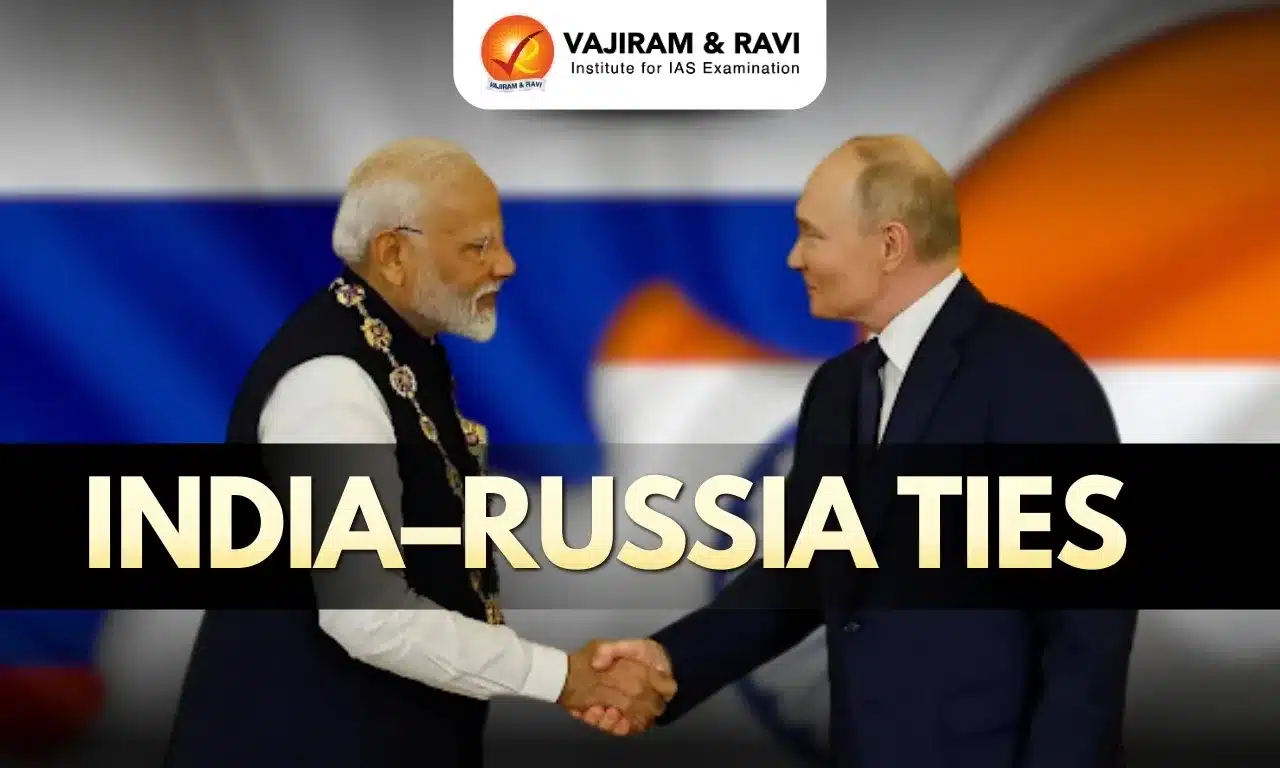
  • India is preparing to host President Vladimir Putin for a two-day visit, even as it faces punitive U.S. tariffs over its imports of Russian oil. 
  • President Putin is visiting India to attend 23rd India–Russia annual summit.
  • The visit underscores New Delhi’s intent to deepen ties with Moscow. Analysts say India views Russia as a crucial partner at a time when the U.S. appears unreliable and China increasingly hostile.

Putin’s India Visits: Then and Now

  • When Putin first visited India in October 2000, both countries were navigating turbulent times:
    • Putin was newly elected President.
    • India was under Western sanctions for Pokhran-II.
    • Russia was weakened after the Soviet collapse.
    • The U.S. dominated a unipolar world.
    • India–Pakistan tensions were high after Kargil and IC-814 hijack.
    • The visit came just months before the Red Fort attack (Dec 2000).
    • India and Russia were both struggling, albeit for different reasons.

Putin’s 2025 Visit: Striking Parallels, Changed Realities

  • Putin’s upcoming visit (on December 4–5, 2025) — the 23rd annual summit — is his first since the Ukraine invasion (2022).
  • Today:
    • Russia faces sweeping Western sanctions.
    • India faces secondary U.S. sanctions and steep tariffs on Russian oil purchases.
    • India–Pakistan tensions have resurfaced after May 2025 clashes.
    • Delhi again saw a blast near the Red Fort.
  • Despite the parallels, both nations hold stronger positions than 25 years ago.

India’s Evolving Global Alignments

  • In the past two decades, India has significantly expanded ties with the West:
    • Deep security and defence cooperation
    • Strong economic partnerships
    • Growing people-to-people engagement
    • Strategic alignment with the U.S. on the Indo-Pacific
  • At the same time, India has retained its defence partnership with Russia, a Soviet-era legacy, while gradually diversifying to other technology providers.

Russia’s Changing Global Role

  • Russia is now more isolated due to the Ukraine war but remains strategically important for India:
    • Defence cooperation
    • Energy supplies
    • Diplomatic alignment on some geopolitical issues
  • Both countries, though facing external pressure, continue to pursue a relationship shaped by mutual strategic interests.

India’s Defence Dependence on Russia: Shrinking but Still Significant

  • India has diversified its defence imports, but around 60% of its military equipment remains of Russian origin, requiring ongoing spares and maintenance.
  • Key systems like the S-400 air defence system illustrate this reliance: Russia has delivered 3 of 5 batteries, and India now wants five more.
  • However, the Ukraine war and Western sanctions have slowed Russia’s ability to supply equipment on time. 
  • While European analysts say sanctions have weakened Russia’s capacity to produce advanced systems, Moscow disputes this claim.

India–Russia Oil Trade: From Discount Bonanza to Sanctions Pressure

  • After the Ukraine war began, India bought discounted Russian oil, helping keep domestic fuel prices stable. 
  • This pushed bilateral trade to a record $68.7 billion in FY 2024–25, but the balance is heavily one-sided — India exported just $4.9 billion, while imports, mostly oil, were $63.8 billion.
  • Both countries had set a $100-billion trade target by 2030, but that goal is now uncertain.
  • With U.S. tariffs, secondary sanctions from the U.S. and Europe, and shrinking cost advantages, Indian refiners are expected to cut Russian oil purchases. 
  • This shift jeopardizes the trade target and places India in a strategic bind between energy security and geopolitical pressures.

What to Expect from Putin’s India Visit

  • Putin’s visit to Delhi will be closely watched as India faces growing U.S. and European pressure over its ties with Russia. 
  • The trip will feature high optics — a private dinner, state banquet, bilateral talks, and a CEOs’ address — echoing the warm public gestures seen earlier between Modi and Putin.
  • Substantive outcomes are expected, including:
    • Progress on a labour mobility pact
    • Movement on a trade deal with the Eurasian Economic Union
    • Potential new defence purchases, including additional S-400 systems and the latest Sukhoi aircraft
    • Expanded market access for Indian goods, from perishables to pharmaceuticals
  • Overall, the visit is expected to reinforce strategic cooperation even as geopolitical pressures intensify.

India’s Strategic Balancing Between the West and Russia

  • India seeks deeper ties with the US and Europe for technology, investment, and ambitious trade agreements. 
  • Yet Russia remains indispensable for long-term defence needs.
  • Delhi is also wary of Russia’s “no-limits” partnership with China, especially with 50,000 Indian troops deployed along the tense India–China border. 
  • Maintaining a careful equilibrium between these major powers remains India’s core strategic challenge.

Source: IE | CNBC

India–Russia Ties FAQs

Q1: Why is Putin’s 2025 visit to India significant?

Ans: Putin’s visit comes amid U.S. tariffs on India and sanctions on Russia, underscoring India’s intent to deepen strategic ties despite geopolitical pressure from the West.

Q2: How have India–Russia ties changed since Putin’s first visit in 2000?

Ans: Both countries were weaker in 2000; today India has stronger Western ties while maintaining defence links with Russia, and both face sanctions-driven external pressure.

Q3: How dependent is India on Russian defence equipment?

Ans: Around 60% of India’s military platforms remain Russian-made, including the S-400 system. Deliveries have slowed due to the Ukraine war and sanctions impacting Russian capacity.

Q4: What is the status of India–Russia oil trade?

Ans: Trade hit $68.7 billion, driven by discounted Russian oil. But U.S. tariffs and secondary sanctions reduce incentives, threatening the $100-billion trade target for 2030.

Q5: What outcomes are expected from Putin’s India visit?

Ans: Likely outcomes include progress on labour mobility, Eurasian trade talks, new defence deals, and expanded Russian market access for Indian perishables and pharmaceuticals.

Ebola

What is Ebola?

Ebola Latest News

An Ebola outbreak in the Democratic Republic of Congo is now over, Congolese health officials and the U.N.'s World Health Organization said recently, after the country went 42 consecutive days without recording a new case.

About Ebola

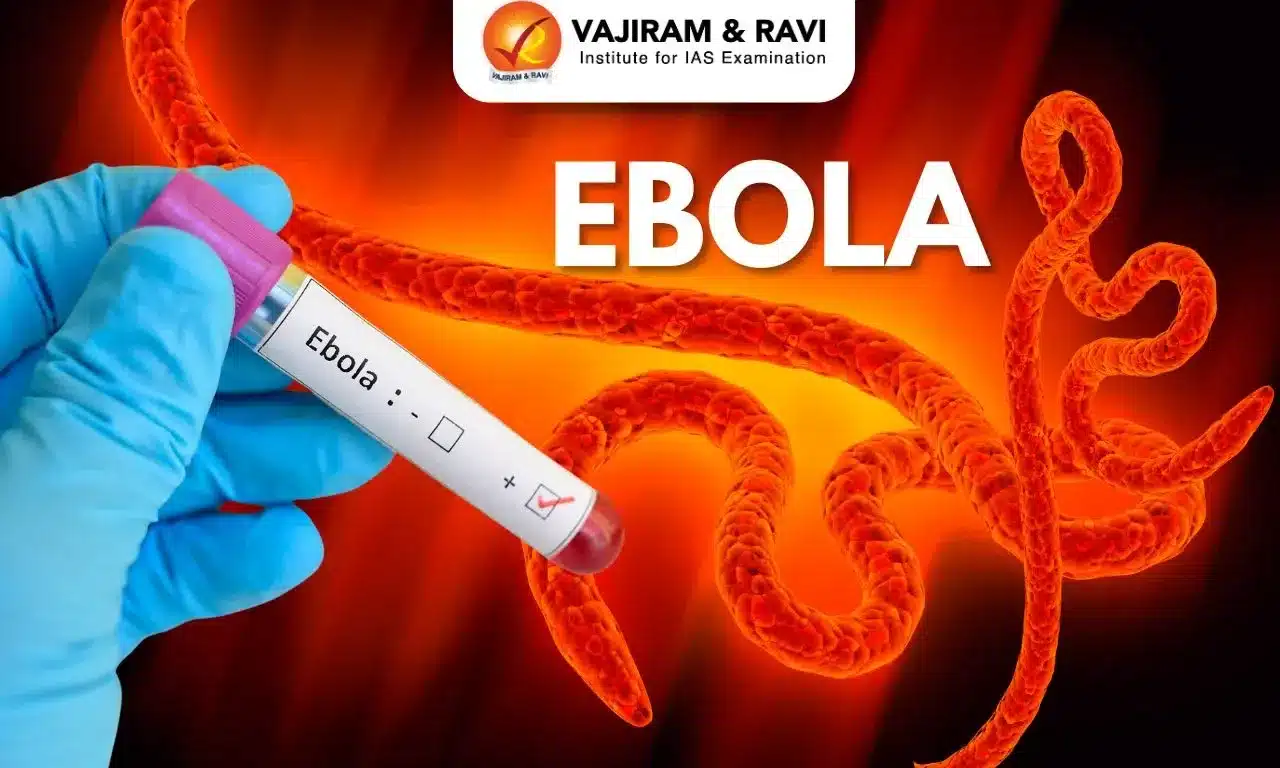
  • It is a severe and often deadly disease caused by a group of viruses known as orthoebolaviruses (formally ebolavirus).
  • Orthoebolaviruses were discovered in 1976 in the Democratic Republic of the Congo and are found primarily in sub-Saharan Africa.
  • It is known as a hemorrhagic fever virus because it can cause problems with the clotting system of the body and lead to internal bleeding as blood leaks from small blood vessels. 
  • Six different species of the virus have been found, but only four are known to cause disease in humans.
  • It gets its name from the Ebola River, which is near one of the villages in the Democratic Republic of Congo where the disease first appeared.
  • Ebola can occur in humans and other primates (gorillas, monkeys, and chimpanzees).
  • Transmission:
    • The virus is transmitted to people from wild animals (such as fruit bats, porcupines, and non-human primates) and then spreads in the human population through direct contact with the blood, secretions, organs, or other bodily fluids of infected people and with surfaces and materials (e.g., bedding, clothing) contaminated with these fluids.
    • Ebola cannot be transmitted by air. 
  • Symptoms:
    • It includes fever, diarrhea, vomiting, bleeding, and often, death.
    • The average Ebola disease case fatality rate is around 50%. Case fatality rates have varied from 25–90% in past outbreaks.
  • Treatment:
    • There is no known cure for Ebola. Experimental treatments have been used, but none have been fully tested to see if they work well and are safe.
    • For example, there are two FDA-approved monoclonal antibody treatments for the Ebola Zaire strain (Inmazeb and Ebanga).
    • Recovery seems to depend in part on how much virus a person was initially exposed to, how early treatment is started, and the patient’s age and immune response. 
    • Current therapy consists of maintenance of fluid and electrolyte balance and the administration of blood and plasma to control bleeding.

Source: LM

Ebola FAQs

Q1: What is Ebola?

Ans: It is a severe and often deadly disease caused by a group of viruses.

Q2: Ebola is caused by which group of viruses?

Ans: Ebola is caused by a group of viruses known as orthoebolaviruses (formally ebolavirus).

Q3: Can Ebola be transmitted through air?

Ans: No — Ebola cannot be transmitted through air.

Q4: What is the average case fatality rate of Ebola?

Ans: The average Ebola disease case fatality rate is around 50%.

Solar Flare

Solar Flare

Solar Flare Latest News

A huge sunspot that is more than 10 times bigger than Earth recently appeared on the surface of the sun, and scientists say it could lead to several strong solar flares in the coming weeks.

About Solar Flare

  • A solar flare is an intense burst of radiation coming from the release of magnetic energy associated with sunspots.
  • A flare appears as a sudden, intense brightening of a region on the Sun, lasting several minutes to hours.
  • Flares occur when intense magnetic fields on the Sun become too tangled. 
  • Like a rubber band that snaps when it is twisted too far, the tangled magnetic fields release energy when they snap. 
  • The energy emitted by a solar flare is more than a million times greater than the energy from a volcanic eruption on Earth.
  • Flares are our solar system’s largest explosive events. 
  • In a matter of just a few minutes, they heat the material to many millions of degrees and produce a burst of radiation across the electromagnetic spectrum, including from radio waves to x-rays and gamma rays.
  • Although solar flares can be visible in white light, they are often more readily noticed via their bright X-ray and ultraviolet emissions. 
  • The biggest flares occur in association with large sunspots that have sharp magnetic gradients and large currents, which are the source of the flare energy.
  • Solar flares burst forth from intense magnetic fields in the vicinity of active regions on the Sun and are most common during times of peak solar activity. 
  • Coronal mass ejections often accompany solar flares, though scientists are still trying to determine exactly how the two phenomena are related. 
  • Effect of Solar Flare on Earth:
    • The intense radiation emitted during a solar flare can affect satellite communications, disrupt radio signals, and even pose a risk to astronauts in space.
    • Additionally, the increased solar radiation can lead to geomagnetic storms, which may impact power grids and cause auroras (northern and southern lights) at lower latitudes.

What are Sunspots?

  • Sunspots are areas that appear dark on the surface of the Sun. 
  • They appear dark because they are cooler than other parts of the Sun’s surface. 
  • Why are sunspots relatively cool? 
    • It’s because they form in areas where magnetic fields are particularly strong.
    • These magnetic fields are so strong that they keep some of the heat within the Sun from reaching the surface.

Source: NDTV

Solar Flare FAQs

Q1: What causes a solar flare to occur?

Ans: Sudden release of energy from tangled magnetic fields.

Q2: Solar flares usually emerge from which regions on the Sun?

Ans: Active regions with strong magnetic fields.

Q3: What impact can intense solar flares have on Earth?

Ans: Disruption of satellite communication and radio signals.

Q4: What effect can solar flare activity have on power grids on Earth?

Ans: They can trigger geomagnetic storms affecting power systems.

Green Tug Transition Programme

Green Tug Transition Programme

Green Tug Transition Programme Latest News

Recently, the Union Minister for Ports, Shipping and Waterways (MoPSW) virtually flagged off the steel-cutting ceremony for Indias first all-electric green tug Deendayal Port Authority (DPA), being developed under the Green Tug Transition Programme (GTTP).

About Green Tug Transition Programme

  • It aims to transition India's harbour tug fleet from conventional diesel-powered vessels to greener alternatives.
  • It was launched by the Ministry of Ports, Shipping and Waterways in 2024.
  • Implementation:
    • Under this programme, 50 green tugs will be inducted by 2030, with 16 to be deployed in the first phase between 2024 and 2027.
    • In Phase 1, two green tugs each will be stationed at DPA, Paradip Port Authority, Jawaharlal Nehru Port Authority and V.O. Chidambaranar Port Authority.
    • One tug each will be deployed at the remaining eight major ports.
    • This is achieved through a phased approach spanning five phases from 2024 to 2040.
  • Nodal Agency: National Centre of Excellence in Green Port & Shipping (NCoEGPS) will act as the nodal entity for this programme
  • ‘Green Hybrid Tugs’ will be powered by Green Hybrid Propulsion systems. These Green hybrid tugs will subsequently adopt non-fossil fuel solutions like (Methanol, Ammonia, and Hydrogen).

Source: PIB

Green Tug Transition Programme FAQs

Q1: What is the primary objective of the Green Tug Transition Programme (GTTP)?

Ans: To reduce greenhouse gas emissions from port vessels

Q2: Which ministry launched the GTTP?

Ans: Ministry of Ports, Shipping and Waterways

Enquire Now