Asemonea Dentis and Colyttus Nongwar

Asemonea Dentis and Colyttus Nongwar

Asemonea dentis and Colyttus nongwar Latest News

Scientists of the Zoological Survey of India (ZSI) recently identified two new species of jumping spiders, Asemonea dentis and Colyttus nongwar, in the forested terrains of the Northeast.

About Asemonea dentis and Colyttus nongwar

  • These are two new species of jumping spiders discovered in Meghalaya.
  • Both species belong to the Salticidae family, the tribe of “jumping spiders” known for their sharp vision, rapid reflexes and predatory precision. 
  • Unlike traditional web-weavers, these spiders stalk their prey with stealth before springing in a split-second leap.
  • Asemonea dentis:
    • Only the third Indian species identified under the Asemonea genus, a group that remains sparsely documented in the country.
    • The species is named ‘dentis’ for a distinctive tooth-like projection on the male’s palpal femur.
    • Males carry a greenish-brown body marked by a pale-yellow V-shaped pattern on the abdomen. 
    • Females, by contrast, appear creamy white with delicate black markings.
  • Colyttus nongwar:
    • It is the second Indian member of the little-known Oriental genus Colyttus. 
    • It draws its name from Nongwar, the Khasi Hills village where it was documented.
    • Both sexes display an oval, reddish-brown carapace and a light-brown abdomen framed by a creamy band at the front and five crisp chevron-shaped patches toward the rear.

Source: TELE

Asemonea dentis and Colyttus nongwar FAQs

Q1: Asemonea dentis and Colyttus nongwar were recently discovered in which Indian state?

Ans: Meghalaya

Q2: Asemonea dentis and Colyttus nongwar belong to which family of spiders?

Ans: Both species belong to the Salticidae family, the tribe of “jumping spiders”.

Q3: Jumping spiders (Salticidae) are particularly known for which characteristic?

Ans: Excellent vision and rapid predatory leaps.

Q4: How do jumping spiders like Asemonea dentis and Colyttus nongwar typically hunt?

Ans: These spiders stalk their prey with stealth before springing in a split-second leap.

AviSpray-10c

AviSpray-10c

AviSpray-10c Latest News

AvironiX Drones, a Chennai-based deep-tech drone company, recently announced the launch of its latest agricultural innovation, the AviSpray-10c.

About AviSpray-10c

  • It is a compact, backpack-sized spraying drone 53% smaller than the current generation.
  • It was developed by the AvironiX Drones, a Chennai-based deep-tech drone company focused on precision farming and defence technologies.
  • It is designed to significantly reduce the cost, operational complexity, and manpower requirements of drone-based crop spraying in India.
  • Unlike many agricultural drones developed primarily under laboratory conditions, the AviSpray-10c has been validated through extensive real-world deployment.
  • It is built on operational insights gathered from over 6,000 acres of real-world agricultural spraying across diverse crops, including sugarcane and paddy.

AviSpray-10c Advantages

  • Backpack-sized form factor for transport on scooters and bicycles.
  • No requirement for bulky transport vehicles.
  • Elimination of permanent drone mounting boxes.
  • Single-operator deployment with no assistant required.
  • Coverage of up to 5 acres per battery charge, representing a 60% improvement over most comparable platforms.
  • Reduced battery count, lower upfront capital costs, and lower fuel consumption.
  • 2× improvement in spraying accuracy.
  • Terrain-following radar and collision-avoidance systems.
  • Multiple nozzle configurations.
  • Swappable chemical tanks.

Source: BS

AviSpray-10c FAQs

Q1: What is AviSpray-10c?

Ans: It is a compact, backpack-sized spraying drone.

Q2: AviSpray-10c was developed by which organisation?

Ans: It was developed by the AvironiX Drones, a Chennai-based deep-tech drone company.

Q3: AviSpray-10c is primarily designed for which sector?

Ans: Precision agriculture and crop spraying.

Q4: The AviSpray-10c can cover up to how many acres per battery charge?

Ans: 5 acres

Solar Storm

Solar Storm

Solar Storm Latest News

India's first solar observatory Aditya-L1 played a key role in helping scientists decode why the strongest solar storm in more than two decades that struck Earth in May 2024 behaved so unusually, ISRO said recently.

About Solar Storm

  • A solar storm is a sudden explosion of particles, energy, magnetic fields, and material blasted into the solar system by the Sun.
  • What Causes a Solar Storm?
    • The Sun creates a tangled mess of magnetic fields.
    • These magnetic fields get twisted up as the Sun rotates — with its equator rotating faster than its poles. 
    • Solar storms typically begin when these twisted magnetic fields on the Sun get contorted and stretched so much that they snap and reconnect (in a process called magnetic reconnection), releasing large amounts of energy. 
  • These powerful eruptions can generate any or all of the following:
    • a bright flash of light called a solar flare.
    • a radiation storm, or flurry of solar particles propelled into space at high speeds.
    • an enormous cloud of solar material, called a coronal mass ejection, that billows away from the Sun.
  • How Does a Solar Storm Affect Us?
    • When directed toward Earth, a solar storm can create a major disturbance in Earth’s magnetic field, called a geomagnetic storm, that can produce effects such as radio blackouts, power outages, and beautiful auroras
    • They do not cause direct harm to anyone on Earth, however, as our planet’s magnetic field and atmosphere protect us from the worst of these storms.

What are Solar Flares?

  • A solar flare is an intense burst of radiation, or light, on the Sun. 
  • These flashes span the electromagnetic spectrum — including X-rays, gamma rays, radio waves, and ultraviolet and visible light.
  • Solar flares are the most powerful explosions in the solar system — the biggest ones can have as much energy as a billion hydrogen bombs.

What are Radiation Storms?

  • Solar eruptions can accelerate charged particles — electrons and protons — into space at incredibly high speeds, initiating a radiation storm.
  • The fastest particles travel so quickly they can zip across roughly 93 million miles from the Sun to Earth in about 30 minutes or less. 

What are Coronal Mass Ejections (CMEs)?

  • A CME is an enormous cloud of electrically charged gas, called plasma, that erupts from the Sun. 
  • A single CME can blast billions of tons of material into the solar system all at once.
  • CMEs occur in the outer atmosphere of the Sun, called the corona, and often look like giant bubbles bursting from the Sun.

Key Facts about Aditya-L1

  • It is the first space-based observatory-class Indian solar mission to study the Sun. 
  • It was launched on September 2, 2023, by the Indian Space Research Organisation (ISRO).
  • The spacecraft is placed in a halo orbit around the Lagrangian point 1 (L1) of the Sun-Earth system, which is about 1.5 million km from the Earth. 
  • A satellite placed in the halo orbit around the L1 point has the major advantage of continuously viewing the Sun without any occultation/eclipse. 
  • This provides a greater advantage of observing the solar activities continuously.
  • The spacecraft is carrying seven payloads to observe the photosphere, chromosphere, and outermost layers of the Sun using electromagnetic and particle detectors.

Source: NDTV

Solar Storm FAQs

Q1: What is a solar storm?

Ans: A sudden explosion of particles, energy, and magnetic fields from the Sun.

Q2: What causes a solar storm?

Ans: The snapping and reconnection of twisted magnetic fields on the Sun.

Q3: What is a solar flare?

Ans: A bright flash of light caused by a sudden release of energy on the Sun.

Q4: What is a coronal mass ejection (CME)?

Ans: A massive cloud of solar material blasted into space from the Sun.

Q5: Can solar storms directly harm people on Earth?

Ans: No, Earth’s magnetic field and atmosphere protect us from direct harm.

Sultanpur National Park

Sultanpur National Park

Sultanpur National Park Latest News

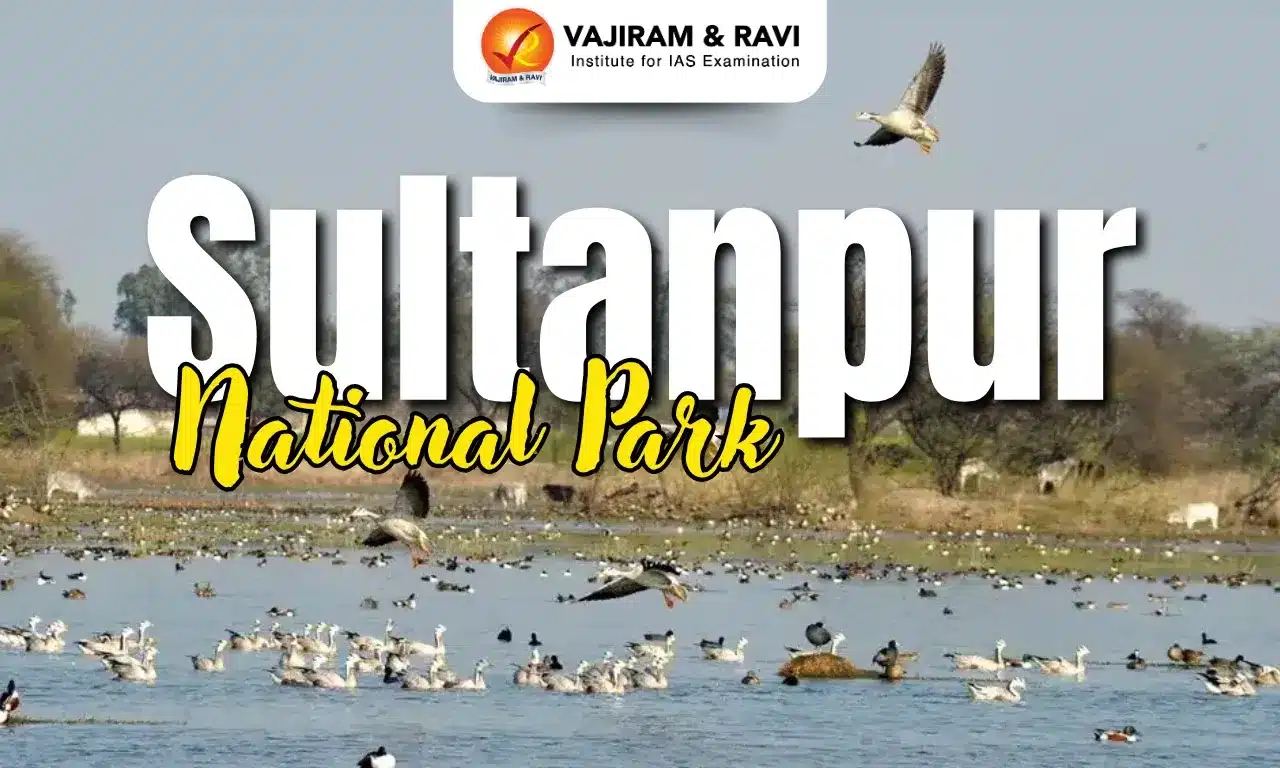
Sultanpur National Park is once again echoing with the sounds of migratory birds, with their numbers rising significantly as temperatures drop. 

About Sultanpur National Park

  • Sultanpur National Park, formerly known as Sultanpur Bird Sanctuary, is located in the Gurgaon district in Haryana, 46 km from Delhi.
  • Spanning 1.42 sq.km., it consists primarily of marshy lakes and floodplains.
  • It includes a core area of 1.21 sq. km containing the main Sultanpur Lake/Jheel.
    • The Sultanpur Jheel is a seasonal freshwater wetland with fluctuating water levels throughout the year.
    • This shallow lake is mostly fed by waters from River Yamuna’s Gurgaon canal and the overflowing waters of the neighboring agricultural lands. 
    • It gained national attention in the late 1960s due to the conservation efforts of ornithologists Peter Michel Jackson and Dr. Salim Ali, who frequently visited the site for birding.
  • It was recognised as a Ramsar site in 2021. 
  • It has been identified as an Important Bird Area by BirdLife International.
  • Flora: The vegetation of this park is tropical and dry deciduous, and the flora includes grasses, dhok, khair, tendu, ber, jamun, banyan tree, neem, berberis, Acacia nilotica, and Acacia tortilis.
  • Fauna:
    • Over 320 bird species have been recorded at Sultanpur, making it a vital wintering ground.
    • It forms a part of the ‘Central Asian Migratory Flyway’ and thousands of migratory birds from the countries of Russia, Turkey, Afghanistan, and Europe visit the park during the winter months. 
      • Winter Migrants: Greater Flamingos, Northern Pintails, Eurasian Wigeons, Common Teals, and Bar-headed Geese.
      • Resident Birds: Indian Peafowl, Red-wattled Lapwings, Cattle Egrets, and White-throated Kingfishers.
      • Rare/Threatened Species: Sarus Crane, Black-necked Stork, and Indian Courser have been recorded here.
    • Other faunal species, such as Nilgai, Sambar, Golden jackals, wild dog, striped hyenas, Indian porcupine, mongoose, etc., are also found here.

Source: DG

Sultanpur National Park FAQs

Q1: Sultanpur National Park is located in which state?

Ans: Haryana

Q2: The core area of the park includes which major feature?

Ans: Sultanpur Lake/Jheel

Q3: Sultanpur Jheel is mainly fed by water from which source?

Ans: River Yamuna’s Gurgaon canal.

Q4: Which vegetation type best describes Sultanpur National Park?

Ans: Tropical and dry deciduous

Q5: Sultanpur National Park was recognised as a Ramsar site in which year?

Ans: 2021

Blue Corner Notice

Blue Corner Notice

Blue Corner Notice Latest News

Recently, Interpol has issued a Blue Corner Notice for the missing owners of the Goa’s nightclub, where a devastating fire took place.

About Blue Corner Notice

  • The Blue Corner Notice is an international alert issued under Interpol’s colour-coded system, which allows member countries to share information and requests for information across borders.
  • It is also known as an “enquiry notice” allows police forces in member states to share critical crime-related information such as obtaining a person’s criminal record, and location and having his or her identity verified among others.
  • Blue corner notices are issued prior to the filing of criminal charges.
  • Other types of notices of INTERPOL include:
    • Red Notice: To locate and arrest individuals wanted for prosecution or to serve a sentence
    • Yellow Notice: It is issued to trace missing persons—especially children—or identify individuals unable to confirm their identity.
    • Black Notice: To gather information about unidentified bodies.
    • Green Notice: Alerts member countries about someone with a history of criminal behaviour who may pose a threat.
    • Orange Notice: Warns about a person, object, or event that could pose an immediate risk to public safety.
    • Purple Notice: Shares details on criminal methods, tools, or concealment techniques.
    • Silver Notice (pilot): Helps identify and trace assets linked to criminal activities.

What is INTERPOL?

  • The International Criminal Police Organization (INTERPOL), is commonly known as Interpol, is an international organization facilitating international police cooperation against cross-border terrorism, trafficking, and other crime
  • Members: 196 member countries. India joined Interpol in 1949.
  • It is ‘NOT’ a unit or part of a united nation system. It is an independent international organization.
  • It has enjoyed a special role – that of Permanent Observer at the United Nations – since 1996.
  • Headquarter:  Lyon, France.

Source: ET

Blue Corner Notice FAQs

Q1: What is a Blue Corner Notice?

Ans: A notice issued by Interpol to locate and identify a suspect in a crime

Q2: Which organization issues a Blue Corner Notice?

Ans: Interpol

Google’s Quantum Echoes Explained: What It Really Means for Q-Day

Google’s Quantum Echoes

Google’s Quantum Echoes Latest News

  • Google’s new Quantum Echoes experiment used a 65-qubit quantum processor to study how information moves around inside a quantum system. 
  • Unlike Google’s 2019 Sycamore experiment, which focused on speed, this work was about understanding how quantum bits behave.
  • Scientists measured out-of-time-order correlators (OTOC) — tiny echoes that reveal how disturbances travel through a network of qubits.
    • Basically, scientists gave the system a tiny “poke,” reversed its evolution, and looked for a small “echo” that came back. 
    • This echo helped them see how quickly information spreads or gets scrambled among qubits. 
  • These insights can help in studying new materials, superconductors, and chemical reactions.
  • Even though the research is scientifically important, it does not bring us closer to Q-day — the point when quantum computers could break modern encryption. It poses no threat to security systems today.

Q-Day

  • Q-day is the future moment when a powerful quantum computer can break today’s commonly used encryption systems.
  • This doesn’t mean data will be exposed instantly — but anything stolen and stored today could be decoded later once such a machine exists.
    • This threat is called “harvest now, decrypt later.”

How Are Governments Preparing

  • Countries are already working on protections.
  • The U.S. National Institute of Standards and Technology (NIST) has approved new post-quantum cryptography (PQC) methods designed to stay secure even against quantum computers:
    • CRYSTALS-Kyber → for encryption
    • Dilithium → for digital signatures
  • These rely on tough mathematical problems that quantum computers are not expected to crack.
  • Experts believe breaking RSA-2048 — a widely used encryption standard — will require millions of stable (logical) qubits.
    • RSA encryption works by multiplying two huge prime numbers.
    • Multiplying them is easy. But figuring out the original primes from the final product is extremely hard — so hard that even supercomputers would need billions of years.
  • At current progress, this may take 5 to 8 years, so Q-day is still a future risk, not an immediate one.

How Quantum Computers Work

  • Quantum computers use special units called qubits. Unlike normal bits (0 or 1), qubits can be 0 and 1 at the same time (superposition).
  • They can also be entangled, meaning a change in one instantly affects another, even far away.
  • Because of this, quantum computers can test many possibilities at once, making them powerful for certain tasks.

Why Quantum Computers Threaten RSA Encryption

  • RSA encryption is built on the difficulty of breaking a number into its prime factors — something classical computers take billions of years to do.
  • But quantum computers can use Shor’s algorithm, which turns the factoring challenge into a search for hidden repeating patterns.
  • The algorithm uses a special mathematical tool called the Quantum Fourier Transform (QFT) to detect these patterns.
  • If a quantum computer can run this algorithm on a large scale, it could break RSA encryption exponentially faster than classical computers.

The Problem: Today’s Quantum Computers Are Too Small

  • Breaking a strong key like RSA-2048 requires enormous quantum machines.
  • A 2019 study by Google researchers estimated that breaking RSA-2048 needs:
    • About 20 million physical qubits
    • 8 hours of computation
    • Perfect error correction
  • But today’s biggest quantum machines (Google’s Willow, IBM’s Condor) only have a few hundred noisy qubits.

Why We Need Millions of ‘Logical Qubits’

  • Physical qubits make many errors.
  • To perform long, accurate calculations, we need logical qubits — stable units created by combining many physical qubits through error correction.
  • A future, powerful quantum computer would need millions of these logical qubits.
  • Right now, we aren’t even close to that technology.

Shor’s Algorithm vs. Quantum Echoes: Why They Are Not the Same

  • Shor’s algorithm is a mathematical tool that could one day break modern encryption by rapidly factoring large numbers — something classical computers struggle to do. Its goal is computational power.
  • Quantum Echoes, on the other hand, is a physics experiment. It studies how quantum information spreads and comes back like an “echo” inside entangled particles. Its purpose is scientific understanding, not breaking codes.

How Far Are We From Q-Day

  • Google’s Quantum Echoes experiment does not make that day arrive sooner.
  • Instead, it marks progress in understanding how quantum systems behave, not in breaking codes.
  • The experiment shows that quantum processors are getting better at studying complex interactions inside entangled particles. This is a scientific milestone, not a cybersecurity threat.
  • While quantum machines are slowly advancing, their biggest potential right now is in understanding nature, chemistry, and materials — not cracking RSA.
  • The real challenge is making sure our digital systems become quantum-safe before quantum computers eventually reach that power. 
  • The technology is evolving, but so must our defences.


Source: TH

Google’s Quantum Echoes FAQs

Q1: What is Google’s Quantum Echoes experiment?

Ans: Quantum Echoes is an experiment using a 65-qubit processor to study how quantum information spreads and refocuses—showing scientific progress in physics, not a step toward breaking encryption.

Q2: Does Quantum Echoes bring Q-Day closer?

Ans: No. The experiment improves understanding of quantum behaviour but does not advance quantum computers toward the scale required to break modern encryption systems.

Q3: What does Q-Day mean in cybersecurity?

Ans: Q-Day refers to the future moment when a powerful quantum computer could break today’s encryption. It is a long-term concern, not an immediate threat.

Q4: How many qubits are needed to break RSA-2048?

Ans: Experts estimate millions of error-corrected logical qubits are required—far beyond today’s few-hundred-qubit machines like Google’s Willow or IBM’s Condor.

Q5: How are governments preparing for Q-Day?

Ans: Countries are adopting post-quantum cryptography. NIST has standardised PQC algorithms like Kyber and Dilithium to secure communications against future quantum attacks.

African Penguin

African Penguin

African Penguin Latest News

Recently, a new study found that over 60,000 African penguins starved to death between 2004 and 2011 after sardine stocks collapsed.

About African Penguin

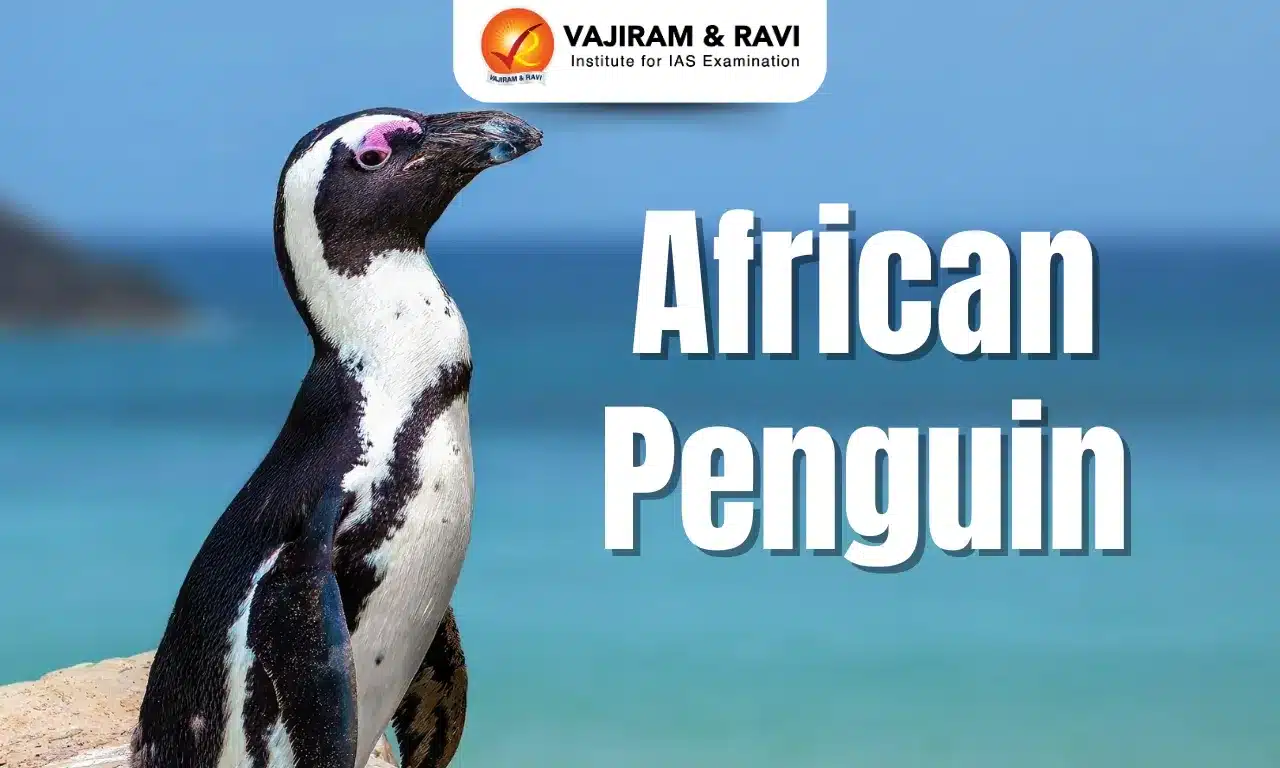
  • The African penguin (Spheniscus demersus) is a species of penguin that lives in southern African waters.
  • It is flightless and adapted for a marine habitat. 
  • Breeding: The species breeds naturally in burrows dug into guano (a natural substance composed of the excrement of birds, bats, and seals), which protects them from the extreme heat of their environment. 
  • Appearance: It has a black stripe and a pattern of unique black spots on its chest, as well as pink glands above its eyes that become pinker as the penguin gets hotter.
  • Penguins can lose almost half their body mass during their annual 21-day moult.
    • During this period, the birds come ashore, shed their feathers and cannot enter the water to feed.
  • Habitat: It is usually found within 40 kilometers of the shore, coming onshore to a variety of coastal habitats to breed, molt, and rest.
  • Distribution: It is mainly found along the coast of Namibia and the Atlantic coast of South Africa.
  • Lifespan: Its average lifespan in the wild is 20 years.
  • Threats: Global-warming-induced shifts in the marine and atmospheric environment are destructive to the African penguin’s habitat.
  • Conservation Status:  IUCN: Critically Endangered

Source: DTE

African Penguin FAQs

Q1: What is the scientific name of the African Penguin?

Ans: Spheniscus demersus

Q2: Where is the African Penguin primarily found?

Ans: Coasts of South Africa and Namibia

Buxa Tiger Reserve

Buxa Tiger Reserve

Buxa Tiger Reserve Latest News

Recently, a mega 4 month wildlife survey has begun across the Buxa Tiger Reserve.

About Buxa Tiger Reserve

  • Location: It is located in the Jalpaiguri district of West Bengal.
  • Its northern boundary runs along the international border with Bhutan.
  • The fragile “Terai Eco-System” constitutes a part of this reserve.
  • It serves as an international corridor for elephant migration between India and Bhutan.
  • The reserve has corridor connectivity across the border with the forests of Bhutan in the North, on the East it has linkages with the Kochugaon forests, Manas Tiger Reserve and on the West with the Jaldapara National Park.
  • Rivers: Two rivers, namely the River Raidak and the River Jayanti, flow through the forest of Buxa. 
  • Vegetation: The forests of the reserve can be broadly classified as the ‘Moist Tropical Forest’.
  • Flora: Some of the important species are Sal, Champa, Gamar, Simul, and Chikrasi.
  • Fauna: The main species include the Tiger, elephant, leopard cat, gaur, wild boar, sambar, hog deer, Chinese pangolin, etc.

Source: MP

Buxa Tiger Reserve FAQs

Q1: Where is the Buxa Tiger Reserve located?

Ans: West Bengal

Q2: What is the main vegetation type in the Buxa Tiger Reserve?

Ans: Tropical moist deciduous forest

India–US Rice Trade: Why Trump’s ‘Dumping’ Claim Doesn’t Add Up

India–US Rice Trade

India–US Rice Trade Latest News

  • US President Donald Trump recently alleged that India is “dumping” rice in the US and hurting American farmers, vowing to fix the issue with tariffs. However, trade data contradicts this claim. 
  • The US is not a major rice producer and actually exports more rice than it imports. In 2024–25, US production was only 7.05 million tonnes—far below India’s 150 million tonnes—yet the US still exported 3 million tonnes while importing 1.6 million tonnes.
  • In value terms, the US imported $1.5 billion worth of rice in 2024, mainly from Thailand, while imports from India were much smaller. 
  • The data shows India’s rice exports to the US are limited, and the US is far from being flooded with Indian rice.

India’s Dominance in Global Rice Exports

  • India remained the world’s leading rice exporter in 2024–25, shipping 198.65 lakh tonnes (19.86 million tonnes) of rice across multiple categories — basmati, parboiled, non-basmati white, broken and other varieties.
  • In value terms, exports exceeded $12.95 billion, reinforcing India’s position as the top global supplier, controlling around 40% of international rice trade.
  • Strong monsoons, competitive pricing and the removal of export restrictions on non-basmati rice boosted the sector.
  • India produced 150 million tonnes of rice in 2024–25, accounting for 28% of global output, with yields increasing from 2.72 t/ha (2014–15) to 3.2 t/ha (2024–25) due to better seeds, agronomy and irrigation.
  • India currently supplies rice to over 172 countries, and aims to expand exports to 26 additional markets, including the Philippines, Indonesia, the UK, and Mexico, according to APEDA.

U.S. Threatens Tariffs on Indian Rice

  • Days before U.S. negotiators arrive in New Delhi, President Donald Trump suggested new tariffs on Indian rice, claiming India was “dumping” rice in the U.S.
  • However, experts say the move appears aimed at pleasing U.S. farmers rather than reflecting genuine trade concerns.

US Rice Imports: Mostly Premium, Not Low-Value Dumping

  • The US does not import cheap, low-value rice from India or Thailand. Instead, it buys premium aromatic varieties such as Thai Hom Mali, Jasmine, and Indian basmati—priced much higher than US-exported rice. 
  • These imported varieties cost between $690 and $1,125 per tonne, compared to $560–$675 per tonne for typical US export rice.
  • Since the US exports more rice than it imports, and its imports consist mainly of high-value specialty rice, claims of India “dumping” cheap rice in the American market do not hold.

Impact of Potential New Tariffs on India’s Rice Exports

  • India is the world’s biggest rice exporter, shipping 22.5–25 million tonnes annually. In comparison, the US is a very small buyer of Indian rice.

US Share in Indian Exports Is Tiny

  • Basmati exports (2024–25):
    • Total: 60.65 lakh tonnes
    • To the US: 2.74 lakh tonnes (≈ 4.5%)
  • Non-basmati exports:
    • Total: 141.30 lakh tonnes
    • To the US: 0.61 lakh tonnes (≈ 0.4%)
  • This trend continues in the current fiscal year as well: the US takes only 1–2% of India’s rice shipments.

Bigger Markets Lie Elsewhere

  • Basmati: West Asia dominates — Saudi Arabia, Iran, Iraq, UAE.
    • In the US, basmati sales are controlled by a few Indian companies like LT Foods, whose "Royal" brand holds 55% of the North American market.
  • Non-basmati: Africa is the main buyer — Benin, Togo, Côte d’Ivoire, Liberia, Senegal, etc.
    • The US is almost irrelevant for this category.

Tariff Impact: Minimal to Negligible

  • Even if Donald Trump imposes new tariffs, the effect on India will be small because:
    • The US is not a major rice market for India.
    • Indian exporters are not dependent on the US for volumes or revenue.
    • Other export items (shrimps, jewellery, garments) would feel tariffs much more than rice.
  • Experts believe that the proposed tariff would backfire on the US as:
    • Tariffs would barely affect India, which has strong global markets. But they would raise rice prices for U.S. households, hurting consumers.
    • The threat looks like election-season messaging to American farmers, not a policy shift.

Source: IE | TH | ET

India–US Rice Trade FAQs

Q1: Is India really ‘dumping’ rice in the US?

Ans: No. India sends mainly premium basmati rice to the US, not cheap varieties. Imports are small and do not harm US producers, so “dumping” is inaccurate.

Q2: How important is the US market for India’s rice exports?

Ans: Not very. The US accounts for only about 3% of India’s total rice exports. India exports rice to more than 170 countries, making its markets highly diversified.

Q3: Does India export cheap rice to the US?

Ans: No. The US imports high-value aromatic rice like basmati from India and jasmine from Thailand. These are premium products, not low-priced dumped varieties.

Q4: Would US tariffs hurt India’s rice exporters?

Ans: Only marginally. Since the US is a small buyer and India has strong demand elsewhere, new tariffs would not significantly affect India’s overall rice export earnings.

Q5: Why would new US tariffs impact American consumers more?

Ans: Because the US relies on imports for specialty rice, tariffs would raise retail prices for American households, making rice costlier without reducing India’s export momentum.

One Nation One Licence – India’s Proposed Framework to Balance AI Innovation and Copyright

One Nation One Licence

One Nation One Licence Latest News

  • With the rapid rise of Artificial Intelligence (AI) and Large Language Models (LLMs) like ChatGPT, concerns have intensified over the use of copyrighted content for AI training without consent or remuneration. 
  • Globally, this has triggered litigation, policy debates, and regulatory uncertainty due to intersection of technology, IPR, innovation, and regulation; the role of the State in rate regulation and compulsory licensing.
  • In this backdrop, a Department for Promotion of Industry and Internal Trade (DPIIT)-led committee has released a working paper proposing a statutory licensing framework to balance AI innovation with copyright protection in India.

Key Proposal - ‘One Nation, One Licence, One Payment’

  • Mandatory blanket licence for AI training:
    • All AI developers must pay royalties for using copyrighted works in AI training.
    • No opt-out mechanism for freely available online content.
    • Model inspired by compulsory licensing in radio broadcasting under Indian copyright law.
  • Rejection of voluntary licensing:
    • The committee rejects bilateral licensing deals (e.g., OpenAI–Associated Press).
    • Reasons are high transaction costs, unequal bargaining power, and marginalisation of small creators and startups.
    • Voluntary licensing is seen as favouring big tech and big publishers only.

Institutional Mechanism - CRCAT

  • A new umbrella non-profit body (Copyright Royalties Collective for AI Training [CRCAT]) to be established under the Copyright Act, 1957.
  • Functions of the body include collecting royalties from AI companies, distributing proceeds among copyright holders, etc.
  • Membership: Only organisations (not individuals), one member per class of work.
  • Coverage can expand gradually to unorganised sectors.

Royalty Determination Framework

  • Government-appointed rate-setting committee:
    • Composition: Senior government officers, legal experts, economic and financial experts, AI and emerging technology experts, AI developers’ and CRCAT representatives.
    • Powers: Fix fair, transparent, predictable rates; review rates every three years; decisions subject to judicial review.
  • Likely pricing model:
    • Flat rate preferred initially.
    • Royalty as a percentage of gross global revenue earned from commercialised AI systems (excluding taxes).

Retroactive Application of Royalties

  • Royalties to apply retrospectively: AI developers already using copyrighted works and earning revenue must pay past dues.
  • Justification:
    • Ensures fairness and accountability.
    • Not punitive, but corrective to restore balance in the creative ecosystem.

Transparency and Burden of Proof

  • Data disclosure by AI developers:
    • Mandatory submission of a ‘Sufficiently Detailed Summary’ of datasets used.
    • Includes:
      • Type of data (text, image, music, audiovisual)
      • Source (social media, publications, libraries, public datasets, proprietary data)
      • Nature of data usage
  • Distribution of royalties: CRCAT to distribute funds proportionally based on extent of usage, heavily used categories (news, music, audiovisual) receive higher shares.
  • Legal presumption: In litigation, content owners claim it is presumed valid. Burden shifts to AI developers to disprove misuse or non-payment.

Stakeholder Responses

  • Supporters (Committee view):
    • Ensures non-discriminatory access to training data
    • Prevents concentration of royalties among a few big players
    • Creates a predictable legal environment for AI development
  • Opponents:
    • NASSCOM:
      • Calls forced royalties a “tax on innovation”
      • Supports opt-out mechanisms for content creators
  • Creative industry concerns:
    • Government-fixed rates are globally unprecedented
    • Fear undervaluation of premium content

Challenges in the Proposed Framework and Way Forward

  • Risk of over-regulation stifling AI innovation: Ensure robust stakeholder consultation.
  • Administrative complexity in royalty distribution: Fine-tune royalty rates to avoid discouraging AI startups.
  • Resistance: From both AI firms (cost burden) and content creators (flat-rate concerns). Strong judicial oversight to prevent arbitrariness.
  • India becoming a global outlier in AI copyright regulation: Harmonisation with global AI governance norms.

Conclusion

  • India’s proposed mandatory blanket licensing regime for AI training represents a bold and interventionist approach to reconciling innovation with copyright protection. 
  • By institutionalising royalty payments through a statutory mechanism, the Centre aims to ensure equitable compensation for creators while maintaining open access to training data for AI developers.
  • The success of this model will ultimately depend on rate rationality, transparency, and adaptive governance, making it a critical test case for AI regulation in the Global South.

Source: TH | IE

One Nation One Licence FAQs

Q1: What is the rationale behind India’s proposed “One Nation, One Licence, One Payment” framework for AI training?

Ans: It seeks to balance AI innovation and copyright protection by mandating a statutory blanket licence ensuring equitable compensation to all copyright holders.

Q2: Why has the DPIIT-led committee rejected voluntary licensing agreements between AI developers and content creators?

Ans: Due to high transaction costs, unequal bargaining power, and its tendency to favour large AI firms and major publishers.

Q3: What is the role of the Copyright Royalties Collective for AI Training (CRCAT) in the proposed framework?

Ans: CRCAT will function as a centralised, government-designated body to collect, manage, and proportionally distribute AI training royalties.

Q4: What is the significance of applying royalties retrospectively to AI systems?

Ans: Retroactive royalties aim to ensure fairness and accountability by requiring commercially successful AI developers to compensate creators for past use of copyrighted works.

Q5: How does the proposed Indian model of AI copyright regulation differ from global practices?

Ans: Unlike global voluntary or negotiated models, India proposes government-fixed statutory royalty rates, which may ensure equity but risk over-regulation.


India’s Transport Crisis Reveal Structural Gaps – Explained

Transport Crisis

Transport Crisis Latest News

  • India recently witnessed two major transport disruptions: severe overcrowding on Bihar-bound trains during October-November, and mass cancellation of Indigo flights in December. 
  • The events raise critical questions on pricing policies, regulatory oversight, monopolies, and the role of the state in ensuring accessible and efficient transport services. 

Demand Pressures and the Strain on Public Transport

  • During Chhath Puja and the Bihar elections, lakhs of migrants attempted to return home, producing a sharp, sudden demand shock for long-distance trains. 
  • With prices kept low for welfare purposes and limited train availability, passengers faced extreme overcrowding, unsafe travel conditions, and inhospitable unreserved compartments. 
  • Economic theory suggests that rising demand should push up prices to equilibrate the market. 
  • However, in essential public services like railways, artificially low prices are a welfare mandate. 
  • The resulting excess demand exposes the underinvestment in public transport infrastructure, rather than a pricing failure.
  • Why Raising Prices Is Not the Solution
    • Critics often argue that low fares create inefficiency. However, the core issue is inadequate supply, not affordability. 
    • For essential sectors, health, education, and public transport, low pricing is integral to welfare. What is missing is state-led expansion in capacity.

Constraints of a Neo-Liberal Fiscal Framework

  • Fiscal Limits on Public Investment
    • India’s fiscal rules constrain government spending, preventing large-scale expansion of railway capacity. 
    • Strict deficit targets limit the ability to build additional trains, add new routes, or expand infrastructure. 
  • Impact on Public Welfare
    • Thus, the state is forced into a paradox:
    • Keeping prices low to maintain welfare,
    • But it lacks the fiscal bandwidth to expand services.
  • This leads to systemic overcrowding, service degradation, and periodic crises.

Private Sector Vulnerabilities: The Indigo Flight Crisis

  • In December, Indigo, India's dominant private airline, cancelled a large number of flights due to regulatory issues, creating a supply shock. This triggered:
    • Stranded passengers
    • Sharp spike in airfares across airlines
    • Market-wide disruption, despite the issue originating in one firm
  • This is because Indigo holds a near-monopoly in several sectors of the Indian aviation market. 
  • In a competitive market, one airline’s supply cut would not cause such widespread chaos. The episode underscores the need for regulatory oversight to prevent monopolistic dominance.

Common Structural Thread Between the Crises

  • At first glance, the train overcrowding and airline cancellations seem unrelated, one arising from public sector limitations, the other from private sector dominance. But both crises stem from a single underlying framework:
  • Underinvestment in essential public services
    • Public transport is priced low for welfare reasons, but cannot expand sufficiently under strict fiscal rules.
  • Overreliance on deregulated private markets
    • Private airlines operate with concentrated market power, enabling fare spikes and system-wide disruption when one firm fails.
  • Together, these factors reflect the constraints of a neo-liberal policy model, where the state is discouraged from expanding welfare services and private monopolies grow unchecked. 
  • The result is recurring transport crises affecting millions.

Way Forward

  • The lessons from recent events point to three clear policy needs:
    • Expand public investment in railways and essential transport infrastructure.
    • Strengthen regulatory oversight of private operators, especially monopolistic entities.
    • Reassess fiscal rules to allow higher spending in welfare-critical sectors.
  • Transport is not just an economic service; it is a public good
  • Ensuring reliability, affordability, and resilience requires a balanced model where both state capacity and market behaviour are aligned with public welfare.

Source: TH

Transport Crisis FAQs

Q1: What caused overcrowding in Bihar-bound trains?

Ans: A sudden festive and election-driven surge in passengers overwhelmed limited railway capacity.

Q2: Why didn’t railways raise fares to reduce demand?

Ans: Rail fares are kept low as a welfare measure, making capacity expansion, not price increases, the solution.

Q3: What led to mass Indigo flight cancellations?

Ans: Regulatory non-compliance by Indigo triggered a supply shock and widespread cancellations.

Q4: Why did airfares rise sharply after the cancellations?

Ans: Indigo’s dominant market position allowed fare inflation across the aviation sector.

Q5: What common issue links both crises?

Ans: Both reveal structural weaknesses, underinvestment in public transport and inadequate regulation of private monopolies.

International Organization of Aids to Marine Navigation

International Organization of Aids to Marine Navigation

International Organization for Marine Aids to Navigation Latest News

Recently, the Union Minister for Ports, Shipping and Waterways virtually inaugurated the 3rd Session of the Council of the International Organization for Marine Aids to Navigation (IALA) held in Mumbai.

About International Organization for Marine Aids to Navigation

  • It was established in 1957 as a Non-Governmental Organisation (NGO).
  • It officially changed its status from a Non-governmental Organization (NGO) to an Intergovernmental Organization (IGO) based on a Convention ratified by 34 States in 2024.
  • Its mandate is to harmonise global maritime navigation systems, promote maritime safety initiatives, and collaborate with member states, international organizations, and industry stakeholders to address emerging challenges in maritime safety and environmental protection.
  • Motto: Successful Voyages, Sustainable Planet.
  • Governance: The IALA Council is the key decision-making body of the intergovernmental organization responsible for marine aids to navigation.
  • It aims to
    • Foster safe, economic and efficient movement of vessels by improving and harmonizing aids to navigation worldwide and by other appropriate means.
    • Encourage, support and communicate recent developments; develop international cooperation by promoting close working relationships and assistance among members;
    • Enhance mutual exchange of information with organizations representing users of aids to navigation.
  • Members:  It comprises 200 members, 80 of which are national authorities and 60 are commercial firms. (India has been a member of this organization since 1957).
  • Headquarters: Saint-Germain-en-Laye, France.

Source: PIB

International Organization for Marine Aids to Navigation FAQs

Q1: What is the primary objective of International Organization for Marine Aids to Navigation?

Ans: To promote maritime safety and efficiency

Q2: Where is the headquarters of IALA located?

Ans: Saint Germain en Laye, France

Large Language Models (LLMs)

Large Language Models (LLMs)

Large Language Models (LLMs) Latest News

A government working paper released recently suggested that AI large language models (LLMs) like ChatGPT should, by default, have access to content freely available online, and that publishers should not have an opt-out mechanism for such content.

About Large Language Models (LLMs)

  • An LLM is a type of artificial intelligence (AI) program that can recognize and generate text, among other tasks.
  • LLMs are trained on huge sets of data—hence the name “large.”
  • LLMs are built on machine learning: specifically, a type of neural network called a transformer model, which excels at handling sequences of words and capturing patterns in text.
  • In simpler terms, an LLM is a computer program that has been fed enough examples to be able to recognize and interpret human language or other types of complex data. 
  • Many LLMs are trained on data that has been gathered from the Internet—thousands or millions of gigabytes’ worth of text.
  • But the quality of the samples impacts how well LLMs will learn natural language, so LLM's programmers may use a more curated data set.
  • LLMs use a type of machine learning called deep learning in order to understand how characters, words, and sentences function together.
    • Deep learning involves the probabilistic analysis of unstructured data, which eventually enables the deep learning model to recognize distinctions between pieces of content without human intervention.
  • LLMs are then further trained via tuning: they are fine-tuned or prompt-tuned to the particular task that the programmer wants them to do.
  • What are LLMs Used For?
    • LLMs can perform various language tasks, such as answering questions, summarizing text, translating between languages, and writing content.
    • Businesses use LLM-based applications to help improve employee productivity and efficiency, provide personalized recommendations to customers, and accelerate ideation, innovation, and product development.
    • LLMs serve as the foundational powerhouses behind some of today’s most used text-focused generative AI (GenAI) tools, such as ChatGPT, Claude, Microsoft Copilot, Gemini, and Meta AI.
  • Since LLMs are now becoming multimodal (working with media types beyond text), they are now also called “foundation models”. 
  • Though they are groundbreaking, LLMs face challenges that may include computational requirements, ethical concerns, and limitations in understanding context.

Quick Definitions

  • Machine learning: A subset of AI where data is fed into a program so it can identify features in that data.
  • Deep learning: Trains itself to recognize patterns without human intervention.
  • Neural networks: Constructed of connected network nodes composed of several layers that pass information between each other.
  • Transformer models: Learn context using a technique called self-attention to detect how elements in a sequence are related.

Source: TH

Large Language Models (LLMs) FAQs

Q1: What is a Large Language Model (LLM)?

Ans: It is a type of artificial intelligence (AI) program that can recognize and generate text, among other tasks.

Q2: Large Language Models (LLMs) are primarily built using which type of neural network?

Ans: Transformer models, which excels at handling sequences of words and capturing patterns in text.

Q3: What kind of data do Large Language Models (LLMs) primarily analyze during training?

Ans: Large amounts of unstructured text.

Q4: Which challenge is associated with the massive scale of Large Language Models (LLMs)?

Ans: High computational and energy requirements.

Key Facts about Brunei

Key Facts about Brunei

Brunei Latest News

Recently, the inaugural meeting of the India-Brunei Joint Working Group (JWG) on Defence Cooperation was held in New Delhi. 

About Brunei

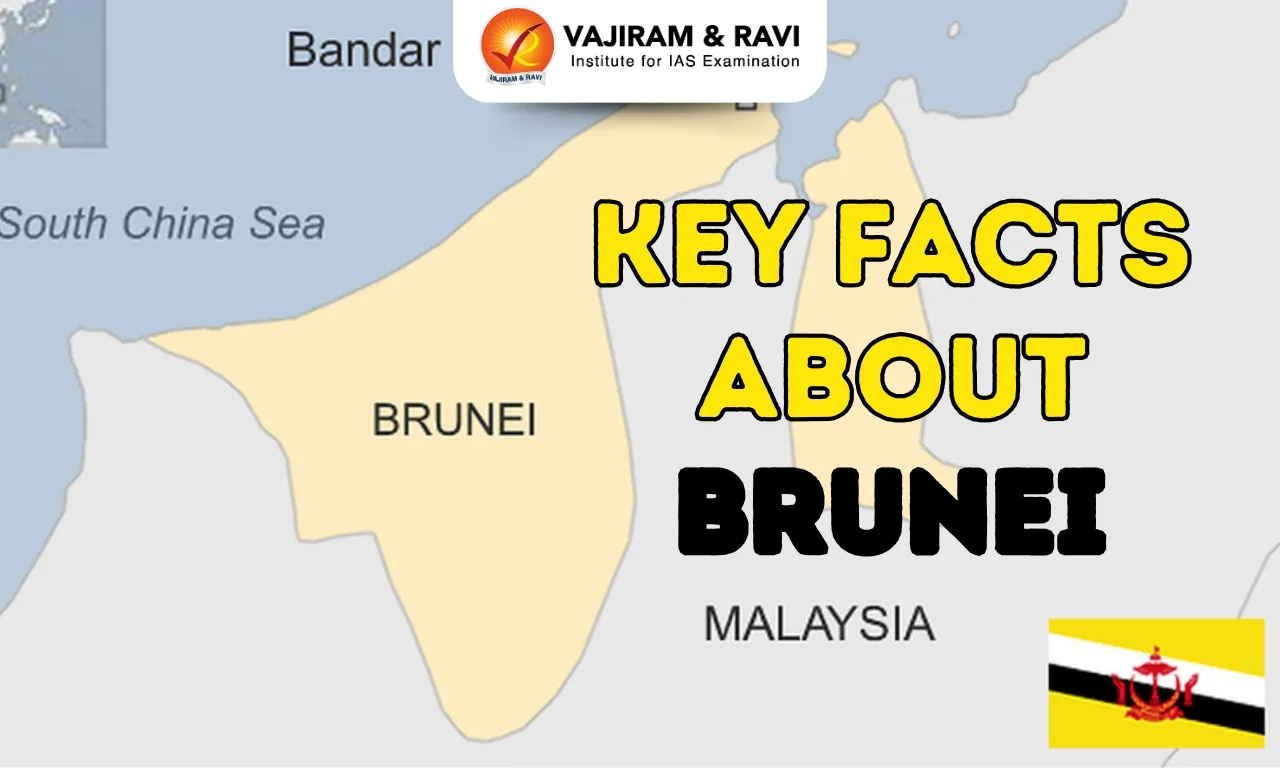
  • Location: It is located along the northern coast of Borneo Island in Southeast Asia.
  • Bordered by: Brunei is bordered by the South China Sea in the north and on all other sides by Malaysia.
  • Brunei is divided into two non-contiguous parts by a portion of the Malaysian State of Sarawak.
  • Capital: Bander Seri Begawan – the capital and largest city of Brunei.
  • It is a member country of the Commonwealth and ASEAN.

Geographical Features of Brunei

  • Climate: The climate of Brunei (or Brunei Darussalam) is equatorial, i.e. hot, humid and rainy throughout the year. 
  • Terrain: It consists of flat coastal plain rises to mountains in east; hilly lowland in west
  • Mountain: Bukit Pagon is the highest point in the country at 6,069 ft along the border with Malaysia in the eastern mountainous region.
  • Rivers: Numerous rivers drain the land, including the Belait, Pandaruan, and Tutong.
  • Natural Resources: It is also a major oil producer in Southeast Asia.

Source: TH

Brunei FAQs

Q1: Where is Brunei located?

Ans: Southeast Asia

Q2: What is the capital of Brunei?

Ans: Bandar Seri Begawan

Enquire Now