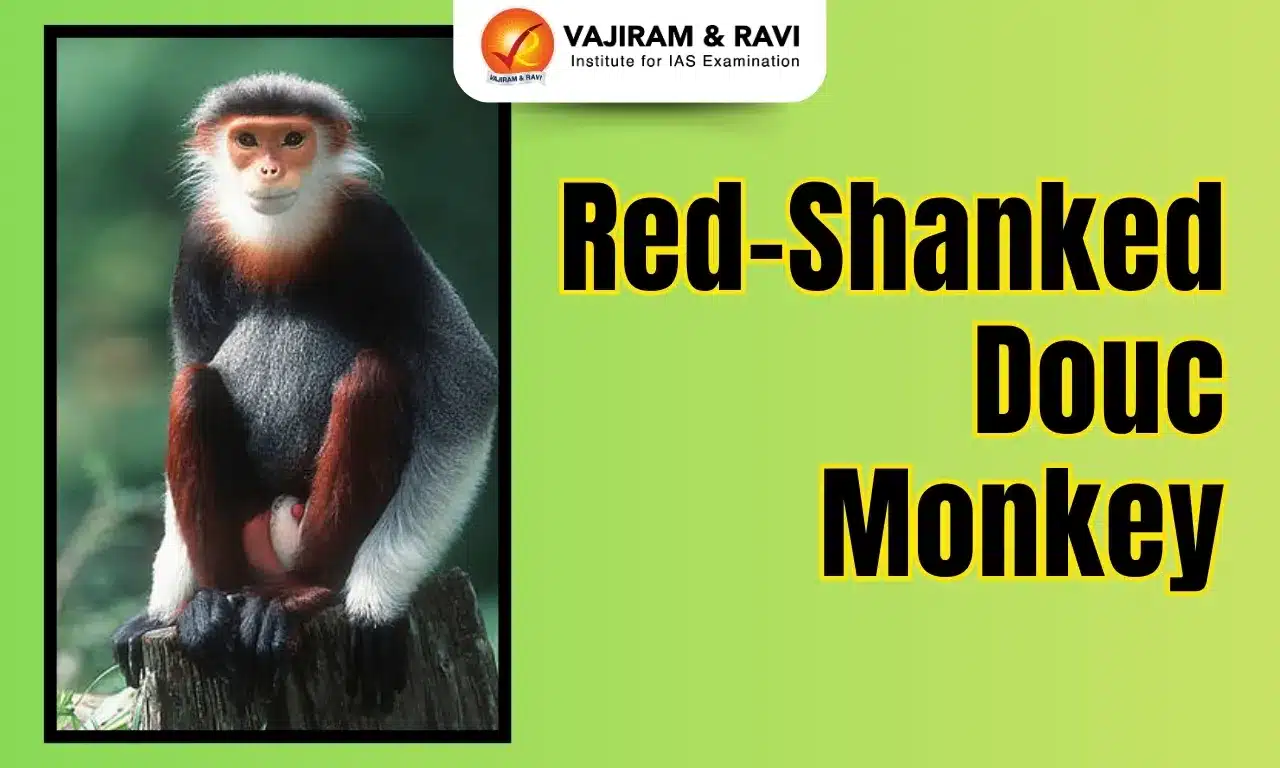
Red-Shanked Douc Monkey

Red-Shanked Douc Monkey

Red-Shanked Douc Monkey Latest News

Recently, customs officials at the Kempegowda International Airport (KIA) arrested a passenger who was smuggling two red-shanked douc monkeys.

About Red-Shanked Douc Monkey

  • The Red-shanked douc (Pygathrix nemaeus) is an Old World monkey which is considered as a “Queen of primates”.
  • Habitat: They occur in subtropical and tropical broadleaf evergreen or semi-deciduous forests and to a lesser extent in secondary evergreen and mixed bamboo forests.
  • Distribution: Red-shanked doucs are found in Southeast Asia mainly in Vietnam, Southern Laos and Cambodia.

Characteristics of Red-Shanked Douc Monkey

  • Appearance: It is referred to as “the costumed ape,” the red-shanked douc langur is among the most colorful of primates. 
  • These are arboreal, herbivores and diurnal monkeys that eat and sleep in the trees of the forest.
  • Communication: They communicate with each other using various facial expressions.
  • Conservation Status: IUCN: Critically Endangered 
  • Threats: Hunting is the main threat – for subsistence use and traditional medicine – they are also hunted for the international pet trade. 

Source: TH

Red-Shanked Douc Monkey FAQs

Q1: What is the scientific name of the Red-Shanked Douc Monkey?

Ans: Pygathrix nemaeus

Q2: What is distinctive about the Red-Shanked Douc Monkey's appearance?

Ans: Red legs and hands

Dandami Madia Tribe

Dandami Madia Tribe

Dandami Madia Tribe Latest News

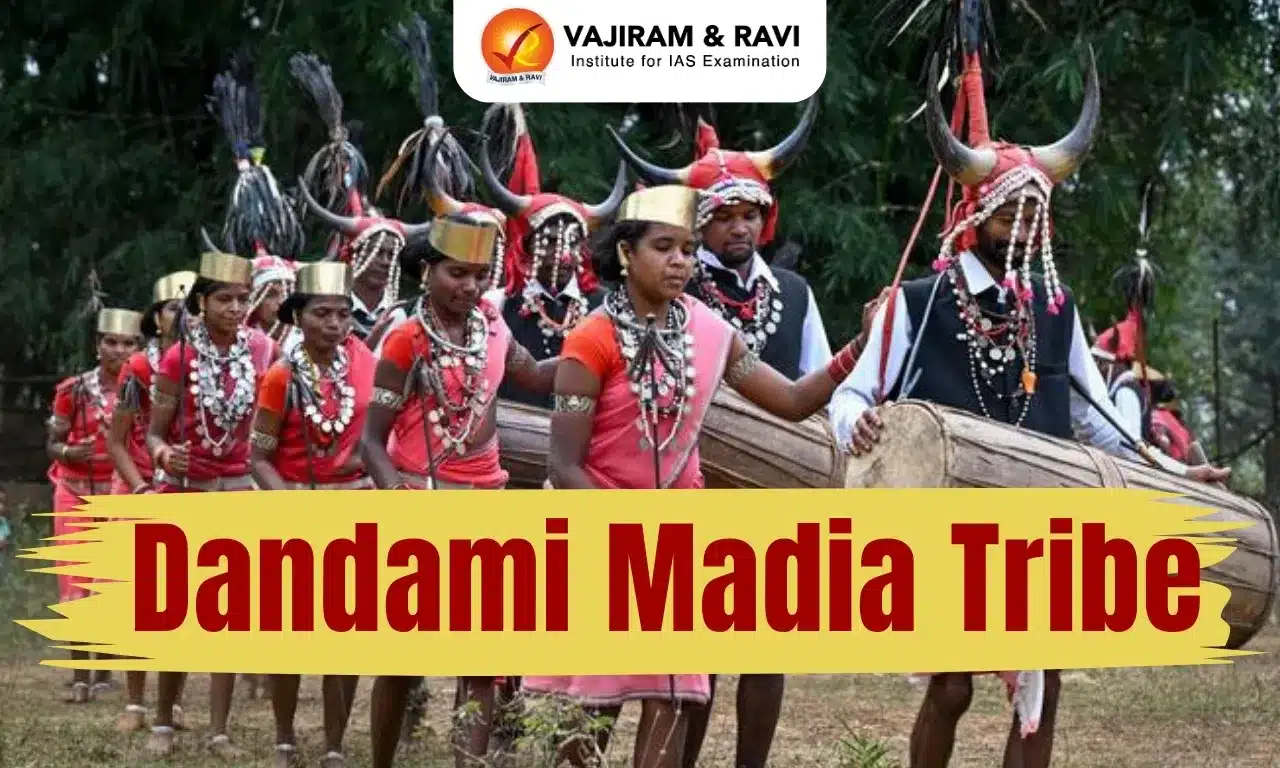
Recently, members of the Dandami Madia tribe perform the traditional Bison Horn Maria dance during a village festival at Judiya Para in Jagdalpur.

About Dandami Madia Tribe

  • Dandami Maria, also known by other names like Bison Horn Maria and Khalpati Maria.
  • It is a tribal community which lives in Chhattisgarh.
  • They have derived their name from their unique custom of wearing a distinctive head-gear, which resembles the horns of a wild bison.
  • They generally wear that head-gear during ceremonies.
  • They identify themselves as part of the larger Gond tradition.
  • Language: The main distinct language spoken by this tribe is Dandami Maria. Some of them speak Gondi dialects, which is an oral language of Dravidian origins.

Society and Customs of Dandami Madia Tribe

  • Economy: They live by agriculture, supplemented by hunting and fishing.
  • Belief: Their belief is a combination of Hinduism with Animistic beliefs.
  • Their ghotul (youth dormitory for unmarried boys and girls) is an important social institution.
  • They permit divorce and widow remarriage.
  • They perform the traditional Bison Horn Maria dance during a village festival. It is performed by both men and women.

Source: TH

Dandami Madia Tribe FAQs

Q1: In which state is the Dandami Madia Tribe primarily found?

Ans: Chhattisgarh

Q2: What is the primary language spoken by the Dandami Madia Tribe?

Ans: Gondi

Perumbidugu Mutharaiyar

Perumbidugu Mutharaiyar

Perumbidugu Mutharaiyar Latest News

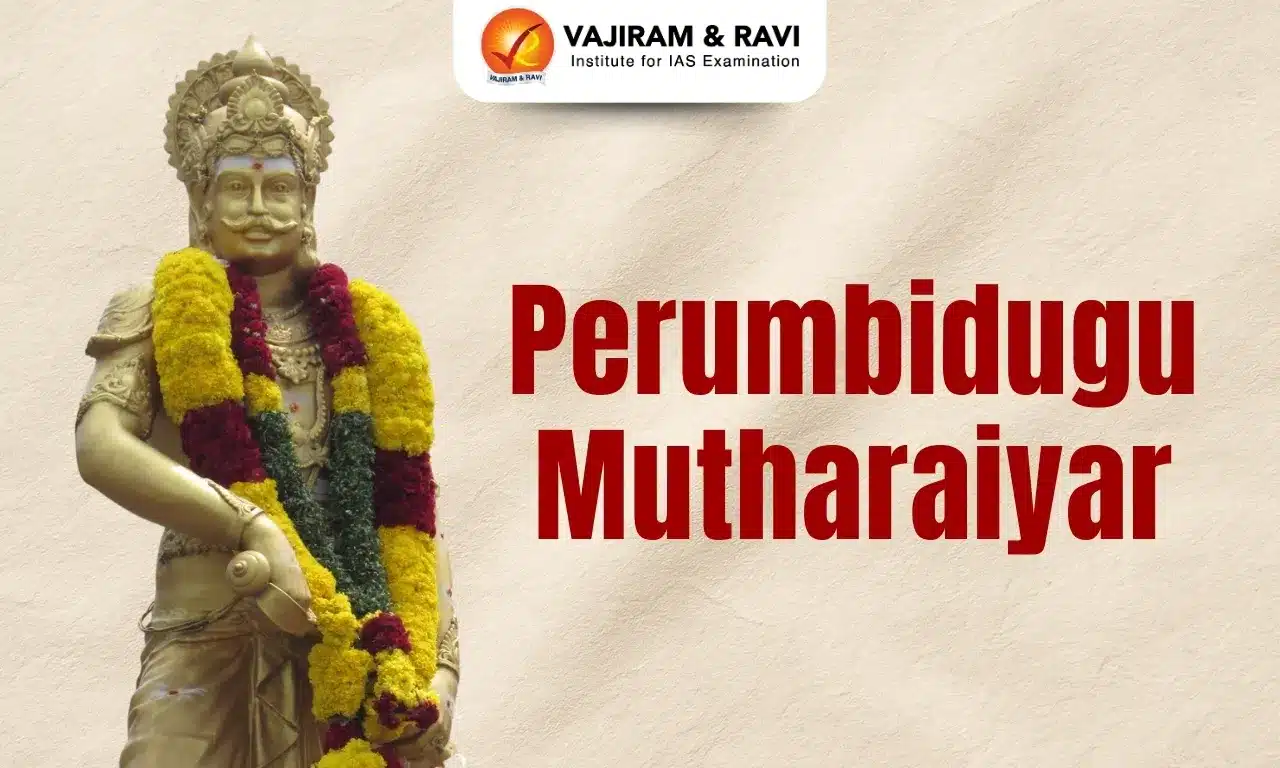
Recently, a commemorative postage stamp in honour of the king Perumbidugu Mutharaiyar II (Suvaran Maran) was released by the Vice President of India. 

About Perumbidugu Mutharaiyar

  • Perumbidugu Mutharaiyar (705 AD-745 AD), also known as Suvaran Maran, was a ruler of the Mutharaiyar lineage.
  • Suvaran Maran was also known as Shatrubhayankar.
  • Perumbidugu Mutharaiyar is believed to have fought bravely in several battles alongside the Pallava king Nandivarman, and is remembered as a great administrator.
  • He seems to have patronised Shaivya and other scholars, as a Jain monk Vimalachandra is mentioned as visiting his court to debate them.

Who are Mutharaiyars?

  • They were the feudatories of the Pallavas.
  • As the Pallavas’ rule weakened, many such chiefs earned more power and prominence and were treated as rulers in their own right.
  • The Mutharaiyars held sway over areas including Thanjavur, Pudukkottai, Perambalur, Tiruchirappalli, and others near the Cauvery river.
  • As the feudatories of the Pallavas, the Mutharaiyars were great temple builders.
  • Muttarayars were engaged in cave temple enterprises up to the opening decades of the ninth century.

Source: IE

Perumbidugu Mutharaiyar FAQs

Q1: Who was Perumbidugu Mutharaiyar?

Ans: A Mutharaiyar king

Q2: What was Perumbidugu Mutharaiyar's other name?

Ans: Suvaran Maran

Moei River

Moei River

Moei River Latest News

Promises of data-entry jobs drew young men from the State of Gujarat across the Moei River into Myanmar’s alleged cyber-fraud compounds.

About Moei River

  • The Moei River, known in Myanmar as the Tonge Yin River, is an important river in northern Thailand.
  • It is a tributary of the Salween River.
  • SourceOriginates in the Tenasserim Hills (Myanmar–Thailand border region)
  • Unlike most rivers in Thailand, the Moei River flows north in a northwest direction.
  • It stretches approximately 327 kilometers, flowing from the south to the north of Thailand before joining the Salween River in Myanmar. 
  • This river serves as a natural border between Thailand and Myanmar.
  • Key Towns Along the River:
    • Mae Sot (Thailand)
    • Myawaddy (Myanmar)
  • Historically, the Moei River was a key waterway for communication and transporting goods between Thai and Burmese communities.

Source: TH

Moei River FAQs

Q1: Which two countries does the Moei River form a natural boundary between?

Ans: Thailand and Myanmar

Q2: The Moei River is a tributary of which major river?

Ans: Salween River

Q3: Where does the Moei River originate from?

Ans: Tenasserim Hills (Myanmar–Thailand border region)

Q4: Approximately how long is the Moei River?

Ans: 327 kilometers

Chakrashila Wildlife Sanctuary

Chakrashila Wildlife Sanctuary

Chakrashila Wildlife Sanctuary Latest News

Community-led conservation efforts at the Chakrashila Wildlife Sanctuary have successfully restored wild honey bee colonies and revitalized associated wildlife.

About Chakrashila Wildlife Sanctuary

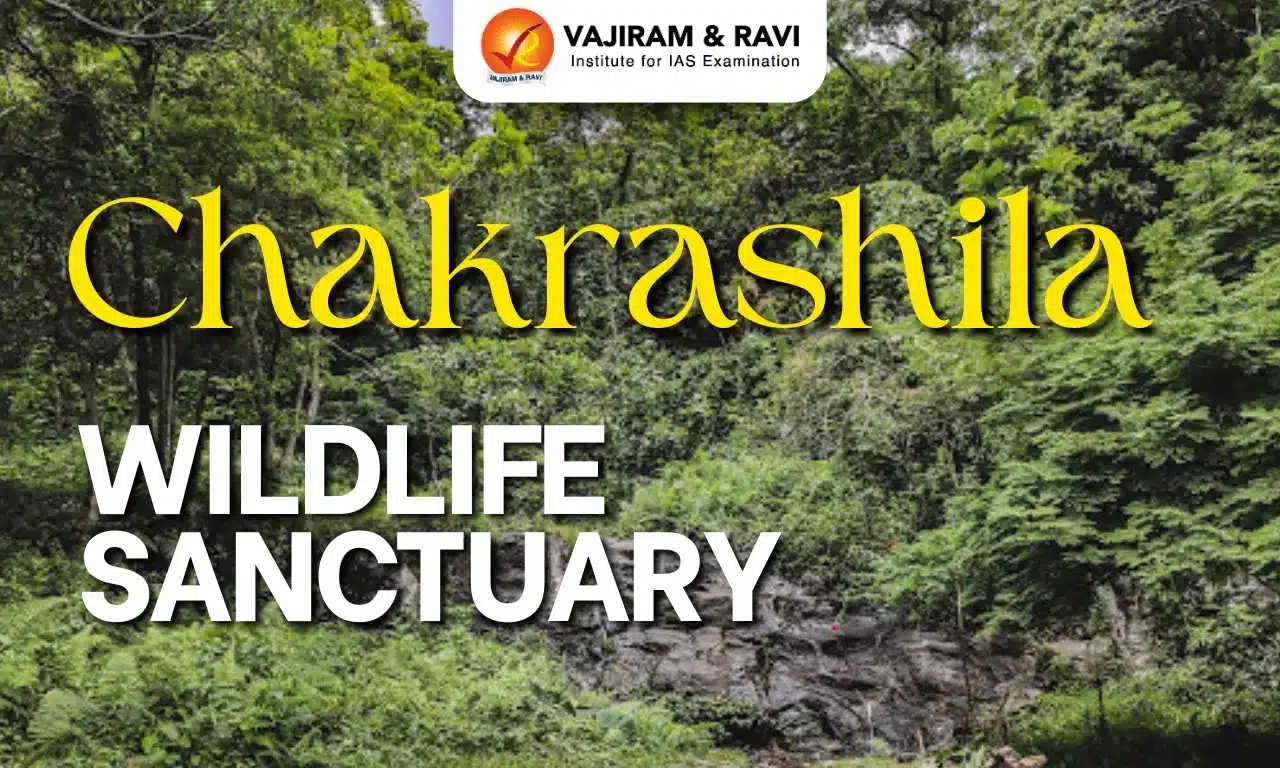
  • It is locatеd in thе Kokrajhar and Dhubri districts of Assam.
  • The sanctuary is well-known as the second protected habitat for the endangered golden langur, hosting over 600 individuals.
  • It spans over 45.5 sq.km. of hilly tеrrain and dеnsе forеsts.
  • There are two lakes (Dheer Beel and Diplai Beel) on either side, which are integral to the ecosystem of the sanctuary. 
  • Flora
    • The vegetation of the sanctuary is predominantly tropical moist deciduous forests, mixed deciduous forests, and semi-evergreen forests.
    • Sal tree is a dominant tree in this forest.
  • Fauna:
    • It is home to various species, including elephants, tigers, leopards, clouded leopards, sambar deer, barking deer, and gaur. 
    • The sanctuary is also home to several species of birds, including the endangered Bengal Florican, Great Hornbill, and White-winged Wood Duck.

Source: SENT

Chakrashila Wildlife Sanctuary FAQs

Q1: Chakrashila Wildlife Sanctuary is located in state?

Ans: Assam

Q2: Chakrashila Wildlife Sanctuary is especially known for being the protected habitat of which endangered species?

Ans: Golden Langur

Q3: What is the approximate area of Chakrashila Wildlife Sanctuary?

Ans: It spans over 45.5 sq.km. of hilly tеrrain and dеnsе forеsts.

Q4: What is the dominant vegetation type of Chakrashila Wildlife Sanctuary?

Ans: Tropical moist deciduous and mixed deciduous forests

Man-Portable Air Defence Systems (MANPADS)

Man-Portable Air Defence Systems (MANPADS)

Man-Portable Air Defence Systems (MANPADS) Latest News

The Indian Army is undertaking a major strategic shift in its air defence operations, repurposing its Man-Portable Air Defence Systems (MANPADS) to specifically counter the rising threat of sub-sonic cruise missiles.

About Man-Portable Air Defence Systems (MANPADS)

  • MANPADS are surface-to-air missiles that can be fired by an individual or a small team of people against aircraft.
  • These weapon systems often are described as shoulder-fired anti-aircraft missiles. 
  • MANPADS are generally less than 2 metres in length and weigh around 20 kg. 
  • The United States and the Soviet Union first deployed MANPADS—the Redeye and Strela systems, respectively—in the 1960s to provide their infantries with portable anti-aircraft weapons. 
  • The militaries of about 105 countries across the world operate MANPADS, although only 12 countries, including India, produce them. 
  • The most famous MANPADS are the US-made ‘Stinger’ and the Soviet 9K32 Strela-2, or simply ‘SA-7' with the China-made ‘FN-16’ being the latest entrant. 
  • Three general types of MANPADS exist: command line of sight, laser guided, and infrared seekers.
    • Command line-of-sight MANPADS are guided to their targets through the use of a remote control. 
    • Laser-guided or laser beam rider MANPADS follow a laser projected onto the target. 
    • The most common MANPADS, frequently called heat seeking missiles, however, are infrared seekers that acquire their target by detecting the heat of an aircraft’s engine.
  • Most MANPADS consist of: 
    • a missile packaged in a tube; 
    • a launching mechanism (commonly known as a “gripstock”); and 
    • a battery

Source: DEF

Man-Portable Air Defence Systems (MANPADS) FAQs

Q1: What are MANPADS?

Ans: Surface-to-air missile systems that can be fired by an individual or a small team against aircraft.

Q2: What is the typical length of a Man-Portable Air Defence Systems (MANPADS) missile?

Ans: Generally less than 2 metres.

Q3: Which two countries first deployed Man-Portable Air Defence Systems (MANPADS) in the 1960s?

Ans: The United States and the Soviet Union.

Q4: How many countries worldwide operate Man-Portable Air Defence Systems (MANPADS)?

Ans: The militaries of about 105 countries across the world operate MANPADS.

Q5: What are the three general types of Man-Portable Air Defence Systems (MANPADS) based on guidance?

Ans: Command line-of-sight, laser-guided, and infrared seeker MANPADS.

Bluebird 6 Satellite

Bluebird Satellite

Bluebird 6 Satellite Latest News

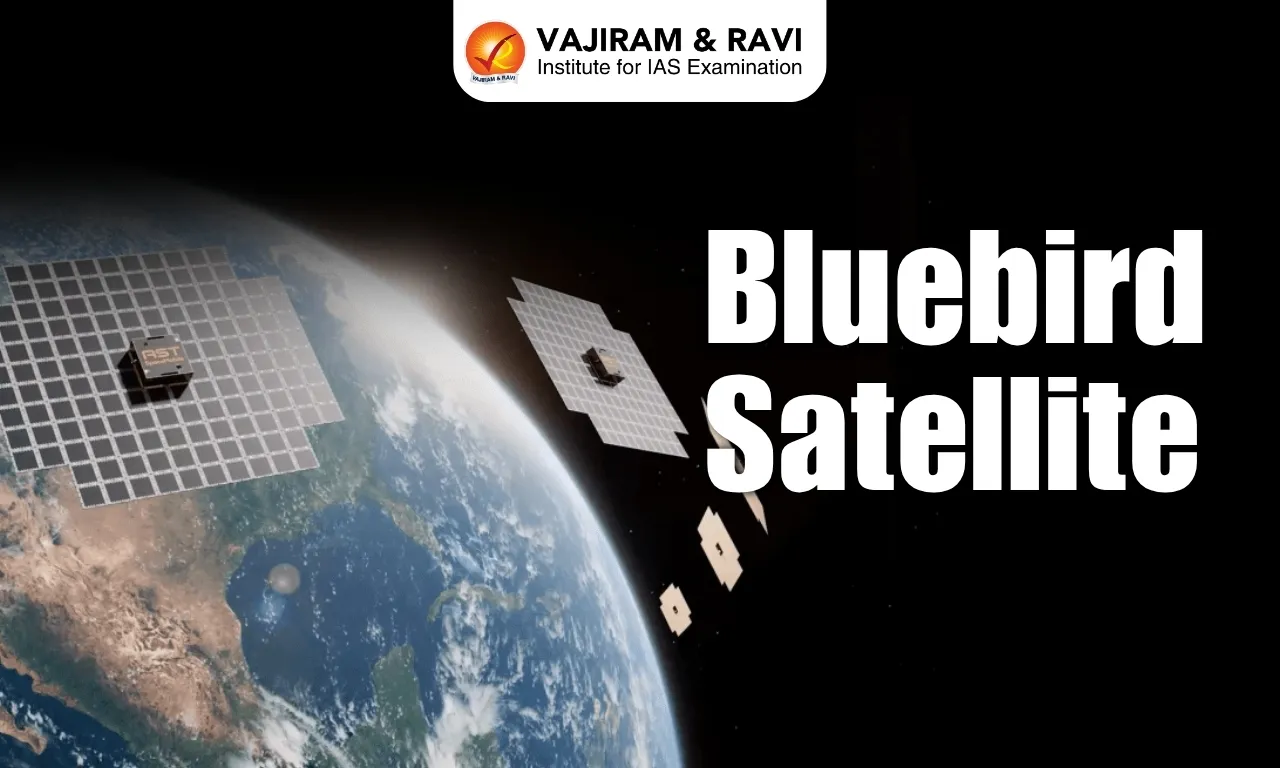
The Indian Space Research Organisation (ISRO) is scheduled to launch the US-based commercial BlueBird-6 satellite developed by US-based AST Spacemobile on 21st December 2025 using ISRO’s LVM-3 rocket.

About Bluebird 6 Satellite

  • Purpose: Designed to provide direct-to-device internet connectivity, enabling mobile phones to access broadband without relying on traditional cell towers.
  • Origin: Developed by the US-based commercial company AST SpaceMobile for global mobile coverage.
  • Weight and Size: Weighs around 6.5 tonnes, making it one of the heaviest satellites launched by ISRO.
  • Orbit Type: Will operate in low-Earth orbit (LEO) to cover large regions of the Earth efficiently.
  • Technology: Features one of the largest phased array antennas ever flown, which covers nearly 2,400 square feet, allowing it to communicate directly with standard mobile phones.
  • Significance: It enhances global mobile broadband connectivity, especially in remote and rural areas.
  • Collaboration: Represents a significant step in Indo-US space cooperation and commercial space ventures.
  • Future Impact: Expected to help bridge the digital divide, providing internet access to regions without cellular infrastructure.

About LVM-3

  • LVM-3, also known as GSLV Mk III or “Bahubali”, is a heavy-lift launch vehicle developed by ISRO.
  • It is designed to carry large satellites into space and support human spaceflight missions.
  • The rocket is approximately 43.43 meters tall and has a lift-off mass of around 640 tonnes, making it India’s heaviest launch vehicle.
  • It can carry up to 4 tonnes to Geostationary Transfer Orbit (GTO) and 10 tonnes to Low Earth Orbit (LEO).
  • It is a three-stage rocket: two solid rocket boosters (S200), a liquid core stage (L110), and a cryogenic upper stage (C25).
  • It has been used for heavier communication satellites, interplanetary missions, and India’s Gaganyaan human spaceflight project.
  • Its first successful experimental flight was in December 2014, and it is known for its reliability and heavy payload capability.

Source: ToI

Bluebird Satellite FAQs

Q1: Who developed the Bluebird satellite?

Ans: It was developed by the U.S.-based AST SpaceMobile.

Q2: What is the primary purpose of the Bluebird satellite?

Ans: Direct smartphone communication from space.

Q3: What is the approximate weight of the Bluebird satellite?

Ans: 6,000 kg

Q4: In which type of Earth orbit will the Bluebird satellite operate?

Ans: Low Earth Orbit (LEO)

Key Facts About Jordan

Key Facts about Jordan

Jordan Latest News

Recently, the Prime Minister of India has embarked on a three-nation visit to Jordan, Ethiopia and Oman.

About Jordan

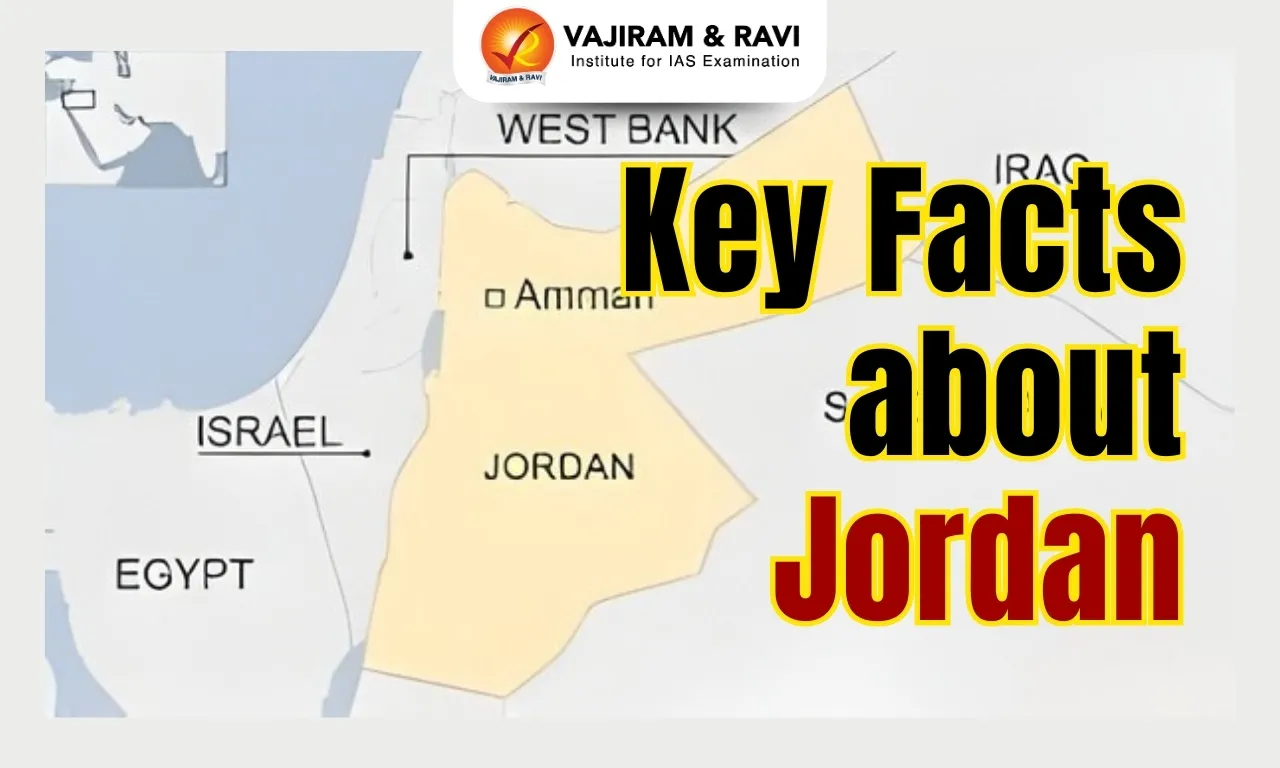
  • Location: It is a landlocked country located in the rocky desert of the northern Arabian Peninsula.
  • Bordering Countries: It is bordered by 5 Nations: Syria in the north, Iraq in the east, Saudi Arabia in the south and southeast and Israel and Palestine in the west.
  • Water bodies: Dead Sea, the Gulf of Aqaba and the Sea of Galilee.
    • The Dead Sea is located along the western borders of the country.
  • Ports: Al-Aqabah, the only port of Jordan is located in the south-western part of the country along the coasts of the Gulf of Aqaba.
  • Capital City: Amman

Geographical Features of Jordan

  • Terrain: It has arid desert plateau; a great north-south geological rift along the west of the country is the dominant topographical feature.
  • Highest Point: Jabal Umm ad Dami is the highest point of Jordan.
  • Rivers: The Jordan River which drains into the Dead Sea.
  • Natural Resources: It mainly consists of phosphates, potash and shale oil.

Source: DD News

Jordan FAQs

Q1: Which river forms part of Jordan's western border?

Ans: Jordan River

Q2: Which ancient city is a UNESCO World Heritage Site in Jordan?

Ans: Petra

Gulf of Oman

Gulf of Oman

Gulf of Oman Latest News

Iran recently seized an oil tanker in the Gulf of Oman, Iranian media said recently, adding that 18 crew members from India, Sri Lanka, and Bangladesh were on board.

About Gulf of Oman

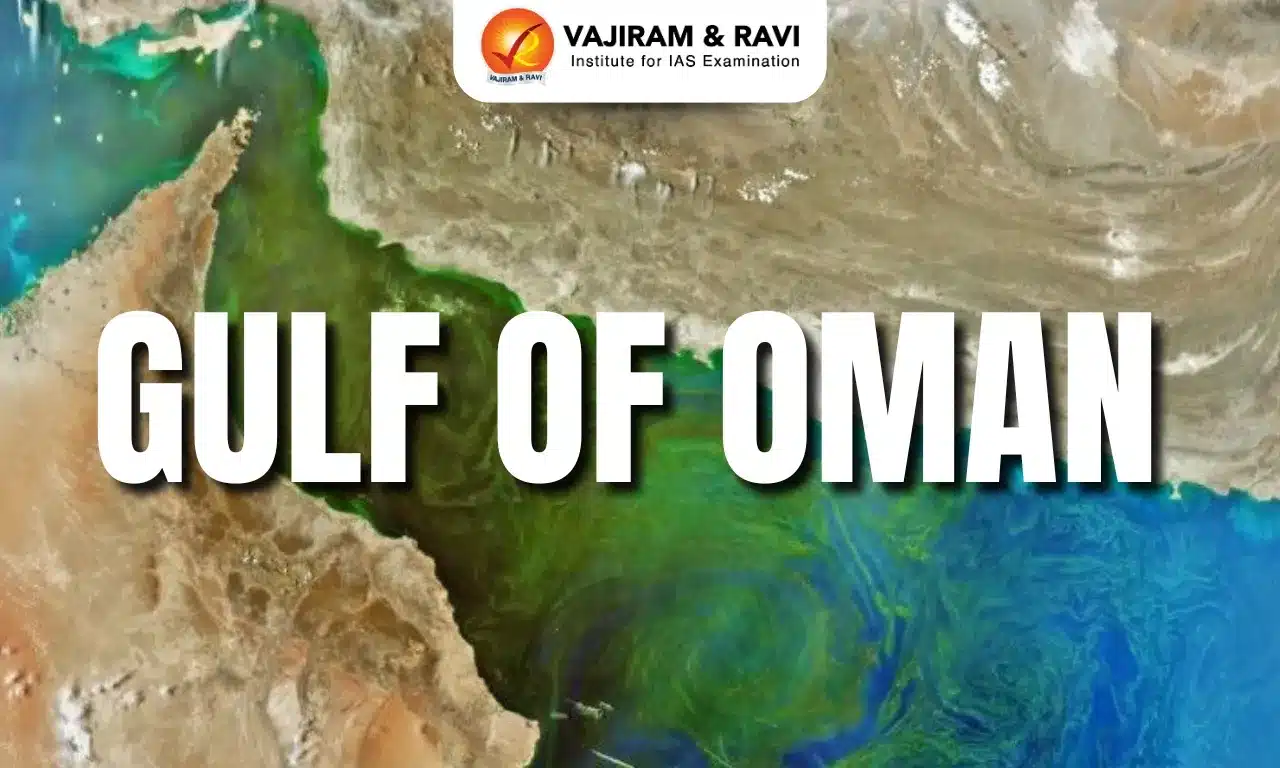
  • The Gulf of Oman, also known as the Gulf of Makran, is the northwest arm of the Arabian Sea.
  • It forms the only entrance to the Persian Gulf from the Indian Ocean.
  • It covers an area spanning 115,000 sq.km. 
  • It connects the Arabian Sea with the Strait of Hormuz, which then empties into the Persian Gulf.
  • Bordering Countries: It is bordered by Pakistan and Iran in the north, by the United Arab Emirates in the west, and by Oman in the south.
  • The gulf is about 320 km wide at its widest point between Cape al-Hadd in Oman and Gwadar Bay on the Iran-Pakistan border. It narrows to 35 miles (56 km) at the Strait of Hormuz.
  • It is approximately 560 km long.
  • The gulf is relatively shallow because of its origin as a fissure in the mountain spine now divided between Iran and Oman. 
  • Some of the significant islands that are located in the Gulf of Oman include Sheytan Island, Al Fahal Island, Dimaniyat Islands, and the Sawadi Islands.
  • The major international shipping ports that are situated in the Gulf of Oman include Port Sultan Qaboos Muttrah in Muscat, Oman; Chabahar Port in Iran; the Port of Fujairah and Khor Fakkan Container Terminal in the United Arab Emirates.
  • Roughly one-third of the world’s oil is exported via the Strait of Hormuz and the Gulf of Oman.

Source: TH

Gulf of Oman FAQs

Q1: What is the Gulf of Oman also known as?

Ans: Gulf of Makran

Q2: The Gulf of Oman is the northwest arm of which sea?

Ans: Arabian Sea

Q3: Which water body connects the Gulf of Oman to the Persian Gulf?

Ans: Strait of Hormuz

Q4: Which countries border the Gulf of Oman?

Ans: Pakistan and Iran (north), United Arab Emirates (west), and Oman (south).

Dieback Disease

Dieback Disease

Dieback Disease Latest News

The withering of thousands of neem trees over some years had prompted the Mulugu-based Forest College & Research Institute (FCRI), to launch a comprehensive scientific probe into the devastating "dieback disease."

About Dieback Disease

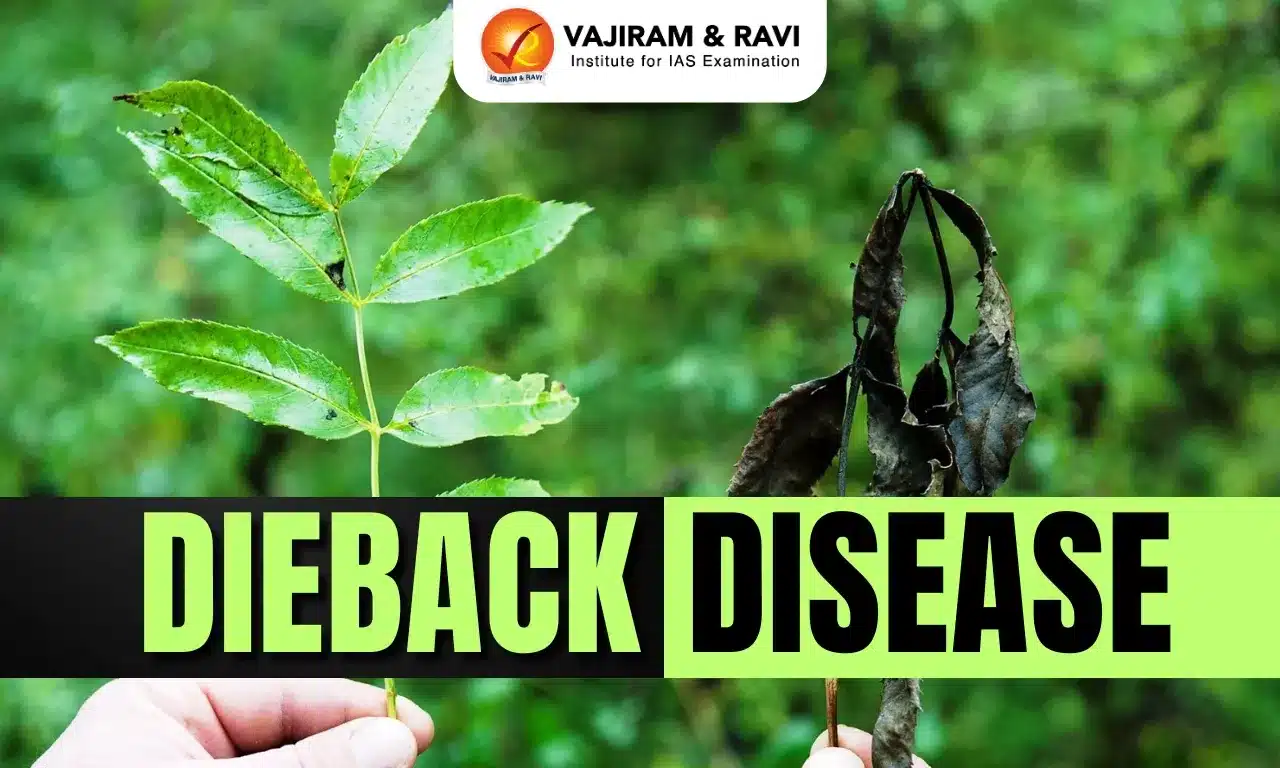
  • It is a fungal disease which kills a wide variety of plants.
  • It is responsible for causing wilting and browning of leaves from the tip of the branch, stem canker, and fruit rot.
  • It was first reported in the country during the 1990s near Dehradun in Uttarakhand.
  • The dieback fungus belongs to the genus Phytophthora
  • Mode of spread: 
    • The fungus is spread through the movement of soil and mud, especially by vehicles and footwear. 
    • It also moves in free water and via root-to root contact between plants.
  • The fungus lives in susceptible plant tissue and soil, and migrates and reproduces in warm, moist conditions. 
  • Infected roots cannot provide the water and nutrients needed to maintain life, and the plants die from dehydration.
  • It causes almost 100% loss of fruit production in severely infected trees.
  • Where the disease occurs, the native vegetation can become devastated, and the delicate fabric of ecosystems seriously impaired; certain species can disappear from the area.
  • The appearance of symptoms starts with the onset of the rainy season and becomes progressively severe in the later part of the rainy season and early winter.
  • Dieback is not easy to detect, as infected plants often appear to be dying from drought.
  • There is no known cure for the disease.

Source: DC

Dieback Disease FAQs

Q1: Dieback disease is caused by which type of pathogen?

Ans: Fungus

Q2: What is the common symptom of dieback disease?

Ans: Browning of leaves from the tip of the branch.

Q3: Why is dieback disease often difficult to detect in its early stages?

Ans: Infected plants appear similar to drought stress

Q4: Where was dieback disease first reported in India?

Ans: Near Dehradun in Uttarakhand.

Ramappa Temple

Ramappa Temple

Ramappa Temple Latest News

Recently, ambassador and Permanent Representative of India to UNESCO-Paris visited the Ramappa Temple and reviewed the preservation and conservation efforts undertaken by the Archaeological Survey of India (ASI) and the State government.

About  Ramappa Temple

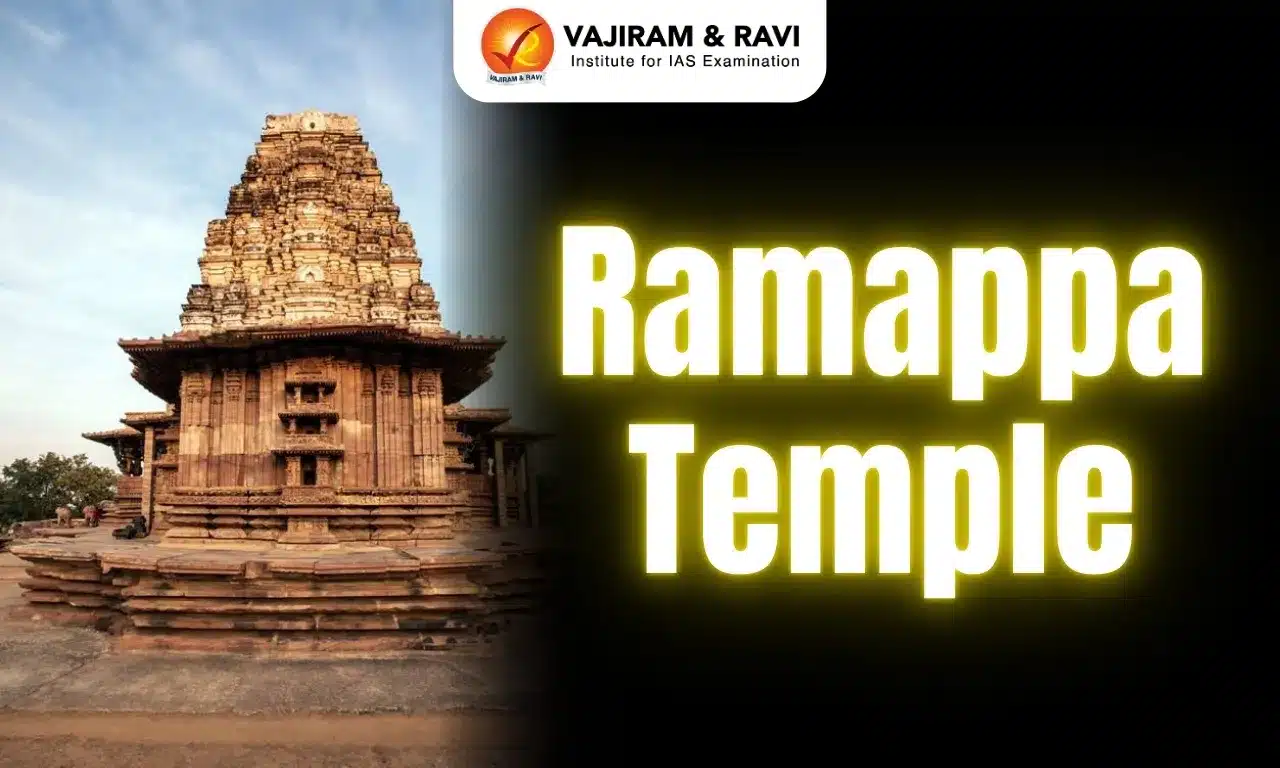
  • It is located in the state of Telangana.
  • It was constructed in 1213 AD during the reign of the Kakatiya Empire by RecharlaRudra, a general of Kakatiya king Ganapati Deva.
  • The presiding deity here is RamalingeswaraSwamy.
  • It is also known as the Rudreswara Temple.
  • The temple got its name Ramappa because of its chief sculptor Ramappa.
  • Ramappa Temple is probably the only temple in India that is named after the architect.

Architectural Features of Ramappa Temple

  • The temple stands on a 6 feet high star-shaped platform with walls, pillars and ceilings adorned with intricate carvings.
  • Earthquake-proof: Made out of clay mixed with acacia wood, chaff and myrobalan fruit (a family of amla), the bricks used in building the gopuram of the temple are light enough to float on water.
    • Using this technique has made the temple light, meaning, in case of a natural event like an earthquake, the probability of it collapsing would be very low.
  • Sandbox technique: The temple construction was done using the sandbox technique. This is a technique where the foundation pit is filled with a mixture of sand-lime, jaggery and black myrobalan fruit.
  • This mix acts as a cushion in case of earthquakes. 
  • In 2021, the temple was inscribed as a UNESCO World Heritage Site as “Kakatiya Rudreshwara (Ramappa) Temple, Telangana”.

 Source: TH

Ramappa Temple FAQs

Q1: When was the Ramappa Temple built?

Ans: 13th century

Q2: What is the architectural style of Ramappa Temple?

Ans: Kakatiya

MahaCrimeOS AI: How Maharashtra Police Is Using AI to Fight Cybercrime

MahaCrimeOS AI

MahaCrimeOS AI Latest News

  • Microsoft CEO Satya Nadella announced the statewide rollout of MahaCrimeOS AI, an advanced AI-driven investigation platform for the Maharashtra Police. 
  • Developed in partnership with the Maharashtra Government and its AI policing initiative MARVEL, the platform will equip all 1,100 police stations with next-generation cybercrime tools. 
  • The initiative marks a shift beyond traditional policing, reflecting how law enforcement and the judiciary are embracing AI as a transformative force to enhance investigation, vigilance, and justice delivery.

MahaCrimeOS AI: Transforming Crime Investigation in Maharashtra

  • MahaCrimeOS AI is an AI-powered crime investigation platform developed using Microsoft Foundry. 
  • First deployed in Nagpur Rural in April 2025, it helps police process complaints faster, analyse complex data, and streamline investigative procedures—especially in cybercrime cases. 
  • Recognising its effectiveness, the Maharashtra government and Microsoft announced recently that the platform will be rolled out across all 1,100 police stations in the state.

MARVEL: Maharashtra’s AI Vision for Policing

  • MARVEL (Maharashtra Research and Vigilance for Enhanced Law Enforcement) is a government-owned AI initiative created to integrate advanced technologies into policing. 
  • Established in 2024 as a special-purpose vehicle (SPV), MARVEL aims to modernise investigations, strengthen police intelligence, and improve crime prediction. 
  • Maharashtra is the first Indian state to set up an independent AI body dedicated to law enforcement.

From CrimeOS to MahaCrimeOS AI

  • Working with Microsoft, MARVEL adapted CrimeOS AI—developed by CyberEye, a Microsoft AI partner—into MahaCrimeOS AI, fine-tuned to comply with Maharashtra’s investigation protocols. 
  • The system was also configured in Marathi to ensure easy adoption across the police force. 
  • An MoU between the Maharashtra government and Microsoft includes setting up three AI Centres of Excellence.

Advanced Capabilities of MahaCrimeOS AI

  • MahaCrimeOS AI can ingest complaints in multiple formats, including PDFs, audio files, handwritten notes, and images. 
  • Using multimodal intelligence, it extracts key information in any language, automates analysis, adapts investigation pathways, and rapidly profiles persons of interest, significantly enhancing investigative efficiency.

Transforming Governance Through AI

  • MARVEL’s goal is to collaborate with global technology leaders to build AI copilots that fundamentally transform governance. 
  • The initiative positions Maharashtra as a national leader in AI-driven, future-ready policing.

Benefits of MahaCrimeOS AI

  • MahaCrimeOS AI automates routine administrative tasks, allowing investigating officers to focus more on solving crimes and assisting victims. 
  • Officers access a dashboard showing active cases, updates, and pending actions, improving case management and efficiency.
  • In one case involving a ₹38 lakh bank fraud, the system helped analyse telecom data and open-source intelligence to trace and arrest accused across multiple states.

AI-Generated Investigation Plans

  • A key feature of MahaCrimeOS AI is its ability to read FIRs in Marathi and automatically generate detailed investigation plans. 
  • These are based on Maharashtra Police protocols and guidelines issued by the High Court and Supreme Court for different crime categories.

Investigation Copilot for Faster Decision-Making

  • Developed with CyberEye and Microsoft, the AI-powered investigation copilot analyses case details, creates automated workflows, and suggests investigation pathways. 
  • This reduces delays that earlier arose when officers waited for senior approvals in complex cases.

Advanced Data Analysis and Court Readiness

  • The platform analyses telecom data to identify interlinkages, gathers open-source intelligence by tracing phone numbers across digital platforms, and prepares time-stamped, date-wise case diaries for court submissions, embedding judicial best practices into investigations.

Improved Experience for Complainants

  • By speeding up investigations and reducing bottlenecks, MahaCrimeOS AI delivers quicker, more consistent outcomes for complainants. 
  • Faster response times and smoother case handling enhance public trust and improve overall access to justice.

Key Features of MahaCrimeOS AI

  • MahaCrimeOS AI has been designed primarily in Marathi, ensuring that even constables can use it with ease. 
  • Tasks such as drafting letters to banks and telecom companies, which earlier took 30–45 minutes, are now completed in seconds. 
  • The system can also directly email these documents, significantly cutting investigation time and administrative delays.
  • The platform democratises advanced investigative capabilities. 
    • Previously limited to specialised cybercrime officers, open-source intelligence and data analysis can now be performed by all 3,000 officers in Nagpur Rural, eliminating dependence on a small expert pool.

Handling Complex Crime Categories

  • The system currently supports investigations in four complex crime areas: narcotics, cybercrime, crimes against women, and financial fraud
  • Additional AI models are being developed to extend its application to other types of crimes.

Tailored, Protocol-Based Investigations

  • A key strength of MahaCrimeOS AI is its ability to incorporate best-practice protocols, apply crime-specific knowledge, and generate customised investigation plans, enabling more precise and efficient law enforcement outcomes.

Supporting Faster Investigations Under New Criminal Laws

  • With the Bharatiya Nyaya Sanhita mandating charge sheets within 60–90 days, police officers handling multiple cases face tight deadlines. 
  • MahaCrimeOS AI enables faster, structured investigations, helping officers meet legal timelines and adapt effectively to the new criminal law framework.

Source: IE | TH

MahaCrimeOS AI FAQs

Q1: What is MahaCrimeOS AI and why is it significant?

Ans: MahaCrimeOS AI is an AI-powered investigation platform that helps Maharashtra Police analyse data, automate workflows, and investigate complex crimes, especially cybercrime, more efficiently.

Q2: Who developed MahaCrimeOS AI?

Ans: It was jointly developed by the Maharashtra Government, Microsoft, and MARVEL, with CyberEye as a Microsoft AI partner, using Microsoft Foundry and Azure OpenAI services.

Q3: How does MahaCrimeOS AI assist investigators?

Ans: It automates routine tasks, generates investigation plans from FIRs, analyses telecom and open-source data, and prepares court-ready case diaries aligned with judicial guidelines.

Q4: Which crime categories does MahaCrimeOS AI currently support?

Ans: The platform currently supports cybercrime, financial fraud, narcotics cases, and crimes against women, with plans to expand to other crime categories.

Q5: How does MahaCrimeOS AI align with new criminal laws?

Ans: By enabling faster, structured investigations, it helps police meet Bharatiya Nyaya Sanhita deadlines of filing charge sheets within 60–90 days.

New Insurance Bill 2025 Explained: 100% FDI, IRDAI Powers and Key Omissions

New Insurance Bill 2025

New Insurance Bill 2025 Latest News

  • The Union Cabinet has approved the Sabka Bima Sabki Raksha (Amendment of Insurance Laws) Bill, 2025, paving the way for its introduction in Parliament during the Winter Session.
  • The Bill proposes major reforms to India’s insurance framework by amending the Insurance Act, 1938, LIC Act, 1956, and IRDAI Act, 1999, aiming at modernisation, expanded insurance coverage, and stronger regulatory oversight. 
  • Key positives include the long-awaited provision for 100% FDI in insurance
  • However, several industry demands—such as the introduction of a composite licence—have been excluded or diluted, leading to mixed reactions from stakeholders. 
  • Overall, the Bill seeks to balance industry growth, consumer protection, and broader financial sector reforms, and is expected to generate significant parliamentary debate.

Key Provisions of the New Insurance Bill

  • The Union Cabinet has approved a major change in India’s insurance rules by allowing full foreign ownership in insurance companies. 
  • The decision aims to bring more capital, improve competition, and strengthen customer services across the sector.
  • The Bill advances liberalisation, regulatory capacity, and ease of doing business in insurance, while strengthening policyholder protection.

100% Foreign Direct Investment (FDI) in Insurance

  • Raises FDI cap from 74% to 100% in Indian insurance companies.
  • Aims to attract long-term foreign capital, enhance insurance penetration, promote technology transfer, and support the goal of ‘Insurance for All by 2047’.
  • Expected impacts: greater competition, product innovation, customer-centric services, and adoption of global best practices in underwriting, risk management, and digital claims.

Easing Entry for Foreign Reinsurers

  • Reduces Net Owned Funds (NOF) requirement for foreign reinsurers from ₹5,000 crore to ₹1,000 crore.
  • Addresses a long-standing demand to widen participation beyond the public sector GIC Re.
  • Expected to boost reinsurance capacity, competition, and risk diversification in India.

Enhanced Powers for IRDAI 

  • Grants IRDAI disgorgement powers to recover wrongful gains—bringing it closer to SEBI’s enforcement toolkit.
  • Introduces a one-time registration for insurance intermediaries to simplify compliance.
  • Raises the threshold for IRDAI approval of equity transfers from 1% to 5%, easing business operations.
  • Mandates a formal SOP for regulation-making and clear penalty criteria to improve transparency, predictability, and consistency.

Greater Operational Autonomy for LIC

  • Allows LIC to set up new zonal offices without prior government approval, enabling faster expansion and administrative efficiency.
  • Permits restructuring of overseas operations in line with host-country laws, strengthening LIC’s global footprint.
  • Overall goal: modernise LIC’s governance and enhance competitiveness domestically and internationally.

What the Insurance Amendment Bill Leaves Out

  • No Composite Licence: A Major Miss
    • The Bill is expected to exclude composite licences, a long-pending industry demand.
    • Currently, insurers are confined to strict silos: life insurers cannot sell non-life products and vice versa.
    • A composite licence would have allowed a single insurer to offer life, health, and general insurance under one roof.
    • Its absence preserves long-standing structural rigidities, limits bundled offerings, and curbs competition, despite global best practices favouring integrated models.
  • No Reduction in Capital Norms for New Entrants
    • The Bill is unlikely to lower minimum capital requirements (₹100 crore for insurers, ₹200 crore for reinsurers).
    • High entry barriers continue to deter small, niche, regional, and specialised insurers.
    • Lower capital norms could have boosted insurance penetration, especially in rural areas, among gig workers, MSMEs, and low-income households.
    • The omission is seen as a setback for financial inclusion and innovation.
  • Dropped Proposals from Earlier Drafts
    • Several reforms discussed in earlier versions appear missing:
      • Permission for insurers to distribute other financial products (mutual funds, loans, credit cards).
      • Greater flexibility in investment norms to improve policyholder returns.
      • Allowing individual agents to sell policies of multiple insurers, beyond the current one-life–one-general restriction.
  • No Provision for Captive Insurance Companies
    • The Bill is silent on allowing large corporations to set up captive insurers.
    • A captive insurance company is a wholly-owned subsidiary created by a parent company to insure its own risks.
    • Captives are widely used globally to manage complex risks, reduce insurance costs, and improve underwriting control.
    • Their exclusion delays modernisation of India’s corporate risk-management ecosystem.

Conclusion

  • While the Bill delivers key reforms like 100% FDI and stronger regulation, it stops short of deeper structural changes. 
  • The absence of composite licences, lower capital norms, and captives represents missed opportunities to accelerate competition, inclusion, and innovation in India’s insurance sector.

Source: IE | IT

New Insurance Bill 2025 FAQs

Q1: What is the Sabka Bima Sabki Raksha Bill, 2025?

Ans: It is an amendment bill reforming insurance laws to modernise the sector, expand coverage, strengthen regulation, and align with the goal of Insurance for All by 2047.

Q2: What is the biggest reform introduced in the Bill?

Ans: The Bill raises the FDI limit in insurance companies from 74% to 100%, enabling full foreign ownership and attracting long-term global capital and technology.

Q3: How does the Bill strengthen IRDAI?

Ans: It grants IRDAI disgorgement powers, simplifies intermediary registration, raises equity transfer thresholds, and mandates transparent rule-making and penalty frameworks.

Q4: What operational changes does the Bill make for LIC?

Ans: LIC can open zonal offices without government approval and restructure overseas operations, improving administrative efficiency and strengthening its global presence.

Q5: What are the major omissions in the Bill?

Ans: The Bill excludes composite licences, reduced capital norms for new insurers, captive insurance companies, and multi-insurer agency permissions, limiting deeper structural reform.

Higher Education Overhaul – Viksit Bharat Shiksha Adhishthan Bill 2025

Higher Education

Higher Education Latest News

  • The Union Government has proposed the Viksit Bharat Shiksha Adhishthan Bill, 2025, aimed at overhauling India’s higher education regulatory system by replacing the UGC, AICTE, and NCTE with a new umbrella commission. 
  • This Bill was listed in the Winter Session of Parliament. 

Reform of India’s Higher Education Regulatory Framework

  • India’s higher education sector has long operated with multiple regulatory bodies, often resulting in overlapping mandates, fragmented standards, and inconsistent approval mechanisms. 
  • To address these structural challenges and align with the National Education Policy (NEP) 2020 vision, the government has introduced the Viksit Bharat Shiksha Adhishthan (VBSA) Bill, 2025.
  • The Bill aims to improve academic quality, streamline regulation, and modernise governance in universities and higher educational institutions across India. 
  • It marks one of the most significant policy interventions in the higher education domain in recent years.

Core Objectives of the VBSA Bill

  • The Bill states that its primary purpose is to enable and empower universities to achieve excellence in teaching, learning, research, and innovation. This is to be achieved through:
    • Better coordination between regulatory bodies
    • Clear determination of academic and institutional standards
    • A unified governance mechanism for higher education
  • The Statement of Objects and Reasons emphasises the NEP 2020 principle of a “light but tight” regulatory structure, ensuring reduced bureaucratic complexity while maintaining strong accountability. 

Structure of the VBSA Commission

  • At the centre of the proposed reforms is the Viksit Bharat Shiksha Adhishthan (VBSA), a 12-member umbrella commission that functions as the apex authority. 
  • It will oversee three specialised councils:
  • Viksit Bharat Viniyaman Parishad (Regulatory Council)
    • Responsible for maintaining regulatory standards
    • Coordinates governance norms in universities and colleges
  • Viksit Bharat Gunvatta Parishad (Accreditation Council)
    • Supervises accreditation processes
    • Builds an independent ecosystem for institutional and program accreditation
  • Viksit Bharat Manak Parishad (Standards Council)
    • Establishes academic standards
    • Ensures harmonisation of policies and quality benchmarks
  • Each council can have up to 14 members. The VBSA will include members from the Education Ministry, State higher education institutions, and eminent experts. 

Institutions Covered Under the Bill

  • The proposed law applies to:
    • All Central and State universities
    • Colleges and Higher Educational Institutions (HEIs)
    • Institutions of national importance
    • Institutions of eminence
    • Technical and teacher education institutions
  • However, professional programmes such as Medicine, Dentistry, Nursing, Law, Pharmacology, and Veterinary Sciences are exempted and will continue under their respective regulators. 
  • The Council of Architecture will remain the professional standards-setting body for architecture but will not have regulatory powers. 

Key Changes Proposed Under the Bill

  • Replacing Existing Bodies
    • The VBSA Bill seeks to subsume the UGC, AICTE, and NCTE, integrating their regulatory, accreditation, and standardisation functions under one framework.
  • Separation of Funding from Regulation
    • A major shift is the removal of grant-disbursal powers from the UGC. Funding functions will now be performed through mechanisms devised by the Ministry of Education.
    • This separation aligns with NEP-2020’s recommendation to delink academic regulation from financial control. 
  • Enabling Foreign Universities and Global Outreach
    • The Regulatory Council will:
      • Set standards for foreign universities to operate in India
      • Facilitate high-performing Indian universities to set up offshore campuses
      • Prevent the commercialisation of higher education
  • Strengthening Accreditation
    • The Accreditation Council must develop an outcome-based framework, encouraging institutions to improve learning outputs rather than merely compliance inputs.

Criticism and Concerns

  • Earlier attempts to reform the higher education framework, such as the 2018 Higher Education Commission of India (HECI) Bill, faced strong criticism for placing excessive central control and weakening the role of States. Similar concerns have resurfaced.
  • Key criticisms include:
    • The possibility of the Centre having disproportionate influence in appointments
    • Removal of grant-disbursal powers from an autonomous body
    • Risk of over-centralisation in standard-setting functions
  • However, unlike the HECI Bill, the VBSA Bill includes State representation in all three councils, partly addressing federal concerns. 

Graded Penalties and Enforcement Mechanisms

  • The VBSA will have significant punitive powers, including:
    • Fines beginning at Rs. 10 lakh and going up to Rs. 75 lakh
    • Possible closure of institutions for repeated non-compliance
    • Power to suspend an institution’s authority to grant degrees or diplomas
    • Institutions operating without accreditation may face fines of Rs. 2 crore or more
  • These provisions aim to improve accountability and discourage substandard educational practices. 

Implications for India’s Higher Education System

  • If implemented, the VBSA Bill could:
    • Streamline regulatory processes
    • Ensure uniform academic standards nationwide
    • Enhance India’s global competitiveness in higher education
    • Promote transparency in accreditation and governance
    • Reduce fragmentation among regulators
  • However, concerns about autonomy, funding clarity, and centralisation will require careful implementation and stakeholder dialogue.

Source: TH | IE

Higher Education FAQs

Q1: What is the VBSA Bill 2025?

Ans: It is a proposed law to overhaul India’s higher education regulation through a unified umbrella commission.

Q2: Which bodies will be replaced under the Bill?

Ans: The UGC, AICTE, and NCTE will be subsumed under the new VBSA framework.

Q3: Who will handle grants under the new system?

Ans: The Ministry of Education will take over grant-disbursal functions from the UGC.

Q4: What are the three major councils under the VBSA?

Ans: Regulatory, Accreditation, and Standards Councils.

Q5: What penalties does the Bill propose?

Ans: Fines up to Rs. 75 lakh or closure for violations, with Rs. 2 crore penalties for operating without accreditation.

Enquire Now