Key facts about Netherlands

Key Facts about Netherlands

Netherlands Latest News

Recently, the Indian defence Minister and the Foreign Minister of the Netherlands reaffirmed the strong and steadily expanding defence partnership between the two nations.

About Netherlands

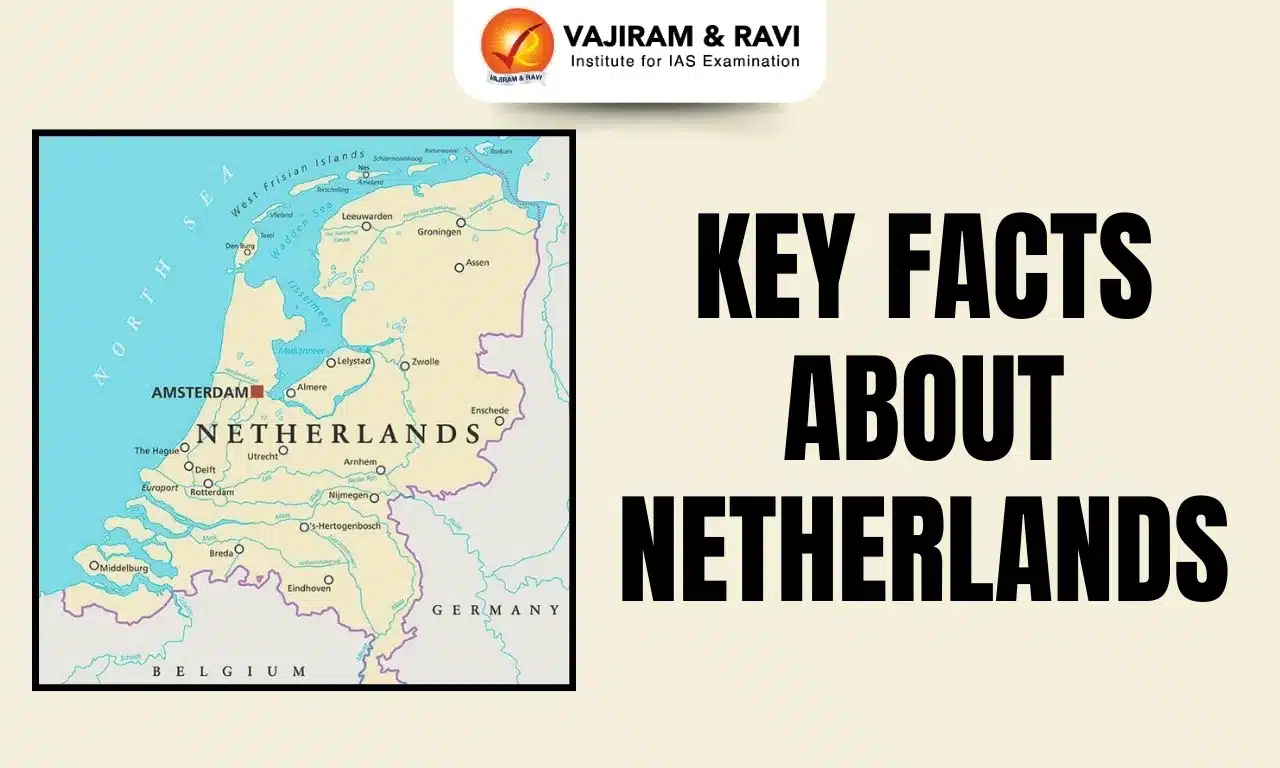
  • Location: It is a country located in Northwestern Europe.
  • Bordering Countries: It is bordered by Germany in the east; and Belgium in the south.
  • Maritime Borders: It is bounded by the North Sea in the north and west. 
  • Capital City: Amsterdam

Geographical Features of Netherlands

    • Three primary geographic regions form the Netherlands: the Lowlands, Veluwe and Utrecht Hill Ridge, and the Limburg Hills.
    • Rivers: Rhine, Meuse and the Scheldt. 
    • Ports: Port of Rotterdam is the country's ports along the North Sea.
    • Climate: It mostly has temperate; marine; cool summers and mild winters.
    • Major lake: Ijsselmeer is the largest freshwater lake of Switzerlands.
    • Highest Point: The highest point on continental Netherlands is Vaalserberg at 322 m
    • Natural resources: It has natural gas, petroleum, peat, limestone, salt

Source: TH

Netherlands FAQs

Q1: What is the capital of Netherlands?

Ans: Amsterdam

Q2: Which Dutch city is known as the "Venice of the North"?

Ans: Amsterdam

Sashastra Seema Bal (SSB)

Sashastra Seema Bal (SSB)

Sashastra Seema Bal (SSB) Latest News

The Prime Minister, Narendra Modi, recently extended his greetings to all personnel associated with the Sashastra Seema Bal on their Raising Day.

About Sashastra Seema Bal (SSB)

  • The Sashastra Seema Bal, previously known as the Special Service Bureau, was established on 15 March 1963 after the Sino–Indian Conflict of 1962.
  • It was created with the objective of guarding India’s international borders with Nepal and Bhutan. 
  • SSB is a part of the Central Armed Police Forces (CAPF) and falls under the Ministry of Home Affairs.
  • Role of SSB:
    • The primary responsibility of SSB is to protect the safety of India’s designated borders with neighbouring nations Nepal and Bhutan.
    • To foster an understanding of security among people residing in those border communities.
    • To stop smuggling, illegal immigration, and other transnational crimes.
    • To stop unlawful entry or exit on or from the Indian Border.
    • To implement social responsibility initiatives in the relevant jurisdiction, for instance, establishing schools, buildings, restrooms, and roads by a border region development plan.
    • To perform any additional tasks, such as UN missions, Law & Order missions, Counter The uprising Operations, Election duty, the central government may assign.
  • Organisation: Headed by a Director General (IPS officer or senior CAPF officer); includes infantry-style battalions, specialized units (engineering, signals, medical, dog squads), and training centers.

Source: PMI

Sashastra Seema Bal (SSB) FAQs

Q1: When was the Sashastra Seema Bal (SSB) established?

Ans: 15 March 1963

Q2: Which borders of India are guarded by the Sashastra Seema Bal (SSB)?

Ans: India’s borders with Nepal and Bhutan.

Q3: Under which ministry does the Sashastra Seema Bal (SSB)?

Ans: Ministry of Home Affairs

Q4: Who heads the Sashastra Seema Bal (SSB)?

Ans: A Director General (an IPS officer or senior CAPF officer).

What is Candida auris (C. auris)?

What is Candida auris (C.auris)

Candida auris Latest News

Scientists recently discovered a genetic process which could unlock new ways to treat mysterious and deadly Candida auris.

About Candida auris

  • It is a fungal pathogen that is often multi-drug-resistant. 
  • This pathogen can live on the skin, inside the human body (e.g. in the gut), or in the environment.
  • It is capable of causing invasive infections in the human body.
  • C. auris causes serious infections such as bloodstream infections, meningitis, bone infections, burns/wound infections, and urinary tract infections. 
  • It was first identified in Japan in 2009.
  • How is it contracted?
    • Most cases of the fungus have been reported in healthcare settings, such as hospitals and nursing homes.
    • It is generally thought to be spread through contact with contaminated surfaces or by person-to-person transmission.
    • People who are already suffering from other medical conditions, recent hospital stays, and invasive devices are most at risk of contracting the fungus.
  • How does the fungus act on the body? There are two ways C. auris can affect the body,
    • The fungus can either live on a specific region, such as the skin, rectum, or mouth, in a process called “asymptomatic colonization,” where a patient has no symptoms but can spread it to other people.
    • It can enter the bloodstream or wounds, where it can cause severe invasive infections.
  • Symptoms:
    • Its symptoms are often similar to those of other common diseases, and hence diagnosis is difficult.
    • The most common symptoms of C. auris include fever and chills that don’t go away after treatment with antibiotics.
  • Mortality Rate: It is estimated to be between 30-60%.
  • Treatment:
    • Most C. auris infections are treatable with antifungal drugs called echinocandins.
    • However, some C. auris infections are resistant to the main types of antifungal medications, making them more difficult to treat.
    • In this situation, multiple antifungals at high doses may be required to treat the infection.

Source: EUK

Candida auris FAQs

Q1: What type of pathogen is Candida auris?

Ans: It is a fungal pathogen that is often multi-drug-resistant.

Q2: What types of severe infections can Candida auris cause?

Ans: It can cause bloodstream infections, meningitis, bone infections, burns/wound infections, and urinary tract infections.

Q3: In what type of settings are most Candida auris cases reported?

Ans: Most cases are reported in healthcare settings such as hospitals and nursing homes.

Kavachi Volcano

Kavachi Volcano

Kavachi Volcano Latest News

Scientists recently reported a rare footage showing sharks living inside Kavachi volcano near the Solomon Islands, challenging assumptions about marine survival in extreme volcanic environments.

About Kavachi Volcano

  • It is a shallow submarine volcano located in the South Pacific Ocean, south of the remote Vangunu Island in the Solomon Islands.
  • It sits on the Pacific Ring of Fire, a tectonically active region.
  • It is one of the world's few active and visible undersea volcanoes.
  • It has been erupting on a regular (though thoroughly unpredictable) basis for many years, including several temporary island-building events.
  • Eruptions typically produce steam plumes, ash, lava, and water discoloration due to volcanic gas release.
  • The new islands formed are not large enough and coated with solid lava flows to be able to resist wave erosion. 
  • Notable eruptive activity has been recorded repeatedly since it was first documented in 1939.

Source: TOI

Kavachi Volcano FAQs

Q1: Kavachi Volcano is located in which region?

Ans: South Pacific Ocean

Q2: What type of volcano is Kavachi?

Ans: Submarine volcano

Q3: Kavachi Volcano is known for what unique characteristic?

Ans: Being one of the few active and visible undersea volcanoes.

Bharat Taxi Initiative

Bharat Taxi Initiative

Bharat Taxi Initiative Latest News

Recently, the Government of India has launched Bharat Taxi initiative.

About Bharat Taxi Initiative

  • It is a first-of-its-kind cooperative-driven, citizen-first national ride-hailing initiative.
  • It is a government-supported initiative developed under the Union Ministry of Cooperation and the National e-Governance Division (NeGD).
  • It is India’s first cooperative taxi network, allowing drivers to become shareholders and co-owners.
  • Promoted: It is being jointly promoted by leading cooperative and financial institutions including NCDC, IFFCO, AMUL, KRIBHCO, NAFED, NABARD, NDDBand NCEL.

Key Features of Bharat Taxi Initiative

  • Driver-Owned Fleet: Drivers can purchase shares and become cooperative members, giving them transparency and decision-making power.
  • Zero Commission: Unlike private cab aggregators that take a large cut, Bharat Taxi transfers the full fare to the driver.
  • Transparent, No-Surge Pricing: Fares will remain predictable, with no surge charges.
  • Deep Digital Integration: Services will connect with government platforms such as DigiLocker and UMANG.
  • Platform Integration & Technical Architecture: Integration of the Bharat Taxi platform with national digital platforms such as DigiLocker, UMANG, and API Setu to enable seamless identity verification and service delivery.
  • Security, Compliance & Infrastructure: Ensuring adherence to Government of India’s data protection norms and cybersecurity standards and advising on robust technical infrastructure.

Source: News On Air

Bharat Taxi Initiative FAQs

Q1: What is Bharat Taxi?

Ans: A government-backed cooperative taxi service.

Q2: Who launched Bharat Taxi?

Ans: Ministry of Cooperation and National e-Governance Division (NeGD)

Competition Commission of India

Competition Commission of India

Competition Commission of India Latest News

Recently, the Competition Commission of India has taken cognizance of information filed against IndiGo in the context of the recent flight disruptions witnessed in the aviation sector.

About Competition Commission of India

  • It is a statutory body which was established in March 2009 under the Competition Act, 2002.
  • The priority of the Commission is to eliminate practices having adverse effects on competition, promote and sustain competition, protect the interests of consumers, and ensure freedom of trade in the markets of India. 
  • Nodal Ministry: Ministry of Corporate Affairs
  • Headquarters: New Delhi

Composition of Competition Commission of India

  • It has the composition of a quasi-judicial body, with one chairperson and six additional members.
  • All members of the CCI are appointed by the Central Government.
  • Eligibility of Members: Appointments to the CCI require a minimum of 15 years of professional experience in areas like international trade, finance, or law, with members serving a five-year term.

Functions of Competition Commission of India

  • Promoting Fair Competition and Consumer Protection: The CCI prevents anti-competitive practices like price-fixing and collusion, ensuring competitive pricing and quality to protect consumer interests.
  • Maintaining Market Freedom: It restricts unfair practices by dominant players, safeguarding a level playing field and reviewing mergers and acquisitions to prevent monopolistic control.
  • Investigation and Penalties: The CCI conducts inquiries into violations, imposes penalties on offenders, and promotes awareness of competition law through training programs.
  • Advisory and Collaborative Role: The CCI provides advisory opinions on competition matters to government bodies and collaborates with other regulators to ensure consistency with competition laws.

Source: News On Air

Competition Commission of India FAQs

Q1: What is the primary objective of the Competition Commission of India (CCI)?

Ans: To ensure fair competition and protect consumer interests

Q2: Under which act is the CCI established?

Ans: Competition Act, 2002

Udanti Sitanadi Tiger Reserve

Udanti Sitanadi Tiger Reserve

Udanti Sitanadi Tiger Reserve Latest News

Forest authorities recently arrested 53 persons for attempting to encroach upon protected land within the Udanti Sitanadi Tiger Reserve, Chhattisgarh.

About Udanti Sitanadi Tiger Reserve

  • It is located in the state of Chhattisgarh.
  • It was established by joining the regions represented by Sitanadi and Udanti wildlife sanctuaries. 
  • The drainage system of the reserve consists of the Mahanadi as the main river, along with the Udanti, Sitanadi, Indravan, and Pairi Rivers as tributaries.
  • The location of the reserve is strategic since it also connects with the Kanker and North Kondagaon forest divisions, forming a contiguous forest corridor to Indravati Tiger Reserve in the Bastar region.
  • It covers an area of about 1,842 sq.km.
  • There are 19 named mountains in the reserve. Deo Dongri is the highest point. The most prominent mountain is Atānga Dongar.
  • Flora
    • The forest type here is predominantly tropical dry and moist deciduous.
    • The forest is dominated by Sal (Shorea robusta), which forms dense patches across the landscape. 
    • Alongside, species such as Teak (Tectona grandis), Bamboo, Tendu, Mahua, Bija, and Harra contribute to the green diversity of the region.
  • Fauna: 
    • Along with the Indravati Tiger Reserve, the Udanti Sitanadi Tiger Reserve is an important refuge for the last few herds of the highly endangered Wild Buffalo.
    • Apart from the tiger, other endangered and rare species are the Indian Wolf, Leopard, Sloth Bear, and Mouse Deer.

Source: TOI

Udanti Sitanadi Tiger Reserve FAQs

Q1: Udanti Sitanadi Tiger Reserve is located in which Indian state?

Ans: Chhattisgarh

Q2: Which major river forms the main drainage system of the Udanti Sitanadi Tiger Reserve?

Ans: The Mahanadi River.

Q3: What is the total area covered by the Udanti Sitanadi Tiger Reserve?

Ans: Approximately 1,842 sq. km.

Q4: What is the predominant forest type found in the Udanti Sitanadi region?

Ans: Tropical dry and moist deciduous forests.

Dark Eagle Hypersonic Missile System

Dark Eagle Anti Missile System

Dark Eagle Hypersonic Missile System Latest News

The US Army and Navy recently completed integrated testing of the Dark Eagle Long-Range Hypersonic Weapon (LRHW).

About Dark Eagle Hypersonic Missile System

  • It is a hypersonic missile system of the United States Army.
  • It is a non-nuclear, ground-launched hypersonic missile weapon system.
  • The missile component of the LRHW is reportedly being developed by Lockheed Martin and Northrop Grumman.
  • Built for strategic attack missions, the weapon is capable of penetrating anti-access/area-denial (A2/AD) defenses, suppressing long-range enemy fires, and delivering rapid precision effects when and where they are needed.

Dark Eagle Hypersonic Missile System Features

  • It is a land-based hypersonic weapon designed to strike targets at distances of up to 2,735 kilometers.
  • It comprises a mobile ground-based battery equipped with four Transporter Erector Launchers (TEL), supported by command and control elements, with each TEL capable of launching two missiles for a total of eight.
  • The system’s ballistic missile features two stages, one of which includes a hypersonic glide warhead (C-HGB), an unpowered but highly maneuverable vehicle capable of reaching extreme speeds of Mach 17, making interception particularly difficult.
  • The missile climbs to the edge of space, flies through the upper atmosphere out of reach of most enemy defenses, then maneuvers toward its target.
  • Each hypersonic missile is powered by a solid-fueled two-stage rocket booster.

Source: ET

Dark Eagle Hypersonic Missile System FAQs

Q1: The Dark Eagle LRHW is a hypersonic missile system developed by which country?

Ans: United States

Q2: The Dark Eagle LRHW is classified as which type of weapon system?

Ans: Non-nuclear, ground-launched system.

Q3: What is the maximum strike range of the Dark Eagle LRHW?

Ans: 2,735 km

Q4: What type of propulsion is used in each Dark Eagle hypersonic missile?

Ans: Solid-fueled two-stage rocket booster.

Autophagy

Autophagy

Autophagy Latest News

Researchers have uncovered a surprising player in the autophagy process that can pave the way for developing therapies for diseases such as Alzheimer’s, Parkinson’s, and cancer.

About Autophagy

  • It is a key biological process where cells clear out damaged and unwanted materials.
  • The autophagy pathway, which removes damaged material and defends against infections, is disrupted in diseases like Alzheimer’s and Huntington’s.
  • When a cell fails to clear waste, its health suffers, especially in long-lived neurons.
  • Autophagy is the body's cellular recycling system.
  • It allows a cell to disassemble its junk parts and repurpose the salvageable bits and pieces into new, usable cell parts.

Importance of Autophagy

  • It recycles damaged cell parts into fully functioning cell parts.
  • It gets rid of nonfunctional cell parts that take up space and slow performance.
  • It destroys pathogens in a cell that can damage it, like viruses and bacteria.
  • Autophagy plays an important role when it comes to aging and longevity, too. 

Autophagy and Disease Linkages

  • Autophagy initially prevents cancer but later supports tumour growth and acts as a tumour suppressor by maintaining genome integrity and cellular homeostasis.
  • In certain types of cancer, cells hijack autophagy for their own survival and propagation.

Source: DD News

Autophagy FAQs

Q1: What is autophagy?

Ans: A process of cellular digestion and recycling

Q2: What is the role of autophagy in cells?

Ans: To remove damaged organelles and proteins.

Tundra Ecosystem

Tundra Ecosystem

Tundra Ecosystem Latest News

 According to a study conducted in Arctic Alaska, wildfires in the tundra have been more active this past century than at any time in the past 3,000 years.

About Tundra Ecosystem

Tundra Biome is a treeless region found in the Arctic and on the tops of mountains, where the climate is cold and windy, and rainfall is scant.

Characteristics of Tundra Ecosystem

  • Low temperatures: The average temperature is -34 to -6 degrees Celsius (-30 to 20 degrees Fahrenheit) in the tundra region.
  • Short growing seasons: The summer growing season is just 50 to 60 days, when the sun shines up to 24 hours a day.
  • Permafrost: A layer of permanently frozen soil lies beneath the surface, which can be a few inches to several feet thick.
  • Minimal precipitation: Despite often being compared to deserts in terms of moisture, the tundra receives low levels of precipitation, often as snow.
  • Limited biodiversity: The harsh conditions of the tundra result in fewer plant and animal species compared to other biomes.
  • Carbon sink: The tundra acts as a significant carbon storage area due to slow decomposition rates in the cold environment.

The World has Three Types of Tundra

  • Arctic Tundra: It  occurs north of the taiga belt in the far Northern Hemisphere (It encompasses the land between the North Pole and the boreal forest, including parts of Canada, Russia, Greenland, Iceland, Norway, Sweden, and Finland.)
  • Alpine tundra: It prevails above the tree line in mountains worldwide (in various mountain ranges such as the Rockies, the Andes, the Himalayas, and the Alps).
  • Antarctic tundra: It includes several sub-Antarctic islands and parts of the continent of Antarctica.
  • Flora: Mosses, lichens, sedges, cotton grass, birches etc.
  • Fauna: Arctic foxes, snow geese, polar bears etc.

Source: DTE

Tundra Ecosystem FAQs

Q1: What is the Tundra Biome characterized by?

Ans: Cold temperatures and low vegetation

Q2: Where is the Tundra Biome primarily located?

Ans: In Arctic and sub-Arctic regions

Rupee Depreciation – Rupee at ₹91/USD a Crisis Signal or External Shock

Rupee Depreciation - Rupee at ₹91/USD a Crisis Signal or External Shock

Rupee Depreciation Latest News

  • The Indian Rupee (INR) recently breached the psychological level of ₹91/USD, triggering speculation about a possible slide towards ₹100/USD.
  • The rupee depreciation comes amid global trade uncertainties, especially high U.S. tariffs on Indian goods, and has sparked a debate on whether this trend is structurally worrisome or cyclical and manageable.
  • Experts present divergent views on the implications for macroeconomic stability, capital flows, exports, and growth.

Key Drivers of Rupee Depreciation

  • External factors:
    • U.S. tariffs (up to 50%) on Indian exports under the Trump administration.
    • Global market volatility and risk-off sentiment.
    • Broad-based depreciation of INR against major global currencies (USD, Euro, Yen, Pound, Swiss Franc, etc.).
  • Domestic structural factors:
    • Persistent Current Account Deficit (CAD).
    • Dependence on capital inflows to finance growth.
    • Rising outward remittances under the Liberalised Remittance Scheme (LRS) and demand for gold as a hedge.

Divergent Expert Views

  • View 1 - Key arguments on depreciation as a serious concern:
    • A “leaking rupee” hampers income growth targets.
    • Reduces foreign portfolio investment (FPI) attractiveness due to currency risk.
    • Encourages capital flight via LRS and dollar-linked assets.
    • Shrinks domestic capital availability, increasing the cost of capital.
    • Weakens macroeconomic growth potential in a high-growth phase.
    • On exports: The notion that a weak rupee boosts exports is a myth -
      • Indian exports lack pricing power (unlike Apple/Microsoft).
      • Mostly B2B exports, where buyers negotiate based on rupee cost structures.
      • Major exporter China succeeded on constant currency competitiveness, not depreciation.
  • View 2 - Key arguments on depreciation not alarming:
    • Depreciation is externally driven, not due to domestic macro weakness.
    • India’s macroeconomic fundamentals remain strong adequate forex reserves, manageable CAD, robust GDP growth
    • Seen as a temporary aberration, not a structural crisis.
    • Opportunity angle:
      • Indian Government Bonds (IGBs) are effectively 6% cheaper for foreign investors due to currency depreciation.
      • Could attract fresh capital inflows into Indian markets.

Impact on Export Competitiveness

  • Changing export structure: Shift towards value-added exports: engineering goods, specialty chemicals, pharmaceuticals, electronics.
  • Problem with depreciation: These sectors have high import intensity in their value chains. A weaker rupee raises input costs, potentially reducing net export competitiveness.

Outlook for the Rupee

  • Short-term pressure: Likely due to tariffs and global uncertainty.
  • Medium-term optimism: Expected India–U.S. trade deal by early 2026. Anticipated improvement in capital flows.
  • Long-term scenario:
    • Assuming 2–3% annual depreciation, the rupee may stay under pressure but avoid disorderly collapse.
    • Possibility of rupee strengthening below ₹90/USD if external conditions stabilise.

Challenges and Way Forward

  • Managing CAD: This should be done without excessive capital inflow dependence. Strengthen export competitiveness through productivity gains, not currency depreciation.
  • Preventing capital flight amid currency volatility: Promote stable, long-term capital inflows (FDI over volatile FPI).
  • Balancing export competitiveness with rising import costs: Diversify export markets and products to reduce tariff vulnerability.
  • Maintaining investor confidence: Maintain credible macroeconomic fundamentals - fiscal discipline, inflation control, forex buffer. Accelerate trade negotiations to reduce tariff-related shocks.

Conclusion

  • The rupee’s fall past ₹91/USD reflects a complex interplay of external trade shocks and structural economic constraints rather than an immediate macroeconomic crisis. 
  • While strong fundamentals provide resilience, over-reliance on depreciation as a growth or export strategy is misplaced. 
  • For India, sustainable competitiveness, capital stability, and policy credibility—not a weaker currency—will determine long-term economic strength.

Source: TH

Rupee Depreciation FAQs

Q1: What are the key factors behind the recent depreciation of the Indian Rupee beyond ₹91 per dollar?

Ans: The depreciation is driven by external shocks such as high U.S. tariffs, global market volatility, persistent CADand volatile capital flows.

Q2: Why does a depreciating rupee not automatically enhance India’s export competitiveness?

Ans: Most Indian exports lack pricing power and have high import intensity, making depreciation raise input costs and reduce net competitiveness.

Q3: Why is a weakening rupee seen as a challenge for India’s capital formation and growth prospects?

Ans: A weaker rupee discourages foreign capital inflows, encourages outward remittances under LRS, and raises the overall cost of capital in the economy.

Q4: How do strong macroeconomic fundamentals moderate concerns over the rupee’s depreciation?

Ans: Adequate forex reserves, manageable CAD and robust GDP growth prevent depreciation from turning into a macroeconomic crisis.

Q5: What policy measures can help India manage exchange rate volatility without relying on depreciation-led growth?

Ans: Strengthening productivity, diversifying exports, attracting stable FDI, maintaining fiscal discipline, etc.

MGNREGA vs New Rural Employment Bill: Why the Government Is Replacing MGNREGA

Why the Government Is Reviewing MGNREGA’s Future

MGNREGA Latest News

  • Recently, Parliament passed the Viksit Bharat Guarantee For Rozgar and Ajeevika Mission (Gramin) or VB-G RAM G Bill, just three days after it was circulated, replacing MGNREGA (2005)
  • The move drew strong protests from the Opposition and civil society, who accused the government of pushing the legislation without prior consultation or adequate debate.

Origins of MGNREGA: From Civil Society Vision to Law

  • In 2005, Parliament passed a national rural employment guarantee law, which was expanded to all districts by 2008. 
  • After 2009, it was renamed the Mahatma Gandhi National Rural Employment Guarantee Act (MGNREGA).

Role of the National Advisory Council (NAC)

  • In 2004, the National Advisory Council (NAC) brought together civil society leaders, retired officials, and intellectuals. 
  • At its very first meetings, Aruna Roy and economist Jean Drèze proposed two landmark ideas: the Right to Information Act and a rural employment guarantee. 
  • The initial MGNREGA draft was prepared swiftly, emerging from the NAC’s August 19, 2004 meeting.

Dilution and Pushback

  • The Bill sent to Parliament diluted the NAC’s vision—removing universal coverage, weakening the “guarantee,” and limiting benefits to below-poverty-line families. 
  • This prompted widespread protests by civil society groups, especially the Right to Food Campaign.

Parliamentary Review and Restoration

  • The weakened Bill was examined by the Parliamentary Standing Committee on Rural Development. 
  • The committee recommended restoring most original provisions. 
  • The government accepted these changes, leading to the Bill’s passage in 2005—cementing MGNREGA as a rights-based employment guarantee.

Why MGNREGA Was Unique: Rights, Reach, and Resilience

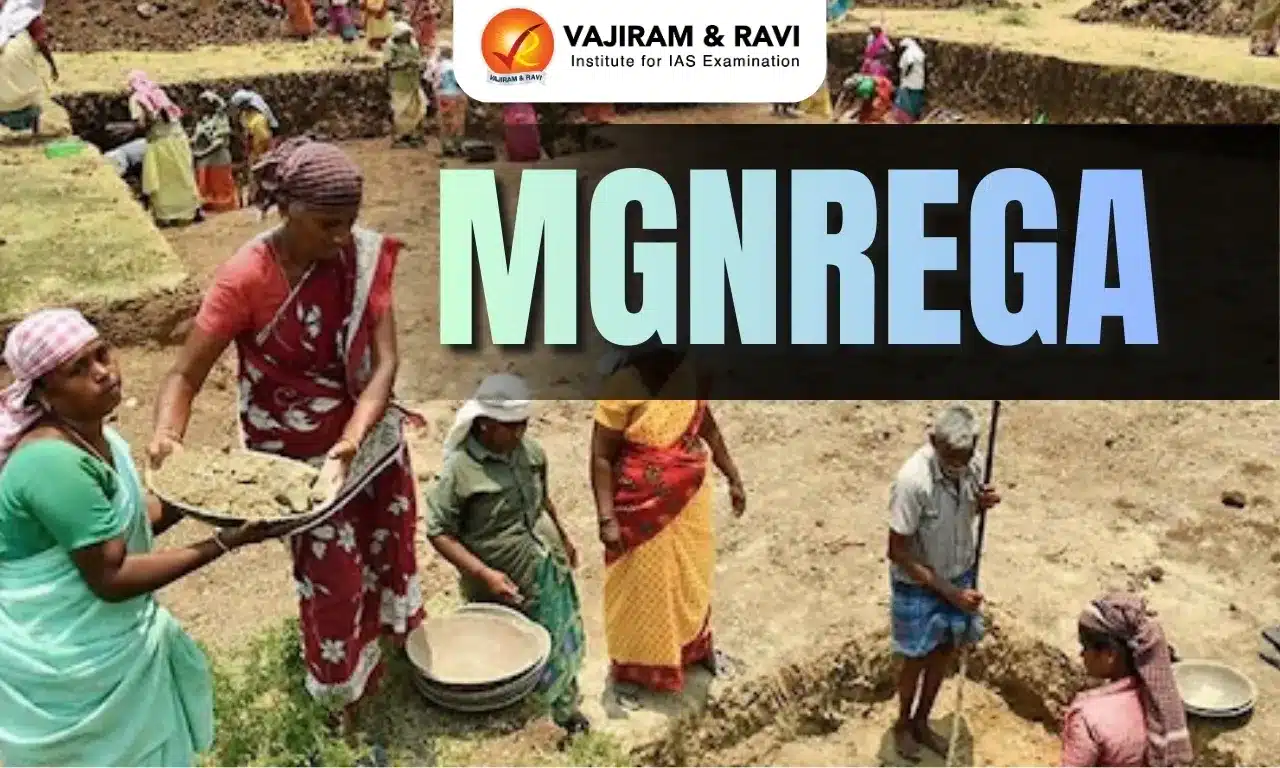
  • MGNREGA guaranteed 100 days of paid unskilled work per rural household on demand, making it a legal entitlement rather than a welfare dole. 
  • Wages in 2025–26 ranged from ₹241 to ₹400, offering a basic safety net against extreme poverty.
  • Universal and Non-Targeted Design - Unlike most schemes, MGNREGA was universal—not restricted by caste, category, or Below Poverty Line status. Anyone willing to work could access it, avoiding exclusion errors tied to disputed poverty metrics.
  • Scale and Inclusion - About 12.61 crore active workers depend on the scheme.  Women account for nearly 58% participation over the past five years, many entering paid work for the first time. SCs and STs form 35% of the workforce, with studies showing up to 30% higher consumption for Dalit and Adivasi households during lean seasons.
  • Crisis Buffer During COVID-19 - MGNREGA proved crucial during the pandemic. A survey led by Azim Premji University found that in Karnataka, over 60% of households felt the scheme contributed to village development and stability.
  • Reducing Distress Migration - Avoiding migration emerged as the top reason for continuing MGNREGA. A large majority recommended expanding support to 100 days per person, not just per household.
  • Building Citizenship and Collective Action - Beyond incomes, MGNREGA fostered civic engagement and rights awareness, strengthening worker organisation and unionisation in States like Rajasthan and Karnataka—an impact rare among welfare programmes.
  •  

Government’s Rationale for Introducing a New Rural Employment Bill

  • The government argues that MGNREGA suffers from serious flaws, citing widespread corruption and misuse of funds by State governments, as stated by the Union Rural Development Minister in Parliament. 
  • However, critics note that these were largely implementation challenges, not design failures. 
  • MGNREGA already had strong safeguards, including social audits and a transparent IT-based system tracking work demand, execution, and wage payments.

How the New Bill Differs from MGNREGA

  • From Demand-Driven to Supply-Driven - MGNREGA guaranteed work on demand. The new Bill shifts to a supply-driven model, with employment capped by a fixed Union budget and provided only in Centre-notified rural areas, ending the scheme’s universal character.
  • Funding Pattern and State Burden - While MGNREGA effectively operated on a 90:10 Centre–State cost share, the new Bill raises States’ burden. Funding will be 60:40 for most States, and 90:10 for northeastern and Himalayan States, increasing fiscal pressure on State governments.
  • More Days, Less Autonomy - The guaranteed workdays rise from 100 to 125, but the Centre gains greater control—deciding State-wise allocations using unspecified parameters and notifying eligible rural areas each year.
  • Selective Coverage and Blackout Periods - Unlike MGNREGA’s universal access, implementation will be selective. The Bill also allows blackout periods during peak agricultural seasons, temporarily suspending work to ensure farm labour availability—another major departure from the original Act.

Source: TH

MGNREGA FAQs

Q1: Why does the government want an MGNREGA replacement?

Ans: The government argues MGNREGA faces corruption and misuse by States, prompting the VB-G RAM G Bill to improve efficiency and fiscal control.

Q2: How was MGNREGA different from other welfare schemes?

Ans: MGNREGA was demand-driven, universal, and rights-based, guaranteeing 100 days of work without caste, poverty-line, or regional restrictions.

Q3: What are the key changes in the new rural employment Bill?

Ans: The MGNREGA replacement shifts to a supply-driven model, caps budgets, limits coverage to notified areas, and increases guaranteed workdays to 125.

Q4: How does the new Bill change Centre–State funding?

Ans: Unlike MGNREGA’s 90:10 structure, the new Bill raises States’ share to 40% for most States, increasing their financial burden.

Q5: Why is the MGNREGA replacement controversial?

Ans: Critics argue it weakens the right to work, centralises control, allows blackout periods during peak farm seasons, and undermines rural livelihood security.

Child Marriage in India: Trends, Regional Gaps, Laws and the Road to 2030

Child Marriage in India

Child Marriage in India Latest News

  • The Union government launched a 100-day awareness drive to mark one year of the Bal Vivah Mukt Bharat Abhiyan, reaffirming India’s pledge to end child marriage by 2030. 
  • While child marriage has declined over the past decade, progress remains uneven across States and socio-economic groups, leaving substantial gaps to meet the UN target.

Global Push to End Child Marriage: Targets, Stakes, and Slow Progress

  • Ending child marriage is central to SDG 5 on gender equality, with Target 5.3 aiming to eliminate child, early, and forced marriages. 
    • Target 5.3 is to eliminate all harmful practices, including child marriage, as well as early and forced marriages, and female genital mutilation. 
  • Progress is measured by the share of women aged 20–24 married before 18. 
  • Experts warns that failure to end child marriage will derail at least nine SDGs, spanning poverty, health, education, economic growth, climate action, and peace. 
  • In 2023, UNICEF estimated 64 crore women worldwide were married as children, with India accounting for one-third. 
  • At current rates, progress must accelerate 20-fold to meet the 2030 goal.

Child Marriage in India: Progress, Plateaus, and Persistent Inequalities

  • Sharp Decline, Slower Momentum - India reduced child marriage significantly from 47.4% (2005–06) to 26.8% (2015–16), a steep 21-point fall. However, progress slowed thereafter, declining only to 23.3% by 2019–21.
  • Wide Regional Variations - Rates remain highest in West Bengal (42%), Bihar (40%), and Tripura (39%), with several other States above the national average. In contrast, Lakshadweep, J&K, Ladakh, Himachal Pradesh, Goa, and Nagaland report the lowest prevalence.
  • Education and Income Gaps - Child marriage is strongly linked to socio-economic status. Nearly half of girls with no education marry before 18, compared to just 4% with higher education. Similarly, 40% of girls from the poorest households marry early, against 8% from the richest quintile.

Tackling Child Marriage in India: Laws, Campaigns, and Social Change

  • India enacted the Prevention of Child Marriage Act, 2006, after which child marriage rates halved. 
  • The Protection of Children from Sexual Offences Act, 2012 further strengthened protection. 
  • However, experts stress that laws alone are insufficient without changing social norms—especially by expanding girls’ education, the most effective factor in delaying marriage.

Bal Vivah Mukt Bharat Abhiyan: On-Ground Action

  • Under the campaign, 54,917 Child Marriage Prevention Officers have been appointed nationwide. 
  • In one year, 1,520 child marriages were prevented through persuasion or administrative action, with Madhya Pradesh and Haryana leading. 
  • Still, 198 cases could not be stopped, requiring police or child welfare intervention. 
  • The campaign also works with faith leaders, youth groups, and community networks to encourage reporting and shift attitudes at the grassroots.

Girls’ Empowerment and Welfare Schemes

  • The Beti Bachao Beti Padhao scheme focuses on improving child sex ratio and girls’ education, though implementation has been uneven. 
  • Complementary measures include financial incentives (Laadli schemes), improved school sanitation, and cycles for safe travel, aimed at keeping girls in school longer.

State-Level Incentives: Mixed Signals

  • Some States support girls’ education through targeted aid. 
  • For example, West Bengal’s Kanyashree scheme provides annual support to girls aged 13–18 and a lump sum for those delaying marriage and pursuing higher education. 
  • Some women’s activists argue that the State with the highest child marriage rates is sending a confusing message through the Rupashree scheme. 
  • While the scheme gives ₹25,000 to poor families only if the daughter is over 18, offering money at the time of marriage may still encourage early marriages instead of delaying them further.

Debate on Raising the Legal Age of Marriage for Women

  • The Centre has proposed increasing the minimum marriage age for women to 21 years, aligning it with men to support higher education, skill development, economic independence, and better maternal and child health. 
  • However, the proposal has faced opposition seeking deeper scrutiny. 
  • Critics caution that without parallel social reforms, the change could criminalise large sections of society, as 61% of women aged 20–24 were married before turning 21.

Source: TH | UNICEF

Child Marriage in India FAQs

Q1: What is the current status of child marriage in India?

Ans: Child marriage in India declined from 47.4% in 2005–06 to 23.3% in 2019–21, but progress has slowed and remains uneven across regions and communities.

Q2: Which States have the highest child marriage rates in India?

Ans: West Bengal, Bihar, and Tripura report the highest child marriage rates, followed by Jharkhand, Andhra Pradesh, Assam, Telangana, Madhya Pradesh, and Rajasthan.

Q3: How does education affect child marriage in India?

Ans: Education is the strongest deterrent: 48% of girls with no education marry early, compared to just 4% among those with higher education.

Q4: What laws address child marriage in India?

Ans: The Prevention of Child Marriage Act, 2006 and the POCSO Act, 2012 form the legal framework, supported by campaigns like Bal Vivah Mukt Bharat Abhiyan.

Q5: Why is ending child marriage critical for India’s development goals?

Ans: Child marriage in India impacts poverty, health, education, gender equality, and economic growth, threatening progress on at least nine UN Sustainable Development Goals.

SHANTI Act and India’s Nuclear Energy Roadmap

SHANTI Act and India’s Nuclear Energy Roadmap

SHANTI Act Latest News

  • Parliament has enacted the Sustainable Harnessing and Advancement of Nuclear Energy for Transforming India (SHANTI) Act, replacing older nuclear laws to accelerate nuclear power expansion and attract private participation. 

India’s Nuclear Energy Programme: Background

  • Nuclear energy has been a strategic component of India’s long-term energy planning since independence. 
  • Guided by Homi Bhabha’s three-stage nuclear programme, India sought energy security while overcoming its limited uranium reserves by eventually using thorium, which is abundantly available domestically.
  • At present, nuclear power contributes about 3% of India’s electricity generation, with an installed capacity of 8.8 GW, making it a relatively small but stable and low-carbon energy source. 
  • However, meeting India’s growing electricity demand while transitioning to clean energy has renewed focus on expanding nuclear power alongside renewables.

Existing Legal Framework Before SHANTI

  • Before the new Act, India’s nuclear sector was governed by two major laws:
    • Atomic Energy Act, 1962, which restricted nuclear power generation to public sector entities
    • Civil Liability for Nuclear Damage (CLND) Act, 2010, which imposed liability not only on operators but also allowed recourse against equipment suppliers
  • While the CLND Act aimed to protect citizens in case of nuclear accidents, its supplier liability clause discouraged foreign and private companies from investing in India’s nuclear sector. 
  • This became a major bottleneck after the 2008 Indo-US civil nuclear agreement, as international reactor manufacturers remained wary of legal exposure. 

Key Features of the Act

  • The SHANTI Act repeals both earlier laws and introduces a consolidated legal framework for nuclear energy development. 
  • Its core objective is to scale up nuclear capacity to 100 GW by 2047, increasing nuclear power’s share in India’s energy mix.
  • A major shift under SHANTI is opening the sector to private companies and facilitating foreign investment, while maintaining state oversight on safety and regulation. 
  • State-owned utilities are expected to add around 54 GW, with the remaining capacity likely coming from private players.

Changes in Nuclear Liability Provisions

  • Safety and liability lie at the heart of nuclear regulation. Under international norms, nuclear plant operators are strictly liable for damages, with immediate compensation to victims, irrespective of fault.
  • The earlier CLND Act allowed operators to seek compensation from suppliers if equipment defects caused an accident. 
  • SHANTI removes this supplier liability clause and even eliminates the explicit reference to “suppliers,” thereby addressing long-standing concerns of foreign reactor manufacturers.
  • The Act introduces a graded liability system based on plant capacity:
    • Rs. 3,000 crore for plants above 3,600 MW
    • Rs. 1,500 crore for 1,500-3,600 MW
    • Rs. 750 crore for 750-1,500 MW
    • Rs. 300 crore for 150-750 MW
    • Rs. 100 crore for plants below 150 MW
  • This graded approach aims to reduce risk perception and encourage private investment, though concerns remain about the adequacy of compensation in severe accidents. 

Regulatory Structure and Safety Oversight

  • The SHANTI Act gives statutory backing to the Atomic Energy Regulatory Board (AERB), strengthening its legal status. 
  • However, the Union government continues to control key aspects such as licensing and appointments, raising questions about regulatory independence.
  • Given global nuclear disasters like Chernobyl (1986) and Fukushima (2011), safety oversight remains critical, and India’s cautious regulatory approach reflects these historical lessons.

Nuclear Expansion and Small Modular Reactors

  • To meet its ambitious targets, India plans to rely significantly on Small Modular Reactors (SMRs)
  • These reactors are smaller, factory-built units that can be assembled on-site, potentially reducing construction time.
  • However, SMRs require enriched uranium-235, which India lacks in sufficient quantities, and they do not directly support India’s long-term thorium-based vision. 
  • They are also costlier per unit of electricity and do not fundamentally solve the problem of radioactive waste.
  • Meanwhile, India’s Fast Breeder Reactor, essential for moving to the second stage of the three-stage programme, has faced repeated delays and is now expected to be commissioned only by 2026.

Source : TH

SHANTI Act FAQs

Q1: What is the SHANTI Act?

Ans: It is a new law governing nuclear energy that replaces the Atomic Energy Act, 1962 and the CLND Act, 2010.

Q2: Why was the CLND Act seen as restrictive?

Ans: Because it allowed operators to seek compensation from suppliers, deterring private and foreign investment.

Q3: What nuclear capacity does India aim to achieve under SHANTI?

Ans: India targets 100 GW of nuclear capacity by 2047.

Q4: How does SHANTI change nuclear liability rules?

Ans: It removes supplier liability and introduces graded compensation limits based on plant size.

Q5: Are Small Modular Reactors central to India’s nuclear plans?

Ans: Yes, but they rely on enriched uranium and do not directly advance India’s thorium-based programme.

Enquire Now