UPSC Daily Quiz 24 December 2025

UPSC Daily Quiz

[WpProQuiz 54]

UPSC Daily Quiz FAQs

Q1: What is the Daily UPSC Quiz?

Ans: The Daily UPSC Quiz is a set of practice questions based on current affairs, static subjects, and PYQs that help aspirants enhance retention and test conceptual clarity regularly.

Q2: How is the Daily Quiz useful for UPSC preparation?

Ans: Daily quizzes support learning, help in revision, improve time management, and boost accuracy for both UPSC Prelims and Mains through consistent practice.

Q3: Are the quiz questions based on the UPSC syllabus?

Ans: Yes, all questions are aligned with the UPSC Syllabus 2025, covering key areas like Polity, Economy, Environment, History, Geography, and Current Affairs.

Q4: Are solutions and explanations provided with the quiz?

Ans: Yes, each quiz includes detailed explanations and source references to enhance conceptual understanding and enable self-assessment.

Q5: Is the Daily UPSC Quiz suitable for both Prelims and Mains?

Ans: Primarily focused on Prelims (MCQ format), but it also indirectly helps in Mains by strengthening subject knowledge and factual clarity.

National Parks in Odisha, Map, Wildlife Sanctuaries, Tiger Reserves

National Parks in Odisha

National Parks in Odisha are large, legally protected natural areas created to conserve entire ecosystems, ecological processes, and native wildlife with minimal human interference. As per the IUCN definition, protected areas are clearly defined geographical spaces managed through legal means to ensure long-term conservation of nature, ecosystem services, and cultural values. The National Parks in India support biodiversity conservation, climate regulation, water security, scientific research, education, and sustainable eco-tourism while maintaining ecological balance across landscapes and biogeographic zones.

Protected Areas in Odisha

Odisha has a well-distributed protected area network covering coastal, plateau, mangrove, riverine, and Eastern Ghats ecosystems.

  • National Parks: Highest legal protection areas conserving entire ecosystems.
  • Wildlife Sanctuaries: Areas allowing limited regulated human activities.
  • Tiger Reserves: Landscapes prioritizing tiger and prey conservation.
  • Ramsar Sites: Wetlands of international importance under Ramsar Convention.
  • Biosphere Reserves: Large regions integrating conservation with livelihoods.

National Parks in Odisha

There are two officially notified National Parks in Odisha, namely- Bhitarkanika and Similipal. These represent coastal mangrove and plateau forest ecosystems respectively. These parks protect globally significant biodiversity including mangroves, estuarine crocodiles, melanistic tigers, elephants, orchids, and migratory birds. Similipal was declared Odisha’s second National Park in 2025, becoming India’s 107th National Park. Together, these parks secure key habitats, regulate hydrology, support climate resilience, and serve as biodiversity strongholds within the Eastern Ghats and coastal ecological systems.

[my_image src="https://vajiramandravi.com/current-affairs/wp-content/uploads/2025/12/National-Parks-in-Odisha-map.webp" size="full" align="none" width="auto" height="535px" alt="National Parks in Odisha map" title="National Parks in Odisha map"]

Bhitarkanika National Park

Bhitarkanika National Park conserves India’s second-largest mangrove ecosystem within a complex estuarine river network. The key features of the Bhitarkanika National Park has been listed below:

  • Location: It is located within the Kendrapara district of Odisha.
  • Area: It is spread over 145 sq km covering a vast area.
  • Ecosystem Type: Mangrove forests influenced by Brahmani, Baitarani, and Dhamra rivers.
  • Crocodile Habitat: Largest breeding ground of saltwater crocodiles in India.
  • Turtle Nesting: Adjacent Gahirmatha beach hosts world’s largest Olive Ridley rookery.
  • Bird Diversity: Bagagahana heronry supports thousands of nesting waterbirds.
  • Hydrology: Interlinked creeks, canals, and tidal channels shape unique estuarine ecology.

Similipal National Park

Similipal National Park protects a large plateau forest ecosystem within the Eastern Ghats landscape. The major highlights of Similipal National Park has been given below:

  • Location: It is located in the Mayurbhanj district of Odisha.
  • Area: It covers area of about 845.70 sq km
  • Tiger Uniqueness: World’s only natural habitat of wild melanistic tigers.
  • Species Richness: Home to 40 Bengal tigers and 25% of Odisha’s elephants.
  • Floral Diversity: Supports 104 orchid species including several endemics.
  • Geography: Surrounded by plateaus with Meghashini and Khairiburu highest peaks.
  • Waterfalls: Barehipani and Joranda rank among India’s tallest waterfalls.

Tiger Reserves in Odisha

Odisha has two notified tiger reserves and one approved reserve expanding tiger conservation landscapes. The list of existing and proposed Tiger Reserves in Odisha has been given below:

  1. Similipal Tiger Reserve: Largest reserve protecting melanistic tigers, elephants, and Eastern Ghats forests across Mayurbhanj district.
  2. Satkosia Tiger Reserve: Combines Satkosia Gorge and Baisipalli sanctuaries conserving riverine forests along Mahanadi gorge.
  3. Debrigarh Tiger Reserve (Proposed): NTCA-approved sanctuary near Hirakud reservoir, strengthening central Indian tiger corridor connectivity.

Wildlife Sanctuaries in Odisha

Odisha hosts a diverse network of Wildlife Sanctuaries covering rivers, forests, hills, wetlands, and coastlines. There are total 19 Wildlife Sanctuaries in Odisha as listed below:

  1. Badrama Wildlife Sanctuary: Located near Hirakud reservoir, protecting moist deciduous forests and elephant habitats.
  2. Baisipalli Wildlife Sanctuary: Part of Satkosia landscape along Mahanadi gorge with rich riverine biodiversity.
  3. Balukhand Konark Wildlife Sanctuary: Coastal sanctuary protecting dunes, casuarina plantations, blackbucks, and spotted deer.
  4. Chandaka Dampara Wildlife Sanctuary: Elephant reserve near Bhubaneswar supporting migratory elephant corridors.
  5. Debrigarh Wildlife Sanctuary: Forested hills near Hirakud reservoir with leopard and bird diversity.
  6. Hadgarh Wildlife Sanctuary: Catchment of Salandi river supporting elephants and linking Similipal landscape.
  7. Kapilash Wildlife Sanctuary: Elephant corridor between Mahanadi and Brahmani rivers near Cuttack.
  8. Kothagarh Wildlife Sanctuary: Eastern Ghats forest connected with Karlapat and Satkosia landscapes.
  9. Lakhari Valley Wildlife Sanctuary: Eastern Ghats sanctuary drained by Rushikulya river system.
  10. Nandankanan Wildlife Sanctuary: Urban-proximate sanctuary known for captive breeding of lions and crocodiles.
  11. Satkosia Gorge Wildlife Sanctuary: River gorge ecosystem with moist deciduous and riverine forests.
  12. Sunabeda Wildlife Sanctuary: Proposed tiger reserve adjoining Udanti-Sitanadi landscape of Chhattisgarh.
  13. Karlapat Wildlife Sanctuary: Eastern Ghats sanctuary in Kalahandi supporting leopards and deciduous forests.
  14. Khalasuni Wildlife Sanctuary: Adjacent to Badrama, protecting forested hills and wildlife corridors.
  15. Kuldiha Wildlife Sanctuary: Forested hills linked to Similipal through narrow ecological corridors.
  16. Gahirmatha Marine Wildlife Sanctuary: World’s largest Olive Ridley turtle nesting beach along Odisha coast.
  17. Chilika Nalabana Wildlife Sanctuary: Core bird habitat within Chilika lagoon hosting migratory waterfowl.
  18. Bhitarkanika Wildlife Sanctuary: Larger mangrove landscape surrounding Bhitarkanika National Park.
  19. Similipal Wildlife Sanctuary: Buffer zone around national park allowing regulated human activities.

Ramsar Site in Odisha

Odisha has six Ramsar wetlands recognized for global ecological importance.

  1. Chilika Lake: Asia’s largest brackish lagoon supporting Irrawaddy dolphins and migratory birds.
  2. Bhitarkanika Mangroves: Mangrove wetland protecting saltwater crocodiles and Olive Ridley turtles.
  3. Ansupa Lake: Odisha’s largest freshwater lake formed by Mahanadi oxbow system.
  4. Hirakud Reservoir: Major flood-regulating wetland supporting fish and waterbird diversity.
  5. Satkosia Gorge: Riverine wetland with endangered turtles and Eastern Ghats biodiversity.
  6. Tampara Lake: Coastal freshwater lagoon aiding flood control and fishery resources.
Also Check
National Parks in Uttar Pradesh National Parks in Bihar
National Parks in Assam National Parks in Uttarakhand
National Parks in West Bengal National Parks in Arunachal Pradesh
National Parks in Andhra Pradesh

National Parks in Odisha FAQs

Q1: How many National Parks are there in Odisha?

Ans: Odisha has two national parks: Bhitarkanika National Park and Similipal National Park.

Q2: Which National Park in Odisha is famous for melanistic tigers?

Ans: Similipal National Park is globally known for hosting the world’s only wild melanistic tigers.

Q3: Which ecosystem is protected by Bhitarkanika National Park?

Ans: Bhitarkanika protects India’s second-largest mangrove ecosystem with estuarine and tidal habitats.

Q4: How many Tiger Reserves are officially notified in Odisha?

Ans: Odisha has two notified tiger reserves: Similipal and Satkosia, with Debrigarh approved as the third.

Q5: Which Ramsar site in Odisha is the largest coastal lagoon in India?

Ans: Chilika Lake is India’s largest coastal lagoon and the first Ramsar site of the country.

National Parks in Tamil Nadu, Map, Wildlife Sanctuaries, Ramsar Sites

National Parks in Tamil Nadu Map

National Parks in Tamil Nadu are legally notified areas under the Wildlife Protection Act, 1972, created to conserve ecosystems, species, and landscapes of high ecological value. No human activity is allowed except those permitted by the Chief Wildlife Warden. Wildlife Sanctuaries allow limited human activities under regulation, while Biosphere Reserves focus on conservation, research, and sustainable use. There are a total 107 National Parks in India covering 44,402.95 km² and 574 Wildlife Sanctuaries covering 127,241.24 km², ensuring long term protection of biodiversity.

Protected Areas in Tamil Nadu

Protected areas conserve forests, wildlife, wetlands, and coastal ecosystems across varied landscapes of Tamil Nadu.

  • National Parks: Five parks covering 307.84 km² protect flagship ecosystems.
  • Wildlife Sanctuaries: Thirty four sanctuaries conserve terrestrial and wetland biodiversity.
  • Biosphere Reserves: Three reserves promote conservation, research, and sustainable livelihoods.
  • Tiger Reserves: Five reserves strengthen tiger conservation under Project Tiger.
  • Elephant Reserves: Five landscapes ensure long term elephant movement corridors.

National Parks in Tamil Nadu

Tamil Nadu has five National Parks covering 307.84 km², representing urban forests, marine ecosystems, montane grasslands, and tropical deciduous forests. These parks safeguard endemic species like Nilgiri tahr and marine species like dugong. Established between 1976 and 1990, they form the core conservation network of the state. Strict protection, minimal human interference, and scientific management make these parks critical for biodiversity conservation and ecological stability in southern India.

[my_image src="https://vajiramandravi.com/current-affairs/wp-content/uploads/2025/12/National-Parks-in-Tamil-Nadu-map.webp" size="full" align="none" width="auto" height="477px" alt="National Parks in Tamil Nadu Map" title="National Parks in Tamil Nadu map"]

Guindy National Park

Guindy National Park is one of India’s smallest and rare urban National Parks, located in Chennai city.

  • Location: Situated around Raj Bhavan within Chennai metropolitan area.
  • Area: Covers 2.82 km², established in 1976.
  • Vegetation: Tropical dry evergreen, scrub, and thorn forests.
  • Flagship Species: Blackbuck represents grassland conservation.
  • Fauna: Supports chital, jackal, snakes, reptiles, and birds.
  • Importance: Demonstrates biodiversity conservation within dense urban landscape.

Gulf of Mannar Marine National Park

Gulf of Mannar Marine National Park protects India’s richest marine biodiversity zone.

  • Location: Ramanathapuram coast along southeast Tamil Nadu.
  • Area: Covers 6.23 km², notified in 1980.
  • Islands: Comprises 21 coral islands with surrounding reefs.
  • Ecosystems: Coral reefs, seagrass meadows, mangroves, salt marshes.
  • Flagship Species: Dugong, a vulnerable marine mammal.
  • Threats: Coral mining, illegal fishing, mechanized trawling, tourism pressure.

Indira Gandhi (Annamalai) National Park

Indira Gandhi National Park lies in the Anaimalai Hills of Western Ghats.

  • Location: Coimbatore and Tiruppur districts.
  • Area: Covers 117.1 km², established in 1989.
  • Vegetation: Wet evergreen forests, moist deciduous forests, shola grasslands.
  • Fauna: Tiger, elephant, leopard, Nilgiri tahr, lion tailed macaque.
  • Status: Forms core of Anamalai Tiger Reserve.
  • Threats: Plantation expansion and tourism pressure.

Mudumalai National Park

Mudumalai National Park is a key conservation unit in Nilgiri landscape.

  • Location: Nilgiri district bordering Karnataka and Kerala.
  • Area: Covers 103.24 km², declared in 1990.
  • Vegetation: Tropical moist deciduous, dry deciduous, thorn forests.
  • Fauna: Tiger, elephant, leopard, sloth bear, giant squirrel.
  • Birds: Hosts critically endangered Indian vultures.
  • Threats: Tourism pressure and invasive lantana species.

Mukurthi National Park

Mukurthi National Park conserves montane ecosystems of Nilgiris.

  • Location: Nilgiri district within Nilgiri Biosphere Reserve.
  • Area: Covers 78.46 km², established in 1982.
  • Vegetation: Montane grasslands with shola forest patches.
  • Keystone Species: Nilgiri tahr, an endangered mountain ungulate.
  • Fauna: Tiger, elephant, Nilgiri marten, Nilgiri langur.
  • Threats: Invasive wattle and eucalyptus plantations.

Tiger Reserves in Tamil Nadu

Tamil Nadu has five Tiger Reserves strengthening southern tiger landscapes.

  1. Anamalai Tiger Reserve: Western Ghats landscape supporting tiger elephant coexistence.
  2. Kalakad Mundanthurai: Part of Agasthyamalai Biosphere Reserve with high endemism.
  3. Mudumalai Tiger Reserve: Crucial Nilgiri corridor linking Bandipur and Wayanad.
  4. Sathyamangalam Tiger Reserve: Eastern Ghats corridor connecting Western and Eastern Ghats.
  5. Srivilliputhur Megamalai Tiger Reserve (SMTR): It is the recently added reserve, incorporating the Grizzled Giant Squirrel Sanctuary.

Elephant Reserves in Tamil Nadu

There are five Elephant Reserves in Tamil Nadu to ensure genetic connectivity and long term elephant survival.

  1. Agasthyamalai Elephant Reserve: Southern Western Ghats corridor supporting migratory herds.
  2. Anamalai Elephant Reserve: Links Kerala forests with Tamil Nadu landscapes.
  3. Coimbatore Elephant Reserve: Protects fragmented elephant habitats around urban edges.
  4. Nilgiris Elephant Reserve: India’s largest elephant landscape with transboundary corridors.
  5. Srivilliputhur Elephant Reserve: Secures elephant movement near southern Western Ghats.

Wildlife Sanctuaries in Tamil Nadu

Tamil Nadu has thirty four Wildlife Sanctuaries (including Bird Sanctuaries) conserving diverse habitats.

  1. Cauvery North Sanctuary: Riverine forests linking Karnataka wildlife corridors.
  2. Cauvery South Sanctuary: Supports grizzled squirrel and river dependent species.
  3. Chitrangudi Bird Sanctuary: Wetland supporting pelicans and storks.
  4. Gangaikondan Sanctuary: Major spotted deer habitat outside Western Ghats.
  5. Indira Gandhi Sanctuary: Large Western Ghats forest protecting elephants and tigers.
  6. Kadavur Slender Loris Sanctuary: India’s first sanctuary for slender loris.
  7. Kalakad Sanctuary: Forms core of Kalakad Mundanthurai Tiger Reserve.
  8. Kanyakumari Sanctuary: Southernmost forest supporting tiger movement.
  9. Kanjirankulam Bird Sanctuary: Breeding ground for painted storks.
  10. Karaivetti Bird Sanctuary: Riverine wetland along Kollidam River.
  11. Karikili Bird Sanctuary: Wetland near Palar Cheyyar river confluence.
  12. Kazhuveli Bird Sanctuary: Large brackish wetland supporting migratory birds.
  13. Kodaikanal Sanctuary: Palani Hills forest protecting montane biodiversity.
  14. Koonthankulam Kadankulam Sanctuary: Community managed wetland bird habitat.
  15. Meghamalai Sanctuary: Buffer forest for Periyar Tiger Reserve.
  16. Melaselvanur Keelaselvanur Sanctuary: Seasonal wetland supporting waterbirds.
  17. Mudumalai Sanctuary: Oldest sanctuary forming Nilgiri landscape core.
  18. Mundanthurai Sanctuary: River catchment forest sustaining perennial streams.
  19. Nanjarayan Tank Sanctuary: Urban wetland supporting migratory birds.
  20. Nellai Sanctuary: Dry deciduous forest conserving southern fauna.
  21. Oussudu Lake Sanctuary: Transboundary wetland shared with Puducherry.
  22. Point Calimere Sanctuary: Dry evergreen forest conserving blackbuck.
  23. Point Calimere Block A and B: Extended coastal wetland habitat.
  24. Pulicat Lake Sanctuary: Largest brackish lagoon supporting flamingos.
  25. Sakkarakottai Sanctuary: Small irrigation tank supporting waterbirds.
  26. Sathyamangalam Sanctuary: Eastern Ghats forest and wildlife corridor.
  27. Srivilliputhur Sanctuary: Protects grizzled giant squirrel habitat.
  28. Therthangal Sanctuary: Seasonal wetland in Ramanathapuram district.
  29. Udayamarthandapuram Sanctuary: Floodwater storage wetland supporting birds.
  30. Vaduvoor Sanctuary: Large irrigation tank attracting migratory birds.
  31. Vallanadu Blackbuck Sanctuary: Grassland conserving blackbuck populations.
  32. Vedanthangal Sanctuary: Oldest bird sanctuary protected by communities.
  33. Vellode Sanctuary: Wetland supporting threatened river terns.
  34. Vettangudi Sanctuary: Small wetland critical for nesting waterbirds.

Ramsar Sites in Tamil Nadu

Ramsar Sites are internationally recognized wetlands under the Ramsar Convention for ecological importance. There are 20 officially designated Ramsar Sites in Tamil Nadu as discussed below:

  1. Point Calimere: Dry evergreen forest and migratory bird hotspot.
  2. Gulf of Mannar: South Asia’s first marine biosphere reserve.
  3. Vembannur Wetland: Ancient irrigation tank supporting threatened birds.
  4. Vellode Sanctuary: Important habitat for river terns and storks.
  5. Udhayamarthandapuram: Monsoon floodwater wetland sustaining birds.
  6. Vedanthangal: Community protected wetland improving agriculture productivity.
  7. Koonthankulam: Human made wetland managed by local villagers.
  8. Karikili: Inland wetland paired with Vedanthangal IBA.
  9. Pallikaranai Marsh: Chennai’s last natural coastal freshwater marsh.
  10. Pichavaram Mangrove: Mangrove forest buffering cyclones and tides.
  11. Kanjirankulam: Breeding site for painted storks and darters.
  12. Chitrangudi: Pelican and stork nesting wetland.
  13. Suchindram Theroor: Southern flyway wetland for migratory birds.
  14. Vaduvur: Large irrigation tank sheltering winter migrants.
  15. Karaivetti: River fed wetland supporting large bird congregations.
  16. Longwood Shola: Montane forest wetland conserving endemic flora.
  17. Kazhuveli: Brackish lagoon supporting coastal biodiversity.
  18. Nanjarayan: Urban wetland conserving migratory waterbirds.
  19. Sakkarakottai: Small tank supporting seasonal bird populations.
  20. Therthangal: Minor wetland contributing to regional waterbird networks.
Also Check
National Parks in Uttar Pradesh National Parks in Bihar
National Parks in Assam National Parks in Uttarakhand
National Parks in West Bengal National Parks in Arunachal Pradesh
National Parks in Andhra Pradesh

National Parks in Tamil Nadu FAQs

Q1: How many National Parks are there in Tamil Nadu?

Ans: Tamil Nadu has five National Parks covering about 307.84 square kilometres.

Q2: Which is the smallest National Park in Tamil Nadu?

Ans: Guindy National Park is the smallest, spread over just 2.82 square kilometres.

Q3: Which National Park protects marine biodiversity in Tamil Nadu?

Ans: Gulf of Mannar Marine National Park protects coral reefs, seagrass, and marine species.

Q4: Which National Park is important for Nilgiri tahr conservation?

Ans: Mukurthi National Park was created mainly to protect the endangered Nilgiri tahr.

Q5: Are human activities allowed inside National Parks?

Ans: No regular human activities are allowed, except those permitted by the Chief Wildlife Warden under WPA 1972.

National Parks in Sikkim, Map, Wildlife Sanctuaries, Ramsar Site

National Parks in Sikkim

National Parks in Sikkim are legally notified regions established to conserve ecologically important landscapes, wildlife populations, plant diversity, and natural geological features. Under the Wildlife Protection Act 1972, State Governments can declare areas of significant ecological, faunal, floral, geomorphological, natural, or zoological value as protected zones. National Parks in India offer the highest protection, prohibiting human activities except those permitted for conservation purposes, while Wildlife Sanctuaries allow limited regulated activities. As of 2025, India currently has 107 National Parks covering 44,402.95 square kilometres and 574 Wildlife Sanctuaries spanning 127,241.24 square kilometres, ensuring long-term biodiversity security.

Protected Areas in Sikkim

Sikkim has a dense protected area network covering ecologically sensitive Himalayan landscapes with strict legal protection.

  • Protected Area Network: Nine protected areas collectively cover 30.77% of Sikkim’s total geographical area.
  • National Park Coverage: One National Park alone protects 1,784 square kilometres of alpine ecosystems.
  • Wildlife Sanctuaries: Seven sanctuaries safeguard forests, wetlands, alpine meadows, and bird habitats.
  • Conservation Reserve: One orchid-focused conservation reserve protects rare endemic plant species.
  • Biosphere Integration: Protected areas integrate with Khangchendzonga Biosphere Reserve for landscape level conservation.

National Parks in Sikkim

There is only one National Park in Sikkim, but it is among India’s most ecologically significant and globally recognised conservation landscapes. Khangchendzonga National Park spans 1,784 square kilometres across North and West Sikkim and protects altitudes ranging from 1,400 metres to 8,585 metres, including Mount Kangchenjunga, the world’s third-highest peak. Declared a UNESCO World Heritage Site in 2016, it is India’s first “Mixed Heritage Site,” recognised for both natural and cultural values. The park forms the core of the Khangchendzonga Biosphere Reserve and plays a critical role in Himalayan biodiversity conservation.

[my_image src="https://vajiramandravi.com/current-affairs/wp-content/uploads/2025/12/National-Parks-in-Sikkim-map.webp" size="full" align="none" width="auto" height="490px" alt="National Parks in Sikkim map" title="National Parks in Sikkim map"]

Khangchendzonga National Park

Khangchendzonga National Park is Sikkim’s largest protected ecosystem, preserving pristine Himalayan wilderness. The key features of the Khangchendzonga National Park has been highlighted below:

  • Geographical Extent: Covers 1,784 square kilometres across North and West Sikkim districts.
  • Altitude Range: Elevation varies from 1,400 metres to 8,585 metres at Kangchenjunga peak.
  • Global Recognition: Declared UNESCO World Heritage Site on 17 July 2016.
  • Heritage Status: India’s first Mixed Heritage Site recognising natural and cultural values.
  • Biosphere Core: Forms the core zone of Khangchendzonga Biosphere Reserve.
  • Vegetation Zones: Supports temperate broadleaf, mixed forests, subalpine and alpine vegetation.
  • Key Mammals: Home to snow leopard, red panda, Himalayan black bear, and musk deer.
  • High-Altitude Fauna: Supports Himalayan blue sheep, takin, serow, goral, and Tibetan wild ass.
  • Natural Boundaries: Bounded by Zemu Glacier, Lamaongden ridge, Mount Pandim, and Nepal Peak.
  • Ecological Integrity: Remains largely untouched due to formidable natural geographical barriers.

Wildlife Sanctuaries in Sikkim

Sikkim’s seven Wildlife Sanctuaries protect diverse Himalayan ecosystems ranging from lowland forests to alpine zones. These sanctuaries collectively cover 399.10 square kilometres and support rare rhododendron species, migratory birds, alpine fauna, and critical wildlife corridors connecting protected landscapes across India, Nepal, and West Bengal. Declared under the Wildlife Protection Act 1972, these sanctuaries allow limited human activities while ensuring habitat protection, species conservation, and ecological stability across varying altitudinal gradients.

List of Wildlife Sanctuaries in Sikkim

The list of seven officially recognised Wildlife Sanctuaries in Sikkim has been given below:

  1. Barsey Rhododendron Sanctuary: Located in Singalila Range, protects vast rhododendron forests bordering Nepal and West Bengal.
  2. Fambong Lho Wildlife Sanctuary: Situated near Gangtok, conserves subtropical forests contiguous with Khangchendzonga National Park.
  3. Kyongnosla Alpine Sanctuary: East Sikkim sanctuary protecting alpine meadows between 3,292 and 4,116 metres altitude.
  4. Maenam Wildlife Sanctuary: South Sikkim sanctuary preserving temperate forests and critical wildlife corridors.
  5. Pangolakha Wildlife Sanctuary: Eastern Sikkim sanctuary connected to Neora Valley National Park of West Bengal.
  6. Shingba Rhododendron Sanctuary: North Sikkim sanctuary famous for high-altitude rhododendron species diversity.
  7. Kitam Bird Sanctuary: South Sikkim’s low-altitude bird sanctuary supporting migratory and resident avifauna.

Ramsar Site in Sikkim (Khachoedpalri Wetland)

Khachoedpalri Wetland is Sikkim’s first Ramsar Site, recognised for high-altitude wetland conservation. The key features of this site are given below:

  • Ramsar Recognition: Declared Ramsar Site in 2024.
  • Wetland Area: Covers 1.72 square kilometres of high-altitude Himalayan wetland ecosystem.
  • Ecological Importance: Supports peatlands, temperate forests, and over 680 plant species.
  • Key Wildlife: Habitat for endangered red panda and vulnerable Himalayan black bear.
  • Cultural Significance: Sacred pilgrimage site with major ecological and tourism value in Sikkim.
Also Check
National Parks in Uttar Pradesh National Parks in Bihar
National Parks in Assam National Parks in Uttarakhand
National Parks in West Bengal National Parks in Arunachal Pradesh
National Parks in Andhra Pradesh

National Parks in Sikkim FAQs

Q1: How many National Parks are there in Sikkim?

Ans: Sikkim has only one National Park, Khangchendzonga National Park, covering 1,784 square kilometres.

Q2: Why is Khangchendzonga National Park globally important?

Ans: It is a UNESCO World Heritage Site and India’s first Mixed Heritage Site with natural and cultural value.

Q3: How much of the area in Sikkim is under protected areas?

Ans: About 30.77% of Sikkim’s total geographical area is under protected areas.

Q4: How many Wildlife Sanctuaries exist in Sikkim?

Ans: There are seven Wildlife Sanctuaries protecting forests, alpine zones, birds, and rare plant species.

Q5: How many Ramsar Sites are there in Sikkim?

Ans: Khachoedpalri Wetland is the only Ramsar Site in Sikkim that has been designated in 2024.

Rationaslim vs Empiricism, Definition, Principles, Examples

Rationaslim vs Empiricism

The debate between Rationalism and Empiricism represents one of the most fundamental intellectual confrontations in the history of philosophy. At its core, this debate seeks to answer a simple yet profound question: How do humans acquire knowledge? While Rationalism places its trust in reason and innate ideas, Empiricism emphasizes sense experience and observation as the foundation of knowledge. These two approaches have shaped Western philosophy, scientific inquiry, ethics, and modern education systems.

What is Rationaslim?

Rationalism is a philosophical doctrine that considers reason as the primary and most reliable source of knowledge. Rationalists argue that certain truths exist independently of sensory experience and can be discovered through logical reasoning, intellectual intuition, and deduction.

According to Rationalism, the human mind is not a blank slate. Instead, it is equipped with innate ideas or principles that structure human understanding. Mathematical truths, logical principles, and metaphysical concepts are often cited as examples of knowledge that does not depend on experience.

What is Empiricism?

Empiricism is a philosophical theory that asserts that all knowledge arises from sensory experience. Empiricists reject the notion of innate ideas and argue that the human mind begins as a tabula rasa, or blank slate.

According to Empiricism, ideas are formed through observation, perception, reflection, and experimentation. Knowledge, therefore, is always provisional and open to revision based on new experiences. This perspective laid the intellectual foundation for modern science and experimental methods.

Rationaslim vs Empiricism Comparison

Rationalism vs Empiricism represents a fundamental philosophical debate on the source of knowledge. While Rationalism emphasizes reason and innate ideas as the primary means of understanding reality, Empiricism asserts that knowledge arises mainly from sensory experience and observation.

Rationaslim vs Empiricism Comparison
Basis of Comparison Rationalism Empiricism

Definition

Rationalism is a philosophical view that holds reason and logic as the primary sources of knowledge.

Empiricism is a philosophical view that considers experience and sensory perception as the main sources of knowledge.

Belief

Rationalists believe that reason alone can explain the nature and working of the world.

Empiricists believe that observation and experimentation are necessary to understand reality.

Principles

Based on mental processes, innate ideas, and organizing principles of the mind.

Based on sensory experience, observation, and association of ideas.

History

The roots of Rationalism can be traced back to ancient Greek thinkers like Pythagoras (570–495 BCE) and later philosophers.

Empiricism developed through early philosophical traditions (600–200 BCE) and was systematized later by modern thinkers.

Examples

Mathematics and logic are classic examples of rationalist knowledge.

Experimental and natural sciences are prime examples of empiricist knowledge.

Criticisms of Rationalism

  • Overemphasizes abstract reasoning, often ignoring the role of real-world experience.
  • The idea of innate ideas lacks clear empirical proof.
  • Can lead to speculative and metaphysical conclusions detached from practical reality.
  • Underestimates the importance of learning through observation and experimentation.

Criticisms of Empiricism

  • Neglects the role of reason in organizing and interpreting experience.
  • Fails to fully explain abstract knowledge such as mathematics and logic.
  • Sensory experience can be misleading or subjective.
  • Can result in skepticism, especially about universal truths and causality.
Also Check Related Articles
Difference between NITI Aayog and Inter-State Council Difference Between Economic Survey and Union Budget
Difference Between Tropical Evergreen and Tropical Deciduous Forests Difference Between Ordinary Bill and Money Bill
Difference Between Legislative and Executive Difference between Himalayan and Peninsular Plateau
Difference Between Vedas and Upanishads Difference Between Scheduled and Non-Scheduled Banks
Difference Between Written and Unwritten Constitution Difference between NITI Aayog and Planning Commission
Difference between Colonialism and Imperialism Difference between Fundamental Rights and Directive Principles of State Policy
Difference between Procedure Established by Law and Due Process of Law Difference Between Democracy and Republic
Difference between Creamy Layer and Non-Creamy Layer of OBC Difference between Rajya Sabha and Vidhan Sabha
Difference Between Western Ghats and Eastern Ghats

Rationaslim vs Empiricism FAQs

Q1: What is the core debate between Rationalism and Empiricism?

Ans: The core debate concerns whether knowledge originates from reason or experience.

Q2: Which philosophy believes in innate ideas?

Ans: Rationalism supports the existence of innate ideas.

Q3: Which approach influenced modern science more?

Ans: Empiricism has had a greater influence on modern scientific methods.

Q4: Can sensory experience alone produce knowledge?

Ans: Empiricists argue yes, but critics note that reasoning plays a crucial role in organizing experience.

Q5: Is there a middle path between Rationalism and Empiricism?

Ans: Many modern philosophers adopt a synthetic approach, combining both reason and experience.

Project Cheetah, History, Objectives, Significance, Current Status

Project Cheetah

Project Cheetah is India’s flagship wildlife conservation programme aimed at reintroducing the cheetah, which became extinct in the country in 1952. It marks a historic ecological intervention, as India became the first country in the world to attempt the reintroduction of an extinct large carnivore through intercontinental translocation. 

The project focuses on restoring grassland ecosystems, strengthening biodiversity, and creating a sustainable cheetah population in central India.

History and Background of the Project Cheetah

Cheetahs were once widely distributed across the Indian subcontinent, particularly in grasslands and open forests. However, excessive hunting during the colonial period, loss of habitat, and decline in prey base led to their extinction in India by the mid-20th century.

  • In 1952, the cheetah was officially declared extinct in India.
  • Early reintroduction proposals were discussed in the 1970s, but did not materialise due to ecological and political constraints.
  • After extensive scientific studies, India launched Project Cheetah in 2022.
  • The first batch of African cheetahs from Namibia was released into Kuno National Park, Madhya Pradesh, followed by a second batch from South Africa in 2023.

The project is implemented under the Ministry of Environment, Forest and Climate Change with technical support from national and international wildlife experts.

Project Cheetah Objectives

The major objectives of Project Cheetah are:

  • Reintroducing cheetahs into India after a gap of more than 70 years.
  • Establishing a viable, free-ranging cheetah population that can sustain itself in the long term.
  • Restoring grassland and savannah ecosystems, which are among the most neglected ecosystems in India.
  • Improving biodiversity conservation by re-establishing a top predator in the food chain.
  • Promoting eco-tourism and local livelihoods through community participation.
  • Strengthening India’s global leadership in wildlife conservation and species restoration.

Implementation and Reintroduction Efforts

  • Scientific Planning and Approval: The project was designed after extensive ecological studies, habitat assessments, and expert consultations to ensure that Indian grasslands and open forests could support cheetahs sustainably.
  • Selection of Suitable Habitats: Kuno National Park in Madhya Pradesh was selected as the initial site due to its large grassland area, adequate prey base, low human population pressure, and historical suitability for cheetahs.
  • Inter-Continental Translocation: African cheetahs were translocated from Namibia in 2022 and South Africa in 2023, marking the world’s first inter-continental reintroduction of a large carnivore into its historical range.
  • Phased Introduction Strategy: Cheetahs were introduced in phases to minimise ecological stress, allowing authorities to monitor adaptation before further releases or expansion to new sites.
  • Soft-Release Method: Initially, cheetahs were housed in large enclosures (bomas) to help them acclimatise to Indian climate, prey species, and terrain before being released into the wild.
  • Health Screening and Quarantine: All translocated cheetahs underwent strict health checks, disease screening, and quarantine procedures to prevent the spread of infections and ensure long-term survival.
  • GPS and Satellite Monitoring: Each cheetah was fitted with a GPS satellite collar to track movement, hunting patterns, territorial behaviour, and habitat use in real time.
  • Veterinary and Field Monitoring: Dedicated veterinary teams regularly monitored cheetah health, injuries, and stress levels, while field teams tracked behaviour and prey interaction.
  • Breeding and Population Management: Special attention was given to facilitating natural breeding, resulting in the birth of multiple India-born cubs, a major indicator of successful adaptation.
  • Expansion to New Landscapes: To reduce pressure on a single habitat, cheetahs were relocated to Gandhi Sagar Wildlife Sanctuary in 2025, initiating the creation of a multi-site cheetah population.
  • Community Involvement: Local communities were engaged through employment opportunities, awareness programmes, and eco-tourism initiatives to ensure long-term support for conservation.

Current Status of Cheetah in India

As of 2025, Project Cheetah has reached several important milestones:

  • Total Cheetahs: Around 30 cheetahs are currently present in India, including both adult translocated cheetahs and India-born cubs.
  • Successful Breeding: Multiple litters have been born in Kuno, indicating successful adaptation and reproduction.
  • India-Born Cubs: Nearly two-thirds of the current cheetah population consists of India-born cubs, a key indicator of project success.
  • Geographical Spread:
    • Kuno National Park remains the primary habitat.
    • Gandhi Sagar Wildlife Sanctuary has emerged as the second cheetah site.
  • Future Target: Establishing a metapopulation of 60–70 cheetahs across interconnected landscapes in central India.

Significance of Project Cheetah for Wildlife Conservation

Project Cheetah holds immense ecological and conservation significance:

  • Ecosystem Balance: As an apex predator, cheetahs help regulate herbivore populations and maintain trophic balance.
  • Grassland Conservation: The project brings focus to grasslands, which are often misclassified as wastelands.
  • Biodiversity Enhancement: Habitat protection for cheetahs benefits multiple species, including birds, ungulates, and small mammals.
  • Scientific Advancement: Provides valuable data on predator reintroduction, genetics, and habitat management.
  • Socio-Economic Benefits: Generates employment, promotes eco-tourism, and increases conservation awareness among local communities.
  • Global Conservation Leadership: Positions India as a leader in ambitious and science-based wildlife restoration efforts.

About Cheetah

The cheetah (Acinonyx jubatus) is the fastest land animal and a distinctive large cat known for its slender body, long legs, and exceptional speed. Unlike other big cats, cheetahs rely on speed rather than strength to hunt, making them uniquely adapted to open grasslands and savanna ecosystems.

  • Habitat and Distribution: It inhabits open grasslands, savannas, and semi-arid regions, requiring wide open spaces; currently found mainly in Africa with a small population in Iran.
  • Hunting Behaviour: A diurnal predator, the cheetah hunts by sight and speed rather than ambush, targeting medium-sized herbivores such as antelopes and deer.
  • Reproduction and Gestation: The gestation period is about 90–95 days, with females giving birth to 3–5 cubs; cub survival depends heavily on habitat safety and prey availability.
  • Male and Female Characteristics: Females are solitary except when raising cubs, while males often form coalitions, usually of brothers, to defend territory and improve hunting success.
  • Vocal Behaviour: Unlike lions, cheetahs cannot roar due to a fixed vocal structure; instead, they communicate through chirps, purrs, growls, and hisses.


About Gandhi Sagar Wildlife Sanctuary

  • Location: Gandhi Sagar Wildlife Sanctuary is located in north-western Madhya Pradesh, along the Rajasthan border, and falls within the Khathiar-Gir dry deciduous forest ecoregion.
  • Ecosystem: The sanctuary supports a diverse mosaic of habitats, including savanna landscapes, open grasslands, dry deciduous forests, and riverine ecosystems. It is also recognised as an Important Bird and Biodiversity Area (IBA) due to its rich avifaunal diversity.
  • Topography: The terrain is characterised by hills and plateaus, with the Chambal River, a major tributary of the Yamuna, flowing through the sanctuary. The Gandhi Sagar Dam further divides the sanctuary into two nearly equal sections.
  • Flora: Vegetation is dominated by dry deciduous species such as Khair, Salai, Tendu, along with other hardy tree and shrub species adapted to semi-arid conditions.
  • Fauna: The sanctuary is home to a wide range of wildlife, including Chinkara, Nilgai, Indian Leopard, Hyena, and several other mammal and bird species.
  • Historical and Archaeological Sites: Gandhi Sagar Wildlife Sanctuary contains significant heritage locations such as Chaurasigarh, Chaturbhuj Nala rock shelters, Bhadkaji rock paintings, and the historic Hinglajgarh Fort, reflecting its cultural and archaeological importance.
  • Ideal Habitat for Cheetahs: The presence of extensive savanna grasslands, suitable prey base, and low forest density makes the sanctuary an ideal site for cheetah reintroduction, comparable to savanna ecosystems like the Maasai Mara, known for supporting large carnivore populations.

About Kuno National Park

    • Location: Situated in northern Madhya Pradesh, near the Madhya Pradesh–Rajasthan border, within the Vindhyan landscape.
    • Area: Covers an area of about 748 square kilometres, making it one of the largest national parks in central India.
    • River System: The Kuno River, a tributary of the Chambal River, flows through the park and plays a crucial role in maintaining the park’s ecosystem and water availability.
  • Ecosystem and Habitat:
      • Dominated by savanna grasslands, open woodlands, and dry deciduous forests.
      • The habitat structure is ideal for cursorial predators like cheetahs that require open landscapes for high-speed chases.
  • Flora:
      • Vegetation mainly includes Khair, Kardhai, Salai, Palash, and Tendu trees.
      • The forest type supports both grazing and browsing herbivores.
  • Fauna:
    • Herbivores: Chital, Sambar, Nilgai, Chinkara, Wild Boar.
    • Carnivores: Leopard, Indian Wolf, Hyena, Jackal, and now Cheetah.
    • Rich bird diversity and reptiles are also found.
  • Prey Base: Kuno has a well-developed prey base, essential for sustaining large carnivores, making it suitable for long-term cheetah conservation.

Challenges and Criticism of Project Cheetah

Despite its achievements, Project Cheetah faces several challenges:

  • Prey Availability: Sustaining sufficient prey across multiple sites remains critical.
  • Competition with Leopards: Overlapping territories create ecological pressure.
  • Initial Mortalities: Some cheetah deaths occurred due to adaptation stress and natural causes.
  • Habitat Fragmentation: Long-term success requires landscape connectivity beyond protected areas.
  • Public and Scientific Criticism: Questions have been raised about suitability of habitats and long-term sustainability.

Way Forward

To ensure long-term success, the following steps are essential:

  • Expansion to Multiple Landscapes to avoid over-dependence on a single park.
  • Strengthening Prey Base through habitat improvement and prey augmentation.
  • Developing Wildlife Corridors for genetic exchange and population stability.
  • Community Participation through eco-tourism, compensation mechanisms, and awareness programmes.
  • Continuous Scientific Monitoring and adaptive management based on field data.

Project Cheetah FAQs

Q1: What is Project Cheetah?

Ans: A conservation programme to reintroduce the cheetah in India, extinct since 1952, using translocation and habitat management. 

Q2: Where were the first cheetahs released?

Ans: At Kuno National Park in Madhya Pradesh in September 2022. 

Q3: How many cheetahs are currently in India?

Ans: Around 30 cheetahs, including India-born cubs.

Q4: What is the long-term target of the project?

Ans: To establish a metapopulation of 60–70 cheetahs across multiple landscapes by 2032.

Q5: Why is Gandhi Sagar Wildlife Sanctuary important?

Ans: It is the second major cheetah habitat developed to expand the species’ range and breeding success.

Battle of Longewala 1971, Background, Significance, Impact

Battle of Longewala

The Battle of Longewala is one of the most iconic battles of the 1971 India-Pakistan War, symbolizing valor, determination, and the strategic brilliance of the Indian armed forces. Fought in the Thar Desert of Rajasthan, this battle is renowned for the courage displayed by a small contingent of Indian soldiers who held off a much larger Pakistani force. Despite being heavily outnumbered, the defenders leveraged terrain, intelligence, and air support to turn the tide decisively in India’s favor.

Battle of Longewala 1971 Historical Background

The 1971 India-Pakistan War had its roots in the Bangladesh Liberation movement, with India intervening to support the Mukti Bahini against Pakistani oppression in East Pakistan.

While the eastern front witnessed a massive Indian advance leading to the eventual liberation of Bangladesh, Pakistan aimed to open a western front to divert Indian attention.

    • Location: Longewala is a remote border post near Jaisalmer, Rajasthan, in the western Thar Desert.
    • Strategic Importance: Longewala was a key entry point for Pakistani forces to advance into Indian territory. Capturing it would have allowed Pakistan to threaten major towns and create a diversion.
  • Indian Forces:
      • 23rd Battalion, Punjab Regiment – around 120 soldiers.
      • Led by Captain Bhagwan Singh, a young but determined officer.
  • Pakistani Forces:
    • Approximately 2,000 soldiers with 40–50 tanks from the 22nd Cavalry.
    • Equipped for a swift armored thrust into India.

Course of the Battle

The Battle of Longewala began on the night of December 4-5, 1971, when Pakistani forces launched a major attack on the post.

  • Pakistani forces advanced with tanks and infantry under cover of darkness.
  • Indian soldiers defended with machine guns and mortars, using the desert terrain effectively.
  • Many Pakistani tanks got stuck in the soft sand, slowing their progress.
  • Indian Air Force launched airstrikes at dawn, destroying Pakistani armor.
  • Pakistani attack was repelled, resulting in heavy casualties and retreat.

Role of the Indian Army and Air Force

The victory at Longewala was a combined effort of both the Indian Army and Indian Air Force, demonstrating the importance of inter-service cooperation:

  • Indian Army Contributions:
    • Courageous Defense: Soldiers held their ground despite being heavily outnumbered.
    • Tactical Use of Weapons: Mortars, recoilless rifles, and machine guns were used effectively to damage tanks and slow the enemy.
    • Morale and Leadership: Captain Bhagwan Singh’s leadership inspired his men to resist fiercely.
  • Indian Air Force Contributions:
    • Timely Intervention: Air support arrived at dawn, attacking the immobilized Pakistani tanks.
    • Precision Strikes: Fighter-bombers targeted enemy armor and supply lines.
    • Psychological Impact: The airstrikes demoralized Pakistani troops, causing chaos and retreat.

Also Read: Important Battles in Indian History

Battle of Longewala Significance

The Battle of Longewala is celebrated for its strategic, tactical, and symbolic importance:

  • Symbol of Heroism: Demonstrated extraordinary courage and resilience against overwhelming odds.
  • Tactical Masterclass: Showcased effective defensive positioning, use of terrain, and timely reinforcements.
  • Strategic Victory: Prevented Pakistani forces from advancing further into Rajasthan.
  • Boost to Morale: Became a source of national pride and inspiration for Indian forces.
  • Military Lessons: Highlighted the importance of combined arms operations, intelligence, and quick decision-making.

Impact on the 1971 India-Pakistan War

The Battle of Longewala had significant strategic, psychological, and operational effects on the overall 1971 conflict. Key impacts include:

  • Halted Pakistani Advance in the West: The successful defense prevented Pakistani forces from advancing into Rajasthan, protecting key Indian territories like Jaisalmer.
  • Diversion of Pakistani Resources: After the defeat, Pakistan had to divert troops and armor to regroup, weakening their operations on both western and eastern fronts.
  • Facilitated Eastern Front Operations: With reduced pressure in the west, India could focus more resources on the eastern sector, hastening the liberation of East Pakistan (Bangladesh).
  • Boosted Indian Morale: The victory at Longewala became a symbol of bravery and determination, significantly boosting the morale of Indian troops and civilians alike.
  • Weakened Pakistani Morale: The heavy losses and failure of a well-planned offensive demoralized Pakistani soldiers and commanders, affecting their overall war strategy.
  • Demonstrated Effective Use of Air-Ground Coordination: The battle highlighted the importance of close cooperation between the Indian Army and Air Force, setting a precedent for modern warfare strategy.
  • Global Recognition of Indian Military Capability: The battle showcased India’s military efficiency on an international stage, gaining recognition for strategic planning and operational excellence.
  • Strategic Psychological Advantage: It created a perception that India could effectively defend and counter even when outnumbered, influencing Pakistani decision-making for the remainder of the war.

Battle of Longewala FAQs

Q1: When did the Battle of Longewala occur?

Ans: On the night of December 4-5, 1971.

Q2: Who led the Indian forces?

Ans: Captain Bhagwan Singh commanded the 23rd Battalion, Punjab Regiment.

Q3: How many soldiers defended Longewala?

Ans: Approximately 120 Indian soldiers defended against 2,000 Pakistani troops.

Q4: How did the terrain influence the battle?

Ans: The soft desert sand caused many Pakistani tanks to get stuck, slowing their advance and making them easy targets for Indian forces.

Q5: What role did the Indian Air Force play?

Ans: The IAF conducted dawn airstrikes, destroying Pakistani tanks and preventing further advancement.

BlueBird Block-2, Features, Weight, Orbit, Importance

BlueBird Block-2

The BlueBird Block-2 Mission marks a significant milestone in India’s space launch capabilities and global commercial space services. The mission involves the launch of a next-generation communication satellite of AST SpaceMobile, USA, using ISRO’s LVM3 (Gaganyaan-class heavy-lift rocket). Officially designated as LVM3-M6 / BlueBird Block-2, this mission represents the 6th operational flight of LVM3 and highlights India’s growing role in deploying advanced commercial satellites into Low Earth Orbit (LEO).

What is BlueBird Block-2?

BlueBird Block-2 is a next-generation space-based cellular broadband satellite developed by AST SpaceMobile. It is designed to deliver direct-to-mobile connectivity, enabling ordinary smartphones to connect to satellites without relying on terrestrial infrastructure.

Capabilities of BlueBird Block-2

  • Provides 4G and 5G connectivity directly to standard smartphones
  • Supports:
    • Voice calls
    • Video calls
    • Text messaging
    • Internet data services
  • Operates without ground towers, dish antennas, or special handsets
  • Offers global, continuous (24/7) coverage

Features of BlueBird Block-2 Satellite

  • Heaviest Commercial Satellite to LEO: BlueBird Block‑2 weighs approximately 6,100 kg, making it the heaviest payload ever placed into Low Earth Orbit (LEO) by India’s LVM3 launch vehicle.
  • Massive Phased‑Array Antenna: It carries a 223 m² phased‑array antenna, the largest commercial communications antenna deployed in LEO, enabling strong direct connectivity.
  • Direct‑to‑Mobile Connectivity: The satellite is designed to provide 4G and 5G services directly to standard smartphones without special antennas or hardware.
  • Global Coverage: It supports voice calls, video calls, messaging, streaming, and high‑speed data worldwide, including remote and underserved regions.
  • Part of a LEO Constellation: BlueBird Block‑2 is part of AST SpaceMobile’s global Low Earth Orbit satellite network aimed at universal mobile broadband connectivity.

LVM3-M6 Mission

The LVM3-M6 mission is a dedicated commercial launch undertaken to place the BlueBird Block-2 communication satellite into Low Earth Orbit. The mission is executed through NewSpace India Limited (NSIL), ISRO’s commercial arm, underscoring India’s expanding footprint in the global space launch market.

  • Mission Name: LVM3-M6 / BlueBird Block-2
  • Launch Vehicle: LVM3 (GSLV Mk-III)
  • Launch Site: Second Launch Pad, SDSC SHAR, Sriharikota
  • Payload: BlueBird Block-2 Communication Satellite
  • Client: AST SpaceMobile, USA
  • Orbit: Low Earth Orbit (LEO)

This mission is notable for carrying the largest and heaviest commercial communication satellite ever deployed in LEO.

Why is this mission important?

  • Direct-to-Mobile Connectivity: Enables ordinary smartphones to connect directly to the satellite without relying on ground towers or special devices, benefiting remote areas, oceans, and disaster-prone regions.
  • Major Commercial Milestone: Executed through NewSpace India Limited, the mission demonstrates India’s capability to launch heavy commercial payloads, strengthening its position in the global space launch market.
  • Part of Global LEO Constellation: Contributes to AST SpaceMobile’s worldwide Low Earth Orbit satellite network, enhancing global cellular broadband coverage.
  • Technological Demonstration: Showcases India’s advanced launch vehicle technology (LVM3) and precision orbital insertion for extremely heavy payloads, reinforcing confidence in ISRO’s engineering expertise.
  • Strategic and Societal Impact: Supports telecommunication expansion, disaster management, and connectivity in underserved regions, aligning with global digital inclusion initiatives.

LVM3 Three-Stage Configuration

The LVM3 (GSLV Mk-III) is a three-stage heavy-lift launch vehicle designed to place large satellites into Low Earth Orbit and Geosynchronous Transfer Orbit. Its configuration combines solid, liquid, and cryogenic propulsion, ensuring high thrust at lift-off and precise orbital insertion.

1. First Stage: S200 Solid Strap-On Boosters

  • LVM3 uses two S200 solid rocket boosters attached on either side of the core stage.
  • Each booster contains around 200 tonnes of solid propellant, making them among the largest solid boosters in operation globally.
  • These boosters provide the maximum thrust during lift-off, accounting for nearly 80–85% of the total thrust at launch.
  • Their primary role is to overcome Earth’s gravity and atmospheric drag in the initial phase of flight.
  • The S200 boosters are developed by Vikram Sarabhai Space Centre (VSSC).
  • After burnout, the boosters are jettisoned to reduce weight and improve flight efficiency.

2. Second Stage: L110 Liquid Core Stage

  • The L110 is the central liquid-fuel stage of LVM3.
  • It uses liquid propellants (UDMH and N₂O₄) and is powered by two Vikas engines.
  • This stage provides controlled and sustained thrust after the solid boosters separate.
  • The L110 stage ensures vehicle stability, trajectory correction, and velocity buildup during the mid-phase of the ascent.
  • It bridges the transition from high-thrust lift-off to precise orbital insertion.
  • After completing its burn, the L110 stage is also separated from the vehicle.

3. Third Stage: C25 Cryogenic Upper Stage

  • The C25 stage is the most technologically advanced stage of LVM3.
  • It is powered by an indigenously developed cryogenic engine (CE-20).
  • The engine uses liquid hydrogen (LH₂) as fuel and liquid oxygen (LOX) as oxidiser.
  • Cryogenic propulsion provides very high efficiency and specific impulse, crucial for placing heavy payloads into precise orbits.
  • This stage performs the final orbital insertion, whether into LEO or Geosynchronous Transfer Orbit (GTO).
  • The C25 stage has been designed and developed by ISRO’s Liquid Propulsion Systems Centre (LPSC).

Track Record of LVM3 Missions

  • Proven National Mission Reliability: LVM3 has successfully launched Chandrayaan-2 and Chandrayaan-3, demonstrating its capability for complex scientific and lunar missions.
  • Successful Commercial Deployments: It has completed two OneWeb missions, placing 72 satellites into Low Earth Orbit, establishing India as a trusted partner for large commercial satellite launches.
  • Recent Operational Success: The LVM3-M5 / CMS-03 mission was successfully executed in November 2025, carrying a 4,400 kg communication satellite, showcasing the vehicle’s consistent reliability.

About Semi-Cryogenic Engine in India

  • Indigenous Development: India is developing the SCE-200 semi-cryogenic engine indigenously at ISRO’s Liquid Propulsion Systems Centre (LPSC) to power future heavy-lift rockets.
  • Fuel and Oxidizer: Uses kerosene (RP-1) as fuel and liquid oxygen (LOX) as oxidizer, offering higher efficiency than conventional liquid engines.
  • High Payload Capability: Designed to enhance payload capacity to GTO and LEO, supporting heavier satellites and ambitious space missions.
  • Cost-Effective Launches: The semi-cryogenic engine allows reduced launch costs due to better fuel efficiency and potential for partial reusability.
  • Strategic Significance: Strengthens India’s indigenous heavy-lift launch capability, boosting commercial competitiveness and supporting national space exploration goals.

BlueBird Block-2 FAQs

Q1: What is the BlueBird Block‑2 Mission?

Ans: It is a commercial mission by ISRO to launch the AST SpaceMobile BlueBird Block‑2 satellite into Low Earth Orbit using LVM3‑M6.

Q2: Who is the client and purpose of the satellite?

Ans: The client is AST SpaceMobile, and the satellite provides direct-to-mobile 4G/5G broadband to standard smartphones globally.

Q3: Where and when was the mission launched?

Ans: The mission launched from the Second Launch Pad, SDSC SHAR, Sriharikota, on 24 December 2025.

Q4: What is significant about the payload?

Ans: Weighing 6,100 kg, it is the heaviest commercial satellite ever launched into LEO by LVM3.

Q5: What coverage and services will the satellite provide?

Ans: It offers 24/7 global coverage for voice calls, video calls, messaging, and high-speed internet directly to smartphones.

National Parks in Rajasthan, Map, Wildlife Sanctuaries, Tiger Reserves

Default Image

National Parks in Rajasthan are legally defined regions created to conserve ecosystems, wildlife species, and natural processes over the long term. According to the IUCN, protected areas are managed geographical spaces dedicated to biodiversity conservation with associated ecosystem services and cultural values. National Parks in India specifically focus on preserving large-scale ecological processes, native flora and fauna, and natural landscapes while supporting education, research, recreation, and eco-tourism in an environmentally responsible manner.

Protected Areas in Rajasthan

Rajasthan has an extensive protected area network conserving desert, Aravalli, wetland, and plateau ecosystems. These areas include: National Parks, Wildlife Sanctuaries, Tiger Reserves, Ramsar Sites, etc.

  • Forest Area Coverage: Rajasthan has 32,639 sq km forest area, about 9.54% of its geography.
  • Protected Area Network: Includes tiger reserves, national parks, wildlife sanctuaries, and Ramsar wetlands.
  • Ecological Importance: Protects desert fauna, Aravalli biodiversity, wetlands, and riverine ecosystems.
  • Conservation Challenge: Low per capita forest cover of only 0.02 hectares highlights ecological stress.

National Parks in Rajasthan

Rajasthan has three officially notified National Parks covering about 510.31 sq km. These parks conserve diverse ecosystems ranging from wetlands and dry deciduous forests to rocky plateaus. They play a crucial role in protecting flagship species like Bengal tiger, migratory birds, and grassland fauna. Despite low overall forest cover in the state, these National Parks act as biodiversity hotspots, support eco-tourism, and contribute significantly to wildlife research, habitat restoration, and long-term ecological stability in arid and semi-arid landscapes.

[my_image src="https://vajiramandravi.com/current-affairs/wp-content/uploads/2025/12/National-Parks-in-Rajasthan-map-2.webp" size="full" align="none" width="auto" height="490px" alt="National Parks in Rajasthan map" title="National Parks in Rajasthan map (2)"]

Keoladeo Ghana National Park

Keoladeo Ghana National Park in Bharatpur is a globally significant wetland ecosystem and UNESCO World Heritage Site.

  • Location and Area: Situated in Bharatpur district, spread over 28.73 sq km.
  • Wetland Nature: Artificial freshwater marshes flooded during monsoon support aquatic biodiversity.
  • Bird Diversity: Hosts thousands of migratory birds including Siberian crane and sarus crane.
  • Vegetation Type: Tropical dry deciduous forest, grasslands, and marsh vegetation.
  • Conservation Status: Declared Ramsar Site and placed on Montreux Record due to ecological stress.

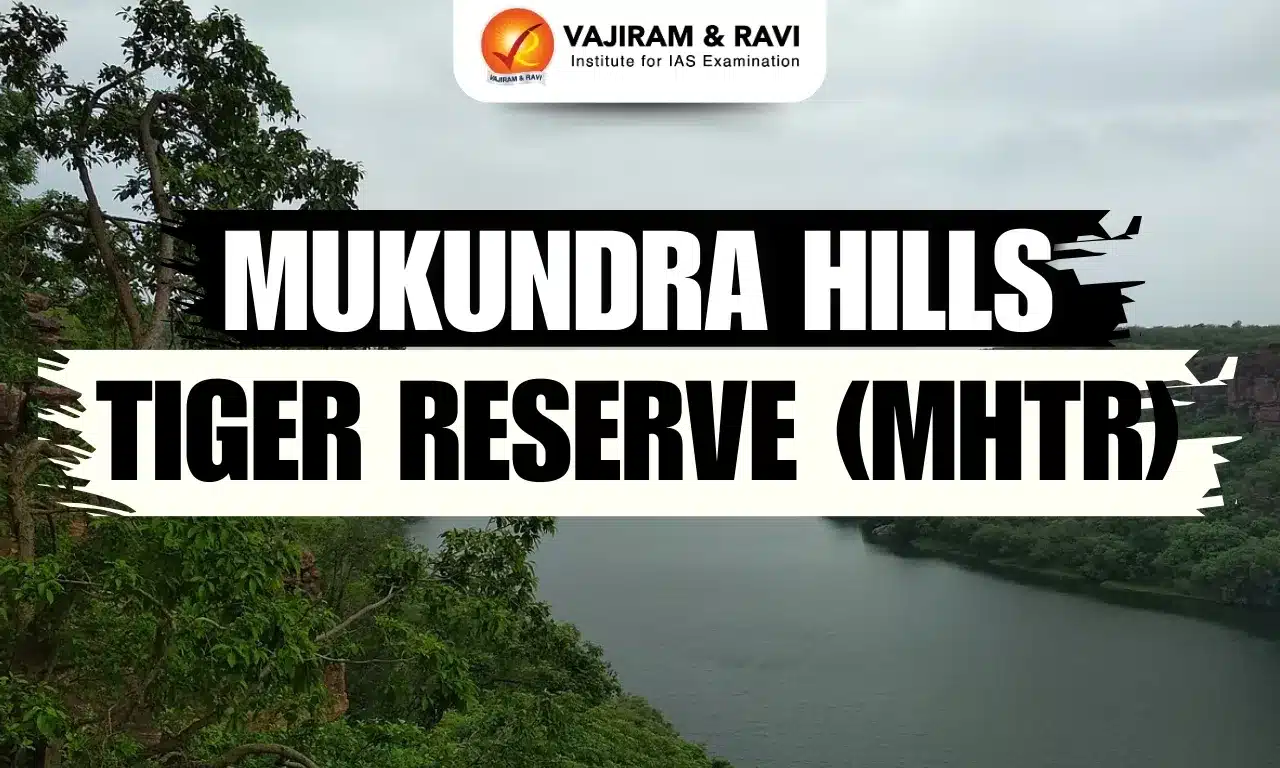
Mukundra Hills National Park

Mukundra Hills National Park is a critical dry deciduous forest and grassland ecosystem in southeastern Rajasthan.

  • Location and Area: Located in Kota and Chittorgarh districts covering 199.55 sq km.
  • Earlier Status: Formerly part of Darrah Wildlife Sanctuary complex.
  • Habitat Type: Dry deciduous forests and open grasslands of Kathiawar-Gir ecoregion.
  • Major Fauna: Bengal tiger, leopard, sloth bear, chital, sambar, and Indian wolf.
  • Ecological Role: Important corridor linking tiger landscapes of southeastern Rajasthan.

Desert National Park

Desert National Park represents one of the finest examples of Thar Desert ecology in India.

  • Location and Area: Spread across Jaisalmer and Barmer districts, covering 3,162 sq km.
  • Landscape Type: Sand dunes, rocky terrain, thorn scrub, and grassland patches.
  • Flora Composition: Dominated by sewan grass and hardy desert shrubs like aak.
  • Flagship Species: Critically endangered Great Indian Bustard and desert fox.
  • Conservation Value: One of the largest arid zone protected areas in the country.

Ranthambhore National Park

Ranthambhore National Park is among India’s most renowned tiger habitats located in eastern Rajasthan.

  • Location and Area: Situated in Sawai Madhopur district, covering 282.03 sq km.
  • River Boundaries: Bounded by Banas River in north and Chambal River in south.
  • Vegetation Type: Dry deciduous forest interspersed with grasslands and lakes.
  • Major Fauna: Bengal tiger, leopard, nilgai, sambar, and mugger crocodile.
  • Conservation Issues: Faces challenges of overcrowding, habitat fragmentation, and human conflict.

Sariska National Park

Sariska National Park lies in the Aravalli hills and forms a critical tiger landscape in Rajasthan.

  • Location and Area: Located in Alwar district with forested hills and valleys.
  • Ecoregion: Part of Kathiawar-Gir dry deciduous forest zone.
  • Vegetation: Arid forest, scrub-thorn woodland, and grassland ecosystems.
  • Wildlife Diversity: Bengal tiger, leopard, jackal, chital, sambar, and rhesus macaque.
  • Conservation History: Tiger population revived after reintroduction program in 2008.

Tiger Reserves in Rajasthan

Rajasthan has five notified tiger reserves covering about 5,980.88 sq km, strengthening landscape-level conservation.

  1. Ranthambore Tiger Reserve: Oldest reserve with high tiger density and tourism pressure.
  2. Sariska Tiger Reserve: Aravalli based reserve revived through tiger relocation program.
  3. Mukundara Hills Tiger Reserve: Newly established reserve supporting tiger dispersal corridors.
  4. Ramgarh Vishdhari Tiger Reserve: Acts as buffer and corridor between Ranthambore and Mukundara.
  5. Dholpur-Karauli Tiger Reserve: Riverine Chambal landscape enhancing eastern Rajasthan connectivity.

Wildlife Sanctuaries in Rajasthan

Rajasthan has a vast number of wildlife sanctuaries covering about 9,145.13 sq km, conserving diverse habitats. The major Wildlife Sanctuaries in Rajasthan has been listed here:

  1. Sariska Sanctuary: Aravalli forests supporting large mammals and avifauna.
  2. Darrah Sanctuary: Rocky plateau and forest habitat near Kota.
  3. Van Vihar Sanctuary: Small forest patch in Dholpur district.
  4. Jaisamand Sanctuary: Surrounds Dhebar Lake, one of India’s largest artificial lakes.
  5. Mount Abu Sanctuary: Highest biodiversity zone of Aravallis with altitude variation.
  6. Kumbhalgarh Sanctuary: Extensive Aravalli forest supporting wolves and leopards.
  7. Tal Chhapar Sanctuary: Grassland sanctuary famous for blackbuck conservation.
  8. Sitamata Sanctuary: Southern Rajasthan forest once considered for Asiatic lion.
  9. National Chambal Sanctuary: Riverine habitat protecting gharial and dolphins.
  10. Nahargarh Sanctuary: Forest near Jaipur city acting as urban green buffer.
  11. Jamwa Ramgarh Sanctuary: Man-made lake ecosystem near Jaipur.
  12. Jawahar Sagar Sanctuary: Chambal river dam ecosystem with crocodilian fauna.
  13. Desert National Park Sanctuary: Arid grassland protecting desert species.
  14. Ramgarh Vishdhari Sanctuary: Recently upgraded and linked with tiger corridors.
  15. Bhensrodgarh Sanctuary: Chambal riverine forest near Rana Pratap Sagar Dam.
  16. Kailadevi Sanctuary: Extension of Ranthambore forest landscape.
  17. Shergarh Sanctuary: Eastern Rajasthan forest adjoining Mukundara Hills.
  18. Todgarh Raoli Sanctuary: Aravalli forest stretch across multiple districts.
  19. Phulwari Ki Nal Sanctuary: Southern Aravalli hills near Gujarat border.
  20. Sawai Madhopur Sanctuary: Peripheral forest of Ranthambore Tiger Reserve.
  21. Sawai Man Singh Sanctuary: Buffer zone supporting Ranthambore wildlife movement.
  22. Band Baretha Sanctuary: Surrounds Baretha Dam supporting wetland biodiversity.
  23. Sajjangarh Sanctuary: Small hill sanctuary near Udaipur city.
  24. Bassi Sanctuary: Forest west of Mukundara Tiger Reserve.
  25. Ramsagar Sanctuary: Wetland ecosystem in Dholpur district.
  26. Kesarbagh Sanctuary: Small protected forest patch in Dholpur region.

Ramsar Site in Rajasthan

Rajasthan has four Ramsar-designated wetlands of international importance supporting migratory birds.

  1. Khichan Wetland: Famous wintering site for thousands of Demoiselle cranes.
  2. Menar Wetland: Community-conserved bird village near Udaipur.
  3. Keoladeo Wetland: Artificial marsh complex supporting global waterbird populations.
  4. Sambhar Lake: India’s largest inland saltwater lake and flamingo habitat.
Also Check
National Parks in Uttar Pradesh National Parks in Bihar
National Parks in Assam National Parks in Uttarakhand
National Parks in West Bengal National Parks in Arunachal Pradesh
National Parks in Andhra Pradesh

National Parks in Rajasthan FAQs

Q1: How many National Parks are there in Rajasthan?

Ans: Rajasthan has five National Parks, including Ranthambhore, Keoladeo Ghana, Mukundra Hills National Park, etc.

Q2: Which National Park in Rajasthan is a UNESCO World Heritage Site?

Ans: Keoladeo Ghana National Park in Bharatpur is a UNESCO World Heritage Site and Ramsar Site.

Q3: Which National Park is famous for tigers in Rajasthan?

Ans: Ranthambhore National Park is most famous for its Bengal tiger population and tiger safaris.

Q4: Which National Park represents the desert ecosystem in Rajasthan?

Ans: Desert National Park represents Thar Desert ecology and protects the Great Indian Bustard.

Q5: How many Tiger Reserves are there in Rajasthan?

Ans: Rajasthan has five Tiger Reserves including Ranthambore, Sariska, Mukundra Hills, Ramgarh Vishdhari, and Dholpur Karauli.

AILA (Artificially Intelligent Lab Assistant)

AILA (Artificially Intelligent Lab Assistant)

AILA (Artificially Intelligent Lab Assistant) Latest News

IIT Delhi researchers recently developed an AI- Agent AILA- Artificially Intelligent Lab Assistant.

About AILA (Artificially Intelligent Lab Assistant)

  • It is an AI agent which can independently run complex scientific experiments, analyse results, and make decisions in real time.
  • It was developed by IIT Delhi researchers in collaboration with scientists from Denmark and Germany.
  • Unlike earlier AI tools that mainly helped with writing or data analysis, AILA works directly with laboratory instruments. 
  • It can operate real scientific equipment, particularly the Atomic Force Microscope (AFM), one of the most delicate and complex instruments used to study materials at the nanoscale.
    • The agent has helped reduce the time taken to optimize high-resolution AFM imaging from 24 hours to 7–10 minutes.
  • When AILA is instructed to perform an experiment, it writes the necessary code, operates the scientific instrument, collects data, and analyses the results on its own. 
  • The entire scientific workflow, data generation, processing, and interpretation, is automated through AILA.
  • It performs experiments much like a trained scientist.

Source: NOA

AILA (Artificially Intelligent Lab Assistant) FAQs

Q1: What is AILA (Artificially Intelligent Lab Assistant)?

Ans: AILA is an AI agent capable of independently running scientific experiments, analysing results, and making real-time decisions.

Q2: Which institution led the development of AILA (Artificially Intelligent Lab Assistant)?

Ans: IIT Delhi developed AILA in collaboration with researchers from Denmark and Germany.

Q3: What major advantage does AILA (Artificially Intelligent Lab Assistant) offer over earlier AI tools?

Ans: nlike earlier tools that mainly supported writing or data analysis, AILA works directly with real laboratory instruments.

Micrometeoroids and Orbital Debris

Micrometeoroids and Orbital Debris

Micrometeoroids and Orbital Debris Latest News

Recently, a piece of debris struck the Chinese crewed vehicle Shenzhou-20, causing a minor crack in the window of its return capsule which raised the concerns regarding protections of astronauts from Micrometeoroids and Orbital Debris (MMOD) that orbit the earth.

About Micrometeoroids

  • Micrometeoroids are typically extremely small, with sizes ranging from a few micrometres (a millionth of a meter) to up to about two millimetres
  • Origin: Most of them originate from collisions between asteroids in the Asteroid belt (between Mars and Jupiter) with a small portion coming from comets.
  • Speed: They travel at extremely high velocities (about 11 to 72 km/s).
  • Distribution: They exist everywhere in space, but due to the Earth’s gravity pull their distribution is slightly higher near our planet.
  • The micrometeoroids in Earth’s orbital environment are effectively uncountable and they deliver billions of impacts to orbiting spacecraft annually.

About Orbital Debris

  • They are also called space debris, space junk or space trash.
  • They consist of human-made objects in the Earth’s orbit which no longer serves any useful purpose.
  • Origin: All orbital debris originated primarily from exploded rocket stages, satellites, accidental collisions and intentional anti-satellite weapon tests.
  • The typical average speed of orbital debris is about 10 km/s.
  • Orbital debris is mostly concentrated in a “shell” around the Earth in Low earth Orbit (LEO) ranging from about 200 km up to 2,000 km altitude. 

Source: TH

Micrometeoroids and Orbital Debris FAQs

Q1: What is the main concern with orbital debris?

Ans: They collide with operational spacecrafts.

Q2: What are micrometeoroids?

Ans: These are small particles from space

SHAKTI Scholars Young Research Fellowship

SHAKTI Scholars Young Research Fellowship

SHAKTI Scholars Young Research Fellowship Latest News

Recently, the National Commission for Women launched ‘SHAKTI Scholars’ young research fellowship on women-centric policy issues.

About SHAKTI Scholars Young Research Fellowship

  • It is a six-month program aimed at supporting emerging scholars in researching women's issues in India. 
  • Objectives of SHAKTI Scholars Young Research Fellowship
    • Encourage research on women's issues from a multidisciplinary perspective. 
    • ​Promote academic and policy-oriented studies that contribute to gender equality, safety, and empowerment. 
    • Provide opportunities for young scholars to engage in meaningful research that can support the Commission's mandate
  • Duration: 6 months. 
  • Research areas:  Women’s safety and dignity, gender-based violence, legal rights and access to justice, cyber safety, implementation of the Prevention of Sexual Harassment (POSH) framework ETC.
  • It is an initiative of the National Commission for Women.

​Eligibility for SHAKTI Scholars Young Research Fellowship

  • Academic: Must hold at least a graduate degree; preference is given to those completed or pursuing Masters, M.Phil., or Ph.D. in relevant fields. 
  • Nationality & Age: The fellowship is open to Indian citizens aged between 21 and 30 years who hold at least a graduation degree from a recognised institution.
  • Financial Support: Selected candidates will receive a research grant of Rs 1 lakh to undertake a six-month study.

Source: News On Air

SHAKTI Scholars Young Research Fellowship FAQs

Q1: What is the objective of SHAKTI Scholars Fellowship?

Ans: To support research on women-centric issues

Q2: Who is eligible for SHAKTI Scholars Fellowship?

Ans: Indian citizens aged 21-30 years with a graduate degree

Directed Energy Weapons

Directed Energy Weapons

Directed Energy Weapons Latest News

Recently, the Apollo Micro Systems has secured Defence Research & Development Organisation approval to get access to Directed Energy Weapon (DEW) systems technologies from two DRDO entities.

About Directed Energy Weapons

  • It uses concentrated energy from electromagnetic or particle technology, rather than kinetic energy.
  • Directed Energy Weapon systems use high-powered lasers to inflict damage on targets.
  • DEW uses directed energy to heat up and destroy or damage the target.

Capabilities of Directed Energy Weapons

  • Precision and Low Collateral Damage: DEWs can target specific weak spots of enemy systems, motors, electronics, or wings, minimising collateral damage.
  • Rapid Response: DEWs engage with targets at the speed of light, eliminating fast-moving threats in real time.
  • Cost and Logistics: DEWs have low operational costs, only requiring a continuous supply of electricity to work indefinitely.
  • Counter-Drone and Stealth Technology: DEWs are uniquely positioned to tackle swarm drones while ensuring there are no sounds or explosions, giving them stealth capabilities.
  • Applications Directed Energy Weapons: It has diverse military applications, offering rapid and precision strikes against threats such as unmanned aerial vehicles (UAVs), missiles and small vehicles and can be used in all war fighting environments.

Source: TH

Directed Energy Weapons FAQs

Q1: What are Directed Energy Weapons (DEWs)?

Ans: These are high-energy weapons using electromagnetic or particle beams.

Q2: What is a key advantage of DEWs?

Ans: Precision targeting with minimal collateral damage

Aravalli Range, Map, Location, Geology, Minerals, Drainage

Aravalli Range

Why Aravalli Range in News?

In November 2025, the Supreme Court of India defined Aravalli Hills as elevations 100 meters or higher above the local ground, raising concerns that this could weaken legal protections

About Aravalli Range 

The Aravalli Range, also called the Aravali Hills, is among the oldest surviving mountain systems on Earth and forms a major physiographic division of north-western India. Although heavily eroded over geological time, the range continues to exert a strong influence on climate, drainage, mineral resources, ecology, and human settlement patterns across Rajasthan, Haryana, Gujarat, and adjoining regions.

Supreme Court Definition and Guidelines for Aravalli Range

  • Aravalli Hills Definition: Any landform rising 100 metres or more above the surrounding local terrain. Local relief is measured using the lowest contour line encircling the hill. Protection applies to the entire hill system, including supporting slopes and associated landforms, regardless of height.
  • Aravalli Ranges Definition: Clusters of two or more such hills located within 500 metres of each other. The entire intervening area, including slopes and smaller hillocks, is considered part of the range.
  • SC Directions on Mining:
    • Temporary ban on issuing new mining leases in areas falling under the Aravalli definition.
    • Existing legal mining allowed but under strict regulation.
    • The ban remains until a Management Plan for Sustainable Mining (MPSM) is prepared by the Indian Council of Forestry Research and Education (ICFRE).
  • Requirements for the Management Plan (MPSM):
    • Identify no-mining zones and strictly regulated mining areas.
    • Map sensitive habitats and wildlife corridors.
    • Assess cumulative ecological impacts and carrying capacity.
    • Prescribe restoration and rehabilitation measures for mined areas.
  • SC Observations:
    • Recognized that blanket bans can fuel illegal mining.
    • Adopted a calibrated approach combining temporary pause on new mining, regulated continuation of existing legal mining, and permanent protection of ecologically sensitive areas.

Location and Extent of the Aravalli Range

  • The Aravalli Range is located in north-western India, forming one of the most prominent physiographic features of the region.
  • The range extends in a south-west to north-east orientation, which is distinct from most other Indian mountain ranges.
  • Its northernmost extension begins near Delhi, where the hills appear as discontinuous ridges.
  • From Delhi, the range passes through southern Haryana, influencing the drainage and ecological conditions of the region.
  • It then traverses through central and southern Rajasthan, where it is most extensive and prominent in height and width.
  • The Aravalli Range finally terminates near Ahmedabad in Gujarat, gradually merging with the surrounding plains.

Drainage System of the Aravalli Range

  • The Aravalli Range is a major watershed, with rivers from western slopes draining into inland basins/Arabian Sea and eastern slopes feeding the Yamuna system.
  • Western-slope rivers like Luni, Sakhi, and Sabarmati flow through arid regions, ending in marshes such as the Rann of Kutch, and host historical Indus Valley sites.
  • The Sahibi River and tributaries (Dohan, Sota, Krishnavati) flow northwest into Yamuna, with paleochannels containing key wetlands like Bhindawas and Sultanpur.
  • Eastern-slope rivers like Chambal, Banas, and Berach drain northeast into the Yamuna, with tributaries such as Ahar River forming lakes like Pichola.
  • The drainage system features seasonal flows, wide sandy channels, and paleochannels, supporting biodiversity, wetlands, and human settlements.

Physical Characteristics of the Aravalli Range

  • Composed of discontinuous ridges, hills, and residual mountains, forming a rugged terrain rather than a continuous chain.
  • Width varies between 6 to 60 miles, with average elevations of 1,000–3,000 feet, and the highest peak Guru Shikhar at 5,650 feet.
  • The range stretches 670 km in a south-west to north-east orientation, from Delhi to Ahmedabad (Gujarat).
  • Divides Rajasthan into two distinct regions:
    • North-western arid zone dominated by sand dunes and sparse vegetation.
    • South-eastern fertile zone with better drainage and denser population.
  • Terrain features steep slopes, ridges, hillocks, and low plateaus, with local variations in relief contributing to diverse microclimates.
  • Acts as a climatic and hydrological barrier, influencing rainfall patterns and river courses.

Geological Formation and Evolution

  • Formed during the Proterozoic Era, making it one of the oldest fold mountain systems globally.
  • Part of the Aravalli–Delhi Orogenic Belt and integral to the Indian Shield, showcasing ancient cratonic collisions.
  • Initially consisted of very high fold mountains, which have been extensively worn down by weathering, denudation, and erosion over millions of years.
  • Displays gneiss, schist, quartzite, and marble formations, reflecting complex geological history.
  • Provides crucial evidence of ancient tectonic activity, plate movements, and early Earth processes.
  • The landscape contains paleochannels and river valleys, indicating former extensive drainage systems.

Mineral Resources of the Aravalli Range

  • Recognized as one of India’s oldest mineral belts with continuous mining since ancient times.
  • Rich in economically important minerals:
    • Copper, zinc, and lead – mined historically and in modern times.
    • Marble and other building stones – extensively used in construction and handicrafts.
  • Mining has contributed to historical metallurgy, trade, and settlement development.
  • Current regulations emphasize sustainable mining, especially in ecologically sensitive areas.
  • Mineral-rich zones influence regional industrial growth, employment, and economic planning.

Ecological and Historical Significance

  • Serves as a natural barrier preventing the spread of the Thar Desert eastward, mitigating desertification.
  • Supports critical wetlands, lakes, and wildlife habitats, including bird sanctuaries and protected forests.
  • Influences river origin, groundwater recharge, and soil fertility, crucial for agriculture and settlements.
  • Holds archaeological and historical importance:
    • Sites along Luni, Sahibi, and Krishnavati rivers linked to Indus Valley Civilisation.
    • Ochre Coloured Pottery (OCP) culture sites indicate Late Harappan phase settlements.
  • The Aravalli ecosystem guides land use, conservation, and sustainable development policies.
  • Provides scenic and tourism value, with Mount Abu and Guru Shikhar being key hill-station and pilgrimage destinations.

Aravalli Range FAQs

Q1: Where is the Aravalli Range located?

Ans: It stretches 670 km across Delhi, Haryana, Rajasthan, and Gujarat in north-western India.

Q2: What is its orientation and width?

Ans: The range runs south-west to north-east, with widths from 6 to 60 miles and elevations of 1,000–3,000 feet.

Q3: What is the highest peak?

Ans: Guru Shikhar (5,650 feet) on Mount Abu is the highest peak.

Q4: How does it affect Rajasthan’s geography?

Ans: It divides Rajasthan into arid north-west and fertile south-east and acts as a barrier against desertification.

Q5: What is its geological significance?

Ans: Formed in the Proterozoic Era, it is one of the oldest fold mountain systems in the world.

India’s Largest Circular Stone Labyrinth

India's Largest Circular Stone Labyrinth

India's Largest Circular Stone Labyrinth Latest News

Archaeologists recently discovered a remarkable circular stone labyrinth in the Boramani grasslands of Solapur, Maharashtra, identified as the largest of its kind ever recorded in India.

About India's Largest Circular Stone Labyrinth

  • It was discovered in the Boramani grasslands of Solapur, Maharashtra.
  • It is approximately 50 feet by 50 feet in size and has 15 concentric circles formed from small stone blocks. 
  • The rings guide movement inward toward a tightly coiled spiral at the center, creating a design that reflects both precision and symbolic intent.
  • This structure dates back to nearly 2,000 years ago and is linked to Indo-Roman trade during the Satavahana dynasty period.
  • The presence of soil accumulation between the stone rings shows that this structure has remained untouched for several centuries.
  • Its design resembles classical labyrinth forms found in Mediterranean cultures, including motifs seen on Roman-era coins, while also incorporating a central spiral associated in India with the concept of the Chakravyuh.
    • The Chakravyūha is a complex military formation described in the Hindu epic Mahabharata, designed to encircle and overwhelm enemies through multiple defensive layers.
  • Before this discovery, the largest known circular labyrinth in India had 11 circuits, making the Solapur example unprecedented in terms of circular complexity. 
  • Although there is a larger square labyrinth in Gedimedu in Tamil Nadu, this newly documented site is the largest circular stone labyrinth identified in the country to date.

Mazes vs. Labyrinths

  • Labyrinths and mazes are not the same; however both are patterns for a path from the entrance to the centre. 
  • Though the terms are often used interchangeably, they mean different things.
  • Mazes are a kind of puzzle with multiple paths and decision points, and sometimes high walls. 
  • Labyrinths, by contrast, are unicursal: a single path twisting and turning through several concentric circles or circuits to arrive at a central goal, without walls or other obstructions to visibility. 
    • There are no "wrong turns" in a labyrinth.
    • Labyrinths and/or labyrinth carvings in rock and stone date back more than 4,000 years.  
    • There are labyrinths etched in Roman mosaics, in caves, cliffs, and tombs, on stone floors of medieval churches, and cut into turf.

Source: IT

India's Largest Circular Stone Labyrinth FAQs

Q1: Where was India’s largest circular stone labyrinth discovered?

Ans: It was discovered in the Boramani grasslands of Solapur, Maharashtra.

Q2: How many concentric circles does India’s largest circular stone labyrinth contain?

Ans: It has 15 concentric circles formed from small stone blocks.

Q3: India's Largest Circular Stone Labyrinth dates back to which historical period?

Ans: It dates back to nearly 2,000 years ago and is linked to Indo-Roman trade during the Satavahana dynasty period.

Akash-NG Missile System

Akash-NG Missile System

Akash-NG Missile System Latest News

The Defence Research and Development Organisation (DRDO) has successfully completed the User Evaluation Trials of the Next Generation Akash missile (Akash-NG) system recently.

About Akash-NG Missile System

  • Akash Next Generation (Akash-NG) is a state-of-the-art surface-to-air missile (SAM) defence system. 
  • It was developed by the Defence Research and Development Organisation (DRDO) and produced by Bharat Dynamics Limited (BDL). 
  • It is designed to protect vulnerable areas and points from air attacks.
  • It succeeds the original Akash missile system, which has been operational with the Indian Air Force since 2014 and the Army since 2015.

Akash-NG Missile System Features

  • The next-generation variant is lighter, weighing approximately 350 kilograms compared to the original's 720 kilograms.
  • It consists of several advanced features, including an indigenous Radio Frequency (RF) seeker, dual-pulse solid rocket motor, and fully homegrown radars and Command, Control, and Communication (C2) systems. 
  • These features enable the system to detect and engage high-speed, low-altitude, and long-range high-altitude targets with high precision.
  • It is designed to engage multiple targets simultaneously, with a range of up to 30 km and an altitude of 18 km.
  • It has the ability to engage up to 10 targets simultaneously, with a firing rate of one missile every 10 seconds.
  • The system can also be deployed in various configurations, including mobile and fixed installations.

Source: NOA

Akash-NG Missile System FAQs

Q1: What type of missile system is the Akash-NG?

Ans: It is a surface-to-air missile (SAM) defence system.

Q2: Which organisation developed the Akash-NG missile system?

Ans: The Defence Research and Development Organisation (DRDO).

Q3: What is the maximum range of the Akash-NG missile?

Ans: Up to 30 km.

Q4: What type of rocket motor powers the Akash-NG?

Ans: A dual-pulse solid rocket motor.

Q5: How many targets can the Akash-NG engage simultaneously?

Ans: Up to 10 targets.

Neelus sikkimensis

Neelus sikkimensis

Neelus sikkimensis Latest News

Scientists from the Zoological Survey of India (ZSI) recently discovered ‘Neelus sikkimensis’, the first of its genus in India, in the high-altitude region of Sikkim.

About Neelus sikkimensis

  • It is a new species of Collembolatiny, soil-dwelling micro-arthropods.
  • It was discovered in the high-altitude landscapes of Sikkim.
  • It marks the first-ever record of the genus Neelus in India.
  • It brings the total number of known species under this genus worldwide to eight.
  • It exhibits several distinctive biological characteristics. 
    • Microscopic Size: An extremely small body adapted for life deep within soil and moss.
    • Sensory Adaptation: A complete absence of eyes, typical of species living in dark, subterranean environments.
    • Unique Morphology: A specific “labral chaetotaxy” (arrangement of bristles on the mouthparts) that distinguishes it from its global relatives.

Key Facts about Arthropods

  • Arthropods are invertebrates with jointed legs. 
  • They make up about 75% of all animals on Earth and have a major role in maintaining ecosystems as pollinators, recyclers of nutrients, scavengers, and food for other animals. 
  • They include many animals we come across in our gardens, such as spiders, ants, centipedes, and slaters. 
  • Arthropods are divided into four major groups:
    • insects;
    • myriapods (including centipedes and millipedes);
    • arachnids (including spiders, mites, and scorpions);
    • crustaceans (including slaters, prawn, and crabs)

Key Facts about Collembola

  • Collembola are among the most abundant and diverse soil microarthropods, which are found in almost all (semi) terrestrial environments.
  • They are among the oldest and most abundant hexapods on Earth and play a crucial role in soil health and nutrient cycling.
  • They are commonly known as “springtails,” because of their ability to jump using a tail-like appendage. 
  • There are around 8,200 named species.
  • They live in all types of soil and feed on algae, fungi, plant roots, and decaying organic matter.

Source: TELE

Neelus sikkimensis FAQs

Q1: What is Neelus sikkimensis?

Ans: It is a newly discovered species of Collembola (springtails), tiny soil-dwelling micro-arthropods.

Q2: Where was Neelus sikkimensis discovered?

Ans: In the high-altitude landscapes of Sikkim.

Q3: Why is the discovery of Neelus sikkimensis significant for India?

Ans: It marks the first-ever record of the genus Neelus in India.

Q4: Does Neelus sikkimensis have eyes?

Ans: No, it completely lacks eyes, an adaptation to dark subterranean habitats.

Daily Editorial Analysis 24 December 2025

Daily Editorial Analysis

The VB-G RAM G Act 2025 Fixes Structural Gaps

Context

  • The Viksit Bharat–Guarantee for Rozgar and Ajeevika Mission (Gramin) Act, 2025 marks a significant reform in India’s rural employment and livelihood framework.
  • By expanding the statutory employment guarantee from 100 to 125 days and restructuring implementation around planning, convergence, and accountability, the Act seeks to strengthen rural livelihoods while enhancing long-term productivity.
  • Criticism that the reform weakens employment rights, undermines decentralisation, or signals fiscal withdrawal rests on a flawed assumption that welfare and development are competing objectives.
  • The Act is grounded in the principle that welfare and development are mutually reinforcing, and embeds this understanding within its statutory and institutional design.

Key Features of the VB- G RAM G Act

  • Strengthening the Statutory Right to Employment

    • A key feature of the Act is the expansion of the guaranteed employment entitlement from 100 to 125 days, reinforcing the legal right to work.
    • The Act also strengthens enforceability by removing procedural dis-entitlement clauses that previously rendered unemployment allowances ineffective.
    • Time-bound grievance redress mechanisms have been reinforced, addressing the gap between statutory promise and lived reality.
    • The employment guarantee remains statutory, justiciable, and substantively stronger than before.
  • Demand-Based Employment and Participatory Planning

    • The Act retains the demand-driven nature of employment, with workers continuing to initiate requests for work.
    • The reform lies in anticipatory, participatory village-level planning, ensuring that employment is available when demanded rather than being denied due to administrative unpreparedness.
    • Planning operationalises demand instead of replacing it, shifting the framework from reactive distress response to proactive livelihood assurance.
  • Decentralisation and Institutional Architecture

    • Decentralisation remains central to the Act’s architecture. Gram panchayats continue as the primary planning and implementing authorities, while gram sabhas retain approval powers over local plans.
    • The introduction of Viksit Gram Panchayat Plans institutionalises decentralised planning rather than diluting it.
    • Aggregation of plans at higher administrative levels enables coordination, convergence, and visibility, while decision-making authority remains local. Centralisation is limited to coherence, not control.
  • Consultation and Cooperative Federalism

    • The Act reflects the principles of cooperative federalism, having been shaped through extensive consultations with State governments, technical workshops, and multi-stakeholder discussions.
    • Key design elements, such as structured village planning, convergence mechanisms, and digital governance, are informed by State-level feedback and implementation experience.
    • States are positioned as development partners, not merely implementing agencies.

Fiscal Commitment and Addressing Structural Weakness

  • Fiscal Commitment and Equity in Allocation

    • Claims of fiscal withdrawal are inconsistent with budgetary trends. Central allocations have increased to nearly ₹95,000 crore, demonstrating sustained fiscal commitment.
    • The 60:40 funding model, with a 90:10 ratio for northeastern and Himalayan States and Jammu and Kashmir, follows established norms.
    • Rule-based, normative allocation ensures equity, while flexibility provisions allow States to seek relaxations during natural disasters or extraordinary circumstances, balancing accountability with responsiveness.
  • Addressing Structural Weaknesses of Earlier Frameworks

    • Implementation experience under earlier frameworks revealed episodic employment, weak enforceability of unemployment allowances, fragmented asset creation, and vulnerability to corruption and duplication.
    • These weaknesses became evident during droughts, migration surges, and the COVID-19 pandemic.
    • The Act responds by integrating livelihood security with durable asset creation, agricultural stability, and productivity enhancement, treating income support and development outcomes as a continuum.

Comparative Perspective: Lessons from the UPA Era

  • Wage freezes ignored inflation, budgetary allocations declined despite rising demand, and worker participation fell.
  • Delayed fund releases and administrative apathy weakened the employment guarantee.
  • The Comptroller and Auditor General’s 2013 report documented widespread corruption, including fake job cards, financial irregularities, delayed wages, and poor record-keeping, particularly in States with high rural poverty.
  • These failures underscored the necessity of structural correction rather than policy stagnation.

Conclusion

  • The Viksit Bharat–Guarantee for Rozgar and Ajeevika Mission (Gramin) Act, 2025 represents renewal, not retreat, in India’s rural welfare framework.
  • By expanding entitlements, strengthening enforceability, institutionalising decentralised planning, and enhancing fiscal and administrative coherence, the Act integrates welfare and development into a unified statutory model.
  • Income support and productivity enhancement are treated as interdependent goals, laying the foundation for a resilient, self-reliant rural economy grounded in enforceable rights, cooperative federalism, and sustainable development.

The VB-G RAM G Act 2025 Fixes Structural Gaps FAQs

 Q1. What is the main objective of the Viksit Bharat–Guarantee for Rozgar and Ajeevika Mission (Gramin) Act, 2025?
Ans. The Act aims to strengthen rural livelihoods by expanding the statutory employment guarantee and integrating welfare with long-term development.

Q2. How does the Act strengthen the legal right to employment?
Ans. The Act increases guaranteed employment from 100 to 125 days and improves enforceability through stronger grievance redress mechanisms.

Q3. Does the Act replace demand-based employment with top-down planning?
Ans. No, the Act retains worker-initiated demand while using advance participatory planning to ensure timely availability of work.

Q4. How does the Act address concerns about centralisation?
Ans. The Act preserves decentralised decision-making by keeping gram panchayats and gram sabhas as primary planning authorities while centralising coordination.

Q5. Why is the Act described as integrating welfare and development?
Ans. The Act links income support with durable asset creation and productivity enhancement, treating welfare and development as mutually reinforcing.

Source: The Hindu


Putin’s Visit to India and the Aftermath

Context

  • Russian President Vladimir Putin’s visit to India in early December for the 23rd India-Russia Annual Summit drew intense international attention.
  • While India viewed the visit as part of a long-standing bilateral process, the West saw it through the prism of the Russia-Ukraine war and the diplomatic boycott imposed on Moscow since 2022.
  • The visit ultimately reaffirmed India’s commitment to strategic autonomy, while revealing both continuity and subtle recalibration in India–Russia ties.

Historical Foundations of a Strategic Partnership

  • India–Russia relations are anchored in deep historical trust and shared strategic interests.
  • Meetings between leaders of the two countries have often reshaped regional geopolitics, most notably the 1971 India-Soviet Treaty of Peace, Friendship and Cooperation.
  • That agreement decisively altered South Asia’s strategic balance, enabling India’s victory over Pakistan and the emergence of Bangladesh.
  • Beyond landmark treaties, symbolic and substantive gestures have sustained mutual confidence, such as President Putin’s 2009 decision to waive penalties to facilitate India’s acquisition of its second aircraft carrier.
  • Over decades, Russia’s consistent support, especially during periods when the West aligned with Pakistan, cemented a relationship based on mutual accommodation and reliability.
  • Since the Gorbachev era and under President Putin’s long tenure, successive Indian Prime Ministers have strengthened this partnership.

Ukraine, the West, and India’s Strategic Autonomy

  • The Russia-Ukraine conflict posed a critical test for India-Russia relations.
  • India maintained neutrality and refused to align with Western efforts to isolate Russia, a stance that has caused persistent friction with the U.S. and the European Union.
  • Against this backdrop, President Putin’s visit acquired heightened symbolic significance.
  • Western expectations that global political shifts, U.S. tariffs on Indian purchases of Russian oil, and diplomatic pressure might weaken India-Russia ties were not borne out.
  • The warmth displayed between Prime Minister Narendra Modi and President Putin, coupled with extensive media coverage, underscored continuity rather than divergence.

The Joint Statement: Continuity with Subtle Nuances

  • The Joint Statement issued after the summit reaffirmed the Special and Privileged Strategic Partnership, marking 25 years of formal strategic cooperation.
  • It reiterated mutual trust, respect for core national interests, and the intention to strengthen traditional areas while exploring new avenues.
  • Particular emphasis was placed on connectivity initiatives, including the Northern Sea Route through the Arctic and the Chennai-Vladivostok Eastern Maritime Corridor, alongside enhanced technological and industrial cooperation.
  • The optics of the visit-public warmth, coordinated messaging, and expanded cooperation-were widely viewed as successful.

Defence Ties: An Enduring but Questioned Pillar

  • Despite these affirmations, the conspicuous absence of defence cooperation from the Joint Statement was striking.
  • Defence has historically been the bedrock of India-Russia relations, especially during the Putin era.
  • Whether this silence reflects deliberate diplomatic caution or a gradual shift in priorities remains open to interpretation.
  • Nevertheless, defence cooperation remains central to India’s security architecture.
  • Russia has been India’s most consistent and reliable supplier of advanced military systems, spanning land, sea, and air domains.
  • Critical platforms include the S-400 air and missile defence system, the jointly developed BrahMos missile, Sukhoi Su-30 MKI fighter aircraft, T-90 tanks, and transport helicopters.
  • These systems continue to form the core of India’s defence capabilities and have significantly enhanced operational effectiveness in recent conflicts.

Western Contradictions and Strategic Realities

  • A shift away from Russia towards Western defence sources carries significant strategic risks. Western partners have historically proven inconsistent, particularly in South Asia.
  • This concern is reinforced by recent U.S. decisions to approve major upgrade and sustainment packages for Pakistan’s F-16 fighter fleet, even as Washington publicly characterises U.S.-India ties as the defining relationship of the century.
  • Such contradictions reinforce India’s strategic scepticism and highlight why Russia continues to be viewed as a trusted long-term partner.

Conclusion

  • President Putin’s visit demonstrated the resilience and adaptability of India-Russia relations amid global turbulence.
  • While the partnership remains robust and symbolically strong, the muted emphasis on defence suggests nuanced recalibration rather than rupture.
  • India’s foreign policy continues to prioritise strategic autonomy, reliable partnerships, and long-term national interest, resisting pressure to conform to transient geopolitical alignments.

Putin’s Visit to India and the Aftermath FAQs

Q1. Why did President Putin’s visit to India attract global attention?
Ans. The visit drew global attention because it occurred amid Western efforts to diplomatically isolate Russia after the Ukraine conflict.

Q2. What historical event significantly strengthened India–Russia relations in 1971?
Ans. The 1971 India–Soviet Treaty of Peace, Friendship and Cooperation significantly strengthened India–Russia relations.

Q3. How did India position itself during the Russia–Ukraine war?
Ans. India maintained strategic neutrality and refused to join Western sanctions against Russia.

Q4. What notable omission appeared in the Joint Statement of the summit?
Ans. Defence cooperation was notably absent from the Joint Statement despite its traditional importance.

Q5. Why does Russia remain a critical defence partner for India?
Ans. Russia remains critical because it has consistently supplied advanced and reliable military systems essential to India’s defence capabilities.

Source: The Hindu


SHANTI Bill - India’s Second Shot at Nuclear Energy Leadership

Context

  • India’s nuclear power programme has long suffered from policy uncertainty, liability bottlenecks, and investor hesitation, especially after the Civil Liability for Nuclear Damage Act, 2010.
  • In this backdrop, Parliament has passed the Sustainable Harnessing and Advancement of Nuclear Energy for Transforming India (SHANTI) Bill.
  • It aims to reset India’s nuclear governance framework and align it with global nuclear commerce norms while strengthening energy security and decarbonisation goals.

Why the SHANTI Bill Matters

  • Nuclear power is a clean, reliable baseload energy source, crucial for India’s net-zero ambitions.
  • India targets 100 GW of nuclear power by 2047, requiring large-scale investment, global collaboration, and regulatory credibility.
  • The SHANTI Bill represents India’s “second chance” to emerge as a credible nuclear energy leader.

Key Features of the SHANTI Bill

  • Legislative reset

    • Replaces the Atomic Energy Act, 1962 and the Civil Liability for Nuclear Damage Act, 2010 with a single, integrated legal framework.
    • Seeks to harmonise Indian law with global nuclear liability regimes.
  • Balanced public–private participation (PPP)

    • Allows involvement of both public and private sectors, but maintains a state-led system. Foreign-incorporated companies excluded as licensees.
    • Sensitive stages such as fuel cycle, enrichment, reprocessing, spent fuel management remain exclusively with the central government.
    • This balanced PPP is termed as a cautious expansion strategy.
  • Regulatory architecture and safety

    • Licensing: Retained by the government.
    • Safety authorization: Assigned to the Atomic Energy Regulatory Board (AERB) with enhanced statutory powers, stronger radiation safety norms, mandatory public outreach, and improved emergency preparedness.
    • It ensures independent regulators, nuclear safety, institutional capacity.
  • Nuclear liability framework – The core reform

    • Operator-centric liability: Aligns with global practice where primary liability rests with the operator. Limits operator liability to 300 million SDR (Special Drawing Rights).
    • Curtailment of supplier liability:
      • Operator’s right of recourse limited to contractual terms, intentional wrongdoing, etc.
      • It shifts a share of responsibility beyond the operator’s cap to the central government through a Nuclear Liability Fund.
      • It points to the Convention on Supplementary Compensation (CSC) for supplementary funds if claims exceed that level.
      • This indicates a shift from the expansive supplier liability introduced in 2010.
    • State as insurer of last resort:
      • Terrorism recognised as a sovereign risk.
      • The state assumes liability in extreme cases.
      • Ensures victims are not left uncompensated after catastrophic events, assuring last-resort liability of the state.
    • Graded liability and transparency:
      • Liability graded according to the nature of installation, risk profile.
      • No category allowed below a minimum threshold without regulator-certified rationale.
      • Annual public disclosure on liability and compensation financing.
    • Victim-centric compensation:
      • Expanded definition of nuclear damage: long-term health impacts, environmental degradation, loss of livelihood and income, and preventive measures.
      • Claims pathway with timelines, faster disbursement via dedicated funds - establishing the principle of speed of compensation equals justice.
    • Intellectual property (IP) reforms:
      • Creation of a special nuclear inventions regime.
      • Amendments to patent laws to encourage nuclear energy–related innovations, safety software, radiation applications, robotics and specialised manufacturing.
      • Impact: Strengthens domestic nuclear supply chains and skilled employment.

Challenges and Concerns

  • Political and moral insensitivities: Dilution of supplier liability may be criticised as pro-corporate, diluting victim justice and a strong emotional legacy of the Bhopal disaster.
  • Weak institutional capacity: AERB needs more specialised inspectors, faster rule-making ability, and strong enforcement credibility.
  • Public trust deficit: Nuclear safety concerns, limited public understanding of liability mechanisms.

Way Forward

  • Capacity building and public engagement

    • Strengthen AERB autonomy and staffing.
    • Build insurance and reinsurance capacity.
    • Enhance public communication and transparency.
  • Use SHANTI To

    • Deepen India–US civil nuclear cooperation.
    • Diversify nuclear partnerships beyond single suppliers.
    • Integrate nuclear energy firmly into India’s climate strategy.

Conclusion

  • The SHANTI Bill does not claim perfection, but it offers credibility, clarity, and convergence with global norms—three essentials for scaling nuclear energy.
  • By balancing safety, liability, innovation, and investment, SHANTI provides India with an opportunity to move from prolonged debate to delivery, transforming India from a cautious nuclear outlier into a reliable global nuclear builder.

SHANTI Bill FAQs

Q1. How does the SHANTI Bill attempt to revive India’s stalled nuclear power expansion?

Ans. By aligning India’s nuclear liability regime with global norms, strengthening regulation, and enabling cautious PPP.

Q2. Why was the Civil Liability for Nuclear Damage Act, 2010 considered a bottleneck for nuclear energy growth?

Ans. Its expansive supplier liability, shaped by the Bhopal gas tragedy, discouraged private and foreign participation in nuclear projects.

Q3. What is the significance of operator-centric liability under the SHANTI Bill?

Ans. It places primary responsibility on the nuclear operator, caps liability at 300 million SDR, and restores predictability.

Q4. How does the SHANTI Bill balance victim justice with investment certainty?

Ans. By expanding the definition of nuclear damage and ensuring faster compensation while limiting supplier liability.

Q5. In what ways can the SHANTI Bill strengthen India’s energy security and climate commitments?

Ans. By enabling scalable, safe nuclear power as a clean baseload source critical for decarbonisation and long-term energy security.

Source: IE

Daily Editorial Analysis 24 December 2025 FAQs

Q1: What is editorial analysis?

Ans: Editorial analysis is the critical examination and interpretation of newspaper editorials to extract key insights, arguments, and perspectives relevant to UPSC preparation.

Q2: What is an editorial analyst?

Ans: An editorial analyst is someone who studies and breaks down editorials to highlight their relevance, structure, and usefulness for competitive exams like the UPSC.

Q3: What is an editorial for UPSC?

Ans: For UPSC, an editorial refers to opinion-based articles in reputed newspapers that provide analysis on current affairs, governance, policy, and socio-economic issues.

Q4: What are the sources of UPSC Editorial Analysis?

Ans: Key sources include editorials from The Hindu and Indian Express.

Q5: Can Editorial Analysis help in Mains Answer Writing?

Ans: Yes, editorial analysis enhances content quality, analytical depth, and structure in Mains answer writing.


Mukundra Hills Tiger Reserve (MHTR)

Mukundra Hills Tiger Reserve (MHTR)

Mukundra Hills Tiger Reserve (MHTR) Latest News

To promote tourism and wildlife conservation, the Mukundra Hills Tiger Reserve (MHTR) administration in Kota launched a poster and trailer of a documentary entitled "Enchanting Mukundra" recently.

About Mukundra Hills Tiger Reserve (MHTR)

  • The Mukundara Hills Tiger Reserve, also known as the Darrah Wildlife Sanctuary, is spread across 4 districts – Bundi, Kota, Jhalawar & Chittorgarh in Rajasthan.
  • It is situated in a valley formed by two parallel mountains, viz. Mukundra and Gargola.
  • It encompasses the area of Mukandra National Park, Darrah Sanctuary, Jawahar Sagar Sanctuary, and part of Chambal Sanctuary (from Garadia Mahadev to Jawahar Sagar Dam), forming its core/critical tiger habitat. 
  • It is strategically located between Ranthambore and Madhya Pradesh’s Kuno National Park, making it a vital corridor for tiger movement.
  • This tiger reserve was once a hunting preserve belonging to the Maharaja of Kota.
  • River: It is located on the eastern bank of the Chambal River and is drained by its tributaries.
  • Vegetation: Dry Deciduous Forest
  • Flora: Kala Dhok, or Kaladhi, is the predominant species, along with Khair, Ber, Kakan, Raunj, etc.
  • Fauna:
    • The important fauna includes Leopard, Sloth bear, Nilgai, Chinkara, Spotted Deer, Small Indian Civet, Toddy Cat, Jackal, Hyena, Jungle Cat, Common Langur, etc.
    • The common reptiles and amphibians are Pythons, Rat Snake, Buff-striped keelbacks, Green keelback, crocodiles, Gharial, Otter, and Turtles.

Source: WEEK

Mukundra Hills Tiger Reserve (MHTR) FAQs

Q1: Mukundra Hills Tiger Reserve is located in which Indian state?

Ans: Rajasthan

Q2: Between which two mountain ranges is Mukundra Hills Tiger Reserve located?

Ans: It lies in a valley between the Mukundra and Gargola mountain ranges.

Q3: Which protected areas form the core tiger habitat of Mukundra Hills Tiger Reserve?

Ans: Mukandra National Park, Darrah Sanctuary, Jawahar Sagar Sanctuary, and a part of Chambal Sanctuary.

Q4: On which river’s eastern bank is the Mukundra Hills Tiger Reserve located?

Ans: It is located on the eastern bank of the Chambal River.

Digital Trails and Policing in India: How Data Is Reshaping Crime Detection

Digital Trails in Policing

Digital Trails in Policing Latest News

  • The arrest of Ravindra Soni, alleged mastermind of the ₹1,000-crore BlueChip Group scam, highlights how digital footprints are transforming policing in India
  • Tracked down in Dehradun after a year on the run, Soni was caught not through traditional surveillance but via a food delivery order. 
  • The case underscores law enforcement’s growing use of everyday digital data—OTPs, delivery logs, and e-commerce histories—to trace suspects, showing how routine online activity now leaves an electronic trail that can unravel even sophisticated criminal networks.

The BlueChip Scam: How a Global Investment Fraud Unfolded

  • Ravindra Soni, in 2021, founded the BlueChip Group, claiming to trade in forex and commodities like gold, oil, and metals. The firm drew investors from India, the UAE, Malaysia, Canada, and Japan.
  • By 2024, investigators found the operation to be an elaborate fraud, with the company disappearing along with investors’ money. 
  • After nearly a year on the run, Soni was traced back to India and arrested in Dehradun on November 30, when police tracked him via a food delivery. 
  • Authorities allege he ran multiple investment fronts, with the scam’s scale estimated at up to ₹1,000 crore.

Digital Residue as Evidence: A New Tool for Law Enforcement

  • Investigators are increasingly using digital residue—data from everyday apps and services—as key evidence. 
  • In a ₹5,300-crore GST fraud, uncovered in May 2024, seemingly minor data points such as OTPs from food-delivery apps and FASTag alerts helped map suspect movements and expose networks of fake firms and forged tax credits.

Tracking Evasion Tactics

  • Suspects tried to evade detection by frequently changing phones, SIM cards, and hotel identities, keeping devices switched off except to receive OTPs. This pattern itself became a tell. 
  • FASTag toll data was used to trace luxury vehicles along the Delhi–Noida–Lucknow corridor, narrowing locations despite constant digital churn.

Multi-App Linkages Crack Cyber Rings

  • In October, Delhi Police dismantled a ₹22 lakh cyber-fraud network after a nine-day, 1,800-km operation across four states. 
  • WhatsApp data indicated overseas operations from Malaysia, while footprints from Flipkart, Swiggy, and Zomato helped identify suspects despite frequent location changes.

Legal Pathways for Data Sharing

  • Most apps’ privacy policies permit data sharing with law enforcement when required to investigate or prevent illegal activity or to comply with legal processes—making such digital traces admissible and actionable.

Beyond Financial Crime: Global Parallels

  • The evidentiary shift isn’t limited to financial cases. 
  • In the United States, prosecutors investigating the 2025 Palisades Fire in California used digital evidence to build their case. 
  • They cited the suspect’s interactions with ChatGPT, including questions about starting fires and AI-generated images of burning landscapes. 
  • These digital records were used to link the accused to the fire, which burned over 23,000 acres and destroyed thousands of homes.

Regulatory Changes to Tackle Digital Crime

  • Cybersecurity incidents in India have surged from 10.29 lakh in 2022 to 22.68 lakh in 2024, reflecting the growing scale and sophistication of digital crime. 
  • The financial impact is also rising, with cyber fraud losses of ₹36.45 lakh reported on the National Cyber Crime Reporting Portal by February 2025.

SIM-to-Device Binding for Messaging Apps

  • To curb misuse of digital platforms, the Department of Telecommunications (DoT) has directed messaging services like WhatsApp, Telegram, and Signal to enforce SIM-to-device binding. 
  • These apps must remain continuously linked to the SIM used at registration and deny access if the device does not contain that SIM.

New Legal Basis: Telecommunication Cybersecurity Amendment Rules, 2025

  • The Centre is using powers under the Telecommunication Cybersecurity Amendment Rules, 2025 to regulate digital identifiers more tightly. 
  • The rules introduce the concept of a Telecommunication Identifier User Entity (TIUE).
  • A TIUE is any non-telecom entity that uses telecommunication identifiers, such as mobile numbers, to identify users. 
  • This means apps that require phone numbers for registration fall within the regulatory scope.

Possible Expansion Beyond Messaging Apps

  • The current directive targets messaging platforms.
  • However, experts note that the broad TIUE definition could extend to other services, including food delivery apps like Swiggy and Zomato, since they also rely on mobile numbers for user onboarding.

Source: IE

Digital Trails in Policing FAQs

Q1: What are digital trails in policing?

Ans: Digital trails in policing refer to data from everyday digital activities like OTPs, delivery logs, FASTag records, and app usage used to track suspects and crimes.

Q2: How did digital data help crack the BlueChip scam?

Ans: Investigators traced the accused through food delivery orders and mobile OTP patterns, showing how routine digital activity can expose large financial frauds.

Q3: How are OTPs and FASTag data used by police?

Ans: OTPs reveal device usage patterns, while FASTag toll data helps track vehicle movement, enabling police to map suspect travel despite SIM or phone changes.

Q4: What regulatory steps has India taken to control digital crime?

Ans: India has introduced SIM-to-device binding, TIUE classification, and stricter telecom cybersecurity rules to regulate digital identifiers and curb misuse.

Q5: What are the concerns around digital trails in policing?

Ans: While effective, digital trails raise privacy and surveillance concerns, as more apps may be required to share user data with law enforcement agencies.

LVM3-M6 Mission: Why ISRO’s Heaviest Launch Is a Test of Capability and Cost

LVM3-M6

LVM3-M6 Latest News

  • The Indian Space Research Organisation (ISRO) is set to launch the LVM-3 rocket carrying its heaviest-ever satellite, BlueBird Block-2 (≈6,100 kg).
  • The satellite will be placed into a low Earth orbit (LEO) of about 520 km roughly 15 minutes after liftoff. 
  • BlueBird Block-2 will be the largest commercial communications satellite deployed in LEO to date. Designed by AST SpaceMobile, the satellite is part of a constellation aimed at direct-to-mobile connectivity. 
  • Unlike traditional satellites that rely on ground stations, this system will communicate directly with standard smartphones, enabling 4G/5G voice and video calls, messaging, streaming, and data access globally.

LVM3: India’s Heavy-Lift Launch Vehicle

  • The Launch Vehicle Mark-3 (LMV3) is a three-stage launch vehicle weighing about 640 tonnes and standing 43.5 metres tall. 
  • Developed over decades, it represents the peak of India’s launch vehicle engineering.

S200 Solid Strap-On Boosters: Power at Lift-Off

  • The first stage comprises two S200 solid-propellant boosters, among the most powerful solid rockets in use worldwide. 
  • They provide the massive thrust needed at lift-off to overcome gravity and pass through Earth’s dense lower atmosphere.

L110 Liquid Core Stage: Controlled Acceleration

  • After booster separation, the L110 liquid stage takes over, using hypergolic propellants for smooth, controllable thrust. 
  • This stage plays a crucial role in shaping the satellite’s trajectory and reflects India’s long-standing expertise in liquid propulsion.

C25 Cryogenic Upper Stage: Precision and Efficiency

  • The C25 cryogenic stage burns supercooled liquid oxygen and hydrogen stored below –180°C. 
  • It is India’s largest and most advanced cryogenic engine, offering high efficiency, longer burn duration, and precise orbit insertion—key to technological self-reliance achieved after decades of effort.

ISRO’s Push to Optimise LVM3 Engines

  • ISRO is upgrading the LVM3 to meet human-rating requirements for Gaganyaan and to increase lift capacity for modules of the proposed Bharatiya Antariksh Station
  • This involves adding redundancies for safety and boosting overall performance.

More Thrust from the Cryogenic Upper Stage

  • ISRO is enhancing the cryogenic upper stage, which provides nearly 50% of the velocity needed for geosynchronous missions. 
  • The current C25 stage carries 28,000 kg of propellant and produces 20 tonnes of thrust. 
  • The planned C32 stage will carry 32,000 kg of fuel, increasing thrust to 22 tonnes, enabling heavier payloads.

Switch to a Semi-Cryogenic Second Stage

  • The agency is considering replacing the liquid-propellant second stage with a semi-cryogenic engine using refined kerosene and liquid oxygen. 
  • This change would lower costs, improve efficiency, and raise LEO payload capacity from ~8,000 kg to ~10,000 kg, a configuration likely for space-station module launches.

Bootstrap Reignition for Multi-Orbit Missions

  • To support missions deploying satellites into multiple orbits, ISRO is developing bootstrap reignition for cryogenic engines. 
  • This allows the upper stage to restart without external gases (like helium), reducing system mass and increasing payload capability—especially valuable for LEO constellation missions.

Significance of LVM3-M6 Mission

  • The LVM3-M6 / BlueBird Block-2 mission is a dedicated commercial launch using ISRO’s LVM3 rocket to deploy the BlueBird Block-2 communication satellite of AST SpaceMobile. 
    • It represents the sixth operational flight of the LVM3 launch vehicle.
  • This is ISRO’s third commercial mission with the LVM-3, after launching OneWeb satellites in 2022–23. 
  • With alternatives like SpaceX’s Falcon-9 and European Space Agency’s Ariane-6 available, the launch is a chance for ISRO to prove it can deliver heavy launches at lower cost.

Expanding the LVM-3’s Role

  • Originally designed for geosynchronous missions (~36,000 km), the LVM-3 has now proven versatile in low Earth orbit (LEO) deployments. 
  • This marks the third LEO mission for the vehicle, reflecting its evolution from the earlier GSLV-Mk3.

Operational Readiness and Turnaround Time

  • The launch follows the CMS-03 mission on November 2, making it the shortest gap between two LVM-3 launches. 
  • It tests ISRO’s ability to assemble and execute heavy missions rapidly, a key metric for commercial reliability.

Record-Breaking Payload

  • At 6,100 kg, the BlueBird payload is ISRO’s heaviest satellite ever placed into orbit, surpassing the cumulative OneWeb payloads (~5,700 kg) to LEO and the 4,410 kg CMS-03 sent to geosynchronous transfer orbit last month.

Strategic Momentum

  • This is the second year since 2023 that ISRO flies two LVM-3 missions in a single year, underscoring growing cadence, capability, and confidence in India’s heavy-lift launch ecosystem.

Source: IE | ISRO | MC

LVM3-M6 FAQs

Q1: What is the LVM3-M6 mission?

Ans: The LVM3-M6 mission is a dedicated commercial launch by ISRO to place the BlueBird Block-2 satellite into low Earth orbit using the LVM3 rocket.

Q2: Why is the LVM3-M6 mission significant for ISRO?

Ans: It carries ISRO’s heaviest-ever payload at 6,100 kg and tests India’s ability to conduct heavy commercial launches at a competitive cost.

Q3: What makes the BlueBird Block-2 satellite unique?

Ans: BlueBird Block-2 enables direct-to-mobile connectivity, allowing 4G/5G calls, texts, and data directly on smartphones without ground relay stations.

Q4: How does LVM3 compare with other heavy-lift launch vehicles?

Ans: LVM3 competes with SpaceX’s Falcon-9 and ESA’s Ariane-6, offering a lower-cost alternative for heavy satellite launches to LEO and GTO.

Q5: How does LVM3-M6 support India’s future space plans?

Ans: The mission strengthens ISRO’s readiness for Gaganyaan, Bharatiya Antariksh Station modules, and global commercial satellite launches.

India’s Export Concentration Across States – Explained

Export Concentration

Export Concentration Latest News

  • Recent analysis of RBI State-wise export data shows that India’s export growth is increasingly concentrated in a few States, exposing structural imbalances in regional development.

Overview of India’s Export Performance

  • India’s export numbers appear robust at the national level, even amid a weakening rupee. 
  • However, a disaggregated view reveals that export growth is not evenly distributed across States. 
  • According to the RBI Handbook of Statistics on Indian States (2024-25), a small group of States accounts for a disproportionately large share of India’s total exports. 
  • This pattern challenges the long-held assumption that export expansion naturally leads to broad-based industrialisation and employment growth across regions.

Concentration of Exports Among a Few States

  • India’s export geography is increasingly dominated by five States, Maharashtra, Gujarat, Tamil Nadu, Karnataka, and Uttar Pradesh, which together contribute nearly 70% of the national export basket. 
  • Half a decade ago, their share was around 65%, indicating a steady rise in concentration.
  • This trend reflects a core-periphery pattern, where coastal and industrially advanced States integrate more deeply into global supply chains, while large parts of northern and eastern India remain marginalised. 
  • The rising Herfindahl-Hirschman Index (HHI) of export concentration signals growing regional imbalance rather than convergence.
    • The HHI is used by anti-trust agencies that possess the mandate to promote competition. It is calculated by squaring the market share of each producer in the market and then comparing the sum to a scale.

Structural Reasons Behind Regional Divergence

  • Several structural factors explain why exports are clustering instead of dispersing:
    • First, global trade conditions have changed. The era of labour-intensive, low-skill manufacturing as a pathway to development is narrowing. 
    • Global merchandise trade growth has slowed, and capital now seeks regions with high economic complexity rather than just cheap labour.
    • Second, export-leading States possess dense industrial ecosystems, logistics, skilled labour, supplier networks, and financial depth that reinforce agglomeration. 
    • Firms benefit from spatial clustering, making it costly to relocate to less-developed regions.
    • Third, hinterland States suffer from persistent deficits in infrastructure, human capital, and institutional capacity, preventing them from entering complex global value chains.

Shift from Labour-Intensive to Capital-Intensive Exports

  • A key insight from the analysis is that India’s export growth is increasingly capital-intensive rather than labour-absorbing. 
  • Data from the Annual Survey of Industries (2022-23) shows that while fixed capital investment grew by over 10%, employment growth lagged behind at about 7%.
  • Fixed capital per worker has risen sharply, indicating capital deepening. As a result, exports generate value without proportionate job creation. 
  • This breaks the traditional development link where exports absorb surplus labour from agriculture into manufacturing.

Employment Outcomes and Labour Market Trends

  • The Periodic Labour Force Survey (PLFS) reinforces this concern. Manufacturing’s share in total employment has stagnated around 11.6-12%, despite record export values. 
  • This suggests a collapse in the employment elasticity of exports.
  • Most new export-linked jobs are concentrated in capital-intensive hubs, such as electronics clusters in Tamil Nadu or Noida, rather than dispersed factory employment across the hinterland. 
  • Wage share in Net Value Added has also declined, indicating that productivity gains accrue more to capital than to workers.

Financial and Institutional Constraints in Hinterland States

  • Regional inequality is further deepened by financial asymmetries. Credit-Deposit (CD) ratios in export-leading States often exceed 90%, ensuring local recycling of savings into industry. 
  • In contrast, States like Bihar and eastern Uttar Pradesh have CD ratios below 50%, implying capital outflow to already developed regions.
  • This creates a vicious cycle: weaker States lose capital, struggle to build industrial capacity, and remain excluded from export growth.

Rethinking Exports as a Development Metric

  • The evidence suggests a structural shift; exports are no longer a driver of development but an outcome of prior development. 
  • States do not export their way into prosperity; they export because they already possess industrial and institutional strength.
  • This raises important policy questions. Treating export growth as a proxy for inclusive development risks overlooking employment generation, regional equity, and human capital outcomes.

Source: TH

Export Concentration FAQs

Q1: Which States dominate India’s exports?

Ans: Five States, Maharashtra, Gujarat, Tamil Nadu, Karnataka, and Uttar Pradesh, account for nearly 70% of India’s exports.

Q2: What does export concentration indicate?

Ans: It indicates regional imbalance and agglomeration of economic activity rather than uniform development.

Q3: Why are exports becoming capital-intensive?

Ans: Global trade now favours economic complexity, automation, and advanced supply chains over cheap labour.

Q4: Has export growth increased manufacturing jobs?

Ans: No, manufacturing employment has stagnated despite rising export values.

Q5: Why is export growth a weak proxy for inclusive development?

Ans: Because it reflects existing industrial strength and capital intensity, not broad-based job creation or regional convergence.

Coringa Wildlife Sanctuary

Coringa Wildlife Sanctuary

Coringa Wildlife Sanctuary Latest News

The 40th Asian Waterbird Census and 60th International Waterbird Census will enumerate the bird species of Coringa Wildlife Sanctuary and its adjoining wetlands.

About Coringa Wildlife Sanctuary

  • Location: It is located in the state of Andhra Pradesh.
  • It is part of the Godavari estuary, where the Coringa river confluences into the Bay of Bengal.
  • Vegetation: It has extensive mangrove and dry deciduous tropical forests. It is the second-largest stretch of mangrove forests in India.
  • Flora: Mangrove plants like Rhizophora spp, Avicennia spp, Sonnertia spp, etc; grow here.
  • Fauna: It is home to endangered mammals like Smooth Indian otter, Fishing cat, Jackal, etc. Mangroves offer excellent habitat for birds like Black capped kingfisher, Brahminy kite, Sea gulls, Reef heron, Sand piper, etc.
  • The sea coast of the Coringa Wildlife Sanctuary is a breeding ground for Olive ridley turtles.

Key Facts about Asian Waterbird Census

  • It is a citizen-science programme that supports the conservation and management of wetlands and waterbirds worldwide.
  • It is conducted annually and is part of the global International Waterbird Census (IWC).
  • It was initiated in 1987 in the Indian subcontinent and since has grown rapidly to cover major regions of Asia, from Afghanistan eastwards to Japan, Southeast Asia and Australasia.
  • In India it is conducted under the aegis of the Bombay Natural History Society (BNHS) and the Wildlife Institute of India (WII) in early January.

Source: TH

Coringa Wildlife Sanctuary FAQs

Q1: Where is Coringa Wildlife Sanctuary located?

Ans: Andhra Pradesh

Q2: What type of ecosystem does Coringa Wildlife Sanctuary represent?

Ans: Mangrove

INSV Kaundinya

INSV Kaundinya

INSV Kaundinya Latest News

The Indian Navy’s pioneering stitched vessel Indian Naval Sailing Vessel (INSV) Kaundinya will undertake her maiden overseas voyage.  

About INSV Kaundinya

  • It is a stitched ship which is inspired by a fifth-century vessel shown in Ajanta cave paintings.
  • It is named after the legendary mariner Kaundinya, who is believed to have sailed from India to Southeast Asia in ancient times.
  • It has been built using traditional stitching techniques instead of metal nails. Artisans from Kerala used coconut fibre, coir rope, wooden joinery, natural resins, and cotton sails.
  • It is a joint initiative of the Indian Navy, Ministry of Culture, and Hodi Innovations.
  • It features symbolic motifs like
    • Gandabherunda (mythical two-headed eagle) symbol of the Kadamba dynasty and the Sun
    • The bow carries a Simha Yali  
    • Harappan-style stone anchor on the deck
  • Significance: INSV Kaundinya showcases India’s ancient maritime traditions. It reflects India’s historic role in trade, cultural exchange, and modern maritime diplomacy.

Who was Kaundinya?

  • He is a legendary Indian mariner who sailed to Southeast Asia about 2,000 years ago.
  • He married Queen Soma and founded the Funan kingdom.

Source: PIB

INSV Kaundinya FAQs

Q1: INSV Kaundinya is named after?

Ans: A legendary Indian mariner Kaundinya

Q2: What is unique about INSV Kaundinya's construction?

Ans: Use of wooden planks stitched with coconut coir rope

Enquire Now