Jungle Bachao Andolan, History, Pillars, Impact, Community

Jungle Bachao Andolan

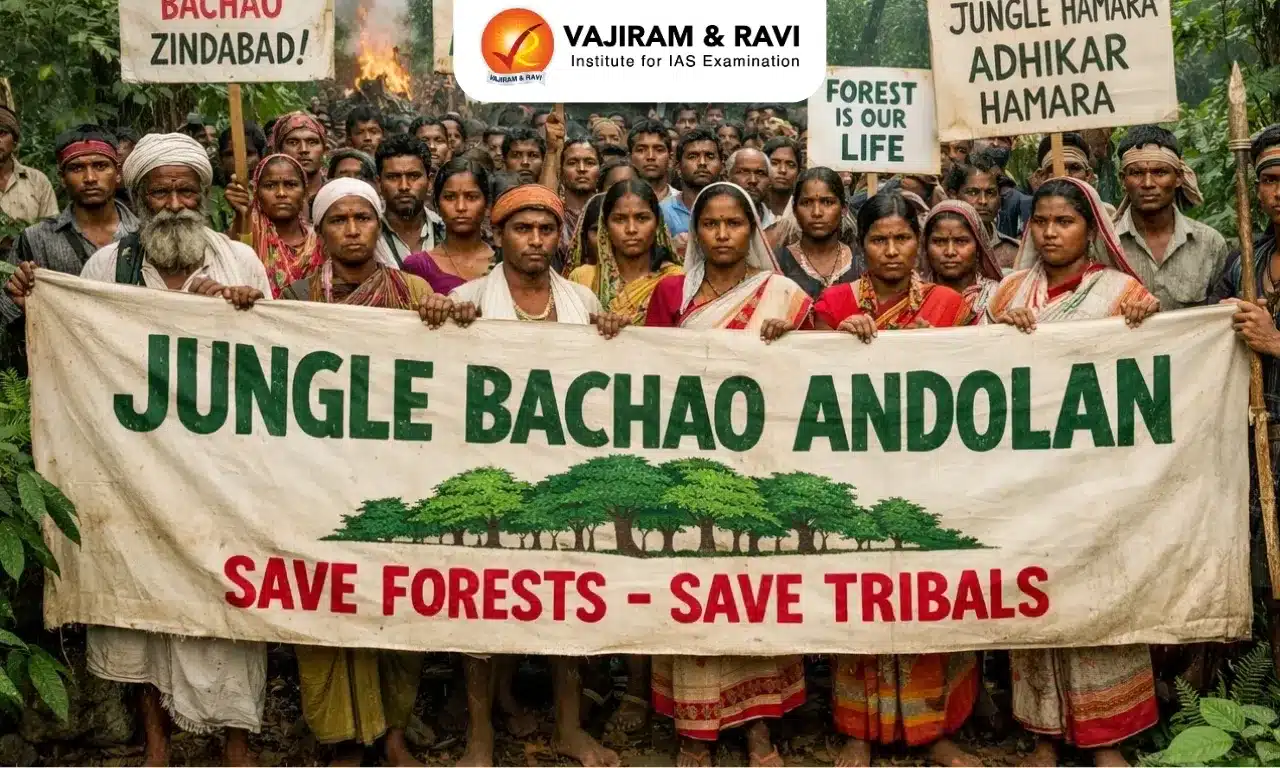
The Jungle Bachao Andolan was a major community led environmental movement that emerged in India during the early 1980s to oppose rapid deforestation and protect indigenous forest rights. Originating in the forest rich Singhbhum region of erstwhile Bihar, now Jharkhand, the movement arose as a direct response to state led commercial forestry policies that threatened natural Sal forests. Jungle Bachao Andolan highlighted the deep link between ecological conservation and tribal livelihoods, transforming forest protection into a people-driven governance issue.

Jungle Bachao Andolan

The Jungle Bachao Andolan, also known as the Jharkhand Jungle Bachao Andolan, focused on safeguarding forests while asserting the customary rights of Adivasi communities. It opposed monoculture commercial plantations, particularly teak, replacing biodiverse Sal forests. The movement expanded from Jharkhand to parts of Odisha, mobilising Gram Sabhas and local institutions. Jungle Bachao Andolan framed forests as living ecosystems rather than revenue-generating assets, shifting environmental discourse toward sustainable, community-controlled conservation.

Jungle Bachao Andolan History

The Jungle Bachao Andolan developed through local resistance against state-controlled forest management models prioritising revenue over ecology and indigenous survival.

  • Early 1980s Origin: Initiated in Singhbhum against proposed replacement of Sal forests with teak plantations.
  • 1978 Precursor Movements: Jungal Katai Andolan protested forest destruction in Kolhan Singhbhum region.
  • Community Resistance: Munda, Ho, and Santhal tribes mobilised to protect ancestral forest lands.
  • Government Proposal Trigger: Bihar Forest Department promoted commercial teak plantations for timber revenue.
  • Grassroots Mobilisation: Villagers organised rallies, forest guarding, and awareness campaigns.
  • Policy Reversal Success: Government dropped teak plantation plans after sustained local opposition.
  • 1990s Expansion: Movement spread beyond Jharkhand, influencing forest activism nationally.
  • Institutional Consolidation: Jharkhand Jungle Bachao Andolan emerged as organised platform by 2000.

Jungle Bachao Andolan Features

The Jungle Bachao Andolan combined environmental conservation with social justice using decentralised, community based forest governance mechanisms.

  • Community Leadership: Forest protection decisions driven by local Adivasi communities.
  • Ecological Focus: Emphasis on preserving native Sal forests over monoculture plantations.
  • Participatory Governance: Gram Sabhas recognised as primary forest decision making bodies.
  • Livelihood Protection: Movement linked forest conservation with survival of tribal economies.
  • Decentralised Action: Village level monitoring replaced centralized forest administration.
  • Non Violent Protest: Used rallies, public meetings, and awareness campaigns.
  • Cultural Integration: Traditional ecological knowledge guided conservation practices.
  • Regional Expansion: Spread to Odisha and neighbouring forest regions.

Jungle Bachao Andolan Pillars

The Jungle Bachao Andolan functioned through four institutional pillars that empowered communities to manage forests collectively.

  1. Gram Sabha: Village councils exercised authority over forest use and protection.
  2. Forest Protection Committees: Local groups monitored illegal logging and forest degradation.
  3. Women’s Cooperatives: Women participated in conservation and resource decision making.
  4. Youth Forums (Bal Akhra): Youth engaged in forest patrolling and awareness activities.

Jungle Bachao Andolan Impact

The Jungle Bachao Andolan produced measurable environmental, social, and policy level outcomes across forest regions.

  • Commercial Projects Halted: Prevented conversion of Sal forests into teak plantations.
  • Forest Regeneration: Community protection slowed forest degradation in Singhbhum region.
  • Adivasi Empowerment: Indigenous communities gained negotiation power over land use.
  • Policy Recognition: Government acknowledged people centric forest conservation approaches.
  • Institutional Models: Inspired participatory forest management frameworks.
  • Movement Replication: Encouraged similar conservation movements across India.
  • Awareness Expansion: Linked forests with biodiversity, climate balance, and livelihoods.

Jungle Bachao Andolan Indigenous Communities

The Jungle Bachao Andolan directly addressed the historical marginalisation of Adivasi communities in forest governance.

  • Customary Rights Defence: Protected traditional access to forest produce.
  • Displacement Resistance: Opposed forced relocation due to dams, mining, and plantations.
  • Cultural Preservation: Safeguarded forest based cultural and spiritual practices.
  • Economic Security: Prevented loss of minor forest produce livelihoods.
  • Political Voice: Enabled tribal participation in development decision making.

Jungle Bachao Andolan Forest Governance

The movement challenged colonial era forest administration models and promoted democratic alternatives.

  • Revenue Model Critique: Questioned timber centric forest management.
  • Administrative Accountability: Exposed misuse of forest laws against communities.
  • Decentralisation Push: Advocated local forest governance systems.
  • Ecological Management: Prioritised biodiversity over commercial species.
  • Long Term Sustainability: Encouraged regenerative forest use practices.

Jungle Bachao Andolan Significance

The Jungle Bachao Andolan marked a turning point in India’s environmental history by redefining forests as community commons.

  • Forest Rights Visibility: Brought Adivasi forest rights into national policy debates.
  • Deforestation Awareness: Highlighted ecological damage caused by commercial forestry.
  • Policy Influence: Contributed to conservation oriented thinking in National Forest Policy 1988.
  • People’s Environmentalism: Demonstrated effectiveness of grassroots ecological movements.
  • Sustainable Development: Promoted coexistence of development and conservation.
  • Legal Consciousness: Strengthened understanding of customary forest rights.
  • Movement Inspiration: Influenced later forest rights and environmental campaigns.
  • Movement Blueprint: Provided framework for community based conservation.
  • Forest Policy Shift: Influenced conservation first policy thinking.
  • Grassroots Strength: Proved local resistance can reshape national agendas.
  • Educational Relevance: Became core case study in environmental governance.
  • Ongoing Relevance: Continues to inform forest rights activism.

Jungle Bachao Andolan FAQs

Q1: What is Jungle Bachao Andolan?

Ans: Jungle Bachao Andolan was a community led environmental movement to protect natural forests and indigenous rights.

Q2: Where did Jungle Bachao Andolan originate?

Ans: It originated in Singhbhum district of Bihar, now Jharkhand, during the early 1980s.

Q3: Why was Jungle Bachao Andolan started?

Ans: It began to oppose the replacement of Sal forests with commercial teak plantations.

Q4: Who participated in Jungle Bachao Andolan?

Ans: Adivasi communities like Munda, Ho, and Santhal played a central role.

Q5: What was the outcome of Jungle Bachao Andolan?

Ans: The government withdrew commercial plantation plans, strengthening community forest protection.


Exogenic Forces, Definition, Process, Types, Denudation

Exogenic Forces

Exogenic Forces are external geomorphic forces that operate on the Earth’s surface and shape landforms by breaking down rocks and redistributing materials. These forces originate outside the Earth’s crust and derive their energy primarily from the Sun. Through continuous interaction with atmosphere, hydrosphere, and biosphere, Exogenic Forces slowly but persistently modify relief features over geological time. Although their effects appear gradual, long-term action causes extensive transformation of mountains, plateaus, plains, and coastal regions across the planet.

Exogenic Forces Definition

Exogenic Forces refer to geomorphic processes driven by external agents such as wind, water, ice, waves, and biological activity that act on Earth’s surface. These processes include weathering, erosion, transportation, and deposition, collectively responsible for denudation. Unlike internal tectonic forces that build landforms, Exogenic Forces predominantly reduce elevation by wearing down rocks through mechanical stress, chemical reactions, and gravitational movement, reshaping landscapes continuously under the influence of solar energy.

Exogenic Forces Process

Exogenic Forces operate through a sequence of interlinked geomorphic processes driven by solar energy, gravity, and atmospheric circulation patterns.

  • Weathering: In-situ breakdown of rocks without material movement due to physical, chemical, and biological actions.
  • Erosion: Removal of weathered material by running water, wind, glaciers, or waves.
  • Transportation: Movement of eroded sediments through fluvial, aeolian, glacial, or marine agents.
  • Deposition: Accumulation of transported material when carrying capacity of agents decreases.
  • Denudation: Combined effect of weathering, erosion, transportation, and deposition lowering land surface.
  • Gravitational Movement: Downslope transfer of materials under Earth’s gravity without external transporting medium.
  • Stress Induction: Temperature changes create molecular stresses within rocks causing structural fatigue.
  • Chemical Bond Weakening: Chemical reactions loosen mineral bonds accelerating rock disintegration.
  • Surface Energy Control: Solar radiation regulates rainfall, winds, freeze-thaw cycles, and evaporation.
  • Long-Term Landscape Evolution: Small-scale processes cumulatively reshape continents over millions of years.

Exogenic Forces Types

Exogenic Forces are classified based on the dominant process and agent responsible for landform modification.

  1. Weathering Forces: Processes breaking rocks at their original location without displacement.
  2. Erosional Forces: Agents removing loosened materials from Earth’s surface.
  3. Depositional Forces: Processes laying down sediments forming new landforms.
  4. Mass Wasting Forces: Gravity-driven movement of soil and rock downslope.
  5. Fluvial Forces: Running water shaping valleys, floodplains, and deltas.
  6. Aeolian Forces: Wind-driven erosion and deposition in arid and semi-arid regions.
  7. Glacial Forces: Ice movement sculpting high-latitude and high-altitude terrains.
  8. Marine Forces: Waves and currents reshaping coastlines.
  9. Biological Forces: Living organisms contributing to mechanical and chemical weathering.
  10. Anthropogenic Forces: Human-induced acceleration of natural exogenic processes.

Also Read: Endogenic Vs Exogenic Forces

Exogenic Forces Features

Exogenic Forces display distinct characteristics that differentiate them from endogenic processes.

  • Solar Energy Driven: Sun’s heat controls winds, rainfall, evaporation, and weathering intensity.
  • Surface-Oriented: Processes operate mainly on Earth’s crustal surface.
  • Gradual Action: Changes occur slowly but continuously over long periods.
  • Denudational Nature: Primarily reduce elevation rather than create relief.
  • Climate Sensitive: Intensity varies with temperature, precipitation, and humidity.
  • Material Redistribution: Transport sediments from highlands to lowlands.
  • Repetitive Cycles: Weathering-erosion-deposition operate in continuous loops.
  • Universally Active: Affect all climatic and geomorphic regions.
  • Scale Dependent: Range from microscopic mineral changes to continental reshaping.
  • Landscape Smoothing: Tend to flatten irregular topography over time.

Denudation Exogenic Forces

Denudation represents the cumulative effect of all Exogenic Forces stripping Earth’s surface.

  • Meaning of Denudation: Derived from Latin “denudare” meaning to strip or expose.
  • Process Coverage: Includes weathering, erosion, mass wasting, and transportation.
  • Structural Control: Influenced by joints, bedding planes, faults, and folds.
  • Lithological Control: Rock hardness and mineral composition determine denudation rate.
  • Permeability Effect: Porous rocks weather faster due to water infiltration.
  • Chemical Susceptibility: Minerals prone to corrosion denude rapidly.
  • Climatic Influence: Humid tropics experience intense chemical denudation.
  • Slope Dependency: Steeper slopes enhance erosional denudation.
  • Time Scale: Operates over thousands to millions of years.
  • Landscape Outcome: Produces peneplains, pediplains, and erosion surfaces.

Weathering Exogenic Forces

Weathering is the foundational Exogenic Force initiating landscape modification.

  • In-Situ Process: Rock disintegration occurs without transportation.
  • Physical Agents: Temperature, pressure, frost, and salt cause mechanical breakdown.
  • Chemical Agents: Water, oxygen, carbon dioxide alter mineral composition.
  • Biological Agents: Plants, animals, and microbes accelerate decay.
  • Precursor Role: Supplies material for erosion and soil formation.
  • Climate Dependence: Hot-wet climates favour chemical weathering.
  • Rock Type Control: Igneous, sedimentary, and metamorphic rocks weather differently.
  • Surface Exposure: Greater exposure increases weathering rate.
  • Time Accumulation: Effects intensify with prolonged exposure.
  • Soil Genesis: Weathering initiates soil development.

Exogenic Forces Physical Weathering

Physical weathering disintegrates rocks through mechanical stress without chemical alteration.

  • Pressure Release Exfoliation: Removal of overburden causes sheet-like rock peeling.
  • Sheeting: Expansion fractures parallel to surface in intrusive igneous rocks.
  • Thermal Stress Weathering: Expansion and contraction due to temperature variation.
  • Desert Effectiveness: Strong diurnal temperature range enhances exfoliation.
  • Granular Disintegration: Differential heating separates mineral grains.
  • Colour Absorption: Dark minerals expand more than light minerals.
  • Freeze-Thaw Weathering: Water expansion on freezing widens rock cracks.
  • Frost Wedging: Repeated freeze-thaw cycles force cracks apart.
  • Shattering: Severe frost produces angular rock fragments.
  • Block Disintegration: Joint-controlled splitting into angular blocks.

Exogenic Forces Salt Weathering

Salt crystallization is a powerful physical weathering mechanism in arid regions.

  • Saline Infiltration: Salt solutions enter rock pores and fractures.
  • Evaporation Effect: Water loss leaves salt crystals behind.
  • Crystallization Pressure: Growing crystals exert outward force.
  • Thermal Expansion: Heat enhances crystal expansion.
  • Grain Splitting: Individual mineral grains detach.
  • Granular Foliation: Surface layers peel off gradually.
  • Arid Climate Dominance: Strong evaporation intensifies salt weathering.
  • Coastal Occurrence: Sea spray supplies salts.
  • Structural Weakening: Progressive loss of cohesion.
  • Surface Flaking: Leads to rock surface decay

Also Read: Geomorphology

Exogenic Forces Mass Wasting

Mass wasting involves downslope movement driven solely by gravity.

  • Gravity Dominance: No transporting agent required.
  • Material Involved: Soil, regolith, debris, and rock fragments.
  • Slope Threshold: Occurs when driving force exceeds resisting force.
  • Rapid Events: Landslides and debris flows occur within seconds.
  • Slow Movements: Soil creep operates over centuries.
  • Trigger Factors: Rainfall, earthquakes, deforestation increase risk.
  • Alluvial Fans: Depositional features at slope bases.
  • Mountain Regions: High relief increases mass wasting frequency.
  • Human Impact: Construction destabilises slopes.
  • Landscape Reshaping: Gradually reduces slope angles.

Exogenic Forces Chemical Weathering 

Chemical weathering alters rock composition through chemical reactions.

  • Dissolution: Soluble minerals dissolve directly in water.
  • Solution Weathering: Acidic solutions enhance mineral dissolution.
  • Carbonation: Carbon dioxide forms carbonic acid dissolving limestone.
  • Karst Formation: Caves develop in carbonate rock regions.
  • Temperature Control: Colder water retains more carbon dioxide.
  • Anthropogenic Acid Rain: Sulphur dioxide lowers rainwater pH below 4.
  • Hydration: Mineral water absorption increases volume.
  • Hydrolysis: Water reacts with silicate minerals causing decomposition.
  • Oxidation: Iron reacts with oxygen forming rust.
  • Reduction: Oxygen-poor environments reverse oxidation effects.

Exogenic Forces Biological Weathering

Living organisms significantly contribute to both mechanical and chemical weathering.

  • Lichen Colonisation: Creates acidic microenvironment on bare rocks.
  • Root Pressure: Growing roots widen cracks physically.
  • Burrowing Activity: Animals expose fresh rock surfaces.
  • Microbial Acids: Organic acids dissolve minerals.
  • Humic Acid Formation: Decaying matter enhances chemical decay.
  • Algae Action: Concentrates iron and manganese oxides.
  • Soil Formation Role: Organic matter enriches weathered material.
  • Moisture Retention: Vegetation increases rock-water interaction.
  • Nutrient Cycling: Releases mineral nutrients into ecosystems.
  • Long-Term Impact: Gradual but persistent landscape alteration.

Exogenic Forces Significance

Exogenic Forces play a fundamental role in Earth system functioning.

  • Soil Formation: Convert bedrock into fertile soil.
  • Resource Availability: Enrich ores by leaching unwanted minerals.
  • Landscape Evolution: Shape valleys, plains, and coastal features.
  • Ecosystem Support: Provide nutrients for vegetation growth.
  • Hydrological Balance: Influence drainage patterns.
  • Human Settlement: Create habitable landforms.
  • Sediment Supply: Support riverine and marine ecosystems.
  • Climate Interaction: Regulate carbon dioxide through weathering.
  • Economic Importance: Enable agriculture and mining.
  • Earth Surface Renewal: Maintain dynamic equilibrium of landscapes.

Exogenic Forces FAQs

Q1: What are Exogenic Forces?

Ans: Exogenic Forces are external geomorphic forces driven by solar energy that shape Earth’s surface through weathering and erosion.

Q2: What is the main energy source of Exogenic Forces?

Ans: The Sun is the primary energy source controlling climate, winds, rainfall, and temperature variations driving Exogenic Forces.

Q3: Which processes are included under Exogenic Forces?

Ans: Weathering, erosion, mass wasting, transportation, and deposition are the main processes under Exogenic Forces.

Q4: How are Exogenic Forces different from Endogenic Forces?

Ans: Exogenic Forces wear down landforms, while Endogenic Forces build landforms through tectonic and volcanic activity.

Q5: Why are Exogenic Forces important?

Ans: They form soil, shape landscapes, redistribute sediments, and support ecosystems essential for human life.

Napoleon Bonaparte (1769-1821), Biography, French Revolution, Death

Napoleon Bonaparte

Napoleon Bonaparte was one of the most powerful and influential leaders in world history. He rose from a modest background to become the Emperor of France and ruled much of Europe in the early nineteenth century. Napoleon Bonaparte shaped modern warfare, laws, administration, and education systems. His actions changed the political map of Europe and influenced many countries beyond France. Even today, Napoleon Bonaparte is remembered for his military skills, legal reforms, and the long wars that affected millions of people across Europe.

Napoleon Bonaparte Biography

Napoleon Bonaparte was born on 15 August 1769 in Ajaccio, Corsica, a Mediterranean island that had recently come under French control. He belonged to a family of minor nobility with Italian roots. Napoleon Bonaparte joined the French army as an artillery officer and gained recognition during the French Revolution. Through military success and political skill, he became First Consul of France in 1799. In 1804, Napoleon Bonaparte crowned himself Emperor of the French. He ruled until his defeat in 1815 and died in exile on the island of Saint Helena on 5 May 1821.

Napoleon Bonaparte Early Life

Napoleon Bonaparte grew up in Corsica in a disciplined household led by his mother, Letizia. At the age of nine, he was sent to France for education. He studied at military schools in Autun, Brienne, and later Paris. Napoleon Bonaparte was especially good at mathematics and artillery science, which later helped him in battles. Although he struggled with the French language initially, his strong focus on learning and military training shaped his future as a skilled commander.

Napoleon Bonaparte and the French Revolution

The French Revolution created opportunities for talented officers like Napoleon Bonaparte. He supported revolutionary ideas such as equality and the end of monarchy. His major breakthrough came in 1793 when he helped France recapture the port city of Toulon from enemy forces. In 1795, Napoleon Bonaparte protected the revolutionary government by stopping a royalist uprising in Paris. These successes made him famous and helped him rise quickly in the French army.

Napoleon Bonaparte Rise to Power

Napoleon Bonaparte became a national hero after leading successful military campaigns in Italy between 1796 and 1797. He defeated stronger Austrian forces and gained territory for France. In 1798, he led a military expedition to Egypt to weaken British influence, though his navy was defeated at the Battle of the Nile. In 1799, Napoleon Bonaparte played a key role in the Coup of 18 Brumaire, which overthrew the existing government and made him First Consul, the most powerful leader in France.

Napoleon Bonaparte First Consul

As First Consul, Napoleon Bonaparte controlled France’s government, military, and administration. He brought political stability after years of revolution. His victory over Austria at the Battle of Marengo in 1800 strengthened his authority. Napoleon Bonaparte improved tax collection, rebuilt infrastructure, and restored order. In 1802, peace with Britain through the Treaty of Amiens increased his popularity among the French people.

Napoleon Bonaparte French Empire

In December 1804, Napoleon Bonaparte declared himself Emperor of the French. This symbolized complete control over the state. As emperor, he expanded French influence across Europe by conquering territories and placing his relatives on foreign thrones. Napoleon Bonaparte ruled over France, Italy, and large parts of Central Europe. His empire became the most powerful political force on the continent.

Napoleonic Wars under Napoleon Bonaparte

Between 1803 and 1815, Napoleon Bonaparte fought a series of wars against European powers such as Britain, Austria, Prussia, and Russia. His greatest victory came in 1805 at the Battle of Austerlitz, where he defeated Austrian and Russian armies. This victory ended the Holy Roman Empire. However, Napoleon Bonaparte’s navy was destroyed by Britain at the Battle of Trafalgar. Despite many land victories, constant warfare weakened France over time.

Napoleon Bonaparte Policies

In 1803, Napoleon Bonaparte sold the Louisiana Territory to the United States for fifteen million dollars. This helped France raise money for wars and ended its North American ambitions. He also introduced the Continental System, an economic blockade aimed at damaging British trade. However, this policy hurt European economies and created resistance among French allies, reducing support for Napoleon Bonaparte.

Napoleon Bonaparte Reforms

One of Napoleon Bonaparte’s most important achievements was the Napoleonic Code, introduced in 1804. It created equal laws for all male citizens and ended privileges based on birth. The code protected private property, allowed religious freedom, and promoted merit-based government jobs. Napoleon Bonaparte also abolished feudal practices and serfdom in many regions under French control.

Napoleon Bonaparte reformed education to create skilled administrators and soldiers. He established state-run secondary schools called lycées and strengthened higher education institutions. In 1808, he created the Imperial University to control education standards. The system focused on discipline, science, and loyalty to the state and influenced education systems across Europe.

Napoleon Bonaparte Decline

Napoleon Bonaparte’s power declined due to continuous wars. The Peninsular War in Spain drained French resources. His invasion of Russia in 1812 failed due to harsh weather, disease, and supply problems. After major defeats, especially at the Battle of Leipzig in 1813, enemy forces invaded France. Napoleon Bonaparte abdicated in 1814 and was sent to the island of Elba.

Napoleon Bonaparte Death

Napoleon Bonaparte returned briefly to power in 1815 but was defeated by British and allied forces at the Battle of Waterloo. He was then exiled to the remote island of Saint Helena in the South Atlantic Ocean. Living under strict supervision, Napoleon Bonaparte died there on 5 May 1821. Medical studies suggest stomach cancer as the cause of death.

Napoleon Bonaparte Legacy

Napoleon Bonaparte left a lasting impact on the modern world. His legal reforms influenced many countries. His military strategies are still studied today. At the same time, his wars caused massive destruction and loss of life across Europe. Napoleon Bonaparte is remembered as both a brilliant leader and a controversial ruler whose actions shaped modern history.

Napoleon Bonaparte FAQs

Q1: Who was Napoleon Bonaparte?

Ans: Napoleon Bonaparte was a French military leader who became Emperor of France and ruled much of Europe.

Q2: When and where was Napoleon Bonaparte born?

Ans: Napoleon Bonaparte was born on 15 August 1769 in Ajaccio, Corsica.

Q3: Why is Napoleon Bonaparte famous?

Ans: He is famous for his military victories, legal reforms, and shaping modern Europe.

Q4: What was the Napoleonic Code?

Ans: The Napoleonic Code was a law system that gave equal rights to male citizens.

Q5: How did Napoleon Bonaparte die?

Ans: Napoleon Bonaparte died in exile on Saint Helena in 1821, likely due to stomach cancer.

National Parks in Manipur, Map, Wildlife Sanctuaries, Ramsar Site

National Parks in Manipur

National Parks in Manipur are legally defined geographical spaces created to conserve nature, ecosystems, wildlife, and associated cultural values over the long term. As per the IUCN definition, these areas are managed through effective legal means to protect ecological processes, species diversity, and habitats. National Parks in India specifically focus on preserving large natural ecosystems with minimal human interference, while also supporting scientific research, environmental education, recreation, and cultural values. In India, protected areas form the backbone of biodiversity conservation and ensure survival of endangered and endemic species.

Protected Areas in Manipur

Manipur has an extensive protected area network supporting biodiversity conservation across hills, wetlands, and forests.

  • Biodiversity hotspot location: Lies at the junction of Himalayan and Indo-Myanmar global biodiversity hotspots.
  • High forest cover: About 77.20% of the state’s geographical area is under forests.
  • Protected Area Network: Around 3.7% of the state area legally notified for wildlife protection, including National Parks, Sanctuaries, Community Reserves, Ramsar Convention, etc.
  • Ecosystem diversity: Includes wetlands, floating meadows, evergreen forests, and montane ecosystems.
  • Species richness: Supports thousands of plant species and hundreds of animal and bird species.

National Parks in Manipur

Manipur has two notified National Parks that play a critical role in conserving rare ecosystems and endemic species. These parks represent unique habitats, ranging from floating wetland ecosystems to high-altitude Himalayan landscapes. They protect flagship species like the Sangai deer and the Shirui Lily, both globally rare and culturally significant. National Parks in Manipur also support endangered mammals, migratory birds, orchids, medicinal plants, and traditional ecological knowledge of indigenous communities. Their legal protection ensures in-situ conservation, ecological stability, and long-term biodiversity security in the state.

[my_image src="https://vajiramandravi.com/current-affairs/wp-content/uploads/2025/12/National-Parks-in-Manipur-map.webp" size="full" align="none" width="auto" height="588px" alt="National Parks in Manipur Map" title="National Parks in Manipur map"]

Keibul Lamjao National Park

Keibul Lamjao National Park is globally unique as the only floating national park in the world, located on Loktak Lake.

  • Unique ecosystem: World’s only floating park formed by phumdi vegetation mats.
  • Flagship species: Sole natural habitat of Sangai, the endangered brow-antlered deer.
  • Conservation history: Notified in 1977 after Sangai rediscovery and population collapse.
  • Sangai population growth: Increased from 14 in 1975 to about 260 in 2016.
  • Ramsar linkage: Forms an integral ecological part of Loktak Lake Ramsar site.
  • Habitat diversity: Combines wetland, aquatic vegetation, and semi-evergreen forest ecosystems.
  • Other fauna: Supports hog deer, Asian golden cat, civets, otters, and wetland birds.

Shirui National Park

Shirui National Park protects high-altitude Himalayan biodiversity and the rare Shirui Lily.

  • Location: Situated in Ukhrul district within the Shirui Kashong range.
  • Establishment year: Declared National Park in 1982 for floral conservation.
  • Endemic flower: Natural habitat of Shirui Lily, Manipur’s state flower.
  • Altitudinal range: Located around 2,835 meters in Eastern Himalayan ecosystem.
  • Cultural value: Closely linked with Tangkhul Naga traditions and Shirui Lily Festival.
  • Faunal diversity: Supports clouded leopard, deer, wild boar, and rare pheasants.
  • Floral richness: Dominated by oak, rhododendron, magnolia, and conifer species.

Wildlife Sanctuaries in Manipur

Wildlife Sanctuaries in Manipur protect diverse habitats such as riverine forests, hill ranges, wetlands, and international border landscapes. These sanctuaries conserve endangered mammals, primates, birds, reptiles, and aquatic species. They also play a vital role in maintaining ecological connectivity between forest patches and supporting migratory bird routes like the East Asian flyway. Many sanctuaries are located in forest-rich hill districts where communities depend on forest resources, making conservation efforts closely linked with livelihoods and sustainable resource management.

Yangoupokpi Lokchao Wildlife Sanctuary

Yangoupokpi Lokchao Wildlife Sanctuary lies along the Indo-Myanmar border with rich forest biodiversity.

  • Strategic location: Situated in Tengnoupal district near international border forests.
  • Ecological connectivity: Forms a corridor with Myanmar forests and Keibul Lamjao region.
  • Forest type: Dominated by tropical moist deciduous and semi-evergreen forests.
  • Key fauna: Habitat for hoolock gibbon, deer, elephants, and carnivores.
  • Bird diversity: Supports resident and migratory birds from regional flyways.

Jiri-Makru Wildlife Sanctuary

Jiri-Makru Wildlife Sanctuary protects riverine and hill ecosystems in western Manipur.

  • Geographic setting: Located between Jiri and Makru rivers near Assam border.
  • Primate conservation: Important habitat for hoolock gibbon and capped langur.
  • Forest structure: Characterized by dense tropical evergreen and moist deciduous forests.
  • Faunal richness: Supports leopards, deer, wild boar, and small carnivores.
  • Hydrological role: Forests help regulate Barak river tributary catchments.

Kailam Wildlife Sanctuary

Kailam Wildlife Sanctuary is known for hornbill diversity and intact hill forests.

  • District location: Situated in Churachandpur district of southern Manipur.
  • Avian importance: Home to Great Indian Hornbill and other hornbill species.
  • Mammalian fauna: Supports hoolock gibbon, barking deer, and clouded leopard.
  • Forest composition: Dense evergreen and semi-evergreen hill forests dominate landscape.
  • Conservation value: Protects high biodiversity in community-influenced forest areas.

Bunning Wildlife Sanctuary

Bunning Wildlife Sanctuary conserves forest ecosystems of the Barail hill range.

  • Location: Situated in Tamenglong district within Barail Range.
  • Forest type: Tropical evergreen and moist deciduous forests predominate.
  • Faunal diversity: Supports birds, small mammals, and forest-dependent species.
  • Ecological role: Maintains forest continuity across western Manipur hills.
  • Conservation significance: Protects lesser-known but ecologically vital habitats.

Zeilad Wildlife Sanctuary

Zeilad Wildlife Sanctuary is notable for its lake systems and forest biodiversity.

  • Geographic feature: Comprises a group of natural lakes within forested hills.
  • District location: Located in Tamenglong district of Manipur.
  • Wildlife similarity: Faunal composition similar to Kailam Wildlife Sanctuary.
  • Aquatic habitats: Supports wetland birds, amphibians, and aquatic organisms.
  • Ecological importance: Lakes enhance habitat diversity and water availability.

Khongjeingamba Wildlife Sanctuary

Khongjeingamba Wildlife Sanctuary protects lowland forest ecosystems near Loktak region.

  1. Location: Situated in Bishnupur district of Manipur.
  2. Habitat type: Includes forested hills and valley-edge ecosystems.
  3. Key species: Supports hog deer and small carnivores.
  4. Conservation role: Acts as buffer to Loktak Lake ecosystems.
  5. Biodiversity value: Important for maintaining regional wildlife movement.

Thinungei Bird Sanctuary

Thinungei Bird Sanctuary is Manipur’s first notified bird sanctuary.

  • District location: Located in Bishnupur district near Loktak wetlands.
  • Habitat type: Floodplain wetland ecosystem with seasonal water spread.
  • Avifaunal importance: Supports resident and migratory water birds.
  • Conservation status: Declared specifically for bird protection.
  • Ecological role: Enhances wetland bird conservation in Loktak basin.

Ramsar Site in Manipur (Loktak Lake)

Loktak Lake is a globally significant wetland supporting floating ecosystems and biodiversity.

  • Largest freshwater lake: Biggest natural freshwater lake in northeast India.
  • Floating meadows: Characterized by phumdi mats supporting Keibul Lamjao Park.
  • Ramsar recognition: Designated for international wetland importance.
  • Montreux Record: Listed in 1993 due to ecological threats and degradation.
  • Biodiversity support: Habitat for Sangai deer, fish species, and migratory birds.
Also Check
National Parks in Uttar Pradesh National Parks in Bihar
National Parks in Assam National Parks in Uttarakhand
National Parks in West Bengal National Parks in Arunachal Pradesh
National Parks in Andhra Pradesh

National Parks in Manipur FAQs

Q1: How many National Parks are there in Manipur?

Ans: Manipur has two National Parks: Keibul Lamjao National Park and Shirui National Park.

Q2: Why is Keibul Lamjao National Park unique?

Ans: It is the world’s only floating National Park, located on Loktak Lake.

Q3: Which endangered animal is found only in Manipur?

Ans: The Sangai or brow-antlered deer is found only in Keibul Lamjao National Park.

Q4: What is Shirui National Park famous for?

Ans: It is famous for the rare Shirui Lily, Manipur’s state flower.

Q5: Which Ramsar site is located in Manipur?

Ans: Loktak Lake is the only Ramsar site in Manipur.

National Parks in Tripura, Map, Wildlife Sanctuaries, Ramsar Site

National Parks in Tripura

National Parks in Tripura are legally notified regions created to conserve wildlife, forests, and natural ecosystems of high ecological value. Under the Wildlife Protection Act, 1972, National Parks allow almost no human activity, while Wildlife Sanctuaries permit limited regulated use. There are currently 107 National Parks in India covering 44,402.95 square kilometres and 574 Wildlife Sanctuaries covering 127,241.24 square kilometres, together forming the backbone of biodiversity conservation. These areas protect threatened species, maintain ecological balance, conserve river systems, and safeguard unique landscapes for future generations.

Protected Areas in Tripura

Tripura has a compact yet ecologically rich protected area network supporting Indo-Burmese biodiversity.

  • Legal Framework: Protected under Wildlife Protection Act, 1972 for biodiversity conservation.
  • Ecological Zone: Part of Indo-Burma biodiversity hotspot with high species endemism.
  • Coverage Type: Includes National Parks, Wildlife Sanctuaries, and Ramsar wetland site.
  • Habitat Diversity: Tropical semi-evergreen forests, bamboo brakes, wetlands, and riverine systems.
  • Conservation Focus: Protection of threatened mammals, primates, reptiles, and freshwater ecosystems.

National Parks in Tripura

Tripura has two National Parks, both embedded within larger Wildlife Sanctuaries, ensuring landscape-level conservation. These parks are unique because they were carved out of pre-existing sanctuaries to give stronger legal protection to ecologically sensitive core zones. The parks safeguard rare mammals like the Indian Gaur and Clouded Leopard, preserve tropical semi-evergreen forests, and protect river-fed ecosystems linked to the Gumti River system. Their strategic location between sanctuaries and wetlands ensures habitat connectivity, species movement, and long-term ecological stability within a small northeastern state with high forest dependence.

[my_image src="https://vajiramandravi.com/current-affairs/wp-content/uploads/2025/12/National-Parks-in-Tripura-Map.webp" size="full" align="none" width="auto" height="679px" alt="National Parks in Tripura Map" title="National Parks in Tripura Map"]

Bison National Park

Bison National Park, also known as Rajbari National Park, lies within the Trishna Wildlife Sanctuary and focuses on megafauna conservation.

  • Location: Situated inside Trishna Wildlife Sanctuary in southern Tripura.
  • Primary Objective: Established to restore natural habitat of Indian Gaur (Vulnerable).
  • Vegetation Type: Tropical semi-evergreen forests mixed with savannah grasslands and bamboo.
  • Key Mammals: Indian Gaur, multiple deer species, and Golden Langur populations.
  • Ecological Link: Separated from Sipahijola Sanctuary by Gumti River natural boundary.
  • Landscape Role: Forms southern forest corridor connecting riverine and forest ecosystems.

Clouded Leopard National Park

Clouded Leopard National Park is carved from Sipahijola Wildlife Sanctuary and emphasizes carnivore conservation.

  • Administrative Location: Lies within Sipahijola Wildlife Sanctuary of Tripura.
  • Year of Establishment: Declared a National Park in 2007.
  • Flagship Species: Clouded Leopard listed as Vulnerable globally.
  • Water Source: Gumti River acts as primary perennial water system.
  • Habitat Features: Woodland ecosystem with artificial lake and zoological gardens.
  • Conservation Value: Protects forest predators and prey species simultaneously.

Wildlife Sanctuaries in Tripura

There are 4 Wildlife Sanctuaries in Tripura as detailed below:

  1. Sepahijala Wildlife Sanctuary: Located south of Agartala, it is a forested area famous for Clouded Leopard conservation and houses Clouded Leopard National Park, botanical gardens, artificial lake, and zoological diversity supporting long-term environmental education and tourism.
  2. Trishna Wildlife Sanctuary: Established primarily to restore Indian Gaur habitat, it supports threatened primates like Hoolock Gibbon (Endangered), Golden Langur (Endangered), and Capped Langur (Vulnerable), making it Tripura’s most faunally diverse sanctuary.
  3. Gumti Wildlife Sanctuary: Located in southeastern Tripura, named after the Gumti River, and ecologically linked with Dumbur Lake or Gumti Reservoir, forming an important river-wetland-forest continuum supporting aquatic and terrestrial biodiversity.
  4. Rowa Wildlife Sanctuary: Situated in Panisagar subdivision of North Tripura district, it is one of the smallest sanctuaries in India, crucial for protecting lowland forest patches and acting as a biodiversity refuge amid expanding human settlements.

Ramsar Site in Tripura (Rudrasagar Lake)

Rudrasagar Lake is Tripura’s only Ramsar Site and a vital wetland ecosystem with cultural importance. The key features of the Rudrasagar Lake have been highlighted below:

  • Geographical Location: Located in Melaghar Block, Sonamura subdivision, Sipahijala district.
  • Historical Origin: Artificial lake built by Ahom King Lakshmi Singha honoring King Rudra Singha.
  • Alternative Name: Also known as Twijilikma and functions as sedimentation reservoir.
  • Hydrological System: Fed by three perennial streams draining into the Gomti River.
  • Biodiversity Importance: Ideal habitat for critically endangered Three-Striped Roof Turtle.
  • Cultural Value: Major tourist attraction during Vijaya Dashami festival season.
Also Check
National Parks in Uttar Pradesh National Parks in Bihar
National Parks in Assam National Parks in Uttarakhand
National Parks in West Bengal National Parks in Arunachal Pradesh
National Parks in Andhra Pradesh

National Parks in Tripura FAQs

Q1: How many National Parks are there in Tripura?

Ans: Tripura has two National Parks: Bison National Park and Clouded Leopard National Park, both carved from existing wildlife sanctuaries.

Q2: Where is Bison National Park located?

Ans: Bison National Park is located within Trishna Wildlife Sanctuary in southern Tripura, primarily created to protect Indian Gaur populations.

Q3: Which species is Clouded Leopard National Park famous for?

Ans: Clouded Leopard National Park is famous for conserving the Vulnerable clouded leopard within the forested Sipahijola Wildlife Sanctuary landscape.

Q4: Which river connects the major protected areas of Tripura?

Ans: The Gumti River separates Sipahijola and Trishna sanctuaries and supplies water to national parks and Rudrasagar Lake.

Q5: What is the Ramsar Site of Tripura?

Ans: Rudrasagar Lake is Tripura’s only Ramsar Site, known for wetland biodiversity, cultural importance, and habitat of endangered turtles.

National Parks in Telangana, Map, Wildlife Sanctuaries, Tiger Reserves

National Parks in Telangana

National Parks in Telangana are legally notified regions created to conserve wildlife, forests, and ecological systems under the Wildlife (Protection) Act, 1972. Wildlife Sanctuaries permit limited human activity, while National Parks allow no human use except regulated conservation work. There are 574 Wildlife Sanctuaries covering 127,241.24 square kilometres and 107 National Parks in India spanning 44,402.95 square kilometres. These areas safeguard biodiversity, maintain ecological balance, protect endangered species, and preserve natural habitats critical for long-term environmental sustainability and climate resilience.

Protected Areas in Telangana

Telangana has a legally protected conservation network covering 7,260 square kilometres, forming 27% of the state’s forest area.

  • Ecological Coverage: Protected Areas preserve forests, rivers, reservoirs, and wildlife corridors.
  • Legal Framework: All areas are notified under the Wildlife Protection Act, 1972.
  • Biodiversity Strength: The state hosts 2,939 plant species and 365 bird species.
  • Faunal Diversity: Telangana supports 103 mammal and 28 reptile species.
  • Conservation Network: Includes Wildlife Sanctuaries, National Parks, and Tiger Reserves.
  • Landscape Variety: Ranges from dry deciduous forests to riverine ecosystems.
  • Threat Mitigation: Protected Areas reduce habitat loss and species decline.
  • Community Interface: Tribal livelihoods coexist under regulated conservation norms.
  • Ecological Balance: These zones stabilize food chains and water systems.

National Parks in Telangana

Telangana has three National Parks notified in 1994, each serving as a strictly protected ecosystem with zero human interference except permitted conservation activities. These parks are located in and around Hyderabad and collectively cover approximately 19.615 square kilometres. Despite their small size, they act as critical green lungs, preserve native dry deciduous vegetation, and support herbivores, carnivores, reptiles, and birds. Their legal status ensures maximum habitat protection, scientific monitoring, and long-term ecological stability in rapidly urbanizing landscapes.

[my_image src="https://vajiramandravi.com/current-affairs/wp-content/uploads/2025/12/national-parks-in-telangana-map.webp" size="full" align="none" width="auto" height="481px" alt="national parks in telangana map" title="national parks in telangana map"]

Kasu Brahmananda Reddy National Park

Kasu Brahmananda Reddy National Park is a dense forest island surrounded by Jubilee Hills and Banjara Hills in Hyderabad.

  • Urban Forest Core: Preserves native forest inside a highly urbanized city.
  • Year of Notification: Declared a National Park in 1994.
  • Area Coverage: Spreads across 1.425 square kilometres.
  • Ecological Role: Regulates city temperature and air quality.
  • Vegetation Type: Supports dry deciduous forest species.
  • Faunal Presence: Habitat for birds, reptiles, and small mammals.
  • Conservation Value: Acts as Hyderabad’s primary biodiversity refuge.

Mahaveer Harina Vanasthali National Park

Mahaveer Harina Vanasthali National Park is a protected deer habitat located on Hyderabad’s outskirts.

  • Deer Conservation: Primarily protects spotted deer populations.
  • Year of Establishment: Notified as National Park in 1994.
  • Area Extent: Covers approximately 14.59 square kilometres.
  • Naming Origin: Named after Jain saint Lord Mahavir.
  • Habitat Type: Dry deciduous forest and grassland mosaic.
  • Faunal Diversity: Supports deer, reptiles, and avian species.
  • Ecological Importance: Maintains prey base for regional predators.

Mrugavani National Park

Mrugavani National Park is a compact conservation zone safeguarding dry forest biodiversity near Hyderabad.

  • Geographic Location: Situated on the outskirts of Hyderabad city.
  • Year of Declaration: Established as National Park in 1994.
  • Area Size: Covers about 3.60 square kilometres.
  • Key Species: Home to spotted deer and wild boars.
  • Predator Presence: Supports fox populations.
  • Vegetation Profile: Dry deciduous forest dominated landscape.
  • Conservation Role: Preserves native fauna near urban settlements.

Tiger Reserves in Telangana

Telangana has two notified Tiger Reserves forming the backbone of large-scale wildlife conservation.

  1. Amrabad Tiger Reserve: India’s second-largest reserve spanning 2,166.37 square kilometres, hosting tiger, leopard, nilgai, sambar, star tortoise, mugger crocodile, and yellow-throated bulbul, while supporting Chenchu tribal livelihoods.
  2. Kawal Tiger Reserve: Covers 892.23 square kilometres with dry deciduous forests, bordered by Godavari River, and supports tiger, gaur, sloth bear, cheetal, chausingha, and barking deer amid conservation challenges.

Wildlife Sanctuaries in Telangana

Wildlife Sanctuaries form the largest share of Telangana’s protected conservation framework. There are 9 Wildlife Sanctuaries in Telangana as discussed below:

  1. Eturnagaram Wildlife Sanctuary: Located in Dandakaranya forests, traversed by Godavari River, and hosts Medaram Jatara with Koya tribal presence.
  2. Kinnersani Wildlife Sanctuary: Surrounds Kinnerasani Reservoir and connects ecologically with Eturnagaram Sanctuary.
  3. Lanja Madugu Siwaram Sanctuary: Situated on Godavari River bank, protecting marsh crocodile habitats.
  4. Manjeera Crocodile Sanctuary: Riverine ecosystem around Manjeera Reservoir supporting mugger crocodiles and freshwater turtles.
  5. Pranahita Wildlife Sanctuary: Located along Pranahita River, famous for blackbuck populations near Kaleswaram.
  6. Pakhal Wildlife Sanctuary: Built around historic Pakhal Lake near Warangal, conserving forest-lake ecosystems.
  7. Pocharam Wildlife Sanctuary: Located in Medak and Nizamabad districts around Pocharam Lake.
  8. Kawal Wildlife Sanctuary: Dry deciduous forest zone forming core of Kawal Tiger Reserve.
  9. Amrabad Wildlife Sanctuary: Former Nagarjunasagar-Srisailam segment now forming Telangana’s primary tiger landscape.
Also Check
National Parks in Uttar Pradesh National Parks in Bihar
National Parks in Assam National Parks in Uttarakhand
National Parks in West Bengal National Parks in Arunachal Pradesh
National Parks in Andhra Pradesh

National Parks in Telangana FAQs

Q1: How many National Parks are there in Telangana?

Ans: Telangana has three National Parks: Kasu Brahmananda Reddy, Mahaveer Harina Vanasthali, and Mrugavani National Parks.

Q2: How many Protected Areas exist in Telangana?

Ans: The state has 14 Protected Areas, including 9 Wildlife Sanctuaries, 2 Tiger Reserves, and 3 National Parks.

Q3: Which is the largest Tiger Reserve in Telangana?

Ans: Amrabad Tiger Reserve is the largest in Telangana and the second largest Tiger Reserve in India.

Q4: What is the total area covered by Protected Areas in Telangana?

Ans: Protected Areas in Telangana cover about 7,260 square kilometres, nearly 27% of the state’s forest area.

Q5: Which endangered species are found in Telangana’s Protected Areas?

Ans: Key endangered species include tiger, leopard, gaur, four-horned antelope, blackbuck, marsh crocodile, and yellow-throated bulbul.

Difference between Unicameral and Bicameral Legislature

Difference between Unicameral and Bicameral Legislature

The legislature is one of the most important organs of government, responsible for law-making, representation of the people, and oversight of the executive. Legislatures across the world are broadly classified into Unicameral and Bicameral systems based on the number of legislative houses. Understanding the difference between unicameral and bicameral legislature is crucial for Indian polity, governance, and constitutional studies.

In India, while the Parliament is bicameral, most State Legislatures are unicameral, with only a few states following the bicameral system. Both systems have distinct features, advantages, and limitations.

What is a Unicameral Legislature?

A Unicameral Legislature is a legislative system that consists of only one house or chamber. In this system, all legislative powers such as law-making, budget approval, and executive oversight are exercised by a single body.

In India, most states follow a unicameral legislature where the Legislative Assembly (Vidhan Sabha) is the only house. Members are directly elected by the people, ensuring direct democratic representation.

Features of a Unicameral Legislature

  • It has only one legislative house, making the law-making process simpler and faster.
  • Members are generally directly elected, enhancing democratic accountability.
  • It is cost-effective as it avoids the expenses of maintaining an upper house.
  • Decision-making is less time-consuming since bills do not require approval from another chamber.
  • It is suitable for smaller states or countries with limited population and administrative needs.

What is a Bicameral Legislature?

A Bicameral Legislature consists of two separate houses: a Lower House and an Upper House. The objective of this system is to introduce checks and balances in the legislative process and ensure more detailed scrutiny of laws.

In India, the Parliament is bicameral, comprising the Lok Sabha (Lower House) and the Rajya Sabha (Upper House). Similarly, a few Indian states have bicameral legislatures with a Legislative Assembly and a Legislative Council (Vidhan Parishad).

Features of a Bicameral Legislature

  • It has two houses, allowing reconsideration and refinement of legislation.
  • The Upper House often represents states, regions, or experienced members, adding depth to debates.
  • It acts as a revising and delaying chamber, preventing hasty laws.
  • It provides representation to diverse interests, including professionals and minorities.
  • It strengthens the system of checks and balances within the legislature.

Indian States Having Bicameral Legislature

As of now, six Indian states have a bicameral legislature:

  1. Uttar Pradesh
  2. Bihar
  3. Maharashtra
  4. Karnataka
  5. Andhra Pradesh
  6. Telangana

Each of these states has a Legislative Assembly (Vidhan Sabha) and a Legislative Council (Vidhan Parishad), established under Article 168 of the Indian Constitution.

Difference between Unicameral and Bicameral Legislature 

The following table clearly explain the Difference between Unicameral and Bicameral Legislature in a comparative and exam-friendly manner:

Difference between Unicameral and Bicameral Legislature
Unicameral Legislature Bicameral Legislature

Consists of only one legislative house responsible for law-making.

Consists of two legislative houses, usually a Lower House and an Upper House.

Has a single chamber, generally called the Legislative Assembly (Vidhan Sabha) in states.

Has two chambers – Legislative Assembly (Vidhan Sabha) and Legislative Council (Vidhan Parishad) in states.

Bills are passed by one house only, making the legislative process quicker.

Bills must be approved by both houses, ensuring detailed scrutiny and debate.

Law-making is faster and simpler due to absence of a second house.

Law-making is slower as bills may be delayed or amended by the Upper House.

Provides limited internal checks within the legislature.

Ensures stronger checks and balances through the revising role of the second house.

Laws may sometimes be passed without extensive examination.

Laws are generally better examined and refined before enactment.

Represents the general electorate directly through elected members.

Represents diverse interests, including regions, professionals, and experienced members.

More cost-effective due to maintenance of only one house.

Costlier due to maintenance of two legislative houses.

Suitable for smaller states or less diverse populations.

Suitable for larger states and diverse societies.

No possibility of deadlock between houses.

Possibility of deadlock between the two houses on legislation.

Easier to amend and pass laws quickly.

Amendments require approval of both houses, making the process more rigid.

Money Bills are passed solely by the single house.

Upper House has limited powers over Money Bills; final authority rests with the Lower House.

Followed by most Indian states such as Rajasthan, Gujarat, Kerala, Punjab, and Tamil Nadu.

Followed by six Indian states: Uttar Pradesh, Bihar, Maharashtra, Karnataka, Andhra Pradesh, and Telangana.

Examples include New Zealand, Sweden, Denmark, and Nepal.

Examples include India (Parliament), USA, UK, and Australia.

Provided under Article 168 of the Indian Constitution for states.

Also provided under Article 168, allowing states to have two houses.

Also Check Related Articles
Difference between NITI Aayog and Inter-State Council Difference Between Economic Survey and Union Budget
Difference Between Tropical Evergreen and Tropical Deciduous Forests Difference Between Ordinary Bill and Money Bill
Difference Between Legislative and Executive Difference between Himalayan and Peninsular Plateau
Difference Between Vedas and Upanishads Difference Between Scheduled and Non-Scheduled Banks
Difference Between Written and Unwritten Constitution Difference between NITI Aayog and Planning Commission
Difference between Colonialism and Imperialism Difference between Fundamental Rights and Directive Principles of State Policy
Difference between Procedure Established by Law and Due Process of Law Difference Between Democracy and Republic
Difference between Creamy Layer and Non-Creamy Layer of OBC Difference between Rajya Sabha and Vidhan Sabha
Difference Between Western Ghats and Eastern Ghats

Difference between Unicameral and Bicameral Legislature FAQs

Q1: What is the main difference between unicameral and bicameral legislature?

Ans: The main difference lies in the number of houses: unicameral has one house, while bicameral has two legislative houses.

Q2: How many Indian states have a bicameral legislature?

Ans: Currently, six Indian states have a bicameral legislature: Uttar Pradesh, Bihar, Maharashtra, Karnataka, Andhra Pradesh, and Telangana.

Q3: Which Article of the Indian Constitution deals with state legislatures?

Ans: Article 168 of the Indian Constitution provides for the establishment of State Legislatures, either unicameral or bicameral.

Q4: Is bicameral legislature compulsory for Indian states?

Ans: No, having a bicameral legislature is not compulsory. States may create or abolish a Legislative Council through a resolution passed by the Legislative Assembly and Parliament’s approval.

Q5: Why do most Indian states prefer unicameral legislature?

Ans: Most states prefer unicameral legislatures because they are cost-effective, efficient, and simpler to administer.

Statutory Liquidity Ratio (SLR), Meaning, Objectives, Components

Statutory Liquidity Ratio

The Statutory Liquidity Ratio (SLR) is the minimum percentage of a commercial bank’s deposits that must be maintained in the form of cash, gold, or government-approved securities. It is mandated by the Reserve Bank of India (RBI) to regulate liquidity and ensure financial stability. The main objectives of SLR are to control credit flow, manage inflation, and ensure the solvency of banks. Its major components include liquid assets and Net Demand and Time Liabilities (NDTL) of banks.

What is Statutory Liquidity Ratio?

The Statutory Liquidity Ratio (SLR) is the minimum percentage of a bank’s Net Demand and Time Liabilities (NDTL) that must be maintained in the form of liquid assets such as cash, gold, or government securities. It is prescribed by the Reserve Bank of India (RBI) as a tool of monetary policy. Unlike CRR, SLR is maintained by banks with themselves and not with the RBI. SLR helps control credit growth, ensure bank solvency, and maintain liquidity in the economy.

Statutory Liquidity Ratio (SLR) Objectives

The Statutory Liquidity Ratio is maintained to regulate the lending capacity of banks and ensure financial stability in the economy. By mandating banks to hold a portion of deposits in liquid assets, RBI controls credit flow and inflation.

  • To prevent excessive credit creation and over-lending by banks
  • To control inflation by restricting liquidity during inflationary periods
  • To encourage banks to invest in government securities
  • To ensure solvency and financial stability of banks
  • To regulate money supply as a tool of monetary policy

Major Components of Statutory Liquidity Ratio

The Statutory Liquidity Ratio is calculated based on a bank’s Net Demand and Time Liabilities (NDTL) and the liquid assets it holds. These components together determine the minimum liquidity that banks must maintain as prescribed by the RBI.

  • Liquid Assets: Assets that can be easily converted into cash, including cash balances, gold, treasury bills, government bonds, government-approved securities, and securities issued under Market Stabilisation Scheme (MSS) and market borrowing programmes.
  • Net Demand and Time Liabilities (NDTL): Total liabilities of a bank payable to the public.
  • Demand Liabilities: Current deposits, demand drafts, balances in overdue fixed deposits, and the demand portion of savings bank deposits.
  • Time Liabilities: Fixed deposits, time portion of savings bank deposits, and staff security deposits.

Difference Between Cash Reserve Ratio (CRR) and Statutory Liquidity Ratio (SLR)

Cash Reserve Ratio and Statutory Liquidity Ratio are quantitative monetary policy tools used by the RBI to control liquidity and credit creation in the banking system. The Difference Between Cash Reserve Ratio (CRR) and Statutory Liquidity Ratio (SLR) have been highlighted below:

Difference Between Cash Reserve Ratio (CRR) and Statutory Liquidity Ratio (SLR)
Basis of Difference Cash Reserve Ratio (CRR) Statutory Liquidity Ratio (SLR)

Full Form

Cash Reserve Ratio

Statutory Liquidity Ratio

Maintained With

Reserve Bank of India

Bank itself

Form of Reserve

Cash only

Cash, gold, and government securities

Interest Earnings

No interest earned

Interest earned on government securities

Objective

Control liquidity in the banking system

Control credit expansion and ensure solvency

Effectiveness

More effective liquidity control tool

Relatively less effective than CRR

Legal Provision

RBI Act, 1934

Banking Regulation Act, 1949

Statutory Liquidity Ratio FAQs

Q1: What is Statutory Liquidity Ratio (SLR)?

Ans: SLR is the minimum percentage of a commercial bank’s Net Demand and Time Liabilities (NDTL) that must be maintained in the form of cash, gold, or government-approved securities.

Q2: Who decides the SLR in India?

Ans: The Reserve Bank of India (RBI) determines and revises the SLR based on prevailing economic conditions.

Q3: How is SLR different from CRR?

Ans: CRR is maintained as cash with RBI, while SLR is maintained by the banks themselves in cash, gold, or approved securities. CRR does not earn interest, whereas SLR does when invested in government securities.

Q4: Which banks are required to maintain SLR?

Ans: All scheduled commercial banks, urban cooperative banks, and state & central cooperative banks must maintain SLR as per RBI norms.

Q5: What is the current SLR rate in India?

Ans: As of 2025, the SLR rate is 18% of NDTL for commercial banks.

Yashpal Committee, Objectives, Recommendations, Impact

Yashpal Committee

The Yashpal Committee was constituted in 2008 under the chairmanship of Professor Yash Pal to review and suggest reforms in higher education in India. Its main focus was to improve the quality of teaching, learning, and research in universities and colleges. The committee emphasised multidisciplinary, student-centric, and inclusive education. It submitted its recommendations in 2009 to guide the modernization of the Indian higher education system.

Yashpal Committee Objectives

The Yashpal Committee was guided by several objectives aimed at transforming higher education in India. These include:

  • Improve the quality of higher education by enhancing teaching, learning, and research standards across universities and colleges.
  • Promote multidisciplinary learning, allowing students to take courses across different streams for a broader knowledge base.
  • Ensure equity and inclusivity by providing access to underrepresented and marginalized groups in higher education.
  • Shift from an exam-centric system to focus on understanding, projects, practical work, and continuous assessment.
  • Strengthen research and innovation by fostering a research culture and encouraging collaboration with industries.
  • Reform governance by granting autonomy to universities and streamlining regulatory mechanisms for efficiency.
  • Empower teachers through better recruitment, professional development, training, and motivation.
  • Integrate vocational and academic education to blend practical skills with theoretical knowledge for employability.

Read About: Malegam Committee

Yashpal Committee Report on Higher Education in India 2009

The Yashpal Committee Report of 2009 provided a comprehensive analysis of the existing higher education scenario in India. It identified key challenges such as outdated curricula, fragmented governance, insufficient autonomy for universities, and inadequate emphasis on research and innovation. 

The report highlighted the need for flexible, multidisciplinary, and student-centric higher education systems. It also pointed out the excessive reliance on examinations and rigid boundaries between streams like arts, science, and technology, which limited holistic learning and critical thinking.

Recommendations of the Yashpal Committee Report

The Yashpal Committee Report offered wide-ranging recommendations to reform higher education. Suggestions include:

  1. Holistic and Multidisciplinary Education – Encourage universities to offer flexible programs allowing students to choose courses across disciplines.
  2. Autonomy for Universities – Grant more decision-making powers to institutions regarding curricula, faculty recruitment, and research priorities.
  3. Assessment Reforms – Shift from high-stakes examinations to continuous assessment and evaluation for better learning outcomes.
  4. Teacher Empowerment – Improve faculty recruitment, training, and working conditions to attract quality educators.
  5. Integration of Vocational and Academic Education – Blend vocational training with traditional academic courses to enhance employability.
  6. Regulatory Overhaul – Merge various regulatory bodies into a single, autonomous, and transparent higher education regulator.
  7. Research and Innovation Focus – Promote research culture, innovation hubs, and collaborations with industries.
  8. Equity and Inclusivity – Ensure marginalized and underrepresented groups have better access to higher education opportunities.

Read About: Narasimham Committee

Impact on the Indian Education System

  • Total higher education enrolment increased from 3.42 crore in 2014–15 to 4.33 crore in 2021–22, a rise of about 26.5%, showing improved access.
  • Enrolment of Scheduled Caste (SC) students rose by 44%, Scheduled Tribe (ST) by 65.2%, and OBC by 45%, reflecting progress in equity and inclusion.
  • Female student enrolment grew from 1.57 crore to 2.07 crore during 2014–15 to 2021–22, indicating higher participation and gender parity.
  • Ph.D. enrolment increased by over 81%, reaching 2.12 lakh students, highlighting a focus on research and innovation.
  • Around 341 new universities and university-level institutions were established since 2014–15, expanding infrastructure.
  • Undergraduate courses make up 78.9% of total enrolment, but participation across science, commerce, arts, and technical streams shows diversification.
  • Total faculty strength increased, with female faculty growing by approximately 22%, improving teaching capacity and diversity.

Criticisms and Challenges

  • Many recommendations, such as university autonomy and multidisciplinary programs, have not been fully implemented due to resistance from traditional institutions.
  • Resource constraints, including funding and infrastructure limitations, have hindered the adoption of holistic reforms.
  • Existing regulatory bodies resisted changes, slowing the creation of a unified and streamlined higher education governance system.
  • Examination and assessment reforms suggested by the committee faced practical difficulties in implementation across thousands of institutions.
  • Awareness and training gaps among faculty and administrators limited the adoption of new teaching methods and student-centric approaches.
  • The committee’s recommendations were broad and ambitious, making full-scale implementation challenging in the short term.

Also Read: Drafting Committee

Way Forward

  • Strengthen autonomy of universities to enable innovation in curricula, research, and administration.
  • Modernize curricula to make education multidisciplinary, flexible, and aligned with global and industry standards.
  • Invest in teacher development through training, professional growth programs, and research-led teaching initiatives.
  • Expand access and equity by providing scholarships, mentorship, and support for marginalized and underrepresented students.
  • Promote research, innovation, and collaboration between academia and industry to build a knowledge-driven ecosystem.
  • Integrate technology in teaching, learning, and assessment to improve quality and efficiency.

Yashpal Committee FAQs

Q1: What is the Yashpal Committee?

Ans: It was a committee formed in 2008 under Professor Yash Pal to suggest reforms for improving higher education in India.

Q2: What was the main objective of the Yashpal Committee?

Ans: To enhance quality, promote multidisciplinary learning, ensure equity, strengthen research, and reform governance in higher education.

Q3: When was the Yashpal Committee Report submitted?

Ans: The committee submitted its report in 2009.

Q4: What are the recommendations of the Yashpal Committee?

Ans: Multidisciplinary programs, university autonomy, research promotion, student-centric assessment, teacher empowerment, and inclusive education.

Q5: Has the Yashpal Committee Report been fully implemented?

Ans: No, many recommendations remain partially implemented due to resource, regulatory, and institutional challenges.

Titan

Titan

Titan Latest News

Saturn's largest moon, Titan, may not have a subsurface ocean after all, according to a re-examination of data captured by NASA's Cassini spacecraft, which flew by Titan dozens of times starting in 2004.

About Titan

  • Titan is Saturn's largest moon. 
  • Dutch astronomer Christiaan Huygens discovered Titan on March 25, 1655
  • It is the second largest moon in our solar system. Only Jupiter's moon Ganymede is larger, by just 2 percent. 
  • It has a radius of about 2,575 kilometers, and is nearly 50 percent wider than Earth’s moon.
  • It is the only moon in the solar system with a dense atmosphere.
  • It's the only world besides Earth that has standing bodies of liquid, including rivers, lakes, and seas, on its surface.
  • Like Earth, Titan’s atmosphere is primarily nitrogen, plus a small amount of methane.
  • It is the sole other place in the solar system known to have an earth-like cycle of liquids raining from clouds, flowing across its surface, filling lakes and seas, and evaporating back into the sky (akin to Earth’s water cycle). 
  • Titan takes 15 days and 22 hours to complete a full orbit of Saturn.
  • Titan is also tidally locked in synchronous rotation with Saturn, meaning that, like Earth’s Moon, Titan always shows the same face to the planet as it orbits. 

Key Facts about Cassini Spacecraft

  • It is a joint project of NASA, the European Space Agency, and the Italian Space Agency (ASI).
  • Cassini was a sophisticated robotic spacecraft sent to study Saturn and its complex system of rings and moons in unprecedented detail.
  • It was launched on October 15, 1997. It was one of the largest interplanetary spacecraft.
  • The mission consisted of NASA’s Cassini orbiter, which was the first space probe to orbit Saturn, and the ESA’s Huygens probe, which landed on Titan, Saturn’s largest moon.

Source: SA

Titan FAQs

Q1: Titan is the largest moon of which planet?

Ans: Saturn

Q2: What is the approximate radius of Titan?

Ans: 2,575 km

Q3: Which gas makes up most of Titan’s atmosphere?

Ans: Like Earth, Titan’s atmosphere is primarily nitrogen, plus a small amount of methane.

Q4: What makes Titan unique in terms of surface liquids?

Ans: It's the only world besides Earth that has standing bodies of liquid, including rivers, lakes, and seas, on its surface.

Q5: Is Titan tidally locked with Saturn?

Ans: Yes, Titan is tidally locked, meaning it always shows the same face to Saturn.

Rashtriya Prerna Sthal

Rashtriya Prerna Sthal

Rashtriya Prerna Sthal Latest News

The Prime Minister recently inaugurated the Rashtra Prerna Sthal in Lucknow, Uttar Pradesh, dedicated to the life and ideals of former Prime Minister Atal Bihari Vajpayee, marking his 101st birth anniversary.

About Rashtriya Prerna Sthal

  • It has been developed as a landmark national memorial and inspirational complex of enduring national significance.
  • It has been dedicated to the life and ideals of former Prime Minister Shri Atal Bihari Vajpayee.
  • It is located on the banks of the Gomti River in Lucknow, Uttar Pradesh. 
  • It is spread across 65 acres. 
  • The sprawling complex also features 65-foot-high bronze statues of BJP ideologues Syama Prasad Mookerjee and Pandit Deendayal Upadhyaya, alongside Vajpayee. 
    • Each statue weighs 42 tonnes and has a water body surrounding their platforms.
  • Constructed at an approximate cost of ₹230 crore, the complex is envisioned as a permanent national asset dedicated to fostering leadership values, national service, cultural consciousness, and public inspiration.
  • The complex houses a state-of-the-art museum designed in the shape of a lotus flower. It spans approximately 98,000 square feet. 
  • It features five galleries and 12 interpretation walls depicting the lives, struggles, and ideologies of the three leaders.

Source: DDN

Rashtriya Prerna Sthal FAQs

Q1: Rashtriya Prerna Sthal has been dedicated to the life and ideals of which former Prime Minister?

Ans: It has been dedicated to the life and ideals of former Prime Minister Shri Atal Bihari Vajpayee.

Q2: Where is Rashtriya Prerna Sthal located?

Ans: It is located on the banks of the Gomti River in Lucknow, Uttar Pradesh.

Q3: Which leaders have 65-foot-high bronze statues at Rashtriya Prerna Sthal?

Ans: Rashtriya Prerna Sthal features 65-foot-high bronze statues of BJP ideologues Syama Prasad Mookerjee and Pandit Deendayal Upadhyaya, alongside Vajpayee.

Quality Council of India (QCI)

Quality Council of India

Quality Council of India Latest News

The Quality Council of India (QCI) recently announced a comprehensive set of next-generation quality reforms aimed at strengthening India’s quality ecosystem across healthcare, laboratories, MSMEs, and manufacturing sectors.

About Quality Council of India 

  • It is a non-profit autonomous organisation registered under Societies Registration Act XXI of 1860.
  • It was set up in 1997 jointly by the Government of India and the Indian Industry, represented by the three premier industry associations, i.e., 
  • Associated Chambers of Commerce and Industry of India (ASSOCHAM)
  • Confederation of Indian Industry (CII)
  • Federation of Indian Chambers of Commerce and Industry (FICCI).
  • It is under the administrative control of the Department for Promotion of Industry and Internal Trade (DPIIT), Ministry of Commerce and Industry.
  • Functions:
    • It works as the national accreditation body.
    • It has been established to create a mechanism for independent third-party assessment of products, services, and processes.
    • It also promotes the adoption of quality standards relating to Quality Management Systems, Food Safety Management Systems, and Product Certification and Inspection Bodies through the accreditation services provided by the National Accreditation Board for Certification Bodies (NABCB). 
    • It plays a pivotal role at the national level in propagating, adoption, and adherence to quality standards in all important spheres of activities.
    • It leads a nationwide quality movement in the country through the National Quality Campaign.
  • Boards/divisions under QCI:
    • National Accreditation Board for Testing & Calibration Laboratories (NABL)
    • National Accreditation Board for Hospitals & Healthcare Providers (NABH)
    • National Accreditation Board for Education & Training (NABET)
    • National Accreditation Board for Certification Bodies (NABCB) 
    • National Board for Quality Promotion (NBQP).
  • Every board is functionally independent and works within its area of expertise.
  • The council comprises 38 members, with equal representation from the government, industries, and other stakeholders.

Source: DDN

Quality Council of India FAQs

Q1: What type of organisation is the Quality Council of India (QCI)?

Ans: It is a non-profit autonomous organisation registered under the Societies Registration Act, 1860.

Q2: When was the Quality Council of India (QCI) established?

Ans: It was established in 1997.

Q3: Which bodies jointly set up the Quality Council of India (QCI)?

Ans: The Government of India along with ASSOCHAM, CII, and FICCI.

Q4: Under which ministry does the Quality Council of India (QCI) function?

Ans: Under the Department for Promotion of Industry and Internal Trade (DPIIT), Ministry of Commerce and Industry.

Q5: What is the main role of Quality Council of India (QCI) in India?

Ans: It acts as the national accreditation body.

Camellia sinensis

Camellia sinensis

Camellia sinensis Latest News

Recently, the Food Safety and Standards Authority of India (FSSAI) issued a clarification that a beverage qualifies to be called tea only if it is derived from the plant Camellia sinensis.

About Camellia sinensis

  • It belongs to the family Theaceae, commonly known as the tea plant.
  • It is the source of various types of tea including green tea, black tea, and oolong tea. 
  • It is a shrub or evergreen tree up to 16 m in height. 
  • It is widely cultivated in mountain slopes, altitude up to 2200 m.
  • Required Climatic Conditions
    • Temperature: Range of 15°C–23°C (optimal growth)
    • Climate: Warm and humid climate with at least 5 hours of sunlight daily
    • Rainfall: Annual rainfall of 150–300 cm, evenly distributed
    • Soil: Slightly acidic, calcium-free soil with porous sub-soil
    • Terrain: Sloping terrain to ensure proper drainage
  • Reproduction: Camellia species flowers are complete, bisexual, i.e., with functional male (androecium) and female (gynoecium), including stamens, carpels and ovary. 
  • Global Distribution: Cultivated in Subtropical and warm temperate zones of South-east Asia
  • It is mainly grown in Bangladesh, Bhutan, China, India, Japan, Korea and Malaysia.

Types of Tea Produced in India

  • Green tea: Oxidation is prevented by quickly heating (steaming or pan-frying) the leaves after plucking to keep them green.
  • Oolong Tea: Partially oxidized, falling between green and black teas in flavour and colour.
  • Black tea: It is fully oxidized before drying, resulting in its characteristic dark colour and strong taste.
  • White tea: Minimal processing, often just withered and dried, preserves its delicate nature.

Source: TH

Camellia sinensis FAQs

Q1: What is Camellia sinensis?

Ans: A species of tea plant

Q2: Black tea is produced from?

Ans: Fermented leaves of Camellia sinensis

Kimberly Process

Kimberly Process

Kimberly Process Latest News

Recently, the Kimberley Process (KP) Plenary has selected India to assume the chairmanship of the Kimberley Process from 1 January 2026.

About Kimberly Process

  • It is a tripartite initiative involving governments, the international diamond industry and civil society.
  • Aim: It is aimed at preventing the trade in “conflict diamonds”.
    • Conflict diamonds are rough diamonds used by rebel groups or their allies to finance conflicts that undermine legitimate governments, (As defined in United Nations Security Council resolutions).
  • Governance: Each year, the Vice-Chair becomes the Chair the next year. Chair and Vice-Chair are appointed by Plenary consensus.
  • Participants: It currently has 60 participants representing 86 countries, with the European Union counting as a single participant.
  • This will be the third time India has been entrusted with the chair of the Kimberley Process.

What is Kimberley Process Certification Scheme (KPCS)

  • It is the mechanism the KP uses to prevent the trade of conflict diamonds.
  • It was launched in 2003, which is enforced individually by KP Participant countries to ensure that rough diamonds in the legitimate supply chain are KP-compliant. 
  • Since 2003, India has been actively participating in the KPCS process. 
    • Department of Commerce is the nodal Department
    • Gem & Jewellery Export Promotion Council (GJEPC) is designated as the KPCS Importing and Exporting Authority in India.
    • GJEPC is responsible for issuing KP Certificates and is also the custodian of KP Certificates received in the country.

Source: PIB

Kimberly Process FAQs

Q1: What is the main goal of the Kimberly Process?

Ans: To prevent conflict diamonds from entering the market

Q2: Why is India a significant player in the Kimberly Process?

Ans: It is because India is a major diamond cutting and polishing hub in the world.

Valmiki Tiger Reserve

Valmiki Tiger Reserve (VTR)

Valmiki Tiger Reserve Latest News

The tiger population in the Valmiki Tiger Reserve in West Champaran district has increased more than sevenfold over a 15-year period, rising from eight in 2010 to 54 in the last census conducted in 2022.

About Valmiki Tiger Reserve

  • Location: It is located at the India-Nepal border in the northern part of the West Champaran District of Bihar. 
  • It forms the easternmost limit of the Himalayan Terai forests in India and is the only tiger reserve of Bihar.
  • It comprises the Valmiki National Park and the Valmiki Wild Sanctuary.
  • Situated in the Gangetic Plains bio-geographic zone of the country, the forest has a combination of Bhabar and Terai tracts.
  • Bordered by: It is surrounded by the Royal Chitwan National Park of Nepal in the north and the river Gandak on the western side, with the Himalayan mountains as a backdrop.
  • Drainage: The rivers Gandak, Pandai, Manor, Harha, Masan, and Bhapsa flow through various parts of the reserve.
  • Vegetation: The reserve boasts a variety of vegetation types, including tropical wet deciduous forests, grasslands, savannas, and riverine forests. 
  • Flora: Sal trees dominate the forests, but the region also features species like teak, bamboo, semal, and khair.
  • Fauna: Tiger, leopard, fishing cat, leopard cat, sambar, hog deer, spotted deer, black buck, gaur, sloth bear, langur, rhesus monkey, etc.

Source: TOI

Valmiki Tiger Reserve FAQ's

Q1: Where is Valmiki Tiger Reserve located?

Ans: West Champaran, Bihar

Q2: Which river forms the western boundary of Valmiki Tiger Reserve?

Ans: Gandak

Vitamin C

Vitamin C

Vitamin C Latest News

Recent research suggests that large doses of vitamin C may provide our lungs with a degree of protection from the harmful effects of fine particles in the air.

About Vitamin C

  • Vitamin C, also known as ascorbic acid, is a water-soluble vitamin.
  • Function
    • It is needed for the growth and repair of tissues in all parts of your body. It is used to:
      • Form an important protein called collagen, used to make skin, tendons, ligaments, and blood vessels.
      • Heal wounds and form scar tissue.
      • Repair and maintain cartilage, bones, and teeth.
      • Aid in the absorption of iron.
    • It is a powerful antioxidant that can neutralize harmful free radicals.
    • It helps make several hormones and chemical messengers used in the brain and nerves.
  • The body doesn't make vitamin C. It comes from the diet. 
  • Sources
    • Vitamin C comes from fruits and vegetables. 
    • Good sources include citrus, red and green peppers, tomatoes, broccoli, and greens. 
    • Some juices and cereals have added vitamin C.
  • Vitamin C is sensitive to heat, so some of its nutritional benefits can be lost during cooking. Raw foods are more beneficial as dietary sources.
  • Vitamin C is not stored in your body, so deficiency can happen quickly.
  • Sometimes, vitamin C deficiency can lead to scurvy.
    • Scurvy symptoms and signs can include anemia, exhaustion, spontaneous bleeding, limb pain, swelling, and sometimes ulceration of the gums and loss of teeth.

Source: SA

Vitamin C FAQ's

Q1: What is another name for Vitamin C?

Ans: Vitamin C is also known as ascorbic acid.

Q2: Is Vitamin C water-soluble or fat-soluble?

Ans: Vitamin C is water-soluble.

Q3: Does the human body produce Vitamin C on its own?

Ans: No, the body does not make Vitamin C; it must come from the diet.

Q4: Which are the good sources of Vitamin C?

Ans: Good sources include citrus, red and green peppers, tomatoes, broccoli, and greens.

Q5: Is Vitamin C sensitive to heat?

Ans: es, Vitamin C is sensitive to heat and can be lost during cooking.

Minamitori Island

Minamitori Island

Minamitori Island Latest News

Japan will conduct test mining of rare-earth-rich mud from the deep seabed off Minamitori Island

About Minamitori Island

  • It is also known as Marcus Island, is an isolated Japanese coral atoll in the northwestern Pacific Ocean.
  • It is at the easternmost edge of Japan, the island is the first in Japan to see the sun rise.
  • It lies 1,950 km southeast of central Tokyo.

Topography and Formation of Minamitori Island

  • It is the summit of a giant seamount rising from the seafloor located on the Marcus-Necker Ridge, and the only land of it in Japan on the Pacific Plate.
  • Climate: It is in the transitional zone between tropical and subtropical climates, has an oceanic climate with an average annual temperature of around 25.6°C.
  • Resources: Valuable marine mineral resources like rare-earth muds and cobalt-rich crust have been discovered in the waters surrounding the Minamitorishima Island.

What is Rare-earth mud?

  • Rare-earth muds are pelagic muds made by accumulated remains of plankton in which a large amount of rare-earth is contained.
  • It contains significant amounts of minerals such as neodymium and dysprosium, which are used in high-performance magnets for motors and power generators.
  • It is distributed across the ocean floor as a thin layer and cannot be excavated deeply like coal. 

Source: Reuters

Minamitori Island FAQs

Q1: Where is Minamitori Island located?

Ans: Pacific Ocean

Q2: What is found around Minamitori Island?

Ans: Rare earth deposits

Himalayan Red Fox

Himalayan Red Fox

Himalayan Red Fox Latest News

A brief roadside encounter with a Himalayan red fox near Pangong Tso in Ladakh has captivated social media users recently, but the viral clip has also prompted a cautionary note from wildlife officials about the hidden risks of human interference.

About Himalayan Red Fox

  • The Himalayan Red Fox, a subspecies of the widespread red fox (Vulpes vulpes), is one of the most adaptable predators of the high-altitude landscapes. 
  • Scientific Name: Vulpes vulpes montana

Himalayan Red Fox Distribution

  • It is native to the Himalayan mountain range in India, Nepal, Bhutan, and Tibet.
  • It has a wide distribution in the Indian Himalayan region, including the states of Jammu and Kashmir, Himachal Pradesh, Uttarakhand, Sikkim, and Arunachal Pradesh.

Himalayan Red Fox Habitat

  • Highly adaptable, the red fox inhabits altitudes ranging from 2,500 to 5,000 meters.
  • They are known to occupy a variety of habitats, including alpine meadows, grasslands, forests, and agricultural lands.

Himalayan Red Fox Features

  • It is a medium-sized mammal, with a body length of 50-90 cm and a tail length of 30-45 cm. 
  • Adults typically weigh between 4-7 kg, with males being slightly larger and heavier than females.
  • The coat of the Himalayan red fox is typically rusty-red in color, with white underparts and a distinctive white-tipped tail. 
  • The fur is dense and insulating, providing protection against the harsh, cold weather.
  • It is an agile and fast runner, capable of reaching speeds of up to 60 km/hr. 
  • They are also good climbers and swimmers.
  • It is a solitary and nocturnal animal.
  • An opportunistic feeder, its diet includes rodents, birds, insects, fruits, and even carrion.

Himalayan Red Fox Conservation Status

It is classified as 'Least Concern' under the IUCN Red List.

Key Facts about Pangong Tso

  • Pangong Tso, or Pangong Lake, is a long, narrow, endorheic (landlocked) lake situated at a height of more than 14,000 ft (4,350 meters) in the Ladakh Himalayas.
  • The lake is 5 kilometers wide and 134 kilometers long, with one-third of it lying in India & the other two-thirds in China. 
  • It is the world’s highest saltwater lake.
  • The lake is also very deep and reaches a maximum depth of almost 328 feet.
  • It is also known to change colors, appearing blue, green, and red at different times.

Source: ETVB

Himalayan Red Fox FAQs

Q1: Himalayan Red Fox is native to which region?

Ans: It is native to the Himalayan mountain range in India, Nepal, Bhutan, and Tibet.

Q2: Why does the Himalayan Red Fox have dense fur?

Ans: To provide insulation against harsh, cold weather.

Q3: Is the Himalayan Red Fox solitary or social in nature?

Ans: It is solitary.

Q4: What is the IUCN conservation status of the Himalayan Red Fox?

Ans: Least Concern.

Tsunami Ready Recognition Programme

Tsunami Ready Recognition Programme

Tsunami Ready Recognition Programme  Latest News

India would soon have over 100 tsunami-ready villages among the Indian Ocean region under the Tsunami Ready Recognition Programme.

About Tsunami Ready Recognition Programme

  • It is an international community-based recognition programme developed by Intergovermental Oceanographic Commission (IOC) of UNESCO.
  • Aim: It aims to build resilient communities through awareness and preparedness strategies that will protect life, livelihoods and property from tsunamis in different regions.
  • The main goal of the Programme is to improve coastal community preparedness for tsunamis and to minimize the loss of life, livelihoods and property.
    • This is achieved through a collaborative effort to meet a standard level of tsunami preparedness through the fulfilment of a set of established indicators. 
  • Methodology used
    • To get this recognition, communities must meet all 12 indicators, which cover Assessment, Preparedness, and Response, will be recognized as ‘Tsunami Ready’ by the UNESCO/IOC.
    • Tsunami-ready village is certified to the ones that have high awareness about tsunami, hazard preparedness and mapping, public display of evacuation maps, 24-hour warning systems, participation in mock drills among others.
    • The recognition is renewable every four years.

Source: IE

Tsunami Ready Recognition Programme FAQs

Q1: What is the Tsunami Ready Recognition Programme?

Ans: A programme to promote tsunami preparedness

Q2: Which organization initiated the Tsunami Ready Recognition Programme?

Ans: UNESCO-IOC

100 Years of CPI: Origins, Ideology, Freedom Struggle and Constitutional Legacy

100 Years of CPI

100 years of CPI Latest News

  • The Communist Party of India (CPI) has completed 100 years, tracing its origins to the Kanpur conference of December 26, 1925. 
  • The milestone has renewed attention on how communism took root in India, its ideological influences, organisational evolution, and role in the freedom struggle.

Global Antecedents of Indian Communism

  • The roots of communism lie in European political upheavals after the French Revolution (1789) and Napoleonic Wars (1796–1815), which polarised society between defenders of monarchy and advocates of republican change.
  • The Industrial Revolution intensified inequalities, creating fertile ground for socialist ideas.
  • Karl Marx, writing in 19th-century Europe, argued for a transition from capitalism to socialism.
  • While Marx expected socialist revolutions in advanced capitalist societies, the first successful socialist revolution occurred in Russia in 1917, a relatively backward, Tsarist empire.
  • The Russian Revolution combined anti-feudal, anti-capitalist, and anti-imperialist elements, making it especially attractive to colonised countries like India.

Three Political Strands Behind CPI’s Formation

  • Indian communism emerged from three distinct but converging strands:

The MN Roy–Comintern Strand

  • MN Roy, a revolutionary who lived in the US, Mexico, Berlin, and later the USSR, played a pivotal role.
  • He attended the 1920 Comintern (Communist International) meeting as India’s representative.
  • The Comintern assessed how communism could adapt to colonial conditions, influencing Indian communists.
  • There were other groups of diasporic Indian revolutionaries active in Berlin, led by Virendranath Chattopadhyay, and Kabul, led by Raja Mahendra Pratap.

Independent Left Groups in India

  • Separate Left formations emerged in Lahore (Ghulam Hussain), Bombay (S A Dange), Calcutta (Muzaffar Ahmad), and Madras (Singaravelu Chettiar).
  • These groups operated independently but shared anti-imperialist and socialist goals.

Worker–Peasant Organisations

  • Trade unions and peasant bodies such as the All-India Trade Union Congress (AITUC), formed in 1920, provided a mass base.
  • These organisations linked socialism with labour and agrarian struggles.

Origin Story: Tashkent vs Kanpur Debate

  • 1920, Tashkent
    • Four Indian revolutionaries (including MN Roy and Abani Mukherji) set up a Communist Party under Comintern influence.
    • Aim: liberate India from British rule and establish socialism.
    • However, it lacked support from Indian-based Left groups and the diaspora.
  • 1925, Kanpur Conference
    • Indian communist groups organised a national conference in Kanpur, resolving to form the Communist Party of India.
    • Objectives included:
      • Ending British rule
      • Establishing a workers’ and peasants’ republic
      • Socialising the means of production and distribution
  • Key ideological divide
    • The CPI(M) later traced its origins to Tashkent (1920), emphasising internationalism.
    • The CPI identified Kanpur (1925) as the foundation, highlighting the Indian component of communism.

Social Reform and Anti-Oppression Stance

  • Early Communists opposed not only colonial exploitation but also caste oppression and patriarchy. 
  • At Kanpur, conference chair M Singaravelu condemned untouchability. 
  • The CPI became the first organisation to bar members of communal bodies, underscoring its secular and inclusive ethos.

Role in the Freedom Struggle (1925–1947)

  • 1925–28: Communists were active in organising workers’ and peasants’ movements.
  • 1929: Leaders were arrested in the Meerut Conspiracy Case, accused of organising railway strikes; many were jailed or deported.
  • 1930s: Communists worked with the Congress Socialist Party in a United Front against imperialism.
  • 1939: The United Front collapsed due to ideological and political differences.
  • Post-1945: Communists led major peasant struggles, especially in Bengal and Telangana.

Shaping the Constitution and Mass Mobilisation

  • Communist influence was evident in Constituent Assembly debates on land reforms, workers’ rights, and protections for backward classes. 
  • Movements like the Telangana Rebellion showcased commitment to agrarian justice. 
  • The CPI mobilised society through organisations such as the All India Trade Union Congress, All India Kisan Sabha, All India Students’ Federation, and the Progressive Writers’ Association, embedding ideals of liberty, equality, fraternity, and justice in post-Independence discourse.

Post-Independence Trajectory

  • After 1947, Indian communists followed divergent paths:
    • Some adopted armed, insurrectionary strategies.
    • Others chose the parliamentary democratic route, seeking power through elections.
  • These differences eventually led to splits within the communist movement, most notably in 1964 (CPI–CPI(M) split).

Source: IE | IE

100 years of CPI FAQs

Q1: Why is 100 years of CPI significant?

Ans: The centenary marks the CPI’s formation in 1925 and renews focus on its role in India’s freedom struggle, social reform movements, and constitutional development.

Q2: What global ideas influenced the CPI?

Ans: European political upheavals, Marxist thought, the Industrial Revolution, and the 1917 Russian Revolution deeply shaped the ideological foundations of Indian communism.

Q3: What were the main strands behind CPI’s formation?

Ans: Indian communism emerged from the MN Roy–Comintern strand, independent Left groups across cities, and mass worker–peasant organisations like AITUC.

Q4: How did CPI contribute to India’s independence movement?

Ans: CPI organised workers and peasants, demanded Poorna Swaraj early, faced colonial repression, and led major struggles such as those in Bengal and Telangana.

Q5: How did CPI influence the Indian Constitution?

Ans: Communists shaped debates on land reforms, workers’ rights, and social justice, reinforcing constitutional values of equality, fraternity, and economic rights.

Four New Regional Airlines in India: Why Success Is Uncertain Despite NOCs

Regional Airlines

Regional airlines Latest News

  • The Ministry of Civil Aviation has issued no-objection certificates (NOCs) to two new regional airlines—Al Hind Air and FlyExpress—bringing the total number of proposed regional carriers to four. 
  • Two others, Air Kerala and Shankh Air, received NOCs last year but are yet to secure Air Operator Certificates (AOCs) and begin flights.
  • While the government is keen to expand domestic aviation in one of the world’s fastest-growing markets, the regional airline segment remains high-risk, with a history of more failures than successes.

What an NOC Allows—and How It’s Granted

  • Issued by the Ministry of Civil Aviation, an NOC lets applicants set up offices, hire staff, and pursue further approvals. 
  • It’s granted after assessing financial soundness, operational plans, and security clearances, and is typically valid for three years.

Duopoly Worries After IndiGo Disruption

  • The announcement of new regional airlines comes weeks after a major operational disruption at IndiGo, which renewed concerns about India’s airline duopoly.
  • Together, IndiGo and the Air India group command over 90% of the domestic market, heightening risks from over-concentration.
  • In this context, the NoC is being read as a signal to encourage competition, though experts urge caution.

New Entrants Unlikely to Shift Market Shares

  • While fresh regional players are a positive signal, experts doubt they will significantly dent the dominance of the two majors. 
  • The tougher question is whether these startups can survive India’s unforgiving aviation economics.

The New Regional Players

  • Al Hind Air: Backed by the Kerala-based Al Hind Group; plans a regional commuter model using ATR-72 turboprops.
  • FlyExpress: Plans yet to be detailed publicly.
  • Air Kerala: Envisions an ultra-low-cost carrier (ULCC) connecting tier-2 and tier-3 cities to major hubs with turboprops; despite an NOC last year, it has struggled to induct aircraft—required for an AOC from the Directorate General of Civil Aviation.
  • Shankh Air: Promoted by UP-based entrepreneur; aims to operate regional routes within and beyond Uttar Pradesh from the upcoming Noida International Airport, with operations planned in the coming months.

Why Regional Airlines Struggle in India

  • Despite a few successes—Star Air, Fly91, and government-owned Alliance Air—India’s regional aviation space has seen many collapses. 
  • Past failures include Paramount Airways, Air Pegasus, TruJet, Zoom Air, Air Carnival, Air Costa, Air Mantra, and Air Odisha. 
  • More recently, Fly Big suspended operations in October.

Structural Challenges in the Market

  • India is a tough aviation market, especially for small carriers. 
  • High price sensitivity, thin profit margins, high debt, and dollar-denominated costs (fuel, leasing, maintenance) favour large airlines with scale, efficient fleets, and deep pockets. 
  • Most regional airlines lack the financial resilience to withstand shocks.

Demand Constraints at Smaller Airports

  • Regional routes often suffer from limited and seasonal demand, while most passenger traffic remains concentrated at major hubs. 
  • This makes load factors volatile and route planning risky for small carriers.

Financing and Revenue Limitations

  • Without backing from a major airline group, regional carriers struggle to access finance and debt, as lenders perceive higher risk. 
  • Short-haul routes also face stiff competition from trains and road transport, and offer fewer opportunities for ancillary revenues like belly cargo.

What Could Improve Viability

  • There is cautious optimism that a growing, upwardly mobile middle class could improve regional airline prospects. 
  • Success will hinge on lean operations, serving genuinely underserved regions, building dominance in specific geographies, and—crucially—strong financial backing to sustain operations through inevitable downturns.

Source: IE | LM

Regional airlines FAQs

Q1: Why are regional airlines in India in the news?

Ans: The government has issued NOCs to new regional airlines, raising hopes of competition amid concerns over IndiGo–Air India dominance.

Q2: Does an NOC allow an airline to start flying?

Ans: No. An NOC only permits initial setup. Airlines must obtain an Air Operator Certificate after inducting aircraft and completing regulatory checks.

Q3: Why is India’s aviation market tough for regional airlines?

Ans: High price sensitivity, thin margins, dollar-linked costs, debt burdens, and intense competition favour large airlines over small regional carriers.

Q4: Why can’t new regional airlines break the duopoly?

Ans: Experts say small airlines lack scale, capital, and resilience to challenge IndiGo and Air India, which together control over 90% of domestic capacity.

Q5: What could improve the viability of regional airlines?

Ans: Lean operations, focus on underserved routes, strong regional presence, and solid financial backing could improve survival chances as demand matures.

Linking NATGRID with NPR – Implications for Internal Security and Privacy

NATGRID

NATGRID Latest News

  • The government has linked the National Intelligence Grid (NATGRID) with the National Population Register (NPR), enabling security agencies to access family-wise data of nearly 119 crore residents.

Background: National Intelligence Grid (NATGRID)

  • The National Intelligence Grid (NATGRID) is a secure and integrated data-sharing platform developed to assist law enforcement and intelligence agencies in India. 
  • Conceived after the 26/11 Mumbai terror attacks, NATGRID aims to enable real-time access to multiple government and private databases for faster investigation and intelligence gathering.
  • Operationalised in recent years, NATGRID links datasets such as banking transactions, telecom records, travel data, vehicle registration, and identity documents. 
  • Initially restricted to a limited number of central agencies, access has now been expanded to include State police forces, particularly officers of Superintendent of Police rank and above.
  • The core objective of NATGRID is to overcome information silos between agencies and improve coordination in tackling terrorism, organised crime, financial fraud, and transnational criminal networks.

National Population Register (NPR)

  • The National Population Register is a comprehensive database containing demographic and family-wise details of residents in India. 
  • It was first compiled during the 2011 Census and later updated in 2015 through door-to-door enumeration. 
  • The NPR includes information such as name, age, gender, address, and family relationships.
  • The NPR is considered the first step towards the creation of a National Register of Citizens (NRC), although the government has clarified that no decision has been taken to update the NPR during the forthcoming Census exercise. 
  • Despite this, the NPR remains one of the largest repositories of personal data in the country.

News Summary

  • The Union Home Ministry has linked NATGRID with the NPR, allowing authorised police and security agencies to access family-wise details of nearly 119 crore residents through a secure platform. 
  • This integration enables investigators to trace relationships, household details, and identity linkages while probing criminal or terror-related cases. 
  • According to officials, upgraded analytical tools within NATGRID, such as “Gandiva”, can perform entity resolution, facial recognition, and multi-source data analysis. 
  • If a suspect’s image or identity detail is available, the system can match it with databases such as telecom KYC, driving licences, vehicle registrations, and travel records, thereby reducing investigation time.
  • Requests on NATGRID are categorised as non-sensitive, sensitive, and highly sensitive. 
  • Financial records, tax data, and banking information fall under the highly sensitive category, with access subject to additional safeguards. 
  • Each query is logged, the purpose must be specified, and senior officers provide oversight to ensure accountability.
  • The government has encouraged States to make wider use of NATGRID for intelligence-led policing and faster resolution of criminal cases.

Significance for Internal Security

  • The integration of NATGRID with NPR significantly strengthens India’s internal security framework. 
  • By enabling real-time access to verified demographic and relational data, security agencies can identify suspects, dismantle organised crime networks, and track terror financing more efficiently.
  • The move also supports coordinated action between central and State agencies, especially in counter-terrorism operations, narcotics control, and financial crime investigations. 
  • From a governance perspective, it reflects India’s shift towards technology-driven policing and data-based decision-making.

Concerns Related to Privacy and Civil Liberties

  • Despite its security benefits, the NATGRID–NPR linkage has raised concerns about data privacy and potential misuse. 
  • Since agencies can access vast amounts of personal data without necessarily registering a First Information Report (FIR), critics argue that this could weaken procedural safeguards.
  • India currently lacks a fully operational data protection law, which makes issues of consent, proportionality, and redress mechanisms especially relevant. 
  • The government has maintained that strict access controls, audit trails, and hierarchical approvals are in place, but the debate highlights the need to balance national security with individual rights.

Way Forward

  • To ensure public trust, the use of NATGRID must be accompanied by robust legal safeguards, clear accountability mechanisms, and parliamentary oversight. 
  • The operationalisation of a comprehensive data protection framework will be critical in defining limits on data access and ensuring proportional use.
  • For India, the challenge lies in leveraging technology to enhance security while upholding constitutional values of privacy and due process.

Source: TH

NATGRID FAQs

Q1: What is NATGRID?

Ans: NATGRID is a secure data-sharing platform that allows law enforcement agencies to access multiple databases for intelligence and investigation.

Q2: What information does the NPR contain?

Ans: The NPR stores family-wise demographic details of residents collected during Census-related exercises.

Q3: Why was NATGRID linked with NPR?

Ans: To enable faster access to verified family and identity data for security and criminal investigations.

Q4: Who can access NATGRID data?

Ans: Access is currently available to authorised central agencies and State police officers of Superintendent rank and above.

Q5: What is the main concern with this integration?

Ans: The primary concern relates to privacy, data misuse, and the absence of a comprehensive data protection law.

Enquire Now