The Justice Yashwant Varma Case and the Legacy of the Veeraswami Judgment

The Justice Yashwant Varma Case

Judicial Accountability vs Judicial Independence Latest News

  • Vice President Jagdeep Dhankhar recently questioned the constitutional validity of the Supreme Court's in-house inquiry into Justice Yashwant Varma, and called for revisiting the K Veeraswami judgment.
  • This has reignited a long-standing debate on judicial accountability and the scope of criminal prosecution against judges.

Key Highlights of the Controversy

  • The Justice Yashwant Varma case:
    • Unaccounted cash was found at the residence of Justice Yashwant Varma in March 2024.
    • Then a judge of the Delhi High Court, he was later transferred to the Allahabad High Court.
    • An in-house inquiry by the Supreme Court indicted Justice Varma.
    • SC dismissed a petition seeking FIR and criminal investigation; forwarded the inquiry report to the President and Prime Minister.
  • Vice President's objections:
    • Called the in-house inquiry lacking constitutional or legal sanctity.
    • Urged for an FIR against the judge and a relook at the K Veeraswami (1991) judgment, as the judgment has allegedly created a “scaffolding of impunity” for judges.

Judicial Independence vs Accountability 

  • Constitutional provisions:
    • To protect judicial independence, the Constitution allows removal of judges only through impeachment under Article 124.
    • Impeachment is a political process initiated by Parliament, which ensures due process for a judge.
    • However, in the 75 years since the SC and the Constitution came into being, not a single attempt at impeachment has been successful.
  • In-house inquiry mechanism:
    • Origin: Created by the Supreme Court to address complaints against judges outside the formal impeachment process.
    • Procedure: The CJI forms a panel to assess prima facie misconduct.
    • Limitations: Cannot enforce removal - can only recommend action or act as a precursor to impeachment.
    • Powers of CJI: Limited to transferring judges or withdrawing judicial work.

The Veeraswami Judgement (1991) - A Landmark in Judicial Prosecution

  • Background:
    • Justice K Veeraswami, former Chief Justice of Madras High Court, was accused of possessing disproportionate assets.
    • An FIR, filed by CBI, was challenged in Madras High Court and later appealed to the Supreme Court.
  • Key legal questions:
    • Can a judge be considered a public servant under the Prevention of Corruption Act (1947)?
    • Who has the authority to sanction prosecution against a sitting judge?
  • SC verdict (3:2 majority): The SC held that while a judge can be considered a public servant for a corruption case to be registered against him, the sanction must come from the CJI (not the President or executive) to avoid executive overreach.
  • Implication: Ensures judicial independence while permitting limited criminal accountability.

Post-Veeraswami Precedents

  • Rare use of provision: Sanction for criminal proceedings against judges is rarely granted.
  • 2019 precedent: Then CJI Ranjan Gogoi allowed CBI to register an FIR against Justice S N Shukla (Allahabad HC) for favouring a private medical college.
  • Justice Gogoi’s predecessor: CJI Dipak Misra, had recommended the impeachment of Justice Shukla, but the government did not act on it.

Conclusion

  • The Justice Varma episode and Dhankhar’s critique signal renewed tensions between institutional autonomy and public accountability
  • While the judiciary has developed internal mechanisms like the in-house inquiry to preserve its independence, critics argue these mechanisms lack transparency and enforceability
  • Revisiting the Veeraswami judgment and debating reforms to allow responsible criminal investigation without executive interference could help strike a better balance.

Judicial Accountability vs Judicial Independence FAQs

Q1. What is the significance of the Veeraswami judgment (1991) in the context of prosecuting judges in India?

Ans. The Veeraswami judgment held that judges of the higher judiciary can be prosecuted under the Prevention of Corruption Act, but only with prior sanction from the CJI, ensuring judicial independence.

Q2. Why has Vice President Jagdeep Dhankhar questioned the constitutional validity of the in-house inquiry mechanism of the Supreme Court?

Ans. He argued that the in-house inquiry lacks constitutional and legal sanctity and cannot substitute for formal criminal investigation or impeachment proceedings.

Q3. What are the constitutional provisions related to the removal of High Court and Supreme Court judges in India?

Ans. Under Article 124(4) and Article 217, judges can only be removed through impeachment by Parliament for proven misbehavior or incapacity.

Q4. How does the in-house inquiry mechanism differ from impeachment in ensuring judicial accountability?

Ans. The in-house inquiry is an internal disciplinary process initiated by the CJI with limited powers, while impeachment is a formal constitutional process requiring legislative sanction.

Q5. What was the context and outcome of the FIR sought against Justice Yashwant Varma?

Ans. Following the recovery of unaccounted cash at his residence, an FIR was sought but dismissed by the Supreme Court, which cited the ongoing in-house inquiry and its report being sent to the President and Prime Minister.

Source: IE

SWOT Satellite

SWOT Satellite

SWOT Satellite Latest News

In a scientific first, NASA and Virginia Tech researchers successfully measured the speed and height of flood waves on U.S. rivers using SWOT satellite data.

About SWOT Satellite

  • The Surface Water and Ocean Topography (SWOT) satellite, launched in 2022, is a joint mission of NASA and CNES (French Space Agency).
  • It uses a specialised instrument called the Ka-band Radar Interferometer (KaRIn) to measure the height, width, and elevation of surface water bodies such as rivers, lakes, reservoirs, and oceans.
  • SWOT offers high spatial resolution by bouncing microwaves off water surfaces and calculating return time, allowing dynamic water movement tracking.
  • The satellite covers over 55% of large-scale global floods during their lifecycle through frequent Earth orbits.

What Are River Waves and Why Do They Matter

  • River waves, also referred to as flood or flow waves, are temporary surges in water flow typically caused by intense rainfallsnowmeltice jams, or dam breaches.
  • Unlike ocean waves driven by wind and tides, river waves are transient, unsteady phenomena that can stretch for tens to hundreds of kilometers.
  • These waves play a crucial ecological role by transporting nutrients and organisms, but also pose flood risks to downstream populations.
  • Previously, such large-scale waves could only be detected locally by ground stream gauges, which are sparse in many global regions.

SWOT Satellite FAQs

Q1: What does SWOT stand for in the SWOT satellite?
Ans: SWOT stands for Surface Water and Ocean Topography.

Q2: Which agencies developed the SWOT satellite?
Ans: It is a joint mission of NASA, CNES (France), UK Space Agency, and Canadian Space Agency.

Q3: When was the SWOT satellite launched?
Ans: SWOT was launched in December 2022 aboard a SpaceX Falcon 9 rocket.

Source: PHY

Water, Warfare and the Future of Bilateral Diplomacy

The Indus Water Treaty

The Indus Water Treaty Latest News

  • The suspension of the Indus Waters Treaty (IWT) between India and Pakistan in the wake of the Pahalgam terrorist attack has reignited debates on whether shared natural resources like water can be used as tools of geopolitical leverage
  • This raises concerns about legality, sustainability, and international credibility from India’s standpoint.

Background - The Indus Water Treaty

  • Partition and river dependency:
    • The partition in 1947 left Pakistan (downstream of the Indus basin) heavily reliant on river flows that originated in India.
    • In 1948, India's brief suspension of water flow created a regional crisis.
  • Mediation and agreement:
    • World Bank-brokered agreement led to the Indus Waters Treaty in 1960.
    • The IWT allocated the eastern rivers (the Ravi, Beas, and Sutlej) to India, and the western rivers (the Indus, Jhelum, and Chenab) to Pakistan.
    • It allowed India certain non-consumptive uses (of western rivers) such as generating hydropower, provided they meet stringent design and operational conditions. 

Resilience of the Treaty

  • Durability despite conflicts: Survived three wars (1965, 1971, 1999), diplomatic breakdowns, and cross-border skirmishes.
  • Success attributed to its technical nature and institutional mechanisms:
    • Permanent Indus Commission.
    • Dispute resolution via bilateral consultations, neutral experts, and Court of Arbitration.

India’s Hydropower Projects and Emerging Tensions

  • Strategic shift post-terrorism:
    • Calls to revise the IWT intensified after the Uri (2016) and Pulwama (2019) attacks.
    • India views water as a potential strategic leverage against state-sponsored terrorism from Pakistan.
  • Contentious projects: Kishanganga (Jhelum) and Ratle (Chenab) hydroelectric projects became flashpoints - Pakistan alleges violation of treaty; India asserts compliance.
  • Legal proceedings:
    • Kishanganga: The Court of Arbitration (2013) allowed India’s diversion with ecological safeguards.
    • Ratle: 
      • India chose a neutral expert, Pakistan preferred the Court of Arbitration.
      • The World Bank, tasked with administering the treaty’s dispute process, paused both requests to avoid parallel proceedings. 
      • However, it allowed both to go forward, prompting India to boycott the arbitration proceedings while participating in the neutral expert process.

Legal and Diplomatic Dimensions

  • Third-party mediation and Simla agreement:
    • India cites Simla agreement (1972) for bilateralism.
    • However, IWT predates Simla and allows third-party adjudication by consent.
  • International precedents:
    • Danube River disputes (Hungary-Czechoslovakia, Hungary-Slovakia) resolved through ICJ rulings and cooperation.
    • The Mekong River Commission in Southeast Asia helps manage hydropower-related tensions.

Risks of Unilateral Withdrawal

  • International repercussions: Unilateral exit would - 
    • Undermine India’s image as a responsible power.
    • Trigger World Bank intervention.
    • Alarm neighbours like Nepal and Bangladesh.
  • Legal constraints:
    • IWT is a binding treaty; no withdrawal clause.
    • The Vienna Convention permits withdrawal only under exceptional conditions.
  • Ethical considerations:
    • Water as a human right, not a weapon.
    • Retaliatory cuts may lead to humanitarian crises in Pakistan’s downstream communities.

Way Forward

  • Leverage within the legal framework: India should - 
    • Maximise its permitted usage under IWT.
    • Continue legitimate hydropower projects within treaty parameters.
  • Preserving the spirit of cooperation:
    • IWT is a rare model of cooperation between adversaries.
    • Withdrawing could undo diplomatic gains, and set dangerous precedents for resource conflicts globally.

Conclusion

  • While strategic considerations are valid in geopolitics, the Indus Waters Treaty underscores the principle that shared resources demand shared responsibility
  • In a volatile region, India’s strength lies in demonstrating moral and legal leadership - choosing cooperation over coercion.

The Indus Water Treaty FAQs

Q1. What are the key provisions of the Indus Waters Treaty (1960), and why is it considered a successful water-sharing agreement?

Ans. The Indus Waters Treaty allocates the eastern rivers to India and western rivers to Pakistan while allowing limited non-consumptive use by India, and is considered successful due to its resilience during wars and political tensions.

Q2. Why has India’s hydroelectric development in Jammu and Kashmir become a point of contention under the Indus Waters Treaty?

Ans. India’s projects like Kishanganga and Ratle are seen by Pakistan as giving India undue control over water flow, leading to legal disputes over treaty compliance.

Q3. Discuss the dispute resolution mechanism under the Indus Waters Treaty.

Ans. The treaty provides a three-tier mechanism including bilateral talks, neutral experts, and arbitration by a Court of Arbitration, all of which have been activated in past disputes.

Q4. What are the implications of a unilateral withdrawal by India from the Indus Waters Treaty?

Ans. Unilateral withdrawal could damage India’s international reputation, invite legal challenges, and strain relations with neighbouring countries dependent on transboundary rivers.

Q5. How does the Indus Waters Treaty illustrate the role of international legal frameworks in managing shared natural resources?

Ans. The IWT exemplifies how legal agreements, supported by neutral institutions like the World Bank, can sustain cooperation even between adversarial states over vital resources like water.

Source: TH

India’s Push to Become a Global Maritime Power with Made-in-India Ships

Made-in-India Merchant Vessels

Made-in-India Merchant Vessels Latest News

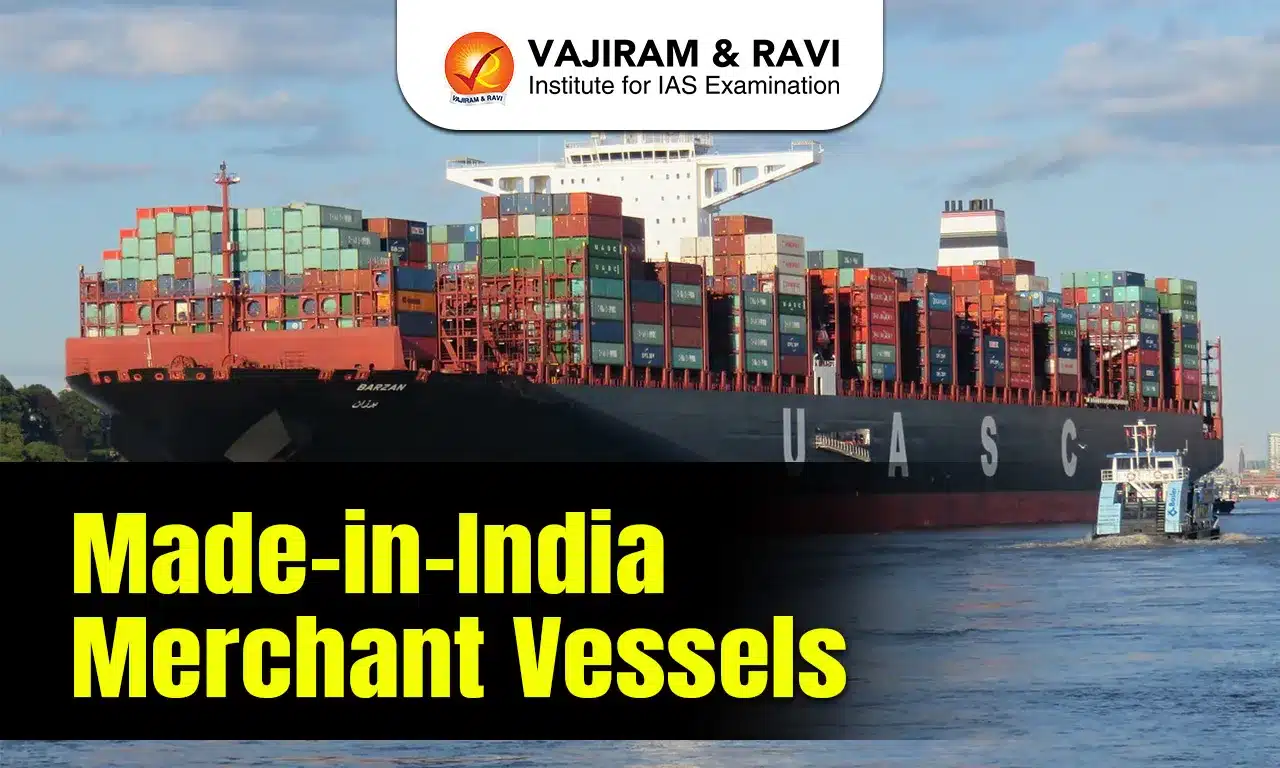
  • The Centre has initiated efforts to expand India's fleet of domestically built merchant ships, aiming to become a leading maritime nation within two decades. 
  • This step is driven by the need for self-reliance, as dependence on foreign ships poses risks during emergencies.

Challenges Faced by India’s Shipbuilding Sector

  • India’s shipbuilding sector, which currently holds only 1.2% of global ship tonnage, is set for significant growth following policy reforms and financial support announced in Union Budget 2025-26.

Ongoing Challenges

  • Small & Outdated Shipyards: Less automation, longer delivery timelines, and higher costs compared to China, Japan, and South Korea.
  • Expensive Financing: Indian interest rates (9–10%) are nearly double those in global competitors.
  • Import Dependency: Heavy reliance on imported marine-grade steel, navigation systems, and propulsion units.
  • Weak Repair Ecosystem: India’s global share in ship repair is <1%; most Indian ships are serviced abroad due to cost and quality issues.
  • Lack of Integrated Maritime Ecosystem: Bureaucratic delays and absence of dedicated maritime financing institutions continue to constrain growth.

India's Push to Become a Global Maritime Power

  • The Indian government has launched an ambitious initiative to significantly expand its fleet of large ‘Made in India’ merchant ships. 
  • The aim is to position India among the top maritime nations over the next two decades, with specific targets to be in the top 10 shipbuilding countries by 2030 and top 5 by 2047.

Need for Indigenous Fleet

  • The move stems from strategic and security concerns. 
  • In times of emergency, such as conflicts or high-alert situations at ports, foreign ships may avoid Indian ports, disrupting trade. 
  • A self-reliant fleet would ensure continuity in trade and economic stability.

Role in National Development

  • The initiative aligns with the government’s vision of making India a “developed nation” by 2047. 
  • Maritime power is seen as a critical pillar of that development journey.

Policy Measures and Financial Support

  • Maritime Development Fund
    • Rs 25,000 crore fund created (49% government-funded), to provide long-term, low-cost financing for shipbuilding, ship repair, and infrastructure. 
    • Expected to attract Rs 1.5 lakh crore investment by 2030.
  • Shipbuilding Financial Assistance Policy (SBFAP) 2.0
    • Outlay of Rs 18,090 crore to provide direct financial subsidies to Indian shipyards.
  • Infrastructure Status
    • Large ships now classified as infrastructure assets, enabling cheaper and longer-term financing.
  • Shipbreaking Credit Note Scheme
    • Offers 40% credit on the scrap value of old ships, usable for purchasing new ‘Made in India’ vessels.
  • Customs Duty Exemptions
    • Extended for 10 years on components used in shipbuilding and shipbreaking to reduce costs and boost domestic manufacturing.
  • Maritime Triad Vision
    • The long-term vision is to establish India as a dominant force in the full maritime value chain — shipbuilding, repairing, and recycling — reinforcing India's position as a global maritime powerhouse.

Strategic Reforms in Shipping Laws

  • Coastal Shipping Bill, 2024: Removes separation between coastal and riverine vessels, cutting transshipment costs.
  • Merchant Shipping Bill, 2024: Expands ship ownership rights to NRIs, OCIs, and Indian-registered businesses, boosting investment.
  • Bare Boat-cum-Demise Chartering: Allows staggered payments instead of upfront full vessel payment.

Strengthening India's Maritime Finance and Shipbuilding Ecosystem

  • Establishment of SCI Bharat IFSC Ltd
    • A new shipping company, SCI Bharat IFSC Ltd, was incorporated in August 2024, at GIFT City, Gandhinagar. 
    • It is designed to operate under the ship leasing framework of the GIFT International Financial Services Centre (IFSC), focusing on vessel ownership, chartering, and other permitted shipping activities.
  • Strategic Objective: 1,000 New Ships by 2034
    • In collaboration with public sector oil, gas, and fertiliser companies, the government plans to expand the Indian merchant fleet by at least 1,000 ships in the next decade. 
    • This would reduce dependence on foreign ships and is expected to bring down freight costs by at least 33% by 2047.
  • Current Status and Need for Growth
    • India currently has about 1,500 merchant vessels, but only 50–60 are large ships. 
    • The policy push aims to trigger a substantial increase in large, domestically built ships to match global standards and secure India's maritime trade interests.
  • India’s Ship Recycling Strength
    • India is already a global leader in ship recycling. 
    • In 2024, it ranked second globally in ship recycling by tonnage, with a 33% share in the global market. 
    • The Alang Ship Breaking Yard in Gujarat remains a vital hub, dismantling a significant portion of retired ships worldwide.

Made-in-India Merchant Vessels FAQs

Q1. Why is India expanding its merchant fleet?

Ans. To ensure trade security during crises and become a self-reliant maritime power under its Make in India vision.

Q2. What financial support has been announced?

Ans. ₹25,000 crore Maritime Development Fund and ₹18,090 crore subsidies under SBFAP 2.0 to boost domestic shipbuilding.

Q3. What are the major industry challenges?

Ans. High financing costs, outdated shipyards, import dependency, and a weak ship repair ecosystem hinder competitiveness.

Q4. What is SCI Bharat IFSC Ltd’s role?

Ans. A GIFT City-based company to lease and own vessels, helping expand India’s fleet by 1,000 ships by 2034.

Q5. How does India plan to lead globally?

Ans. By building strength across the maritime triad: shipbuilding, repairing, and recycling, targeting global leadership by 2047.

Source: IE |BW

India to Impose Retaliatory Tariffs on U.S. Imports Amid Trade Dispute

India-U.S. Trade Dispute

India-U.S. Trade Dispute Latest News

  • In response to the U.S. imposing 25% tariffs on steel and aluminium imports in March, India has notified the WTO of its plan to impose tariffs on $7.6 billion worth of U.S. imports. 
  • The move aims to recover an estimated $1.91 billion in losses suffered by Indian exporters. 

Reinstatement of U.S. Tariffs on Indian Steel and Aluminium

  • In March 2025, U.S. President Donald Trump, in his second term, reimposed 25% tariffs on all imports of steel and aluminium, eliminating earlier exemptions. 
  • The move aimed to protect U.S. domestic industries from “unfair trade practices” and “global excess capacity.”

Historical Context: Tariff Measures During Trump’s First Term (2018)

  • Trump first introduced 25% tariffs on steel and 10% on aluminium in March 2018. 
  • These protectionist measures were part of his "America First" economic approach.

Temporary Easing Under Joe Biden (2021–2023)

  • After Joe Biden assumed office in 2021, trade tensions eased. 
  • During PM Modi’s U.S. visit in September 2023, the U.S. pledged to provide greater market access to Indian steel and aluminium as a gesture following India’s withdrawal of earlier retaliatory duties imposed in 2019.

Return to Protectionism in 2024

  • With Trump’s return to the presidency in 2024, the earlier tariffs were reinstated, this time setting both steel and aluminium duties at 25%.

India’s Retaliation in 2019 Post-GSP Removal

  • India had earlier retaliated in June 2019 when the U.S. revoked India’s Generalised System of Preferences (GSP) benefits. 
    • GSP is a unilateral trade measure where developed countries offer preferential tariff treatment to developing countries, often by reducing or eliminating tariffs on specific products.
  • India responded by imposing tariffs on 28 U.S. imports, including apples, almonds, and walnuts.

Dispute Over Nature of Tariffs

  • India disputes the U.S. claim that the tariffs on steel and aluminium are based on national security concerns.
  • The U.S. argues its actions fall under GATT 1994’s security exception and are not “safeguards.”
  • India, along with the EU, China, and the U.K., disagrees and views the tariffs as safeguard measures, which have different legal obligations under WTO rules.

Lack of Mandatory Consultations

  • India has pointed out that the mandatory pre-consultations required under the Agreement on Safeguards (AoS) were not conducted.
  • According to India, this procedural lapse violates WTO obligations.

Right to Suspend Concessions

  • Citing the adverse impact on its trade, India has reserved its right to suspend trade concessions or obligations toward the U.S.
  • India has stated it will take measures that are “substantially equivalent” to the negative effects caused by the U.S. tariffs.

Concerns Over Competitiveness

  • Indian exporters had expressed worry that U.S. tariffs would make their products costlier and uncompetitive.
  • In 2018, India faced disadvantage compared to countries that had received exemptions from the U.S. tariff regime.
  • The current regime offers no exemptions, leveling the field but still raising pricing concerns.

Sharp Decline in Steel Exports

  • The impact of U.S. tariffs on India’s steel exports was substantial:
    • Exports to the U.S. dropped by 48.4% in FY 2019-20 and 46.7% in FY 2020-21.
    • U.S. share in India’s steel exports fell from 3.3% (2017-18) to 2.5% (2018-19).

Recent Recovery in Exports

  • Despite past declines, FY 2024-25 has seen a 44.21% rise in steel exports until February.
  • This follows a 42.3% decline in FY 2023-24, indicating recent resilience despite global challenges.

Industry Calls for Caution

  • Leading producers like SAIL have warned of global market volatility due to U.S. protectionist policies.
  • There are fears of retaliatory tariffs affecting the global trade balance.

Limited Gains for the U.S.

  • Ironically, the U.S. tariffs did not benefit its own economy significantly.
  • A 2019 analysis by the Federal Reserve found only a “small boost” in manufacturing jobs.
  • These gains were offset by higher input costs and the negative effects of retaliatory tariffs.

A Strategic and Calibrated Response

  • India’s WTO action is seen as strategic rather than reactive.
  • India’s approach is “rules-based and calibrated”, contrasting with the U.S.’ unilateralism.
  • This positions India as a defender of multilateral trade norms, enhancing its reputation in global trade forums.

Alignment with 'Make in India'

  • The move reflects India’s tougher stance on politically sensitive sectors like steel and aluminium.
  • This assertiveness aligns with the Make in India initiative, aimed at boosting domestic industry and reducing foreign dependency.

India-U.S. Trade Dispute FAQs

Q1. Why is India imposing tariffs on the U.S.?

Ans. To recover losses from U.S. tariffs on steel and aluminium and assert trade rights under WTO norms.

Q2. How much will India target in tariffs?

Ans. India will impose tariffs on $7.6 billion worth of U.S. imports, reflecting equivalent trade damage.

Q3. What legal basis does India use?

Ans. India argues the U.S. measures are safeguard-like and failed required consultations, violating WTO's Agreement on Safeguards.

Q4. How have Indian industries reacted?

Ans. Steel producers warned of global volatility, citing rising costs and calls for caution in an unstable market.

Q5. What’s the global trade implication?

Ans. India’s assertive WTO move boosts its image as a multilateral trade defender amid growing protectionism from the U.S.

Source: TH

Kakapo

Kakapo

Kakapo Latest News

A team of researchers from Justus Liebig University Giessen (Germany), New Zealand’s Department of Conservation, Kakapo Recovery, and the University of Otago have successfully implemented artificial insemination (AI) to help breed the critically endangered Kakapo.

About Kakapo (Strigops habroptilus)

  • The Kakapo is the largest flightless parrot in the world, native to New Zealand.
  • It is nocturnalherbivorous, and the only lek-breeding parrot species, meaning males gather to perform mating displays at specific sites.
  • It is named for its owl-like face, with moss-green plumage mottled with yellow and blackgrey bill, and grey legs with pale soles.
  • The Kakapo reproduces infrequently, only breeding in years when certain native fruits, such as rimu berries, are abundant.
  • Lek-breeding behaviour includes the digging of bowl-shaped depressions in the ground, which help amplify mating calls across long distances.

Threats to Survival

  • The species faces multiple threats:
    • Predation by invasive mammals (rats, stoats, weasels) introduced by European settlers.
    • Infertility issues and high embryo mortality have severely restricted population growth.
    • Susceptibility to diseases such as aspergillosis, a dangerous fungal infection.
  • Due to these pressures, the Kakapo is listed as Critically Endangered on the IUCN Red List.

Kakapo FAQs

Q1: What is a Kakapo?
Ans: The Kakapo is a critically endangered, nocturnal, flightless parrot native to New Zealand.

Q2: Why is the Kakapo ecologically important?
Ans: It plays a key role in seed dispersal and maintaining the forest ecosystem in its native habitat.

Source: PHY

Central Equipment Identity Register (CEIR) Portal

Central Equipment Identity Register (CEIR) Portal

Central Equipment Identity Register Latest News

Telangana has emerged as the top-performing state in India for recovering stolen and lost mobile phones through the Central Equipment Identity Register (CEIR) portal.

About Central Equipment Identity Register

  • It was developed by the Department of Telecommunications (DoT), Ministry of Communications, to track lost or stolen mobile phones.
  • It acts as a central database of all the mobile phones that are used and registered in India. It contains all the International Mobile Equipment Identity (IMEI) or Electronic Serial Number (ESN). 
    • IMEI is a 15-digit unique number attached to all the handsets. These numbers are attached to the registered service provider. 
  • The user can track the devices by providing the required information requested on the portal along with the IMEI and FIR copy.
  • The CEIR shares a wide platform that supports all the network operators. 
  • It helps to receive information on the blacklisted mobile devices from the registered network to notify other networks. 
  • This helps to track the device even if the Subscriber Identity Module (SIM) has changed.

Types of Lists in the Equipment Identity Register Database

  • White List: It contains all the authorised IMEI numbers that are allowed to access the network.
  • Grey List: It contains all the authorised IMEI numbers that are kept for observation to track the number.
  • Black List: It contains all the unauthorised IMEI numbers that are prohibited from registration in a cellular network.

Objectives of Central Equipment Identity Register 

  • Discourage mobile theft, identify fraudulent mobile markets, and protect consumer interest.
  • To centralise the database for identifying and blocking the lost, stolen, or illegal mobile phones/networks.
  • To track the lost or stolen mobile phones through IMEI numbers even if the SIM cards are changed or disabled.
  • Create an infrastructure to provide the services to track the mobile devices.
  • Create an infrastructure to access GSMA's database to check the authentication of the mobile device.
  • To identify duplicate IMEI numbers, cloned, reprogrammed, stolen or unauthorised devices.

Central Equipment Identity Register FAQs

Q1: Who developed the Central Equipment Identity Register (CEIR)?

Ans: Department of Telecommunications (DoT)

Q2: What is the primary purpose of the Central Equipment Identity Register?

Ans: To track and block lost or stolen mobile phones

Q3: What unique number does CEIR use to identify mobile devices?

Ans: International Mobile Equipment Identity (IMEI) Number

SourceUNI

Liquid Carbon

Liquid Carbon

Liquid Carbon Latest News

Scientists have for the first time observed the atomic structure of liquid carbon using the high-power DIPOLE 100-X laser and ultrashort X-ray pulses from the European XFEL (X-ray Free Electron Laser) in Germany.

About Liquid Carbon

  • Liquid carbon refers to carbon in a liquid state, which is not naturally stable under normal temperature and pressure conditions.
  • Carbon typically exists in solid forms like graphitediamond, or as gas (CO₂) when oxidised.
  • Liquid carbon is a transient phase, and its study is important for understanding:
    • Planetary core compositions (e.g., carbon-rich exoplanets),
    • High-energy astrophysical processes,
    • And high-temperature material behaviour in laser-material interactions and nuclear science.

Why Liquid Carbon Is Hard to Study

  • Carbon does not melt under normal pressure; it transitions directly from solid to gas (sublimation), making lab-based liquid-phase studies almost impossible.
  • Liquid carbon only forms under extreme conditions:
    • Temperatures ~4500°C,
    • Very high pressures,
    • Conditions that no conventional container can withstand.
  • Thus, laser-driven compression was employed to briefly liquefy solid carbon for nanoseconds, enabling real-time measurement.

Experimental Technique and Innovation

  • The DIPOLE 100-X laser was used to generate compression waves through the carbon sample, converting it to the liquid state for a billionth of a second.
  • During this fleeting moment, the European XFEL’s ultrashort X-ray pulse was used to irradiate the sample, causing the X-ray light to diffract off atoms.
  • The resulting diffraction pattern revealed the atomic arrangement of liquid carbon.
  • Multiple iterations of the experiment with varying delays and conditions were used to create a step-by-step "movie" of the solid-to-liquid transition.

Major Findings of the Study

  • Liquid carbon has a water-like structure, with four nearest atomic neighbours, resembling the structure of solid diamond.
  • The experiment confirmed earlier theoretical simulations and helped to precisely determine the melting point of carbon under high pressure.
  • These insights are important for:
    • Planetary science, as liquid carbon exists in the interiors of planets.
    • Nuclear fusion technology, where carbon-based materials are often involved under extreme conditions.

Liquid Carbon FAQs

Q1: What is Liquid Carbon?
Ans: Liquid Carbon refers to carbon in a liquid state, which is not naturally stable under normal temperature and pressure.

Q2: Why is Liquid Carbon rare?

Ans: It typically forms only under extreme conditions like temperatures above 4500°C and very high pressure, making it transient and difficult to study in laboratory settings.

Source: PHY

INSV Kaundinya

INSV Kaundinya

INSV Kaundinya Latest News

The Indian Navy has inducted the INSV Kaundinya, a reconstructed 5th-century stitched ship based on depictions found in the Ajanta Cave paintings.

About INSV Kaundinya

  • This initiative was launched in July 2023 under a tripartite agreement involving the Ministry of Culture, the Indian Navy, and Hodi Innovations.
  • The Ministry of Culture funded the ship as a symbol of India’s ancient shipbuilding tradition and to promote maritime heritage awareness.
  • INSV Kaundinya is scheduled to sail along the ancient maritime trade route from Gujarat to Oman later in 2025.

Traditional Shipbuilding Techniques

  • The ship was constructed using ancient “stitched ship” techniques, where wooden planks are joined using coir ropescoconut fibres, and natural resinwithout metal nails.
  • The design was based on a 5th-century maritime scene depicted in the Ajanta mural paintings.
  • As there are no surviving blueprints, the design process involved interpreting 2D artistic representations through archaeological, naval architectural, and hydrodynamic analysis.

Symbolism and Cultural Integration

  • The sails feature motifs such as the ‘Gandabherunda’ (mythical two-headed eagle) and the Sun, symbolizing strength and vitality.
  • The bow is adorned with a ‘Simha Yali’ (mythical lion-like figure), reflecting traditional South Indian maritime iconography.
  • Harappan-style stone anchor on the deck connects the ship to India’s Indus Valley maritime legacy.
  • Named after Kaundinya, a legendary Indian sailor who reached Southeast Asia, the ship highlights India’s role in ancient transoceanic trade and cultural exchange.

About Ajanta Paintings

  • The Ajanta Caves, located in Maharashtra, date from the 2nd century BCE to the 6th century CE, and are among the earliest surviving examples of Indian mural art.
  • The paintings follow the tempera technique (painting on dry plaster with pigments), using vegetable and mineral dyes like red ochreblack, and brown.
  • The murals focus on Buddhist themes, such as the Jataka Taleslife of the Buddha, and Avadanas, often interwoven with nature motifs and decorative patterns.
  • Figures are depicted with heavy proportionsexpressive gestures, and distinctive hairstyles, showcasing emotional depth and spiritual symbolism.

INSV Kaundinya FAQs

Q1: What is INSV Kaundinya?
Ans: INSV Kaundinya is a reconstructed stitched ship commissioned by the Indian Navy, inspired by 5th-century maritime depictions in the Ajanta Caves.

Q2: What traditional techniques were used to build INSV Kaundinya?
Ans: The ship was built using ancient stitched shipbuilding methods, where wooden planks are tied together using coir ropes, coconut fibres, and natural resin, with no use of metal nails.

Source: TH

Polavaram Project

Polavaram Project

Polavaram Project Latest News

The Prime Minister will chair a meeting with chief ministers of Andhra Pradesh, Telangana, Odisha, and Chhattisgarh to discuss the Polavaram project.

About Polavaram Project

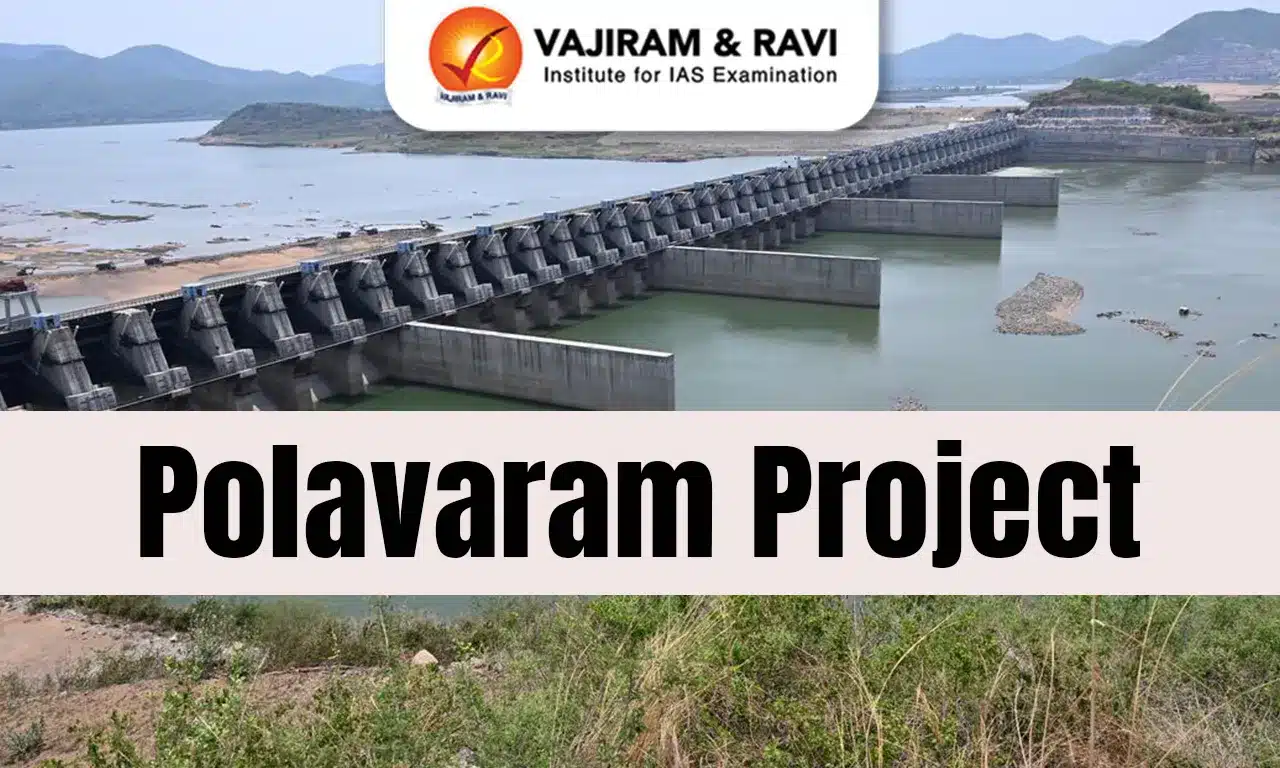
  • It is a multi-purpose irrigation project built on the Godavari River where the river emerges out of the last range of the Eastern Ghats and enters the plains.
  • The dam will be located near Polavaram village in the West Godavari district of Andhra Pradesh, an area bordering Chhattisgarh and Odisha
  • It was conceived in 1980 as a part of the recommendations of the Godavari Water Disputes Tribunal (GWDT).
  • It has been accorded national project status by the central government.
  • It involves the construction of a dam to address water scarcity, boost agricultural productivity, and generate power.
    • The span of the dam is about 1.2 km, having a pier height of 54 m and a total of 48 radial gates (16mx20m).
    • Designed to withstand massive floods that could occur once in 1000 years, the Polavaram Spillway is set to have the highest discharge capacity in the world.
    • At 50 lakh cusecs, it is set to surpass even the 3 Gorges Dam of China, one of the largest dams in the world.
    • The project has set a world record by pouring 32,315.5 cubic metres of concrete into the spillway channel of the project.

Polavaram Project Objectives

  • It is intended for the development of a gross irrigation potential of 4,36,825 ha. 
  • The project also envisages the generation of 960 MW of hydropower and drinking water supply to a population of 28.50 lakh in 611 villages.
  • The project also aims to transfer 80 TMC (Thousand Million Cubic Feet) of water from the Godavari to the Krishna river basin.
  • The dam will help manage floodwaters from the Godavari River, reducing risks to nearby communities.

Polavaram Project FAQs

Q1: On which river is the Polavaram Project constructed?

Ans: Godavari River

Q2: Where is the Polavaram Project located?

Ans: It is located in the West Godavari district of Andhra Pradesh, an area bordering Chhattisgarh and Odisha. 

Q3: How much hydropower is the Polavaram Project expected to generate?

Ans: 960 MW

SourceTOI

SPICED Scheme

Default Image

SPICED Scheme Latest News

The Spices Board recently announced the launch of the “Sustainability in Spice Sector through Progressive, Innovative and Collaborative Interventions for Export Development (SPICED)” scheme for the financial year 2025–26.

About SPICED Scheme

  • Sustainability in Spice Sector through Progressive, Innovative, and Collaborative Interventions for Export Development (SPICED) is an initiative of the Spices Board, under the Ministry of Commerce and Industry.
  • The scheme offers financial assistance across various components, aiming to enhance sustainability, foster innovation, and promote export development in the Indian spices sector.
  • The scheme aims to enhance the productivity of small and large cardamom, improve the quality of post-harvest processes, and encourage the production and export of value-added, GI-tagged, and organic spices. 
  • It is also focused on enabling compliance with global food safety and phytosanitary standards and boosting the capacity of stakeholders across the value chain.

SPICED Scheme Features

  • The scheme offers support for activities such as replanting and rejuvenation of cardamom plantations, development of water resourcesmicro-irrigation, promotion of organic farming, and expansion of good agricultural practices (GAP). 
  • In addition, it supports the installation of improved post-harvest infrastructure, such as modern dryers, slicers, dehullers, and grading machines to ensure superior product quality.
  • The scheme provides financial assistance to farmers and Farmer Producer Organizations (FPOs) to procure essential post-harvest machines such as spice polishers, turmeric boilers, mint distillation units, and threshing machines.
  • The scheme further supports the creation of Spice Incubation Centres and promotes entrepreneurship and product development initiatives aimed at enhancing market access and branding for startups and micro, small, and medium enterprises (MSMEs).
  • Through capacity-building efforts, including training and extension services, the scheme aims to empower spice farmers, SHGs, and FPOs with the latest technical know-how, best practices, and market intelligence.
  • In export development and promotion, the scheme assists in participating in international trade fairs, buyer-seller meets, and other market linkage programs. 
  • While exporters with a valid Certificate of Registration as Exporter of Spices (CRES) are eligible for assistance under these programs, preference will be given to first-time applicants, Small and Medium Enterprises (SMEs), etc.
  • Scheme activities will be geo-tagged, and fund availability, status of applications under different components, list of beneficiaries, etc., will be published on the board's website for better transparency.

SPICED Scheme FAQs

Q1: Which organization is responsible for implementing the SPICED scheme?

Ans: It is an initiative of the Spices Board, under the Ministry of Commerce and Industry.

Q2: What is the primary objective of the SPICED scheme?

Ans: Enhance sustainability and promote export development in the spice sector.

Q3: Which state is called the spice Garden of India?

Ans: Kerala is known as the spice garden of India

SourceHBL

International Day for Biological Diversity (IDB)

International Day for Biological Diversity (IDB)

International Day for Biological Diversity Latest News

To raise a reminder of the pressing need to take action and protect biodiversity, International Day for Biological Diversity is commemorated on May 22 every year.

About International Day for Biological Diversity 

Celebrated each year on May 22, IDB aims to increase understanding and awareness of biodiversity issues. 

International Day for Biological Diversity 2025 Theme

  • This year’s theme “Harmony with nature and sustainable development", highlights how this campaign for nature connects with the Sustainable Development Goals (SDGs).
  • The IDB 2025 seeks to focus the world’s attention on the linkages between the 2030 Agenda and its SDGs and the goals and targets of the Kunming-Montreal Global Biodiversity Framework (KMGBF), as two universal agendas must advance together as they support the recently adopted Pact for the Future.

History of International Day for Biological Diversity

  • The United Nations has proclaimed May 22 as the IDB to increase understanding and awareness of biodiversity issues. 
  • When first created by the Second Committee of the UN General Assembly in late 1993, 29 December (the date of entry into force of the Convention of Biological Diversity), was designated IDB. 
  • In December 2000, the UN General Assembly adopted 22 May as IDB, to commemorate the adoption of the text of the Convention on 22 May 1992 by the Nairobi Final Act of the Conference for the Adoption of the Agreed Text of the Convention on Biological Diversity. 
  • This was partly done because it was difficult for many countries to plan and carry out suitable celebrations for the date of 29 December, given the number of holidays that coincide around that time of year.

International Day for Biological Diversity FAQs

Q1: On which date is the International Day for Biological Diversity (IDB) celebrated annually?

Ans: May 22

Q2: Which international agreement's adoption does the International Day for Biological Diversity commemorate?

Ans: Convention on Biological Diversity

Q3: What is the theme of the International Day for Biological Diversity 2025?

Ans: Harmony with nature and sustainable development.

SourceN18

Intercrystals

Intercrystals

Intercrystals Latest News

Researchers at Rutgers University–New Brunswick have discovered a new class of materials called intercrystals, which possess unique electronic properties that could drive future technologies.

What are Intercrystals?

  • Intercrystals are created by stacking two layers of twisted graphene atop hexagonal boron nitride (h-BN), resulting in moiré patterns that significantly alter electron behaviour.
  • The material is based on the principle of “twistronics”, where ultrathin atomic layers are rotated at small angles to form moiré superlattices.
  • The misalignment of layers causes new electronic phases, not found in regular crystals.
  • This approach builds upon earlier work by the same team, who in 2009 first showed that twisted graphene displays unusual electronic properties.

Structural Properties of Intercrystals

  • Regular crystals possess repeating atomic arrangements and show symmetry under specific translations or rotations.
  • Quasicrystals, discovered in 1982, are ordered but non-repeating, defying traditional crystallography.
  • Intercrystals combine traits of both:
    • They exhibit non-repeating atomic patterns (like quasicrystals),
    • But retain certain crystalline symmetries.
  • The structure creates geometric frustration, enabling new quantum phases.

Unique Electronic Characteristics

  • In intercrystals, electronic properties change dramatically with minor structural variations, unlike conventional materials.
  • These materials exhibit novel quantum behaviours, including: Superconductivity (zero-resistance current), Magnetism, and other quantum electronic states.

Intercrystals FAQs

Q1: What are Intercrystals?
Ans: Intercrystals refer to structures formed between individual crystals in solid-state materials, often affecting their mechanical and optical properties.

Q2: In which fields are Intercrystals significant?
Ans: They are important in materials science, mineralogy, semiconductor physics, and nanotechnology.

Source: PHY

Enquire Now