Stratospheric Aerosol Intervention

Stratospheric Aerosol Injection

Stratospheric Aerosol Injection Latest News

A study recently published in the journal Earth’s Future offered an innovative approach to Stratospheric aerosol injection (SAI) technique that could reduce its costs but also bring it closer to fruition despite the opposition to it.

About Stratospheric Aerosol Injection

  • It is a method of cooling the planet and reducing the impacts of climate change by adding a layer of tiny reflective particles to the high atmosphere.
  • The method was inspired by volcanic eruptions, which have been known to have a cooling effect on the planet by spewing aerosols into the air.
  • It aims to mimic the cooling effects of volcanic eruptions by injecting sulfur dioxide (SO2) directly into the stratosphere, where it forms sunlight-reflecting sulfate aerosols. 

Key Facts about Aerosols

  • They are tiny solid or liquid particles suspended in air or a gas.
  • Aerosols can be natural, such as fog or gas from volcanic eruptions, or artificial, such as smoke from burning fossil fuels.
  • Aerosol particles are either emitted directly into the atmosphere (primary aerosols) or produced in the atmosphere from precursor gases (secondary aerosols).
  • Aerosol particles are tiny, but numerous, and often comprise a number of inorganic and organic substances.
  • True aerosol particles range in diameter from a few milli micrometres to about 1 micrometre (equal to 10-4 cm). 
  • Particles with a diameter of less than 0.1 micrometre are sometimes referred to as Aitken nuclei.
  • Visible forms of atmospheric aerosol plumes include smoke, smog, haze, and dust.

Stratospheric Aerosol Injection FAQs

Q1: What is the Stratosphere?

Ans: It is the layer of Earth’s atmosphere lying between the troposphere and the mesosphere. The stratosphere extends from the tropopause at about 10 to 17 km (about 6 to 11 miles) altitude to its upper boundary (the stratopause) at about 50 km (30 miles).

Q2: What is smog?

Ans: Smog is a specific type of air pollution. It is a combination of harmful pollutants (often appearing relatively low to the ground as a yellow-brown haze) that are introduced into the atmosphere by both natural and human induced processes.

Source: TH

Arsia Mons

Default Image

Arsia Mons Latest News

NASA’s 2001 Mars Odyssey orbiter recently delivered a stunning new picture from Mars, capturing the colossal Arsia Mons volcano piercing through a dense layer of early morning clouds.

About Arsia Mons

  • Arsia Mons is a massive shield volcano located in the Tharsis region of Mars.
  • It is one of the largest volcanoes in the solar system, with a height of over 18 kilometers (11 miles) and a base diameter of more than 300 kilometers (190 miles), dwarfing Earth's tallest volcano, Mauna Loa, which rises 6 miles (9 kilometers) above the seafloor.
  • Arsia Mons is part of the Tharsis Montes, a group of three large shield volcanoes on Mars.
  • It is the southernmost of the three Tharsis Montes volcanoes.
  • The volcano has a caldera (summit crater) that is approximately 110 kilometers (68 miles) wide.
  • Arsia Mons is believed to have been volcanically active for billions of years, with the most recent eruptions occurring within the past 2 million years.
  • The flanks of Arsia Mons are covered in lava flows, channels, and other volcanic features, indicating a long and complex eruptive history.
  • Arsia Mons is thought to have formed through the gradual accumulation of fluid basaltic lava flows, characteristic of shield volcano formation.

Arsia Mons FAQs

Q1. Where is Arsia Mons located?

Ans. Tharsis region of Mars

Q2. What type of volcano is Arsia Mons?

Ans. Shield volcano

Q3. How tall is Arsia Mons?

Ans. Over 18 km

Source: NDTV

Himalayan Long-Tailed Myotis

Himalayan Long-Tailed Myotis

Himalayan Long-Tailed Myotis Latest News

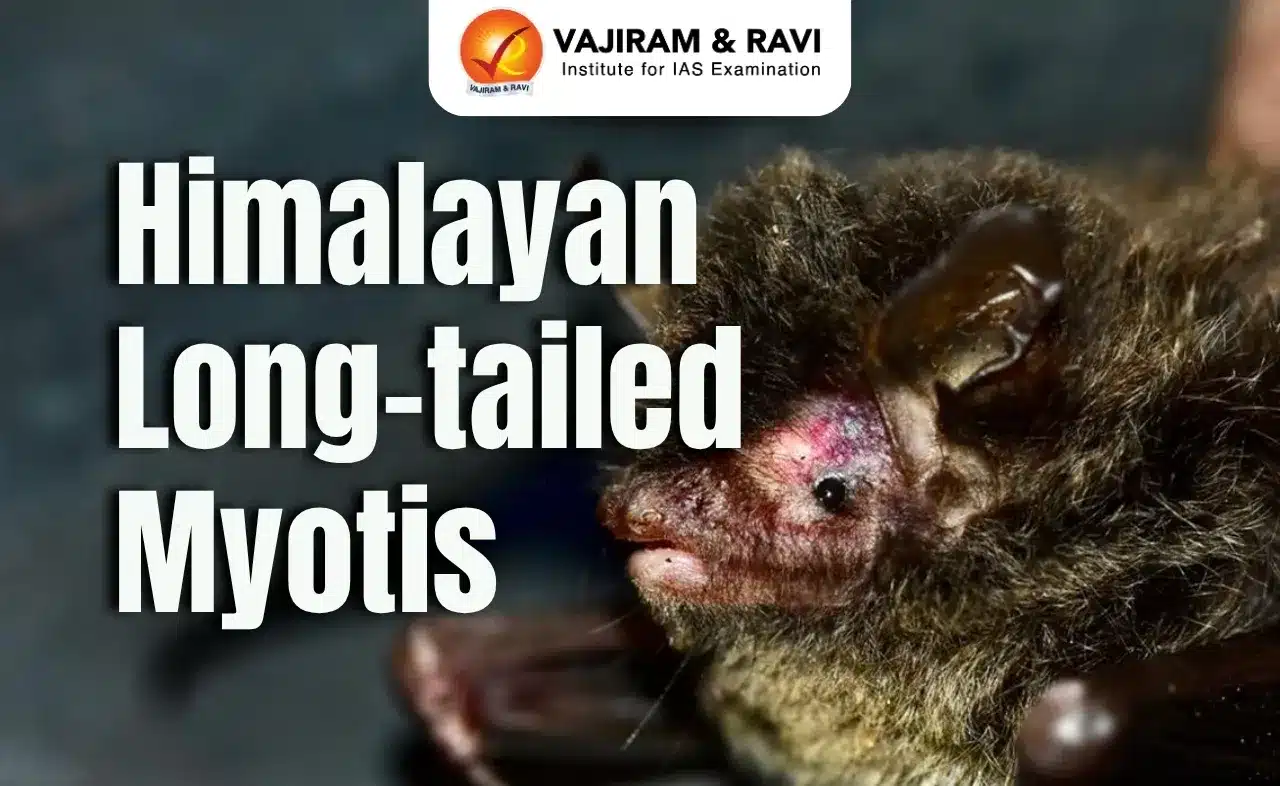
Recently, researchers have discovered a new species of bat named Himalayan long-tailed Myotis (Myotis himalaicus).

About Himalayan Long-Tailed Myotis

  • It is a new species of bat found in the Western Himalayan region.
  • It belongs to a group of morphologically similar species called the Myotis frater complex, which has a wide distribution from eastern China, Taiwan, central and southeastern Siberia, Korea, Japan, Tajikistan, and Uzbekistan.
  • Habitat: The Himalayan long-tailed Myotis, which inhabits Deodar, Pine, and Cedar forests, appears to be a rare species native to the southern slopes of the Himalayas.
  • Distribution: These bats have been found in Uttarakhand, India, and Khyber Pakhtunkhwa, Pakistan.

Features Of Himalayan Long-Tailed Myotis

  • It is considered “medium-sized,” reaching about 3.5 inches in length and weighing less than an ounce
  • They have “delicate” feet and “relatively long” thumbs ending in “a strong but short claw.” Their heads have “short” ears and “rather delicate” teeth.

Ecological Significance of Bats

  • Bats contribute to overall biodiversity and the health of ecosystems.
  • Insect Predators: Throughout the night, bats devour insects in farms, fields, forests, grasslands and around our homes, including agricultural pests and disease-causing mosquitoes.
  • Bat droppings (guano) mined from caves are widely used as a fertilizer for agricultural crops as they have high concentrations of nitrogen and phosphorous.
  • Pollinators: Some bats sip nectar, pollinate flowers, eat fruits, and spread the seeds of many important tree species.

Himalayan Long-Tailed Myotis FAQs

Q1: What do long-tailed bats eat?

Ans: An aerial insectivore, they feed on small moths, midges, mosquitoes and beetles.

Q2: What is the biggest bat?

Ans: The giant golden-crowned flying fox

Source: TH

Dugesia Punensis

Dugesia Punensis

Dugesia Punensis Latest News

A new species of planarian worm that regenerates, named Dugesia Punensis, has been found in the Pashan Lake in the city of Pune recently. 

About Dugesia Punensis

  • It is a new species of planarian worm.
  • Planarians are aquatic flatworms, renowned for their extraordinary regenerative capabilities.
  • It was discovered in Pashan LakePune district, Maharashtra, a wetland within the Western Ghats biodiversity hotspot.
  • It is the first time since 1983 that a new planarian species has been recorded in India.

Dugesia Punensis Features

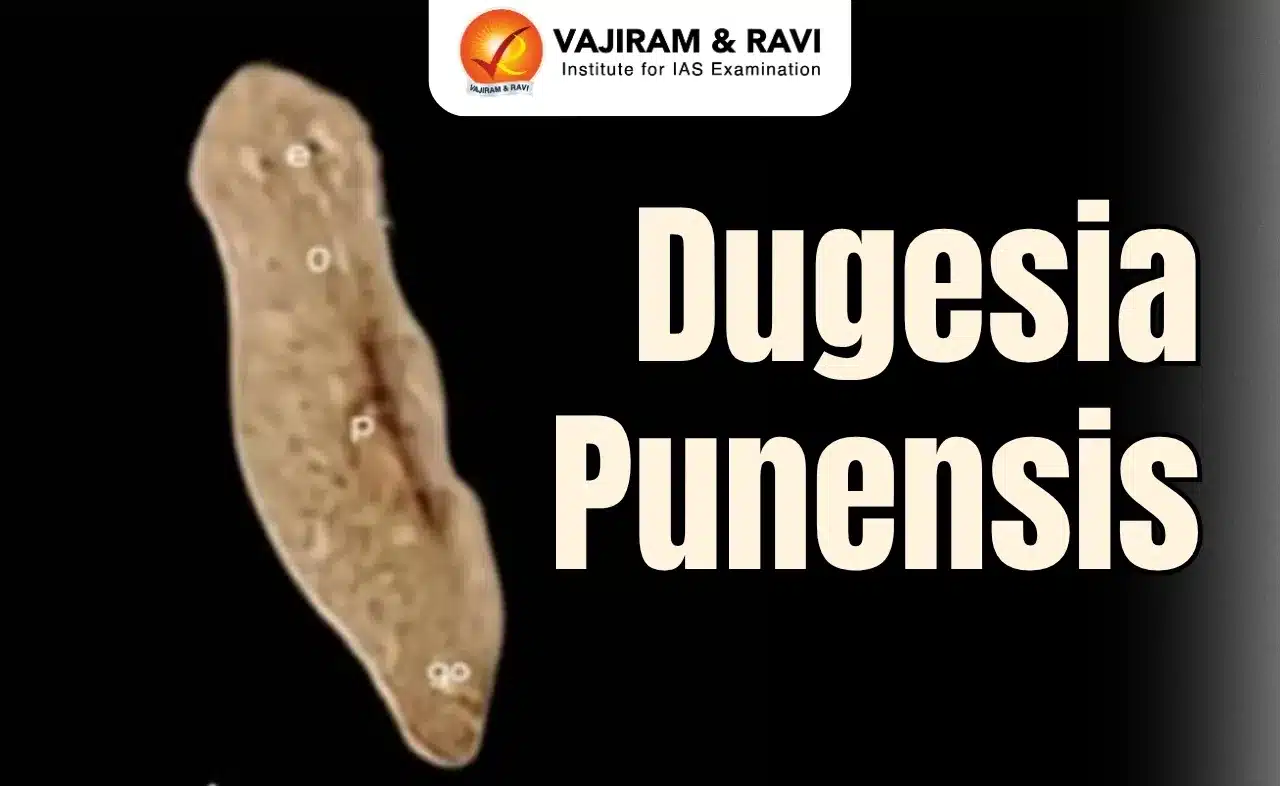
  • The new species is characterised by its spotted appearance, slightly reduced auricles, and elongated pharynx and gonopore. 
  • The body size ranges between 8mm-12mm in length.
  • The dorsal side is spotted dark brown in appearance, with a light brown back. 
  • The ventral side looks pale. 
  • Eggs are circular and have a reddish appearance. 
  • Auricular grooves enclose two bright black eyes
  • It can completely regenerate in 10-13 days.

Dugesia Punensis FAQs

Q1. Dugesia punensis belongs to which group of animals?

Ans. Flatworms

Q2. How long does it take for Dugesia punensis to completely regenerate?

Ans. 10–13 days

Q3. In which Indian biodiversity hotspot was Dugesia punensis discovered?

Ans. Western Ghats

SourceNDTV

Battle of Surat 1664, History, Series of Events, Aftermath

Battle of Surat

The Battle of Surat fought on January 5, 1664 in between the Maratha and the mughal empire, was led by Shivaji Maharaj. Surat, an important port city and trade center of Mughals, was attacked by the Marathas. Prince Muazzam (Emperor Aurangzeb) the governor in chief of Gujarat fought against the marathas. Eventually the Marathas won the war and the Surat city was ransacked for six days. In this article, we are going to cover the Battle of Surat History, the components of the war and significant consequences. 

Battle of Surat History 

The Battle of Surat was an important event that happened on 5 February 1664. At this time, the Mughal Empire was at its highest power , while the Maratha Empire was an emerging regional force. Shivaji launched this battle to increase his territory and challenge mughal authority. 

At the same time, Shaista Khan, the mughal governor, engaged in a war against the Marathas in the Deccan. This war weakened the financial condition of the Maratha kingdom. In order to revive the treasury, Shivaji created a plan to attack Surat, a wealthy Mughal stronghold and thriving port city. The goal was to conquer and plunder the riches and transfer the wealth to Raigad Fort, the primary residence. 

Mughal Forces at Surat

The city's defenses were weak, and Inayat Khan, the local Mughal Subedar, could only deploy 1,000 armed men for protection. However, this proved insufficient against the swift and strategic attack launched by Shivaji. As the battle unfolded, the Mughal garrison was overwhelmed, and Shivaji’s forces set the regional shipping sector ablaze, dealing a severe blow to Mughal trade and influence.

Maratha Forces at Surat

Shivaji led a well-organized force of over 8,000 cavalrymen, accompanied by his trusted commanders. The Marathas’ mobility and guerrilla tactics allowed them to swiftly overrun the city, ensuring a decisive victory.

Battle of Surat Series of Events

The Maratha War of Battle of Surat was a struggle between the Marathas and the Mughal Empire. Daud Khan and Shaista Khan had attacked the Pune-Supa region, setting the entire village on fire. Shaista Khan continued to seize control of Lal Mahal in Pune, looting the wealth and enforcing the mughal dominance in the Deccan. Aurangzeb with an aim to consolidate his rule, targeted the vulnerable people of Pune and Supa. In response, Chhatrapati Shivaji devised a bold strategy to attack Surat- the wealthiest trade hub. The decision followed the night raid on Shaista Khan during which he amputated the thumb of Mughal general. Instead of launching a direct assault on the Surat Fort, Shivaji initially demanded tribute from the city's wealthy merchants. However, upon their refusal, he launched a full-fledged attack on the city.

The element of surprise played a crucial role, leaving the Mughal chieftains unprepared. Rather than facing Shivaji’s forces head-on, they sought refuge inside the Fort of Surat. Over the course of three days, the Marathas plundered the city, targeting the riches of traders and merchants from Mughal Gujarat Subah, Portuguese settlements, and other commercial hubs. The residences of prominent traders like Virji Vora, Haji Zahid Beg, and Haji Kasim were raided, yielding gold, silver, pearls, diamonds, rubies, and emeralds.

Notably, Shivaji refrained from looting the homes of foreign missionaries, demonstrating his strategic and principled approach to warfare. The Battle of Surat not only boosted Maratha finances but also sent a strong message to the Mughal Empire, proving that Shivaji was a formidable force against their expansionist ambitions.

Battle of Surat Series of Loots by Chhatrapati Shivaji

The first is of Father Ambrose, a Catholic monk. Shivaji was informed that this person’s home was deserving of looting. Father Ambrose was a devout man, and Chhatrapati Shivaji was aware of this and refrained from looting his home. His home remained unharmed during the battle of Surat. The second businessman was Mohandas Parekh. He was also one of Surat’s wealthiest businessmen. It so happened that Parekh had passed away a few months earlier and that his wife was now his sole heir. The merchant has also been a big humanitarian throughout his life. Shivaji immediately outlawed the robbing of his home or of his valuables and, in fact, stationed guards to ensure that this would not occur.

Battle of Surat Aftermath

In this Maratha War, before the Mughal Empire in Delhi was informed of the battle of Surat, all of this loot had already been transferred to the Deccan. Later, the Maratha state was built up and strengthened with this wealth. The Mughal Emperor Aurangzeb was angered by this occurrence. After Shivaji’s invasion of the Port of Surat, trade did not thrive as much, which resulted in a decrease in the Mughal Empire’s revenue. The battle of Surat resulted in the victory of the Maratha Empire against Mughal forces.

The second sacking of Surat occurred in 1670. This time, Shivaji was directly engaged in battle with Mughal forces deployed throughout the Sahyadris. He was also squaring off against Janjira Siddi. The Mughal boats from Surat attacked the back of his soldiers when they were fighting the Siddi. Shivaji responded by attacking Surat. This time, Lohagad, which is close to Pune, received the loot.

Battle of Surat FAQs

Q1: Why did Shivaji sack Surat?

Ans: Shivaji sacked Surat in 1664 to weaken the Mughal Empire financially and replenish the Maratha treasury.

Q2: How did Surat get its name?

Ans: Surat derives its name from the Gujarati word Suraj, meaning "good land" or "beautiful place."

Q3: How many times did Shivaji loot Surat?

Ans: Shivaji looted Surat twice, first in 1664 and again in 1670.

Q4: When did the British capture Surat?

Ans: The British captured Surat in 1759 after defeating the Dutch forces.

Q5: Why is Surat called the Diamond City?

Ans: Surat is called the Diamond City because it is a global hub for diamond cutting and polishing, handling over 90% of the world's diamonds.


National Automated Fingerprint Identification System

National Automated Fingerprint Identification System

National Automated Fingerprint Identification System Latest News

Recently, the Centre has revised the procedure for the Foreigners Identification Portal (FIP) of the National Automated Fingerprint Identification System (NAFIS) and asked states/UTs to use fingerprint scanners available in districts under districts police module (DPM) of Immigration Visa Foreigner Registration Tracking system (IVFRT).

About National Automated Fingerprint Identification System

  • It is a pan-India searchable database of crime and criminal-related fingerprints. 
  • Objective: To collect fingerprint data of all the criminals from all the states and the Union Territories.
  • It will enable law enforcement agencies to upload, trace and retrieve information from the database 24x7 in real-time.
  • It is managed by the National Crime Records Bureau (NCRB) at the Central fingerprint bureau, based in New Delhi.
  • With NAFIS, it is possible to locate a person of interest in a matter of minutes and connect that individual’s name to any active warrants, warnings, or information about related criminal conduct stored in other police information reference systems.

Working of NAFIS

  • It assigns a unique 10-digit National Fingerprint Number for each criminal, based on biometrics.
  • The unique ID will be used for a lifetime of an offender. Different crimes registered under different FIRs will be logged as incidents belonging to the same National Fingerprint Number.
  • The first two digits of the ID will be the state code of the state where the criminal is registered, followed by a sequence number.
  • The state partition will have IDs belonging to a state. 
  • Apart from this, a digital record will be added as storage to match the fingerprints in the future.

National Automated Fingerprint Identification System FAQs

Q1: Which ministry is NAFIS under?

Ans: Ministry of Home Affairs

Q2: What is the full form of NCRB?

Ans: NATIONAL CRIME RECORDS BUREAU

Source: IE

Ejiao

Ejiao

Ejiao Latest News

Recently, there has been a sudden surge in donkey prices in Pakistan due to China’s demand for ejiao.

About Ejiao

  • It is a gelatin used in traditional Chinese medicine, made by stewing and concentrating donkey skin.
  • It is widely used in clinics for its biological advantages of being anti-fatigue, immunity-improving properties, for tumour suppression, and for its anti-anaemia effect.
  • It is produced from the collagen extracted from donkey skin.
  • The collagen is mixed with herbs and other ingredients to create bars, pills or liquids for consumable goods or beauty products.
  • Between 2013 and 2016, the annual production of ejiao increased from 3,200 to 5,600 tonnes, a yearly growth of over 20%.
  • China’s ejiao industry has witnessed a 160 per cent growth in the past five years, fuelling more demand for millions of donkey hides annually. 
  • Pakistan is only behind Ethiopia and Sudan in being home to the largest number of donkeys.

Ejiao FAQs

Q1: What is Ejiao in English?

Ans: Ejiao is also known as 'colla corii asini' or 'donkey-hide glue.

Q2: How is donkey gelatin made?

Ans: It is gelatin obtained from the skin of the donkey by soaking and stewing.

Source: TH

Tamhini Wildlife Sanctuary

Tamhini Wildlife Sanctuary

Tamhini Wildlife Sanctuary Latest News

Maharashtra forest department recently partnered with Microsoft and the Centre for Youth Development and Activities (CYDA), Pune, to address socio-ecological challenges in the Tamhini Wildlife Sanctuary.

About Tamhini Wildlife Sanctuary

  • It is a protected forest area located in the Western Ghats near Pune, Maharashtra.
  • It covers an area of 49.62 sq.km.
  • It has been carved out by taking 12 compartments of reserved forest from the Paund and Sinhgad ranges in the Pune forest division, while 8 compartments belong to Mangaon range in the Roha division in Thane.
  • Vegetation: It is made up of evergreen forests, semi-evergreen forests, and most deciduous forests.
  • Flora: Species like teak, bamboo, Ain, Shisham, mango, and Jamun are found in this area.
  • Fauna
  • Indian giant squirrels, barking deer, Indian pangolins, Indian civets, and wild boars are some of the many species found in this region.
  • In terms of avifauna population, species like the Malabar whistling thrush, crested serpent eagle, grey junglefowl, golden oriole, and Indian pitta are some of the residents.

Tamhini Wildlife Sanctuary FAQs

Q1: Where is the Tamhini Wildlife Sanctuary located?

Ans: Western Ghats, Maharashtra

Q2: What is the approximate area covered by Tamhini Wildlife Sanctuary?

Ans: 49.62 sq.km

Q3: Tamhini Wildlife Sanctuary lies near which major city?

Ans: Pune

Source: IE

Thitu Island

Thitu Island

Thitu Island Latest News

A Chinese ship was recently struck aground in severe weather in shallow seas off Philippine-occupied Thitu island in the disputed South China Sea, causing Filipino soldiers to be on high alert.

About Thitu Island

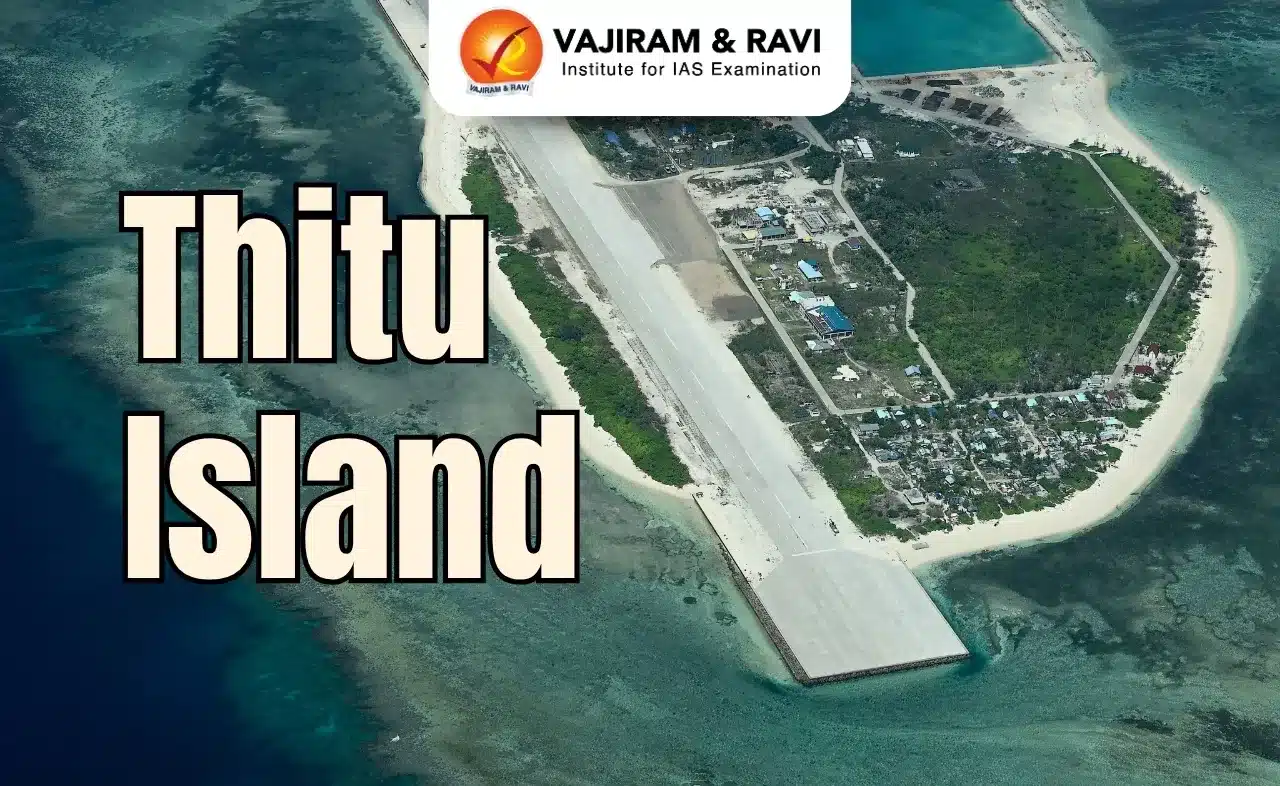
  • Thitu Island (also known as Pag-asa Island in the Philippines) is located in the South China Sea, specifically within the Spratly Islands archipelago.
  • The Spratly Islands consist of more than 100 small islands or reefs in the South China Sea.
  • They are claimed in their entirety by China, Taiwan, and Vietnam, while portions are claimed by Malaysia and the Philippines.
  • Thitu Island is the second largest of the naturally occurring Spratly Islands and the largest of nine islands occupied by the Philippines.
  • Thitu Island is home to a Philippine fishing village and Filipino forces.
  • It has been administered by the Philippines since 1971, with civilian settlement initiated in the mid‑1990s.
  • It has a permanent civilian population, including a school and airport (Rancudo Airfield), a large harbor, and a lighthouse for navigation. 
  • It is only about 24–27 km from China’s Subi Reef, which hosts a large military base.

Thitu Island FAQs

Q1: Thitu Island is located in which group of islands?

Ans: Spratly Islands

Q2: What is the name of the airfield located on Thitu Island?

Ans: Rancudo Airfield

Q3: What is the significance of Thitu Island for the Philippines?

Ans: It provides strategic and civilian presence in the South China Sea.

SourceFP

Important Days in April 2025, Date, Events

Important Days in April 2025

Important Days in April 2025 hold various significance from the perspective of national as well as international importance as they represent various important historical events, social and environmental causes. The main idea behind celebrating these days is to create an impact and awareness in the society along with encouraging people to take a step towards a better society. The article below discusses the Important Days in April 2025 and their importance.

Important Days in April 2025

The month of April marks a range of significant national and international days which holds importance for various causes and cultural observance. Check out the List of Important Days in April 2025:

Important Days in April 2025

Date

Event

April 1

Fossil Fools Day

April 1

Odisha Day (Utkala Dibasa)

April 1

Autism Awareness Month

April 2

World Autism Awareness Day

April 4

World Rat Day

April 5

International Day for Mine Awareness

April 5

National Maritime Day 

April 6

International Day of Sport for Development and Peace

April 6

Ram Navami

April 7

World Health Day

April 10

World Homeopathy Day

April 11 

National Safe Motherhood Day (India) 

April 12

American Civil War Day

April 12 

International Day of Human Space Flight 

April 13

Baisakhi

April 14

Ambedkar Jayanti

April 14

Bohag Bihu (also known as Rongali Bihu)

April 15

Himachal Day

April 17

World Hemophilia Day

April 18

World Heritage Day

April 21

National Civil Service Day

April 22

International Mother Earth Day

April 24

National Panchayati Raj Day

April 25

World Penguin Day

April 25

National DNA Day

April 25

National Telephone Day

April 25

World Malaria Day

April 26

World Intellectual Property Day

April 26

World Veterinary Day

April 28 

World Day for Safety and Health at Work

Important National Days in April 2025 Importance

April 1 - Odisha Foundation Day (Utkal Divas)

Odisha Foundation Day celebrated the formation of Odisha as a separate state in 1936, recognizing its rich cultural heritage.

April 2 - World Autism Awareness Day

World Autism Awareness Day promotes awareness and encourages acceptance and inclusion of individuals with autism spectrum disorders worldwide.

April 5 - National Maritime Day

Marks the historic journey of SS Loyalty, the first Indian-owned ship, in 1919, highlighting the maritime sector's role in economic growth.

April 7 - World Health Day

World Health Day Established by the World Health Organization (WHO) which draws attention to global health challenges and advocates for universal healthcare.

April 12 - International Day of Human Space Flight

International Day of Human Space Flight marks the historic first human space flight by Yuri Gagarin in 1961 and celebrates advancements in space exploration.

April 14 - Ambedkar Jayanti

Ambedkar Jayanti is celebrated honoring Dr. B.R. Ambedkar for his contribution to the Indian Constitution and his efforts in social reform.

April 14 - Baisakhi

Baisakhi Celebrated in Punjab as a harvest festival and the Sikh New Year which also marks the formation of the Khalsa.

April 15 - Himachal Day

Himachal Day celebrated the formation of Himachal Pradesh as a full-fledged state in 1948.

April 17 - World Haemophilia Day

Raises awareness about haemophilia and other bleeding disorders while supporting better healthcare facilities.

April 18 - World Heritage Day (India Observance)

World Heritage Day promotes awareness of the importance of preserving India’s cultural and historical heritage.

April 21 - Civil Services Day

Civil Services Day is celebrated to recognize the contributions of Indian civil servants in governance and public service.

April 22 - Earth Day

Emphasizes the importance of environmental protection and calls for action on climate change and sustainable living.

April 24 - National Panchayati Raj Day

National Panchayati Raj Day celebrates the establishment of the Panchayati Raj System in India, encouraging local self-governance.

April 25 - World Malaria Day

Spreads awareness about malaria prevention and control and acknowledges global efforts to eliminate the disease.

April 26 - World Intellectual Property Day

World Intellectual Property Day highlights the significance of intellectual property rights in driving innovation and fostering creativity.

April 28 - World Day for Safety and Health at Work

World Day for Safety and Health at Work is celebrated to promote safer work environments by addressing occupational hazards and promoting workplace safety measures globally

April 30 - Ayushman Bharat Diwas

Ayushman Bharat Diwas celebrates the launch of the Ayushman Bharat Yojana in 2018, a milestone in providing healthcare to millions across India.

Important Days in April 2025 FAQs

Q1: What are the special days in April 2025?

Ans: Special days in April 2025 include World Autism Awareness Day (Apr 2), World Health Day (Apr 7), Baisakhi (Apr 14), Earth Day (Apr 22), and World Book Day (Apr 23).

Q2: What are the important days of year 2025?

Ans: Important days in 2025 include Republic Day (Jan 26), Independence Day (Aug 15), Earth Day (Apr 22), Gandhi Jayanti (Oct 2), and Christmas (Dec 25).

Q3: What special day is April 22 2025?

Ans: April 22, 2025, is Earth Day, dedicated to raising awareness about environmental protection, promoting sustainability, and encouraging global actions to combat climate change.

Q4: What is on in April 2025?

Ans: April 2025 features significant days like World Autism Awareness Day, World Health Day, Earth Day, Baisakhi, and Ambedkar Jayanti, celebrating health, environment, culture, and awareness.

Q5: What special day is April 23 2025?

Ans: April 23, 2025, marks World Book and Copyright Day, celebrating the joy of reading, promoting literacy, and honoring authors, books, and copyright protection globally.

India’s EV Localisation Policy: Balancing Imports and Industrial Growth

India EV Manufacturing Policy

India’s EV Localisation Policy Latest News

  • The Ministry of Heavy Industries notified guidelines of the Scheme to Promote Manufacturing of Electric Passenger Cars in India.

India’s Strategy to Accelerate EV Manufacturing

  • India has taken a bold step to bolster its electric vehicle (EV) sector by unveiling a policy aimed at encouraging domestic manufacturing while permitting limited imports of fully built electric cars at reduced import duties. 
  • This Scheme to Promote Manufacturing of Electric Passenger Cars, announced by the Ministry of Heavy Industries (MHI), is part of a broader effort to enhance clean mobility and industrial competitiveness.

Key Provisions of the Scheme

  • The central feature of the policy is a sharp reduction in customs duty on completely built units (CBUs) of electric cars, from the current 70-100% to just 15%
  • This duty cut applies to vehicles priced at or above $35,000 (approximately Rs. 29.75 lakh) for a five-year period. However, this benefit is contingent on manufacturers investing a minimum of Rs. 4,150 crore in India over three years.
  • These investments must result in domestic value addition (DVA) of at least 25% within three years, increasing to 50% by the fifth year. 
  • A maximum of 8,000 vehicles can be imported annually under the concessional duty regime, and the total foregone customs duty is capped at Rs. 6,484 crore.
  • MHI estimates that an imported EV under this scheme would incur a landing cost of Rs. 36 lakh, significantly lower than before.

Assessing Ecosystem Impact

  • The policy aims to strike a balance between short-term affordability for Indian consumers and long-term self-reliance in manufacturing. 
  • According to FADA data for FY 2025, EVs made up 7.8% of total vehicle sales, with three-wheelers leading at 57% within their segment, followed by two-wheelers (6.1%), passenger vehicles (2.6%), and commercial vehicles (0.9%).
  • The International Energy Agency (IEA) identified India as the largest global market for electric three-wheelers in 2024, underscoring the importance of focusing not only on private four-wheelers but also on mass and last-mile mobility.
  • Critics, however, caution that the scheme could dilute India's domestic manufacturing ambitions if foreign firms are not compelled to transfer core technologies. Countries often resist exporting their technological edge, potentially reducing India to a component assembly hub.
  • Another critic emphasized the importance of innovation, R&D, and skilling, elements that powered China and South Korea's emergence as global EV leaders. Without these, India may fail to build a truly indigenous ecosystem.

Concerns Over Industrial and Employment Policy

  • Indian EV manufacturers, notably Tata Motors and Mahindra, have expressed reservations about the scheme. 
  • In December 2023, Tata opposed Tesla’s demand for lower import duties, arguing that such a move would disrupt an investment climate based on a stable, protectionist tax regime.
  • IEA data revealed that over 80% of electric cars produced in India in 2024 came from local manufacturers, while Chinese imports contributed less than 15% to EV sales, thanks in part to the earlier high-duty barriers and availability of affordable domestic options.
  • Analysts argue that the new policy may tilt the scale in favour of foreign capital, thereby impacting domestic players and job creation. 
  • As EVs typically require fewer moving parts than traditional internal combustion engines, the shift could also mean fewer jobs in traditional manufacturing sectors unless accompanied by new skilling initiatives.
  • Furthermore, S&P Global Mobility has pointed out that India’s continued reliance on imported batteries and components, along with the high upfront cost of EVs (20–30% more than ICE vehicles), remains a barrier to mass adoption and localisation.

Path Forward

  • Experts suggest that India’s EV roadmap must be reoriented toward building domestic capacity, fostering innovation, and ensuring broad-based industrial growth. 
  • Rather than focusing primarily on attracting foreign OEMs, policies should invest in research institutes, encourage public sector participation, and fund start-ups in the EV supply chain.
  • A critical challenge will be to integrate India's climate commitments with its manufacturing strategy. 
  • As India targets net-zero emissions by 2070, it must simultaneously expand clean mobility options and ensure they are accessible, affordable, and built with local value addition.

India EV Manufacturing Policy FAQs

Q1. What is the core provision of India’s new EV manufacturing scheme?

Ans. The policy allows import of electric cars at 15% duty if the manufacturer invests ₹4,150 crore and meets localisation targets.

Q2. How many EVs can be imported under the scheme annually?

Ans. A maximum of 8,000 electric vehicles can be imported per year at the reduced duty rate.

Q3. What localisation targets are set for EV manufacturers?

Ans. Manufacturers must achieve 25% domestic value addition in three years and 50% in five years.

Q4. Why are Indian automakers opposing the scheme?

Ans. Domestic players like Tata fear reduced import duties could disrupt the investment climate and harm local industries.

Q5. How does the policy align with India’s EV and climate goals?

Ans. The policy aims to boost clean mobility while encouraging foreign investment, but concerns remain over technology transfer and job creation.

Source: TH

Intensified Naxal Crackdown and Major Welfare Push

Anti-Naxal Operations

Anti-Naxal Operations Latest News

  • In its first year, the current government has intensified efforts against the Naxal insurgency while expanding key welfare schemes from earlier terms.

Final Push Against Naxals Underway

  • The government has intensified efforts to eliminate Left-Wing Extremism (LWE), aiming to end the decades-long Naxal insurgency by March 31, 2026, as declared by Union Home Minister.

Major Gains in Maoist Strongholds

  • Security forces have made significant advances in Chhattisgarh, Jharkhand, and Odisha, particularly in the Bijapur-Sukma-Dantewada tri-junction. 
  • The use of forward operating bases, enhanced road connectivity, and targeted operations have been central to the strategy.

Surge in Maoist Casualties

  • In Chhattisgarh alone, 209 Maoists were killed in the first five months of 2025—nearly matching the 219 killed in all of 2024. 
  • In contrast, only 53 were killed across India in 2023. 
  • The most notable success was the killing of CPI Maoist general secretary Basavaraju in May 2025.
    • Union Home Minister Amit Shah termed this the first time in 30 years that a leader of such high rank has been eliminated in India's fight against Naxalism.

Operation Black Forest: Massive Success

  • Operation Black Forest was launched on April 21. It was a bold and carefully planned three-week joint campaign by the CRPF and Chhattisgarh Police.
  • It successfully dismantled the Maoists’ strongest fortress in the Kurragutta hills on the Chhattisgarh-Telangana border.
  • As part of Operation Black Forest:
    • 54 Naxalites were arrested
    • 84 surrendered across Chhattisgarh, Telangana, and Maharashtra

Key Factors Behind the Success

  • The progress is attributed to:
    • Strong political will
    • Intelligence-led operations
    • Enhanced state-centre coordination
    • Active participation of local units like Chhattisgarh’s District Reserve Guards

Setbacks and Challenges Remain

  • Despite gains, ambushes by Maoists in areas like Kolhan (Jharkhand) and Abujhmad (Chhattisgarh) have resulted in casualties among security forces, showing the rebels still retain strike capabilities.

The Road Ahead: Security and Development

  • To fully neutralize LWE, the government must sustain military pressure while also ensuring governance, infrastructure, and welfare outreach in the affected regions.

Ayushman Bharat Expanded to Cover All Above 70

  • In a landmark move under Modi 3.0, the government expanded the Ayushman Bharat Pradhan Mantri Jan Arogya Yojana (PM-JAY) in September to include all citizens aged 70 and above, regardless of income or social status.

World’s Largest Health Insurance Scheme

  • Launched in 2018, PM-JAY already provided Rs 5 lakh annual health cover to over 40% of India’s poorest families, making it the world’s largest public health insurance programme.

Addressing India’s Ageing Population

  • This expansion anticipates a major demographic shift. 
  • India’s elderly population (60+) is projected to rise from 103 million in 2011 to 319 million by 2050, increasing from 8.6% to 19.5% of the total population.
  • According to the India Ageing Report 2023, only 20% of the senior population currently has any form of insurance coverage, highlighting the significance of universal health coverage for the elderly.

Boost to Rural Housing: PMAY-G Extended Till 2029

  • The government has extended the Pradhan Mantri Awas Yojana-Gramin (PMAY-G) till 2029, aiming to build 2 crore additional rural houses. 
  • So far, Rs 34,000 crore has been released to states, and 84.45 lakh houses have been sanctioned.

Improved Rural Connectivity: PMGSY-IV Launched

  • Under Pradhan Mantri Gram Sadak Yojana-IV, the Centre plans to connect 25,000 villages with all-weather roads by 2028-29, significantly enhancing rural infrastructure and accessibility.

Digitising Indian Agriculture

  • In September, the government launched the Digital Agriculture Mission, allocating Rs 2,817 crore. Key initiatives include:
    • Digital Public Infrastructure (DPI) for agriculture
    • Digital General Crop Estimation Survey (DGCES) for better crop data and planning

Anti-Naxal Operations FAQs

Q1. What is Operation Black Forest?

Ans. A three-week joint CRPF-Chhattisgarh Police mission that dismantled a major Maoist stronghold in the Kurragutta hills.

Q2. Who was Basavaraju in the Naxal hierarchy?

Ans. Basavaraju was the general secretary of CPI-Maoist and the highest-ranking leader killed in India’s anti-Naxal operations.

Q3. How has Ayushman Bharat expanded under Modi 3.0?

Ans. It now covers all Indians aged 70 and above, regardless of income, for health insurance up to Rs 5 lakh annually.

Q4. What are the goals of PMAY-G extension?

Ans. To build 2 crore rural houses by 2029, ensuring housing access for underprivileged families in remote areas.

Q5. What does the Digital Agriculture Mission aim to achieve?

Ans. It promotes digital infrastructure, crop estimation, and data-driven policy support for farmers across India through Rs 2,817 crore investment.

Source: IE | PIB | IT

Neglected Tropical Diseases (NTDs)

Neglected Tropical Diseases (NTDs)

Neglected Tropical Diseases Latest News

As of May 2025, 56 countries have successfully eliminated at least one NTD – demonstrating significant progress towards WHO’s global target of 100 countries reaching elimination by 2030.

About Neglected Tropical Diseases

  • NTDs are a diverse group of conditions caused by a variety of pathogens (including viruses, bacteria, parasites, fungi, and toxins) and associated with devastating health, social, and economic consequences.
  • NTDs are mainly prevalent among impoverished communities in tropical areas, although some have a much larger geographical distribution.
  • They are widespread where people in vulnerable situations live, where water safety, sanitation, and access to health care are inadequate or suboptimal. 
  • These diseases are called “neglected” because they have historically ranked very low on the global health agenda, when they have appeared at all, receiving little attention and funding.
  • NTDs include Guinea worm, Chikungunya, Dengue, Kala Azar (Visceral Leishmaniasis), and Elephantiasis (Lymphatic Filariasis), among others. India is home to about 12 NTDs.
  • The epidemiology of NTDs is complex; some have animal and/or human reservoirs, many are vector-borne, and most are associated with intricate life cycles. Preventing or eliminating NTDs is therefore challenging.
  • It is estimated that NTDs affect more than 1 billion people, while the number of people requiring NTD interventions (both preventive and curative) is 1.5 billion.
  • Every year on 30th January, the global community comes together to mark World NTDs Day and renew its commitment to eliminating its burden worldwide.

Neglected Tropical Diseases FAQs

Q1: Why are Neglected Tropical Diseases referred to as “neglected”?

Ans: Because they have historically received little global attention and funding.

Q2: What is the primary reason NTDs are difficult to eliminate?

Ans: They often have complex life cycles, vectors, and reservoirs.

Q3: When is World Neglected Tropical Diseases Day observed globally?

Ans: 30th January

SourceWHO

Enquire Now