Vajiram and Ravi provide Current Affairs of 14 June 2025 for UPSC aspirants. We cover all relevant news and important events crucial for the exam, helping you stay updated and well prepared.
Recently, the Indian Coast Guard (ICG) chaired the 137th meeting of the Offshore Security Coordination Committee (OSCC) in New Delhi.
About Offshore Security Coordination Committee
It was constituted in 1978 to ensure the effective functioning of offshore security arrangements.
Since then, the committee has contributed effectively in framing policies and providing guidance and resolution to Offshore Defence Area related issues.
Itwas constituted to ensure smooth and efficient functioning of offshore security arrangements, and to identify peace-time threats to offshore installations, such as terrorism and sabotage.
The OSCC develops contingency plans to be implemented by various agencies in respect of offshore security.
The exponential growth in the offshore Oil and Natural Gas sector has necessitated a manifold increase in the responsibilities of the ICG, in terms of responding to breaches of security, or likely threats, as well as fishing activity in the vicinity of oil platforms that could jeopardize safety.
Chairman: Director General, ICG
Key Facts about Indian Coast Guard
It is an armed force that protects India’s maritime interests and enforces maritime law, with jurisdiction over the territorial waters of India, including its contiguous zone and exclusive economic zone.
It was formally established in 1978 by the Coast Guard Act, 1978 as an independent Armed force of India.
It operates under the Ministry of Defence.
It is headed by the Director General Indian Coast Guard (DGICG).
Ans: Territorial waters are informally an area of water where a sovereign state has jurisdiction
Q2: What is an Exclusive Economic Zone (EEZ)?
Ans: EEZ, as defined under UNCLOS, is an area of the ocean extending up to 200 nautical miles (370 km) immediately offshore from a country’s land coast in which that country retains exclusive rights to the exploration and exploitation of natural resources.
Recently, the Andhra Pradesh government has banned the entry of juicy Totapuri mangoes from other states into Chittoor district, a decision that has put it at loggerheads with neighbouring Karnataka.
About Totapuri Mangoes
Totapuri mangoes are primarily grown in Chittoor district in Andhra Pradesh and in parts of border districts in Karnataka and Tamil Nadu.
It is known for its elongated shape and distinct parrot beak-like tip (hence “Totapuri”), the variety is valued for its juice and pulp.
It is indigenous to South India and also known by other names such as Ginimoothi, Sandersha, Banglora.
Totapuri mangoes are used aplenty in mango drinks manufactured and distributed across the country.
These mangoes are largely supplied to processing units that extract mango pulp for commercial use, both domestically and internationally.
Climatic conditions required for Totapuri mangoes
Soil: Thrives in well-drained, loamy soils with a neutral to slightly acidic pH.
Climate: Best suited for tropical climates with moderate to high temperatures.
Nutritional Value of Totapuri mangoes
Vitamins: Rich in Vitamin C and Vitamin A, supporting immune function and eye health.
Minerals: Contains calcium, potassium, and magnesium, which are vital for bone health and muscle function.
Antioxidants: Provides antioxidants that protect cells from damage and support skin health.
The Jammu and Kashmir Government has constituted a Divisional Level Committee to monitor the Eco-Sensitive Zone around the Surinsar-Mansar Wildlife Sanctuary.
About Surinsar-Mansar Wildlife Sanctuary
It is located in the Union Territory of Jammu and Kashmir.
It is named after the twin lakes i.e. Surinsar and Mansar situated almost at two corners of the sanctuary separated by 16 km distance from each other.
The Sanctuary spreads over three districts vis-àvis Jammu, Udhampur and Samba. The major part of the sanctuary falls in the Jammu District.
Surinsar and Mansar lakes are included in the list of Ramsar sites in 2005.
The area forms one of the important catchments of river Tawi.
Topography: The topography of the area is hilly with moderate to steep slopes interspersed with small drainage nallas.
Recently, the department of Posts has introduced ‘Gyan Post’, service to deliver educational books.
About Gyan Post Service
It is a dedicated postal service for affordable delivery of educational, cultural, social and religious books.
This initiative aligns with the objectives of the New Education Policy (NEP) and aims to bridge the educational divide by making printed educational material more accessible and affordable across India, including remote and rural areas.
It is operational through all Departmental post offices and is offering a traceable surface mail service for eligible book packets.
Salient Features of ‘Gyan Post’
It is available at all Departmental Post Offices w.e.f. 01 May 2025.
It will deliver non-commercial printed educational content only.
Minimum rate: 20 for packets up to 300 grams.
Maximum rate: 100 for packets up to 5 kilograms (excluding applicable taxes).
A tracking facility will be available to ensure transparency and reliability.
Strict eligibility: Only books without commercialads or promotional content are accepted. Each item must bear the name of the printer or publisher.
Books and printed educational materials sent under 'Gyan Post' will be trackable and transported through surface mode to ensure cost-effective delivery.
Ans: Gyan Post will be a product under the mail services offered by the Department. of Posts, which allows the sender to post certain books and study material. through the post office.
Q2: Which ministry is the Department of Post under?
Ans: It is an organisation under the Ministry of Communications.
Aircraft Accident Investigation Bureau Latest News
Recently, the Aircraft Accident Investigation Bureau (AAIB) launched a formal investigation to determine what went wrong in Air India flight AI-17, operating a Boeing 787 crash.
About Aircraft Accident Investigation Bureau
It is a government agency established in 2012 within the Ministry of Civil Aviation.
Its primary responsibility is to investigate aircraft accidents and serious incidents in India’s airspace. The purpose is to determine how the accident happened and recommend safety improvements, not to assign blame or punish people.
Before AAIB, such investigations were handled by the Directorate General of Civil Aviation (DGCA), which also regulated airlines.
Mandate of Aircraft Accident Investigation Bureau
It is responsible for classification of ‘Safety Occurrences’ involving aircraft operating in the Indian Airspace into Accidents, Serious Incidents and Incidents.
All Accidents and Serious Incidents involving aircraft with AUW more than 2250 Kgs or Turbojet aircraft are investigated by AAIB.
AAIB may investigate serious incidents or incidents to aircraft apart from the ones mentioned above, if it appears expedient to hold an investigation into the circumstances of such serious incident or incident.
As per the Rule 3 of Aircraft (Investigation of Accidents and Incidents) Rules, 2017 the sole objective of the investigations carried out by AAIB is prevention of accidents and incidents and not to apportion blame or liability.
Key functions of Aircraft Accident Investigation Bureau
Investigate all aircraft accidents and serious incidents in Indian airspace
Publish final reports for global aviation authorities
After completion of the investigation and acceptance of the same by the Director General, AAIB, the Investigation Reports are made public and published by AAIB on its website.
The accepted ‘Final Investigation Reports’ are also forwarded to the International Civil Aviation Organisation (ICAO) and the States participating in the investigation.
Ans: The Directorate General of Civil Aviation (DGCA) is the regulatory body in the field of Civil Aviation, primarily dealing with safety issues.
Q2: What is the International Civil Aviation Organization?
Ans: The International Civil Aviation Organization (ICAO) is a United Nations agency which helps 193 countries to cooperate together and share their skies to their mutual benefit.
Recently, Power Finance Corporation withdrew zero-coupon bonds issuance due to weak investor demand.
About Zero-Coupon Bonds
These are a debt instrument that does not pay periodic interest but is issued at a discount rate to its face value.
These are also known as discount bonds, are issued at a discount on the bond’s face value and do not pay periodic interest to bondholders.
They offer payment at face value at maturity so zero-coupon bonds tend to fluctuate in price on the secondary market much more than coupon bonds.
Advantages of Zero Coupon Bonds
Varied investment horizon: These bonds suit investors with long-term and short-term investment motives.
Less risky: These bonds are considered less risky than coupon bonds, as the investors have to buy and leave them until maturity.
Disadvantages of Zero Coupon Bonds
Period: It is only suited for long-term investment purposes. People with short-term motives cannot invest in these bonds.
No regular income: The investor does not get a fixed, steady income from such bonds.
What is a Bond?
A bond is a financial instrument that promises a fixed return (face value) at the end of a specific period, unlike equity, which has no fixed term or guaranteed returns.
Bonds are generally safer investments used to hedge against risks or act as a store of value.
Bonds are used by companies, municipalities, states and sovereign governments to raise money to finance a variety of projects and activities.
Recently, the Central Bureau of Investigation (CBI) successfully got India’s first ‘silver notice’ issued by Interpol, which will enable the CBI to trace proceeds of crime related to the French embassy visa ‘fraud’ case.
About Silver Notice
It is the latest addition to Interpol’s suite of colour-coded alerts, designed to help countries track and retrieve criminally obtained assets.
It allows participating nations to request information on assets linked to criminal activities such as fraud, corruption, drug trafficking, and environmental crimes.
It aimed at tracing assets laundered across international borders.
It is part of a pilot project involving 52 countries, including India, was launched following a request from Italy to locate the assets of a senior mafia member.
The project will run until at least November 2025, with 500 notices available for distribution among the participating countries.
How does it work?
Countries can use the Silver Notice to request information on various assets, including properties, vehicles, financial accounts, and businesses connected to criminal activities.
The notice facilitates the identification and location of these assets, enabling further legal action, such as seizure or confiscation, subject to national laws.
India is a participant in this pilot project and stands to benefit significantly.
Benefit to India: With numerous fugitive economic offenders and a substantial amount of unaccounted black money transferred offshore, the Silver Notice could be instrumental in tracing and recovering these assets.
Ans: The Silver notice is a colour-coded notice introduced by the Interpol in January this year to track the movement of illicit assets across the globe.
Q2: What is the full form of Interpol?
Ans: Our full name is the International Criminal Police Organization
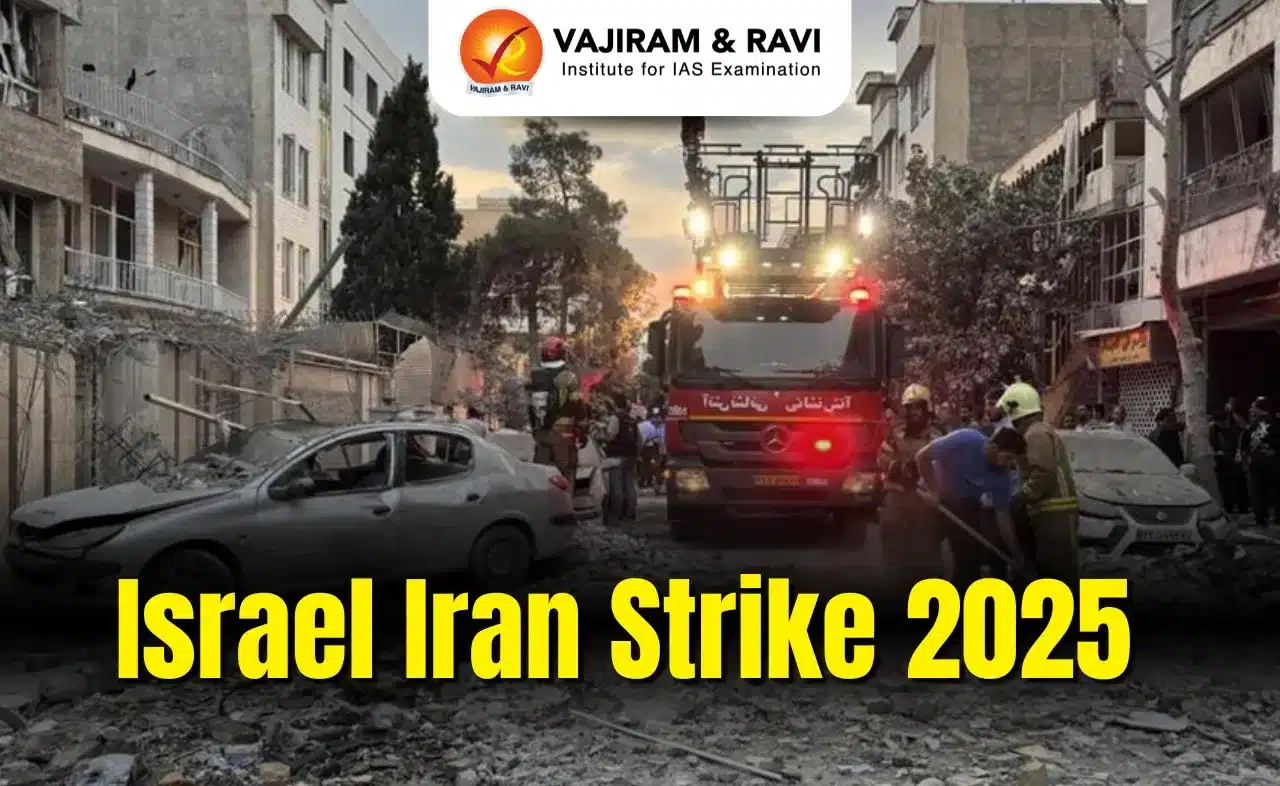
On June 13, 2025, Israel launched a major strike on Iran, targeting nuclear and military sites in Tehran, killing Iran’s Revolutionary Guard chief and two top nuclear scientists.
The attack marks a dramatic escalation in the Israel-Iran shadow war, raising fears of a broader regional conflict amid growing tensions over Iran’s advancing nuclear programme.
Iran's Nuclear Programme
Iran claims its nuclear programme is dedicated solely to civilian and peaceful purposes, such as energy production and medical research.
It operates multiple nuclear facilities across the country, some of which were recently hit in Israeli strikes.
Global Skepticism Persists
Despite Iran’s assertions, many countries and the IAEA remain unconvinced, suspecting military dimensions to the programme.
Concerns centre on Iran’s lack of transparency and its refusal to fully explain the presence of undeclared nuclear material.
IAEA Declares Non-Compliance
For the first time in two decades, the IAEA Board of Governors formally declared Iran in breach of its nuclear non-proliferation obligations.
The resolution cited multiple failures, including the lack of credible answers regarding nuclear activities and stockpiles.
Near-Weapons-Grade Enrichment
Earlier IAEA reports revealed that Iran has enriched uranium up to 60% purity, dangerously close to the 90% threshold needed for weapons.
This stockpile could, in theory, be used to produce up to nine nuclear bombs, raising alarm across the international community.
Israel’s Long-Planned Strike Comes to Fruition
Israel’s attack on Iran marks the culmination of years of planning. Long opposed to the 2015 nuclear deal, Israel had already carried out clandestine operations.
This includes the 2020 assassination of nuclear scientist Mohsen Fakhrizadeh and the 2014 bombing of Iran’s embassy in Damascus.
The latest assault targeted Iran’s nuclear sites, missile facilities, residences of top generals, and over two dozen scientists—making it the most severe blow to Iran since the 1979 revolution.
The Fall of Assad and the Collapse of Iran’s Regional Axis
The regional power dynamic shifted dramatically after Hamas's October 7, 2023, attack on Israel.
Israel’s response included strikes on Gaza, Hezbollah in Lebanon, and Syrian forces.
The fall of Syrian President Bashar al-Assad in December 2024—who had served as a strategic bridge between Tehran and Hezbollah—severely weakened Iran’s deterrence network, known as the “axis of resistance.”
With this axis dismantled and Iranian defences exposed, Israel saw a narrow window to strike.
Trump's Return and the Strategic Shift
President Donald Trump’s re-election introduced a new but aggressive diplomatic posture.
Though he initially delayed Israel's planned May attack to explore negotiations, his administration aimed to force Iran into a new deal that eliminates its nuclear program entirely.
With talks stalling, Trump backed the June Israeli strike, using it as leverage.
Rising Tensions and Immediate Fallout
The escalation triggered an 8% surge in global oil prices, raising fears of prolonged instability and global supply chain disruptions.
India’s Energy Vulnerability
India, which imports over 80% of its crude oil, faces serious risks even though direct imports from Iran are limited.
Global price hikes and potential supply chain disruptions could significantly increase import costs, impacting inflation and energy security.
Strait of Hormuz: A Strategic Chokepoint
About 20% of global oil trade passes through the Strait of Hormuz, situated between Iran and the Arabian Peninsula.
Conflict in this area could disrupt oil supplies from Iraq, Saudi Arabia, and the UAE—India’s key energy partners.
Export Routes and Shipping Costs Affected
Rising conflict could close access to the Suez Canal and Red Sea, forcing Indian exporters to reroute via the Cape of Good Hope, adding 15–20 days of travel time and raising container costs by 40–50%.
Oil Prices May Stabilise, But Gold Surges
Experts predict the oil market will stabilise, citing ample global reserves and diversified supply.
However, gold prices soared above ₹1 lakh per 10g, as investors moved towards safe-haven assets amid geopolitical uncertainty and broader inflationary fears.
Recently, a study revealed that emperor penguins are the iconic species threatened by climate change in Antarctica.
About Emperor Penguins
Emperor penguins are the tallest and heaviest penguin alive today.
They evolved about one million years ago, and are highly adapted to life in one of Earth’s harshest environments.
Distribution: They are found throughout the Antarctic continent and sub-Antarctic islands.
Breeding: In breeding months (April to November), emperor penguin colonies are found between 66° and 78° south latitude along the Antarctic coastline.
Habitat: It is the most ice-adapted of any penguin species, inhabiting pack ice and surrounding marine areas. They spend their entire lives on Antarctic ice and in its waters.
Features of Emperor Penguins
Adults are coloured black and white with areas of orange and yellow on the head, neck, and breast.
They gain and lose weight rapidly during breeding and feeding seasons. On average, females tend to weigh less than males.
They have two layers of feathers, a good reserve of fat, and proportionally smaller beaks and flippers than other penguins to prevent heat loss.
They also huddle close together in large groups to keep themselves and each other warm.
They are capable of diving to depths of approximately 550 metres (1,800 feet) in search of food; they are the world’s deepest-diving birds.
Lifespan: 15 to 20 years
Conservation Status: IUCN Red List: Near Threatened
Ans: Penguins are flightless birds with flippers instead of wings. Their bodies are adapted for swimming and diving in the water. Penguins are only found in the Southern Hemisphere. The greatest concentrations are on Antarctic coasts and sub-Antarctic islands.
Q2: What Is Climate Change?
Ans: Climate change refers to long-term shifts in temperatures and weather patterns. Such shifts can be natural, due to changes in the sun’s activity or large volcanic eruptions.
The President of the United States serves as both the head of state and government, with ultimate authority over the executive branch and command over the nation’s military forces. Established in 1789, the role has been filled by 45 men in 46 presidencies, making it one of the longest-standing political offices globally. Presidents are elected every four years through an indirect process via the Electoral College, and the office is considered one of the most influential in the world, shaping both domestic and international policies. This article includes the history of the U.S. presidency, exploring the significance of the office and highlighting the key leaders who have influenced America's journey throughout the years.
Presidents of the United States of America
The US Presidency is one of the most influential roles in global leadership, shaping American history and impacting the world. Since George Washington’s first term in 1789, 46 presidents have led the nation, each bringing unique perspectives and policies.
Throughout history, presidents have faced various challenges, from wars and economic crises to social movements and technological change. These administrations reflect the evolving priorities of the US, from expansion and industrialization to global leadership and digital transformation.
List of Presidents of the United States of America
Below is the List of Presidents of the United States of America for the candidate’s ease.
List of Presidents of the United States of America
No
US President Name
Term Start
Term End
Party
1
George Washington
April 30, 1789
March 4, 1797
Unaffiliated
2
John Adams
March 4, 1797
March 4, 1801
Federalist
3
Thomas Jefferson
March 4, 1801
March 4, 1809
Democratic-Republican
4
James Madison
March 4, 1809
March 4, 1817
Democratic-Republican
5
James Monroe
March 4, 1817
March 4, 1825
Democratic-Republican
6
John Quincy Adams
March 4, 1825
March 4, 1829
Democratic-Republican, National Republican
7
Andrew Jackson
March 4, 1829
March 4, 1837
Democratic
8
Martin Van Buren
March 4, 1837
March 4, 1841
Democratic
9
William Henry Harrison
March 4, 1841
April 4, 1841
Whig
10
John Tyler
April 4, 1841
March 4, 1845
Whig, Unaffiliated
11
James K. Polk
March 4, 1845
March 4, 1849
Democratic
12
Zachary Taylor
March 4, 1849
July 9, 1850
Whig
13
Millard Fillmore
July 9, 1850
March 4, 1853
Whig
14
Franklin Pierce
March 4, 1853
March 4, 1857
Democratic
15
James Buchanan
March 4, 1857
March 4, 1861
Democratic
16
Abraham Lincoln
March 4, 1861
April 15, 1865
Republican, National Union
17
Andrew Johnson
April 15, 1865
March 4, 1869
National Union, Democratic
18
Ulysses S. Grant
March 4, 1869
March 4, 1877
Republican
19
Rutherford B. Hayes
March 4, 1877
March 4, 1881
Republican
20
James A. Garfield
March 4, 1881
September 19, 1881
Republican
21
Chester A. Arthur
September 19, 1881
March 4, 1885
Republican
22
Grover Cleveland
March 4, 1885
March 4, 1889
Democratic
23
Benjamin Harrison
March 4, 1889
March 4, 1893
Republican
24
Grover Cleveland
March 4, 1893
March 4, 1897
Democratic
25
William McKinley
March 4, 1897
September 14, 1901
Republican
26
Theodore Roosevelt
September 14, 1901
March 4, 1909
Republican
27
William Howard Taft
March 4, 1909
March 4, 1913
Republican
28
Woodrow Wilson
March 4, 1913
March 4, 1921
Democratic
29
Warren G. Harding
March 4, 1921
August 2, 1923
Republican
30
Calvin Coolidge
August 2, 1923
March 4, 1929
Republican
31
Herbert Hoover
March 4, 1929
March 4, 1933
Republican
32
Franklin D. Roosevelt
March 4, 1933
April 12, 1945
Democratic
33
Harry S. Truman
April 12, 1945
January 20, 1953
Democratic
34
Dwight D. Eisenhower
January 20, 1953
January 20, 1961
Republican
35
John F. Kennedy
January 20, 1961
November 22, 1963
Democratic
36
Lyndon B. Johnson
November 22, 1963
January 20, 1969
Democratic
37
Richard Nixon
January 20, 1969
August 9, 1974
Republican
38
Gerald Ford
August 9, 1974
January 20, 1977
Republican
39
Jimmy Carter
January 20, 1977
January 20, 1981
Democratic
40
Ronald Reagan
January 20, 1981
January 20, 1989
Republican
41
George H. W. Bush
January 20, 1989
January 20, 1993
Republican
42
Bill Clinton
January 20, 1993
January 20, 2001
Democratic
43
George W. Bush
January 20, 2001
January 20, 2009
Republican
44
Barack Obama
January 20, 2009
January 20, 2017
Democratic
45
Donald Trump
January 20, 2017
January 20, 2021
Republican
46
Joe Biden
January 20, 2021
Incumbent
Democratic
List of Vice Presidents of the United States of America
Below is the List of Vice Presidents of the United States of America for the candidate’s ease.
List of Vice Presidents of the United States of America
No
US President Name
Term Start
Term End
Vice President(s)
1
George Washington
April 30, 1789
March 4, 1797
John Adams
2
John Adams
March 4, 1797
March 4, 1801
Thomas Jefferson
3
Thomas Jefferson
March 4, 1801
March 4, 1809
Aaron Burr, George Clinton
4
James Madison
March 4, 1809
March 4, 1817
George Clinton, Elbridge Gerry
5
James Monroe
March 4, 1817
March 4, 1825
Daniel D. Tompkins
6
John Quincy Adams
March 4, 1825
March 4, 1829
John C. Calhoun
7
Andrew Jackson
March 4, 1829
March 4, 1837
John C. Calhoun, Martin Van Buren
8
Martin Van Buren
March 4, 1837
March 4, 1841
Richard Mentor Johnson
9
William Henry Harrison
March 4, 1841
April 4, 1841
John Tyler
10
John Tyler
April 4, 1841
March 4, 1845
Vacant
11
James K. Polk
March 4, 1845
March 4, 1849
George M. Dallas
12
Zachary Taylor
March 4, 1849
July 9, 1850
Millard Fillmore
13
Millard Fillmore
July 9, 1850
March 4, 1853
Vacant
14
Franklin Pierce
March 4, 1853
March 4, 1857
William R. King
15
James Buchanan
March 4, 1857
March 4, 1861
John C. Breckinridge
16
Abraham Lincoln
March 4, 1861
April 15, 1865
Hannibal Hamlin, Andrew Johnson
17
Andrew Johnson
April 15, 1865
March 4, 1869
Vacant
18
Ulysses S. Grant
March 4, 1869
March 4, 1877
Schuyler Colfax, Henry Wilson
19
Rutherford B. Hayes
March 4, 1877
March 4, 1881
William A. Wheeler
20
James A. Garfield
March 4, 1881
September 19, 1881
Chester A. Arthur
21
Chester A. Arthur
September 19, 1881
March 4, 1885
Vacant
22
Grover Cleveland
March 4, 1885
March 4, 1889
Thomas A. Hendricks
23
Benjamin Harrison
March 4, 1889
March 4, 1893
Levi P. Morton
24
Grover Cleveland
March 4, 1893
March 4, 1897
Adlai Stevenson I
25
William McKinley
March 4, 1897
September 14, 1901
Garret Hobart, Theodore Roosevelt
26
Theodore Roosevelt
September 14, 1901
March 4, 1909
Charles W. Fairbanks
27
William Howard Taft
March 4, 1909
March 4, 1913
James S. Sherman
28
Woodrow Wilson
March 4, 1913
March 4, 1921
Thomas R. Marshall
29
Warren G. Harding
March 4, 1921
August 2, 1923
Calvin Coolidge
30
Calvin Coolidge
August 2, 1923
March 4, 1929
Charles G. Dawes
31
Herbert Hoover
March 4, 1929
March 4, 1933
Charles Curtis
32
Franklin D. Roosevelt
March 4, 1933
April 12, 1945
John Nance Garner, Henry A. Wallace, Harry S. Truman
33
Harry S. Truman
April 12, 1945
January 20, 1953
Alben W. Barkley
34
Dwight D. Eisenhower
January 20, 1953
January 20, 1961
Richard Nixon
35
John F. Kennedy
January 20, 1961
November 22, 1963
Lyndon B. Johnson
36
Lyndon B. Johnson
November 22, 1963
January 20, 1969
Hubert Humphrey
37
Richard Nixon
January 20, 1969
August 9, 1974
Spiro Agnew, Gerald Ford
38
Gerald Ford
August 9, 1974
January 20, 1977
Nelson Rockefeller
39
Jimmy Carter
January 20, 1977
January 20, 1981
Walter Mondale
40
Ronald Reagan
January 20, 1981
January 20, 1989
George H. W. Bush
41
George H. W. Bush
January 20, 1989
January 20, 1993
Dan Quayle
42
Bill Clinton
January 20, 1993
January 20, 2001
Al Gore
43
George W. Bush
January 20, 2001
January 20, 2009
Dick Cheney
44
Barack Obama
January 20, 2009
January 20, 2017
Joe Biden
45
Donald Trump
January 20, 2017
January 20, 2021
Mike Pence
46
Joe Biden
January 20, 2021
Incumbent
Kamala Harris
Presidents of the United States of America Facts
The United States Constitution established the presidency, a role that has undergone significant transformations over the years. As the head of the executive branch, the president is responsible for implementing federal laws, managing nationwide affairs, and serving as a key figure in international diplomacy.
Key Responsibilities and Authority of the President
The president of the United States has several important duties, such as:
Acting as the leader of the military
Managing the executive branch of the government
Having the power to approve or reject laws passed by Congress
Choosing judges for federal courts, including the Supreme Court
Building relationships with leaders of other countries through diplomacy
List of Presidents of the United States of America FAQ
Q1: What is the president's power in us?
Ans: The President of the United States serves as both the head of state and head of government, as well as the Commander-in-Chief of the U.S. Armed Forces. According to Article II of the U.S. Constitution, the President holds the responsibility for enforcing and executing the laws passed by Congress, ensuring the proper functioning of the federal government.
Q2: Is the president the most powerful man in the US?
Ans: In today's world, the U.S. president stands as one of the most influential political figures globally, leading the world's sole superpower.
Q3: What is the most common career of the presidents?
Ans: While there are various paths to the presidency, the most common profession among U.S. Presidents has been law, with many having a background as lawyers before assuming office.
Q4: What are the top 3 powers of the President?
Ans: Represent the nation in diplomatic relations, enforce laws passed by Congress, and serve as Commander-in-Chief during times of war.
A new study seems to suggest that more than one-fifth of the global ocean has considerably darkened in the last two decades.
About Ocean Darkening
Darkening of the ocean is essentially shrinking of the photic zones or those layers of water where sunlight can pass and induce the process of photosynthesis which is key to all biological processes.
The photic layers can go down to about 200 meters and they also act as a base for nearly 90 per cent of the world’s marine life.
This layer is responsible for increasing the productivity of the ocean which also involves regulating climate and even supporting global fisheries or related activities.
A new study seems to suggest that more than one-fifth of the global ocean has considerably darkened in the last two decades.
Why is Ocean Darkening happening?
In coastal zones, darkening is usually due to higher runoff of agricultural nutrients, organic matter, and sediments into the ocean with rain which directly promotes algal blooms that block light.
In the open ocean, the likely causes are changes in plankton dynamics, increase in sea surface temperature and changes in ocean circulation.
Impacts of Ocean Darkening
The contraction of photic zones may lead to fundamental shifts in marine ecosystems. Those species that use sunlight and moonlight cues to feed, move, hide, and reproduce will be competing for shallower zones.
This might upset marine food webs that are already working hard against an ecosystem with minimal fishing activity.
The Union government has started funding structural mechanisms to “facilitate” the implementation of the Forest Rights Act, 2006.
Introduction
For the first time since the enactment of the Forest Rights Act (FRA) in 2006, the Union government has initiated direct structural support to streamline its implementation.
Under the Dharti Aaba Janjatiya Gram Utkarsh Abhiyaan (DAJGUA), the Ministry of Tribal Affairs has approved the establishment of over 300 district and State-level FRA cells across India.
This strategic push is aimed at assisting Scheduled Tribes and Other Traditional Forest Dwellers in exercising their legal rights over forest land and resources.
The Forest Rights Act and its Decentralised Framework
The Scheduled Tribes and Other Traditional Forest Dwellers (Recognition of Forest Rights) Act, 2006 was enacted to correct historical injustices faced by tribal communities and forest dwellers.
It decentralised the recognition of rights to the Gram Sabha, which in turn sets up Forest Rights Committees (FRCs).
These committees work with Sub-Divisional Level Committees (SDLCs) and District Level Committees (DLCs) to process claims.
Until now, the onus of implementing FRA was entirely on State governments and Union Territories, with the Centre offering only advisory support.
However, limited coordination, delayed committee meetings, and lack of field-level assistance have led to 14.45% of total claims still pending, as of March 2025.
Role and Structure of FRA Cells
The new FRA cells, sanctioned under the DAJGUA scheme launched in October 2024, aim to provide technical and administrative support without intervening in statutory decision-making. These cells are tasked with:
Assisting claimants and Gram Sabhas in preparing claim documents.
Aiding in collection of necessary evidence and resolutions.
Helping in digitisation of land records and tracking claim status.
Facilitating conversion of forest habitations into revenue villages.
To date, 324 district-level FRA cells have been approved across 18 States and Union Territories, along with State-level FRA cells in 17 regions. The Centre funds these cells through the Grants-in-Aid General route, while operational control lies with State Tribal Welfare departments.
Each district-level cell receives a budget of Rs. 8.67 lakh, while State-level cells are allocated Rs. 25.85 lakh. States like Madhya Pradesh (55 cells), Chhattisgarh (30), and Telangana (29) lead the count in terms of sanctioned FRA cells.
Divergence from FRA’s Statutory Process
Despite the declared facilitative nature, forest rights activists have raised concerns about these cells creating a parallel implementation mechanism that exists outside the statutory framework of the FRA.
The original law clearly delineates roles for Gram Sabhas and statutory committees, which cannot be superseded by an administrative scheme.
Critics argue that many responsibilities assigned to the FRA cells, like assisting with documentation and verifying evidence, already fall under the remit of statutory bodies.
The risk, they note, is the creation of confusion at the grassroots level over who is responsible for which task.
Moreover, structural gaps such as infrequent DLC/SDLC meetings and inaction by Forest Departments on approved claims continue to hinder progress, issues that mere creation of new units may not solve.
DAJGUA’s Broader Vision
The DAJGUA scheme integrates 25 tribal welfare interventions across 17 ministries to uplift over 68,000 tribal-majority villages. FRA implementation is just one pillar of this initiative. The overarching goal is to expedite delivery of rights, improve governance, and ensure development reaches the most marginalised.
The operational guidelines state that FRA cells must function under the directives of State governments, aligning with existing legal and administrative frameworks. Their scope is supportive, not supervisory, ensuring that statutory powers remain unaffected.
Balancing Institutional Innovation with Legal Integrity
While the Centre’s direct involvement marks a major policy shift in supporting FRA implementation, success will depend on the clarity of roles and cooperation between central and State authorities.
If implemented carefully, these FRA cells can bridge capacity gaps, reduce pendency, and empower Gram Sabhas.
However, the approach must be inclusive and transparent, ensuring that the legal sanctity of the Forest Rights Act is preserved. Any deviation from the statutory process could dilute the law’s purpose and undermine the trust of forest-dwelling communities.
The International Atomic Energy Agency (IAEA) Board of Governors passed a resolution declaring Iran in breach of its 1974 Safeguards Agreement, citing concerns over unexplained uranium traces at multiple sites. The vote saw opposition from China, Russia, and Venezuela, with 11 abstentions.
A day later, Israel launched "preliminary strikes" on Iranian nuclear facilities and declared a domestic state of emergency.
IAEA Safeguards Agreements
IAEA Safeguards are embedded in legally binding agreements.
In line with the IAEA’s Statute, States accept these Safeguards through the conclusion of such agreements with the Agency.
As of May 2023, the IAEA has concluded comprehensive safeguards agreements with 182 countries, primarily non-nuclear-weapon states under the NPT.
These agreements are the most common type and are designed to ensure the peaceful use of nuclear material.
1974 Safeguards Agreement
The 1974 Safeguards Agreement refers to a legally binding accord between Iran and the IAEA, concluded under the framework of the Treaty on the Non-Proliferation of Nuclear Weapons (NPT).
Inventory and Reporting Obligations
Iran is required to:
Declare and maintain a detailed inventory of all nuclear materials.
Provide design information of any nuclear facility handling such materials.
Notify the IAEA before constructing or modifying any nuclear facility.
Inspections
The IAEA is authorized to conduct routine, ad hoc, and special inspections.
Iran must allow access to facilities, materials, and relevant documents to verify compliance.
Surveillance equipment like cameras and seals may be installed at key locations.
Verification Mandate
The IAEA must be able to verify that there is no diversion of declared nuclear material to weapons-related programs.
Non-Compliance Consequences
If Iran fails to meet its obligations, the IAEA can:
Report the breach to its Board of Governors.
Notify all IAEA member states.
Refer the matter to the U.N. Security Council, which can impose sanctions or take other measures.
IAEA Resolution Marks a Turning Point
For the first time, the IAEA Board of Governors formally declared Iran non-compliant with its 1974 Safeguards Agreement, paving the way for potential escalation to the U.N. Security Council.
The resolution follows years of urging Iran to cooperate and was welcomed by several Gulf states.
IAEA Invokes Rare Article XII.C Powers
The IAEA Board of Governors, empowered by Article XII.C of its 1957 statute, has formally cited Iran for non-compliance.
Thus far, this Article has been invoked only six times: against Iraq (1991), Romania (1992), North Korea (1993), Iran (2006), Libya (2004), and Syria (2011).
This provision enables the Board to demand corrective measures, suspend technical aid, and escalate the issue to the U.N. Security Council if Iran fails to respond satisfactorily.
Iran Under Scrutiny, Technical Projects at Risk
The IAEA currently operates around $1.5 million worth of peaceful nuclear projects in Iran, including in medicine and water desalination.
These could now be curtailed if Iran does not cooperate.
Verification Challenges and Safeguard Breaches
Under its 1974 Comprehensive Safeguards Agreement, Iran must provide nuclear material inventories, notify about new facilities, and allow inspections.
The IAEA, however, has stated it is unable to verify the absence of nuclear material diversion for weapon use—a key safeguard failure.
Next Steps: Security Council in Sight
Iran has a limited window to respond to IAEA queries. If it fails to comply, the Board may escalate the matter to the U.N. Security Council, which could respond with statements, binding resolutions, or renewed sanctions.
A follow-up IAEA vote is likely in September 2025.
Israel Responds with Strikes and Warnings
In response, Israel launched early morning strikes against Iranian nuclear sites and reiterated its position that it will not permit Iran to enrich uranium to weapons-grade levels (90%).
Tehran condemned the resolution as politically motivated and announced plans to build a new underground enrichment facility, upgrade centrifuges at Fordow, and implement “proportional measures”.
Following Israeli attacks, Iran placed its air defence system on high alert, while Israel reported Iranian drone mobilisations.