UPSC Daily Quiz 8 July 2025

UPSC Daily Quiz

The Daily UPSC Quiz by Vajiram & Ravi is a thoughtfully curated initiative designed to support UPSC aspirants in strengthening their current affairs knowledge and core conceptual understanding. Aligned with the UPSC Syllabus 2025, this daily quiz serves as a revision resource, helping candidates assess their preparation, revise key topics, and stay updated with relevant issues. Whether you are preparing for Prelims or sharpening your revision for Mains, consistent practice with these Daily UPSC Quiz can significantly enhance accuracy, speed, and confidence in solving exam-level questions.

[WpProQuiz 16]

UPSC Daily Quiz FAQs

Q1: What is the Daily UPSC Quiz?

Ans: The Daily UPSC Quiz is a set of practice questions based on current affairs, static subjects, and PYQs that help aspirants enhance retention and test conceptual clarity regularly.

Q2: How is the Daily Quiz useful for UPSC preparation?

Ans: Daily quizzes support learning, help in revision, improve time management, and boost accuracy for both UPSC Prelims and Mains through consistent practice.

Q3: Are the quiz questions based on the UPSC syllabus?

Ans: Yes, all questions are aligned with the UPSC Syllabus 2025, covering key areas like Polity, Economy, Environment, History, Geography, and Current Affairs.

Q4: Are solutions and explanations provided with the quiz?

Ans: Yes, each quiz includes detailed explanations and source references to enhance conceptual understanding and enable self-assessment.

Q5: Is the Daily UPSC Quiz suitable for both Prelims and Mains?

Ans: Primarily focused on Prelims (MCQ format), but it also indirectly helps in Mains by strengthening subject knowledge and factual clarity.

Chief Ministers of Arunachal Pradesh, List from 1975 to 2025, Tenure

Chief Ministers of Arunachal Pradesh

Arunachal Pradesh, situated in the north-east region of India, known for its breathtaking beauty and rich cultural heritage. The diverse landscape, which ranges from the Himalayas to the forests of the Brahmaputra Valley, is home to over 1.5 million people. Prem Khandu Thungan was the First Chief Minister of Arunachal Pradesh and held the office from 1937. Pema Khandu is serving as the Current Chief Minister of Arunachal Pradesh. Check out the article below including the List of Chief Ministers of Arunachal Pradesh from 1975 to 2025 with their tenures and other details that you should know.

Chief Ministers of Arunachal Pradesh

Arunachal Pradesh, a state known for its beautiful landscapes and diverse cultures. Since its establishment the state has been led by several prominent leaders who served as the Chief Ministers. These leaders have played an important role in shaping the state's development path, overcoming challenges, and improving the lives of its citizens. Keep reading the article to know the List of Chief Ministers of Arunachal Pradesh from 1975 to 2025.

List of Chief Ministers of Arunachal Pradesh from 1975 to 2025

Here is a List of Chief Ministers of Arunachal Pradesh from 1975 to 2025, their tenure, and the party they belonged to:

List of Chief Ministers of Arunachal Pradesh from 1975 to 2025
S. No. Names Period Party

1.

Prem Khandu Thungan

13 August 1975 to 18 September 1979

Janata Party

2.

Tomo Riba

18 September 1979 to 3 November 1979

People’s Party of Arunachal

3.

Gegong Apang

18 January 1980 to 19 January 1999

Indian National Congress + Arunachal Congress

4.

Mukut Mithi

19 January 1999 to 3 August 2003

Arunachal Congress (Mithi) + Indian National Congress

5.

Gegong Apang

3 August 2003 to 9 April 2007

United Democratic Front + Bharatiya Janata Party

6.

Dorjee Khandu

9 April 2007 to 30 April 2011

Indian National Congress

7.

Jarbom Gamlin

5 May 2011 to 1 November 2011

Indian National Congress

8.

Nabam Tuki

1 November 2011 to 26 January 2016

Indian National Congress

9.

Kalikho Pul

26 January 2016 to 19 February 2016

People’s Party of Arunachal

10.

Nabam Tuki

13 July 2016 to 17 July 2016

Indian National Congress

11.

Pema Khandu

17 July 2016 to 16 September 2016

Indian National Congress

16 September 2016 to 31 December 2016

People’s Party of Arunachal

31 December 2016 to 29 May 2019

Bharatiya Janata Party

29 May 2019 to —

Bharatiya Janata Party

First Chief Minister of Arunachal Pradesh

Prem Khandu Thungan is the First Chief Minister of Arunachal Pradesh who served the position from August 13, 1975, to September 18, 1979. His leadership laid the foundation for the state's governance and development. He is known for his courage and the initiatives he took for the state and the citizens.

Current Chief Minister of Arunachal Pradesh

Pema Khandu is the Current Chief Minister of Arunachal Pradesh, assumed office on May 29, 2019. Alongside Deputy Chief Minister Chowna Mein, they represent leadership in guiding Arunachal Pradesh towards progress and prosperity. He focused on building the infrastructure for the welfare of the citizens and growth of the youth so that they can contribute maximum towards the state as well as the best for the nation.

Longest Serving Chief Minister of Arunachal Pradesh

Gegong Apang is the Longest Serving Chief Minister of Arunachal Pradesh, having held office for over 22 years across two terms, from 1980 to 1999 and again from 2003 to 2007. A veteran politician, Apang played a crucial role in shaping the state’s political and developmental landscape, holding the record as one of the longest-serving Chief Ministers in India.

Shortest Serving Chief Minister of Arunachal Pradesh

Kalikho Pul served as the Shortest Serving Chief Minister of Arunachal Pradesh, just a few months from February 19, 2016, to July 13, 2016. His tenure was marked by political instability and legal battles, ultimately ending with a Supreme Court verdict that reinstated the previous government. Pul’s brief stint remains a significant chapter in the state’s political history.

First Woman Chief Minister of Arunachal Pradesh

As of 2025, Arunachal Pradesh has not had a woman Chief Minister. The state’s political landscape has so far been dominated by male leaders. However, increasing women’s representation in local governance and legislative bodies suggests that future leadership may see the emergence of women at the highest levels of political office in the state.

Also Check Other State CM List
Chief Ministers of Haryana Chief Ministers of Delhi
Chief Ministers of Maharashtra Chief Ministers of Jharkhand
Chief Ministers of Jammu and Kashmir Chief Ministers of Assam
Chief Ministers of Bihar Chief Ministers of Kerala
Chief Ministers of Tamil Nadu Chief Ministers of West Bengal
Chief Ministers of Puducherry Chief Ministers of Punjab
Chief Ministers of Uttarakhand Chief Ministers of Uttar Pradesh
Chief Ministers of Gujarat Chief Ministers of Madhya Pradesh
Chief Ministers of Himachal Pradesh Chief Ministers of Rajasthan
Chief Ministers of Telangana Chief Ministers of Andhra Pradesh
Chief Ministers of Meghalaya Chief Ministers of Tripura
Chief Ministers of Nagaland Chief Ministers of Karnataka
Chief Ministers of Mizoram
Chief Ministers of Arunachal Pradesh
Chief Ministers of Odisha Chief Ministers of Sikkim

Chief Ministers of Arunachal Pradesh FAQs

Q1: Who was the first Chief Minister of Arunachal Pradesh?

Ans: The first Chief Minister of Arunachal Pradesh was Prem Khandu Thungan.

Q2: Who is the current Chief Minister of Arunachal Pradesh?

Ans: Pema Khandu is the Chief Minister of Arunachal Pradesh.

Q3: How many Chief Ministers has Arunachal Pradesh had so far?

Ans: Arunachal Pradesh has had several Chief Ministers since its first in 1975.

Q4: Has Arunachal Pradesh ever had a female Chief Minister?

Ans: No, Arunachal Pradesh has not yet had a female Chief Minister.

Q5: What is the term duration for a Chief Minister in Arunachal Pradesh?

Ans: The term duration for a Chief Minister in Arunachal Pradesh is typically five years.

Soil Health Card Scheme, Launch Date, Objectives, Significance

Soil Health Card Scheme

The Soil Health Card Scheme was introduced on December 5, 2015 flagship program by the Ministry of Agriculture and Farmers’ Welfare and the Prime Minister also gave the slogan of “Swasth Dharaa. Khet Haraa." - Healthy Earth, Green Farm, which led to the decline of 8-10% usage of chemical fertilizers and also resulted in increasing productivity by 5-6%. This scheme was crafted to know the soil nutrient status and improve productivity. Under the Phase-I (2015-17) of the scheme, 10.74 crore soil health cards were issued to farmers, while under the Phase-II (2017-19), 11.69 crore soil health cards were issued to farmers.

Soil Health Card Scheme Objectives

  1. Soil Health Cards provide a scientific basis for fertilizer and crop recommendations, enabling farmers to make informed decisions about soil management and resource allocation.
  2. Through the establishment of Village Level Soil Testing Labs (VLSTLs), rural youth, Self-Help Groups (SHGs), and Farmer Producer Organizations (FPOs) are actively involved in soil testing, education, and resource optimization.
  3. From 2022-23, the SHC Scheme has been merged into the Rashtriya Krishi Vikas Yojana (RKVY) under the component "Soil Health & Fertility," aligning it with broader agricultural development goals.
  4. The Soil Health Card Scheme also includes soil sampling and testing to determine the nutrient status of the soil. Farmers receive recommendations for nutrient application to enhance soil fertility and crop productivity according to the quality of the soil.

Soil Health Card Scheme Significance

Soil Health Card Scheme is an initiative of the Ministry of Agriculture and Farmers’ Welfare to modernize the agriculture of India which addresses various issues of this sector in India such as declining soil fertility, overuse of fertilizers, and uninformed farming practices.  Soil Health Card Scheme provides accurate and updated insights of the health of soil. The Soil Health Card Scheme Significance includes: Promotes Informed Decision-Making:

  1. With detailed soil health reports, farmers can make data-driven decisions regarding which crops to grow and avoid.
  2. With specific recommendations for nutrients and fertilizers, farmers avoid excessive or incorrect use of inputs. 
  3. Regular soil health updates encourage farmers to adopt practices that maintain or improve soil fertility in the long term. 
  4. The scheme experts assist farmers in implementing the recommendations, bridging the gap between knowledge and action.
  5. Soil health records help farmers to use land more efficiently, ensuring optimal resource utilization and conservation.

Soil Health Card Scheme Implementation

The Soil Health Card Scheme has been implemented through the Department of Agriculture in 28 States and Union Territories till now, integrated with a Geographic Information System (GIS) system so that all the test results are captured and seen on a map. This scheme has also created the job facilities for the agrarian youth. 75% of laboratory costs are funded by the Central and State Governments.

Soil Health Card Scheme FAQs

Q1: What is the Soil Health Card Scheme?

Ans: Soil Health Card Scheme provides soil nutrient status with advice on the dosage of fertilizers.

Q2: What are the 12 parameters of a soil health card?

Ans: It will contain the status of his soil with respect to 12 parameters, namely N,P,K (Macronutrients); S (Secondary- nutrient); Zn, Fe, Cu, Mn, Bo (Micro - nutrients); and pH, EC, OC (Physical parameters).

Q3: Is soil health card free of cost?

Ans: The central government provides 60% of the funding for the Soil Health Card Scheme. The state government contributes 40% of the funding for the scheme.

Q4: Which state started a soil health card scheme first?

Ans: Suratgarh, Rajasthan

Q5: What is the full form of SHC?

Ans: Soil Health Card (SHC) is a Government of India's scheme promoted by the Department of Agriculture & Cooperation under the Ministry of Agriculture and Farmers' Welfare.

PM Cares for Children Scheme, Launch Date, Benefits, Objectives

PM Cares for Children Scheme

The PM CARES for Children Scheme is a welfare initiative, launched by Prime Minister Narendra Modi on May 29, 2021, stands as a hope for children who lost their parents, legal guardians, or adoptive parents during the global pandemic COVID-19 pandemic. This initiative was adopted to ensure the care, protection, welfare, empowerment for orphaned children helping them to overcome hardships and lead independent, fulfilling lives.

PM Cares for Children Scheme Objectives

The PM CARES for Children Scheme aims to:

  1. Provide care and protection to children affected by the pandemic.
  2. Ensure their well-being through health insurance, emotional support, and rehabilitation.
  3. Equip them with equal educational opportunities to secure their future.
  4. Empower them for self-sufficient adulthood with financial assistance and skill development.

PM Cares for Children Benefits

The scheme offers a wide range of benefits to the fulfill the needs of orphaned children:

Financial Security

  1. Each identified child receives a financial support of ₹10 lakh, which will mature when they turn 18.
  2. From 18 to 23 years of age, they will receive a monthly stipend from that to support their living expenses.
  3. Upon turning 23, the entire amount is given as a lump sum to help them establish their professional or personal lives.

Educational Assistance

  1. Children under this scheme will get admission in Kendriya Vidyalayas, Kasturba Gandhi Balika Vidyalayas, or private schools to ensure continuity in education.
  2. Scholarships of ₹20,000 per annum is provided to students from Classes 1 to 12 to help them cover educational expenses.
  3. Providing support in Higher education includes educational loans for professional courses, with the PM CARES Fund bearing the interest.

Health Insurance

Under the scheme they are enrolled in the Ayushman Bharat Pradhan Mantri Jan Arogya Yojana (AB-PMJAY), ensuring a health insurance cover of ₹5 lakh per year until the child turns 18. This enables access to quality healthcare and financial security during medical emergencies.

PM Cares for Children Scholarships

  1. Children can avail scholarships like the Swanath Scholarship Scheme by All India Council for Technical Education, which provides ₹50,000 annually for students pursuing technical courses.
  2. Skill enhancement programs under Kaushal Augmentation and Restructuring Mission of AICTE (KARMA) initiative prepare children for professional success and economic independence.

PM Cares for Children Rehabilitation

  1. Children staying with relatives receive a monthly support of ₹4,000 under the Mission Vatsalya Scheme to ensure proper care and living standards.
  2. They are also provided access to psychosocial support and mentorship to address emotional and mental health needs.

PM Cares for Children Implementation

The Ministry of Women and Child Development is the agency responsible for implementing the PM Cares for Children Scheme, working in collaboration with various ministries, state governments, and district administrations. To ensure transparency, the scheme is managed through a dedicated online portal (www.pmcaresforchildren.in). The portal facilitates easy registration and tracking of beneficiaries, ensuring that no eligible child is left behind.

PM Cares for Children FAQs

Q1: Who is eligible under the PM CARES for Children Scheme?

Ans: The children who have lost both of their parents or a single parent/guardian due to COVID-19 and are under 18 years of age are eligible under the scheme.

Q2: What is the PM girl child Scheme?

Ans: Beti Bachao Beti Padhao (BBBP) was launched by the Prime Minister on 22nd January, 2015 at Panipat, Haryana.

Q3: Is the PM Cares Fund still active?

Ans: The trust deed of PM CARES Fund has been registered under the Registration Act, 1908 at New Delhi on 27th March, 2020.

Q4: How to apply for PM Relief Fund?

Ans: Submit the application along with all the required documents through a Member of Parliament (MP) from the constituency where the applicant or patient resides.

Yuva Scheme, Features, Objectives, Implementations

Yuva Scheme

Pradhan Mantri Mentorships’s program for Young writers, YUVA Scheme has been launched by the Ministry of Education on 29 May 2021 to train young authors. This scheme was introduced to train 75 creative and aspiring writers who are below the age of 30 who can project India and its culture and literature worldwide to promote “Ek Bharat Shrestha Bharat”. These 75 authors were selected via an All India Contest at MyGov (Government of India’s Citizen Engagement Platform). Participants were provided with a scholarship of Rs. 50,000 per month for a period of six months per author.

Yuva Scheme Objectives

  1. To bring the authorship, writing profession equivalent to other fast pacing careers.
  2. To provide a positive psychological push towards the minds of young writers after the pandemic of Covid-19.

Yuva Scheme Features

  1. The scheme was designed for writers below 30 years of age, nurturing emerging authors with a focus on India's national movement, the role of lesser-known places in the freedom struggle.
  2. 75 selected writers through a manuscript competition in 22 scheduled languages
  3. Provides guidance and scholarship of ₹50,000 per month for six months to develop manuscripts into books.
  4. Offers royalty of 10% on book sales, encouraging financial support and acknowledgment.
  5. Translates selected books into multiple Indian languages to promote ‘Ek Bharat Shrestha Bharat.’

Yuva Scheme Implementation

Yuva Scheme was implemented in two different stages by the National Book Trust (NBT) under the Ministry of Education:

Stage 1: Training

  • Objective: Provide training to selected candidates with essential writing skills.
  • Duration: A three-month training program to enhance their knowledge.
  • Activities: Workshops, interactive sessions, and expert guidance to help candidates with their manuscript development and storytelling abilities.

Stage 2: Promotion

  • Selected authors got a chance to become a part of the below mentioned events to gain insights for their writing abilities:
    • Literary festivals
    • Book fairs (including virtual events)
    • Cultural exchange programs
    • Other international and national literary platforms.
  • National Book Trust will publish books authored by the selected writers, offering a 10% royalty on sales to support them financially and motivate them.

Yuva Scheme FAQs

Q1: What is the full form of Yuva?

Ans: Young, Upcoming and Versatile Authors is the full form of Yuva.

Q2: What is the Yuva government scheme?

Ans: This scheme was introduced to train 75 creative and aspiring writers who are below the age of 30 who can project India and its culture and literature worldwide to promote “Ek Bharat Shrestha Bharat”. 

Q3: What is the age limit for the Yuva Scheme?

Ans: The scheme was designed for writers below 30 years of age.

Q4: What are the schemes of Pradhan Mantri for youth?

Ans: Sashaktikaran Karyakram (RYSK) includes the sub-schemes of Pradhan Mantri for youth.

NERPSIP Scheme, Benefits, Objectives, Features, Impact

NERPSIP Scheme

The NERPSIP Scheme or North Eastern Region Power System Improvement Project is an initiative aimingA at strengthening the intra-state transmission and distribution systems in India’s North-Eastern Region (NER). Initially the project got approved in December 2014 by the Government of India, this scheme is a crucial step toward addressing the challenges related to the Distribution Infrastructure and increasing its economic growth.

NERPSIP Scheme History

The origins of NERPSIP Scheme can be noticed in the Pasighat Proclamation on Power during the North Eastern Council’s Sectoral Summit in 2007. This summit emphasized the urgent need to enhance transmission, sub-transmission, and distribution systems in the NER and Sikkim. Following these recommendations, a comprehensive plan was developed by the Central Electricity Authority (CEA) in collaboration with POWERGRID and the respective state governments.

NERPSIP Scheme Implementation

NERPSIP Scheme is a Central Government Scheme under the Ministry of Power. The project is jointly funded by the Government of India and the World Bank on a 50:50 basis, except for the Rs. 89 crore allocated for capacity building, which is fully funded by the Government of India.

The scheme’s total project cost, originally estimated at Rs. 5,111.33 crore, was revised to Rs. 6,700 crore in December 2020. POWERGRID, a Maharatna company under the Ministry of Power, serves as the implementing agency in collaboration with six beneficiary states:

  1. Assam
  2. Manipur
  3. Meghalaya
  4. Mizoram
  5. Nagaland
  6. Tripura

NERPSIP Scheme Key Objectives

NERPSIP Scheme Key Objectives include:

  • Establishing a reliable and efficient power grid to improve electricity connectivity to emerging load centers.
  • Increasing the overall economic growth of the region by increasing per capita power consumption and creating employment opportunities.
  • Ensuring all categories of consumers benefit from grid-connected power systems.

NERPSIP Scheme Impact

NERPSIP Scheme is more than just a power project; it is a transformative initiative aimed at addressing long-standing energy deficits in the North Eastern Region. Some of the NERPSIP Scheme Impact include:

  • The creation of a power grid that reduces dependency on diesel generators and improves access to electricity.
  • The project’s implementation involves hiring local skilled and unskilled labor, generating substantial job opportunities.
  • Comprehensive Scheme for Arunachal Pradesh and Sikkim
  • In addition to the NERPSIP Scheme, the Government of India approved a separate project for Arunachal Pradesh and Sikkim in October 2014, initially estimated at Rs. 4,754.42 crore and later revised to Rs. 9,129.32 crore. 
    • This scheme is funded by the Government of India, highlighting its strategic importance in strengthening power infrastructure in the remotest regions of India.

NERPSIP Scheme FAQs

Q1: What is the full form of Nerpsip?

Ans: North Eastern Region Power System Improvement Project (NERPSIP)

Q2: What is the North East Development Scheme?

Ans: The North East Special Infrastructure Development Scheme, or commonly known as NESIDS, was sanctioned by the Government of India to focus on projects relating to infrastructure creation concerning water supply, power, and connectivity, and thereby enhancing tourism.

Q3: Who is the minister of North East Development?

Ans: Shri Jyotiraditya M. Scindia

Q4: Which is the largest state in north east India?

Ans: Arunachal

Sheesh Mahal

Sheesh Mahal

Sheesh Mahal Latest News

Recently, a Mughal-era palace, Sheesh Mahal, located in Shalimar Bagh, North Delhi, was restored and unveiled by the Union Culture and Tourism minister.

About Sheesh Mahal

  • It was built in 1653 by Izz-un-Nisha Begum, wife of Mughal Emperor Shah Jahan.
  • This monument was a tribute — and a replica — of the Shalimar Bagh in Kashmir.
  • It is a fine example of Mughal garden architecture designed to be a royal retreat away from Shahjahanabad’s bustle.
  • Construction: Originally constructed of bricks and red sandstone, with entry gates in the east and west, the palace has an archway, flanked on either side by a three-arched dalan.
  • Beyond the archway is a central hall with a compartment at each wing.
  • The main building of the Sheesh Mahal had a Baradari with a water channel running through it. 
  • The paintings in two of its well maintained , mirror-worked chambers are of Kangra and Rajasthani qalam, depicting the poetic visions of Keshav, Surdas and Bihari. 
  • The red sandstone building adjacent to the Mahal is believed to have been used as hamam (public bathhouse), made of brick masonry and red sandstone.
  • Historical significance: Aurangzeb held his imperial coronation (1658) in this mahal.
  • In 1983, it was declared a monument of national importance, and the ASI has been preserving it since.

Source: TH

Sheesh Mahal FAQs

Q1: What is the national monument of importance?

Ans: A national monument is a monument constructed in order to commemorate something of importance to national heritage, such as a country's founding, independence, war, or the life and death of a historical figure.

Q2: What is the importance of Archaeological Survey of India?

Ans: The ASI is responsible for carrying out excavations, conducting surveys, and documenting heritage sites. It promotes the conservation and protection of India's archaeological treasures.

Barilius imphalensis

Barilius imphalensis

Barilius imphalensis Latest News

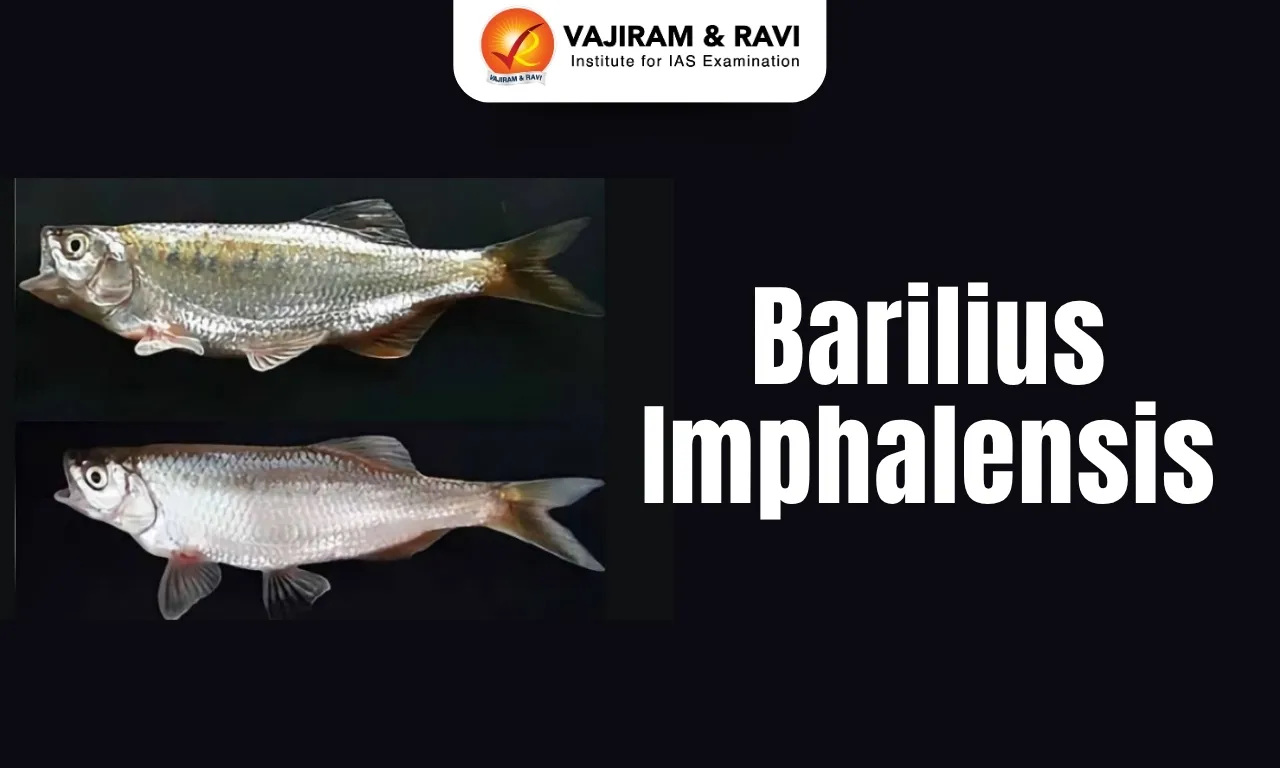
A new species of freshwater fish, named Barilius imphalensis, has been recently discovered in the Imphal River in Manipur.

About Barilius imphalensis

  • It is a new species of freshwater fish.
  • It was discovered in the Imphal River, Manipur.
  • The fish has been locally named “Ngawa” in the Meitei language.
  • The fish belongs to the Danionidae family and the subfamily Chedrinae—popularly known as danionid fishes—recognized for their vibrant patterns and ecological significance.
  • It is endemic to the Imphal River and differs markedly from its known relatives across India and Southeast Asia.
  • Its habitat consists of clear, shallow waters—typically 3 to 5 feet deep—characterized by gravel and cobble beds, and lined with riverbank vegetation.
  • It stands out for several distinctive features, including the absence of barbels (sensory whisker-like organs), a series of short blue vertical bars on its body, and the presence of tiny tubercles (small bumps) on its snout and jaw. 
  • The fish also displays a complete lateral line with 41 scales—important for detecting movement and vibration in the water.

Source: NEN

Barilius imphalensis FAQs

Q1: What is Barilius imphalensis?

Ans: It is a new species of freshwater fish.

Q2: Barilius imphalensis was discovered in which river?

Ans: Imphal River

Q3: What type of habitat does Barilius imphalensis prefer?

Ans: Clear, shallow waters with gravel and cobble beds.

Green Skill Development Programme, Launch Date, Benefits

Green Skill Development Programme

The Green Skill Development Programme (GSDP) is an initiative by the Ministry of Environment, Forest & Climate Change (MoEF&CC) under the Skill India Mission. It aims to empower India’s youth with environment-focused skills, addressing both employment needs and ecological challenges. With its focus on introducing a green workforce, the GSDP is a significant step toward sustainable development and environmental conservation.

Green Skill Development Programme Overview

Launched in June 2017, the GSDP is part of the government’s efforts to address the skill gap in environmental sectors. Most vocational training programs emphasize technical or mechanical skills, often neglecting green skills critical for ecological preservation. The GSDP bridges this gap by developing a workforce equipped with the technical knowledge and commitment needed for sustainable development.

The initiative aligns with India’s national and international commitments, including:

  1. Sustainable Development Goals (SDGs)
  2. National Biodiversity Targets (NBTs)
  3. Nationally Determined Contributions (NDCs) under the Paris Agreement
  4. Key Features of GSDP
  5. Diverse Training Modules

Green Skill Development Programme Significance

  1. India faces a demand-supply mismatch in the environment and forest sectors. The GSDP addresses this gap by creating a skilled workforce to meet market demands in green industries.
  2. By focusing on underprivileged youth, the program ensures that sustainable development benefits all sections of society, ensuring inclusive growth.
  3. With its emphasis on renewable energy, waste management, and biodiversity conservation, the GSDP supports India’s transition to a low-carbon economy.
  4. The GSDP contributes to India’s international commitments, such as the Paris Climate Agreement, by fostering skills critical for reducing carbon emissions and promoting sustainable practices.

Green Skill Development Programme Achievement

  1. During the introductory phase, the program trained over 200 individuals, who are now working as biodiversity conservationists and para-taxonomists.
  2. The government aims to train 5.6 lakh individuals by 2021, covering diverse fields like pollution monitoring, wildlife conservation, and waste management.
  3. New courses in electric vehicles, hazardous waste management, and climate-resilient agriculture are being introduced to meet emerging market needs.

GSDP Employment Opportunities

The program also equips participants with the skills needed for self-employment, such as establishing nurseries or eco-friendly enterprises. Graduates of the GSDP can secure roles in sectors such as:

  1. Zoos, national parks, and wildlife sanctuaries
  2. Municipal waste management systems
  3. Eco-tourism and nature guide services
  4. Renewable energy industries
  5. Horticulture and organic farming.

Green Skill Development Programme FAQs

Q1: who launched the Green Skill Development Program (GSDP)?

Ans: It is an initiative of the Ministry of Environment, Forest and Climate Change (MoEF&CC).

Q2: How is the Green Skill Development Programme (GSDP) implemented?

Ans: The Ministry of Environment, Forest and Climate Change (MoEF&CC) has planned to utilise the vast network and expertise of Environmental Information System (ENVIS) hubs and Resource Partners (RPs). All the courses will be National Skills Qualifications Framework (NSQF) compliant. As the first stage of implementation, the Ministry will provide a certificate to all successful candidates.

Q3: What is the green skills Programme?

Ans: The Green Skills Programme operates one Saturday per month from January to December.

Q4: What are examples of green skills?

Ans: Quantification and monitoring (waste, energy, water) Management systems (waste, energy, water) Procurement and selection. Material use and impact quantification. Impact and use minimisation. Impact assessment. Risk management.

Ambedkar Social Innovation Incubation Mission, Launch Date, Objectives

Ambedkar Social Innovation Incubation Mission

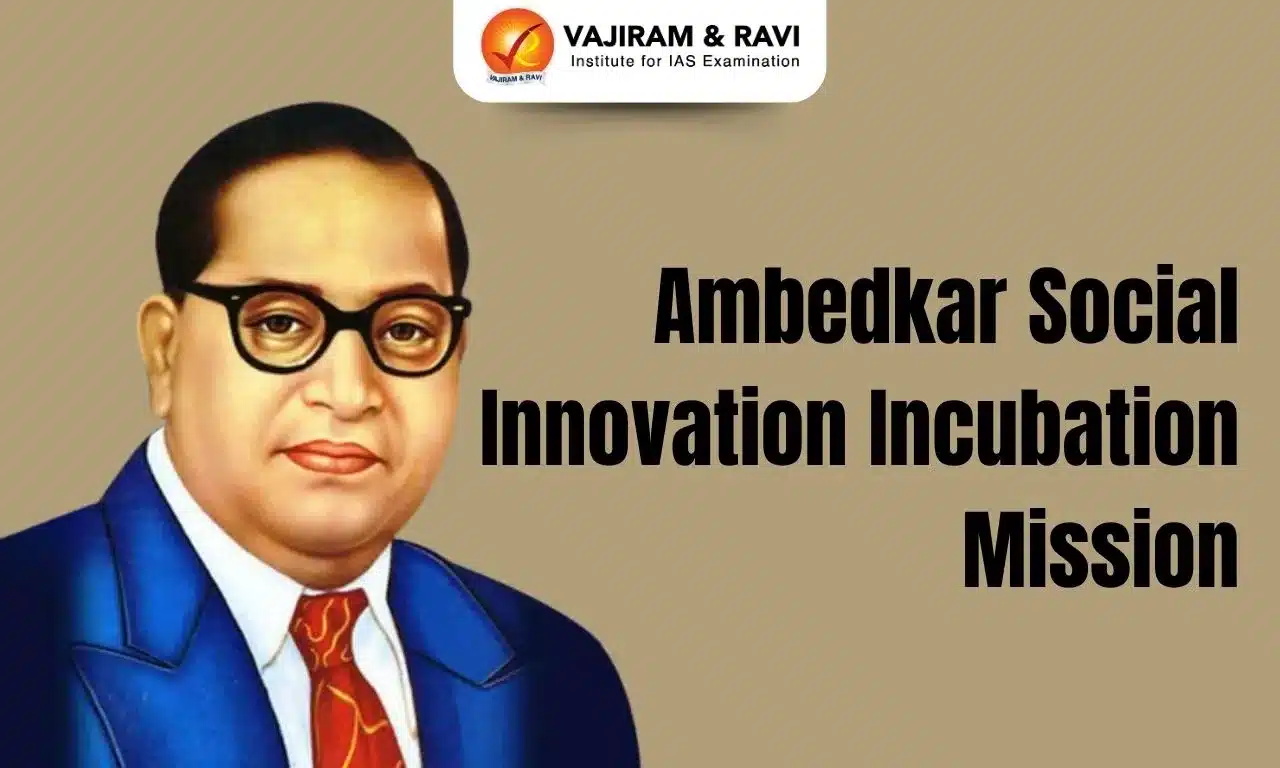
The Ambedkar Social Innovation Incubation Mission (ASIIM) was launched on September 30, 2020, by the Ministry of Social Justice and Empowerment, is a groundbreaking initiative focusing innovation and entrepreneurship among Scheduled Caste (SC) youth. This mission, implemented under the Venture Capital Fund for Scheduled Castes (VCF-SC), seeks to transform Scheduled Caste youth into "job-givers" rather than being "job-seekers." It offers significant opportunities to young innovators with technology-driven ideas, enabling them to contribute to the socio-economic development of the country.

Ambedkar Social Innovation Incubation Mission Objectives

The Objective of ASIIM is to nurture entrepreneurship among SC youth, with a special focus on Divyangs (persons with disabilities). The mission aspires to support 1,000 innovative business ideas by 2024 through collaborations with Technology Business Incubators (TBIs). 
Key Objectives of ASIIM include:

  1. Promoting entrepreneurship and innovation in SC youth.
  2. Offering equity funding of up to ₹30 lakh over three years to develop startups into profitable commercial ventures.
  3. Hand-holding, mentoring, and supporting SC entrepreneurs until their ideas reach the commercialisation stage.
  4. Aligning with the government’s broader "Stand Up India" initiative to encourage entrepreneurship among marginalised communities.

Ambedkar Social Innovation Incubation Mission Implementation

ASIIM operates under the VCF-SC, a fund established in 2015 with an initial fund of ₹500 crore to provide finance assistance to SC entrepreneurs. The initiative leverages the resources and expertise of Technology Business Incubators (TBIs) located in higher education institutions, management schools, and science and technology parks across the country.

ASIIM Funding Support

Each selected startup under ASIIM is entitled to receive up to ₹30 lakh in equity assistance over a three-year incubation period. This funding covers essential expenses such as:

  • Accommodation in TBIs.
  • Procurement of hardware and software.
  • Fellowship stipends for entrepreneurs.
  • Intellectual property (IP) filing costs.
  • Marketing and travel expenses.

Ambedkar Social Innovation Incubation Mission Eligibility Criteria

The program identifies and supports SC youth with innovative ideas through a transparent and systematic process. Eligibility includes:

  • SC/Divyang students identified by TBIs supported by DST.
  • Awardees of national competitions like the Smart India Hackathon.
  • Startups focused on socio-economic development, as identified by TBIs.
  • Enterprises supported by corporate CSR funds.

Ambedkar Social Innovation Incubation Mission Selection Process

The search for potential entrepreneurs is carried out through Technology Business Incubators (TBIs), industries, and higher education institutions. To encourage participation, ASIIM employs widespread publicity via social media, television, and direct outreach in educational campuses. Selection involves two streams:

  • Automatic selection of ideas already incubated by TBIs.
  • Evaluation of other proposals based on guidelines of the VCF-SC.

Ambedkar Social Innovation Incubation Mission Benefits

ASIIM targets technology-oriented ideas that address pressing socio-economic challenges.

Equity funding reduces the financial burden on young entrepreneurs, enabling them to focus on scaling their ideas.Who is eligible for asiim scheme?

The mission emphasises inclusion by giving preference to Divyang youth.

By turning SC youth into job creators, ASIIM contributes to the country’s employment generation efforts.

ASIIM Significance

The Ambedkar Social Innovation Incubation Mission is a significant step toward social justice and empowerment. By encouraging SC youth to transition from traditional job roles to entrepreneurial ventures, the initiative addresses inequalities and promotes a culture of innovation in marginalised communities.

The mission aligns with national priorities such as Atmanirbhar Bharat (self-reliant India) by equipping SC youth with the skills, resources, and networks necessary to grow in competitive markets. 

Ambedkar Social Innovation Incubation Mission FAQs

Q1: What is Ambedkar's social innovation and incubation mission?

Ans: This mission, implemented under the Venture Capital Fund for Scheduled Castes (VCF-SC), seeks to transform Scheduled Caste youth into "job-givers" rather than being "job-seekers."

Q2: Who is eligible for the ASIIM Scheme?

Ans: SC/Divyang students identified by TBIs supported by DST. Awardees of national competitions like the Smart India Hackathon. Startups focused on socio-economic development, as identified by TBIs. Enterprises supported by corporate CSR funds.

Q3: What is the full form of Asiim?

Ans: Ambedkar Social Innovation Incubation Mission.

Q4: What are the objectives of social innovation?

Ans: The Objective of ASIIM is to nurture entrepreneurship among SC youth, with a special focus on Divyangs (persons with disabilities). 

Helgoland

Helgoland

Helgoland  Latest News

Physicists treat Helgoland as the birthplace of quantum theory.

About Helgoland

  • Location: Helgoland is a speck of red-sandstone cliffs lies in the German Bay (Deutsche Bucht) of the North Sea.
  • It is barely a square kilometre in area, it was once a naval fortress.
  • Physicists today treat Helgoland as the birthplace of quantum theory.

Relevance of Helgoland

  • In June 1925, Werner Heisenberg, 23 and tormented by hay fever in Göttingen, fled to Helgoland. 
  • He dropped the idea of electrons ‘orbiting’ an atom’s nucleus in favour of only those facts that fit experimental data: the frequencies and strengths of the light atoms absorb or emit.
  • To keep track of those numbers, he arranged them in grids called matrices.
  • When he multiplied the grids, the order mattered: position times momentum was not equal to momentum times position.
  • This detail produced equations that matched the spectrum of hydrogen atoms perfectly. Heisenberg had thus sketched the first complete version of quantum mechanics, later called matrix mechanics.

Source: TH

Helgoland FAQs

Q1: Where is Heligoland island?

Ans: Northwestern Germany

Q2: What is quantum theory in simple terms?

Ans: It is the branch of physics theory that seeks to explain phenomena occurring at an atomic, and even smaller, scale.

Ancient City of Penico

Ancient City of Penico

Ancient City of Penico Latest News

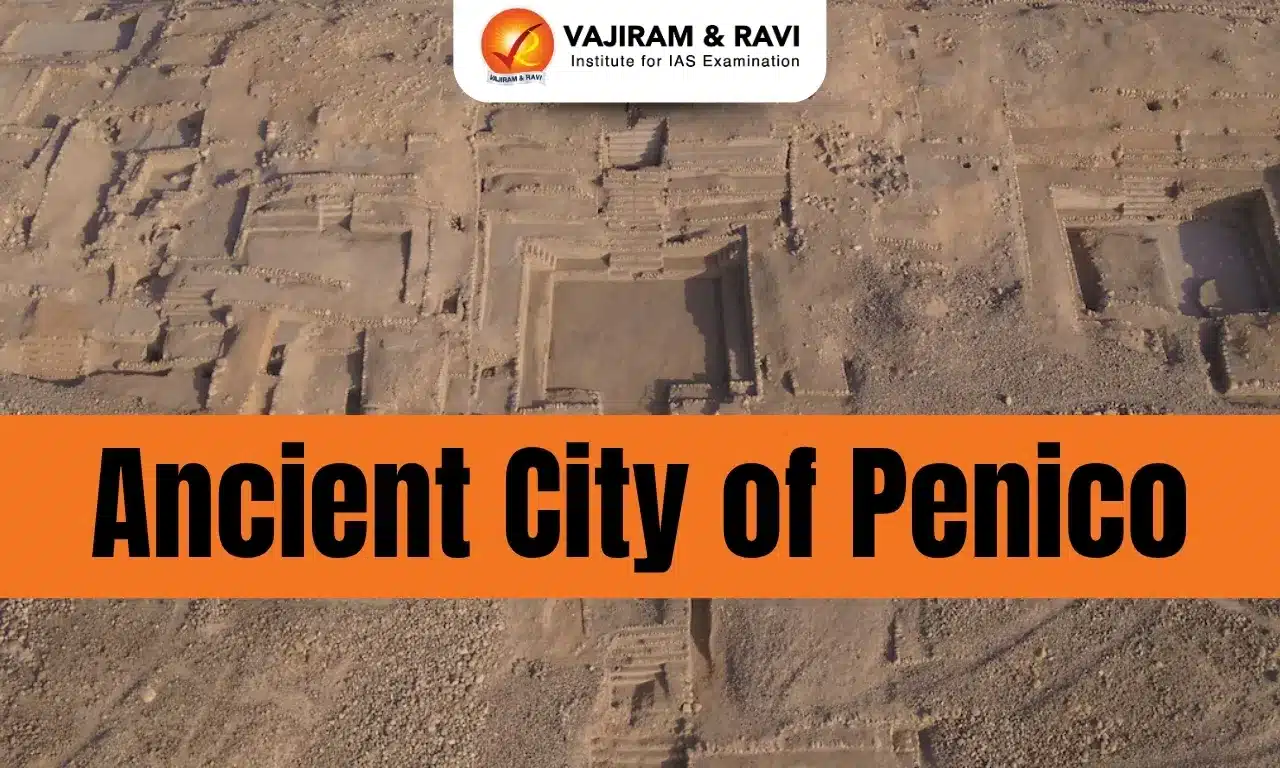
Archaeologists recently unveiled a 3,500-year-old city named Penico in Peru.

About Ancient City of Penico

  • It is a 3,500-year-old lost city located in present-day Peru.
  • Located some 200 km north of Lima (capital of Peru) in the Barranca province, the site lies about 600 metres (1,970 feet) above sea level and is thought to have been founded between 1,800 and 1,500 BC-around the same time that early civilisations were flourishing in the Middle East and Asia.
  • Peñico is situated close to where Caral, recognised as the oldest known civilisation in the Americas, was established 5,000 years ago, at around 3,000 BC, in the Supe Valley of Peru.
  • Peñico's importance lies in it being the continuation of the Caral society.
  • The researchers have identified up to 18 structures in Penico, including ceremonial temples and residential complexes.
    • The walls of a central plaza stand out for their sculptural reliefs and depictions of the pututu, a conch shell trumpet whose sound carries over long distances.
    • In other buildings, researchers found clay sculptures of human and animal figures, ceremonial objects, and necklaces made from beads and seashells.
  • The height at which the structures were found suggests the ancient city’s settlers strategically chose the location, likely to enhance the monumentality of their buildings, protect themselves from floods and landslides, or to promote interaction and exchange.
  • Peñico is believed to have served as a key trading hub connecting early Pacific coast communities with those living in the Andes mountains and Amazon basin.

Source: REUTERS

Penico FAQ's

Q1: The ancient city of Peñico is located in which present-day country?

Ans: Peru

Q2: Approximately how old is the ancient city of Peñico?

Ans: 3,500 years

Q3: Peñico is believed to be a continuation of which ancient civilization?

Ans: Caral

Q4: What is a likely reason why the inhabitants of Peñico chose its elevated location?

Ans: To avoid floods, enhance monumentality, and facilitate exchange.

Japonica Rice

Japonica Rice

Japonica Rice Latest News

Scientists at the Delhi-based National Institute of Plant Genome Research (NIPGR) have used CRISPR-Cas9 gene editing technology to increase phosphate uptake and transport in japonica rice varieties.

About Japonica Rice

  • Japonica is one of the two major eco-geographical races of O. sativa (O. sativa japonica), the other is Indica.
  • It is a group of rice varieties from northern and eastern China grown extensively in some areas of the world.
  • It is an Asian rice variety that belongs within the broader sinica rice family.
  • It is characterized by its short to medium grain and is harder, thicker, and stickier than traditional white rice. 
  • Japonica grains are short, roundish, spikelets are awnless to long-awned, grains do not shatter easily, and have 0-20% amylose content.
  • It includes several varieties, including the sushi rice and glutinous rice, which despite its name, is entirely gluten free.
  • Climate: It is found in the cooler zones of the subtropics and in the temperate zones.
  • Major growing areas:  It is the primary type of rice grown and consumed in Japan and also in China, Korea, Vietnam, Indonesia.
  • The different varieties of Japonica are called cultivars. Each Japonica rice cultivar has been developed to exhibit unique qualities, making them suitable for various culinary uses and growing conditions.

Source:TH

Japonica Rice FAQs

Q1: What type of rice is Japonica?

Ans: Japonica rice (Oryza sativa subsp. japonica), sometimes called sinica rice, is one of the two major domestic types of Asian rice varieties.

Q2: Where is the headquarter of the National Bureau of plant Genetics?

Ans: New Delhi

Defence Accounts Department (DAD)

Defence Accounts Department

Defence Accounts Department Latest News

The defence minister recently underscored the role of the Defence Accounts Department (DAD) in enhancing the operational readiness and financial agility of the Armed Forces at the Controllers’ Conference 2025 in New Delhi.

About Defence Accounts Department

  • It functions under the administrative control of the Ministry of Defence.
  • It is headed by the Controller General of Defence Accounts (CGDA).
  • The mandate given to the department is broadly audit, financial advice, payment, and accounting of all charges pertaining to the Armed Forces.
    • It includes bills for supplies and services rendered and for construction and repair work, pay and allowances, pension etc. of defence personnel and civilians, and audit of cash and store accounts of all organizations under the Ministry of Defence.
  • The DAD has a vast geographical spread with a network of 1110 offices to cater to the needs of all elements of the Indian Defence Services i.e., Army, Air Force, and Navy, as also all other organizations under Ministry of Defence viz Defence Ordnance Factories (41), DRDO Laboratories/Projects (50), Coast Guard , DGQA , DGBR, DGNCC, DG Defence Estates, Canteen Stores Department (CSD), etc.
  • As the principal accounting officer for the Ministry of Defence, the CGDA furnishes necessary information for the Appropriation Accounts to the Ministry of Defence. 
  • CGDA also prepares the Annual Consolidated Accounts of Defence Services Receipts & Charges and acts as the Principal Accounts Officer for Civil Estimates of the Ministry of Defence. 
  • DAD is also responsible for rendering the annual accounts for the Ordnance Factory Board (OFB), Military Farms, Canteen Stores Department, and Works Expenditure. 
  • In addition, the Annual Audit Certificate for the Defence Services, rendered by the CGDA to the Comptroller and Auditor General of India (C&AG) through the Ministry of Defence, is tabled in the Parliament. 
  • Of late, Audit of offset claims has also been entrusted to the Department.

History of Defence Accounts Department

  • It is one of the oldest departments under the Government of India. 
  • Its origin can be traced to the Military Pay Masters under the East India Company.
  • In January 1750, the first Pay Master was appointed for paying the garrison at Fort Williams, Calcutta. 
  • Payments to the troops in the field were made by a Commissary. 
  • In 1776 a Commissary General was appointed for regulating the accounts.
  • In 1788, the designation of the Commissary General was changed to Military Auditor General, who exercised his control over all military disbursements.
  • When the British Crown started administering India in 1858, there were Military Accountants General in the Presidencies of Bengal, Madras, and Bombay.
  • The office of the Accountant General, Military Department, was created in April 1864. 
  • In 1865, the Government recognized this position as the Head of the Military Accounts Department
  • In 1922, the office of Military Accountant General (MAG) was reorganised. The Office of MAG then comprised 8 sections viz. Record, AN, Audit, Accounts, Estimate, Pay, Foreign Claims, and Inspection. 
  • The department was re-named the Defence Accounts Department (DAD) on October 1st, 1951, and the departmental head designated as Controller General of Defence Accounts (CGDA). 
  • For more than three decades after independence, the DAD functioned under the administrative control of the Ministry of Finance. 
  • With the introduction of the Integrated Financial Advisor scheme in the Ministry of Defence from August 1983, the department came under the administrative control of the Ministry of Defence.

Source: DDN

Defence Accounts Department FAQ's

Q1: The Defence Accounts Department (DAD) functions under the administrative control of which ministry?

Ans: Ministry of Defence.

Q2: Who is the head of the Defence Accounts Department (DAD)?

Ans: Controller General of Defence Accounts (CGDA)

Q3: Before 1983, under which ministry did the Defence Accounts Department (DAD) function administratively?

Ans: Ministry of Finance

Swadhar Greh Scheme, Launch Date, Eligibility, Objectives

Swadhar Greh Scheme

Swadhar Greh Scheme is a welfare initiative introduced by the Ministry of Women and Child Development which includes a framework for victim women helping them to live a life with dignity and conviction by providing them shelter, safety, and rehabilitation services.This scheme represented the government's commitment to ensure the dignity, security, and empowerment of vulnerable women.

Swadhar Greh Scheme Objectives

Swadhar Greh Scheme is set up with the capacity of 30 women in each district and holds the below mentioned objectives:

  1. The primary goal of the scheme is to provide women in distress a safe and supportive environment to overcome challenges and rebuild their lives with dignity.
  2. To provide women the skills, resources, and counseling to enable them to lead independent and dignified lives.
  3. In highly populated districts or specific districts with a significant need for additional support to women, the Swadhar Greh Scheme allows for greater flexibility in infrastructure.

Swadhar Greh Scheme Funding

The Swadhar Greh Scheme is funded by the Central Government and State Governments:

  1. 60:40 sharing ratio between the Central and State Governments for most states.
  2. 90:10 sharing ratio for North-Eastern and Himalayan States.
  3. 100% funding by the Central Government for Union Territories.

Release of Funds

The allocation of funds depends on the number of operational Swadhar Grehs, proposed new projects, and available resources. The government releases funds to the States/UTs in two installments annually:

  1. The first installment (50% of the allocated amount) is released at the start of the financial year.
  2. The second installment is distributed once 60% of the first installment has been utilized.

Swadhar Greh Scheme Eligibility

Swadhar Greh Scheme benefits can be availed by the women above the age of 18 who falls in the below mentioned categories:

  1. Women abandoned by their families and left without any social or economic support.
  2. Women who have been homeless due to calamities like floods, earthquakes, or cyclones, and lack socio-economic assistance.
  3. Women coming out of jail who do not have family support or access to financial and social security.
  4. Women are forced to leave their homes due to domestic violence, family tension, or marital disputes and are left without a source of livelihood.
  5. Women or girls rescued from trafficking, or exploitative situations, including those who have run away to escape abuse.
  6. HIV-positive women who have lost family or community support and require shelter and rehabilitation.

Swadhar Greh Scheme Challenges

While the scheme is introduced for the social cause and has a very impactful mark, some areas still require attention:

  1. Some states have struggled to fully utilize allocated funds due to administrative inefficiencies.
  2. Many eligible women remain unaware of the scheme and its benefits.
  3. Some Swadhar Greh shelters lack adequate infrastructure, trained personnel, or funding for expansion.

Swadhar Greh Scheme FAQs

Q1: What is the SWadhar scheme?

Ans: The Scheme provides for primary needs of shelter, food, clothing, and rehabilitation.

Q2: Who is eligible for SWadhar?

Ans: Swadhar Greh Scheme benefits can be availed by the women above the age of 18 who fall in the categories mentioned in the article above.

Q3: What is the Swadhar Greh scheme 2001?

Ans: Under the Scheme, Swadhar Greh will be set up in every district with a capacity of 30 women with the objectives mentioned in the article.

Q4: Who started swadhar Yojana?

Ans: The Swadhar scheme was launched by the Union Ministry of Women and Child Development in 2002 for rehabilitation of women in difficult circumstances.

Q5: Who are the beneficiaries of the Swadhar Greh scheme?

Ans: Girls up to the age of 18 years and boys up to the age of 12 years would be allowed to stay in the Swadhar Greh with their mothers. 

Biotech Kisan Scheme, Launch Date, Features, Objectives, Impacts

Biotech Kisan Scheme

The Biotech-Krishi Innovation Science Application Network (Biotech-KISAN) is a transformative initiative launched in 2017 by the Department of Biotechnology, Ministry of Science and Technology designed to enhance the lives of farmers across India by bridging the gap between agricultural challenges and scientific solutions. This farmer-centric program has gained prominence for its innovative approach to addressing issues such as water management, soil health, seed quality, and market access.

Biotech Kisan Scheme Features

Following are the features of Biotech Kisan Scheme: 

  1. The scheme promotes collaboration between scientists and farmers, ensuring solutions to the unique needs of local communities.
  2. Operating under a hub-and-spoke model, the program extends its benefits to all 15 agro-climatic zones and 115 Aspirational Districts across the country.
  3. Special emphasis is placed on women farmers through initiatives like the Mahila Kisan Biotech Fellowship, initiating leadership and grassroots innovation.
  4. By encouraging entrepreneurial ventures in rural areas, the scheme aims to stimulate innovation and economic growth.

Biotech Kisan Scheme Objectives

The primary goals of the Biotech Kisan Scheme include:

  1. Identifying and resolving local agricultural challenges.
  2. Demonstrating and scaling up effective solutions.
  3. Establishing a scientist-farmer interaction platform.
  4. Offering training programs and exposure to advanced scientific practices.
  5. Promoting the formation of Self-Help Groups (SHGs) and Farmer Producer Organizations (FPOs) to strengthen market linkages.

Biotech Kisan Scheme Impact

Since its launch, the Biotech-KISAN Scheme has delivered measurable benefits to the agriculture sector:

  1. 52 Biotech-KISAN Hubs have been set up in collaboration with the Indian Council of Agricultural Research (ICAR).
  2. Over three lakh farmers have directly and indirectly benefited, including 1.6 lakh farmers in 2022 alone.
  3. More than 200 rural entrepreneurs have emerged, contributing to local economies.
  4. Farmers have incorporated scientific innovations like the use of bio-fertilizers, improved seeds, and better livestock management practices.

Biotech Kisan Scheme Success Stories

  1. The Biotech-KISAN Hub at Bihar Agriculture University, Sabour, helped revive a traditional crop, benefiting farmers and preserving biodiversity.
  2. Women in Sundarbans region adopted scientific methods for goat and sheep rearing, facilitated by the West Bengal University of Animal & Fishery Sciences.
  3. Utilization of rice fallows for pulse cultivation was promoted by the Acharya NG Ranga Agricultural University, Guntur, leading to increased agricultural output in Andhra Pradesh.

Biotech Kisan Scheme FAQs

Q1: What is biotech KISAN?

Ans: Biotech-Krishi Innovation Science Application Network (Biotech-KISAN) is a transformative initiative launched to enhance the lives of farmers across India.

Q2: What is the objective of the biotech KISAN scheme which was making news recently?

Ans: Biotech-KISAN Scheme, a scientist-farmer partnership scheme that empowers farmers, especially women farmers for agriculture innovation.

Q3: What is the full form of Biotech Kisan Scheme?

Ans: Biotech-Krishi Innovation Science Application Network.

Q4: What is Biotechnology UPSC?

Ans: Biotechnology is the use of microbes, plants, and animal cells, or their components, to create goods and processes that benefit humans.

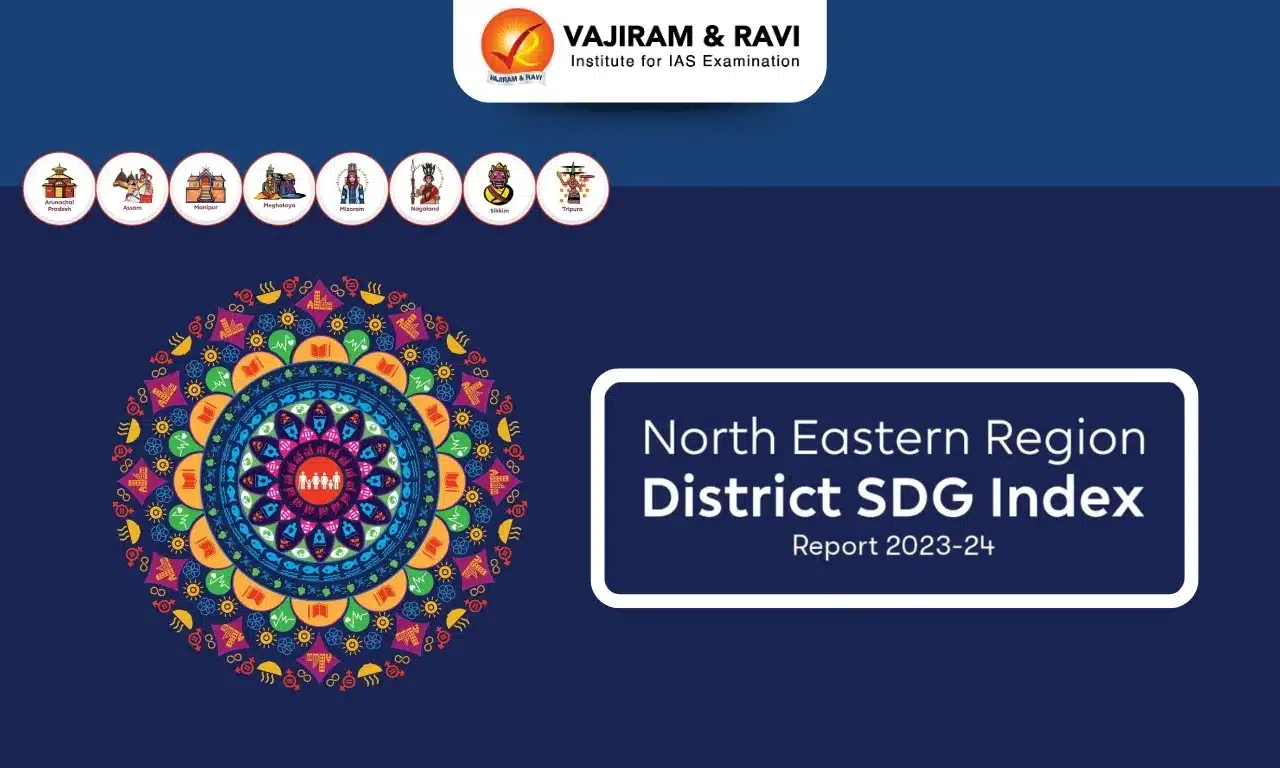
North Eastern Region District SDG Index

North Eastern Region District SDG Index

North Eastern Region District SDG Index Latest News

Recently, the second edition of the North Eastern Region (NER) District Sustainable Development Goals (SDG) Index Report (2023-24) was released today by NITI Aayog.

About North Eastern Region District SDG Index

  • It is developed by NITI Aayog and the Ministry of Development of North Eastern Region (MoDoNER), with technical support from UNDP.
  • The Index is built upon the momentum of the first edition released on 26 August 2021
  • It measures the performance of districts across eight North Eastern States on the SDGs.
  • Based on NITI Aayog's SDG India Index methodology, it serves as a key tool for monitoring development related progress at the district level in the region to inform decision making.
  • Districts are categorised into four categories
    • Achiever: Score equals 100 (achieved the targets set for identified indicators);
    • Front Runner: Score between 65 and 99 (excluding 100);
    • Performer: Score between 50 and 65 (excluding 65); and
    • Aspirant: Score less than 50.
  • The (2023-24) Index is a major milestone in improving monitoring at the regional level.
  • The index reflects the commitment to address development challenges across social, economic, and environmental dimensions while ensuring that no one is left behind in the NER.
  • The index report provides detailed district-level analysis and recommendations for accelerating progress towards achieving the SDGs by 2030, ensuring that no district is left behind in the region's development journey.

Key Findings of the Index

  • The composite scores for the 121 districts range from 58.71 in Longding, Arunachal Pradesh to 81.43 in Hnahthial, Mizoram.
  • All districts in Mizoram, Sikkim and Tripura have achieved Front Runner status, with no districts falling in the Aspirant or Achiever categories.
  • Mizoram has the highest-scoring district in the entire Northeast region (Hnahthial at 81.43) and Arunachal Pradesh has the lowest-scoring district in the entire region (Longding at 58.71).
  • Sikkim has the narrowest range (5.5 points) in terms of the score of the highest and lowest district, showing the most consistent performance across its districts.
  • Tripura has the distinction of having some of the highest-scoring districts with minimum intra-state variation (6.5 points).
  • Mizoram and Nagaland have some of the highest-scoring districts but also exhibit variation (ranges of 13.72 and 15.07, respectively).

Source: PIB

North Eastern Region District SDG Index FAQs

Q1: What is sustainable development?

Ans: Sustainable development is development that meets the needs of the present without compromising the ability of future generations to meet their own needs.

Q2: What are the 7 pillars of NITI Aayog?

Ans: The seven pillars of the NITI Aayog include Pro-activity, Pro-people, Participation, Empowering, Inclusion of all, Equality, and Transparency.

National Overseas Scholarship (NOS) Scheme

National Overseas Scholarship Scheme

National Overseas Scholarship Scheme Latest News

The Union Social Justice Ministry is in the process of seeking additional allocation for administering the National Overseas Scholarship scheme for marginalised students.

About National Overseas Scholarship Scheme

  • It is a Central Sector Scheme to facilitate the low-income students from marginalized communities, including the Scheduled Castes (SC), Denotified Nomadic and Semi-Nomadic Tribes, Landless Agricultural Labourers, and Traditional Artisans, to obtain higher education, viz., Master degree or Ph.D courses, by studying abroad.
  • The scheme is administered by the Ministry of Social Justice & Empowerment.
  • Under the NOS Scheme, each selection year, 125 fresh candidates are selected, subject to the availability of funds. 
  • Out of the 125 candidates who are awarded scholarships, 115 are for SC candidates, 6 for Denotified, Nomadic and Semi-Nomadic Tribes, and 4 are for Landless Agricultural Labourers candidates and Traditional Artisans. 
  • 30% of the scholarships for each year are earmarked for female candidates.

National Overseas Scholarship Scheme Eligibility

  • The applicant should be less than 35 years of age on 1st April of the selection year.
  • The applicant must have been admitted to or received an unconditional offer of admission for pursuing a master's/Ph.D. from an institute/university located abroad.
  • The institute/university of the applicant must be accredited by the Government/authorized body of that country.
  • The applicant must have secured at least 60% marks or equivalent grade in the qualifying examination (In the case of Ph.D. courses, the qualifying exam is a Master’s Degree; In the case of a Master’s Degree, the qualifying exam is a Bachelor's Degree)
  • The total income of the family of the applicant (from all sources) is less than or equal to ₹ 8 lakh per annum.

National Overseas Scholarship Scheme Exclusions

  • Bachelors-level courses, in any discipline, are not covered under this scheme.
  • No more than two children of the same parents/guardians will be eligible for scholarships. The second child of the same parents/guardians will be considered only if slots are still available in the last cycle of the year in which the applicant has applied.
  • Candidates already staying or studying or having completed studies abroad by utilizing any other scholarship from the State Government, other agency, or through their own funds are not eligible to apply under this scheme.
  • The candidate is not eligible for a scholarship to pursue the same level (Masters/Ph.D.) of course for which he/she has already acquired the qualification from any University/Institution either in India or abroad.

Source: TH

National Overseas Scholarship Scheme FAQs

Q1: The National Overseas Scholarship (NOS) Scheme is administered by which ministry?

Ans: Ministry of Social Justice & Empowerment

Q2: What type of courses are funded under the National Overseas Scholarship (NOS) Scheme?

Ans: Master's and Ph.D. courses

Q3: What is the total number of fresh candidates selected each year under the National Overseas Scholarship (NOS) Scheme?

Ans: 125

Q4: What percentage of scholarships under the National Overseas Scholarship (NOS) Scheme is earmarked for female candidates?

Ans: 30%

Tiruchendur Subramanya Swamy Temple

Tiruchendur Subramanya Swamy Temple

Tiruchendur Subramanya Swamy Temple Latest News

Thousands of devotees recently witnessed the grand consecration of the Subramanya Swamy temple in Tiruchendur, held after a gap of 16 years.

About Tiruchendur Subramanya Swamy Temple

  • It is a Hindu temple dedicated to Lord Murugan (Son of Lord Shiva and Goddess Parvati).
  • It is located in Tiruchendur, Thoothukudi District, Tamil Nadu.
  • It is one of the six sacred abodes of Lord Murugan and is the only one along the seashore. The other five temples are situated on mountains. 
  • The temple faces the Bay of Bengal and is washed by the sea waves from the Gulf of Mannar.
  • Having stood for over 2 millennia, the temple is a splendid example of Tamil architecture. 
    • The temple is constructed with red sandstone and presents a panoramic view of the sea.
    • The RajaGopuram (temple tower) is built on the western side of the temple, unlike other temples where the RajaGopuram is erected on the eastern side, the reason being that the sea is very close to the eastern side.
    • The Gopuram is nine-tier that is 138 feet high. The sanctum sanctorum of the temple has Lord Subramanyam in a standing posture. 
    • There are nine Kalasams (sacred copper pots) atop the Gopuram to indicate that the Gopuram consists of 9 storeys.
    • The temple also boasts of many other stunning architectural features, like huge mandapams (halls), long streets, majestically carved pillars, and a number of small shrines.

Source: TH

Tiruchendur Subramanya Swamy Temple FAQs

Q1: In which Indian state is the Tiruchendur Subramanya Swamy Temple located?

Ans: Tamil Nadu

Q2: What makes Tiruchendur unique among the six sacred abodes (Arupadai Veedu) of Lord Murugan?

Ans: It is the only one situated along the seashore.

Q3: What is the primary building material used in constructing the Tiruchendur Subramanya Swamy Temple?

Ans: Red sandstone

Q4: What is unusual about the placement of the Raja Gopuram at Tiruchendur Temple?

Ans: It is built on the western side of the temple, unlike other temples where the RajaGopuram is erected on the eastern side

Five Star Villages Scheme, Features, Objectives, Significance

Five Star Villages Scheme

The Five Star Villages Scheme is an initiative which was introduced by the Department of Posts under the Ministry of Communications, designed to ensure universal access to flagship postal schemes in India's rural areas. This innovative program aims to provide awareness and accessibility gaps for postal products and services, particularly in remote and underserved areas.

Five Star Villages Scheme Objective

The primary goal of the Five Star Villages Scheme is to establish universal coverage of postal schemes in villages, transforming branch post offices into one-stop service hubs for all postal needs. By creating a network of India Post, the scheme also contributes to the Aatmanirbhar Bharat as well by enhancing financial inclusion and empowering rural communities.

Five Star Villages Scheme Key Features 

The program includes the promotion and marketing of a variety of postal schemes, such as:

  1. Savings Products: Savings Bank Accounts, Recurring Deposit Accounts, and National Savings Certificates (NSC)/Kisan Vikas Patra (KVP).
  2. Financial Inclusion Products: Sukanya Samriddhi Accounts, Public Provident Fund (PPF) Accounts, and India Post Payments Bank-linked savings accounts.
  3. Insurance: Postal Life Insurance (PLI), Rural Postal Life Insurance (RPLI), and coverage under Pradhan Mantri Suraksha Bima Yojana (PMSBY) and Pradhan Mantri Jeevan Jyoti Bima Yojana (PMJJBY).

Star Rating System

Villages earn ratings based on the number of schemes successfully implemented:

  • One Star: Universal coverage of one scheme.
  • Two Stars: Coverage of two schemes, and so forth.

Five Star Villages Scheme Implementation Strategy

A dedicated team of Gramin Dak Sevaks, led by Branch Post Masters, drives the implementation. These teams conduct door-to-door awareness campaigns and utilize public spaces such as panchayat offices and schools for outreach. Monthly reviews and close monitoring at regional and divisional levels ensure the program's success.

Five Star Villages Scheme Significance

The Five Star Villages Scheme not only strengthens the role of the postal network in rural India but also:

  1. Promotes secure and high-return savings products.
  2. Provides a safety net through insurance and financial inclusion schemes.
  3. Enhances the livelihoods of rural residents through better accessibility to essential financial services.

Five Star Villages Scheme FAQs

Q1: What is the Five Star Village Scheme?

Ans: The Five Star Villages Scheme is an ambitious initiative which was introduced by the Department of Posts under the Ministry of Communications, designed to ensure universal access to flagship postal schemes in India's rural areas. 

Q2: Who conducted the village scheme?

Ans: Postal Service Schemes.

Q3: Who started the Indian village scheme?

Ans: Prime Minister Narendra Modi launched Saansad Adarsh Gram Yojana (SAGY) or SAANJHI) on 2 October 2014.

Q4: What is the PMAY scheme for villages?

Ans: PMAYG is a housing scheme for construction of dwelling units in the rural part of the Country by providing the financial assistance of Rs. 1.2 Lakh/1.3 lakh to the eligible beneficiaries in plain/Hilly areas.

Q5: Is the village panchayat appointed by the Government?

Ans: The Panchayat is chaired by the president of the village, known as a Sarpanch.

BRICS Summit 2025 – Advancing Global South Cooperation for Inclusive and Sustainable Governance

BRICS Summit 2025

BRICS Summit 2025 Latest News

  • The 17th BRICS Summit was held in Rio de Janeiro, Brazil on 6–7 July 2025, under the theme "Strengthening Global South Cooperation for a More Inclusive and Sustainable Governance". 
  • This Summit, which concluded with the ‘Rio de Janeiro Declaration’, marks a strategic shift towards inclusivity, expansion, and stronger South-South cooperation.

Key Highlights of the BRICS Summit 2025

  • Reaffirmation of BRICS spirit and strategic vision:
    • Emphasized mutual respect, sovereign equality, democracy, and inclusiveness.
    • Strengthened cooperation under three pillars:
      • Political and security
      • Economic and financial
      • Cultural and people-to-people cooperation
    • Reiterated commitment to peace, inclusive development, and reform of global governance institutions.
  • Expansion of BRICS membership and partnerships:
    • Indonesia formally joins as a full BRICS member.
    • 11 new BRICS partner countries welcomed - Belarus, Bolivia, Kazakhstan, Cuba, Nigeria, Malaysia, Thailand, Vietnam, Uganda, Uzbekistan.
    • Expansion reflects an evolving multipolar world order and Global South solidarity.
  • Key declarations:
    • Initiatives launched:
      • BRICS Leaders’ Framework Declaration on Climate Finance
      • Statement on Global Governance of Artificial Intelligence (AI)
      • Launch of BRICS Partnership for the Elimination of Socially Determined Diseases
    • These highlight BRICS’ commitment to inclusive innovation, climate action, and equitable health systems.

Strategic Focus Areas and Commitments

  • Strengthening multilateralism and reforming global governance:
    • The ‘Rio de Janeiro Declaration’ called for equitable, effective, and accountable multilateralism.
    • Supported the UN Summit of the Future's "Pact for the Future", including:
      • Global Digital Compact
      • Declaration on Future Generations
    • Emphasis on consultation, shared responsibility, and equitable representation in international institutions.
  • Promoting peace, security, and stability:
    • Expressed concern over global military spending surge and regional conflicts.
    • Rejected linking climate change with security narratives.
    • Advocated development-centric multilateral solutions for poverty, hunger, and environmental crises.
  • Economic, trade, and financial cooperation:
    • Reviewed implementation of Strategy for BRICS Economic Partnership 2025.
    • Welcomed upcoming Strategy for BRICS Economic Partnership 2030, focusing on:
      • Digital economy, trade and investment,
      • Financial cooperation, and
      • Sustainable development.
    • Pledged to uphold a transparent and inclusive multilateral trading system.
  • Climate change and sustainability commitments:
    • Strong support for Paris Agreement and UNFCCC principles, especially:
      • Common but Differentiated Responsibilities (CBDR)
      • National circumstances of developing countries
    • Full backing for COP-30 in Brazil (Belem) and India’s bid to host COP-33 (2028).
    • Called for scaled-up efforts and finance for climate adaptation and mitigation.
  • Social, human, and cultural development:
    • Emphasized inclusive development, particularly: youth empowerment, women’s rights, disability inclusion, urbanization, and migration management.
    • Recognized demographic changes as both a challenge and opportunity for development.

India at BRICS Summit 2025

  • India’s leadership vision - BRICS in a “New Form”:
    • At the 17th BRICS Summit, the Indian PM announced India’s upcoming BRICS presidency for 2026, outlining a transformative vision and proposing a new interpretation of BRICS - 
      • Building
      • Resilience and
      • Innovation for
      • Cooperation and
      • Sustainability
      • Echoed India’s G20 Presidency theme of “People-centricity and Humanity First”, placing Global South concerns at the core.
  • India’s strategic gains from BRICS 2025: 
  • At the 17th BRICS Summit, India emerged as a leading voice in shaping the BRICS agenda, advancing themes of de-dollarization, climate finance, digital governance, and global institutional reform. 
    • BRICS Pay and national currency settlement frameworks were discussed, though a common BRICS currency was ruled out.
    • A BRICS Multilateral Guarantee (BMG) mechanism was launched by the New Development Bank (NDB) to mobilize private investment in infrastructure, climate, and sustainable development.
    • Improving India–China relations:
      • A bilateral between PM Modi and Chinese President Xi Jinping led to agreements on:
        • De-escalation along the Line of Actual Control (LAC), and
        • Resumption of border patrols.
      • This may restore investor confidence, particularly in electronics and manufacturing sectors.

US Opposition to BRICS

  • BRICS as a growing power bloc: With the addition of new members, BRICS now represents 45% of the global population and contributes 35% to global GDP.
  • Concerns over BRICS currency alternatives: Despite early speculation, BRICS clarified it does not intend to replace the dollar, but rather aims to offer viable alternative settlement systems to improve market efficiency and ensure inclusive globalisation.
  • Trump’s tariff threat:
    • President Trump warned of a 10% tariff on any country aligning with BRICS’ “anti-American policies”.
    • He issued a stronger warning of a 100% tariff on BRICS nations if they move to reduce dollar usage in international trade.
  • India’s calibrated stand and resistance to Yuan’s dominance:
    • External Affairs Minister S. Jaishankar: “India does not target the dollar, but explores alternative trade settlements due to practical constraints.”
    • Yuan's role in BRICS: Yuan became the most traded currency in Russia, accounting for 90% of bilateral trade settlements.
    • India’s resistance: India refused to use the yuan for Russian oil imports, indicating reluctance to accept Chinese monetary hegemony.

Conclusion

  • The BRICS Summit 2025 marks a defining moment in Global South-led multilateralism and highlights BRICS’ growing relevance in shaping global discourse, reinforcing BRICS as a credible alternative to Western-dominated institutions.
  • India’s proactive leadership at BRICS 2025 and forthcoming BRICS Presidency in 2026 signals its growing influence in shaping a South-led multilateral order, with tangible gains across finance, climate, tech, and trade sectors. 
  • India’s nuanced position on BRICS’ financial initiatives reflects its pursuit of strategic autonomy, economic de-risking, and multipolarity in global governance.

Source: TH | TNIE | IE

BRICS Summit 2025

Q1: Critically examine the implications of BRICS expansion and inclusion of new partner countries on the future of multilateral global governance.

Ans: The expansion of BRICS to include countries like Indonesia and 11 new partners reflects a shift towards a multipolar and representative global order, enhancing the voice of the Global South in multilateral forums.

Q2: Discuss how BRICS 2025 has addressed the challenges of climate change through its declarations and commitments.

Ans: BRICS 2025 reaffirmed commitment to the Paris Agreement, supported COP-30 in Brazil and India’s COP-33 bid, and emphasized climate finance and differentiated responsibilities for sustainable development.

Q3: Highlight the strategic significance of the BRICS Leaders’ Statement on Global Governance of Artificial Intelligence in the context of digital sovereignty and ethical technology use.

Ans: The statement on AI governance underscores BRICS' resolve to promote ethical, inclusive, and sovereign digital frameworks amid rising concerns over global technological hegemony.

Q4: How does the BRICS Economic Partnership Strategy 2030 aim to shape future economic cooperation among member states?

Ans: The Strategy 2030 seeks to consolidate mandates and provide frameworks for cooperation on digital economy, multilateral trade, financial integration, and sustainable development among BRICS nations.

Q5: Evaluate the role of BRICS in reinforcing inclusive human development through its socio-cultural and demographic cooperation agendas.

Ans: BRICS aims to foster inclusive growth by addressing issues like youth development, women's rights, disability inclusion, urbanization, and demographic transitions as key areas for cooperation.

Daily Editorial Analysis 8 July 2025

Daily Editorial Analysis

Rising Seas, Shifting Lives and a Test of Democratic Values

Context

  • As climate change accelerates, India’s coastal regions are witnessing not just environmental degradation but also profound socio-economic disruptions.
  • Rising sea levels, saltwater intrusion, and unchecked development are displacing communities dependent on coastal ecosystems, forcing them into vulnerable urban labour markets.
  • This article examines the legal, environmental, and human rights challenges posed by climate-induced displacement, and argues for a rights-based policy framework to protect and rehabilitate the affected populations as part of India’s broader climate adaptation strategy.

Climate Change and Coastal Displacement in India

  • Reshaping the Coastline
    • India’s eastern and western seaboards are undergoing dramatic transformation due to rising sea levels, saltwater intrusion, and unregulated development.
    • Agricultural and fishing communities, historically reliant on coastal ecosystems, are being uprooted and forced into migration.
  • Inadequate Resettlement
    • Villages like Satabhaya in Odisha have vanished, with displaced residents moved to government colonies that fail to ensure sustainable livelihoods.
    • Displacement and environmental degradation are affecting regions such as Karnataka’s Honnavar, Tamil Nadu’s Nagapattinam, Gujarat’s Kutch, and parts of Kerala.
    • Displaced populations are pushed into precarious urban labour markets, lacking legal safeguards and adequate state support.

Projects and Environmental Degradation: A Vicious Cycle

  • Coastal Development Fuelling Ecological Loss
    • Industrial projects like ports, energy hubs, and aquaculture under schemes like Sagarmala have led to large-scale clearing of mangroves, sand dunes, and wetlands—natural buffers against climate impacts.
    • Environmental approvals often overlook cumulative climate vulnerabilities, promoting a development model that exacerbates ecological degradation and community displacement.
  • Displacement into Informal Urban Labour
    • Displaced coastal populations are being absorbed into informal jobs in cities like Bhubaneswar, Chennai, Hyderabad, and Mumbai, lacking job security and social safety nets.
  • Rise of Labour Exploitation
    • Migrants face systemic exploitation—through debt bondage, absence of legal protections under labour laws, and gendered abuse in domestic and low-wage work sectors.

Legal Gaps in Addressing Climate Displacement

  • Absence of a Specific Legal Framework
    • While Article 21 of the Constitution guarantees the right to life and dignity, India lacks a dedicated law for those displaced by slow-onset climate disasters.
    • Current laws—like the Disaster Management Act (2005), Environment (Protection) Act (1986), and Coastal Regulation Zone (CRZ) Notifications—focus on environmental protection or emergency relief, not long-term rehabilitation or livelihood integration.
  • Inadequate Coastal and Climate Policies
    • The CRZ Notification, 2019, intended to ensure sustainable coastal management, has been criticised for prioritising tourism and industrial development over the rights of traditional fishing communities.
    • Diluted zoning has enabled unchecked commercial projects without informed consent, violating national and international environmental norms.
  • Policy Shortfalls in Climate Adaptation Plans
    • The National Action Plan on Climate Change (NAPCC) and State Action Plans acknowledge vulnerability but lack targeted strategies for rehabilitating displaced populations or integrating them into formal labour markets.
  • Labour Codes and Migrant Protections
    • India’s recent Labour Codes fail to recognise or protect climate migrants, particularly in informal sectors like construction and domestic work, where such migrants are overrepresented.
  • Judicial Recognition Without Legislative Translation
    • Key Supreme Court judgments—M.C. Mehta v. Union of India (1987) and Indian Council for Enviro-Legal Action v. Union of India (1996)—established the link between environment and fundamental rights.
    • However, these principles have not been translated into binding, community-centric legal safeguards for climate-induced displacement.
  • Managed Retreat Without Safeguards
    • As climate change is increasingly used to justify displacement under the guise of “managed retreat,” the absence of participatory planning and rights-based safeguards raises serious concerns for the displaced.

Building a Rights-Based Framework for Climate Migrants

  • Integration into National Policies
    • Climate migrants must be formally recognised in India’s migration and urban planning frameworks to ensure inclusive and equitable adaptation strategies.
  • Guaranteeing Core Rights and Services
    • A rights-based approach should ensure access to decent work, housing, education, and healthcare for displaced communities, particularly in urban informal sectors.
  • Reforming Labour Codes
    • Labour laws must be revised to extend explicit protections to climate migrants, especially in vulnerable sectors like construction and domestic work where exploitation is rampant.
  • Rethinking Coastal Zone Management
    • Coastal management policies must shift focus from commercial development to ecological sustainability and protection of community rights.
  • Aligning with Global Commitments
    • India’s pursuit of SDG Target 8.7—ending forced labour and promoting decent work—depends on addressing vulnerabilities caused by climate displacement.
  • A Test of Democratic Values
    • Upholding the rights and dignity of climate-affected populations is not just about adaptation—it is a moral and constitutional imperative for India.

BRICS Summit 2025 - Advancing Global South Cooperation for Inclusive and Sustainable Governance

Why in News?

  • The 17th BRICS Summit was held in Rio de Janeiro, Brazil under the theme "Strengthening Global South Cooperation for a More Inclusive and Sustainable Governance".
  • This Summit, which concluded with the ‘Rio de Janeiro Declaration’, marks a strategic shift towards inclusivity, expansion, and stronger South-South cooperation.

What’s in Today’s Article?

  • Key Highlights of the BRICS Summit 2025
  • Strategic Focus Areas and Commitments
  • India at BRICS Summit 2025
  • US Opposition to BRICS
  • Conclusion

Key Highlights of the BRICS Summit 2025:

  • Reaffirmation of BRICS spirit and strategic vision:
    • Emphasized mutual respect, sovereign equality, democracy, and inclusiveness.
    • Strengthened cooperation under three pillars:
      • Political and security
      • Economic and financial
      • Cultural and people-to-people cooperation
    • Reiterated commitment to peace, inclusive development, and reform of global governance institutions.
  • Expansion of BRICS membership and partnerships:
    • Indonesia formally joins as a full BRICS member.
    • 11 new BRICS partner countries welcomed - Belarus, Bolivia, Kazakhstan, Cuba, Nigeria, Malaysia, Thailand, Vietnam, Uganda, Uzbekistan.
    • Expansion reflects an evolving multipolar world order and Global South solidarity.
  • Key declarations:
    • Initiatives launched:
      • BRICS Leaders’ Framework Declaration on Climate Finance
      • Statement on Global Governance of Artificial Intelligence (AI)
      • Launch of BRICS Partnership for the Elimination of Socially Determined Diseases
    • These highlight BRICS’ commitment to inclusive innovation, climate action, and equitable health systems.

Strategic Focus Areas and Commitments:

  • Strengthening multilateralism and reforming global governance:
    • The ‘Rio de Janeiro Declaration’ called for equitable, effective, and accountable multilateralism.
    • Supported the UN Summit of the Future's "Pact for the Future", including:
      • Global Digital Compact
      • Declaration on Future Generations
    • Emphasis on consultation, shared responsibility, and equitable representation in international institutions.
  • Promoting peace, security, and stability:
    • Expressed concern over global military spending surge and regional conflicts.
    • Rejected linking climate change with security narratives.
    • Advocated development-centric multilateral solutions for poverty, hunger, and environmental crises.
  • Economic, trade, and financial cooperation:
    • Reviewed implementation of Strategy for BRICS Economic Partnership 2025.
    • Welcomed upcoming Strategy for BRICS Economic Partnership 2030, focusing on:
      • Digital economy, trade and investment,
      • Financial cooperation, and
      • Sustainable development.
    • Pledged to uphold a transparent and inclusive multilateral trading system.
  • Climate change and sustainability commitments:
    • Strong support for Paris Agreement and UNFCCC principles, especially:
      • Common but Differentiated Responsibilities (CBDR)
      • National circumstances of developing countries
    • Full backing for COP-30 in Brazil (Belem) and India’s bid to host COP-33 (2028).
    • Called for scaled-up efforts and finance for climate adaptation and mitigation.
  • Social, human, and cultural development:
    • Emphasized inclusive development, particularly: youth empowerment, women’s rights, disability inclusion, urbanization, and migration management.
    • Recognized demographic changes as both a challenge and opportunity for development.

India at BRICS Summit 2025:

  • India’s leadership vision - BRICS in a “New Form”:
    • At the 17th BRICS Summit, the Indian PM announced India’s upcoming BRICS presidency for 2026, outlining a transformative vision and proposing a new interpretation of BRICS -
      • Building
      • Resilience and
      • Innovation for
      • Cooperation and
      • Sustainability
    • Echoed India’s G20 Presidency theme of “People-centricity and Humanity First”, placing Global South concerns at the core.
  • India’s strategic gains from BRICS 2025:
    • At the 17th BRICS Summit, India emerged as a leading voice in shaping the BRICS agenda, advancing themes of de-dollarization, climate finance, digital governance, and global institutional reform.
    • BRICS Pay and national currency settlement frameworks were discussed, though a common BRICS currency was ruled out.
    • A BRICS Multilateral Guarantee (BMG) mechanism was launched by the New Development Bank (NDB) to mobilize private investment in infrastructure, climate, and sustainable development.
  • Improving India–China relations:
    • A bilateral between PM Modi and Chinese President Xi Jinping led to agreements on:
      • De-escalation along the Line of Actual Control (LAC), and
      • Resumption of border patrols.
    • This may restore investor confidence, particularly in electronics and manufacturing sectors.

US Opposition to BRICS:

  • BRICS as a growing power bloc: With the addition of new members, BRICS now represents 45% of the global population and contributes 35% to global GDP.
  • Concerns over BRICS currency alternatives: Despite early speculation, BRICS clarified it does not intend to replace the dollar, but rather aims to offer viable alternative settlement systems to improve market efficiency and ensure inclusive globalisation.
  • Trump’s tariff threat:
    • President Trump warned of a 10% tariff on any country aligning with BRICS’ “anti-American policies”.
    • He issued a stronger warning of a 100% tariff on BRICS nations if they move to reduce dollar usage in international trade.
  • India’s calibrated stand and resistance to Yuan’s dominance:
    • External Affairs Minister S. Jaishankar: “India does not target the dollar, but explores alternative trade settlements due to practical constraints.”
    • Yuan's role in BRICS: Yuan became the most traded currency in Russia, accounting for 90% of bilateral trade settlements.
    • India’s resistance: India refused to use the yuan for Russian oil imports, indicating reluctance to accept Chinese monetary hegemony.

Conclusion:

  • The BRICS Summit 2025 marks a defining moment in Global South-led multilateralism and highlights BRICS’ growing relevance in shaping global discourse, reinforcing BRICS as a credible alternative to Western-dominated institutions.
  • India’s proactive leadership at BRICS 2025 and forthcoming BRICS Presidency in 2026 signals its growing influence in shaping a South-led multilateral order, with tangible gains across finance, climate, tech, and trade sectors.
  • India’s nuanced position on BRICS’ financial initiatives reflects its pursuit of strategic autonomy, economic de-risking, and multipolarity in global governance

Fostering a Commitment to Stop Maternal Deaths

Context

  • Maternal mortality remains a critical public health concern in India, reflecting the broader socio-economic, infrastructural, and systemic challenges facing the country's healthcare system.
  • While India’s Maternal Mortality Ratio (MMR) has improved, falling from 103 in 2017–19 to 93 in 2019–21, this still translates to 93 women dying for every 1,00,000 live births.
  • Therefore, it is important to analyse the various dimensions contributing to maternal mortality in India, highlighting the disparities among different states and strategic solutions.

The National Picture and Regional Disparities

  • Empowered Action Group (EAG) States
    • States including Bihar, Jharkhand, Madhya Pradesh, Chhattisgarh, Odisha, Rajasthan, Uttar Pradesh, Uttarakhand, and Assam, represent the most concerning figures.
    • Madhya Pradesh (175) and Assam (167) have alarmingly high MMRs, highlighting acute systemic gaps.
  • Southern States
    • Kerala, Tamil Nadu, Andhra Pradesh, Telangana, and Karnataka perform significantly better.
    • Kerala leads the nation with the lowest MMR of 20, exemplifying what committed governance, effective training, and community health initiatives can achieve.
  • Other States
    • This list comprises Maharashtra, Gujarat, Punjab, Haryana, and West Bengal and displays a mixed picture, indicating the need for tailored policy interventions to address state-specific challenges.

The Three Delays Model: Understanding Maternal Deaths

  • Delay in Decision-Making to Seek Care
    • Often rooted in poor health literacy, financial insecurity, or gendered social norms, this delay can be fatal.
    • Families underestimate complications, assuming childbirth is a routine process.
    • However, community engagement through ASHA workers, self-help groups, and financial incentives under the National Rural Health Mission have begun to shift attitudes, promoting institutional deliveries.
  • Delay in Reaching Healthcare Facilities
    • Geographic isolation, inadequate transportation, and poor road connectivity are barriers in rural and tribal areas.
    • The 108-ambulance service and emergency transport provisions under the National Health Mission have mitigated this to some extent, but challenges persist.
  • Delay in Receiving Adequate Care at the Facility
    • This is perhaps the most inexcusable of all delays.
    • Systemic issues like understaffed hospitals, lack of blood banks, absence of skilled obstetricians or anaesthetists, and delayed emergency response contribute significantly to avoidable deaths.
    • A non-functional operation theatre or delayed availability of lab results can mean the difference between life and death.

Medical Causes of Maternal Mortality

  • Postpartum Haemorrhage
    • The leading cause, often due to uterine atony, which can lead to massive blood loss.
    • In the absence of timely blood transfusion and uterine contraction management, death occurs swiftly.
  • Obstructed Labour
    • Especially prevalent among malnourished, stunted women with narrow pelvic structures.
    • Without timely Caesarean sections, prolonged labour can cause uterine rupture and foetal death.
  • Hypertensive Disorders: Conditions like preeclampsia and eclampsia are often undetected and untreated, resulting in seizures, coma, or death.
  • Sepsis: Caused by unsafe home deliveries or crude abortion practices, particularly in areas with poor access to contraception and trained medical personnel.
  • Coexisting Illnesses: Diseases like tuberculosis, malaria, and urinary tract infections compound maternal risk, especially in underdeveloped states.

Models of Success: Learning from Kerala

  • Kerala’s approach stands out as a national and even global benchmark.
  • The state’s implementation of the Confidential Review of Maternal Deaths, pioneered by Dr. V.P. Paily, has helped identify and address avoidable causes.
  • Strategies such as early use of uterine artery clamps, management of amniotic fluid embolism, and proactive treatment of antenatal depression exemplify a comprehensive model of care.
  • This goes beyond the physical to address the psychological and social aspects of maternal health.
  • This proactive approach, backed by routine audits, robust training, and community engagement, should serve as a template for other states, particularly in the south and parts of western India.

Recommendations and the Way Forward

  • Enhance Antenatal Care: Early registration, regular check-ups, and management of pre-existing conditions must be rigorously implemented.
  • Strengthen Institutional Deliveries: Public awareness campaigns and incentives must continue, especially in high-risk zones.
  • Upgrade First Referral Units (FRUs): Each district must have fully functional FRUs with emergency obstetric services, a 24x7 blood bank, and trained personnel.
  • Expand Human Resources: Training and deploying more obstetricians, anaesthetists, and nurses in rural areas is essential. Task-sharing models and telemedicine can also help bridge gaps.
  • Robust Transport Mechanisms: Ambulance systems need to be expanded and better integrated with community health networks.

Conclusion

  • Maternal mortality is not merely a health issue; it is a reflection of a society’s commitment to the well-being of its women.
  • While India has made commendable progress in reducing MMR, the journey is far from over.
  • The existence of high-performing models like Kerala proves that with political will, systemic investment, and community involvement, preventable maternal deaths can be a thing of the past.
  • The tragedy of 93 women dying out of every one lakh live births should not be normalised and it is both a challenge and a call to action, for policymakers, healthcare professionals, and society at large.

Fostering a Commitment to Stop Maternal Deaths FAQs

Q1. What is India's Maternal Mortality Ratio (MMR) for 2019–21?
Ans. India's Maternal Mortality Ratio for the period 2019–21 is 93 maternal deaths per 1,00,000 live births.

Q2. Which state has the lowest MMR in India?
Ans. Kerala has the lowest Maternal Mortality Ratio in India, with only 20 deaths per 1,00,000 live births.

Q3. What is the leading medical cause of maternal death in India?
Ans. The leading medical cause of maternal death in India is postpartum hemorrhage, which is severe bleeding after childbirth.

Q4. What are the three delays in maternal healthcare?
Ans. The three delays refer to delays in deciding to seek care, delays in reaching a healthcare facility, and delays in receiving appropriate care once at the facility.

Q5. What program helped increase institutional deliveries in India?
Ans. The National Rural Health Mission (NRHM) helped increase institutional deliveries in India through community health workers and financial incentives.

Source: The Hindu

Daily Editorial Analysis 8 July 2025 FAQs

Q1: What is editorial analysis?

Ans: Editorial analysis is the critical examination and interpretation of newspaper editorials to extract key insights, arguments, and perspectives relevant to UPSC preparation.

Q2: What is an editorial analyst?

Ans: An editorial analyst is someone who studies and breaks down editorials to highlight their relevance, structure, and usefulness for competitive exams like the UPSC.

Q3: What is an editorial for UPSC?

Ans: For UPSC, an editorial refers to opinion-based articles in reputed newspapers that provide analysis on current affairs, governance, policy, and socio-economic issues.

Q4: What are the sources of UPSC Editorial Analysis?

Ans: Key sources include editorials from The Hindu and Indian Express.

Q5: Can Editorial Analysis help in Mains Answer Writing?

Ans: Yes, editorial analysis enhances content quality, analytical depth, and structure in Mains answer writing.

Kashmir’s Unprecedented Heatwave: Causes and Climate Impact

Kashmir Heatwave

Kashmir Heatwave Latest News

On July 5, the Kashmir Valley recorded its highest day temperature in over 70 years, with Pahalgam experiencing its hottest day ever. This follows the valley's hottest June in nearly 50 years.

Understanding Kashmir’s Climate: A Balance of Seasons and Natural Cooling

  • The Kashmir Valley experiences a temperate climate characterized by four well-defined seasons—spring, summer, autumn, and winter. 
  • Spring (March to May) and autumn (September to November) are generally pleasant and marked by moderate temperatures, making them ideal for tourism and agriculture. 
  • Winter (December to February) is harsh, with temperatures often plunging below freezing, especially in higher altitudes. 
    • Snowfall is common—heavy in the mountains and moderate in the plains.
  • Summers (June to August), in contrast to many parts of India, are relatively mild. 
  • The region benefits from frequent western disturbances during this season, which bring intermittent rainfall that naturally cools the atmosphere. 
  • However, the recent surge in summer temperatures marks a notable deviation from these long-standing climatic norms.

Rising Heat and Erratic Weather Disrupt Kashmir’s Climate Norms

  • In recent years, Kashmir has witnessed a noticeable shift in its climate, marked by rising temperatures and prolonged dry spells. 
  • The region recorded its hottest June in nearly five decades, with temperatures averaging about 3°C above normal. 
  • On July 5, Srinagar reached 37.4°C—the highest in over 70 years and the third-highest ever recorded.
  • These trends signal a clear departure from the Valley’s traditionally moderate summer climate.

Consistent Heat, Not Just Isolated Spikes, Raises Concern in Kashmir

  • Unlike past years where high temperatures were rare and short-lived, 2024 has seen persistently elevated maximum and minimum temperatures
  • This consistency in above-normal readings suggests a deeper climatic shift rather than an isolated weather anomaly, making the situation more worrisome for the region’s environmental stability and public health.

Factors Behind Kashmir’s Rising Temperatures

  • The rise in Kashmir’s temperatures is the result of multiple interlinked factors. 
  • Global warming is the overarching cause, raising baseline temperatures globally. 
  • Traditionally, when Kashmir’s temperature crossed 35°C, rainfall would follow, offering natural relief. However, this pattern is now disrupted due to extended dry spells.
  • Experts attributed this to a reduction in water vapour, caused by declining snowfall in the mountains. 
  • The little snow that does fall melts by March, leaving the mountains bare and reducing natural cooling. 
  • Additionally, Urban Heat Islands (UHIs)—areas where urbanisation traps heat—are further intensifying temperatures in cities like Srinagar.

Urban Heat Islands: How Cities Like Srinagar Are Getting Hotter

  • Urban Heat Islands (UHIs) are urban zones that are significantly warmer than surrounding rural areas. 
  • In Kashmir, rapid urbanisation, concretisation, and the loss of vegetation and water bodies have intensified the UHI effect—especially in cities like Srinagar. 
  • These hard, heat-retaining surfaces absorb and radiate more heat, while limited green spaces offer little natural cooling. 
  • Added to this are vehicular emissions and industrial activities, which further elevate temperatures, making urban areas markedly hotter than their rural counterparts.

Source: IE | NDTV

Kashmir Heatwave FAQs

Q1: What is causing Kashmir’s heatwave?

Ans: Global warming, reduced snowfall, extended dry spells, and urban heat islands are the primary contributors to Kashmir’s rising temperatures.

Q2: How is Kashmir’s climate changing?

Ans: Traditionally mild summers are turning hotter and drier, breaking decades-old temperature records and disrupting the seasonal climate rhythm.

Q3: What are Urban Heat Islands?

Ans: Urban Heat Islands are city zones with retained heat due to concrete, loss of vegetation, and vehicular and industrial activity.

Q4: Why is this year’s heatwave concerning?

Ans: Unlike past short spikes, this year shows consistently high temperatures, indicating a deeper climatic shift affecting public health.

Q5: Which regions in Kashmir are most affected?

Ans: Urban centres like Srinagar and hill stations like Pahalgam have recorded their highest temperatures in decades during the 2024 heatwave.

Tamil Nadu Leads with AI-Based TB Death Prediction Model

TB Death Prediction Model

TB Death Prediction Model Latest News

Tamil Nadu has become the first Indian state to integrate a TB death prediction model into its State TB Elimination Programme, enabling early identification and hospitalisation of high-risk patients to reduce tuberculosis-related mortality.

Introduction

  • In a landmark step towards eliminating tuberculosis (TB), Tamil Nadu has become the first state in India to deploy a predictive model that estimates the likelihood of death in TB patients. 
  • Integrated with the state’s existing digital triage platform TB SeWA, this model is designed to enable faster hospital admissions for severely ill patients, ultimately reducing TB-related mortality.
  • This innovation is a collaborative outcome of the Indian Council of Medical Research’s National Institute of Epidemiology (ICMR-NIE) and the Tamil Nadu State Health Department under the larger framework of Tamil Nadu Kasanoi Erappila Thittam (TN-KET).

The Predictive Model and How It Works

  • The newly launched predictive model uses five clinical indicators at the time of TB diagnosis:
    • Body Mass Index (BMI)
    • Presence of pedal oedema (swelling of feet)
    • Respiratory rate
    • Oxygen saturation levels
    • Ability to stand without support
  • Healthcare workers input these variables into the TB SeWA application. Based on this input, the model calculates the probability of death ranging from 10% to 50% for severely ill patients. 
  • For those not flagged as severely ill, the predicted mortality risk remains between 1% and 4%.
  • This sharp differentiation in risk estimation helps frontline healthcare staff prioritise admissions and initiate early treatment, which is especially crucial given that over 70% of TB deaths occur within the first two months of treatment.

Significance of the Integration

  • Prior to this model, Tamil Nadu's TB SeWA system helped identify severely ill patients using the five indicators, enabling timely inpatient care. 
  • The integration of a quantified probability of death now offers an objective assessment of risk, improving decision-making at the primary health level.
  • The team at ICMR-NIE noted that while the average time from diagnosis to hospital admission is one day in Tamil Nadu, about 25% of severely ill patients face delays of 3–6 days. The new model is expected to reduce such delays.

Development and Validation of the Model

  • The model was developed using data from nearly 56,000 TB patients diagnosed across Tamil Nadu between July 2022 and June 2023. 
  • It was observed that 10–15% of adults diagnosed with TB were classified as severely ill at the time of diagnosis.
  • The model's validation has demonstrated that the five triage variables used in TN-KET are just as predictive of mortality risk as the comprehensive baseline variables in the national Ni-kshay TB portal. 
  • However, Ni-kshay variables typically take up to three weeks to populate, too late to act upon for high-risk patients. In contrast, the TN-KET system captures triage data within a day, ensuring faster action.

Broader Public Health Impact

  • All 2,800 public health facilities in Tamil Nadu, from Primary Health Centres to Medical Colleges, currently use the TB SeWA application. The model supports:
    • Real-time triaging
    • Objective risk stratification
    • Timely hospital referrals
  • The success of TN-KET and its associated tools has already contributed to reduced loss in the TB care cascade across two-thirds of Tamil Nadu’s districts.
  • This innovation serves as a replicable model for other Indian states, where early TB deaths remain a significant challenge despite free diagnosis and treatment.

Global and National Context

  • According to the World Health Organisation, TB remains one of the top causes of death globally. 
  • India bears the highest burden of TB in the world, with two deaths every three minutes.
  • A recent study titled “Time to Death and Associated Factors among Tuberculosis Patients in Dangila Woreda, Ethiopia” identifies old age, low body weight, and TB/HIV co-infection as significant predictors of early mortality. 
  • Tamil Nadu’s model, by addressing similar risk factors early, aligns with global recommendations for reducing TB deaths.

Source: TH | Week

TB Death Prediction Mode FAQs

Q1: What is the TB death prediction model implemented by Tamil Nadu?

Ans: It is a model that uses five clinical indicators to predict the probability of death among adult TB patients at the time of diagnosis.

Q2: How does this model help in TB care?

Ans: It enables frontline health workers to prioritize severely ill patients for hospital admission, thus reducing treatment delays and mortality.

Q3: What platform has the model been integrated with?

Ans: The model is integrated with TB SeWA, Tamil Nadu’s state-wide digital triage and care management system under TN-KET.

Q4: How accurate is this model compared to national systems like Ni-kshay?

Ans: The model using five triage indicators was found to be as predictive as the baseline variables in Ni-kshay, and more actionable due to faster availability.

Q5: Why is this model significant for India?

Ans: India has the highest TB burden globally, and Tamil Nadu’s predictive model could serve as a template for reducing early TB deaths across the country.

Chief Ministers of Himachal Pradesh, List from 1952 to 2025, Tenure

Chief Ministers of Himachal Pradesh

Himachal Pradesh is the northern state situated near Himalayas, known for the beautiful views. The state holds a political history, since establishment of the state there have been 14 leaders from different political parties who have served as the Chief Ministers of Himachal Pradesh. Himachal Pradesh achieved the part C status in 1951, where the state is governed by a 36 member Legislative Assembly and a Lt. Governor. Yashwant Singh Parmar from Congress has served as the First Chief Minister of Himachal Pradesh and currently, Sukhvinder Singh Sukhu is holding the position.

List of Chief Ministers of Himachal Pradesh from 1952-2025

The list of Chief Ministers of Himachal Pradesh provides brief details of the prominent leaders who represented their parties in the legislative assembly and won the position of Chief Ministers of Himachal Pradesh from 1952-2025. Check out the list below:

List of Chief Ministers of Himachal Pradesh from 1952-2025
Name Duration Party Constituency

Sukhvinder Singh Sukhu

2022 - Present

INC

Nadaun

Jai Ram Thakur

2017 - 2022

BJP

Seraj

Virbhadra Singh

2012 - 2017

INC

Shimla Rural

Prem Kumar Dhumal

2007 - 2012

BJP

Bamsan

Virbhadra Singh

2003 - 2007

INC

Rohru

Prem Kumar Dhumal

1998 - 2003

BJP

Bamsan

Virbhadra Singh

1993 - 1998

INC

Rohru

Vacant(President’s rule)

1992 - 1993

NA

NA

Shanta Kumar

1990 - 1992

BJP

Palampur

Virbhadra Singh

1983 - 1990

INC

Jubbal Kothai

Shanta Kumar

1977 - 1980

Janata Party

Sullah

Thakur Ram Lal

1977 - 1977

INC

Jubbal Kothai

Vacant(President’s rule)

1977 - 1977

NA

NA

Yashwant Singh Parmar

1963 - 1977

INC

Shri Renukaji

Thakur Ram Lal

1080 - 1983

INC

Jubbal Kothai

First Chief Minister of Himachal Pradesh

Dr. Yashwant Singh Parmar was the First Chief Minister of Himachal Pradesh, who took oath on April 8, 1963. He was a visionary leader and his commitment for social welfare played an important role in shaping the state’s progress and development. 

Current Chief Minister of Himachal Pradesh

Sukhvinder Singh Sukhu is serving as the Current Chief Ministers of Himachal Pradesh, who took oath on December 11, 2022 and is known for his dedication towards the state. He’s a member of the Indian National Congress (INC). He was the President of the Himachal Pradesh Congress Committee. 

Longest Serving Chief Minister of Himachal Pradesh

Virbhadra Singh holds the distinction of being the Longest Serving Chief Minister of Himachal Pradesh. A senior leader from the Indian National Congress, he served six terms spanning over 21 years between 1983 and 2017. Known as the "Raja Sahib" of Himachal, he played a major role in the state's infrastructural development, especially in education, healthcare, and road connectivity across remote regions.

Shortest Serving Chief Minister of Himachal Pradesh

Shanta Kumar’s second term as Chief Minister in 1990 was the shortest in Himachal Pradesh's political history, lasting only just over one year. His tenure was cut short due to political shifts and internal party conflicts. Despite the brief tenure, Shanta Kumar had earlier served a full term and is remembered for promoting rural development and initiating water supply projects in the state.

First Woman Chief Minister of Himachal Pradesh

Himachal Pradesh has never had a woman Chief Minister since its formation in 1971. While many women have held prominent roles in state politics, including legislative positions and ministerial portfolios, no female leader has yet occupied the top executive post in the state. The political landscape continues to evolve, and the emergence of strong female leadership is highly anticipated in the coming years.

Also Check Other State CM List
Chief Ministers of Haryana Chief Ministers of Delhi
Chief Ministers of Maharashtra Chief Ministers of Jharkhand
Chief Ministers of Jammu and Kashmir Chief Ministers of Assam
Chief Ministers of Bihar Chief Ministers of Kerala
Chief Ministers of Tamil Nadu Chief Ministers of West Bengal
Chief Ministers of Puducherry Chief Ministers of Punjab
Chief Ministers of Uttarakhand Chief Ministers of Uttar Pradesh
Chief Ministers of Gujarat Chief Ministers of Madhya Pradesh
Chief Ministers of Himachal Pradesh Chief Ministers of Rajasthan
Chief Ministers of Telangana Chief Ministers of Andhra Pradesh
Chief Ministers of Meghalaya Chief Ministers of Tripura
Chief Ministers of Nagaland Chief Ministers of Karnataka
Chief Ministers of Mizoram
Chief Ministers of Arunachal Pradesh
Chief Ministers of Odisha Chief Ministers of Sikkim

Chief Ministers of Himachal Pradesh FAQs

Q1: Who was the longest-serving Chief Minister of Himachal Pradesh?

Ans: Virbhadra Singh is the longest-serving Chief Minister of Himachal Pradesh.

Q2: Has any Chief Minister of Himachal Pradesh become a Union Minister in India?

Ans: Yes, several Chief Ministers of Himachal Pradesh have gone on to become Union Ministers in India.

Q3: Who was the first woman Chief Minister of Himachal Pradesh?

Ans: Sheila Dikshit was the first woman Chief Minister of Himachal Pradesh.

Q4: Who was the youngest Chief Minister of Himachal Pradesh?

Ans: Virbhadra Singh became the Chief Minister of Himachal Pradesh for the first time in 1983 at the age of 49.

Enquire Now