UPSC Daily Quiz 30 July 2025

UPSC Daily Quiz

The Daily UPSC Quiz by Vajiram & Ravi is a thoughtfully curated initiative designed to support UPSC aspirants in strengthening their current affairs knowledge and core conceptual understanding. Aligned with the UPSC Syllabus 2025, this daily quiz serves as a revision resource, helping candidates assess their preparation, revise key topics, and stay updated with relevant issues. Whether you are preparing for Prelims or sharpening your revision for Mains, consistent practice with these Daily UPSC Quiz can significantly enhance accuracy, speed, and confidence in solving exam-level questions.

[WpProQuiz 32]

UPSC Daily Quiz FAQs

Q1: What is the Daily UPSC Quiz?

Ans: The Daily UPSC Quiz is a set of practice questions based on current affairs, static subjects, and PYQs that help aspirants enhance retention and test conceptual clarity regularly.

Q2: How is the Daily Quiz useful for UPSC preparation?

Ans: Daily quizzes support learning, help in revision, improve time management, and boost accuracy for both UPSC Prelims and Mains through consistent practice.

Q3: Are the quiz questions based on the UPSC syllabus?

Ans: Yes, all questions are aligned with the UPSC Syllabus 2025, covering key areas like Polity, Economy, Environment, History, Geography, and Current Affairs.

Q4: Are solutions and explanations provided with the quiz?

Ans: Yes, each quiz includes detailed explanations and source references to enhance conceptual understanding and enable self-assessment.

Q5: Is the Daily UPSC Quiz suitable for both Prelims and Mains?

Ans: Primarily focused on Prelims (MCQ format), but it also indirectly helps in Mains by strengthening subject knowledge and factual clarity.

Operation Shiv Shakti, Launch, Area, Objectives, Features

Operation Shiv Shakti

Operation Mahadev is a counter-infiltration mission launched by the Indian Army to prevent terrorists from crossing the Line of Control (LoC) into Jammu and Kashmir. Its aim is to detect and neutralize infiltration attempts before they reach Indian territory.

Operation Shiv Shakti

Operation Shiv Shakti was jointly conducted by the Indian Army’s White Knight Corps and the Jammu & Kashmir Police (JKP). The operation is conducted in coordination between the military and local police.

Operation Shiv Shakti Launch

Operation Mahadev is a counter-infiltration mission conducted by the Indian Army’s White Knight Corps in coordination with the Jammu & Kashmir Police. It is based on precise intelligence gathered through multiple agencies. The operation aims to prevent terrorists from crossing the Line of Control (LoC) into Indian territory, ensuring the security of border regions and maintaining peace in the Jammu and Kashmir area.

Operation Shiv Shakti Area

The operation was carried out in the Degwar sector of Poonch district, with a focused sweep near the Maldivalan area. This region lies along the Line of Control (LoC). Its dense terrain, proximity to the border, and history of militant movement made it a strategically significant target for the Indian Army’s counter-infiltration mission.

Operation Shiv Shakti Objectives

The Operation Shiv Shakti Objective was to prevent cross-border terrorism by intercepting and neutralising armed infiltrators attempting to enter Indian territory. By targeting them near the LoC itself, the operation aimed to stop militants before they could move deeper into civilian zones or sabotage critical infrastructure.

Also Check: Operation Sindoor

Operation Shiv Shakti Features

  • Quick and accurate firepower left no room for militant retaliation.
  • Three weapons were seized, indicating the mission targeted heavily armed infiltrators.
  • A joint effort by Army intelligence and Jammu & Kashmir Police ensured precise targeting.
  • Post-operation, search and cordon drills continued to secure the area from lingering threats.

Operation Shiv Shakti FAQs

Q1: What is Operation Shiv Shakti?

Ans: It is a rescue operation launched by the Indian Air Force to evacuate people stranded in Himachal Pradesh after heavy rains and floods in 2023.

Q2: When did Operation Shiv Shakti take place?

Ans: It began in July 2023 following severe monsoon-triggered landslides and flash floods in Himachal Pradesh.

Q3: Which forces were involved in Operation Shiv Shakti?

Ans: The Indian Air Force primarily led the operation, supported by the Indian Army and NDRF teams.

Q4: Why was the operation launched?

Ans: To rescue tourists, locals, and restore essential supplies after roads and bridges were destroyed by heavy rains.

Q5: How many people were rescued in Operation Shiv Shakti?

Ans: Thousands were airlifted from remote areas, though the exact number varied as operations progressed.

4th Schedule of Indian Constitution, Provisions, States, Articles

4th Schedule of Indian Constitution

The 4th Schedule of Indian Constitution discusses how seats in the Rajya Sabha are allocated among various states and Union Territories. Out of the total 250 seats, 238 are elected members representing States and Union Territory, while 12 are nominated by the President for their expertise in fields like literature, science, art, and social service. Originally, the Constitution had just eight schedules. The total went up to twelve over time through amendments.

4th Schedule of Indian Constitution

The 4th Schedule of Indian Constitution deals with the allocation of seats in the Rajya Sabha (Council of States). It specifies how many seats each State and Union Territory allocated in the Rajya Sabha. Elected members (238) are chosen through indirect elections by the elected members of State Legislative Assemblies. 12 members are nominated by the President for their contribution to arts, science, literature, and social service. The allocation of seats is not uniform,  it usually varies based on the population of each State and Union Territory. Though the Rajya Sabha has a maximum strength of 250, the current strength is 245:

  • 233 are elected members from States and UTs
  • 12 are nominated members by the President

Also Check:

Schedule of Indian Constitution

The Constitution of India was adopted on January 26, 1950 which consists of 8 Schedules initially which expanded to 12 Schedule of Indian Constitution through amendment.

4th Schedule of Indian Constitution History

In 1949, when the Indian Constitution was adopted, the idea was to have 217 seats in the Rajya Sabha from which 205 elected and 12 nominated. By the time the Constitution of India came into force in 1950, the seats were adjusted to 216 seats, 204 elected and 12 nominated. Over the years, the number of elective seats has increased in response to new states being formed, territories reorganized and population changes:

  • 1954: 204 elected seats
  • 1956: Increased to 207
  • 1970: Increased again to 220
  • Present: 238 elective seats allotted; currently, 233 are filled

4th Schedule of Indian Constitution Articles

The 4th Schedule of Indian Constitution is linked to Articles 4(1) and 80(2).

  • Article 4(1) explains that when Parliament passes a law under Article 2 or 3 (which deals with the formation or alteration of states), it must also include changes to the First and Fourth Schedules, wherever necessary.
  • Article 80(2) deals with the Rajya Sabha (Council of States) and says that the number of seats allocated to each State and Union Territory must follow the structure laid out in the Fourth Schedule.

4th Schedule of Indian Constitution Provisions

  • The Rajya Sabha (Council of States) can have a maximum of 250 members.
  • Out of these, 238 seats are allocated to States and Union Territories, while 12 members are nominated by the President for their expertise in fields like literature, science, art, and social service.
  • As of now, the total strength of Rajya Sabha is 245 with 233 elected members from States and Union Territories and 12 nominated members.
  • The elected members are chosen by the elected MLAs (Members of Legislative Assemblies) of each State and Union Territory.
  • The election process follows the system of proportional representation by means of a single transferable vote, ensuring fair representation for political parties based on their strength in the State Assemblies.

List of Seats Allocated to State and Union Territory

The 4th Schedule of Indian Constitution outlines how seats in the Rajya Sabha are distributed among the States and Union Territories. Uttar Pradesh has the highest representation with 31 seats in the Rajya Sabha. Some Union Territories like Andaman and Nicobar Islands and Chandigarh have no seats allotted. The table below includes the List of Seats Allocated to State and Union Territory:

List of Seats Allocated to State and Union Territory
State/Union Territory Number of Seats

Total

233

Uttar Pradesh

31

Maharashtra

19

Tamil Nadu

18

West Bengal

16

Bihar

16

Karnataka

12

Madhya Pradesh

11

Gujarat

11

Andhra Pradesh

11

Rajasthan

10

Odisha

10

Kerala

9

Telangana

7

Punjab

7

Assam

7

Jharkhand

6

Chhattisgarh

5

Haryana

5

Jammu and Kashmir

4

Himachal Pradesh

3

National Capital Territory of Delhi

3

Uttarakhand

3

Arunachal Pradesh

1

Goa

1

Manipur

1

Nagaland

1

Mizoram

1

Meghalaya

1

Puducherry

1

Sikkim

1

Tripura

1

Lakshadweep

0

Daman and Diu

0

Dadra and Nagar Haveli

0

Andaman and Nicobar Islands

0

Chandigarh

0

4th Schedule of Indian Constitution FAQs

Q1: What does the 4th Schedule of the Constitution deal with?

Ans: It allocates seats to each state and union territory in the Rajya Sabha (Council of States).

Q2: Under which Article is the 4th Schedule covered?

Ans: It is mentioned under Article 4 and Article 80 of the Indian Constitution.

Q3: How many total seats are there in the Rajya Sabha?

Ans: The Rajya Sabha has a maximum strength of 250 members, currently 245.

Q4: On what basis are seats allotted to states?

Ans: Seats are allocated based on the population of each state and union territory.

Q5: Do Union Territories have representation in the Rajya Sabha?

Ans: Yes, some Union Territories like Delhi and Puducherry have Rajya Sabha representation.

Article 88 of Indian Constitution, Interpretation, Significance

Article 88 of Indian Constitution

Article 88 of the Constitution of India talks about the rights of Ministers and Attorney-General in their respective houses. The Constitution of India provides the framework and the operations of the Government of India. In this article, we are going to cover all about Article 88 of the Constitution of India. 

Article 88 of Constitution of India Interpretation

Article 88 of the Constitution states - “Every Minister and the Attorney-General of India shall have the right to speak in, and otherwise to take part in the proceedings of either House, any joint sitting of the Houses, and any committee of Parliament of which he may be named a member, but shall not by virtue of this article be entitled to vote.” 

Article 88 of the Constitution of India talks about all the Ministers and the Attorney General of India and their right to speak and engage in discussion in- 

  • House of Parliament
  • Joint Sittings
  • Parliamentary Committees

These rights to speak and discuss in the parliament does not include voting in any of the proceedings. A Minister who is also a member of one house can attend the proceedings of the other house. 

Article 88 of the Indian Constitution Significance 

Article 88 of the Indian Constitution has the following importance: 

  1. Provides Executive accountability to legislature: Allows participation of ministers and attorney generals in parliamentary debates, government policies and provides clarification on matters. 
  2. Legal as well as Policy Clarity: The Attorney General has the right to speak and offer legal insights in houses, providing constitutionality and legality of proposals. 
  3. Cabinet Responsibility: Ministers who are members of either House can engage with both Lok Sabha and Rajya Sabha proceedings, strengthening the principle of collective responsibility. 
  4. Functioning Committee: The Attorney General is allowed to contribute in the scrutiny of bills, budgets and policies.
Also Check Related Post
Article 295 of Indian Constitution Article 194 of Indian Constitution
Article 39 of Indian Constitution Article 191 of Indian Constitution
Article 20 of Indian Constitution Article 16 of Indian Constitution
Article 67 of Indian Constitution Article 40 of Indian Constitution
Article 78 of Indian Constitution

Article 88 of Indian Constitution FAQs

Q1: What is Article 88 of the Indian Constitution?

Ans: Article 88 allows every Minister and the Attorney General of India to speak and participate in Parliament proceedings, though they cannot vote unless they are members.

Q2: Article 88 is part of which Indian Schedule?

Ans: Article 88 is not part of any Schedule; it is a standalone provision under Part V of the Constitution dealing with the Union.

Q3: What is the 88th Amendment of the Indian Constitution?

Ans: The 88th Amendment (2003) inserted Article 268A to provide for service tax and its distribution between the Union and States.

Q4: What is Article 89 of the Indian Constitution?

Ans: Article 89 provides for the Chairman and Deputy Chairman of the Rajya Sabha, with the Vice-President of India serving as the ex-officio Chairman.

Q5: What is the importance of Article 88 of Indian Constitution?

Ans: Article 88 is important as it enables executive members and the Attorney General to participate in parliamentary discussions, ensuring accountability and informed debate.

3rd Schedule of Indian Constitution, Provisions, States, Articles

3rd Schedule of Indian Constitution

The 3rd Schedule of Indian Constitution includes the official oaths or affirmations taken by individuals assuming key constitutional positions in India. It’s linked to the following Articles: 75(4), 99, 124(6), 148(2), 164(3), 188, and 219. It applies to posts including Union and State Ministers, Members of Parliament and State Legislatures, Judges of the Supreme Court and High Courts and The Comptroller and Auditor-General of India (CAG).

Each oath contains specific phrases like “faithfully discharge the duties,” “bear true faith and allegiance to the Constitution,” and “uphold the sovereignty and integrity of India.”

Schedule of Indian Constitution

The Constitution of India was adopted on January 26, 1950 which consists of 8 Schedules initially which expanded to 12 Schedule of Indian Constitution through amendment.

Also Check:

3rd Schedule of Indian Constitution Provisions

The 3rd Schedule of Indian Constitution prescribes the Forms of Oaths or Affirmations for various constitutional authorities. These forms are legally binding and ensure allegiance to the Constitution and the sovereignty of India. Here’s the list of constitutional posts along with their corresponding Articles:

  • Union Ministers of India - Article 75(4)
  • Parliament Election Candidates
  • Members of Parliament (MPs) - Article 99
  • Supreme Court Judges - Article 124(6)
  • Comptroller and Auditor General - Article 148(2)
  • State Ministers - Article 164(3)
  • State Legislature Election’s Candidates
  • State Legislature Members - Article 188
  • High Court Judges - Article 219

Keywords Associated With Different Posts

The oaths or affirmations under the 3rd Schedule of Indian Constitution differ slightly based on the nature of the post which are discussed in the table below:

Keywords Associated With Different Posts
Post Key Phrases in the Oath

Union Ministers of India

Uphold the sovereignty and integrity of India; Oath of secrecy

Parliament Election Candidates

Uphold the sovereignty and integrity of India

Members of Parliament (MPs)

Uphold the sovereignty and integrity of India

Supreme Court Judges

Uphold the Constitution and the laws

Comptroller and Auditor General (CAG)

Uphold the Constitution and the laws

State Ministers

Uphold the sovereignty and integrity of India; Oath of secrecy

State Legislature Election Candidates

Uphold the sovereignty and integrity of India

State Legislature Members

Uphold the sovereignty and integrity of India

High Court Judges

Uphold the Constitution and the laws

3rd Schedule of Indian Constitution FAQs

Q1: What does the 3rd Schedule of the Constitution deal with?

Ans: It prescribes the Forms of Oaths or Affirmations for various constitutional posts in India.

Q2: Who takes oaths under the 3rd Schedule?

Ans: The President, Ministers, MPs, Judges, CAG, and State-level constitutional authorities take oaths under this Schedule.

Q3: How many oath forms are included in the 3rd Schedule?

Ans: There are 8 different oath forms mentioned for various constitutional functionaries.

Q4: Is the oath mandatory before assuming office?

Ans: Yes, taking the prescribed oath is a legal requirement before holding office.

Q5: What is the purpose of the oath in the 3rd Schedule?

Ans: To affirm allegiance to the Constitution and the duty to discharge responsibilities faithfully.

2nd Schedule of Indian Constitution, Provisions, States, Articles

2nd Schedule of Indian Constitution

The 2nd Schedule of Indian Constitution deals with the salaries, allowances, and privileges of key constitutional authorities. This includes the President, Governors of States, Speakers and Deputy Speakers of the Lok Sabha and State Legislative Assemblies, Chairpersons and Deputy Chairpersons of the Rajya Sabha and State Legislative Councils, Judges of the Supreme Court and High Courts, and the Comptroller and Auditor General of India (CAG). 

Schedule of Indian Constitution

The Constitution of India was adopted on January 26, 1950 which consists of 8 Schedules initially which expanded to 12 Schedule of Indian Constitution through amendment.

Also Check:

2nd Schedule of Indian Constitution Provisions

2nd Schedule of Indian Constitution is divided into various parts which includes provisions related to salaries, allowances and other benefits discussed below:

  • Part A: Part A: Deals with the President and Governors of States
  • Relevant Articles: 59(3), 65(3), 158(3)
  • Covers their salaries and allowances.
  • Part B: Omitted by the 7th Constitutional Amendment Act, 1956
  • Earlier related to Ministers for the Union and States.
  • Part C: Covers the Speaker and Deputy Speaker of the Lok Sabha, Chairman and Deputy Chairman of the Rajya Sabha, and similar posts in State Legislatures
  • Relevant Articles: 97, 186
  • Focuses on their salaries and entitlements.
  • Part D: Provisions related to Judges of the Supreme Court and High Courts
  • Relevant Articles: 125, 221
  • Part E: Deals with the Comptroller and Auditor-General of India (CAG)
  • Relevant Article: 148(3)

2nd Schedule of Indian Constitution FAQs

Q1: What does the 2nd Schedule of the Indian Constitution deal with?

Ans: It deals with the salaries, allowances, and privileges of constitutional authorities in India.

Q2: Which Articles are associated with the 2nd Schedule?

Ans: Articles 59, 65, 75, 97, 125, 148, 158, and 221 refer to the 2nd Schedule.

Q3: Who are covered under the 2nd Schedule?

Ans: The President, Governors, Judges, Comptroller and Auditor General, Speaker, Deputy Speaker, and others.

Q4: Does it apply to both Central and State officials?

Ans: Yes, it applies to top constitutional posts at both central and state levels.

Q5: How many parts are there in the 2nd Schedule?

Ans: It contains eight parts (Parts A to H), each dealing with different authorities.

1st Schedule of Indian Constitution, Provisions, States, Articles

1st Schedule of Indian Constitution

The Constitution of India initially included eight schedules, resulting in various amendments; currently there are twelve Schedules of Indian Constitution. These schedules were included to remove any sort of uncertainty and provide details to the articles of the Indian Constitution. The 1st Schedule of Indian Constitution includes the List of State and Union Territory and jurisdictions in accordance with their territorial region.

Schedule of Indian Constitution

The Constitution of India was adopted on January 26, 1950 which consists of 8 Schedules initially which expanded to 12 Schedule of Indian Constitution through amendment.

Also Read: 7th schedule of indian constitution

1st Schedule of Indian Constitution Provisions

The 1st Schedule of Indian Constitution outlines the names and territorial boundaries of both the States and Union Territories of India. It serves as the legal foundation for defining the political map of the country.

This Schedule is linked to Articles 1 and 4 of the Constitution. Article 1 declares India as a Union of States, and Article 4 provides the power to Parliament to make laws for the reorganization of states, including alterations in names, boundaries, or the formation of new states or Union Territories.

The 1st Schedule of Indian Constitution is essential for understanding the federal structure and administrative divisions of India.

1st Schedule of Indian Constitution Amendments

  • Any sort of changes in regional territory of a State or Union Territory or even the formation of any new State or Union Territory or even mergers of States or Union Territory, 1st Schedule of Indian Constitution will be amended.
  • Initial amendment in 1st Schedule of Indian Constitution was by 7th Constitutional Amendment in 1956 during the formation of Andhra Pradesh as a separate state.
  • Whereas the latest amendment in 1st Schedule of Indian Constitution was under Jammu and Kashmir Reorganisation Act in 2019 which removed Jammu and Kashmir from the State List and added it along with Ladakh to the Union Territory List.

1st Schedule of Indian Constitution FAQs

Q1: What does the 1st Schedule of the Indian Constitution deal with?

Ans: It lists all Indian States and Union Territories and defines their territorial extent.

Q2: How many parts are there in the 1st Schedule?

Ans: It has two parts: Part A (States) and Part B (Union Territories).

Q3: How many states are listed in the 1st Schedule?

Ans: As of 2025, there are 28 states listed in the 1st Schedule.

Q4: How many Union Territories are mentioned in the 1st Schedule?

Ans: There are 8 Union Territories mentioned in Part B of the 1st Schedule.

Q5: Which Articles are related to the 1st Schedule?

Ans: Articles 1 and 4 of the Indian Constitution refer to the 1st Schedule.

SOFI Report 2025

SOFI Report 2025

SOFI Report 2025 Latest News

According to the ‘State of Food and Nutrition in the World’ (SOFI) 2025 report, hunger affected up to 720 million people worldwide in 2024 — around 8.2 per cent of the global population.

About SOFI Report 2025

  • It is an annual report prepared by five UN agencies — Food and Agriculture Organization (FAO), IFAD (International Fund for Agricultural Development), UNICEF (UN Children’s Fund), WFP (World Food Programme), and WHO (World Health Organization).
  • It presents the latest data and analysis on hunger, food security and nutrition worldwide.

Key Highlights of SOFI Report 2025

  • Despite some recent progress, global hunger in 2024 remained well above pre-pandemic levels and even higher than in 2015
  • An estimated 96 million more people were suffering from chronic hunger today compared to 2015.
  • It is now estimated that about 2.3 billion people in the world were moderately or severely food insecure in 2024
  • Asia accounted for the highest number of undernourished people at 323 million, followed by Africa (307 million) and Latin America and the Caribbean (34 million).
  • Although hunger levels declined in Southeast Asia, Southern Asia, and South America, the report noted persistent or rising food insecurity in several other regions like Africa.

Source: DTE

SOFI Report 2025 FAQs

Q1: What is the Food and Agriculture Organization?

Ans: The Food and Agriculture Organization (FAO) is a specialized agency of the United Nations that leads international efforts to defeat hunger.

Q2: What is World Health Organisation and its function?

Ans: It was founded in 1948, WHO is the United Nations agency that connects nations, partners and people to promote health, keep the world safe and serve the vulnerable – so everyone, everywhere can attain the highest level of health.

Exercise Divya Drishti

Exercise Divya Drishti

Exercise Divya Drishti Latest News

The Indian Army recently conducted 'Exercise Divya Drishti' in the high-altitude regions of East Sikkim to test advanced military technologies.

About Exercise Divya Drishti

  • It is a high-altitude technology demonstration exercise conducted by the Indian Army in East Sikkim.
  • It was designed to test new technologies that are designed to improve battlefield awareness, real-time surveillance, and quick decision-making.
  • Troops from the Trishakti Corps, which is headquartered in Sukna on the outskirts of Siliguri, used a mix of ground-based systems and aerial platforms, including UAVs and drones, to create realistic battle scenes.
  • A key highlight was the use of AI-enabled sensors linked with advanced communication systems. 
    • This setup ensures smooth and secure data flow among command centres, improves situational awareness, and enables faster and better decisions by creating a strong sensor-to-shooter link.
  • The exercise was taken up to check out the army’s preparedness in using AI and some other modern technologies in a realistic battle situation.

Source: WEEK

Exercise Divya Drishti FAQs

Q1: What is Exercise Divya Drishti?

Ans: It is a high-altitude technology demonstration exercise conducted by the Indian Army.

Q2: In which region was Exercise Divya Drishti conducted?

Ans: East Sikkim

Q3: Which Indian Army Corps participated in Exercise Divya Drishti?

Ans: Trishakti Corps

Q4: What is the primary purpose of Exercise Divya Drishti?

Ans: Test new technologies that are designed to improve battlefield awareness, real-time surveillance, and quick decision-making.

Bigha

Bigha

Bigha Latest News

The Assam government recently launched an eviction drive to clear 11,000 bighas of encroached forest land in Uriamghat area of Golaghat district.

About Bigha

  • Bigha is a traditional unit of land measurement commonly used in India, Bangladesh, and Nepal. 
  • Popular in states where farming is common, it helps measure large agricultural land tracts as well as residential land. 
  • The states which use Bigha for land measurement are Haryana, Punjab, Rajasthan, Madhya Pradesh, Assam, Uttar Pradesh, Bihar, West Bengal, Gujarat, Himachal Pradesh, Jharkhand, and Uttarakhand. 
  • Historical Context:
    • The origins of Bigha trace back to ancient South Asian practices. 
    • Before the introduction of modern units like the acre or hectare, landowners and farmers relied on Bigha to calculate land for cultivation, taxation, and trade. 
    • Over time, it became deeply rooted in the cultural and economic fabric of these regions.
  • The exact measurement of bigha differs from state to state. For instance, in West Bengal and Assam, one bigha equals about 14,400 sq.ft., while in Punjab, it measures approximately 9,070 sq.ft. 
  • There is no national standard for the size of a bigha, and it is typically smaller than an acre, which is 43,560 sq.ft. or 4,047 sq.m.
  • Bigha is common among farmers when measuring plots and negotiating land prices.
  • A bigha is often divided into smaller subunits, such as ‘biswa’ , ‘katha’ and Nalli. 
  • Bigha in Bangladesh and Nepal:
    • Bangladesh: Standardized under British rule at 14,400 square feet (1,340 square meters).
    • Nepal: A bigha equals about 6,772.63 square meters, with local variations.

Source: TH

Bigha FAQs

Q1: What is Bigha?

Ans: It is a traditional unit of land measurement.

Q2: In which countries is Bigha commonly used as a land measurement unit?

Ans: India, Bangladesh, Nepal

Q3: In the traditional land measurement system, Bigha is divided into which smaller units?

Ans: Biswa, Katha, Nalli

Q4: How does Bigha compare in size to an Acre?

Ans: Bigha is typically smaller than an acre.

Mansa Devi Temple

Mansa Devi Temple

Mansa Devi Temple Latest News

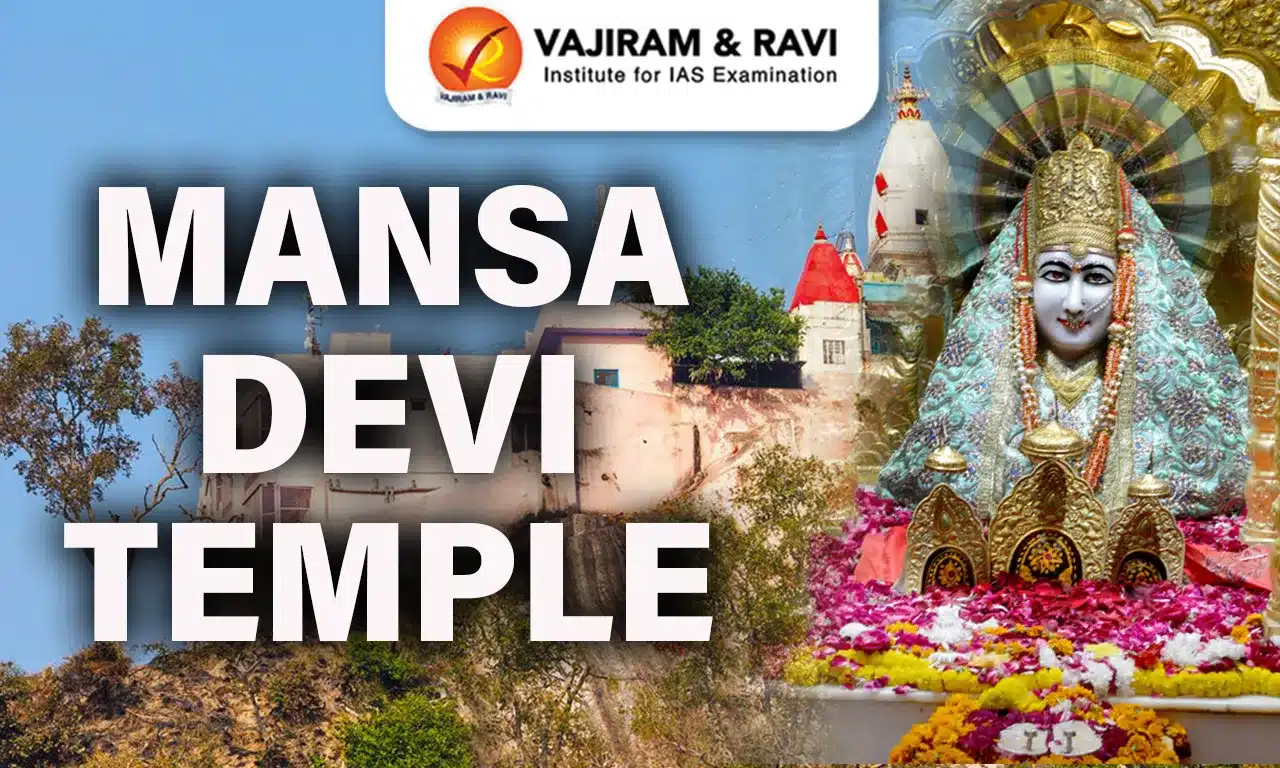
A tragic stampede near Haridwar's Mansa Devi temple claimed eight lives and injured 28 others recently.

About Mansa Devi Temple

  • It is a Hindu temple dedicated to the goddess Mansa Devi, a form of Shakti (Goddess Durga).
  • It is located in the city of Haridwar in Uttarakhand.
  • The temple is located atop the Bilwa Parvat on the Sivalik Hills, the southernmost mountain chain of the Himalayas. 
  • The temple, also known as Bilwa Tirth, is one of the Panch Tirth (Five Pilgrimages) within Haridwar.
  • It is an epitome of the age-old tradition of ‘Shakti’ worship in Northern India. 
  • Maharaja Gopal Singh of Manimajra constructed the present main temple during the period 1811-1815.
  • The temple complex is spread over an area of 100 acres.
  • Built in a traditional North Indian style shape, the temple includes two important deities, Mansa Devi and her sister Chandi Devi.

Source: TOI

Mansa Devi Temple FAQs

Q1: Where is the Mansa Devi Temple located?

Ans: Haridwar, Uttarakhand

Q2: The Mansa Devi Temple is located atop which hill?

Ans: It is located atop the Bilwa Parvat on the Sivalik Hills.

Q3: Who constructed the present structure of the Mansa Devi Temple?

Ans: Maharaja Gopal Singh of Manimajra

Q4: During which period was the present Mansa Devi Temple constructed?

Ans: 1811–1815

Chronic Traumatic Encephalopathy (CTE)

Chronic Traumatic Encephalopathy

Chronic Traumatic Encephalopathy Latest News

The 27-year-old suspected gunman behind the recent deadly shooting inside the NFL's headquarters building in New York City reportedly left behind a multi-page suicide note pointing to chronic traumatic encephalopathy (CTE) as a key factor in his actions.

About Chronic Traumatic Encephalopathy

  • It is a degenerative brain condition that happens after repeated head injuries. 
  • It causes the death of nerve cells in the brain, known as degeneration.
  • CTE has been most commonly observed in athletes involved in contact sports such as American football, boxing, and hockey, as well as military veterans exposed to blast injuries. 
  • The condition typically develops years after repeated head trauma and worsens over time.
  • Symptoms
    • Early symptoms may be mild or go unnoticed, often including depression or suicidal thoughts, aggression, mood swings, and personality changes. 
    • As the disease progresses, people may experience confusion, memory loss, and difficulty with planning or decision-making. 
    • In advanced cases, movement problems can also develop.
  • Treatment: CTE cannot be cured, but medicines and other treatments can help your symptoms.

Source: LMINT

Chronic Traumatic Encephalopathy FAQs

Q1: What is Chronic Traumatic Encephalopathy (CTE)?

Ans: A degenerative brain condition caused by repeated head injuries.

Q2: What happens in the brain as a result of Chronic Traumatic Encephalopathy (CTE)?

Ans: CTE causes the death of nerve cells in the brain, known as degeneration.

Q3: Which groups is most at risk of developing Chronic Traumatic Encephalopathy (CTE)?

Ans: CTE has been most commonly observed in athletes involved in contact sports such as American football, boxing, and hockey.

Q4: Is Chronic Traumatic Encephalopathy (CTE) curable?

Ans: No, Chronic Traumatic Encephalopathy (CTE) is not curable.

International Tiger Day 2025

International Tiger Day

International Tiger Day Latest News

India joined 12 other nations on July 29 to mark International Tiger Day 2025, a global event to raise awareness about tiger conservation.

About International Tiger Day

  • It is observed on July 29 each year.
  • It serves as a platform to raise awareness about tiger conservation.
  • It is celebrated worldwide to promote comprehensive efforts in safeguarding tigers and their natural habitats, fostering harmonious coexistence between humans and tigers.
  • Theme of International Tiger Day 2025:Securing the future of Tigers with Indigenous Peoples and Local Communities at the heart“.

International Tiger Day History

  • Global Tiger Day, commonly referred to as International Tiger Day, was established during the Saint Petersburg Tiger Summit in Russia in 2010. 
  • The summit brought together 13 tiger-range countries, including India, Bangladesh, Nepal, Bhutan, Malaysia, and Russia, following alarming reports that only around 3,000 tigers remained in the wild.
  • The participating nations adopted the “Tx2” goal at the summit, which aimed to double the global tiger population by 2022 through joint conservation efforts and stronger protection laws. 
  • The 29th of July was chosen as International Tiger Day because it represents the halfway point between the first and last days of the Saint Petersburg Tiger Summit and the ongoing international campaign to rescue tigers.

Tiger Population in India

  • India now supports the world’s largest tiger population. 
  • While holding only 18% of the world’s tiger habitat, and facing the highest human density among tiger-range countries, India accounts for 75% of the world’s wild tigers.
  • More than 3,600 tigers now roam the country’s forests, double the number recorded just over a decade ago.
  • These tigers live across 138,200 sq.km. of forest, roughly half the size of the UK, often sharing the land with 60 million people.
  • This success comes from decades of conservation efforts, particularly under a national initiative known as Project Tiger.

Source: ET

International Tiger Day FAQs

Q1: When is International Tiger Day observed each year?

Ans: July 29

Q2: What was the theme of International Tiger Day 2025?

Ans: “Securing the future of Tigers with Indigenous Peoples and Local Communities at the heart”

Q3: In which year was International Tiger Day established?

Ans: It was established during the Saint Petersburg Tiger Summit in Russia in 2010.

Setubandha Scholar Scheme

Setubandha Scholar Scheme

Setubandha Scholar Scheme  Latest News

Students, who have studied in traditional gurukuls, will now have the opportunity to earn recognised qualifications and receive generous scholarships for research at premier IITs under the Setubandha Scholar Scheme.

About Setubandha Scholar Scheme 

  • It is the first national-level programme to formally integrate traditional scholars into the research ecosystem of IITs, without insisting on conventional degrees.
  • It aims to bridge India's age-old gurukul tradition with modern scientific and academic inquiry.
  • It is backed by the Ministry of Education and implemented by the Indian Knowledge System (IKS) division of the Central Sanskrit University (CSU),
  • The scheme offers fellowships of up to Rs 65,000 per month across 18 interdisciplinary fields - from ayurveda to cognitive science, and architecture to political theory, grammar to strategic studies, performing arts to mathematics, physics, and health sciences.
  • Eligibility: It is based on a minimum of five years of rigorous study in a recognised gurukul and demonstrable excellence in Shastras or traditional knowledge.
  • The maximum age to apply is 32 years.
  • Scholars selected under Category 1 (equivalent to postgraduate level) will receive a monthly fellowship of Rs 40,000 and an annual research grant of Rs 1 lakh.
  • Those under Category 2 (equivalent to PhD level) will be awarded Rs 65,000 monthly and an annual grant of Rs 2 lakh. 
  • It is a major shift in India's education policy, opening up elite research pathways for scholars from non-formal backgrounds rooted in classical learning.

Source: TOI

Setubandha Scholar Scheme FAQs

Q1: What is the Indian Knowledge System?

Ans: The Indian Knowledge System is a rich and diverse collection of knowledge, beliefs, and practices developed over thousands of years in the Indian subcontinent.

Q2: What is the Gurukul tradition?

Ans: The traditional Gurukul education system emphasized teacher-student bonding, self-discipline, and value-driven learning.

Mera Gaon Meri Dharohar Initiative

Mera Gaon meri dharohar

Mera Gaon Meri Dharohar Initiative Latest News

The Central government has so far documented the cultural heritage of over 4.7 lakh villages under the ‘Mera Gaon Meri Dharohar’ (MGMD) initiative.

About Mera Gaon Meri Dharohar Initiative

  • It is a pan-India initiative of the Ministry of Culture under National Mission on Cultural Mapping and was launched on 27th July 2023. 
  •  It was launched as part of ‘Azadi Ka Amrit Mahotsav’.
  • The main objective of the project is to culturally map India's 6.5 lakh villages, spanning across all States and  Union Territories, on a comprehensive virtual platform.
  • The core idea behind this project is to encourage appreciation for India's culture and traditions, paving way for economic growth, social harmony, and artistic development in rural communities.
  • It is aimed at mapping India’s intangible cultural assets.
  • The programme is being implemented by the Indira Gandhi National Centre for the Arts (IGNCA) under the National Mission on Cultural Mapping (NMCM).
  • Under the MGMD, information is collected under seven broad categories as given below-
    • Arts and Crafts Village
    • Ecologically Oriented Village
    • Scholastic Village linked with Textual and Scriptural Traditions of India
    • Epic Village linked with Ramayana, Mahabharata and/or Puranic legends and oral epics
    • Historical Village linked with Local and National History
    • Architectural Heritage Village
    • Any other characteristic that may need highlighting such as fishing village, horticulture village, shepherding village etc.

Source: dd news

Mera Gaon Meri Dharohar Initiative FAQs

Q1: In which city is the headquarters of Indira Gandhi National Centre for Arts located?

Ans: New Delhi

Q2: What is the national mission of cultural mapping?

Ans: To preserve and promote India's rich cultural heritage, the Ministry of Culture has established the National Mission on Cultural Mapping (NMCM).

Pralay Missile

Pralay Missile

Pralay Missile Latest News

Recently, Defence Research & Development Organisation (DRDO) conducted two consecutive successful flight-tests of the Pralay missile from Dr APJ Abdul Kalam island off the coast of Odisha.

About Pralay Missile

  • It is an indigenously-developed quasi-ballistic missile employing state-of-the-art guidance and navigation to ensure high precision.

Features of Pralay Missile

  • It is a solid propellant quasi-ballistic missile.
  • The missile is capable of carrying multiple types of warheads against various targets.
  • Range: The missile has a range of 150-500 km and can be launched from a mobile launcher.
  • Payload capacity: It has a payload capacity of 500-1,000 kg.
  • The missile is capable of carrying conventional warheads.
  • It is equipped with guidance systems that provide a Circular Error Probable (CEP) of less than 10 meters.
  • The missile reaches terminal speeds of Mach 6.1 and can engage targets such as radar installations, command centers, and airstrips.
  • It has the ability to change its path after covering a certain range midair.
  • Developed by: It has been developed by Research Centre Imarat and in collaboration with other Defence Research & Development Organisation labs.
  • Industry partners - Bharat Dynamics Limited & Bharat Electronics Limited and many other industries and MSMEs.

Source: PIB

Pralay Missile FAQs

Q1: Which is the first ballistic missile of India?

Ans: The first ballistic missile developed by India is the Prithvi Missile. It was part of the Integrated Guided Missile Development Programme (IGMDP) initiated in 1983.

Q2: Is Pralay a hypersonic missile?

Ans: The Pralay missile is a state-of-the-art hypersonic weapon system designed to travel at speeds exceeding Mach 5 (five times the speed of sound).

Daily Editorial Analysis 30 July 2025

Daily Editorial Analysis

Bihar’s Dark Side — The Hub of Girl Child Trafficking

Context

  • The harrowing journey of a 14-year-old girl, trafficked from Chhattisgarh to Bihar under false promises of a better future, is not just a singular tragedy.
  • It stands as a grim testament to a widespread and deeply rooted crisis.
  • Her story, marked by unimaginable violence and loss of dignity, mirrors the experience of countless girls across India, particularly in Bihar, where human trafficking has evolved into a sophisticated and brutal industry.

The Stark Reality: Statistics and Suffering

  • Until June this year alone, 271 girls were rescued from trafficking in Bihar, more than half having been forced into exploitative orchestra work, the rest into the flesh trade.
  • Saran district, notorious for such operations, saw the rescue of 162 girls since January, while partner organisations like Just Rights for Children aided in saving 116 more between March and June.
  • Behind these numbers lie horrors: girls as young as 12 sold for as little as ₹10,000, forced into sexual slavery, and subjected to violence in squalid, overcrowded quarters.

Why Bihar? The Roots of Vulnerability

  • Pervasive Poverty: Years of deprivation drive families to take perilous risks.
  • Geographical Factors: Porous borders with Nepal and railway links to trafficking-prone states (West Bengal, Jharkhand, Chhattisgarh, and others) ease the movement of traffickers and their victims.
  • Cultural Manipulation: In arts-focused states, aspirations for a better life or artistic stardom are cynically manipulated by traffickers.

Systemic Failures: Where Protection Breaks Down

  • Low Conviction Rates: Most cases are misfiled as kidnappings; prosecutions lag, and convictions remain rare.
  • Under-Resourced Agencies: Anti-Human Trafficking Units (AHTUs) lack manpower and expertise, and jurisdictional disputes thwart cross-state investigations.
  • Inadequate Rehabilitation: Rescued girls often return to the same conditions, and families, that enabled their exploitation in the first place.

The Orchestra Belt: A Facade of Performance

  • In Bihar’s orchestra belt, districts like Saran, Gopalganj, Muzaffarpur, Rohtas, and West Champaran, the supposed dance troupes and orchestras are often fronts for trafficking rings.
  • Girls are forced into dehumanising performances before drunken crowds, punished or raped for resistance, and stripped of any possibility for escape.

The Way Forward

  • Legal and Institutional Responses

    • Encouragingly, there are signs of institutional recognition and action.
    • Following advocacy by groups such as Just Rights for Children, the Patna High Court directed the state government to urgently address the trafficking and exploitation of girls in orchestras.
    • However, such acknowledgments require transformation into concrete actions:
      • Strict Enforcement: Immediate prohibition and mapping of minors in orchestras, prosecution of perpetrators, and the sealing of exploitative premises.
      • Comprehensive Oversight: Institutions, from law enforcement to local panchayats, must be involved in not just rescue but in monitoring, prosecution, and long-term rehabilitation.
  • Prevention at the Core

    • School and Community Vigilance: Monitoring attendance and reporting prolonged absences must become routine. Migratory registers in villages should trigger action when children disappear.
    • Transport Surveillance: Authorities like the Railway Protection Force must extend vigilance to all transport networks and train staff to recognize trafficking signs.
    • Strengthening AHTUs: Specialized, full-time officers with clear mandates and cross-border authority are critical for tracking and prosecuting traffickers.
    • Victim-Centric Rehabilitation: State-supervised, long-term support and victim compensation must be non-negotiable.
  • Prosecution as Prevention

    • A recent report by the Centre for Legal Action and Behaviour Change (C-Lab) reinforces the pivotal role of prosecution.
    • Data from 24 states demonstrate that when every case is pursued and legal action taken, justice is not only delivered, but child labour and trafficking are also effectively deterred.
  • The PICKET Strategy: A Blueprint for Zero Tolerance

    • Policy: Clear, enforced policies prohibiting child labour and exploitation.
    • Institutions: Strong, accountable monitoring, prosecution, and rehabilitation systems.
    • Convergence: Collaboration among agencies, digital databases, and survivor-led intelligence.
    • Knowledge: Community awareness and the strategic use of survivor insights.
    • Economic Disincentives: Making trafficking financially riskier than any perceived benefit.
    • Technology: Databases, predictive analytics, and heat mapping to preempt trafficking routes.

Conclusion

  • India possesses the laws, the institutions, and the knowledge to end child trafficking and exploitation.
  • What is desperately needed now is the political will and public resolve to transform systemic acknowledgment into systemic action.
  • Prevention, vigilance, and an uncompromising pursuit of justice hold the key to breaking the cycle of trafficking and ensuring that no girl’s dreams are shattered on the promise of a better tomorrow.

Bihar’s Dark Side — The Hub of Girl Child Trafficking FAQs

Q1. What are the primary forms of exploitation faced by trafficked girls in Bihar?
Ans. They are trafficked mainly into orchestras for forced performances and into the commercial sex trade.

Q2. Why is Bihar a significant destination for human trafficking?
Ans. Due to poverty, porous borders with Nepal, and strong transport links to other trafficking-prone states.

Q3. What are some key systemic failures contributing to the persistence of trafficking in Bihar?
Ans. Low conviction rates, under-resourced Anti-Human Trafficking Units, jurisdictional confusion, and inadequate rehabilitation efforts.

Q4. What is the PICKET strategy proposed for combating child trafficking?
Ans. A multi-pronged approach focusing on Policy, Institutions, Convergence, Knowledge, Economics, and Technology.

Q5. How can prosecution help in preventing child trafficking and labour?
Ans. Effective prosecution deters traffickers and secures justice, making trafficking financially and legally unviable.

Source: The Hindu


Adopt Formalisation to Power Productivity Growth

Context

  • In recent decades, India’s formal manufacturing sector has experienced a profound shift in its employment structure, marked by a significant rise in contract labour.
  • Data from the Annual Surveys of Industries (ASI) shows that the share of contract labour in manufacturing employment doubled from 20% in 1999-2000 to 40.7% in 2022-23, cutting across various industries.
  • This growing trend towards informalisation within the formal sector has raised considerable concerns regarding its implications for worker welfare and productivity growth.

Plight of Contract Workers

  • Employment Outside Core Labour Protections

    • The rise of contract labour is often rationalised as a means to enhance operational flexibility by allowing firms to access specialised skills and adjust labour force size according to market needs.
    • However, evidence suggests that cost avoidance, rather than true labour flexibility or skill acquisition, is the predominant driver behind this trend.
    • Contract workers are usually hired through third-party contractors and remain outside core labour protections under the Industrial Disputes Act 1947.
    • Their exclusion from laws governing layoffs, retrenchments, and protection from arbitrary dismissals severely weakens their bargaining power, leaving them vulnerable to exploitation.
  • Wage Disparities

    • This exploitation is reflected in wage disparities: in 2018-19, contract workers earned 47% less than regular workers on average.
    • Large enterprises exhibited the greatest wage gaps at 31%, followed by medium (23%) and small enterprises (12%).
    • Employer cost savings are even more striking, the average daily labour cost for contract workers was 24% lower than for regular workers.
    • In certain industries, the labour cost for contract workers was less than 50% that of regular staff, with gaps as high as 78-85% indicating deep exploitation levels.

Impact of Contract Labour on Productivity

  • Workforce Stability

    • Contract labour can contribute beneficially by bringing job-specific expertise and offering firms a buffer to rapidly respond to market fluctuations.
    • Nevertheless, when contractualization is mediated through third-party agencies on short-term contracts, it can create principal-agent problems.
    • Contracting firms may misalign incentives with subcontractors, increasing risks of shirking and reducing workforce stability.
  • Overall Low Productivity

    • High labour turnover and insecurity discourage investment in on-the-job training and innovation, crucial factors for sustained productivity growth.
    • The study’s analysis reveals that contract labour-intensive (CLI) enterprises show 31% lower labour productivity compared to regular labour-intensive (RLI) enterprises on average.
    • This disparity is more pronounced in smaller firms with fewer than 100 workers (36%) and medium-sized firms (23%), and is the worst in labour-intensive industries (42%).
    • These gaps persist even after controlling for other firm and regional factors, underscoring the detrimental productivity effects of contractualization primarily driven by cost-cutting and regulation circumvention.
    • However, a small subset of enterprises, approximately 20% of formal manufacturing, demonstrate productivity gains from contractualization.
    • High-skill CLI enterprises enjoy a 5% productivity advantage over their low-skill counterparts, rising to 20% in large high-skill firms.
    • Similarly, large capital-intensive CLI firms show a 17% productivity gain.
    • Despite these exceptions, the overwhelming majority of firms experience adverse outcomes due to excessive reliance on contract labour.

Policy Recommendations

  • Timely Implementation of Industrial Relations Code

    • In response to these challenges, the Indian government introduced the Industrial Relations Code in 2020.
    • The code aims to grant firms greater flexibility through direct fixed-term contracts with non-regular workers, eliminating third-party intermediaries, while ensuring baseline statutory benefits to reduce worker exploitation.
    • However, implementation delays and union apprehensions highlight risks that increased hiring flexibility might accelerate informalisation and degrade job quality further.
  • Incentivise Firms for Long-Terms Contracts

    • To reconcile flexibility with security, policymakers should incentivise firms to adopt longer fixed-term contracts by offering social security contribution discounts or subsidised access to government skilling programmes.
    • This would improve workforce stability, skill formation, and allay labour union concerns about precarious employment proliferation.
  • Resurrecting Initiatives Like the Pradhan Mantri Rojgar Protsahan Yojana (PMRPY)

    • These initiatives encouraged formal job creation by subsidising employer contributions to pension and provident funds, could significantly curb contract labour misuse and promote formalisation.
    • Despite benefiting over one crore workers, the PMRPY was discontinued in March 2022.
    • Reviving it could be pivotal in strengthening secure employment in manufacturing.

Conclusion

  • While contractualization may offer operational flexibility and skill-access advantages in some high-skill or capital-intensive enterprises, for most firms, especially small, medium, and labour-intensive ones, it results in exploitation and inefficiency.
  • Addressing these issues demands a balanced regulatory approach that safeguards worker rights, incentivises formalisation, and fosters skill development, thereby ensuring the sector’s sustainable growth and equitable employment landscape.

Adopt Formalisation to Power Productivity Growth FAQs

 Q1. What has been the trend in contract labour’s share in India’s formal manufacturing sector from 1999-2000 to 2022-23?
Ans. The share of contract labour doubled from 20% to 40.7% across all manufacturing industries.

Q2. Why are contract workers vulnerable in India’s manufacturing sector?
Ans. Because they are hired through third-party contractors and excluded from core labour laws, leaving them with weak bargaining power and prone to exploitation.

Q3. How does contract labour affect productivity in manufacturing firms?
Ans. Firms reliant on contract labour typically show 31% lower labour productivity than those with a regular workforce, especially in small and labour-intensive enterprises.

Q4. What are some positive productivity outcomes seen with contract labour?
Ans. High-skill and large capital-intensive contract labour enterprises can experience productivity gains of 5% to 20%, but these constitute only about 20% of the sector.

Q5. What policy measures are recommended to address the challenges of contract labour?
Ans. Implementing longer fixed-term contracts with social security incentives, reviving programmes like Pradhan Mantri Rojgar Protsahan Yojana (PMRPY), and enforcing labour codes to protect workers while ensuring flexibility.

Source: The Hindu


Fiscal Health of Indian States in FY2025 - Trends, Concerns, and Outlook


Context:

  • Understanding the fiscal position of states is essential for gauging India’s overall macroeconomic health.
  • Therefore, analysing provisional actuals (PA) for FY2025 of 17 major Indian states (covering approximately 90% of India’s GDP) and highlighting trends in fiscal deficit, revenue deficit, and capital expenditure, offers insights into the evolving fiscal dynamics and implications for FY2026 and beyond.


Fiscal Trends in FY2025 (Provisional Actuals):

  • Widening fiscal deficit:

    • Fiscal deficit is the excess of total expenditure of the Government over its non- debt receipts (revenue receipts, miscellaneous capital receipts and recovery of loans and advances).
    • It normally represents the net incremental liabilities of the Government or its additional borrowings.
    • FY2025 fiscal deficit of 17 states rose to ₹9.5 trillion (3.2% of GSDP) from ₹7.8 trillion (2.9% of GSDP) in FY2024.
    • The deterioration was largely driven by an increase in revenue deficit, with a smaller contribution from capital spending.
  • Surge in revenue deficit:

    • Revenue deficit is the excess of revenue expenditure of the Government over its revenue receipts. It leads to increase in borrowings without corresponding capital/asset formation.
    • Revenue deficit nearly doubled to ₹2.1 trillion (0.7% of GSDP) in FY2025 from ₹1.1 trillion (0.4% of GSDP) in FY2024.
    • This resulted from -
      • Slower growth in revenue receipts (6.3% in FY2025 vs 7.9% in FY2024).
      • Stable revenue expenditure growth at 9% year-on-year (YoY).
    • Negative implications of rising revenue deficit:

      • In contrast to the Centre’s fiscal compression, states witnessed revenue pressure.
      • Higher share of revenue deficit in total fiscal deficit indicates less room for productive capital expenditure.
      • Capex share in fiscal deficit declined to 78% in FY2025, below the 80–90% trend in FY2022–24.


Capital Expenditure Dynamics:

  • Overall capex performance:

    • Total capital spending - ₹7.4 trillion in FY2025 PA, ₹678 billion higher than the amount spent in FY2024.
    • However, the incremental capex of the states in FY2025 PA was sharply lower than the incremental spending of Rs 910-1,120 billion during FY2022-FY2024.
    • Capex fell short of Revised Estimates by ₹1.1 trillion.
  • March 2025 capex surge:

    • In March 2025, the states’ capex surged by 42% YoY to Rs 2.2 trillion from Rs 1.5 trillion in March 2024, led by a pick-up in spending by UP, Andhra Pradesh, MP, Maharashtra, Tamil Nadu and Karnataka.
    • 30% of annual capex was incurred in March alone—indicative of back-loaded spending and corresponding spike in state government securities borrowing.
  • Role of Centre’s Capex Loan Scheme: Capex loan disbursement -

    • ₹1.5 trillion in FY2025 (up from ₹1.1 trillion in FY2024).
    • 17 states’ share - estimated at ₹1.13 trillion (up from ₹0.8 trillion).
    • Funded over 40% of FY2025's incremental capex for these states.


Budgeted Projections for FY2026 and Future Outlook:

  • FY2026 capex targets:

    • For the budget estimates of FY2026, 17 states have indicated capital spending of Rs 9.5 trillion, 29.2% higher on a YoY basis or an incremental spending of Rs 2.1 trillion in FY2026, relative to the FY2025 PA.
    • This seems a little unrealistic given that it is double the average incremental capital expenditure of Rs 1 trillion during FY2022-FY2024.
  • Long-term challenges and reforms:

    • Recommendations of Finance Commission, Pay Commission, and changes in GST compensation cess will significantly impact state finances.
    • Policies incentivising capex over revenue expenditure within the fiscal space are crucial.


Fiscal Health of Indian States in FY2025 FAQs

Q1. Why did states' fiscal deficit widen in FY2025 despite higher capex?

Ans. Due to a sharp rise in revenue deficit from sluggish revenue growth and rising expenditure.

Q2. How does rising revenue deficit impact state finances?

Ans. It reduces fiscal quality by diverting borrowings toward less productive revenue spending.

Q3. What role did the Centre’s capex loan scheme play in FY2025?

Ans. It funded over 40% of states’ incremental capital expenditure, easing fiscal pressure.

Q4. Why is back-ended capex in March a concern?

Ans. It leads to inefficient spending patterns and borrowing spikes at the year-end.

Q5. Are the FY2026 capex targets by states realistic?

Ans. Unlikely, as past trends show consistent undershooting of capital spending estimates.


Source: IE


Daily Editorial Analysis 30 July 2025 FAQs

Q1: What is editorial analysis?

Ans: Editorial analysis is the critical examination and interpretation of newspaper editorials to extract key insights, arguments, and perspectives relevant to UPSC preparation.

Q2: What is an editorial analyst?

Ans: An editorial analyst is someone who studies and breaks down editorials to highlight their relevance, structure, and usefulness for competitive exams like the UPSC.

Q3: What is an editorial for UPSC?

Ans: For UPSC, an editorial refers to opinion-based articles in reputed newspapers that provide analysis on current affairs, governance, policy, and socio-economic issues.

Q4: What are the sources of UPSC Editorial Analysis?

Ans: Key sources include editorials from The Hindu and Indian Express.

Q5: Can Editorial Analysis help in Mains Answer Writing?

Ans: Yes, editorial analysis enhances content quality, analytical depth, and structure in Mains answer writing.

N-nitrosodimethylamine (NDMA)

N nitrosodimethylamine (NDMA)

N-Nitrosodimethylamine (NDMA) Latest News

Recently, drug regulator DCGI has asked drug controllers of all states and Union Territories to direct manufacturers under their jurisdiction to monitor the presence of a potentially carcinogenic chemical -- N-Nitrosodimethylamine -- in antacid Ranitidine.

About N-Nitrosodimethylamine

  • It is a volatile organic chemical that occurs widely in the environment due to its ready formation from commonly found precursors.
  • It is classified as a probable human carcinogen (a substance that could cause cancer) on the basis of animal studies.
  • NDMA are formed when a secondary or tertiary amine reacts with a nitrite ion under acidic conditions.

Features of N-Nitrosodimethylamine

  • It is a yellow, odorless liquid chemical once used to make rocket fuel.
  • It is also a byproduct of several manufacturing processes and water chlorination.
  • NDMA breaks down when sunlight hits it.
  • Applications: Historically it was commercially used in the production of rocket fuel, antioxidants, softeners for copolymers, and additives for lubricants.

Exposure to N-Nitrosodimethylamine

  • Normally, people are exposed to small amounts of NDMA in the environment and through food and water.
  • Chemicals found in food and water, such as nitrosamines or alkylamines, can turn into NDMA in the stomach.
  • NDMA is also created when food or drink is processed. Foods such as cured meats (particularly bacon), beer, fish, cheese and even vegetables may contain NDMA.
  • Some people may have had exposure to NDMA through the use of contaminated medications

Source: ET

N-Nitrosodimethylamine (NDMA) FAQs

Q1: What are the side effects of N-Nitrosodimethylamine NDMA?

Ans: Acute (short-term) exposure to N-nitrosodimethylamine may damage the liver in humans, with symptoms that include nausea, vomiting, headaches, and malaise.

Q2: What foods contain NDMA?

Ans: NDMA can also be found in many processed foods and beverages such as whiskey, beer, cured meats, bacon, and cheeses.

Flash Floods in India: Causes, Climate Impact & Adaptation Strategies

Flash Floods in India

Flash Floods in India Latest News

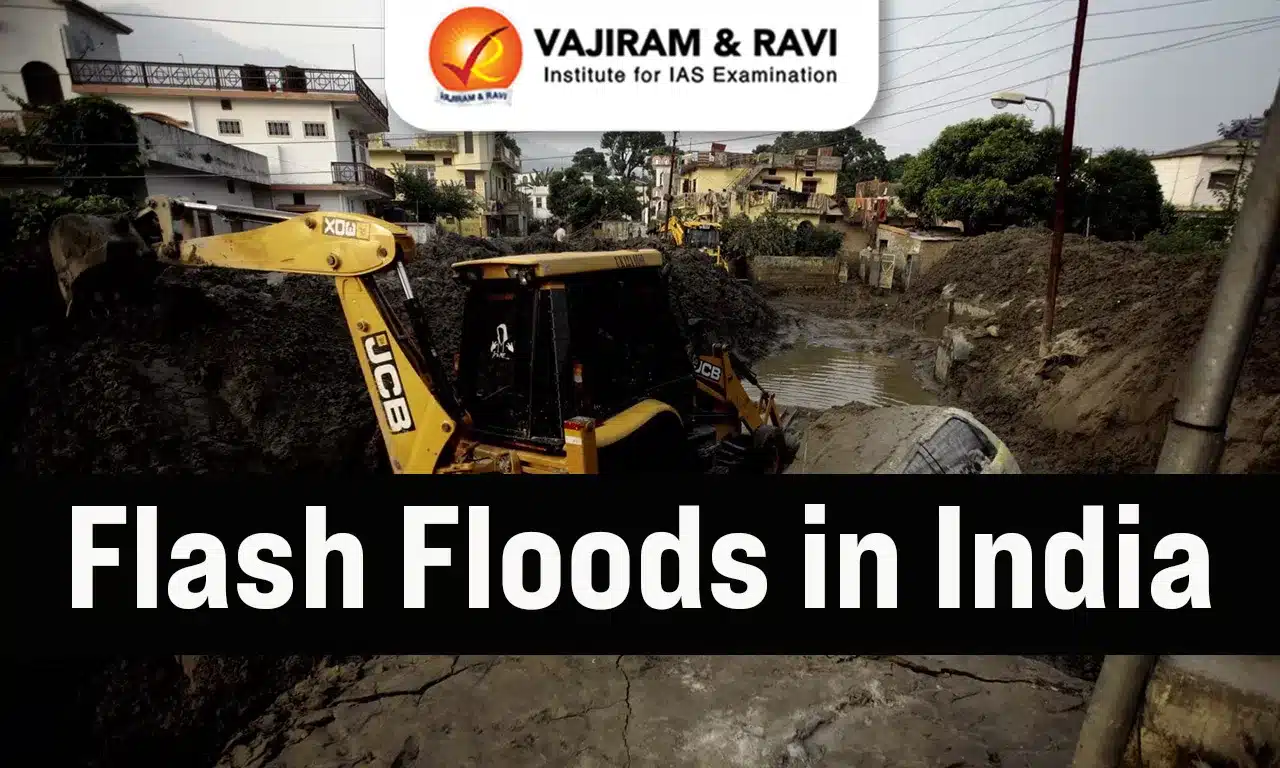
  • Flash floods have emerged as a deadly and recurring hazard across India, claiming thousands of lives and damaging infrastructure annually. 
  • Tragedies in Himachal Pradesh (July 2025), Kerala’s Wayanad (July 2024), Ladakh (June 2024), and Sikkim (October 2023) underline the severity of the crisis. 
  • These sudden and intense floods, primarily triggered by extreme rainfall, have become more frequent with rising global temperatures — increasing from 132 events in 2020 to 184 in 2022, as per the Union Jal Shakti Ministry.
  • Despite the mounting threat, there remains a lack of detailed research to pinpoint the most vulnerable regions, hampering the effectiveness of mitigation strategies like early warning systems. 

Study Related to Flash Floods in India

  • A recent IIT Gandhinagar study, published in Nature Hazards, addresses the lack of granular data on flash flood vulnerability in India.
  • The study, ‘Drivers of flash floods in the Indian sub-continental river basins’, identifies the Himalayas, western coast, and Central India as key hotspots, using hydrological and geomorphological data to map sub-basin susceptibility. 
  • In the Himalayas, steep terrain and elevation drive flood risk, while in the West Coast and Central India, rapid runoff—termed "flashiness"—plays a key role. 
  • The study finds that nearly 75% of flash floods result from a combination of extreme rainfall and already saturated soil, with only 25% due to precipitation alone. 
  • Alarmingly, even previously low-risk basins are witnessing rising extreme rainfall, suggesting that climate change may create new flash flood zones in the future.

Key Drivers Behind Flash Floods in India

  • The study reveals that only 25% of flash floods in India are caused solely by extreme rainfall
  • Most incidents result from a combination of heavy precipitation and pre-existing soil saturation. 
    • When the ground is already wet, it cannot absorb additional rainfall, leading to rapid runoff and increased flood risk.
  • Notably, only 23% of extreme rainfall events trigger flash floods within six hours. Instead, prolonged periods of both low- and high-intensity rain are more likely to cause such disasters.
  • The study also highlights regional variations. 
    • In the western coast and Central India, sub-basins react quickly to rainfall due to their high "flashiness" — the tendency of water levels to rise rapidly. 
    • In the Himalayan region, steep terrain and high relief further elevate the risk. 
    • Within major river basins like the Ganga, flash flood susceptibility differs — sub-basins in the southern Himalayan stretch are more prone, while central areas show lower risk. 
  • This points to how terrain and local climatic conditions strongly influence flash flood vulnerability.

Climate Change Intensifies Flash Flood Risk in India

  • Rising global temperatures are significantly contributing to the increase in frequency and severity of flash floods. 
  • As the atmosphere warms, it retains more moisture — about 7% more for every 1°C rise — leading to heavier rainfall events. 
    • In India, from 1981 to 2020, the incidence of extreme rainfall during the pre-monsoon season doubled. 
    • During the monsoon, post-monsoon, and winter seasons, extreme precipitation increased by 56%, 40%, and 12.5% respectively. 
    • Notably, over 75% of flash floods between 1980 and 2018 occurred during the monsoon season.
  • The study also shows that flash floods have risen sharply since 1995, especially in the Brahmaputra, Ganga, and Krishna river basins. 
  • Interestingly, many regions that were not previously flood-prone are now experiencing more "wet hours" and higher streamflow due to warming temperatures.
    • 51% of non-prone sub-basins showing increased rainfall and 66.5% showing higher streamflow. 
  • Conversely, some existing flood-prone areas are seeing a decline in wet hours, indicating shifting climate patterns and flood vulnerabilities.

Region-Specific Adaptation Key to Mitigating Flash Flood Risks

  • The study highlights the need for region-specific adaptation strategies tailored to topography, soil conditions, and not just rainfall intensity. 
  • Such localized approaches can strengthen early warning systems, improve disaster preparedness, and support long-term resilience planning. 
  • Researchers emphasize the urgency of identifying emerging flash flood hotspots and investing in climate-resilient infrastructure to reduce the impact of extreme events. 
  • Additionally, with shifting rainfall patterns and rising temperatures, improved land-use planning and integrated flood management are essential for effective mitigation.

Source: IE | Nature

Flash Floods in India FAQs

Q1: What causes most flash floods in India?

Ans: A combination of extreme rainfall and pre-saturated soil triggers most flash floods across Indian river basins.

Q2: How does climate change influence flash floods?

Ans: Rising temperatures increase atmospheric moisture, leading to more intense rainfall and higher flash flood risks.

Q3: Which regions are flash flood hotspots?

Ans: The Himalayas, Western Coast, and Central India are most vulnerable to frequent flash floods.

Q4: What is ‘flashiness’ in flood context?

Ans: Flashiness refers to rapid water level rise after rainfall, heightening flash flood potential.

Q5: What adaptation measures are needed?

Ans: Region-specific strategies, better land use planning, and early warning systems are vital for effective flash flood mitigation.

Kaziranga Bird Census: Tracking Grassland Birds Through Acoustic Monitoring

Kaziranga Grassland Bird Census

Kaziranga Grassland Bird Census Latest News

  • Recently, PM Modi, in his Mann ki Baat address, spotlighted the first-ever grassland bird census conducted in Assam’s Kaziranga National Park
  • This unique initiative aimed to assess the presence, diversity, and habitat preferences of grassland bird species—many of which are endangered or declining in number.
  • This article deals with the Kaziranga grassland bird census, its methodology, and the growing conservation concerns around grassland bird species in India.

Grassland Birds

  • Grassland birds in India are a unique group of avian species adapted to live in open, grassy habitats. 
  • These birds play a critical ecological role as indicators of healthy ecosystems, reflecting the overall status of grassland habitats. 
  • Notable examples include the Bengal Florican, Finn’s Weaver, Indian Courser, Great Indian Bustard, and Jerdon’s Babbler.
  • Many grassland bird species are threatened due to rapid habitat loss. Climate change has further intensified these threats.
  • Conservation of grassland birds requires sustained protection of their habitats, scientific monitoring (like acoustic surveys), and strong policy support. 
  • Special attention is needed for species endemic to India’s grasslands, as their extinction would be irreversible on a global scale.

Kaziranga’s Grassland Bird Census: A Conservation Milestone

  • Recently, a collaborative survey was conducted in Assam’s Kaziranga National Park to record its grassland bird population. 
  • The initiative was led by forest officials, scientists, and conservationists, and was sparked by the research of Chiranjib Bora, a doctoral student studying the endangered Black-breasted Parrotbill
    • Funded by the INSPIRE fellowship from the Department of Science & Technology, his project used acoustic monitoring tools to document bird species in Kaziranga, 70% of which is grassland. 
  • The survey aimed to monitor elusive and rapidly declining grassland bird species, many of which are hard to detect due to their small size and camouflaged appearance. 
  • It focused on 10 priority species that are either globally threatened or endemic to the Brahmaputra floodplains, such as the Bengal Florican, Swamp Francolin, and Finn’s Weaver. 
  • In total, 43 species were recorded, including 1 Critically Endangered, 2 Endangered, and 6 Vulnerable species, as per the IUCN Red List.

Innovative Acoustic Monitoring in Kaziranga Bird Survey

  • The Kaziranga grassland bird survey stood out for its use of passive acoustic monitoring. 
  • Traditional visual counting was ineffective for these small and shy birds, so acoustic recorders were strategically placed on tall trees near grasslands during their breeding season (March to May), a time when birds are most vocal. 
  • These devices captured bird songs over three consecutive days at 29 locations using six recorders. 
  • The recorded audio was then analyzed using spectrograms—graphical representations of sound—and a machine learning tool called Birdnet to accurately identify bird species based on their calls. 
  • This method enabled researchers to detect species that might have gone unnoticed using conventional techniques.

Grassland Birds as Ecosystem Health Indicators

  • The survey’s findings underscore the ecological significance of grassland birds, which serve as vital indicators of habitat health. 
  • Their presence confirms that the grasslands of Kaziranga are thriving. 
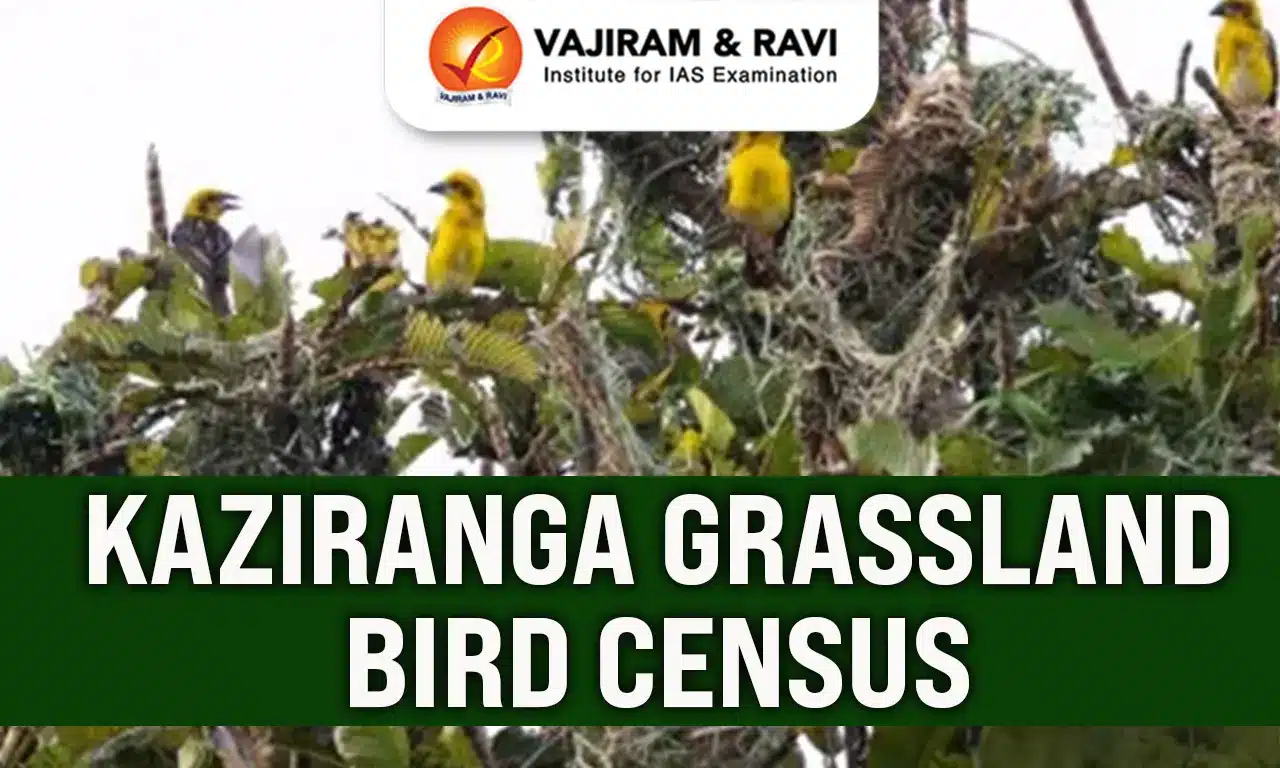
  • A key highlight was the discovery of a breeding colony of the endangered Finn’s Weaver, a species endemic to the Brahmaputra floodplain. 
  • For the first time, researchers located over 85 nests of this rare bird atop trees in Kaziranga, shedding light on its nesting behavior and strengthening conservation efforts in the region.

Multiple Threats to Grassland Bird Habitats

  • Kaziranga’s grassland birds face serious threats due to both human activities and natural processes
  • Over the past 40 years, Assam has lost around 70% of its grasslands. Key drivers include overgrazing, conversion of grasslands into agricultural land, and ecological succession, where grasslands naturally transition into forests. 
  • This is particularly alarming for species endemic to the Northeast, as their extinction in this region would mean global extinction. 
  • Climate change adds another layer of threat, with some species like the Bengal Florican showing significant declines. 
  • Further research is needed to understand the full impact of these changes.

Source: IE | MB

Kaziranga Grassland Bird Census FAQs

Q1: What was the goal of Kaziranga’s bird census?

Ans: To identify and monitor rare and endangered grassland bird species in Kaziranga National Park.

Q2: Which technology was used in the survey?

Ans: Passive acoustic monitoring and AI-based tools like BirdNet helped identify bird species from their calls.

Q3: Why are grassland birds important?

Ans: They act as ecosystem health indicators, showing habitat quality and biodiversity.

Q4: What species were documented?

Ans: 43 species including Bengal Florican and Finn’s Weaver were recorded, many of them endangered or endemic.

Q5: What are the threats to their habitat?

Ans: Habitat loss, overgrazing, ecological succession, and climate change pose major threats to grassland birds in Assam.

India Rethinks China Blockade to Boost Tech Manufacturing

China Blockade

China Blockade Latest News

  • India is reconsidering its restrictive stance on Chinese investments in electronics manufacturing to boost domestic production and strengthen global supply chain integration.

Introduction

  • Nearly five years after adopting a restrictive stance toward Chinese investments in the wake of the 2020 Galwan Valley clashes, India is signalling a calibrated shift in its ‘China-out’ electronics strategy
  • In light of its ambitious goals to become a global electronics manufacturing hub, India is re-evaluating Foreign Direct Investment (FDI) rules and barriers previously imposed on China-based companies.
  • The move comes amid changing global trade dynamics, evolving geopolitical realities, and India’s realization that Chinese firms remain essential in upstream components critical for high-tech manufacturing.

Background of the Blockade

  • In April 2020, India issued Press Note 3, mandating government approval for all FDI inflows from countries sharing a land border with India, effectively restricting Chinese investments. 
  • The policy was designed to prevent opportunistic takeovers of Indian firms during the COVID-19 pandemic and reflected a broader pushback following border tensions.
  • This led to the exclusion of Chinese entities from key sectors such as telecommunications, electronic hardware, and infrastructure, even as India’s electronics assembly sector began expanding rapidly under the Production Linked Incentive (PLI) schemes.

Emerging Signs of Policy Recalibration

  • Amid rising manufacturing needs and limited domestic capacity for advanced components, India has begun showing pragmatic openness to Chinese participation in select areas.
  • Key Developments:
    • Dixon Technologies, a major Indian contract manufacturer, received approval from the Ministry of Electronics and IT to form a joint venture with China-based Longcheer. The JV will produce smartphones, smartwatches, automotive electronics, and AI-powered PCs.
    • NITI Aayog has recommended easing FDI norms for Chinese companies to attract investment and enhance exports.
    • The Economic Survey 2023–24 also hinted at the need to revisit restrictions on Chinese firms, acknowledging their integral role in the electronics supply chain.

Structural Dependencies on Chinese Components

  • Despite the policy blockade, India has continued to import large volumes of components from China:
    • In FY2023-24, India imported over $12 billion worth of electronic parts from China and another $6 billion from Hong Kong.
    • Together, these regions accounted for over 50% of all component imports, far exceeding inflows from South Korea, Taiwan, Japan, or ASEAN.
  • This underscores a reality: while India has kept finished goods like smartphones from Chinese firms out of its domestic market, it remains reliant on upstream inputs from them to fuel its fast-growing assembly operations.

Policy Drivers Behind the Rethink

  • India’s evolving stance is informed by multiple considerations:
  • Manufacturing Ambitions:
    • The government aims to make India a global electronics manufacturing hub. The Rs. 23,000 crore scheme for electronic components manufacturing envisages foreign collaboration, where Chinese expertise remains unparalleled.
  • Global Supply Chain Realignment:
    • The post-pandemic world, U.S.-China trade tensions, and “China+1” strategies have opened opportunities for India to step in as an alternative hub. 
      • The China+1 strategy is a business tactic where companies diversify their production and supply chains away from China.
    • But that requires deeper integration into global supply chains, where Chinese firms are major stakeholders.
  • Geopolitical Pragmatism:
    • India has resumed issuance of tourist visas to Chinese nationals and facilitated diplomatic visits, including External Affairs Minister S. Jaishankar’s trip to China, where he stressed that competition should not become a conflict.”

Challenges and Repercussions

  • Even as India contemplates easing restrictions:
    • China has retaliated by pulling back workers and making it harder for Indian firms to import capital goods.
    • There have been blockades on rare earth metals and magnets, key to manufacturing electronics, which India has struggled to circumvent.
    • Chinese companies themselves face compliance bottlenecks, procedural delays, and security-related distrust in India.
  • The challenge lies in striking a balance between strategic autonomy and manufacturing dependency.

Source: IE

China Blockade FAQs

Q1: Why did India restrict Chinese investments after 2020?

Ans: India issued Press Note 3 to prevent opportunistic takeovers during the pandemic and amid rising border tensions.

Q2: What has changed in India’s policy towards Chinese firms in 2025?

Ans: India is reconsidering its restrictive stance and allowing selective partnerships in electronics manufacturing.

Q3: Which Indian firm recently partnered with a Chinese company?

Ans: Dixon Technologies received approval to form a joint venture with China-based Longcheer for electronics production.

Q4: How reliant is India on Chinese electronic components?

Ans: China and Hong Kong account for over 50% of India’s electronic component imports, highlighting significant dependence.

Q5: What is the main motivation behind India’s policy shift?

Ans: India aims to boost domestic manufacturing and integrate deeper into global supply chains where China plays a critical role.

Enquire Now