
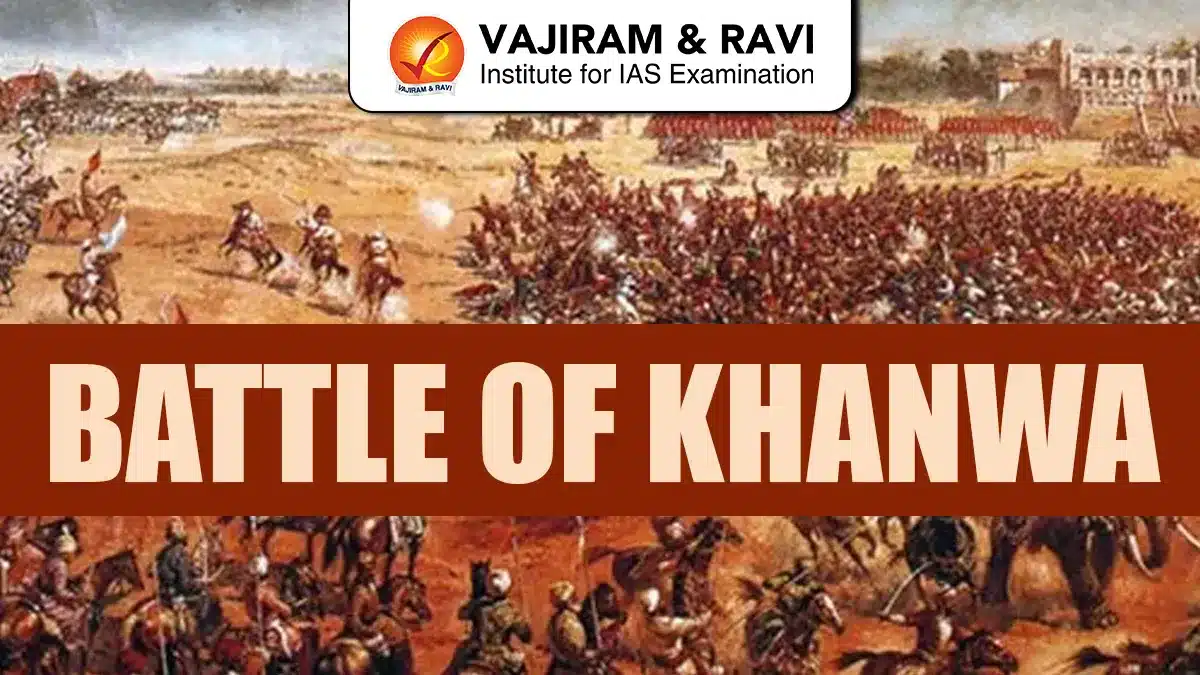
The Battle of Khanwa was a decisive military confrontation fought on 16 March 1527 near Khanwa, close to present day Fatehpur Sikri in Rajasthan. It marked a critical phase in medieval Indian history as it firmly established Mughal authority in northern India. The battle was fought between the Mughal forces led by Babur and a powerful Rajput confederacy under Rana Sanga of Mewar. This conflict was not merely a clash of two armies but a struggle for political supremacy over North India. It was among the earliest battles in the region where gunpowder weapons were used on a large scale, resulting in heavy casualties on both sides.
Battle of Khanwa
The Battle of Khanwa was fought between the Mughal Empire led by Babur and the Kingdom of Mewar led by Rana Sanga for dominance over northern India. The encounter followed Babur’s victory at the First Battle of Panipat in 1526 and represented a direct challenge to Mughal expansion. Rana Sanga had united several Rajput chiefs and Afghan nobles to expel Babur from India. The battle ended in a decisive Mughal victory, largely due to Babur’s superior military tactics and effective use of artillery and firearms. This victory ensured Mughal control over the Delhi-Agra region and weakened Rajput resistance significantly.
Battle of Khanwa Reasons
The Battle of Khanwa was fought due to a direct struggle for political supremacy in northern India after the decline of the Lodi Sultanate. Babur’s victory at the First Battle of Panipat in 1526 alarmed Rana Sanga, who had emerged as the most powerful Rajput ruler and aimed to expand his influence over the Delhi-Agra region. Rana Sanga formed a strong Rajput-Afghan confederacy to expel Babur from India. Disputes over an alleged alliance, Babur’s decision to permanently settle in India, and fear of Mughal expansion finally made armed conflict unavoidable.
Battle of Khanwa Historical Background
The historical background of the Battle of Khanwa reflects political instability in North India and competing ambitions of Babur and Rana Sanga.
- Decline of the Lodi Dynasty: The Delhi Sultanate under Ibrahim Lodi was weakened by rebellions, defections, and administrative failures, creating conditions for foreign intervention and regional power struggles.
- Babur’s Early Indian Campaigns: Babur had conducted multiple raids into Punjab between 1504 and 1519, gradually familiarizing himself with Indian politics and geography before launching a full-scale invasion.
- Conquest of Punjab Region: Between 1520 and 1521, Babur captured Bhira, Sialkot, and Lahore, gaining control over the strategic gateways to Hindustan and weakening Afghan resistance.
- Role of Lodi Rebels: Afghan nobles like Daulat Khan Lodi and Alam Khan Lodi invited Babur to invade India, hoping to overthrow Ibrahim Lodi and gain political advantage.
- First Battle of Panipat 1526: Babur defeated Ibrahim Lodi at Panipat, killing the Sultan and founding the Mughal Empire in India, which altered the balance of power in North India.
- Rana Sanga’s Rising Power: Rana Sanga had transformed Mewar into the strongest Rajput state, extending influence over eastern Malwa, Chanderi, and areas close to Agra.
- Disputed Alliance Claims: Babur accused Rana Sanga of breaking an alleged agreement to jointly fight the Lodis, while Rajput sources claim Babur himself sought Sanga’s support.
- Formation of Rajput Confederacy: Realizing Babur intended to stay in India, Rana Sanga organized a grand coalition of Rajput chiefs and Afghan allies to confront Mughal authority.
Battle of Khanwa Leaders
The major leaders involved in the Battle of Khanwa were:
- Rana Sanga: Ruler of Mewar and leader of the Rajput confederacy, he commanded the anti-Mughal alliance aiming to expel Babur from India.
- Babur: Founder of the Mughal Empire, he led the Mughal forces using artillery, firearms, and defensive tactics to secure victory.
- Mahmud Lodi: Younger son of Sikandar Lodi, he joined Rana Sanga with Afghan troops to restore Lodi rule in Delhi.
- Hasan Khan Mewati: Ruler of Mewat, he supported Rana Sanga and contributed men and resources to the Rajput-Afghan alliance.
Battle of Khanwa Course
The course of the Battle of Khanwa shows contrasting military strategies, intense fighting, and decisive moments that shaped the outcome.
- Initial Mughal Concerns: Babur identified Rana Sanga and eastern Afghan rulers as major threats, initially sending Humayun east before recalling him due to Sanga’s rapid advance.
- Strength of Opposing Armies: Estimates suggest Rana Sanga commanded over 110,000 soldiers, including 10,000 Afghan troops, while Babur’s army was likely around 80,000 men.
- Early Rajput Successes: Mughal detachments sent to Dholpur, Gwalior, and Bayana were defeated, especially at the Battle of Bayana, boosting Rajput morale.
- Impact on Mughal Morale: Continuous defeats caused fear among Babur’s troops, leading to desertions by Afghans and dissatisfaction among Turkish soldiers unwilling to fight in India.
- Babur’s Religious Appeal: To raise morale, Babur renounced wine, destroyed his drinking vessels, and declared the campaign a religious struggle, strengthening unity within his army.
- Strategic Positioning at Khanwa: Babur selected Khanwa carefully and fortified his camp using carts chained with iron, trenches on flanks, and defensive barriers.
- Use of Firearms and Artillery: Mughal musketeers, falconets, and mortars were placed behind defensive carts, allowing sustained fire against advancing Rajput forces.
- Rajput Battle Tactics: Rana Sanga relied on traditional cavalry charges, believing Rajput horsemen could overwhelm Mughal ranks through direct and sustained assaults.
- Psychological Effect of Gunfire: Loud musket fire frightened Rajput horses and elephants, causing confusion and trampling within their own ranks.
- Flank Battles: Rajput forces attacked Mughal flanks for nearly three hours, but Mughal firepower prevented them from breaking through defensive positions.
- Failed Taulqama Maneuvers: Babur attempted flanking movements twice, but fierce Rajput resistance forced Mughal units to withdraw temporarily.
- Silhadi’s Alleged Defection: Silhadi of Raisen reportedly joined Babur during the battle, though some historians believe this was a later Mughal narrative.
- Rana Sanga Wounded: Rana Sanga was struck by a bullet and lost consciousness, creating confusion and temporary leadership vacuum within the Rajput army.
- Role of Jhala Ajja: Jhala Ajja impersonated Rana Sanga to maintain morale and command, continuing Rajput attacks despite heavy losses.
- Collapse of Rajput Centre: Continuous artillery fire decimated Rajput central formations, preventing close combat and causing severe casualties.
- Mughal Counteroffensive: Babur ordered a general advance when Rajput strength weakened, pushing their forces back and killing many commanders.
- Final Rajput Charge: Rajputs launched desperate attacks on Mughal flanks, but superior Mughal firepower ensured their defeat.
- End of the Battle: Exhausted Mughal troops did not pursue fleeing Rajputs, marking the battle’s end with heavy casualties scattered across Bayana, Alwar, and Mewat.
Battle of Khanwa Outcomes
The outcomes of the Battle of Khanwa reshaped political power in North India and confirmed Mughal military superiority.
- Decisive Mughal Victory: Babur’s victory eliminated the strongest immediate threat to Mughal rule in North India after Panipat.
- Heavy Casualties: Both Mughal and Rajput forces suffered severe losses, reflecting the battle’s intensity and scale.
- Use of Gunpowder Warfare: Khanwa highlighted the effectiveness of firearms and artillery against traditional cavalry-based armies.
- Decline of Rajput Confederacy: The defeat weakened Rajput unity and ended Rana Sanga’s bid for northern supremacy.
- Psychological Impact: Babur’s victory established Mughal invincibility, discouraging further large-scale resistance.
- Construction of Skull Towers: Babur ordered towers of enemy skulls, following Timurid tradition, to intimidate future opponents.
- End of Afghan Hopes: Afghan nobles supporting Mahmud Lodi lost their last major chance to revive Lodi authority.
- Territorial Consolidation: Mughal control over Agra, Delhi, and surrounding regions was secured after the battle.
Also Read: Important Battles in Indian History
Battle of Khanwa Aftermath and Impact
The aftermath of the Battle of Khanwa had long-term military, political, and historical consequences for India.
- Rana Sanga’s Retreat: Rana Sanga was carried unconscious from the battlefield by Prithviraj Kachwaha and Maldev Rathore of Marwar.
- Oath of Revenge: After regaining consciousness, Rana Sanga vowed not to return to Chittor until Babur was defeated and expelled from India.
- Death of Rana Sanga: In January 1528, Rana Sanga died at Kalpi, reportedly poisoned by his own nobles fearing further conflict with Babur.
- Shift in Warfare Methods: Indian armies increasingly adopted artillery and firearms, abandoning older battlefield strategies.
- Babur’s Strategic Advantage: Superior tactics and cannons proved decisive, as noted by historians like Pradeep Barua.
- Subsequent Campaigns: Babur went on to fight the Battle of Chanderi in 1528 and the Battle of Ghagra in 1529.
- Continuation of Rajput Power: Rajput resistance did not end permanently, as Rao Maldeo Rathore later emerged as a strong Rajput leader.
- Foundation of Mughal Rule: Khanwa confirmed Babur’s intention to stay in India and laid the groundwork for a lasting Mughal Empire.
Battle of Khanwa FAQs
Q1: When was the Battle of Khanwa fought?
Ans: The Battle of Khanwa was fought on 16 March 1527 near Khanwa in present-day Rajasthan.
Q2: Who fought in the Battle of Khanwa?
Ans: The battle was fought between Mughal Emperor Babur and Rana Sanga of Mewar leading a Rajput confederacy.
Q3: Why was the Battle of Khanwa important?
Ans: It firmly established Mughal supremacy in North India after Panipat and weakened Rajput resistance significantly.
Q4: What military innovation decided the Battle of Khanwa?
Ans: Babur’s effective use of artillery, muskets, and defensive tactics proved decisive against traditional cavalry warfare.
Q5: What happened to Rana Sanga after the Battle of Khanwa?
Ans: Rana Sanga was wounded, retreated from the battlefield, and died in January 1528 before launching another campaign.
