
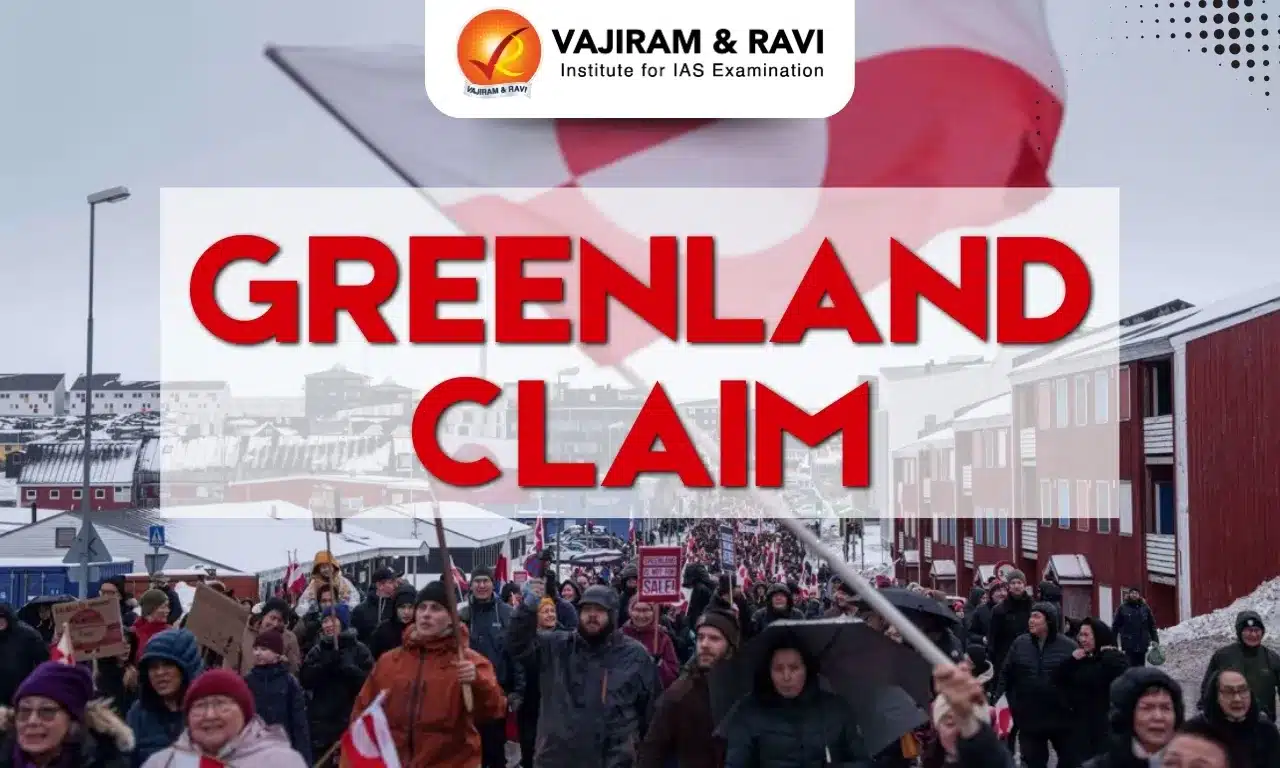
Greenland Claim Latest News
- An American military takeover of Greenland, which increasingly looks possible, would involve multiple contradictions.
- It would undermine U.S. commitments to sovereignty and international law, strain NATO unity, alarm Canada and Europe, and hand Russia a propaganda victory in the Arctic.
NATO at Risk: The Greenland Contradiction
- Any American military move into Greenland would strike at the heart of North Atlantic Treaty Organization (NATO).
- NATO’s credibility rests on Article 5 — collective defence — which assumes external aggression, not one member violating another’s territorial integrity.
- A U.S. action against Denmark, which administers Greenland, would create an unprecedented crisis the alliance was never designed to handle.
Denmark’s Sacrifice and the Irony of Article 5
- The contradiction is stark. Denmark was among the first to invoke Article 5 after the 9/11 attacks, standing firmly with the United States.
- Danish troops fought alongside U.S. forces in Afghanistan, suffering heavy losses.
- A U.S. incursion into Greenland would nullify this shared history and hollow out NATO’s moral foundation.
A Gift to Russia and China
- Such a move would directly benefit Vladimir Putin, who has long sought to fracture NATO unity and divert Western focus from Ukraine.
- Ironically, an action justified as countering Russian influence in the Arctic would weaken the very alliance designed to contain Moscow.
The Strategic Argument Falls Apart
- Strategically, the move makes little sense.
- The U.S. already has extensive rights in Greenland under a 1951 treaty and once operated 17 bases there, most of which were voluntarily shut down by Washington itself.
- These facilities could be reactivated without violating sovereignty.
The Real Arctic Pressure Point
- While Donald Trump has pointed to rising Russian and Chinese activity in the Arctic, U.S. defence assessments show the real pressure point lies near Alaska, not Greenland.
- Pentagon briefings and the 2024 Arctic Strategy highlight infrastructure degradation and increased China–Russia cooperation in waters off Alaska.
- In effect, a Greenland misadventure would weaken NATO, empower adversaries, distract from Ukraine, and undermine U.S. credibility — all while addressing the wrong Arctic problem in the wrong place.
The Backers Behind the Greenland Push
- The idea of acquiring Greenland has moved beyond speculation. The White House has not ruled out a military option, while officials have spoken of discussions with European officials about a possible purchase.
- However, Denmark, which administers Greenland, has made it clear the territory is not for sale.
- The issue is now so politically sensitive in Copenhagen and Nuuk that any attempt at a commercial deal could bring down the Danish government.
Trump’s Domestic Constituencies
- Support for the Greenland idea appears to come from several figures close to Donald Trump.
- Tech investor Peter Thiel has floated the idea of a libertarian, post-nation settlement in a place like Greenland.
- Elon Musk has shown interest in the territory’s rare earth resources.
- Billionaire Ronald Lauder is reported to have first raised the Greenland idea with Trump.
- Trump himself is said to view the move through a real-estate lens, consistent with his business instincts.
Canada’s Security Anxiety
- The country most alarmed by a potential annexation is Canada.
- U.S. control of Greenland would effectively hem Canada in, intensifying security concerns.
- This has triggered a debate within Canada about revisiting its non-nuclear stance, with experts urging the country to confront difficult questions about national defence.
Nuclear Domino Effect
- The implications could extend far beyond North America.
- If NATO were to fracture over Greenland, countries such as Germany and Poland might reconsider nuclear options, as could South Korea and Japan.
- A Greenland takeover could thus spark a wider nuclear arms race, reshaping global security in unpredictable ways.
Greenland Claim FAQs
Q1: Why is the Greenland claim controversial within NATO?
Ans: The Greenland claim involves one NATO member violating another’s territory, a situation NATO’s collective defence framework was never designed to handle.
Q2: How could the Greenland claim benefit Russia?
Ans: The Greenland claim could fracture NATO unity, weaken Western focus on Ukraine, and hand President Vladimir Putin a strategic propaganda victory.
Q3: Why is Canada particularly concerned about the Greenland claim?
Ans: U.S. control over Greenland would geographically hem in Canada, intensifying security fears and triggering debates over nuclear deterrence.
Q4: Is Greenland strategically essential for the U.S.?
Ans: No. The U.S. already holds extensive rights under a 1951 treaty, making the Greenland claim strategically unnecessary.
Q5: What wider risks could the Greenland claim trigger?
Ans: The Greenland claim could encourage nuclear debates in Europe and Asia, risking a broader arms race and global instability.
