Parakaempferia Alba

Parakaempferia Alba

Parakaempferia Alba Latest News

A new species of ginger, Parakaempferia alba, has been discovered in the Siang Valley of Arunachal Pradesh.

About Parakaempferia Alba

  • It is a new species of Zingiberaceae (ginger family).
  • It was discovered in the Siang Valley of Arunachal Pradesh.
  • The plant was found in the Miglung area of East Siang District at an altitude of 150–400 meters, growing along shaded streambanks in humid, sandy soil. 

Key Facts about Zingiberaceae

  • Zingiberaceae, the ginger family of flowering plants, is the largest family of the order Zingiberales, containing about 56 genera and about 1,300 species. 
  • These aromatic herbs grow in moist areas of the tropics and subtropics, including some regions that are seasonably dry.
  • Members of the family are perennials that frequently have sympodial (forked) fleshy rhizomes (underground stems). 
  • They may grow to 6 metres (20 feet) in height. 
  • A few species are epiphytic—i.e., supported by other plants and having aerial roots exposed to the humid atmosphere.
  • Many species are economically valuable for their spices and perfume. 
    • The dried thick rhizome of turmeric (Curcuma longa) is commonly ground for culinary, medicinal, and cosmetic uses. 
    • The seeds of Elettaria cardamomum are the source of cardamom. 
    • Ginger is obtained from the fresh or dried rhizomes of Zingiber officinale, and a number of ornamental gingers are grown for their attractive flowers and foliage.
    • Several species of shellflower (Alpinia) are cultivated as ornamentals.

Source: NET

Parakaempferia Alba FAQs

Q1: What is Parakaempferia alba?

Ans: It is a newly discovered plant species belonging to the Zingiberaceae (ginger) family.

Q2: Where was Parakaempferia alba discovered?

Ans: It was discovered in the Siang Valley of Arunachal Pradesh.

Q3: In which climatic regions are Zingiberaceae plants commonly found?

Ans: They are found mainly in tropical and subtropical regions, including seasonally dry areas.

Q4: What type of underground stem is common in Zingiberaceae plants?

Ans: They commonly have sympodial, fleshy rhizomes.
United Nations Economic and Social Council

United Nations Economic and Social Council

United Nations Economic and Social Council Latest News

The Economic and Social Council (ECOSOC) will commemorate its 80th anniversary by holding a special event on 23 January 2026.

About United Nations Economic and Social Council

  • It was established by the Charter of the United Nations in 1945 as one of the six principal organs of the United Nations.
  • It is responsible for the direction and coordination of the economic, social, humanitarian, and cultural activities carried out by the UN.
  • Decisions are taken by a simple majority vote. The presidency of ECOSOC changes annually.
  • Members: It has 54 members, which are elected for three-year terms by the General Assembly.
  • Headquarter: New York (USA).

Functions of United Nations Economic and Social Council

  • It is responsible for coordinating the social and economic fields of the organization, specifically in regards to the 14 specialized agencies, the five regional commissions under its jurisdiction and eight functional commissions.
  • It also serves as a central forum to discuss international social and economic issues.
  • It formulates policy recommendations addressed to the member states and the United States system.
  • It has been at the centre of global progress, advancing the principles of the United Nations Charter and promoting international cooperation on economic, social, cultural, educational, health and related issues.

Source: UN

United Nations Economic and Social Council FAQs

Q1: How many members are there in ECOSOC?

Ans: 54 members

Q2: What is the primary function of ECOSOC?

Ans: To promote economic and social development

INS Sudarshini

INS Sudarshini

INS Sudarshini Latest News

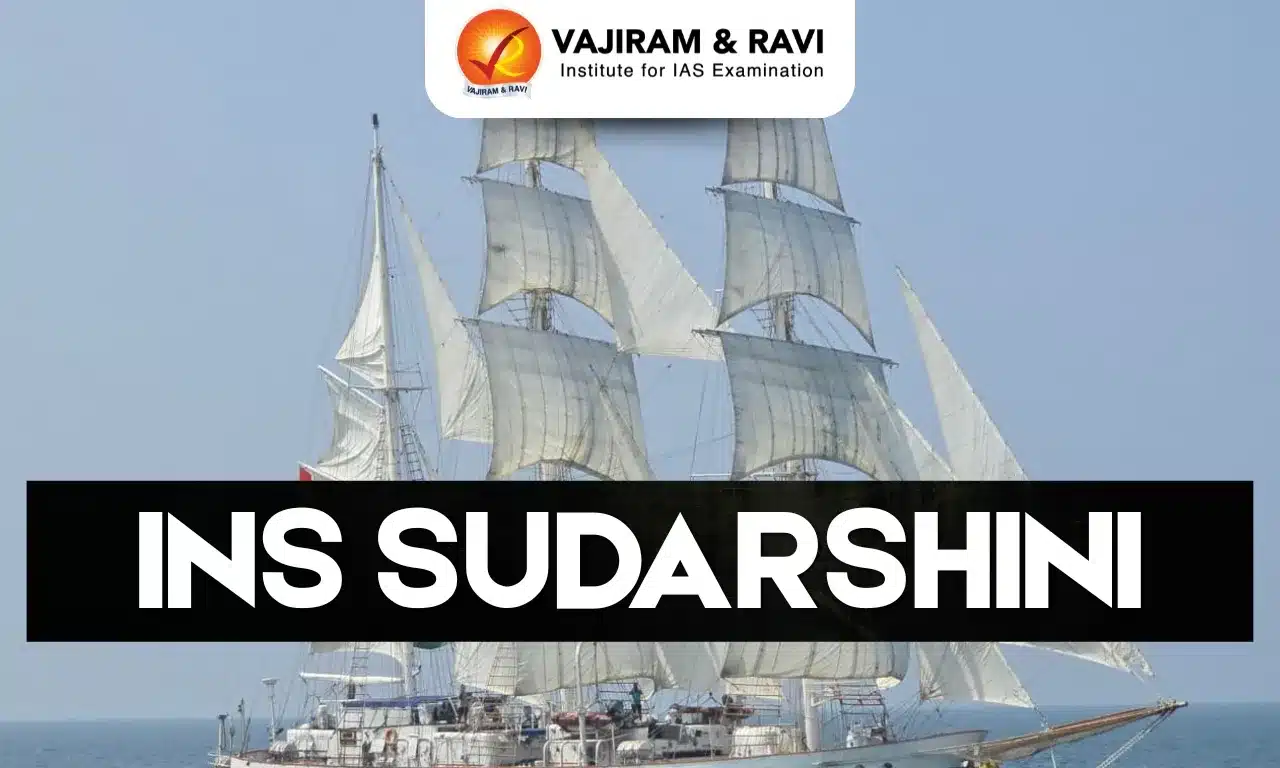
The Indian Navy’s Sail Training Ship INS Sudarshini will embark on the flagship voyage of Lokayan 26, a 10-month transoceanic expedition.

About INS Sudarshini

  • It is an indigenously built Sail Training Ship (STS).
  • It was built by Goa Shipyard Limited and based at Kochi, Kerala under the Southern Naval Command of the Indian Navy. 
  • It was successfully built and was commissioned on 27 Jan. 2012.
  • The aim of using such ships is to make sailors sea-friendly, as they are taught how to survive alone at sea, understand rough weather conditions and train themselves to become good sailors.

Features of INS Sudarshini

  • Sudarshini is a three-masted barque.
  • It is capable of operations under sail or power.
  • It has a very high endurance and can be deployed at sea continuously for a period of twenty days.

What is Lokayan 26?

  • It is a 10-month transoceanic expedition where the ship will sail over 22,000 nautical miles, visiting 18 foreign ports across 13 countries.
  • During this journey INS Sudarshini participates in prestigious international tall-ship events – Escale à Sète, in France, and SAIL 250, in New York, USA. 
  • Also Indian Navy and Indian Coast Guard trainees will undergo intensive sail training, gaining invaluable experience in long-range ocean navigation.

Source: PIB

INS Sudarshini FAQs

Q1: What is INS Sudarshini?

Ans: A sail training ship

Q2: Who built INS Sudarshini?

Ans: Goa Shipyard Limited

Sela Lake

Sela Lake

Sela Lake Latest News

Two tourists from Kerala drowned after the frozen surface of Sela Lake in Arunachal Pradesh’s Tawang district gave way recently.

About Sela Lake

  • Sela Lake, also known as Paradise Lake, is a glacial lake located near Sela Pass in Tawang district, Arunachal Pradesh.
    • Sela Pass is a crucial mountain pass connecting the Tawang region with the rest of Arunachal Pradesh.
  • It lies at an altitude of 13,700 feet (4,170 meters) and is surrounded by snow-clad mountains.
  • Its crystal-clear waters reflect the peaks around it, offering a stunning view.
  • The lake is usually frozen all winter because of its very cold temperatures (below zero).
  • The lake and its surroundings have limited vegetation because of the altitude. 
  • Locals and Buddhist monks consider Sela Lake a sacred site.
  • It is one of the 101 sacred lakes in the Tawang region, each with its own spiritual story.

Source: TELE

Sela Lake FAQs

Q1: What type of lake is Sela Lake?

Ans: It is a glacial lake.

Q2: Where is Sela Lake located?

Ans: It is located near Sela Pass in Tawang district, Arunachal Pradesh.

Q3: Why is Sela Pass important?

Ans: It is a crucial mountain pass connecting the Tawang region with the rest of Arunachal Pradesh.

Q4: At what altitude is Sela Lake situated?

Ans: It lies at an altitude of 13,700 feet (4,170 metres).

Q5: What happens to Sela Lake during winter?

Ans: The lake is usually frozen throughout winter due to sub-zero temperatures.

India International Conference on Democracy and Election Management (IICDEM) 2026

India International Conference on Democracy and Election Management (IICDEM) 2026

India International Conference on Democracy and Election Management (IICDEM) 2026 Latest News

The Election Commission of India (ECI) will host the inaugural India International Conference on Democracy and Election Management (IICDEM) 2026 at Bharat Mandapam in the national capital.

About India International Conference on Democracy and Election Management (IICDEM) 2026

  • The 3-day conference, starting on the 21st of January, will be held at Bharat Mandapam, New Delhi.
  • It is being organised by the India International Institute of Democracy and Election Management (IIIDEM) under the aegis of the Election Commission of India (ECI). 
  • IICDEM 2026 is poised to be the largest global conference of its kind hosted by India in the field of democracy and election management. 
  • Nearly 100 international delegates, representing over 70 countries from across the world, are expected to participate. 
  • Representatives of international organisations, foreign missions in India, and academic and practicing experts in the electoral domain will also take part.
  • The programme will feature a mix of general and plenary sessions of Election Management Bodies (EMBs).
  • These discussions will focus on global electoral challenges, international electoral standards, and innovations and best practices in election processes.
  • As part of the conference, 36 thematic groups will conduct detailed deliberations. 
    • These groups will be led by Chief Electoral Officers of States and Union Territories and supported by national and international academic experts. 
  • During the event, the ECI will also formally launch ECINET, ECI’s one-stop digital platform for all election-related information and services.
  • An exhibition highlighting the scale and complexity of conducting elections in India will run alongside the conference. 
  • The exhibition will also showcase recent initiatives undertaken by the ECI to strengthen electoral roll preparation and the conduct of elections. 
  • Additionally, the docuseries “India Decides”, which documents the conduct of the Lok Sabha 2024 elections, will be screened on the opening day of IICDEM 2026.

Key Facts about India International Institute of Democracy & Election Management (IIIDEM)

  • IIIDEM is the dedicated training, academic & resource arm of the Election Commission of India (ECI). 
  • Established in 2011, the Institute was conceived to train, prepare, and equip election officials and other stakeholders for delivery of free, fair, credible, and error-free elections.
  • It is a global knowledge and capacity-building centre dedicated to advancing democratic governance and strengthening electoral integrity.
  • IIIDEM is one of the few institutions in the world which is not only involved in the training and capacity building of its electoral officials, but also caters to the requirements of Election Management Bodies (EMBs) the world over.
  • IIIDEM has a team of senior experts and professionals to run its academic and research programmes. 
  • It holds domestic and international courses and training programmes that are residential and non-residential.
  • Earlier, the IIIDEM was housed in the premises of the ECI. Now, the Institute is functioning from a full-fledged campus at Dwarka (Delhi).

Source: DDN

India International Conference on Democracy and Election Management (IICDEM) 2026 FAQs

Q1: Which institution is organising India International Conference on Democracy and Election Management (IICDEM) 2026?

Ans: It is being organised by the India International Institute of Democracy and Election Management (IIIDEM).

Q2: Where will India International Conference on Democracy and Election Management (IICDEM) 2026 be held?

Ans: It will be held at Bharat Mandapam, New Delhi.

Q3: Why is India International Conference on Democracy and Election Management (IICDEM) 2026 considered significant?

Ans: It is poised to be the largest global conference of its kind in democracy and election management hosted by India.

Type 096 Tang-Class Submarine

Type 096 Tang-Class Submarine

Type 096 Tang-Class Submarine Latest News

China has unveiled the most significant upgrade to its undersea nuclear capability with the unveiling of the Type 096 Tang-Class ballistic missile submarine recently.

About Type 096 Tang-Class Submarine

  • The Type 096 (NATO reporting name of Tang-class) submarine is China’s next-generation nuclear-powered ballistic missile submarine (SSBN).
  • It is bigger, stealthier, and armed with longer-range missiles than its predecessors.

Type 096 Tang-Class Submarine Features

  • It will displace around 20,000 tons when submerged, placing it in the same weight class as the U.S. Navy’s Ohio-class submarines.
  • It is said to have raft-mounted machinery, hull isolation systems, and a propulsion design that minimizes acoustic signatures during patrols.
  • These features are aimed at making the sub harder to detect in contested waters.
  • The vessel's pressurized water-cooled nuclear reactor powers a single shaft via a steam turbine arrangement.
  • Modern power plant elements and improved vibration dampening technologies are said to enhance submerged speed and stealth performance.
  • The submarine is expected to carry between 16 and 24 JL-3 submarine-launched ballistic missiles (SLBMs), each capable of ranges exceeding 10,000 to 12,000 kilometers and equipped with multiple independently targetable reentry vehicles (MIRVs).
  • It can also launch wire-guided, high-speed Yu-6 torpedoes with a range of over 29 km.

Source: WION

Type 096 Tang-Class Submarine FAQs

Q1: What is the Type 096 Tang-class submarine?

Ans: It is China’s next-generation nuclear-powered ballistic missile submarine (SSBN).

Q2: What is the approximate submerged displacement of the Type 096 Tang-class submarine?

Ans: It displaces around 20,000 tons when submerged.

Q3: What design features improve the stealth of the Type 096 Tang-class submarine?

Ans: Raft-mounted machinery, hull isolation systems, and low-noise propulsion design.

Q4: Type 096 Tang-class submarine carries which ballistic missile?

Ans: It is expected to carry between 16 and 24 JL-3 submarine-launched ballistic missiles (SLBMs).

C-DOT’s Cell Broadcast Solution

C-DOT’s Cell Broadcast Solution

C-DOT’s Cell Broadcast Solution Latest News

 Recently, the Centre for Development of Telematics (C-DOT) has been conferred the  “SKOCH Award-2025” for its Cell Broadcast Solution (CBS). 

About C-DOT’s Cell Broadcast Solution

  • It is an indigenous disaster and emergency alert platform.
  • It is designed to enable near real-time dissemination of life-saving information to citizens in affected areas through cellular networks.
  • It is developed by the Centre for Development of Telematics (C-DOT).

Features of Cell Broadcast Solution

  • It provides an automated integration between government emergency alert dissemination platforms and the telecom networks of the country for instant information delivery to the affected citizens.
  • It supports 2G, 3G, 4G, 5G Technologies.
  • It is designed to support varied geographic & demographic scenarios.
  • It integrates multiple disaster alert generation agencies, including the India Meteorological Department, the Central Water Commission for floods, Indian National Centre for Ocean Information Services, and Forest Survey of India.
  • It also brings together mobile service providers for message delivery, State Disaster Management Authorities and the National Disaster Management Authority for alert approval and disaster response.
  • It enables geo-targeted, multi-hazard alerts with support for 21 Indian languages.

Significance of C-DOT’s Cell Broadcast Solution

  • It significantly enhances the efficiency of disaster risk reduction and management efforts.
  • It aligns with the United Nations’ Early Warnings for All programme, the International Telecommunication Union’s Common Alerting Protocol.

Source: PIB

C-DOT’s Cell Broadcast Solution FAQs

Q1: What is C-DOT's Cell Broadcast Solution?

Ans: A indigenous emergency alert system

Q2: What is the primary purpose of C-DOT's Cell Broadcast Solution?

Ans: To disseminate emergency alerts

Saltwater Crocodile

Saltwater Crocodile

Saltwater Crocodile Latest News

According to the Odisha state forest and environment department pilot drone-based survey, the saltwater crocodiles population has increased in the state.

About Saltwater Crocodile

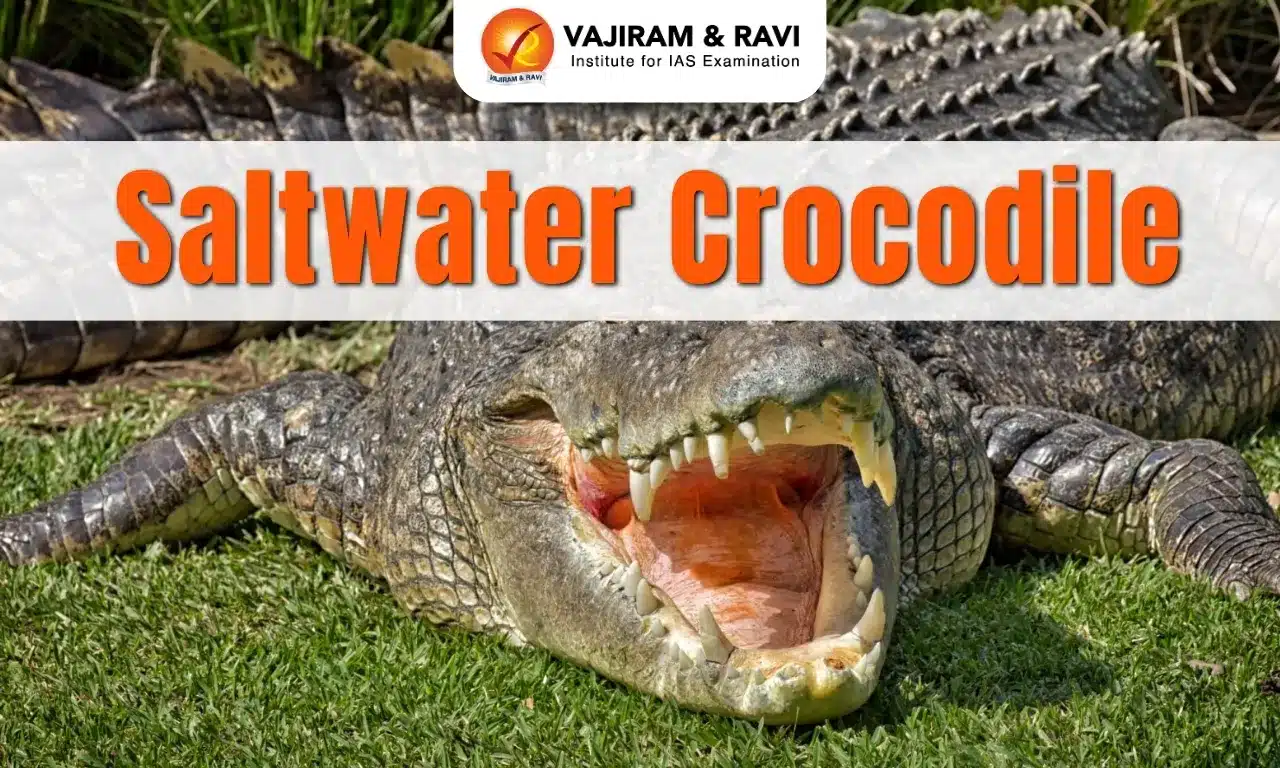
  • It is the largest and heaviest of all living reptiles in the world.
  • Other Names: Estuarine crocodile, Indo-Pacific crocodile, marine crocodile, sea crocodile, or informally as saltie.
  • It is an opportunistic hypercarnivorous apex predator.
  • Habitat: It inhabits saltwater habitats and brackish wetlands, rivers and mangroves.
  • Distribution: It is found in India’s east coast, Southeast Asia and the Sundaic region and northern Australia and Micronesia.
    • In India, these are distributed in Odisha and West Bengal and the coastal areas of the Andaman and Nicobar Islands.
    • Odisha has India’s largest population of saltwater crocodiles in its natural habitat.

Features of Saltwater Crocodile

  • They are solitary creatures, especially when it comes to adult males. 
  • They are highly territorial, with large male saltwater crocodiles often controlling extensive stretches of rivers, estuaries, or coastlines.
  • Conservation Status: It is categorized  as ‘Least Concern’ under the IUCN Red List.

Source: TH

Saltwater Crocodile FAQs

Q1: What is the scientific name of the Saltwater Crocodile?

Ans: Crocodylus porosus

Q2: Where is the Saltwater Crocodile primarily found?

Ans: Saltwater coastal habitats and brackish water

Vadhavan Port

Vadhavan Port

Vadhavan Port Latest News

Around 20,000 residents of Palghar district recently took out a protest march on Monday against the proposed Vadhavan port and a slew of other infrastructure projects, citing environmental damage.

About Vadhavan Port

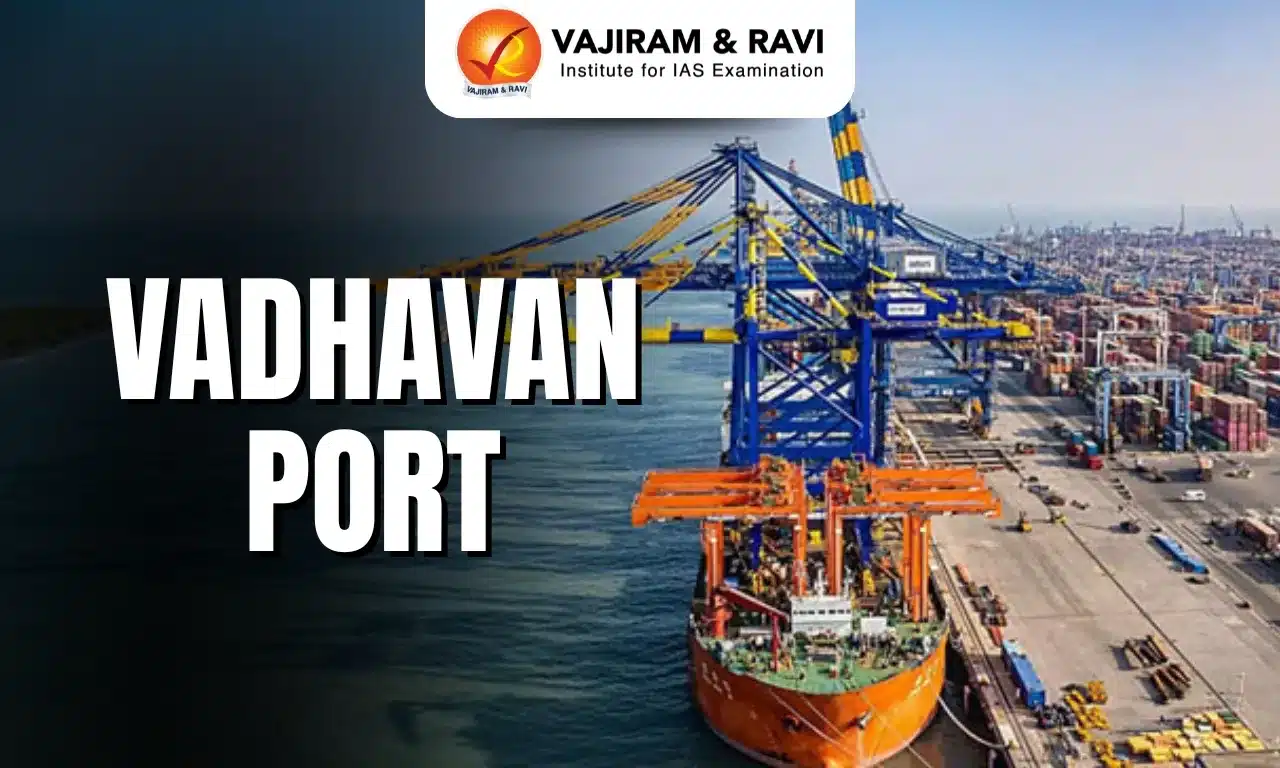
  • It is a proposed new port 140 km north of Mumbai on the coast of Maharashtra in the Palghar District.
  • It is being developed as an all-weather greenfield deep-draft major port.
  • Vadhvan offers a natural depth of 20 meters, making it ideal for large container and bulk vessels. 
  • The project will be constructed by Vadhavan Port Project Limited (VPPL), a special purpose vehicle (SPV) formed by Jawaharlal Nehru Port Authority (JNPA) and Maharashtra Maritime Board (MMB) with a shareholding of 74% and 26%, respectively. 
  • The total project cost, including the land acquisition component, is Rs.76,220 Crore. 
  • Scheduled to be finished by 2034, it is projected to be among the top 10 ports in the world.
  • The port will comprise nine container terminals, each 1000 meters long; four multipurpose berths; including the coastal berth, four liquid cargo berths, a Ro-Ro berth, and a Coast Guard berth. 
  • The project involves the reclamation of 1,448 hectares of area in the sea and the construction of 10.14 km of offshore breakwater and container/cargo storage areas.
  • The Project will create a cumulative capacity of 298 million metric tons (MMT) per annum, including around 23.2 million TEUs (twenty-foot equivalents) of container handling capacity.
  • The strategic location of Vadhavan Port provides it with a unique edge. 
    • Situated just 12 km from the Dedicated Rail Freight Corridor and 22 km from the Mumbai-Vadodara Expressway, the port will connect seamlessly to industrial centers across Maharashtra, Gujarat, and beyond.
    • The capacities created will also aid EXIM trade flow through IMEEC (India Middle East Europe Economic Corridor) and INSTC (International North South Transportation Corridor).

Source: IE

Vadhavan Port FAQs

Q1: What is Vadhavan Port?

Ans: It is a proposed all-weather greenfield deep-draft major port.

Q2: Where is Vadhavan Port located?

Ans: It is located in Palghar district of Maharashtra, about 140 km north of Mumbai, on the Arabian Sea coast.

Q3: Why is Vadhavan Port suitable for large vessels?

Ans: Because it has a natural depth of about 20 metres, ideal for large container and bulk ships.

Q4: What is the total estimated cost of the Vadhavan Port project?

Ans: The total project cost is ₹76,220 crore, including land acquisition.

Greenland Claim: How U.S. Move Could Reshape Arctic Politics

Greenland Claim

Greenland Claim Latest News

  • An American military takeover of Greenland, which increasingly looks possible, would involve multiple contradictions.
  • It would undermine U.S. commitments to sovereignty and international law, strain NATO unity, alarm Canada and Europe, and hand Russia a propaganda victory in the Arctic.

NATO at Risk: The Greenland Contradiction

  • Any American military move into Greenland would strike at the heart of North Atlantic Treaty Organization (NATO). 
  • NATO’s credibility rests on Article 5 — collective defence — which assumes external aggression, not one member violating another’s territorial integrity. 
  • A U.S. action against Denmark, which administers Greenland, would create an unprecedented crisis the alliance was never designed to handle.

Denmark’s Sacrifice and the Irony of Article 5

  • The contradiction is stark. Denmark was among the first to invoke Article 5 after the 9/11 attacks, standing firmly with the United States. 
  • Danish troops fought alongside U.S. forces in Afghanistan, suffering heavy losses. 
  • A U.S. incursion into Greenland would nullify this shared history and hollow out NATO’s moral foundation.

A Gift to Russia and China

  • Such a move would directly benefit Vladimir Putin, who has long sought to fracture NATO unity and divert Western focus from Ukraine. 
  • Ironically, an action justified as countering Russian influence in the Arctic would weaken the very alliance designed to contain Moscow.

The Strategic Argument Falls Apart

  • Strategically, the move makes little sense. 
  • The U.S. already has extensive rights in Greenland under a 1951 treaty and once operated 17 bases there, most of which were voluntarily shut down by Washington itself. 
  • These facilities could be reactivated without violating sovereignty.

The Real Arctic Pressure Point

  • While Donald Trump has pointed to rising Russian and Chinese activity in the Arctic, U.S. defence assessments show the real pressure point lies near Alaska, not Greenland. 
  • Pentagon briefings and the 2024 Arctic Strategy highlight infrastructure degradation and increased China–Russia cooperation in waters off Alaska.
  • In effect, a Greenland misadventure would weaken NATO, empower adversaries, distract from Ukraine, and undermine U.S. credibility — all while addressing the wrong Arctic problem in the wrong place.

The Backers Behind the Greenland Push

  • The idea of acquiring Greenland has moved beyond speculation. The White House has not ruled out a military option, while officials have spoken of discussions with European officials about a possible purchase. 
  • However, Denmark, which administers Greenland, has made it clear the territory is not for sale. 
  • The issue is now so politically sensitive in Copenhagen and Nuuk that any attempt at a commercial deal could bring down the Danish government.

Trump’s Domestic Constituencies

  • Support for the Greenland idea appears to come from several figures close to Donald Trump. 
  • Tech investor Peter Thiel has floated the idea of a libertarian, post-nation settlement in a place like Greenland
  • Elon Musk has shown interest in the territory’s rare earth resources. 
  • Billionaire Ronald Lauder is reported to have first raised the Greenland idea with Trump. 
  • Trump himself is said to view the move through a real-estate lens, consistent with his business instincts.

Canada’s Security Anxiety

  • The country most alarmed by a potential annexation is Canada. 
  • U.S. control of Greenland would effectively hem Canada in, intensifying security concerns. 
  • This has triggered a debate within Canada about revisiting its non-nuclear stance, with experts urging the country to confront difficult questions about national defence.

Nuclear Domino Effect

  • The implications could extend far beyond North America. 
  • If NATO were to fracture over Greenland, countries such as Germany and Poland might reconsider nuclear options, as could South Korea and Japan. 
  • A Greenland takeover could thus spark a wider nuclear arms race, reshaping global security in unpredictable ways.

Source: IE | BBC

Greenland Claim FAQs

Q1: Why is the Greenland claim controversial within NATO?

Ans: The Greenland claim involves one NATO member violating another’s territory, a situation NATO’s collective defence framework was never designed to handle.

Q2: How could the Greenland claim benefit Russia?

Ans: The Greenland claim could fracture NATO unity, weaken Western focus on Ukraine, and hand President Vladimir Putin a strategic propaganda victory.

Q3: Why is Canada particularly concerned about the Greenland claim?

Ans: U.S. control over Greenland would geographically hem in Canada, intensifying security fears and triggering debates over nuclear deterrence.

Q4: Is Greenland strategically essential for the U.S.?

Ans: No. The U.S. already holds extensive rights under a 1951 treaty, making the Greenland claim strategically unnecessary.

Q5: What wider risks could the Greenland claim trigger?

Ans: The Greenland claim could encourage nuclear debates in Europe and Asia, risking a broader arms race and global instability.

Celebrity Endorsement Liability: Kerala HC Sets Clear Limits

Celebrity Endorsement Liability

Celebrity Endorsement Liability Latest News

  • The Kerala High Court has set aside consumer proceedings against actor Mohanlal, holding that a brand ambassador cannot be held liable for a company’s alleged unfair trade practices unless there is a clear, direct link between the endorsement and the consumer’s transaction.
  • The ruling arose from complaints against Manappuram Finance, where borrowers claimed they were charged higher interest rates than advertised. 
  • The court clarified the boundary between promotional activity and transactional responsibility, emphasizing that mere appearance in advertisements does not create consumer liability for endorsers.

Background: The Gold Loan Dispute

  • The case arose from gold loans taken by two borrowers in Thiruvananthapuram. They had initially pledged gold with Catholic Syrian Bank at 15% interest. 
  • In 2018, Manappuram Finance took over the loans after a bank manager allegedly promised a lower interest rate.
  • The borrowers claimed they were influenced by advertisements featuring actor Mohanlal, who was Manappuram Finance’s brand ambassador at the time. 
  • They alleged that the advertised interest rate was lower than what was eventually charged.

Consumer Complaint and Claims

  • When the borrowers tried to close the loan and retrieve their gold, Manappuram allegedly demanded a higher interest rate. 
  • They approached the District Consumer Disputes Redressal Commission, alleging deficiency in service and unfair trade practices. 
  • They sought a refund of excess interest and compensation of ₹25 lakh.

Mohanlal Made a Party to the Case

  • Along with Manappuram Finance and its manager, Mohanlal was named as an opposite party solely because of his appearance in the advertisements. 
  • Mohanlal raised a preliminary objection, arguing that he had no role in the loan transaction, no interaction with the borrowers, and no control over interest rates.

Consumer Fora’s Initial View

  • Mohanlal contended that being a brand ambassador did not make him a service provider. 
  • However, relying on the definition of “endorsement” under the Consumer Protection Act, 2019, the District Commission rejected his objection and held the complaint maintainable. 
  • The State Consumer Commission later declined to rule on this issue at the revision stage.

Legal Provisions on Endorsements Examined by the Court

  • The court examined Section 2(18) of the Consumer Protection Act, which gives a broad meaning to “endorsement”. 
  • It covers any message or depiction that may lead consumers to believe an advertisement reflects the opinion or experience of the person featured. 
  • Section 2(47) similarly defines “unfair trade practice” widely, including false representations about price or quality.

Where Endorsers Are Specifically Mentioned

  • The term “endorser” appears explicitly only in Section 21 of the Act. 
  • This provision deals with false or misleading advertisements and empowers the Central Consumer Protection Authority to impose penalties on manufacturers and endorsers, including fines and temporary bans on endorsements.
  • Section 21(5) provides a safeguard for endorsers. 
  • It protects them from liability if they have exercised due diligence to verify the truthfulness of the claims made in the advertisement.

Limits of Endorser Liability in Consumer Disputes

  • Crucially, the Act does not refer to endorsers in provisions dealing with consumer complaints on deficiency of service or unfair trade practices before consumer commissions. 
  • The Kerala High Court held that this omission was deliberate, noting that endorser liability is confined to proceedings under Section 21 alone.

Role of the 2022 Misleading Advertisement Guidelines

  • The court also considered the 2022 guidelines issued by the Central Consumer Protection Authority. 
  • While these define endorsers and require due diligence, the court clarified that they operate within the scope of Section 21 and do not expand endorser liability to all consumer disputes.

What the Kerala High Court Held

  • Kerala HC noted that Mohanlal’s role was confined to appearing in advertisements as a brand ambassador.

No Direct Link to the Transaction

  • The court examined the consumer complaint to identify any direct connection between the actor and the borrowers’ gold loan transaction. 
  • It found only two references to Mohanlal: his status as brand ambassador and an assurance allegedly given by the company’s manager referring to advertisements featuring him. This, the court held, was insufficient.

Liability Cannot Be Presumed

  • The pleadings did not show that Mohanlal persuaded the borrowers, participated in the loan transaction, or made any assurance to them. 
  • The assurance, as pleaded, came solely from the company’s manager. 
  • Therefore, the court ruled that no liability for unfair trade practice or deficiency of service could be fixed on the actor.
  • The court clarified that merely falling within the definition of an “endorser” does not attract liability
  • A direct and specific link between the endorser and the consumer transaction must be established to fasten responsibility.

Company, Not Endorser, Answerable

  • Even if advertisements formed part of the background facts, an unfair trade practice arises when the service provider fails to deliver what was advertised. 
  • On the pleadings, that failure could only be attributed to Manappuram Finance, not the endorser.

Source: IE | SCCO

Celebrity endorsement liability FAQs

Q1: What did the Kerala HC rule on celebrity endorsement liability?

Ans: The court held that celebrity endorsement liability arises only with a direct link between the endorser and the consumer transaction.

Q2: Why was Mohanlal removed from the consumer case?

Ans: There was no evidence that Mohanlal influenced the loan transaction or assured interest rates, limiting celebrity endorsement liability.

Q3: Which law governs celebrity endorsement liability?

Ans: Celebrity endorsement liability is governed mainly under Section 21 of the Consumer Protection Act, dealing with misleading advertisements.

Q4: Can endorsers be liable for deficiency of service?

Ans: No. The court ruled that celebrity endorsement liability does not extend to deficiency of service unless direct involvement is proven.

Q5: What remedy remains available to consumers?

Ans: Consumers may pursue misleading advertisement claims under Section 21 before the competent authority, not through general consumer disputes.

India–UAE Relations – Strategic Defence Partnership amid West Asia Turbulence

India–UAE Relations

India-UAE Relations Latest News

  • Against the backdrop of escalating geopolitical tensions in the West Asia/Gulf region—including conflicts in Gaza, Yemen, and unrest in Iran—India and the United Arab Emirates (UAE) have further deepened their Comprehensive Strategic Partnership. 
  • During the brief visit of UAE President Sheikh Mohamed bin Zayed Al Nahyan (MBZ) to New Delhi, the two countries signed a Letter of Intent (LoI) for a bilateral Strategic Defence Partnership.

Key Outcomes and Agreements

  • Strategic defence partnership:
    • Letter of Intent signed to work towards a framework agreement, which builds on regular bilateral military exercises, exchange of Service Chiefs, and defence-industrial cooperation.
    • India clarified that the partnership is a natural evolution, not a response to any specific conflict, and it does not imply Indian military involvement in Gulf conflicts.
  • Trade and economic cooperation: Target to double bilateral trade to $200 billion by 2032, which stands at $100 billion (FY 2024–25), due to momentum driven by India–UAE Comprehensive Economic Partnership Agreement (CEPA, 2022).
  • Energy cooperation:
    • 10-year LNG Supply Agreement between HPCL (Hindustan Petroleum Company Ltd) and ADNOC (Abu Dhabi National Oil Company Gas) will allow the purchase of 0.5 MMPTA LNG by HPCL from ADNOC over 10 years starting from 2028.
    • The agreement makes the UAE India’s second-largest LNG supplier, reinforcing India’s energy security.
  • Civil nuclear cooperation:
    • Exploration of partnership in large nuclear reactors, Small Modular Reactors (SMRs), nuclear safety, and operations and maintenance.
    • This will be enabled by India’s SHANTI Act (Sustainable Harnessing and Advancement of Nuclear Energy for Transforming India).
  • Space cooperation: LoI between IN-SPACe (India) and UAE Space Agency to integrate space ecosystem, joint missions, commercial space services, and promote Start-ups and high-skilled employment.
  • Digital and financial cooperation:
    • Proposal for Digital/Data Embassies to protect sovereign data, plan to interlink national payment platforms for faster cross-border payments.
    • Support for initiatives like Bharat Mart, Virtual Trade Corridor, and Bharat–Africa Setu.
  • Counter-terrorism and financial security: Reaffirmed zero tolerance for terrorism, including cross-border terrorism. Commitment to cooperation under FATF counter-terror financing, and anti-money laundering.
  • Investment and institutional cooperation: Establishment of House of India in Abu Dhabi, UAE companies (FAB, DP World) offices at GIFT City. LoI between Gujarat and UAE for Dholera Special Investment Region.

Geopolitical Backdrop and What the Visit of UAE President Signify

  • West Asia churn:
    • Growing US–Israel–Iran tensions, 
    • Saudi Arabia–UAE divergence over Yemen, 
    • Enhanced Saudi–Pakistan defence cooperation (2025 defence pact), and 
    • Gaza conflict and US-led peace initiatives (India being invited to the ‘Board of Peace for Gaza’ by the US).
  • Significance of the visit:
    • It signals India’s strategic autonomy and balanced diplomacy in West Asia, reinforcing India’s multi-alignment approach amid rivalries among Gulf partners.
    • It highlights UAE’s importance as a key energy supplier, investment partner and host of the Indian diaspora.

India-UAE Relations

  • Background: Diplomatic ties began in the 1970s, but relations transformed into a "Comprehensive Strategic Partnership" after the Indian PM's 2015 visit, accelerating cooperation in trade, investment, and strategic areas. 
  • Key pillars:
    • Economic and trade: UAE is India's 3rd largest trading partner and 2nd largest export destination. The CEPA aims to boost non-oil trade to $100 billion by 2030. UAE is a major investor in India (infrastructure, energy, AI, fintech).
    • Strategic and defense: Both are part of I2U2 Group, and have deep defense cooperation with joint exercises (Desert Eagle, Gulf Star-1).
    • People-to-people and cultural:
      • Indians are the largest expatriate community (3.5-4.3 million) in the UAE.
      • Cultural milestones like the BAPS Temple in Abu Dhabi and expanding Indian educational presence (IIM Ahmedabad, IIFT campuses).
    • Energy security: UAE provides strategic oil reserves for India. 

Challenges for India and Way Ahead

  • Risk of perception of alignment: Maintain strategic autonomy and issue-based partnerships. For example, actively leveraging CEPA and Gulf capital for Make in India and Atmanirbhar Bharat.
  • Managing relations simultaneously: With UAE, Saudi Arabia, Iran, Israel, US. Deepen geo-economic engagement (trade, energy, digital, space).
  • Challenges of defence cooperation: Ensuring defence cooperation does not dilute India’s non-entanglement policy. Institutionalise defence cooperation without operational entanglements.
  • Regional instability and maritime insecurity: Continue diplomatic engagement to support de-escalation in West Asia.

Conclusion

  • The India–UAE Strategic Defence Partnership marks a maturation of bilateral ties from transactional engagement to a multi-dimensional strategic relationship. 
  • Amid volatility in West Asia, India has carefully balanced its interests by strengthening cooperation with the UAE while reaffirming its commitment to peace, stability, and strategic autonomy. 
  • The outcomes underscore India’s evolving role as a credible, non-aligned yet influential stakeholder in the Gulf region—an approach crucial for safeguarding its energy security, diaspora interests, and geopolitical relevance.

Source: TH | IE

India–UAE Relations FAQs

Q1: How does the India–UAE Strategic Defence Partnership reflect its strategic autonomy approach?

Ans: It strengthens defence cooperation while avoiding military entanglement.

Q2: What is the significance of the $200-billion trade target between India and the UAE?

Ans: The target consolidates CEPA gains by deepening geo-economic integration, trade diversification.

Q3: Why is the HPCL–ADNOC LNG agreement strategically important for India’s energy security?

Ans: It ensures long-term LNG supply, reduces import volatility and makes the UAE India’s second-largest LNG supplier.

Q4: How does India–UAE cooperation in space and nuclear technology align with India’s development priorities?

Ans: It supports clean energy transition, advanced technology access, start-ups, and high-skilled employment.

Q5: What is the geopolitical relevance of India–UAE ties amid rising Saudi–Pakistan defence cooperation?

Ans: The partnership enhances India’s diplomatic leverage, safeguards diaspora and energy interests.

Environmental Protection Fund Rules – Explained

Environmental Protection

Environmental Protection Latest News

  • The Union government has notified detailed rules governing the utilisation of the Environmental (Protection) Fund, created from penalties imposed under key environmental laws. 

Background of the Environmental (Protection) Fund

  • The Environmental (Protection) Fund has been created to ensure that penalties imposed for violations of environmental laws are channelled back into environmental restoration, pollution control, and sustainability-related activities. 
  • The legal basis for the fund was laid under the Jan Vishwas Act, 2023, which decriminalised several minor environmental offences while retaining monetary penalties to ensure regulatory compliance.
  • The fund draws resources from penalties levied under major environmental legislations, including laws related to air pollution, water pollution, and the Environment (Protection) Act, 1986
  • The notified rules provide clarity on how this fund will be credited, administered, audited, and utilised for specific environmental purposes, addressing long-standing concerns regarding the effective use of environmental penalties.

Objectives of the Environmental (Protection) Fund

  • The primary objective of the Environmental (Protection) Fund is to convert regulatory penalties into tangible environmental outcomes. The rules seek to:
    • Strengthen pollution prevention, control, and mitigation mechanisms
    • Support remediation of environmentally contaminated sites
    • Promote research and adoption of clean and green technologies
    • Enhance the institutional capacity of environmental regulatory bodies
  • By doing so, the fund aligns with the broader principle of “polluter pays,” ensuring that environmental damage leads to corrective and restorative action rather than remaining a purely punitive measure.

Permitted Areas of Fund Utilisation

  • The notified rules specify 11 broad categories of activities for which the Environmental (Protection) Fund can be used. These include:
    • Prevention, control, and mitigation of air, water, and soil pollution
    • Remediation and restoration of contaminated and degraded environmental sites
    • Installation, operation, and maintenance of environmental monitoring equipment
    • Development of laboratory infrastructure for environmental testing and compliance
    • Capacity building of regulatory institutions and technical personnel
    • Research and innovation in clean technologies and sustainable practices
    • Development of Information Technology (IT)-enabled systems for environmental monitoring
  • These provisions aim to ensure that fund utilisation directly contributes to improving environmental quality and regulatory effectiveness rather than being diverted for unrelated purposes.

Administrative Structure and Fund Management

  • The rules clearly outline the institutional framework for administering the Environmental (Protection) Fund. 
  • The Union Ministry of Environment, Forest and Climate Change will be the primary authority for administering the fund, or it may notify any other competent body for this purpose.
  • To ensure decentralised yet coordinated implementation:
    • Dedicated Project Management Units (PMUs) will be created at both central and state levels
    • Penalties collected will be credited to the fund following a standardised procedure
    • The Central Pollution Control Board (CPCB) will develop and maintain an online portal for managing fund-related processes
  • This digital interface will serve as a common platform for coordination among central ministries, state governments, pollution control boards, and other stakeholders.

Distribution of Funds Between Centre and States

  • A significant feature of the rules is the transparent sharing mechanism between the Centre and States. According to the notified provisions:
    • 75% of the penalty amount collected will be transferred to the Consolidated Fund of the concerned State
    • 25% of the amount will be retained by the Centre for national-level environmental initiatives
  • This arrangement recognises that most environmental violations and remediation activities are local in nature, while also enabling the Centre to fund large-scale or cross-cutting environmental projects.

Accountability and Audit Mechanisms

  • To strengthen transparency and public accountability, the rules mandate robust oversight mechanisms. 
  • The Comptroller and Auditor General of India (CAG) will audit the Environmental (Protection) Fund periodically. 
  • This audit requirement is crucial to prevent misuse, underutilisation, or diversion of environmental penalty funds.
  • Further, the online portal managed by the CPCB will act as a monitoring tool, enabling real-time tracking of fund allocation, utilisation, and project outcomes. 
  • Together, these measures aim to enhance public trust in environmental governance.

Significance for Environmental Governance in India

  • The notification of these rules marks an important shift in India’s environmental regulatory approach. 
  • Instead of treating penalties merely as revenue, the framework institutionalises their use for environmental improvement. 
  • It also complements the decriminalisation approach adopted under the Jan Vishwas Act by ensuring that monetary penalties have a corrective and restorative purpose.
  • For India, which faces persistent challenges related to pollution, waste management, and ecological degradation, the Environmental (Protection) Fund can serve as a critical financial instrument to bridge regulatory gaps and support sustainable development goals.

Source: TOI | IE

Environmental Protection FAQs

Q1: What is the Environmental (Protection) Fund?

Ans: It is a fund created from penalties imposed under environmental laws to support pollution control, remediation, and clean technology initiatives.

Q2: Which law enabled the creation of the Environmental (Protection) Fund?

Ans: The fund was provided for under the Jan Vishwas Act, 2023.

Q3: How are penalties distributed between the Centre and States?

Ans: Seventy-five percent of the penalty amount goes to the State, while 25% is retained by the Centre.

Q4: Who audits the Environmental (Protection) Fund?

Ans: The Comptroller and Auditor General of India audits the fund.

Q5: What types of activities can the fund be used for?

Ans: It can be used for pollution control, environmental remediation, monitoring infrastructure, capacity building, and clean technology research.

Chile

Key Facts about Chile

Chile Latest News

Recently, wildfires raged across central and southern Chile which left at least 18 people dead, scorched thousands of acres of forest and destroyed.

About Chile

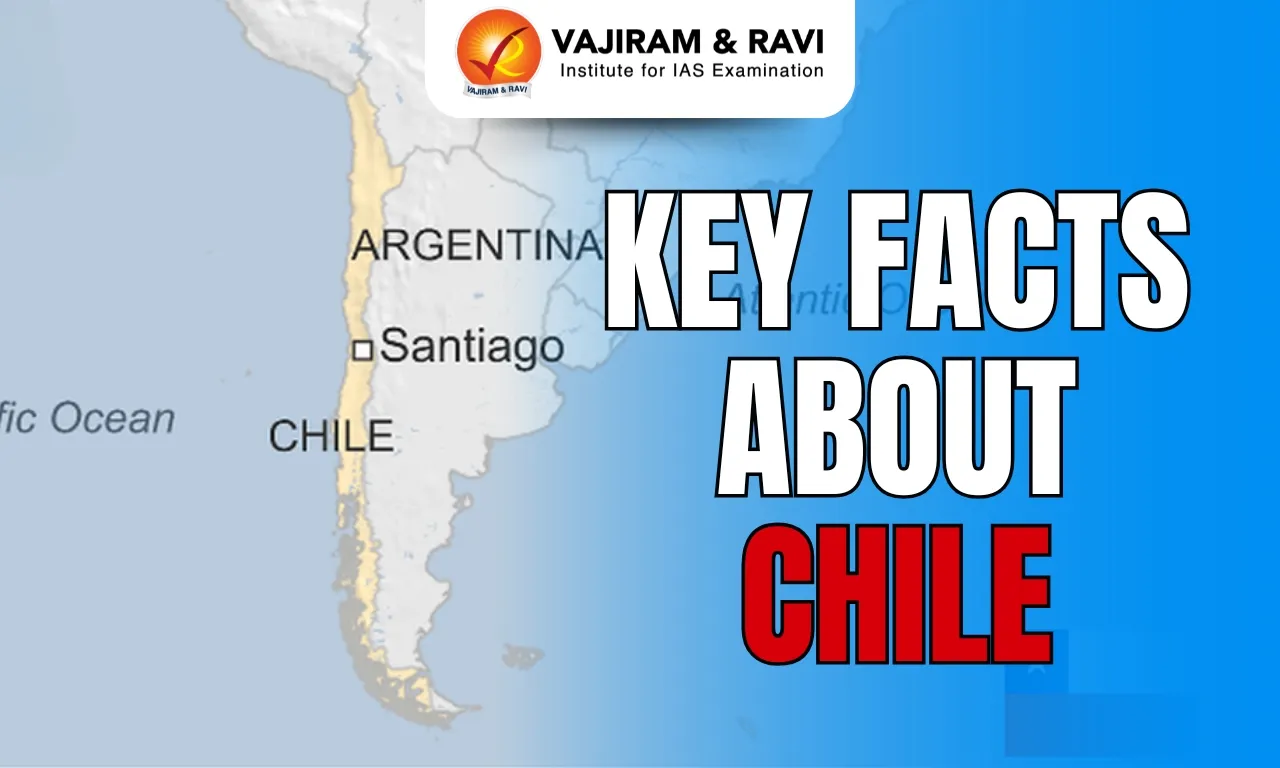
  • Location: It is located in the southwestern part of South America.
  • It occupies a long, narrow coastal land strip wedged between the Andes Mountains to the east and the South Pacific Ocean to the west.
  • Bordering Countries: It is bordered by Peru to the north, Bolivia to the northeast and Argentina to the east and by the Drake Passage to the south.
  • Capital City: Santiago

Geographical Features of Chile

  • Climate: Temperate; desert in north; Mediterranean in central region; cool and damp in south.
  • Desert: Atacama Desert which is the driest non-polar desert in the world is in Chile.
  • Major River: Loa River
  • Volcano: Ojos del Salado which is the World’s highest active volcano and 2nd highest peak in South America (6,880 m).
  • It is located along the Pacific Ring of Fire.
  • Natural Resources: It is the world’s largest copper and Lithium producer. Other resources include molybdenum, iron ore, timber, hydropower, and precious metals.

Source: IE

Chile FAQs

Q1: Which desert is located in northern Chile?

Ans: Atacama Desert

Q2: What is the capital of Chile?

Ans: Santiago

Enquire Now