Borax

Borax

Borax Latest News

In a tragic incident from Tamil Nadu, a 19-year-old college girl recently died after consuming borax for weight loss.

About Borax

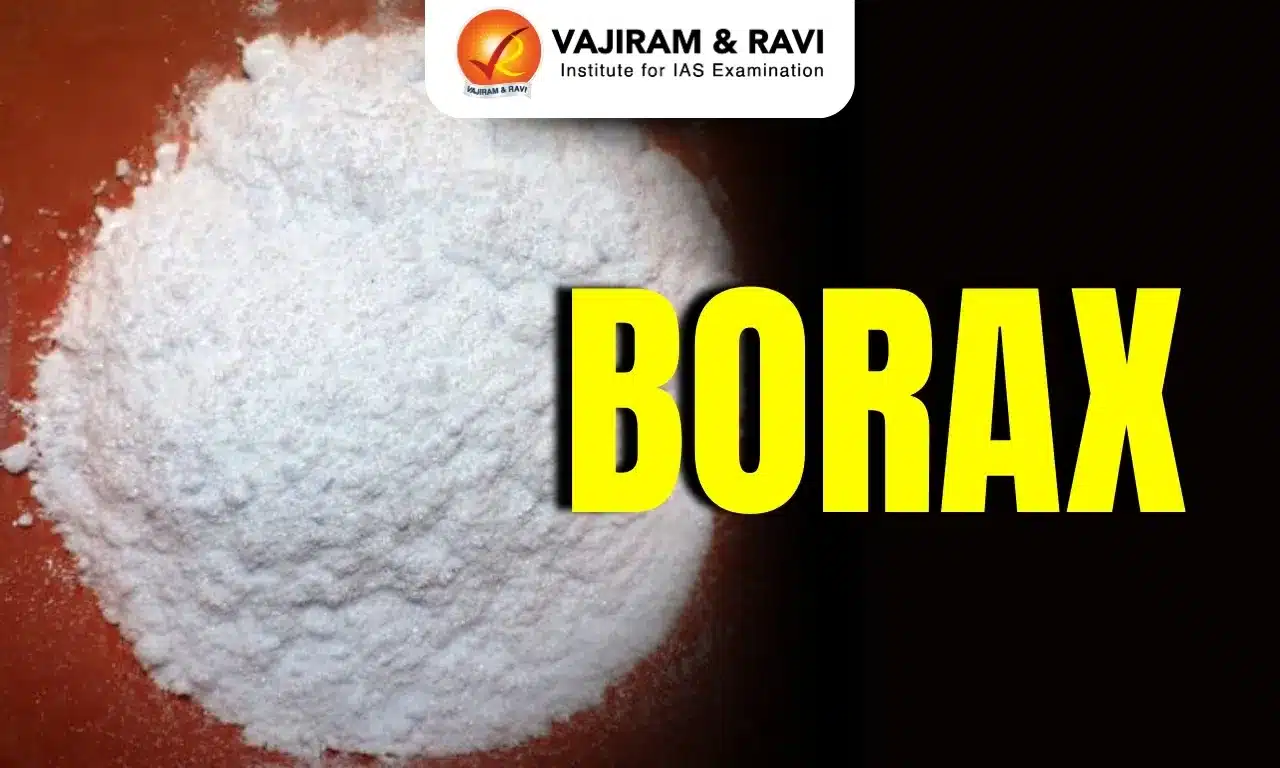
  • Borax, also known as sodium tetraborate decahydrate, is a powdery white mineral.
  • It’s a combination of boron, sodium, and oxygen. 
  • Chemical Formula: Na2B4O7·10H2O 
  • It is used in many ways—as a component of glass and pottery glazes in the ceramics industry, as a solvent for metal-oxide slags in metallurgy, as a flux in welding and soldering, and as a fertilizer additive, a soap supplement, a disinfectant, a mouthwash, and a water softener.
  • Borax occurs naturally in evaporite deposits produced by the repeated evaporation of seasonal lakes. 
  • Borax can also be produced synthetically from other boron compounds. 
  • Naturally occurring borax is refined by the process of recrystallization.

Source: NDTV

Borax FAQs

Q1: What is Borax?

Ans: Borax, also known as sodium tetraborate decahydrate, is a powdery white mineral.

Q2: Which elements combine to form Borax?

Ans: Boron, sodium, and oxygen.

Q3: What is the chemical formula of Borax?

Ans: Na₂B₄O₇·10H₂O.

Q4: How is Borax used in agriculture?

Ans: As a fertilizer additive.

Q5: In what type of geological deposits does Borax occur naturally?

Ans: Borax occurs naturally in evaporite deposits produced by the repeated evaporation of seasonal lakes.

Solar Storm, Meaning, Impact, Latest News

Solar Storm

Solar Storm Latest News

The biggest Solar Radiation Storm hit Earth's magnetic field in past 23 years, producing spectacular auroras visible across the United States and larger parts of Europe.

About Solar Storm

  • A solar storm is a sudden explosion of particles, energy, magnetic fields, and material blasted into the solar system by the Sun.
  • What Causes a Solar Storm?
    • The Sun creates a tangled mess of magnetic fields.
    • These magnetic fields get twisted up as the Sun rotates, with its equator rotating faster than its poles. 
    • Solar storms typically begin when these twisted magnetic fields on the Sun get contorted and stretched so much that they snap and reconnect (in a process called magnetic reconnection), releasing large amounts of energy. 
  • These powerful eruptions can generate any or all of the following:
    • a bright flash of light called a solar flare.
    • a solar radiation storm, or flurry of solar particles propelled into space at high speeds.
    • an enormous cloud of solar material, called a coronal mass ejection, that billows away from the Sun.
  • How Does a Solar Storm Affect Us?
    • When directed toward Earth, a solar storm can create a major disturbance in Earth’s magnetic field, called a geomagnetic storm, that can produce effects such as radio blackouts, power outages, and beautiful auroras
    • They do not cause direct harm to anyone on Earth, however, as our planet’s magnetic field and atmosphere protect us from the worst of these storms.

What are Solar Flares?

  • A solar flare is an intense burst of radiation, or light, on the Sun. 
  • These flashes span the electromagnetic spectrum — including X-rays, gamma rays, radio waves, and ultraviolet and visible light.
  • Solar flares are the most powerful explosions in the solar system — the biggest ones can have as much energy as a billion hydrogen bombs.

What are Radiation Storms?

  • Solar eruptions can accelerate charged particles — electrons and protons — into space at incredibly high speeds, initiating a radiation storm.
  • The fastest particles travel so quickly they can zip across roughly 93 million miles from the Sun to Earth in about 30 minutes or less. 

What are Coronal Mass Ejections (CMEs)?

  • A CME is an enormous cloud of electrically charged gas, called plasma, that erupts from the Sun. 
  • A single CME can blast billions of tons of material into the solar system all at once.
  • CMEs occur in the outer atmosphere of the Sun, called the corona, and often look like giant bubbles bursting from the Sun.

Key Facts about Aditya-L1

  • It is the first space-based observatory-class Indian solar mission to study the Sun. 
  • It was launched on September 2, 2023, by the Indian Space Research Organisation (ISRO).
  • The spacecraft is placed in a halo orbit around the Lagrangian point 1 (L1) of the Sun-Earth system, which is about 1.5 million km from the Earth. 
  • A satellite placed in the halo orbit around the L1 point has the major advantage of continuously viewing the Sun without any occultation/eclipse. 
  • This provides a greater advantage of observing the solar activities continuously.
  • The spacecraft is carrying seven payloads to observe the photosphere, chromosphere, and outermost layers of the Sun using electromagnetic and particle detectors.

Source: NDTV

Solar Storm FAQs

Q1: What is a solar storm?

Ans: A sudden explosion of particles, energy, and magnetic fields from the Sun.

Q2: What causes a solar storm?

Ans: The snapping and reconnection of twisted magnetic fields on the Sun.

Q3: What is a solar flare?

Ans: A bright flash of light caused by a sudden release of energy on the Sun.

Q4: What is a coronal mass ejection (CME)?

Ans: A massive cloud of solar material blasted into space from the Sun.

Q5: Can solar storms directly harm people on Earth?

Ans: No, Earth’s magnetic field and atmosphere protect us from direct harm.

ICE Cloud

ICE Cloud

ICE Cloud Latest News

Recently, the Centre for Development of Advanced Computing (CDAC) revealed that it has significantly expanded capabilities of the Integrated Cloud Environment (ICE) platform.

About ICE Cloud

  • It is an indigenous, comprehensive digital platform for conducting complex scientific research using Artificial Intelligence (AI) and High-Performance Computing (HPC).
  • It provides ease of access to computational resources.
  • It is built indigenously to provide cloud services for research and development that is reproducible.
  • It now offers an open-access platform equipped with supercomputers and tools for software development, AI, quantum technologies, simulation studies and more.
  • The platform is available to students, scientists, researchers, start-ups and others.
  • ICE offers an array of services — storage, bioinformatics tools, virtual hosting, pipeline execution, AI visualisation, development environments on the cloud and seamless collaboration features.
  • Use Cases of ICE Cloud: Research Institutes, Researchers, Developers and Industry
  • It was funded by the Department of Biotechnology (DBT) to support scientific research.

Source: TH

ICE Cloud FAQs

Q1: Who developed the ICE cloud?

Ans: C-DAC

Q2: What does ICE stand for in C-DAC's ICE cloud?

Ans: Integrated Cloud Environment

Muna Island

Muna Island

Muna Island Latest News

The painted outline of a human hand inside a cave on the Indonesian island of Muna represents what researchers are calling the oldest example of rock art in the world, created at least 67,800 years ago.

About Muna Island

  • It is situated in the Southeast Sulawesi province of Indonesia.
  • With an area of 1,704 sq.km., it has a hilly surface, rising to 1,460 feet (445 metres). The north and northeast have teak forests.
  • It is known for its diverse culture and natural beauty, including lush forests and pristine beaches. 
  • The island is home to the Muna people, who have a rich cultural heritage and are known for their traditional crafts and dances. 
  • The economy of Muna Island is primarily based on agriculture, fishing, and local crafts. 
  • The main town and principal port is Raha, on the northeastern coast across the Strait of Buton from the neighbouring island of Buton to the east.
  • One of the most famous natural attractions on Muna Island is the Liangkobori Cave, which contains prehistoric paintings. 
  • Additionally, there is Napabale Lake, which has a natural tunnel connecting it directly to the sea.

Source: REUT

Muna Island FAQs

Q1: Where is Muna Island located?

Ans: It is located in the Southeast Sulawesi province of Indonesia.

Q2: What type of terrain characterises Muna Island?

Ans: It has a hilly surface.

Q3: What is the main town and principal port of Muna Island?

Ans: Raha

Q4: Which island lies to the east of Muna Island?

Ans: Buton Island.

Q5: Which cave on Muna Island is famous for prehistoric paintings?

Ans: Liangkobori Cave.

Kaladi

Kaladi

Kaladi Latest News

Recently, the union Minister of State for Science & Technology directed that "Kaladi" traditional dairy products be upscaled for wider food applications and recipes.

About Kaladi

  • Kaladi is a famous Dogra cuisine.
  • It is a traditional dairy product of Udhampur district, Jammu & Kashmir.
  • It has received the Geographical Indication tag (GI).

Preparation of Kaladi

  • It is traditionally prepared from raw full-fat milk using whey water as a coagulant.
  • The raw full fat milk, vigorously churned in an iron pot with a wooden plunger-like tool.
  • The molten mass of milk solids was then separated by adding sour milk or curd called mathar.
  • Once stretched, the flattened cheese was cooled on the black iron pot itself, before being placed in a bowl to solidify.
  • The solidified cheese was then sun dried to help it to lose the moisture.
  • Since the ambient temperature in the mountainous area of Udhampur remains low despite a strong sun, the Kalari dried from the outside yet remain moist inside

Key Facts about Geographical Indication Tag

  • It is a sign used on products that have a specific geographical origin and possess qualities or a reputation that are due to that origin.
  • This is typically used for agricultural products, foodstuffs, wine and spirit drinks, handicrafts and industrial products.
  • The Geographical Indications of Goods (Registration and Protection) Act, 1999 seeks to provide for the registration and better protection of geographical indications relating to goods in India.

This GI tag is valid for 10 years following which it can be renewed.

Kaladi FAQs

Q1: What is kaladi made of?

Ans: It is made using raw, full-fat milk that is churned vigorously in an iron pot.

Q2: Which organization administers GI tags in India?

Ans: eographical Indications Registry, India

Metabolic Dysfunction-Associated Steatotic Liver Disease (MASLD)

Metabolic Dysfunction-Associated Steatotic Liver Disease (MASLD)

Metabolic Dysfunction-Associated Steatotic Liver Disease (MASLD), Latest News

Metabolic Dysfunction-Associated Steatotic Liver Disease, or MASLD, is emerging as a significant health concern, particularly in India.

About Metabolic Dysfunction-Associated Steatotic Liver Disease (MASLD)

  • Often referred to as a “silent” disease, MASLD is a liver condition that can progress over time if left unaddressed. 
  • It is a long-lasting liver condition caused by having too much fat in the liver. 
  • Previously known as Non-Alcoholic Fatty Liver Disease (NAFLD), its name was changed to better reflect the condition’s underlying causes. 
  • The new term highlights that the disease is a metabolic one, linked to factors such as obesity, diabetes, and high cholesterol. 
  • It is the most common form of liver disease in the world. 
  • MASLD ranges in severity from hepatic steatosis — sometimes called diffuse hepatic steatosis, or formerly fatty liver infiltration or simply fatty liver — to a more severe form of disease called metabolic dysfunction-associated steatohepatitis (MASH), formerly called nonalcoholic steatohepatitis (NASH).
  • Symptoms
    • MASLD often has no symptoms. 
    • If symptoms begin, however, they usually include fatigue (extreme tiredness), weakness, discomfort, or pain in the abdomen.
    • If MASLD begins to advance to MASH, other symptoms may begin. 
      • These can include jaundice (yellowing of the eyes and skin), severe itching, fluid buildup in the belly (ascites), and fluid buildup in the ankles (edema).
      • Sometimes mental confusion can occur.
      • MASH causes the liver to swell and become damaged.
  • Treatment: Treating MASLD with a healthy diet, physical activity, and weight loss can slow or even reverse liver damage, especially if it is at an earlier stage.

Source: TH

Metabolic dysfunction-associated steatotic liver disease (MASLD) FAQs

Q1: What is Metabolic dysfunction-associated steatotic liver disease (MASLD)?

Ans: It is a long-lasting liver condition caused by excessive fat accumulation in the liver.

Q2: What was Metabolic dysfunction-associated steatotic liver disease (MASLD) previously known as?

Ans: Non-Alcoholic Fatty Liver Disease (NAFLD).

Q3: Which metabolic factors are linked to Metabolic dysfunction-associated steatotic liver disease (MASLD)?

Ans: Obesity, diabetes, and high cholesterol.

Q4: What is the more severe form of Metabolic dysfunction-associated steatotic liver disease (MASLD) called?

Ans: Metabolic dysfunction-associated steatohepatitis (MASH).

Q5: What lifestyle measures are recommended for treating Metabolic dysfunction-associated steatotic liver disease (MASLD)?

Ans: A healthy diet, regular physical activity, and weight loss.

Metadon Ghorpadei and Metadon Reemeri

Metadon Ghorpadei and Metadon Reemeri

Metadon Ghorpadei and Metadon Reemeri Latest News

Researchers recently discovered two rare ant-fly species in India, Metadon ghorpadei and Metadon reemeri.

About Metadon Ghorpadei and Metadon Reemeri

  • They are two new species of ant flies.
  • These insects belong to the Microdontinae subfamily of hoverflies. 
  • Metadon ghorpadei was discovered in Delhi’s Northern Ridge Forest. 
  • Metadon reemeri was found in the Siruvani Hills of the Western Ghats
  • Globally, many Microdontinae species are considered rare or threatened due to their specialised habitat requirements and patchy distribution.
    • They are known for their unique association with ants, as their larvae live inside ant nests and feed on ant broods, a specialised behaviour called myrmecophily that makes them exceptionally rare and difficult to detect. 
    • Of the 454 species reported worldwide, only 27 are known from the Indian subcontinent.

Source: TH

Metadon Ghorpadei and Metadon Reemeri FAQs

Q1: What are Metadon ghorpadei and Metadon reemeri?

Ans: They are two newly discovered species of ant flies.

Q2: Where was Metadon ghorpadei discovered?

Ans: It was discovered in Delhi’s Northern Ridge Forest.

Q3: Where was Metadon reemeri found?

Ans: It was found in the Siruvani Hills of the Western Ghats.

Q4: What unique ecological association are Microdontinae species known for?

Ans: Their larvae live inside ant nests and feed on ant broods.

Atal Pension Yojana

Atal Pension Yojana

Atal Pension Yojana Latest News

Recently, the union cabinet approved the continuation of Atal Pension Yojana (APY) up to FY 2030-31.

About Atal Pension Yojana

  • It was launched by the Government of India on 9th May 2015.
  • It was designed to encourage voluntary savings for retirement by offering defined pension benefits, linked to the age of joining and amount of contribution.

Key Features of Atal Pension Yojana

  • Target Group: It is aimed at workers in the unorganised sector.
  • It was initially available to all citizens of India between 18 and 40 years of age.
  • With effect from 1st October 2022, individuals paying income tax are not eligible to join the scheme.
  • Guaranteed Pension: Subscribers can opt for a fixed pension ranging from ₹1,000 to ₹5,000 per month, depending on the contribution made.
  • Government Co-Contribution: For subscribers who enrolled between June 1, 2015, and March 31, 2016, and met certain criteria, the government contributed 50% of the subscriber’s amount or ₹1,000 per annum for five years.
  • It is administered by the Pension Fund Regulatory and Development Authority (PFRDA).
  • Exit and withdrawal options 
    • Exit at age 60: Full pension begins.
    • Exit before age 60: Permitted only in cases of death or terminal illness.
    • Voluntary Exit: Allowed, but the subscriber only receives the contribution made (with interest) and government co-contribution (if any) is forfeited.

Source: PIB

Atal Pension Yojana FAQs

Q1: When was Atal Pension Yojana launched?

Ans: 2015

Q2: What is the primary objective of Atal Pension Yojana?

Ans: To provide pension benefits to workers in the unorganized sector

Small Industries Development Bank of India

Small Industries Development Bank of India

Small Industries Development Bank of India Latest News

Recently, the Union Cabinet has approved the equity support of Rs.5,000 crore to Small Industries Development Bank of India (SIDBI).

About Small Industries Development Bank of India

  • It was set up on 2nd April, 1990 by the Government of India under an act of the Parliament, as a wholly owned subsidiary of IDBI Bank.
  • It was delinked from IDBI on March 27, 2000. 
  • Mandate: It is mandated to serve as the Principal Financial Institution for executing the triple agenda of promotion, financing and development of the MSME sector and coordination of the functions of the various Institutions engaged in similar activities.
  • Functions of Small Industries Development Bank of India
    • Offers direct loans and refinancing to banks and NBFCs.
    • Promotes entrepreneurship and MSME growth
    • Provides venture capital and technology support
  • Financial support to MSMEs is provided by way of
    • Indirect/refinance to banks/Financial Institutions for onward lending to MSMEs
    • Direct finance in niche areas like risk capital, sustainable finance, receivable financing, service sector financing, etc..
  • SIDBI was made responsible for administering the Small Industries Development Fund and the National Equity Fund that were administered by IDBI before.
  • Major Stakeholders in SIDBI: Government of India (GOI), State Bank of India (SBI), LIC, and NABARD are among the major stakeholders in the SIDBI.
  • Headquarters: Lucknow, Uttar Pradesh

Source: PIB

Small Industries Development Bank of India FAQ's

Q1: What is the primary objective of SIDBI?

Ans: To develop and finance small-scale industries

Q2: Under which ministry does SIDBI operate?

Ans: Ministry of Finance

Bhitarkanika National Park

Bhitarkanika National Park

Bhitarkanika National Park Latest News

Bhitarkanika National Park saw a marginal increase in winged guests as compared to the previous year, according to the latest census report released by the forest department recently.

About Bhitarkanika National Park

  • It is located in the Kendrapara district of Odisha.
  • Spread across an area of 672 sq.km. of the mangrove swamp situated on the delta formed by the three rivers, namely Brahmani, Baitarani, and Dhamra, the park houses an array of creeks, backwaters, estuaries, deltas, and mudhuts.
  • The national park is surrounded by the Bhitarkanika Wildlife Sanctuary. Gahirmatha Beach and Marine Sanctuary lie to the east, and separates a swamp region covered with a canopy of mangroves from the Bay of Bengal. 
  • It is India’s second largest mangrove ecosystem after the Sunderbans
  • Proximity to the Bay of Bengal makes the soil of the area enriched with salt.
  • The vegetation and species of the sanctuary are those that are mainly found in the tropical and subtropical intertidal regions.
  • It is also designated as a Ramsar site.
  • Flora: Mangrove species, casuarinas, and grasses like the indigo bush.
  • Fauna:
    • It is home to the largest congregation of the endangered saltwater crocodile in the country.
    • The Gahirmatha Beach is the largest colony of the Olive Ridley Sea Turtles.
    • It is also home to numerous animals like hyenas, wild boar, Chitals, Sambar, Spotted Deer, Wild Boar, Jungle cat, Wild Pigs, etc., and migratory birds, which make it their home during the winter season, lending a vibrant hue to the ecosystem.
    • It is also home to eight varieties of Kingfisher birds, which is also a rarity.

Source: TP

Bhitarkanika National Park FAQs

Q1: Where is Bhitarkanika National Park located?

Ans: It is located in the Kendrapara district of Odisha.

Q2: Bhitarkanika National Park is situated on the delta formed by which rivers?

Ans: The Brahmani, Baitarani, and Dhamra rivers.

Q3: What type of ecosystem dominates Bhitarkanika National Park?

Ans: A mangrove swamp ecosystem.

Q4: Which beach and marine sanctuary lie to the east of Bhitarkanika National Park?

Ans: Gahirmatha Beach and Gahirmatha Marine Sanctuary.

Q5: Which endangered reptile has the largest congregation in Bhitarkanika National Park?

Ans: The saltwater crocodile.

Steel Slag

Steel Slag

Steel Slag Latest News

Recently, the union Minister of State (Independent Charge) for Science and Technology advocated wider adoption of steel slag–based road construction and repair technology, particularly in hilly and Himalayan regions.

About Steel Slag

  • Steel slag is an industrial byproduct obtained from the steel manufacturing industry.
  • It is produced in large quantities during steel-making operations that use electric arc furnaces.
  • It can also be produced by smelting iron ore in a basic oxygen furnace.
  • Composition: Primarily, slag consists of calcium, magnesium, manganese and aluminium silicates and oxides in various combinations.
  • The cooling process of slag is responsible mainly for generating different types of slags required for various end-use consumers

Applications of Steel Slag

  • Environmental Remediation: It has found use as a barrier material remedy for waste sites where heavy metals tend to leach into the surrounding environment.
    • Steel slag forces the heavy metals to drop out of solution in water run off because of its high oxide mineral content.
    • It has been used successfully to treat acidic water discharges from abandoned mines.
  • It can replace coarse aggregate due to a higher impact and crushing strength, and better anti-skid capacity.

Source: DD news

Steel Slag FAQs

Q1: What is steel slag primarily composed of?

Ans: Calcium, magnesium, manganese, and aluminium silicates and oxide

Q2: What is one of the applications of steel slag?

Ans: Treating acidic water discharges from abandoned mines

RBI’s ‘State of the Economy’ – Growth Resilience and Emerging Global Risks

State of the Economy

State of the Economy Latest News

  • The Reserve Bank of India (RBI), in its State of the Economy article, has assessed India’s macroeconomic conditions based on high-frequency indicators (for December 2025). 
  • The assessment points towards continued growth momentum, resilient domestic demand, and optimism about future prospects, despite elevated global geopolitical and geo-economic uncertainties.
  • The views expressed in the article are those of the authors and not the official stance of the RBI.

Key Growth Signals - Domestic Economy

  • Robust demand conditions: High-frequency indicators suggest sustained buoyancy in growth impulses. Demand conditions remain upbeat, supported by consumption and economic activity.
  • Revival of rural demand:
    • Retail automobile sales recorded broad-based growth across categories.
    • Key drivers are GST rate cuts improving affordability, year-end promotional offers, and pre-buying ahead of expected price hikes in January.
  • Commercial activity and logistics: Retail commercial vehicle sales maintained strong growth. It indicates improved goods movement, and strong underlying economic activity.
  • GST and formal economy indicators: E-way bill generation continued healthy growth due to GST rate rationalisation, stock clearance, and firms pushing year-end sales.

Macro-Economic Indicators

  • GDP growth: (National Statistics Office’s first advance estimate)
    • The real GDP growth is estimated at 7.4% in 2025-26, up from 6.5% a year ago.
  • Inflation trends: In December, the consumer price index (CPI) inflation rose to 1.3% driven by a lower rate of deflation in the food group along with an increase in core index.

Global Geopolitical and Geo-Economic Risks

  • Key developments at the start of 2026:
    • US intervention in Venezuela
    • Ongoing Middle East conflict
    • Uncertainty over Russia–Ukraine peace deal
    • Escalation of the Greenland dispute
  • Implications:
    • Elevated geo-economic risks
    • High policy uncertainty
    • Potential spillover effects on trade, energy, and capital flows

Structural Reforms and Policy Environment (2025)

  • Major reforms highlighted:
    • Rationalisation of tax structures
    • Implementation of labour codes (labour market reforms)
    • Financial sector deregulation
  • Expected outcomes:
    • Improved growth prospects
    • Enhanced productivity
    • Strengthened medium- to long-term economic fundamentals

External Sector and Trade Strategy

  • Export diversification: India has made significant efforts to diversify exports (like focusing on new markets in Africa and Latin America).
  • Trade negotiations: Ongoing talks with 14 countries/groups, covering nearly 50 nations, including European Union (EU), Gulf Cooperation Council (GCC), United States.

Challenges and Way Ahead

  • Persisting global geopolitical instability: Strengthen domestic demand while boosting export competitiveness.
  • Risk of imported inflation: Tackling imported inflation by a mix of monetary (interest rate cuts), fiscal (reducing import duties) and trade policies (boosting domestic supply chains).
  • Balancing growth and inflation management: Maintain a balanced policy approach between innovation vs. stability, and growth vs. consumer protection.
  • Ensuring inclusive and sustainable growth: Deepen structural reforms to enhance productivity and resilience. 
  • Managing policy uncertainty: Continue prudent regulation and supervision.

Conclusion

  • The RBI’s State of the Economy assessment underlines the resilience of the Indian economy, supported by strong domestic demand, improving rural consumption, robust GST indicators, and sustained reform momentum. 
  • While global uncertainties remain elevated, India’s macroeconomic fundamentals and reform-oriented policy framework provide credible grounds for optimism, positioning the economy for stronger and more stable long-term growth.

Source: IE

State of the Economy FAQs

Q1: How do high-frequency indicators reflect the current growth momentum of the Indian economy?

Ans: Indicators such as automobile sales, e-way bill generation, and commercial vehicle sales indicate sustained demand, robust economic activity.

Q2: What factors contributed to the revival of rural demand as highlighted by the RBI?

Ans: Rural demand revival was driven by enhanced affordability due to GST rate cuts, year-end discounts, etc.

Q3: Despite global uncertainties, why does the RBI express optimism about India’s growth prospects?

Ans: This is due to strong domestic demand, resilient macroeconomic fundamentals, and ongoing structural reforms.

Q4: What is the role of structural reforms undertaken in 2025 in strengthening India’s long-term growth?

Ans: Reforms such as tax rationalisation, labour code implementation, are expected to enhance productivity, formalisation, and investment-led growth.

Q5: How does India’s trade strategy contribute to economic resilience amid geo-economic uncertainties?

Ans: Export diversification and trade negotiations with the EU, GCC, and the US help reduce external vulnerability and strengthen economic resilience.

Judiciary on Prior Sanction for Corruption Probe – Explained

Corruption Probe

Corruption Probe Latest News

  • The Supreme Court has delivered a split verdict on the constitutional validity of Section 17A of the Prevention of Corruption Act, 1988, which mandates prior government approval before investigating certain corruption allegations against public servants.

Background of the Prevention of Corruption Act, 1988

  • The Prevention of Corruption Act, 1988 (PCA) is India’s primary anti-corruption legislation dealing with offences committed by public servants in the discharge of official duties. 
  • The Act traces its origin to the recommendations of the Santhanam Committee (1962-64), which highlighted the need for a strong legal framework to curb corruption in public life. 
  • The PCA consolidated existing laws and introduced penal provisions covering bribery, criminal misconduct, and abuse of official position.
  • Under the Act, a “public servant” is defined broadly to include government employees, judges, and individuals entrusted with public duties. 
  • Over time, judicial scrutiny and legislative amendments have shaped the balance between protecting honest officials and ensuring accountability for corrupt practices.

Section 17A and Its Legislative Intent

  • Section 17A was introduced through the 2018 amendment to the PCA. 
  • It mandates that prior approval of the appropriate government is required before initiating any inquiry or investigation against a public servant for decisions or recommendations made while discharging official functions.
  • The legislative rationale behind Section 17A was to address concerns that honest officers were becoming risk-averse due to fear of frivolous or malicious investigations. 
  • Policymakers argued that excessive scrutiny could lead to a “policy paralysis” where officials avoid taking bold or time-sensitive decisions, particularly in areas involving economic or administrative discretion.
  • It is important to note that the PCA already contains Section 19, which requires prior sanction before a court can take cognisance of corruption offences. 
  • Section 17A extends this protection to the pre-investigation stage.

Judicial Precedents on Prior Sanction

  • The Supreme Court has historically been cautious about executive controls over corruption investigations. 
  • In Vineet Narain vs Union of India (1998), the Court struck down the “Single Directive,” which required prior government approval before investigating senior officials. 
  • Similarly, in Subramanian Swamy vs Director, CBI (2014), Section 6A of the Delhi Special Police Establishment Act, requiring prior approval to investigate senior officers, was declared unconstitutional for violating Article 14 (equality before law).
  • These rulings established that differential treatment based on rank or position in corruption investigations undermines the principle of equal accountability under law.

Supreme Court’s Split Verdict on Section 17A

  • A two-judge Bench of the Supreme Court delivered a split verdict while examining the constitutional validity of Section 17A.
  • One judge upheld the provision, reasoning that prior approval is necessary to protect honest officers from harassment and to prevent a “play-it-safe” bureaucratic culture. 
  • However, this view came with a significant caveat: the approval mechanism should involve an independent body, such as the Lokpal or Lokayukta, rather than being controlled solely by the executive.
  • The other judge struck down Section 17A as unconstitutional, describing it as a reintroduction of previously invalidated safeguards in a new form. 
  • The judgment held that Section 17A fails the test of reasonable classification under Article 14 and that sufficient protection already exists under Section 19 of the PCA at the prosecution stage.
  • As a result of the split verdict, the matter has been referred to a larger Bench of the Supreme Court for final adjudication.

Governance and Accountability Implications

  • The case raises critical governance questions. 
  • On the one hand, excessive procedural safeguards may dilute the effectiveness of anti-corruption agencies and delay investigations. 
  • On the other hand, unchecked investigations can be misused as tools of political or administrative vendetta.
  • The debate highlights the need to balance administrative efficiency, decision-making autonomy, and constitutional principles of equality and rule of law. 
  • The outcome of the larger Bench decision will significantly shape the future of corruption control mechanisms in India.

Way Forward and Systemic Reforms

  • Beyond the constitutional question, the case underscores broader systemic issues in tackling corruption. 
  • Speedy investigation and time-bound trials are essential to ensure deterrence. 
  • Additionally, mechanisms to penalise false or malicious complaints can help prevent abuse of the investigative process without shielding genuine wrongdoing.
  • Institutional independence, transparency in approval mechanisms, and judicial oversight will be crucial in maintaining public trust in anti-corruption frameworks.

Source: TH

Corruption Probe FAQs

Q1: What is Section 17A of the Prevention of Corruption Act?

Ans: It requires prior government approval before investigating certain corruption allegations related to official decisions of public servants.

Q2: Why was Section 17A introduced?

Ans: To protect honest officials from frivolous investigations and encourage bold decision-making.

Q3: What did the Supreme Court rule on Section 17A?

Ans: A two-judge Bench delivered a split verdict, leading to referral of the case to a larger Bench.

Q4: How is Section 17A different from Section 19 of the PCA?

Ans: Section 17A applies at the investigation stage, while Section 19 applies before prosecution in court.

Q5: Why is the verdict significant for governance?

Ans: It affects the balance between administrative autonomy and accountability under anti-corruption laws.

Punjab Border Fence Shift: Why Farmers Want It Moved Closer to Pakistan Border

Punjab Border Fence

Punjab Border Fence Latest News

  • Punjab Chief Minister said the Centre has agreed in principle to move the security fence closer to the India–Pakistan border, a step that could restore access to farmland lying beyond the fence. 
  • The proposal, discussed earlier but never implemented, revives questions around its origins, security concerns, and why relief for border farmers has remained elusive.

Why Punjab’s Border Fence Has Become a Farmers’ Flashpoint

International Border in Punjab

  • Punjab’s 532-km border with Pakistan is secured by a barbed-wire fence that, due to uneven terrain, lies anywhere from a few feet to nearly 2 km inside Indian territory
  • As a result, about 21,500 acres of privately owned farmland and 10,000 acres of government land fall between the fence and the International Border.
  • Farmers cultivating this land face strict restrictions. Access gates open only for limited hours on fixed days, with caps on the number of people and tractors allowed. 
  • Each tractor must be escorted by two BSF Kisan Guards, further limiting daily access. 
  • Border farmers have long demanded that the fence be moved closer to the International Border to ease cultivation.

Why the Punjab Border Fence Was Built

  • The electrified barbed-wire fence along the Punjab–Pakistan border was first installed in 1988 across Gurdaspur, Amritsar and Ferozepur, at the height of militancy in the state. Its primary purpose was to curb infiltration, militancy and drug smuggling.
  • At the time, farmers did not protest, as dissent was often viewed with suspicion during those volatile years. 
  • In 1992, farmers formed the Border Area Sangharsh Committee to raise their concerns, but the issue has remained unresolved. 
  • With the later creation of Tarn Taran, Fazilka and Pathankot districts, the fence now affects border communities across six districts in Punjab.

Kapoor Committee and Farmer Compensation

  • The Kapoor Committee, headed by then Punjab Chief Secretary S L Kapoor, was constituted in 1986 to examine the difficulties faced by farmers whose land lay beyond the border fence. 
  • It recommended compensating affected farmers, leading to the release of an inconvenience allowance of ₹2,500 per acre in 1988. 
  • However, farmers say this compensation has been irregular and not paid annually.

Farmers Seek Fence Shift Amid Evolving Security Landscape

  • Punjab’s border farmers argue that advances in surveillance and drone monitoring have changed the nature of border security, making the current fence alignment outdated. 
  • With hundreds of acres trapped behind the fence, farmers face daily checks, delays in using machinery, and hurdles in transporting crops. 
  • They say shifting the fence closer to the International Border would ease cultivation without compromising security, given improved monitoring and adequate defence resources.

Why the Border Fence Remains Unmoved

  • Despite repeated proposals, shifting the Punjab border fence has not materialised due to practical and administrative hurdles. 
  • BSF officials say the nearly 40-year-old fence is in poor condition and moving it would require dismantling and rebuilding it with newly procured barbed wire. 
  • Farmers, meanwhile, remain sceptical, noting that similar assurances have surfaced during elections in the past without any follow-through, including in 2023 when a possible fence shift was announced but never implemented.

Source: IE | HT

Punjab Border Fence FAQs

Q1: Why is the Punjab border fence shift in the news?

Ans: The Punjab border fence shift gained attention after the Centre agreed in principle to move the fence closer to the International Border, potentially restoring farmers’ access to restricted land.

Q2: How much farmland lies beyond the Punjab border fence?

Ans: About 21,500 acres of private farmland and 10,000 acres of government land lie beyond the Punjab border fence, restricting cultivation and access for border farmers.

Q3: Why was the Punjab border fence originally built?

Ans: The Punjab border fence was installed in 1988 during militancy to prevent infiltration, terrorism and drug smuggling along the India–Pakistan border.

Q4: What problems do farmers face due to the current fence alignment?

Ans: Farmers face restricted access hours, limits on tractors and workers, mandatory BSF escorts, delays in cultivation, and difficulties in transporting crops from fenced-off fields.

Q5: Why has the Punjab border fence not been shifted so far?

Ans: The Punjab border fence shift faces logistical hurdles, poor condition of the old fence, rebuilding costs, and repeated political assurances without implementation over decades.

Bombay High Court on Protective Custody Under PITA: Care vs Detention

Protective Custody under PITA

Protective Custody under PITA Latest News

  • The Bombay High Court set aside an order placing an adult trafficking survivor in a protective home for a year, holding that such custody without legal justification violates constitutional liberty. 
  • The court clarified that protective homes under the Immoral Traffic (Prevention) Act (PITA) are meant for rehabilitation, not confinement. 
  • The court stressed that an adult survivor’s fundamental rights to personal liberty and freedom under Article 19 prevail over statutory powers, and do not stand suspended merely because she was trafficked. 
  • The case arose after a police raid in Maharashtra, where the petitioner alone was detained on the assumption that her lack of family support or income made her likely to return to sex work—an assumption the court found impermissible.

Limits of Custody Under the Immoral Traffic (Prevention) Act

  • What PITA Allows After Rescue - Under Section 17 of the Immoral Traffic (Prevention) Act, a rescued person may be kept in safe custody only briefly if immediate production before a magistrate is not possible. This initial custody is capped at 10 days.
  • Magisterial Inquiry and Time Limits - Once produced before a magistrate, the law requires an inquiry. During this stage, interim custody can continue, but only up to three weeks. Any placement beyond this period is not automatic.

When Long-Term Placement Is Permissible

  • A longer stay in a protective home — ranging from one to three years — can be ordered only if the magistrate records a clear finding that the person is “in need of care and protection”. 
  • The Bombay High Court stressed that these timelines reflect legislative intent to prevent rescue from turning into confinement.

Protective Homes vs Corrective Institutions

  • PITA draws a clear distinction:
    • Protective homes (Section 2(g)) are meant for care and rehabilitation of victims.
    • Corrective institutions (Section 2(b)) are for detention of offenders and are governed by Section 10A.
  • Only persons found guilty of offences under the Act can be sent to corrective institutions.

Constitutional Rights of Adult Survivors

  • For adults, constitutional freedoms under Article 19 — including the right to move freely, choose residence, and pursue a livelihood — remain intact even after trafficking. 
  • Unlike children, adults cannot be subjected to extended state control without consent.

Consent as the Core Principle

  • The High Court held that “care” for an adult survivor must be voluntary. 
  • Once an adult clearly expresses a desire to leave a protective home, continued confinement ceases to be care and becomes unlawful detention. 
  • In this case, the woman’s repeated refusal to stay made her consent central, not optional.

When Care Becomes Detention: The Court’s Test

  • Substance Over Labels - The Bombay High Court clarified that the difference between care and detention depends on effect, not terminology. 
    • Care involves voluntary support — counselling, shelter with consent, and help in rebuilding life — while detention is defined by compulsion.
  • Consent and Autonomy as the Core - When an adult is kept in a protective home against her wishes, with restrictions on movement and choice, it amounts to detention. 
    • Such restraint on personal liberty must be justified with concrete material on record, not assumptions.
  • Victims Are Not Offenders - The court cautioned against treating trafficking survivors as offenders by default. 
    • The Immoral Traffic (Prevention) Act (PITA) “was not meant to punish a victim of sexual exploitation”. 
    • In the absence of conduct attracting penal provisions, restrictions cannot be imposed.
  • Role of the Magistrate - Under PITA, only a magistrate, after conducting a proper inquiry, can determine whether a rescued person genuinely requires care and protection. 
    • Any placement in a protective home must follow this satisfaction and statutory safeguards.

When Detention May Be Justified

  • Detention may be permissible only in limited situations:
    • Evidence of a condition impairing decision-making capacity
    • A demonstrable danger to society if released
    • The person being an accused in a criminal case

Why Detention Failed in This Case

  • None of these conditions were met. There was no medical evidence of incapacity, no finding of danger to others, and the woman was not accused of any offence. 
  • The court rejected speculative fears — including the possibility of returning to sex work — as insufficient grounds for confinement.

What the Law Penalises Under PITA

  • Prostitution Is Not a Crime - The PITA does not criminalise prostitution itself. Courts have clarified that being engaged in sex work does not automatically make a person an offender.
  • Focus on Exploitation, Not Individuals – The Act targets the commercial exploitation surrounding prostitution. The law is aimed at those who control, profit from, or facilitate exploitation — not the individuals trapped within it.
  • Who the Act Criminally Targets
    • Criminal liability arises for:
      • Managing or running a brothel
      • Living off the earnings of another person’s prostitution
      • Procuring or trafficking persons for prostitution, even with apparent consent
      • Detaining a person for sexual exploitation
  • Limited Punishable Conduct - Certain acts linked to prostitution are punishable only when they affect public order — such as soliciting in public spaces or operating near schools, hospitals, or places of worship. 
    • Courts stress these are regulatory, not moral, provisions.

Poverty Is Not Grounds for Detention

  • The Bombay High Court rejected the view that economic vulnerability justifies confinement. 
  • Lack of family support or fear of returning to sex work cannot override constitutional rights. 
  • Poverty may warrant assistance, but never the curtailment of liberty.

Source: IE | LL

Protective Custody under PITA FAQs

Q1: What did the Bombay High Court rule on protective custody under PITA?

Ans: The Bombay High Court held that protective custody under PITA for adult trafficking survivors cannot violate constitutional liberty and must remain voluntary, time-bound, and justified by law.

Q2: How does PITA regulate protective custody after rescue?

Ans: Under PITA, protective custody is limited to 10 days initially and three weeks during inquiry; longer confinement requires a magistrate’s clear finding of need for care and protection.

Q3: Why did the court reject detention in this case?

Ans: The court found no medical incapacity, criminal charge, or danger to society, making continued protective custody under PITA unconstitutional and based on speculative assumptions.

Q4: What distinction did the court draw between care and detention?

Ans: Care under PITA involves voluntary support and rehabilitation, while detention involves forced confinement; keeping an adult against her will transforms care into unconstitutional detention.

Q5: Does PITA criminalise prostitution?

Ans: No, PITA does not criminalise prostitution itself; it targets exploitation by traffickers and brothel operators, not individuals engaged in sex work.

Enquire Now