
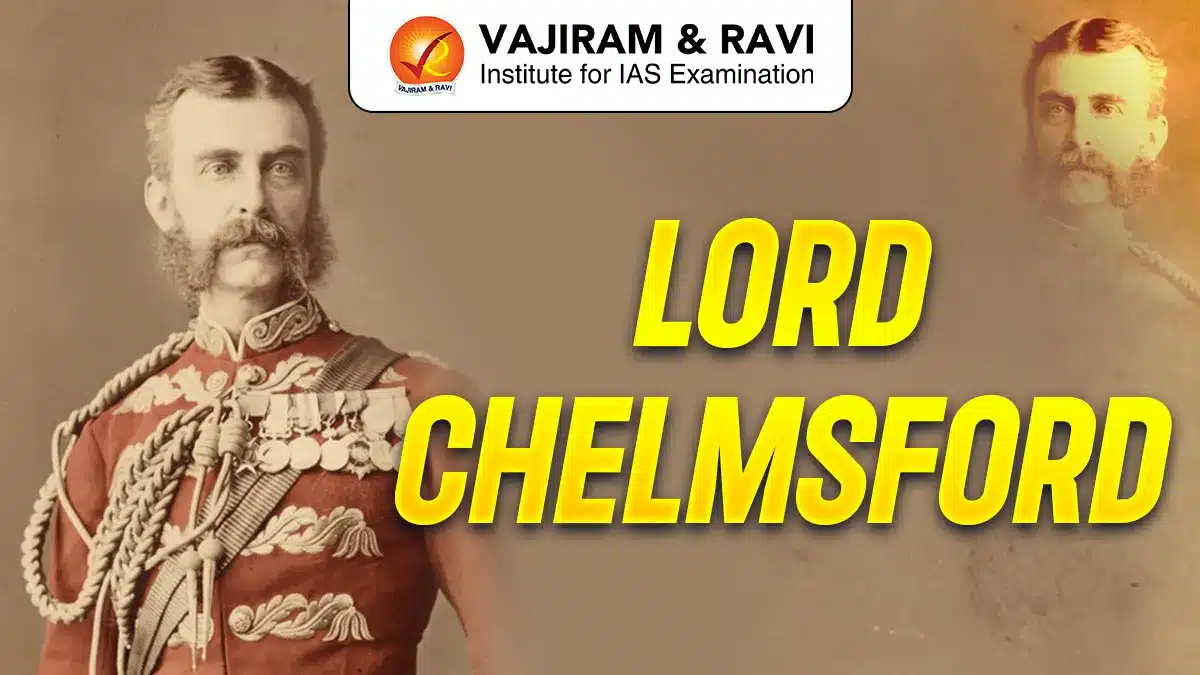
Lord Chelmsford, formally known as Frederic John Napier Thesiger, was a famous British administrator whose tenure as Viceroy of India coincided with intense political unrest and constitutional change. He served from 1916 to 1921 as the Viceroy of India. His period witnessed the First World War’s impact on India, rising nationalist demands and the first structured attempt to introduce responsible government through constitutional reforms.
Lord Chelmsford Biography
Lord Chelmsford was born on 12 August 1868 to a distinguished British family with a strong military and administrative background. He served as Governor of Queensland from 1905 to 1909 and Governor of New South Wales from 1909 to 1913 which gave him colonial administrative experience. During the First World War, he returned to military service and was appointed to the Privy Council in February 1916. In March 1916, he succeeded Lord Hardinge as Viceroy of India, later becoming the 1st Viscount Chelmsford in 1921. He died in 1933 at the age of 64 in London, England.
Lord Chelmsford Contributions
Lord Chelmsford had brought several administrative, economic, social as well as military reforms. Various contributions during the tenure of Chelmsford as the Viceroy of India has been listed below:
- Constitutional Reform Advocate: Chelmsford accepted that educated Indians demanded self government and supported gradual constitutional change within the British Empire framework through structured reforms rather than immediate transfer of power.
- Montagu Partnership: He worked closely with Edwin Samuel Montagu, Secretary of State for India, facilitating consultations with Indian leaders like Gandhi and Jinnah, which shaped the Indian Constitutional Reforms Report of 1918.
- Administrative Restructuring: Under his leadership, provincial legislative councils were expanded, Indian representation increased and the idea of responsible government at the provincial level was formally introduced.
- Wartime Governance: During World War I, Chelmsford ensured India’s continued contribution of troops, finances and resources to the British war effort while managing rising political expectations at home.
Events During Lord Chelmsford Tenure
The tenure of Lord Chelmsford as Viceroy coincided with major political movements, laws and conflicts that reshaped Indian nationalism.
- Lucknow Pact 1916: The Congress and Muslim League jointly demanded constitutional reforms, including separate electorates and weightage for minorities, symbolizing temporary Hindu-Muslim unity encouraged by Chelmsford’s call for reform suggestions.
- August Declaration 1917: Edwin Montagu’s statement in the British Parliament promised progressive realization of responsible government in India, marking the first formal British commitment to self governing institutions.
- Rowlatt Act 1919: Based on the Rowlatt Committee’s recommendations, Chelmsford’s government passed a law allowing detention without trial for up to two years, triggering nationwide protests due to its denial of civil liberties.
- Jallianwala Bagh Massacre 1919: Following unrest in Punjab, martial law was imposed and General Reginald Dyer ordered firing on an unarmed crowd at Amritsar on 13 April 1919, killing more than 400 people and deeply damaging British legitimacy.
- Hunter Commission Inquiry: The British government appointed the Disorders Inquiry Committee under Lord William Hunter, which condemned Dyer’s actions but upheld martial law, leading to Chelmsford disciplining Dyer without criminal prosecution.
- Khilafat Movement: Indian Muslims launched protests against the dismemberment of the Ottoman Caliphate after World War I, reflecting global Islamic concerns intersecting with Indian anti-imperial politics.
- Non-Cooperation Movement 1920: Mahatma Gandhi launched a mass movement boycotting British institutions, goods and councils, transforming the Congress into a mass based party during Chelmsford’s final year in office.
- Third Anglo-Afghan War 1919: Conflict between British India and Afghanistan ended with the Treaty of Rawalpindi, recognizing Afghan control over its foreign policy and affecting India’s north-west frontier security.
- Government of India Act 1919: The Government of India Act also known as Montagu-Chelmsford Reforms was enacted with the joint recommendations of Montagu and Lord Chelmsford.
Montagu-Chelmsford Reforms
The Montagu-Chelmsford Reforms aimed to introduce limited responsible Government in India while retaining British supremacy. It formed the basis of the Government of India Act 1919.
- Objective: The reforms sought gradual self government by increasing Indian participation in administration while affirming India as an integral part of the British Empire under parliamentary sovereignty.
- Central Legislature Changes: A bicameral legislature was introduced with the Legislative Assembly of 145 members and the Council of State of 60 members, allowing elected Indians to debate budgets and question the executive.
- Executive Structure: The Governor General remained the chief executive with overriding powers, but his executive council now included three Indian members out of eight, marking limited inclusion at the highest level.
- Provincial Dyarchy System: Provincial subjects were divided into reserved and transferred categories, with elected Indian ministers handling areas like education and health, while governors retained control over finance and law and order.
- Impact: The Act provided for a Public Service Commission and a ten year review clause leading to the Simon Commission, institutionalizing constitutional reform while exposing limitations that fueled further nationalist resistance.
Lord Chelmsford FAQs
Q1: Who was Lord Chelmsford?
Ans: Lord Chelmsford was a British statesman who served as Governor General and Viceroy of India from 1916 to 1921 during a critical phase of constitutional reforms and nationalist movements.
Q2: What major events occurred during the tenure of Lord Chelmsford?
Ans: Key events included the Lucknow Pact, August Declaration 1917, Rowlatt Act, Jallianwala Bagh tragedy, Khilafat Movement, Non-Cooperation Movement, the Third Anglo-Afghan War and Government of India Act 1919.
Q3: What was the Rowlatt Act passed during Lord Chelmsford?
Ans: The Rowlatt Act of 1919 allowed detention without trial for suspected political offenders, which was widely opposed for violating civil liberties and sparked nationwide protests.
Q4: What was Lord Chelmsford’s role in the Jallianwala Bagh incident?
Ans: As Viceroy, Chelmsford initially supported General Dyer’s actions under martial law but later disciplined him after the Hunter Committee inquiry, a response widely viewed as inadequate by Indian nationalists.
Q5: What were the Montagu-Chelmsford Reforms recommended by Lord Chelmsford?
Ans: The reforms expanded legislative councils, introduced dyarchy in provinces and increased Indian representation, but their limited nature disappointed nationalists and intensified demands for complete self rule.
