
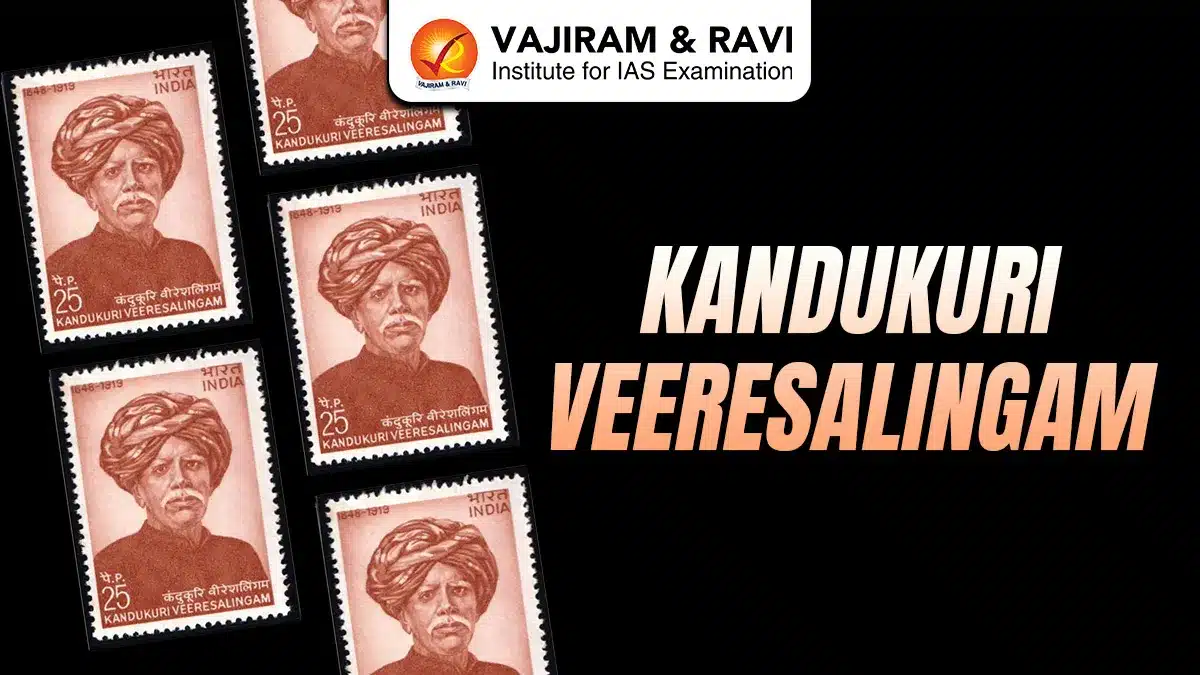
Kandukuri Veeresalingam was a pioneering social reformer, writer and thinker from the Madras Presidency, present day Andhra Pradesh. Widely regarded as the Father of the Telugu Renaissance, he used literature, education and reform movements to challenge deep rooted social evils. Strongly influenced by Brahmo Samaj ideals, he worked relentlessly for women’s education, widow remarriage and rational thinking. His fearless activism against child marriage, dowry and orthodoxy reshaped Telugu society and laid a strong foundation for social modernity in Andhra.
Kandukuri Veeresalingam Biography
Kandukuri Veeresalingam was born on 16 April 1848 in Rajahmundry to Subbarayudu and Poornamma, Veeresalingam faced early hardships including smallpox in infancy and his father’s death at four. Adopted by his uncle Venkataratnam, he excelled academically, completing matriculation in 1869. He began his career as a teacher in Korangi village and later emerged as a powerful reformist intellectual. A scholar of Telugu, Sanskrit and Hindi, he combined rational thought with compassion, earning titles like “Gadya Tikkana” and comparisons with Raja Ram Mohan Roy for his reformist courage. He passed away on 27 May 1919.
Kandukuri Veeresalingam Books
Veeresalingam used literature as a reform tool, writing novels, plays, journals and essays to challenge superstition and promote social equality. Few of the major literary contributions and writing of Veeresalingam are:
- Rajasekhara Charitramu: Published in 1880 after serialisation from 1878, it is recognised as the first Telugu novel, inspired by Oliver Goldsmith’s The Vicar of Wakefield, exposing social hypocrisy through simple narrative.
- Prahlada (1886): This Telugu play blended devotion with moral instruction, using familiar mythological themes to subtly promote ethical conduct, rational thinking and social responsibility among common readers.
- Satya Harischandra (1886): Through this play, he highlighted truth, sacrifice and integrity, presenting moral values in an accessible dramatic form suitable for mass social awareness.
- Viveka Vardhini (1876): A reformist journal started to discuss women’s education, widow remarriage and social evils, initially printed in Madras and later from his own press in Rajahmundry.
- Satihita Bodhini: A monthly magazine dedicated to women, focusing on education, health and moral independence, aimed at empowering women through knowledge and informed discussion.
Kandukuri Veeresalingam Contributions
Kandukuri Veeresalingam’s contributions spanned social reform, women empowerment, education, literature, religion and early nationalist political engagement. He dedicated his life for various causes as highlighted below:
- Women’s Education Promotion: At a time when educating women was taboo, he strongly advocated girls’ schooling, wrote extensively on women’s rights and established institutions supporting female literacy.
- Widow Remarriage Movement: He organised Andhra’s first widow remarriage on 11 December 1881, formed a Remarriage Association and personally helped arrange nearly forty widow remarriages despite violent opposition.
- Opposition to Child Marriage: Veeresalingam openly criticised child marriage, exposing its social and health consequences through essays, debates and reformist writings grounded in scriptural references.
- Fight Against Dowry System: He condemned dowry as immoral and exploitative, using literature and public discourse to encourage simple marriages based on consent and dignity rather than wealth exchange.
- Educational Institutions: He started a school in Dowlaiswaram in 1874 and later established Hithakarini School in 1908 to provide inclusive and progressive education.
- Brahmo Samaj: Inspired by Raja Ram Mohan Roy, Ishwar Chandra Vidyasagar and Keshab Chandra Sen, he propagated rational religion and social equality through Brahmo Samaj principles.
- Brahmo Mandir Establishment: In 1887, he founded Andhra Pradesh’s first Brahmo Mandir at Rajahmundry, making it a centre for reformist thought and ethical discussions.
- Upliftment of Marginalised Groups: He worked for Harijan upliftment, social equality and human dignity, promoting compassion, justice, courage and humanism as core social values.
- Political Awareness: Veeresalingam attended the first Indian National Congress session in 1885, showing his engagement with early nationalist politics and constitutional reform ideas.
- Literary Renaissance: Through prose, satire, drama and journalism, he modernised Telugu literature, introduced new genres and used simple language to reach ordinary people effectively.
Kandukuri Veeresalingam Awards and Honours
Kandukuri Veeresalingam received national recognition during and after his lifetime for his exceptional service to social reform and literature.
- Rao Bahadur Title (1893): The British Government conferred this title in recognition of his fearless social reform work, especially his leadership in women’s education and widow remarriage.
- Postage Stamp Honour (1974): India Post issued a 25 paisa commemorative stamp acknowledging his lasting contribution to social reform and Telugu literary renaissance.
- Statue at Visakhapatnam: His statue on Beach Road, Visakhapatnam, stands as a public tribute to his lifelong struggle against social injustice and orthodoxy.
- Kandukuri Awards by Andhra Pradesh: The state government instituted annual Kandukuri Awards on his birth anniversary, honouring excellence in theatre, literature and performing arts.
- Title and Legacy: He is remembered as the “Father of Telugu Renaissance” and “Raja Ram Mohan Roy of Andhra,” his name remains synonymous with reform, rationalism and social courage.
Kandukuri Veeresalingam FAQs
Q1: Who was Kandukuri Veeresalingam?
Ans: Kandukuri Veeresalingam was a social reformer and writer from Andhra Pradesh, known as the Father of the Telugu Renaissance movement.
Q2: Why is Kandukuri Veeresalingam called the Father of Telugu Renaissance?
Ans: He modernised Telugu literature and society by promoting rational thinking, social reforms, women’s education and progressive ideas through writing and activism.
Q3: What was Kandukuri Veeresalingam’s major social reform?
Ans: His most important reform was promoting widow remarriage and women’s education while strongly opposing child marriage and the dowry system.
Q4: Which book made Kandukuri Veeresalingam famous?
Ans: His novel Rajasekhara Charitramu, published in 1880, is regarded as the first novel in Telugu literature.
Q5: What honour was given to Kandukuri Veeresalingam?
Ans: He was awarded the title “Rao Bahadur” in 1893 for his significant contributions to social reform and public welfare.
