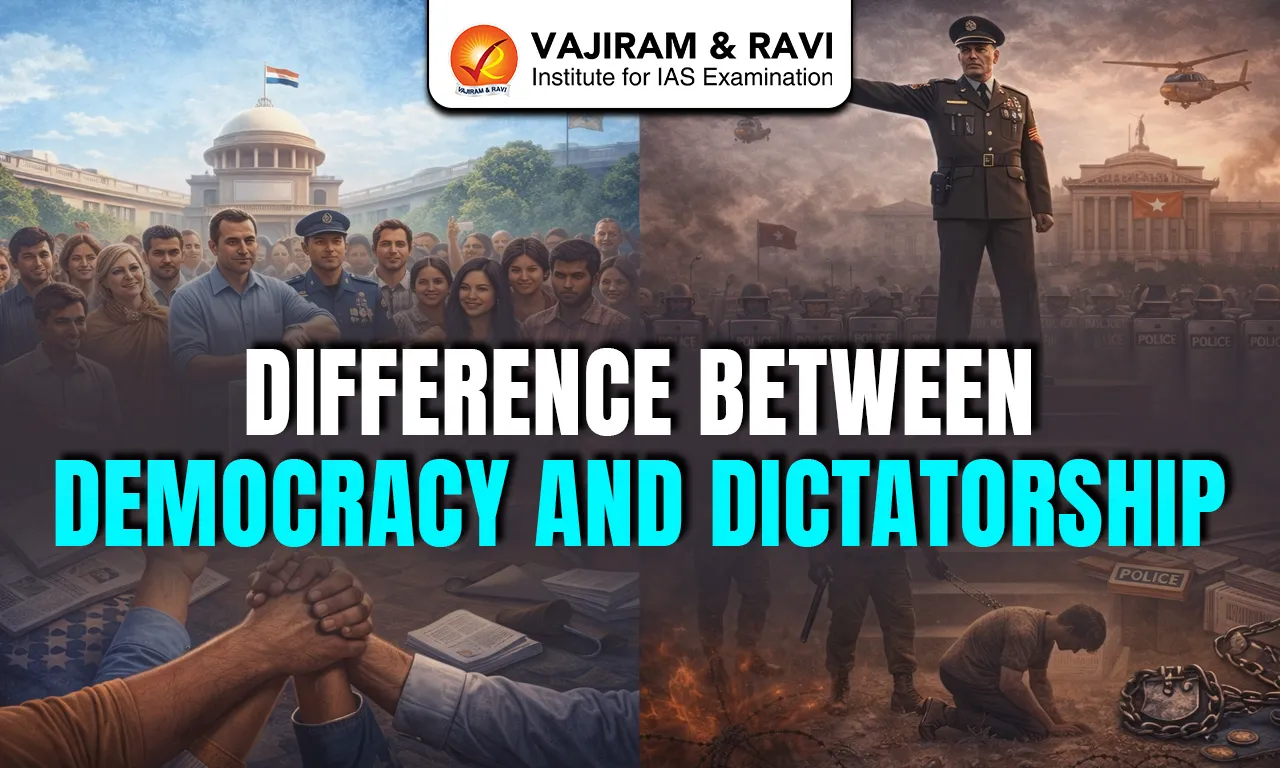
Difference between Democracy and Dictatorship, Key Differences

Difference between Democracy and Dictatorship

Democracy and dictatorship are two different systems of government. In a democracy, the people have the power and choose their leaders through elections, with rights and freedoms protected. In a dictatorship, power is concentrated in the hands of one person or a small group, and citizens have limited influence and fewer freedoms. The Difference between Democracy and Dictatorship is highlighted below to get a clear understanding.

Difference between Democracy and Dictatorship

Democracy and dictatorship are two opposite ways of running a country. In a democracy, people have the power to choose their leaders and participate in decision-making and individual freedoms are respected. In a dictatorship, all power rests with a single leader or group, who control the government and citizens’ lives, often without accountability. The Difference Between Democracy and Dictatorship are discussed below in detail.

Difference between Democracy and Dictatorship
Basis Democracy Dictatorship

Source of Power

Power comes from the people. Citizens elect representatives who govern on their behalf (popular sovereignty).

Power is concentrated in the hands of one person or a small group. Authority is often maintained through force, control, or manipulation.

Leadership Selection

Leaders are chosen through free and fair elections. Citizens have a voice in governance.

Leaders often come to power without genuine elections or through manipulation. Opposition is suppressed.

Political Freedoms

Citizens enjoy rights like freedom of speech, assembly and participation in politics.

Political freedoms are restricted. Dissent is punished and opposition is banned.

Media & Information

Free and independent media acts as a watchdog, reporting government actions and holding leaders accountable.

The media is controlled by the government. It spreads only favorable information, suppressing criticism.

Decision-Making

Decisions are made after discussion, debate and consultation among representatives.

Decisions are made centrally by the dictator or ruling group. Public opinion is usually ignored.

Checks and Balances

Institutions like the judiciary, legislature, and independent commissions prevent abuse of power.

Institutional checks are weak or absent. The ruler has almost complete control.

Inclusivity

Encourages representation of minorities and diverse opinions in governance.

Limited pluralism. Only the ruler’s decisions and ideology dominate; alternative voices are suppressed.

Transparency

Governance is open. Citizens can access information and hold leaders accountable.

Lack of transparency. Decisions are often secret, and citizens have little understanding of government actions.

Individual Rights

Fundamental rights are protected. People can join political parties, groups and express opinions freely.

Individual rights are often violated. Citizens may face monitoring, repression or state violence.

Transition of Power

Power changes peacefully through regular, constitutional elections.

Power changes often through force, hereditary succession or coups.

Examples

Democracy: India, United States, Germany, Canada, Japan

Dictatorship: North Korea, Syria, Cuba, Belarus

Democracy

Democracy is a form of government where the people hold the real power. Citizens participate in decision-making through free and fair elections, ensuring that leaders represent the will of the people. A democratic government protects individual rights, freedoms, and the rule of law, and it aims to balance the needs of both the majority and minorities. Transparency, accountability, and inclusiveness are key features that make democracy work.

  • Characteristics of Democracy
    • Popular Sovereignty: People are the ultimate source of power and are encouraged to actively participate in governance.
    • Elections: Free, fair and regular elections allow citizens to choose their leaders and hold them accountable.
    • Individual Rights: Democracy protects personal freedoms, equality, and basic human rights.
    • Rule of Law: Laws apply equally to everyone, and justice is fair and impartial.
    • Transparency and Accountability: Leaders are answerable to the people, and government actions are open to public scrutiny.
  • Examples of Democracy
    • India: The largest democracy in the world, with elected representatives at both central and state levels in a federal parliamentary system.
    • United States: A federal democratic republic where officials are elected at local, state, and national levels.
    • United Kingdom: A parliamentary democracy where citizens elect Members of Parliament to represent them in the House of Commons.
    • Germany: A federal parliamentary republic where citizens elect representatives to the Bundestag.
    • Canada: A federal parliamentary democracy where the Prime Minister is elected indirectly through the Parliament.
  • Democracy is not just about elections; it is about ensuring everyone’s voice is heard, protecting rights, and creating a government that serves the people fairly and responsibly. It encourages participation, debate, and compromise, helping societies grow peacefully and fairly.

Dictatorship

A Dictatorship is a form of government where all power is held by a single person or a small group, called the dictator. Dictators often gain power through force or manipulation rather than elections. In this system, decisions can be made quickly, but citizens have very little freedom or say in how the country is run. Political opposition is usually suppressed, and individual rights are often ignored.

  • Characteristics of a Dictatorship
    • Concentration of Power: One person or a small group controls all aspects of government.
    • Authoritarian Rule: Power is maintained through force, threats or strict control rather than democratic processes.
    • Limited Political Freedoms: Opposition parties, protests and criticism of the government are often banned or punished.
    • Lack of Checks and Balances: Institutions like courts or legislatures cannot limit the dictator’s power.
    • Rapid Decision-Making: Decisions are made quickly, but citizens’ participation and rights are often ignored.
  • Examples of Dictatorships
    • North Korea: Ruled by the Kim family in a hereditary one-party system with tight control over politics and society.
    • Cuba: Led by the Communist Party with limited political freedom, historically under Fidel Castro.
    • Syria: Long-term authoritarian rule under the Assad family, suppressing dissent.
    • Zimbabwe: Robert Mugabe’s rule, marked by economic problems and political repression.
  • Dictatorships can make decisions fast, but this often comes at the cost of people’s freedoms and equality. Unlike democracy, citizens have very little role in governance, and dissent is not tolerated.
Also Check Related Articles
Difference between NITI Aayog and Inter-State Council Difference Between Economic Survey and Union Budget
Difference Between Tropical Evergreen and Tropical Deciduous Forests Difference Between Ordinary Bill and Money Bill
Difference Between Legislative and Executive Difference between Himalayan and Peninsular Plateau
Difference Between Vedas and Upanishads Difference Between Scheduled and Non-Scheduled Banks
Difference Between Written and Unwritten Constitution Difference between NITI Aayog and Planning Commission
Difference between Colonialism and Imperialism Difference between Fundamental Rights and Directive Principles of State Policy
Difference between Procedure Established by Law and Due Process of Law Difference Between Democracy and Republic
Difference between Creamy Layer and Non-Creamy Layer of OBC Difference between Rajya Sabha and Vidhan Sabha
Difference Between Western Ghats and Eastern Ghats

Difference between Democracy and Dictatorship FAQs

Q1: What is democracy?

Ans: Democracy is a system of government where people hold the power. Citizens choose leaders through free and fair elections, and their rights, freedoms and the rule of law are protected.

Q2: What is dictatorship?

Ans: A dictatorship is a government where all power is held by one person or a small group. Leaders often come to power through force or manipulation and citizens have limited rights and influence.

Q3: What are the main characteristics of democracy?

Ans: Popular sovereignty, free elections, protection of individual rights, rule of law, transparency, accountability and inclusiveness.

Q4: What are the main characteristics of dictatorship?

Ans: Concentration of power, authoritarian rule, limited political freedoms, lack of checks and balances, and rapid centralized decision-making.

Q5: How do elections and political participation differ?

Ans: In democracy, elections are free, fair, and regular, allowing citizens to participate. In dictatorship, elections are absent or controlled and opposition is often suppressed.
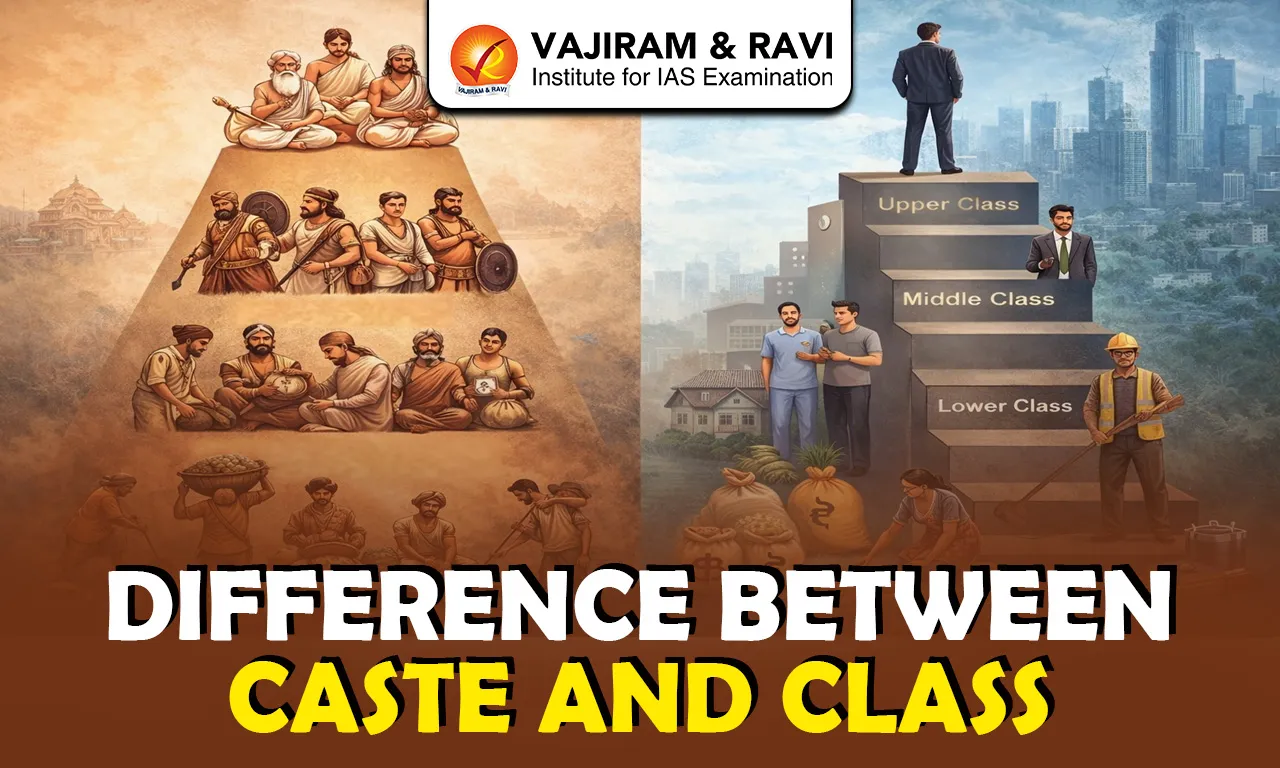
Difference Between Caste and Class, Heredity, Mobility, Religion

Difference Between Caste and Class

Caste and class are two ways society organizes people, but they are different. Caste is a social group people are born into, often linked to religion, tradition, and fixed social roles. Class is based on economic status, education, or occupation and people can move between classes. While caste is rigid and hereditary, class is more flexible and can change over a person’s life. The Difference Between Caste and Class has been discussed below in this article.

Difference Between Caste and Class

Caste and class are two ways of dividing people in society based on social and economic factors. While caste is mostly hereditary and fixed by birth, class is largely based on wealth, education, occupation and achievements and allows mobility. The table below explains the Difference Between Caste and Class in detail.

Difference Between Caste and Class
Basis Caste Class

Definition

A hereditary social group with fixed status, rituals and customs, mostly unique to India.

A group based on social and economic factors like wealth, education, occupation, and achievements. Found worldwide, especially in industrial societies.

Hereditary vs Achieved

Determined by birth; people cannot move out of their caste.

Determined by personal effort, education, and work; people can move up or down socially.

Traditions and Customs

Strictly follow customs, rituals, and social rules.

No fixed rituals or customs; lifestyle depends on individual choice and opportunities.

Marriage Rules

Intercaste marriages often face social and family conflicts.

Marriages across classes usually do not create conflicts.

Occupational Mobility

Very limited; people usually continue in traditional family occupations, even if skilled or educated.

Flexible; individuals can choose occupations based on education, skills, or interests.

Relation to Religion

Closely linked to religion and ritual purity.

Not linked to religion; purely social and economic.

Social Gap

Large gaps between higher and lower castes; can create social tensions and affect national progress.

The gap exists but is smaller and less rigid; social mobility is possible and contributes to equality.

Flexibility

Static - caste cannot change; vertical mobility is almost impossible.

Dynamic - class position can change over time; vertical mobility is possible.

Democracy & Equality

Limits opportunities for social mobility; less favorable for democratic equality.

Supports democracy; mobility and opportunity are based on merit and achievement.

Political Influence

Caste often acts as a strong political factor in elections and social movements.

Class does not usually act as a political force.

Inequality Type

Cumulative inequality - disadvantages are passed on generation after generation.

Dispersed inequality - based on personal achievements; not necessarily inherited.

Global Context

Mostly unique to India and South Asia; linked to traditional and ritualistic norms.

Common in industrialized and developed countries; based on social, economic, and educational factors.

Key Feature

Rigid, hereditary, and tied to religion and customs. Restricts marriage, occupation, and mobility.

Flexible, merit-based, allows personal choice in occupation and social status. Inequalities are not inherited.

Caste

  • Caste is a social system in which people are born into specific groups that often determine their occupation, social status, and relationships. In India, the Hindu caste system is the most well-known example. It divides Hindus into four main groups: Brahmins, Kshatriyas, Vaishyas and Shudras. Over time, these groups developed 3,000 major subgroups and around 25,000 sub-castes, based mostly on traditional professions.
  • This system historically did not include Dalits (also called Untouchables), who were considered outside the main caste hierarchy. Among the main castes, Brahmins and Kshatriyas were considered the highest, while Dalits faced severe social discrimination and were the most vulnerable.
  • The caste system has its roots in ancient India, and the strict social divisions have shaped community life for centuries. Even today, these divisions influence social interactions, marriage, and politics in some areas, though urbanization, education and legal protections have reduced its economic and social impact.
  • In modern India, while caste continues to affect social identity, there are increasing opportunities for education, employment, and mobility, which allow people to move beyond traditional caste roles. This makes caste less rigid than it was in the past, though its cultural and social influence remains significant.

Class

  • Class refers to a person’s social and economic position in society. It is mostly determined by factors like wealth, occupation, education, income and sometimes caste. Unlike caste, class is not fixed by birth and allows social mobility. People can improve their position through education, hard work or business success.
  • Social classes are usually seen as groups of people who share similar economic conditions and lifestyles. For example, some people belong to the ruling elite, educated elite, middle class, working class, or lower class, depending on their income, education, and occupation.
  • According to Karl Marx, class is also about relationships in production the way wealth and resources are distributed between the rich and the poor. Marx highlighted the idea of class conflict, where workers often have little control over their work and have to follow the instructions of those in higher classes, while the rich benefit from their labor.
  • In modern society, class influences opportunities, access to education, healthcare and living standards. However, unlike caste, class is flexible. People can move up or down based on their skills, effort and achievements.
Also Check Related Articles
Difference between NITI Aayog and Inter-State Council Difference Between Economic Survey and Union Budget
Difference Between Tropical Evergreen and Tropical Deciduous Forests Difference Between Ordinary Bill and Money Bill
Difference Between Legislative and Executive Difference between Himalayan and Peninsular Plateau
Difference Between Vedas and Upanishads Difference Between Scheduled and Non-Scheduled Banks
Difference Between Written and Unwritten Constitution Difference between NITI Aayog and Planning Commission
Difference between Colonialism and Imperialism Difference between Fundamental Rights and Directive Principles of State Policy
Difference between Procedure Established by Law and Due Process of Law Difference Between Democracy and Republic
Difference between Creamy Layer and Non-Creamy Layer of OBC Difference between Rajya Sabha and Vidhan Sabha
Difference Between Western Ghats and Eastern Ghats

Difference Between Caste and Class FAQs

Q1: What is the main difference between caste and class?

Ans: Caste is hereditary, fixed, and tied to religion and traditions, while class is based on wealth, education, occupation and personal achievements, allowing mobility.

Q2: How does caste influence occupation and marriage?

Ans: Caste often dictates traditional occupations and restricts marriages within the same caste. Class does not restrict marriage or work choices.

Q3: Which system supports democracy and social equality more?

Ans: Class supports democracy and equality because it allows mobility based on merit. Caste limits opportunities and can hinder equal social participation.

Q4: How does inequality differ in caste and class?

Ans: Caste shows cumulative inequality, passed across generations. Class shows dispersed inequality, depending on personal effort and achievements.

Q5: Can people change their caste or class?

Ans: Caste is almost impossible to change as it is determined by birth. Class is flexible, and people can move up or down through education, work or income.

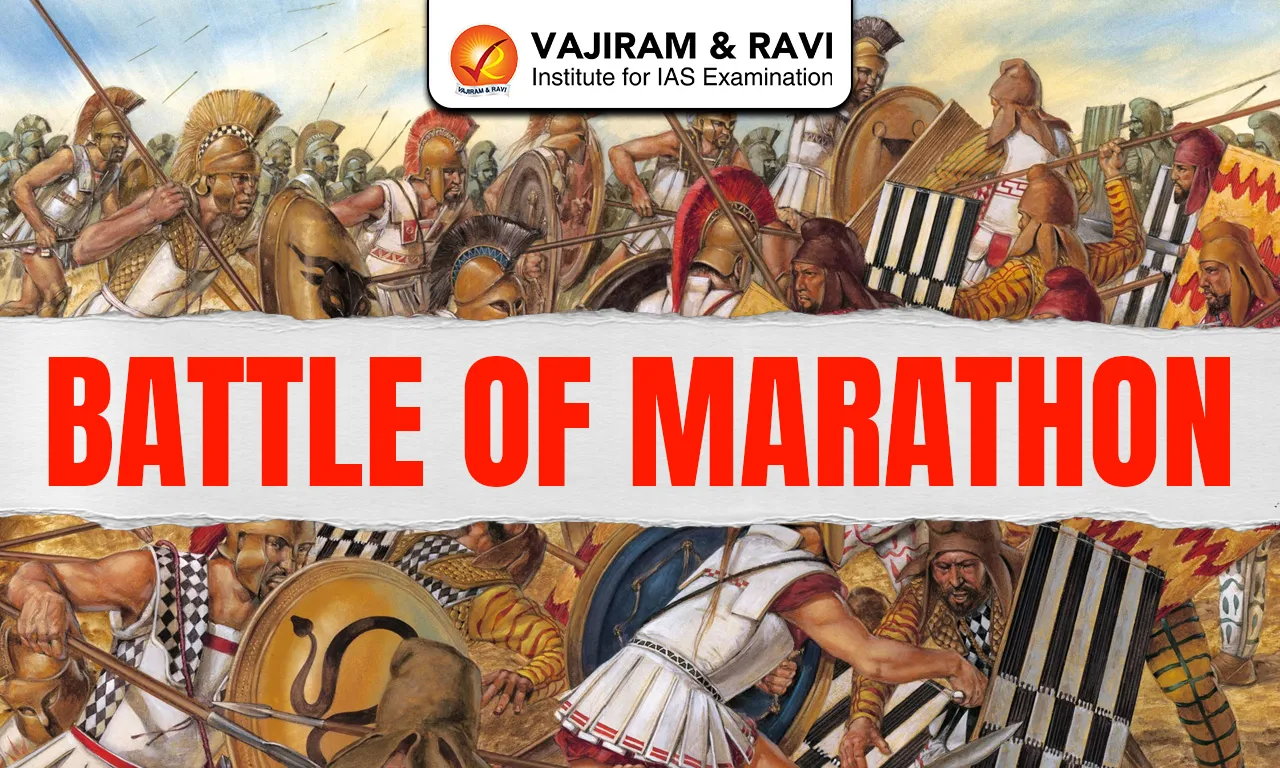
Battle of Marathon, Background, Course, Causes, Significance

Battle of Marathon

The battle of Marathon was fought in 490 BCE between the Greek city-state of Athens and the Persian Empire. It is considered historically significant because it demonstrated that a smaller, well-organised army could defeat a much larger imperial force through strategy and discipline.

Battle of Marathon Background 

By the late 6th century BCE, the powerful Persian Empire under Darius I had conquered vast territories stretching from Asia Minor to parts of Europe. The Greek cities of Ionia (in present-day Turkey) were under Persian control. In 499 BCE, these Ionian cities revolted against Persian rule. Athens and Eretria sent ships and soldiers to support the revolt. Although the revolt was eventually crushed, Darius was angered by Athenian interference and decided to punish Athens.

In 490 BCE, the Persian army first attacked and destroyed Eretria and then landed at the Marathon plain, located about 40 kilometres from Athens. Marathon was strategically chosen because it provided suitable terrain for Persian cavalry and posed a direct threat to Athens.

Read about: Important Battles in Indian History

Course of the Battle

The Battle of Marathon was fought between the Persian army and the Athenian citizen army led by Athenian generals, especially Miltiades. The Greek army was smaller in number but was well organised and used superior battlefield tactics. The Greeks mainly relied on heavily armed infantry soldiers called hoplites, who fought in close formation. The Persian army had a larger force and strong cavalry units, but the Marathon plain limited the effectiveness of Persian cavalry movement. Miltiades adopted a surprise attack strategy by strengthening the Greek wings while keeping the centre slightly weaker. When the battle began, the Greek wings advanced and surrounded the Persian forces from both sides, creating a pincer-like attack. This tactical formation helped the Greeks defeat the Persian army despite numerical disadvantage, forcing the Persian forces to retreat from the battlefield.

Battle of Marathon Causes

  • Persian Revenge: The Persian king Darius I was angry because Athens and Eretria had helped the Greek cities in Ionia (modern Turkey) revolt against Persia in 499 BCE. He wanted to punish Athens for interfering.
  • Expansion of the Persian Empire: Persia wanted to extend its control into mainland Greece and make the Greek city-states part of its empire.
  • Political Ambition: Darius wanted to restore Hippias, the former tyrant of Athens, to power. This would weaken Athenian democracy and bring Athens under Persian influence.
  • Strategic Location: Controlling Athens and its surrounding region would give Persia control over important trade routes in the Aegean Sea and strengthen its western frontier.
  • Support for the Ionian Revolt: The immediate spark was Athens sending help to the Ionian rebels, which Darius saw as a direct challenge to his authority.

Battle of Marathon Significance 

  • The victory helped protect Athens and prevented early Persian domination of mainland Greece.
  • The defeat of Persia boosted confidence in the democratic political system of Athens.
  • The battle showed that disciplined citizen soldiers could defeat a larger imperial army through strategy and organisation.
  • The battle slowed Persian westward expansion into Greece.

Battle of Marathon FAQs

Q1: When was the Battle of Marathon fought?

Ans: The Battle of Marathon was fought in 490 BCE between the Greek city-state of Athens and the Persian Empire.

Q2: Who led the Greek army in the Battle of Marathon?

Ans: The Greek army was mainly led by Athenian General Miltiades.

Q3: Why is the Battle of Marathon important in history?

Ans: The battle is important because it showed that strategy, discipline, and organisation can help a smaller army defeat a larger force.

Q4: What was the main cause of the Battle of Marathon?

Ans: The main cause was Persian anger over Athens and Eretria supporting the Ionian revolt against Persian rule.

Q5: What is the historical legacy of the Battle of Marathon?

Ans: The battle became a symbol of resistance against imperial expansion and later inspired the modern marathon running event.

Difference Between Dengue and Malaria, Regions, Initiatives

Difference Between Dengue and Malaria

Dengue and Malaria are mosquito-borne diseases causing heavy global burden. According to the World Health Organization, Dengue infects 100-400 million people annually, while Malaria recorded 229 million cases in 2019. Both spread through specific mosquito species but Difference Between Dengue and Malaria lies in cause, symptoms, transmission and complications.

Difference Between Dengue and Malaria

Difference Between Dengue and Malaria is based on causative agent, vector behavior, incubation, symptoms, diagnosis, treatment and complications as highlighted below:

Difference Between Dengue and Malaria

Aspect

Dengue

Malaria

Causative Agent

Caused by Dengue virus (DENV), a tropical viral infection.

Caused by Plasmodium protozoan parasite infecting red blood cells.

Vector

Spread by Aedes aegypti mosquito, active during daytime.

Spread by female Anopheles mosquito, mainly bites at night.

Transmission Mode

Mainly through infected mosquito bite.

Also due to Mosquito bite

Incubation Period

Symptoms appear within 3-14 days after bite.

Fever begins 9-14 days post mosquito bite.

Regions Affected

Predominantly urban areas of Africa, Americas, Southeast Asia.

Mostly rural in Sub-Saharan Africa, West Africa, Central Africa, Eastern Africa, South America (Amazon Basin), Southeast Asia (India, Indonesia), parts of the Middle East and Oceania.

Fever Pattern

Sudden high fever with headache and rashes.

Cyclic fever with chills, sweating, periodic spikes.

Symptoms

Burning eyes, gum bleeding, limb rashes.

Vomiting, dry cough, fainting, recurrent chills.

Diagnosis

Confirmed through antigen and antibody blood tests.

Diagnosed by microscopic blood smear examination.

Treatment

Supportive care; fluid management essential.

Treated with anti-Malarial drugs

Severe Complications

Dengue hemorrhagic fever may affect heart and lungs.

Kidney failure, liver dysfunction, lung fluid retention.

Initiatives to Eradicate

World Mosquito Program used Wolbachia strategy in Indonesia, reducing cases by 77% in 27 months; Dengvaxia approved in 2019 for eligible endemic populations.

World Malaria Day observed on 25 April; WHO Global Malaria Programme launched 2015; India runs NMCP 1953, NVBDCP 2003, MERA-India 2019 and National Strategic Plan targeting zero transmission by 2030.

Also Read: Communicable Diseases

Difference Between Dengue and Malaria FAQs

Q1: What is the main Difference Between Dengue and Malaria?

Ans: Dengue is caused by a virus, while Malaria is caused by a Plasmodium parasite infecting red blood cells.

Q2: Which mosquito spreads Dengue and Malaria?

Ans: Dengue spreads through Aedes aegypti mosquito bites during daytime, whereas Malaria spreads through female Anopheles mosquito bites at night.

Q3: Can Dengue and Malaria become life threatening?

Ans: Yes. Severe Dengue may lead to hemorrhagic complications, while severe Malaria can cause organ failure including kidney and liver dysfunction.

Q4: What international steps have been taken to control Dengue?

Ans: The World Mosquito Program applied the Wolbachia population replacement method, reducing Dengue cases by 77% in field trials; Dengvaxia was approved in 2019 for eligible endemic groups.

Q5: What major programmes aim to eliminate Malaria?

Ans: WHO launched the Global Malaria Programme in 2015, while India’s National Strategic Plan 2023-27 targets zero indigenous Malaria cases and elimination by 2030.

Nuclear Power Plants in India, List, Location, Capacity, Reactor Type

Nuclear Power Plants in India

The fifth largest source of electricity in India is Nuclear Power after thermal, hydroelectric and renewable sources of electricity. Currently, there are 22 Nuclear Power Plants in India operating in seven states with 8.18 GW (targeted 100 GW by 2047) out of which 18 reactors are Pressurized Heavy Water Reactors (PHWRs) and 4 are Light Water Reactors (LWRs).  The responsibility for generating nuclear power in India lies with the Nuclear Power Corporation of India Limited (NPCIL), a public sector enterprise headquartered in Mumbai. NPCIL functions under the administrative control of the Department of Atomic Energy, Government of India.

Nuclear Power Plants in India

Nuclear Power Plants in India play an important role in energy resources which ensure a balanced and sustainable power supply. Recognised as a clean and environment-friendly option, Nuclear Power serves as a reliable energy source available. The Government of India has launched Nuclear Energy Mission through the Union Budget 2025-26. The mission focused on the Small Modular Reactor with target of 5 indegenous SMRs by 2033. The First Nuclear Reactor of Asia was Apsara commissioned in Mumbai, marking a significant milestone in the atomic journey of India.

Nuclear Power Plants in India List

Nuclear Power Plants in India span multiple states, with all commercial nuclear power plants operated by the Nuclear Power Corporation of India Limited (NPCIL). These facilities employ a range of reactor technologies, including Pressurized Heavy Water Reactors (PHWRs), Light Water Reactors (LWRs), and Fast Breeder Reactors (FBRs). Below is a List of Nuclear Power Plants in India currently in operation.

List of Nuclear Power Plants in India

Nuclear Power Plant

Location

Reactor Type

Capacity (MW)

Tarapur Atomic Power Station Units 1 and 2

Maharashtra

Pressurized Heavy Water Reactor (PHWR)

2 x 160

Tarapur Atomic Power Station Units 3 and 4

Maharashtra

PHWR

2 x 540

Rajasthan Atomic Power Station Units 1 and 2

Rajasthan

PHWR

2 x 100

Rajasthan Atomic Power Station Units 3 and 4

Rajasthan

PHWR

2 x 220

Kakrapar Atomic Power Station Units 1 and 2

Gujarat

PHWR

2 x 220

Kudankulam Nuclear Power Plant Units 1 and 2

Tamil Nadu

Pressurized Water Reactor (PWR)

2 x 1,000

Under Construction Nuclear Power Plants in India List

Below are the List of Nuclear Power Plants in India currently under construction in India. The table includes key details such as the location of each plant, reactor type, installed capacity, and the expected year of completion. 

List of Nuclear Power Plants in India (Under Construction)

Name

Location

Reactor Type

Capacity (MW)

Expected Completion

Kakrapar Atomic Power Plant Units 3&4

Gujarat

Pressurized Heavy Water Reactor

700

2024

Kalpakkam Power Plant

Tamil Nadu

Prototype Fast Breeder Reactor

500

20244

Rajasthan Atomic Power Plant Units 7&8

Rajasthan

Pressurized Heavy Water Reactor

700

2023-24

Kudankulam Nuclear Power Plant Units 3&4

Tamil Nadu

VVER-1000

1000

2026-27

Gorakhpur Nuclear Power Plant Units 1&2

Haryana

Pressurized Heavy Water Reactor

700

2029-30

Proposed Nuclear Power Plants In India List

Below are the Nuclear Power Plants In India that are planned for future development in India. The list includes the location of each site and the planned power generation capacity.

Nuclear Power Plants In India (To Be Constructed)

Nuclear Power Plant

Location

Capacity (MW)

Status

Chutka Nuclear Power Plant

Madhya Pradesh

2 x 700

Planned, site clearance obtained

Mahi Banswara Nuclear Power Plant

Rajasthan

2 x 700

Planned, site clearance obtained

Kaiga Nuclear Power Plant Units 5 and 6

Karnataka

2 x 700

Planned, environmental clearance obtained

Bhimpur Nuclear Power Plant

Madhya Pradesh

4 x 700

Planned, pre-project activities underway

Kovvada Nuclear Power Plant

Andhra Pradesh

6 x 1,000

Planned, Pre-Project activities underway

Haripur Nuclear Power Plant

West Bengal

6 x 1,000

Planned, pre-project activities underway

Nuclear Power Plants in India Significance

  • Low Carbon Emissions: Generates minimal greenhouse gases, helping reduce environmental impact and mitigate climate change.
  • High Energy Efficiency: Produces large amounts of electricity from small quantities of nuclear fuel.
  • Enhanced Energy Security: Decreases dependence on imported fossil fuels, supporting national energy independence.
  • Reliable Baseload Supply: Offers a steady and uninterrupted power output, unlike variable sources like solar or wind.
  • Cost-Effective Over Time: While capital-intensive initially, nuclear plants have low long-term operating and fuel costs.
  • Drives Technological Innovation: Promotes R&D in advanced nuclear technologies, including thorium-based reactors.
  • Generates Employment: Creates job opportunities in plant construction, operations, safety, and maintenance.
  • Utilization of Indigenous Resources: Supports India's three-stage nuclear programme through efficient use of domestic thorium reserves.

Also Check: India Nuclear Power 2047

Nuclear Power Plants in India Recent Development

  • Bharat Small Reactors (BSR): India is working on compact, modular reactors designed for flexible deployment and lower costs. These small reactors represent a shift from conventional large plants and involve greater participation from private industry in design and innovation.
  • Expansion of Capacity: The government has set a target to triple the country’s nuclear power capacity by 2032. Currently, six reactors are under construction, with several new large-scale projects in the pipeline.
  • Global Partnerships: India is strengthening international cooperation by securing uranium supplies and partnering with countries like France and Russia for advanced reactor technologies.
  • Focus on Sustainability: The Union Budget 2024 discusses investments in clean energy, including research into low-emission technologies such as ultra-supercritical thermal systems, in line with climate goals.
  • Energy and Climate Alignment: These initiatives collectively aim to address India’s growing energy needs while maintaining commitments to reduce greenhouse gas emissions and promote sustainable development.
  • Sustainable Harnessing and Advancement of Nuclear Energy for Transforming India (SHANTI) Act 2025: The Union Government has introduced the SHANTI Bill further passed by Parliament in December 2025. This act allows the Private Sector to operate and contribute to the Nuclear Energy Sector in India.

Nuclear Power Plants in India Challenges

  • High Capital Investment: Setting up nuclear power plants requires significant upfront costs for infrastructure, advanced technology, and safety systems.
  • Public Resistance: Concerns over radiation, environmental impact, and past global nuclear incidents often lead to local opposition and protests.
  • Fuel Supply Constraints: India's limited domestic uranium reserves make the sector heavily reliant on imports, exposing it to supply chain risks.
  • Radioactive Waste Management: Safely storing and disposing of nuclear waste remains a major technical and environmental challenge.
  • Project Delays: Nuclear projects frequently face execution delays due to regulatory clearances and acquisition issues.
Related Articles
SHANTI Act 2025 India Nuclear Power 2047
Nuclear Energy Nuclear Technology

Nuclear Power Plants in India FAQs

Q1: How many nuclear power plants are there in India (2025)?

Ans: India has 8 nuclear power stations with 23 operational reactors as of 2025.

Q2: Which is India’s first nuclear power plant?

Ans: Tarapur Atomic Power Station (Maharashtra) was India’s first nuclear power plant, commissioned in 1969.

Q3: Which is the largest nuclear power plant in India?

Ans: Kudankulam Nuclear Power Plant in Tamil Nadu is India’s largest, with planned capacity of 6000 MW.

Q4: Who operates nuclear power plants in India?

Ans: All nuclear plants are operated by the Nuclear Power Corporation of India Limited (NPCIL).

Q5: Which Indian state has the most nuclear reactors?

Ans: Tamil Nadu has the highest number of operational nuclear reactors.

Hate Speech and Hate Crime, Legal Framework, Challenges, Reforms

Hate Speech and Hate Crime

In recent times, the Supreme Court has expressed serious concern over the growing instances of hate speech and divisive public communication in public life. The Court has emphasised the importance of constitutional morality and fraternity in maintaining social harmony in a diverse democracy like India. While freedom of speech is a fundamental right, it must operate within constitutional limits that protect equality, dignity, and social harmony.

What is Hate Speech?

As per 267th Law Commission Report (2017), hate speech refers to communication or behaviour intended to promote hostility, discrimination, or violence against individuals or groups based on identity factors such as religion, caste, gender, ethnicity, race, or sexual orientation. It includes any spoken, written, symbolic, or visual expression that aims to create fear, spread hatred, or encourage social violence.

What is Hate Crime?

India does not have a specific legal definition of hate crimes. It refers to actual criminal acts such as violence, harassment, or damage to property motivated by prejudice or bias.

Simply put, hate speech is a harmful expression, while hate crime is a harmful action driven by hatred.

Why Hate Speech is a Serious Concern?

Hate speech is not only a legal issue but also a social and political problem.

  • It can create fear, exclusion, and mistrust among communities.
  • Identity-based narratives may sometimes be used for political mobilisation.
  • Social media platforms can rapidly amplify negative or divisive messages.
  • Repeated exposure to hateful content can normalise discrimination in society.

The Supreme Court has emphasised that public office holders carry greater responsibility because their words influence administrative action and public perception. The Court has also observed that normalisation of discriminatory speech by public authorities can weaken constitutional governance and erode trust in democratic institutions.

Legal Framework in India

India protects freedom of speech under Article 19(1)(a) of the Constitution, but this right is not absolute.

  • Article 19(2) allows reasonable restrictions in the interest of public order, morality, and security.
  • Laws such as the Bharatiya Nyaya Sanhita, 2023 punish promotion of enmity between groups.
  • The SC/ST Prevention of Atrocities Act, 1989 protects marginalised communities from humiliation and violence.
  • The Supreme Court in cases like Shreya Singhal (2015) struck down vague restrictions that could suppress legitimate speech.

Indian courts have repeatedly emphasised that freedom of speech must be balanced with dignity, public order, and social harmony.

  • Shaheen Abdulla v. Union of India (2022): The Supreme Court observed the rising problem of hate speech and directed police authorities to act on their own without waiting for formal complaints in appropriate cases.
  • Tehseen S. Poonawalla v. Union of India (2018): The Court issued guidelines to control mob violence driven by hate narratives and suggested preventive steps such as appointing district nodal officers to monitor communal tensions.
  • Shreya Singhal v. Union of India (2015): The Court struck down Section 66A of the Information Technology Act, 2000 because the provision was vague and could be misused to restrict legitimate free speech.
  • Pravasi Bhalai Sangathan v. Union of India (2014): The Supreme Court urged the government to examine a clearer definition of hate speech and explore regulatory mechanisms.
  • Bilal Ahmed Kaloo Case (1997): The Court clarified that promoting group hatred requires proof of intention to create communal hostility.

Major Challenges

  • Lack of Clear Definition: India does not have a single precise legal definition of hate speech or hate crime, making enforcement and prosecution difficult.
  • Proof of Intent: Courts often face difficulty in establishing the malicious intention behind hate speech or bias-motivated violence.
  • Enforcement Gap: Despite judicial directions, police may not always take suo motu action due to political pressure, weak investigation, or lack of evidence.
  • Algorithm Amplification: Social media algorithms may amplify sensational content, while online anonymity and cross-border hosting of content make regulation difficult.
  • Social and Political Factors: Historical inequalities, social prejudices, and electoral mobilisation based on identity can increase the spread of hate narratives.

Way Forward

  • Clear Legal Framework: India should work towards a precise definition of hate speech and hate crime to improve legal clarity and enforcement.
  • Duty of Restraint for Public Officials: High public office holders should follow constitutional morality and avoid divisive or discriminatory public statements.
  • Strong Enforcement Mechanism: Police authorities should be encouraged to act promptly, including suo motu action against hate speech cases.
  • Digital Regulation: Fast removal of inflammatory online content should be ensured through coordination with social media platforms.
  • Legal and Judicial Measures: Establishment of special fast-track courts can help complete hate crime trials within a fixed time frame.
  • Awareness and Education: Media literacy and constitutional values should be promoted through school education and public awareness programmes.
  • Community Participation: Local peace committees and civil society groups can help prevent escalation of social tensions.

Conclusion 

Freedom of speech is the foundation of democracy, but it must be exercised responsibly. Hate speech and hate crimes threaten social harmony and constitutional values. India’s strength lies in fraternity, equality, and diversity. The real challenge is to protect free expression while preventing communication that promotes violence, discrimination, or social exclusion.

Hate Speech and Hate Crime FAQs

Q1: What is the difference between hate speech and hate crime?

Ans: Hate speech refers to communication that promotes hatred or discrimination against groups, while hate crime refers to actual violent or criminal acts motivated by bias or prejudice.

Q2: Is hate speech punishable in India?

Ans: Yes. Hate speech can be punished under laws such as the Bharatiya Nyaya Sanhita, 2023, and other provisions that prevent promotion of enmity between groups.

Q3: Why is hate speech considered a serious problem?

Ans: Hate speech can create social fear, weaken fraternity, influence public perception, and sometimes be used for political mobilisation.

Q4: Does freedom of speech allow hate speech in India?

Ans: No. Article 19(1)(a) provides free speech, but Article 19(2) allows reasonable restrictions to protect public order, dignity, and security.

Q5: What is the way forward to control hate speech?

Ans: India needs clearer laws, responsible public communication, quick action against online hate content, and greater awareness through education.

UPSC Daily Quiz 21 February 2026

[WpProQuiz 98]

UPSC Daily Quiz FAQs

Q1: What is the Daily UPSC Quiz?

Ans: The Daily UPSC Quiz is a set of practice questions based on current affairs, static subjects, and PYQs that help aspirants enhance retention and test conceptual clarity regularly.

Q2: How is the Daily Quiz useful for UPSC preparation?

Ans: Daily quizzes support learning, help in revision, improve time management, and boost accuracy for both UPSC Prelims and Mains through consistent practice.

Q3: Are the quiz questions based on the UPSC syllabus?

Ans: Yes, all questions are aligned with the UPSC Syllabus 2025, covering key areas like Polity, Economy, Environment, History, Geography, and Current Affairs.

Q4: Are solutions and explanations provided with the quiz?

Ans: Yes, each quiz includes detailed explanations and source references to enhance conceptual understanding and enable self-assessment.

Q5: Is the Daily UPSC Quiz suitable for both Prelims and Mains?

Ans: Primarily focused on Prelims (MCQ format), but it also indirectly helps in Mains by strengthening subject knowledge and factual clarity.

Alauddin Khilji (129-1316 AD), Major Expeditions, Reforms

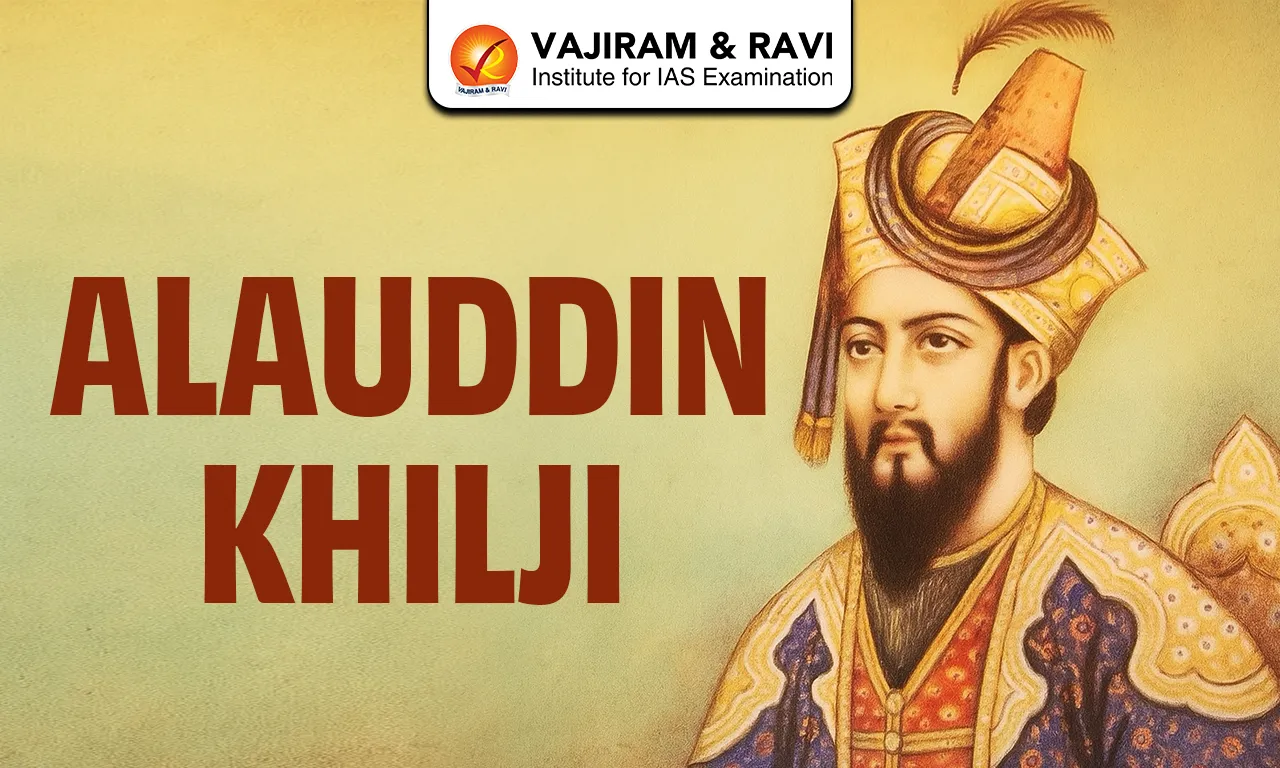
Alauddin Khilji

Alauddin Khilji (1296-1316 AD) was one of the most powerful rulers of the Delhi Sultanate. He belonged to the Khalji Dynasty and ruled for 20 years. His original name was Ali Gurshasp. He is remembered for expanding his empire, defeating Mongol attacks, and introducing strong administrative and market reforms. He came to power by killing his uncle and father-in-law, Jalal-ud-din Firoz Khilji. After becoming Sultan, he removed all possible rivals to secure his throne.

Alauddin Khilji Background

  • Alauddin Khilji was a ruler of the Khalji Dynasty under the Delhi Sultanate.
  • He was the nephew and son-in-law of Jalal-ud-din Firoz Khilji.
  • Before becoming Sultan, he served as the Governor of Kara and Awadh.
    In 1296 AD, he attacked Devagiri and collected huge wealth.
  • Using this wealth, he killed Jalaluddin Khilji and became Sultan in 1296 AD.
  • After taking the throne, he removed rivals to secure his power.
  • He adopted grand titles like Sikander-e-Sani (Second Alexander).
  • His main aim was to expand the empire and strengthen administration.
  • He ruled from 1296 to 1316 AD and became one of the most powerful rulers of the Delhi Sultanate.

Major Expeditions of Alauddin Khilji

  • Alauddin Khilji adopted an aggressive imperial policy to expand the territory of the Delhi Sultanate.
  • His campaigns covered Rajasthan, Gujarat, Central India, and the Deccan region.
  • Most southern expeditions were led by his trusted general Malik Kafur.
  • His victories brought enormous wealth, strengthened administration, and enhanced military power.

1. Gujarat Expedition (1299 AD)

  • Alauddin sent his generals Ulugh Khan and Nusrat Khan to conquer Gujarat, which was ruled by Rai Karan Baghela.
  • The Gujarat army was defeated, and large quantities of gold, silver, and precious items were looted.
  • Kamla Devi, the queen of Gujarat, was captured and brought to Delhi.
  • During this campaign, Malik Kafur was captured and later became Alauddin’s most trusted commander.
  • The conquest helped control important trade ports and increased state revenue.

2. Ranthambore Expedition (1301 AD)

  • The target was Rajput ruler Hamir Dev of Ranthambore, who had given shelter to Alauddin’s enemies.
  • The initial campaign faced resistance, and Nusrat Khan was killed.
  • Alauddin personally led the final assault and captured the fort after a long siege.
  • Rajput women committed Jauhar to avoid capture.
  • Ranthambore was annexed, strengthening Sultanate control in Rajasthan.

3. Chittor Expedition (1303 AD)

  • Chittor was ruled by Rana Ratan Singh of Mewar.
  • The siege lasted nearly seven months due to strong Rajput resistance.
  • After defeat, Rajput women performed Jauhar.
  • Alauddin captured the fort and renamed it Khizrabad after his son Khizr Khan.
  • The victory secured Delhi’s dominance in Rajasthan.

4. Malwa Expedition (1305 AD)

  • Alauddin’s forces attacked the Malwa region in Central India.
  • Important cities such as Ujjain, Mandu, and Dhar were captured.
  • The region was placed under Sultanate administration.
  • This conquest increased political influence in Central India.

5. Devagiri Campaigns (1307–1313 AD)

  • Devagiri was ruled by Ramchandra Deva of the Yadava dynasty.
  • Malik Kafur led the campaign and defeated Ramchandra.
  • Ramchandra accepted Delhi’s authority and agreed to pay tribute.
  • After his death, his son Shankar Deva revolted but was defeated and killed.
  • This brought the Deccan region firmly under Delhi’s control.

6. Warangal (Telangana) Expedition (1309–1310 AD)

  • Malik Kafur attacked Warangal ruled by Pratap Rudra Deva of the Kakatiya dynasty.
  • After resistance, the ruler agreed to pay heavy tribute and accept Delhi’s supremacy.
  • Large amounts of wealth, including diamonds and precious stones, were brought to Delhi.
  • This campaign increased the economic strength of the Sultanate.

7. Dwarasamudra and Madurai Expeditions (1310–1311 AD)

  • Malik Kafur attacked the Hoysala kingdom of Dwarasamudra.
  • The Hoysala ruler accepted Sultanate authority and paid tribute.
  • The army then marched towards Madurai in South India.
  • Southern rulers agreed to pay annual tribute without direct annexation.
  • These campaigns extended Delhi’s influence to far South India.

8. Mongol Invasions (1297–1306 AD)

  • During his reign, several Mongol invasions threatened North India.
  • Alauddin strengthened his army and border defenses.
  • In 1306 AD, Mongols were decisively defeated near the Ravi River.
  • After this victory, Mongol attacks significantly declined.
  • His military reforms ensured long-term security of the northern frontiers.

Major Reforms Under Alauddin Khilji

Alauddin Khilji introduced strict and practical reforms to strengthen the administration and prevent rebellions in the Delhi Sultanate. His reforms mainly focused on administration, market control, military organization, and revenue system to maintain a strong central authority.

1. Administrative Reforms

Alauddin aimed to centralize power and reduce the influence of nobles and religious leaders.

  • Confiscated jagirs (land grants) from nobles to weaken their financial power.
  • Cancelled pensions, waqf (religious endowments), and inam lands.
  • Banned social gatherings, feasts, and matrimonial alliances among nobles to prevent conspiracies.
  • Established a strong spy (intelligence) system to monitor nobles and officials.
  • Prohibited consumption and sale of alcohol and intoxicants in Delhi.
  • Kept religion separate from politics and did not allow Ulema to interfere in administration.

2. Market Reforms

To maintain a large army with low salaries, Alauddin introduced a strict price control system.

  • Fixed prices of essential goods like wheat, rice, sugar, cloth, and horses.
  • Established special markets in Delhi for different commodities.
  • Appointed an officer called Shahana-i-Mandi to supervise markets.
  • Created a department to check hoarding and black marketing.
  • Imposed strict punishments on traders who violated price rules.
  • Maintained government storehouses to control grain supply during famine.

3. Military Reforms

Alauddin strengthened the army to defend against Mongol invasions and expand the empire.

  • Maintained a large standing army directly under the Sultan.
  • Introduced the Dagh system (branding of horses) to prevent fraud.
  • Maintained detailed descriptive rolls (Chehra system) of soldiers.
  • Paid soldiers in cash salary instead of land grants.
  • Strengthened border defenses against Mongols.
  • Appointed Ariz-i-Mumalik as head of the military department.

4. Revenue Reforms

Revenue reforms increased state income and reduced the power of local landlords.

  • Established a separate revenue department called Diwan-i-Mustakhraj.
  • Measured agricultural land to assess tax scientifically.
  • Collected land revenue directly from peasants.
  • Increased land tax up to 50% of the produce in fertile areas.
  • Imposed Jaziya tax on non-Muslims.
  • Reduced the privileges of local chiefs and intermediaries.

Alauddin Khilji FAQs

Q1: Who was Alauddin Khilji?

Ans: Alauddin Khilji was a powerful ruler of the Khalji Dynasty who ruled the Delhi Sultanate from 1296 to 1316 AD.

Q2: What was the original name of Alauddin Khilji?

Ans: His original name was Ali Gurshasp.

Q3: How did Alauddin Khilji become Sultan?

Ans: He became Sultan in 1296 AD after killing his uncle and father-in-law, Jalal-ud-din Firoz Khilji.

Q4: Why is Alauddin Khilji famous?

Ans: He is famous for his military conquests, price control system, military reforms, and for successfully defending India against Mongol invasions.

Q5: What were Alauddin Khilji’s major reforms?

Ans: His major reforms included administrative reforms, market (price control) reforms, military restructuring, and revenue reforms.

Sengol in Parliament, History, Features, Installation Ceremony

Sengol in Parliament

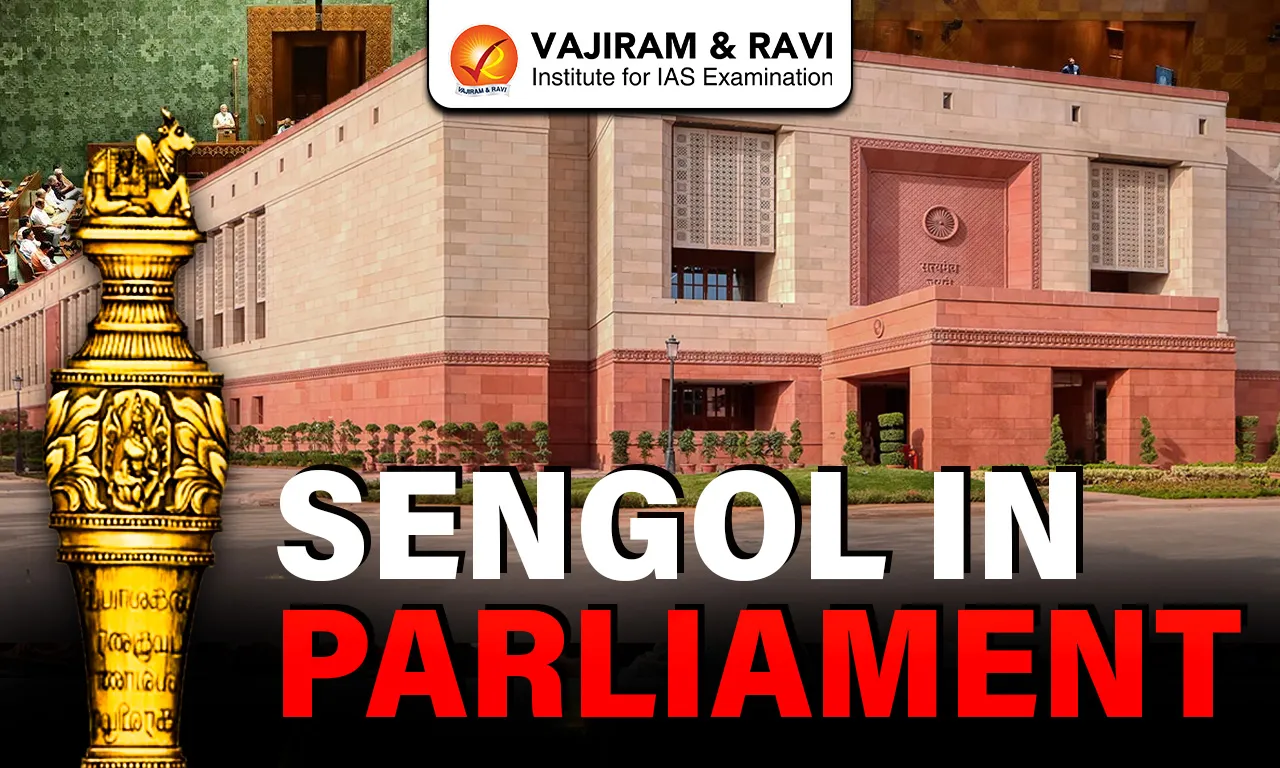
Sengol is a gold plated sceptre that represents righteous authority and ethical governance in India’s democratic journey. The word “Sengol” comes from the Tamil term “Semmai”, meaning righteousness or moral order. This sacred sceptre gained national importance during India’s Independence in 1947 when it symbolised the formal transfer of power. In May 2023, during the inauguration of the new Parliament building, Prime Minister Narendra Modi installed the original Sengol near the Lok Sabha Speaker’s seat, restoring its constitutional and cultural significance for the nation.

Sengol in Parliament

The Sengol has been installed in the Lok Sabha chamber of the new Parliament House in New Delhi, placed prominently beside the Speaker’s podium. It is the same sceptre that was presented to Jawaharlal Nehru on the eve of Independence. It was preserved at the Allahabad Museum in Prayagraj for decades along with several belongings of Nehru. It was relocated in 2023 to mark continuity between India’s freedom moment and present governance.

Sengol in Parliament Historical Background

The Sengol’s origin lies in a traditional Chola Dynasty ritual symbolising legitimate transfer of authority.

  • Lord Mountbatten asked how the British would formally signify power transfer to Indian leadership.
  • C. Rajagopalachari suggested following the Chola coronation custom of handing a sacred sceptre.
  • In the Chola dynasty, a high priest sanctified royal succession by presenting a Sengol to the new ruler.
  • The Thiruvavaduthurai Adheenam was approached to create and bless the sceptre.
  • Vummidi Ethiraju and Vummidi Sudhakar of the Vummidi Bangaru Chetty family designed and handcrafted the 5 foot sceptre in the Madras Presidency.
  • On 14 August 1947, emissaries carried it from Tamil Nadu to Delhi for ceremonial handover.
  • A priest briefly presented it to Mountbatten before transferring it to Nehru at his residence.
  • A devotional hymn composed by 7th century saint Tirugnana Sambandar was sung during the ceremony.
  • After Independence, the sceptre was placed in the Allahabad Museum in Prayagraj for decades.
  • In 2023, it was moved to the new Parliament building.

Sengol in Parliament Features

The design  of Sengol in Parliament reflects symbolic meaning rooted in justice and moral authority.

  • Material Composition: The sceptre is made of silver and coated with gold plating, encasing a solid wooden staff inside.
  • Dimensions: It measures approximately five feet, or about 1.5 metres, in total height. The upper portion has a diameter of around three inches, tapering to nearly one inch at the bottom.
  • Nandi Figure: A seated Nandi bull is placed at the top, symbolising justice, righteousness and vigilance. The Nandi’s steady gaze represents “Nyaya” or fairness, reminding rulers of moral accountability.
  • ‘Aanai’: The recipient of the Sengol receives an “Aanai”, meaning a moral command to govern justly and impartially.
  • Display Arrangement: In Parliament, it is positioned in a glass enclosure near the Speaker’s chair for national visibility.
  • Special Occasions Usage: The Sengol may be ceremonially displayed during important national events connected with parliamentary functioning.
  • Symbol of Amrit Kaal: It has been described as representing a new era of governance rooted in civilisational values and democratic responsibility.

Sengol in Parliament Installation Ceremony

The 2023 installation ceremony of Sengol in Parliament revived the 1947 ritual tradition in a constitutional setting. The key highlights of the Sengol inauguration and installation ceremony are:

  • During the opening of the new Parliament House in May 2023, the Sengol was ceremonially installed in the Lok Sabha chamber.
  • Heads of 20 Adheenams from Tamil Nadu attended and offered blessings, linking the event to historic monastic traditions.
  • Priests sanctified the sceptre with holy water before its placement near the Speaker’s podium.
  • Traditional nagaswaram instruments were played, echoing the cultural practices followed during the 1947 ceremony.
  • Prime Minister Narendra Modi received the Sengol from Adheenam priests before installing it formally.
  • A dedicated website, Sengol1947.ignca.gov.in, was launched to provide historical details and archival material.
  • 96 year old Vummidi Bangaru Chetty craftsmen, associated with its making, was present during the ceremony.
  • Sacred Placement: The Home Minister stated that Parliament is the most appropriate place for this historic symbol of authority.

Sengol in Parliament FAQs

Q1: What does the Sengol represent in Parliament?

Ans: The Sengol represents righteous authority and the moral responsibility of elected leaders to govern with justice, fairness and accountability.

Q2: When was the Sengol first presented to Jawaharlal Nehru?

Ans: The Sengol was presented to Jawaharlal Nehru on 14 August 1947, on the eve of India’s Independence.

Q3: Who suggested using the Sengol as a symbol of transfer of power?

Ans: C. Rajagopalachari suggested adopting the Chola Dynasty tradition of handing over a Sengol to symbolise the lawful transfer of authority.

Q4: What is placed on top of the Sengol and what does it signify?

Ans: A seated Nandi bull is placed on top, symbolising justice, righteousness and ethical governance.

Q5: Where is the Sengol installed in the new Parliament building?

Ans: The Sengol is installed near the Lok Sabha Speaker’s podium in the new Parliament House in New Delhi.

Are Freebies Welfare or Appeasement? Supreme Court Statement

Freebies Appeasement or Welfare ?

The Supreme Court recently questioned the trend of announcing freebies before elections, saying that giving universal benefits despite fiscal stress may amount to appeasement rather than genuine welfare. 

The observations came during the hearing of a petition filed by the Tamil Nadu Power Distribution Corporation challenging Rule 23 of the Electricity Amendment Rules, 2024, which mandates cost-reflective tariffs and no revenue gap between approved expenditure and tariff recovery (except during natural calamities). The Court questioned whether states can continue offering universal free electricity while running revenue deficits.

What are Freebies?

Freebies refer to goods or services provided free of cost or at highly subsidised rates by governments. These may include free electricity, loan waivers, direct cash transfers, free transport, gadgets, or other benefits announced as welfare measures.

Freebies Key features 

Key features of freebies are as follows: 

  • Freebies are generally consumption-oriented rather than productivity-oriented, as they focus more on providing immediate material benefits instead of creating long-term assets or income-generating capacity. 
  • They are often universal in nature instead of being strictly targeted at the most vulnerable sections, which increases their fiscal burden. 
  • In many cases, such schemes may not be backed by proper financial planning or sustainable revenue sources, leading to stress on state finances. 
  • Overall, freebies are typically designed to provide immediate relief to citizens or to serve short-term political and electoral appeal rather than structural economic transformation.

Freebies Recent Examples 

  • Free electricity up to 200 units per month under Gruha Jyoti Scheme (Karnataka).
  • Monthly cash transfer to women under Subhadra Yojana (Odisha).
  • Monthly unemployment allowance for graduates and diploma holders under Yuva Nidhi Scheme (Karnataka).
  • Direct cash transfer to women heads of households under Mukhyamantri Ladli Behna Yojana (Madhya Pradesh).
  • Additional free ration distribution beyond NFSA commitments in several states like Tamil Nadu and Chhattisgarh.
  • Farm loan waiver announcements in states such as Punjab and Karnataka.

Arguments in Favour (Welfare Perspective)

From a welfare point of view, these measures are not just political appeasement but genuine support for people in need. In a country where many struggle with poverty and inequality, government help through subsidies and cash transfers can make a real difference in daily life. So, many so-called freebies are actually welfare steps meant to support inclusive growth.

  • Constitutional Mandate: The Indian Constitution envisions India as a welfare state. The Directive Principles of State Policy support this idea through Article 38, which directs the State to promote social, economic and political justice and reduce inequalities, and Article 39, which ensures equitable distribution of resources and prevents concentration of wealth. 
  • Support to the Poor: Free food, education, healthcare, and targeted cash transfers help vulnerable groups survive economic distress.
  • Human Development: Subsidies for education, nutrition, and health improve long-term productivity and social mobility.
  • Income Support in Crisis: During inflation, pandemics, or unemployment, direct benefit transfers can act as social safety nets.
  • Redistributive Justice: Welfare schemes can reduce regional and socio-economic disparities.

From this perspective, not all freebies are wasteful; some are necessary instruments of inclusive growth.

Arguments Against (Appeasement Perspective)

From the appeasement perspective, excessive freebies strain state finances and reduce funds for long-term development like infrastructure and health. Poor targeting and unplanned spending can increase deficits and public debt. Over time, such measures may encourage dependency and prioritise short-term electoral gains over sustainable economic growth.

  • Fiscal Burden: Many states operate under revenue deficits. Excessive free schemes reduce funds for infrastructure, hospitals, and schools.
    • For Example: As highlighted in the Economic Survey 2025–26, spending on unconditional cash transfers and various populist freebie schemes by states is projected to be around ₹1.7 lakh crore in FY26.
    • The combined gross fiscal deficit of states has also increased from 2.6% of GDP in FY22 to about 3.2% in FY25, while their total outstanding liabilities stand at nearly 28.1% of GDP.
  • Lack of Distinction Between Affluent and Poor: The Supreme Court questioned the absence of differentiation between those who can afford to pay and those who cannot. It observed that providing universal free electricity without distinguishing between affluent households and marginalised sections may amount to appeasement rather than welfare.
  • Unplanned Spending: Justice Joymalya Bagchi said that if states want to give subsidies, they should clearly provide for them in the budget in advance. Announcing benefits suddenly, without proper planning, leads to financial uncertainty and can disturb systems like electricity tariff setting.
  • Opportunity Cost of Public Money: The CJI observed that taxpayer money used for universal freebies could otherwise be spent on infrastructure, hospitals, roads, schools and employment generation. Diverting funds for short-term electoral gains may hamper long-term national development.
  • Dependency Culture: The Court questioned whether continuous distribution of free food, cash transfers, scooters and utilities may discourage work culture and weaken nation-building by reducing incentives for productive engagement.
  • Inter-generational Impact: Mounting public debt today can burden future generations.

Thus, when welfare turns into competitive populism, it risks harming economic stability.

The real question is not whether welfare schemes should exist, but whether they are targeted, transparent, and fiscally sustainable. Essential services for the poor are different from indiscriminate largesse aimed at electoral gains.

Way Forward

  • Budgetary Transparency - A three-judge bench presided over by Chief Justice of India Surya Kant suggested that governments seeking to provide subsidies should include them in their planned expenditure.
  • Clearly differentiate between essential welfare and populist freebies, based on social utility and long-term impact.
  • Target benefits to genuinely vulnerable sections, avoiding universal subsidies for the affluent.
  • Integrate all subsidies into transparent budgetary frameworks under FRBM norms.
  • Encourage conditional and outcome-based transfers, linking benefits to education, health or skill development.
  • Introduce sunset clauses and periodic review mechanisms for schemes.
  • Strengthen voter awareness regarding the opportunity cost of excessive freebies.
  • Ensure disclosure of fiscal implications in party manifestos.

Freebies FAQs

Q1: What are Freebies?

Ans: Freebies refer to goods or services provided free of cost or at highly subsidised rates by governments. These may include free electricity, loan waivers, direct cash transfers, free transport, gadgets, or other benefits announced as welfare measures.

Q2: How are freebies different from welfare schemes?

Ans: Welfare schemes are generally targeted, human-capability enhancing and development-oriented, whereas universal freebies are often consumption-focused and may create fiscal pressure.

Q3: Are freebies appeasement or welfare?

Ans: Freebies can be either welfare or appeasement depending on their design. Targeted, need-based support promotes welfare, while universal and politically motivated distribution may resemble appeasement.

Q4: What are the major concerns associated with freebies?

Ans: Concerns include rising fiscal deficits, crowding out of capital expenditure, dependency culture, electoral populism, and inter-generational debt burden.

Q5: What is the Supreme Court’s concern regarding freebies?

Ans: The Supreme Court has expressed concern that universal freebies, especially when announced before elections, may encourage appeasement politics and fiscal instability.

AI in Healthcare, Promise, Challenges, Way Forward

AI in Healthcare

India is currently witnessing growing discussions about the role of Artificial Intelligence (AI) in healthcare. AI is often presented as a transformative solution that can solve major health system challenges. However, beyond the global excitement, it is important to examine whether AI truly addresses ground realities and whether it strengthens public health systems in a fair and ethical manner.

Promise of AI in Healthcare

The promise of AI in healthcare is reflected in its potential to improve diagnosis, increase efficiency, expand access to quality care, and strengthen overall health system functioning. Its key promises are:

  • Improved Diagnosis: AI can assist doctors in early detection of diseases, especially in radiology, pathology, and screening of chronic illnesses.
  • Better Efficiency: It can reduce paperwork, streamline hospital workflows, and save time for doctors and nurses.
  • Support in Remote Areas: AI-powered tools can help bridge gaps in rural and underserved regions where specialist doctors are scarce.
  • Data-Driven Decision Making: AI can analyse large volumes of health data to identify disease trends and support public health planning.
  • Strengthening Preventive Care: It can help in early risk prediction, monitoring patients, and encouraging timely intervention.
  • Improved Referral Systems: AI can assist in directing patients to appropriate levels of care, reducing overcrowding in tertiary hospitals.
  • Patient Empowerment: AI systems can simplify medical information and make health records more understandable.
  • Rational Drug Use: It can help monitor prescriptions and reduce misuse or overuse of medicines.
  • Cost Reduction in the Long Term: If implemented properly, AI may reduce unnecessary tests and improve resource allocation.
  • Research and Innovation: AI can accelerate medical research, drug discovery, and development of personalised treatment plans.

AI in Healthcare Challenges 

Some major concerns regarding Artificial Intelligence (AI) in healthcare include:

  • Data ownership and digital extractivism: Questions arise about who owns health data, who benefits from it, and who bears the risks. Patients should not be treated merely as sources of data.
  • Right to understand: People must be able to comprehend their medical information. AI systems should simplify complex medical terms rather than create more confusion.
  • Right to control and consent: Consent should not be a one-time formality. Individuals must have the option to withdraw their data and control how it is used.
  • Bias and inequality: If AI systems are trained mainly on urban and privileged populations, they may reinforce caste, gender, regional, and economic inequalities. Regular audits and inclusive data are necessary.
  • Impact on health workers: AI should support health workers, not replace them. There is a risk that technology may be used to justify staff reductions or increase surveillance of frontline workers.
  • Commercialisation of healthcare: If AI is driven by profit-oriented corporate platforms, it may deepen corporatisation instead of strengthening public healthcare.

Another key issue is that India’s health challenges are largely structural. Chronic underinvestment in public health, shortage of trained personnel, weak regulation of private healthcare, and high out-of-pocket expenditure are systemic problems. These cannot be solved by algorithms alone. Over-reliance on AI may lead to “techno-solutionism,” where complex policy problems are treated as purely technical issues.

AI in Healthcare Way forward

  • Adopt a rights-based framework: Ensure patient privacy, data protection, informed consent, and the right to withdraw data at any time.
  • Strengthen public healthcare systems first: AI should complement investments in infrastructure, human resources, and primary healthcare, not replace them.
  • Ensure transparency and accountability: AI algorithms used in healthcare must be explainable, regularly audited, and subject to regulatory oversight.
  • Address bias and ensure inclusivity: Use diverse and representative datasets to prevent caste, gender, regional, and socio-economic discrimination.
  • Keep humans in the loop: Final medical decisions must remain with trained and accountable healthcare professionals. AI should assist, not substitute, doctors and health workers.
  • Protect health workers’ rights: Conduct labour impact assessments before adopting AI tools to ensure no workforce reduction, casualisation, or excessive surveillance.
  • Promote local data processing and data sovereignty: Sensitive health data should be processed locally wherever possible, with strict safeguards against misuse.
  • Ensure equitable access: AI-enabled services developed with public funds must be accessible and affordable within the public health system.
  • Encourage ethical innovation: Public research institutions and startups should be supported to develop AI tools aligned with public interest rather than purely commercial motives.
  • Avoid techno-solutionism: Recognise that AI cannot solve structural issues like underfunding, regulatory gaps, and inequality. Policy reforms and systemic improvements must remain the priority

In conclusion, AI can help improve healthcare in India by supporting diagnosis and making systems more efficient. However, it cannot replace strong public health systems and trained professionals. AI must protect patient rights and work under proper regulation. It should support doctors, not replace them, and strengthen public healthcare. Ultimately, people and human care must remain at the centre of the health system.

AI in Healthcare FAQs

Q1: What is meant by AI in healthcare?

Ans: AI in healthcare refers to the use of artificial intelligence technologies to assist in diagnosis, treatment planning, data analysis, hospital management, and public health decision-making. It helps process large amounts of medical data and supports doctors and health systems in delivering better care.

Q2: How can AI improve healthcare delivery in India?

Ans: AI can improve healthcare by enabling early disease detection, reducing paperwork, improving hospital efficiency, strengthening preventive care, and supporting services in rural and underserved areas where specialist doctors are limited.

Q3: What are the major concerns related to AI in healthcare?

Ans: Key concerns include data privacy, lack of informed consent, bias in algorithms, digital inequality, over-commercialisation, and the risk of reducing the role of human health workers. There are also questions about who owns and benefits from health data.

Q4: Can AI replace doctors and health workers?

Ans: No, AI cannot replace doctors. It can assist in diagnosis and decision-making, but final medical judgement must remain with trained and accountable healthcare professionals. Human empathy, ethical reasoning, and patient interaction cannot be replaced by algorithms.

Q5: What should be the approach for adopting AI in healthcare?

Ans: AI should be adopted within a rights-based and equitable framework that protects patient privacy, ensures transparency, avoids bias, and strengthens public health systems. It must complement investments in infrastructure and human resources rather than substitute them.

Naneghat Caves, Location, importance, Major Caves of Western India

Naneghat Caves

The Naneghat Caves were in the news due to concerns over illegal constructions, infrastructure activities, and environmental damage. The Archaeological Survey of India (ASI) took steps to safeguard the site from encroachments and damage.

Naneghat cave is an example of Rock-cut cave architecture in India. Rock-cut cave architecture is one of the most remarkable achievements of ancient Indian civilization. Rock-cut cave architecture is a style of building in which structures are carved directly into natural rock surfaces such as hills or mountains instead of being built with bricks or stones.

The tradition of carving caves into hills and mountains developed mainly with the spread of Buddhism and Jainism from around the 5th- 4th century BCE. These caves were used as monasteries, meditation spaces, and religious centres. Western India, especially Maharashtra, Karnataka, and parts of Madhya Pradesh, contains some of the finest examples of this architectural tradition.

About Nanaghat Caves 

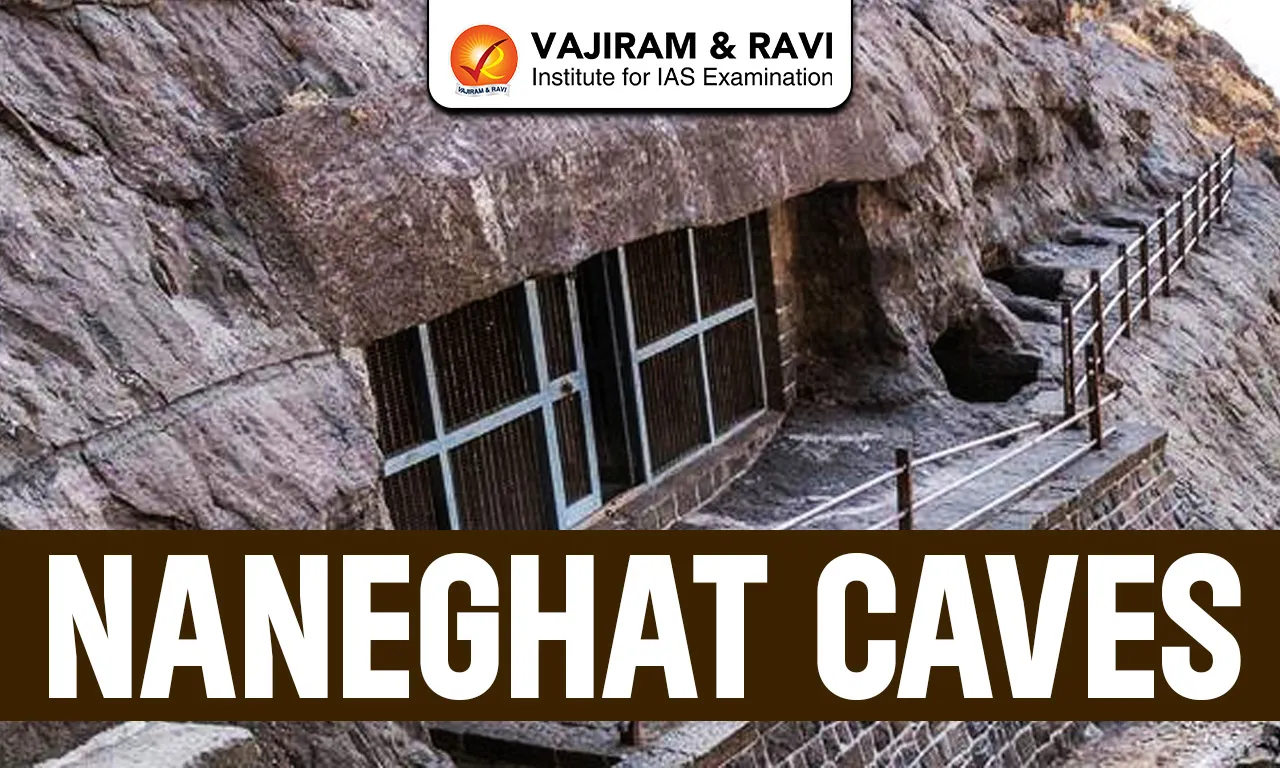
  • Naneghat Caves are ancient caves located in the Western Ghats of Maharashtra near Junnar in Pune district.
  • These caves are believed to be built around the Satavahana period (about 2nd century BCE to 1st century CE).
  • In Marathi, “nane” means coin and “ghat” means mountain pass. Therefore, the Naneghat Caves were likely a place where traders had to pay tolls while crossing the mountain pass. In ancient times, this pass was very important for trade between the Konkan coastal region and the Deccan plateau.
  • The site is historically important because of its Brahmi inscriptions, which provide information about the Satavahana dynasty and ancient trade networks between the Deccan plateau and the western coastal region.
  • There is also a rock-cut water cistern inside the cave, which shows how people managed water storage in ancient times.
  • Today, Naneghat Caves are protected as an archaeological site. Archeological Survey of India (ASI) prevents illegal construction, mining, or damage around the caves.

Junnar Region

  • The Junnar taluka of Maharashtra is an important archaeological cluster
  • Three major heritage sites in this region are protected - Naneghat rock-cut caves, Shivneri fort and Lenyadri cave complex.
  • The Shivneri Fort is historically significant as the birthplace of Chhatrapati Shivaji, and it also demonstrates advanced military and water management architecture.
  • The Lenyadri Caves are part of a Buddhist cave complex containing chaitya halls and viharas carved into rocky hillsides.

Major Cave Complexes of Western India

The major cave complexes of Western India are important examples of ancient rock-cut architecture. Sites like the Naneghat Caves and other cave complexes reflect India’s rich historical, religious, and artistic heritage.

Ajanta Caves

  • The Ajanta Caves are among the most famous Buddhist cave complexes in the world. 
  • Located in Maharashtra’s Aurangabad district, these caves were developed as a monastic centre for Buddhist monks. 
  • The complex contains 29 rock-cut caves, which include chaitya halls (prayer halls) and vihara caves (residential and learning spaces for monks).
  • Ajanta is especially renowned for its wall paintings and sculptures depicting Buddhist mythology, Jataka tales, and scenes from the life of the Buddha. 
  • Famous artworks include the Bodhisattva paintings such as Padmapani and Vajrapani.
  • Because of their outstanding artistic and historical importance, Ajanta was declared a UNESCO World Heritage Site in 1983.

Ellora Caves

  • The Ellora Caves are unique because they represent the coexistence of three major religions of ancient India - Buddhism, Hinduism, and Jainism. 
  • The complex consists of 34 rock-cut caves extending over nearly two kilometres.
  • The most remarkable structure is the Kailashnath Temple, Ellora, a massive monolithic temple carved from a single rock during the 8th century. This structure is considered one of the largest rock-cut monolithic temples in the world. 
  • Ellora is also listed as a UNESCO World Heritage Site.

Elephanta Caves

  • The Elephanta Caves are located on Elephanta Island, which was originally known as Gharapuri.
  • These caves mainly belong to the 5th century CE.
  • They are famous for rock-cut Hindu temples dedicated to Lord Shiva.
  • The most famous sculpture here is the gigantic three-faced Shiva sculpture, known as the Trimurti, symbolising the cosmic functions of creation, preservation, and destruction. 
  • The caves were later named Elephanta by Portuguese explorers because they installed a large stone elephant statue on the island. 
  • Elephanta caves are also recognised as a UNESCO World Heritage monument.

Badami Cave Temples

  • The Badami caves are considered important examples of early Hindu rock-cut architecture.
  • The Badami Cave Temples are carved into red sandstone hills in Karnataka.
  • They were developed during the rule of the early Chalukya dynasty. 
  • The complex contains mainly three important caves dedicated to Hindu and Jain traditions. These caves are famous for mythological carvings, especially the depiction of Vishnu’s avatars such as Varaha, Narasimha, and Vamana. 
  • Another important artistic feature is the representation of Hari-Hara, a combined form of Shiva and Vishnu. 

Bagh Caves

  • The Bagh Caves are a Buddhist cave complex located in Madhya Pradesh. 
  • The caves are generally dated to the 5th–6th century CE.
  • These caves are often compared with Ajanta because of their mural paintings, although Bagh caves are structurally simpler.
  • The caves were used mainly as meditation and residential spaces for Buddhist monks.

Naneghat Caves FAQs

Q1: Where are the Naneghat Caves located?

Ans: The Naneghat Caves are located in the Western Ghats near Junnar in Pune district of Maharashtra. They lie on an ancient mountain pass connecting the Konkan coast with the Deccan plateau.

Q2: During which period were the Naneghat Caves built?

Ans: The caves were built during the Satavahana period, around the 2nd century BCE to 1st century CE.

Q3: Why is the name “Naneghat” significant?

Ans: In Marathi, “nane” means coin and “ghat” means mountain pass. It was likely a toll collection point where traders paid coins while crossing the pass.

Q4: Why are the Naneghat Caves historically important?

Ans: They contain Brahmi inscriptions that provide important information about the Satavahana dynasty and ancient trade networks of the Deccan region.

Q5: Which authority protects the Naneghat Caves today?

Ans: The caves are protected by the Archaeological Survey of India (ASI), which safeguards them from damage and illegal activities.

National Agricultural Cooperative Marketing Federation of India

National Agricultural Cooperative Marketing Federation of India

National Agricultural Cooperative Marketing Federation of India Latest News

The Union Minister for Agriculture and Farmers’ Welfare held an extensive review meeting of the National Agricultural Cooperative Marketing Federation of India Ltd (NAFED) in New Delhi.

About National Agricultural Cooperative Marketing Federation of India

  • It is an apex organization of marketing cooperatives for agricultural produce in India.
  • It was founded on 2 October 1958 to promote the trade of agricultural produce and forest resources across the nation.
  • It is registered under the Multi State Co-operative Societies Act.
  • It has headquarters in New Delhi, NAFED has four regional offices in Delhi, Mumbai, Chennai and Kolkata.
  • Objectives
    • To organize, promote and develop marketing, processing and storage of agricultural, horticultural and forest produce.
    • To distribute agricultural machinery, implements and other inputs, undertake inter-state, import and export trade, wholesale or retail as the case may be.
    • To act and assist for technical advice in agricultural production for the promotion and the working of its members, partners, associates and cooperative marketing, processing and supply societies in India.
  • Nodal Ministry: It is an apex Organisation under the Ministry of Agriculture & Farmers Welfare, Government of India. 

Source: PIB

National Agricultural Cooperative Marketing Federation of India FAQs

Q1: What is the main objective of NAFED?

Ans: To promote agricultural marketing and support farmers

Q2: Under which ministry does NAFED operate?

Ans: Ministry of Agriculture and Farmers Welfare

Article 32 of Indian Constitution, Right to Constitutional Remedies

Article 32 of Indian Constitution

Article 32 of Indian Constitution is famously called the “heart and soul” of the Constitution by Dr. B.R. Ambedkar. It guarantees every Indian citizen the right to constitutional remedies when their fundamental rights are violated. Through this provision, citizens can directly approach the Supreme Court for protection of their rights. It ensures justice, safeguards liberty, and strengthens the democratic framework of India.

Article 32 of Indian Constitution

Article 32 provides the right to constitutional remedies, allowing citizens to move the Supreme Court (SC) for enforcement of their Fundamental Rights (FRs). Unlike other rights, Article 32 gives the SC mandatory jurisdiction, meaning the Court cannot refuse to hear cases related to violations of FRs.

The Parliament can empower other courts to issue directions and writs for enforcing fundamental rights. However, this does not include High Courts, as they already have writ jurisdiction under Article 226.

Types of Writs under Article 32

Writs are legal orders issued by the Supreme Court to enforce fundamental rights. There are five main writs:

1. Habeas Corpus (“To have the body”)

  • Purpose: Protects individuals from unlawful detention or imprisonment.
  • Who can file: Any person, even on behalf of someone detained.
  • Against whom: Public authorities or private individuals.
  • Exceptions:
    • Lawful detention
    • Detention by a competent court
    • Contempt proceedings
    • Detention outside court jurisdiction

2. Mandamus (“We command”)

  • Purpose: Orders public officials to perform duties they have failed to do.
  • Who can file: Any person whose rights are affected.
  • Against whom: Public officials, government bodies, corporations, tribunals, or inferior courts.
  • Cannot be issued:
  • Against private individuals
  • To enforce discretionary duties
  • To enforce contractual obligations
  • Against the President, Governors, or Chief Justices of High Courts

3. Prohibition (“To forbid”)

  • Purpose: Prevents a lower court or tribunal from exceeding its jurisdiction.
  • Against whom: Only judicial and quasi-judicial bodies.
  • Difference from Mandamus: Mandamus orders action, while Prohibition orders inaction.

4. Certiorari (“To be certified or informed”)

  • Purpose: Transfers a case from a lower court to a higher court or nullifies the lower court’s order due to excess of jurisdiction or error of law.
  • Against whom: Judicial, quasi-judicial, and administrative authorities.

5. Quo Warranto (“By what authority”)

  • Purpose: Challenges the legal right of a person to hold a public office.
  • Who can file: Any interested person, not necessarily the aggrieved.
  • Scope: Only for substantial public offices created by statute or Constitution. Cannot be applied to ministerial or private offices.

Can Article 32 of Indian Constitution be Amended?

Article 32 of the Indian Constitution cannot be amended as it is part of the basic structure of the Constitution. The Supreme Court, in Kesavananda Bharati vs State of Kerala, ruled that the basic structure cannot be altered. Later, in L. Chandra Kumar vs Union of India, the Court confirmed that Article 32 is an integral part of this basic structure. Therefore, Parliament cannot amend or remove the right to constitutional remedies under Article 32.

Supreme Court Observations on Article 32

The Supreme Court has repeatedly emphasized that Article 32 is a fundamental right and a guaranteed remedy for enforcement of fundamental rights, and any obstruction to it undermines justice. Its accessibility and urgency are crucial for protecting citizens’ liberties.

  1. Romesh Thappar vs State of Madras (1950) – Article 32 provides a “guaranteed remedy” for the enforcement of fundamental rights.
  2. Arnab Goswami Case – Any hindrance to the right under Article 32 is a serious interference with the justice system.
  3. Telugu Poet Varavara Rao Case – SC directed the Bombay High Court to expedite a bail plea, emphasizing timely justice.
  4. Journalist Siddique Kappan Case – SC questioned why petitioners could not approach the High Court, underlining the importance of accessible remedies.
  5. L. Chandra Kumar vs Union of India – Confirmed Article 32 as integral to the basic structure and cannot be amended.

Difference Between Article 32 and Article 226

Article 32 provides citizens with a fundamental right to approach the Supreme Court for enforcement of Fundamental Rights, whereas Article 226 empowers High Courts with discretionary writ jurisdiction to enforce both fundamental and legal rights.

Difference Between Article 32 and Article 226

Feature

Article 32

Article 226

Type of Right

Fundamental Right under Part III

Constitutional right (not a fundamental right)

Jurisdiction

Pan India (Supreme Court)

Territorial jurisdiction of the respective High Court

Scope

Limited to enforcement of Fundamental Rights only

Broader scope; can enforce Fundamental Rights and other legal rights

Discretionary Power

Mandatory; SC cannot refuse to hear a petition

Discretionary; High Court may decide whether to issue a writ or not

Suspension

Can be suspended during National Emergency under Article 359

Cannot be suspended even during Emergency

Writs

SC can issue Habeas Corpus, Mandamus, Prohibition, Certiorari, Quo Warranto

High Court can issue all five writs similar to SC

Court to Approach

Supreme Court directly

High Court within its territorial jurisdiction

Speed of Justice

Often faster for fundamental rights violation

May vary depending on court discretion and local jurisdiction

Article 32 of Indian Constitution FAQs

Q1: What is Article 32 of the Indian Constitution?

Ans: Article 32 guarantees every Indian citizen the right to move the Supreme Court directly if their fundamental rights are violated. It is called the “heart and soul of the Constitution” by Dr. B.R. Ambedkar.

Q2: Can the Supreme Court refuse to hear a case under Article 32?

Ans: No, the Supreme Court has mandatory jurisdiction under Article 32, which means it cannot refuse to hear petitions for enforcement of fundamental rights.

Q3: Can Article 32 be suspended?

Ans: Yes, the President can suspend the right to move any court for enforcement of fundamental rights during a National Emergency under Article 359.

Q4: What are the powers of the Supreme Court under Article 32?

Ans: The SC has original, wide, and concurrent powers to enforce fundamental rights and issue writs.

Q5: What are the types of writs under Article 32?

Ans: The five writs are Habeas Corpus, Mandamus, Prohibition, Certiorari, and Quo Warranto.

Types of Pollution, Major Types, Air, Water, Noise Pollution

Types of Pollution

Pollution refers to the contamination of the environment by harmful substances that disturb natural balance and affect living organisms. The major types of pollution have been discussed below in the article. Air pollution contaminates the atmosphere with toxic gases and particulate matter, while water pollution degrades rivers, lakes, and oceans through waste and chemicals. Noise pollution involves excessive sound levels that harm human health and disrupt normal life, especially in urban areas.

Major Types of Pollution

The Major Types of Pollution are classified based on the part of the environment they primarily impact. These major types includes:

  1. Air Pollution
  2. Water Pollution
  3. Soil (Land) Pollution
  4. Noise Pollution
  5. Thermal Pollution
  6. Radioactive Pollution
  7. Light Pollution

1. Air Pollution

Air Pollution occurs when harmful gases, smoke, dust, and particulate matter contaminate the atmosphere. It is mainly caused by industrialization, vehicular emissions, and burning of fossil fuels. It directly affects human respiratory health and contributes to global climate change.

Air Pollution Causes

  • Burning of fossil fuels such as coal, petrol, and diesel in power plants and vehicles.
  • Emission of toxic gases (CO, SO₂, NOx) from industries and factories.
  • Rapid urbanization and increase in the number of motor vehicles.
  • Crop residue burning and forest fires.
  • Construction activities producing large amounts of dust (PM2.5 and PM10).
  • Use of traditional biomass fuels for cooking in rural areas.

Air Pollution Effects

  • Respiratory diseases like asthma, bronchitis, and lung cancer.
  • Increased risk of cardiovascular diseases and strokes.
  • Formation of smog reducing visibility in cities.
  • Acid rain damaging crops, soil, forests, and historical monuments.
  • Contribution to greenhouse effect and global warming.
  • Negative impact on wildlife and plant growth.

Air Pollution Prevention

  • Promotion of renewable energy sources such as solar and wind power.
  • Adoption of electric vehicles and public transportation systems.
  • Enforcement of strict emission norms (e.g., BS-VI standards).
  • Development of green belts and large-scale afforestation programs.
  • Use of cleaner fuels like CNG and LPG.
  • Public awareness campaigns to reduce pollution levels.

2. Water Pollution

Water Pollution occurs when harmful substances such as chemicals, sewage, plastics, and industrial waste contaminate water bodies. It affects rivers, lakes, groundwater, and oceans, making water unsafe for human consumption and aquatic life. Increasing industrialization and poor waste management practices are major contributors to water contamination.

Water Pollution Causes

  • Discharge of untreated industrial effluents into rivers and lakes.
  • Dumping of domestic sewage and wastewater.
  • Agricultural runoff containing fertilizers and pesticides.
  • Oil spills from ships and offshore drilling operations.
  • Plastic waste entering oceans and forming garbage patches.
  • Religious and cultural waste immersion practices.

Water Pollution Effects

  • Spread of water-borne diseases like cholera, dysentery, and typhoid.
  • Oxygen depletion leading to fish and aquatic organism deaths.
  • Eutrophication due to excessive nutrients causing algal blooms.
  • Contamination of groundwater sources.
  • Bioaccumulation of toxins in the aquatic food chain.
  • Reduction in availability of safe drinking water.

Water Pollution Prevention

  • Installation and proper functioning of sewage treatment plants (STPs).
  • Strict monitoring of industrial waste discharge.
  • Promotion of organic farming to reduce chemical runoff.
  • Reduction and recycling of plastic waste.
  • Public awareness about water conservation.
  • Implementation of strong water protection laws.

3. Soil Pollution

Soil pollution refers to the contamination of land due to hazardous chemicals, solid waste, and industrial activities. It degrades soil quality and reduces its fertility, directly affecting agriculture and food security. Toxic substances present in soil can also seep into groundwater and enter the food chain.

Soil Pollution Causes

  • Excessive use of chemical fertilizers and pesticides.
  • Dumping of industrial and municipal solid waste.
  • Plastic and electronic waste accumulation.
  • Mining and quarrying activities.
  • Oil spills and leakage from landfills.
  • Deforestation and improper land use practices.

Soil Pollution Effects

  • Decline in soil fertility and reduced agricultural productivity.
  • Contamination of crops with harmful chemicals.
  • Groundwater pollution through leaching of toxins.
  • Loss of soil biodiversity and beneficial microorganisms.
  • Increased risk of health issues through contaminated food.

Soil Pollution Prevention

  • Promotion of organic and sustainable farming practices.
  • Proper segregation and recycling of waste.
  • Safe disposal of hazardous industrial waste.
  • Reforestation and soil conservation techniques.
  • Minimizing the use of chemical pesticides.
  • Adoption of biodegradable products.

4. Noise Pollution

Noise Pollution refers to excessive and unwanted sound that disrupts daily activities and affects physical and mental health. It is most prevalent in urban areas due to heavy traffic, construction, and industrial operations. Continuous exposure to high noise levels can lead to long-term health complications.

Noise Pollution Causes

  • Traffic congestion and constant honking.
  • Industrial machinery and heavy equipment.
  • Construction and demolition work.
  • Loudspeakers during festivals and public gatherings.
  • Airports, railways, and metro operations.

Noise Pollution Effects

  • Hearing impairment and tinnitus.
  • Increased stress, anxiety, and irritability.
  • Sleep disturbances and insomnia.
  • High blood pressure and cardiovascular problems.
  • Reduced concentration and work productivity.

Noise Pollution Prevention

  • Enforcement of noise pollution control laws.
  • Use of soundproof materials in buildings.
  • Plantation of trees as natural sound barriers.
  • Maintenance of vehicles and machinery.
  • Limiting use of loudspeakers and firecrackers.

5. Thermal Pollution

Thermal Pollution occurs when industries and power plants discharge heated water into natural water bodies, increasing their temperature. This sudden temperature rise disturbs aquatic ecosystems and reduces dissolved oxygen levels necessary for marine life.

Thermal Pollution Causes

  • Thermal and nuclear power plants using water for cooling.
  • Industrial cooling processes.
  • Deforestation near rivers reducing natural shade.

Thermal Pollution Effects

  • Decrease in dissolved oxygen in water.
  • Fish mortality and migration changes.
  • Disturbance in breeding cycles of aquatic species.
  • Alteration of aquatic biodiversity.

Thermal Pollution Prevention

  • Use of cooling towers and cooling ponds.
  • Recycling and reuse of industrial water.
  • Strict environmental impact assessments (EIA).
  • Plantation along riverbanks.

6. Radioactive Pollution

Radioactive Pollution is caused by the release of radioactive substances into the environment due to nuclear accidents or improper waste disposal. It is highly hazardous because radioactive materials remain active for long durations and cause severe genetic damage.

Radioactive Pollution Causes

  • Nuclear power plant accidents leading to leakage of radioactive materials into air, water, and soil.
  • Improper disposal of nuclear waste without secure containment systems.
  • Atomic and hydrogen bomb testing releasing radioactive isotopes into the atmosphere.
  • Uranium mining and processing activities exposing radioactive elements.
  • Leakage during transportation of radioactive materials.

Radioactive Pollution Effects

  • Increased risk of cancer, especially leukemia and thyroid cancer.
  • Genetic mutations and hereditary defects in future generations.
  • Birth defects and developmental abnormalities in infants.
  • Long-term soil and water contamination, making areas uninhabitable.
  • Damage to plants and animals, affecting biodiversity.
  • Weakened immune system and radiation sickness in humans.

Radioactive Pollution Prevention

  • Strict nuclear safety standards in power plants and research facilities.
    Safe storage and deep geological disposal of radioactive waste.
  • Regular inspection and maintenance of nuclear reactors.
  • International treaties and monitoring to limit nuclear weapon testing.
  • Use of advanced containment technologies to prevent leaks.
  • Proper training and protective equipment for workers handling radioactive materials.

7. Light Pollution

Light Pollution refers to excessive artificial lighting that disrupts natural darkness and ecological systems. It is commonly observed in urban areas with bright streetlights and commercial lighting.

Light Pollution Causes

  • Excessive use of artificial lighting in urban and metropolitan areas.
  • Unshielded streetlights that scatter light upward and sideways instead of downward.
  • Commercial billboards and advertising boards with high-intensity illumination.
  • Stadium lights and event lighting operating for long hours at night.
  • Residential and office buildings leaving lights on unnecessarily.
  • Poor urban planning without proper lighting design standards.

Light Pollution Effects

  • Disruption of human sleep cycles (circadian rhythm) leading to insomnia and health issues.
  • Disturbance to nocturnal animals, affecting hunting and breeding patterns.
  • Disorientation of migratory birds due to bright city lights.
  • Reduced visibility of stars, impacting astronomical observations.
  • Increased energy consumption, contributing indirectly to air pollution and carbon emissions.
  • Glare and reduced night-time visibility, increasing road accident risks.

Light Pollution Prevention

  • Use of shielded and downward-facing lighting fixtures to minimize skyglow.
  • Installation of energy-efficient LED lights with appropriate brightness levels.
  • Adoption of smart lighting systems with timers and motion sensors.
  • Switching off unnecessary lights in homes, offices, and public places.
  • Implementation of dark-sky policies in urban planning.
  • Using warm-colored lights instead of blue-rich white lights.

Types of Pollution FAQs

Q1: What are the major types of pollution?

Ans: The major types of pollution are air pollution, water pollution, soil pollution, noise pollution, thermal pollution, radioactive pollution, and light pollution.

Q2: Which type of pollution is most harmful to human health?

Ans: Air pollution is considered the most harmful because it directly affects the respiratory and cardiovascular systems and contributes to climate change.

Q3: What causes pollution in the environment?

Ans: Pollution is mainly caused by industrial activities, vehicle emissions, improper waste disposal, burning of fossil fuels, excessive use of chemicals, and rapid urbanization.

Q4: How does water pollution affect human life?

Ans: Water pollution spreads water-borne diseases, contaminates drinking water sources, and disrupts aquatic ecosystems essential for food and livelihood.

Q5: What is the difference between air and water pollution?

Ans: Air pollution contaminates the atmosphere with harmful gases and particles, while water pollution contaminates rivers, lakes, oceans, and groundwater with chemicals and waste.

Tetanus and Adult Diphtheria (Td) Vaccine

Tetanus and Adult Diphtheria (Td) Vaccine

Tetanus and Adult Diphtheria (Td) Vaccine Latest News

The Union Minister for Health and Family Welfare will launch the Tetanus and Adult Diphtheria (Td) vaccine at the Central Research Institute (CRI), Kasauli, Himachal Pradesh.

About Tetanus and Adult Diphtheria (Td) Vaccine

  • It provides protection against both tetanus and diphtheria.
  • Preparation: It is prepared by combining purified diphtheria toxoid and purified tetanus toxoid.
  • The antigens are adsorbed onto aluminum phosphate, which acts as an adjuvant, and thiomersal is added as a preservative.
  • The Td vaccine is aimed at strengthening protection among adolescents and adults and reducing morbidity and mortality associated with these vaccine-preventable diseases.
  • Td is freeze and heat sensitive.
  • The vaccine has been developed and manufactured by the Central Research Institute (CRI), which functions under the Directorate General of Health Services.

Key Facts about Tetanus

  • Tetanus is an acute infectious disease caused by toxigenic strains of the bacterium Clostridium tetani.
  • The disease may occur at any age and case-fatality rates are high even where intensive care is available.
  • Symptoms: It causes painful muscle stiffness and spasms and can lead to severe health complications.
  • Inability to open the mouth (lockjaw), difficulty in swallowing and breathing, and may result in death.

About Diphtheria

  • It is caused by Corynebacterium diphtheriae, has been one of the most feared infectious diseases globally, which causes devastating epidemics.
  • South East Asia is the primary driver of global diphtheria incidence, especially since 2005.
  • Spread: It can spread from person to person, usually through respiratory droplets, like from coughing or sneezing.
  • Symptoms: It is a potentially life-threatening infection that can cause breathing difficulties, heart failure, paralysis, and death.

Source: PIB

Tetanus and Adult Diphtheria (Td) Vaccine FAQs

Q1: What does Td vaccine protect against?

Ans: Tetanus and Diphtheria

Q2: How often is Td booster recommended?

Ans: Every 10 years

Part 12 of Indian Constitution, Article 264 to 300A, Amendments, Case Laws

Part 12 of Indian Constitution

Part 12 of the Indian Constitution is titled “Finance, Property, Contracts and Suits” and covers Articles 264 to 300A. It lays down the complete financial and property framework of the country. This Part explains how taxes are imposed, how revenue is distributed between the Union and the States and how public funds are maintained. It also provides rules regarding borrowing powers, government contracts, legal proceedings and succession to property. Article 300A ensures that no person can be deprived of property except by authority of law. Thus, Part 12 forms the constitutional base of fiscal federalism and financial governance in India.

Chapters under Part 12 of Indian Constitution

Part 12 of Indian Constitution is divided into four chapters covering finance, borrowing, property matters and right to property.

  • Chapter I- Finance: This chapter contains Articles 264 to 291 and deals with taxation principles, Consolidated Funds, Contingency Funds, distribution of revenue between Union and States, grants-in-aid, exemptions from taxation and the Finance Commission.
  • Chapter II- Borrowing: Articles 292 and 293 regulate borrowing powers of the Government of India and the States. Borrowing must be secured on the respective Consolidated Funds, ensuring financial responsibility and constitutional control.
  • Chapter III- Property, Contracts, Rights, Liabilities and Suits: Articles 294 to 300 govern succession of property from British India and princely States, ownership of offshore resources, government trade powers, validity of contracts and legal proceedings involving governments.
  • Chapter IV- Right to Property: Article 300A forms this chapter. It provides that no person can be deprived of property except by authority of law, making property a constitutional legal right instead of a Fundamental Right.

Articles under Part 12 of Indian Constitution

The articles under Part 12 of Indian Constitution consist of Article 264 to 300A under the four chapters as detailed below:

  • Article 264- Interpretation: Article 264 clarifies that provisions of this Part are subject to the general financial framework of the Constitution. It establishes that taxation and financial matters must be understood within the broader constitutional distribution of legislative powers between Union and States.
  • Article 265- Taxes not to be imposed except by authority of law: Article 265 mandates that no tax shall be levied or collected except by authority of law. It safeguards citizens against arbitrary taxation and ensures that every tax must have legislative sanction passed by a competent legislature.
  • Article 266- Consolidated Funds and Public Accounts: Article 266 establishes the Consolidated Fund and Public Account of India and of each State. All revenues, loans and receipts are credited to these funds and expenditure can be made only in accordance with law.
  • Article 267- Contingency Fund: Article 267 provides for the creation of a Contingency Fund for India and for each State. It enables the executive to meet urgent, unforeseen expenditure pending legislative authorization, ensuring continuity of governance during emergencies.
  • Article 268- Duties levied by the Union but collected and appropriated by the States: Article 268 specifies certain stamp duties and excise duties levied by the Union but collected and retained by the States. It supports fiscal federalism by allocating specific revenue sources directly to State governments.
  • Article 269- Taxes levied and collected by the Union but assigned to the States: Article 269 provides that certain inter-State trade taxes are levied and collected by the Union but assigned to the States. This ensures uniform administration while distributing proceeds among States as constitutionally prescribed.
  • Article 269A- Levy and collection of Goods and Services Tax in inter-State trade: Article 269A governs Goods and Services Tax on inter-State supplies. The Union levies and collects GST and revenue is apportioned between Union and States according to principles recommended by the GST Council.
  • Article 270- Taxes levied and distributed between the Union and the States: Article 270 lays down the mechanism for distribution of certain Union taxes between the Union and the States. It forms the foundation of vertical fiscal devolution and strengthens cooperative federal financial arrangements.
  • Article 271- Surcharge on certain duties and taxes for purposes of the Union: Article 271 empowers Parliament to impose surcharges on certain taxes for Union purposes. Such surcharges are exclusively retained by the Union and are not shared with States under the distribution scheme.
  • Article 272- [Omitted]: Article 272 earlier dealt with distribution of excise duties but was omitted by the Eightieth Constitutional Amendment Act, 2000. Its subject matter was incorporated within revised provisions under Article 270.
  • Article 273- Grants in lieu of export duty on jute and jute products: Article 273 provided for grants to certain States in lieu of export duty on jute and jute products. It was intended as a transitional fiscal arrangement and has now ceased to operate.
  • Article 274- Prior recommendation of President required for certain taxation Bills: Article 274 requires prior recommendation of the President before introducing Bills affecting taxation in which States are interested. This ensures coordination between Union and States in financial matters impacting revenue distribution.
  • Article 275- Grants from the Union to certain States: Article 275 authorizes Parliament to provide grants-in-aid to States requiring financial assistance. It includes special provisions for promoting welfare of Scheduled Tribes and supporting administration of Scheduled Areas.
  • Article 276- Taxes on professions, trades, callings and employments: Article 276 empowers States and local authorities to levy taxes on professions, trades, callings and employments, subject to a constitutional monetary ceiling, thereby expanding States’ independent revenue sources.
  • Article 277- Savings: Article 277 protects taxes, duties and fees lawfully levied by States or local authorities before commencement of the Constitution, until Parliament legislates otherwise. It ensures continuity and financial stability during constitutional transition.
  • Article 278- [Omitted]: Article 278 earlier dealt with agreements relating to certain financial matters between the Union and Part B States. It was omitted after reorganization of States and restructuring of fiscal relations.
  • Article 279- Calculation of “net proceeds”: Article 279 defines “net proceeds” of taxes and authorizes the Comptroller and Auditor-General to certify such amounts. This certification determines the share of revenue distributable between Union and States.
  • Article 279A- Goods and Services Tax Council: Article 279A establishes the Goods and Services Tax Council, comprising Union and State representatives. It recommends rates, exemptions and policies related to GST, strengthening cooperative fiscal decision-making.
  • Article 280- Finance Commission: Article 280 provides for constitution of a Finance Commission every five years. It recommends distribution of tax revenues between Union and States and suggests measures to improve States’ financial positions.
  • Article 281- Recommendations of the Finance Commission: Article 281 mandates that recommendations of the Finance Commission be laid before Parliament along with explanatory memoranda. This ensures transparency and legislative oversight in matters of fiscal devolution.
  • Article 282- Expenditure defrayable by the Union or a State out of its revenues: Article 282 allows the Union or a State to make grants for any public purpose, even if the subject lies outside its legislative competence, promoting cooperative development initiatives.
  • Article 283- Custody, etc., of Consolidated Funds and Contingency Funds: Article 283 authorizes Parliament and State Legislatures to regulate custody, payment and withdrawal procedures concerning Consolidated and Contingency Funds, ensuring statutory control over public financial management.
  • Article 284- Custody of suitors’ deposits and other moneys: Article 284 provides that certain moneys received by public servants or courts must be paid into the appropriate public account. It ensures accountability and proper management of entrusted funds.
  • Article 285- Exemption of property of the Union from State taxation: Article 285 exempts Union property from State taxation, unless Parliament provides otherwise. This prevents fiscal conflicts and preserves financial autonomy of the Union government.
  • Article 286- Restrictions as to imposition of tax on the sale or purchase of goods: Article 286 restricts States from taxing sales occurring outside the State, in the course of import or export or in inter-State trade, ensuring uniformity in national commercial taxation.
  • Article 287- Exemption from taxes on electricity: Article 287 exempts electricity consumed by the Government of India or sold to it from State taxation, unless Parliament permits otherwise, safeguarding Union interests in energy usage.
  • Article 288- Exemption from taxation by States in respect of water or electricity in certain cases: Article 288 restricts States from taxing water or electricity supplied by statutory authorities established by Parliament, unless presidential assent is obtained, protecting intergovernmental infrastructure arrangements.
  • Article 289- Exemption of property and income of a State from Union taxation: Article 289 exempts property and income of States from Union taxation, except when States engage in trade or business activities, thereby balancing federal immunity with commercial accountability.
  • Article 290- Adjustment in respect of certain expenses and pensions: Article 290 provides for financial adjustments between Union and States regarding administrative expenses and pensions arising from constitutional changes, ensuring equitable fiscal settlement.
  • Article 290A- Annual payment to certain Devaswom Funds: Article 290A mandates annual payments from Consolidated Funds of Kerala and Tamil Nadu to specified Devaswom Funds, recognizing historical obligations linked to temple administration arrangements.
  • Article 291- [Repealed]: Article 291 earlier guaranteed privy purse payments to former rulers of princely States. It was repealed by the Twenty-sixth Constitutional Amendment Act, 1971, ending constitutional recognition of such privileges.
  • Article 292- Borrowing by the Government of India: Article 292 empowers the Government of India to borrow money upon the security of the Consolidated Fund of India within limits set by Parliament, ensuring legislative oversight of public debt.
  • Article 293- Borrowing by States: Article 293 authorizes States to borrow within India upon the security of their Consolidated Funds, subject to limitations and, in certain cases, consent of the Union government.
  • Article 294- Succession to property, assets, rights and liabilities: Article 294 provides for succession of property, assets, rights and liabilities of the Dominion of India and Provinces to the Union and States after commencement of the Constitution.
  • Article 295- Succession to property, assets, rights and liabilities in other cases: Article 295 deals with succession concerning princely States and other authorities, allocating their property and obligations between the Union and respective States.
  • Article 296- Property accruing by escheat or lapse: Article 296 states that property accruing by escheat, lapse or as bona vacantia within a State vests in that State and in other cases, vests in the Union.
  • Article 297- Things of value within territorial waters or continental shelf: Article 297 vests minerals and valuable resources in territorial waters, continental shelf and exclusive economic zone in the Union, ensuring national control over offshore natural wealth.
  • Article 298- Power to carry on trade, etc.: Article 298 empowers the Union and States to carry on trade, business, acquire property and enter contracts, expanding governmental capacity beyond strictly sovereign functions.
  • Article 299- Contracts: Article 299 prescribes that government contracts must be expressed in the name of the President or Governor and executed by authorized persons, failing which they are unenforceable.
  • Article 300- Suits and proceedings: Article 300 allows the Government of India and States to sue and be sued in courts, maintaining continuity of legal liability similar to pre-Constitution governmental arrangements.
  • Article 300A- Persons not to be deprived of property save by authority of law: Article 300A guarantees that no person shall be deprived of property except by authority of law. Though no longer a Fundamental Right, it remains a constitutional legal protection.

Amendments related to Part 12 of Indian Constitution

Several constitutional amendments have directly impacted taxation, property rights and financial provisions under Part 12 of Indian Constitution.

  • Forty-Fourth Amendment Act 1978: This amendment removed the right to property from the list of Fundamental Rights and inserted Article 300A. Property became a constitutional legal right enforceable by authority of law.
  • Sixtieth Amendment Act 1988: This amendment revised Article 276 and increased the ceiling on taxes on professions, trades, callings and employments to ₹2,500 per person per annum, giving greater flexibility to States.
  • Twenty-Sixth Amendment Act 1971: Article 291 relating to privy purse sums of Rulers was repealed by this amendment. It ended the constitutional recognition of privy purses previously guaranteed to former rulers.
  • One Hundred and First Amendment Act 2016: It brought Article 279A which introduced the Goods and Services Tax Council (GST Council) and Article 269A which deals with levy and collection of goods and services tax in inter-State trade or commerce.

Case Laws related to Part 12 of Indian Constitution

Judicial decisions have clarified several times taxation authority, government liability and the scope of property rights under Part 12 of Indian Constitution:

  • Kunnathat Thathunni Moopil Nair v. State of Kerala 1961: The Supreme Court struck down a land tax imposed by Kerala as it lacked proper legal authority and violated Article 265, which mandates taxation only by law.
  • K.P. Chowdhary v. State of Madhya Pradesh 1966: The Supreme Court held that a government contract not executed according to Article 299 requirements is void, even if parties have acted upon it.
  • State of Rajasthan v. Vidyawati 1962: The Court ruled that the State is liable for negligence of its employees when the act is non-sovereign in nature. Government immunity does not extend to wrongful civil acts.
  • K.T. Plantation Pvt. Ltd. v. State of Karnataka 2011: The Court clarified that property under Article 300A includes both tangible and intangible rights. Deprivation must follow valid law and meet public purpose standards.
  • P and O Steam Navigation Company v. Secretary of State for India 1861: This case distinguished sovereign and non-sovereign functions of the State. It held that government can be sued for acts done in commercial capacity.
  • Delhi Airtech Services Pvt. Ltd. v. State of U.P. 2011: The Court recognized that although property is no longer a Fundamental Right, Article 300A protects individuals from arbitrary deprivation by the State.
  • Vidya Devi v. State of Himachal Pradesh 2020: The Supreme Court emphasized that the State must ensure proper compensation while acquiring property, reinforcing constitutional protection under Article 300A.

Part 12 of Indian Constitution FAQs

Q1: What does Part 12 of Indian Constitution deal with?

Ans: Part XII (Articles 264-300A) deals with finance, taxation, distribution of revenues, borrowing powers, government property, contracts, legal proceedings and the constitutional right to property.

Q2: What is the significance of Article 265 in Part 12 of Indian Constitution?

Ans: Article 265 states that no tax shall be levied or collected except by authority of law. It prevents arbitrary taxation and ensures legislative control over public revenue.

Q3: How does Part 12 of Indian Constitution regulate financial relations between the Union and States?

Ans: Part XII provides for tax distribution, grants-in-aid and establishment of the Finance Commission under Article 280 to maintain fiscal balance between the Union and the States.

Q4: What is the role of Article 299 under Part 12 of Indian Constitution?

Ans: Article 299 lays down mandatory procedures for government contracts. Contracts must be executed in the name of the President or Governor; otherwise, they are not legally enforceable.

Q5: Is the right to property still a Fundamental Right under Part 12 of Indian Constitution?

Ans: No. After the 44th Constitutional Amendment Act 1978, the right to property was removed from Fundamental Rights and is now a constitutional legal right under Article 300A.

Beat the Heat Programme, Objectives, Features, Significance

Beat the Heat Programme

The Beat the Heat Programme is a public awareness and safety initiative aimed at protecting people from extreme heat and heatwaves. It focuses on spreading information about preventive measures such as staying hydrated, avoiding direct sunlight and recognizing symptoms of heatstroke.

Beat the Heat Programme

Beat the Heat is a global climate initiative aimed at tackling the growing problem of extreme heat and rising temperatures. It focuses on promoting sustainable cooling solutions and building heat-resilient cities. The programme translates the Global Cooling Pledge into practical actions at the city level.

It was announced under the COP30 Presidency (Brazil) and is supported by the United Nations Environment Programme (UNEP) through its Cool Coalition.

Beat the Heat Programme Objectives

  1. Climate Mitigation
  • Reduce greenhouse gas emissions from cooling systems.
  • Promote energy-efficient and low-carbon cooling technologies.
  • Encourage the use of environment-friendly refrigerants.
  1. Climate Adaptation
  • Protect vulnerable groups (children, elderly, outdoor workers) from heat stress.
  • Integrate cooling and heat resilience into urban planning and building design.

Beat the Heat Programme Features

  • Heat Risk Assessment: Cities identify heat hotspots and vulnerable areas.
  • Nature-Based Solutions: Increase tree cover, parks, shaded spaces and green roofs.
  • Passive Cooling: Promote cool roofs, reflective surfaces and climate-sensitive buildings.
  • Efficient Cooling Technologies: Encourage low-energy air conditioners.
  • Policy Integration: Include cooling in building codes and urban planning.
  • Financial Support: Help cities access climate finance and strengthen institutions.

Global Participation and Progress

  • Over 185 cities and 83 partners have joined the initiative.
  • 72 countries have signed the Global Cooling Pledge to reduce cooling-related emissions by 68% by 2050.
  • Many countries have included cooling in their climate action plans, but progress remains uneven.
  • Major gaps exist in African and Asia-Pacific countries, where cooling demand is rapidly increasing.

Beat the Heat Programme Significance

  • Climate Adaptation Imperative
    • Extreme heat has become a serious climate risk and causes more deaths globally each year than floods and storms combined. The programme helps countries prepare for rising temperatures due to climate change.
  • Urban Focus
    • Cities face the urban heat island effect, where temperatures can be up to 10°C higher than nearby rural areas due to concrete structures and lack of greenery. The initiative promotes better urban planning, green spaces and cooling infrastructure to reduce this impact.

Two Different “Beat the Heat” Initiatives

There are two global programmes with the same name:

  • UNEP’s Beat the Heat: Focuses on sustainable cooling, urban infrastructure and reducing emissions.
  • WHO’s Beat the Heat: Focuses on protecting human health, especially during extreme heat events and major sports activities.

India’s Participation

India has 44 cities participating in the UNEP-led Beat the Heat initiative. Among them, Maharashtra accounts for nearly 70% of the participating Indian cities, showing strong state-level engagement in climate action.

Beat the Heat Programme FAQs

Q1: What is the Beat the Heat Programme?

Ans: The Beat the Heat Programme is a global initiative to address extreme heat through sustainable cooling and urban resilience.

Q2: Who launched and supports the Beat the Heat Programme?

Ans: It was launched under COP30 (Brazil) and is supported by the UNEP Cool Coalition.

Q3: What are the main objectives of the Beat the Heat Programme?

Ans: The Beat the Heat Programme aims to reduce emissions from cooling systems and protect vulnerable populations from heat stress.

Q4: What are the key features of the Beat the Heat Programme?

Ans: It includes heat risk mapping, nature-based cooling, passive cooling, energy-efficient technologies, policy integration and financial support.

Q5: Why is the Beat the Heat Programme significant?

Ans: The Beat the Heat Programme helps reduce urban heat, prevent heat-related deaths and promote climate-resilient cities.

Part 13 of Indian Constitution, Article 301 to 307, Amendments

Part 13 of Indian Constitution

Part 13 of Indian Constitution (Articles 301-307) deals with trade and commerce within India. It ensures the free flow of goods and services across the country to maintain economic unity. At the same time, it permits reasonable restrictions in the public interest.

Part 13 of Indian Constitution

Part 13 of Indian Constitution (Articles 301-307) deals with Trade, Commerce and Intercourse within the territory of India. It aims to ensure that goods and services can move freely from one state to another without unnecessary barriers. This helps in maintaining economic unity and integration in the country. At the same time, the Constitution allows Parliament and State Legislatures to impose reasonable restrictions in the public interest. For example, restrictions may be imposed for public health, safety or through certain taxes.

Articles Under Part 13 of Indian Constitution

Part 13 (Articles 301-307) of the Indian Constitution deals with Trade, Commerce and Intercourse within the territory of India are discussed below:

  • Article 301: It states that, subject to the other provisions of Part XIII, trade, commerce and intercourse throughout the territory of India shall be free.
  • Article 302: It states that Parliament has the power to make laws to restrict trade, commerce or movement of goods between states or within any part of India, if it is necessary in the public interest.
  • Article 303: This provision deals with restrictions on the legislative powers of the Union and the States regarding trade and commerce under Article 303 of the Constitution.
    • 303 (1): states that neither Parliament nor any State Legislature can make a law that gives preference to one State over another or discriminates between States in matters of trade and commerce. This ensures equality among States.
    • 303 (2): It provides an exception. Parliament can make such a law if it declares that it is necessary to deal with a situation of scarcity of goods in any part of India.
  • Article 304 : Restrictions on trade, commerce and intercourse among States
    • (a) states that a State Legislature can impose tax on goods coming from other States or Union Territories. However, the tax must be equal to the tax imposed on similar goods produced within that State. 
    • (b) allows a State to impose reasonable restrictions on trade and commerce within the State or with other States if it is necessary in the public interest. However, before introducing such a law, the State must take the prior approval of the President.
  • Article 305: Saving of existing laws and laws providing for State monopolies. This provision under Article 305 states that the freedom of trade under Articles 301 and 303 will not affect existing laws, unless the President directs otherwise. It also protects laws made before the Constitution (Fourth Amendment) Act, 1955, especially those related to State monopolies under Article 19(6)(ii).
  • Article 306: Power of certain States in Part B of the First Schedule to impose restrictions on trade and commerce Omitted by the Constitution (Seventh Amendment) Act, 1956.
  • Article 307: Appointment of authority for carrying out the purposes of articles 301 to 304. Under this article Parliament can appoint an authority to implement the provisions of Articles 301 to 304 related to trade and commerce. It can also give this authority the necessary powers and duties.

Amendments Related to Part 13 of Indian Constitution

The following section discusses the key constitutional amendments that have impacted Part 13 of the Indian Constitution. The amendment has shaped the scope and operation of economic federalism and trade regulations in India.

7th Constitutional Amendment Act, 1956

  • The 7th Constitutional Amendment Act, 1956 removed Article 306, which earlier allowed certain Part B States to impose restrictions on trade and commerce.
  • This amendment was part of the larger reorganization of states in 1956, which reorganized state boundaries mainly on linguistic basis. With the removal of Article 306, special powers given to some states to levy duties on goods were abolished.

Significance

  • It helped in promoting economic unity in the country.
  • It removed special trade privileges of certain states.
  • It supported the idea of a common national market.
  • It strengthened the principle of equality among states in matters of trade and commerce.

Case Laws Related to Part 13 of Indian Constitution

  • Atiabari Tea Co. Ltd. v. State of Assam (1961): The issue was whether the Assam tax on goods carried by road and waterways violated Article 301, which guarantees freedom of inter-state trade. The Supreme Court held that the tax directly restricted free trade and was invalid because it did not follow the conditions under Article 304(b), such as prior Presidential sanction. This case strengthened the principle of free trade and economic unity in India.
  • Automobile Transport (Rajasthan) Ltd. v. State of Rajasthan: The Supreme Court held that taxes on motor vehicles under the Rajasthan Motor Vehicles Taxation Act were valid. It ruled that compensatory and regulatory taxes, which are used to maintain roads and transport facilities, do not violate Article 301 because they help trade rather than restrict it. The Court clarified that only taxes which directly and immediately hinder the free flow of trade would be unconstitutional.
  • State of Madras v. N.K. Nataraja Mudaliar (1968): The Court held that the sales or purchases made by an assessee which actually took place in the course of inter-State trade or commerce could not be taxed by any State until by law it was otherwise provided by Parliament.
  • Jindal Stainless Ltd. v. State of Haryana (2016): The Court ruled that entry taxes imposed by States are constitutional as long as they do not discriminate unfairly and are meant to create a level playing field between local goods and goods coming from other States. Such taxes do not violate Article 301, which guarantees freedom of trade and commerce.

Part 13 of Indian Constitution FAQs

Q1: What does Part 13 of the Indian Constitution deal with?

Ans: Part 13 (Articles 301-307) deals with trade, commerce and intercourse within India. It ensures free movement of goods and services across states to maintain economic unity.

Q2: What is the objective of Article 301?

Ans: Article 301 guarantees freedom of trade, commerce and intercourse throughout India, subject to other provisions of Part 13.

Q3: What powers does Parliament have under Article 302?

Ans: Under Article 302, Parliament can impose restrictions on trade and commerce between states in the public interest.

Q4: What change was made by the 7th Constitutional Amendment Act, 1956?

Ans: The 7th Amendment removed Article 306, abolishing special trade powers of certain states and promoting a common national market.

Q5: What principle was laid down in Atiabari Tea Co. Ltd. v. State of Assam (1961)?

Ans: The Supreme Court held that taxes directly restricting free trade violate Article 301 unless they meet conditions under Article 304(b).

Difference between Qualitative and Quantitative Research

Difference between Qualitative and Quantitative Research

Difference between Qualitative and Quantitative Research refers to the two main approaches used in fields like science, economics, sociology, psychology, marketing and business. Qualitative research focuses on understanding ideas, opinions, experiences and behavior. It deals with words and detailed explanations to find out why and how something happens. Quantitative research, on the other hand, focuses on numbers and measurable data. It uses surveys and statistics to find out how much or how many.

Difference between Qualitative and Quantitative Research

Qualitative and Quantitative research are two major approaches used to study problems. Qualitative research focuses on understanding ideas and experiences, while quantitative research focuses on numerical data and measurable facts. The Difference between Qualitative and Quantitative Research is discussed below.

Difference between Qualitative and Quantitative Research
Basis Qualitative Research Quantitative Research

Meaning

It aims to understand human behaviour, opinions, feelings and social issues in depth.

It aims to collect numerical data and measurable facts to study a problem.

Nature of Approach

Subjective approach - focuses on personal views and social realities.

Objective approach - focuses on facts and avoids personal bias.

Type of Data

Data is mainly in the form of words, descriptions and explanations.

Data is mainly in the form of numbers, statistics, graphs and tables.

Type of Questions

Uses open-ended questions to allow detailed answers.

Uses closed-ended or multiple-choice questions for easy measurement.

Sample Size

Usually involves a small number of respondents for detailed study.

Requires a large number of respondents for accuracy and reliability.

Data Collection Methods

Interviews, focus group discussions, observation, case studies and literature review.

Surveys, experiments and structured observations expressed in numbers.

Scope

Holistic in nature - studies the issue as a whole and in its social context.

Particularistic in nature - focuses on specific variables and measurable aspects.

Reasoning Used

Inductive reasoning - forms general conclusions from specific observations.

Deductive reasoning - tests existing theories using collected data.

Purpose

Exploratory - develops initial understanding and explores new ideas.

Conclusive - examines cause-and-effect relationships and supports final decisions.

Qualitative Research

  • Qualitative Research is a method used to understand human behaviour, thoughts, feelings, attitudes and experiences in a deep and detailed way. It mainly deals with non-numerical or textual data, such as words, descriptions, opinions, photographs, videos and observations.
  • This type of research is exploratory and unstructured, which means it does not follow strict numerical rules like quantitative research. Instead of asking “how many” or “how much”, it tries to answer “why” and “how” questions. For example, why do people prefer a particular government scheme? How do citizens feel about public services?
  • Qualitative research gives importance to the views and experiences of participants. The researcher studies their answers carefully and tries to understand the meaning behind them. It accepts that some level of subjectivity is natural because human behaviour cannot always be measured in numbers.

Qualitative Research Features

  • Type of Data: Non-numerical data such as text, audio, video and detailed descriptions.
  • Sample Size: Usually small and not necessarily representative of the entire population.
  • Data Collection Methods: In-depth interviews, focus group discussions, observation, case studies, ethnography, historical studies and document analysis.
  • Method of Analysis: Interpretive in nature; the researcher studies patterns, themes and meanings.
  • Reasoning: Mostly inductive, meaning conclusions are formed from specific observations.
  • Purpose: To explore complex social issues and develop ideas or hypotheses for future quantitative research.

What is Qualitative Data?

Qualitative data is descriptive information expressed in words rather than numbers. It explains characteristics, opinions and emotions. It cannot be counted or measured mathematically.

For example:

  • Why do people choose one product over another?
  • How do citizens feel about their customer service experience?
  • What do people think about a new government policy?

Quantitative Research

  • Quantitative Research is a method of study that is based on numbers, measurements and mathematical analysis. It is used when we want to measure something clearly, test a theory, or find out the relationship between two variables.
  • This type of research focuses on objective facts rather than personal opinions. It answers questions like “how many?”, “how much?” or “what is the effect?” For example, how many people benefited from a government scheme? What is the impact of education level on income?
  • Quantitative research is often conducted in a structured and controlled manner, such as through surveys, experiments, or large-scale data collection. The data collected is then analysed using statistical and mathematical tools to draw accurate conclusions.

When is Quantitative Research Used?

  • Testing hypotheses or theories: When we want to prove or disprove a theory.
  • Establishing cause-and-effect relationships: For example, studying whether an increase in minimum wage reduces poverty.
  • Generalization: When findings need to apply to a large population using representative samples.
  • Statistical analysis: When trends, patterns and relationships need to be measured scientifically.

Quantitative Research Features

  • Type of Data: Numerical data (numbers, percentages, statistics).
  • Sample Size: Usually large and representative.
  • Data Collection Methods: Surveys, experiments, structured observations, census data.
  • Nature: Objective and empirical (based on observed and measured evidence).
  • Reasoning: Mostly deductive, meaning it tests existing theories with data.
  • Purpose: To establish general facts and provide measurable evidence.

Quantitative and Qualitative Research Need

  • Both quantitative and qualitative research are important because they help us understand problems in different ways.
  • Qualitative research helps us understand the deeper reasons, opinions, feelings and motivations behind an issue. It gives detailed insights and helps us explore new ideas. For example, it can explain why people are unhappy with a government scheme or how social problems affect different groups.
  • Quantitative research, on the other hand, helps us measure facts using numbers and statistics. It identifies trends, patterns and relationships between variables. For example, it can show how many people are below the poverty line or the percentage increase in literacy rate.
Also Check Related Articles
Difference between NITI Aayog and Inter-State Council Difference Between Economic Survey and Union Budget
Difference Between Tropical Evergreen and Tropical Deciduous Forests Difference Between Ordinary Bill and Money Bill
Difference Between Legislative and Executive Difference between Himalayan and Peninsular Plateau
Difference Between Vedas and Upanishads Difference Between Scheduled and Non-Scheduled Banks
Difference Between Written and Unwritten Constitution Difference between NITI Aayog and Planning Commission
Difference between Colonialism and Imperialism Difference between Fundamental Rights and Directive Principles of State Policy
Difference between Procedure Established by Law and Due Process of Law Difference Between Democracy and Republic
Difference between Creamy Layer and Non-Creamy Layer of OBC Difference between Rajya Sabha and Vidhan Sabha
Difference Between Western Ghats and Eastern Ghats

Difference between Qualitative and Quantitative Research FAQs

Q1: What is the main difference between Qualitative and Quantitative research?

Ans: Qualitative research focuses on understanding ideas, opinions and experiences using words. Quantitative research focuses on numbers and measurable data to study facts and relationships.

Q2: What type of data is used in qualitative and quantitative research?

Ans: Qualitative research uses non-numerical data such as interviews, descriptions and observations. Quantitative research uses numerical data like percentages, statistics, graphs and tables.

Q3: What kind of questions do both methods answer?

Ans: Qualitative research answers “why” and “how” questions. Quantitative research answers “how many” and “how much” questions.

Q4: Which type of reasoning is used in both methods?

Ans: Qualitative research mainly uses inductive reasoning (forming general ideas from specific cases). Quantitative research mainly uses deductive reasoning (testing theories using data).

Q5: What are the common methods of data collection?

Ans: Qualitative research uses interviews, focus groups, case studies and observation. Quantitative research uses surveys, experiments and structured data collection methods.

INS Krishna

INS Krishna

INS Krishna Latest News

Indian naval cadets will now get to train aboard dedicated “floating classrooms” as the Indian Navy has commissioned ‘INS Krishna’, the first of three indigenously built cadet training ships (CTS).

About INS Krishna

  • It is the first of three indigenously built cadet training ships (CTS) of the Indian Navy.
    • These CTS will be utilised for training officer cadets, including women, at sea after their basic training ashore, and cadets from friendly foreign countries.
    • These vessels function as “floating classrooms and living labs”, offering hands-on instruction in navigation, seamanship, and watch-keeping under real maritime conditions.
  • Designated Yard 18003, INS Krishna, was constructed at the L&T shipyard in Kattupalli near Chennai.
  • Apart from serving as a training platform, the ship is designed to undertake non-combatant evacuations, humanitarian aid and disaster relief, and search-and-rescue operations.
  • INS Krishna can simultaneously accommodate 20 officers, 150 sailors, and 200 cadets.
  • The vessel features three classrooms with a capacity of 70 cadets each, along with a specialised training bridge and chart room. 
  • Displacing nearly 4,700 tonnes, it can achieve speeds of up to 20 knots and has an endurance of 60 days.

Source: MC

INS Krishna FAQs

Q1: What is INS Krishna?

Ans: It is a cadet training ship (CTS) of the Indian Navy.

Q2: For what primary purpose is INS Krishna used?

Ans: It is used for training officer cadets at sea after their basic shore training.

Q3: Where was INS Krishna constructed?

Ans: At the Larsen & Toubro shipyard in Kattupalli near Chennai.

Q4: What is the endurance of INS Krishna?

Ans: 60 days.

Arisaema siahaense

Arisaema siahaense

Arisaema siahaense Latest News

Researchers recently discovered a new species of Cobra Lily hidden within the rugged, misty mountains of Northeast India.

About Arisaema siahaense

  • It is a new species of Cobra Lily.
  • It was discovered in the Siaha District of Mizoram.
  • It is an evergreen herb that can grow up to 1.08 meters (about 3.5 feet) tall. 
  • It belongs to a group of plants commonly known as Cobra Lilies because their flowering structure (the spathe) resembles a cobra's hood. 
  • What makes this specific species unique is its spadix appendix, a long, slender growth that emerges from the flower. 
  • In this new species, the appendix is exceptionally long, reaching up to 21 centimetres, and is covered in brownish-green, hair-like bristles. 
  • Unlike its closest relatives found in China and Southeast Asia, this plant grows from a rounded tuber rather than a creeping rootstock and features leaves divided into exactly three segments.
  • The plant's name, siahaense, is a tribute to the Siaha District where it was first found. 
  • Specifically, the naming recognises the commitment of local communities, such as the Kompa family, who have worked tirelessly to preserve the biodiversity of their ancestral lands.
  • Although it is currently classified as Data Deficient by international standards, the scientists observed that its habitat is under pressure from road construction, grazing animals like goats and mithuns, and the spread of invasive weeds.

Source: RM

Arisaema siahaense FAQs

Q1: What is Arisaema siahaense?

Ans: It is a species of Cobra Lily.

Q2: n which state of India was Arisaema siahaense discovered?

Ans: Mizoram.

Q3: What unique floral feature distinguishes Arisaema siahaense?

Ans: An exceptionally long spadix appendix.

Q4: What is the current conservation status of Arisaema siahaense?

Ans: Data Deficient.

Kolleru Wildlife Sanctuary

Kolleru Wildlife Sanctuary

Kolleru Wildlife Sanctuary Latest News

New aquaculture tanks have reportedly been dug in parts of the Kolleru Wildlife Sanctuary, where illegal tanks were demolished recently as part of an encroachment drive undertaken following the Supreme Court orders.

About Kolleru Wildlife Sanctuary

  • It is a significant wetland sanctuary located in the West Godavari and Krishna districts of the Indian state of Andhra Pradesh.
  • It was established in November 1999, under the Wildlife Protection Act of 1972.
  • The sanctuary covers around 308 sq.km. of wetlands and marshes that provide a vital habitat for diverse flora and fauna.
  • The sanctuary protects part of the Kolleru Lake wetland, which gained Ramsar Convention for International importance in 2002.
    • The lake is fed directly by the seasonal Budameru and Tammileru rivers and is connected to the Krishna and Godavari systems by 67 inflowing drains and channels.
  • It is a crucial wetland ecosystem and serves as a stopover point for migratory birds.
  • Flora: The sanctuary’s flora includes various aquatic plants, submerged macrophytes, and wetland vegetation that provide essential food and shelter for the diverse bird species.
  • Fauna
    • It is home to more than 150 species of resident and migratory birds.
    • Commonly found birds in the sanctuary are: little egret, cattle egret, pied kingfisher, small blue kingfisher, blackcapped kingfisher, pond heron, reef heron, grey heron, night heron, etc.

Source: TH

Kolleru Wildlife Sanctuary FAQs

Q1: In which state is the Kolleru Wildlife Sanctuary located?

Ans: Andhra Pradesh.

Q2: Which important wetland forms the core of the Kolleru Wildlife Sanctuary?

Ans: Kolleru Lake.

Q3: Which rivers directly feed the Kolleru Lake?

Ans: Budameru and Tammileru rivers.

Q4: What type of vegetation dominates the flora of Kolleru Wildlife Sanctuary?

Ans: Aquatic plants, submerged macrophytes, and wetland vegetation.

Panama Disease

Panama Disease

Panama Disease Latest News

Recently, scientists discovered a gene that could save bananas from deadly Panama disease.

About Panama Disease

  • Panama disease is also known as fusarium wilt.
  • It is a devastating disease of bananas caused by the soil-inhabiting fungus species.
  • Cause: It is caused by the fungus Fusarium oxysporum f. sp. cubense, which lives in soil and can survive there for many years.
  • This disease affects the Cavendish variety or the G9 Banana cultivar, which is the most widely grown banana in the world.
  • Spread: The fungus resides below ground and infects the plant through its roots.
  • The infection then stops water and essential nutrients from being transported to the rest of the plant.
  • The disease is so deadly that it is sometimes referred to as ‘banana cancer’.

Symptoms of Panama Disease

  • The leaves begin to wilt, and the stem of the plant starts turning dark brownish before the plant dies.
  • The first external symptom of Panama is the irregular yellowing of the margins of older leaves, which later turn brown and dry out.
  • These leaves eventually collapse along the leaf stalk or at the junction of the stalk and stem, resulting in a skirt of dead leaves forming around the lower part of the plant.

Source: DTE

Panama Disease FAQs

Q1: What is another name for Panama Disease?

Ans: Fusarium wilt

Q2: Which banana cultivar is most affected by Panama Disease?

Ans: Cavendish banana

Daily Editorial Analysis 21 February 2026

Daily-Editorial-Analysis

Gen Z and the Dynamics of Democratic Engagement

Context

  • Across the world, democratic systems are experiencing democratic backsliding, weakening institutions, and growing authoritarianism.
  • Many citizens appeared resigned to unresponsive governance, yet a new political actor has emerged: Generation Z (1997–2012).
  • Recent protests in Bangladesh (2024) and Nepal (2025), organised around corruption, transparency, and accountability, demonstrate that political participation has not disappeared but is transforming.
  • Unlike earlier protest waves such as the Arab Spring or Occupy Wall Street, which generated visibility without lasting institutional change, contemporary youth mobilisation requires understanding beyond traditional frameworks of parties, leadership, and ideology.

Generational Change and Political Imagination

  • Each generation reshapes social values and ethical practices.
  • Older traditions persist as an absent presence within new forms, yet unfamiliar expressions often appear superficial to earlier generations. Political participation is therefore not declining but changing in form.
  • Gen Z was frequently considered politically disengaged, absorbed in technology and detached from public life.
  • However, organised youth protests reveal a different reality. Democracy rests not only on constitutional frameworks and institutions but also on everyday moral behaviour and collective emotions.
  • Gen Z’s politics operates primarily within everyday experience rather than formal structures, making it less visible yet socially influential.

The Worldview of Gen Z

  • Gen Z embodies a blend of radical individualism and relative tolerance, showing less overt prejudice and cynicism.
  • Its guiding principle resembles: personal is political, while politics itself is not treated as a personal ideological commitment.
  • This generation prefers lived conduct over doctrine. Acting as exemplars rather than emissaries, it demonstrates values through behaviour instead of advocacy.
  • It resists preaching and avoids preaching to others, making sustained collective mobilisation difficult.
  • Young people react strongly to visible hierarchies and discrimination but often lack a systemic analysis of structural inequality.
  • Comfort with the virtual world shapes political participation. Digital platforms allow expression without intense face-to-face interaction.
  • Consequently, protests are typically leaderless, ideologically loose, and episodic protests rather than long-term movements.

Changing Forms of Protest

  • Comparison with the farmers’ movement (2020–24) clarifies the shift.
  • The farmers-maintained leadership, organisation, and sustained demands for years. In contrast, Gen Z mobilisations appear suddenly and dissolve quickly, yet leave a lasting symbolic impact.
  • This pattern reflects a combination of confidence and insecurity. Gen Z grew up in an environment of social democratisation, encouraging self-expression and self-introspection, but also faces shrinking economic opportunities and employment instability.
  • Their political engagement is therefore assertive yet fragmented.
  • Mental health awareness further shapes behaviour. Openness to mental health, therapy, and emotional vulnerability contrasts with earlier generational restraint.
  • Experiences of mental despair, workplace toxicity, and anomie produce intense but short-lived political participation. Emotional precarity contributes to fleeting involvement in democratic processes.

Identity, Consumption, and Nationalism

  • Gen Z links identity formation with consumption patterns. Markets, technology, and education shape self-representation and weaken traditional ascriptive identities such as caste and religion.
  • Digital access and information serve as sources of dignity, sometimes more meaningful than inherited status.
  • Possessing advanced technology, symbolised by the iPhone, becomes an imagined social equaliser.
  • This produces a generation that is more secularised yet inward-looking, prioritising personal choices.
  • However, rapid digital exposure can also foster hyper-nationalism.
  • Unlike earlier cultural chauvinism, this nationalism emphasises future potential and developmental achievement, pride in space missions, technological innovation, and global visibility despite persistent inequality.

Conclusion

  • Generation Z is transforming democratic participation rather than abandoning it.
  • Although its activism may appear inconsistent compared to traditional movements, it reflects deeper changes in democratic culture.
  • This generation’s contradictions, individualistic yet socially aware, confident yet anxious, globalised yet nationalist, make its influence unpredictable.
  • Established expectations of activism may not be met, but new forms of engagement are emerging.
  • Gen Z therefore represents not the decline of democracy but its adaptation to a digitally connected and uncertain social world.

Gen Z and the Dynamics of Democratic Engagement FAQs

Q1. What is meant by democratic backsliding?
Ans. Democratic backsliding refers to the weakening of democratic institutions, erosion of accountability, and the rise of authoritarian governance.

Q2. Why is Generation Z considered politically different from previous generations?
Ans. Generation Z engages in politics through personal experiences and digital platforms rather than through formal ideologies and long-term organisations.

Q3. How do Gen Z protests differ from traditional protest movements?
Ans. Gen Z protests are usually leaderless, short-lived, and issue-based, while traditional movements tend to be organised, sustained, and guided by clear leadership.

Q4. What role does technology play in shaping Gen Z’s political behaviour?
Ans. Technology allows Gen Z to express opinions, mobilise support, and participate in political discussions primarily through virtual platforms.

Q5. How does economic insecurity affect Gen Z’s democratic participation?
Ans. Economic insecurity creates anxiety and precarity, leading Gen Z to participate intensely but briefly in political activities.

Source: The Hindu


‘Bhasha’ Matters in India’s Multilingual Moment

Context

  • India’s vast linguistic diversity—over 1,300 mother tongues and 121 recognised languages—forms a core part of its national identity and educational strength.
  • Languages shape how children learn and understand the world, carrying generations of accumulated knowledge.
  • When a language disappears, more than words are lost; entire worldviews and knowledge systems vanish.
  • Protecting languages is therefore both a cultural and educational priority, making mother-tongue-based multilingual education (MTB-MLE) essential.
  • This article highlights how India’s linguistic diversity is central to educational equity and national identity, and explains why mother-tongue-based multilingual education (MTB-MLE) is essential for improving learning outcomes, strengthening inclusion, and preserving cultural knowledge.

Mother Tongue as the Foundation of Quality Education

  • International Mother Language Day and Youth Voices
    • As International Mother Language Day (February 21) highlights multilingual education, the focus is clear: children thrive when their languages and identities are recognised in classrooms.
    • Valuing linguistic diversity turns schools into spaces of inclusive learning and mutual understanding.
  • UNESCO’s Advocacy for Multilingual Teaching
    • UNESCO has consistently promoted teaching in languages best understood by learners as a cornerstone of quality education.
    • Multilingual instruction strengthens comprehension, participation, and overall educational outcomes.

State of the Education Report 2025: Bhasha Matters

  • Focus on Mother-Tongue-Based Multilingual Education
    • The seventh edition of UNESCO’s State of the Education Report for India (2025), titled Bhasha Matters, examines the status of Mother Tongue and Multilingual Education (MTB-MLE).
    • It combines global research, national evidence, and practical insights.
  • Key Findings and Policy Directions
    • The report shows that MTB-MLE is both pedagogically effective and transformative.
    • It proposes 10 policy recommendations aimed at building an inclusive and equitable education system that views linguistic diversity as an asset.
  • What Is Working
    • Successful practices highlighted include bilingual learning materials, improved teacher preparation, and innovative digital tools that expand multilingual resources for classrooms and communities.

Language as a Barrier to Learning

  • The Scale of the Challenge

    • Globally, over 250 million learners lack access to education in a language they fully understand.
    • In India, about 44% of children begin school in a language different from the medium of instruction, adding an extra burden to early learning.
  • Impact on Foundational Learning

    • When children must first decode an unfamiliar language, it weakens foundational literacy and numeracy.
    • This can lead to cumulative learning gaps, reduced confidence, and higher dropout risks.

Policy Response in India

  • The National Education Policy (2020) and the National Curriculum Frameworks (2022, 2023) place the child’s home or mother tongue at the centre of early education to improve comprehension and learning outcomes.
  • Promising Practices Across States
    • Odisha’s Multilingual Education Model - Odisha runs a multilingual programme covering 21 tribal languages in 17 districts, benefiting nearly 90,000 children.
    • Digital and AI-Driven Solutions - Telangana uses DIKSHA-enabled multilingual resources. National initiatives such as PM eVIDYA, Adi Vaani, BHASHINI, and AI4Bharat leverage digital platforms and AI to create local-language content and support teachers.
  • Roadmap for Systemic Reform
    • Policy and Teacher Development - The Bhasha Matters report recommends clear state-level language policies, stronger multilingual teacher recruitment, and reforms in pre-service and in-service training.
    • Materials, Technology, and Community Participation - It calls for quality multilingual materials, inclusive assessments, community engagement, responsible language technology investment, and sustainable financing.
    • National Mission for MTB-MLE - A proposed National Mission for Mother-Tongue-Based Multilingual Education (MTB-MLE) aims to coordinate efforts across ministries, research bodies, civil society, and technology partners to scale successful pilots into nationwide reform.

Linguistic Diversity as a Strength

  • Driver of Equity and Social Cohesion
    • India’s linguistic diversity is not an obstacle but a catalyst for equity, identity, and unity. Teaching children in languages they understand strengthens learning outcomes and supports inclusive development.
  • A Moment for Educational Transformation
    • With supportive policy frameworks and successful State-level initiatives, India stands poised for meaningful educational reform grounded in multilingual learning.

International Mother Language Day: A Renewed Call

  • Recognising Every Learner’s Language - Education systems must value each child’s language to enhance academic success, affirm identity, and promote well-being and active participation in society.
  • Youth as Catalysts for Change - When young voices are included, multilingual education evolves from policy to movement. India’s multilingual future is being shaped by its youth, marking a pivotal national moment.

‘Bhasha’ Matters in India’s Multilingual Moment FAQs

Q1. Why is linguistic diversity important for India’s education system?

Ans. Linguistic diversity strengthens identity and inclusion. Teaching in familiar languages improves comprehension, preserves cultural knowledge, and promotes equitable participation in education and society.

Q2. What challenge do many Indian children face at school entry?

Ans. About 44% of children begin schooling in a language different from their home language, creating barriers to foundational literacy, numeracy, and overall academic confidence.

Q3. How does UNESCO view mother-tongue-based multilingual education?

Ans. UNESCO considers multilingual teaching in languages learners understand as a cornerstone of quality education, enhancing participation, comprehension, and long-term academic success.

Q4. What policy measures support MTB-MLE in India?

Ans. The National Education Policy 2020 and National Curriculum Frameworks emphasise mother tongue instruction, alongside state programmes, digital platforms, and proposed national coordination mechanisms.

Q5. What reforms does the Bhasha Matters report recommend?

Ans. The report calls for state-level language policies, improved teacher training, multilingual materials, community participation, responsible technology use, sustainable financing, and a National Mission for MTB-MLE.

Source: TH

Daily Editorial Analysis 21 February 2026 FAQs

Q1: What is editorial analysis?

Ans: Editorial analysis is the critical examination and interpretation of newspaper editorials to extract key insights, arguments, and perspectives relevant to UPSC preparation.

Q2: What is an editorial analyst?

Ans: An editorial analyst is someone who studies and breaks down editorials to highlight their relevance, structure, and usefulness for competitive exams like the UPSC.

Q3: What is an editorial for UPSC?

Ans: For UPSC, an editorial refers to opinion-based articles in reputed newspapers that provide analysis on current affairs, governance, policy, and socio-economic issues.

Q4: What are the sources of UPSC Editorial Analysis?

Ans: Key sources include editorials from The Hindu and Indian Express.

Q5: Can Editorial Analysis help in Mains Answer Writing?

Ans: Yes, editorial analysis enhances content quality, analytical depth, and structure in Mains answer writing.

Bhavani River

Bhavani River

Bhavani River Latest News

An RTI activist recently filed an online petition to the Prime Minister's Office seeking criminal, departmental, and regulatory action against officials responsible for the pollution of the Bhavani river.

About Bhavani River

  • It is a major tributary of the Cauvery River.
  • It flows through the states of Kerala and Tamil Nadu.
  • It is the second largest river in Tamil Nadu.
  • Course
    • The Bhavani River starts its journey in the Nilgiri hills, which are part of the Western Ghats mountain range. 
    • From there, it flows into Kerala, passing through the beautiful Silent Valley National Park. 
    • After flowing through Kerala, the river turns and flows back into Tamil Nadu.
    • Finally, the river merges with the Cauvery River in the town of Bhavani, at a location known as Bhavani Sangameshwarar Temple, a significant pilgrimage site for Hindus.
  • Total Length: 217 km.
  • It is a "perennial" river, which means it flows all year round and never dries up.
  • The drainage basin of the Bhavani River spans approximately 6,200 sq.km., covering parts of Tamil Nadu, Kerala, and Karnataka:
  • About 90 percent of the river water is used for agriculture.
  • Tributaries: The largest tributaries of the Bhavani River are West and East Varagar, which come from the Nilgiris. 
  • There are two major dams on the Bhavani River:
    • Bhavani Sagar Dam
    • Kodiveri Dam.

Source: TOI

Bhavani River FAQs

Q1: Of which major river is the Bhavani River a tributary?

Ans: The Cauvery River.

Q2: Through which states does the Bhavani River flow?

Ans: Kerala and Tamil Nadu.

Q3: Where does the Bhavani River originate?

Ans: In the Nilgiri Hills.

Q4: hich famous temple is located at the confluence of the Bhavani and Cauvery rivers?

Ans: Bhavani Sangameshwarar Temple.

U.S. Supreme Court Curbs Trump’s Emergency Tariff Powers

Trump’s Emergency Tariff Powers

Trump’s Emergency Tariff Powers Latest News

  • The U.S. Supreme Court, in a 6–3 ruling, struck down President Donald Trump’s sweeping tariffs imposed under the International Emergency Economic Powers Act (IEEPA), 1977.
  • The judgment marks a critical moment in the debate over separation of powers, executive overreach, and the future of U.S. trade policy. 
  • The ruling has significant implications for the global economy, including countries like India, which have been directly affected by U.S. tariff measures.

Constitutional Issue - Executive vs Legislative Authority

  • Core constitutional principle:
    • The U.S. Constitution grants Congress the authority to levy taxes and tariffs, not the President.
    • Trump invoked IEEPA, a law meant for national emergencies, to impose tariffs without Congressional approval.
    • The Court upheld a lower court ruling stating that this action exceeded presidential authority.
  • Nature of IEEPA:
    • Enacted in 1977 under President Jimmy Carter, it was historically used to freeze assets, impose sanctions. It does not explicitly mention tariffs.
    • Trump became the first President to use IEEPA to impose tariffs.

Trump’s Tariff Strategy - Economic and Foreign Policy Tool

  • Trade war and economic leverage:
    • Trump used tariffs as a revenue-generating instrument (estimated $300 billion annually if fully retained). 
    • It is used as a foreign policy tool, a means to renegotiate trade deals, and a pressure mechanism against China, Canada, Mexico, India, and Brazil.
  • “Liberation Day” tariffs (April 2, 2025):
    • Announced “reciprocal tariffs” on most trading partners.
    • Justified under a “national emergency” related to trade deficits.
    • Also invoked IEEPA citing fentanyl trafficking and migration concerns.
  • Economic impact:
    • Over $175 billion collected under IEEPA-based tariffs (Penn-Wharton estimate).
    • $195 billion net customs duty receipts in FY 2025 (record high).
    • Refund liability likely after the Supreme Court ruling.
    • Created global market uncertainty and financial volatility.

Legal Challenges and Federal Pushback

  • Three lawsuits challenged the tariffs -
    • Small importing businesses.
    • 12 U.S. states (including Arizona, Colorado, New York).
    • Federal rulings against the administration.
  • The Court reaffirmed national emergency powers cannot become a substitute for legislative trade authority.

Alternative Tariff Mechanisms - Sections 122, 301, and 232

  • After the ruling, Trump indicated he would explore other statutory options. For example,
  • Section 122 (Trade Act, 1974): 
    • It allows up to 15% tariff to address serious balance-of-payments deficits. Never used before, it is valid for 150 days, unless extended by Congress.
    • Trump signaled a 10% global tariff under this provision.
  • Section 301 (Trade Act, 1974):
    • It is a targeted and investigation-based (not sweeping) provision, triggered when the U.S. Trade Representative (USTR) finds “unfair trade practices”.
    • Previously used against India over the Digital Services Tax (2020). Later resolved under OECD global minimum tax framework.
  • Section 232 (Trade Expansion Act, 1962):
    • It allows tariffs on national security grounds, and it is sector-specific (steel, aluminium, automobiles, etc.).
    • India currently faces 232 tariffs on steel, aluminium, automobiles, and copper derivatives.
    • Some relief possible under the recent U.S.-India trade understanding, including:
      • Tariff removal on certain aircraft parts.
      • Preferential TRQ (Tariff Rate Quota) for automotive parts.
      • Negotiations in generic pharmaceuticals.

Broader Implications

  • For the U.S. political system: Reassertion of judicial review. Curtailment of expansive executive authority. Reinforcement of Congressional primacy in taxation.
  • For Global trade: Potential rollback or restructuring of tariff regimes. Increased uncertainty in the short term. Possible shift toward more rules-based trade measures. Affects WTO dynamics and global trade governance.
  • For India: Relief potential in select sectors (aircraft parts, auto components). Continued exposure to 232 tariffs. Trade diplomacy becomes critical. Strategic balancing amid U.S.–China competition.

Challenges and Way Forward

  • Conflict: Between Executive-Legislative branches over trade authority. Strengthening Congressional oversight in trade policy.
  • Risk: Of renewed protectionism under alternative provisions. Greater adherence to multilateral trade norms (WTO-consistent measures). Targeted, transparent use of national security provisions.
  • Instability: Of the global supply chain. Diplomatic engagement to prevent tariff escalation. For India, proactive trade negotiations and diversification of export markets is the way ahead.

Conclusion

  • The Supreme Court’s ruling marks a pivotal constitutional correction in the United States, reinforcing the doctrine that emergency powers cannot be stretched into instruments of broad economic policy. 
  • For the global economy — and countries like India — the decision may reduce tariff unpredictability, but the era of strategic trade weaponisation is far from over. 
  • The episode underscores a larger global trend: trade policy is increasingly intertwined with national security, domestic politics, and geopolitical rivalry.

Source: TH | TH

Trump’s Emergency Tariff Powers FAQs

Q1: What are the constitutional issues involved in the U.S. Supreme Court’s ruling against Trump’s tariffs?

Ans: The ruling reaffirmed that taxation and tariff powers rest with Congress, limiting executive overreach under emergency powers.

Q2: How did the use of tariffs under IEEPA reflect the growing trend of trade weaponisation?

Ans: The tariffs transformed trade policy into a coercive foreign policy tool, linking economic measures with geopolitical leverage.

Q3: What are Section 301 and Section 232 of U.S. trade law?

Ans: Section 301 targets unfair trade practices through investigation, while Section 232 permits sector-specific tariffs on national security grounds.

Q4: What are the implications of the U.S. Supreme Court judgment on global trade governance?

Ans: It may restore greater predictability and legislative oversight in trade policy, reducing unilateral protectionism.

Q5: What is the impact of U.S. tariff policies on India’s trade interests?

Ans: While India faces sectoral tariffs under Section 232, recent trade negotiations offer selective relief.

Ottawa Convention

Ottawa Convention

Ottawa Convention Latest News

Poland's withdrawal from the Ottawa Convention, as announced by the Prime Minister recently, is a strategic maneuver that allows the country to deploy anti-personnel mines swiftly along its eastern borders if necessary.

About Ottawa Convention

  • The Ottawa Convention, also referred to as the "Mine Ban Treaty," prohibits the use, stockpiling, production, and transfer of anti-personnel landmines (APLs). 
  • It requires states-parties to destroy their stockpiled APLs within four years and eliminate all APL holdings, including mines currently planted in the soil, within 10 years.
  • Countries may request a renewable extension, which can be up to 10 years long, to fulfill their destruction obligations. 
  • States-parties are also required annually to report their total APL stockpiles, the technical characteristics of their APLs, the location of all mined areas, and the status of APL destruction programs.
  • The convention, which is of unlimited duration and open to all nations, entered into force on March 1, 1999.
  • The Treaty has 164 States Parties, including 34 out of the 50 States that produced mines before 1997, and 33 Signatories. 
  • However, six major countries remain outside the Convention: China, India, Pakistan, Republic of Korea, Russian Federation and United States.
  • States Party to the Ottawa Treaty commit to
    • Never use APLs, nor “develop, produce, otherwise acquire, stockpile, retain, or transfer” them;
    • Clear mined areas in their territory within 10 years;
    • In mine-affected countries, conduct mine risk education and ensure that mine survivors, their families, and communities receive comprehensive assistance;
    • Offer assistance to other States Parties, for example, in providing for survivors or contributing to clearance programs;
    • Adopt national implementation measures (such as national legislation) in order to ensure that the terms of the treaty are upheld in their territory.

Source: DEVD

Ottawa Convention FAQs

Q1: What is the Ottawa Convention?

Ans: It prohibits the use, stockpiling, production, and transfer of anti-personnel landmines (APLs).

Q2: What activities related to anti-personnel landmines are banned under the Ottawa Convention?

Ans: Use, stockpiling, production, and transfer.

Q3: When did the Ottawa Convention enter into force?

Ans: March 1, 1999.

Q4: Is India part of the Ottawa Convention?

Ans: No, India is not a party to the Ottawa Convention.

US-Iran Tensions and Oil Prices: Strait of Hormuz Risks for India

Strait of Hormuz

Strait of Hormuz Latest News

  • International oil prices have climbed to a six-month high amid rising US-Iran tensions and fears of potential American military strikes on Tehran. Although recent nuclear talks in Geneva showed limited progress, no concrete breakthrough has emerged to ease concerns. 
  • The US has increased its military presence in the region, and President Donald Trump’s statement giving Iran 10–15 days to agree to a “meaningful deal” has been widely viewed as an ultimatum, intensifying market anxiety over possible supply disruptions.

Strait of Hormuz: A Critical Chokepoint

  • Oil markets are nervous that any US military action against Iran could disrupt supplies from the Gulf, which dominates global exports. 
    • Brent crude has already risen above $71 per barrel, up over 12% in a month, reflecting market anxiety.
    • Future price movements hinge on whether the US undertakes military action and how Iran responds. 
    • Prices could ease if diplomacy prevails, or spike sharply—possibly into triple digits—if conflict escalates regionally.
  • The key concern is the Strait of Hormuz, a vital transit route for global oil and gas. If Iran blocks or disrupts the strait, energy flows could be severely affected.
  • Major producers such as Saudi Arabia, Iraq, the UAE, and Kuwait depend heavily on Hormuz for exports. 
  • Despite strained ties with Tehran, Gulf nations are engaging diplomatically to prevent escalation. 

Implications for India

  • Rising Import Bill - India imports around 2 billion barrels of oil annually. Every $1 rise in crude prices adds roughly $2 billion to its annual import bill.
  • Strategic Vulnerability - Over 40% of India’s crude imports pass through the Strait of Hormuz. As the world’s third-largest oil consumer, meeting more than 88% of its needs through imports, India faces significant energy security risks if supplies are disrupted.

Strait of Hormuz: The World’s Key Energy Chokepoint

  • Described by the US Energy Information Administration as the most important oil transit chokepoint, the Strait of Hormuz handles nearly one-fifth of global petroleum consumption and LNG trade
  • Around 15 million barrels of crude and 20% of global LNG volumes pass through it daily, linking the Persian Gulf to global markets.

Escalation Risks and Limited Alternatives

  • With US-Iran tensions rising, oil markets fear disruptions not just to Iranian supplies but to wider Gulf exports. 
  • Though some bypass pipelines exist, their capacity is limited. Even at full use, about 9 million barrels per day—around 9% of global demand—would remain vulnerable during a major conflict.
  • Iran has repeatedly threatened to block the strait or target tankers. 
  • Additionally, proxy attacks from Yemen on vessels in the Bab el-Mandeb—another critical chokepoint connecting the Red Sea to the Arabian Sea—pose further risks to global energy flows.

Strait of Hormuz: Blockade Risks and Strategic Calculations

  • Although Iran often threatens to close the Strait of Hormuz, analysts say a complete blockade would be self-defeating. 
  • It could alienate China—its key oil buyer—strain ties with Oman, and invite international military retaliation.
  • Despite these deterrents, risks persist. If Tehran feels existentially threatened, it may escalate. 
  • Any disruption in this globally critical energy corridor would sharply raise oil prices and damage the fragile global economy.

Oil Price Scenarios if Conflict Escalates

  • Limited Disruption: Iranian Shipments Targeted - If the US or Israel disrupts Iranian oil exports alone, analysts project oil prices might rise by around $10–$12 per barrel as buyers like China seek alternative supply sources.
  • Strait of Hormuz Disruption - If Iran moves to throttle oil flows through the Strait of Hormuz—a chokepoint for roughly 20% of global oil and LNG trade—prices could exceed $90 per barrel.
  • Attacks on Iranian Oil Facilities - Should military action target Iranian refineries, platforms, or terminals and keep Iranian supply off the market for longer, oil prices could top $100 per barrel amid broader escalation risk.
  • Broad Regional Conflict - In the worst case, if Iran directly attacks major Arab Gulf oil infrastructure or the conflict spreads, prices could surge past $130 per barrel, rivaling spikes seen after major geopolitical shocks.
  • Strategic Dilemma for Policymakers - Leaders face a challenge: confronting Iran may risk supply disruptions and sharp price spikes, while restrained action could embolden adversaries—making oil market volatility a key strategic variable.

Source: IE

Strait of Hormuz FAQs

Q1: Why is the Strait of Hormuz important to global oil markets?

Ans: The Strait of Hormuz handles nearly one-fifth of global petroleum consumption and LNG trade, making it the world’s most critical oil transit chokepoint.

Q2: How could US-Iran conflict affect oil prices?

Ans: If conflict disrupts flows through the Strait of Hormuz, oil prices could rise above $90 or even cross $130 per barrel in worst-case scenarios.

Q3: Why would Iran avoid fully blocking the Strait of Hormuz?

Ans: A blockade of the Strait of Hormuz could alienate China, strain relations with Oman, and invite international military retaliation, making it politically risky for Iran

Q4: What are the risks for India?

Ans: Over 40% of India’s crude imports pass through the Strait of Hormuz, and every $1 oil price rise adds roughly $2 billion to India’s annual import bill.

Q5: What are the possible oil disruption scenarios?

Ans: Scenarios range from limited Iranian export disruptions to full Strait of Hormuz blockage or regional escalation, potentially triggering historic oil price spikes.

PAC Flags Gaps in SANKALP Scheme Implementation

SANKALP Scheme

SANKALP Scheme Latest News

  • The Public Accounts Committee (PAC) has criticised the government for poorly planned and slow SANKALP Scheme Implementation, citing findings from a CAG report. 

Overview of the SANKALP Scheme

  • The Skill Acquisition and Knowledge Awareness for Livelihood Promotion (SANKALP) scheme is a flagship programme of the Ministry of Skill Development and Entrepreneurship. 
  • It was approved by the Cabinet Committee on Economic Affairs (CCEA) in October 2017 with a total outlay of Rs. 4,455 crore.
  • The scheme was launched in January 2018 and was originally scheduled for completion by March 2023. It was later extended to March 2024.
  • SANKALP was designed to strengthen short-term skill training across India through:
    • Improved institutional frameworks
    • Better industry linkages
    • Inclusion of marginalised communities
    • Enhanced monitoring and governance systems
  • The broader objective was to improve employability outcomes and create a more demand-driven skilling ecosystem aligned with industry requirements.

Funding Structure of the Scheme

  • The financial design of SANKALP involved a mix of domestic and external funding sources:
    • Rs. 3,300 crore through a World Bank loan
    • Rs. 660 crore through State leverage
    • Rs. 495 crore through industry participation
  • The scheme aimed to use outcome-based financing and performance-linked incentives to strengthen skill development at both national and State levels.
  • However, the Comptroller and Auditor General (CAG) found significant shortfalls in financial utilisation and implementation efficiency.

CAG Findings on Financial and Physical Progress

  • According to the CAG report examined by the PAC, only 44% of the budgeted provision under the SANKALP scheme was disbursed between 2017-18 and 2023-24.
  • Further, against the first tranche of the World Bank loan of $250 million, Rs. 1,606.15 crore (86%) was disbursed by the World Bank. However, the Ministry utilised only Rs. 850.71 crore as of December 2023. The CAG also highlighted:
    • Weak adherence to implementation guidelines
    • Sluggish pace of execution
    • Lack of preparedness before commencement of the loan period
  • The audit pointed to “non-preparedness” within the Ministry as a key reason for delays.

Observations of the Public Accounts Committee

  • The Public Accounts Committee described the scheme’s implementation as “lackadaisical”.
  • During its examination of the CAG report, the PAC raised several critical concerns:
  • Absence of Central Monitoring Mechanism
    • Members questioned why there was no robust central monitoring system to track implementation across States.
    • Given that skill development involves coordination between the Centre, States, and private sector partners, monitoring gaps can significantly undermine outcomes.
  • Lack of Due Diligence
    • The Committee flagged inadequate due diligence before the rollout of the scheme. This suggests that institutional readiness and administrative capacity were not fully assessed prior to loan utilisation.
  • Missing Roadmap for School-Level Skilling
    • MPs also noted the absence of a clear roadmap to integrate skilling into the school curriculum from primary to higher secondary levels.
    • This is particularly significant in light of the National Education Policy (NEP) 2020, which emphasises vocational education from an early stage. The lack of alignment between skilling schemes and education reform weakens long-term employability goals.

Broader Context of Skill Development in India

  • India’s demographic dividend presents both an opportunity and a challenge. With a large youth population entering the workforce, skill development is central to economic growth and social mobility.
  • Schemes such as Pradhan Mantri Kaushal Vikas Yojana (PMKVY) and SANKALP aim to improve the quality, scale, and relevance of skill training. However, issues such as the following continue to affect the outcomes:
    • Fragmented implementation
    • Weak industry alignment
    • Inadequate monitoring
    • Underutilisation of funds
  • The SANKALP experience underscores the importance of institutional preparedness, data-driven evaluation, and inter-ministerial coordination.

Source: TH

SANKALP Scheme FAQs

Q1: What is the SANKALP scheme?

Ans: It is a flagship skill development programme aimed at strengthening short-term training and institutional frameworks.

Q2: What was the total outlay of the SANKALP scheme?

Ans: The scheme was approved with a total outlay of Rs. 4,455 crore.

Q3: What did the CAG report highlight about the scheme?

Ans: It flagged only 44% fund disbursal and significant delays in implementation.

Q4: What concerns did the PAC raise?

Ans: The PAC criticised weak monitoring, lack of preparedness, and absence of a roadmap for school-level skilling integration.

Q5: Why is SANKALP significant for India’s development?

Ans: It aims to improve employability and strengthen India’s skill ecosystem, which is crucial for leveraging the demographic dividend.

Trump’s Board of Peace: Why India Joined as an Observer

Board of Peace

Board of Peace Latest News

  • The US President Donald Trump’s “Board of Peace” held its first meeting in Washington to discuss Gaza’s reconstruction, with India participating as an observer. 
  • New Delhi said it supports the Gaza Peace Plan and efforts aligned with UNSC Resolution 2803.
  • Initially announced to end the Israel-Gaza war, the board’s expanded mandate to address “global conflict” has drawn criticism for potentially sidelining the UN. 
  • While 27 countries joined the body, India chose not to become a member. By attending as an observer, India signalled cautious engagement—supporting diplomatic efforts without fully endorsing a controversial initiative, especially amid evolving ties with the US.

Composition of the Board of Peace

  • The 27-member board includes key West Asian nations such as Israel, Egypt, Jordan, Saudi Arabia, UAE, Qatar, Turkey, and Bahrain. 
  • Other members include Argentina, Hungary, Vietnam, Cambodia, and Pakistan, whose Prime Minister Shehbaz Sharif attended the inaugural meeting.

Observer Participation

  • Twenty-two countries joined as observers, including the UK, Germany, Italy, Norway, Switzerland, Poland, the Netherlands, Japan, Oman, and the European Union. 
  • India participated as an observer, represented by its Deputy Chief of Mission in Washington, Namgya Khampa, after weighing diplomatic considerations.

Financial Commitments Announced

  • Pledges from Members - President Trump announced that nine member countries had collectively pledged $7 billion for Gaza’s relief and reconstruction efforts.
  • US Contribution - The United States pledged an additional $10 billion for the Board of Peace, though specific allocations were not detailed. Trump described the funding as an investment in regional stability and harmony.

Observer Status as a Strategic Off-Ramp

  • India initially stayed away when President Trump unveiled the Board of Peace in Davos, choosing to assess its membership and direction. 
  • With the first meeting held, the board’s composition has become clearer—featuring key West Asian states, Trump’s ideological allies, and countries seeking closer ties with the US, but notably excluding permanent UN Security Council members such as Russia, China, France, and the UK, which limits its legitimacy.
  • New Delhi is also weighing the initiative’s durability, viewing it largely as Trump’s personal project that may lose relevance after his term. 
  • Concerns about policy unpredictability further shape India’s cautious approach. 
  • By participating as an observer, India maintains diplomatic engagement while preserving flexibility and an exit option.

Balancing Multilateral Commitments

  • India is cautious that the Board of Peace could evolve into a parallel platform that sidelines the United Nations. 
  • Although Trump has said the board will work “in conjunction with the UN,” its broad mandate and vague charter raise concerns in New Delhi.
  • While initially framed around Gaza’s reconstruction, the board’s charter does not explicitly limit its scope. 
  • Trump has described it as a body “for the world,” prompting worries that it could intervene in other conflicts.

India-Pakistan Factor

  • Trump’s Mediation Claims - Trump reiterated claims that he prevented escalation between India and Pakistan, including alleged tariff threats—assertions India has consistently rejected.
  • Why Observer Status Matters - With Pakistan a board member, India sees value in maintaining observer status to monitor discussions and prevent any attempts to internationalise the India-Pakistan issue. Staying completely out could risk being excluded from potential decisions.

Regional Diplomacy and Strategic Interests

  • Upcoming Diplomatic Engagements - India’s participation comes ahead of the Prime Minister’s visit to Israel and ongoing ceasefire negotiations. India continues to support a two-state solution and seeks regional stability.
  • Economic Stakes - Peace in West Asia would advance initiatives such as the India-Middle East-Europe Economic Corridor. Observer status provides India a strategic vantage point without committing to formal negotiations.

Calibrated Outreach to Trump

  • As India and the United States work to stabilise ties—finalising an interim trade deal framework and cooperating on initiatives like Pax Silica—New Delhi is mindful of President Trump’s unpredictability. 
  • Joining the Board of Peace as an observer allows India to avoid signalling disengagement or slighting Washington, while still limiting formal commitment. 
  • The move reflects a cautious diplomatic balance: maintaining goodwill with the US without fully endorsing a controversial initiative.

Source: IE | TH

Board of Peace FAQs

Q1: Why did India join the Board of Peace as an observer?

Ans: India joined the Board of Peace as an observer to maintain diplomatic engagement with the US while avoiding full endorsement of a controversial initiative that may overlap with UN mechanisms.

Q2: Who are the main members of the Board of Peace?

Ans: The Board of Peace includes 27 countries such as Israel, Saudi Arabia, UAE, Egypt, Pakistan, Argentina, and Hungary, while India and several others joined only as observers.

Q3: Why is India cautious about the Board of Peace?

Ans: India is cautious because the Board of Peace could evolve into a parallel platform undermining the UN and potentially intervene in broader conflicts beyond Gaza.

Q4: How does Pakistan’s membership affect India’s decision?

Ans: Pakistan’s presence in the Board of Peace makes observer status strategically important for India to monitor discussions and prevent internationalisation of bilateral issues.

Q5: How does this relate to India-US ties?

Ans: India’s observer participation in the Board of Peace reflects outreach to the US amid trade negotiations and strategic cooperation, while retaining diplomatic flexibility.

Gentoo Penguin

Gentoo Penguin

Gentoo Penguin Latest News

Recently, Gentoo penguins have become the first bird species confirmed to be infected with H5 avian influenza on an Australian territory.

About Gentoo Penguin

  • The Gentoo penguin (Pygoscelis papua) is a penguin species in the genus Pygoscelis.
  • It is most closely related to the Adélie penguin and the Chinstrap penguin.
  • Distribution: Gentoo penguins are found along the coastlines of the Antarctic Peninsula, sub-Antarctic islands, and the Falkland Islands in the southern part of the Atlantic Ocean. 
  • Habitat: Gentoo penguins typically are found along the shoreline. This allows the penguins to be able to quickly access food while remaining close to their nest.
  • Characteristics of Gentoo Penguins
    • Gentoo penguins are the fastest underwater swimmers of all penguins
    • It is exclusively found in the Southern Hemisphere between 45 and 65 degrees south latitude.
    • It is a diurnal and social bird, breeding in colonies and remaining together for the rest of the year.
    • Diet: These are carnivorous (piscivorous) birds.
  • Conservation Status: IUCN Red List: Least Concern.

Source: DTE

Gentoo Penguin FAQs

Q1: What is the scientific name of Gentoo Penguin?

Ans: Pygoscelis papua

Q2: Where do Gentoo Penguins primarily live?

Ans: Antarctic Peninsula and sub-Antarctic islands

Key Facts about Brazil

Key Facts about Brazil

Brazil Latest News

Recently, the Union Agriculture Minister held bilateral meeting with Brazil counterparts to deepen India–Brazil cooperation in agriculture and allied sectors

About Brazil

  • Location: It is located in the central-eastern part of South America.
  • Bordering Countries: It shares its borders with all South American countries except Chile and Ecuador.
  • Argentina and Paraguay (Southwest), Bolivia and Peru (West), Columbia (Northwest), and Venezuela, Guyana, Suriname and French Guiana (North).
  • Bordering Water body: It borders the Atlantic Ocean.
  • It occupies almost half of the continent's landmass and is dissected by both the Equator and the Tropic of Capricorn.
  • Capital City: Brasilia

Geographical Features of Brazil

  • Major physiographic zones: It includes the Brazilian Highlands, the Amazon Rainforest, and the Pantanal Wetlands.
  • Major Rivers: Amazon, São Francisco River and Iguacu River.
  • Highest Peak: Pico da Neblina (2,999 m) is Brazil’s tallest mountain.
  • Natural Resources:  It mainly consists of iron ore, tin, copper, pyrochlore and bauxite. 
  • Amazon Basin: It is the world’s largest river basin, spans across Brazil, Peru, Colombia, Ecuador, Venezuela, Bolivia, Guyana, and Suriname.
  • It is home to the Amazon Rainforest, the largest tropical forest in the world.

Source: PIB

Brazil FAQs

Q1: What is the capital of Brazil?

Ans: Brasília

Q2: Which river is the longest in Brazil?

Ans: Amazon River

Right to Constitutional Remedies, Article 32, Supreme Court’s Role

Right to Constitutional Remedies

The Right to Constitutional Remedies are part of the fundamental Rights mentioned in the Constitution of India. Enshrined as Article 32, the Right to Constitutional Remedies protects the accountability, justice and independent rights. It provides people the right to seek redressal for the violation of rights in order to safeguard the liberties in the democracy. In this article, we are going to cover Article 32, its role and functions and the writs mentioned in the Indian Constitution. 

Right to Constitutional Remedies in India

Article 32 of the Indian Constitution guarantees the Right to Constitutional Remedies, which is itself a Fundamental Right. It serves as a powerful safeguard against the violation of Fundamental Rights by providing citizens with direct access to the Supreme Court for their enforcement. This article ensures legal protection and empowers individuals to seek justice when their rights are infringed.

Right to Constitutional Remedies (Article 32)

Article 32 of the Indian Constitution guarantees the Right to Constitutional Remedies, which empowers an aggrieved citizen to approach the Supreme Court directly for the enforcement of their Fundamental Rights. This Article plays a pivotal role in upholding the sanctity of these rights and includes the following key provisions:

  • It guarantees every citizen the right to move the Supreme Court for the enforcement of Fundamental Rights.
  • The Supreme Court is empowered to issue directions, orders, or writs, including habeas corpus, mandamus, prohibition, quo warranto, and certiorari, for ensuring the protection of Fundamental Rights.
  • Parliament may authorize other courts to issue similar directions, orders, or writs. However, this does not dilute the authority of the Supreme Court in this regard.
  • The term "any other court" here does not refer to High Courts, as Article 226 already provides them with the power to issue writs independently.
  • The right to move the Supreme Court under Article 32 cannot be suspended, except as provided by the Constitution, such as during a National Emergency, when the President may suspend this right.

Key Points to Understand About Article 32

  • Article 32 elevates the right to seek enforcement of Fundamental Rights to the level of a Fundamental Right itself, thereby making these rights meaningful and enforceable.
  • Dr. B.R. Ambedkar famously described Article 32 as the “heart and soul” of the Constitution, emphasizing its critical importance.
  • It positions the Supreme Court as the ultimate protector and guarantor of Fundamental Rights.
  • The Court is vested with original and wide, but not exclusive powers in this domain:
    • Original Powers: Citizens can approach the Supreme Court directly without needing to go through lower courts.
    • Wide Powers: The Supreme Court's authority includes not only issuing directions or orders but also any kind of writ for enforcement.
    • Not Exclusive: These powers are concurrent with those of other courts empowered by Parliament, most notably, High Courts under Article 226 also hold writ jurisdiction.
  • It is important to note that only Fundamental Rights, not other legal or constitutional rights, can be enforced under Article 32.

Supreme Court’s Role in the Right to Constitutional Remedies

The Supreme Court has declared the Right to Constitutional Remedies as a basic feature of the Constitution, meaning it cannot be altered or removed even through a Constitutional Amendment Act.

Writs under the Indian Constitution

Writs are formal written orders issued by a court to uphold the Fundamental Rights of citizens and address legal wrongs. Both the Supreme Court (under Article 32) and the High Courts (under Article 226) are empowered to issue these writs.

The concept of writs has been adopted from the British legal system, where they are known as Prerogative Writs.

The Constitution of India provides for five types of writs:

  • Habeas Corpus
  • Certiorari
  • Prohibition
  • Mandamus
  • Quo Warranto

Right to Constitutional Remedies FAQs

Q1: What are the rights to Constitutional remedies?

Ans: The right to Constitutional remedies allows citizens to move courts to enforce their Fundamental Rights.

Q2: What are Article 32 and Article 226?

Ans: Article 32 empowers the Supreme Court, and Article 226 empowers the High Courts to issue writs for enforcing rights.

Q3: What are the 5 remedies provided by the Constitution of India?

Ans: The five constitutional remedies (writs) are: Habeas Corpus, Mandamus, Prohibition, Certiorari, and Quo-Warranto.

Q4: What are Writs in India?

Ans: Writs are formal written orders issued by courts to protect citizens' rights and ensure lawful conduct.

Q5: Is Right to Constitutional Remedy a fundamental Right?

Ans: Yes, the Right to Constitutional Remedies is itself a Fundamental Right under Article 32.

Pax Silica, Objective, Inaugural Summit, Core Commitments

Pax Silica

Why Pax Silica is in News?

The United States’ new Ambassador to India, Sergio Gor, announced that India will be invited to join Pax Silica.

What is Pax Silica?

Pax Silica is a US-led international coalition designed to build a secure, resilient, and innovation-driven silicon and AI supply chain ecosystem. It focuses on collaboration among trusted global partners to safeguard critical materials and ensure the development and deployment of advanced technologies.

Features of Pax Silica

The features of Pax Silica have been discussed below:

  • Objective: Reduce reliance on a single country for critical minerals and AI technology, while protecting sensitive materials and promoting innovation.
  • Inaugural Summit: Held in Washington, D.C., December 2025.
  • Critical Minerals: China dominates over 60% of lithium, cobalt, and rare earth production, which are crucial for semiconductors and AI hardware. Pax Silica aims to diversify supply chains globally.
  • Participating Nations: Japan, Republic of Korea, Singapore, Netherlands, United Kingdom, Israel, United Arab Emirates, and Australia.
  • Core Commitments: Joint projects covering semiconductor design, fabrication, packaging, compute infrastructure, energy grids, and protection of sensitive technologies.

Impact on Global Trade and Economy

Pax Silica has significant implications for global trade and the economy:

  • Diversification of Supply Chains: Reduces dependency on China for critical minerals, minimizing supply disruptions.
  • Boost to Innovation: Collaboration allows member countries to develop AI and semiconductor technologies at scale.
  • Economic Security: Joint projects ensure that sensitive technologies remain protected from countries of concern.
  • Job Creation: Strengthening AI and semiconductor industries could generate employment in high-tech sectors globally.
  • Trade Partnerships: Encourages deeper trade ties among coalition members, including technology sharing and joint investments.

India’s Initiatives to Strengthen the Silicon and AI Supply Chain

India has launched several initiatives to develop its semiconductor and AI capabilities and enhance critical mineral self-reliance: The key initiatives includes:

 1. India Semiconductor Mission (ISM, 2021)

  • Objective: The mission aims to build a robust indigenous semiconductor ecosystem in India, reducing dependence on imports and strengthening national security in technology-critical sectors.
  • Investment: The Government of India has committed USD 10 billion to support semiconductor manufacturing, research, and development projects across the country.
  • Approved Projects: Currently, 10 major projects have been approved, covering:
    • Fabrication Units (Fabs): Manufacturing chips domestically to reduce reliance on foreign suppliers.
    • Packaging and Testing: Ensuring high-quality standards and global competitiveness.
    • Chip Design: Supporting startups and established companies in advanced semiconductor design.
  • Impact: Once implemented, ISM is expected to create over 50,000 direct and indirect jobs, boost high-tech manufacturing, and make India a significant player in the global semiconductor supply chain.

2. IndiaAI Mission (2024)

  • Focus: The mission emphasizes the development of indigenous Large Language Models (LLMs), AI algorithms, and foundational AI infrastructure. This supports India’s goal of becoming a global AI innovation hub.

  • Infrastructure Expansion:
    • GPU capacity has been expanded to 34,333 GPUs, almost doubling previous capacity.
    • This allows faster AI model training and reduces reliance on foreign cloud platforms.
  • Shared Compute Platform:
    • Provides cloud-based resources for AI research, model training, and inference.
    • Tailored to Indian data and context, enabling AI solutions suitable for local languages, governance, healthcare, and industry needs.
  • Expected Outcome: Encourages the growth of AI startups, supports research in generative AI, and strengthens India’s digital sovereignty.

3. National Critical Mineral Mission (NCMM)

  • Objective: To achieve self-reliance in critical minerals essential for high-tech manufacturing, clean energy, and defense applications.
  • Scope: The mission covers the entire mineral lifecycle, including:
    • Exploration: Identifying domestic sources of lithium, cobalt, rare earths, and other strategic minerals.
    • Mining and Processing: Developing modern mining and refining capabilities in India.
    • Recycling and Circular Economy: Promoting sustainable use of minerals through recycling and recovery.
  • Key Initiatives:
    • Establish mineral parks to support industrial clustering and infrastructure development.
    • Promote mineral recycling and reuse to reduce imports and environmental impact.
    • Support research and innovation, including setting up Centres of Excellence for advanced mineral technologies.
  • Impact: Enhances India’s strategic autonomy, supports high-tech manufacturing, and aligns with global initiatives like Pax Silica and MSP.

4. Minerals Security Partnership (MSP)

  • Objective: The MSP is a US-led initiative that aims to strengthen global critical mineral supply chains while supporting India’s domestic strategy.
  • Key Benefits to India:
    • Encourages overseas mineral asset acquisition to secure long-term supply.
    • Strengthens international trade ties, facilitating partnerships with leading mining and technology firms.
    • Complements NCMM objectives, ensuring India can both produce and process strategic minerals efficiently.
  • Strategic Importance: Participation in MSP helps India reduce supply chain risks, access advanced technologies, and position itself as a trusted partner in global high-tech ecosystems.

Pax Silica FAQs

Q1: What is Pax Silica?

Ans: Pax Silica is a US-led coalition to secure and strengthen the global silicon and AI supply chain.

Q2: Why was Pax Silica formed?

Ans: It was formed to reduce dependency on a single country for critical minerals and AI technologies.

Q3: Which countries are part of Pax Silica?

Ans: Japan, South Korea, Singapore, Netherlands, UK, Israel, UAE, and Australia are members.

Q4: What is India’s role in Pax Silica?

Ans: India is expected to join the coalition to strengthen its AI, semiconductor, and critical minerals capabilities.

Q5: How does Pax Silica impact the global economy?

Ans: It diversifies supply chains, promotes innovation, and boosts economic and technological security.

Enquire Now