World Pharmacist Day 2026, Theme, Celebration, Importance

World Pharmacist Day 2026

World Pharmacists Day 2026 will be observed on September 25, 2026, to recognise the contribution of pharmacists to healthcare and highlight their role in improving access to medicines, promoting safe medicine use and supporting healthier communities.

In India, the Pharmacy Council of India (PCI) has aligned the 2026 celebrations with the same global theme and is promoting the overarching mission “Swastha Bharat: Combating Antimicrobial Resistance (AMR)”.

What is World Pharmacists Day?

World Pharmacists Day is observed every year on September 25 to recognise the contribution of pharmacists and the wider pharmacy profession to healthcare.

Pharmacists work across community pharmacies, hospitals, pharmaceutical industries, research institutions, regulatory organisations and other healthcare settings. Their responsibilities extend beyond dispensing medicines and include supporting appropriate medicine use, patient counselling, medication safety, health promotion and disease prevention.

World Pharmacist Day 2026 Theme

The theme of World Pharmacists Day 2026 is: “Empowering pharmacists for healthier futures”

FIP announced the theme in March 2026. It highlights the need to ensure that pharmacists have appropriate skills, recognition, education and system support to respond to changing healthcare requirements.

World Pharmacist Week 2026

World Pharmacy Week 2026 is observed from September 19 to September 25, 2026, highlighting the contribution of pharmacists and the wider pharmacy workforce to healthcare. It provides an opportunity to raise awareness about safe medicine use, patient care, public health and antimicrobial resistance. The week encourages healthcare institutions, educational organisations and pharmacy professionals to organise awareness programmes, educational activities and community initiatives. 

Why is World Pharmacists Day Celebrated?

World Pharmacists Day is celebrated to recognise the important contribution of pharmacists to individual and public health.

Pharmacists are often among the most accessible healthcare professionals, particularly in community settings. They help people understand how to use medicines correctly, identify potential medicine-related problems and seek appropriate medical care when required.

The 2026 FIP campaign highlights the importance of pharmacists in prevention, access to care, medicine use and health-system resilience.

The day also creates an opportunity to discuss how pharmacists can contribute to emerging health challenges.

Importance of World Pharmacists Day 2026

World Pharmacists Day 2026 highlights the important role of pharmacists in patient care, safe medicine use, public health and stronger healthcare systems, while promoting greater recognition and empowerment of the pharmacy profession.

  • Recognises Pharmacists: Highlights the contribution of pharmacists to healthcare and patient well-being.
  • Promotes Safe Medicine Use: Creates awareness about the correct, safe and responsible use of medicines.
  • Supports AMR Awareness: Promotes action against Antimicrobial Resistance (AMR) through responsible antimicrobial use.
  • Strengthens Healthcare Systems: Highlights how pharmacists can contribute to accessible and effective healthcare.
  • Improves Patient Care: Emphasises the role of pharmacists in patient counselling, medication safety and health education.
  • Encourages Professional Development: Supports education, training and skill development for pharmacists.
  • Promotes Public Health: Encourages pharmacists to participate in disease prevention and health-awareness activities.

Role of Pharmacists in Healthcare

Pharmacists play an important role in safe medicine use, patient care, disease prevention and public health, working across community pharmacies, hospitals, research, industry and other healthcare settings.

  • Safe Use of Medicines: Help patients understand the correct dose, timing, precautions and storage of medicines.
  • Patient Counselling: Provide guidance on medicine use, side effects, interactions and treatment adherence.
  • Medication Safety: Help identify potential drug interactions, duplicate medicines and medication-related problems.
  • Antimicrobial Stewardship: Promote responsible use of antibiotics and create awareness about Antimicrobial Resistance (AMR).
  • Disease Prevention: Support health screening, vaccination awareness and preventive healthcare within their professional scope.
  • Health Education: Educate people about medicines, healthy practices and disease prevention.
  • Chronic Disease Management: Support patients in managing conditions such as diabetes, hypertension and asthma through proper medicine use and adherence.
  • Healthcare Support: Work with doctors, nurses and other healthcare professionals to improve medication-related care.

World Pharmacists Day 2026 in India

In India, the Pharmacy Council of India is coordinating activities related to World Pharmacists Day and National Pharmacy Week 2026.

The PCI announced the September 25 celebration under the global theme “Empowering Pharmacists for Healthier Futures” and the overarching mission Swastha Bharat: Combating Antimicrobial Resistance (AMR)”.

The PCI has also issued notices related to state-level celebrations, nodal officers and participation in World Pharmacists Day/National Pharmacy Week activities.

About Pharmacy Council of India

Pharmacy Council of India (PCI) is a statutory body established under the Pharmacy Act, 1948, responsible for regulating pharmacy education and the profession of pharmacy in India.

  • Established Under: The PCI was constituted under the Pharmacy Act, 1948.
  • Main Objective: To regulate and maintain standards of pharmacy education and professional practice in India.
  • Pharmacy Education: Prescribes minimum standards of education and training required for pharmacists.
  • Approval of Institutions: Approves pharmacy courses and institutions that meet the prescribed standards.
  • Registration of Pharmacists: Supports the regulatory framework for registration of pharmacists through State Pharmacy Councils.
  • Professional Standards: Works to ensure that pharmacy professionals receive appropriate education and training.
  • Regulatory Role: Frames and maintains standards related to pharmacy education, examinations and practical training.
  • Public Health: Its regulatory work supports the availability of qualified and trained pharmacy professionals for the healthcare system.
  • Legal Framework: Its functions are carried out under the provisions of the Pharmacy Act, 1948 and related regulations.

World Pharmacist Day 2026 FAQs

Q1: When is World Pharmacists Day 2026?

Ans: World Pharmacists Day 2026 will be observed on September 25, 2026, which falls on a Friday.

Q2: What is the theme of World Pharmacists Day 2026?

Ans: The global theme is “Empowering pharmacists for healthier futures.” It was announced by the International Pharmaceutical Federation (FIP).

Q3: What is the theme of World Pharmacists Day 2026 in India?

Ans: In India, the Pharmacy Council of India is observing the day under the global theme “Empowering Pharmacists for Healthier Futures”, with the overarching mission “Swastha Bharat: Combating Antimicrobial Resistance (AMR).”

Q4: Who organises World Pharmacists Day?

Ans: The global World Pharmacists Day campaign is led by the International Pharmaceutical Federation (FIP). In India, the Pharmacy Council of India is conducting activities related to the 2026 celebration.

Q5: Why is World Pharmacists Day celebrated?

Ans: The day recognises the contribution of pharmacists to healthcare and raises awareness about their role in safe medicine use, patient care, prevention and stronger health systems.

Ophiopogon Japonicus

Ophiopogon Japonicus

Ophiopogon Japonicus Latest News

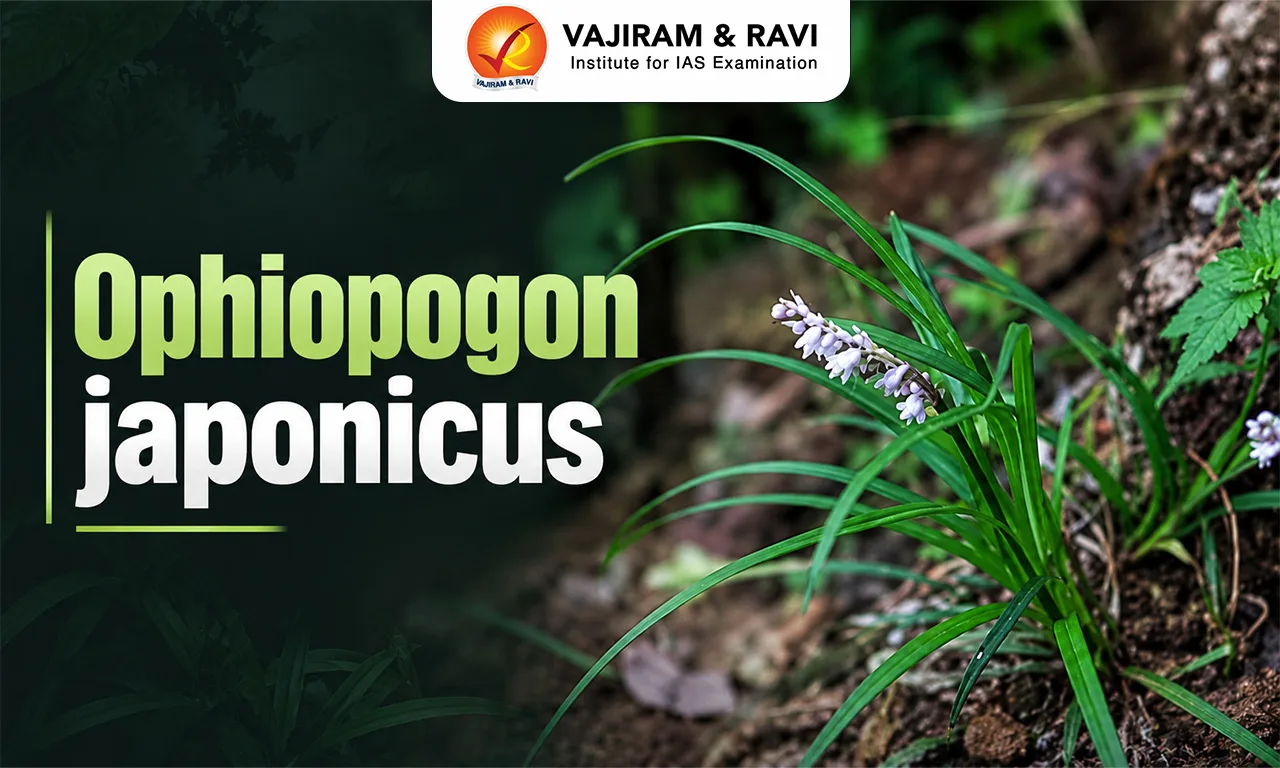
Recently, researchers from the Wildlife Institute of India (WII), Dehradun, and the Uluberia Botanical Institute Herbarium recorded the Ophiopogon japonicus in the wild in Arunachal Pradesh for the first time.

About Ophiopogon Japonicus

  • It is an evergreen perennial herb that grows in dense clumps.
  • Other names: Commonly known as dwarf lilyturf or mondo grass.
  • The genus Ophiopogon comprises around 85 species worldwide, of which seven species were previously recorded from India.  
  • It is a perennial and grows primarily in the subtropical biome.
  • Appearance: It has narrow, grass-like leaves with retroserrulate margin, small white to pale-purple flowers, and blue, berry-like fruits.
  • Distribution: The plant is native to East Asia and is found in China, Japan, Korea and Nepal, generally at elevations between 200 and 2,800 m.
  • Applications
    • Its tuberous roots are known as Ophiopogonis Radix or Maidong in Chinese and have long been used in traditional Chinese medicine.
    • It is reported that O. japonicus polysaccharides (OJPs) have a variety of biological activities, including anti-diabetes, anti-inflammatory, kidney protection, hepatoprotective and immunomodulatory activity.

Source: TOI

Ophiopogon Japonicus FAQs

Q1: What is Ophiopogon Japonicus?

Ans: It is an evergreen perennial herb that grows in dense clumps.

Q2: What are the other names of Ophiopogon Japonicus?

Ans: It is commonly known as dwarf lilyturf or mondo grass.

Khejri Tree

Khejri Tree

Khejri Tree Latest News

Recently, Lok Sabha Speaker has paid respects to Amrita Devi Bishnoi and all the martyrs who laid down their lives for the protection of Khejri trees in Khejadli village of Rajasthan during the 18th century.

About Khejri Tree

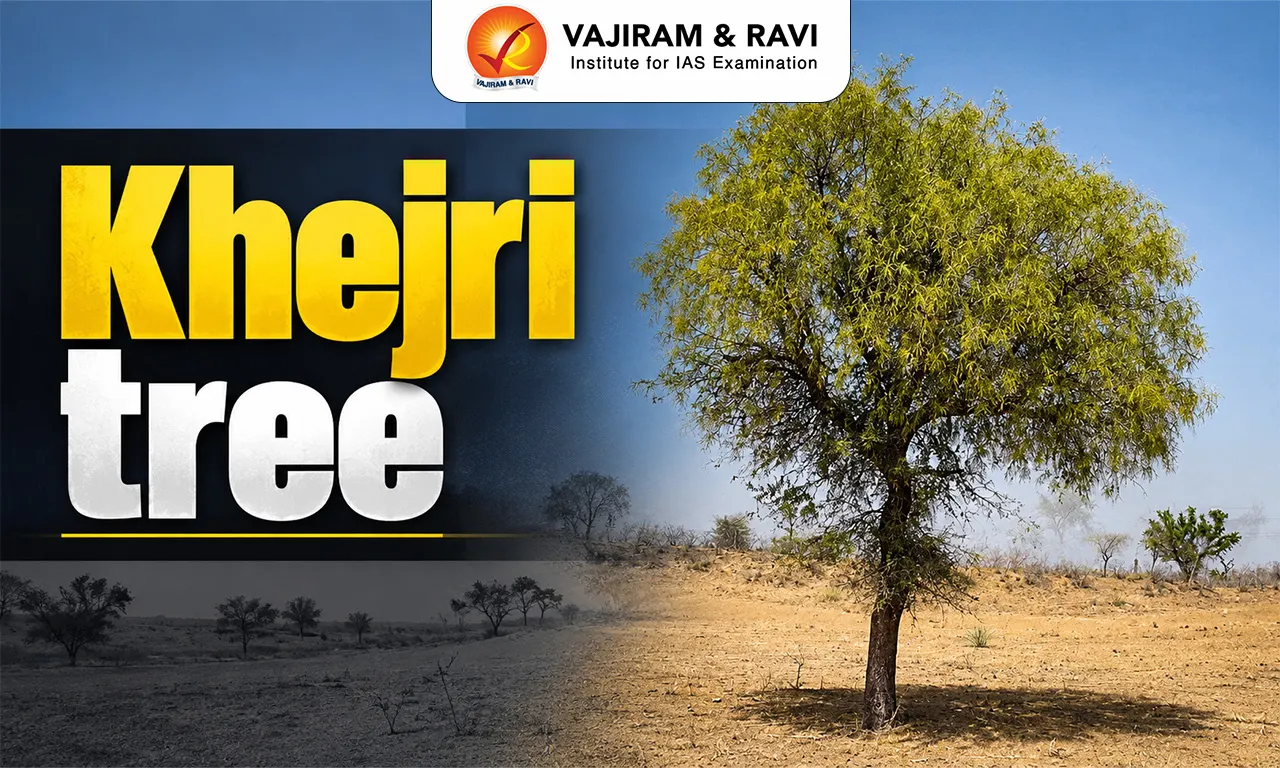
  • Khejri (Prosopis cineraria (L.) Marbride) is considered a sacred tree in Rajasthan.
  • It is also called jant or janti in areas like Alwar, Sikar, Jhunjhunu,
  • Khejri is called the state tree of Rajasthan.
  • Distribution: It is found growing in arid and semi-arid parts of Rajasthan, Gujarat, Haryana, Punjab, Delhi and some parts of southern India.

Features of Khejri Tree

  • The tree is frost and drought resistant and tolerates extreme temperatures ranging from 40–45 0C in summer to less than 10 0C in winter.
  • It is capable of growing in areas of rainfall ranging from 100–600 mm.
  • The tree can withstand the hottest winds, the driest season and stay alive where other plants cannot survive.
  • It is a deciduous tree with finely divided, feathery leaves and small yellow flowers.
  • It is known for its adaptability to arid conditions, the tree thrives in dry and sandy soils.

Significance of Khejri Tree

  • It is a nitrogen-fixing tree which enhances the fertility of the soil.
  • The fruit is used to make the very popular local dish ‘Sangri’
  • The bark of this tress is used medicinally for a range of ailments.
  • It plays a vital role in preserving the ecosystem of arid and semi-arid areas, mainly in the Thar Desert.
  • Its highly nutritious leaves constitute an important source of fodder for livestock while nutritious pods are valued as vegetables for human beings.

Source: News On Air

Khejri Tree FAQs

Q1: Where do we find Khejri Tree ?

Ans: It is found growing in arid and semi-arid parts of Rajasthan, Gujarat, Haryana, Punjab, Delhi.

Q2: What is the significance of Khejri Tree?

Ans: It is a nitrogen-fixing tree which enhances the fertility of the soil.

Neodymium-Iron-Boron (NdFeB) Magnets

Neodymium-Iron-Boron (NdFeB) Magnets

Neodymium-Iron-Boron (NdFeB) Magnets Latest News

Neodymium-Iron-Boron (NdFeB) magnets have become the backbone of energy transition and advanced manufacturing.

About Neodymium-Iron-Boron (NdFeB) Magnets

  • NdFeB magnets are a type of rare-earth permanent magnet composed of an alloy of neodymium (Nd), iron (Fe), and boron (B). 
  • First developed in the early 1980s, they are the strongest commercially available permanent magnets in the world, offering an extraordinary combination of high magnetic energy density, coercivity, and remanence in a compact size. 
  • The chemical formula for the primary magnetic phase in an NdFeB magnet is Nd₂Fe₁₄B — a tetragonal crystalline structure that gives the material its exceptional magnetic properties.  
  • Typically, the composition includes 29-32.5% neodymium, 64-69% iron, and 1.1-1.2% boron.   
  • Their magnetic performance can deteriorate at high temperatures, although specialized grades are designed for higher-temperature applications. 
  • The addition of heavy rare-earth elements like dysprosium (Dy) or terbium (Tb) is common in high-temperature grades to maintain performance above 150°C. 
  • All the NdFeB magnets are prone to corrosion. They will require a form of protective coating. The standard coating is a triple-layer plating of nickel copper nickel (Ni-Cu-Ni). 
  • Applications:
    • NdFeB magnets find widespread use in various industries, including electronics, automotive, medical devices, renewable energy, and more. 
    • In everyday products like headphones, electric motors, sensors, speakers, and generators, NdFeB magnets deliver enhanced performance, underlining their adaptability in modern technology.

News: TH

Neodymium-Iron-Boron (NdFeB) Magnets FAQs

Q1: What are Neodymium-Iron-Boron (NdFeB) magnets?

Ans: NdFeB magnets are rare-earth permanent magnets composed primarily of neodymium, iron, and boron.

Q2: What makes Neodymium-Iron-Boron (NdFeB) magnets significant among permanent magnets?

Ans: They are the strongest commercially available permanent magnets.

Q3: Which magnetic properties contribute to the exceptional performance of Neodymium-Iron-Boron (NdFeB) magnets?

Ans: Their high magnetic energy density, coercivity, and remanence.

Q4: What happens to the magnetic performance of Neodymium-Iron-Boron (NdFeB) magnets at high temperatures?

Ans: Their magnetic performance can deteriorate at high temperatures.

Q5: Which industries widely use Neodymium-Iron-Boron (NdFeB) magnets?

Ans: They are widely used in electronics, automotive, medical devices, and renewable energy.

AASHVAST Lab

AASHVAST Lab

AASHVAST Lab Latest News

Indian Army to deploy six AASHVAST labs nationwide for mandatory drone and CCTV cybersecurity screening to counter operational vulnerabilities.

About AASHVAST Lab

  • AASHVAST stands for Assessment and Analysis of Electronic Systems Hardware for Vulnerabilities and Security Threats.
  • It is a specialized testing and validation system developed to examine military electronics for hidden security weaknesses.
  • The primary goal is to ensure that critical military systems operate exactly as intended and do not contain unauthorized components or malicious code.
  • It is developed by the private firm for the Directorate General of Electronics and Mechanical Engineering (DG EME).

Working of AASHVAST Lab

  • Scale: There are approximately 14 types of vulnerabilities that the labs can detect.
  • Neutralize Threats: It neutralizes the common threats of enemy interference in Indian drones, preventing them from performing their designated tasks in a contested area.
  • Inspect Both Software and Hardware: The facility can inspect both hardware and software components used in drones, communication systems, sensors, and other defence equipment.
  • It examines the software that operates these unmanned aerial vehicles (UAVs) – to identify and eliminate firmware-level vulnerabilities.
  • Location based Bug Test: The system examines location-based security controls and assesses how a drone would respond to GPS spoofing or jamming by an adversary.
  • It can scan systems for hidden passwords, embedded keys and remote-access tools. It can also check whether a drone accepts only manufacturer-approved software updates.

Significance of AASHVAST Lab

  • The launch of AASHVAST Labs marks a major step toward strengthening the cybersecurity and resilience of India’s defence infrastructure.
  • The facility will help ensure that military drones, sensors, communication systems, and electronic platforms remain secure from hidden vulnerabilities and evolving cyber threats.

Source: IE

AASHVAST Lab FAQs

Q1: What does AASHVAST stand for?

Ans: AASHVAST stands for Assessment and Analysis of Electronic Systems Hardware for Vulnerabilities and Security Threats.

Q2: What is AASHVAST Lab?

Ans: It is a specialized testing and validation system developed to examine military electronics for hidden security weaknesses.

Nevados de Chillán Volcano

Nevados de Chillán Volcano

Nevados de Chillán Volcano Latest News

Chile’s Nevados de Chillán volcano erupted in an eruptive pulse recently, sending ash and volcanic material about 380 metres above the crater.

About Nevados de Chillán Volcano

  • It is a large composite stratovolcanic complex located in the Southern Volcanic Zone of the Chilean Andes. 
  • It's one of the most active volcanoes in the Ñuble Region of Chile.  
  • This volcanic group is made up of three main peaks that overlap each other. 
    • The highest peak is Cerro Blanco (also called Volcán Nevado), which stands about 3,212 meters (10,538 feet) tall. 
    • To the southeast, you'll find Volcán Viejo (also known as Volcán Chillán), which is about 3,089 meters (10,135 feet) high. 
    • In the middle of these two is Volcán Nuevo. 
  • Documented eruptions date back to the 17th century, while geological deposits preserve evidence of activity dating back thousands of years. 
  • It is particularly known for lava-dome growth, explosions and pyroclastic activity.

News: HT

Nevados de Chillán Volcano FAQs

Q1: What is Nevados de Chillán?

Ans: Nevados de Chillán is a large composite stratovolcanic complex in the Southern Volcanic Zone of the Chilean Andes.

Q2: How many main peaks make up the Nevados de Chillán volcanic group?

Ans: The volcanic group consists of three main overlapping peaks.

Q3: Which is the highest peak of the Nevados de Chillán volcanic group?

Ans: Cerro Blanco, also known as Volcán Nevado, is the highest peak.

Q4: How old is the documented eruptive history of Nevados de Chillán?

Ans: Its documented eruptions date back to the 17th century.

Painganga Wildlife Sanctuary

Painganga Wildlife Sanctuary

Painganga Wildlife Sanctuary Latest News

Maharashtra’s tiger conservation programme has added a third big cat to the population being established in Painganga Wildlife Sanctuary, with a young tigress shifted to the 325-sq-km sanctuary in Yavatmal district recently.

About Painganga Wildlife Sanctuary

  • It is located in the Yavatmal district of Maharashtra.  
  • It derives its name from the river Painganga, or Penganaga River (a tributary of the Wardha River), which borders the sanctuary on its three sides. 
  • It encompasses an area of about 325 sq.km.
  • The sanctuary’s geological formation consists of basaltic rock, which contributes to the thermal mass of the region.
  • The sanctuary features several ancient rock shelters adorned with petroglyphs, providing insights into the region’s prehistoric human activity. 
  • Flora: It is characterized by its diverse topography, which includes rolling hills, riverine valleys, and dense deciduous forests primarily composed of teak and bamboo.  
  • Fauna:
    • The numerous species of fauna sheltered here include Fox, Leopard, Jackal, Hare, Four Horned Antelope, Porcupine, Sambar, Nilgai, Black Buck, Chinkara, and many others.
    • It is also a paradise for birdwatchers with numerous species of avifauna like Vulture, Bulbul, Dove, Kingfisher, Cuckoo, Kite, and others.  

News: TOI

Painganga Wildlife Sanctuary FAQs

Q1: Where is Painganga Wildlife Sanctuary located?

Ans: It is located in Yavatmal district of Maharashtra.

Q2: From which river does Painganga Wildlife Sanctuary derive its name?

Ans: It derives its name from the Painganga, or Penganga River.

Q3: What type of forests are mainly found in Painganga Wildlife Sanctuary?

Ans: The sanctuary mainly has dense deciduous forests.

Q4: Which two tree species are prominent in the forests of Painganga Wildlife Sanctuary?

Ans: Teak and bamboo are prominent.

Damodar River

Damodar River

Damodar River Latest News

River and fishery department experts in West Bengal are still unable to explain why hilsas are frequently found upstream in the Damodar River.

About Damodar River

  • It is a major river of eastern India and an important part of the Ganges River System. 
  • It flows through the states of Jharkhand and West Bengal.
  • This river is sometimes called "the Sorrow of Bengal" because it used to cause big floods in the plains of West Bengal.  
  • Course:
    • It originates from the Palamau hills of Chota Nagpur Plateau in Jharkhand
    • From its source, the river flows in a southeastern direction, passing through the Chota Nagpur Plateau, a region known for its rich mineral deposits.
    • In its lower course, it flows through West Bengal’s plains and is joined by several tributaries. 
    • It meets the Hooghly River at Shayampur, which is 48 km from Kolkata.
  • Total Length: 592 km 
  • The Damodar basin is the industrial and mineral heartland of India. 
    • It traverses the Gondwana coalfieldsJharia, Raniganj, Bokaro, Karanpura and Giridih — which contain the bulk of India's high-grade coking coal reserves, making the valley the foundation of the country's iron, steel and thermal-power industries.  
  • Tributaries: Barakar River, Konar River, Jamunia River, Bokaro River, Sali River, Ghari River, Guaia River, Khadia River, Bhera River.
  • Damodar Valley Project:
    • It is a multipurpose river valley project in eastern India, developed on the Damodar River and its tributaries with objectives including flood control, irrigation and power generation.  
    • The project is operated by the Damodar Valley Corporation (DVC), an undertaking of the Indian Government established in July 1948.
    • It was one of the first major multipurpose river valley projects undertaken in independent India. 
    • The DVC constructed dams at Tilaiya and Maithon on the Barakar, Konar on the Konar, and Panchet on the Damodar, together with the Durgapur barrage that feeds the Damodar Valley Canal system.

News: SM

Damodar River FAQs

Q1: Which major river system is the Damodar River an important part of?

Ans: It is an important part of the Ganges River System.

Q2: Which two Indian states does the Damodar River flow through?

Ans: Jharkhand and West Bengal.

Q3: Where does the Damodar River originate?

Ans: It originates in the Palamau hills of the Chota Nagpur Plateau in Jharkhand.

Q4: What is the approximate total length of the Damodar River?

Ans: The Damodar River is approximately 592 km long.

Q5: Where does the Damodar River meet the Hooghly River?

Ans: It meets the Hooghly River at Shayampur, about 48 km from Kolkata.

Indian Crafts and Luxury Brands: The Legal Gap Around Traditional Art

Indian Crafts and Luxury Brands

Indian Craft Latest News

  • Indian crafts and weaves are skills and visual languages carried across generations, rooted in specific regions and communities. 
  • Yet when they enter the global luxury fashion system, the people and places behind them become invisible.
  • After the controversy over Prada's Kolhapuri chappals, two more instances have drawn criticism.
    • Recently, Ralph Lauren presented a pink evening gown featuring aari work — hook embroidery from Gujarat. It was described only as hand-applied embellishment.
    • Fendi's autumn collection includes a mirror-work Baguette bag, made in Italy over 138 hours, using 39,500 beads and 475 mirrors, priced at $10,000. It closely resembles the mirrored purses sold at Indian craft fairs.
  • The pattern raises a sharp question. Why is it so easy to commercially appropriate a traditional Indian craft, and so hard for the community behind it to claim recognition, ownership or a share of the value?

The Core Legal Contradiction

  • Experts identify the root problem. Intellectual property is territorial, while culture is not. Laws stop at borders; crafts do not.
  • A centuries-old technique does not fit conventional IP categories. There may be a specific artistic expression, a design, a geographical identity or a protected name. 
  • But the underlying tradition belongs to a community and has evolved over generations. 
  • Hence, traditional crafts have cultural provenance but no clearly identifiable legal owner
  • That gap is what gets exploited.

What GI Can and Cannot Do

  • A Geographical Indication (GI) protects the name, origin and reputation of a qualifying product. 
  • It does not necessarily protect every motif, stitch or visual element associated with a craft. This is the crucial limitation.
  • Analysts argue that the guiding principle should be representation and custodianship. 
  • Those who have sustained and transmitted a tradition should have a meaningful role in decisions about its commercial use.
  • Key points on the GI framework:
    • Under India's GI Act, both registered proprietors and authorised users can seek relief for infringement.
    • Remedies include injunctions, damages and account of profits.
    • But recognising a right and giving a community the capacity to exercise it are two different things.
    • Cross-border litigation is resource-intensive, placing it beyond most artisan groups.
  • Institutional capacity therefore matters. Producer organisations, cooperatives and representative bodies can document provenance, organise authorised users, negotiate collectively and pursue enforcement.
  • Also, the government should assist with registration, recognition and enforcement. Ownership must remain with the community.

The Problem of Authorship

  • Traditional craft unsettles the very idea of an author. The first creator of a technique may be unknown, unidentifiable, or simply irrelevant to how the tradition actually grew. 
  • Each generation passes knowledge on and alters it slightly. The community keeps practising it.
  • However, the absence of an identifiable author cannot become an invitation to appropriate. The law must recognise the community as custodian wherever a continuing relationship exists between a cultural expression and the people who preserved it. 
  • Provenance could be established through historical records, regional practice, oral testimony and community knowledge.

Documentation: Necessary but Delicate

  • Traditional knowledge cannot simply be recorded and handed to an outside institution. 
  • Some knowledge is sacred or restricted. Documentation must not become a route to external control.
  • Experts propose a carefully maintained digital registry covering motifs, techniques, names, regions and custodial communities. 
  • Such a registry would not grant ownership over every visual similarity. But it would make it far harder for a company to claim that a centuries-old Indian tradition originated in a European design studio.

The 'Inspiration' Escape Route

  • As per the experts, the place of origin must be credited, not absorbed into a brand's own creative vocabulary.
  • European brands rely on the language of "inspiration." Their design and copyright frameworks are also stronger than those of developing countries. 
  • A further loophole exists in technique itself. If work is fully machine-made, it is not aari but computerised crewel work — and that relabelling becomes an escape route.

The Risk of Over-Protection

  • There is a real danger in protecting crafts too aggressively. The law meant to preserve them could freeze them.
  • Techniques have always moved between communities. Artisans have adapted motifs, colours, materials and methods. 
  • The aim, therefore, should be to prevent extraction, false authorship and unacknowledged exploitation — not to stop culture from moving. Protection should not turn a living craft into a museum piece.

Towards a Sui Generis Framework

  • This is why a sui generis — specially designed — legal framework for traditional cultural expressions is being debated. 
  • It could answer questions conventional copyright and design law cannot:
    • Who represents the community?
    • When is consent required?
    • When is attribution mandatory?
    • When must a commercial user share economic benefits?
    • How is legitimate inspiration distinguished from misappropriation?

International developments

  • The World Intellectual Property Organisation (WIPO) is negotiating rules on misappropriation, attribution, community rights and benefit-sharing. 
  • Its 2024 treaty on genetic resources and associated traditional knowledge shows international IP law is beginning to move beyond conventional copyright and patents. 
  • The Berne Convention also offers some avenues to challenge unauthorised use.

Conclusion

  • The debate is not about halting cultural exchange. It is about ending extraction without acknowledgement. 
  • India needs collective legal identity for artisan communities, documented provenance, and enforceable attribution with benefit-sharing. Inheritance must not enrich everyone except those who kept it alive.

Source: IE | ToI

Indian Craft FAQ

Q1: Why do Indian crafts face legal challenges when used by luxury brands?

Ans: Indian crafts face legal challenges because traditional techniques belong to communities, while conventional intellectual property laws often require identifiable authors or owners.

Q2: Can geographical indications protect Indian crafts?

Ans: Geographical indications can protect the name, origin and reputation of qualifying Indian crafts, but they do not necessarily protect every motif or stitch.

Q3: Why is community ownership important for Indian crafts?

Ans: Community ownership recognises artisans who preserve and transmit Indian crafts across generations, giving them meaningful participation in commercial decisions and benefit-sharing.

Q4: How can Indian crafts be better documented?

Ans: Indian crafts could be documented through digital registries recording motifs, techniques, names, regions and custodial communities while protecting sensitive traditional knowledge.

Q5: What legal framework could better protect Indian crafts?

Ans: A sui generis framework could protect Indian crafts by establishing community representation, attribution, consent requirements, commercial benefit-sharing and safeguards against misappropriation.

Public Insurance Registry – India’s UPI Moment for the Insurance Sector

Public Insurance Registry

Public Insurance Registry Latest News

  • IRDAI has released a consultation paper on a Public Insurance Registry (PIR), which is being described as having the potential to spark a revolution in insurance similar to what UPI achieved in payments.

About UPI and the Digital Public Infrastructure Model

  • UPI (Unified Payments Interface) is widely regarded as a landmark in India's Digital Public Infrastructure (DPI) journey. 
  • Its significance lies not merely in enabling digital transactions, but in creating an interoperable system that allowed an entire market to function differently.
  • The key features of the DPI approach, as articulated in India's G20 Task Force on DPI, include:
    • Interoperability: systems work across providers, but without forcing uniformity
    • Minimalist building blocks: simple foundational components
    • Federated architecture: data stays where it is collected rather than being centralised
  • The PIR proposal applies this same framework to insurance.

The Problem in Insurance

  • Insurance remains one of the last large financial sectors where policies are not accessible at a single point. Several frictions follow from this.
  • KYC has to be done multiple times, once for each insurer or policy, despite being the same individual.
  • Claims history is not easily available, even though it should be. This affects both underwriting accuracy and the policyholder's ability to switch providers.
  • Consumer awareness and product comparison still depend largely on a salesperson's narrative rather than verified information.
  • The consultation paper aims to shift the sector from the old adage that "insurance is sold" to a world where "insurance is also bought", where customers have enough verified information to make informed choices.

The Missing Connective Tissue

  • Recent legislation provides partial foundations:
    • Sabka Bima Sabki Raksha Act: gives IRDAI a statutory anchor for insurance digitisation
    • Digital Personal Data Protection Act: provides data privacy safeguards
    • Bima Sugam: boosts accessibility
  • What was missing was a connective tissue making these a unified framework. That is the role the PIR is intended to fill.

Design Principles of the PIR

  • The consultation paper not only borrows the language of DPI but also its discipline.
  • Its design principles derive from India's G20 Task Force on DPI, emphasising that systems should be interoperable but not uniform.
  • Two structural features stand out:
    • Minimalist building blocks: the registry provides foundational components rather than prescribing detailed operations.
    • Federated architecture with source-system primacy: data remains where it is collected and is not centralised. This addresses a significant privacy concern, since no single repository would hold all insurance data.

The Registry's Function

  • The PIR positions itself as a common information layer that lets participants discover, verify and exchange insurance information consistently.
  • The argument is that with free flow of information, competitive advantage shifts to innovation and customer experience rather than to information asymmetry. 
  • Every stakeholder, including insurers and customers, has a shared role in making the ecosystem more transparent.

Governance Structure

  • A critical element of the proposal is the governance model.
  • The paper proposes restructuring the Insurance Information Bureau (IIB) into a not-for-profit firm wholly owned by IRDAI.
  • Three features are highlighted as important:
    • Independent execution
    • Institutional neutrality
    • Rotating industry representation on the board
  • The stated objective is to ensure the PIR gains statutory legitimacy without regulatory capture, that is, without being captured by the very industry it is meant to serve transparently.
  • A phased rollout is proposed, focusing on early, visible wins rather than an all-out sweeping mandate from the outset.

What the PIR Offers Stakeholders

  • For Policyholders
    • A consolidated view of every policy across life, health, motor and property
    • Nominees, renewals, claims and unclaimed benefits visible in one place
    • Portability becomes genuinely practical rather than theoretical
  • For Insurers
    • Verified policy and claims history, improving underwriting accuracy
    • Better fraud control through access to consolidated records
    • Standardised reporting, reducing compliance costs
  • For Reinsurers and IRDAI
    • Aggregate exposure data, improving catastrophe preparedness
    • Stronger regulatory oversight through consolidated information
  • For Banks and Government
    • Verified coverage data supporting better credit decisions
    • More targeted welfare delivery

Significance

  • The framing of the PIR as insurance's "UPI moment" captures something important about its ambition. 
  • UPI did not merely digitise existing payment processes; it restructured how the market operated by making interoperability the default.
  • If the PIR achieves the same for insurance, the consequences could include:
    • Higher insurance penetration, as friction in purchase, comparison and claims reduces
    • Faster claim settlement, particularly for motor claims with VAHAN linkages
    • Reduced fraud, through verified history
    • Better catastrophe preparedness, through aggregate exposure data
    • Stronger credit markets, as verified coverage improves lender confidence

Considerations and Challenges

  • Several issues will determine whether the PIR delivers on this potential.
  • Data privacy and consent must be handled carefully, even with federated architecture. Federated systems still require query mechanisms, and those must operate within the Digital Personal Data Protection Act framework.
  • Voluntary versus mandatory participation will shape adoption. A phased approach suggests initial voluntary uptake, which may limit the completeness of the data layer in early years.
  • Governance independence will be tested in practice. Not-for-profit ownership by IRDAI with rotating industry representation is a careful design, but its effectiveness depends on implementation.
  • Insurer incentives matter too. Incumbents with large books may see less advantage in transparency than new entrants, and the rollout must account for that asymmetry.

Source: TH

Public Insurance Registry FAQs

Q1: What is the Public Insurance Registry?

Ans: It is a proposed common information layer for the insurance sector, designed to let participants discover, verify and exchange insurance information consistently.

Q2: Which body has released the consultation paper?

Ans: IRDAI has released the consultation paper, proposing to restructure the Insurance Information Bureau into a not-for-profit firm wholly owned by IRDAI.

Q3: What design principles does the PIR follow?

Ans: Principles from India's G20 Task Force on DPI, interoperable but not uniform, with minimalist building blocks and federated architecture with source-system primacy.

Q4: What benefits does the PIR offer policyholders?

Ans: A consolidated view of all policies across life, health, motor and property, with nominees, renewals, claims and unclaimed benefits visible in one place, and genuine portability.

Q5: What linkages could speed up motor claim settlement?

Ans: Linkages with VAHAN and e-DAR could cut motor claim settlement times and reduce disputes.

UPI Merchant Charges Above ₹2,000, New MDR Rules from 15th October

UPI MDR 2026

National Payments Corporation of India (NPCI) has introduced a new Merchant Discount Rate (MDR) framework for selected UPI person-to-merchant (P2M) transactions. From October 15, 2026, a 0.4% MDR will apply to eligible UPI merchant transactions above ₹2,000. The new framework is aimed at supporting the long-term sustainability, infrastructure and security of the digital payments ecosystem.

What is UPI MDR?

Merchant Discount Rate (MDR) is a fee associated with accepting digital payments. It is generally paid within the payment ecosystem by the merchant side and is distributed among participating entities such as banks, payment service providers and payment application providers.

In the case of UPI, MDR is being introduced for a specified category of person-to-merchant transactions above ₹2,000. It is important to note that MDR is not a tax collected by the government. The revenue remains within the payment ecosystem to support its functioning and expansion.

Why has NPCI Introduced MDR on UPI Transactions?

UPI has grown into a large-scale digital payment infrastructure handling billions of transactions every month. With the expansion of the network, payment infrastructure requires continued investment in technology, cybersecurity, fraud prevention, server capacity and customer support.

The new MDR framework provides a revenue mechanism within the payment ecosystem while keeping everyday low-value transactions free. NPCI and the government have also emphasised the need to protect small merchants and ordinary users from additional costs.

Major reasons behind the introduction of MDR

  • Financial sustainability: A revenue mechanism can support the continued operation and expansion of the UPI ecosystem.
  • Infrastructure development: UPI requires continuous investment in payment infrastructure and technology.
  • Cybersecurity: Growing digital payments require stronger systems for preventing fraud and cyber threats.
  • Innovation: Revenue can support technological improvements and new payment solutions.
  • Consumer protection: The framework keeps P2P payments and low-value merchant payments free.
  • Support for small businesses: Eligible small merchants continue to receive zero-MDR benefits.
  • Reduced dependence on government incentives: A payment ecosystem with its own revenue mechanism can reduce dependence on continued public funding.

What is the New 0.4% UPI MDR Rule?

Under the UPI New Rules 2026 framework, a 0.4% MDR will apply to specified person-to-merchant UPI transactions above ₹2,000 from October 15, 2026.

For example, if an eligible merchant receives a ₹3,000 UPI payment, the standard MDR would be ₹12. Similarly, a ₹50,000 eligible transaction would attract ₹200 MDR. For transactions of ₹75,000 and above, the MDR is capped at ₹300 per transaction.

Impact of UPI MDR on Merchants and Consumers

The new UPI MDR framework will mainly affect eligible merchants receiving higher-value UPI payments, while ordinary consumers will continue to use most UPI services without direct charges. The policy aims to maintain affordable digital payments while supporting the financial sustainability of the UPI ecosystem.

  • Consumers: P2P transactions and merchant payments up to ₹2,000 remain free.
  • Merchants: Eligible P2M transactions above ₹2,000 will attract 0.4% MDR.
  • Small merchants: Eligible small merchants continue to benefit from zero MDR.
  • No direct consumer charge: MDR is not intended to be separately recovered from customers.
  • Digital payment ecosystem: MDR can provide a revenue stream for maintaining payment infrastructure, cybersecurity and innovation.
  • Higher-value transactions: Transactions of ₹75,000 and above have an MDR cap of ₹300 per transaction.

Significance of UPI MDR for India’s Digital Payments Ecosystem

The introduction of UPI MDR is significant because it creates a revenue mechanism for supporting the rapidly expanding digital payments infrastructure while keeping most everyday UPI transactions free.

  • Financial sustainability: Provides a revenue stream to support the long-term functioning of the UPI ecosystem.
  • Stronger infrastructure: Can support investment in payment technology, processing capacity and system upgrades.
  • Better cybersecurity: Growing digital transactions require continuous investment in fraud prevention and cybersecurity.
  • Continued innovation: Revenue within the ecosystem can support development of new digital payment solutions.
  • Protection of small users: P2P payments and merchant transactions up to ₹2,000 remain free.
  • Support for small merchants: Eligible small merchants continue to receive zero-MDR benefits.
  • Growth of Digital Public Infrastructure: Strengthens the sustainability of UPI as a major component of India's Digital Public Infrastructure (DPI).
  • Balanced approach: The framework attempts to combine affordable digital payments with the long-term sustainability of payment infrastructure.

About National Payment Corporation of India (NPCI)

National Payments Corporation of India (NPCI) is an umbrella organisation for operating and developing retail payment and settlement systems in India, established as an initiative of the Reserve Bank of India (RBI) and the Indian Banks’ Association (IBA).

  • Established: 2008
  • Headquarters: Mumbai, Maharashtra
  • Legal status: Section 8 company under the Companies Act, 2013
  • Key role: Develops and operates retail payment systems in India.
  • Major payment systems: UPI, RuPay, IMPS, Bharat BillPay, FASTag (NETC) and AePS.
  • Ownership: Promoted by RBI and IBA, with ownership held by member banks.
  • Importance: Acts as a key institution in India's digital payments ecosystem.

UPI MDR 2026 FAQs

Q1: What is UPI MDR?

Ans: UPI MDR (Merchant Discount Rate) is the fee charged to eligible merchants for accepting certain UPI payments. From October 15, 2026, a 0.4% MDR will apply to specified person-to-merchant transactions above ₹2,000.

Q2: When will the new UPI MDR rule come into effect?

Ans: The new UPI MDR framework will come into effect from October 15, 2026.

Q3: Will UPI payments above ₹2,000 be charged to consumers?

Ans: No. The MDR is a merchant-side charge, and consumers will continue to make UPI payments without a separate transaction fee.

Q4: What is the MDR rate for UPI transactions above ₹2,000?

Ans: The standard MDR is 0.4% for eligible person-to-merchant UPI transactions above ₹2,000.

Q5: What is the maximum UPI MDR that can be charged?

Ans: For transactions of ₹75,000 and above, the MDR is capped at ₹300 per transaction.

Exercise SLINEX

Exercise SLINEX

Exercise SLINEX Latest News

The 13th edition of the exercise SLINEX-26 is being conducted at Visakhapatnam.

About Exercise SLINEX

  • It is a bilateral naval exercise between India and Sri Lanka, which was conceptualised in 2005.
  • It has strengthened maritime cooperation between the nations over two decades.
  • Participation: INS Kavaratti, an indigenous Anti-Submarine Warfare Corvette, and INS Jyoti, the Fleet Tanker, will participate from the Indian Navy.
  • Phases: The exercise commenced with the Harbour Phase, which will be followed by the Sea Phase.
    • The Harbour Phase includes professional interactions, cross-deck visits, sharing of best practices, Yoga, sports and cultural activities.
    • The subsequent Sea Phase will focus on enhancing operational synergy and interoperability through coordinated activities at sea.
  • SLINEX has evolved into an important forum for fostering maritime cooperation, interoperability and mutual understanding between the two Navies.
  • Significance: It is aligned with India’s vision of MAHASAGAR, SLINEX-26 reinforces India’s commitment to a secure, stable and inclusive maritime environment and further consolidates the enduring maritime partnership between India and Sri Lanka.

Source: PIB

Exercise SLINEX FAQs

Q1: Exercise SLINEX is conducted between which two countries?

Ans: India and Sri Lanka

Q2: What is the significance of Exercise SLINEX?

Ans: It has strengthened maritime cooperation between the nations over two decades.

Sulphur

Sulphur

Sulphur Latest News

Soaring prices of sulphur which is again linked to the escalating West Asia and Russia-Ukraine conflicts – is impacting the availability of di-ammonium phosphate (DAP), single super phosphate (SSP) and other major complex fertilisers in India. 

About Sulphur

  • Sulphur (identified by the letter S) is a non-metallic chemical element.
  • Occurrence: It can be found as a pure element or as sulphate or sulphide minerals. 
  • It occurs naturally in the environment and is believed to be the thirteenth most abundant element in the earth’s crust.

Properties of Sulphur

  • In its pure form, sulfur is a tasteless, odorless, brittle solid with a pale yellow color.
  • It’s a poor conductor of electricity that doesn’t dissolve in water.
  • It combines directly with almost all the elements with the exception of gold, platinum and the noble gases.
  • Distribution: In India it is mainly found in Puga Valley (Jammu & Kashmir), Barren Island of Bay of Bengal, Andhra Pradesh Kerala and Himachal Pradesh.

Uses of Sulphur

  • Chemical Industries:  Sulphur is an essential raw material for many chemical industries and is essentially used for the production of sulphuric acid.
    • Sulphuric acid is a strong mineral acid which is used in ore processing, fertilizer manufacturing, oil refining, waste water processing and chemical synthesis. 
  • Other Industries: The powdered form of sulphur produced by sublimation process is generally used in rubber vulcanisation, agricultural dusts, pharmaceutical products and stock feeds.
  • Sulphur is used as a light-generating medium in the rare lighting fixtures known as “sulphur lamps”.
  • Sulphur compounds are also used in detergents, fungicides, dyestuffs and agrichemicals.

Source: IE

Sulphur FAQs

Q1: What is Sulphur?

Ans: Sulphur (identified by the letter S) is a non-metallic chemical element.

Q2: Where do we find Sulphur in India?

Ans: In India it is mainly found in Puga Valley (Jammu & Kashmir), Barren Island of Bay of Bengal, Andhra Pradesh Kerala and Himachal Pradesh.

Asian Games 2026, Medal Tally, Participating Countries, Host Country

Asian Games 2026

Asian Games 2026, officially known as the 20th Asian Games Aichi-Nagoya 2026, are being held in Japan from 19 September to 4 October 2026. Aichi Prefecture and Nagoya are hosting the continental multi-sport event, which brings together athletes from across Asia.

The Games feature 43 sports, 71 disciplines and 469 medal events. The official programme also includes newer sports such as teqball, padel, sport climbing, skateboarding, surfing, esports and mixed martial arts (MMA).

Asian Games 2026 Overview

The key highlights related to the Asian Games 2026 have been tabulated below.

Asian Games 2026 Overview

Particulars

Details

Event

20th Asian Games

Official Name

Aichi-Nagoya 2026

Host Country

Japan

Host Region

Aichi Prefecture and Nagoya

Dates

19 September – 4 October 2026

Total Indian Delegation

768

New and Emerging Sports at Asian Games 2026

Asian Games 2026 feature several new and emerging sports, reflecting the changing interests of athletes and younger audiences. These sports add more variety to the Games and give athletes from newer sporting disciplines an international platform.

  • Teqball: A football-based sport played on a curved table, making its Asian Games debut in 2026.
  • Mixed Martial Arts (MMA): Included in the Games for the first time, with competitions across different weight categories.
  • Padel: A racket sport combining elements of tennis and squash, included in men's and women's competitions.
  • Surfing: Features shortboard events for men and women.
  • Skateboarding: Includes different disciplines that test balance, speed and technical skills.
  • Sport Climbing: Includes speed, bouldering and lead events.
  • Esports: Continues to provide a competitive platform for digital sports and gaming.

Also Read:- India to Host Commonwealth Games 2030

Asian Games 2026 Participating Countries

Asian Games 2026 feature participation from 45 countries and regions across Asia. The participating delegations represent South Asia, Southeast Asia, East Asia, Central Asia and West Asia.

No. Country/Region No. Country/Region No. Country/Region
1 Afghanistan 16 Kazakhstan 31 Philippines
2 Bahrain 17 Kuwait 32 Qatar
3 Bangladesh 18 Kyrgyzstan 33 Korea
4 Bhutan 19 Lao PDR 34 Saudi Arabia
5 Brunei 20 Lebanon 35 Singapore
6 Cambodia 21 Macao, China 36 Sri Lanka
7 Chinese Taipei 22 Malaysia 37 Syria
8 DPR Korea 23 Maldives 38 Tajikistan
9 Hong Kong, China 24 Mongolia 39 Thailand
10 India 25 Myanmar 40 Timor-Leste
11 Indonesia 26 Nepal 41 Turkmenistan
12 Iraq 27 Oman 42 United Arab Emirates
13 IR Iran 28 Pakistan 43 Uzbekistan
14 Japan 29 Palestine 44 Vietnam
15 Jordan 30 China 45 Yemen

Asian Games 2026 Host Country

Japan is hosting the 20th Asian Games 2026 in Aichi-Nagoya, marking the third time the country has hosted the Asian Games. The event is being held from 19 September to 4 October 2026 across multiple venues in Aichi Prefecture and Nagoya. Japan previously hosted the Asian Games in Tokyo in 1958 and Hiroshima in 1994. The Games feature athletes from across Asia competing in a wide range of sports and disciplines.

India at Asian Games 2026

India is participating in the 20th Asian Games in Aichi-Nagoya with 503 athletes across 36 disciplines. The contingent includes 269 men and 234 women, supported by coaches, officials and other staff. India enters the Games after winning a record 107 medals at Hangzhou 2023, including 28 gold, 38 silver and 41 bronze medals.

Medal Tally at Asian Games 2026

As of 21 September 2026, China leads the Asian Games 2026 medal table with 22 medals, while India is ranked 10th with 6 medals, including 4 silver and 2 bronze.

Rank

Nation

Gold

Silver

Bronze

Total

1

China

13

6

3

22

2

Japan

6

8

7

21

3

South Korea

4

3

9

16

4

Kazakhstan

4

0

3

7

5

Thailand

3

1

0

4

6

Hong Kong

1

2

2

5

10

India

0

4

2

6

About Asian Games

Asian Games, also known as the Asiad, are a major multi-sport event held every four years for athletes from across Asia. The Games have evolved significantly since their beginning in 1951.

  • Early Origins: The idea of an Asian multi-sport event was influenced by the Far Eastern Championship Games (1913) and the West Asian Games (1934).
  • 1948 Initiative: During the 1948 London Olympics, Asian representatives discussed creating a larger sporting event for Asian countries. Indian IOC representative Guru Dutt Sondhi played an important role in promoting the idea.
  • Asian Games Federation: The Asian Games Federation (AGF) was established in 1949 in New Delhi to organise and govern the new continental sporting event.
  • First Asian Games: The first Asian Games were held in New Delhi in March 1951, with 489 athletes from 11 countries competing in 6 sports and 57 events.
  • Expansion: The Games gradually expanded to more countries and sports, with editions held in Manila (1954), Tokyo (1958), Jakarta (1962), Bangkok (1966 and 1970) and other Asian cities.
  • Formation of OCA: In 1981, the Olympic Council of Asia (OCA) was created to replace the Asian Games Federation. It later became the main governing body for the Asian Games.
  • Modern Asian Games: The Games continued to grow, with recent editions held in Guangzhou (2010), Incheon (2014), Jakarta-Palembang (2018) and Hangzhou (2023).

Asian Games 2026 FAQs

Q1: When are the Asian Games 2026 being held?

Ans: Asian Games 2026 are being held from 19 September to 4 October 2026 in Aichi-Nagoya, Japan.

Q2: Where are the Asian Games 2026 being held?

Ans: The Games are being hosted by Aichi Prefecture and Nagoya in Japan, with competitions taking place across multiple venues.

Q3: How many sports are there in Asian Games 2026?

Ans: The official Aichi-Nagoya programme features 43 sports, 71 disciplines and 469 medal events.

Q4: How many athletes are representing India?

Ans: India has sent 503 athletes, comprising 269 men and 234 women, across 36 disciplines.

Q5: How many members are there in India's Asian Games contingent?

Ans: India's total approved contingent consists of 768 members, including 503 athletes and accompanying support staff and officials.

Project Cheetah – Gandhi Sagar Emerges as a 2nd Cheetah Habitat in MP

Project Cheetah

Project Cheetah Latest News

  • Recently, Madhya Pradesh CM released CCB-2, a three-year-old female cheetah brought from Botswana, into Gandhi Sagar Wildlife Sanctuary. 
  • The relocation from Kuno National Park aims to establish Gandhi Sagar as a viable second home for cheetahs in MP and strengthen the long-term conservation strategy under Project Cheetah.
  • The move comes shortly after KGP12, an India-born female cheetah, gave birth to four cubs at Kuno National Park, marking an important milestone for the programme.

Project Cheetah

  • Genesis: Discussions to bring the Cheetah back to India were initiated in 2009 by the Wildlife Trust of India. 
  • Plan: Under the ‘Action Plan for Reintroduction of Cheetah in India’, 50 cheetahs to be brought from African countries to various national parks over 5 years. 
  • Most suitable site - Kuno Palpur National Park (KNP) in MP: 
    • Amongst the surveyed sites of the central Indian states, KNP has been rated as the most suitable habitat with adequate prey base. 
    • It is assessed to be capable of supporting 21 Cheetahs and is likely the only wildlife site in the country where villages have been completely relocated from within the park.
    • Kuno also provides the possibility of harbouring four of India's big cats - tiger, lion, leopard and Cheetah, enabling them to coexist as they have in the past.
  • Other recommended sites: Nauradehi Wildlife Sanctuary and Gandhi Sagar Wildlife Sanctuary of MP; Shahgarh bulge and Mukundara Tiger Reserve of Rajasthan.
  • First reintroduction:
    • India’s cheetah reintroduction programme began in (September) 2022, with African cheetahs being brought to India after the species had become extinct in the country.
    • The programme is gradually moving beyond simply introducing individual animals towards creating multiple viable habitats and a sustainable, interconnected cheetah population.
  • Rise in population:
    • The birth of four cubs at Kuno is particularly significant because their mother, KGP12, was herself born in India to a cheetah brought from South Africa. 
    • Thus, the cubs represent the second generation of cheetahs born on Indian soil. The latest births reportedly took India’s cheetah population to 56.

Why Gandhi Sagar Matters

  • Location: 
    • The sanctuary (notified in 1974) is spread across (an area of 368.62 sq km) the districts of Mandsaur and Neemuch in western MP, right on the border with Rajasthan.
    • The Chambal river cuts the sanctuary into two almost equal halves and the Gandhi Sagar dam lies within the area of the sanctuary.
  • Ecosystem:
    • The savanna ecosystem - comprising open grasslands interspersed with dry deciduous trees and shrubs, belongs to the sanctuary. 
    • However, the riverine valleys of the sanctuary are evergreen.
  • Cheetah reintroduction
    • It became India’s second cheetah habitat after Kuno when two male cheetahs, Pawak and Prabhas, were relocated there in (April) 2025.
    • With the arrival of CCB-2, Gandhi Sagar now has four cheetahs—two males and two females.
    • The addition of another female is expected to improve the prospects of breeding and population establishment at the sanctuary.

Significance of the Relocation

  • Geographic diversification: Concentrating the population at a single site can increase vulnerability to disease, ecological disturbances and other risks. Gandhi Sagar provides an additional habitat.
  • Breeding potential: A balanced male-female composition can improve the prospects of establishing a breeding population.
  • Landscape-level conservation: Project Cheetah seeks to develop multiple suitable habitats rather than depend exclusively on Kuno.
  • Long-term population viability: The broader objective of Project Cheetah is not merely to increase the number of cheetahs but to establish ecologically viable, genetically diverse and sustainable populations across suitable landscapes.
  • Boon to the ecosystem: Conserve the big cat, save not just the prey base (including certain threatened species), but also other endangered species of grasslands in the region. They are not a threat to humans and do not attack large livestock either.

Way Forward

  • Strengthen habitat management and prey availability.
  • Monitor cheetah health, mortality and reproductive success scientifically.
  • Maintain adequate genetic diversity through carefully planned translocations.
  • Develop wildlife corridors and landscape connectivity where feasible.
  • Ensure community participation and minimise human–wildlife conflict.
  • Continuously assess carrying capacity before expanding the population.

Conclusion

  • The return of cheetahs to India is an important example of species reintroduction and ecological restoration. 
  • Gandhi Sagar’s development as a second cheetah habitat expands the geographical footprint of Project Cheetah and supports the objective of creating a self-sustaining wild population.
  • For Madhya Pradesh, which already hosts the country’s principal cheetah population at Kuno, Gandhi Sagar could become an important complementary landscape for the species.

Source: IE

Project Cheetah

Q1: What is the significance of Gandhi Sagar Wildlife Sanctuary for Project Cheetah?

Ans: It provides a second cheetah habitat in India, enabling geographical diversification, breeding, etc.

Q2: Why is the birth of four cubs at Kuno National Park significant?

Ans: The cubs represent the 2nd generation of cheetahs born in India, indicating successful reproduction and adaptation.

Q3: What are the major objectives of Project Cheetah?

Ans: To establish self-sustaining, genetically diverse and viable cheetah populations through species reintroduction.

Q4: How does habitat diversification strengthen wildlife conservation?

Ans: It facilitates population growth and genetic diversity, and improves resilience against disease and environmental disturbances.

Q5: What measures are essential for the long-term success of cheetah reintroduction in India?

Ans: Success requires genetic monitoring, disease surveillance and community participation to minimise human–wildlife conflict.

Rebate of State and Central Taxes and Levies (RoSCTL) Scheme

Rebate of State and Central Taxes and Levies (RoSCTL) Scheme

Rebate of State and Central Taxes and Levies (RoSCTL) Scheme Latest News

The government may extend the tenure of the Rebate of State and Central Taxes and Levies (RoSCTL) scheme, an export-boosting incentive for the textile sector, beyond September 30, an official aware of the matter said recently.

About Rebate of State and Central Taxes and Levies (RoSCTL) Scheme

  • It is a significant export incentive framework introduced by the Ministry of Textiles in March 2019.
  • Objective: To compensate for the State and Central Taxes and Levies in addition to the Duty Drawback Scheme on export of apparel/garments and Made-ups by way of rebate. 
  • It aims to reimburse all embedded State and Central Taxes/Levies for exports of manufactured goods and garments.
  • These taxes are incurred during the production of garments and made-ups before export. 
  • It has been established as a successor for the old “Rebate of State Levies (RoSL) Scheme.
  • The difference between the RoSL & RoSCTL Schemes is that under the RoSL Scheme, there was no benefit on the central tax and levies. 
  • But in the RoSCTL scheme, the exporter will get a rebate of both State and Central tax and Levies.

Why is Rebate of State and Central Taxes and Levies (RoSCTL) Scheme Important?

  • Many taxes (like electricity duty, mandi tax, fuel tax, etc.) get embedded in production costs. 
  • These cannot be claimed through GST or duty drawback.  
  • RoSCTL refunds these leftover taxes, reducing production cost and increasing competitiveness. 
  • It is based on an internationally acceptable principle that taxes and duties should not be exported, to enable a level playing field in the international market for exports. 
  • Hence, not only indirect taxes on inputs are to be rebated or reimbursed, but also other un-refunded State & Central taxes and levies are to be rebated

Rebate of State and Central Taxes and Levies (RoSCTL) Scheme Features

  • It provides transferable and sellable duty credit scrips to exporters based on the Free on-board (FOB) value of their exports. 
  • The scrips shall be issued electronically on the Customs system.
  • The duty credit scrips shall be used for payment of Basic Customs Duty on the import of goods. These scrips shall be freely transferable.
  • The duty credit available in an e-scrip shall be transferred at a time for the entire amount in the said e-scrip to another person, and transfer of the duty credit in part shall not be permitted.
  • Validity of e-scrip: The period of validity of the e-scrip, of one year from its creation, shall not change on account of transfer of the e-scrip.
  • Eligibility: All exporters of garments/apparel and made-ups manufactured in India are eligible to take benefit under this scheme, except entities/IECs under the Denied Entity List of the Directorate General of Foreign Trade (DGFT).
  • Implementing agency: It is implemented by the Department of Revenue, Ministry of Finance.

News: BS

Rebate of State and Central Taxes and Levies (RoSCTL) Scheme FAQ's

Q1: What is the Rebate of State and Central Taxes and Levies (RoSCTL) Scheme?

Ans: It is an export incentive scheme that provides rebates on embedded State and Central taxes and levies on exported apparel, garments and made-ups.

Q2: Which Ministry introduced the Rebate of State and Central Taxes and Levies (RoSCTL) Scheme?

Ans: The Ministry of Textiles introduced the scheme.

Q3: What is the main objective of the Rebate of State and Central Taxes and Levies (RoSCTL) Scheme?

Ans: Its main objective is to rebate State and Central taxes and levies embedded in the production of exported apparel, garments and made-ups.

Q4: Why is the Rebate of State and Central Taxes and Levies (RoSCTL) Scheme important for exporters?

Ans: It helps refund un-reimbursed taxes and levies embedded in production costs, thereby reducing costs and improving the competitiveness of Indian exports.

Q5: What does Rebate of State and Central Taxes and Levies (RoSCTL) Scheme provide to eligible exporters?

Ans: It provides transferable and sellable duty credit e-scrips.

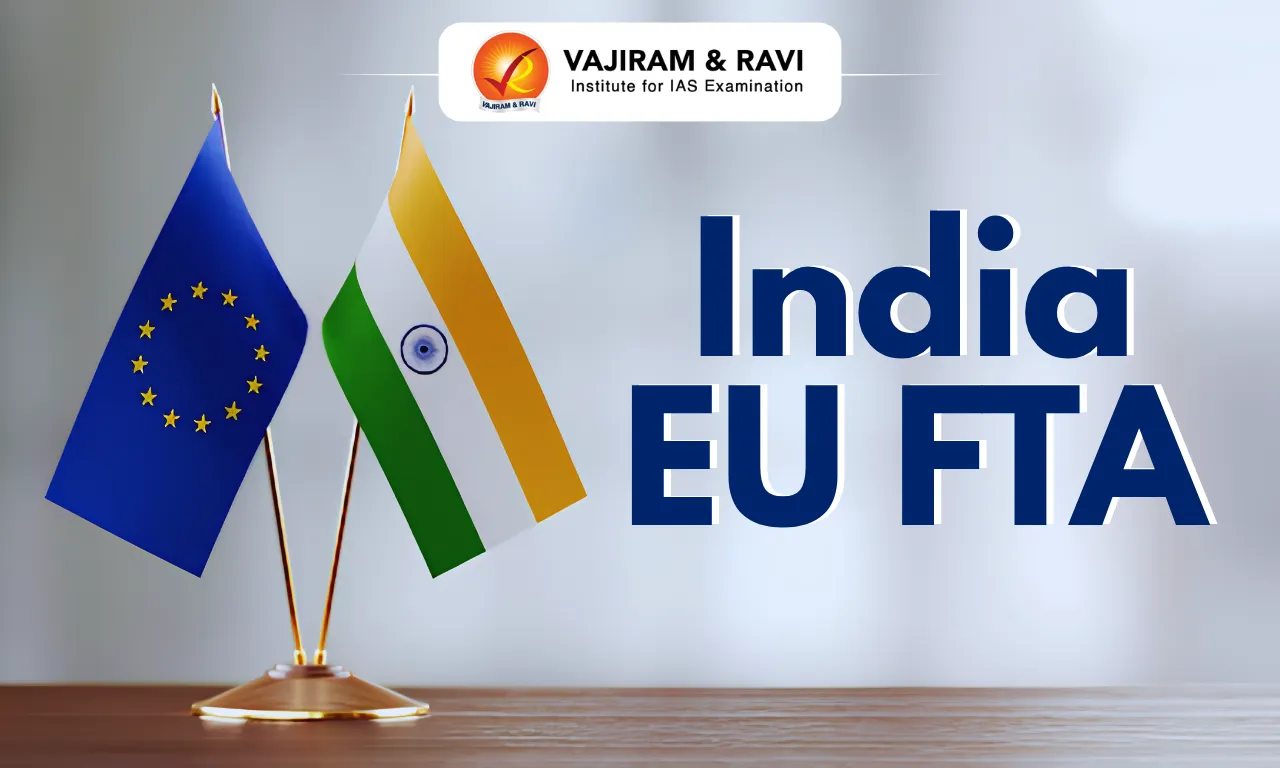
India-EU FTA: Copyright Rules and India’s Digital Sovereignty

India EU FTA

India-EU FTA Latest News

  • The European Commission has formally asked EU member states to approve the signing and conclusion of the India-EU Free Trade Agreement. Details of the commitments in covered areas, including intellectual property, are now public.
  • The draft IP Chapter carries detailed copyright provisions. Experts argue that these provisions could force amendments to India's Copyright Act, 1957, and weaken exceptions that students, researchers, archivists and internet service providers currently rely on.

The Structural Asymmetry

  • India's Copyright Act conforms to international IP treaties, including the WIPO Copyright Treaty (WCT) and the TRIPS Agreement
  • The draft chapter affirms both parties' commitment to these treaties. But it does something curious.
  • It omits the WCT from the National Treatment clause (Article 10.8), while retaining the WCT's enforcement mandates.

Why This Matters

  • The WCT was adopted specifically to protect works in the digital environment, particularly software and databases.
  • It also provides for Technological Protection Measures (TPMs).
  • Crucially, its Article 10 permits limitations and exceptions to copyright for digital works.
  • Excluding the WCT from National Treatment means these flexibilities would no longer be available to India.
  • Footnote 1 of Article 10.8(1) deepens the problem. It expands "protection" to cover enforcement against circumvention of TPMs (Article 10.18) and Rights Management Information (Article 10.19).
  • The result is an imbalance. The treaty's enforcement obligations are binding; its public-interest exceptions are excluded
  • The WCT's core principle — balancing authors' rights against public interest in education and research — is abandoned, leaving only a rigid enforcement mandate.

The Narrow Three-Step Test

  • Article 10.21 of the FTA introduces a narrow "three-step test" for limitations and exceptions, borrowed from EU copyright statutes.
  • If India's existing exceptions are not expressly preserved, foreign rightsholders could challenge the fair dealing provisions under Section 52 of the Copyright Act
  • This includes transient or incidental storage of a work purely in the technical process of electronic transmission. 
  • Under Article 10.11 of the FTA, such acts could attract civil and criminal remedies.

Threat to Section 65A

  • The imbalance directly threatens Section 65A of the Copyright Act, which governs TPMs.
  • Section 65A(2) provides exceptions permitting circumvention of digital locks for specified lawful purposes. 
  • Because of this, a student or researcher who bypasses a lock to perform an act protected under Section 52 attracts no criminal liability today. 
  • A strict anti-circumvention regime under the FTA would erode this safeguard.

Chilling Effect on Classrooms and Labs

  • Indian law today lets students and researchers open up software to test compatibility or find security flaws. 
  • Librarians may copy digital works to preserve old books. Strict anti-circumvention rules would make both illegal.
  • Paywalls and Digital Rights Management (DRM) would then override public-interest protections that Indian courts secured, most famously in the DU Photocopy Case.
    • The DU Photocopy Case was a landmark intellectual property lawsuit in India where top publishers sued a Delhi University photocopy kiosk for copyright infringement. 
    • In 2016, the Delhi High Court ruled that making educational coursepacks is legal under fair use.

Threat to Internet Service Providers

  • India currently shields intermediaries from liability for the temporary, transient copies created in RAM and server caches during routine data routing. 
    • This protection flows from Sections 52(1)(b) and (c). 
    • The notice-and-takedown regime under Rule 75 of the Copyright Rules, 2013 rests on these statutory safe harbours.
  • The draft text undermines this. Article 10.11(a) grants rightsholders an exclusive, unqualified right over all "temporary or permanent" reproductions.
  • This contradicts the Agreed Statements to Articles 8 and 10 of the WCT, which exempt transient network copies from liability.
  • With the WCT excluded from the National Treatment exception, Indian ISPs could face systemic liability from EU rightsholders.

Beyond Parliament's Mandate

  • Analysts contend that by accepting the draft text, negotiators appear to have gone beyond the mandate of Parliament, as reflected in the Copyright Act, 1957. 
  • If uncorrected, Parliament would be obliged to delete digital-work exceptions from the Act — even where the user was engaged in legitimate, lawful research.
  • Negotiators must press to re-insert the WCT into the National Treatment clause and preserve India's statutory copyright flexibilities.
  • The underlying argument is that India's rise as a digital power rests on open access to knowledge, robust educational inquiry and independent technical research. 
  • Deepening trade ties with the EU is important, but not at the cost of digital sovereignty.

Conclusion

  • The dispute is not about protecting creators. It is about who decides the balance between protection and access. 
  • A treaty that imports enforcement while leaving exceptions behind is not balanced law. India must negotiate flexibilities in, not trade them away.

Source: TH 

India-EU FTA FAQs

Q1: What is the main concern with the India-EU FTA copyright provisions?

Ans: The India-EU FTA could narrow copyright exceptions relied upon by students, researchers, archivists and internet service providers under Indian law.

Q2: How could the India-EU FTA affect India's Copyright Act?

Ans: The India-EU FTA could require amendments to India's Copyright Act by imposing stricter enforcement obligations and limiting existing digital-work exceptions.

Q3: Why is the WCT important under the India-EU FTA?

Ans: The India-EU FTA's treatment of the WCT is important because excluding it from national treatment could remove important copyright flexibilities.

Q4: How could the India-EU FTA affect students and researchers?

Ans: The India-EU FTA could restrict lawful circumvention of digital locks, potentially affecting software testing, security research, compatibility work and educational activities.

Q5: Why are internet service providers concerned about the India-EU FTA?

Ans: The India-EU FTA could expose Indian internet service providers to liability for temporary digital copies created during routine data transmission and caching.

Daily Editorial Analysis 21 September 2026

Daily-Editorial-Analysis

India’s Real Rate Moment, The Cost of Delay

Context

  • India’s monetary policy is approaching a delicate phase as the real policy rate is losing its cushion despite strong economic growth.
  • The Reserve Bank of India (RBI) has retained the repo rate at 5.25%, while consumer inflation has risen for three consecutive months to 82% in August.
  • Food inflation stands at 5.95%, while core inflation has risen to around 2%. These developments raise concerns about whether monetary policy remains sufficiently restrictive.
  • The crucial issue is not merely the difference between the repo rate and past inflation. Monetary policy also operates through inflation expectations.
  • If expected inflation approaches 5.25%, the ex-ante real policy rate could approach zero, weakening monetary restraint.

The Erosion of the Real Policy Rate

  • The RBI has retained a neutral monetary policy stance while projecting FY2026–27 inflations at around 5%.
  • However, inflation at 4.82% is already approaching the policy rate.
  • A positive real interest rate normally discourages excessive borrowing and encourages saving.
  • As inflation expectations rise, this restraint diminishes. India could therefore enter a near-zero real interest-rate environment if inflation continues to accelerate.
  • This is particularly important because economic activity remains strong rather than demand-deficient.

External Inflationary Pressures

  • West Asian conflict and disruptions around the Strait of Hormuz have raised concerns over energy supplies, while Brent crude has moved above $100 a barrel and approached $110.
  • Higher crude prices can increase transportation and production costs, widen the import bill and weaken the rupee.
  • Consequently, higher oil prices and a weaker rupee can intensify imported inflation.
  • The monsoon also remains an important uncertainty because food prices significantly influence headline inflation.
  • Persistent supply shocks could eventually affect inflation expectations, wages and pricing behaviour.

Strong Credit Growth and Banking-System Dynamics

  • Bank credit grew 19.1% year-on-year at the end of August, indicating strong demand for loans. GDP growth of 8% further demonstrates economic resilience.
  • Deposit growth reached 8%, reportedly its fastest pace in a decade.
  • However, this figure requires careful interpretation because the RBI’s special FCNR(B) mobilisation scheme contributed to foreign-currency inflows.
  • It therefore does not necessarily indicate a comparable rise in conventional domestic household deposits.
  • The credit-deposit ratio was around 80.3%, highlighting the need for banks to balance strong lending demand with stable funding.

Inflation and Household Financial Behaviour

  • When inflation exceeds deposit returns, the real return on conventional bank deposits declines, encouraging savers to consider equities, mutual funds, gold and other assets.
  • RBI research on the 2010–2013 high-inflation period found that real returns on savings instruments became negative, financial savings weakened and gold demand increased.
  • The study estimated a 83 correlation between gold imports and household inflation expectations.
  • Persistent inflation can therefore affect not only consumption and investment but also the composition of household savings and bank deposits.

Should Monetary Policy Have Tightened Earlier?

  • Whether the RBI should have acted earlier involves a difficult trade-off.
  • A central bank should not automatically raise interest rates after every oil-price shock, particularly when inflation originates from supply disruptions.
  • However, risks increase when temporary shocks begin influencing inflation expectations, wages, prices and credit demand.
  • Current conditions warrant vigilance: inflation has remained above 4% for three consecutive months, core inflation is around 4.2%, and the one-year OIS rate near 6% signals expectations of future tightening.
  • At the same time, strong GDP growth and rapid credit expansion indicate that domestic demand remains resilient.

The Importance of Timing

  • The central issue is increasingly one of monetary-policy timing.
  • Delaying action when inflation becomes persistent can eventually require stronger intervention if expectations become entrenched.
  • A 25-basis-point adjustment could provide a gradual response if conditions warrant it, whereas prolonged inaction could necessitate a larger correction later.
  • The appropriate decision, however, depends on inflation persistence, expectations, oil prices, exchange-rate movements and domestic demand.

Conclusion

  • India faces a challenging monetary-policy environment in which inflation is approaching the repo rate while growth and credit remain strong.
  • Rising food and core inflation, external oil-price risks, currency pressures and rapid credit growth could progressively reduce the effectiveness of the existing real policy rate.
  • The RBI’s challenge is to distinguish temporary supply shocks from persistent inflation while maintaining economic momentum.
  • Price stability requires careful calibration rather than automatic tightening.
  • As the real interest-rate cushion diminishes, timely and measured monetary-policy action becomes increasingly important.

India’s Real Rate Moment, The Cost of Delay FAQs

Q1. What is the current repo rate maintained by the RBI?
Ans. The RBI has maintained the repo rate at 5.25%.

Q2. Why is the real policy rate losing its cushion?
Ans. The real policy rate is weakening because inflation is rising closer to the repo rate.

Q3. What was India’s CPI inflation in August?
And. India’s CPI inflation rose to 4.82% in August.

Q4. How can higher oil prices affect inflation?
Ans. Higher oil prices can increase imported inflation, production costs and pressure on the rupee.

Q5. Why is the timing of monetary policy important?
Ans. Timely action can help prevent temporary inflation from becoming persistent and reduce the need for sharper tightening later.

Source: The Hindu


India’s NGOs at a New Funding Crossroads

Context

  • The proposed FCRA Amendment Bill, 2026 has revived the debate over foreign funding, national security, religious activity and civil society autonomy.
  • Since the FCRA was enacted in 1976, governments have remained concerned that overseas funds could influence domestic affairs or destabilise the country.
  • Today, concerns also include religious conversion and proselytisation, particularly involving Christian organisations.
  • The core challenge is balancing national security and financial accountability with the need for an independent and plural civil society.

FCRA and the Question of Foreign Influence

  • The FCRA seeks to ensure that foreign financial resources do not undermine political independence, social stability or institutional integrity.
  • The government argues that foreign contributions can sometimes support opaque networks, politically sensitive campaigns or religious activities.
  • However, foreign funding is not inherently harmful. Only a proportion of NGOs receive overseas contributions, and such funding is relatively small compared with government expenditure.
  • Foreign grants remain valuable because they are often flexible, need-based and less bureaucratic than government assistance.
  • The challenge is therefore to distinguish between legitimate development assistance and activities threatening national interests.

Proposed Changes and Concerns

  • The proposed legislation would allow foreign contributions and assets created from them to temporarily vest in a government-appointed designated authority when an FCRA registration is cancelled, surrendered or lapses.
  • If registration is restored within the prescribed period, assets and unused funds can be returned. Otherwise, assets may be sold or transferred to government departments.
  • Although provisions for revision and judicial appeal exist, NGOs fear greater governmental control and uncertainty.
  • Christian organisations are particularly concerned about possible unequal treatment.
  • Their concerns also extend to beneficiaries because many charitable organisations operate schools, hospitals, old-age homes and welfare institutions, especially in tribal and north-eastern areas where they may be major or sole service providers.

The Developmental Contribution of Foreign Aid

  • Foreign assistance has produced both benefits and risks.
  • Some organisations have argued that overseas funding can encourage the adoption of foreign ideas unsuited to Indian conditions.
  • Yet foreign assistance has also introduced new technologies, organisational practices, professional methods and innovative development approaches.
  • In periods of inadequate government expenditure and domestic philanthropy, foreign funding strengthened India's voluntary sector.
  • Nevertheless, donor influence remains a concern because funding can shape organisational priorities. Hence, funding diversity is essential to preserve institutional independence.

The Need for Funding Diversity

  • India now has a broader domestic philanthropic ecosystem.
  • Private philanthropy was projected to reach ₹1.43 lakh crore in FY2025, while retail giving contributes around ₹37,000 crore annually.
  • Corporate social responsibility has created another major funding channel, with listed companies spending ₹22,563 crore on CSR in FY2025.
  • However, philanthropic resources remain inadequate and unevenly distributed. New philanthropists increasingly prefer scientific research, higher education, ecosystem building and institutional development.
  • This may leave traditional NGOs working in healthcare, education, rural development and social welfare facing funding shortages.

A New Opportunity for Indian Philanthropy

  • Restrictions on foreign funding could encourage a stronger domestically financed civil society.
  • Indian donors can adopt useful foreign funding practices such as flexibility, consultation, innovation and long-term institutional support.
  • CSR can also strengthen NGOs because many corporations lack the expertise to implement social programmes independently.
  • NGOs can provide specialised knowledge and community-level networks, particularly in health, education and rural development.

The Way Forward: Balancing Regulation with Civil Society Freedom

  • India needs a regulatory framework that protects national interests without weakening democratic pluralism and civil society independence.
  • NGOs receiving foreign contributions should maintain strict financial records, disclose funding sources and demonstrate proper utilisation of resources.
  • Regulation should be transparent, proportionate, predictable and religion-neutral.
  • Financial violations, legitimate advocacy, charitable activity and genuine national-security threats should not be treated alike.
  • Excessive restrictions could weaken organisations that support vulnerable communities and contribute to democratic accountability.

Conclusion

  • The FCRA debate concerns more than foreign money; it involves national security, religious freedom, democratic accountability, institutional independence and social development.
  • Foreign aid has historically supported innovation and voluntary organisations, while India's growing domestic philanthropy offers an opportunity to diversify funding.
  • The long-term goal should be a plural funding ecosystem involving citizens, philanthropists, corporations, government and responsible international partners.
  • Stronger Indian philanthropy, effective CSR partnerships and responsive public institutions can reduce excessive dependence on foreign funding while preserving a vibrant, independent and accountable civil society.

India’s NGOs at a New Funding Crossroads FAQs

Q1. What is the main purpose of the FCRA?
Ans. The FCRA regulates foreign contributions to protect national interests and financial accountability.

Q2. Why are NGOs concerned about the proposed FCRA Amendment Bill?
Ans. NGOs fear greater government control over their foreign-funded assets and operations.

Q3. What benefits has foreign funding provided to Indian NGOs?
Ans. Foreign funding has supported innovation, technology, organisational development and social welfare programmes.

Q4. Why is funding diversity important for civil society?
Ans. Funding diversity reduces dependence on a single source and strengthens institutional independence.

Q5. What can replace foreign funding if restrictions increase?
Ans. Domestic philanthropy, CSR and government support can help fill the funding gap.

Source: The Hindu

Daily Editorial Analysis 2026 FAQs

Q1: What is editorial analysis?

Ans: Editorial analysis is the critical examination and interpretation of newspaper editorials to extract key insights, arguments, and perspectives relevant to UPSC preparation.

Q2: What is an editorial analyst?

Ans: An editorial analyst is someone who studies and breaks down editorials to highlight their relevance, structure, and usefulness for competitive exams like the UPSC.

Q3: What is an editorial for UPSC?

Ans: For UPSC, an editorial refers to opinion-based articles in reputed newspapers that provide analysis on current affairs, governance, policy, and socio-economic issues.

Q4: What are the sources of UPSC Editorial Analysis?

Ans: Key sources include editorials from The Hindu and Indian Express.

Q5: Can Editorial Analysis help in Mains Answer Writing?

Ans: Yes, editorial analysis enhances content quality, analytical depth, and structure in Mains answer writing.


Enquire Now