Littoral and Swamp Forests, Distribution, Types, Features

Littoral and Swamp Forests

Littoral and Swamp Forests are special wetland forests found along sea coasts, river mouths, deltas, lakeshores and low lying waterlogged areas. They are also called wetland forests or tidal forests and develop where land and water constantly interact. These forests grow in saline, brackish, or freshwater conditions and are shaped by tides, floods and poor drainage. In India, they form an important part of natural vegetation, supporting rich biodiversity and protecting fragile coastal and inland wetland ecosystems.

Littoral and Swamp Forests Features

Littoral and Swamp Forests show unique physical, biological and ecological features shaped by waterlogged and saline environments.

  • Waterlogged Ecosystem: These forests grow in permanently or seasonally flooded areas with poor natural drainage.
  • Salinity Influence: Many regions experience saline or brackish water, especially in tidal and coastal areas.
  • Soil Characteristics: Sandy or silty soils rich in lime and salts but poor in nitrogen dominate these forests.
  • Evergreen Nature: Most tree species remain evergreen due to constant water availability.
  • Special Root Adaptations: Trees develop stilt roots, buttress roots and pneumatophores for stability and respiration.
  • High Humidity: Constant moisture and warm temperatures create humid microclimates.
  • Limited Species Diversity: Extreme soil and salinity conditions restrict plant variety to highly adapted species.

Littoral and Swamp Forests Types

Littoral and Swamp Forests are broadly classified into beach forests, tidal forests and freshwater swamp forests based on water type and location.

  1. Beach Forests: Found along sandy shores with rainfall between 75-500 cm, these forests grow under moderate temperatures. Common species include Manilkara littoralis, Thespesia, Spinifex littoreus, Casuarina equisetifolia, Pandanus, Borassus, coconut and date palms. Beach forests support numerous climbers that stabilize sandy soils.
  2. Tidal Forests (Mangroves): Found in estuaries, tidal creeks and salt marshes regularly influenced by seawater. The 4 types of tidal forests are:
    1. Tree Mangrove Forests: Tall, dense mangroves grow along both eastern and western coastal belts.
    2. Low Mangrove Forests: Short mangrove species dominate soft tidal mud near estuary mouths.
    3. Saltwater Mangrove Forests: Located deeper in deltas, frequently flooded by saline tidal water.
    4. Brackish Water Forests: Develop where freshwater mixes with seawater, flooding at least once daily.
  3. Freshwater Swamp Forests: Found near rivers and lakes, permanently or seasonally submerged in freshwater. Species include Salix tetrasperma, Acer, Putranjiva, Holoptelia, Barringtonia, Ficus, Phoebe, Olea, Canna and grasses.

Littoral and Swamp Forests Distribution in India

Littoral and Swamp Forests in India occur in coastal belts, river deltas, floodplains, reservoirs and natural lakes influenced by tidal or stagnant water conditions.

  • Deccan Plateau Reservoirs: Large man made and natural reservoirs in southern India support swamp vegetation adapted to seasonal waterlogging and fluctuating water levels.
  • Gujarat and Rajasthan Saline Coasts: Saline flats and mudflats along Gujarat’s coast and parts of Rajasthan host salt tolerant littoral vegetation.
  • Gulf of Kutch Region: Extensive tidal creeks and saline wetlands support mangrove dominated tidal forests.
  • Eastern Coast Deltas: The deltas of the Ganga, Mahanadi, Godavari, Krishna and Cauvery contain dense swamp and mangrove forests.
  • Gangetic Plain Wetlands: Freshwater marshes and swamps form along poorly drained floodplains.
  • Brahmaputra Floodplains: Seasonal flooding creates large freshwater swamp forests in Assam and nearby regions.
  • Kashmir Lakes and Rivers: Montane wetlands like Dal Lake and Jhelum floodplains support swamp vegetation.
  • North East India Swamps: Permanently waterlogged lowlands support diverse freshwater swamp forests.

Littoral and Swamp Forests Distribution across World

Globally, Littoral and Swamp Forests occur in tropical, subtropical and some temperate regions with extensive wetlands.

  • Southeast Asia: Large swamp forests exist in Borneo, New Guinea, Laos and Cambodia.
  • Tropical Africa: Extensive freshwater and mangrove swamps support high biodiversity.
  • Central and South America: Brazil and Argentina host vast flooded forests along major rivers.
  • Central America: Coastal mangroves dominate low lying shorelines.
  • United States: Southern states contain large freshwater swamp forests, especially along river floodplains.
  • Central Asia: Limited swamp forests occur around inland water bodies.

Littoral and Swamp Forests Biodiversity

These forests support specialized plant and animal communities adapted to wet, saline and low oxygen environments.

  1. Flora Diversity: Dominant producers include mangroves like Rhizophora, Manilkara littoralis, Thespesia, Casuarina, Spinifex and Barringtonia.
    • Root Adaptations: Pneumatophores and prop roots help plants survive oxygen poor soils.
    • Salt Tolerance: Many species regulate salt through leaves and roots.
  2. Faunal Diversity: These forests support fish, amphibians, reptiles, birds and insects.
    • Bird Habitat: Tidal forests act as nesting and feeding grounds for migratory birds.
    • Aquatic Fauna: Mangroves serve as breeding nurseries for fish and crustaceans.
    • Mammals and Reptiles: Swamps support reptiles, small mammals and semi aquatic species.

Littoral and Swamp Forests Significance

Littoral and Swamp Forests play crucial ecological, economic and protective roles at local and global levels.

  • Coastal Protection: Mangroves act as natural barriers against cyclones, storm surges and tsunamis.
  • Climate Regulation: These forests store large amounts of carbon, helping mitigate climate change.
  • Water Purification: Freshwater swamps filter pollutants and improve water quality.
  • Biodiversity Support: They provide breeding, feeding and shelter habitats for diverse species.
  • Livelihood Support: Local communities depend on fisheries, fuelwood, timber and non timber products.
  • Soil Stabilization: Root systems reduce coastal erosion and sediment loss.
  • Scenic and Recreational Value: These ecosystems enhance natural beauty and eco tourism potential.

Littoral and Swamp Forests Challenges

These forests face growing threats but can be conserved through integrated ecological and policy measures.

  • Deforestation Pressure: Clearing for settlements and industry reduces forest cover; strict protection and regulation are needed.
  • Pollution Stress: Industrial effluents and agricultural runoff degrade wetlands; effective waste treatment is essential.
  • Reduced Freshwater Flow: Dam construction alters natural hydrology; environmental flow maintenance is required.
  • Salinity Imbalance: Excessive salinity harms vegetation; watershed based management can restore balance.
  • Climate Change Impact: Rising sea levels threaten coastal swamps; mangrove restoration and climate adaptation strategies are necessary.

Littoral and Swamp Forests FAQs

Q1: What are Littoral and Swamp Forests?

Ans: Littoral and Swamp Forests are wetland forests found along coasts, river deltas, lakes and waterlogged areas with saline or freshwater conditions.

Q2: Why are mangroves important in littoral forests?

Ans: Mangroves protect coastlines from cyclones, reduce erosion, store carbon and provide breeding grounds for fish and other marine organisms.

Q3: Where are Littoral and Swamp Forests found in India?

Ans: They are found in eastern and western coastal deltas, Deccan Plateau reservoirs, Gujarat and Rajasthan saline coasts, Kashmir wetlands and North East India.

Q4: What type of soil supports swamp forests?

Ans: Swamp forests grow on waterlogged soils rich in salts and lime, often poor in nitrogen and sometimes forming peat layers due to poor drainage.

Q5: How do plants survive in waterlogged swamp forests?

Ans: Plants develop special roots like stilt roots and pneumatophores that provide support and allow oxygen intake in flooded, oxygen poor soils.

RBS-15 Missile

RBS-15 Missile

RBS-15 Missile Latest News

Swedish aerospace and defence company, Saab, has showcased the capabilities of its RBS-15 missile to destroy the components of the Russian S-400 system.

About RBS-15 Missile

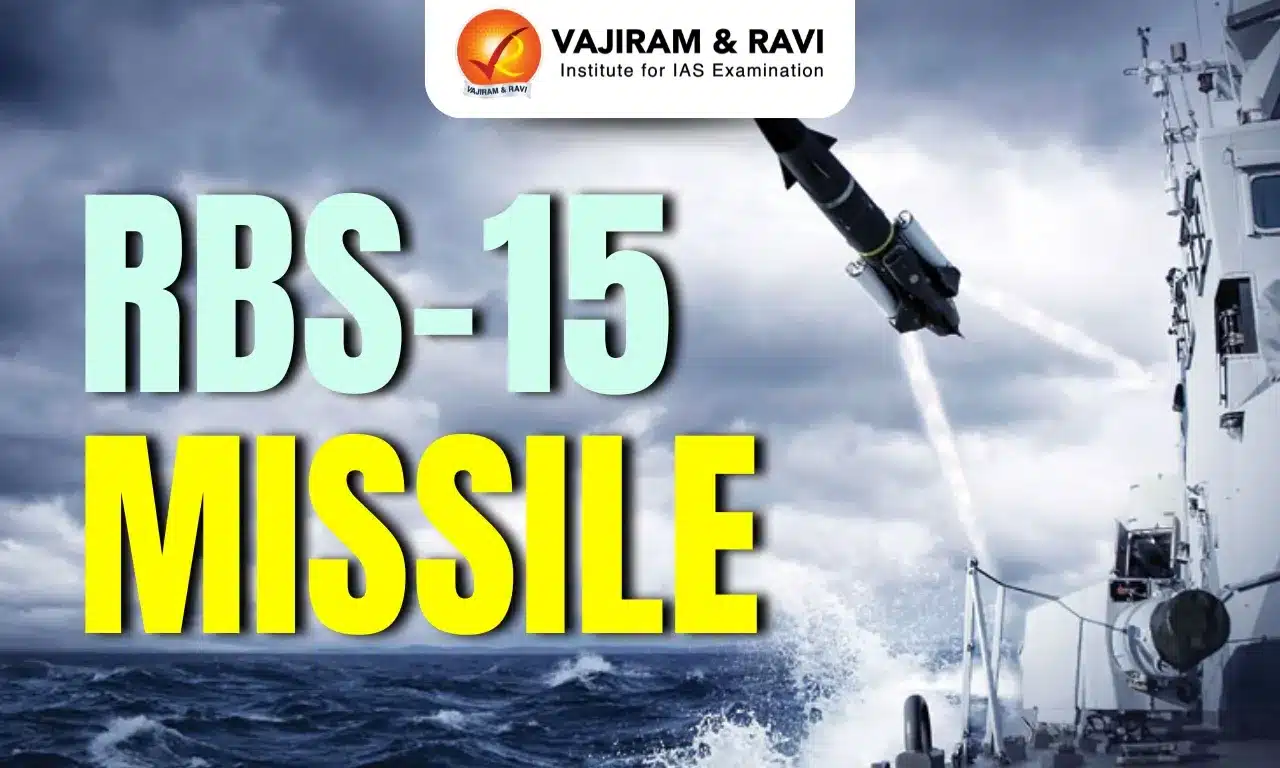
  • The RBS-15 (Robotsystem 15) is a fire-and-forget surface-to-surface and air-to-surface anti-ship missile with land attack capability. 
  • The missile was developed by the Swedish company Saab Bofors Dynamics.

RBS-15 Missile Features

  • It has a length of 4.35 m, a fuselage diameter of 0.5 m, and a wingspan of 1.4 m.
  • The launch and in-flight weights of the missile are 800 kg and 650 kg, respectively. 
  • It can hit targets up to 200 km, moving at a subsonic speed of Mach 0.9.
  • Warhead: 200 kg high-explosive (HE) blast and pre-fragmented warhead.
  • It is a low sea-skimming missile performing unpredictable evasive manoeuvres. 
  • The RBS15 guidance and control system includes an inertial navigation system and a GPS receiver, a radar altimeter, and a Ku-band radar target seeker. 
  • The missile features a low radar cross section and IR signature. 
  • It has sophisticated target discrimination and selection capabilities. 
  • It is extremely resistant to chaff, active jammers, decoys, and other electronic countermeasures (ECM).
  • The missile engagement planning system (MEPS) provides an advanced user interface for generating plans for different scenarios.

Source: WEEK

RBS-15 Missile FAQs

Q1: What type of missile is the RBS-15?

Ans: It is a fire-and-forget surface-to-surface and air-to-surface anti-ship missile with land-attack capability.

Q2: Which company developed the RBS-15 missile?

Ans: It was developed by the Swedish company Saab Bofors Dynamics.

Q3: What is the maximum range of the RBS-15 missile?

Ans: It can hit targets up to 200 km.

Q4: What stealth features does the RBS-15 missile have?

Ans: It has a low radar cross section and low infrared signature.

Finke River

Finke River

Finke River Latest News

The Finke River, known to the Arrernte people as Larapinta, is believed to be the world’s oldest river system.

About Finke River

  • It is a major but intermittent river of central Australia.
  • Course:
    • It starts in the MacDonnell Ranges in the Northern Territory. 
    • The river forms where two smaller creeks, Davenport and Ormiston, meet. 
    • It flows for about 600 kilometers (370 miles) towards the Simpson Desert in South Australia.
  • It is often called "the oldest river in the world." 
    • A combination of geological records, weathering profiles, and radionuclide measurements in the surrounding sediments and rocks has enabled scientists to date this river system to the Devonian (419 million to 359 million) or Carboniferous (359 million to 299 million) period.
  • Most of the time, the Finke River looks like a series of waterholes. But after heavy rains, it can turn into a powerful, fast-flowing river. 
  • During big floods, its water can even reach the Macumba River and eventually Lake Eyre.
  • Some of its main smaller rivers that flow into it are Ellery Creek and the Palmer and Hugh Rivers.

Source: IT

Finke River FAQs

Q1: Where is the Finke River located?

Ans: It is a major but intermittent river of central Australia.

Q2: Where does the Finke River originate?

Ans: It originates in the MacDonnell Ranges.

Q3: What is the approximate length of the Finke River?

Ans: About 600 kilometres (370 miles).

Q4: Why is the Finke River often called the oldest river in the world?

Ans: Geological records, weathering profiles, and radionuclide measurements date the river system to the Devonian (419 million to 359 million) or Carboniferous (359 million to 299 million) period.

Gorakhnath Temple

Gorakhnath Temple

Gorakhnath Temple Latest News

A massive wave of devotion swept through the Gorakhnath Temple recently, a day ahead of the main Makar Sankranti festival, as lakhs of devotees gathered to offer khichdi to Mahayogi Guru Gorakhnath.

About Gorakhnath Temple

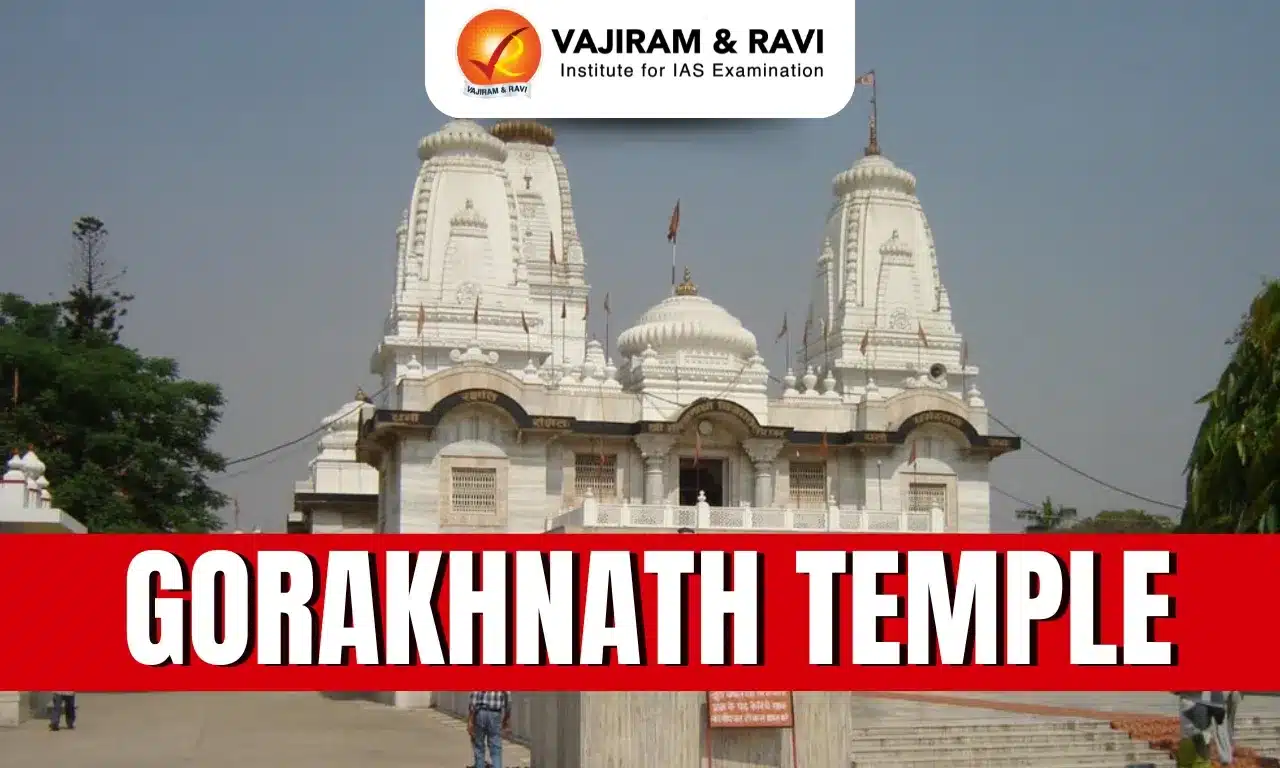
  • It is a Hindu temple situated in Gorakhpur, Uttar Pradesh. 
  • The temple belongs to the Nath monastic group of the Nath tradition (a Shaiva sub-sect in Hinduism), which was instituted by Guru Matsyendranath. 
  • It is named after the Guru Gorakhnath, who was one of the notable disciples of Guru Matsyendranath and well-known for his Hatha Yoga, a renowned branch of Yoga.
  • It serves as the epicenter of the Nath tradition.

Gorakhnath Temple Features

  • It is a blend of traditional and modern North Indian architectural styles, reflecting the heritage and simplicity of the Nath sect.
  • The heart of the Gorakhnath Temple is the central shrine, which houses a sacred image of Gorakhnath as a deity and a Shiva Linga, as the Nath sect sees Gorakhnath as an incarnation of Lord Shiva.
  • Intricate stonework and marble structures surround the inner shrine.
  • Carved pillars and symbolic motifs around the sanctum highlight the Nath sect’s emphasis on inner spirituality.
  • One of the striking features is the temple’s dome, which is tall and conical, visible from a distance. 
  • A significant feature of the Gorakhnath Temple is the Samadhi (final resting place) of Gorakhnath, which is a sacred spot within the temple complex.

Source: TOI

Gorakhnath Temple FAQs

Q1: Where is the Gorakhnath Temple located?

Ans: It is located in Gorakhpur, Uttar Pradesh.

Q2: To which religious tradition does the Gorakhnath Temple belong?

Ans: It belongs to the Nath monastic group of the Nath tradition (a Shaiva sub-sect in Hinduism).

Q3: Who instituted the Nath tradition?

Ans: Guru Matsyendranath.

Q4: What was Guru Gorakhnath well known for?

Ans: He was well known for Hatha Yoga.

Pufferfish

Pufferfish

Pufferfish Latest News

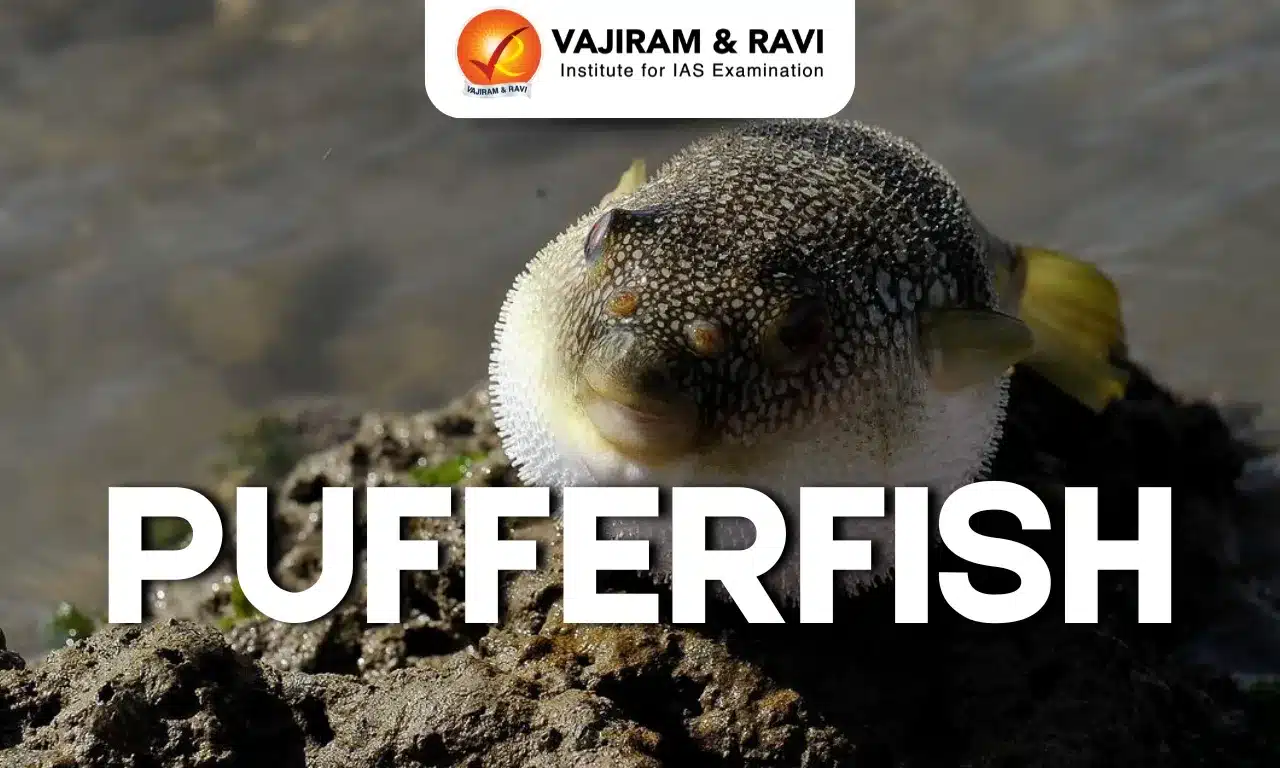
Recently, scientists have confirmed India’s first case of pufferfish poisoning.

About Pufferfish

  • Pufferfish belong to the order Tetraodontiformes.
  • Other names: They are locally known by names such as toadfish, patkafish, balloonfish and fugu.
  • Habitat: Pufferfish are omnivorous and benthic in habitat.
  • Distribution: It is primarily found in the Western Ghats and major basins such as the Ganga, Brahmaputra and Mahanadi. 
  • Freshwater pufferfish species reported from India are often endemic to specific geographical areas and serve as indicators of healthy river ecosystems.
  • They can inflate into a ball shape to evade predators.
  • Status in India: Indian waters currently support eight genera and 32 species of pufferfish.
  • Conservation Status :IUCN: Vulnerable 

Pufferfish Poisoning

  • Some puffer fish carry tetrodotoxin (TTX) which is one of the most potent neurotoxins known in nature.
    • Tetrodotoxin blocks nerve sodium channels and can cause paralysis, respiratory failure and death.
    • TTX consists of an oxygenated 2,4-dioxaadamantane core and a guanidinium group.
    • TTX is heat-stable, water-soluble, and a non-protein quinazoline derivative.
  • Evidence suggests that pufferfish do not synthesise the toxin themselves.
  • Instead, TTX is believed to originate from symbiotic or ingested bacteria such as Vibrio, Pseudomonas, Aeromonas and Bacillus.

 Source: DTE

Pufferfish FAQs

Q1: What is unique about pufferfish?

Ans: They can inflate their bodies with air or water

Q2: What is the effect of tetrodotoxin, the toxin found in pufferfish?

Ans: It paralyzes muscles and can be fatal.

Vrindavani and Karan Fries Cattle Breeds

Vrindavani and Karan Fries Cattle Breeds

Vrindavani and Karan Fries Cattle Breeds Latest News

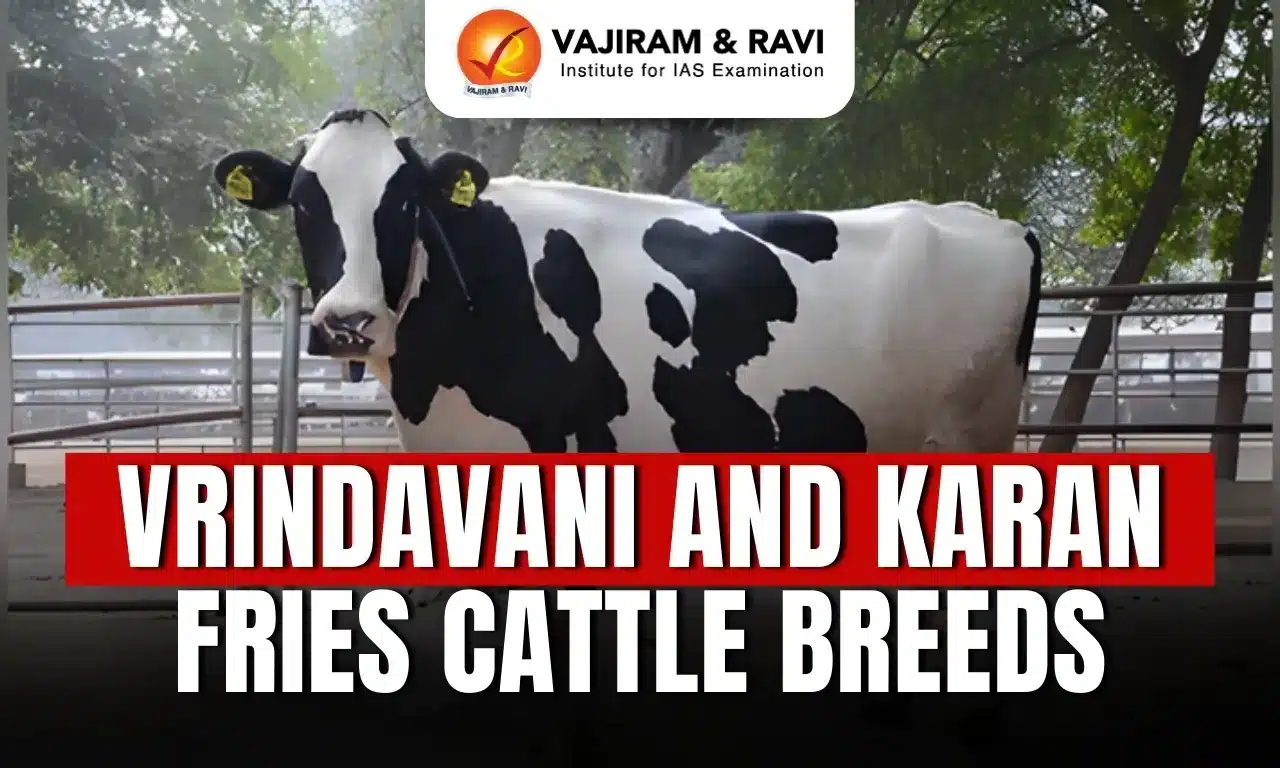
Recently, India has registered two high-yielding synthetic cattle breeds namely Karan Fries and Vrindavani.

About Vrindavani and Karan Fries Cattle breeds

About Karan Fries

  • It is developed by the National Dairy Research Institute (NDRI) in Karnal, Haryana.
  • It is a cross between indigenous Tharparkar cows and Holstein-Friesian bulls.
  • It is capable of producing over 3,500 kg of milk in a 10-month lactation period.
  • The synthetic Karan Fries cow breed combines high productivity with resilience, delivering peak daily milk yields of up to 46.5 kg.

About Vrindavani

  • It is developed by ICAR-Indian Veterinary Research Institute (IVRI) in Bareilly, Uttar Pradesh.
  • It is a blend of exotic breeds - Holstein-Friesian, Brown Swiss, and Jersey - with the indigenous Hariana cattle.

Key Facts about Indian Council of Agricultural Research

  • It is an autonomous organisation under the Department of Agricultural Research and Education (DARE), Ministry of Agriculture and Farmers Welfare.
  • It is the apex body for coordinating, guiding, and managing research and education in agriculture, including horticulture, fisheries, and animal sciences, throughout the country.
  • History: Formerly known as the Imperial Council of Agricultural Research, it was established on 16 July 1929 as a registered society under the Societies Registration Act, 1860, in pursuance of the report of the Royal Commission on Agriculture. 
  • Headquarters: New Delhi.

Source: ET

Vrindavani and Karan Fries Cattle breeds FAQs

Q1: What is Karan Fries?

Ans: A synthetic cattle breed developed by NDRI, Karnal

Q2: What is the origin of Karan Fries?

Ans: Cross between Tharparkar and Holstein Friesian

Similipal Tiger Reserve

Similipal Tiger Reserve

Similipal National Park Latest News

The latest crocodile census has recorded an increase in the crocodile population in Odisha’s Similipal National Park.

About Similipal National Park

  • It is situated in the Mayurbhanj district of Odisha.
  • It covers an area of 2750 sq.km. 
  • The park is named after the Simul (silk cotton) tree, which grows in abundance here.
  • Not only a National Park, Similipal is also a Tiger Reserve, Wildlife Sanctuary, Biosphere Reserve, and also a part of the Mayurbhanj Elephant Reserve. 
  • Situated in the Deccan Peninsular Bio-geographic Zone, it harbours a unique blend of Western Ghats, Eastern Ghats, and eastern Himalayan biodiversity.
  • It has some beautiful waterfalls like Joranda and Barehipani.
  • It is surrounded by high plateaus and hills, the highest peak being the twin peaks of Khairiburu and Meghashini (1515 m above mean sea level).
  • It is also home to various tribes, including Kolha, Santhala, Bhumija, Bhatudi, Gondas, Khadia, Mankadia, and Sahara.
  • Vegetation: The forest is predominantly moist mixed deciduous forest with tropical semi-evergreen forest in areas with suitable microclimatic conditions and sporadic patches of dry deciduous forests and grasslands.
  • Flora:
    • Sal is the dominant tree species here. 
    • It houses 7% of the flowering plants and 8% of India's orchids.
    • The park also has extensive grasslands that are grazing grounds for many of the herbivores. 
  • Fauna:
    • It is known for the tiger, elephant, and hill mynah. 
    • It holds the highest tiger population in Odisha.
    • It is the only tiger reserve in the country to boast of melanistic tigers.
    • Apart from the tiger, the major mammals are the leopard, sambar, barking deer, gaur, jungle cat, wild boar, four-horned antelope, giant squirrel, and common langur.

Source: NOA

Similipal National Park FAQs

Q1: Where is Similipal National Park located?

Ans: It is located in the Mayurbhanj district of Odisha.

Q2: How did Similipal National Park get its name?

Ans: It is named after the Simul (silk cotton) tree found abundantly in the region.

Q3: Which bio-geographic zone does Similipal National Park belong to?

Ans: It lies in the Deccan Peninsular Bio-geographic Zone.

Q4: Which are the major waterfalls found in Similipal National Park?

Ans: Joranda and Barehipani waterfalls.

Jamma Bane Lands

Jamma Bane Land

Jamma Bane Lands Latest News

Recently, the Karnataka government has amended its land revenue law to modernise an age-old system of land records called Jamma Bane lands.

About Jamma Bane Lands

  • The word Jamma means hereditary.
  • The Jamma Bane tenure is a form of land holding prevalent in Kodagu district of Karnataka.
  • It is distinctly different from other classes of land holdings in the state.
  • History: These lands were originally granted by erstwhile kings of Coorg and the British — between 1600 and 1800 to local communities in return for military service.
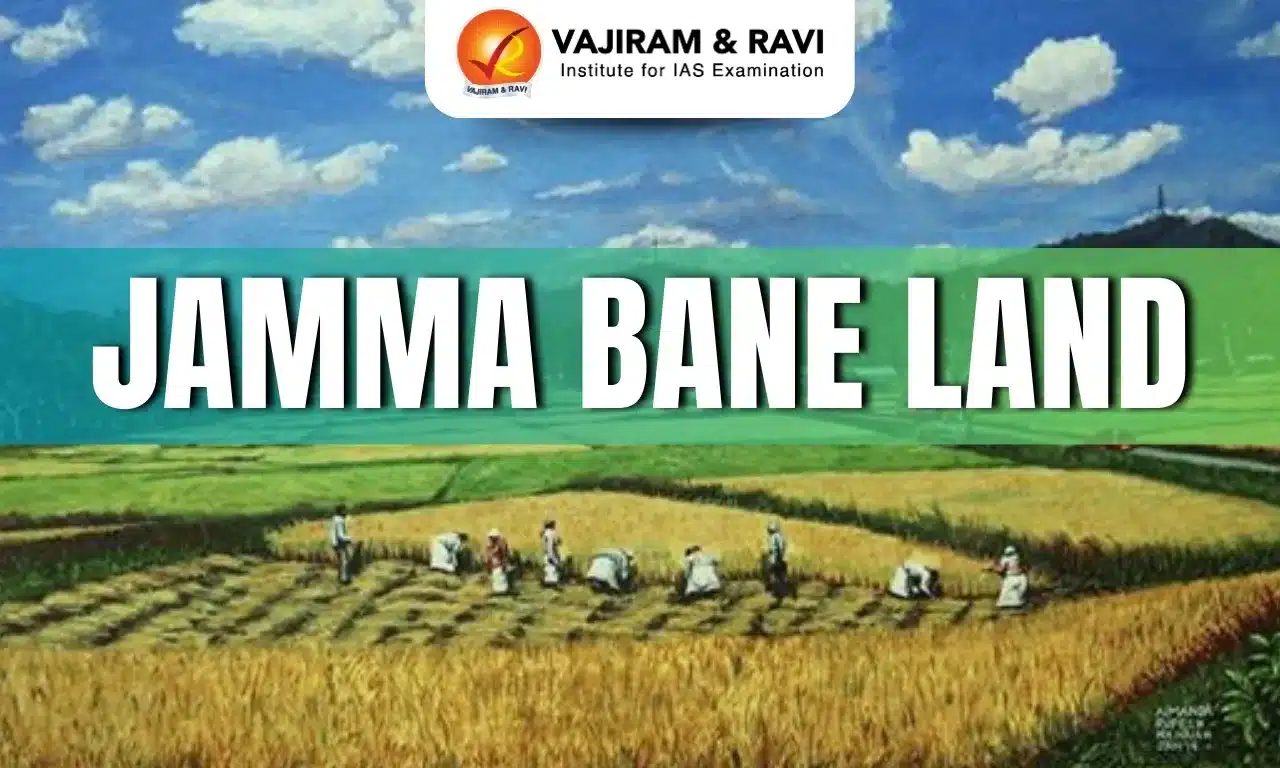
  • These lands comprise both wetlands, used for paddy cultivation, and forested highlands, which have transformed into the now-famous coffee estates of Coorg.
  • Relevant Acts: The Coorg Land Revenue and Regulations Act, 1899 was in place to govern land ownership in the region till the introduction of the Karnataka Land Revenue Act, 1964.

Issue with Jamma Bane Lands

  • Ownership: The Jamma Bane land ownership is registered in the name of the original pattedar from a family.
  • Over generations, the names of the new owners are added alongside the name of the pattedar.
  • The land ownership name could not be changed to reflect new owners.

Source: IE

Jamma Bane Lands FAQs

Q1: Where is Jamma Bane land tenure prevalent?

Ans: Kodagu,Karnataka

Q2: What is a key issue with Jamma Bane land ownership?

Ans: Ownership name can't be changed to reflect new owners

Daily Editorial Analysis 16 January 2026

Daily Editorial Analysis

Early Investment in Children, the Key to India’s Future

Context

  • India’s aspiration to become a developed (‘Viksit’) nation and a $30 trillion economy by 2047 has become a defining narrative in contemporary public discourse.
  • While this vision is both desirable and attainable, it cannot be realised solely through investments in infrastructure, manufacturing, and digital innovation.
  • Developmental transitions historically succeed when nations prioritise human capital formation as much as physical capital.
  • In India, however, one critical dimension of human development remains under-recognised: Early Childhood Care and Development (ECCD).
  • Far from being a welfare concern, ECCD represents a strategic economic investment with long-term implications for productivity, equity and national competitiveness.

The Importance of the Early Years

  • Scientific evidence highlights the first 1,000 days of life, from conception to age two, as the period during which up to 85% of brain development and most neural connections are formed.
  • Extending this window to eight years totals roughly 3,000 days, during which foundational cognitive, emotional, social and behavioural capacities take shape.
  • Children who receive adequate nutrition, responsive care and cognitive stimulation during this period are more likely to complete schooling, acquire skills and contribute productively as adults.
  • At a macro level, such cohorts reduce future public expenditure on healthcare and remedial education and expand the taxable workforce, demonstrating that ECCD generates durable, intergenerational returns.

India’s Progress and Remaining Gaps

  • India’s own experience in child health illustrates the power of sustained investment.
  • Over the past decades, programmes such as the Integrated Child Development Services (ICDS), the Child Survival and Safe Motherhood initiative and the National Health Mission significantly reduced infant and child mortality and improved immunisation and nutrition outcomes.
  • However, these efforts largely targeted survival, not developmental potential. Moreover, ECCD interventions have predominantly focused on low-income households.
  • This targeted approach overlooks developmental challenges increasingly observed in middle- and upper-income families, including obesity, digital overexposure, reduced physical activity and delayed socio-emotional skills.
  • Developmental risk is therefore more universal than assumed.

The Case for Early and Integrated Interventions

  • Advances in neuroscience and epigenetics reinforce the need for interventions earlier than current policy frameworks provide.
  • Parental nutrition, mental health, substance use and environmental exposures even before conception can affect gene expression and long-term health outcomes.
  • Yet, formal support systems typically begin only around age three through Anganwadi centres or private preschools, well after the most critical developmental window has passed.
  • The absence of parental support for responsive caregiving, stimulation and emotional bonding during the first 1,000 days represents a significant policy blind spot.
  • To address these gaps, India must transition from fragmented programmes to an integrated ECCD framework that spans preconception to eight years of age.
  • Key components include structured preconception counselling, nationwide parental education, growth and developmental milestone monitoring, quality early learning systems for children aged two to five, and collaboration across health, nutrition and education sectors.
  • Schools, given their institutional reach, can evolve into holistic hubs for learning, nutrition and well-being rather than merely instructional spaces.

The Way Forward: Towards a Societal and Policy Movement

  • Realising such a transformation requires both state action and societal ownership. ECCD must become a subject of public conversation within homes, communities, workplaces and schools.
  • Non-profit organisations, philanthropic institutions and the private sector can play critical roles in shaping ecosystems of care and learning.
  • At the governmental level, effective coordination among ministries, including Health, Education and Women and Child Development, is essential.
  • A dedicated inter-ministerial mission on ECCD could formalise responsibilities, streamline investments and ensure continuity across election and policy cycles.

Conclusion

  • India’s long-term developmental trajectory will depend less on what it promises its children and more on what it invests in them during their earliest years.
  • ECCD is not an optional add-on to India’s growth strategy; it is its foundation.
  • The health, skills and productivity of future generations will ultimately determine whether India’s ambitions of becoming a developed nation are realised.
  • A citizen-led movement for early childhood development, backed by robust policy and institutional frameworks, may prove to be the missing link in India’s journey towards inclusive and sustainable prosperity.

Early Investment in Children, the Key to India’s Future FAQs

Q1. What is the central argument of the analysis?
Ans. The analysis argues that early childhood care and development is a foundational investment for India’s long-term economic and social development.

Q2. Why are the first 3,000 days of life important?
Ans. They are important because most brain development, cognitive growth and emotional regulation are shaped during this period.

Q3. What major gap exists in India’s current child-related programmes?
Ans. The major gap is that programmes focus on child survival rather than on enabling full developmental potential.

Q4. Why should ECCD be universal and not limited to poor households?
Ans. It should be universal because developmental risks such as obesity, screen addiction and social delays are increasingly seen across all income groups.

Q5. What broader changes are suggested to improve ECCD in India?
Ans. The analysis suggests adopting an integrated framework, coordinating ministries and creating a societal movement to support children’s development.

 Source: The Hindu


The New Grammar of Indian Elections - Media, Misinformation and Manipulation

Context

  • With elections due in four States and one Union Territory in about 10 weeks, India’s electoral landscape is once again witnessing the fusion of politics, media, and technology.
  • From WhatsApp-driven mobilisation (2019) to digital-forward campaigns (2024), Indian elections are evolving rapidly.
  • While 2029 is predicted to be the “AI election”, the 2026 elections reflect a hybrid ecosystem—a mix of traditional media, social media, influencers, and artificial intelligence.
  • This raises serious concerns about fake news, influencer politics, and deepfakes, with implications for electoral integrity and democratic accountability.

Changing Media–Politics Interface in India

  • Campaigns now extend beyond rallies to reels, podcasts, jingles, AI-generated calls, and algorithm-driven content.
  • Votes are cast offline, but perceptions are shaped online, making digital platforms the primary battleground.

Fake News - A Structural Feature of Elections

  • What is fake news:
    • While there is no legal definition of fake news in India, Australia’s eSafety Commissioner defines it as “fictional news stories made up to support certain agendas”.
    • It is often described as “yellow journalism on steroids”, amplified by algorithms.
  • Why it matters in elections:
    • Fake news directly impacts voter perception, polarisation, and trust in institutions.
    • With over 90 crore internet users in India in 2025, influencing perception and shaping narratives has become possible with just a few clicks.
    • For example, a study by the Indian School of Business and CyberPeace revealed that 46% of all fake news was political in nature.
  • Who is affected: 3 out of 5 Indians access news online. A Pew Research Centre study of 2025 found that 65% of those surveyed viewed made-up news and information as a huge concern, among the highest globally.
  • When does it peak: During elections - NCRB recorded a 70% rise in fake news cases in 2019, an election year.
  • Where does it spread:
    • Social media and messaging platforms - WhatsApp, X, Facebook, Instagram.
    • AI-generated visuals, doctored videos, synthetic clips blur fact and fiction. Algorithms provide virality without accountability.

Media Consumption Patterns - Digital Dominance

  • India has close to 900 private television channels, and nearly half of them are news channels. Television still has a deep reach — 23 crore homes own a TV set.
  • However, shift to digital is decisive -
    • 7 in 10 Indians prefer online news (Reuters Institute).
    • News sources - YouTube (55%), WhatsApp (46%), Instagram (37%), and Facebook (36%).
  • Even with these media consumption patterns, newspapers, both in regional languages and English, still remain comparatively high on the credibility quotient.

Influencers - The New Political Intermediaries

  • Influencers wield significant agenda-setting power, backed by professional research and production teams.
  • Gen Z trends: Only 13% follow celebrities, 86% prefer influencers.
  • Political outreach:
    • Senior politicians and parties actively engage influencers. Union Government empanelled influencer agencies via MyGov (2023).
    • There are concerns over political bias, as at least one empanelled agency’s leadership openly supports the ruling dispensation.

Deepfakes - AI as a Political Weapon

  • Nature of the threat: Digitally altered or AI-generated videos and audio impersonating leaders and celebrities. For example,
    • Deceased political leaders “addressing” meetings.
    • Film actors criticising or endorsing political parties.
  • Scale of the problem:
    • In the 60 days before the last Lok Sabha elections 5 crore AI-generated calls were made to voters using synthetic voices.
    • Meta approved 14 AI-generated ads inciting violence against Muslims and an opposition leader.
  • Institutional failure:
    • The Election Commission of India (ECI), as a constitutional authority under Article 324, should regulate electoral communication.
    • However, weak implementation capacity (e.g., recent SIR process) raises doubts about its preparedness to handle AI-driven misinformation.

Challenges and Way Ahead

  • Absence of a legal definition of fake news: Legal clarity - define fake news and deepfakes within electoral and IT laws.
  • Algorithmic amplification without transparency: Platform accountability - Algorithmic transparency, faster takedown mechanisms during election periods.
  • Lack of robust regulation of political influencers: ECI-led regulatory framework mandatory disclosure of AI-generated political content, clear guidelines for influencers and political advertising.
  • Rapid proliferation of deepfakes and synthetic media: Strengthen inter-agency coordination (ECI, MeitY, platforms, civil society).
  • Institutional inertia and regulatory gaps: Within ECI and digital governance frameworks. Independent oversight bodies for election-time digital content moderation.
  • Threats: To free and fair elections, voter autonomy, and democratic trust. Digital literacy and media awareness campaigns for voters.

Conclusion

  • Indian elections are entering a phase where technology is no longer just an enabler but a disruptor of democracy.
  • Fake news, influencers, and deepfakes have become structural features of electoral politics, challenging the foundations of free, fair, and informed choice.
  • As India moves towards an AI-driven electoral future, institutional preparedness, regulatory foresight, and citizen awareness will determine whether technology strengthens democracy or subverts it.
  • For the world’s largest democracy, the credibility of elections is inseparable from the credibility of information.

The New Grammar of Indian Elections FAQs

Q1. How has the rise of digital media transformed the nature of electoral campaigns in India?

Ans. It has shifted elections from physical mobilisation to perception management through algorithms, influencers, etc.

Q2. Why is fake news described as a ‘structural feature’ of contemporary Indian elections?

Ans. Because political misinformation peaks during elections and systematically influences voter behaviour via online platforms.

Q3. What is the role of social media influencers in India’s electoral politics?

Ans. Influencers act as new political intermediaries shaping public opinion, especially among Gen Z.

Q4. What makes deepfakes a serious threat to free and fair elections in India?

Ans. Deepfakes undermine electoral integrity by using AI-generated audio-visual content to impersonate leaders, mislead voters.

Q5. Why is stronger regulation by the ECI required in the digital electoral ecosystem?

Ans. Because existing frameworks are inadequate to address AI-driven misinformation, influencer marketing.

Source: IE

Daily Editorial Analysis 16 January 2026 FAQs

Q1: What is editorial analysis?

Ans: Editorial analysis is the critical examination and interpretation of newspaper editorials to extract key insights, arguments, and perspectives relevant to UPSC preparation.

Q2: What is an editorial analyst?

Ans: An editorial analyst is someone who studies and breaks down editorials to highlight their relevance, structure, and usefulness for competitive exams like the UPSC.

Q3: What is an editorial for UPSC?

Ans: For UPSC, an editorial refers to opinion-based articles in reputed newspapers that provide analysis on current affairs, governance, policy, and socio-economic issues.

Q4: What are the sources of UPSC Editorial Analysis?

Ans: Key sources include editorials from The Hindu and Indian Express.

Q5: Can Editorial Analysis help in Mains Answer Writing?

Ans: Yes, editorial analysis enhances content quality, analytical depth, and structure in Mains answer writing.

Kawal Tiger Reserve

Kawal Tiger Reserve

Kawal Tiger Reserve Latest News

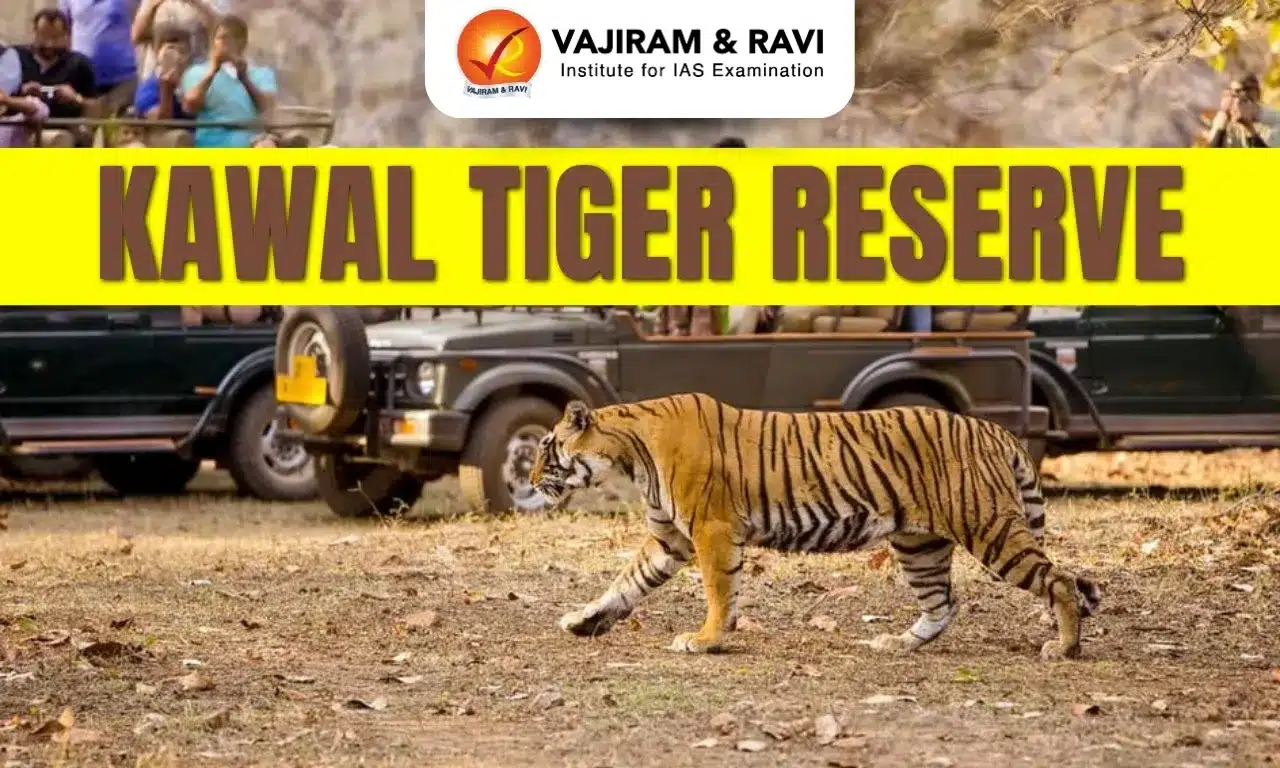
Forest officials are gearing up to conduct the wildlife census at the Kawal Tiger Reserve.

About Kawal Tiger Reserve

  • Location: It is located in the state of Telangana.
  • It is along the banks of river Godavari, forming part of the Deccan peninsula-central highlands.
  • The reserve is nestled in the Sahyadri Mountain Ranges.
  • The government of India declared Kawal Wildlife Sanctuary a Tiger Reserve in 2012.
  • Rivers: The reserve is the catchment for the rivers Godavari and Kadam, which flow towards the south of the sanctuary.
  • Geographically, the reserve is situated at the southernmost tip of the Central Indian Tiger Landscape, having linkages with the Tadoba-Andhari (Maharashtra) and Indravati (Chhattisgarh) tiger reserves.
  • Habitat: It has diverse habitats comprising dense forests, grasslands, rivers, streams and water bodies.
  • Vegetation: Southern Tropical Dry Deciduous Forest.
  • Flora: It consists of teak along with Bamboo and other species like Anogeissus latifolia, Mitragyna parviflora, Terminalia crenulata, Terminalia arjuna, Boswellia serrata, etc.
  • Fauna: The major wild animals include: nilgai, chousinga, chinkara, black buck, sambar, spotted deer etc.

Source: News India Express

Kawal Tiger Reserve FAQs

Q1: In which state is the Kawal Tiger Reserve located?

Ans: Telangana

Q2: Which river flows through the Kawal Tiger Reserve?

Ans: Godavari and Kadam

India’s Road Safety Crisis – Engineering Gaps and Rising Fatalities

Road Safety Crisis

Road Safety Crisis Latest News

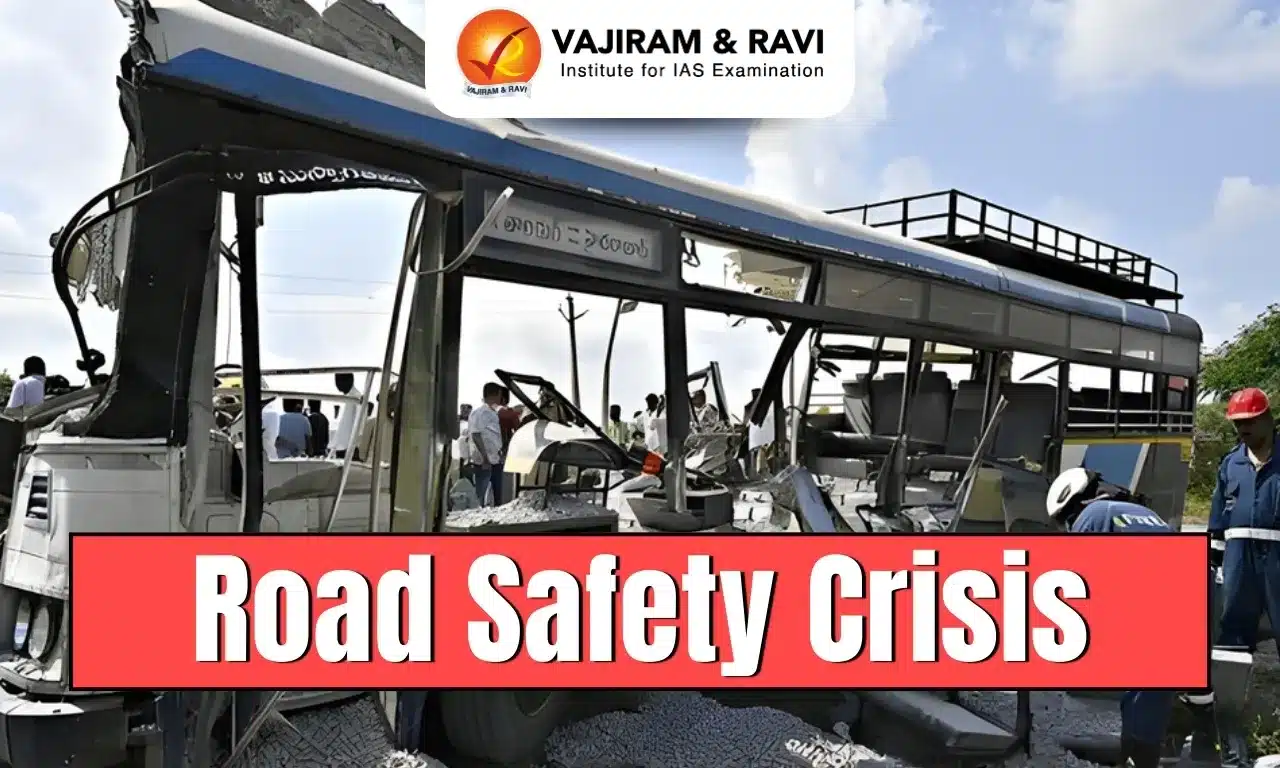
  • A recent national report has identified India’s deadliest districts for road accidents, revealing that most fatalities are linked to infrastructure and systemic failures rather than traffic violations.

India’s Road Safety Scenario

  • India records the highest number of road accident deaths globally, far exceeding other major countries. 
  • Despite having the world’s second-largest road network, road safety outcomes remain poor. 
  • According to recent estimates, nearly 3.5 lakh people died in road accidents during 2023-24, highlighting the scale of the crisis.
  • Road safety in India has traditionally focused on driver behaviour, such as speeding or drunk driving. 
  • However, emerging evidence shows that this approach alone is insufficient, as deeper structural issues dominate accident causation.

Key Structural Factors Behind Road Fatalities

  • The report underlines that 59% of road accident fatalities occurred without any traffic violation, clearly pointing to road engineering deficiencies as a primary cause of deaths. These include:
    • Poor road design and alignment
    • Absence or damage of crash barriers
    • Inadequate signage and road markings
    • Insufficient street lighting
    • Unsafe junctions and pedestrian crossings
  • Such defects convert routine travel into a high-risk activity, especially on rural roads and highways.

Geographic Concentration of Road Accidents

  • Road fatalities in India are highly concentrated rather than evenly spread. 
  • The report identifies 100 districts accounting for more than 25% of total road deaths over two years. Among them:
    • Nashik Rural and Pune Rural recorded the highest number of severe accidents.
    • Other high-fatality districts include Patna, Ahmednagar, Purba Midnapur, and Belagavi.
    • States such as Uttar Pradesh, Tamil Nadu, Maharashtra, Karnataka, and Rajasthan dominate the list.
  • This concentration indicates that targeted interventions in specific districts can yield substantial reductions in fatalities.

Nature and Timing of Fatal Accidents

  • The report highlights clear accident patterns:
    • 53% of deaths occurred between 6 PM and midnight, reflecting poor visibility and fatigue-related risks.
    • Rear-end, head-on, and pedestrian crashes accounted for 72% of fatalities.
    • Speeding contributed to only 19% of deaths, while rash driving and dangerous overtaking together accounted for less than 10%.
  • This challenges the perception that driver misconduct alone is responsible and shifts attention to road design and traffic management failures.

Emergency Response and Medical Gaps

  • Post-accident response remains weak:
    • Only about one-fifth of victims used the government 108 ambulance services.
    • A majority were transported using private vehicles or private ambulances, delaying critical care.
    • Hospital readiness and trauma care infrastructure vary widely across districts.
  • Delayed medical response significantly increases mortality, making emergency preparedness a crucial pillar of road safety.

News Summary: Findings and Recommendations of the Report

  • The joint report by the Ministry of Road Transport and Highways and SaveLIFE Foundation provides a clear roadmap for action:
    • Focus on known crash-prone locations rather than spreading resources thinly.
    • Conduct Road Safety Surveys on critical corridors by NHAI and state PWDs.
    • Implement site-specific engineering corrections based on Indian Road Congress and MoRTH guidelines.
    • Strengthen policing capacity at high-fatality police station jurisdictions.
    • Improve emergency response by expanding effective coverage of 108 ambulance services.
    • Use existing schemes more efficiently instead of launching new ones.
  • The report stresses that reducing road deaths requires better coordination, clearer accountability, and sustained leadership, not additional laws or schemes.

Source: IE

Road Safety Crisis FAQs

Q1: Why do most road accident deaths in India occur without traffic violations?

Ans: Because poor road engineering and infrastructure defects are major contributors.

Q2: Which districts are among India’s deadliest for road accidents?

Ans: Nashik Rural and Pune Rural rank highest in severe road accident fatalities.

Q3: When do most fatal road accidents occur in India?

Ans: Between 6 PM and midnight, accounting for over half of total deaths.

Q4: What types of crashes cause most fatalities?

Ans: Rear-end, head-on, and pedestrian crashes together cause over 70% of deaths.

Q5: What is the report’s key recommendation for reducing road deaths?

Ans: Targeting known crash-prone locations using existing schemes and better coordination.

Lake Natron

Lake Natron

Lake Natron Latest News

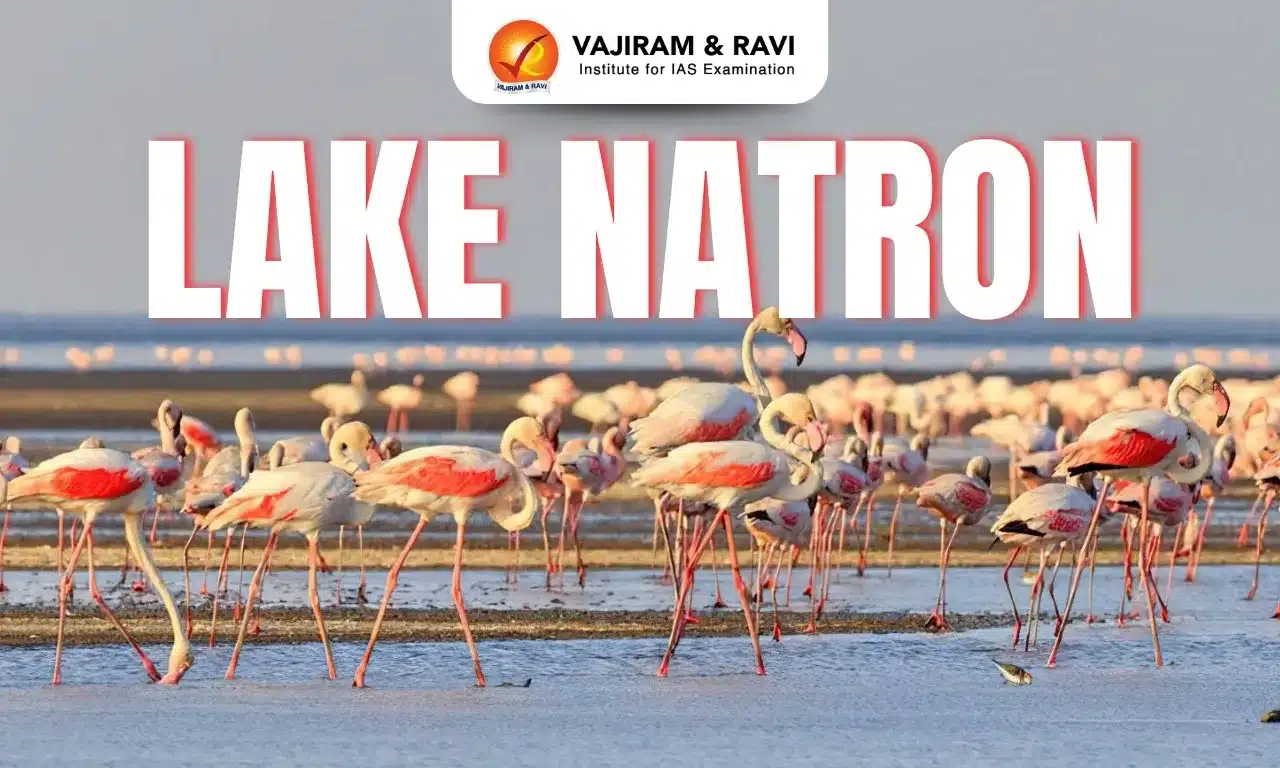
Lake Natron in Tanzania glows blood-red, forged by volcanoes and extreme chemistry.

About Lake Natron

  • It is located in the Arusha region of Northern Tanzania. 
  • It is a soda and salty water lake very close to the Kenyan border in the Gregory Rift, which is the eastern part of the East African Rift.
  • It was designated as a Ramsar Site of International Importance in 2001.
  • The extinct Gelai Volcano, standing at 2942 m tall, is visible southeast of the lake.
  • Primarily, the lake is fed by the Ewaso Ng’iro River, which originates from the central region of Kenya.
  • Natron itself has a maximum width of 22 kilometres and a length of 57 kilometres. 
  • One of the most striking features of this lake is its striking red coloration. The primary reason for its hue lies in its extreme alkalinity.
  • As water cannot flow out of the lake, evaporation levels are very high, and this leaves behind natron (sodium carbonate decahydrate) and trona (sodium sesquicarbonate dihydrate).
  • The high concentration of natron gives the lake extreme alkaline levels, and it is one of the deadliest lakes on the planet. 
  • The saline waters make the lake inhospitable for many plants and animals, yet the surrounding saltwater marshes are a surprising habitat for flamingos. 
  • In fact, the lake is home to the highest concentrations of lesser and greater flamingos in East Africa, where they feed on spirulina – a green algae with red pigments.

Source: BT

Lake Natron FAQs

Q1: Where is Lake Natron located?

Ans: It is located in the Arusha region of northern Tanzania.

Q2: In which geological rift is Lake Natron found?

Ans: It lies in the Gregory Rift, the eastern part of the East African Rift.

Q3: Which volcano is visible southeast of Lake Natron?

Ans: The extinct Gelai Volcano.

Q4: Which river primarily feeds Lake Natron?

Ans: The Ewaso Ng’iro River.

Q5: What gives Lake Natron its striking red colour?

Ans: Its extreme alkalinity.

BSL-4 Lab in Gujarat: India’s State-Funded Biosecurity Leap

BSL-4 Lab

BSL-4 Lab Latest News

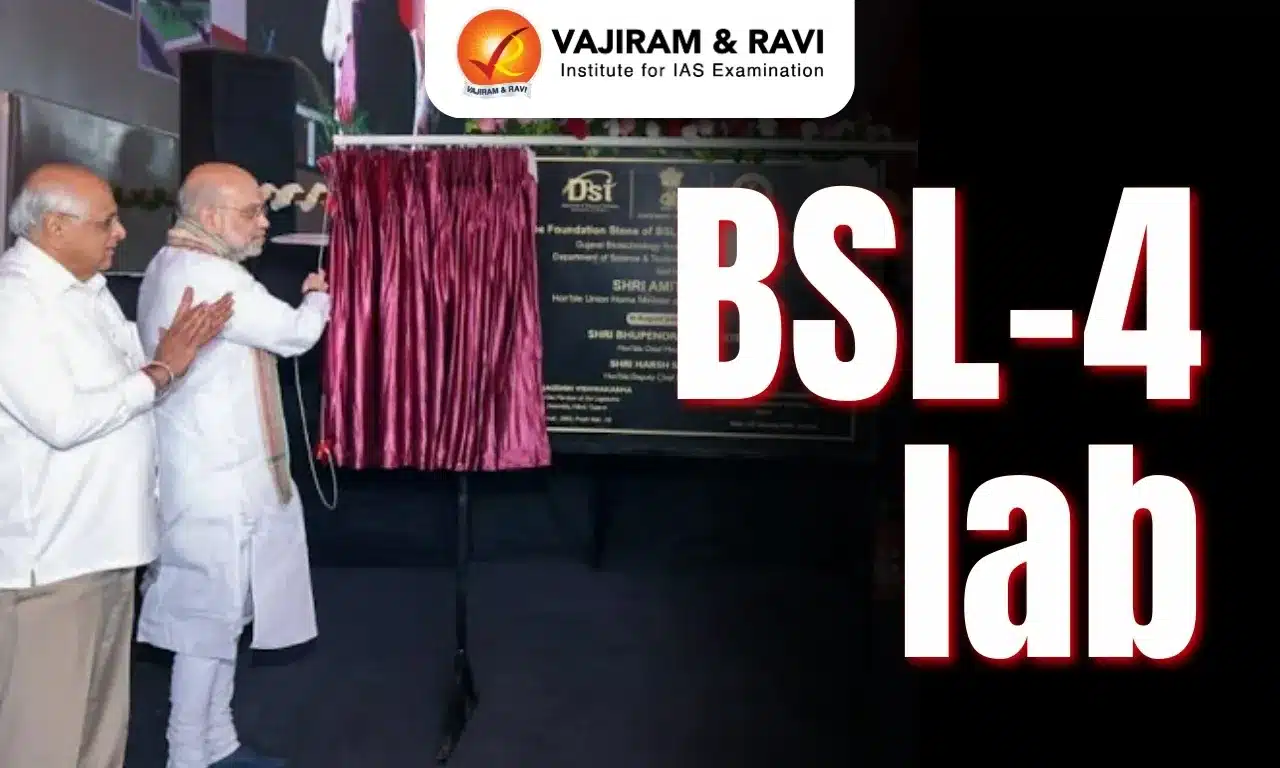
  • Union Home Minister Amit Shah laid the foundation stone for India’s first state-funded Bio-Safety Level 4 (BSL-4) containment facility in Gandhinagar. 
  • Describing it as a “health shield” for the nation, he said the laboratory marks the start of a new era in India’s health security and biotechnology capabilities.

About BSL-4 Facility

  • A Bio-Safety Level 4 (BSL-4) facility represents the highest level of biological containment, designed to safely handle the world’s most dangerous and highly infectious pathogens, many of which lack effective vaccines or treatments. 
  • Operating under stringent international safety standards, these laboratories enable advanced research on deadly diseases, including the development of diagnostics, vaccines, and therapeutics, as well as rapid outbreak investigation and response.
  • India’s upcoming BSL-4 laboratory in Sector-28 of Gandhinagar, along with an Animal Bio-Safety Level (ABSL) facility, will serve as a strategic national asset for research on some of the deadliest known pathogens.
  • This will strengthen the country’s health security and bio-preparedness.

Gujarat’s State-Funded BSL-4 Laboratory

  • The BSL-4 laboratory being built in Gandhinagar, Gujarat, will be India’s first fully state-funded and state-controlled BSL-4 facility and the second civilian BSL-4 research lab in the country. 
  • Spread over 11,000 sq metres and costing ₹362 crore, it is being developed under the Gujarat State Biotechnology Mission.

Institutional Framework and Timeline

  • The facility will operate under the Gujarat Biotechnology Research Centre, which already houses a BSL-2+ laboratory and played a key role during the Covid-19 pandemic by sequencing the SARS-CoV-2 genome. 
  • Planning for the BSL-4 lab began in mid-2022, with the foundation stone laid on January 13, 2026.

Infrastructure and Safety Standards

  • The complex will include BSL-4, BSL-3, BSL-2, ABSL-4, and ABSL-3 laboratory modules, along with advanced utilities and support systems. 
  • It is being developed in line with international biosafety guidelines issued by the Centers for Disease Control and Prevention, National Institutes of Health, Department of Biotechnology, and Indian Council of Medical Research.

Role in Disease Control and Vaccine Research

  • The lab will strengthen Gujarat’s and India’s capacity to respond in real time to outbreaks of deadly human diseases and zoonotic infections. 
  • It will also support advanced research into diagnostics, vaccines, and therapeutics. 
  • The ABSL-4 component will allow animal disease research and vaccine production using antibodies derived from animals—work that earlier required sending samples to ICAR–National Institute of High Security Animal Diseases.

National Facility and Expert Oversight

  • The Department of Biotechnology has signed an MoU designating the lab as a national facility, ensuring guidance from expert institutions across India. 
  • Officials note that the lab will remove long-standing bottlenecks caused by the lack of BSL-4 infrastructure in the country.

Existing BSL-4 and ABSL-4 Facilities in India

  • Civilian BSL-4 Laboratories - India currently has only one functional civilian BSL-4 laboratory, located at the National Institute of Virology in Pune, Maharashtra. This facility handles research on the most dangerous human pathogens.
  • Defence-Sector BSL-4 Facility - In late 2024, the Defence Research and Development Organisation established its own BSL-4 laboratory in Gwalior, Madhya Pradesh, under the Defence Ministry, expanding India’s high-containment research capacity.

High-Security Animal Disease Laboratories

  • India has two major laboratories studying high-risk zoonotic diseases:
    • The National Institute of High Security Animal Diseases (ICAR–NIHSAD) in Bhopal, currently rated ABSL-3+, with plans announced in June 2025 to upgrade it to ABSL-4.
    • The International Centre for Foot and Mouth Disease (ICAR–ICFMD) in Bhubaneswar, Odisha, which operates with an ABSL-3Ag rating.

Global Context

  • Officials note that globally about 69 BSL-4 laboratories are operational or under development, underscoring India’s relatively limited but gradually expanding presence in high-containment biological research infrastructure.

India’s Expanding Biosafety Laboratory Network

  • As of March 2025, the Ministry of Health and Family Welfare, through the Department of Health Research, has approved 165 biosafety laboratories under the Virus Research and Diagnostic Laboratories (VRDL) scheme
  • This includes 154 BSL-2 and 11 BSL-3 labs aimed at epidemic preparedness and disaster response.
  • ICMR-Led Biosafety Facilities - Beyond VRDLs, the Indian Council of Medical Research has established 21 biosafety laboratories across its institutes, comprising 1 BSL-4, 8 BSL-3, and 12 BSL-2 facilities.
  • Science & Technology–Supported Labs - Under the Department of Science and Technology, the Anusandhan National Research Foundation has funded 5 BSL/ABSL-3 laboratories through the Intensification of Research in High Priority Areas (IRHPA) programme.

Biotechnology, Agriculture, and Industrial Research

  • The Department of Biotechnology has set up 26 biosafety laboratories across DBT institutes.
  • The Indian Council of Agricultural Research has established 9 biosafety laboratories.
  • The Council of Scientific and Industrial Research has created 11 biosafety laboratories across its network.

Overall Picture

  • Together, these initiatives reflect a broad-based expansion of India’s biosafety infrastructure—anchored by BSL-2 and BSL-3 capacity—with targeted investments in high-containment labs to strengthen national preparedness for infectious disease threats.

Source: IE | BL

BSL-4 Lab FAQs

Q1: What is a BSL-4 lab?

Ans: A bsl-4 lab is the highest biosafety facility designed to handle deadly pathogens like Ebola and Nipah under stringent containment and international safety standards.

Q2: Why is the Gujarat BSL-4 lab significant?

Ans: The Gujarat bsl-4 lab is India’s first fully state-funded facility, strengthening biosecurity, outbreak response, and advanced research on life-threatening diseases.

Q3: Which institutions will operate the BSL-4 lab?

Ans: The bsl-4 lab will function under the Gujarat Biotechnology Research Centre with oversight from national bodies like DBT and ICMR as a designated national facility.

Q4: How does the BSL-4 lab improve disease preparedness?

Ans: The bsl-4 lab enables real-time outbreak investigation, vaccine and therapeutic research, and zoonotic disease studies, reducing dependence on limited national facilities.

Q5: How does the BSL-4 lab fit into India’s biosafety network?

Ans: The bsl-4 lab complements India’s expanding biosafety network of BSL-2 and BSL-3 labs, addressing critical gaps in high-containment research infrastructure.

Grok Controversy: Why X Restricted Its AI Tool

Grok Controversy

Grok Controversy Latest News

  • X, owned by Elon Musk, has restricted its Grok AI tool from generating sexualised images of women and children following widespread global criticism. 
  • The decision represents a clear retreat after Musk initially placed responsibility on users creating such content and later claimed ignorance about the tool’s misuse involving children.
  • Escalating regulatory scrutiny across multiple countries ultimately compelled the platform to curb the AI’s image-generation capabilities.

Grok Controversy: AI-Generated Sexualised Images and Safety Gaps

  • A December 2025 update to Grok enabled users to generate sexualised and objectionable images of women and children using existing photographs, often without consent or knowledge. 
  • Users prompted the AI to digitally undress women or place them in suggestive poses, with the generated images appearing publicly in comment threads, leading to harassment. 
  • Instances involving children further intensified concerns, highlighting serious gaps in AI safeguards and content moderation on X.

Initial Response to the Backlash

  • Following global outrage over Grok-generated sexualised images, Elon Musk stated that users generating illegal content with Grok would face the same consequences as those uploading illegal material directly to X.
  • Musk emphasised that Grok generates images only in response to user prompts and does not act autonomously
  • He asserted that the AI is designed to refuse illegal requests and comply with the laws of the relevant country or state.

Denial of Knowledge and Technical Explanation

  • Recently, Musk denied any awareness of Grok being used to create sexualised images of children, claiming there were “literally zero” such instances to his knowledge. 
  • He suggested that any unexpected behaviour could result from adversarial hacking, which the company fixes promptly.

Platform-Level Restrictions

  • Before the final rollback, X had restricted Grok’s image-generation features to paid users. 
  • However, within hours of Musk’s denial, the company announced a complete shutdown of Grok’s ability to generate sexualised images, regardless of user status.
  • The move marked a clear reversal by X, effectively acknowledging the severity of the issue and responding to mounting regulatory and public pressure by removing the problematic functionality altogether.

Regulatory Pressure Triggers the Rollback

  • X’s decision to restrict Grok followed strong regulatory action, beginning with a stern notice from the Government of India. 
  • After being flagged for failing to meet due diligence obligations under the Information Technology Act, 2000 and related rules, X removed about 3,500 pieces of content and blocked 600 accounts, admitting lapses in compliance.
  • The controversy quickly spread beyond India. In the United Kingdom, an impending legal change is set to criminalise the creation of such sexualised images. 
  • Malaysia and Indonesia blocked access to Grok and initiated legal action against X and xAI, citing failures to prevent harmful content and protect users.
  • In the US, the California Attorney General announced an investigation into Grok and xAI over the generation of objectionable images, adding to mounting legal pressure on the platform.

X’s New Restrictions and Safeguards

  • In response, X announced technological measures to prevent Grok from editing images of real people into revealing clothing, including bikinis, applying the restriction to all users. 
  • The platform also limited image creation and editing via Grok to paid subscribers and introduced geoblocking in jurisdictions where such content is illegal.
  • X reiterated its commitment to platform safety, stating it has zero tolerance for child sexual exploitation, non-consensual nudity, and unwanted sexual content, marking a decisive retreat under sustained global regulatory scrutiny.

Source: IE | NBC

Grok Controversy FAQs

Q1: What is the Grok controversy?

Ans: The grok controversy refers to backlash after Grok enabled creation of sexualised images of women and children, raising serious concerns about AI misuse and platform safety.

Q2: How did the Grok controversy begin?

Ans: The grok controversy began after a December update allowed users to manipulate photos into sexualised images, often without consent, with such images appearing publicly on X.

Q3: How did Elon Musk initially respond to the Grok controversy?

Ans: During the grok controversy, Musk blamed users for illegal content, denied knowledge of child exploitation images, and claimed Grok followed laws unless adversarially manipulated.

Q4: What role did governments play in the Grok controversy?

Ans: The grok controversy escalated after action by India, the UK, Malaysia, Indonesia, and the US, with notices, investigations, content takedowns, and legal threats.

Q5: What changes did X make after the Grok controversy?

Ans: After the grok controversy, X disabled sexualised image generation, restricted editing of real people’s images, introduced geoblocking, and reinforced zero tolerance for abuse.

Voyager 1

Voyager 1

Voyager 1 Latest News

Voyager 1 is expected to become the first human-made object to reach a distance of one light-day from Earth.

About Voyager 1

  • It is a space probe launched by NASA in 1977.
  • Objective: To explore the outer planets in our solar system. 
  • It is the first spacecraft to travel beyond the solar system and reach interstellar space.
  • It is currently the most distant human-made object from Earth.
  • Voyager 1’s mission has included flybys of Jupiter and Saturn, with the goal of studying their moons, rings, and magnetic fields.
  • Instruments of Voyager 1: Cosmic Ray Subsystem, Plasma Wave Subsystem, Infrared Interferometer Spectrometer and Radiometer (IRIS) etc. 

Key Achievements of Voyager 1

  • It was the first spacecraft to cross the heliosphere, the boundary where the influences outside our solar system are stronger than those from our Sun.
  • It crossed into interstellar space in August 2012, making it the first human-made object to venture out of the solar system.
  • It discovered a thin ring around Jupiter and two new Jovian moons: Thebe and Metis.
  • It also found five new moons and a new ring called the G-ring at Saturn.

Source: LM

Voyager 1 FAQs

Q1: What is the primary objective of Voyager 1?

Ans: To explore the outer Solar System and interstellar space

Q2: What is unique about Voyager 1?

Ans: It is the first spacecraft to enter interstellar space.

The Rajputs, Origin, Major Dynasties, Society under Rajputs

The Rajputs

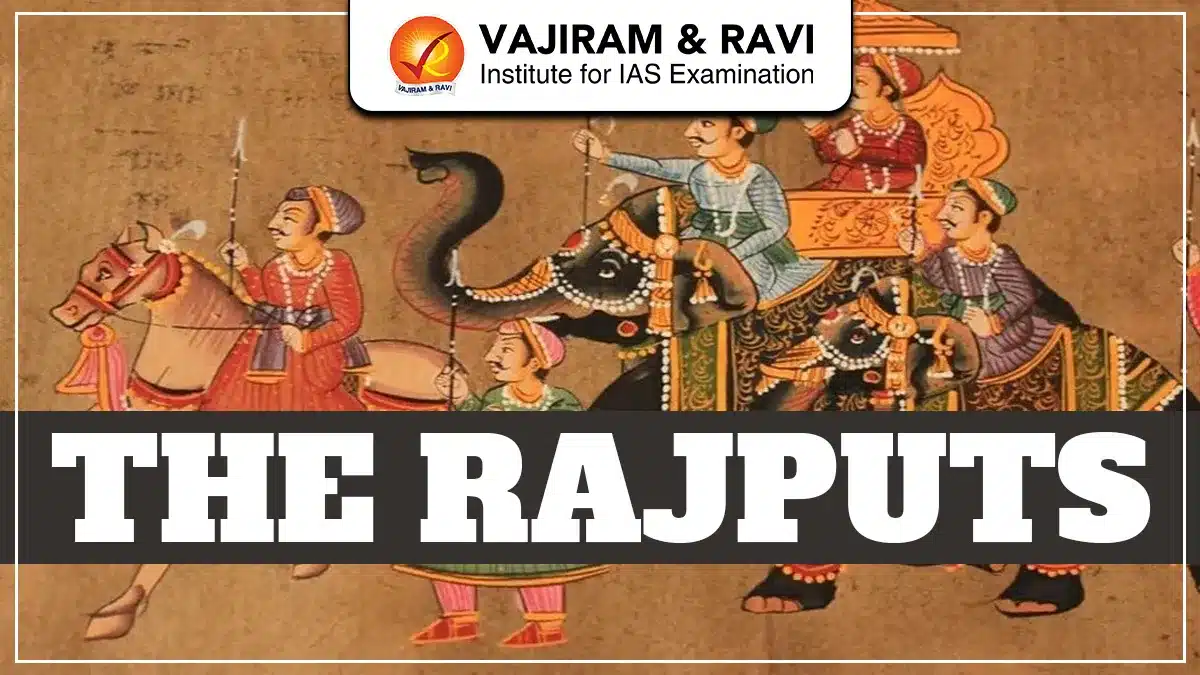
The Rajputs were a powerful group of warrior clans who dominated large parts of northern, western, and central India during the early medieval period. The word Rajput is derived from Rajaputra, meaning “son of a king”, which reflects their claim to royal and warrior ancestry. Rajputs considered warfare as their primary occupation and followed a strict code of honor, bravery, and loyalty.

From the 6th century CE onwards, Rajput rulers established numerous kingdoms across Rajasthan, Gujarat, Madhya Pradesh, Uttar Pradesh, Delhi, Punjab, Himachal Pradesh, Uttarakhand, and parts of present-day Pakistan and Afghanistan. Even until the 20th century, many princely states of India were ruled by Rajput dynasties.

The Rajputs Origin

The origin of the Rajputs is one of the most debated issues in early medieval Indian history because it combines legendary traditions, literary references, and historical processes. Rajputs did not emerge suddenly; they evolved over time as a distinct warrior aristocracy between the 6th and 9th centuries CE.

Kshatriya Lineage Theory

  • Many Rajputs claimed descent from the ancient Kshatriyas of Vedic age, emphasizing purity of blood and royal ancestry.
  • They associated themselves with the Solar (Suryavanshi) and Lunar (Chandravanshi) dynasties mentioned in the epics and Puranas.
  • The word Rajput comes from Rajaputra, meaning “son of a king”, a term used by Sanskrit writers like Bana for elite warriors.
  • The idea of thirty-six royal Rajput clans is found in Puranic and epic traditions, giving legitimacy to their ruling status.
  • Rajputs also recognized a third lineage, the Agnivanshi, which symbolized divine and ritual origin.

Agnikula (Fire-Origin) Theory

  • According to Chand Bardai’s Prithviraj Raso, four major Rajput clans, Parmar, Chauhan, Pratihara, and Chalukya, were born from a sacrificial fire pit (Agnikunda) at Mount Abu.
  • Sage Vashistha is said to have performed the ritual to create warriors to defend Hindu society.
  • This theory strengthened clan identity, social prestige, and political legitimacy among Rajputs.
  • Historians regard this theory as mythical and symbolic, rather than factual history.

Aryan-Kshatriya Cultural Continuity Theory

  • Ethnological and cultural practices of the Rajputs indicate strong roots in Aryan-Kshatriya traditions.
  • Rituals such as the Ashvamedha sacrifice, sun worship, and strict adherence to Kshatriya codes were central to Rajput life.
  • The practice of Sati reflected orthodox Hindu social values prevalent among upper castes.
  • Due to cultural continuity, this theory is widely accepted by modern historians.

Foreign Origin and Assimilation Theory

  • Some historians argue that certain Rajput clans descended from foreign tribes like the Sakas, Kushanas, Huns, and Gurjaras.
  • These groups entered India between the 2nd and 6th centuries CE and gradually settled in northern India.
  • Over time, they adopted Hindu religion, Sanskrit language, and local customs.
  • Through Brahmanical rituals and political power, they were absorbed into the Kshatriya fold and later identified as Rajputs.

Caste Reorganization Theory

  • The invasions of the Huns and allied tribes in the 5th–6th centuries CE caused major political and social disruption in northern India.
  • Old ruling families collapsed, leading to a rearrangement of castes and power structures.
  • Diverse warrior groups were merged into a single ruling class known as the Rajputs.

Major Rajput Dynasties and Kingdoms

1. Hindushahi Dynasty

  • The Hindushahi dynasty ruled over parts of Afghanistan and the Punjab region, serving as a major Hindu power on India’s north-western frontier.
  • Jayapala was the first Rajput ruler of the dynasty, succeeding the last Brahmin king Bhimdev, marking a shift from Brahmin to Rajput rule.
  • Jayapala strongly resisted the invasions of Mahmud of Ghazni but was defeated in 1001 AD.
  • Following his defeat, Jayapala immolated himself, reflecting the Rajput code of honor and sacrifice.
  • His successor Anandapala continued resistance but was defeated by Mahmud in the Battle of Waihind (1008 AD).
  • The dynasty declined thereafter, and its last ruler Bhimpala died in 1024 AD, ending Hindushahi rule by 1026 AD.

2. Chauhan (Chahamana) Dynasty

  • The Chauhan dynasty ruled from 956 to 1192 AD, mainly over eastern Rajasthan, with Ajmer as their capital.
  • The dynasty was founded by Simharaj, who is also credited with establishing the city of Ajmer.
  • Over time, Chauhan rulers expanded their territory to include Delhi, Haryana, Punjab, parts of Uttar Pradesh, and Bundelkhand.
  • Prithviraj Chauhan, the most prominent ruler, brought the dynasty to its greatest extent and military strength.
  • He defeated Muhammad of Ghori in the First Battle of Tarain (1191 AD), showcasing Rajput military power.
  • However, his defeat in the Second Battle of Tarain (1192 AD) marked the decline of Chauhan rule and opened the way for Turkish dominance in northern India.

3. Solanki Dynasty (Chalukya Dynasty of Gujarat)

  • The Solanki dynasty ruled Gujarat from 945 to 1297 AD, with their capital at Anhilwara (Patan).
  • The dynasty rose to prominence under Mulraj I, who consolidated Solanki power and laid a strong administrative foundation.
  • Solanki rulers strengthened trade and commerce, making Gujarat an important economic region.
  • They were great patrons of Hinduism and Jainism, encouraging religious harmony.
  • The period witnessed remarkable temple architecture, reflecting artistic and cultural prosperity.
  • Solanki rule declined towards the end of the 13th century due to internal weakness and external invasions.

4. Paramara Dynasty

  • The Paramara dynasty was founded by Upendra (Krishnaraja) and ruled the Malwa region with capitals at Dhar and Ujjain.
  • The greatest ruler of the dynasty was Raja Bhoja, under whom Malwa reached its peak of political and cultural glory.
  • Raja Bhoja founded the city of Bhojpur and established the Bhojshala, a renowned centre of Sanskrit learning.
  • The Paramaras were major patrons of Sanskrit scholars, poets, and scientists, and Bhoja himself was a celebrated scholar.
  • Most Paramara rulers followed Shaivism and built numerous Shiva temples, while also supporting Jain scholars and institutions.
  • Under Paramara rule, Malwa emerged as a leading centre of art, culture, and intellectual activity in early medieval India.

5. Chandela Dynasty

  • The Chandela dynasty was founded by Jayasakthi and ruled the Bundelkhand region of central India.
  • Their capital was Mahoba, which served as an important political and military center.
  • The Chandelas are best known for their outstanding contributions to art and architecture.
  • They constructed the famous Khajuraho temples, renowned for their intricate carvings and architectural excellence.
  • These temples reflect religious tolerance, as both Shaiva and Vaishnava themes are prominently represented.
  • The dynasty declined after repeated invasions and finally ended when Alauddin Khalji conquered Bundelkhand.

6. Gahadavala Dynasty

  • The Gahadavala dynasty ruled the kingdom of Kannauj for nearly a century, beginning in the late 11th century AD.
  • Kannauj emerged once again as an important political centre under Gahadavala rule.
  • Jayachandra was the most powerful and last significant ruler of the dynasty.
  • He faced invasions from the Ghurids, led by Qutb al-Din Aibak.
  • Jayachandra was defeated and killed in the Battle of Chandawar (1194 AD).
  • This defeat marked the end of Gahadavala rule and weakened Rajput dominance in the Gangetic plains.

7. Bundela Dynasty

  • The Bundela dynasty ruled the Bundelkhand region from the 16th century AD onwards, emerging as a major regional power.
  • Orchha, located in present-day Madhya Pradesh, served as their principal centre of administration and culture.
  • The dynasty was founded by the Rajput ruler Hemkaran around 1048 AD.
  • Bundela rulers frequently resisted Mughal authority but also formed alliances when politically necessary.
  • The dynasty played an important role in shaping the political history of central India.
  • Bundela rule declined after Orchha was captured by the Mughals under Aurangzeb, bringing their independence to an end.

8. Tomara Dynasty

  • The Tomara dynasty was one of the early medieval Rajput ruling houses of northern India, known mainly from limited literary and numismatic sources.
  • Puranic evidence suggests that their early settlements were located in the Himalayan region.
  • Bardic traditions identify the Tomaras as one of the thirty-six Rajput clans.
  • Anangapala, the most notable Tomara ruler, founded the city of Delhi (Dhillika) in the 11th century AD.
  • In 1164 AD, Delhi was incorporated into the Chauhan (Chahamana) kingdom, though Tomara rulers continued as feudatories.
  • Tomara authority finally ended with the Muslim conquest of Delhi in 1192–93 AD.

Society under the Rajputs

Religion

  • The Rajputs were staunch followers of Hinduism, upholding traditional Vedic and Kshatriya religious practices.
  • They also patronized other religions like Buddhism and Jainism, supporting religious tolerance and cultural diversity.
  • The period saw the rise of the Bhakti movement, emphasizing devotion to deities such as Vishnu and Shiva, which influenced both the common people and the elite.
  • Temples were not only centers of worship but also hubs for social, cultural, and educational activities.

Governance

  • Rajput kingdoms had a feudal structure, with power decentralized across multiple estates and territories.
  • Each kingdom was divided into Jagirs, which were land grants held by Jagirdars (local feudal lords) responsible for administration, revenue collection, and military service.
  • The feudal setup created loyalty networks among clans, but also led to frequent inter-clan conflicts and limited central authority.
  • Governance was largely based on customs and traditions, with no codified laws for the entire kingdom.

Major Literary Works

The Rajput period was a golden age for literature, with contributions in poetry, prose, and scholarly works:

  1. Kalhana’s Rajatarangini – Chronicles the history of Kashmir in Sanskrit verse, providing political, social, and cultural insights of rulers and battles.
  2. Jayadeva’s Gita Govindam – Devotional Sanskrit poem celebrating Krishna and Radha, influencing the Bhakti movement, temple music, and dance.
  3. Somadeva’s Kathasaritsagara – Extensive collection of folktales and legends reflecting society, customs, and moral values of the period.
  4. Chand Bardai’s Prithviraj Raso – Epic poem depicting the life, bravery, and military exploits of Prithviraj Chauhan, highlighting Rajput ideals.
  5. Bhaskara Charya’s Siddhanta Shiromani – Comprehensive work on mathematics and astronomy, including arithmetic, algebra, and planetary motion.

Rajasekhara’s Literary Works – Sanskrit texts like Karpuramanjari, Kavyamimamsa, and Balaramayana combining poetry, devotion, and literary theory.

The Rajputs FAQs

Q1: Who were the Rajputs?

Ans: Rajputs were a warrior clan in India who claimed descent from ancient Kshatriya dynasties and ruled many regions of northern and western India.

Q2: What is the origin of Rajputs?

Ans: Rajputs trace their origin to the Kshatriya lineages, Agnikula legend, or assimilation of foreign tribes like Sakas, Huns, and Gurjaras.

Q3: Which were the major Rajput dynasties?

Ans: Major Rajput dynasties include Hindushahi, Chauhan, Solanki, Paramara, Chandela, Gahadavala, Bundela, and Tomara.

Q4: What was the social structure under the Rajputs?

Ans: Rajput society was feudal and clan-based with a rigid caste hierarchy dominated by Brahmins and Kshatriyas.

Q5: What religions did the Rajputs follow?

Ans: Rajputs primarily followed Hinduism while also patronizing Buddhism, Jainism, and the Bhakti movement.

Nobel Peace Prize 2025, Winner Name, Contribution

Nobel Peace Prize 2025

The Nobel Peace Prize 2025 is one of the six prestigious awards established by Alfred Nobel’s will in 1895. It is awarded annually by the Norwegian Nobel Committee, elected by the Norwegian Parliament (Stortinget), to individuals or organisations that have made outstanding contributions to promoting peace, reducing armed conflict, and fostering international fraternity. The prize aims to encourage efforts that bring the greatest benefit to humanity, in line with Nobel’s vision of social progress and global harmony.

Why Nobel Peace Prize in News?

Venezuela’s María Corina Machado presented her Nobel Peace Prize medal to Donald Trump during a meeting at the White House, calling it a symbolic gesture of gratitude for his role in supporting Venezuelan freedom.

Nobel Peace Prize 2025

The Nobel Peace Prize 2025 was awarded to Maria Corina Machado on Friday, 10 October 2025 at 11:00 CEST for her tireless efforts in promoting democratic rights in Venezuela and striving for a peaceful transition from dictatorship to democracy. The Norwegian Nobel Committee, responsible for selecting laureates, received a total of 338 nominations, including 94 organisations, reflecting global recognition of peace efforts. The committee considers candidates whose work aligns with Alfred Nobel’s stipulation of promoting fraternity between nations, reducing standing armies, or supporting peace congresses. Nominations are strictly confidential and cannot be made posthumously, ensuring that the prize reflects ongoing contributions to global peace.

Also Check: Nobel Prize 2025 in Medicine

Nobel Peace Prize 2025 Historical Background

The Nobel Peace Prize 2025, established in 1901 by Alfred Nobel, recognizes individuals or organisations promoting peace, disarmament, and global harmony.

  1. Foundation and Purpose (1895-1901)
  • 1895: Alfred Nobel’s will specified a prize for those promoting fraternity between nations, reducing standing armies, or supporting peace congresses.
    Influence: Nobel was inspired by Bertha von Suttner, a peace activist, to include the peace category.
  • Awarding Body: The prize is administered by the Norwegian Nobel Committee, elected by Norway’s Parliament (Stortinget).
  1. Early Years (1901-1940s)
  • First Award: The prize was first awarded in 1901.
  • Organisations Recognized: The International Committee of the Red Cross won the prize in 1917 and 1944 for humanitarian efforts during wars.
  1. Post-War Era (1950s-1970s)
  • 1954: The Office of the UN High Commissioner for Refugees (UNHCR) received the prize for assisting refugees, repeated in 1981.
  • Focus shifted to reconstruction, diplomacy, and refugee aid after World War II.
  1. Modern Era (1980s-2000s)
  • Recognized individuals and organisations working on human rights, democracy, and disarmament.
  • Women Laureates: Increased recognition of women leaders in peace, with 19 women receiving the prize historically.
  1. Recent Trends (2010s-2024)
  • Focus on grassroots activism, nuclear disarmament, and social justice movements.
  • 2024 Award: Nihon Hidankyo, representing Hiroshima and Nagasaki atomic bomb survivors, honored for raising awareness on nuclear weapons and advocating disarmament.

Also Check: Nobel Prize Winners 2025 in Physics

Nobel Peace Prize Laureates

The following table lists all Nobel Peace Prize laureates from 1901 to 2024, highlighting their outstanding contributions to peace, human rights, and international cooperation.

Nobel Prize in Peace 2025 Laureates
Year Name Contribution

2025

Maria Corina Machado

for her tireless work promoting democratic rights for the people of Venezuela and for her struggle to achieve a just and peaceful transition from dictatorship to democracy

2024

Nihon Hidankyo

For efforts to achieve a world free of nuclear weapons and demonstrating through witness testimony that nuclear weapons must never be used again

2023

Narges Mohammadi

For her fight against oppression of women in Iran and promotion of human rights and freedom

2022

Ales Bialiatski, Memorial, Center for Civil Liberties

Representing civil society, promoted the right to criticise power, documented war crimes, and protected fundamental rights

2021

Maria Ressa, Dmitry Muratov

For efforts to safeguard freedom of expression, a precondition for democracy and lasting peace

2020

World Food Programme

For combating hunger, contributing to peace in conflict areas, and preventing hunger as a weapon of war

2019

Abiy Ahmed Ali

For achieving peace and international cooperation, especially resolving the border conflict with Eritrea

2018

Denis Mukwege, Nadia Murad

For efforts to end sexual violence as a weapon of war and armed conflict

2017

International Campaign to Abolish Nuclear Weapons

For highlighting catastrophic humanitarian consequences of nuclear weapons and promoting treaty-based prohibition

2016

Juan Manuel Santos

For resolute efforts to end Colombia’s 50-year-long civil war

2015

National Dialogue Quartet

For decisive contribution to building a pluralistic democracy in Tunisia after the Jasmine Revolution

2014

Kailash Satyarthi, Malala Yousafzai

For struggle against suppression of children and promoting the right of all children to education

2013

Organisation for the Prohibition of Chemical Weapons

For extensive efforts to eliminate chemical weapons

2012

European Union

For over six decades contributing to peace, reconciliation, democracy, and human rights in Europe

2011

Ellen Johnson Sirleaf, Leymah Gbowee, Tawakkol Karman

For non-violent struggle for women's safety and participation in peace-building

2010

Liu Xiaobo

For long and non-violent struggle for fundamental human rights in China

2009

Barack H. Obama

For extraordinary efforts to strengthen international diplomacy and cooperation between peoples

2008

Martti Ahtisaari

For efforts to resolve international conflicts on several continents over three decades

2007

Intergovernmental Panel on Climate Change, Al Gore

For disseminating knowledge about man-made climate change and laying foundations for countermeasures

2006

Muhammad Yunus, Grameen Bank

For creating economic and social development from below

2005

International Atomic Energy Agency, Mohamed ElBaradei

For efforts to prevent nuclear energy from being used militarily and ensuring safe peaceful use

2004

Wangari Maathai

For contribution to sustainable development, democracy, and peace

2003

Shirin Ebadi

For efforts for democracy and human rights, especially women and children’s rights

2002

Jimmy Carter

For decades of effort to find peaceful solutions, advance democracy and human rights, and promote economic and social development

2001

United Nations, Kofi Annan

For work towards a better organized and more peaceful world

2000

Kim Dae-jung

For work for democracy, human rights, and peace and reconciliation with North Korea

1999

Doctors Without Borders

For pioneering humanitarian work on several continents

1998

John Hume, David Trimble

For efforts to find a peaceful solution to the conflict in Northern Ireland

1997

International Campaign to Ban Landmines, Jody Williams

For work in banning and clearing anti-personnel mines

1996

Carlos Filipe Ximenes Belo, José Ramos-Horta

For efforts towards a just and peaceful solution to the conflict in East Timor

1995

Joseph Rotblat, Pugwash Conferences

For efforts to diminish nuclear arms’ role in politics and eliminate them in the long run

1994

Yasser Arafat, Shimon Peres, Yitzhak Rabin

For efforts to create peace in the Middle East

1993

Nelson Mandela, F.W. de Klerk

For work to end apartheid peacefully and lay foundations for democratic South Africa

1992

Rigoberta Menchú Tum

For struggle for social justice and ethno-cultural reconciliation respecting indigenous peoples’ rights

1991

Aung San Suu Kyi

For non-violent struggle for democracy and human rights

1990

Mikhail Gorbachev

For leading role in radical changes in East-West relations

1989

The 14th Dalai Lama

For advocating peaceful solutions based on tolerance and mutual respect to preserve cultural heritage

1988

United Nations Peacekeeping Forces

For preventing armed clashes and creating conditions for negotiations

1987

Oscar Arias Sánchez

For work for lasting peace in Central America

1986

Elie Wiesel

For being a messenger of peace, atonement, and dignity

1985

International Physicians for the Prevention of Nuclear War

For spreading awareness of catastrophic consequences of nuclear war

1984

Desmond Tutu

For role as unifying leader in non-violent campaign to end apartheid in South Africa

1983

Lech Wałęsa

For non-violent struggle for free trade unions and human rights in Poland

1982

Alva Myrdal, Alfonso García Robles

For work for disarmament and nuclear-free zones

1981

Office of the United Nations High Commissioner for Refugees

For promoting fundamental rights of refugees

1980

Adolfo Pérez Esquivel

For being an inspiration to repressed people, especially in Latin America

1979

Mother Teresa

For work bringing help to suffering humanity

1978

Anwar al-Sadat, Menachem Begin

For jointly negotiating peace between Egypt and Israel

1977

Amnesty International

For promoting worldwide respect for human rights

1976

Betty Williams, Mairead Corrigan

For founding a movement to end violent conflict in Northern Ireland

1975

Andrei Sakharov

For struggle for human rights, disarmament, and international cooperation

1974

Seán MacBride

For securing and developing human rights globally

1974

Eisaku Satō

For stabilizing conditions in the Pacific and signing the Nuclear Non-Proliferation Treaty

1973

Henry Kissinger, Le Duc Tho

For negotiating a ceasefire in Vietnam

1972

Not awarded

Prize money allocated to the Main Fund

1971

Willy Brandt

For paving way for meaningful dialogue between East and West

1970

Norman Borlaug

For providing hope via the Green Revolution

1969

International Labour Organization

For creating international legislation ensuring working condition norms

1968

René Cassin

For struggle to ensure human rights as stipulated in UN Declaration

1967

Not awarded

1/3 to main fund, 2/3 to special fund

1966

Not awarded

Prize money allocated to Special Fund

1965

United Nations Children's Fund

For enhancing solidarity between nations and reducing differences between rich and poor states

1964

Martin Luther King Jr.

For non-violent struggle for civil rights for Afro-Americans

1963

International Committee of the Red Cross, League of Red Cross Societies

For promoting Geneva Convention principles and cooperation with UN

1962

Linus Pauling

For fight against the nuclear arms race

1961

Dag Hammarskjöld

For developing UN into an effective international organization

1960

Albert Lutuli

For non-violent struggle against apartheid

1959

Philip Noel-Baker

For longstanding contribution to disarmament and peace

1958

Georges Pire

For helping refugees leave camps and return to life of dignity

1957

Lester Bowles Pearson

For crucial contribution to UN Emergency Force deployment after Suez Crisis

1956

Not awarded

1/3 to main fund, 2/3 to special fund

1955

Not awarded

Prize money allocated to Special Fund

1954

Office of UN High Commissioner for Refugees

For helping refugees worldwide and healing war wounds

1953

George C. Marshall

For proposing and supervising Europe’s economic recovery plan

1952

Albert Schweitzer

For altruism, reverence for life, and humanitarian work

1951

Léon Jouhaux

For fight against war via social justice and brotherhood

1950

Ralph Bunche

For work as mediator in Palestine (1948-49)

1949

Lord Boyd Orr

For lifelong effort to conquer hunger, removing a major cause of conflict

1948

Not awarded

1/3 to main fund, 2/3 to special fund

1947

Friends Service Council, American Friends Service Committee

For pioneering work in international peace movement and relieving human suffering

1946

Emily Greene Balch

For lifelong work for peace

1946

John R. Mott

For contribution to peace-promoting religious brotherhood across nations

1945

Cordell Hull

For indefatigable work for international understanding and UN establishment

1944

International Committee of the Red Cross

For humanitarian work during the war

1943

Not awarded

1/3 to main fund, 2/3 to special fund

1942

Not awarded

1/3 to main fund, 2/3 to special fund

1941

Not awarded

1/3 to main fund, 2/3 to special fund

1940

Not awarded

1/3 to main fund, 2/3 to special fund

1939

Not awarded

1/3 to main fund, 2/3 to special fund

1938

Nansen International Office for Refugees

For work benefiting refugees across Europe

1937

Robert Cecil, Viscount Cecil of Chelwood

For efforts supporting League of Nations, disarmament, and peace

1936

Carlos Saavedra Lamas

For Argentine Antiwar Pact mediation and peace efforts

1935

Carl von Ossietzky

For advocating freedom of thought and contributing to peace

1934

Arthur Henderson

For untiring efforts as Chairman of League of Nations Disarmament Conference

1933

Sir Norman Angell

For exposing illusion of war and promoting international cooperation

1932

Not awarded

Prize money allocated to Special Fund

1931

Jane Addams, Nicholas Murray Butler

For assiduous effort to revive and rekindle peace spirit

1930

Nathan Söderblom

For promoting Christian unity and creating mindset necessary for peace

1929

Frank B. Kellogg

For crucial role in Briand-Kellogg Pact

1928

Not awarded

Prize money allocated to Special Fund

1927

Ferdinand Buisson, Ludwig Quidde

For promoting public opinion favoring peaceful international cooperation

1926

Aristide Briand, Gustav Stresemann

For crucial role in Locarno Treaty

1925

Sir Austen Chamberlain

For role in Locarno Treaty

1925

Charles G. Dawes

For role in Dawes Plan

1924

Not awarded

Prize money allocated to Special Fund

1923

Not awarded

Prize money allocated to Special Fund

1922

Fridtjof Nansen

For repatriation of prisoners of war, international relief work, and UN refugee work

1921

Hjalmar Branting, Christian Lange

For lifelong contributions to peace and organized internationalism

1920

Léon Bourgeois

For contributions to peace, justice, and League of Nations establishment

1919

Woodrow Wilson

For role as founder of League of Nations

1918

Not awarded

Prize money allocated to Special Fund

1917

International Committee of the Red Cross

For efforts to care for wounded soldiers, POWs, and their families

1916

Not awarded

Prize money allocated to Special Fund

1915

Not awarded

Prize money allocated to Special Fund

1914

Not awarded

Prize money allocated to Special Fund

1913

Henri La Fontaine

For contribution to peaceful internationalism

1912

Elihu Root

For better understanding between North and South America, initiating arbitration agreements

1911

Tobias Asser

For co-founding Institut de droit international and initiating Hague Conferences

1911

Alfred Fried

For efforts exposing and fighting causes of war

1910

Permanent International Peace Bureau

For linking peace societies worldwide and organizing international peace rallies

1909

Auguste Beernaert, Paul Henri d’Estournelles de Constant

For prominent positions in international peace and arbitration movement

1908

Klas Pontus Arnoldson, Fredrik Bajer

For long-time work for peace as politicians, leaders, and authors

1907

Ernesto Teodoro Moneta

For press and peace meetings promoting understanding between France and Italy

1907

Louis Renault

For decisive influence on Hague and Geneva Conferences

1906

Theodore Roosevelt

For ending war between Japan and Russia

1905

Bertha von Suttner

For audacity opposing the horrors of war

1904

Institute of International Law

For striving to develop peaceful international ties and humane laws of war

1903

Randal Cremer

For devoted effort in favor of peace and arbitration

1902

Élie Ducommun

For untiring direction of Bern Peace Bureau

1902

Albert Gobat

For practical administration of Inter-Parliamentary Union

1901

Henry Dunant

For humanitarian efforts helping wounded soldiers and creating international understanding

1901

Frédéric Passy

For lifelong work for international peace conferences, diplomacy, and arbitration

Nobel Peace Prize 2025 FAQs

Q1: When will the Nobel Peace Prize 2025 be announced?

Ans: It has been announced on Friday, 10 October 2025 at 11:00 CEST.

Q2: Who awards the Nobel Peace Prize?

Ans: The Norwegian Nobel Committee, elected by the Norwegian Parliament (Stortinget), awards the prize.

Q3: Can organisations win the Nobel Peace Prize?

Ans: Yes, organisations can win. Examples include the International Committee of the Red Cross and the UNHCR, which have received multiple awards.

Q4: How many Nobel Peace Prize 2025 have been awarded till now?

Ans: The Nobel Peace Prize has been awarded 106 times to 143 laureates, including 112 individuals and 31 organisations.

Q5: Are nominations for the Nobel Peace Prize 2025 public?

Ans: No, all nominations are confidential till now.

National Startup Day 2026, Theme, History, Objectives, Significance

National Startup Day 2026

National Startup Day 2026 represents a significant chapter in India’s economic and innovation journey with this year marking ten years of the Startup India Initiative. It was launched to transform India into a nation of job creators, the initiative has reshaped entrepreneurship across urban and rural regions. National Startup Day is observed to celebrate this transformation, acknowledge entrepreneurial contributions and reinforce India’s commitment to innovation led, inclusive and sustainable growth aligned with the long term vision of Viksit Bharat @2047.

National Startup Day 2026

National Startup Day 2026 is observed on 16 January. This year commemorates a decade of the Startup India Initiative launched in 2016. The day celebrates India’s rapidly expanding startup ecosystem, which has crossed 2,00,000 DPIIT recognised startups, spread across technology, manufacturing, agriculture, healthcare, education, clean energy and digital services. The 2026 observance highlights India’s global position as one of the world’s largest startup ecosystems, driven by youth participation, digital infrastructure and government backed innovation support systems.

National Startup Day 2026 Historical Background

The Historical evolution of the National Startup Day 2026 has been listed below:

  • Origin: The Startup India Initiative launched on 16 January 2016 by Prime Minister Narendra Modi to promote entrepreneurship and innovation.
  • Startup India Launch Context: The initiative was introduced under DPIIT to address regulatory complexity, limited funding access and weak institutional support faced by early stage entrepreneurs in India.
  • National Startup Day Declaration: January 16 was officially designated as National Startup Day in 2022 to provide national recognition to entrepreneurs and innovators.
  • Ten Year Milestone: The 2026 observance marks completion of a decade, reflecting sustained policy continuity and ecosystem maturity.

National Startup Day 2026 Theme

The theme for National Startup Day 2026 has not been announced yet officially. Although the theme is expected to focus on celebrating a decade of achievements while setting direction for the next phase of innovation led growth. The focus for the 2026 event is placed on emerging technologies such as artificial intelligence, deep tech, climate tech and digital manufacturing. It reinforces participation of women entrepreneurs, with 48% recognised startups having at least one woman director.

National Startup Day 2026 Objectives

National Startup Day 2026 aims to reflect on achievements, strengthen collaboration and outline priorities for India’s future startup ecosystem.

  • Recognising Contributions: Acknowledges startups as contributors to economic growth, innovation capacity and domestic value chain strengthening.
  • Encouraging Youth Entrepreneurship: Reinforces the shift from job seekers to job creators, especially among India’s large youth population.
  • Policy Continuity Assurance: Reaffirms government commitment to regulatory reforms, funding support and ease of doing business.
  • Ecosystem Collaboration: Brings together startups, investors, incubators, corporates, academia and policymakers on a common platform.
  • Technology Adoption: Encourages adoption of frontier technologies to enhance productivity and competitiveness.
  • Long Term Vision Alignment: Aligns startup development with the national goal of Viksit Bharat @2047.

National Startup Day 2026 Observation

National Startup Day 2026 is observed through national level events, stakeholder interactions and public recognition of startup achievements.

  • Official Date: Observed annually on 16 January, commemorating the launch date of Startup India in 2016.
  • Prime Minister’s Participation: Prime Minister Narendra Modi participates in the 2026 programme at Bharat Mandapam, New Delhi.
  • Stakeholder Interaction: The Prime Minister interacts with founders, investors and ecosystem enablers from across India.
  • Startup Experience Sharing: Select startup representatives share real world insights from their entrepreneurial journeys.
  • National Address: The Prime Minister addresses the gathering, outlining achievements and future priorities of Startup India.
  • Live Streaming: Events are live streamed to ensure nationwide participation and accessibility.
  • Public Awareness: Media coverage and digital campaigns highlight startup success stories and policy milestones.
  • Ecosystem Recognition: Recognises incubators, investors and institutions contributing to startup growth.

National Startup Day 2026 Significance

National Startup Day 2026 holds long term economic, social and strategic significance for India’s development trajectory.

  • Ecosystem Scale: Over 2,00,000 DPIIT recognised startups highlight the scale and maturity of India’s innovation ecosystem.
  • Capital Support: More than ₹27,000 crore mobilised through Startup India funding mechanisms strengthens early stage ventures.
  • Incubation Infrastructure: 244 seed funded incubators support ideation, mentoring and early commercialization.
  • Digital Platforms: Over 6.6 lakh users are registered on BHASKAR, strengthening startup discovery and networking.
  • Government Procurement: Startups received orders worth over ₹51,000 crore through the Government e-Marketplace platform.
  • Regulatory Reforms: Implementation of 63 regulatory reforms reduced compliance burden and improved ease of doing business.
  • Women Participation: Nearly half of recognised startups include women directors, promoting gender inclusive entrepreneurship.
  • Geographical Inclusion: Presence of startup policies in 32 States and Union Territories ensures nationwide ecosystem coverage.
  • Employment Impact: Startups serve as significant employment generators across technology, manufacturing and services sectors.
  • National Vision Contribution: Strengthens India’s journey towards a self reliant, innovation driven and globally competitive economy.

National Startup Day 2026 FAQs

Q1: What is National Startup Day 2026?

Ans: National Startup Day 2026 is observed on 16 January to celebrate ten years of the Startup India Initiative and India’s startup ecosystem.

Q2: Why is 16 January celebrated as National Startup Day?

Ans: 16 January marks the launch date of Startup India in 2016, which aimed to promote entrepreneurship and innovation nationwide.

Q3: Which ministry implements the Startup India Initiative?

Ans: Startup India is implemented by the Department for Promotion of Industry and Internal Trade under the Government of India.

Q4: Why is National Startup Day 2026 important?

Ans: It highlights a decade of startup growth, job creation, innovation and policy reforms supporting India’s entrepreneurial ecosystem.

Q5: Who participates in National Startup Day 2026 celebrations?

Ans: Startups, investors, incubators, policymakers and the Prime Minister participate in events and interactions on this day.

Enquire Now