India Nepal Relations, History, Indo-Nepal Treaty 1950, Challenges

India Nepal Relations

India Nepal Relations represent one of South Asia’s closest and most distinctive bilateral partnerships. The two countries share an open border, deep civilisational links rooted in Hinduism and Buddhism and extensive social and economic interdependence. It was formalised through the Treaty of Peace and Friendship 1950. The treaty enables free movement, trade and employment across borders. India remains Nepal’s largest trade partner, investor and development partner with cooperation in connectivity, hydropower, security and disaster management.

India Nepal Relations Historical Background

The historical foundation of India Nepal Relations has evolved from the ancient time. Major events in the history of India Nepal Cooperation are:

  • Ancient Civilisational Links: India and Nepal share Hindu and Buddhist traditions, with sites like Pashupatinath, Janakpur, Bodhgaya and Lumbini fostering uninterrupted cultural, religious and pilgrimage exchanges since ancient times.
  • Treaty of Sugauli 1816: The treaty between Nepal and British India defined Nepal’s boundaries along the Kali River, laying the groundwork for later territorial interpretations and disputes like Kalapani and Susta.
  • Post Independence Reset 1950: The 1950 Treaty of Peace and Friendship formalised open borders, reciprocal rights and security cooperation, establishing a special relationship after India’s independence and Nepal’s political transition.
  • Cold War Balancing: Nepal gradually diversified foreign relations, engaging China to balance India’s influence, especially after the 1962 Sino-Indian War reshaped Himalayan strategic equations.
  • Economic Blockade 1989-90: Expiry of trade and transit treaties led to severe shortages in Nepal, GDP growth falling from 9.7% in 1988 to 1.5% in 1989, deeply straining bilateral trust.
  • Democratic Transition 1990: Restoration of democracy in Nepal normalised relations, leading to new trade, transit and economic agreements restoring connectivity and cooperation.
  • Maoist Phase and China Factor: Post-2006 politics saw Nepal diversify partnerships, with increased Chinese investments altering traditional India-centric engagement patterns.
  • Post 2014 Engagement: High-level visits since 2014 revitalised ties through credit lines, hydropower cooperation, disaster assistance and cultural diplomacy.
  • Earthquake Diplomacy 2015: India’s Operation Maitri delivered immediate relief after the earthquake, reinforcing humanitarian cooperation despite later political frictions.

Read About: India China Relations

Indo-Nepal Treaty of Peace and Friendship 1950

The Indo-Nepal Treaty of Peace and Friendship 1950 provides the legal and strategic foundation of bilateral relations, governing mobility, trade, security cooperation and economic privileges. The major features of this treaty are:

  • The treaty grants citizens of both countries rights to reside, work, own property and conduct business in each other’s territory without visas or passports.
  • A 1770 km open border enables free movement of people, supporting livelihoods, remittances and cultural exchanges but also creating security management challenges.
  • The treaty obligates both nations to inform each other of external threats, reinforcing mutual security coordination in the sensitive Himalayan region.
  • Indian and Nepali businesses receive national treatment, ensuring imported goods are treated on par with domestic products after entry.

However, Nepal increasingly views the treaty as unequal, prompting the Eminent Persons Group to recommend revisions, though implementation remains pending.

India Nepal Relations Area of Cooperation

India and Nepal partners in trade, connectivity, energy, defence, culture, development assistance, humanitarian support and multilateral engagement. The major areas of cooperation within India Nepal Relations are:

1. Trade and Economy

Economic ties form the backbone of bilateral relations, with India acting as Nepal’s primary trade partner, transit provider and major investment source.

  • Trade Volume: Bilateral trade reached INR 57,858 crore in 2018-19, with India exporting INR 54,300 crore and Nepal exporting INR 3,558 crore, reflecting asymmetrical dependence.
  • Transit Dependency: India provides transit for nearly all of Nepal’s third-country trade, making Indian ports vital for Nepal’s economic stability.
  • Investment Presence: Indian firms operate in banking, insurance, power, manufacturing, tourism and dry ports, contributing significantly to Nepal’s GDP and employment.
  • Energy Trade: Nepal exported electricity worth Rs 10.38 billion to India by mid-2022, marking hydropower as a growing export sector.

2. Connectivity

Connectivity initiatives strengthen economic integration and people-to-people ties between the two countries.

  • Rail Links: The Jayanagar-Kurtha rail line is operational and being extended to Bardibas, enhancing passenger and freight movement.
  • Electric Rail Corridor: India and Nepal signed MoUs for an electric rail link between Kathmandu and Raxaul, improving cross-border mobility.
  • Petroleum Pipeline: The Motihari-Amlekhgunj pipeline, South Asia’s first cross-border pipeline, ensures secure and affordable fuel supply to Nepal.
  • Inland Waterways: India’s Sagarmatha-to-Sagar initiative links Nepal to Indian waterways, expanding access to the Indian Ocean.

3. Energy and Hydropower

Hydropower cooperation is a strategic pillar benefiting both countries’ energy security and climate goals.

  • Arun-3 Project: The 900 MW Arun-3 hydropower project, implemented by SJVN under BOOT mode, involves ₹1,236 crore Indian investment.
  • Arun-4 Agreement: India and Nepal signed an agreement for the 490.2 MW Arun-4 project, strengthening long-term power cooperation.
  • Pancheshwar Project: The Mahakali Treaty’s Pancheshwar Multipurpose Project aims to generate 1,200 MW while supporting irrigation and flood control.
  • Export Commitment: India agreed to import 10,000 MW of electricity from Nepal over a decade, boosting Nepal’s revenue base.

4. Defence Cooperation

Defence ties reinforce mutual trust and regional security.

  • Gorkha Regiments: Around 32,000 Nepali citizens serve in Indian Army Gorkha regiments, symbolising historic military integration.
  • Surya Kiran Exercise: Annual joint military exercise Surya Kiran enhances interoperability, disaster response and counterterrorism coordination.
  • Honorary Ranks: Army chiefs of both nations confer honorary General ranks, reflecting deep institutional respect.

5. Cultural Ties

Cultural diplomacy strengthens grassroots relations beyond formal politics.

  • Sister Cities: India signed Sister-City Agreements linking Kathmandu-Varanasi, Lumbini-Bodhgaya and Janakpur-Ayodhya.
  • Educational Exchanges: India provides over 1,500 scholarships annually to Nepali students across technical and academic disciplines.
  • Religious Tourism: Shared pilgrimage circuits boost tourism and cultural understanding.

6. Humanitarian and Development Assistance

India is Nepal’s largest development and disaster-response partner.

  • Development Aid: India has provided over USD 1.5 billion since 2008 for health, education, infrastructure and rural development.
  • Disaster Relief: Operation Maitri after the 2015 earthquake delivered rapid relief and reconstruction support.
  • Operation Vaccine Maitri: India supplied nearly 9.5 million COVID-19 vaccine doses to Nepal under this operation.
  • Operation Ajay: India helped various Nepalese citizens to evacuate from Israel during Israel-Hamas conflict along with the Indian Citizens.
  • Operation Ganga: During Russia-Ukraine War, India helped Nepal through evacuating citizens from Ukraine and neighbouring nations.

Read About: India Pakistan Relations

India Nepal Relations Challenges

Despite strong ties, bilateral relations face strategic, political, economic and security challenges requiring sustained dialogue and cooperation.

  • Territorial Disputes: Kalapani and Susta disputes intensified after Nepal’s 2019 map claim, complicating diplomatic trust and border management.
  • Treaty Perception Issues: The 1950 treaty is criticised in Nepal as outdated and unequal, affecting public sentiment and political narratives.
  • Trade Imbalance: Nepal imports over 64% from India but exports less than 10%, creating persistent economic asymmetry.
  • China’s Influence: China’s Belt and Road investments in Nepal challenge India’s traditional influence and buffer-state dynamics.
  • Border Security: The open border is exploited for smuggling, fake currency circulation, human trafficking and insurgent movement.
  • Trust Deficit: Delays in project execution and perceptions of political interference fuel anti-India sentiment among sections of Nepali society.

Recent Currency Map Issue: Nepal circulated NPR 100 notes with disputed Kalapani, Lipulekh and Limpiyadhura, symbolically asserting claims, intensifying diplomatic tensions and complicating bilateral trust.

India Nepal Relations FAQs

Q1: What is the basis of India Nepal Relations?

Ans: India Nepal relations are based on shared culture, open borders, economic interdependence and the 1950 Treaty of Peace and Friendship.

Q2: Why is the 1950 India Nepal Treaty controversial?

Ans: Nepal considers the treaty unequal, citing security provisions and economic clauses and has sought its review through diplomatic mechanisms.

Q3: What are the main border disputes between India and Nepal?

Ans: The key disputes involve Kalapani, Lipulekh, Limpiyadhura and Susta regions, arising from differing interpretations of historical boundary agreements.

Q4: How does India support Nepal’s economy?

Ans: India is Nepal’s largest trade partner, transit provider, energy buyer and development assistance contributor across infrastructure and social sectors.

Q5: Why is Nepal strategically important for India?

Ans: Nepal acts as a Himalayan buffer, impacts regional security, controls critical river systems and influences India’s engagement with China in South Asia.
UPSC Daily Quiz 14 October 2026

UPSC Daily Quiz

[WpProQuiz 278]

UPSC Daily Quiz FAQs

Q1: What is the Daily UPSC Quiz?

Ans: The Daily UPSC Quiz is a set of practice questions based on current affairs, static subjects, and PYQs that help aspirants enhance retention and test conceptual clarity regularly.

Q2: How is the Daily Quiz useful for UPSC preparation?

Ans: Daily quizzes support learning, help in revision, improve time management, and boost accuracy for both UPSC Prelims and Mains through consistent practice.

Q3: Are the quiz questions based on the UPSC syllabus?

Ans: Yes, all questions are aligned with the UPSC Syllabus 2025, covering key areas like Polity, Economy, Environment, History, Geography, and Current Affairs.

Q4: Are solutions and explanations provided with the quiz?

Ans: Yes, each quiz includes detailed explanations and source references to enhance conceptual understanding and enable self-assessment.

Q5: Is the Daily UPSC Quiz suitable for both Prelims and Mains?

Ans: Primarily focused on Prelims (MCQ format), but it also indirectly helps in Mains by strengthening subject knowledge and factual clarity.

United Nations Development Programme (UNDP), Functions, Structure

United Nations Development Programme

The United Nations Development Programme (UNDP) is the world’s largest development agency within the United Nations system. It works in 177 countries to reduce poverty, strengthen democratic institutions, support crisis recovery, and promote sustainable development. UNDP plays a leading role in helping nations work toward the Sustainable Development Goals (SDGs), while focusing on fairness, human dignity, and long-term growth. Established in 1965, the organisation remains central to global development efforts.

United Nations Development Programme (UNDP)

The United Nations Development Programme (UNDP) was formed on 22 November 1965 and continues to serve as a key international actor in development cooperation. It provides technical expertise, financial assistance, and policy support to developing nations. Its mandate covers poverty reduction, crisis prevention, democratic governance, environmental sustainability, and development financing. UNDP works closely with governments, civil society, international institutions, and private partners to deliver development results. Its programmes ensure that development is inclusive, resilient, and sustainable.

Also Read: United Nations Environment Programme

United Nations Development Programme (UNDP) Historical Background

The United Nations Development Programme (UNDP) emerged from the merger of the Expanded Programme of Technical Assistance (EPTA) and the UN Special Fund.

  • EPTA, formed in 1949, focused on economic assistance and capacity building for developing countries.
  • The Special Fund, created in 1958, aimed to prepare nations for long-term development by supporting large-scale technical projects.
  • The merger was recommended by the United Nations Economic and Social Council (ECOSOC) to reduce duplication of tasks and make development support more systematic.
  • By 1966, the merger was complete, and the UNDP began functioning as the primary global development agency of the UN.

United Nations Development Programme (UNDP) Purpose

UNDP’s core mandate is to help countries eliminate poverty, reduce inequality, and achieve sustainable human development. It also focuses on building local capacity so that nations can eventually manage development independently. UNDP assists countries in planning economic strategies, improving governance systems, and strengthening institutions. It also supports countries during crises such as natural disasters, conflicts, and public health emergencies. UNDP’s work is closely linked with the SDGs and international development frameworks.

United Nations Development Programme (UNDP) Organizational Structure

United Nations Development Programme (UNDP)

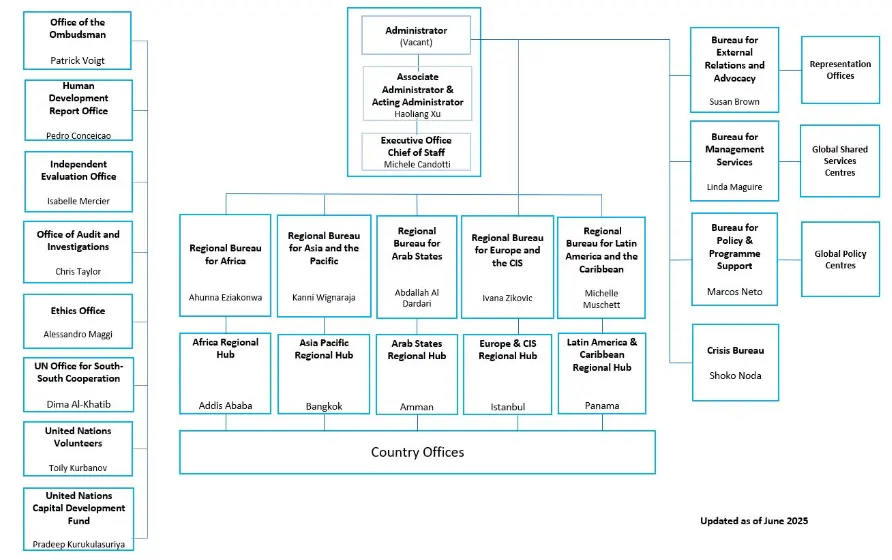
United Nations Development Programme (UNDP) is headquartered in New York City and operates through a network of country offices. It is led by an Administrator who holds the rank of Under-Secretary-General of the United Nations. The Administrator oversees a global workforce and supervises regional bureaus that manage development programmes across continents. As of 2025, Haoliang Xu is serving as the Acting Administrator. UNDP employs 7,394 staff worldwide (2022).

United Nations Development Programme (UNDP) Global Presence

UNDP works in 177 countries and territories, making it the largest development assistance agency in the UN system. Country offices collaborate directly with national governments to design policies, prepare development frameworks, and execute long-term programmes.

United Nations Development Programme (UNDP) Budget

UNDP is financed entirely through voluntary contributions from UN member states. It does not receive funding through compulsory UN assessments. Funding includes core contributions and earmarked resources for specific programmes. United Nations Development Programme (UNDP)’s total budget in 2022 was US$6.73 billion. UNDP has been rated highly for financial transparency and ranked first in the Aid Transparency Index (2015, 2016) with a score of 93.3%.

Also Read: International Labour Organisation

United Nations Development Programme (UNDP) Areas of Work

United Nations Development Programme (UNDP) focuses on five main development challenges. These areas guide its country-level and global operations.

  • Democratic Governance: UNDP supports democratic transitions by improving electoral systems, strengthening public institutions, and promoting citizen participation. It offers technical support for elections, public administration reforms, anti-corruption frameworks, and inclusive governance systems. Many countries rely on UNDP for training officials, improving public service delivery, and creating mechanisms for accountability.
  • Poverty Reduction: Poverty reduction is central to UNDP’s mission. It helps countries design policies that widen access to economic opportunities, promote financial inclusion, and strengthen social protection systems. UNDP also assists in reforming trade, promoting debt relief, and attracting investment to boost local economies. A 2013 independent evaluation noted that UNDP effectively supported national poverty programmes but required stronger monitoring mechanisms.
  • Crisis Prevention and Recovery: UNDP’s crisis-related work includes conflict prevention, disaster management, and peacebuilding. It supports countries in early recovery, demobilization of ex-combatants, reintegration of displaced communities, and restoration of essential services. During humanitarian crises, UNDP often works alongside UN agencies to stabilize governance and rebuild infrastructure. After foreign aid to Afghanistan was suspended in 2021, UNDP funded 25,000 health workers to maintain essential health services.
  • Environment and Energy: UNDP addresses climate change, biodiversity loss, land degradation, renewable energy access, and pollution control. It supports countries in transitioning to clean energy, managing natural resources responsibly, and protecting ecosystems. Key environmental programmes include:
    • BIOFIN (Biodiversity Finance Initiative)- works in 30 countries to develop biodiversity financing plans.
    • Equator Prize- recognizes local communities protecting biodiversity.
    • Sustainable land and water management initiatives across Asia, Africa, and Latin America.
  • HIV/ AIDS Response: UNDP works on reducing HIV impact through awareness programmes, policy reforms, and strengthening health systems. The Global Commission on HIV and the Law (2012) is a major initiative supported by UNDP to improve the legal environment for people affected by HIV.

United Nations Development Programme (UNDP) Initiatives

United Nations Development Programme (UNDP) runs several global programmes to drive innovation and collaboration:

  • Human Development Report (since 1991)- Introduced the Human Development Index (HDI) which measures development beyond income.
  • World Alliance of Cities Against Poverty
  • ART Global Initiative
  • Territorial Approach to Climate Change
  • Global Policy Centres in Seoul, Nairobi, Oslo, Singapore, and Istanbul

United Nations Development Programme and SDGs

United Nations Development Programme (UNDP) is the custodian agency for several SDG indicators and plays an integrating role within the UN system to coordinate SDG implementation. It supports countries in preparing SDG frameworks, aligning national budgets, and strengthening data systems. UNDP’s support is essential for countries that struggle with institutional capacity or financial challenges.

United Nations Development Programme and UN Coordination

United Nations Development Programme (UNDP) serves as the Vice-Chair of the UN Sustainable Development Group (UNSDG). It works through the Resident Coordinator (RC) System to ensure all UN agencies collaborate effectively at the country level.

  • Resident Coordinators operate in over 130 countries.
  • They lead joint UN efforts, ensure unified planning, and coordinate humanitarian and development assistance.

United Nations Development Programme (UNDP) Innovations

Launched in 2014, the Innovation Facility supports creative development solutions. It offers seed funding, digital tools, and technical expertise. In 2015, it supported 62 initiatives across 45 countries, contributing to 16 SDGs. Its innovation labs test artificial intelligence, blockchain, and data systems for development challenges.

United Nations Development Programme (UNDP) Controversies

UNDP has faced several allegations over the years. These incidents highlighted internal weaknesses, whistleblower protection issues, and governance challenges. These include:

  • NSA surveillance exposure (2013): Documents revealed UNDP emails were monitored by international intelligence agencies.
  • Gaza Project Allegations (2016) involving claims of resource misuse.
  • North Korea Financial Irregularities reported by former staff.
  • Russia GEF Project Corruption (2010-2014) where misappropriation of funds was alleged.
  • Iraq Stabilization Fund Corruption Scandal (2024) involving 136 reported corruption cases.

United Nations Development Programme (UNDP) Challenges

United Nations Development Programme (UNDP) faces numerous operational, financial, and structural challenges while working globally. The following are the major concerns and recommended solutions:

  1. Dependence on voluntary contributions, leading to unpredictable funding.
  2. Weak accountability mechanisms in crisis-hit and fragile states.
  3. Difficulty in monitoring outcomes in long-term development projects.
  4. Governance and corruption allegations affecting credibility.
  5. Slow bureaucratic procedures delaying implementation.
  6. Challenges in whistleblower protection, as observed in recent scandals.
  7. Climate change complexities making adaptation and mitigation expensive.
  8. Increasing geopolitical tensions affecting development work.

Way Forward:

  • Introduce stronger financial oversight mechanisms, especially in fragile states.
  • Strengthen digital monitoring systems to track project outcomes in real time.
  • Enhance whistleblower protection policies to ensure transparency.
  • Diversify funding sources to reduce reliance on a few donors.
  • Promote climate financing partnerships with private and public actors.
  • Simplify internal procedures for faster project delivery.
  • Expand capacity-building programmes for national institutions.
  • Improve community-level participation to ensure sustainable results.

United Nations Development Programme in India

United Nations Development Programme (UNDP) has operated in India since 1951, working on governance, livelihoods, energy, disaster resilience and inclusion. UNDP-India supports national priorities such as poverty alleviation, climate action, gender equality and strengthening institutions to deliver public services. Recent UNDP-India work includes support for state-level climate planning, social protection design, and data systems that underpin SDG tracking. 

United Nations Development Programme (UNDP) UPSC

UNDP remains one of the most influential actors in global development. For more than six decades, it has supported developing nations through poverty eradication, governance reforms, crisis recovery, and environmental sustainability. While the organisation faces stiff challenges related to funding, corruption allegations, and operational limitations, its global presence and technical expertise continue to make it indispensable. Strengthening internal governance and building more transparent systems will further enhance United Nations Development Programme (UNDP)’s impact in the coming decades.

To deliver on the SDGs and respond to emerging shocks, UNDP’s priorities include: scaling climate-resilient development, deepening impact in fragile contexts, expanding data and digital systems for better policy making, and mobilizing blended finance for SDG investments. Increasing core funding and improving country-level partnerships will be crucial so UNDP can remain agile and catalytic, helping governments secure equitable, resilient development pathways.

United Nations Development Programme FAQs

Q1: What is the United Nations Development Programme (UNDP)?

Ans: UNDP is the United Nations’ global development agency that works in more than 170 countries to reduce poverty, strengthen governance, and promote sustainable development.

Q2: When was United Nations Development Programme established?

Ans: UNDP was created in 1966 through the merger of two UN funds focused on technical assistance and development support.

Q3: What are the main focus areas of United Nations Development Programme?

Ans: UNDP works across three core areas: poverty reduction, democratic governance, and climate and disaster resilience.

Q4: What is the Human Development Report released by United Nations Development Programme?

Ans: The Human Development Report (HDR) is an annual flagship publication of UNDP that presents the Human Development Index (HDI) and analyzes global development trends.

Q5: How does United Nations Development Programme support countries like India?

Ans: UNDP helps India with sustainable development planning, climate action, digital governance, livelihood improvement, and poverty reduction through policy support and on-ground programmes.

Gujral Doctrine, Principle, Application, Impact, Criticism

Gujral Doctrine

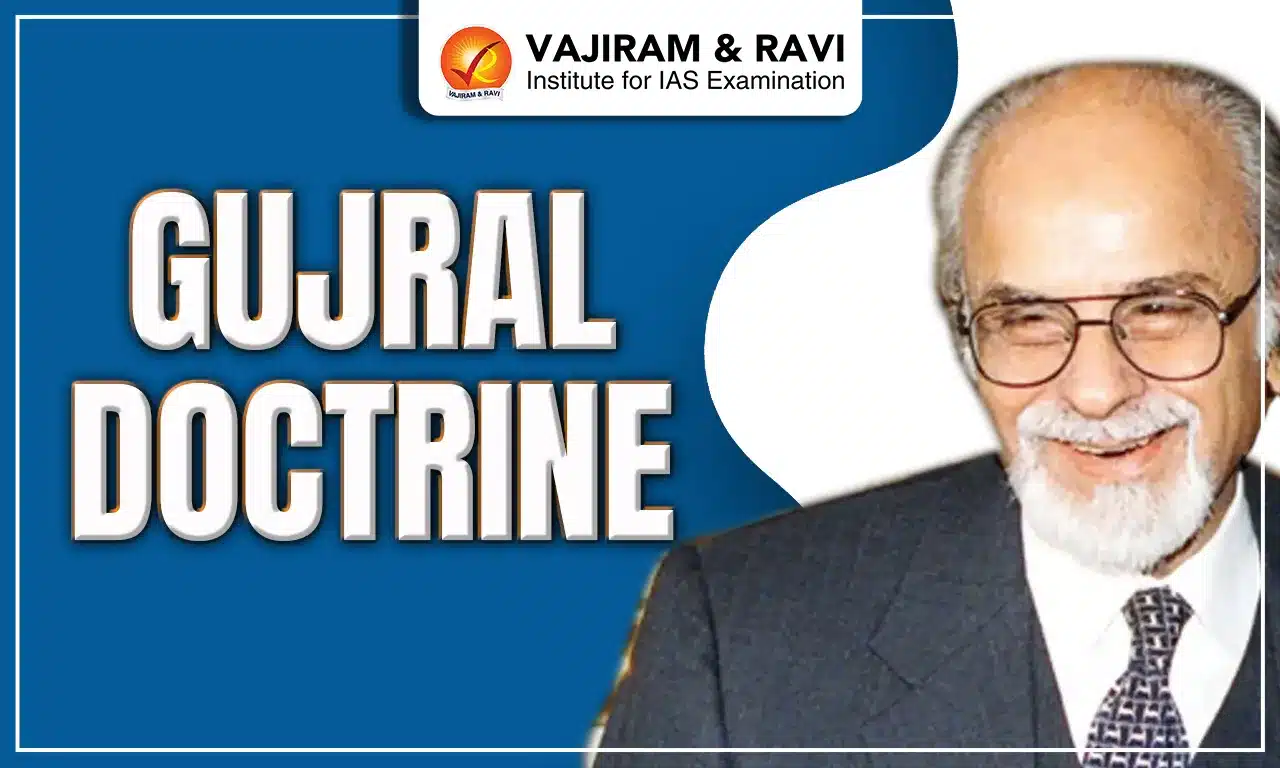
The Gujral Doctrine stands as a cornerstone of India’s post-Cold War foreign policy, emphasizing peace, non-reciprocity, and regional cooperation in South Asia. Introduced by I.K. Gujral, India’s 12th Prime Minister, during his tenure as Foreign Minister (1996-1997) and later as Prime Minister (1997-1998), the doctrine sought to redefine India’s neighborhood diplomacy by promoting goodwill, trust, and mutual respect among South Asian nations, especially in the context of India’s relations with its smaller neighbors.
Gujral Doctrine

The Gujral Doctrine is a set of five principles guiding India’s foreign policy toward its South Asian neighbors. It represented a significant shift from a security-centric approach to one rooted in mutual understanding and non-interference. The doctrine emphasized unilateral goodwill gestures by India toward its neighbors without expecting reciprocity, reflecting India’s role as a benevolent regional power.

The doctrine was officially articulated by I.K. Gujral in 1996 at the Chatham House (1996) and Colombo speech (1997), where he outlined a framework for regional peace and cooperation. It aimed to counterbalance tensions in South Asia and to establish India as a leader fostering integration and stability in the region.

Inder Kumar Gujral

Inder Kumar Gujral (I. K. Gujral) was an Indian diplomat, politician, and the 12th Prime Minister of India from 1997 to 1998. Born on December 4, 1919, in Punjab, he played a key role in shaping India’s foreign policy through his visionary Gujral Doctrine, which emphasized peace, non-reciprocity, and regional cooperation with neighboring countries. A seasoned diplomat and intellectual, Gujral also served as India’s External Affairs Minister and represented India’s moral and peaceful approach in global diplomacy.

Gujral Doctrine Principles

The Gujral Doctrine rests on five core principles that guide India’s engagement with its neighbors. These principles reflected a vision of “cooperative regionalism”, a belief that India’s prosperity is inseparable from the stability and growth of its neighborhood. The fiver principles of Gujral Doctrine are:

  1. Non-reciprocal Cooperation: India would extend unilateral concessions and cooperation to its smaller neighbors without expecting reciprocity, recognizing the asymmetry of size and capability.
  2. Non-interference in Internal Affairs: India would not interfere in the domestic matters of neighboring countries, respecting their sovereignty and independence.
  3. Mutual Respect for Territorial Integrity and Sovereignty: Every South Asian nation would respect the sovereignty and borders of others, promoting trust and peaceful coexistence.
  4. Peaceful Resolution of Disputes: All bilateral issues should be resolved through dialogue and peaceful negotiation, not through force or coercion.
  5. Promotion of Regional Cooperation: Strengthening SAARC and other regional frameworks was emphasized to encourage collective development, trade, and cultural exchange in South Asia.
Gujral Doctrine Objectives

The doctrine had clear strategic, political, and diplomatic objectives that aimed to transform India’s regional relations:

  • To improve India’s image as a responsible and benevolent regional power.
  • To enhance trust and confidence among South Asian neighbors through non-reciprocal gestures.
  • To reduce tensions and promote peace, especially with countries like Bangladesh, Nepal, and Sri Lanka.
  • To promote South Asian integration through economic and cultural cooperation.
  • To isolate cross-border conflicts, especially with Pakistan, while engaging constructively with other neighbors.

Gujral Doctrine Historical Background

Before the 1990s, India’s relations with its neighbors were often marked by suspicion and power imbalances. The Cold War had limited India’s regional outreach, while conflicts such as the 1965 and 1971 wars with Pakistan and intervention in Sri Lanka (1987-1990) strained regional trust.

The post-Cold War environment presented both challenges and opportunities. With globalization and the rise of regional blocs like ASEAN and EU, India sought to foster similar cooperation in South Asia. I.K. Gujral recognized that India’s size and influence could either intimidate or inspire its neighbors. Hence, the doctrine sought to transform India’s foreign policy into a model of soft power diplomacy based on moral leadership and regional solidarity.
Gujral Doctrine Application

The application of the Gujral Doctrine in India’s Neighborhood has been discussed below:

  1. Bangladesh: Under the Gujral Doctrine, India signed the Ganga Water Treaty (1996) with Bangladesh, ending decades of disputes over river water sharing. This agreement was hailed as a major success in bilateral relations. India also pursued cooperation in trade, border management, and connectivity projects, improving trust with Dhaka.
  2. Nepal: The doctrine led to renewed dialogue with Nepal, emphasizing mutual respect and non-interference. Gujral’s government took steps to review old treaties and promote greater trade and transit cooperation, laying the foundation for stronger people-to-people ties.
  3. Sri Lanka: India’s relations with Sri Lanka improved through confidence-building measures. After the contentious IPKF episode, Gujral prioritized dialogue over intervention, focusing on cultural and economic cooperation.
  4. Maldives and Bhutan: Both countries continued to enjoy traditionally strong relations with India. The Gujral Doctrine reinforced India’s role as a development partner, assisting in infrastructure, education, and security collaboration.
  5. Pakistan: Although Gujral initiated peace talks with Pakistan under the Composite Dialogue Process (1997), progress was limited due to continuing tensions over Kashmir and terrorism. However, his approach laid the groundwork for later diplomatic efforts like the Agra Summit (2001) and the Lahore Declaration (1999).

Gujral Doctrine Impact

The Gujral Doctrine had a lasting influence on India’s foreign policy and regional relations.

Positive Impacts:

  • Improved Bilateral Relations: Strengthened ties with Bangladesh, Nepal, and Sri Lanka through dialogue and cooperation.
  • Enhanced India’s Image: Projected India as a benevolent regional leader willing to act without expecting immediate returns.
  • Boosted SAARC’s Relevance: Encouraged South Asian cooperation, trade, and regional integration efforts.
  • Foundation for Future Diplomacy: Inspired subsequent initiatives like “Neighborhood First Policy” and “Act East Policy.”

Limitations:

  • Limited Reciprocity: Many smaller neighbors continued to engage with external powers like China for balance.
  • Pakistan Factor: Ongoing conflicts and terrorism limited the success of non-reciprocal diplomacy.
  • Institutional Weaknesses: SAARC remained largely ineffective due to political differences among member states.

Gujral Doctrine Relevance of in Present Times

In the 21st century, the Gujral Doctrine continues to influence India’s Neighborhood First Policy, focusing on trust, connectivity, and mutual growth.

  • “Neighborhood First Policy” (2014) under Prime Minister Narendra Modi echoes Gujral’s vision through regional connectivity projects like BBIN (Bangladesh, Bhutan, India, Nepal) and initiatives such as Maitri power grids and cross-border rail links.
  • India’s humanitarian aid to Nepal (2015 earthquake), Sri Lanka (economic crisis 2022), and Maldives (COVID-19 assistance) reflects the same principle of non-reciprocal goodwill.
  • In contrast, challenges like China’s Belt and Road Initiative (BRI) in South Asia underscore the need to reinvigorate Gujral’s ideals with stronger economic and strategic engagements.

Gujral Doctrine Criticism

While the doctrine was visionary, it also faced criticism from strategic analysts and political commentators:

  • Overemphasis on Moral Diplomacy: Critics argued that it ignored hard security realities, especially with Pakistan.
  • Asymmetrical Expectations: India’s unilateral concessions were sometimes perceived as weakness.
  • Limited Regional Integration: SAARC’s ineffectiveness diluted the intended impact of regional cooperation.
  • Inconsistent Implementation: Successive governments did not fully institutionalize the doctrine, leading to policy discontinuity.

Despite these limitations, the doctrine remains a symbol of India’s ethical diplomacy and a benchmark for regional cooperation.

Gujral Doctrine and Soft Power Diplomacy

The doctrine marked a shift from traditional realpolitik to soft power diplomacy, using culture, development assistance, and moral leadership to win trust. This shift enhanced India’s regional legitimacy and fostered cooperation through persuasion rather than pressure. India used tools such as:

  • Cultural diplomacy: Promoting Indian art, cinema, and education exchanges in South Asia.

  • Development partnerships: Providing lines of credit, grants, and training programs to neighboring countries.
  • Humanitarian aid: Timely assistance during natural disasters strengthened India’s moral influence in the region.

Gujral Doctrine Challenges

Despite of various appreciations and advancements, the Gujral Doctrine faces several backlashes as mentioned below:

Challenges:

  • Persistent conflicts with Pakistan limit regional integration.
  • China’s growing influence in South Asia poses strategic concerns.
  • SAARC remains inactive due to political differences.
  • Cross-border terrorism continues to hinder peace-building efforts.
  • Domestic politics in neighboring countries affect consistency in relations.

Way Forward:

  • Reinforce economic diplomacy through connectivity and trade projects.
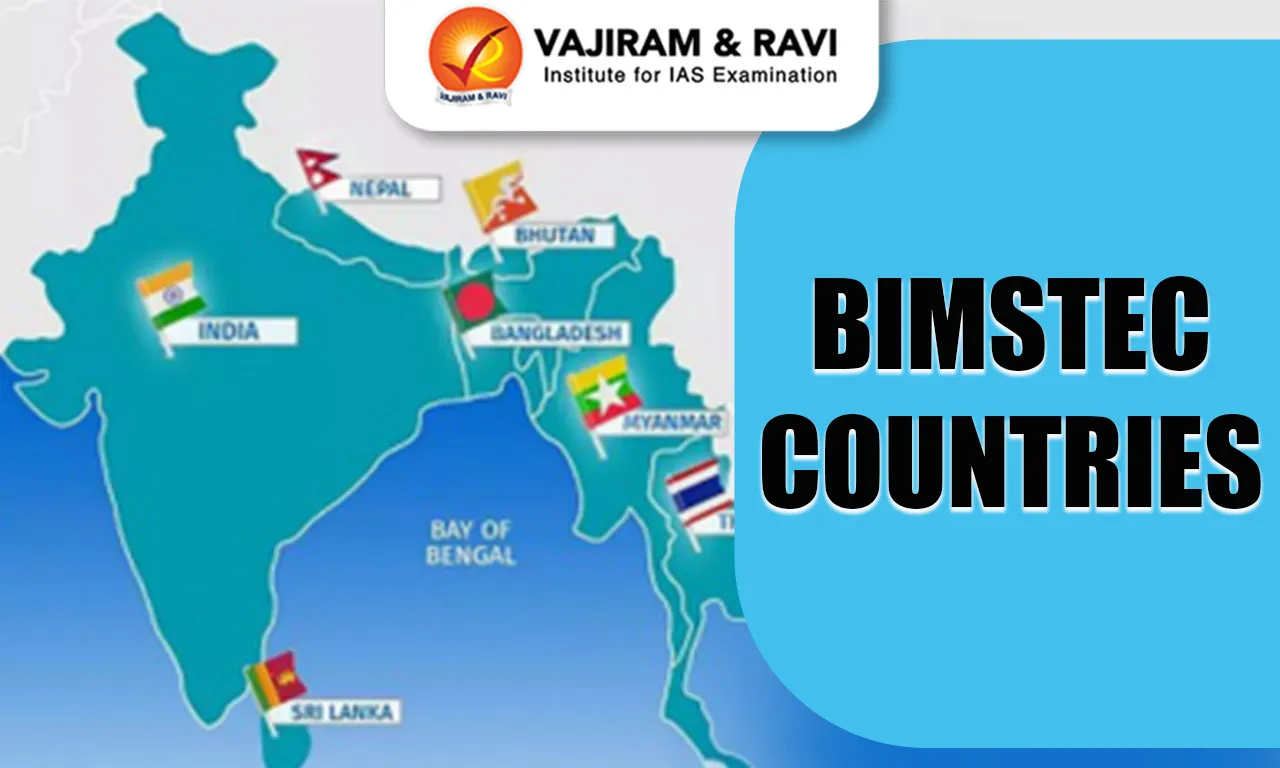
  • Strengthen multilateral frameworks like BIMSTEC and IORA.
  • Invest in people-centric diplomacy through cultural and educational outreach.
  • Address security concerns through dialogue while maintaining deterrence.
  • Promote sustainable regional growth through joint development initiatives.

Gujral Doctrine Effectiveness

The Gujral Doctrine, propounded by I.K. Gujral in 1996, improved India’s ties with Bangladesh (1996 Ganga Water Treaty), Nepal, and Sri Lanka through dialogue and non-reciprocity. It fostered regional goodwill and inspired India’s later “Neighborhood First” policy. However, Pakistan was excluded from the non-reciprocity principle due to ongoing conflicts. Despite promoting soft diplomacy, SAARC remained weak, and China’s growing regional role limited India’s influence. The doctrine’s spirit endures as ethical diplomacy, but its institutional impact was modest.

Gujral Doctrine UPSC

The Gujral Doctrine remains a landmark in India’s foreign policy evolution. By prioritizing trust, non-reciprocity, and regional peace, it redefined India’s relations with its neighbors and inspired future diplomatic frameworks. In an era marked by global uncertainty and regional rivalries, the doctrine’s essence, mutual respect, cooperation, and peaceful coexistence, continues to offer a roadmap for South Asia’s collective progress.

The Gujral Doctrine’s legacy extends far beyond the 1990s. Its vision continues to inform India’s diplomacy in multiple ways:

  • It inspired the “Neighborhood First Policy” (2014) and India’s developmental diplomacy model.
  • It positioned India as a responsible regional power promoting peace and prosperity.
  • The doctrine is now studied in international relations curricula as a case of successful soft diplomacy in South Asia.
  • Former Prime Minister Manmohan Singh and later Narendra Modi have both acknowledged the value of Gujral’s ideas in shaping India’s foreign engagement strategy.

Gujral Doctrine FAQs

Q1: Who introduced the Gujral Doctrine?

Ans: It was introduced by I.K. Gujral, India’s 12th Prime Minister, in 1996 during his tenure as Foreign Minister.

Q2: What are the five principles of the Gujral Doctrine?

Ans: Non-reciprocity, non-interference, respect for sovereignty, peaceful dispute resolution, and regional cooperation.

Q3: Which countries are primarily covered under the Gujral Doctrine?

Ans: India’s South Asian neighbors- Bangladesh, Nepal, Sri Lanka, Bhutan, Maldives, and Pakistan.

Q4: How is the Gujral Doctrine relevant today?

Ans: It guides India’s “Neighborhood First Policy” and soft power approach in regional diplomacy.

Q5: What was the key success of the Gujral Doctrine?

Ans: The 1996 Ganga Water Treaty with Bangladesh is considered a major success of the doctrine’s application.

Food and Agriculture Organization (FAO), Objectives, Structure

Food and Agriculture Organization

The Food and Agriculture Organization (FAO) is a leading specialized agency of the United Nations, dedicated to eradicating hunger, improving nutrition, and promoting sustainable agriculture worldwide. Founded in 1945, it serves as a global knowledge hub, technical advisor, and policy-maker, guiding countries toward food security and resilient agrifood systems. FAO’s work spans agriculture, forestry, fisheries, rural development, and natural resource management, making it a cornerstone of global efforts to ensure everyone has access to sufficient, healthy food.

Food and Agriculture Organization (FAO)

The Food and Agriculture Organization (FAO) was established on 16 October 1945, in Quebec City, Canada, in the aftermath of World War II, to address widespread food scarcity and famine. Headquartered in Rome, Italy, it has 195 members, including 194 countries plus the European Union. Its mission is succinct: to achieve food security for all, meaning that everyone, everywhere, has regular access to enough high-quality food. 

Food and Agriculture Organization (FAO) Objectives

The Food and Agriculture Organization (FAO) pursues several interlinked goals:

  • Eradicate hunger and malnutrition: FAO strives to eliminate chronic undernourishment and improve dietary quality by advising nations on food production and distribution.
  • Boost agricultural productivity: It helps countries increase yields in farming, forestry, fisheries, and livestock.
  • Improve living standards of rural populations: FAO supports rural development because most of the world’s poor depend on agriculture.
  • Promote sustainable use of natural resources: The organization encourages practices that protect land, water, forests, and biodiversity. 

Food and Agriculture Organization (FAO) Structure

The governance of the Food and Agriculture Organization (FAO) is based on its biennial Conference, attended by all member states and the European Union, which sets policy direction. From the Conference emerges a 49-member Council, acting as the FAO’s executive body. FAO also has a Director-General, who heads the Secretariat. As of the latest data, the Director-General is Qu Dongyu. Its presence is global, with field offices in over 130 countries, allowing FAO to provide on-the-ground technical assistance.

Food and Agriculture Organization (FAO) Programmes

The Food and Agriculture Organization (FAO) runs a wide variety of programmes aimed at transforming agrifood systems and addressing food insecurity:

  1. Field Programme: Supports developing countries by giving technical advice and training in agriculture, water management, forestry, fisheries, and nutrition.
  2. Digital Agriculture & Innovation: FAO promotes digitalization through initiatives like its Digital Villages Initiative, bringing technology to rural communities. 
  3. Blue Transformation: To meet future demand for aquatic foods, FAO aims to grow aquaculture by 35% by 2030, under its “Blue Transformation” roadmap. 
  4. Science and Evidence: FAO coordinates global science policy through its Chief Scientist role, and champions research to align agrifood systems with sustainability goals. 
  5. Right to Food: Uses Right to Food Guidelines to support legal, policy, and institutional frameworks that ensure everyone’s access to food. 
  6. Financing for Development: In July 2025, FAO launched the Financing for Shock-Driven Food Crisis (FSFC) Facility, a mechanism for anticipatory financing to prevent food crises. 

Food and Agriculture Organization (FAO) Global Food Security and Nutrition

The Food and Agriculture Organization (FAO) plays a critical role in monitoring and reporting global food security trends. Its key reports, such as the State of Food Security and Nutrition in the World (SOFI), highlight global hunger, undernourishment, and food inequality. For instance, FAO data indicates that between 2019 and 2023, 152 million more people suffered from hunger, rising the prevalence of undernourishment to 9.1% of the world population in 2023. The report also emphasizes that this hunger is not merely due to lack of production but is driven by inequality, access, and affordability. FAO’s work helps shape global and national policies to reduce food insecurity, promote healthy diets, and support social protection systems.

Food and Agriculture Organization (FAO) and SDGs

The Food and Agriculture Organization (FAO) is deeply integrated into the UN’s 2030 Agenda for Sustainable Development. It particularly contributes to SDG 2 (Zero Hunger), by promoting food security, nutrition, and resilient food systems. FAO’s initiatives also support SDG 13 (Climate Action) through sustainable land and water management, and SDG 12 (Responsible Consumption) by improving food systems’ efficiency. Through its global coordination role, FAO aligns partner governments, UN bodies, and stakeholders to transform agrifood systems sustainably. 

Food and Agriculture Organization (FAO) Research

Science and innovation are at the heart of the Food and Agriculture Organization (FAO). It fosters research to make agriculture more productive but also more sustainable. For example, FAO has supported work on artificial intelligence (AI) for agriculture. In collaboration with the International Telecommunication Union (ITU), it has published research on using AI to predict micro-climate conditions, optimize pesticide usage, and support precision farming. FAO also promotes evidence-based policies through its SCOPE mechanism, providing country-level macro- and micro-economic analysis to guide agrifood system transformations. These research-backed tools help integrate climate change mitigation, technology, and socio-economic development in agricultural planning.

Food and Agriculture Organization (FAO) Fisheries and Aquaculture

Fisheries and aquaculture are a major focus for the Food and Agriculture Organization (FAO). The Blue Transformation agenda seeks to scale up sustainable aquatic food production to meet growing global demand. FAO encourages responsible fishing practices through its Ecosystem Approach to Fisheries (EAF), helping countries manage marine resources, reduce overfishing, and preserve biodiversity. It also combats marine pollution, for example via initiatives like GloLitter, and supports legal reforms in fisheries legislation to enhance sustainability. By linking coastal restoration to community livelihoods, FAO promotes both environmental health and food security for fishing communities. 

Food and Agriculture Organization (FAO) Technical Cooperation

One of FAO’s strengths lies in technical assistance and capacity building. It provides policy advice, training, and infrastructure support directly to countries. Through partnerships with civil society and trade unions, FAO engages with farmers, fishers, and rural workers to ensure inclusive policy dialogue. FAO also promotes village-to-village cooperation: under its Digital Villages Initiative, rural communities “twin” to share knowledge, best practices, and technologies. These efforts help strengthen resilience, empower communities and increase the adoption of sustainable farming practices.

Food and Agriculture Organization (FAO) Finance

The Food and Agriculture Organization (FAO) has introduced innovative financial tools to respond to shocks. In July 2025, it launched the Financing for Shock-Driven Food Crisis (FSFC) Facility. This facility is designed to act before food crises escalate, using scientific triggers and pre-planned action to fund anticipatory responses rather than costly emergency aid. FSFC mobilizes blended finance, combining public funds, private-sector resources, and insurance mechanisms, to make interventions faster and more cost-effective. This shift from reactive to proactive financing is crucial, especially as climate change, conflict, and economic instability drive increasingly frequent food crises.

Food and Agriculture Organization (FAO) Challenges

Despite its broad mandate, the Food and Agriculture Organization (FAO) faces key challenges that limit its impact:

  • Funding volatility: FAO relies heavily on voluntary contributions, making long-term planning difficult.
  • Complex geopolitics: Conflict and political instability can disrupt its operations and food-security work.
  • Climate change: Increasing climate shocks strain agricultural systems and undermine FAO’s sustainable development goals.
  • Digital divide: Unequal access to technology in rural areas hampers digital agriculture initiatives.
  • Resource degradation: Soil erosion, water scarcity, and biodiversity loss challenge FAO’s sustainability mission.
  • Inequality and access: Hunger often stems from poor access and affordability, not just lack of food.
  • Institutional capacity: Some member countries lack strong institutions to absorb FAO’s policy advice.
  • Coordination with other UN bodies: Aligning with multiple UN agencies and donors can be challenging for systemic agrifood transformation.
  • Monitoring and evaluation: Measuring the true impact of its diverse programs across contexts is difficult.
  • Debt burden in recipient countries: Many nations FAO assists are heavily indebted, limiting their capacity to invest in long-term agricultural transformation.

Way Forward:

To overcome these challenges, the Food and Agriculture Organization (FAO) can pursue a number of strategic reforms and innovations:

  • Stabilize funding by encouraging predictable, multi-year contributions from member states.
  • Strengthen crisis-response finance through scaling up the FSFC model.
  • Expand climate-smart agriculture by promoting agroecology, regenerative practices, and carbon-sequestering farming.
  • Bridge the digital divide by supporting rural connectivity and training for small farmers.
  • Promote local ownership by building capacities within national institutions for policy-making and evaluation.
  • Enhance partnerships with private sector, civil society, and farmers' organizations for inclusive programs.
  • Integrate food system transformation with SDG strategies at national and regional levels.
  • Improve data and evidence systems using AI, remote sensing, and predictive analytics to monitor food systems.
  • Advocate for equitable food access and social protection, especially for marginalized communities.
  • Promote financial innovation, like blended finance and insurance, to support smallholder farmers and resilient supply chains.

Food and Agriculture Organization (FAO) UPSC

The Food and Agriculture Organization (FAO) remains a vital actor in the global fight against hunger, malnutrition, poverty, and environmental degradation. By combining technical expertise, scientific research, and policy advice, FAO empowers countries to transform agrifood systems. Yet, it faces serious challenges, from volatile funding to climate risks. Strengthening its financial instruments, scaling up digital inclusion, and deepening local partnerships are crucial ways forward. Through these efforts, FAO can accelerate its mission of building a world free from hunger and ensuring sustainable, resilient food systems for all.

Food and Agriculture Organization FAQs

Q1: What is the Food and Agriculture Organization (FAO)?

Ans: The Food and Agriculture Organization (FAO) is a specialized UN agency focused on ending hunger, improving nutrition, and promoting sustainable agriculture globally.

Q2: When was the Food and Agriculture Organization (FAO) founded?

Ans: The Food and Agriculture Organization (FAO) was founded on 16 October 1945 in Quebec City, Canada.

Q3: How does the Food and Agriculture Organization (FAO) help countries?

Ans: FAO helps by providing technical advice, training, data, and policy support in agriculture, fisheries, forestry, and rural development.

Q4: What major initiatives does the Food and Agriculture Organization (FAO) run?

Ans: Major initiatives include the Digital Villages Initiative, Blue Transformation for aquaculture, science and AI research, and anticipatory financing for crises via FSFC Facility.

Q5: What are the biggest challenges for the Food and Agriculture Organization (FAO)?

Ans: Key challenges for FAO include funding instability, climate change impacts, digital divide, coordination complexity, and ensuring equitable access to food.

African Union (AU), History, Members, Objective, Structure

African Union

The African Union (AU) is a continental organization that seeks to unite Africa’s 55 countries for common goals in peace, security, and development. Established as a successor to the Organisation of African Unity (OAU), it represents Africa’s attempt to strengthen its voice globally and coordinate cooperative solutions for the continent’s most pressing issues.

African Union (AU)

The African Union (AU) was formally launched in 2002, replacing the OAU, with the aim of promoting greater unity, economic development, and political cooperation among African nations. It consists of about 55 members at present out of which half of the members were joined under OAU in 1963.

African Union (AU) Historical Background

The key milestones in the development and evolution of the African Union (AU) has been listed below:

  • The Organisation of African Unity (OAU) was founded on May 25, 1963, by 32 African states. 
  • It aimed at decolonization, promoting solidarity among African states, and defending their territorial integrity. 
  • Over decades, the OAU mediated conflicts, supported liberation movements, and represented Africa in global forums. 
  • However, by the late 1990s, leaders felt a need for a more effective and economically focused organization, leading to the idea of the AU. 
  • The Constitutive Act of the African Union was signed on July 11, 2000 in Lomé, Togo, and came into force on May 26, 2001. 
  • The AU officially replaced the OAU in July 2002.

Also Read: World Trade Organisation

African Union (AU) Objectives

The Constitutive Act sets out the guiding aims and principles of the African Union (AU), which drive its work:

  1. Unity and Solidarity: To deepen unity, cohesion, and solidarity among African states and peoples.
  2. Sovereignty and Territorial Integrity: To respect the sovereignty and borders of member states. 
  3. Economic Integration: To accelerate political and socio-economic integration across the continent.
  4. Peace and Security: To promote peace, stability, and prevent conflicts. 
  5. Good Governance and Human Rights: To uphold democratic principles, human rights, and rule of law. 
  6. International Cooperation: To work with global partners, but on African terms, for development. 
  7. Sustainable Development: To work for improving quality of life through coordinated development. 

African Union (AU) Structure

The African Union (AU) is composed of several important organs and institutions that help it achieve its mandate:

  • Assembly of Heads of State and Government: The highest decision-making body of the AU. 
  • African Union Commission (AUC): Acts as the AU’s executive/secretariat, based in Addis Ababa, Ethiopia.
  • Permanent Representatives Committee (PRC): Made up of ambassadors from member states, coordinates the Assembly’s work. 
  • Pan-African Parliament (PAP): A legislative organ intended to provide a democratic voice for Africans. 
  • Peace and Security Council (PSC): Responsible for conflict prevention, peacekeeping, and security on the continent. 
  • African Peer Review Mechanism (APRM): A self-monitoring mechanism encouraging good governance and policy benchmarking among member states.
  • Economic, Social and Cultural Council (ECOSOCC): Civil-society participation organ for the AU. 
  • Specialized Technical Committees, Court of Justice, African Central Bank, African Monetary Fund, African Investment Bank, etc. 
  • African Space Agency (AfSA): A newer AU organ, with its headquarters in Cairo, promoting cooperation in space policy.

Also Read: United Nations Environment Programme

African Union (AU) Functions

The African Union (AU) plays several critical roles on the continent:

  1. Peacekeeping and Conflict Resolution
    • Through its Peace and Security Council, the AU designs and deploys peace support operations. 
    • For example, the African Union Support and Stabilization Mission in Somalia (AUSSOM) is a planned mission taking over from previous operations. 
  2. Promoting Good Governance
    • Via the African Peer Review Mechanism (APRM), member states voluntarily assess and improve governance standards. 
  3. Economic Integration & Development
    • The AU promotes African integration through infrastructure projects, trade, common markets, and shared development goals. 
    • A key vision is Agenda 2063, the AU’s long-term strategic blueprint for Africa’s development. 
  4. Health & Social Development
    • The AU responds to continental health crises. For instance, it has played a coordinating role via the Africa Centres for Disease Control and Prevention (Africa CDC) in past outbreaks. 
  5. Science, Technology & Innovation
    • Through the African Space Agency, the AU supports a continent-wide collaboration in space-related research and policy. 
    • It also backs initiatives to improve science infrastructure, such as through partnerships for projects like the African Light Source. 
  6. Representation in Global Affairs
    • The AU works to present unified African positions in global diplomacy, such as on climate change, UN reform, debt, and trade. 

African Union (AU) Agenda 2063

The African Union (AU)’s vision for the future depicts under the Programme Agenda 2063. The features highlighted are:

  • Agenda 2063 is the AU’s long-term strategic framework, adopted in 2015.
  • It sets out a 50-year vision for Africa, focusing on inclusive growth, sustainable development, democratic governance, and technological advancement. 
  • Some flagship projects under Agenda 2063 include plans for a continental high-speed rail network, free movement of people, and a powerful integrated economy. 
  • The first Ten-Year Implementation Plan under Agenda 2063 provides measurable targets across economic, social, and political domains. 

African Union (AU) Finance

The Financing of the African Union (AU) has the below mentioned features:

  • In 2016, African leaders adopted a 0.2% levy on eligible imports to create a more sustainable financing mechanism for the AU. 
  • This mechanism was intended to provide predictable funds for the Peace Fund and reduce reliance on external donors. 
  • However, the AU continues to face a heavy dependence on external funding: at one point, about 66% of its budget came from international partners. 
  • According to the AU’s own records, not all member states pay their assessed contributions on time, creating financing gaps. 
  • While the Peace Fund has made strides, raising almost 96% of an initial US$400 million target entirely from member states by 2024, full financial independence is still a goal.

Also Read: International Labour Organisation

African Union (AU) Achievements

The key achievements of the African Union (AU) has been mentioned here:

  • Conflict Mediation and Peace Operations: The AU has been central in negotiating peace deals and deploying missions in conflict zones like Somalia. 
  • Good Governance Promotion: Through the APRM, countries peer-review and improve governance, democratic norms, and policy-making. 
  • Pan-African Integration: Agenda 2063’s ambitious roadmap, especially economic integration, is driving long-term structural cooperation. 
  • Health Initiatives: The AU has coordinated continental-level health responses, notably through the Africa CDC. 
  • Institution Building: The AU has created new institutions like the African Space Agency to promote science and innovation.
  • Global Voice: The AU increasingly articulates common African positions in global forums, influencing debates on climate, trade, peace, and development.

African Union (AU) Challenges

The African Union (AU) faces major challenges that limit its potential, and there are clear ways forward to address these issues.

Challenges:

  • Heavy dependence on donor funds limiting autonomy. 
  • Fragmented institutional structure with overlapping responsibilities. 
  • Incomplete implementation of key reform proposals.
  • Many member states delay or default on financial contributions. 
  • Weak coordination between AU and Regional Economic Communities (RECs).
  • Bureaucratic inefficiency and limited managerial capacity. 
  • Inadequate transparency and accountability over the AU’s budget and spending.
  • Political instability and conflict in several member states hamper peace efforts. 
  • Limited capacity to fully implement Agenda 2063 initiatives quickly. 
  • Coordination challenges between the AU Commission, PRC, and Assembly. 

Way Forward:

  • Increase member-states’ financial contributions and enforce timely payments.
  • Strengthen financial independence by fully operationalizing the 0.2% import levy.
  • Simplify and streamline institutional structure to reduce fragmentation.
  • Improve transparency in budgeting and public reporting of AU finances.
  • Deepen coordination with Regional Economic Communities (RECs) for regional integration.
  • Enhance capacity-building in managerial and administrative skills within the AUC.
  • Fully implement Reform Agenda (2018) to enhance decision-making and accountability.
  • Focus on conflict-prone zones and bolster the Peace Fund with sustained funding.
  • Accelerate flagship projects under Agenda 2063 with clear milestones.
  • Strengthen peer-review mechanisms like the APRM to drive governance improvements.

African Union (AU) UPSC

The African Union (AU) plays a vital role in uniting Africa’s nations around shared visions of peace, development, and integration. Despite facing serious challenges, especially in financing, governance, and coordination, its institutional framework, programs like Agenda 2063, and peacekeeping missions demonstrate its commitment to long-term transformation. Strengthening financial autonomy, improving efficiency, and enhancing accountability will be critical for the AU’s success. With the right reforms, the African Union can truly become a strong continental force that shapes Africa’s future.

African Union (AU) FAQs

Q1: What is the African Union (AU)?

Ans: The African Union (AU) is a continental organization of 55 African states, focused on unity, peace, development, and collective self-reliance.

Q2: When was the African Union (AU) founded?

Ans: The AU was officially launched in July 2002, succeeding the Organisation of African Unity (OAU).

Q3: What are the main objectives of the African Union (AU)?

Ans: The AU aims for unity, economic integration, peace and security, good governance, human rights, and sustainable development.

Q4: How is the African Union (AU) funded?

Ans: The AU is funded through member state contributions and a 0.2% levy on eligible imports, but still heavily relies on external donor funds.

Q5: What is Agenda 2063 of the African Union (AU)?

Ans: Agenda 2063 is the AU’s 50-year strategic framework, adopted in 2015, aimed at transforming Africa through development, integration, and sustainability.

United Nations Environment Programme (UNEP), Headquarter, Established

United Nations Environment Programme

The United Nations Environment Programme (UNEP) is the principal global institution responsible for coordinating the environmental activities of the United Nations. It plays a central role in shaping the global environmental agenda, supporting sustainable development, and assisting nations in adopting sound environmental policies. Over the decades, UNEP has contributed significantly to addressing climate change, biodiversity loss, pollution, and the conservation of fragile ecosystems such as wetlands, forests, and marine systems.

This article provides a comprehensive UPSC-friendly overview of UNEP, its history, mandate, structure, functions, programmes, and major global reports.

United Nations Environment Programme (UNEP)

UNEP stands for the United Nations Environment Programme, which acts as the environmental pillar of the UN system. It leads global environmental governance and supports countries in meeting environmental targets under frameworks like the 2030 Agenda for Sustainable Development, the Paris Agreement, and biodiversity conventions.

Key points:

  • UNEP formulates global environmental strategies and supports their implementation.
  • It is the authoritative entity for global environmental monitoring and advocacy.
  • UNEP works closely with governments, NGOs, scientists, private sectors, and civil bodies to address environmental risks.
  • Headquarters: Nairobi, Kenya.
  • Current Head: Executive Director appointed by the UN Secretary-General (UPSC may ask the name in prelims).

United Nations Environment Programme (UNEP) Historical Background

Growing industrialisation and pollution in the 1960s prompted global concern regarding environmental degradation. To discuss these issues, the United Nations Conference on the Human Environment was held in Stockholm in 1972, a landmark global environmental summit.

Important developments from the Stockholm Conference:

  • Adoption of the Stockholm Declaration framing 26 environmental principles.
  • Establishment of a dedicated body for global environmental governance: UNEP.
  • Recognition of the environment as a shared global responsibility.
  • UNEP became the first UN agency headquartered in a developing country, highlighting environmental issues of the Global South.

United Nations Environment Programme (UNEP) Objectives

UNEP’s mandate revolves around promoting environmental sustainability globally.

Major Objectives

  • Coordinate global responses to environmental challenges.
  • Support countries in environmental planning, policy-making, and capacity building.
  • Promote sustainable development by integrating environmental considerations into economic and social planning.
  • Facilitate international environmental treaties, negotiations, and scientific assessments.
  • Address pollution, resource depletion, climate change, and biodiversity loss.

United Nations Environment Programme (UNEP) Structure

UNEP operates through a well-defined structure designed to ensure broad participation and effective policy implementation.

  1. United Nations Environment Assembly (UNEA): UNEA is the world’s highest-level decision-making body on environmental issues, comprising all UN member states. It meets biennially to set global priorities, adopt resolutions, and guide UNEP’s overall policy direction. The inclusive structure ensures equal representation from developing and developed nations.
  2. Committee of Permanent Representatives (CPR): The CPR acts as the main advisory body to UNEA and helps in preparing its agenda. It consists of accredited diplomats based in Nairobi and ensures the smooth functioning of UNEP activities throughout the year.
  3. Secretariat: The UNEP Secretariat, led by the Executive Director, implements UNEA decisions and oversees day-to-day operations. It coordinates with governments, NGOs, research organisations, and regional offices across the world to execute environmental programmes.
  4. Regional and Thematic Offices: UNEP functions through multiple regional offices in Asia-Pacific, Africa, Europe, Latin America, West Asia, and North America. These offices ensure that environmental initiatives address region-specific priorities and challenges.

United Nations Environment Programme (UNEP) Functions

UNEP performs several critical functions that shape global environmental governance:

Develops and supports global environmental treaties, such as the CBD, CITES, and Minamata Convention.

  • Hosts secretariats of major environmental conventions and supports the negotiation of new environmental agreements.
  • Publishes authoritative research and assessments, including the Global Environment Outlook and Emissions Gap Report.
  • Supports developing countries with environmental capacity building, funding, and technical assistance.
  • Promotes environmental awareness through campaigns and educational programmes targeting youth and civil society.
  • Coordinates global responses to environmental emergencies, pollution, and natural disasters.
  • Advances global guidelines and frameworks on chemicals, waste management, and environmental standards.
  • Collaborates with governments and NGOs to ensure environmental policies are implemented effectively.

United Nations Environment Programme (UNEP) Initiatives

  1. Clean Up the World (1993): This initiative mobilises volunteers globally to clean parks, water bodies, streets, and public spaces. It encourages local communities to adopt sustainable waste management practices and promotes environmental activism at the grassroots level.
  2. Billion Tree Campaign (2006): Launched to combat deforestation and climate change, this campaign aimed at planting billions of trees worldwide. It encouraged nations, communities, and individuals to undertake reforestation and promote ecosystem restoration.
  3. Seal the Deal (2009): A global campaign aimed at encouraging world leaders to finalise a legally binding climate agreement during the Copenhagen Summit. It mobilised public support for strong global action on climate change.
  4. APELL (Awareness and Preparedness for Emergencies at Local Level): APELL enhances local community preparedness for industrial accidents, chemical leaks, and environmental emergencies. It was developed after several industrial disasters highlighted the need for strong emergency planning.
  5. TUNZA Youth Programme: This initiative engages youth through environmental education, competitions, leadership programmes, and global summits. It encourages young people to contribute to environmental protection and sustainability.
  6. Faith for Earth Initiative: Launched in 2017, this programme connects religious organisations with global environmental action. It recognises the power of faith leaders in mobilising public support for eco-friendly lifestyles and sustainable development.
  7. UN-REDD Programme: A collaborative programme with FAO and UNDP, aimed at reducing emissions from deforestation and forest degradation. It supports forest conservation and sustainable land-use practices.
  8. Global Peatlands Initiative: Works to protect peatlands, which are among the largest natural carbon sinks. It aims to reduce emissions caused by peatland degradation.
  9. Greening the Blue: Aims to make the UN’s internal operations environmentally sustainable by reducing its waste, emissions, and resource consumption.

United Nations Environment Programme (UNEP) Reports Published

  1. Global Environment Outlook (GEO): Provides a comprehensive assessment of the state of the global environment. Released every four years, it highlights emerging challenges, progress made, and policy recommendations.
  2. Emissions Gap Report: Examines the gap between current global emissions and the reductions needed to meet the Paris Agreement targets. It identifies major emitters, their progress, and urgent global actions required.
  3. Adaptation Gap Report: Assesses global progress in climate adaptation and identifies financial, technological, and policy gaps. It helps countries strengthen resilience against climate impacts.
  4. Global Biodiversity Outlook (GBO): Evaluates global biodiversity trends and assesses the implementation of biodiversity targets under the Convention on Biological Diversity.
  5. Global Air Quality Assessment: Analyses global air pollution levels, their health impacts, pollution sources, and offers policy guidance for cleaner air.
  6. Frontiers Report: Highlights emerging environmental challenges such as zoonotic diseases, microplastics, and antimicrobial resistance.
  7. Food Waste Index Report: Measures global food waste and provides strategies for reducing wastage across the food supply chain.

United Nations Environment Programme (UNEP) Conventions

The United Nations Environment Programme (UNEP) plays a central role in hosting and supporting several major global environmental conventions that govern biodiversity, chemicals, waste management, and pollution control. These conventions provide legally binding frameworks for nations to cooperate on protecting ecosystems and regulating harmful environmental practices.

Conventions Hosted by UNEP

  • Convention on Biological Diversity (CBD): Promotes conservation of biodiversity, sustainable use of biological resources, and fair sharing of benefits arising from genetic resources.
  • CITES (Convention on International Trade in Endangered Species of Wild Fauna and Flora): Regulates international trade in endangered species to prevent their exploitation.
  • Minamata Convention on Mercury: Aims to protect human health and the environment from mercury pollution by phasing out mercury use and reducing emissions.

Conventions Supported by UNEP

  • Montreal Protocol & Vienna Convention: Global framework to phase out ozone-depleting substances, widely regarded as the most successful environmental treaty.
  • Basel Convention: Controls transboundary movement and disposal of hazardous waste.
  • Stockholm Convention: Eliminates or restricts persistent organic pollutants (POPs).
  • Rotterdam Convention: Promotes prior informed consent in the trade of hazardous chemicals and pesticides.
  • UNFCCC (United Nations Framework Convention on Climate Change): UNEP provides scientific and technical support to climate processes.
  • UNCCD (United Nations Convention to Combat Desertification): Supports global efforts to prevent land degradation and desertification.

United Nations Environment Programme (UNEP) UPSC

India collaborates extensively with United Nations Environment Programme (UNEP) on climate policy, biodiversity conservation, waste management, and circular economy initiatives. India hosted World Environment Day 2018, focusing on Beat Plastic Pollution. India also participates in UNEP’s resource efficiency projects, sustainable finance dialogues, and ecosystem restoration programmes. UNEP supports India’s environmental legislation, national action plans, and green technology initiatives through various collaborations.

United Nations Environment Programme (UNEP) FAQs

Q1: What is UNEP?

Ans: The United Nations Environment Programme (UNEP) is the leading global authority on environmental issues, responsible for coordinating environmental activities within the UN system.

Q2: When was UNEP established?

Ans: UNEP was established in 1972 following recommendations from the Stockholm Conference on the Human Environment. It was created to provide a coordinated global response to emerging environmental crises.

Q3: Where is UNEP headquartered?

Ans: UNEP’s headquarters is located in Nairobi, Kenya. It is the only major UN agency headquartered in a developing country, promoting a balanced global approach to environmental issues.

Q4: What is the main objective of UNEP?

Ans: Its main goal is to promote environmental sustainability by guiding global policy, supporting treaties, and providing solutions to climate change, biodiversity loss, pollution, and resource management.

Q5: What is the UNEA?

Ans: The United Nations Environment Assembly (UNEA) is the world’s highest decision-making body on environmental matters. It brings together all UN member states to adopt resolutions and set global environmental priorities.

International Labour Organisation (ILO), Headquarter, Objectives, History

International Labour Organisation (ILO)

The International Labour Organisation (ILO) is a UN specialised agency founded in 1919 to promote social justice and fair working conditions worldwide. Its core objective is to ensure decent work for all by strengthening labour rights, social protection, and tripartite dialogue among governments, employers, and workers. The ILO performs key functions such as setting international labour standards, monitoring compliance, providing technical assistance, and supporting member countries in labour reforms. It has developed 189 conventions, including eight fundamental ones covering forced labour, child labour, equality, and freedom of association.

International Labour Organisation (ILO)

ILO stands for the International Labour Organisation is one of the most influential international bodies working to ensure fairness, dignity, and justice for workers worldwide. Since its inception, the ILO has shaped labour rights, protected vulnerable workers, and set global standards for humane working conditions. Its tripartite model and commitment to social justice make it a cornerstone of global governance in labour welfare.

Also Read: United Nations Environment Programme

International Labour Organisation (ILO) Objectives

The International Labour Organisation (ILO) aims to create a global environment where workers can enjoy decent employment without exploitation. Its objectives promote dignity, fairness, security, and equality in the world of work. Through its Decent Work Agenda, the ILO works to expand social protection, empower workers, and strengthen industrial relations.

  • Promote labour standards and fundamental rights at work.
  • Ensure equal opportunity and treatment for men and women in employment.
  • Strengthen social protection for workers across all sectors.
  • Encourage social dialogue and tripartism for better policymaking.

International Labour Organisation (ILO) History

The International Labour Organisation (ILO) was established after World War I to promote global labour rights and later became the first specialised agency of the UN, continuously working for social justice and fair labour standards worldwide. Over time, it has played a significant role in shaping labour reforms, supporting decolonization, and strengthening democratic labour movements.

  • Established in 1919 under the Treaty of Versailles as part of the League of Nations.
  • Became the first specialised agency of the United Nations in 1946.
  • Headquarter: Geneva, Switzerland.
  • Founded on the belief that social justice is essential for universal and lasting peace.
  • Works to promote internationally recognised human and labour rights.
  • Awarded the Nobel Peace Prize in 1969 for advancing peace and workers’ welfare.

Also Read: World Trade Organisation

International Labour Organisation (ILO) Structure

The International Labour Organisation (ILO) functions through a unique tripartite structure that brings together representatives of governments, employers, and workers to frame labour standards. These bodies collectively design policies, supervise implementation, and ensure global cooperation on labour rights.

  1. International Labour Conference (ILC): The ILC acts as the highest decision-making body of the ILO, responsible for setting international labour standards and shaping the broad policy direction of the organisation. It gathers annually in Geneva, serving as a global parliament of labour where representatives from all member states participate.
    • Functions as the International Parliament of Labour.
    • Sets International Labour Standards (ILS) through conventions and recommendations.
    • Meets annually in Geneva with participation from all member states.
    • Acts as a forum for global discussion on major social, economic, and labour issues.
  1. Governing Body: The Governing Body serves as the executive council of the ILO, responsible for policy decisions, monitoring progress, and approving the program and budget. It meets three times a year in Geneva to develop strategies and recommend actions for implementation by the secretariat.
    • Acts as the executive council overseeing all major ILO decisions.
    • Meets three times a year in Geneva to frame policies, programs, and the budget.
    • Supported by tripartite committees on major industries and specialized sectors.
    • Assisted by expert committees on vocational training, safety, workers’ education, women’s issues, and youth employment.
  1. International Labour Office: The International Labour Office is the permanent secretariat of the ILO and the operational hub for all its activities. It works closely under the direction of the Director-General and the supervision of the Governing Body to implement policies and prepare technical documents, reports, and research studies.
    • Serves as the permanent secretariat and headquarters of ILO operations.
    • Implements policies and programs under the Director-General and Governing Body.
    • Acts as the focal point for research, publications, labour statistics, and technical assistance.
    • Conducts regional meetings to address issues of special concern to regional member states.

International Labour Organisation (ILO) Functions

The International Labour Organisation (ILO) performs a wide range of functions aimed at establishing social justice, promoting fair labour standards, and ensuring the protection of workers across the world. It sets international labour norms, provides technical support to countries, and monitors compliance to improve working conditions globally.

  • Formulates International Labour Standards (ILS): Creates conventions and recommendations to improve wages, working hours, safety, and rights at work.
  • Supervises Implementation: Monitors whether member countries follow the labour standards they have ratified.
  • Provides Technical Assistance: Offers expertise in areas like labour law reform, employment policies, social security, and workplace safety.
  • Supports Employment Promotion: Helps nations design programs for job creation, skill development, and fair recruitment practices.
  • Conducts Research & Publishes Reports: Produces global reports on labour trends, working conditions, and economic changes.
  • Encourages Social Dialogue: Facilitates cooperation among governments, employers, and workers for policy-making and dispute resolution.
  • Promotes Social Protection: Works on programs related to health insurance, maternity benefits, pensions, and protection of vulnerable workers.
  • Eliminates Child Labour & Forced Labour: Assists countries in implementing strategies to end exploitation and ensure safe, dignified work for all.

Core Conventions of the International Labour Organisation (ILO)

The eight fundamental conventions form the global foundation for worker protection. They address child labour, forced labour, discrimination, and the right to organize. They are part of the wider UN Human Rights Framework and ratification reflects a nation’s commitment to fair labour standards.

  1. Forced Labour Convention (No. 29)
  2. Abolition of Forced Labour Convention (No. 105)
  3. Equal Remuneration Convention (No. 100)
  4. Discrimination Convention (No. 111)
  5. Minimum Age Convention (No. 138)
  6. Worst Forms of Child Labour Convention (No. 182)
  7. Freedom of Association Convention (No. 87)
  8. Right to Organise and Collective Bargaining Convention (No. 98)

Also Read: World Organisations and Their Headquarters

ILO Declaration on Fundamental Principles and Rights at Work (1998)

The 1998 Declaration mandates all member states, regardless of ratification, to promote eight core labour rights. These rights represent the minimum standard required for decent work and human dignity.

Four Categories of Fundamental Rights

  • Freedom of Association & Collective Bargaining
  • Elimination of Forced Labour
  • Abolition of Child Labour
  • Elimination of Discrimination in Employment

International Labour Organisation (ILO) and India

India has been an active member of the ILO since its inception and continues to play a significant role in shaping global labour standards. The country participates in all major ILO forums and has collaborated with the organization on issues like child labour elimination, social protection, and workers’ welfare.

  • India is a founding member of the ILO (since 1919).
  • One of the few countries with a permanent seat on the ILO Governing Body.
  • Has ratified multiple ILO conventions, including those on forced labour, equal remuneration, and worst forms of child labour.
  • Collaborates with ILO on child labour eradication, social security reforms, and skill development initiatives.
  • ILO supports India in modernizing labour codes, improving workplace safety, and promoting formal employment.
  • India participates actively in International Labour Conference discussions and regional ILO programs.
  • India’s Ratification Status
      • Ratified 6 out of 8 core conventions.
      • Has not ratified Conventions 87 and 98.
      • Works closely with the ILO on child labour, social security, and skill development.
  • Core ILO Conventions Ratified by India
      • Forced Labour Convention (No. 29)
      • Abolition of Forced Labour Convention (No. 105)
      • Equal Remuneration Convention (No. 100)
      • Discrimination (Employment and Occupation) Convention (No. 111)
      • Minimum Age Convention (No. 138)
      • Worst Forms of Child Labour Convention (No. 182)
  • Core Conventions Not Ratified by India
    • Freedom of Association and Protection of the Right to Organise Convention, 1948 (No. 87)
    • Right to Organise and Collective Bargaining Convention, 1949 (No. 98)

ILO Global Commission on the Future of Work

The ILO established the Global Commission to understand challenges posed by automation, AI, climate change, and demographic shifts. The Commission promotes a human-centred future of work, focusing on adaptability, new skills, and sustainable employment. It encourages nations to invest in people and redesign institutions of work.

Key Focus Areas

  • Skill development for the future workforce.
  • Adapting laws to new technologies.
  • Ensuring inclusive economic growth.
  • Addressing climate-change–induced job transitions.

Reports released by the International Labour Organisation (ILO)

The International Labour Organisation publishes several flagship reports that analyse global employment trends, wages, social protection, labour rights, and workplace conditions.

  • World Employment and Social Outlook (WESO): Provides global and regional trends on employment, unemployment, labour income, productivity, and job quality.
  • Global Wage Report: Analyses global wage patterns, wage inequality, purchasing power, and wage growth trends.
  • World Social Protection Report: Examines coverage and performance of social protection systems (pensions, health, maternity, unemployment benefits).
  • ILO World Report on Child Labour: Provides statistics, trends, and policy recommendations to eliminate child labour globally.
  • The State of Social Justice 2025: A recent flagship ILO report emphasises how climate change, technological advancements, and demographic shifts are converging with existing global inequalities

The Labour Movement in India

The labour movement in India evolved gradually alongside industrialization, beginning in the late 19th century when workers first began raising concerns about harsh working conditions. Over the decades, these scattered protests transformed into organised trade unions advocating for better wages, safety, and rights.

  • Early Phase (1850s-1918): Sporadic, unorganised worker protests highlighted exploitation, poor wages, and long working hours.
  • First Major Agitation (1875): Led by S.S. Bengalee in Bombay, focusing on the plight of women and child workers.
  • Factory Commission & Act: The 1875 agitation resulted in the first Factory Commission and the Factories Act of 1881.
  • First Labour Union (1890): M.N. Lokhande founded the Bombay Mill Hands Association, marking the beginning of organised trade unionism.
  • Second Phase (1918–1947): Trade unions evolved on modern lines, with political groups like the Congress and Communists mobilising workers.
  • 1920s Growth: Rise of All India Trade Union Congress (AITUC) and national-level labour organisations.
  • Features of the Movement: Led by social reformers, focused on welfare, lacked a pan-India presence initially, and advocated issues like women and child labour protection.
  • Impact: Strengthened collective bargaining, shaped labour legislation, and linked worker rights with India's freedom struggle.

International Labour Organisation (ILO) FAQs

Q1: What is the ILO and why was it created?

Ans: The ILO is a specialized UN agency founded in 1919 to promote social justice and internationally recognized labour rights. It was created after World War I on the belief that lasting peace is possible only if it is based on fair working conditions.

Q2: Where is the headquarters of the ILO located?

Ans: The ILO headquarters is located in Geneva, Switzerland, where all major conferences and policy decisions are held.

Q3: Why is the ILO called a tripartite organization?

Ans: Because it brings together governments, employers, and workers on a single platform to frame labour standards and policies—making it the only UN agency with such a tripartite structure.

Q4: What is the main objective of the ILO?

Ans: Its primary objective is to promote decent work, ensure labour rights, encourage employment opportunities, and enhance social protection for all workers.

Q5: How many member countries are part of the ILO?

Ans: The ILO currently has 187 member states, representing governments, employers, and worker groups from around the world.

India-US Relations, Evolution, Challenges, Strategic Cooperation

India-US Relations

India-US Relations have evolved into a comprehensive strategic partnership, covering defence, trade, technology, and people-to-people ties. Over the years, both countries have strengthened political, economic, and security cooperation while collaborating on global and regional issues. Despite shared strategic interests, the relationship faces challenges in trade, technology, and foreign policy. Moving forward, sustained dialogue, mutual trust, and partnership in innovation and security can further deepen bilateral ties.

India-US Relations Evolution

  • Cold War Phase (1947-1991): Relations remained limited due to India’s non-aligned stance and closer ties with the Soviet Union, while the U.S. aligned with Pakistan during this period.
  • Post-Cold War Re-engagement (1991-2000): India’s economic liberalisation and the end of the Cold War opened new avenues for cooperation, particularly in trade and investment.
  • Strategic Breakthrough (2005-2008): The India-US Civil Nuclear Deal (2005) ended India’s nuclear isolation and symbolised mutual strategic trust.
  • Institutionalisation of Strategic Dialogue (2008-2015): Expansion of defence cooperation, regular strategic dialogues, and growing people-to-people ties strengthened bilateral engagement.
  • Major Defence Partner Status (2016): The U.S. designated India as a Major Defence Partner, enabling access to advanced defence technologies.
  • Foundational Agreements Era (2016-2020): Signing of LEMOA, COMCASA, and BECA enhanced interoperability, logistics support, and intelligence sharing.
  • Comprehensive Global Strategic Partnership (2020 onwards): Elevation of ties to a comprehensive partnership covering defence, technology, energy, climate change, and global issues.
  • Focus on Emerging Technologies & Indo-Pacific (Recent Years): Initiatives like iCET, Quad cooperation, and supply-chain resilience reflect the future-oriented nature of the partnership.

Read About: India China Relations

India-US Relations Political and Diplomatic

Political and diplomatic engagement forms the backbone of India-US relations, providing strategic direction and continuity to the partnership.

  • High-Level Political Visits: Frequent exchanges at the level of the Prime Minister of India and the U.S. President have strengthened mutual trust and delivered strategic outcomes. Leaders also interact regularly at G20 Summits, Quad Leaders’ Summits, and India-US-Japan Trilateral meetings.
  • Institutionalised Dialogue Mechanisms: A wide-ranging dialogue architecture provides long-term stability to the relationship, including:
    • India-US 2+2 Ministerial Dialogue (Foreign and Defence Ministers)
    • India-US Commercial Dialogue
    • Economic and Financial Partnership
    • Trade Policy Forum (TPF)
    • Strategic Energy Partnership
    • Homeland Security Dialogue
  • Strategic Coordination on Global Issues: India and the US closely consult on counter-terrorism, Indo-Pacific security, climate change, and global governance reforms, reflecting growing strategic convergence.
  • Multilateral and Minilateral Engagement: Both countries coordinate positions in forums such as the Quad, UN, G20, and WTO, enhancing their collective diplomatic influence.

India-US Relations Defence and Security Cooperation

Defence and security cooperation has emerged as a core pillar of the India-US strategic partnership, driven by shared security concerns, growing mutual trust, and convergence in the Indo-Pacific. Over the years, cooperation has expanded from limited engagement to deep military interoperability, defence trade, intelligence sharing, and joint operational coordination.

  • Defence Trade and Technology Cooperation: The United States has become one of India’s leading defence suppliers, with defence procurements exceeding USD 15 billion. The Defence Technology and Trade Initiative (DTTI) promotes co-development and co-production of advanced defence technologies, aligning with India’s Make in India and Atmanirbhar Bharat goals.
  • Major Defence Partner Status: In 2016, the US designated India as a Major Defence Partner, facilitating access to advanced technologies and placing India on par with Washington’s closest defence allies in terms of technology sharing.
  • Foundational Defence Agreements:The signing of four key agreements has institutionalised defence cooperation and enhanced interoperability:
    • GSOMIA (2002): Protection of classified military information
    • LEMOA (2016): Logistics support for refuelling and replenishment
    • COMCASA (2018): Secure and encrypted military communications
    • BECA (2020): Sharing of geospatial intelligence and satellite data
  • Joint Military Exercises and Interoperability: India conducts more military exercises with the US than with any other country. Major exercises include Yudh Abhyas, Vajra Prahar, Cope India, and the Malabar naval exercise under the Quad framework, enhancing combat readiness and interoperability.
  • Maritime Security and Indo-Pacific Cooperation: Both countries cooperate in maritime domain awareness, anti-piracy operations, freedom of navigation, and humanitarian assistance and disaster relief (HADR), reinforcing a free and open Indo-Pacific.

Read About: India Pakistan Relations

India-US Relations Economic and Trade Ties

Economic and trade engagement is a key pillar of India-US relations, underpinned by growing market complementarities, investment flows, and innovation-driven cooperation.

  • Trade Volume and Composition: The U.S. is India’s largest trading partner, with bilateral trade covering pharmaceuticals, gems and jewellery, machinery, electronics, textiles, chemicals, and agricultural products. In 2024, India exported goods worth about USD 87.3 billion to the U.S., reflecting deepening economic interdependence.
  • Investment and Corporate Linkages: American firms are among the top investors in India, particularly in technology, defence, manufacturing, financial services, and clean energy. At the same time, Indian companies in IT, pharmaceuticals, steel, and automotive sectors have invested heavily in the U.S., generating jobs and innovation.
  • Technology, Innovation, and Supply Chains: Economic ties increasingly focus on semiconductors, digital trade, AI, and critical minerals, strengthening supply chain resilience and reducing over-dependence on single sources.
  • Challenges in Trade Relations: Persistent issues include tariff disputes, absence of a Free Trade Agreement, IPR concerns, regulatory barriers, and differences over data localisation and visa policies.

India-US Relations Science, and Space Cooperation

Science, technology, and space cooperation is a future-defining pillar of India-US relations, reflecting shared innovation-driven growth objectives and strategic trust.

  • Institutional Framework for S&T Cooperation: India-US collaboration is anchored in the Science and Technology Cooperation Agreement (2005), renewed for ten years in 2019.
  • Emerging and Critical Technologies: Both countries prioritise cooperation in artificial intelligence, quantum computing, semiconductors, biotechnology, cybersecurity, and advanced materials. The Initiative on Critical and Emerging Technologies (iCET) provides a strategic framework for government-industry-academia collaboration.
  • Research, Innovation and Academic Linkages: Extensive partnerships between universities, research institutions, and startups support joint R&D, skill development, and innovation ecosystems, strengthening long-term technological competitiveness.
  • Space Cooperation (ISRO-NASA Partnership): India and the US have a long history of cooperation in earth observation, satellite navigation, space science, and planetary exploration. The India-US Joint Working Group on Civil Space Cooperation regularly reviews progress and identifies new collaboration areas.
  • Future-Oriented Space Collaboration: ISRO and NASA are working together on Mars exploration, heliophysics, space situational awareness, and human spaceflight-related research, enhancing scientific capability and strategic trust.

India-US Relations Cooperation in Multilateral Forums

India and the United States closely cooperate in multilateral and minilateral forums to address global governance challenges, regional security, and economic stability.

  • Quadrilateral Security Dialogue (Quad): India, the US, Japan, and Australia work together to ensure Indo-Pacific security, uphold freedom of navigation, and cooperate on critical areas such as climate action, critical technologies, resilient supply chains, and quality infrastructure development.
  • I2U2 Group (India-Israel-UAE-US): This emerging minilateral platform focuses on practical economic cooperation, particularly in clean energy, food security, advanced technology, and infrastructure, linking South Asia, the Middle East, and the US.
  • Indo-Pacific Economic Framework for Prosperity (IPEF): A US-led initiative aimed at deepening economic engagement in the Indo-Pacific, with India playing a key role in pillars related to supply chains, clean energy, and fair economic practices.
  • Global Multilateral Institutions (UN, G20, WTO, IMF, World Bank): India and the US coordinate positions to reform global governance, promote inclusive and sustainable growth, and address transnational challenges such as pandemics, trade disruptions, financial stability, and development financing.
  • Minerals Security Partnership (MSP): India’s participation enhances critical mineral supply chain resilience, reduces dependence on single-source suppliers, and supports energy transition and advanced manufacturing goals.
  • Artemis Accords: Cooperation under the Artemis Accords strengthens peaceful and transparent space exploration, enabling collaboration in lunar exploration, space science, and the responsible use of outer space.

People-to-People Ties and Indian Diaspora in the US

  • Largest Skilled Diaspora: The Indian diaspora, about 4.8 million strong, is one of the most educated and economically influential communities in the US.
  • Technology & Innovation Linkages: Indian-origin engineers and scientists play a key role in Silicon Valley, AI, and startup ecosystems, strengthening tech cooperation.
  • Political Influence: Indian-Americans have growing representation in the US Congress, administration, and local governance, shaping pro-India policies.
  • Education & Academic Exchanges: Over 200,000 Indian students in the US enhance educational ties, research collaboration, and knowledge exchange.
  • Business & Investment Bridge: Indian-origin CEOs and entrepreneurs promote two-way investments, startups, and global value chains.
  • Cultural Diplomacy: Festivals, yoga, cinema, and cultural institutions promote soft power, mutual understanding, and societal goodwill.

India-US Relations Areas of Divergence and Challenges

  • Tariff Escalation & Trade Barriers: The U.S. has doubled tariffs on Indian goods to 50%, including punitive duties linked to India’s Russian oil purchases, impacting exports in sectors like textiles, gems, and seafood. 
  • Trade Deficit & Market Access Issues: The U.S.-India trade deficit rose to ~$45.8 billion in 2024-25, with deep disagreements over agricultural access, dairy, and non-tariff barriers, complicating bilateral economic talks.
  • H-1B Visa Policy Tensions: The U.S. introduced a $100,000 fee on H-1B visa applications, increasing costs for Indian IT firms and creating uncertainty for thousands of professionals amid processing delays.
  • Technology & Data Regulation Friction: India’s data localisation and digital policy frameworks continue to clash with U.S. demands for open cross-border data flows and stronger IP protections, affecting tech and digital services cooperation. (based on ongoing policy debates)
  • Geopolitical Divergence - Russia & Energy: Continued Indian imports of Russian crude have drawn U.S. trade threats and tariff pressure, reflecting deeper strategic differences over the Russia-Ukraine conflict and sanctions policy.
  • Strategic Autonomy vs U.S. Policy Expectations: India’s multi-aligned approach balancing ties with Russia, Iran, and Western partners, often contrasts with U.S. geopolitical priorities, creating diplomatic friction despite shared Indo-Pacific goals.

Way Forward for India-US Relations

  • Deepen Strategic Trust: Enhance high-level political dialogue and defence cooperation to manage differences while strengthening the Indo-Pacific partnership.
  • Resolve Trade & Economic Frictions: Pursue a balanced trade framework by addressing tariffs, market access, digital trade, and mobility issues (H-1B visas) through institutional mechanisms.
  • Strengthen Technology & Innovation Ties: Expand cooperation in semiconductors, AI, defence tech, clean energy, and space, ensuring mutually acceptable data governance and IP regimes.
  • Respect Strategic Autonomy: Acknowledge India’s multi-alignment approach while aligning on shared interests such as maritime security, supply chains, and regional stability.
  • People-to-People & Talent Mobility: Facilitate smoother movement of students, researchers, and professionals to sustain innovation-led growth and soft power linkages.

Cooperate on Global Challenges: Work together on climate action, global health, supply chain resilience, and reform of multilateral institutions to promote inclusive global governance.

India-US Relations FAQs

Q1: Why are India-US relations important for India?

Ans: India-US relations are crucial for economic growth, defence modernization, technology access, and maintaining a balance of power in the Indo-Pacific region.

Q2: What is the strategic significance of India-US relations?

Ans: Strategically, the partnership helps counter regional security challenges, especially China’s assertiveness, and supports a free, open, and rules-based Indo-Pacific order.

Q3: What are the key areas of cooperation between India and the US?

Ans: Major areas include defence and security, trade and investment, science and technology, space cooperation, counter-terrorism, climate change, and people-to-people ties.

Q4: What defence agreements have strengthened India-US relations?

Ans: Key agreements include GSOMIA, LEMOA, COMCASA, and BECA, which enhance logistics support, intelligence sharing, and military interoperability.

Q5: What are the main challenges in India-US relations?

Ans: Challenges include trade disputes, technology and data policy differences, visa and immigration issues, and divergences over foreign policy and strategic autonomy.

Group of Four (G-4) Countries, List, Background, Objectives

Group of Four (G-4) Countries

The Group of Four (G4) countries comprising India, Brazil, Germany, and Japan, is a group formed in 2005 to advocate for reforms in the United Nations Security Council (UNSC). The grouping supports expansion of the UNSC and seeks permanent membership for its members to make global governance more representative and effective.

Group of Four (G-4) Countries Background

The present structure of the United Nations Security Council (UNSC) reflects the geopolitical realities of the post-World War II era. It consists of five permanent members (P5) - United States, United Kingdom, France, Russia , China, with veto power and ten non-permanent members elected for two-year terms. While this structure was designed to ensure stability and avoid failures like the League of Nations, it has increasingly been criticised as outdated.

Over the decades, global power dynamics have shifted significantly, with emerging economies and developing countries playing a larger role in international affairs. However, regions such as Africa, Latin America, and parts of Asia still lack adequate representation in permanent membership. This imbalance has led to growing demands for reform. In this context, the G4 nations came together in 2005 to collectively push for a more inclusive and representative UNSC.

About Group of Four (G4) Countries

The Group of Four (G4) is a group of major emerging and developed countries that have come together to push for reforms in the United Nations Security Council and seek permanent membership.

  • Formation: The G4 was formed in 2005 to promote UNSC reforms.
  • Members: India, Brazil, Germany, and Japan.
  • Nature: It is an informal diplomatic coalition based on mutual support.
  • Core Principle: Each member supports the others’ bid for permanent membership.
  • Engagement: G4 leaders and foreign ministers regularly meet, often on the sidelines of UN General Assembly sessions.

Group of Four (G4) Countries Objectives

The Group of Four (G4) countries aim to reform the United Nations Security Council to make it more inclusive, representative, and effective in addressing global challenges.

  • The primary objective is to secure permanent seats in the UNSC for all four member countries.
  • It seeks to make the UNSC more representative of current global political and economic realities.
  • It supports expansion in both permanent and non-permanent categories.
  • It advocates for greater representation of developing regions, particularly Africa.
  • It calls for text-based negotiations within the UN framework to achieve concrete reforms.

Rationale Behind Group of Four (G4) Demand

  • The G4 countries are among the largest economies and have significant global influence.
  • They contribute substantially to the UN system, including peacekeeping operations and financial resources.
  • They represent diverse regions and large populations, improving geographical balance.
  • The current UNSC structure does not reflect contemporary geopolitical realities.
  • Their inclusion is expected to enhance the legitimacy, accountability, and effectiveness of the UNSC.

Need for UNSC Reforms

The need for UNSC reform arises from the changing global order and the growing demand for a more inclusive and representative international decision-making system.

  • The UNSC still reflects the power structure of 1945, which does not match present-day geopolitical realities.
  • Only five permanent members hold veto power, which limits wider participation and fairness in decision-making.
  • Entire regions such as Africa and Latin America do not have permanent representation in the Council.
  • Emerging global challenges like terrorism, climate change, and cyber security require broader and more inclusive cooperation.
  • Reform is essential to maintain the credibility, legitimacy, and effectiveness of the United Nations system.

Opposition to Group of Four (G4) Countries Grouping

The proposal of the G4 countries to become permanent members of the United Nations Security Council faces strong opposition due to political differences and competing national interests.

  • The main opposition comes from the Uniting for Consensus (UfC) group, also known as the “Coffee Club,” which opposes any increase in permanent membership.
  • Countries such as Italy, Pakistan, Mexico, and Argentina argue that adding more permanent members will make the Council less efficient.
  • These countries instead support expanding only non-permanent seats, which they believe would ensure more rotation and wider representation.
  • Regional rivalries also influence opposition, as some countries are unwilling to support the permanent membership of their regional competitors.
  • In addition, some existing permanent members are cautious about reforms because expanding the Council may reduce their influence and weaken the impact of their veto power.

Group of Four (G-4) Countries FAQs

Q1: What is the G4 grouping in international relations?

Ans: The G4 grouping refers to India, Brazil, Germany, and Japan, which are working together to secure permanent membership in the UNSC.

Q2: When was the G4 grouping formed and why?

Ans: The G4 grouping was formed in 2005 to push for reforms in the UNSC and make it more representative of current global realities.

Q3: What are the main demands of the G4 grouping?

Ans: The G4 grouping demands permanent seats in the UNSC for its members along with broader reforms in both permanent and non-permanent categories.

Q4: Which countries oppose the G4 grouping and why?

Ans: Countries like Italy, Pakistan, Mexico, and Argentina oppose the G4 grouping because they do not support expanding permanent membership in the UNSC.

Q5: Why is India a strong candidate in the G4 grouping?

Ans: India is considered a strong candidate due to its large population, growing economy, democratic system, and significant contributions to UN peacekeeping and global governance.

Asian Development Bank (ADB), History, Objectives, Functions

Asian Development Bank

The Asian Development Bank (ADB) is a regional development bank that promotes social and economic progress across Asia and the Pacific. It provides loans, grants, technical assistance, and policy advice to member countries to support infrastructure, education, healthcare, environmental sustainability, and regional cooperation. 

The ADB headquarters is located in Mandaluyong, Metro Manila, Philippines, and it has 42 field offices in Asia and the Pacific along with representative offices in Washington, Tokyo, Frankfurt, and Sydney.

Asian Development Bank (ADB) History

  • Concept and Establishment: The idea of a regional development bank was first suggested by Japan in the late 1950s and formalized in the 1960s. ADB was officially established on 19 December 1966.
  • Initial Membership: Started with 31 countries, including regional and non-regional members.
  • Headquarters Location: Manila was chosen over Tokyo after votes by prospective member countries.
  • Early Focus: The bank initially concentrated on food production, rural development, and infrastructure in countries like Indonesia, Thailand, Malaysia, South Korea, and the Philippines.
  • Expansion: Over the decades, ADB expanded to include 69 member countries (50 from the Asia-Pacific region and 19 from outside the region).

Also Read: World Bank

Asian Development Bank Objectives

Asian Development Bank’s (ADB) main objectives are:

  • Reduce Poverty: Improve living standards for low-income populations.
  • Promote Inclusive Economic Growth: Support infrastructure, financial systems, and governance reforms.
  • Support Environmental Sustainability: Fund climate-resilient and environmentally friendly projects.
  • Enhance Social Development: Improve education, healthcare, and social welfare programs.
  • Foster Regional Cooperation: Strengthen trade, investment, and connectivity among member countries.
  • Encourage Private Sector Development: Support private investment in projects with social and economic benefits.

Asian Development Bank Functions

  • Provides loans and grants to member countries for development projects in infrastructure, social sectors, and environmental sustainability.
  • Offers technical assistance and advisory services to improve policy-making, governance, and institutional capacity.
  • Promotes regional cooperation and integration by funding cross-border projects and encouraging trade and investment.
  • Supports private sector development by providing financing, guarantees, equity, and mezzanine funds for socially beneficial projects.
  • Helps countries prepare for and respond to natural disasters and health emergencies, providing rapid financial and technical support.
  • Facilitates knowledge sharing and capacity building through research, training programs, and development forums.
  • Encourages environmental sustainability and climate resilience through funding renewable energy, disaster risk management, and resource-efficient projects.

Also Read: Public Sector Banks in India

Organization and Governance of ADB

ADB is governed through a structured system ensuring member participation and accountability. Its governance framework includes a Board of Governors, a Board of Directors, and a President who oversees daily operations. This ensures transparency and effective decision-making in development initiatives.

  • Board of Governors: One representative from each member country; top policy-making body.
  • Board of Directors: Twelve directors manage operations; eight from regional members, four from non-regional members.
  • President: Chairs the Board of Directors and manages ADB; current president is Masato Kanda (since February 2025).
  • Voting System: Weighted voting based on each country’s capital contribution.

Membership and Voting Structure of ADB

ADB has grown to include 69 member countries, including both regional and non-regional nations. Voting power is determined by each country’s capital contribution, with major shareholders holding significant influence over policies and lending.

  • Total Members: 69 (50 regional, 19 non-regional).
  • Major Shareholders: Japan and US (15.571% each), China (6.429%), India (6.317%), Australia (5.773%).
  • Voting System: Weighted votes according to capital subscriptions.
  • Regional Members Include: Afghanistan, India, Indonesia, Japan, Malaysia, Philippines, South Korea, Thailand, Vietnam, Bangladesh, Bhutan, China, and Pacific nations.

Funding and Financial Instruments of ADB

ADB raises funds from multiple sources to provide loans and grants for development projects. Its funding ensures that both middle-income and low-income countries can access financial support for social and economic development.

  • Ordinary Capital Resources (OCR): Loans for middle-income countries.
  • Asian Development Fund (ADF): Concessional loans and grants for low-income countries.
  • Private Sector Operations: Offers loans, equity, and guarantees to private enterprises.
  • Co-Financing: Collaborates with other development organizations to increase funding.
  • Bond Issuance: Raises capital from global financial markets.
  • 2022 Funding Snapshot: $20.5 billion in total assistance; $6.7 billion for climate initiatives; $14 billion for food security.

Role of ADB in Asia-Pacific Development

  • Provides loans, grants, and technical assistance to improve living standards and reduce poverty in member countries, such as the Rural Roads Sector II Investment Program in India, which enhanced connectivity and access to education and healthcare.
  • Funds infrastructure projects such as roads, bridges, energy, urban transport, and water supply to support economic growth, like the North–South Commuter Railway Project in the Philippines.
  • Supports countries in preparing for natural disasters, climate change impacts, and pandemic responses, including the $2 million grant to Armenia during COVID-19.
  • Encourages trade, investment, and economic collaboration among countries, such as initiatives in Mekong River countries to promote regional connectivity and shared resources.
  • Provides financing to private companies to generate economic growth and social benefits, including the Pacific Private Sector Development Initiative in Solomon Islands.
  • Supports education, vocational training, and skill development programs, including the ADB-Japan Scholarship Program, which trains students to contribute to regional development.
  • Funds projects to improve food availability, nutrition, and healthcare systems, such as the $14 billion food security package in 2022 to address rising food prices in member countries.

Asian Development Bank FAQs

Q1: What is the Asian Development Bank (ADB)?

Ans: The ADB is a regional development bank established to promote social and economic development across Asia and the Pacific.

Q2: When was the ADB established?

Ans: The ADB was established on 19 December 1966 with 31 founding members. Its headquarters is in Mandaluyong, Metro Manila, Philippines.

Q3: How many member countries does ADB have?

Ans: ADB has 69 member countries, including 50 regional members from Asia and the Pacific and 19 non-regional members from outside the region.

Q4: What sectors does ADB focus on?

Ans: ADB focuses on education, infrastructure, finance, environment and climate change, regional cooperation, private sector development, and social development such as health and food security.

Q5: How does ADB fund its operations?

Ans: ADB funds its operations through loans from member countries, capital contributions, bond issuance in international markets, co-financing with other organizations, and retained earnings from previous lending.

Act East Policy India, Year, Countries, Objectives

Act East Policy

Act East Policy of India focuses on strengthening economic and strategic relations with Southeast Asian countries. This policy started in 2014, improves the Indian relations in Asia-Pacific region. India’s Act East Policy promotes regional stability and development through cultural ties, economic integration and strategic partnerships. 

Act East Policy 

The Act East Policy aims at creating India’s engagement with southeast Asian Nations. Introduced by the Prime Minister Narendra Modi, the previously existing Look East Policy was upgraded to India’s Act East Policy transforming India’s approach from mere “looking” to active participation in the region’s affairs. The policy strengthens economic, cultural and strategic ties with Indo-Pacific ties with the Indo-Pacific region to promote regional cooperation. 

India’s Act East Policy Objectives

India’s Act East Policy aims to strengthen its engagement with countries in the Indo-Pacific region, with ASEAN at its core. The objectives are: 

  • Improving economic partnerships with the Indo-Pacific region by enhancing investment and trade.
  • Strengthening better people to people relations by deepening cultural understanding and exchanges. 
  • Creating sustained diplomatic engagement by building long-term strategic partnerships through regional, multilateral and bilateral levels. 
  • Boost regional cooperation and integration by improving connectivity in political, cultural, social and political spheres. 
  • Collaborates on issues like counter-terrorism, maritime security and disaster management by contributing to the overall prosperity and stability region. 

Act East Policy Pillars 

The Act East Policy has three pillars: 

  • Economic Pillar: focus on integration with global supply chains in East Asia and Southeast by boosting economic cooperation, investment and boosting trade. 
  • Socio- Cultural Pillar: Deepens social ties and mutual understanding across the region by focusing on cultural exchanges and people to people connections.
  • Political Security Pillar: Focus is on regional stability and counterbalancing external influences by strengthening security ties and defense. 

Key Features of Act East Policy

The Act East Policy fosters multi-dimensional ties across economic, strategic, cultural, and connectivity domains.

  • ASEAN-Centric Approach – Strengthens ties with ASEAN nations and associated frameworks like ARF, EAS, and ADMM+.
  • 4C’s Framework – Emphasizes Culture, Commerce, Connectivity, and Capacity Building for regional engagement.
  • Economic Integration – Boosts trade, investment, and global supply chain integration in Southeast & East Asia.
  • Strategic & Security Ties – Enhances defense partnerships with Japan, Vietnam, and the Philippines.
  • Connectivity & Infrastructure – Develops key projects like the India-Myanmar-Thailand Trilateral Highway.
  • Multilateral Engagement – Strengthens India’s role in ASEAN, BIMSTEC, and the East Asia Summit.

List of Projects Under the Act East Policy

Several key projects have been launched under the Act East Policy to enhance regional connectivity, trade, and cultural ties:

  • India-Myanmar-Thailand Trilateral Highway – Strengthening road connectivity between India and Southeast Asia.
  • Kaladan Multi-Modal Transit Transport Project – Linking India's eastern seaports with Myanmar’s Sittwe port for efficient cargo movement.
  • Agartala-Akhaura Rail Link – Boosting cross-border connectivity between India’s northeast and Bangladesh.
  • Digital Public Infrastructure (DPI) – Advancing digital collaboration through the India-ASEAN Fund for the Digital Future.
  • Mekong-India Economic Corridor – Integrating India’s east coast with Southeast Asia via strategic infrastructure.
  • ITEC Programme – Offering technical and capacity-building support to nations like Cambodia, Laos, and Vietnam.
  • International Buddhist Confederation (IBC) – Strengthening cultural and spiritual ties through shared Buddhist heritage.
  • BIMSTEC Initiatives – Advancing regional cooperation under the Bay of Bengal Initiative.

Look East Policy vs Act East Policy

The Look East Policy was introduced in 1991 with a focus on economic liberalisation and trade relations establishment with Southeast Asian Nations while on the other land Act East Policy was introduced in 2014. The differences between India’s Look East Policy and Act East Policy are: 

Aspect

Look East Policy

Act East Policy

Launch

Initiated in 1991 by PM Narasimha Rao

Launched in 2014 by PM Narendra Modi

Focus

Economic and strategic ties with Southeast Asia

Economic, strategic, and cultural ties with Southeast Asia and Indo-Pacific countries.

Geographical Scope

Mainly focused on Southeast Asia and India's eastern neighbors

Emphasizes Southeast Asia, Indo-Pacific region, and development of India’s North East.

Key Objectives

To establish stronger connections with India’s extended neighborhood.

To boost trade, business, cultural exchanges, and connectivity, particularly benefiting India’s North East.

Security Dimension

Limited focus on security

Strong emphasis on security cooperation

Infrastructure Projects

Limited infrastructure focus

Major infrastructure projects like the Asian Trilateral Highway and the Agartala-Akhaura Rail Link

Outcome and Intent

Economic ties and diplomatic engagement, though the impact was gradual.

More assertive and comprehensive approach to regional influence and development.

Act East Policy FAQs

Q1: What is the Act East Policy in India?

Ans: The Act East Policy is India’s strategic initiative to strengthen economic, cultural, and strategic ties with Southeast and East Asian countries.

Q2: What are the 3 C's of Act East Policy?

Ans: The 3 C's are Commerce, Connectivity, and Culture, which drive India's engagement with the region.

Q3: What are the 4 C's of Act East Policy?

Ans: The 4 C’s are Culture, Commerce, Connectivity, and Capacity Building, forming the core framework of the policy.

Q4: Who launched India's Look East Policy?

Ans: The Look East Policy was launched by Prime Minister P. V. Narasimha Rao in the early 1990s.

Q5: What is the difference between Look East and Act East Policy?

Ans: The Look East Policy focused on establishing diplomatic and economic ties, while the Act East Policy emphasizes deeper engagement through trade, security, and connectivity.

Ceropegia tamilnaduensis

Ceropegia tamilnaduensis

Ceropegia tamilnaduensis Latest News

Recently, botanists from the Botanical Survey of India have discovered and described a new plant species, named Ceropegia tamilnaduensis. 

About Ceropegia tamilnaduensis

  • It is a new plant species discovered from the hill slopes of the Nellai Wildlife Sanctuary in Tamil Nadu.
  • This perennial herb was found thriving at an elevation of approximately 380 meters on a stream-adjacent hill slope surrounded by evergreen forest.
  • Features
    • It features solitary flowers growing directly from the leaf axils with drooping stems.
    • It possesses a glabrous (hairless) central corona and a pollinial corpusculum with lateral wings.
    • It produces unusually large seeds measuring up to 14 mm long.
    • It shows close morphological similarity to Ceropegia annamacharyae (in flower structure) and Ceropegia swarupa (in narrow leaves/body structure).

Key Facts about Nellai Wildlife Sanctuary

  • Location: It is located in the state of Tamil Nadu.
  • It earned the title of wildlife sanctuary in 2015.
  • Geography: It features 29 mountain peaks, including Sivagiri Mala (highest peak at 1,748 m), Totti Malai, Kalli Malai, and Aruitalai Mottai.
  • Rivers: It is sustained by the drainage network of the Cauvery, Moyar, Bhavani, Vaigai, and Tamirabarani River Systems. 
  • Flora: It Santalum album (Sandalwood), Shorea, Tectona grandis, Shola tree species, Avicennia mangroves, Strobilanthes kunthiana.
  • Fauna: It is home to Nilgiri Tahr, Bengal Tiger, Asian Elephant, Lion-tailed Macaque, Grizzled Giant Squirrel, Gaur, Sloth Bear.

Source: RM

Ceropegia tamilnaduensis FAQs

Q1: What is Ceropegia tamilnaduensis?

Ans: Plant Species

Q2: Where was Ceropegia tamilnaduensis discovered?

Ans: It was discovered from the hill slopes of the Nellai Wildlife Sanctuary in Tamil Nadu.

Czech Republic

Czech Republic

Czech Republic Latest News

Recently, the Indian defence minister held a bilateral meeting with the 1st Deputy Prime Minister and Minister of Industry and Trade of Czech Republic in New Delhi.

About Czech Republic

  • Location: It is a landlocked country located in Central Europe.
  • Bordering Countries: It is bordered by 4 nations: by Poland in the north and northeast; by Slovakia in the east; by Austria in the south and by Germany in the west and northwest.
  • Capital City: Prague

Geographical Features of Czech Republic

  • Climate: The climate is temperate with warm summers, and cold, cloudy, and humid winters.
  • Mountains: These include the Carpathian, Ore, Sudetic and the Sumarva mountains.
  • Highest Point: The highest point is Mt. Snezka in the Sudetic Mountains; it rises to 5,259 ft. (1,603 m). 
  • Rivers: It is drained by Elbe, Oder River (flows north to the Baltic Sea), Vltava Moravia and Morava Rivers.
  • Natural Resources: The country is blessed with different types of natural resources such as arable land, Kaolin, graphite, clay, forests, and coal.

 Source: PIB

Czech Republic FAQs

Q1: What is the capital of Czech Republic?

Ans: Prague

Q2: Which mountains are found in Czech Republic?

Ans: It include the Carpathian, Ore, Sudetic and the Sumarva mountains.

Yenisei River

Yenisei River

Yenisei River Latest News

Recently, it was observed that there is a rising Brown Bear attack outside the settlement of Podtesovo, located on the banks of the Yenisei River. 

About Yenisei River

  • It is a river in central Russia.
  • It is the largest river system draining into the Arctic Ocean and ranks as the fifth-largest river in the world.
  • Formation: It is formed as a result of the confluence of the Great Yenisei and Little Yenisei rivers at Kyzyl in Russia.
    • The Great Yenisey rises on the Eastern Sayan Mountains of Tyva, and the Little Yenisey, or Ka-Khem, rises in the Darhadïn Bowl of Mongolia. 
  • It runs from south to north across the great expanse of central Siberia.
  • It ultimately empties into the Kara Sea, a marginal sea of the Arctic Ocean.
  • Tributaries:  The Angara River, which drains Lake Baikal, is one of the major headwater tributaries of the Yenisei.
  • The river plays a crucial role in the ecosystem of the Siberian taiga, characterized by its vast boreal forests. 
  • Fauna: The Yenisei River hosts around 55 native fish species in its waters. Siberian sturgeons, Arctic flounders, Common roaches, Northern pikes,

Source: DD News

Yenisei River FAQs

Q1: Yenisei River drains which country?

Ans: Russia

Q2: Yenisei River empties into which sea?

Ans: Kara Sea

Maritime State Development Council

Maritime State Development Council

Maritime State Development Council Latest News

Recently, the 21st Maritime State Development Council (MSDC) concluded in Mumbai with landmark outcomes for India’s maritime sector. 

About Maritime State Development Council

  • It is an apex advisory body which was constituted in May 1997 for the development of the Maritime sector.
  • The Indian Ports Act, 2025 grants statutory status to the Maritime State Development Council.
  • Aim: Its primary aim is to promote the integrated growth of Major and Non-Major ports in close coordination with State governments. 
  • Composition: The Council, chaired by the Union Minister for Ports, Shipping, and Waterways.
  • Composition: It comprises Ministers responsible for ports from all Maritime States, Administrators of UTs, and key stakeholders, including representatives from the Navy, Coast Guard, and other agencies.

Functions of Maritime State Development Council

  • It monitors the development of minor ports, captive ports and private ports in the Maritime States with a view to ensure their integrated development with Major Ports and to assess the requirements of other infrastructure requirements like roads/rail/IWT and make suitable recommendations to the concerned Ministers.
  • It guides data collection and dissemination and transparency across ports, and advises the central government on national planning, legislative reforms, port efficiency, and connectivity.

Source: PIB

Maritime State Development Council FAQs

Q1: What is Maritime State Development Council?

Ans: It is an apex advisory body which was constituted in May 1997 for the development of the Maritime sector.

Q2: What is the aim of Maritime State Development Council?

Ans: Its primary aim is to promote the integrated growth of Major and Non-Major ports in close coordination with State governments. 

OPEC, Meaning, Headquarter, Countries List, Latest Developments

Organisation of the Petroleum Exporting Countries (OPEC)

Organisation of the Petroleum Exporting Countries (OPEC) is a key global oil organization shaping petroleum supply, pricing and policies among major oil producing nations worldwide. It plays a central role in influencing global energy markets through coordinated actions.

Why is OPEC in News?

The OPEC is currently in news due to a major geopolitical development related to the exit of the United Arab Emirates from OPEC and OPEC+ as announced on 28 April 2026, with effect from 1 May 2026 after more than 50 years of membership. 

UAE Exits OPEC and OPEC+

UAE Leaves OPEC and OPEC+ due to strategic, political and economic reasons amid global energy crisis and geopolitical tensions in the Gulf region. The major factors for the Exit of United Arab Emirates can be seen below:

  • Strategic Policy Decision: UAE Exits OPEC after reviewing its long term energy strategy. The government wants flexibility in production decisions without being bound by OPEC quotas and restrictions.
  • Production Freedom: Outside OPEC, UAE can increase oil output freely. It aims to expand production capacity from about 3.4 million barrels per day to nearly 5 million barrels by 2027.
  • Saudi Arabia Factor: A major reason behind OPEC UAE Exit is disagreement with Saudi Arabia over production levels. Saudi Arabia preferred lower output, while UAE wanted higher production to maximize profits.
  • Iran War Impact: The ongoing Iran conflict disrupted oil supply routes like the Strait of Hormuz. This reduced OPEC Oil Production significantly and exposed internal divisions among Gulf nations.
  • Pakistan Factor: UAE showed dissatisfaction with Pakistan’s neutral stance during the Iran conflict. It also reacted to Pakistan’s close ties with Saudi Arabia, contributing to geopolitical tensions.
  • Geopolitical Realignment: UAE is strengthening ties with the United States and Israel. Leaving OPEC allows it to act independently and gain strategic influence in global energy markets.
  • Economic Motivation: UAE aims to capture larger global market share and benefit from rising demand. It wants to monetize its reserves before global transition to renewable energy reduces oil demand.

What is OPEC?

Organisation of the Petroleum Exporting Countries (OPEC) is an intergovernmental body coordinating oil policies among member nations. The key details related to OPEC has been listed below:

  • OPEC Full Form: OPEC stands for Organization of the Petroleum Exporting Countries. 
  • Establishment: It was founded at the Baghdad Conference during September 10-14, 1960 and formally began functioning in 1961 with five founding countries.
  • Founding Members: The original OPEC Members were Saudi Arabia, Iran, Iraq, Kuwait and Venezuela. These nations aimed to control oil pricing policies and protect their economic interests from multinational oil companies.
  • OPEC Headquarters: The OPEC Headquarters was initially located in Geneva, Switzerland, but was shifted to Vienna, Austria in 1965, where it continues to function as the central administrative hub.
  • OPEC Purpose: The main OPEC Purpose is to coordinate petroleum policies, ensure stable oil markets, maintain fair prices for producers and provide regular supply of petroleum to global consumers efficiently.
  • OPEC Structure: The organization includes the Conference, Board of Governors and Secretariat. The Secretariat handles research, implementation of decisions and technical analysis related to OPEC Oil and global energy trends.
  • Global Share: OPEC Countries collectively hold nearly four fifths of global proven oil reserves and contribute around two fifths of world oil production, making them highly influential in OPEC Oil Production decisions.

OPEC History

The History of Organisation of the Petroleum Exporting Countries (OPEC) reflects the evolution of oil politics, production control and global economic influence since its formation in 1960.

  • Early Phase (1960s): OPEC Established to prevent oil price cuts by major companies. During this period, it focused on asserting control over petroleum resources and stabilizing falling oil prices globally.
  • Rise in Power (1970s): OPEC gained prominence by increasing oil prices significantly during 1973 oil crisis. Prices rose sharply due to supply restrictions and geopolitical tensions, increasing its global influence.
  • Market Challenges (1980s): Oil demand declined, causing price collapse below $10 per barrel. Internal conflicts like Iran-Iraq war weakened unity, forcing members to shift focus from price control to market share.
  • Stabilization Phase (1990s): OPEC adopted production quotas and coordinated with non members. It managed crises like Gulf War and worked toward balancing global oil demand and supply.
  • Global Integration (2000s): OPEC became more cooperative with countries like Russia and Norway. Oil prices surged before falling during the global financial crisis, increasing volatility in OPEC Oil markets.
  • Modern Era (2010s-2020s): Climate concerns, COVID 19 pandemic and energy transitions shaped OPEC History. The group implemented large production cuts in 2020 to stabilize collapsing oil demand globally.

OPEC Member Countries List

Organisation of the Petroleum Exporting Countries (OPEC) Member Countries include major oil exporters with varying reserves, production capacity and geopolitical influence shaping global energy markets.

  • Algeria: Algeria is a North African OPEC Member with significant natural gas and oil reserves. It plays a strategic role in supplying energy to European markets and maintaining regional energy stability.
  • Congo: The Republic of the Congo joined OPEC in 2018. It has moderate oil reserves and contributes to African oil exports, supporting its economy through petroleum revenues.
  • Equatorial Guinea: This small African country joined in 2017. It depends heavily on oil exports, making it a crucial part of OPEC Countries in terms of production diversification.
  • Gabon: Gabon initially joined in 1975, left in 1995 and rejoined in 2016. Its economy relies significantly on oil exports despite relatively smaller production levels.
  • Iran: Iran holds one of the largest oil reserves globally. It is a key OPEC Member, though its production is often affected by sanctions and geopolitical tensions.
  • Iraq: Iraq has vast oil reserves and plays an important role in OPEC Oil Production. Its output levels are high due to increasing domestic demand and reconstruction needs.
  • Kuwait: Kuwait has very large per capita oil reserves and often adjusts production levels strategically to stabilize oil markets within OPEC Members.
  • Libya: Libya possesses significant reserves but faces instability due to internal conflicts, affecting its ability to maintain consistent OPEC Oil output levels.
  • Nigeria: Nigeria is Africa’s largest oil producer in OPEC. It contributes significantly to global supply but faces challenges like infrastructure issues and oil theft.
  • Saudi Arabia: Saudi Arabia is the most influential OPEC Member, controlling about one-third of OPEC reserves. It plays a leading role in setting production levels and stabilizing oil prices globally.
  • United Arab Emirates: UAE joined in 1967 and has major reserves, especially in Abu Dhabi. It is one of the few countries with spare production capacity in the OPEC UAE structure. However it has announced its exit on April 28th effective from May 01st 2026.
  • Venezuela: Venezuela has the world’s largest proven oil reserves. However, economic and political crises have reduced its actual production significantly over the years.

OPEC FAQs

Q1: What is the full form of OPEC?

Ans: OPEC Full Form is Organization of the Petroleum Exporting Countries.

Q2: When was OPEC established?

Ans: OPEC was established in 1960 at the Baghdad Conference.

Q3: Where is the OPEC Headquarters located?

Ans: OPEC Headquarters is located in Vienna, Austria.

Q4: Why did UAE leave OPEC?

Ans: UAE Leaves OPEC to gain production freedom and follow independent energy policies.

Q5: How does OPEC impact global oil prices?

Ans: OPEC influences prices by controlling oil production and supply levels globally.

Annual Survey of Industries (ASI), Objectives, Data, Significance

Annual Survey of Industries 2026

Ministry of Statistics and Programme Implementation (MoSPI) released the results of the Annual Survey of Industries (ASI) for 2024-25 in September 2026. According to the latest report, India's registered manufacturing sector recorded growth in industrial output, employment, wages, investment and Gross Value Added (GVA). The number of manufacturing establishments increased to 2.67 lakh, while total estimated employment crossed 2 crore. The report highlights the growing contribution of manufacturing industries to India's economic development.

What is the Annual Survey of Industries (ASI)?

Annual Survey of Industries (ASI) is a major industrial survey conducted by the Government of India to collect information about the country's registered industrial sector. It provides data on industrial production, employment, wages, capital investment, input costs and the value added by industries.

The survey helps the government understand the performance of manufacturing industries and identify changes in industrial growth over time. It also provides important data for economic planning, policymaking and the preparation of National Accounts Statistics.

The ASI has been conducted annually since 1960, with 1959 as its reference year, except for 1972.

Annual Survey of Industries 2026 Key Highlights

The latest ASI 2024–25 results show that India's registered manufacturing sector continued to expand.

  • Manufacturing establishments: The number increased from 2.60 lakh in 2023-24 to 2.67 lakh in 2024-25, registering growth of 2.64%.
  • Industrial output: Increased by 7.81% compared with the previous year.
  • Gross Value Added (GVA): Increased by 9.59%, from approximately ₹24.58 lakh crore to ₹26.94 lakh crore.
  • Employment: Total employment grew by 7.19%, adding more than 14 lakh workers and taking estimated employment beyond 2 crore.
  • Wages and emoluments: Total emoluments increased by 12.08%.
  • Fixed capital: Recorded growth of 10.54%, indicating increased investment in long-term industrial assets.
  • Invested capital: Increased by 11.10%, including fixed capital and physical working capital.
  • Net income: Increased by 9.68%.
  • Net profit: Grew by 7.73%.
  • Leading industries: Basic metals, motor vehicles, chemicals and chemical products, pharmaceutical products, and food products together contributed more than 45% of total manufacturing GVA.
  • Leading states in employment: Tamil Nadu, Maharashtra, Gujarat, Uttar Pradesh and Haryana together accounted for more than 56% of total manufacturing employment.

Objectives of the Annual Survey of Industries

The main objectives of the ASI are:

  • Measure industrial growth: To understand changes in industrial production and the performance of registered industries.
  • Estimate industrial contribution: To measure the contribution of registered industries to national income through value addition.
  • Study employment trends: To collect information about the number of workers, employment conditions, wages and other payments.
  • Track capital investment: To understand investment in machinery, buildings, equipment and other industrial assets.
  • Support policymaking: To provide reliable information for designing and evaluating industrial and economic policies.
  • Understand industrial structure: To compare the performance of different industries and states.
  • Support national statistics: To provide data for preparing National Accounts Statistics and other important economic indicators.

Annual Survey of Industries 2026: State-Wise Findings

The latest survey shows that a few states account for a major share of India's registered manufacturing establishments, industrial value addition and employment.

1. States with the Highest Number of Manufacturing Establishments

According to ASI 2024–25, the states with the highest number of registered manufacturing establishments were:

  • Tamil Nadu: 41,221 establishments.
  • Gujarat: 33,084 establishments.
  • Maharashtra: 27,379 establishments.

Tamil Nadu had the highest number of manufacturing establishments among the states covered in the report.

2. States with the Highest Manufacturing GVA

The five leading states in terms of their share of manufacturing Gross Value Added were:

  • Maharashtra: 15.92%.
  • Gujarat: 14.10%.
  • Tamil Nadu: 10.90%.
  • Karnataka: 7.31%.
  • Uttar Pradesh: 6.64%.

Together, these five states contributed more than 54% of India's total manufacturing GVA in 2024–25.

3. States with the Highest Manufacturing Employment

The leading states in terms of total manufacturing employment were:

  • Tamil Nadu: 14.99% of total persons engaged.
  • Maharashtra: 13.08%.
  • Gujarat: 12.99%.
  • Uttar Pradesh: 8.72%.
  • Haryana: 6.44%.

These five states together accounted for approximately 56% of total manufacturing employment.

What is Gross Value Added (GVA)?

Gross Value Added (GVA) measures the value created by producing goods and services after deducting the value of intermediate inputs used in production.

In simple terms, it shows how much additional economic value an industry creates through its production activities.

For example, if a factory produces goods worth ₹100 crore and uses raw materials and other intermediate inputs worth ₹60 crore, its GVA is ₹40 crore.

Formula: GVA = Value of Output − Intermediate Consumption

What is the Difference Between ASI and IIP?

The Annual Survey of Industries and the Index of Industrial Production are both important indicators of India's industrial performance, but they serve different purposes.

  • Annual Survey of Industries (ASI): Provides detailed annual information about registered industrial establishments, including employment, wages, capital investment, output and value added.
  • Index of Industrial Production (IIP): Measures changes in the volume of industrial production over time through an index.
  • Nature of data: ASI provides detailed structural and financial information, whereas IIP tracks changes in production levels.
  • Frequency: ASI is an annual survey, while IIP is released monthly.

Significance of the Annual Survey of Industries

The ASI is important for understanding the health of India's industrial sector and supporting evidence-based economic decisions.

  • Economic planning: Helps the government assess industrial performance and formulate suitable policies.
  • Employment generation: Provides information about industrial jobs, workers and wage payments.
  • Investment decisions: Helps identify trends in capital formation and industrial expansion.
  • Manufacturing development: Shows which industries contribute significantly to industrial value addition.
  • Regional development: Helps compare industrial activity across states and identify regional differences.
  • National income estimation: Provides important information for preparing National Accounts Statistics.
  • Business decisions: Helps researchers, investors and industry stakeholders understand industrial trends.

Annual Survey of Industries (ASI) FAQs

Q1: What is the Annual Survey of Industries (ASI)?

Ans: The Annual Survey of Industries is a government survey that collects information about India's registered industrial sector, including production, employment, wages, capital investment and value addition.

Q2: Who conducts the Annual Survey of Industries?

Ans: The Ministry of Statistics and Programme Implementation (MoSPI), Government of India, is responsible for the survey and the release of its results.

Q3: When was the latest Annual Survey of Industries report released?

Ans: The latest results, covering the financial year 2024-25, were released on 30 September 2026.

Q4: What is the total number of manufacturing establishments in ASI 2024-25?

Ans: The survey reported approximately 2.67 lakh registered manufacturing establishments, compared with 2.60 lakh in 2023–24.

Q5: What was the manufacturing GVA in ASI 2024-25?

Ans: The manufacturing sector's GVA was approximately ₹26.94 lakh crore, registering growth of 9.59% over the previous year.

Denotification of Jantar Mantar as a Designated Protest Site

Denotification of Jantar Mantar as a Designated Protest Site

Delhi Police has withdrawn Jantar Mantar's status as an officially designated protest site following recommendations made by a committee of the Ministry of Home Affairs (MHA). Three alternative locations have been identified for public demonstrations: Ramlila Ground, Burari Ground and CBD Ground in East Delhi. 

Jantar Mantar From an Astronomical Observatory to a Public Gathering Place

Jantar Mantar is a historic scientific site in New Delhi that is known today for both its astronomical heritage and its role in public demonstrations.

  • Built in 1724: Maharaja Sawai Jai Singh II of Jaipur established the Delhi observatory to study astronomical movements and improve the accuracy of observations.
  • Origin of the Name: The name combines the Sanskrit words Yantra, meaning instrument, and Mantra, meaning calculation or formula.
  • Scientific Design: The observatory contains 13 architectural instruments that were designed to study celestial movements through direct observation.
  • Samrat Yantra: This large triangular structure functions as a sundial and helps determine local solar time.
  • Misra Yantra: The instrument was designed to identify the longest and shortest days of the year.
  • Jaya Prakash and Ram Yantras: These structures help determine the positions and coordinates of celestial objects.
  • Five Historical Observatories: Jai Singh II established observatories in Delhi, Jaipur, Ujjain, Varanasi and Mathura.
  • Protection of the Delhi Site: The Archaeological Survey of India (ASI) protects Jantar Mantar in Delhi as a Monument of National Importance.
  • UNESCO World Heritage Recognition: Jantar Mantar in Jaipur received UNESCO World Heritage status in 2010 because of its outstanding astronomical instruments and scientific significance.

How Did Jantar Mantar Become a Major Centre for Public Demonstrations?

The rise of Jantar Mantar as a protest venue is linked to changes in the management of public gatherings in the national capital.

  • Restrictions at the Boat Club in 1993: The Boat Club lawns near India Gate had previously hosted large public rallies, including farmers' demonstrations. Security concerns and traffic disruption led to restrictions on major gatherings there, increasing the importance of Jantar Mantar.
  • A Visible Platform for Public Demands: Its location near Parliament and central government offices made Jantar Mantar a convenient place for groups seeking official attention.
  • Anti-Corruption Movement of 2011: Demonstrations demanding a strong Lokpal law brought the site into national focus.
  • Women's Safety Protests in 2012: Demonstrations following the Nirbhaya case highlighted demands for stronger measures against sexual violence and improved public safety.
  • Citizenship-Related Demonstrations: Protests against the Citizenship (Amendment) Act and other government policies made Jantar Mantar an important location for political expression.
  • Wrestlers' Demonstration in 2023: Wrestlers gathered to demand action over allegations of sexual harassment in Indian wrestling administration.
  • Student and Recruitment-Related Demonstrations: The site has also provided a platform for groups raising concerns about examinations, recruitment processes and public policy.

Why Have Authorities and Courts Regulated Protests at Jantar Mantar?

The legal history of Jantar Mantar reflects the need to accommodate peaceful demonstrations while addressing environmental, health and public-order concerns.

Environmental Concerns and the NGT Order of 2017

In 2017, the National Green Tribunal (NGT) ordered restrictions on protest activities at Jantar Mantar Road and directed that demonstrations be shifted elsewhere.

The decision followed concerns about noise, inadequate sanitation, waste disposal and the effect of prolonged gatherings on people living nearby. These issues also raised questions about the relationship between environmental protection and the right to life under Article 21.

Supreme Court's Intervention in 2018

The dispute reached the Supreme Court in Mazdoor Kisan Shakti Sangathan v. Union of India.

The Court examined the interests of demonstrators, residents and other members of the public. Its approach highlighted the importance of creating workable rules for protests rather than treating the right to peaceful assembly and public order as incompatible.

The judgment remains relevant to the regulation of Jantar Mantar because it addresses the need to balance constitutional freedoms with the practical challenges of managing a busy urban area.

Constitutional Rules Governing Public Protests in Delhi

The regulation of demonstrations must operate within the framework of fundamental rights and the reasonable restrictions permitted by the Constitution.

Article 19 Freedom of Expression and Peaceful Assembly

Article 19 protects citizens' ability to express opinions and gather peacefully for a common purpose.

  • Article 19(1)(a): Protects freedom of speech and expression, including the ability to criticise policies and communicate public grievances.
  • Article 19(1)(b): Protects the right to assemble peacefully and without arms.
  • Article 19(2): Permits reasonable restrictions on freedom of expression on specified constitutional grounds, including public order.
  • Article 19(3): Permits reasonable restrictions on peaceful assembly in the interests of the sovereignty and integrity of India and public order.

Article 21 Life, Personal Liberty and Public Well-Being

Article 21 protects life and personal liberty. In disputes over protest venues, the interests of residents and commuters may involve concerns about health, safety, access and the conditions in which they live.

Authorities must consider these concerns alongside the rights of protesters. The objective should be to protect public well-being without unnecessarily limiting peaceful political expression.

Article 239AA Delhi's Special Administrative Structure

Delhi has a distinctive constitutional arrangement under Article 239AA.

Under Article 239AA(3)(a), the Delhi Legislative Assembly does not have legislative power over public order, police and land, which fall under Entries 1, 2 and 18 of the State List.

Important Court Rulings on Peaceful Demonstrations and Public Spaces

The Supreme Court of India has delivered several important judgments explaining how the right to peaceful protest can be balanced with public order, traffic management and the rights of other citizens.

  • Himat Lal K. Shah v. Commissioner of Police (1972): The Court recognised the importance of public meetings under Articles 19(1)(a) and 19(1)(b) and held that authorities may regulate assemblies but cannot impose arbitrary restrictions on them.
  • In Re: Ramlila Maidan Incident (2012): The Court examined police action against a public gathering and emphasised the protection of peaceful assembly and fundamental rights against unjustified state action.
  • Mazdoor Kisan Shakti Sangathan v. Union of India (2018): The Court considered protests at Jantar Mantar and stressed the need to balance demonstrators' rights with residents' interests through appropriate regulation.
  • Amit Sahni v. Commissioner of Police (2020): The Court held that public roads cannot be occupied indefinitely for protests in a manner that prevents other citizens from using them, highlighting the need to balance the right to protest with public access and convenience.

Way Forward

The way forward for Jantar Mantar as a designated protest site should focus on protecting the right to peaceful protest while ensuring public order, traffic movement and the convenience of local residents.

  • Protect the Right to Protest: Authorities should respect the fundamental rights guaranteed under Articles 19(1)(a) and 19(1)(b) of the Constitution, which protect freedom of speech and peaceful assembly, subject to reasonable restrictions.
  • Provide Designated Protest Spaces: The government should identify suitable locations in Delhi where people can organise peaceful demonstrations without causing major disruption to essential public services.
  • Ensure Transparent Rules: Clear guidelines should be established for permissions, crowd limits, timings, sound levels and security arrangements to prevent arbitrary restrictions on demonstrations.
  • Balance Competing Rights: Authorities should consider the rights of protesters alongside the needs of residents, commuters, businesses and other users of public spaces.
  • Encourage Dialogue: Government departments and police should engage with protest organisers to address concerns and find practical solutions before imposing restrictive measures.
  • Use Proportionate Restrictions: Restrictions on demonstrations should be reasonable, necessary and based on specific concerns relating to public order, safety or traffic management.
  • Strengthen Judicial Oversight: Courts should continue to examine disputes involving protest restrictions to ensure that administrative decisions remain consistent with constitutional principles.

Denotification of Jantar Mantar as a Designated Protest Site FAQs

Q1: What is the denotification of Jantar Mantar as a designated protest site?

Ans: It means withdrawing Jantar Mantar’s official status as a designated venue for protests and demonstrations.

Q2: Why has Jantar Mantar been denotified as a protest site?

Ans: The decision aims to manage public order, reduce disruption and identify suitable alternative venues for demonstrations.

Q3: Which alternative protest sites have been designated in Delhi?

Ans: The reported alternative sites are Ramlila Maidan, Burari Ground and CBD Ground.

Q4: Which fundamental rights protect peaceful protests in India?

Ans: Article 19(1)(a) protects freedom of speech and expression, while Article 19(1)(b) protects peaceful assembly without arms, subject to constitutional restrictions.

Q5: Which Supreme Court judgment dealt with protests at Jantar Mantar?

Ans: Mazdoor Kisan Shakti Sangathan v. Union of India (2018) addressed the balance between the right to protest and the interests of local residents.

INS Samarthak

INS Samarthak

INS Samarthak Latest News

The Indian Navy is set to commission Samarthak at Naval Base, Karwar. 

About INS Samarthak

  • It is the first of four Multi-Purpose Vessels being inducted into the Indian Navy.
  • It is built by M/s Larsen and Toubro Ltd under the Government of India's Make in India initiative.
  • Motto: The ship's motto: Victory is Our Sole Aim.
  • The ship’s crest features an Indian elephant emerging from the waves, symbolising strength, intelligence, and agility. 
  • Armaments: The ship's integrated combat suite combines indigenous sensors, weapons and electronic systems optimised for operations in challenging maritime conditions.
  • Functions
    • It is designed primarily for maritime surveillance and patrol.
    • It is also capable of undertaking Low Intensity Maritime Operations (LIMO), Target Deployment & Trials Platform, Unmanned/ autonomous System Mothership, Humanitarian Assistance and Disaster Relief (HADR), conversion to a limited hospital ship and fighting for salvage operations.
  • Significance: It will add a new indigenous multi-purpose platform to the Navy’s fleet and underline the growing role of domestic shipbuilding in meeting India’s maritime security requirements.

Source: PIB

INS Samarthak FAQs

Q1: What is INS Samarthak?

Ans: It is the first of four Multi-Purpose Vessels being inducted into the Indian Navy.

Q2: What is the motto of INS Samarthak?

Ans: Victory is Our Sole Aim.

Central Electricity Authority

Central Electricity Authority

Central Electricity Authority Latest News

The Central Electricity Authority (CEA) is organising a two-day Brainstorming Conclave on “Making Indian Power Sector AI Enabled” (International Conference-cum-Exhibition) in New Delhi.

About Central Electricity Authority

  • It is a statutory body established under section 3(1) of the Electricity Supply Act 1948.
  • Nodal Ministry: Ministry of Power.

Functions of Central Electricity Authority

  • Advisory Role: Advise the Central Government on matters relating to the national electricity policy, formulate short-term and prospective plans for the development of the electricity system.
  • Specify the technical standards for the construction of electrical plants, electric lines, and connectivity to the grid;
  • Collect and record the data concerning the generation, transmission, trading, distribution and utilisation of electricity and carry out studies relating to cost, efficiency, competitiveness, and such like matters;
  • Promote research in matters affecting the generation, transmission, distribution and trading of electricity;

Central Electricity Authority Organisation Structure

  • It is headed by a Chairman, who is also ex-officio Secretary to the Government of India, and comprises six full-time Members. 
  • They are designated as Member (Thermal), Member (Hydro), Member (Economic and Commercial), Member (Power Systems), Member (Planning) and Member (Grid Operation and Distribution).

Source: PIB

Central Electricity Authority FAQs

Q1: What is Central Electricity Authority?

Ans: It is a statutory body established under section 3(1) of the Electricity Supply Act 1948.

Q2: Central Electricity Authority works under which ministry?

Ans: Ministry of Power

National Culture Fund

National Culture Fund

National Culture Fund Latest News

Recently, the Hindustan Aeronautics Ltd (HAL), the National Culture Fund and the Archaeological Survey of India (ASI) have signed a Memorandum of Agreement (MoA) for conservation and development of heritage sites.

About National Culture Fund

  • It was set up as a Trust on 28th November, 1996 under the Charitable Endowment Act, 1890.

Objectives of National Culture Fund

  • To administer and apply the Fund for conservation, maintenance, promotion, protection, preservation and up-gradation of monuments protected or otherwise;
  • To impart training and facilitate development of a cadre of specialists and cultural administrators
  • To facilitate in providing additional space in existing museums & construct new museums to accommodate or create new & special galleries.
  • Documentation of cultural expressions and forms that have lost their relevance in contemporary scenarios and are either fading out or facing extinction.
  • Governance of National Culture Fund
    • It is managed and administered through a Governing Council chaired by the Hon’ble Minister of Culture and has a maximum strength of 25 members to decide the policies.
    • An Executive Committee headed by Secretary (Culture) and has a maximum strength of 11 Members, to execute those policies.
  • Benefits to donors: Donations to the National Culture Fund are eligible for 100% tax benefit under Section 80G (ii) of the Income Tax Act, 1961.
  • NCF’s activities are covered under Schedule VII No. (v) of the Companies Act, 2013 as valid receptacle of Corporate Social Responsibility (CSR) contribution under:  
  • Protection of national heritage, art and culture including restoration of buildings and sites of historical importance and works of art; setting up public libraries; promotion and development of traditional arts and handicrafts.”
  • Contribution to NCF:  It can receive donations from Corporates, PSUs, Trusts and Individuals for maintenance and preservation of Centrally Protected monuments/ cultural projects through NCF.

Source: PIB

National Culture Fund FAQs

Q1: When was National Culture Fund was formed ?

Ans: It was set up as a Trust on 28th November, 1996 under the Charitable Endowment Act, 1890.

Q2: How is National Culture Fund is governed?

Ans: It is managed and administered through a Governing Council chaired by the Hon’ble Minister of Culture

Equator, Meaning, Countries It Passes Through & Climate

Equator

What is Equator?

The Equator is an imaginary circle located at 0° latitude, halfway between the North Pole and the South Pole. It divides the Earth into two equal halves: the Northern Hemisphere and the Southern Hemisphere.

  • Latitude: 0°.
  • Location: It runs around the middle of the Earth, approximately halfway between the two poles.
  • Length: Approximately 40,075 km (24,902 miles).
  • Direction: It runs from west to east around the Earth.
  • Hemisphere division: It divides the Earth into the Northern and Southern Hemispheres.
  • Climate: Equatorial regions generally experience warm temperatures throughout the year and often receive heavy rainfall.
  • Day and night: Places near the Equator usually experience nearly equal day and night lengths throughout the year.

Equator Passes through How Many Countries?

The Equator passes through 13 countries across three continents: South America, Africa, and Asia and Oceania. It crosses the landmass of 11 countries and the territorial waters of two island nations, the Maldives and Kiribati.

1. South America

The Equator passes through three countries in South America: Ecuador, Colombia and Brazil.

  • Ecuador: Ecuador gets its name from the Spanish word for the Equator. The Equator passes through the northern part of the country, near Quito, its capital city.
  • Colombia: The Equator crosses the southern part of Colombia in northwestern South America. The country experiences tropical climatic conditions in many regions due to its location near the Equator.
  • Brazil: The Equator crosses northern Brazil, passing through the Amazon region. Macapá, the capital of Amapá state, is a well-known city located on the Equator.

2. Africa

The Equator passes through seven African countries: São Tomé and Príncipe, Gabon, the Republic of the Congo, the Democratic Republic of the Congo, Uganda, Kenya and Somalia.

  • São Tomé and Príncipe: This island nation lies in the Gulf of Guinea, off the western coast of Central Africa. The Equator passes through Ilhéu das Rolas, a small islet located south of São Tomé Island.
  • Gabon: Gabon is located on the west coast of Central Africa. The Equator crosses its territory, and the country has extensive tropical rainforests and a warm, humid climate.
  • Republic of the Congo: The Equator passes through the central part of the Republic of the Congo. The country is home to tropical rainforests that form part of the wider Congo Basin.
  • Democratic Republic of the Congo: The Equator crosses the Democratic Republic of the Congo, which contains a large part of the Congo Basin rainforest. The country has significant tropical biodiversity and extensive river systems.
  • Uganda: The Equator crosses southern Uganda and passes through Lake Victoria. The country is known for its tropical landscapes, lakes and diverse wildlife.
  • Kenya: The Equator crosses Kenya in East Africa. It passes through regions with different landscapes, including highlands, grasslands and areas near the Great Rift Valley.
  • Somalia: The Equator crosses the southern part of Somalia along the eastern coast of Africa. The country has a long coastline along the Indian Ocean and generally experiences hot climatic conditions.

3. Asia and Oceania

The Equator is associated with three countries in this region: Indonesia, the Maldives and Kiribati. It crosses Indonesia's landmass and passes through the territorial waters of the Maldives and Kiribati.

  • Indonesia: Indonesia is an archipelago located in Southeast Asia. The Equator crosses several of its islands, including Sumatra, Borneo and Sulawesi, and many parts of the country experience a tropical climate.
  • Maldives: The Maldives is an island nation in the Indian Ocean, southwest of India and Sri Lanka. The Equator passes through its territorial waters, making it one of the countries associated with the Equator without the line crossing its land.
  • Kiribati: Kiribati is an island nation in the central Pacific Ocean. The Equator passes through its territorial waters, and the country is spread across a vast area of the Pacific.

Equator Passes through Which States of India?

The Equator does not pass through any state of India because India lies entirely in the Northern Hemisphere. The Equator is located at 0° latitude, while mainland India extends from approximately 8°4′ N to 37°6′ N latitude.

However, the Tropic of Cancer (23°30′ N) passes through eight Indian states. These states are:

  • Gujarat
  • Rajasthan
  • Madhya Pradesh
  • Chhattisgarh
  • Jharkhand
  • West Bengal
  • Tripura
  • Mizoram

Climate Around the Equator

The climate around the Equator is generally hot, humid and rainy throughout the year, with high temperatures and limited seasonal temperature variation.

  • High temperatures: Temperatures remain high throughout the year, with many lowland areas averaging around 25°C to 28°C.
  • Heavy rainfall: Many equatorial regions receive more than 2,000 mm of rainfall annually.
  • High humidity: Warm temperatures and abundant moisture create humid conditions.
  • Frequent thunderstorms: Rising warm, moist air leads to cloud formation, heavy showers and thunderstorms.
  • Small seasonal temperature range: Differences between average monthly temperatures are generally low.
  • Wet and dry seasons: Some regions receive rainfall throughout the year, while others experience distinct wet and dry seasons.
  • Nearly equal day and night: The Equator receives approximately 12 hours of daylight and 12 hours of darkness throughout the year.
  • Dense vegetation: Warm temperatures and abundant rainfall support tropical rainforests, particularly in the Amazon Basin, Congo Basin and parts of Indonesia.
  • Regional variations: Elevation, ocean currents, prevailing winds and topography influence local temperatures and rainfall.

Why Is It Hot Around the Equator?

The Equator receives sunlight at a relatively high angle throughout the year. Solar energy is therefore concentrated over a smaller surface area than at higher latitudes, resulting in strong heating.

The main reasons for high temperatures around the Equator are:

  • Direct solar radiation: Sunlight arrives at a high angle throughout the year, providing substantial energy to the Earth's surface.
  • Consistent day length: The Equator receives approximately 12 hours of daylight throughout the year, allowing regular solar heating.
  • Warm, rising air: The Earth's surface heats the air above it, causing warm air to rise and contributing to atmospheric convection.
  • Moisture in the atmosphere: Water vapour helps retain heat and contributes to the formation of clouds and rainfall.

Natural Vegetation Around the Equator

The natural vegetation of equatorial regions depends mainly on temperature, rainfall, soil conditions and seasonal variations in moisture. Warm temperatures throughout the year allow plants to grow for much of the year wherever sufficient water and suitable soil conditions are available.

  • Tropical rainforests: Areas receiving heavy rainfall throughout the year support dense, evergreen forests. The Amazon and Congo rainforests are major examples. These forests have multiple vegetation layers, broad-leaved trees and a wide variety of plant species.
  • Tropical grasslands and savannas: Regions with distinct wet and dry seasons may support grasslands with scattered trees. Vegetation in these areas is adapted to seasonal water shortages and, in some places, periodic fires.
  • Mangrove forests: Tropical coastal areas with suitable tidal conditions support mangroves. These salt-tolerant trees grow in sheltered coastal waters, estuaries and muddy intertidal zones.
  • Wetland vegetation: Areas with waterlogged soils, floodplains and river margins support specialised vegetation, including aquatic plants and trees adapted to seasonal flooding.
  • Rich biodiversity: Equatorial rainforests provide habitats for numerous species of plants, mammals, birds, reptiles, amphibians and insects. Their consistently warm conditions and abundant moisture support complex food webs.

Equator FAQs

Q1: What is the Equator?

Ans: The Equator is an imaginary line at 0° latitude that divides the Earth into the Northern and Southern Hemispheres.

Q2: How many countries does the Equator pass through?

Ans: The Equator is commonly associated with 13 countries. It crosses the land of 11 countries and passes through the territorial waters of the Maldives and Kiribati.

Q3: Which continents does the Equator pass through?

Ans: The Equator crosses land in South America, Africa and Asia. It also passes through the territorial waters of island nations in the Indian and Pacific Oceans.

Q4: Does the Equator pass through India?

Ans: No, the Equator does not pass through India. The entire country lies in the Northern Hemisphere.

Q5: Which Indian states does the Equator pass through?

Ans: The Equator passes through no Indian state. However, the Tropic of Cancer crosses eight states: Gujarat, Rajasthan, Madhya Pradesh, Chhattisgarh, Jharkhand, West Bengal, Tripura and Mizoram.

India Calls for Major UN Reforms to Address Global Crises

UN Reforms

UN Reforms Latest News

  • India’s External Affairs Minister S. Jaishankar addressed the 80th session of the UN General Assembly. 
  • During this speech, he emphasised that the UN must be reformed and member states — led by active Global South contributors like India — must strengthen cooperation, confront terrorism, and restore multilateral credibility to meet 21st-century challenges.

UN General Assembly

  • The UN General Assembly (UNGA) is the main deliberative, policymaking and representative organ of the United Nations.
  • All 193 UN member states are members (each with one vote). The Holy See and Palestine are permanent observers.
  • It provides a global forum for multilateral discussion of international issues — peace & security, development, human rights, international law, budgetary and administrative matters.

Working

  • It holds an annual Regular Session (High-Level Week in September) plus Special and Emergency Special Sessions when required.
  • Structure: Six Main Committees handle substantive work:
    • Disarmament & International Security
    • Economic & Financial
    • Social, Humanitarian & Cultural
    • Special Political & Decolonization
    • Administrative & Budgetary
    • Legal
  • President & Bureau: A President (elected for one year) chairs sessions and sets procedural priorities; elected from different regional groups on rotation.

Decision-Making & Voting

  • Important questions (admission of members, budget, peace & security recommendations) normally require a two-thirds majority.
  • Other questions require a simple majority.
  • Nature of GA decisions: Most resolutions and declarations are non-binding politically influential instruments; binding enforcement is typically the Security Council’s domain.

Key Powers & Functions

  • Approve the UN budget and apportion member contributions.
  • Elect non-permanent members of the Security Council, members of other UN bodies and the judges of the ICJ (in conjunction with the Security Council).
  • Recommend appointment of the Secretary-General to the Security Council.
  • Create subsidiary organs and specialised agencies; convene world conferences.

Key Achievements & Historical Impact

  • Universal Declaration of Human Rights (1948): Adopted by UNGA — foundational text in international human rights.
  • Decolonization: Adopted the 1960 Declaration on Granting Independence to Colonial Countries and Peoples and guided a major wave of decolonization through UN support and membership expansion.
  • Development agendas: Endorsed the Millennium Declaration (MDGs) and later the 2030 Agenda for Sustainable Development and the SDGs (2015) — global compacts for development.

The General Debate

  • The general debate is part of the General Assembly session and is held at the beginning of each regular session in September.
  • Purpose: Heads of state/government and ministers present national views and priorities and respond to global issues under a chosen theme.
  • Speaking order & practice: Traditionally Brazil speaks first, then the United States, followed by other states in order of request and protocol.
  • Theme of 80th session - Better Together: 80 years and more for peace, development and human rights.
  • Presidency of 80th session - Annalena Baerbock of Germany is the President of 80th UNGA being held in New York.

EAM Jaishankar at the UN — Key Points & Takeaways

  • EAM argued that the UN’s founding Charter calls for peace and human dignity, but the state of the world shows the organisation struggling to deliver.
  • He said that the global problems (conflict, climate, development, trade, terrorism) make a compelling case for more international cooperation — and urgent reform of multilateral institutions.

State of the world — Where the UN is Falling Short

  • Major conflicts: Cited Ukraine and the Middle East as evidence that the UN’s conflict-resolution role is under strain.
  • Development shortfalls: Slow progress on the Sustainable Development Goals; resources and delivery lag.
  • Climate credibility at risk: “If climate action itself is questioned, what hope is there for climate justice?” — concern over hollow commitments and creative accounting.
  • Economic friction: Rising tariff volatility, technology controls, supply-chain grip, and restricted labour mobility undermine open trade and require multilateral responses.

Terrorism — An Urgent, Shared Threat

  • Terrorism synthesises bigotry, violence, intolerance and fear and remains a priority.
  • India’s experience: living next to a state that is a centre for global terrorism underlines the urgency.
  • Required measures: choke terrorism financing, sanction prominent terrorists, and deepen international cooperation against sponsors and sympathisers.

UN Credibility & The Need for Reform

  • The UN is “in a state of crisis”: gridlock has reduced its ability to build common ground and weakened belief in multilateralism.
  • Security Council reform is essential — expand both permanent and non-permanent membership to reflect contemporary realities.

India and the Global South — Readiness to Lead

  • India stands ready to assume greater responsibilities, and the Global South must contribute more actively.
  • Cited India’s international role: development projects, crisis response, safe commerce, and security assistance.
  • Call for countries that can engage all sides (e.g., in Ukraine and the Middle East) to step up mediation and search for solutions.

Principles for Action — Cooperation, Empathy, Common Purpose

  • International cooperation must prevail; islands of prosperity cannot flourish in an ocean of turbulence.
  • A functioning world order requires common purpose and empathy — the UN should be the forum to enable that.
  • Reforming multilateralism is presented as the obvious, necessary path forward.

Source: TH | UN | UNGA

UN Reforms FAQs

Q1: Why is India calling for UN reforms?

Ans: India argues the UN is gridlocked, unable to address terrorism, climate action, and development effectively, and needs urgent reform to restore credibility.

Q2: What did Jaishankar highlight at the UNGA?

Ans: He emphasised terrorism, climate justice, economic frictions, and multilateral failures, urging collective action and reform of institutions like the UN Security Council.

Q3: How does India view its role in UN reforms?

Ans: India projects itself as a responsible Global South leader, ready to take greater responsibilities and strengthen cooperation for peace, development, and global security.

Q4: What reforms does India propose for the UN Security Council?

Ans: India advocates expanding both permanent and non-permanent membership to reflect contemporary realities and strengthen multilateral decision-making.

Q5: Why does terrorism remain central in India’s UN message?

Ans: India stressed its experience living next to a terrorism hub, calling for choking terror financing, sanctioning sponsors, and deeper global cooperation against extremism.

India-Iran Relations, Area of Cooperation, BRICS Discussions 2026

India-Iran Relations

India-Iran Relations share one of the oldest civilisational relationships in the world, rooted in centuries of cultural exchange, trade and political interaction. The connection dates back to the Indus Valley and Mesopotamian civilizations when maritime trade flourished across the Persian Gulf and Arabian Sea. Over time, diplomatic engagement, energy cooperation, and strategic connectivity projects have strengthened ties.

India-Iran Relations 2026 Latest News

India-Iran Relations 2026 Latest News shows renewed diplomatic engagement between Prime Minister Narendra Modi and Iranian President Masoud Pezeshkian. Their second meeting in less than two weeks took place in New Delhi on September 11, 2026, before the BRICS Summit. India stressed dialogue, regional stability, secure sea lanes, open commerce and safety of seafarers amid continuing West Asian tensions.

India-Iran Relations 2026 Discussion During BRICS 2026

India-Iran Relations 2026 gained importance as the BRICS meeting highlighted maritime security, energy supplies, trade routes and regional stability.

  • Modi-Pezeshkian Meeting: Narendra Modi and Masoud Pezeshkian discussed bilateral relations and recent West Asia developments. Modi called for resolving all issues through dialogue and diplomacy while protecting navigation and commerce.
  • Maritime and Energy Security: Vessel transits through the Strait of Hormuz fell to seven on September 10 from about 125 daily before the conflict. Around 55% of India’s crude imports previously used Hormuz, while about 90% of LPG imports traditionally arrived through it.
  • Strategic Importance: India-Iran Relations 2026 also covers connectivity and strategic cooperation. Chabahar provides India access towards Afghanistan and Central Asia, while the INSTC links India with Iran, the Caucasus, Russia and Europe. Iran’s BRICS participation supports wider Global South cooperation.

India-Iran Relations 2026

India-Iran Relations formally began after India’s independence with the establishment of diplomatic ties on 15 March 1950. Since then, cooperation has expanded across trade, energy, connectivity, and regional security. Political visits, agreements such as the Tehran Declaration, and strategic projects like Chabahar Port and the INSTC have strengthened bilateral engagement despite occasional geopolitical constraints.

India-Iran Relations Area of Cooperation

India-Iran Relations cooperate across multiple strategic sectors including politics, energy, trade, culture, connectivity, and regional security frameworks.

  • Political Engagement: India and Iran formally established diplomatic relations on 15 March 1950. High-level political exchanges strengthened ties over decades, including Prime Minister Narasimha Rao’s visit to Iran in 1993 and President Rafsanjani’s visit to India in 1995. The relationship advanced significantly during Prime Minister Atal Bihari Vajpayee’s Tehran visit in April 2001, when the “Tehran Declaration” was signed outlining cooperation areas and emphasizing dialogue among civilizations.
  • Strategic Partnership: The “New Delhi Declaration” further articulated a long term strategic partnership framework between the two countries. Prime Minister Manmohan Singh attended the 16th Non-Aligned Movement Summit in Tehran in 2012. In 2016, Prime Minister Narendra Modi visited Iran and released a joint statement titled “Civilizational connect, contemporary context,” reaffirming the depth of bilateral ties.
  • Agreements during Iranian President Hassan Rouhani’s Visit: During Iranian President Hassan Rouhani’s visit to India in February 2018, both sides signed nine agreements covering several sectors. These included avoidance of double taxation, easing visa norms, cooperation in traditional medicine, and an extradition treaty. The countries also concluded a lease agreement related to Phase-1 of Shahid Beheshti Port at Chabahar.
  • Trade and Commercial Relations: Economic engagement has traditionally revolved around India’s import of Iranian crude oil. During 2016-17, bilateral trade reached about USD 12.89 billion. India imported around USD 10.5 billion worth of goods mainly crude oil while exporting about USD 2.4 billion. Major Indian exports included rice, tea, iron and steel, pharmaceuticals, electrical machinery and organic chemicals.
  • Oil Trade Dynamics: Before international sanctions intensified, Iran was among India’s largest energy suppliers. In 2018-19 India imported crude oil worth about USD 12.11 billion from Iran. Earlier, during April-June 2018, India was the second largest buyer of Iranian crude after China. Iran was also the second largest crude supplier to India during that period.
  • Currency Settlement Mechanism: To address payment challenges arising from international sanctions, the Reserve Bank of India and Iran’s central bank introduced a currency swap arrangement allowing India to pay for Iranian oil using the Indian rupee. This mechanism reduced reliance on US dollar transactions and helped India preserve foreign exchange reserves while maintaining trade flows.
  • Energy Cooperation and Investment: Indian companies expressed willingness to invest nearly USD 20 billion in Iran’s oil, gas, petrochemical, and fertilizer sectors. India has also explored the possibility of establishing petrochemical plants and fertilizer units in the Chabahar Special Economic Zone to strengthen long term energy collaboration.
  • Farzad-B Gas Field: The Farzad-B gas field in the Persian Gulf was discovered by an Indian consortium led by ONGC Videsh Limited in 2008. Negotiations have continued over its development, and discussions were pursued by Indian officials during visits to Iran. The gas reserves in Farzad-B are believed to be significantly larger than many gas reserves discovered within India.
  • Chabahar Port: Chabahar Port in southeastern Iran is located in Iran’s Sistan-Balochistan province on the Gulf of Oman. It is Iran’s only oceanic port with direct access to open seas. In May 2016, India and Iran signed a historic agreement allowing India to develop and operate two terminals and five berths of the port for ten years.
  • Chabahar-Zahedan Railway Project: Alongside port development, India committed to provide services and financing support worth about USD 1.6 billion for the Chabahar-Zahedan railway line. This rail corridor is intended to connect the port with Iran’s inland transport network and improve access toward Central Asia and Afghanistan.
  • International North-South Transport Corridor (INSTC): India, Iran and Russia signed the INSTC agreement in 2000 to develop a 7,200 kilometre multi-modal transport network combining ship, rail and road routes. The corridor aims to connect Mumbai with cities such as Tehran, Baku, Astrakhan and Moscow. It is expected to reduce cargo transit time from around 40 days to nearly half while lowering transport costs by roughly 30%.
  • Ashgabat Agreement: India’s accession to the Ashgabat Agreement strengthened connectivity with Central Asia through a multimodal transport corridor involving Iran, Oman, Kazakhstan, Uzbekistan and Turkmenistan. The agreement facilitates transport of goods between Central Asia and the Persian Gulf region.
  • Cultural Exchanges: Cultural centres operate in both countries including an Indian Cultural Centre in Tehran and Iranian cultural institutions in Delhi, Hyderabad and Mumbai. A Hindi language chair was established at Tehran University. Institutions such as the National Archives of India and the National Library and Archives Organisation of Iran have also entered collaborative arrangements to preserve historical documents and research materials relating to shared heritage.
  • Counter-Terrorism Cooperation: Both countries face threats from extremist organisations such as Al-Qaeda and the Islamic State. Security cooperation therefore includes dialogue on counter-terrorism strategies and regional stability, particularly regarding developments in Afghanistan and West Asia.

India-Iran Relations Significance

The India-Iran Relations carries major strategic importance in energy security, regional connectivity, geopolitical balance and economic engagement.

  • Iran occupies a crucial geographic position connecting South Asia with the Middle East, Central Asia and the Caucasus region. Through Iran, India can access landlocked Central Asian republics and Eurasian markets. Connectivity projects linking the Indian Ocean to the Caspian Sea allow India to expand trade routes beyond traditional maritime channels.
  • Chabahar Port provides India an alternative route to Afghanistan and Central Asia that bypasses Pakistan. Pakistan does not permit Indian goods to transit through its territory to Afghanistan. By using a sea-land corridor through Chabahar, India can transport goods efficiently to Afghan and Central Asian markets.
  • The distance between Kandla Port in Gujarat and Chabahar Port is shorter than the distance between Delhi and Mumbai. This geographic proximity provides logistical advantages for trade operations. Reduced transportation costs and faster shipping make Chabahar a strategically valuable trading gateway for India.
  • China is developing the Gwadar Port in Pakistan under its broader regional infrastructure strategy. Gwadar lies less than 100 kilometres from Chabahar by sea. India’s presence in Chabahar strengthens its strategic visibility in the Arabian Sea and helps balance Chinese maritime influence in the region.
  • The INSTC provides a faster and cheaper trade route linking India with Russia and Europe through Iran and the Caspian region.
  • Iran possesses the world’s second largest reserves of natural gas and substantial oil reserves. For India, cooperation with Iran provides an opportunity to diversify energy sources. 
  • India has used Iranian crude oil supplies to strengthen its Strategic Petroleum Reserves. Maintaining reserves equivalent to around 90 days of consumption helps India manage supply disruptions and energy security risks during geopolitical crises or market volatility.
  • The proposed undersea gas pipeline project connecting Iran to India through the Oman Sea and Indian Ocean is expected to transport approximately 31.5 million standard cubic metres of gas per day.
  • India is one of Iran’s major suppliers of basmati rice. Other important exports include tea, pharmaceuticals and agricultural products.
  • Both India and Iran have shared concerns regarding extremist groups operating in Afghanistan. Cooperation between the two countries has previously included support for the Northern Alliance during the 1990s. Continued engagement can contribute to regional security and stability in Afghanistan.
  • Through projects like INSTC and the Ashgabat Agreement corridor, India can access markets across Eurasia by connecting to cities such as Moscow, Tehran, Baku and Astrakhan.
  • India is one of the world’s largest economies with a vast consumer base and demographic advantage. For Iran, economic cooperation with India provides access to a large nearby market for energy exports and investment partnerships.

India-Iran Relations Challenges

Despite strong historical ties, several geopolitical and economic factors continue to create difficulties in the bilateral India-Iran Relations.

  • Impact of US Sanctions: The United States withdrew from the Iran nuclear agreement in May 2018 and re-imposed sanctions. These measures forced India to stop importing Iranian crude oil after May 2019. The sanctions significantly disrupted energy trade and affected India’s access to an important supplier.
  • Banking and Payment Difficulties: Financial sanctions complicated payment mechanisms between the two countries. Earlier, India used the Asian Clearing Union system for payments, but the Reserve Bank of India discontinued it in 2010 citing lack of transparency. Alternative banking channels also collapsed due to European Union sanctions, creating payment delays.
  • Accumulated Trade Debt: Because of payment restrictions, Indian companies accumulated nearly USD 5 billion in unpaid oil bills to Iran during the early 2010s. Negotiations were required to settle these liabilities gradually and restore commercial confidence between the two countries.
  • Iran-Pakistan-India Gas Pipeline Issues: The proposed Iran-Pakistan-India pipeline was designed to transport gas from Iran’s South Pars field to both countries with a capacity of about 60 million standard cubic metres per day. India withdrew from the project in 2009 due to concerns about security, pricing and transit through Pakistan.
  • Delay in Farzad-B Gas Field Development: Although Indian companies discovered the Farzad-B gas field, Iran has not yet awarded the development rights to ONGC Videsh Limited. Instead, Tehran entered preliminary discussions with Russia’s Gazprom for exploration. This has created uncertainty regarding India’s future participation in the project.
  • Chabahar Railway Project Disagreement: Iran decided to proceed independently with the Chabahar-Zahedan railway project due to delays in Indian financing and implementation. This decision temporarily slowed progress in the connectivity initiative linked to the Chabahar port project.
  • Regional Geopolitical Rivalries: India maintains strong relations with Gulf countries such as Saudi Arabia and the United Arab Emirates while also engaging with Iran. Rivalry between Iran and Gulf states complicates India’s diplomatic balancing in West Asia, particularly during conflicts affecting shipping routes and energy markets.
  • Iran-Israel Dynamics: India enjoys close strategic relations with Israel, whereas Iran has been strongly critical of Israeli policies. Managing relations with both countries requires careful diplomatic balancing to ensure that cooperation with one partner does not adversely affect ties with the other.
  • Iran’s Strategic Partnership with China: Iran has strengthened economic and strategic relations with China, including a long term cooperation agreement linked to the Belt and Road Initiative. India has opposed certain aspects of China’s infrastructure initiatives, creating potential competition in regional connectivity projects.
  • Statements on Kashmir Issue: Iran’s leadership has occasionally made statements regarding the situation in Jammu and Kashmir, including comments by Supreme Leader Ayatollah Khamenei. Such remarks have been viewed critically by India, which considers Kashmir an internal matter and rejects external commentary.
  • Decline in Bilateral Trade Volumes: Due to sanctions and financial restrictions, India’s imports from Iran dropped sharply from about USD 13.53 billion in 2018-19 to roughly USD 1.4 billion in 2019-20. 
  • Rupee Reserve Depletion Issue: Iran’s rupee reserves accumulated in Indian banks have reduced significantly, affecting its capacity to import Indian goods such as basmati rice and tea. This issue has highlighted the need for more stable financial arrangements to sustain trade relations.
  • Dependence on Global Political Environment: India-Iran Relations are heavily influenced by international politics, particularly sanctions regimes and nuclear negotiations. Changes in the global diplomatic environment often determine the pace and depth of economic engagement between the two countries.

India-Iran Relations FAQs

Q1: When were diplomatic India-Iran Relations established?

Ans: India and Iran formally established diplomatic relations on 15 March 1950 after India’s independence, marking the beginning of modern bilateral engagement.

Q2: Why is the Chabahar Port important for India-Iran Relations?

Ans: Chabahar Port in southeastern Iran provides India direct access to Afghanistan and Central Asia, bypassing Pakistan and improving trade connectivity.

Q3: What is the International North-South Transport Corridor (INSTC)?

Ans: INSTC is a 7,200 km multimodal transport network connecting India, Iran, Russia and Eurasian countries to reduce transit time and trade costs.

Q4: Why is India-Iran Relations important for India’s energy security?

Ans: Iran has one of the world’s largest oil and natural gas reserves and historically supplied large volumes of crude oil to India.

Q5: What are the major challenges in India-Iran Relations?

Ans: Key challenges include US sanctions on Iran, banking restrictions, regional geopolitical tensions, and delays in projects like Farzad-B gas field and Chabahar railway line.

BIMSTEC Countries 2026, Area of Cooperation, Significance, Challenges

Bimstec Countries

The Bay of Bengal Initiative for Multi-Sectoral Technical and Economic Cooperation (BIMSTEC) is a regional organisation that brings together countries from South Asia and Southeast Asia, united by the Bay of Bengal. Formed in 1997, it was envisioned as an alternative to SAARC, with a focus on promoting collaboration across key sectors such as trade, transport, energy, and security.

BIMSTEC has gained strategic importance, especially in the context of shifting global alliances and rising tensions in the Indo-Pacific. In this evolving landscape, BIMSTEC is positioning itself as an important forum for enhancing regional connectivity, promoting economic integration, and maintaining geopolitical balance.

The headquarters for the Bay of Bengal Initiative for Multi-Sectoral Technical and Economic Cooperation (BIMSTEC) is located in Dhaka, Bangladesh.

BIMSTEC Countries 2026

BIMSTEC is a multilateral regional organisation that brings together countries located along the coastlines and surrounding regions of the Bay of Bengal. It serves as a bridge between South and Southeast Asia, while also being surrounded by the ecological diversity of both the Himalayan region and the Bay of Bengal basin. 

BIMSTEC Countries 2026

Full Form

Bay of Bengal Initiative for Multi-Sectoral Technical and Economic Cooperation

Established

1997 (as BIST-EC); Renamed BIMSTEC in 2004

Headquarters

Dhaka, Bangladesh

Total Members

7

Member Countries

Bangladesh, Bhutan, India, Nepal, Myanmar, Sri Lanka, Thailand

Regions Covered

South Asia & Southeast Asia

Population (2026)

Over 1.7 billion (~22% of the global population)

Combined GDP (2026)

Approx. $4 trillion

Key Waterbody

Bay of Bengal (connects the Indian Ocean to Southeast Asia)

Official Language

English

BIMSTEC Charter Signed

March 2022 (at the 5th Summit in Sri Lanka)

BIMSTEC History

The table below includes the BIMSTEC History from its establishment till the present day scenario.

BIMSTEC History

Year

Milestone

1997

Formation as BIST-EC (Bangladesh, India, Sri Lanka, Thailand Economic Cooperation).

1998

Renamed to BIMST-EC with the addition of Myanmar.

2004

Fully transformed into BIMSTEC (Bay of Bengal Initiative for Multi-Sectoral Technical and Economic Cooperation).

2022

BIMSTEC Charter signed at the 5th Summit in Sri Lanka, formally institutionalizing the organization.

2025

BIMSTEC enhances sectoral cooperation, with each member state leading specific areas of collaboration.

BIMSTEC Objectives

The BIMSTEC Objectives are to strengthen technical and economic cooperation among its seven member nations situated around the Bay of Bengal. By leveraging shared resources and regional strengths, the organisation aims to deepen integration across key sectors. Its broader mission is to advance peace, prosperity, and sustainable development throughout South and Southeast Asia, promoting collaboration in areas such as trade, connectivity, energy, environment, and security.

BIMSTEC Objectives

Objective

Explanation

Accelerated Economic Growth

Promote regional prosperity by enhancing trade, investment, and technology-sharing to uplift socio-economic conditions.

Regional Connectivity

Strengthen links via roads, railways, ports, and energy grids to enable smoother trade and people-to-people movement.

Multisectoral Cooperation

Deepen collaboration across 14 sectors such as trade, transport, energy, agriculture, health, and security.

Poverty Alleviation

Reduce poverty through inclusive growth strategies, joint projects, and economic reforms.

Bridge Between South & Southeast Asia

Serve as a strategic connector between SAARC and ASEAN, fostering deeper regional integration.

Sustainable Development

Work together on climate action, disaster resilience, environmental protection, and marine sustainability.

Peace and Security

Address terrorism, cross-border crimes, and cyber threats via intelligence-sharing and joint capacity-building efforts.

People-to-People Contact

Promote cultural ties, tourism, academic exchange, and local diplomacy to foster mutual trust and understanding.

BIMSTEC Countries Origin

BIMSTEC was originally established as BIST-EC (Bangladesh, India, Sri Lanka, and Thailand Economic Cooperation) through the Bangkok Declaration in June 1997. Later that year, with the inclusion of Myanmar, the group was renamed BIMST-EC. In 2004, the entry of Nepal and Bhutan expanded the organisation further, and it officially became the Bay of Bengal Initiative for Multi-Sectoral Technical and Economic Cooperation (BIMSTEC). BIMSTEC consists of the following seven member countries:

  • Bangladesh
  • India
  • Bhutan
  • Nepal
  • Myanmar
  • Sri Lanka
  • Thailand

BIMSTEC Full Form

BIMSTEC stands for the Bay of Bengal Initiative for Multi-Sectoral Technical and Economic Cooperation. The organisation was initially formed as BIST-EC in 1997. It was officially renamed to BIMSTEC during the First BIMSTEC Summit held in Bangkok on 31 July 2004, marking the formal inclusion of all seven member countries and expanding the group's vision to cover a broader multi-sectoral agenda.

BIMSTEC Countries List with Capital City

BIMSTEC comprises a total of seven member countries, strategically located around the Bay of Bengal. Among them, five nations belong to South Asia, The remaining two countries are from Southeast Asia:

BIMSTEC Countries List with Capital City

S. No.

Name of BIMSTEC Countries

Capital City

1.

Bangladesh

Dhaka/Dacca

2.

Bhutan

Thimphu

3.

India

New Delhi

4.

Nepal

Kathmandu

5.

Sri Lanka

Colombo (Executive and Judicial);

Sri Jayewardenepura Kotte (Legislative)

6.

Myanmar

Naypyidaw

7.

Thailand

Bangkok

BIMSTEC Countries Map

BIMSTEC Countries Map highlights the seven member nations across South and Southeast Asia, all linked through the Bay of Bengal region. This map helps illustrate BIMSTEC’s strategic position as a bridge between the two subregions.


Area of Cooperation in BIMSTEC

BIMSTEC operates as a sector-driven organisation, with each member country taking the lead in specific areas of cooperation. Initially, in 1997, collaboration focused on six core sectors: trade, technology, energy, transport, tourism, and fisheries. As the organisation evolved, its scope broadened. In 2008, new sectors were added, including agriculture, public health, poverty alleviation, counterterrorism, environment, culture, people-to-people contact, and climate change.

Area of Cooperation in BIMSTEC

Member Country

Sectors

Bangladesh

Trade, Investment and Development

Bhutan

Environment & Climate Change

India

Security: Counter-Terrorism and Transnational Crime, Energy and Disaster Management

Nepal

People-to-People Contact: Tourism, Culture, (forums of think tanks, media etc.)

Sri Lanka

Science, Technology & Innovation (Human Resource Development, Health, Technology)

Myanmar

Agriculture and Food Security (Agriculture, Livestock, Fisheries)

Thailand

Connectivity

BIMSTEC Working Mechanism

Policy-Making in BIMSTEC is structured through a tiered system of regular meetings that ensure coordination, decision-making, and implementation across all sectors:

  • Summit Meetings: These are held every two years at the level of Heads of State or Government. They provide overall direction and make key strategic decisions for the grouping.
  • Ministerial Meetings: Foreign Ministers and Commerce Ministers convene annually to review progress, set priorities, and address major policy and economic matters.
  • Senior Official’s Meetings: These are held twice a year, bringing together high-level bureaucrats from each member country to monitor, evaluate, and coordinate the implementation of BIMSTEC’s initiatives.

Institutional Mechanisms of BIMSTEC

  • BIMSTEC Summit
  • Ministerial Meeting
  • Senior Officials’ Meeting
  • BIMSTEC Working Group
  • Business Forum & Economic Forum

BIMSTEC for India Significance

  • Facilitates Key Foreign Policy Objectives: BIMSTEC supports India in advancing three major foreign policy strategies-
    • Act East Policy: Strengthens economic and strategic ties with Southeast Asia.
    • Neighborhood First Policy: Reinforces cooperation with India’s immediate neighbours.
    • Development of the Northeast Region: Enhances connectivity of northeastern states to the Bay of Bengal through Bangladesh and Myanmar.
  • Alternative to SAARC: With SAARC’s functionality weakening due to political friction, particularly the India-Pakistan divide-BIMSTEC serves as a more practical and cooperation-oriented regional platform.
  • Counterbalancing China: The grouping allows India to counter China’s growing influence in the Bay of Bengal littoral states, especially in light of the Belt and Road Initiative’s expanding footprint in the region.

Challenges in India - BIMSTEC Relations

India have faced various challenges while being a part of BIMSTEC which are discussed in the table below:

Challenges in India - BIMSTEC Relations

Challenge

Description

Example

Economic Disparities

Wide gap between member economies makes equitable implementation of projects difficult.

India has far more economic resources than Bhutan or Nepal, leading to funding and implementation issues.

Infrastructure & Connectivity

Poor roads, ports, and communication systems limit regional trade and collaboration.

Kaladan project between India and Myanmar delayed due to weak infrastructure and coordination problems.

Institutional Weaknesses

BIMSTEC’s Secretariat lacks adequate staff and resources, reducing efficiency.

Dhaka-based Secretariat struggles to coordinate initiatives due to capacity constraints.

Political Instability

Frequent regime changes and internal conflicts disrupt cooperation.

Political unrest in Myanmar hinders regional projects and policy alignment.

Security Concerns

Maritime threats like piracy, trafficking, and illegal fishing affect trade and stability.

Piracy and unregulated fishing in Bay of Bengal require better joint maritime security efforts.

Environmental Issues

Climate risks like cyclones and sea-level rise demand regional disaster response.

Coastal nations like Bangladesh and Sri Lanka frequently suffer cyclone damage, affecting regional planning.

Geopolitical Challenges

China's growing influence undercuts India’s regional position and leadership ambitions.

China’s investments in Myanmar and Bangladesh challenge India’s strategic leverage.

Uneven Member Engagement

Some countries show more interest in ASEAN or SAARC, weakening BIMSTEC’s unity.

Inconsistent participation affects policy follow-through and trust in BIMSTEC’s effectiveness.

BIMSTEC Countries 2026 FAQs

Q1: What is BIMSTEC?

Ans: BIMSTEC is the Bay of Bengal Initiative for Multi-Sectoral Technical and Economic Cooperation, a regional organization for cooperation among South and Southeast Asian countries.

Q2: How many countries are in BIMSTEC?

Ans: There are 7 member countries in BIMSTEC.

Q3: Which countries are members of BIMSTEC?

Ans: Bangladesh, Bhutan, India, Myanmar, Nepal, Sri Lanka, and Thailand are BIMSTEC members.

Q4: When was BIMSTEC established?

Ans: BIMSTEC was established on June 6, 1997.

Q5: Where is the BIMSTEC headquarters?

Ans: BIMSTEC headquarters is located in Dhaka, Bangladesh.

PFAS Contamination in India: The Regulatory Gap in Drinking Water

PFAS Contamination in India

PFAS Contamination in India Latest News

  • Polyfluoroalkyl substances (PFAS) — commonly called “forever chemicals” — have been found in water sources across multiple Indian states, yet India’s water treatment systems and regulatory framework remain ill-equipped to detect or remove them. 
  • With no PFAS-specific drinking-water limit currently in place, this emerging contamination issue carries significant public health and policy implications.

What Are PFAS?

  • PFAS are synthetic chemical compounds containing multiple carbon-fluorine bonds.
  • Used widely in coatings, textiles, and industrial products.
  • Notorious for resisting degradation — they can contaminate the environment for decades, earning the “forever chemicals” label.
  • PFAS have existed for 60 years, yet regulation has lagged behind their spread.

Health Concerns: What We Know

  • In 2025, the International Agency for Research on Cancer (IARC) classified: 
    • Perfluorooctanoic acid (PFOA) as “carcinogenic to humans.”
    • Perfluorooctanesulfonic acid (PFOS) as “possibly carcinogenic to humans.”
  • Important caveat: Merely detecting PFAS in water doesn’t indicate health risk by itself — risk depends on the type of PFAS, dose, duration, and route of exposure.
    • A February 2026 study found that a mix of 24 PFAS compounds delayed zebrafish egg hatching, inhibited offspring growth, accumulated in blood, and reduced heart rates — raising concerns about broader ecological and health impacts.

Evidence of Contamination Across India

  • A 2025 review in the Journal of Hazardous Materials Advances examined monitoring across Gujarat, Maharashtra, Tamil Nadu, and West Bengal. 
  • Key finding: PFAS contamination is a “legitimate concern,” but its national extent remains poorly defined — partly due to inconsistent testing and analysis methods across research groups.

IIT-Madras Study (2024)

  • Analysed 14 water samples (2022–23) from groundwater, surface water, and four stages of a water treatment plant.
  • Groundwater near garbage dumps showed the highest PFAS levels.
  • Startling finding: PFAS concentrations were 5% to 103% HIGHER in treated water than raw water — suggesting treatment processes may convert unidentified precursors into more stable PFAS.
  • Researchers noted the 8 target PFAS tested represent only a fraction of potentially diverse fluorinated compounds present — broader testing beyond fixed lists is needed.

Why Treatment Systems Are Failing

  • Conventional biological wastewater treatment cannot remove PFAS.
  • Adsorption-based treatment shows potential but low-cost materials for PFAS capture are still under development.
  • Testing against a fixed list of PFAS risks missing undetected substances, since precursors can transform into other PFAS over time.
  • High-resolution mass spectrometry can help identify PFAS beyond fixed lists, but requires care since PFAS can contaminate samples during collection/analysis itself.

India’s Regulatory Response: Work in Progress

  • The Union Environment Ministry has confirmed there is no specific regulation banning PFAS manufacturing.
  • India has no PFAS-specific drinking-water limit under the current IS 10500:2012 standard — though this standard is under revision.
  • The Bureau of Indian Standards (BIS) has formed a dedicated Working Group on Emerging Contaminants and Forever Chemicals to examine PFAS limits.
  • Scope and specific PFAS to be regulated have not yet been finalised; analytical testing methods are also under consideration.
  • CSIR-Indian Institute of Toxicology Research (IITR), Lucknow is participating in a UNEP-funded National Implementation Plan to build baseline PFAS data, and has developed capability to detect 50 multi-class PFAS molecules.

Conclusion

  • India’s PFAS problem is a textbook case of regulation lagging behind contamination. 
  • Multiple independent studies have already flagged forever chemicals in groundwater, treated water, and coastal sewage, yet no enforceable drinking-water limit exists, and conventional treatment plants may even be inadvertently creating more stable PFAS compounds. 
  • With global health agencies now classifying key PFAS as carcinogenic, experts agree that waiting for complete exposure data before acting is no longer a defensible position — India needs precautionary interim limits, harmonised testing standards, and a clear accountability framework, well before full contamination mapping is complete.

Source: TH | TH | IWP

PFAS Contamination in India FAQs

Q1: What are PFAS, commonly known as forever chemicals?

Ans: PFAS contamination in India involves synthetic chemicals containing strong carbon-fluorine bonds that resist degradation and can persist in the environment for decades.

Q2: What health concerns are associated with PFAS exposure?

Ans: PFAS contamination in India raises health concerns because IARC classified PFOA as carcinogenic to humans and PFOS as possibly carcinogenic in 2025.

Q3: Where has PFAS contamination been detected in India?

Ans: PFAS contamination in India has been investigated across Gujarat, Maharashtra, Tamil Nadu and West Bengal, with groundwater near garbage dumps showing particularly high levels in an IIT-Madras study.

Q4: Why are conventional water treatment systems ineffective against PFAS?

Ans: PFAS contamination in India remains difficult to control because conventional biological wastewater treatment cannot remove these chemicals, while affordable adsorption technologies are still under development.

Q5: What steps is India taking to regulate PFAS?

Ans: PFAS contamination in India is receiving regulatory attention through a dedicated BIS working group and research to establish baseline data, testing methods and possible drinking-water limits.

India as a Global Growth Partner: PM Modi’s Power to Empower Vision

India as a Global Growth Partner

India as a Global Growth Partner Latest News

  • Speaking at the Bloomberg New Economy Forum 2026 in New Delhi, PM Modi positioned India as a “steady pillar” in a world roiled by conflict and uncertainty. 
  • He declared that India’s reforms stem from conviction, not compulsion, and that the country’s confidence is at an “unprecedented high.” His remarks came against the backdrop of strong growth data and global recognition of India’s economic resilience.

India’s Economic Momentum

  • India’s GDP growth stood at 7.8% in April-June, which PM said “rests on a strong foundation.”
  • Recently, the IMF raised India’s GDP growth forecast for 2026-27 to 7% (up from 6.4% in July), citing “stronger-than-expected momentum” backed by resilient domestic demand and robust services activity.
  • Last week, the RBI also raised its own growth projection to 7.1%.

Key Highlights of PM Modi’s Speech

  • Key Economic Indicators Cited
    • Current account deficit: fell from over 4% of GDP (12-13 years ago) to just 0.61% last year.
    • Foreign exchange reserves: now exceed $700 billion.
    • Banking system: in its strongest position in decades.
    • These strengths have led to sovereign rating upgrades for India.
  • Reforms Are Our Conviction, Not Compulsion
    • PM Modi listed India’s major structural reforms as evidence of a deliberate, sustained policy direction:
    • He termed this continuing momentum India’s “Reform Express,” emphasising: “For us, reforms are not a compulsion. Reforms are our conviction.”
  • The Global Challenge: A Crisis of Trust
    • PM identified trust as the defining challenge of the current global moment, warning that things that once connected the world are now being turned into weapons.
    • Key concerns he raised:
      • Supply chains, energy, minerals, payment systems, and technology are increasingly becoming instruments of pressure and dominance.
      • Routes created by decades of globalisation have, in many cases, become chokepoints.
      • Artificial Intelligence (AI) is simultaneously transforming every sector.
      • Many countries face growing challenges from ageing populations.
  • India’s Response: “Power to Empower”
    • PM Modi framed India’s global engagement through the philosophy of “power to empower” — using its capabilities to benefit the world, not just itself.
    • Examples Cited:
      • Affordable and generic medicines supplied globally.
      • Digital identity and payment solutions (referencing India’s digital public infrastructure, e.g., Aadhaar, UPI).
      • Skilled youth and a talent pool supporting global industry.
      • Over 2,000 Global Capability Centres (GCCs) in India providing services to companies worldwide.
    • COVID-19 Vaccine Example: During the pandemic, India faced the question of whether vaccine manufacturing benefits would stay confined to a few countries. 
        • India “chose the path of empowering humanity,” supplying vaccines to more than 100 countries — turning its manufacturing capability into a source of assistance for other nations.
    • AI Impact Summit Reference: Modi noted that India’s AI summit discussed not just AI for humanity, but even how animals could benefit from AI — reinforcing his point: “the more capable and stronger India becomes, the more beneficial it will be for humanity and the world.”
  • Governance Philosophy: Empowerment Over Dependency
    • PM extended this philosophy to domestic governance, stating that government authority should not be used to make citizens dependent on the system, but rather to make them capable and empowered.
    • Following this approach, India has lifted 250 million people out of poverty over the past decade — a number greater than the population of many countries in the world.
    • He also noted that India does not confine its capabilities within its own borders, but shares them with the Global South and partner countries, creating wider opportunities for innovation and new talent.

Conclusion

  • PM Modi’s address framed India’s economic rise not as an isolated national achievement, but as a contribution to global stability at a time when trust between nations is under strain. 
  • By linking strong macroeconomic indicators, sustained structural reforms, and a deliberate philosophy of “power to empower,” he projected India as both a reliable economic partner and a responsible global actor — one that grows, in his words, “with the world, and for the world,” rather than at anyone’s expense.

Source: IE | PIB

India as a Global Growth Partner FAQs

Q1: What economic indicators support India’s position as a global growth partner?

Ans: India as a global growth partner is supported by strong GDP growth, foreign exchange reserves exceeding $700 billion, a lower current account deficit and a resilient banking system.

Q2: Which major structural reforms did PM Modi highlight?

Ans: India as a global growth partner reflects reforms including the Goods and Services Tax, Insolvency and Bankruptcy Code, four labour codes and decriminalisation of business-related offences.

Q3: What does the philosophy of “Power to Empower” mean?

Ans: India as a global growth partner uses national capabilities to benefit others through affordable medicines, digital identity and payments, skilled professionals and Global Capability Centres.

Q4: How did India demonstrate global cooperation during the COVID-19 pandemic?

Ans: India as a global growth partner demonstrated solidarity by supplying vaccines to more than 100 countries, extending its manufacturing capabilities beyond domestic needs during the pandemic.

Q5: How does the empowerment philosophy apply to domestic governance?

Ans: India as a global growth partner also emphasises empowering citizens rather than creating dependency, with PM Modi citing 250 million people lifted out of poverty over the preceding decade.

Preventive Detention in India – Article 22 and Constitutional Safeguards

Preventive Detention

Preventive Detention Latest News

  • The Supreme Court’s October 11, 2026, directions concerning alleged illegal detentions and restrictions on movement during protests in Delhi have renewed debate over preventive detention, prohibitory orders and constitutional freedoms.

Meaning and Legal Framework of Preventive Detention

  • Preventive detention refers to the detention of a person without a criminal trial or conviction, with the objective of preventing an anticipated offence or threat rather than punishing a past act.
  • In India, preventive detention may be invoked on grounds relating to public order, national security and other legally specified concerns.
  • The National Security Act (NSA), 1980, permits preventive detention where the statutory conditions are met, including when a person’s activities are considered prejudicial to the defence of India, relations with foreign powers or the security of the State.
  • Preventive detention is an exceptional power because it restricts personal liberty without the ordinary process of criminal prosecution and conviction.

Preventive Detention and Prohibitory Orders

  • Preventive detention and prohibitory orders are distinct legal mechanisms, although both aim to prevent potential harm.
  • Preventive detention
    • Involves the detention of an individual to prevent anticipated threats.
    • Operates under specific preventive detention laws, such as the NSA.
    • Is subject to constitutional safeguards and judicial review.
  • Prohibitory orders under Section 163 of the BNSS
    • Section 163 of the Bharatiya Nagarik Suraksha Sanhita (BNSS), 2023, substantially retains the approach of former Section 144 of the Code of Criminal Procedure, 1973.
    • It empowers designated Executive Magistrates to issue urgent orders where immediate prevention or a speedy remedy is necessary to avert obstruction, danger to human life or safety, disturbance of public tranquillity, riots or similar threats.
    • Such orders may be issued without prior notice where urgency warrants it, but must state the material facts supporting the decision. They are subject to judicial scrutiny and should be proportionate to the threat involved.
  • Key distinction: Preventive detention restricts an individual's liberty through detention, whereas a prohibitory order regulates conduct or movement to prevent an imminent threat.

Evolution of Preventive Detention in India

  • Colonial period: Laws such as the Rowlatt Act, 1919, and the Defence of India Act, 1939, enabled detention without trial and were used against political opponents and freedom fighters.
  • Post-Independence: The Preventive Detention Act, 1950, remained in force until 1969.
  • Emergency period: The Maintenance of Internal Security Act (MISA), 1971, expanded detention powers and was widely used during the Emergency of 1975-77 before being repealed in 1978.
  • Subsequent framework: The NSA, 1980, established a continuing framework for preventive detention, while the Conservation of Foreign Exchange and Prevention of Smuggling Activities Act (COFEPOSA), 1974, authorised detention for specified purposes.
  • Judicial interpretation has increasingly emphasised the protection of personal liberty. In Maneka Gandhi v. Union of India (1978), the Supreme Court held that procedures restricting personal liberty must be just, fair and reasonable.

Constitutional Safeguards Against Arbitrary Detention

  • Article 22(4): A person generally cannot be detained under a preventive detention law for more than three months without the constitutionally prescribed Advisory Board review, subject to applicable exceptions and conditions.
  • Article 22(5): The detaining authority must communicate the grounds of detention as soon as possible and provide an opportunity to make a representation against the order.
  • Judicial review: Courts can examine whether detention orders comply with statutory requirements and constitutional safeguards.
  • Fundamental rights: Articles 14, 19 and 21 protect equality before the law, specified freedoms and life and personal liberty, respectively.

Judicial Pronouncements on Preventive Powers

  • Babulal Parate v. State of Maharashtra (1961): The Court upheld the constitutional validity of the predecessor to Section 163 BNSS while emphasising that such powers must operate within legal limits.
  • Khudiram Das v. State of West Bengal (1975): The Court highlighted the importance of communicating detention grounds, enabling representations and checking arbitrary executive action.
  • Ramlila Maidan incident (2012): The Court stressed that prohibitory powers should be used in grave circumstances requiring immediate intervention.
  • Mazdoor Kisan Shakti Sangathan v. Union of India (2018): The Court rejected a blanket ban on protests at Jantar Mantar and emphasised regulation rather than complete prohibition.
  • Shaik Naznen v. State of Telangana (2022): The Court observed that preventive detention powers are exceptional and cannot be exercised routinely.
  • Ameena Begum v. State of Telangana (2023): The Court underscored the importance of enforcing constitutional safeguards under Articles 14, 19 and 21.

Reform Priorities and the Way Forward

  • A constitutional approach to preventive detention requires a balance between security imperatives and individual freedom.
  • Strict necessity: Detention and prohibitory powers should be used only when legally justified and necessary to address the relevant threat.
  • Procedural compliance: Authorities must communicate grounds, facilitate representations and comply with statutory requirements.
  • Effective judicial oversight: Courts should scrutinise detention orders and restrictions for legality, procedural fairness and proportionality.
  • Protection of peaceful protest: Authorities should regulate assemblies where necessary rather than impose blanket restrictions without adequate justification.
  • Accountability and transparency: Clear reasons for restrictions and effective review mechanisms can reduce the risk of arbitrary action.

Source: TH

Preventive Detention in India FAQs

Q1: What is preventive detention?

Ans: Preventive detention involves detaining a person to prevent an anticipated threat or offence rather than to punish a past offence.

Q2: Which constitutional provision safeguards people against preventive detention?

Ans: Article 22 provides specific constitutional safeguards concerning preventive detention, including communication of grounds and the opportunity to make a representation.

Q3: What is the difference between preventive detention and a prohibitory order?

Ans: Preventive detention involves detaining an individual, whereas a prohibitory order regulates conduct or movement to prevent an imminent threat.

Q4: What is Section 163 of the BNSS?

Ans: Section 163 empowers designated Executive Magistrates to issue urgent orders to prevent specified threats to public safety, tranquillity and order.

Q5: Why is judicial review important in preventive detention cases?

Ans: Judicial review helps ensure that detention orders comply with the law and constitutional safeguards and are not exercised arbitrarily.

Kanha Tiger Reserve

Kanha Tiger Reserve (KTR)

Kanha Tiger Reserve Latest News

Recently, eight wild buffaloes brought from Assam’s Kaziranga National Park were released into a 17-hectare enclosure at Madhya Pradesh’s Kanha Tiger Reserve.  

About Kanha Tiger Reserve

  • Location: It is located in the “Maikal” ranges of the Satpuras in the state of Madhya Pradesh.
  • Corridor: It has an active corridor between Kanha and Pench Tiger Reserves. Kanha is also connected with the Achanakmar Tiger Reserve of Chhattisgarh State. 
  • Terrain: It is characterized mainly by forested shallow undulations, hills with varying degrees of slopes, plateaus, and valleys.
  • Tribal Communities: The region is known for some of the ancient tribal communities, like the Gond and Baiga still inhabit the region. 
  • It is also the first tiger reserve in India to officially introduce a mascot, “Bhoorsingh the Barasingha”. 
  • Vegetation: It primarily consists of a moist Sal and moist mixed deciduous forest.
  • Flora: Bamboo, Tendu, Sal, Jamun, Arjun, and Lendia flourish.
  • Fauna: The Park has a significant population of Royal Bengal Tigers, leopards, sloth bears, and Indian wild dogs.

Source: DD News

Kanha Tiger Reserve FAQs

Q1: Where is Kanha Tiger Reserve located?

Ans: Madhya Pradesh

Q2: Which tribal people are residing in Kanha Tiger Reserve?

Ans: Gond and Baiga still inhabit the region. 

Prosopis Juliflora

Prosopis Juliflora

Prosopis Juliflora Latest News

The Water Resources Department (WRD) started removing invasive Prosopis Juliflora from irrigation tanks along Palar River in Vellore, Tamil Nadu. 

About Prosopis Juliflora

  • It is a shrub or small tree in the family Fabaceae, a kind of mesquite.
  • It is native to Mexico, South America and the Caribbean.
  • It is one of the most invasive species in arid and semi-arid areas. 
  • It was brought to Delhi by the British in the 1920s, when the national capital was being built.
  • Other names: In India it is known locally by many names such as Bellary jaali, seemai karuvelam, seemai jaali, gando baval, vilayati kikar.

Characteristics of Prosopis Juliflora

  • Adaptability: It has a very wide ecological adaptability which can grow on soils from sand dune to clay soil, and from saline to alkaline soil type.
  • Rainfall: It can grow below 200 to above 1500 m above sea level, and with a mean annual rainfall ranging from 50 to 1500 mm
  • It is characterized by vigorous growth which helps them to outcompete indigenous plant species.

Impacts of Prosopis Juliflora on Environment

  • This tree absorbs more than four litres of water to obtain one kilogram of biomass.
  • It cannot even shelter birds as it produces less oxygen and more carbon dioxide.
  • It can also turn the groundwater poisonous.
  • It causes land erosion due to the loss of the grasslands that are habitats for native plants and animals.

Source: TH

Prosopis Juliflora FAQs

Q1: What is Prosopis Juliflora?

Ans: It is a shrub or small tree in the family Fabaceae, a kind of mesquite.

Q2: Where do we find Prosopis Juliflora?

Ans: It is one of the most invasive species in arid and semi-arid areas. 

South Asian Association for Regional Cooperation (SAARC), Headquarter

South Asian Association for Regional Cooperation

The South Asian Association for Regional Cooperation (SAARC) is a regional organisation established on 8th December 1985 in Dhaka, Bangladesh, to promote economic, social, cultural, and technical cooperation among South Asian countries. It comprises 8 member states: India, Pakistan, Bangladesh, Sri Lanka, Nepal, Bhutan, the Maldives, and Afghanistan, with its headquarters in Kathmandu, Nepal. SAARC has launched initiatives like the SAARC Development Fund, South Asian University, and SAARC Satellite to strengthen regional collaboration. Despite achievements in trade, education, and disaster management, the organisation faces challenges due to political tensions and low intra-regional trade.

South Asian Association for Regional Cooperation (SAARC)

The South Asian Association for Regional Cooperation (SAARC), established on 8th December 1985 in Dhaka, is a regional organisation. The table gives an overview of the SAARC organisation.

South Asian Association for Regional Cooperation (SAARC) Overview
Information Details

SAARC Established

1985 (December 8), Dhaka, Bangladesh

Number of Member Countries

8 - India, Bangladesh, Nepal, Sri Lanka, Maldives, Bhutan, Afghanistan, Pakistan

Number of Observers

9 - Australia, European Union (E.U), Iran, Japan, Mauritius, South Korea, USA, China, Myanmar

SAARC Headquarters

Kathmandu, Nepal

Launch of SAARC Satellite for South Asia

2017

SAARC Specialised Bodies

  1. South Asian University (SAU) - India
  2. South Asian Regional Standards Organization (SARSO) - Dhaka
  3. SAARC Development Fund (SDF) - Bhutan
  4. SAARC Arbitration Council (SARCO) - Pakistan

1st Secretary General of SAARC

Abul Ahsan (Bangladesh)

Current Secretary-General of SAARC

Golam Sarwar (Bangladesh) - Took office on 4th March 2023

Last Member to Join SAARC

Afghanistan (April 2007)

Last SAARC Summit

19th SAARC Summit in Pakistan (Cancelled)

Also Read: United Nations Environment Programme

SAARC Historical background

The historical evolution of the South Asian Association for Regional Cooperation (SAARC) has been highlighted below:

  • Formation Idea (1980s): The idea of a South Asian regional organisation was first proposed by Ziaur Rahman (Bangladesh), Indira Gandhi (India), and other leaders to promote regional cooperation.
  • Treaty Signed (1985): The SAARC Charter was signed on 8 December 1985 in Dhaka, Bangladesh, officially establishing the organisation.
  • Founding Members: The original members were Bangladesh, Bhutan, India, the Maldives, Nepal, Pakistan, and Sri Lanka. Afghanistan joined later in 2007.
  • Objectives: The main aim was to promote economic, social, cultural, and technical cooperation among South Asian countries and to strengthen regional integration.
  • Headquarters and Secretariat: The SAARC Secretariat was established in Kathmandu, Nepal, in 1987 to coordinate activities and implement programs.
  • Early Initiatives: Initially, SAARC focused on health, population, agriculture, rural development, and education, laying the groundwork for later economic and trade cooperation.

SAARC Principles

The major principles of the South Asian Association for Regional Cooperation (SAARC) has been listed below:

  • All member countries are equal in status, regardless of their size or power.
  • Cooperation is aimed at economic, social, and cultural development for all members.
  • Decisions are taken jointly by all members to ensure a collective agreement.
  • The main focus is on strengthening regional resources and reducing dependence on external powers.
  • Encouragement of collaboration in trade, technology, education, and culture.
  • Respect for each country’s internal affairs, and there is no interference in domestic matters.

Also Read: International Labour Organisation

SAARC Objectives

The key objectives of the South Asian Association for Regional Cooperation (SAARC) has been highlighted below:

  • To promote cooperation in economic, social, cultural, technical, and scientific fields among member countries.
  • To enhance economic growth and trade within the region.
  • To strengthen social development in areas like health, education, and poverty alleviation.
  • To ensure regional peace and stability through dialogue and cooperation.
  • To encourage cultural exchange and knowledge-sharing among member states.
  • To promote regional self-reliance by efficiently utilising shared resources.

South Asian Association for Regional Cooperation (SAARC) Countries List

There are 8 member nations in the South Asian Association for Regional Cooperation (SAARC) organisation. Here is the list of all the SAARC member countries along with their capital, population and area.

South Asian Association for Regional Cooperation (SAARC) Countries List
S.No Country Capital Population Area (sq km)

1

Afghanistan

Kabul

42 million

652,230

2

Bangladesh

Dhaka

170 million

147,570

3

Bhutan

Thimphu

0.8 million

38,394

4

India

New Delhi

1.42 billion

3,287,263

5

Maldives

Malé

0.5 million

298

6

Nepal

Kathmandu

31 million

147,516

7

Pakistan

Islamabad

240 million

881,913

8

Sri Lanka

Colombo / Sri Jayawardenepura Kotte

22 million

65,610

Structure and Composition of SAARC

SAARC’s structure consists of the Secretariat in Kathmandu, the Council of Ministers, and various Technical Committees, and its composition includes eight member states: Afghanistan, Bangladesh, Bhutan, India, Maldives, Nepal, Pakistan, and Sri Lanka.

  • SAARC Summit - The highest decision-making body, comprising the Heads of State or Government of member countries, which meets biennially to set policies and priorities.
  • Council of Ministers (COM) - Composed of Foreign Ministers of member states, responsible for implementing Summit decisions and reviewing progress of SAARC programs.
  • Standing Committee - Consists of Foreign Secretaries of member countries; monitors and coordinates activities of various SAARC bodies.
  • SAARC Secretariat - Headquartered in Kathmandu, Nepal, led by the Secretary-General, it coordinates and implements programs and maintains records of decisions.
  • Observers: SAARC has nine observers: Australia, China, the European Union, Iran, Japan, Mauritius, Myanmar, South Korea, and the United States.

SAARC’s Specialised Bodies

The specialised bodies of South Asian Association for Regional Cooperation (SAARC) are given below:

  1. SAARC Arbitration Council (SARCO) - Pakistan: The SAARC Arbitration Council (SARCO), based in Pakistan, was established to resolve commercial and investment disputes among member countries. It aims to promote regional trade and economic cooperation by providing a fair and efficient arbitration mechanism.
  2. SAARC Development Fund (SDF) - Bhutan: The SAARC Development Fund (SDF), headquartered in Bhutan, finances social, economic, and infrastructure projects across member states. Its goal is to reduce regional disparities and promote sustainable development in South Asia.

  3. South Asian University (SAU) - India: The South Asian University (SAU), located in India, was set up to provide postgraduate education and research for students from SAARC countries. It fosters regional integration and knowledge exchange in higher education and research.
  4. South Asian Regional Standards Organisation (SARSO) - Dhaka: The South Asian Regional Standards Organisation (SARSO) in Dhaka develops regional standards and quality assurance for products and services. It helps facilitate trade and technical cooperation among SAARC member countries.

Also Read: United Nations Development Programme

SAARC Significance

The major significance and importance of the South Asian Association for Regional Cooperation (SAARC) has been provided below:

  • South Asian Association for Regional Cooperation (SAARC) comprises of 21% of world’s population, 3% of the world’s area and 3.8% (US$2.9 trillion) of the world economy.
  • Neighbourhood First Policy: India gives primacy to its immediate South Asian neighbours through initiatives in trade, connectivity, and development projects, strengthening regional ties.
  • Act East Policy Integration: Linking South Asian economies with Southeast Asia through SAARC-driven projects promotes economic integration, especially in the services sector, IT, tourism, and trade.
  • Global Leadership Role: Active participation in SAARC allows India to assert regional leadership, take on development and humanitarian responsibilities, and influence policy-making in South Asia.

  • Regional Stability: SAARC provides a platform for political dialogue and conflict resolution, helping to build mutual trust, peace, and cooperation among South Asian nations historically affected by disputes.

SAARC Achievements

Key achievements of the  South Asian Association for Regional Cooperation (SAARC) has been provided below:

  • SAFTA (South Asian Free Trade Area) came into effect in 2006, which aims to reduce tariffs and promote intra-regional trade.
  • Intra-SAARC trade, low compared to global trade, increased from $1 billion in 1995 to around $23 billion in 2020.
  • SAARC also launched the SAARC Development Fund (SDF) in 2010, with a total capital of $300 million, to finance social, economic, and infrastructure projects.
  • Initiatives like the SAARC Motor Vehicles Agreement (2010) and SAARC Railway Cooperation aim to improve transport links.
  • SAARC established several specialised bodies, e.g., SAARC Tuberculosis and HIV/AIDS Centre (Bangladesh) and SAARC Agriculture Centre (Bhutan).
  • Launched programs like the SAARC Food Bank (2013) to help member countries in times of food shortages.
  • The SAARC Disaster Management Centre (SDMC), based in India, coordinates disaster preparedness and emergency response.
  • Established the SAARC Cultural Centre (Sri Lanka) and SAARC Documentation Centre (India) to promote regional culture and knowledge sharing.

SAARC Challenge

Challenges associated with the South Asian Association for Regional Cooperation (SAARC) has been highlighted below:

  • The relation between India and Pakistan has escalated tensions and conflicts which hamper the prospects of SAARC.
  • Geopolitical factors and the influence of external powers like China create additional complications for regional dynamics.
  • SAARC operates on the consensus of all members which means that a single member's opposition can block reforms and policies.
  • SAARC has often struggled to effectively implement agreements and regional projects due to limited authority and coordination.
  • Trade among SAARC countries remains limited due to similar export products, high tariffs, and investment barriers, restricting regional economic integration.
  • Addressing environmental issues is a common challenge for member nations.

Way Forward

  • Boost Intra-Regional Trade: Intra-SAARC trade is only 5% of the total trade of member countries; reducing tariffs, removing non-tariff barriers, and diversifying exports can significantly increase regional economic integration.
  • Enhance Connectivity: Only 50% of South Asian countries are well-connected via transport and digital networks; improving roads, railways, energy grids, and internet infrastructure will facilitate trade and mobility.
  • Strengthen Institutions: SAARC Secretariat and specialised bodies like SDF ($300 million fund) need greater authority and efficiency to implement regional projects effectively.
  • Support Less-Developed Members: Countries like Afghanistan, Bhutan, and the Maldives lag in development; targeted programs can reduce regional disparities and ensure inclusive growth.
  • Promote Peace and Political Dialogue: Regular SAARC summits and councils can help build trust among India, Pakistan, and other members, ensuring regional stability.
  • Collaborate on Emerging Challenges: Focus on climate change, health, technology, disaster management, and sustainable development, areas where joint action can yield significant regional benefits.

South Asian Association for Regional Cooperation (SAARC) FAQs

Q1: What is SAARC?

Ans: The South Asian Association for Regional Cooperation (SAARC) is a regional organization established in 1985 to promote economic, social, cultural, technical, and scientific cooperation among South Asian countries.

Q2: When and where was SAARC established?

Ans: SAARC was established on 8th December 1985 in Dhaka, Bangladesh.

Q3: How many member countries are in SAARC?

Ans: SAARC has 8 member countries: Afghanistan, Bangladesh, Bhutan, India, Maldives, Nepal, Pakistan, and Sri Lanka.

Q4: How many observer countries does SAARC have?

Ans: There are 9 observer countries: Australia, European Union (EU), Iran, Japan, Mauritius, South Korea, USA, China, and Myanmar.

Q5: Where is the SAARC Secretariat located?

Ans: The SAARC Secretariat is located in Kathmandu, Nepal.

Teesta River

Teesta River

Teesta River Latest News

Recently, the Bangladesh govt has sought China’s “involvement and support” for the Teesta restoration project.

About Teesta River

  • Origin: It originates from the Tso Lhamo Lake at an elevation of approximately 5,280 meters in North Sikkim, India.

  • It is glacier-fed, with sources like Pahurni Glacier, Khangse Glacier, and ChhoLhamo Lake contributing to its flow.
  • It is a major tributary of the Brahmaputra River (known as the Jamuna in Bangladesh) and flows through India and Bangladesh.
  • Course
    • It then flows cutting a deep gorge through the Siwalik Hills east of Darjiling (in West Bengal, India).
    • It turns southeast to run through the Sivok Khola pass onto the plains of West Bengal.
    • It then enters Bangladesh, where it joins the Brahmaputra River (known as the Jamuna River in Bangladesh). 
  • Tributaries: Major tributaries include Lachung Chhu, Dik Chhu, and Rangpo Chhu on the left bank and the Rangit River on the right bank.
  • Notably, 83% of the basin lies in India, while 17% is in Bangladesh.

Source: TOI

Teesta River FAQs

Q1: The Teesta water dispute is between which two countries?

Ans: India & Bangladesh

Q2: Teesta River originates from which location?

Ans: Tso Lhamo Lake, Sikkim

Super El Nino, Causes, Development, Global Effects, Impact

Super El Nino

Super El Nino is an informal term for an exceptionally strong El Nino event, characterised by unusually high sea-surface temperatures in the central and eastern equatorial Pacific Ocean. The impact of Super El Nino can extend far beyond the Pacific, influencing global temperatures, rainfall, agriculture, water security and extreme weather events.

Super El Nino Meaning 

Super El Nino is not an officially recognised scientific category with a universally accepted definition. It generally refers to an exceptionally strong El Nino, often associated with sea-surface temperature anomalies of around +2°C or more in the Nino 3.4 region, along with a strong atmospheric response.

  • El Nino is the warm phase of the El Nino-Southern Oscillation (ENSO), which also includes La Nina and neutral conditions.
  • “Godzilla El Nino” is an informal popular term used to describe an exceptionally powerful El Nino event.

Why Is Super El Nino Called “Godzilla El Nino”?

The term “Godzilla El Nino” is a popular nickname used to highlight the exceptional strength and widespread effects of a major El Nino event. 

  • It became particularly popular during the 2015-16 El Nino, one of the strongest events recorded. 
  • The name compares the enormous scale of the climate event with the fictional monster Godzilla.
  • It is not an official scientific classification used by the World Meteorological Organization or meteorological agencies.
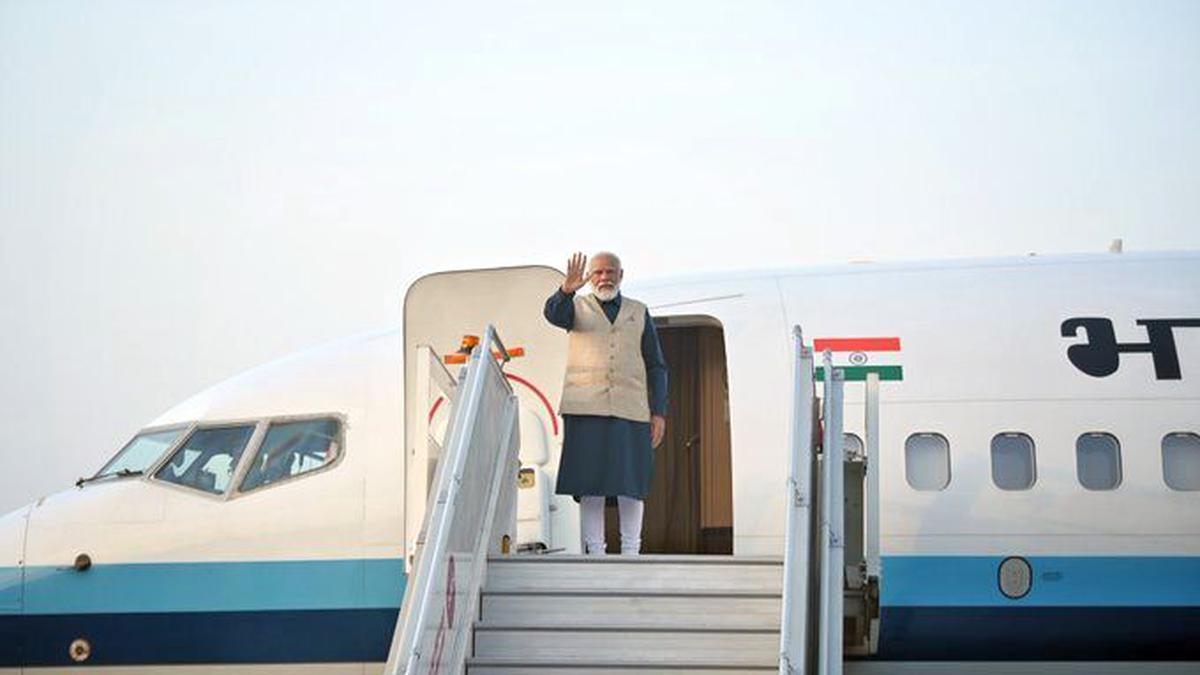
How Does Super El Nino Develop?

Super El Nino develops when weakening Pacific trade winds allow warm surface water to move eastwards, triggering major changes in oceanic and atmospheric circulation.

  • Normally, easterly trade winds push warm surface water towards Indonesia and Australia.
  • Warm water accumulates in the western Pacific, while cold, nutrient-rich water rises near the eastern Pacific through upwelling.
  • When trade winds weaken, warm water moves towards the central and eastern Pacific. This raises sea-surface temperatures in the Nino regions and weakens normal upwelling.
  • The main zone of rising, moisture-laden air and rainfall shifts eastwards.
  • When these oceanic and atmospheric changes become exceptionally strong, the event is informally described as a Super El Nino.

Role of the Walker Circulation: The Walker Circulation is a large-scale east-west circulation of air over the tropical Pacific.

  • Under normal conditions, warm, moist air rises over the western Pacific and air sinks over the relatively cooler eastern Pacific.
  • During El Nino, warming in the central and eastern Pacific shifts the main zone of rising air eastwards.
  • This alters atmospheric pressure, winds and rainfall patterns across the tropics.

These changes can influence distant regions through teleconnections.

Super El Nino Historical Events

Only a few El Nino events have reached exceptionally strong levels in the modern instrumental record.

  • 1982-83: One of the strongest El Nino events of the 20th century, associated with major disruptions in global rainfall and temperature patterns.
  • 1997-98: A particularly powerful event associated with widespread floods, droughts, heatwaves and disruptions to agriculture and marine ecosystems.
  • 2015-16: One of the strongest El Nino events on record, associated with severe drought conditions in several parts of Asia and exceptionally high global temperatures.

These events show that the impact of Super El Nino depends not only on its intensity but also on its interaction with other climate drivers and regional weather systems.

Super El Nino Impact on Global Climate

The impact of Super El Nino on global climate is significant because it disrupts normal atmospheric circulation and produces contrasting weather conditions across different regions.

  • Extreme heat: It can add natural warming to the atmosphere and intensify heatwaves. The 2015-16 El Nino contributed to exceptionally high global temperatures.
  • Drought: It can suppress rainfall in some regions, increasing the risk of water shortages and agricultural losses. Australia and parts of Southeast Asia, for instance, often face increased drought risk during El Nino events.
  • Heavy rainfall and floods: Altered atmospheric circulation can produce excessive rainfall and flooding in other regions, including parts of South America.
  • Agriculture and food security: Erratic rainfall and extreme temperatures can reduce crop yields and increase food-price pressures.
  • Marine ecosystems: Reduced upwelling of nutrient-rich water near the coasts of Peru and Ecuador can affect fisheries.
  • Coral bleaching: Warmer ocean temperatures can increase stress on coral ecosystems.
  • Water security: Drought can reduce river flows, groundwater recharge and reservoir levels, while intense rainfall can damage infrastructure.

Thus, the same Super El Nino event can produce drought in one region and excessive rainfall in another

Super El Nino Impact on India

The primary impact of Super El Nino on India is an increased likelihood of a weaker and more uneven southwest monsoon. However, the actual outcome depends on the interaction between El Nino, the Indian Ocean Dipole and regional weather systems.

  • El Nino weakens the large-scale atmospheric circulation that supports the Indian summer monsoon, reducing moisture transport towards the Indian subcontinent.
  • Its influence is generally stronger during the latter half of the monsoon season, making July-September more vulnerable than the onset phase in June.
  • The greatest concern is often not merely lower seasonal rainfall but its uneven spatial and temporal distribution, with prolonged dry spells proving more damaging than moderate rainfall deficits.
  • Delayed rainfall and long breaks in the monsoon can adversely affect kharif sowing, crop growth and agricultural productivity, particularly in rain-fed regions.
  • Reduced rainfall lowers reservoir storage, groundwater recharge and hydroelectric generation while increasing the risk of heatwaves and agricultural stress.
  • Lower agricultural production may create supply shortages and contribute to food inflation.
  • Since 1950, nearly three-fifths of El Nino years have experienced below-normal monsoon rainfall, and several major drought years including 1972, 1982, 2009 and 2015 coincided with El Nino events.
  • Nevertheless, El Nino increases the probability of a weaker monsoon rather than guaranteeing drought across the entire country.

Why Doesn’t Every Super El Nino Cause Drought in India?

Although a Super El Nino increases the probability of a weaker southwest monsoon, it does not invariably lead to drought. The eventual monsoon outcome depends on the interaction between the Indian Ocean Dipole (IOD) and regional atmospheric systems.

  • A positive IOD, characterised by warmer waters in the western Indian Ocean than in the eastern Indian Ocean, enhances moisture transport towards India and can partly or substantially offset El Nino-induced rainfall suppression.
  • The 1997-98 Super El Nino is the best example, when a strongly positive IOD helped India receive about 2% above-normal monsoon rainfall despite one of the strongest El Nino events on record.
  • Conversely, a weak or neutral IOD provides little support against El Nino-induced monsoon weakening, increasing the likelihood of below-normal seasonal rainfall.

Why Can India Experience Cloud Cover and Heavy Rainfall Despite Super El Nino? 

El Nino primarily influences the seasonal probability of rainfall, whereas day-to-day weather is governed by regional atmospheric systems.

  • Low-pressure systems, upper-air cyclonic circulations and a favourable monsoon trough can transport abundant moisture from the Arabian Sea and the Bay of Bengal, leading to widespread cloud cover and rainfall.
  • Heat-driven convection and the interaction between Western Disturbances and monsoon winds can further enhance rainfall, particularly over northern and central India.

Consequently, episodes of widespread rainfall can occur even during a Super El Nino without contradicting the broader seasonal outlook.

However, short periods of heavy rainfall do not necessarily indicate monsoon recovery, as the overall performance of the monsoon depends on the June-September seasonal rainfall and its spatial and temporal distribution.

Super El Nino FAQs

Q1: What is Super El Nino?

Ans: Super El Nino is an informal term for an exceptionally strong El Nino event, generally associated with sea-surface temperature anomalies of around +2°C or more in the Niño 3.4 region, leading to significant global climatic impacts.

Q2: Why is Super El Nino called “Godzilla El Nino”?

Ans: “Godzilla El Nino” is an informal nickname for an exceptionally strong Super El Nino, reflecting its enormous scale and widespread global impacts. The term became popular during the 2015-16 Super El Nino, one of the strongest events on record, but it is not an official scientific classification.

Q3: How does Super El Nino affect India?

Ans: Super El Nino increases the likelihood of a weaker and more uneven southwest monsoon, raising the risk of prolonged dry spells, agricultural stress, water scarcity and heatwaves.

Q4: Why does Super El Nino not always cause drought in India?

Ans: A positive Indian Ocean Dipole (IOD) and favourable regional weather systems can offset El Nino’s drying effect, allowing India to receive normal or even above-normal rainfall.

Q5: Can India experience heavy rainfall during a Super El Nino?

Ans: Yes. Super El Nino influences seasonal rainfall, while day-to-day rainfall is driven by low-pressure systems, cyclonic circulations, the monsoon trough and Western Disturbances, which can produce widespread rainfall.

National Judicial Appointments Commission (NJAC), Compositions, Functions

National Judicial Appointments Commission

The National Judicial Appointments Commission (NJAC) was introduced as a constitutional body to reform the existing collegium system for appointing judges to the Supreme Court and High Courts. It aimed to make the process more transparent, participatory, and accountable. 

However, the Supreme Court struck it down in 2015, restoring the collegium system. For UPSC aspirants, understanding NJAC’s provisions, composition, issues, and the judicial review that followed is essential for Polity, Governance, and current affairs.

National Judicial Appointments Commission (NJAC) and 99th Constitutional Amendment Act 2014

The 99th Constitutional Amendment Act 2014 established the National Judicial Appointments Commission (NJAC) as an independent constitutional body designed to replace the existing collegium system. Its purpose was to introduce a more transparent, broad-based, and accountable mechanism for appointing judges to the Supreme Court and High Courts in India. Through this Act, Articles 124A, 124B, and 124C were inserted into the Constitution, formally establishing the NJAC as a constitutional body responsible for recommending appointments and transfers of judges to the Supreme Court and High Courts.

  • Created a six-member constitutional body called the NJAC to oversee appointments of judges to the Supreme Court and High Courts.
  • Replaced the collegium system, which was previously responsible for judicial appointments.
  • Inserted Articles 124A to 124C, defining the NJAC’s composition, powers, and procedures.
  • Provided for the inclusion of two eminent persons, the Law Minister, and senior judges to ensure broader participation.
  • Aimed to promote transparency, accountability, and checks and balances in the judicial appointment process.

Judicial Appointments Constitutional Provisions

Judicial appointments in India are governed by Articles 124, 217, and 222 of the Constitution. These provisions outline how Supreme Court and High Court judges are appointed and transferred.

  • Article 124 - Deals with the appointment of Supreme Court judges, including the Chief Justice of India.
  • Article 217 - Provides for the appointment of High Court judges.
  • Article 222 - Allows for the transfer of High Court judges by the President after consultation with the CJI.
  • Article 368 - Amended to add the NJAC through the 99th Constitutional Amendment Act, 2014.
  • Article 124A-124C - Inserted to establish NJAC and define its composition and powers.

National Judicial Appointments Commission (NJAC) Composition

The National Judicial Appointments Commission (NJAC) was envisioned as a six-member constitutional body combining judicial, executive, and independent voices. This structure was designed to diversify decision-making authority so that no single institution could dominate. The inclusion of eminent persons was meant to represent civil society and reduce insularity in judicial appointments.

National Judicial Appointments Commission (NJAC) Composition
Member Details Nature

Chief Justice of India (Chairperson)

Sitting CJI

Ex-officio

Two senior-most Supreme Court judges

Next two senior judges after CJI

Ex-officio

Union Law Minister

Cabinet Minister responsible for law

Executive Member

Two Eminent Persons

Selected by a panel consisting of PM, CJI, and Leader of Opposition

Independent

Selection of Eminent Persons

  • Chosen by a 3-member committee: PM, CJI, and Leader of Opposition.
  • At least one should belong to SC/ST/OBC/minority community or be a woman.
  • Tenure: 3 years, with no reappointment.
  • Aimed to represent diversity and improve accountability.

National Judicial Appointments Commission (NJAC) Functions

The National Judicial Appointments Commission (NJAC) was empowered to handle the entire framework of judicial appointments and transfers. It would recommend appointments to the President and ensure that judges were selected based on merit, integrity, and suitability.

  • Recommend appointments of the Chief Justice of India, Supreme Court judges, Chief Justices of High Courts, and High Court judges.
  • Evaluate candidates based on merit, seniority, judicial experience, legal expertise, and integrity.
  • Recommend transfers of High Court judges after considering administrative and functional needs.
  • Collect and examine background information through consultations with state authorities, bar associations, and other stakeholders.
  • Ensure transparency by establishing criteria, procedures, and timelines for judicial appointments.

Reason for the National Judicial Appointments Commission (NJAC) Struck Down

In the landmark judgment Supreme Court Advocates-on-Record Association v. Union of India (2015), a 4:1 majority of the Supreme Court struck down the NJAC and the 99th Constitutional Amendment, 2014 as unconstitutional. The Court held that the judiciary must remain independent to protect fundamental rights, and any change that substantially reduces judicial primacy violates the basic structure doctrine.

  • Judicial Independence Undermined: Inclusion of the Law Minister and eminent persons meant external influence over judicial appointments, compromising independence.
  • Basic Structure Violation: Judicial independence is a core aspect of the Constitution’s basic structure, and any amendment weakening it is invalid.
  • Two-Member Veto Problem: The provision allowing any two NJAC members to block a recommendation risked creating deadlocks and giving excessive control to non-judicial members.
  • Executive Overreach Concerns: The government’s involvement in selecting eminent persons created possibilities of political interference.
  • Ambiguity in Criteria: Lack of clear qualifications for eminent persons created space for arbitrary or politically motivated selection.

Issues With National Judicial Appointments Commission (NJAC)

While National Judicial Appointments Commission (NJAC) attempted to democratize the process, several concerns emerged around its composition and mechanism. Critics argued that NJAC reintroduced executive influence, which the judiciary had gradually reduced to preserve its autonomy.

  • Potential Loss of Judicial Primacy: Judicial control over appointments would reduce significantly with the inclusion of executives and non-judicial members.
  • Risk of Political Influence: Since eminent persons were indirectly appointed with government participation, political biases could enter the system.
  • Veto Provision Problem: The two-member veto could stall appointments unnecessarily, leading to delays and vacancies in courts.
  • Broad and Ambiguous Criteria: The term "eminent person" lacked specificity, risking appointment of individuals without legal expertise.
  • Structural Imbalance: Equal representation of judiciary, executive, and others could dilute the core principle of an independent judiciary.

National Judicial Appointments Commission (NJAC) Way Forward

Even though NJAC was struck down, the debate on judicial reforms continues. The Supreme Court itself acknowledged the need to improve the collegium system. There is growing consensus that reforms should enhance transparency, accountability, and efficiency while protecting judicial independence.

Proposed Reforms

  • Transparent Collegium Procedure: Publish criteria, minutes, and reasons for appointment decisions to improve public trust.
  • Independent Secretariat: Establish a professional secretariat to conduct research, verify credentials, and manage documentation for judicial appointments.
  • Objective Evaluation Metrics: Use standardized parameters such as judgments delivered, legal expertise, integrity reports, and domain specialization.
  • Broader Consultation Mechanisms: Allow structured input from senior advocates, bar councils, and legal experts while keeping decision-making independent.
  • Increase Diversity: Ensure adequate representation of women, minorities, and marginalized sections in higher judiciary.
  • Periodic Review Mechanism: Introduce performance assessment frameworks before elevation from High Court to Supreme Court.

National Judicial Appointments Commission (NJAC) FAQs

Q1: What is the National Judicial Appointments Commission (NJAC)?

Ans: The NJAC was a six-member constitutional body established through the 99th Constitutional Amendment Act, 2014 to replace the collegium system for appointing judges to the Supreme Court and High Courts.

Q2: Why was the NJAC created?

Ans: The NJAC was created to address concerns regarding the collegium system, such as lack of transparency, limited accountability, and allegations of nepotism.

Q3: Which constitutional amendment introduced the NJAC?

Ans: The 99th Constitutional Amendment Act, 2014 introduced the NJAC and established Articles 124A, 124B, and 124C in the Constitution.

Q4: What was the composition of the NJAC?

Ans: The NJAC consisted of six members: Chief Justice of India (Chairperson), Two senior-most Supreme Court judges, Union Law Minister, and Two eminent persons chosen by a committee comprising the PM, CJI, and Leader of Opposition

Q5: What were the functions of the NJAC?

Ans: The NJAC was responsible for recommending appointments and transfers of Supreme Court and High Court judges. It also evaluated candidates based on merit, integrity, and suitability, ensuring a transparent selection process.

Tele-MANAS

Tele-MANAS

Tele-MANAS Latest News

India’s national mental health helpline, Tele-MANAS, has received nearly 48 lakh calls in four years.

About Tele-MANAS

  • Tele Mental Health Assistance and Networking Across States (Tele MANAS) offers a wide range of mental health services.
  • It was started by the Ministry of Health and Family Welfare in 2022.
  • Aim: To provide universal access to equitable, affordable, and quality mental health care through a 24x7 tele-mental health service, forming a key digital component of the National Mental Health Programme (NMHP).
  • This service is available across all Indian States and Union Territories, with assured linkages to ensure seamless care.
  • Objectives
    • Expanding Access: Scaling up the reach of mental health services nationwide, ensuring that anyone across India can access support at any time through dedicated 24x7 tele-mental health facilities in every State and Union Territory.
    • Building a Comprehensive Mental Health Network: Establishing an integrated system that goes beyond counseling by offering medical and psychosocial interventions, video consultations with specialists, e-prescriptions, follow-up care, and connections to in-person services.
    • Reaching Vulnerable Populations: Prioritizing mental health services for vulnerable and difficult-to-reach groups, ensuring no one is left without essential care.
  • The service is structured in a two-tier system to optimize care delivery and enhance support.
    • Tier 1: It comprises state Tele MANAS cells staffed with trained counsellors and mental health specialists. These professionals provide immediate support through: Tele-Counseling and Tele-Consultation.
    • Tier 2: It comprises specialists from District Mental Health Programme (DMHP) facilities and medical colleges, offering additional resources for physical consultations and audiovisual consultations via e-Sanjeevani.
  • Tele MANAS launched its mobile app and video consultation services to enhance access to mental health support.
  • This app serves as a comprehensive platform offering mental health resources, including self-care tips, stress management strategies, and tools to recognize early distress signals.
  • It is enhanced with Multi-lingual user interface, Chatbot feature (Asmi), Accessibility, Emergency Module. 
  • It will now be available in 10 regional languages, in addition to the English and Hindi languages
  • These languages include Assamese, Bengali, Gujarati, Kannada, Malayalam, Marathi, Tamil, Telugu, Odia, Punjabi.
  •  

Source: TOI

Tele-MANAS FAQs

Q1: What services are offered by Tele-MANAS?

Ans: It provides universal access to equitable, affordable, and quality mental health care through a 24x7 tele-mental health service.

Q2: Which ministry launched the Tele-MANAS?

Ans: Ministry of Health and Family Welfare

Daily Editorial Analysis 14 October 2026

Daily-Editorial-Analysis

Corporate Social Responsibility (CSR) - From Compliance to Developmental Impact

Context

  • India’s Corporate Social Responsibility (CSR) law has created a major source of private-sector development finance.
  • Since its introduction, the framework has mobilised substantial corporate funding for education, healthcare, livelihoods and other social priorities.
  • The next challenge is to move beyond expenditure-based compliance towards equitable distribution, strategic collaboration and measurable developmental outcomes.

CSR in India - Achievements and Significance

  • Legal framework: Under Section 135 of the Companies Act, 2013, eligible companies are required to spend at least 2% of their average net profits of the three immediately preceding financial years on CSR.
  • Applicability: Companies meeting any one of the following thresholds are covered - net worth of ₹500 crore or more, turnover of ₹1,000 crore or more, and net profit of ₹5 crore or more.
  • Resource mobilisation: India mobilised approximately ₹2.6 lakh crore in CSR funds over a decade. In 2024–25, annual expenditure reached ₹40,794 crore, with 29,500 companies supporting around 72,000 projects.
  • Developmental contribution: CSR has emerged as a significant source of supplementary funding for social development, demonstrating the potential of corporate participation in nation-building.

Key Challenges in CSR Implementation

  • Geographical concentration:

    • CSR funds tend to flow towards states with a greater concentration of corporate headquarters and industrial activity.
    • Maharashtra received ₹8,631 crore, Gujarat ₹4,549 crore, Karnataka ₹3,395 crore and Delhi ₹2,753 crore in 2024–25.
    • This concentration may leave regions with greater developmental deficits relatively underfunded.
    • Corporate location can become a stronger determinant of fund allocation than the actual needs of underserved communities.
  • Fragmentation of projects:

    • The large number of CSR projects reflects widespread corporate participation but may also result in fragmented, repetitive and short-term
    • Isolated projects may generate immediate benefits without addressing structural problems.
    • Lack of coordination can lead to duplication of efforts and underutilisation of collective resources.
    • The central question is whether individual projects collectively produce measurable improvements in development indicators.
  • Expenditure versus outcomes:

    • CSR accountability often focuses on the amount spent rather than the lasting change created.
    • Financial compliance alone cannot establish whether interventions have improved learning outcomes, healthcare access, livelihoods or community resilience.
    • Differences in project objectives and impact-assessment methods also make comparisons difficult.

Reforms for the Next Decade of CSR

  • Shift towards outcome-based accountability:

    • Supplement expenditure reporting with measurable output, outcome and impact indicators.
    • Standardise assessment methodologies to improve comparability, transparency and accountability.
    • Conduct credible impact evaluations to identify effective interventions and enable evidence-based decision-making.
  • Promote collaborative and long-term investments:

    • Encourage companies to pool funds and expertise around common development priorities and geographical areas.
    • Develop district-level or sector-specific interventions supported by shared objectives and results frameworks.
    • Move from scattered projects towards integrated programmes addressing systemic challenges in education, health, agriculture and livelihoods.
  • Align CSR with corporate competencies:

    • Companies should contribute not only financial resources but also their technical knowledge, professional networks and managerial expertise.
    • Agricultural and food-processing companies, for instance, can support farmer productivity, value-chain development and climate-resilient agriculture.
    • Such alignment can improve implementation quality, scalability and the long-term sustainability of interventions.
  • Ensure equitable and complementary development:

    • Give greater attention to underserved regions and communities with significant development gaps.
    • Use needs-based planning to complement corporate priorities with local development requirements.
    • Strengthen coordination with public institutions without allowing CSR to replace the government's primary responsibility for public expenditure and welfare delivery.

Conclusion:

  • India's CSR experiment has demonstrated that corporate regulation can mobilise substantial private capital for public good.
  • Its next phase must focus not merely on how much companies spend, but on how effectively their contributions improve people's lives.
  • India should build a strategic CSR ecosystem based on evidence, collaboration and long-term impact, complementing public expenditure, and strengthening inclusive development.
  • This will also demonstrate that corporate profitability and social responsibility can reinforce each other.

Corporate Social Responsibility (CSR) FAQs

Q1. How has CSR emerged as an instrument of inclusive development in India?

Ans. CSR mobilises private-sector resources for education, healthcare and livelihoods.

Q2. What are the major challenges associated with CSR fund allocation in India?

Ans. Geographical concentration, fragmented projects, duplication of efforts and inadequate outcome measurement.

Q3. Why should India shift from expenditure-based to outcome-based CSR accountability?

Ans. For measuring actual improvements in learning, healthcare and livelihoods rather than merely tracking expenditure.

Q4. How can corporate collaboration enhance the developmental impact of CSR initiatives?

Ans. Pooled funding, shared objectives and district-level interventions can reduce duplication.

Q5. How can aligning CSR activities with corporate competencies promote sustainable development?

Ans. By improving project efficiency, scalability and sustainability while aligning business strengths with societal needs.

Source: IE


India-U.S. Ties and The Hurdle of American Unilateralism

Context

  • India-US ties are facing intense scrutiny following the US’s recent announcement suspending the Permanent Labour Certification (PERM) programme for eight global IT companies — including Indian-headquartered firms: Infosys, Tata Consultancy Services (TCS), Wipro, Cognizant, and HCL.
  • Washington accused these companies of misusing immigration and labour-certification systems.
  • In this context, this article argues this episode is not isolated, but part of a broader pattern of American pressure and unilateralism that India must now firmly resist.

The PERM Suspension: What Happened

  • PERM allows tech companies to hire non-US professionals, serving as a step toward employer-sponsored green cards.
  • As per the US government, the named companies had received over 2,30,000 H-1B visa approvals and more than 1,00,000 permanent labour certifications since 2009.
  • Indian professionals account for over 70% of approved H-1B petitions annually — making this suspension disproportionately impactful for India.
  • This follows a broader pattern of ill-treatment and racist incidents against Indians in the US, straining bilateral relations further.

Trade Ties: A Visible Source of Discord

  • Three key friction points define the trade relationship:
    • Trade Surplus Imbalance: India recorded a $33.8 billion trade surplus in bilateral trade exceeding $140 billion in FY 2025-26.
    • Agricultural Market Access: The US seeks entry into India’s dairy and agriculture sectors — a politically sensitive concession India cannot afford to make.
    • Russian Oil Imports: India has refused to halt these despite additional US tariffs and sanctions.
  • Despite a February 2026 framework for an interim reciprocal trade agreement, tensions persist.
  • Finance Minister Nirmala Sitharaman recently noted that trade negotiations have “plateaued,” with little room for compromise.

Defence Cooperation: Agreements Without Delivery

  • Defence has been a key pillar of the relationship, but the critics argue its substance lags its symbolism:
    • Since 2002, India has acquired over $22 billion worth of American military hardware — yet meaningful co-production and technology transfer remain elusive.
    • During PM Modi’s February 2025 Washington visit, the US agreed to expand defence sales/co-production, including Javelin anti-tank guided missiles and Stryker infantry combat vehicles.
    • The two nations signed a 10-year Framework for the US-India Major Defence Partnership in October 2025.
    • However, prolonged delays in supplying GE F404 engines for India’s Tejas fighter aircraft expose the risks of foreign supply-chain dependence.
    • Despite the India-US Defence Acceleration Ecosystem (INDUS-X) (launched 2023), real co-development and tech transfer remain limited.

The Pakistan Factor

  • Pakistan remains a politically sensitive irritant:
    • Since Operation Sindoor (May 2025), President Trump’s repeated claims of having “ended” the India-Pakistan conflict have irked India, though New Delhi has avoided direct confrontation.
    • The US’s courting of Pakistan’s military leadership, particularly Chief of Defence Forces Asim Munir, is a major concern.
    • The Mecca Pact between Saudi Arabia, Pakistan, and Türkiye — reportedly backed by Washington — has raised further security concerns for India.

Technology Cooperation: Promises on Paper

  • The 2008 India-US civil nuclear agreement was historic, but its promise of American-designed nuclear reactors in India remains largely unrealised.
  • The Initiative on Critical and Emerging Technology (iCET) (launched 2023) aimed to deepen cooperation in AI, semiconductors, defence innovation, and space — but much remains undelivered.
  • The India-US TRUST Initiative (Transforming the Relationship Utilizing Strategic Technology), signed in February 2025, similarly raised hopes that remain largely unfulfilled.
  • Core challenge: Translating declarations into measurable outcomes.

The Core Argument: Need for Mutual Respect

  • India-US relations are entering a phase where India’s strategic restraint and accommodation are increasingly met with American pressure, unilateralism, and disregard for India’s interests.
  • Analysts argue that ties between “the world’s oldest democracy and the world’s largest democracy” can only flourish through equality, respect, and trust — not unilateral imposition of will.
  • EAM S. Jaishankar’s observation that the US is “deliberately becoming a lonelier power” is cited as potentially carrying deeper significance about shifting global alignments.

Conclusion

  • The PERM suspension is less a standalone dispute than a symptom of a deeper pattern — one where repeated US actions on trade, defence, Pakistan, and technology reveal a transactional, often one-sided approach to a relationship both sides call strategic.
  • For India, the message is clear: genuine partnership cannot be built on accommodation alone.
  • As New Delhi navigates this phase, its challenge will be converting strategic restraint into strategic leverage, ensuring that mutual respect — not unilateral pressure — defines the terms of engagement going forward.

India-U.S. Ties and The Hurdle of American Unilateralism FAQs

Q1. What is the PERM programme, and why is its suspension significant for India?

Ans. The PERM programme enables companies to hire non-U.S. professionals through employer-sponsored green cards. Its suspension disproportionately affects India because Indians dominate approved H-1B petitions.

Q2. What are the major sources of trade friction between India and the United States?

Ans. Trade friction centres on India’s bilateral trade surplus, U.S. demands for agricultural and dairy market access, and India’s continued imports of Russian oil.

Q3. Why has defence cooperation between India and the United States faced criticism?

Ans. Despite substantial Indian purchases of American military hardware, delays in supplying GE F404 engines and limited technology transfer have constrained meaningful co-production and collaboration.

Q4. Why does U.S. engagement with Pakistan concern India?

Ans. India remains concerned about Washington’s engagement with Pakistan’s military leadership and reported backing for the Saudi Arabia–Pakistan–Türkiye Mecca Pact following Operation Sindoor.

Q5. What approach should India adopt to strengthen its relationship with the United States?

Ans. India should convert strategic restraint into strategic leverage, demanding reciprocal commitments and ensuring equality, mutual respect and tangible outcomes across trade, defence and technology cooperation.

Source: TH

Daily Editorial Analysis 2026 FAQs

Q1: What is editorial analysis?

Ans: Editorial analysis is the critical examination and interpretation of newspaper editorials to extract key insights, arguments, and perspectives relevant to UPSC preparation.

Q2: What is an editorial analyst?

Ans: An editorial analyst is someone who studies and breaks down editorials to highlight their relevance, structure, and usefulness for competitive exams like the UPSC.

Q3: What is an editorial for UPSC?

Ans: For UPSC, an editorial refers to opinion-based articles in reputed newspapers that provide analysis on current affairs, governance, policy, and socio-economic issues.

Q4: What are the sources of UPSC Editorial Analysis?

Ans: Key sources include editorials from The Hindu and Indian Express.

Q5: Can Editorial Analysis help in Mains Answer Writing?

Ans: Yes, editorial analysis enhances content quality, analytical depth, and structure in Mains answer writing.

UNICEF Foundation Day 2025, History, Significance, Theme

UNICEF Foundation Day 2025

UNICEF Foundation Day is observed on 11th December every year, 2025 being the 79th anniversary year of the United Nations Children Fund. UNICEF has been known to be the global organisation, always in the front protecting the rights of children worldwide. The organisation has made various contributions for reducing child mortality, improving education and supporting underprivileged communities. This article will look into the remarkable contributions of UNICEF Organisation, its functions and significance. 

UNICEF Foundation Day 2025

UNICEF Foundation Day 2025 spreads awareness on the importance of supporting unprivileged communities and children. 

UNICEF Foundation Day 2025 Overview

Organisation

United Nations Children’s Fund

Previous Name

United Nations International Children’s Emergency Fund

Date

December 11, 2025

Anniversary

79th Anniversary

Headquarters

New York City, USA

Tagline

For every child

Primary Functions

Promoting child health, supporting education, providing vaccinations, and protecting children from abuse and exploitation.

Key Campaigns

Fair Start, Champions for Children, Early Moments Matter

UNICEF Full Form

UNICEF Full Form is the United Nations International Children Emergency Fund. The name was changed to United Nations Children’s Fund in 1953. 

What is UNICEF?

UNICEF is an organisation established by the United Nations in 1946 which works on humanitarian grounds to provide emergency assistance to children belonging to underprivileged communities. Currently, UNICEF is working in over 190 countries around the globe and focusing of the following areas and issues: 

  • Focus on Children Health: Includes healthcare facilities, nutrition programmes and proper immunisation resources. 
  • Education: Ensuring Gender Equality along with universal education.
  • Child protection: protection of children against child labor, exploitation and trafficking. 
  • Emergency relief fund: UNICEF provides resources to areas that get affected by natural disasters. 

UNICEF History

The UN General Assembly established UNICEF on 11th December 1946. It started its operation as an agency who was providing food, clothing and healthcare to people in Europe affected by World War II. 

Over the years, UNICEF has been collaborating with governments, NGOs and private institutions to work on child welfare programmes. In 1953, UNICEF was declared a permanent organisation of the UN system and in 1956 it gained the Nobel Peace Prize for working for children worldwide. 

UNICEF Headquarters 

UNICEF Headquarters are set in New York City, United States. All the activities ongoing in over 190 countries are coordinated from the central office in New York. Following are the main headquarters of UNICEF Office around the globe: 

  • Global Shared Services Centre, Budapest, Hungary
  • Private Fundraising and Partnerships, Geneva, Switzerland
  • Supply Division, Copenhagen, Denmark
  • Office of Research – Innocenti, Florence, Italy
  • Brussels Office, Belgium
  • Office for Japan, Tokyo, Japan
  • Seoul Office, Republic of Korea 

Functions of UNICEF

UNICEF has a very broad role in ensuring the right care and resources are reached to children. Their responsibilities include: 

  • Eradicating diseases like Polio and Measles by conducting immunisation programs. 
  • Promoting education equality by building schools, providing books and human resources
  • Supporting feeding programs by tackling malnutrition. 
  • Ensure drinking water facility and clean sanitation. 
  • Providing support and supplies to the countries impacted from natural disasters and pandemics.

Importance of UNICEF

UNICEF has always played a very important role in improving the living conditions of children around the globe: 

  • Improving the living conditions of girl childs and their health.
  • Providing aid to natural disasters and calamities stuck countries.
  • Providing education to all 
  • Immunisation and vaccination programmes.

UNICEF Foundation Day 2025 FAQs

Q1: What is the theme for UNICEF Foundation Day 2025?

Ans: The theme for 2025 is "My Day, My Rights".

Q2: What is the 75 years of UNICEF?

Ans: UNICEF celebrated its 75th anniversary in December 2021, marking its legacy of serving children's rights and welfare globally.

Q3: Where is the headquarter of UNICEF?

Ans: UNICEF's headquarters is located in New York City, USA.

Q4: Who declared Universal Children's Day?

Ans: Universal Children's Day was declared by the United Nations General Assembly in 1954.

Q5: Who is the founder of UNICEF?

Ans: UNICEF was founded by Ludwik Rajchman in 1946 to address the needs of children in countries affected by World War II.

Bhutan-India Bilateral Relation

Indian-Bhutan Relations

What’s in Today’s Article?

  • Why in the News?
  • India – Bhutan Bilateral Relationship
  • Trade & Economic Ties
  • Cultural & Buddhist Links
  • Hydropower Cooperation
  • New Areas of Cooperation
  • Indians Working in Bhutan
  • Educational, Cultural Cooperation and People-to-People Exchanges

Why in the News?

Prime Minister Narendra Modi on March 22, 2024, arrived in Paro, Bhutan for a 24-hour State visit.

India – Bhutan Bilateral Relationship

  • India and Bhutan share unique and exemplary bilateral relations, which are based on mutual trust, goodwill and understanding.
  • Formal diplomatic relations between India and Bhutan were established in 1968.
  • The basic framework of India-Bhutan relations is the Treaty of Friendship and Cooperation signed in 1949 between the two countries, which was renewed in 2007.

Trade & Economic Ties

  • The India-Bhutan Agreement on Trade, Commerce and Transit – was first signed in 1972.
  • The agreement establishes a free trade regime between the two countries.
  • India is Bhutan’s top trade partner both as an import source and as an export destination.
  • Since 2014, India’s merchandise trade with Bhutan has almost tripled from USD 484 million in 2014-15 to USD 1422 million in 2021-22.
    • It accounting for about 80% of Bhutan’s overall trade, with the balance of trade in India’s favour.

Cultural & Buddhist Links

  • A number of Bhutanese pilgrims travel to Bodh Gaya, Rajgir, Nalanda, Sikkim, Udayagiri, and other Buddhist sites in India.
  • As a part of the 50th anniversary celebration of diplomatic relations, GOI sponsored a visit by 18 Lam Netens (Buddhist monks) and representative of the Central Monastic Body of Bhutan to India.

Hydropower Cooperation

  • Mutually beneficial hydro-power cooperation with Bhutan is a key pillar of bilateral economic cooperation.
  • For Bhutan, hydro-power development continues to be a vital catalyst for socio-economic development.
  • Revenues from Hydropower constitutes a significant portion of the total revenues of the Royal Government of Bhutan.
  • The ongoing cooperation between India and Bhutan in hydro-power sector is covered under the 2006 bilateral agreement for cooperation and its Protocol signed in 2009.
  • Four hydro-electric projects (HEPs) totalling 2136 MW are already operational in Bhutan and are supplying electricity to India.
  • The 720 MW Mangdechhu was commissioned in August 2019 and handed over to Bhutan in December 2022.

New Areas of Cooperation

  • Apart from hydro-power cooperation and development partnership has moved into new and emerging areas with full interoperability of the flagship digital project RuPay, which has been successfully completed.
  • Bhutan became the second country to launch the BHIM app, further deepening the financial linkages between our two countries.
  • Space cooperation is a new and promising area of bilateral cooperation.
  • The India-Bhutan SAT was launched into space in November 2022 by ISRO's Polar Satellite Launch Vehicle (PSLV).
  • Inauguration of Ground Earth Station during visit of Chairman, ISRO also took place in March 2023.

Indians Working in Bhutan

  • About 50,000 Indian citizens are working in Bhutan, mainly in the construction sector, education and technical consultants involved in infrastructure projects.
  • Some Indian daily-workers also enter and exit Bhutan every day in the border towns, as a sign of the close economic interdependence between both countries.

Educational, Cultural Cooperation and People-to-People Exchanges

  • There is close bilateral cooperation in the educational and cultural fields between India and Bhutan.
  • Over 950 scholarships are being provided annually by GoI for Bhutanese students to study in India in a wide range of disciplines including medicine, engineering, etc.
  • It is estimated that approximately 4,000 Bhutanese are studying in undergraduate courses in Indian Universities on self-finance basis.
  • Under the Nehru Wangchuck Scholarship Scheme since its inception in 2010, 8 slots are annually allotted to students and scholars from Bhutan.
  • 20 slots are provided every year to students from Bhutan under the ICCR Scholarship.

PM Modi's State Visit to Bhutan

  • Prime Minister Narendra Modi on March 22, 2024, arrived in Paro, Bhutan for a 24-hour State visit.
  • PM Modi will receive Bhutan’s highest civilian award, the Order of the Druk Gyalpo.
  • This is PM Modi’s first visit since the award was announced in 2021, which will be presented Bhutan’s King Jigme Khesar Namgyel Wangchuck, in appreciation for his efforts towards strengthening India-Bhutan ties.

Q1) What do you mean by Chicken’s Neck in terms of India’s geographical area?

The Siliguri Corridor, also known as the Chicken's Neck, is a stretch of land around the city of Siliguri in West Bengal, India. 20–22 kilometers (12–14 mi) at the narrowest section, this geo-political and geo-economic corridor connects the seven states of northeast India to the rest of the country.

Q2) Where is Doklam located?

Doklam is an area with a plateau and a valley which lies on the Bhutan-China border, near India.


Source: PM Modi arrives in Paro, to receive Bhutan’s highest civilian award | MEA

Line of Actual Control (LAC)

Line of Actual Control (LAC)

What’s in Today’s Article?

  • Why in News?
  • What is the Line of Actual Control (LAC)?
  • LAC vs Line of Control (LoC) with Pakistan
  • Disagreement over the LAC
  • Why are these Claim Lines Controversial in Ladakh?
  • Current Arrangement to Reconcile Differences over LAC
  • The Plans for Expeditious De-escalation along the LAC in Eastern Ladakh
  • Legacy Issues that Need to be Resolved

Why in News?

  • The Indian PM and Chinese President agreed on the sidelines of the 15th BRICS Summit to intensify efforts for expeditious disengagement and de-escalation along the LAC in eastern Ladakh.
  • With this, the spotlight is now on the exact contours of plans being drawn up by military commanders on the ground to pull back troops.

What is the Line of Actual Control (LAC)?

  • The LAC is the demarcation that separates Indian-controlled territory from Chinese-controlled territory.
  • It is divided into three sectors: the eastern sector which spans Arunachal Pradesh and Sikkim, the middle sector in Uttarakhand and Himachal Pradesh, and the western sector in Ladakh.
  • India considers the LAC to be 3,488 km long, while the Chinese consider it to be only around 2,000 km.
  • India’s claim line is the line seen in the official boundary marked on the maps as released by the Survey of India, including both Aksai Chin and Gilgit-Baltistan. This means LAC is not the claim line for India.
  • In China’s case, LAC is the claim line except in the eastern sector, where it claims the entire Arunachal Pradesh as South Tibet.

LAC vs Line of Control (LoC) with Pakistan:

  • The LoC emerged from the 1948 ceasefire line negotiated by the UN after the Kashmir War.
  • It was designated as the LoC in 1972, following the Shimla Agreement between the two countries (India and Pakistan).
  • It is delineated on a map signed by DGMOs of both armies and has the international sanctity of a legal agreement.
  • On the other hand, the LAC is only a concept. It is not agreed upon by the two countries, neither delineated on a map or demarcated on the ground.

Disagreement over the LAC:

  • The major disagreements are in the western sector where the LAC emerged from two letters written by Chinese PM Zhou Enlai to PM Jawaharlal Nehru in 1959, after he had first mentioned such a ‘line’ in 1956.
  • After the 1962 War, the Chinese claimed they had withdrawn to 20 km behind the LAC of 1959, which coincides with the so-called McMahon Line in the eastern sector.
  • India’s Response to China’s Designation of the LAC:
    • India rejected the concept of LAC in both 1959 and 1962, as it is the line China has created.
    • The Chinese line was a disconnected series of points on a map that could be joined up in many ways.
    • The line should omit gains from aggression in 1962 and therefore should be based on the actual position on September 8, 1962 before the Chinese attack.
    • This vagueness of the Chinese definition left it open for China to continue its creeping attempt to change facts on the ground by military force.
    • During the Doklam crisis in 2017, the Chinese Foreign Ministry spokesperson urged India to abide by the “1959 LAC”.

Why are these Claim Lines Controversial in Ladakh?

  • Aksai Chin in Ladakh province of the princely state of J&K was not part of British India, although it was a part of the British Empire.
  • Thus, the eastern boundary was well defined in 1914 (when the Shimla Agreement on the McMahon Line was signed by British India) but in the west in Ladakh, it was not.

Current Arrangement to Reconcile Differences over LAC:

  • India formally accepted the concept of the LAC when the Indian PM paid a return visit to Beijing in 1993 (after Chinese Premier Li Peng’s 1991 visit to India).
    • The two sides signed the Agreement to Maintain Peace and Tranquility at the LAC.
  • The reference to the LAC was unable to make it clear that it was referring to the LAC at the time the agreement was signed, not the LAC of 1959 or 1962.
  • To reconcile the differences about some areas, the two countries agreed that the Joint Working Group on the border issue would take up the task of clarifying the alignment of the LAC.

The Plans for Expeditious De-escalation along the LAC in Eastern Ladakh:

  • The extent of disengagement and where on the LAC it will take place is not immediately clear.
  • However, various modalities have been prepared for possible limited disengagement in phases.
  • For example, since 2020, Corps Commanders of India and China have been discussing resolution of the flashpoints along the LAC.
    • The talks led to some forward movement with both sides deciding to pull back troops and dismantle temporary structures from the Galwan Valley.
  • Disengagement in most of these areas led to the creation of buffer zones - this stops troops of both sides from accessing areas which they patrolled earlier.

Legacy Issues that Need to be Resolved:

  • Other than these friction points, the legacy issues of Depsang Plains and Demchok - which predate the 2020 incursions by the Chinese PLA - continue to fester.
  • The Depsang Plains are located close to the strategically important Daulat Beg Oldie. The Depsang Plains issue began in 2013 when China carried out an 18-km incursion in the area.
    • Despite the two countries agreeing then to go back from their positions, the PLA troops did not vacate the area completely.
  • In Demchok, which is in the southern part of eastern Ladakh, the problem is mainly at the ChardingNinglung Nullah (CNN) junction.
    • In multiple instances, the PLA also stopped Indian graziers at the Saddle Pass at the CNN junction, well within India’s perception of the LAC.

Q1) Who are the new entrants to the BRICS grouping?

Argentina, Egypt, Ethiopia, Iran, Saudi Arabia and the United Arab Emirates have all been invited to become members of BRICS at the 15th BRICS Summit in Johannesburg, South Africa.

Q2) Where is Doklam located?

Doklam plateau is an area in Bhutan, located on the tri-junction of Tibet-Bhutan-India border lies between Chumbi Valley in the north and Sikkim to the west. In 2017, a military standoff occurred between China and India, as China attempted to extend a road on the Doklam plateau.


Source: India-China LAC | Buffer zones to Depsang to Demchok: Spotlight on pullback plan, the extent | IE

Enquire Now