65th ITBP Raising Day 2026, History, Indo-Tibetan Border Police

ITBP Raising Day 2026

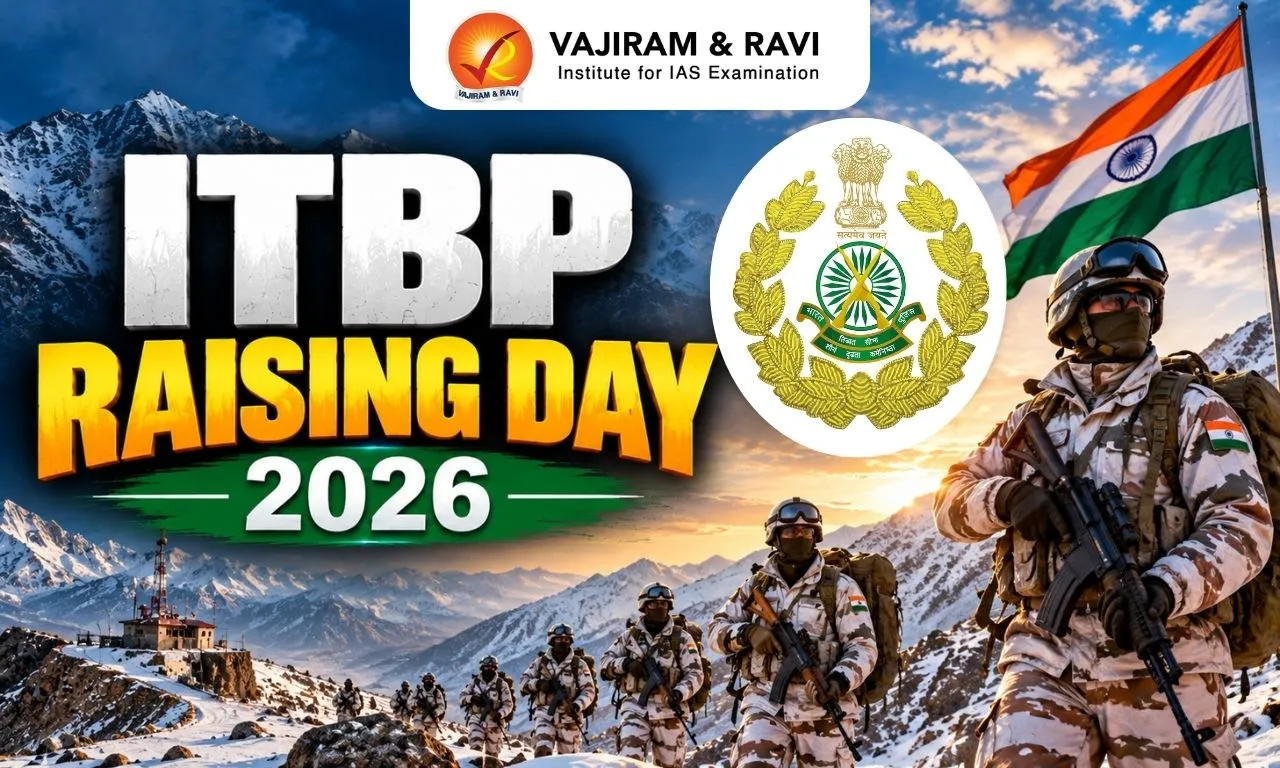
ITBP Raising Day 2026 is observed on October 24 to honour the courage, dedication and sacrifices of the Indo-Tibetan Border Police personnel, known as Himveers. The force marks its 65th Indo-Tibetan Border Police Raising Day 2026, commemorating its establishment in 1962 following the India-China War. The occasion recognises its contribution to border security, internal security, disaster response and humanitarian assistance. Senior national leaders have extended greetings to ITBP personnel and their families, acknowledging their selfless service to the nation.

ITBP Raising Day 2026

ITBP Raising Day 2026 marks 65 years of service by the Indo-Tibetan Border Police in protecting India's Himalayan frontiers and supporting national security. The Date of the occasion is October 24, 2026, and the main Event was held at the Central Training College (CTC) in Alwar, Rajasthan, featuring a special Director General's parade. The celebration honours the bravery of Himveers, remembers personnel who sacrificed their lives and recognises their commitment to duty in extreme climatic conditions.

ITBP Raising Day History

Indo-Tibetan Border Police (ITBP) was established on October 24, 1962, following the India-China War to strengthen border security and address challenges along the Himalayan frontier.

  • Formation in 1962: The Indo-Tibetan Border Police was raised after the India-China War to strengthen security along the India-China border and develop specialised capabilities for high altitude operations.
  • Border responsibility in 2004: Under the One Border One Force approach, ITBP was assigned the entire 3,488 kilometre India-China border, stretching from Karakoram Pass in Ladakh to Jachep La in Arunachal Pradesh.
  • Expansion of responsibilities: The force took over border guarding duties from Assam Rifles in Sikkim and Arunachal Pradesh, strengthening its role along India's Himalayan frontier.
  • Annual observance: ITBP Raising Day is observed every year on October 24 to recognise the force's service, operational achievements and sacrifices in protecting the country.

ITBP Raising Day 2026 Events and Highlights

The ITBP Raising Day 2026 celebration highlighted the force's achievements, honoured its personnel and recognised their contribution to India's security and disaster response.

  • 65th ITBP Raising Day 2026 celebration: October 24, 2026, marks the 65th Raising Day of ITBP, commemorating its establishment in 1962 and decades of service along India's Himalayan borders.
  • Main event and venue: The main ceremonial event was held at the Central Training College (CTC) in Alwar, Rajasthan, featuring a special Director General's parade.
  • Greetings from national leaders: Prime Minister Narendra Modi, Defence Minister Rajnath Singh, Home Minister Amit Shah and Vice President C. P. Radhakrishnan extended greetings to ITBP personnel and their families.
  • Tribute to Himveers: Leaders praised the courage, resilience and professionalism of ITBP personnel, particularly their ability to guard remote border outposts in freezing temperatures and difficult terrain.
  • Homage to martyrs: Home Minister Amit Shah paid tribute to personnel who made the supreme sacrifice in the service of the nation, recognising their contribution to national security.
  • Recognition of wider duties: The occasion also highlighted ITBP's role in internal security operations, disaster relief, search and rescue missions and humanitarian assistance in challenging regions.

What is ITBP?

The Indo-Tibetan Border Police is a Central Armed Police Force under the Ministry of Home Affairs, specialising in high altitude border security and emergency response.

  • Full form of ITBP: ITBP stands for Indo-Tibetan Border Police, a specialised force responsible for guarding India's Himalayan frontier and undertaking other security assignments.
  • Raising date: ITBP was established on October 24, 1962, following the India-China War. Its Raising Day is observed annually on the same date.
  • Motto of ITBP: The force's motto is “Shaurya, Dridhata, Karmanishtha”, which means valour, steadfastness and dedication to duty. It reflects the principles guiding its personnel.
  • Nickname of personnel: ITBP personnel are popularly known as Himveers, reflecting their service and resilience while protecting India's high altitude Himalayan borders.
  • Border security responsibility: ITBP guards approximately 3,488 kilometres of the India-China Border along the Line of Actual Control, from Karakoram Pass in Ladakh to Jachep La in Arunachal Pradesh.
  • Areas of deployment: The force operates across Ladakh and Jammu and Kashmir, Himachal Pradesh, Uttarakhand, Sikkim and Arunachal Pradesh, covering remote and strategically important Himalayan regions.
  • High altitude specialisation: ITBP personnel receive specialised training in mountaineering, skiing and tactical operations to perform duties in freezing temperatures, rugged mountains and areas with limited facilities.
  • Internal security duties: In addition to border protection, ITBP personnel contribute to internal security operations, including efforts to combat Left Wing Extremism when assigned.
  • Disaster response and rescue: The force acts as a first responder during natural disasters in the Himalayan region, conducting rescue operations, providing relief and assisting affected communities.
  • Humanitarian assistance: ITBP personnel support search and rescue missions and emergency relief efforts, demonstrating their commitment to public service beyond routine border guarding responsibilities.

ITBP Raising Day 2026 Significance

ITBP Raising Day 2026 recognises the force's contribution to national security and highlights the courage, discipline and commitment required to serve in demanding Himalayan conditions.

  • Honouring border security personnel: The occasion acknowledges Himveers who protect India's Himalayan frontier and remain deployed in remote locations despite extreme cold, difficult terrain and limited access to essential facilities.
  • Remembering Martyred personnel: Raising Day provides an opportunity to pay tribute to ITBP martyrs whose sacrifices reflect their commitment to protecting the country and fulfilling their duties.
  • Recognising Role in disaster management: The occasion highlights ITBP's contribution to rescue operations, disaster relief and humanitarian assistance, particularly in vulnerable Himalayan regions affected by natural calamities.
  • Promoting national security awareness: The celebration draws attention to the importance of border protection, specialised training and operational preparedness in safeguarding India's territorial interests.
  • Celebrating service and dedication: The day reinforces the values expressed in ITBP's motto, Shaurya, Dridhata, Karmanishtha, recognising the courage, steadfastness and devotion to duty of its personnel.

65th ITBP Raising Day 2026 FAQs

Q1: When is ITBP Raising Day 2026 observed?

Ans: ITBP Raising Day 2026 is observed on October 24, 2026. It marks the 65th Raising Day of the Indo-Tibetan Border Police, which was established in 1962.

Q2: Where was the main ITBP Raising Day 2026 event held?

Ans: The main event was held at the Central Training College (CTC) in Alwar, Rajasthan, featuring a special Director General's parade.

Q3: What is the full form of ITBP?

Ans: ITBP stands for Indo-Tibetan Border Police. It is a Central Armed Police Force under the Ministry of Home Affairs.

Q4: What is the motto of Indo-Tibetan Border Police (ITBP)?

Ans: The motto of ITBP is Shaurya, Dridhata, Karmanishtha, meaning valour, steadfastness and dedication to duty.

Q5: What are the main functions of Indo-Tibetan Border Police (ITBP)?

Ans: ITBP guards the India-China border, conducts high altitude security operations, supports internal security duties and carries out disaster response, rescue and humanitarian assistance missions.
UPSC Daily Quiz 24 October 2026

UPSC Daily Quiz

[WpProQuiz 285]

UPSC Daily Quiz FAQs

Q1: What is the Daily UPSC Quiz?

Ans: The Daily UPSC Quiz is a set of practice questions based on current affairs, static subjects, and PYQs that help aspirants enhance retention and test conceptual clarity regularly.

Q2: How is the Daily Quiz useful for UPSC preparation?

Ans: Daily quizzes support learning, help in revision, improve time management, and boost accuracy for both UPSC Prelims and Mains through consistent practice.

Q3: Are the quiz questions based on the UPSC syllabus?

Ans: Yes, all questions are aligned with the UPSC Syllabus 2025, covering key areas like Polity, Economy, Environment, History, Geography, and Current Affairs.

Q4: Are solutions and explanations provided with the quiz?

Ans: Yes, each quiz includes detailed explanations and source references to enhance conceptual understanding and enable self-assessment.

Q5: Is the Daily UPSC Quiz suitable for both Prelims and Mains?

Ans: Primarily focused on Prelims (MCQ format), but it also indirectly helps in Mains by strengthening subject knowledge and factual clarity.

Arabian Black Electric Ray

Arabian Black Electric Ray

Arabian Black Electric Ray Latest News

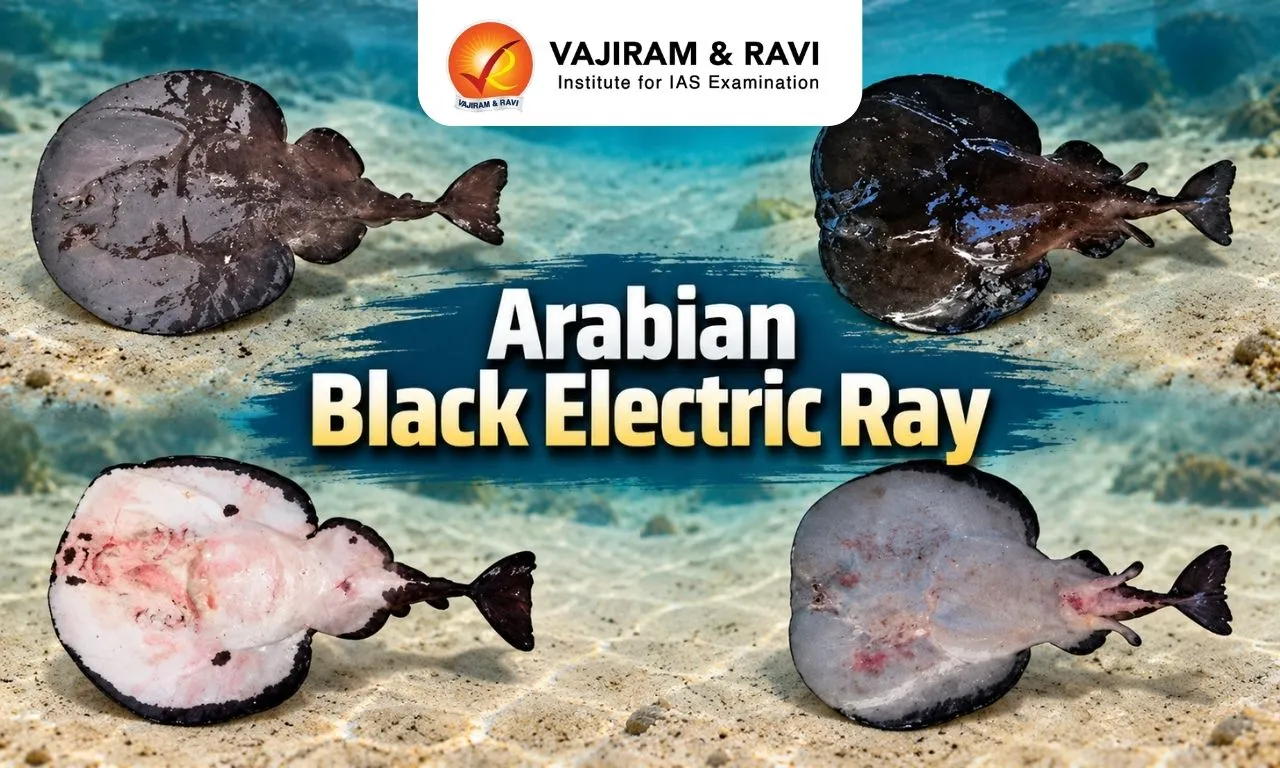
Researchers have discovered a new species of electric ray, named the Arabian Black Electric Ray (Tetronarce ramanamurthyi), in the deep waters of the southeastern Arabian Sea in the north.

About Arabian Black Electric Ray

  • It was discovered in the Arabian Sea.
  • It is the first confirmed record of the genus Tetronarce in the northern Indian Ocean. 
  • Features: It features a uniform dark bluish-black or dark brown upper body surface with a whitish belly, lacking any skin bumps (papillae) around its breathing holes (spiracles).
  • It forms an independent evolutionary lineage well-separated from all other known electric ray species globally.

Key Facts about Electric Ray

  • An electric ray refers to a type of cartilaginous fish capable of producing an electric shock.
  • Appearance: These rays are characterized by their flat bodies and enlarged pectoral fins that are fused to their heads.
  • Habitat& Distribution: The electric rays are found worldwide in tropical, subtropical, and temperate bodies of water and are commonly found to inhabit and prefer shallow waters
  • Diet: These are mesopredators, typically prey on smaller animals 
  • They have electric shock producing ability which helps them to stun their prey.

Source: RM

Arabian Black Electric Ray FAQ's

Q1: What is the scientific name of Arabian Black Electric Ray?

Ans: Tetronarce ramanamurthyi

Q2: Where did Arabian Black Electric Ray found?

Ans: Arabian Sea

Zavodovski Island

Zavodovski Island

Zavodovski Island Latest News

According to research by the British Antarctic Survey (BAS), the number of breeding chinstrap penguins on the Zavodovski Island declined nearly 63% in 14 years.

About Zavodovski Island

  • Location: It is an uninhabited volcanic island situated in the Traversay Islands subgroup of the South Sandwich Islands in the South Atlantic Ocean.
  • It is home to the largest penguin colony in the world and unique terrestrial fauna and flora.
  • Volcano: The basaltic stratovolcano on the island, known as Mount Curry, has a large lava platform extending east from two parasitic cones on the side of the main edifice.

Key Facts about Chinstrap Penguin

  • The chinstrap penguin (Pygoscelis antarcticus ) is a species of penguin that inhabits a variety of islands and shores in the Southern Pacific and the Antarctic Oceans.
  • Appearance: Its name stems from the narrow black band under its head, which makes it appear as if it were wearing a black helmet, making it easy to identify.
  • It is also known as Ringed penguin, Bearded penguin, and Stonecracker penguin, due to its loud, harsh call.
  • Behavior: They are highly social birds, gathering in large colonies, where they live and breed.
  • Diet: It mainly feeds on Antarctic krill, tiny, shrimp-like creatures that live in the ocean and form an important part of the Antarctic food chain.
  • Conservation Status: IUCN Red List: Least Concern

Source: IE

Zavodovski Island FAQs

Q1: Where is Zavodovski Island located?

Ans: South Atlantic Ocean

Q2: What type of penguin is found in Zavodovski Island ?

Ans: Chinstrap penguins

Zuqar Island

Zuqar Island

Zuqar Island Latest News

Yemen’s Houthi rebels recently claimed they are attempting to rescue a boat carrying 14 Indian nationals near Zuqar Island in the Red Sea, alleging that it was targeted by Saudi Arabia.

About Zuqar Island

  • It is a Yemeni island in the southern Red Sea, forming part of the Hanish Islands archipelago. 
  • It is approximately 130 sq.km.  
  • It lies between the coasts of mainland Yemen and Eritrea, near the Bab-el-Mandeb strait, which connects the Red Sea to the Gulf of Aden.  
  • Despite its proximity to the African continent, the island is considered a part of Asia because it sits on the Asian continental shelf.  
  • It has strategic importance because of its location along one of the world’s key maritime routes. 
  • Eritrea captured the island in 1995 after battling Yemeni forces. An international court in 1998 placed the island formally into Yemen’s custody. 
  • The island consists of a shield volcano overlain by basaltic pyroclastic cones and spatter cones, which produce youthful-looking pahoehoe lava flows. 
  • Several small coastal cones and islets surrounding Zuqar Island were formed by phreatic eruptions. 

What are Pahoehoe Lava Flows?

  • Pahoehoe is a type of basaltic lava characterized by a smooth, often shiny, and billowy surface. 
  • This highly fluid lava spreads in thin sheets and forms ropy folds as it continues to flow beneath a hardening crust. 
  • The surface of pahoehoe lava flows can appear gently undulating or broadly hummocky, with liquid lava beneath the surface wrinkling it into tapestry-like folds that resemble twisted rope. 
  • These flows are typically fed internally by streams of liquid lava. 

News: TOI

Zuqar Island FAQs

Q1: Where is Zuqar Island located?

Ans: Zuqar Island is a Yemeni island in the southern Red Sea, forming part of the Hanish Islands archipelago.

Q2: Which strait lies near Zuqar Island?

Ans: The Bab-el-Mandeb Strait lies near Zuqar Island and connects the Red Sea to the Gulf of Aden.

Q3: Why is Zuqar Island strategically important?

Ans: It is strategically important because of its location along a major global maritime route near the Bab-el-Mandeb Strait.

Sakharov Prize

Sakharov Prize

Sakharov Prize Latest News

The International Criminal Court and its officials won the EU’s 2026 Sakharov human rights prize.

About Sakharov Prize

  • It is the European Union’s highest honour dedicated to human rights work.
  • Background:  It was established in 1988 and the inaugural prize was jointly conferred to Nelson Mandela and Anatoli Marchenko.
  • It is named after Soviet physicist and political dissident Andrei Sakharov.
  • It is awarded annually by the European Parliament during its plenary session.
  • This prize consists of € 50 000 endowments and along with an official citation.
  • Focus: Recognizes individuals, groups, or organizations that make an outstanding contribution to defending human rights, freedom of thought, free expression, minority rights, and international law.

Key Facts about International Criminal Court

  • It is a permanent and independent criminal court established to prosecute offenders of serious crimes in the international community.  
  • It is the only permanent international criminal tribunal.
  • It was created by the Rome Statute, which came into force on July 1, 2002. 
  • Mandate: ICC investigates and, where warranted, tries individuals charged with the gravest crimes of concern to the international community.
  • Specifically, the ICC is intended to prosecute the following crimes:Genocide, Crimes against humanity, War crimes and the crime of aggression.
  • Members: There are 125 member countries (China, India, Israel, Russia, and the United States are not ICC parties).
  • Composition
    • Judges: The court has eighteen judges, each from a different member country, elected to non-renewable nine-year terms.
    • The Presidency
      • Consists of three judges (the President and two Vice-Presidents) elected from among the judges.
      • It represents the Court to the outside world and helps with the organization of the work of the judges.

Source: Reuters

Sakharov Prize FAQs

Q1: Which organisation award Sakharov Prize?

Ans: It is the European Union’s highest honour dedicated to human rights work.

Q2: What is International Criminal Court?

Ans: It is a permanent and independent criminal court established to prosecute offenders of serious crimes in the international community.  

NDTV World Summit 2026, Theme, Highlights, Significance

NDTV World Summit 2026

NDTV World Summit 2026 was held in New Delhi on October 22 and 23, 2026, bringing together global leaders, policymakers, economists, business leaders and innovators. The summit explored changes in the global order, emerging geopolitical challenges, technological developments and India’s growing international role. The event examined the need for stronger global institutions, international cooperation and greater representation for the Global South in shaping the emerging world order.

What is NDTV World Summit 2026?

NDTV World Summit 2026 was an international platform organised to discuss major political, economic, technological and security developments shaping the world. It brought together prominent international representatives and experts to examine changing global alliances, artificial intelligence, cybersecurity, economic growth and international relations. The summit also explored India’s role in the emerging global order, highlighting its growing economic capabilities, technological progress and potential to contribute to international cooperation and global prosperity.

NDTV World Summit Theme 2026

The theme of NDTV World Summit 2026 was “A World Between Orders.” It reflected a period of global transition in which established international systems, alliances and economic relationships are undergoing significant changes. The discussions examined why existing institutions are struggling to address contemporary challenges and why reforms are necessary. The theme also highlighted India’s growing role in promoting inclusive global governance, strengthening multilateral cooperation, supporting the Global South and addressing emerging technological and geopolitical challenges.

NDTV World Summit 2026 Highlights

NDTV World Summit 2026 featured discussions on global governance, international security, artificial intelligence, economic development and India’s changing position in world affairs.

  • Date and Venue: The summit took place on October 22 and 23, 2026, in New Delhi, bringing together international leaders, policymakers, economists, entrepreneurs and experts.
  • PM Address: Prime Minister Narendra Modi addressed the summit on October 22, highlighting the changing world order, institutional reforms, international cooperation and India’s growing global responsibilities.
  • Global Governance: Discussions focused on reforming multilateral institutions, strengthening international cooperation and ensuring adequate representation for emerging economies and the Global South.
  • Geopolitics and Security: Sessions examined shifting international alliances, changing geopolitical relationships, security challenges and the evolving nature of global power.
  • Artificial Intelligence and Cybersecurity: Experts discussed AI development, cybersecurity threats, technological risks and the implications of artificial intelligence for economies, organisations and international security.
  • Economic and Technological Growth: Discussions covered global capital flows, digital development, semiconductor capabilities, research, innovation and India’s expanding role in the global economy.
  • India’s Global Contribution: The Prime Minister highlighted India’s progress in digital payments, green energy, artificial intelligence, startups, research and domestic manufacturing as contributors to global development.

NDTV World Summit 2026 Significance

The NDTV World Summit 2026  provided an opportunity to understand emerging global challenges and examine India’s role in promoting cooperation, institutional reform, technological progress and inclusive international development.

  • Reforming Global Institutions: The summit highlighted the need to make international institutions more representative and responsive to changing economic realities, technological developments and contemporary geopolitical challenges.
  • Strengthening the Global South: Discussions emphasised the importance of giving developing countries a stronger voice in global decision making and creating a more inclusive international system.
  • Promoting International Cooperation: The event underlined that cooperation among countries must continue during crises rather than weaken when international tensions, conflicts or economic uncertainties increase.
  • Understanding India’s Global Role: Prime Minister Narendra Modi presented India as a potential bridge builder in international affairs, emphasising consensus building, self reliance and the country's contribution to global stability.
  • Encouraging Technological Innovation: Discussions on artificial intelligence, semiconductors, research and cybersecurity highlighted the importance of technological capabilities in economic development and national resilience.
  • Supporting Global Economic Stability: The summit highlighted how stronger domestic capabilities, resilient supply chains and technological progress can contribute to international productivity, economic security and shared prosperity.
  • Addressing Emerging Security Challenges: Sessions on geopolitics, artificial intelligence and cybersecurity provided a platform to examine new risks and the need for coordinated international responses.

NDTV World Summit 2026 FAQs

Q1: What was the theme of NDTV World Summit 2026?

Ans: The theme of NDTV World Summit 2026 was “A World Between Orders,” focusing on changes in global power structures, international institutions, geopolitical relationships and emerging technologies.

Q2: What was the date of NDTV World Summit 2026?

Ans: NDTV World Summit 2026 was held on October 22 and 23, 2026, in New Delhi, India.

Q3: What did PM Narendra Modi say at NDTV World Summit 2026?

Ans: Prime Minister Narendra Modi emphasised stronger global institutions, greater representation for the Global South, international cooperation during crises and India’s growing technological and economic capabilities.

Q4: Why is NDTV World Summit 2026 important?

Ans: The summit is important because it addressed global governance reforms, geopolitical changes, artificial intelligence, cybersecurity, economic development and India’s role in shaping the emerging international order.

Q5: What were the major topics discussed at NDTV World Summit 2026?

Ans: The major topics included geopolitics, global economics, international security, artificial intelligence, cybersecurity, technological innovation, research, semiconductor development and India’s international partnerships.

Azerbaijan

Azerbaijan

Azerbaijan Latest News

A year after ties between India and Azerbaijan soured over Baku’s alignment with Pakistan during Operation Sindoor, India’s External Affairs Minister (EAM) met with Azerbaijan's top leadership in an attempt to reset bilateral relations.

About Azerbaijan

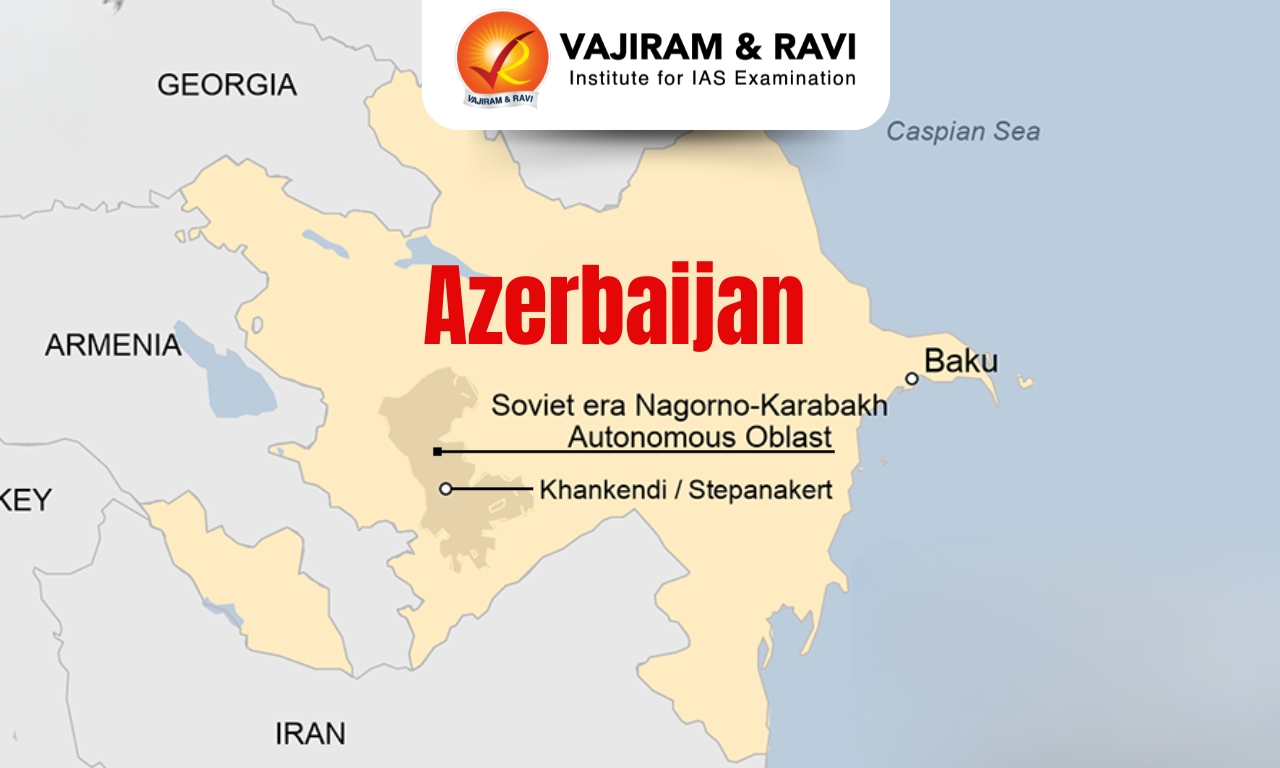
  • Azerbaijan, officially the Republic of Azerbaijan, is located at the junction of Eastern Europe and Western Asia along the southern flanks of the Caucasus Mountains.
  • It is bounded in the east by the Caspian Sea, the world's largest inland body of water.
  • Bordering Countries:  It is bordered by Russia in the north, Georgia in the northwest, Armenia in the west, and Iran in the south.
  • The country is highly mountainous, making human settlement very limited to along rivers and coastlines. 
  • Highest Point: Mount Bazardüzü is the highest peak in the Greater Caucasus Range and the highest mountain in Azerbaijan. 
  • History:
    • At various times Arabs, Persians, Turks, and Mongols dominated the land. 
    • Russia took over Azerbaijan in the early 1800s.  In 1918 Azerbaijan declared independence. 
    • In 1920, however, the new Soviet Union sent troops to take control of Azerbaijan. 
    • At first the Soviets combined Azerbaijan with Georgia and Armenia. 
    • In 1936 Azerbaijan became a separate Soviet republic. 
    • With the breakup of the Soviet Union, Azerbaijan gained independence again in 1991. 
  • Government Type: Presidential Republic 
  • Capital: The capital city, Baku, is famous for its modern architecture and historical sites, including the UNESCO World Heritage-listed Old City. 
    • For its location at 28 m below sea level, Baku is the largest city in the world located below sea level and also the lowest-lying national capital in the world.  
  • Climate: Its climate is highly varied and contains examples of nine out of the world’s eleven climate zones. Most of Azerbaijan is dry, with hot summers and mild winters.  
  • Major Rivers: Alazani, Aras, and Kura Rivers. 
  • Economy: 
    • Azerbaijan’s economy is driven by its natural resources and the service sector. 
    • Its major resources are petroleum (oil) and natural gas.  
    • Other resources consist of gold, silver, iron, titanium, copper, manganese, cobalt, molybdenum, and chromium.
    • The service sector, including information and communication services and tourism, employs almost half of the population.  
  • Currency: Azerbaijani manats (AZN) 
  • People:
    • Most of the country’s people are Azerbaijani, though there are a few Russians, Armenians, and other minority groups. 
    • Most people speak Azerbaijani, a Turkic language. 
    • More than 90 percent of the people are Muslims. 
  • Border Issues: Its relations with neighboring Armenia are tense, especially due to conflict over Nagorno-Karabakh during and following the collapse of the Soviet Union, of which they were both part. 

News: IE

Azerbaijan FAQs

Q1: Where is Azerbaijan located?

Ans: Azerbaijan is located at the junction of Eastern Europe and Western Asia, along the southern flanks of the Caucasus Mountains.

Q2: Which sea lies to the east of Azerbaijan?

Ans: The Caspian Sea lies to the east of Azerbaijan.

Q3: Which countries share land borders with Azerbaijan?

Ans: It is bordered by Russia in the north, Georgia in the northwest, Armenia in the west, and Iran in the south.

Q4: Which mountain is the highest peak in Azerbaijan?

Ans: Mount Bazardüzü is the highest peak in Azerbaijan.

Q5: What is the capital of Azerbaijan?

Ans: Baku is the capital of Azerbaijan.

Locus Coeruleus (LC)

Locus Coeruleus (LC)

Locus Coeruleus Latest News

Previously thought to broadcast the same chemical signal throughout the brain, a new study finds that the locus coeruleus (LC) actually sends targeted messages that help control learning, attention, and behavior, according to new research in mice.

About Locus Coeruleus 

  • The Locus Coeruleus (LC) is a small nucleus (cluster of nerve cells) located in the pons, a part of the brainstem. 
    • The Pons act as a connection between the cerebrum and cerebellum. 
  • The Locus Coeruleus gets its name from the Latin words for "blue place." 
  • Although it contains only a small fraction of the brain's neurons, it produces norepinephrine (NE), a chemical messenger that helps regulate attention, learning, heart rate, and the body's reactions to stress and excitement. 
  • LC is the primary source of norepinephrine to the brain. 
  • Recent Findings:
    • Scientists have long assumed that the LC operates like a loudspeaker, sending essentially the same norepinephrine signal across the brain. 
    • However, in a new study using brain imaging, recordings of neural activity, genetic techniques, and behavioral experiments, researchers discovered that the LC communicates through several distinct pathways. 
    • Rather than broadcasting one general message, it delivers signals to specific destinations, with different groups of neurons responding to different experiences. 
    • Different groups of cells communicate with specific regions of the nervous system. 
    • These pathways determine where signals trigger the release of norepinephrine, creating a much more organized communication network than previously recognized. 
    • Neurons in the upper (dorsal) portion of the LC primarily connect to the cerebral cortex and forebrain. 
    • Meanwhile, cells in the lower (ventral) portion send their signals mainly to the brainstem and spinal cord. 
    • This arrangement allows different parts of the LC to influence separate brain functions. 
  • Why the Discovery Could Matter for Brain Disorders?
    • Norepinephrine plays a central role in regulating attention and mood, making it an important target for medications used to treat depression, anxiety, and ADHD. 
    • Neurons in the LC are also among the earliest brain cells to deteriorate in Alzheimer's disease, suggesting that the new findings could have implications for understanding and treating these conditions. 
    • Current treatments that influence norepinephrine can affect multiple brain circuits at once, sometimes producing beneficial effects in one region while causing unwanted effects elsewhere. 
    • A clearer map of the LC's specialized pathways could help scientists develop therapies that act more selectively on the circuits involved in particular symptoms.

News: SD

Locus Coeruleus FAQs

Q1: What is the Locus Coeruleus (LC)?

Ans: The Locus Coeruleus is a small nucleus, or cluster of nerve cells, located in the pons of the brainstem.

Q2: Which neurotransmitter is primarily produced by the Locus Coeruleus?

Ans: The Locus Coeruleus primarily produces norepinephrine (noradrenaline).

Q3: Why is the Locus Coeruleus important for brain function?

Ans: It helps regulate attention, learning, alertness and the body's responses to stress and excitement.

Q4: What has recent research revealed about how the Locus Coeruleus communicates?

Ans: Recent research has revealed that the Locus Coeruleus communicates through several distinct pathways that deliver signals to specific destinations.

Kesar Mango, GI Tag, Cultivation, Production in India

Kesar Mango

Gir Kesar Mango is a famous mango variety of Gujarat, primarily grown in the Gir region of the Saurashtra peninsula. Known for its saffron-coloured pulp, sweetness and distinctive aroma, it received a Geographical Indication (GI) tag in 2011, recognising its association with the region.

What is Kesar Mango?

Gir Kesar Mango is a famous mango variety of Gujarat, known for its saffron-coloured pulp, sweetness and distinctive aroma. It is primarily associated with the Gir region of the Saurashtra peninsula.

  • Origin: Gir region, Gujarat.
  • Major cultivation area: Junagadh and the adjoining Gir region, including parts of Gir Somnath district.
  • Distinctive feature: Saffron-coloured pulp with a sweet taste and characteristic aroma.
  • GI status: Registered as a Geographical Indication (GI) product in 2011.

Geographical Conditions for Kesar Mango Cultivation

  • Climate: Tropical and subtropical conditions with warm temperatures are suitable for mango cultivation.
  • Rainfall: Moderate to high rainfall can support growth, provided the region has adequate drainage. A relatively dry period during flowering and fruit maturation is beneficial.
  • Soil: Deep, fertile and well-drained loamy or sandy-loam soils support healthy growth. Waterlogging can adversely affect root development and productivity.
  • Water availability: Adequate soil moisture during critical growth stages supports fruit development, while excessive moisture can increase disease risks.

These are general mango-growing requirements; local climate, soil and orchard management determine the suitability of a particular area.

GI Tag of Gir Kesar Mango

The Gir Kesar Mango received its GI registration on 24 June 2011. Gujarat Agro Industries Corporation Limited is the registered proprietor. The registration identifies the product with its recognised geographical origin in Gujarat.

Significance of the GI Tag

  • Protects the product's geographical identity against misleading use of its name.
  • Strengthens regional branding and market recognition.
  • Supports the promotion of local agricultural products and producers.
  • Creates opportunities for product differentiation in domestic and international markets.

Also Read:- Mango Showers

Economic Significance of Kesar Mango

  • Horticulture: Contributes to Gujarat's fruit production and agricultural diversification.
  • Farmers' income: Supports orchard owners and agricultural workers involved in cultivation and harvesting.
  • Food processing: Used in mango pulp, beverages, desserts and other processed products.
  • Market value: Its recognised regional identity supports branding and marketing.

Mango Production in India

India is the world's leading mango producer. Mango cultivation is distributed across different climatic regions, with states producing varieties suited to their local agro-climatic conditions.

Also Read:- Totapuri Mangoes

Major Mango-Producing States

Important mango-producing states include Uttar Pradesh, Andhra Pradesh, Bihar, Karnataka, Gujarat, West Bengal and Telangana.

According to APEDA, Uttar Pradesh ranked first in mango production in 2024–25, accounting for approximately 26.56% of India's production.

Major Mango Varieties and Their Regions

Mango variety

Major geographical association

Gir Kesar

Gujarat

Alphonso

Maharashtra, especially the Konkan region

Dasheri

Uttar Pradesh

Langra

Uttar Pradesh and Bihar

Banganapalli

Andhra Pradesh

Himsagar

West Bengal

Mango Exports from India

India exports fresh mangoes to international markets. Major destinations reported for 2025–26 included the United Arab Emirates, the United Kingdom, the United States, Kuwait and Canada.

Kesar Mango FAQs

Q1: Where is Kesar Mango mainly grown?

Ans: Gir Kesar Mango is mainly associated with the Gir region of Gujarat, including areas around Junagadh and Gir Somnath.

Q2: When did Gir Kesar Mango receive its GI tag?

Ans: It received its GI registration on 24 June 2011.

Q3: Why is it called Kesar Mango?

Ans: It is named after the saffron-like colour of its pulp.

Q4: What is the main distinguishing characteristic of Gir Kesar Mango?

Ans: Gir Kesar Mango is known for its saffron-coloured pulp, distinctive aroma and sweet taste, which contribute to its popularity in domestic markets.

Q5: What is the scientific name of mango?

Ans: The scientific name of mango is Mangifera indica. It belongs to the family Anacardiaceae.

Indo-Tibetan Border Police

Indo-Tibetan Border Police

Indo-Tibetan Border Police Latest News

Recently, the Prime Minister of India extended his greetings to all personnel of the Indo-Tibetan Border Police (ITBP) on their Raising Day.

About Indo-Tibetan Border Police

  • It is a Central Armed Police Force functioning under the Ministry of Home Affairs, Government of India.
  • It guards 3,488 km long India-China borders ranging from the Karakoram Pass in Ladakh to Jachep La in Arunachal Pradesh. 
  • Background
    • It was raised in 1962, in the wake of the Sino-Indian War of 1962, for deployment along India’s border with China’s Tibet Autonomous Region.
    • ITBP was initially raised under the CRPF Act. However, in 1992, parliament enacted the ITBPF Act, and the rules thereunder were framed in 1994.
    • In 2004, ITBP was declared as a full-fledged central armed police force under the Ministry of Home Affairs.
  • Motto: “Shaurya-Dridhata-Karma Nishtha” (Valour – Determination – Devotion to Duty).
  • It is known as one of the most specialized mountain forces in the world, ITBP operates in some of the harshest and most remote areas.
  • ITBP trains its personnel in mountaineering, skiing, and tactical combat, in addition to maintaining readiness for disaster response and relief operations in the Himalayan region. 
  • Headed By: It is headed by a Director General under the Ministry of Home Affairs.
  • Headquarter: New Delhi.

Source: PIB

Indo-Tibetan Border Police FAQs

Q1: What is Indo-Tibetan Border Police?

Ans: It is a Central Armed Police Force functioning under the Ministry of Home Affairs, Government of India.

Q2: What is the motto of Indo-Tibetan Border Police?

Ans: “Shaurya-Dridhata-Karma Nishtha” (Valour – Determination – Devotion to Duty).

Sri Ranganathaswamy Temple

Sri Ranganathaswamy Temple

Sri Ranganathaswamy Temple Latest News

The Madurai Bench of the Madras High Court recently restrained registration authorities from registering documents relating to lands covered by an 1887 deed dedicating properties to the Sri Ranganathaswamy Temple in Srirangam.

About Sri Ranganathaswamy Temple

  • It is a prominent Hindu temple situated at Srirangam near Trichy in Tamil Nadu.
  • This temple lies on an islet formed by the twin rivers Cauvery and Coleroon.
  • It is the biggest functioning Hindu temple in India and is often found ranked amongst the largest religious complexes of the world.
  • Built across an area of 156 acres, this temple is dedicated to Ranganatha, a reclining form of Hindu deity, Lord Vishnu. 
  • It is the foremost of the eight self-manifested shrines of Lord Vishnu.
  • Though the temple has existed since the 2nd century BC, the archaeological inscriptions are available only from the 10th century CE.
  • This temple underwent many changes during the rule of the Cholas, Cheras, Pandiyas, Hoysalas, Vijayanagar kings, and Nayaks of Madurai.
  • In addition, influential Vaishnava leaders like Yamunacarya, Ramanujacarya, and Sudarsanacarya played pivotal roles in shaping the temple’s worship and its enduring legacy. 

Sri Ranganathaswamy Temple Architecture

  • The entire temple complex is a perfect example of Dravidian architecture. 
  • The temple is enclosed by seven concentric walls known as “ Prakaram”, symbolizing the seven planetary systems in Vedic cosmology. 
  • Within these walls, there are twenty-one towering entrances, known as gopurams, each adorned with intricate sculptures and designs. 
  • The primary entrance tower, named the “Rajagopuram,” soars to a remarkable height of 236 feet, making it the largest in Asia. 
  • The vimana over the sanctum of the temple is made up of gold.
  • There is also a royal temple tower, which covers a base area of 32,500 sq. ft. and has a height of 196 ft. 
  • It also comprises a hall containing 1000 pillars. Intricate sculptures are the most attractive part of the hall. The Hall was built during the Vijayanagara period (1336-1565).
  • Inside the temple, one can find inscriptions from the Chola dynasty, accompanied by tales of the Pandya, Hoysala, and Vijayanagara empires that once flourished alongside the Tiruchirappalli rule. 
  • A substantial part of Srirangam town resides within the periphery defined by the three outer walls of the temple complex. 

News: DT

Sri Ranganathaswamy Temple FAQs

Q1: Where is the Sri Ranganathaswamy Temple located?

Ans: The Sri Ranganathaswamy Temple is located at Srirangam near Tiruchirappalli (Trichy) in Tamil Nadu.

Q2: To which Hindu deity is the Sri Ranganathaswamy Temple dedicated?

Ans: The temple is dedicated to Lord Vishnu in his reclining form, known as Ranganatha.

Q3: What is the significance of the Sri Ranganathaswamy Temple in terms of size?

Ans: It is regarded as the largest functioning Hindu temple complex in India.

Q4: Which architectural style is followed by the Sri Ranganathaswamy Temple?

Ans: The temple is an outstanding example of Dravidian architecture.

Indo-Pacific Regional Dialogue (IPRD) 2026

Indo-Pacific Regional Dialogue (IPRD) 2026

Indo-Pacific Regional Dialogue Latest News

The Indian Navy will host the 2026 edition of the Indo-Pacific Regional Dialogue (IPRD) in New Delhi from November 3 to 5.

About Indo-Pacific Regional Dialogue 

  • IPRD is the Indian Navy’s annual apex-level international strategic dialogue. 
  • The idea of an annual IPRD was first conceptualised and conducted in 2018 as the apex-level conference of the Indian Navy.
  • It is organised in association with the National Maritime Foundation (NMF), the Navy’s knowledge partner. 
  • IPRD seeks to translate the broad framework of the Indo-Pacific Oceans Initiative (IPOI) into specific, actionable proposals. 
  • IPRD also supports India’s maritime vision of MAHASAGAR-Mutual and Holistic Advancement for Security and Growth Across Regions.
  • IPRD 2026:
    • It is the eighth edition of the IPRD.
    • Venue: Manekshaw Centre, New Delhi. 
    • Theme: Science, Technology, and Academic Cooperation in the Indo-Pacific. 
    • Notably, IPRD-2026 will expand its focus beyond traditional STEM disciplines to incorporate social sciences, life sciences, and the humanities into maritime deliberations. 
    • The three-day conference will bring together maritime practitioners, scientists, academicians, policymakers, and experts from 18 countries across the Indo-Pacific to formulate actionable proposals for regional cooperation. 
    • Five thematic sessions will be held during the conference. They will focus on
      • joint research, research networks, and human development; 
      • protection of critical maritime infrastructure and enhanced monitoring; 
      • climate resilience and ocean dynamics; 
      • maritime resilience and responsible management; and 
      • dual-use maritime technologies and their implications.
    • The event aims to identify concrete, solution-oriented measures across national, sub-regional, and pan-regional tiers. 

What is the Indo-Pacific Oceans Initiative (IPOI)? 

  • PM Narendra Modi proposed the IPOI at the East Asia Summit held in Bangkok, Thailand, on November 4, 2019.  
  • As an open global initiative, the IPOI draws on existing regional cooperation architecture and mechanisms to focus on seven central pillars. They are: 
    • Maritime security
    • Maritime ecology
    • Maritime resources
    • Capacity building and resource sharing
    • Disaster risk reduction and management
    • Science, technology, and academic cooperation
    • Trade connectivity and maritime transport.

Key Facts about National Maritime Foundation

  • It is the nation’s first maritime think tank for the conduct of independent and policy-relevant research on all ‘matters maritime’.  
  • The foundation was inaugurated on the 15th of February, 2005.
  • It was, from its very inception, designed to create and heighten maritime awareness amongst India’s policymakers, intellectual echelons, and civil society at large.  
  • While the NMF is an independent and autonomous think tank, its intellectual and organisational development is supported by the Ministry of Defence and the Indian Navy. 

News: TH

Indo-Pacific Regional Dialogue FAQs

Q1: What is the Indo-Pacific Regional Dialogue (IPRD)?

Ans: IPRD is the Indian Navy’s annual apex-level international strategic dialogue.

Q2: When was the Indo-Pacific Regional Dialogue first conceptualised and conducted?

Ans: The IPRD was first conceptualised and conducted in 2018.

Q3: Which organisation is associated with organising the Indo-Pacific Regional Dialogue alongside the Indian Navy?

Ans: The National Maritime Foundation (NMF), the Indian Navy’s knowledge partner, is associated with organising the IPRD.

Q4: What is the primary objective of the Indo-Pacific Regional Dialogue?

Ans: It seeks to translate the broad framework of the Indo-Pacific Oceans Initiative (IPOI) into specific, actionable proposals.

Q5: What is the theme of the Indo-Pacific Regional Dialogue 2026?

Ans: The theme is “Science, Technology, and Academic Cooperation in the Indo-Pacific.”

Island of Mindanao, Location, Geography, Rivers, Mountains 

Island of Mindanao

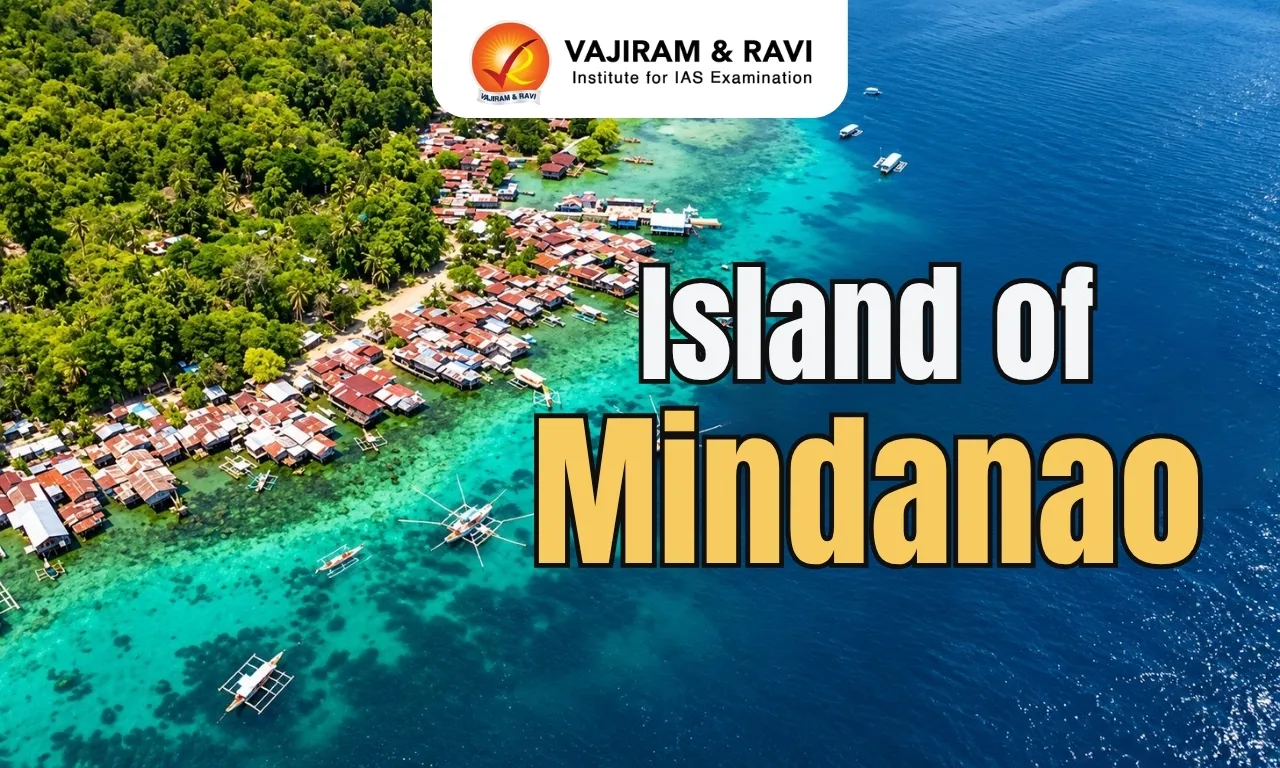
The Island of Mindanao is the second-largest island in the Philippines after Luzon. Located in Southeast Asia, it features volcanic mountains, extensive upland plateaus, major river systems and diverse natural resources. Its location in a tectonically active region makes it significant for understanding earthquakes and volcanic activity.

Location of the Island of Mindanao

The Island of Mindanao lies in the southern part of the Philippine archipelago.

  • The island covers approximately 97,530 square kilometres, making it the second-largest island in the Philippines.
  • It lies south of the Visayas island group.
  • The Sulu Sea lies to its west, the Philippine Sea to its east, the Celebes Sea to its south and the Bohol Sea, also known as the Mindanao Sea, to its north.
  • Its position between major water bodies connects it with important maritime routes in Southeast Asia.

Physical Features of the Island of Mindanao

The Island of Mindanao has a varied landscape comprising mountain ranges, volcanic peaks, upland plateaus, river valleys and coastal plains.

Mountains and Highest Peak

  • Mount Apo: At approximately 2,954 metres, it is the highest peak in the Philippines. This dormant stratovolcano lies between Davao del Sur and Cotabato.
  • Mount Kitanglad and Mount Kalatungan: Prominent peaks in the central highlands of Mindanao.
  • Mountain systems: The island contains multiple structural and volcanic mountain ranges that influence drainage patterns, rainfall and vegetation.

Upland Plateaus

  • Location: Extensive upland plateaus occur in Bukidnon and Lanao del Sur.
  • Formation: Some plateau surfaces developed from basaltic lava flows interspersed with volcanic ash and tuff.
  • Erosional features: Deep canyons and waterfalls occur along the edges of these plateaus.
  • Significance: The uplands support agriculture and contain important forest and watershed areas.

Plains and Valleys

  • Cotabato Plain: A major lowland region associated with the Rio Grande de Mindanao river system.
  • Agusan Valley: Located in northeastern Mindanao and drained by the Agusan River.
  • Coastal plains: Found along parts of the island, supporting settlements and agricultural activities.

Major Rivers of the Island of Mindanao

The Island of Mindanao has two major river systems that drain its interior and support agriculture, wetlands and freshwater ecosystems.

  • Agusan River: Flows northwards through the Agusan Valley, passes through Agusan Marsh and empties into Butuan Bay.
  • Rio Grande de Mindanao: Also known as the Mindanao River, it drains the Cotabato Basin, supports agriculture in the surrounding lowlands and flows into Illana Bay.

Tectonic Setting and Volcanic Activity

The Island of Mindanao lies within the tectonically active Philippine archipelago, which forms part of the Pacific Ring of Fire. Interactions between tectonic plates, subduction zones and active faults generate frequent earthquakes in the region. 

The island also contains volcanic landforms, including Mount Apo and other volcanic centres. The Philippine Trench lies east of Mindanao, while the Cotabato Trench lies to its southwest. This tectonic setting exposes the island to natural hazards such as earthquakes, volcanic activity and earthquake-triggered landslides, which can affect settlements and infrastructure.

Climate and Natural Resources of Mindanao

The Island of Mindanao has a tropical climate, with rainfall patterns influenced by monsoon systems, topography and exposure to surrounding seas.

  • Rainfall: Rainfall distribution varies across the island due to differences in elevation and exposure to prevailing winds.
  • Agriculture: Rice, corn, bananas and pineapples are among the crops cultivated in Mindanao.
  • Forest resources: Mountain forests support diverse ecosystems and wildlife.
  • Mineral resources: Deposits of gold, copper and nickel contribute to the island's economy.

Island of Mindanao FAQ's

Q1: Where is the Island of Mindanao located?

Ans: The Island of Mindanao is located in the southern Philippines in Southeast Asia. It is the second-largest island in the country after Luzon.

Q2: Which seas surround the Island of Mindanao?

Ans: The Sulu Sea lies to the west, the Philippine Sea to the east, the Celebes Sea to the south and the Bohol Sea to the north.

Q3: Which is the highest peak on the Island of Mindanao?

Ans: Mount Apo, at approximately 2,954 metres above sea level, is the highest peak in the Philippines.

Q4: What are the major rivers of the Island of Mindanao?

Ans: The Agusan River and Rio Grande de Mindanao are two major river systems. The Agusan River empties into Butuan Bay, while the Rio Grande de Mindanao flows into Illana Bay.

Q5: Why does the Island of Mindanao experience earthquakes?

Ans: The Island of Mindanao experiences earthquakes because it lies in a tectonically active region characterised by plate interactions, subduction zones and active faults.

Amur Falcon

Amur Falcon

Amur Falcon Latest News

Recently, the two satellite-tagged Amur Falcons (Falco amurensis) have returned to Manipur after travelling across 23 countries in Asia and Africa.  

About Amur Falcon

  • It is a migratory raptor of the falcon family.
  • Other Names: Eastern Red-footed Falcon, Eastern Red-footed Kestrel, Manchurian Falcon, and Red-legged Falcon.
  • Habitat: It is found across open forests, grasslands, wetlands and agricultural landscapes.
  • Distribution: They breed in southeastern Siberia and Northern China and migrate long distances in large flocks to winter in Southern and East Africa.
    • Along the way, large numbers pass through India, with the biggest congregations seen in the northeastern states mainly in Nagaland, Manipur, and parts of Assam and Arunachal Pradesh.
  • Features
    • The male and female are distinctly different. 
    • The male is a dark, sooty grey, with brownish-red thighs and vent. 
    • When flying, a white lining of the male’s wings stands out against the sooty grey. 
    • The female has a pattern common among many falcon species, with a dark spotted chest and vent against a white background and a darker, grey back. 
    • A distinctive feature of both the male and the female is the orange of the eye-ring, beak base (the cere) and feet. 
    • In addition to speed and strength, these birds are known to have keen eyesight for detecting prey from a distance or during flight.
  • Threats: Hunting during migration and habitat loss at roosting sites, and changing weather patterns.
  • Conservation Status
    • IUCN Red List: Least Concern
    • Wildlife (Protection) Act, 1972:  Schedule IV

Source: News On Air

Amur Falcon FAQs

Q1: What is Amur Falcon?

Ans: It is a migratory raptor of the falcon family.

Q2: Where do we find Amur Falcon?

Ans: It is found across open forests, grasslands, wetlands and agricultural landscapes.

India-China Border Tensions: LAC, ITBP and Border Management

India-China Border Relations

India-China Border Tensions Latest News

  • Recently, the Ministry of External Affairs (MEA) attributed recurring disturbances along the India-China border to Chinese forces deviating from established patrolling patterns, following the ITBP chief's remarks about ongoing face-offs at multiple locations in Arunachal Pradesh.

Historical Background of India-China Border Relations

  • India and China share an approximately 3,488-km-long disputed boundary, commonly referred to as the Line of Actual Control (LAC). 
  • Unlike an internationally demarcated border, the LAC reflects the areas where the two countries exercise actual control, and differences in its perception have contributed to recurring confrontations.
  • The 1962 India-China war deepened mutual distrust and shaped India's approach to border security. Subsequent agreements sought to prevent escalation and maintain peace despite the unresolved boundary dispute.
  • Important developments include:
    • 1993 Agreement: Established principles for maintaining peace and tranquillity along the LAC.
    • 1996 Agreement: Introduced confidence-building measures, including restrictions on certain military activities and weapons near the LAC.
    • 2005 agreements: Further developed political principles and measures for implementing confidence-building arrangements.
    • 2020 eastern Ladakh crisis: A serious military confrontation, including the Galwan Valley clash, disrupted bilateral relations and led to sustained military deployments.
    • 2024 disengagement efforts: Agreements concerning patrolling arrangements in parts of eastern Ladakh supported efforts to reduce tensions, although the wider boundary dispute remained unresolved.

Strategic Significance of the LAC

  • The India-China border has considerable strategic importance because of its difficult terrain, proximity to sensitive military positions and implications for regional security.
  • Arunachal Pradesh is particularly significant. China claims parts of the Indian state and refers to it as “Zangnan” or southern Tibet, while India maintains that Arunachal Pradesh is an integral and inalienable part of the country.
  • The LAC's differing perceptions can lead to opposing patrols entering areas claimed by both sides, creating the risk of face-offs and escalation.
  • Border management therefore requires effective surveillance, infrastructure development, military preparedness and reliable communication between local commanders and diplomatic authorities.

Border Management and Confidence-Building Mechanisms

  • India and China use diplomatic and military mechanisms to manage disputes and prevent local confrontations from escalating into wider conflict.
    • Corps Commander-level talks: Facilitate negotiations on troop deployments, disengagement and specific border tensions.
    • Working Mechanism for Consultation and Coordination (WMCC): Provides a diplomatic platform for discussing border affairs and coordinating efforts to maintain peace.
    • Border Personnel Meetings: Enable local military commanders to communicate directly and address incidents.
    • Diplomatic engagement: Helps clarify positions, manage disagreements and maintain channels for negotiations.
    • Confidence-building measures: Agreements and communication arrangements seek to prevent misunderstandings and reduce the risk of unintended escalation.
  • These mechanisms are particularly important because the absence of a mutually agreed, clearly demarcated boundary makes local incidents difficult to resolve without sustained communication.

News Summary

  • MEA spokesperson Randhir Jaiswal stated that disturbances along the India-China border occur when Chinese forces diverge from established patrolling patterns. 
  • He emphasised that both countries continue to use existing diplomatic and military mechanisms to resolve outstanding issues and prevent misunderstandings or miscalculations along the LAC.
  • The MEA also reiterated that maintaining peace and tranquillity in border areas is essential for the overall development of bilateral relations. 
  • Both sides have agreed to discuss ways to improve their understanding of the LAC in appropriate areas to strengthen border management.

ITBP’s Shaurya Commandos and Continuing Face-offs in Arunachal Pradesh

  • Indo-Tibetan Border Police (ITBP) Director General Shatrujeet Singh Kapoor stated that the force's newly established Shaurya commando teams had performed effectively during face-offs with China's People's Liberation Army (PLA) at several locations in Arunachal Pradesh. He described the confrontations as ongoing.
  • The ITBP is expanding these specialised teams across its border battalions, with the objective of developing a dedicated high-altitude combat capability. 
  • The force is also strengthening modernisation, drone operations and counter-drone capabilities.
  • He highlighted the need to adapt to changing warfare technologies, noting that conventional methods alone may be insufficient against a modernising adversary. 
  • He cited increased investment in drones, drone-pilot training and indigenous drone production as important elements of the ITBP's modernisation programme.
  • The remarks followed Corps Commander-level talks held in September at the Wacha–Damai border meeting point in Arunachal Pradesh amid reported tensions in the Taksing area of Upper Subansiri district.

Challenges and the Way Forward

  • India's border strategy must combine operational readiness with sustained diplomatic engagement.
  • Strengthen surveillance: Expand the use of drones, sensors, satellite imagery and secure communication systems.
  • Improve infrastructure: Develop roads, bridges, logistics facilities and communications in border regions.
  • Modernise border forces: Provide specialised high-altitude training, modern equipment and integrated drone and counter-drone capabilities.
  • Maintain dialogue: Continue military and diplomatic negotiations to clarify the LAC and resolve outstanding disputes.
  • Prevent escalation: Strengthen local communication and incident-management protocols to reduce the possibility of miscalculation.
  • Ensure transparency: Provide accurate and timely information about significant border developments while protecting operationally sensitive details.

Source: IE | TOI

India-China Border Relations FAQs

Q1: What is the Line of Actual Control (LAC)?

Ans: The LAC is the line separating areas under Indian and Chinese control, although the two countries differ in their perceptions of its alignment.

Q2: Why do face-offs occur along the India–China border?

Ans: Differing perceptions of the LAC and disputes over established patrolling patterns can bring Indian and Chinese patrols into confrontation.

Q3: What is the role of the ITBP?

Ans: The ITBP is a specialised border-guarding force responsible for guarding India's border with China and operating in challenging high-altitude terrain.

Q4: What are the Shaurya commandos?

Ans: They are specialised ITBP teams being developed to strengthen high-altitude combat readiness and operational capabilities along the China border.

Q5: How do India and China manage border tensions?

Ans: They use military commander-level talks, Border Personnel Meetings, diplomatic consultations and confidence-building mechanisms to resolve disputes and prevent escalation.

PLFS Revamp – Capturing India’s Gig Economy and the Invisible Burden of Unpaid Work

PLFS Revamp

PLFS Revamp Latest News

  • The Ministry of Statistics and Programme Implementation (MoSPI) is revamping the Periodic Labour Force Survey (PLFS) to improve the measurement of emerging forms of employment and unpaid work. 
  • The revised design will be implemented from January 2027, and the proposed changes seek to better capture digital platform workers, unpaid household and caregiving work, volunteer activities and unpaid trainee work.
  • The move is significant because conventional employment statistics can understate the contribution of workers engaged in informal, platform-based and non-market activities, particularly women’s unpaid work.

Better Coverage of Gig and Platform Workers

  • Creating a separate sampling stratum:
    • MoSPI had begun collecting information on digital platform workers experimentally from January 2026. However, the existing sampling arrangement did not identify sufficient platform workers.
    • The revised PLFS will create a separate Second Stage Stratum (SSS) for households containing digital platform workers, thereby improving their representation in the sample.
    • An additional yes/no screening question will ask whether any household member worked through a digital platform during the preceding 365 days. 
    • Platforms mentioned include Ola, Uber, Zomato, Amazon and Urban Company.
    • The information will help identify households eligible for inclusion in the new platform-worker stratum.
  • Understanding the nature of platform work:
    • Identified platform workers will be asked about the goods or services provided; whether they work for multiple platforms; reasons for entering platform work; and major challenges faced.
    • These challenges may include long working hours, harsh weather conditions, uncertain earnings, accident-related risks and inadequate social security.
    • The data can help policymakers design appropriate labour protection, social-security and income-security mechanisms for the growing platform economy.
  • Why it matters: A NITI Aayog estimate put India's gig and platform workforce at 77 lakh in 2020–21, projected to reach 2.35 crore by 2029–30. Better data is therefore essential for evidence-based policymaking.

Beyond Conventional Employment Statistics

  • The revised PLFS will collect information on own-use production, unpaid household and caregiving activities, volunteer work and unpaid trainee work.
  • Questions will cover activities such as fetching water; cooking and cleaning; washing clothes; feeding and caring for children; caring for elderly family members; and producing goods or providing services for household consumption.
  • The survey will also distinguish between activities undertaken for own consumption and those intended for sale.
  • These questions will be asked to persons aged 15 years and above during the first visit in both rural and urban areas.

Women’s Labour Force Participation

  • The reform is particularly important from a gender perspective. MoSPI’s 2024 Time Use Survey found a substantial gender gap in unpaid domestic and caregiving work.
    • For example, females aged above six spent, on average, more than 4.5 hours a day on such activities, compared with only 37 minutes for males.
  • The revised PLFS will additionally ask whether individuals -
    • Sought paid work or work for profit during the preceding 30 days;
    • Currently want such work; and
    • If they did not seek work, the principal reason, including family and household responsibilities.
    • This can help determine whether women remain outside the labour market because of personal choice, social norms or constraints created by unpaid care responsibilities.
  • Time poverty:
    • The disproportionate burden of unpaid care work can produce “time poverty”.
    • It is a shortage of discretionary time that limits women’s ability to undertake paid employment, acquire skills and pursue better economic opportunities.
    • Thus, measuring unpaid work is important not merely for household statistics but also for understanding female labour force participation, gender inequality and economic empowerment.

Updating the Sampling Frame

  • The revamped PLFS will use an updated sampling frame reflecting the new urban settlements; changes in urbanisation; creation, merger or division of districts and administrative units; etc.
  • The Urban Frame Survey will inform the updated urban frame, while the rural Census 2011 frame will undergo follow-up updating.
  • The revised allocation and stratification criteria are intended to improve sample selection and reduce operational difficulties.

Significance of PLFS Revamp

  • It represents a shift towards a more comprehensive measurement of employment and economic activity. 
  • It will - 
    • Improve statistical visibility of gig and platform workers;
    • Capture the scale and nature of unpaid domestic and care work;
    • Strengthen gender-sensitive labour-market analysis;
    • Reflect changing urbanisation and population patterns; and
    • Provide evidence for policies on social security, employment generation, women’s workforce participation and the future of work.
  • Overall, the reform recognises that economic contribution cannot be assessed only through conventional paid employment. 
  • A modern labour-statistics system must also capture the growing platform economy and the substantial unpaid work that sustains households and communities.

Source: IE | ET

PLFS Revamp FAQs

Q1: Why is PLFS being revamped to capture digital platform workers?

Ans: To improve their representation in labour statistics and enable evidence-based policies on social security.

Q2: What is the significance of creating a separate Second Stage Stratum (SSS) for platform workers?

Ans: It will improve the sampling and identification of households with digital platform workers.

Q3: What types of unpaid activities will the revised PLFS capture?

Ans: It will cover own-use production, unpaid domestic and caregiving work, volunteer activities, etc.

Q4: How does unpaid care work contribute to women’s ‘time poverty’?

Ans: It reduces women’s time for paid employment, skill development and better livelihood opportunities.

Q5: How will the revised PLFS improve the quality of labour-market estimates?

Ans: It will improve population representation and reduce sampling and operational gaps.

Legislative Councils in India: Powers, Elections and Role

Legislative Councils in India

Legislative Councils in India Latest News

  • Elections to 28 seats across the Legislative Councils of Uttar Pradesh, Bihar, Maharashtra, and Karnataka were held recently. Unlike elections for Members of Legislative Assemblies (MLAs), not every adult citizen can vote for Members of Legislative Councils (MLCs) — and not all states even have a Legislative Council. 
  • This raises a fundamental constitutional question: why does this body exist, and what role does it play in India’s political system?

What Are Legislative Councils?

  • Just as the Indian Union has a bicameral Parliament (Lok Sabha + Rajya Sabha), some states have a bicameral legislature — a Legislative Assembly plus a Legislative Council.
  • Currently six states have Legislative Councils: Uttar Pradesh, Bihar, Maharashtra, Karnataka, Telangana, and Andhra Pradesh.

Colonial Origins 

  • Traces back to the Montagu-Chelmsford reforms, which created the Council of State at the national level in 1919.
  • The Government of India Act, 1935 established bicameral legislatures in provinces.
  • The first Legislative Council began functioning in Bengal in 1937.

Similarities With the Rajya Sabha

  • Acts as a “second layer” of deliberation in the law-making process.
  • Bills require its approval to become law.
  • Minimum age to contest: above 30 years (versus 25 for Lok Sabha/Assembly elections).
  • Members serve six-year terms via indirect elections.
  • Cannot be dissolved; one-third of members retire every two years.

The Constituent Assembly Debate

  • Views on the need for Legislative Councils were sharply divided.
  • Leaders argued for a check on the Lower House, citing concerns about placing all power “in the hands of those... not only literate but wise too.” (His reasoning reflected the era’s elitist anxieties about universal adult franchise.)
  • Critics pointed out the Council’s limited powers — notably, it cannot reject the Assembly’s decisions on a Money Bill — questioning whether a body with such restricted authority justified the added public expenditure.
  • The debate over whether to have a Council at all remains politically contentious even today: Tamil Nadu’s AIADMK government abolished its Council in 1986; the DMK has since repeatedly sought to revive it.

Political Significance of MLC Elections

  • Though not contested on party symbols, candidates are still backed by political parties.
  • These elections function as a political barometer — signalling party strength among educated groups and professionals, or indicating overall political standing ahead of major elections (as seen currently in Uttar Pradesh).

Constitutional Framework: How Councils Are Created and Composed

  • Article 169: Parliament can create or abolish a Legislative Council if the state’s Legislative Assembly passes a resolution by: 
    • A majority of total Assembly membership, and
    • A majority of at least two-thirds of members present and voting.
  • Article 171 — Composition rules: 
    • Total MLCs cannot exceed one-third of the state’s total MLAs.
    • Total MLCs cannot be fewer than 40.

How MLCs Are Elected: The Composition Formula

  • Elections use proportional representation via the single transferable vote, with electors ranking candidates by preference. The composition breaks down as:
    • One-third: Elected by municipalities, district boards, and other local authorities.
    • One-twelfth: Elected by graduates (minimum 3 years as a university graduate, or equivalent qualification) residing in the state — the “Graduates’ constituency.”
    • One-twelfth: Elected by teachers with at least 3 years of teaching experience in institutions of secondary school level or above — the “Teachers’ constituency.”
    • Remaining members: Partly elected by MLAs themselves, and partly nominated by the Governor, chosen for “special knowledge or practical experience” in fields like literature, science, art, and social service.

Conclusion

  • The Legislative Council remains one of India’s more underexamined constitutional institutions — a colonial-era holdover retained in only a handful of states, serving as a deliberative check rather than a co-equal legislative power. 
  • While it lacks the Rajya Sabha’s robust authority — most notably on Money Bills — its unique functional constituencies for graduates and teachers reflect an attempt to bring specialised, non-partisan expertise into lawmaking. 
  • As debates over its utility continue in states like Tamil Nadu, the Council’s survival ultimately hinges on a political calculation: whether the value of deliberative scrutiny outweighs the cost of maintaining a second chamber with limited veto power.

Source: IE

Legislative Councils in India FAQs

Q1: What are Legislative Councils in India?

Ans: Legislative Councils in India are upper houses in certain state legislatures, providing an additional forum for legislative deliberation alongside the elected Legislative Assembly.

Q2: Which states currently have Legislative Councils in India?

Ans: Legislative Councils in India exist in Uttar Pradesh, Bihar, Maharashtra, Karnataka, Telangana and Andhra Pradesh, creating bicameral legislatures in these six states.

Q3: How are members of Legislative Councils in India elected?

Ans: Members of Legislative Councils in India are selected through local authorities, graduates, teachers, MLAs and gubernatorial nominations, with elections using proportional representation and the single transferable vote.

Q4: Which constitutional articles govern Legislative Councils in India?

Ans: Article 169 governs the creation or abolition of Legislative Councils in India, while Article 171 specifies their composition and limits on membership.

Q5: What are the main powers and limitations of Legislative Councils in India?

Ans: Legislative Councils in India provide additional legislative scrutiny, but their powers are limited compared with Assemblies, particularly because they cannot reject a Money Bill permanently.

Social Unrest in Europe: Economic Causes and Consequences

Social unrest in Europe

Social Unrest in Europe Latest News

  • A wave of social unrest is sweeping across Europe — France, Albania, Belgium, Italy, and Portugal are all witnessing widespread street protests. 
  • As in France, where unrest began with student dissatisfaction over school facilities, many of these movements have evolved into a broader outcry over the cost-of-living crisis. 
  • While the timing is political — with countries like France and Italy heading into 2027 national elections — the underlying drivers are predominantly economic. 
  • This raises a crucial question: what actually causes such unrest, and what are its economic consequences?

Is Rising Inequality the Real Culprit?

  • A common explanation — including arguments made by anti-immigration voices — is that rising economic inequality fuels unrest.
  • The World Inequality Report (WIR) 2026, using data through 2024, measures this via the “Income Gap” — defined as the ratio between the income share of the top 10% and the bottom 50% of a population. A higher ratio means greater inequality.
  • Findings for France: The income gap has increased between 2014 and 2024 — similarly for Italy.
  • However, this trend isn’t universal: In the UK, Germany, and Spain, the income gap has actually fallen over the same period.
  • Crucially, France’s inequality is still comparatively low: Its income gap remains among the lowest among peers like Germany. For context, India’s income gap is 38, and South Africa’s is 118 — far higher than France’s.
  • Conclusion: Rising inequality in France is real, but it is not exceptionally severe by global standards — suggesting inequality alone is an incomplete explanation.

What Else Predicts Social Unrest?

  • IMF economists noted: “Although inequality has crept up slowly in recent decades, it has not significantly worsened over the past decade in a way that would explain the recent surge of discontent.”
  • IMF researchers used machine learning on over 340 economic and social indicators to identify unrest predictors. Their central finding: 
    • Past turmoil — both domestic and in neighbouring countries — is by far the most important predictor of future unrest, roughly 10 times more informative than any economic or social factor.
  • The Bank Run Analogy: Just as people rush to withdraw deposits when they see others doing so, visible protests elsewhere act as “coordinating signals” — encouraging people to join in, especially in culturally similar neighbouring countries.
  • Other Predictive Factors Identified: Digital access and social media penetration — suggesting that the ability to communicate and coordinate at scale is crucial for mobilising protest activity.
  • That said, economic factors aren’t irrelevant — researchers noted “prices, particularly of food and fuel, seem to be particularly important” as triggers.

The Economic Consequences of Unrest

  • While economic factors may not be the biggest predictor of unrest, they play a much larger role in its aftermath:
    • IMF economists found a close link between unrest and subsequent economic performance.
    • Key finding: On average, major unrest events are followed by a 1 percentage point reduction in GDP, measured six quarters after the event.
  • Nature of Unrest Matters
    • Unrest driven by socioeconomic factors leads to sharper GDP contractions than unrest driven by purely political motives.
    • Unrest triggered by a combination of both socioeconomic and political factors produces the sharpest GDP contractions of all.

Conclusion

  • Europe’s protests tell us something simple: inequality alone doesn’t explain unrest. Economic grievances, especially rising food and fuel prices, do play a role. But they are not the main trigger. 
  • Often, it is the sight of protests elsewhere that pushes people to join in. Digital connectivity speeds this up. Once unrest begins, though, its economic cost is real. GDP falls the most when economic and political causes mix together. This leaves governments in a tough spot. 
  • Fixing cost-of-living problems may not stop unrest from spreading. But ignoring them only deepens the economic damage that follows.

Source: IE

Social Unrest in Europe FAQs

Q1: What are the main causes of social unrest in Europe?

Ans: Social unrest in Europe reflects cost-of-living pressures, rising food and fuel prices, political tensions, past turmoil, and the spread of protests across neighbouring countries.

Q2: Does economic inequality explain social unrest in Europe?

Ans: Economic inequality alone cannot explain social unrest in Europe. Research suggests that previous unrest, food and fuel prices, and protest coordination also influence mobilisation.

Q3: How does social media contribute to social unrest in Europe?

Ans: Social media can accelerate social unrest in Europe by helping people communicate, coordinate demonstrations, observe protests elsewhere, and mobilise participants across communities and borders.

Q4: What economic consequences follow social unrest in Europe?

Ans: Social unrest in Europe can weaken economic performance. IMF economists found that major unrest events are followed, on average, by a one-percentage-point reduction in GDP after six quarters.

Q5: Why does politically motivated unrest affect economic growth differently?

Ans: Unrest combining political and socioeconomic grievances tends to produce sharper GDP contractions than unrest driven purely by political motives.

Daily Editorial Analysis 24 October 2026

Daily-Editorial-Analysis

Why Sensitive Legal Language Matters

Context

  • The Indian judiciary plays a vital role in protecting constitutional rights and promoting equality.
  • However, judicial language can sometimes reinforce social prejudices that the law seeks to eliminate.
  • The Supreme Court’s efforts to revise guidelines on gender-sensitive language recognise that justice requires both impartial legal reasoning and social sensitivity.
  • Despite revised handbooks and judicial training, patriarchal assumptions persist, making deeper institutional and attitudinal reform essential.

The Need to Reform Judicial Language

  • Chief Justice of India Surya Kant called for revising the 2024 Handbook on Combating Gender Stereotypes, describing it as too technical and Harvard-oriented in February 2026. This led to the revised Handbook on Judgments and Gender, published in August 2026.
  • The revised handbook promotes sensitivity in judicial language and practice.
  • Its analysis of 125 trial court judgments across States found that, despite improvements, outdated expressions such as real victim and the perpetuation of rape myths remained prevalent.
  • Judicial language influences how victims, accused persons, and marginalised communities are perceived.
  • Insensitive terminology can reinforce stereotypes, undermine dignity, and weaken public confidence in justice.
  • The Supreme Court’s condemnation of an Allahabad High Court judge’s remarks in a 2025 POCSO judgment further demonstrated the consequences of gender-insensitive judicial reasoning.

Limitations of Earlier Reform Efforts

  • Previous initiatives included judicial training, awareness programmes, and guidelines on appropriate terminology.
  • Judges were also encouraged to consult international frameworks, including the 2022 Bangkok General Guidance for Judges on Applying a Gender Perspective in South and Southeast Asia.
  • However, persistent stereotypes reveal that memorising appropriate terminology cannot eliminate deep-rooted prejudice.
  • Judges may replace problematic expressions without questioning the assumptions behind their decisions.
  • Effective reform must address the social attitudes and institutional practices that influence judicial reasoning.

Dealing with Insensitivity

  • Justice Lalitha Kanneganti’s observation that no parent is a visitor in the life of a child illustrates the importance of examining the social context of seemingly ordinary expressions.
  • Indian society traditionally regards mothers as primary caregivers, while fathers are often treated as secondary participants in childcare.
  • Consequently, mothers are expected to assume immediate parenting responsibilities, while fathers are frequently viewed mainly as financial providers.
  • The distinction between mothers who “take care” of children and fathers who merely “babysit” reflects deep-rooted gender stereotypes.
  • Replacing “visitation” with “parenting time” challenges these assumptions by recognising fathers as active parents rather than occasional visitors.
  • Parenting involves emotional engagement, everyday care, and participation in a child’s development, not merely financial maintenance.
  • Judicial sensitivity must therefore go beyond changing words to questioning the social assumptions embedded in legal concepts.

The Role of the Feminist Judgments Project

  • The Feminist Judgments Project seeks to expose hidden biases in judicial reasoning and promote substantive equality.
  • It encourages judges to examine unequal power relationships and question apparently neutral rules that may produce discriminatory outcomes.
  • Gender-sensitive judgments must consider social conventions and historical disadvantages rather than merely avoid offensive expressions.
  • For example, treating mothers as default caregivers can disadvantage fathers seeking equal participation in childcare.
  • Formal equality applies the same rules to everyone, whereas substantive equality recognises unequal social conditions and addresses structural disadvantages.
  • A feminist perspective can help courts deliver more inclusive and equitable judgments.

Beyond Gender: Disability, Caste and Tribal Realities

  • Judicial sensitivity must also encompass persons with disabilities, Scheduled Castes, Scheduled Tribes, and other marginalised communities.
  • Accessibility measures may undermine dignity if they disregard the individuality and perspectives of persons with disabilities.
  • Similarly, inadequate understanding of caste discrimination and tribal histories can prevent courts from recognising structural inequalities.
  • Social disadvantage is multidimensional, requiring judicial decisions to consider historical, cultural, economic, and institutional realities.
  • Greater representation of women and diverse communities on the Bench can help identify biases that might otherwise remain overlooked.

The Significance of the Karnataka High Court's Decision

  • The Karnataka High Court’s decision to replace visitation with parenting time in child custody cases marks a constructive step towards inclusive judicial language.
  • In her October 7, 2026 order, Justice Lalitha Kanneganti recognised that parenting is a continuing responsibility rather than an occasional visit.
  • The decision challenges gender stereotypes and promotes shared parental responsibility.
  • However, such initiatives remain limited and context-specific.
  • Their wider impact depends on whether other courts adopt similar practices and integrate sensitivity into everyday judicial decision-making.

Conclusion

  • Reforming judicial language is essential to strengthening the fairness and credibility of India’s justice system.
  • However, linguistic reform must accompany changes in judicial thinking. Handbooks and training programmes are useful, but cannot independently dismantle entrenched prejudices.
  • The judiciary must question underlying assumptions, promote diverse representation, and recognise marginalised communities’ lived experiences.
  • Ultimately, gender-sensitive justice must advance towards substantive equality so that judicial language becomes an instrument of empowerment rather than discrimination.

Why Sensitive Legal Language Matters FAQs

Q1. What is the purpose of the revised Handbook on Judgments and Gender?
Ans. The handbook promotes gender-sensitive language and judicial practices.

Q2. Why have earlier reform efforts been insufficient?
Ans. Earlier efforts failed to eliminate deep-rooted social prejudices and gender stereotypes.

Q3. What does parenting time signify?
Ans. Parenting time recognises both parents as active participants in childcare.

Q4. What is the objective of the Feminist Judgments Project?
Ans. The project seeks to expose judicial biases and promote substantive equality.

Q5. How can judicial sensitivity be strengthened?
Ans. Judicial sensitivity can be strengthened through inclusive representation, contextual understanding, and unbiased decision-making.

Source: The Hindu

Daily Editorial Analysis 2026 FAQs

Q1: What is editorial analysis?

Ans: Editorial analysis is the critical examination and interpretation of newspaper editorials to extract key insights, arguments, and perspectives relevant to UPSC preparation.

Q2: What is an editorial analyst?

Ans: An editorial analyst is someone who studies and breaks down editorials to highlight their relevance, structure, and usefulness for competitive exams like the UPSC.

Q3: What is an editorial for UPSC?

Ans: For UPSC, an editorial refers to opinion-based articles in reputed newspapers that provide analysis on current affairs, governance, policy, and socio-economic issues.

Q4: What are the sources of UPSC Editorial Analysis?

Ans: Key sources include editorials from The Hindu and Indian Express.

Q5: Can Editorial Analysis help in Mains Answer Writing?

Ans: Yes, editorial analysis enhances content quality, analytical depth, and structure in Mains answer writing.

Uniform Civil Code (UCC), Meaning, Constitutional Provisions, Personal Laws, Judgments

Uniform Civil Code

The Uniform Civil Code (UCC) is a constitutional provision under Article 44 of the Indian Constitution that aims to establish a common framework for civil laws across religious communities, with implications for gender justice, equality, religious freedom and the preservation of India's cultural diversity.

What is the Uniform Civil Code (UCC)?

The Uniform Civil Code (UCC) refers to a common set of civil laws governing personal matters for all citizens, irrespective of religion.

  • Scope: Marriage, divorce, maintenance, adoption, guardianship, inheritance and succession.
  • Objective: To establish common civil rules while promoting equality, gender justice and individual rights.
  • Constitutional Basis: Article 44 of the Constitution directs the State to endeavour to secure a Uniform Civil Code for citizens throughout India.
  • Current Position: India follows different personal laws for various religious communities. Uttarakhand has implemented a UCC, while Gujarat and Assam have enacted UCC legislation whose commencement depends on state notifications.

Uniform Civil Code (UCC) Constitutional Provisions 

The Constitution of India contains several provisions relevant to the Uniform Civil Code (UCC), including Articles 44, 25 and 37.

Article

Constitutional provision

Article 44

Directs the State to endeavour to secure a Uniform Civil Code for citizens throughout India.

Article 25

Guarantees freedom of conscience and the right to freely profess, practise and propagate religion, subject to constitutional limitations.

Article 37

States that Directive Principles of State Policy are not enforceable by courts but are fundamental to the governance of the country.

How Are Personal Matters Governed in India Today?

Different communities are governed by different personal laws, statutory provisions and customary practices in family-related matters.

Community or legal framework

Major laws and provisions

Hindus, Buddhists, Jains and Sikhs

Hindu Marriage Act, 1955; Hindu Succession Act, 1956; Hindu Adoption and Maintenance Act, 1956; Hindu Minority and Guardianship Act, 1956.

Muslims

Muslim personal law, including the Muslim Personal Law (Shariat) Application Act, 1937, along with other applicable statutes and judicial decisions.

Christians

Indian Christian Marriage Act, 1872; Divorce Act, 1869; Indian Succession Act, 1925, subject to applicable provisions.

Parsis

Parsi Marriage and Divorce Act, 1936, and applicable succession laws.

Interfaith and civil marriages

Special Marriage Act, 1954, provides a civil framework for marriage irrespective of religious affiliation, subject to statutory conditions.

Tribal and customary communities

Certain communities follow customary practices and enjoy specific statutory or constitutional protections and exemptions.

Constituent Assembly Debate on UCC

The Constituent Assembly debated the Uniform Civil Code on 23 November 1948, when it was introduced as Draft Article 35. Some members opposed the provision, expressing concerns about religious freedom, cultural diversity and State interference in personal laws, while others supported it as a means of promoting gender equality, social reform and national integration. Dr. B. R. Ambedkar supported the provision, arguing that personal laws were not immutable and that the State had the authority to legislate on civil matters. He clarified that the provision did not require immediate, compulsory implementation and suggested that Parliament could initially make the code voluntary. Following the debate, the provision was incorporated as Article 44 under Part IV of the Constitution, as a Directive Principle of State Policy that is non-justiciable but fundamental to the governance of the country.

Which States Have Adopted or Enacted a UCC?

The implementation of a UCC has largely proceeded through state-level initiatives rather than a single nationwide code.

State

Status and key details

Goa

Has a distinct civil-law framework rooted in its Portuguese-era legal history. It is often cited in discussions on UCC, although its framework contains specific provisions and exceptions.

Uttarakhand

Became the first state in independent India to implement a UCC. The code came into force on 27 January 2025 and regulates specified personal and civil matters, subject to exemptions.

Gujarat

The President gave assent on September 17, and the notification was published in the state gazette. The state still has to issue a separate notification fixing the date the law takes effect. Scheduled Tribes are excluded.

Assam

The Uniform Civil Code, Assam, 2026, received Presidential assent on 29 September 2026. Its commencement depends on the applicable state notification.

Presidential assent does not necessarily mean that a law has already come into force. Gujarat and Assam require the relevant commencement steps to be completed. The Gujarat and Assam laws also provide exemptions for Scheduled Tribes, among other specified categories.

Arguments in favour of Uniform Civil Code (UCC)

A UCC is supported on the grounds that a common civil framework could strengthen equality, simplify legal processes and protect individual rights.

  • Gender Justice: Common standards could address discriminatory provisions in marriage, divorce, maintenance and inheritance.
  • Equality Before Law: Citizens could be governed by common civil rules regardless of religious identity.
  • Secular Governance: Civil rights and obligations could be regulated through a common legal framework while preserving freedom of religion.
  • Legal Clarity: Uniform rules could reduce confusion arising from the interaction of different personal laws.
  • Individual Autonomy: Common protections could strengthen individual rights in family-related matters.
  • National Integration: A shared civil framework could promote a common civic identity without requiring uniformity in religious beliefs or practices.

Arguments against Uniform Civil Code (UCC)

Concerns about a UCC centre on religious freedom, cultural diversity, the protection of customary practices and the practical challenges of designing a genuinely inclusive law.

  • Freedom of Religion: Personal laws may be closely connected with religious beliefs and practices protected under Article 25.
  • Cultural Diversity: Uniform rules may not adequately reflect India's diverse social and customary traditions.
  • Majoritarian Imposition: A code perceived as reflecting the practices of the majority community could undermine trust and equality.
  • Tribal and Customary Laws: Some communities have distinct customary practices and constitutional protections that require careful consideration.
  • Equality Within Communities: Uniformity alone may not remove discrimination unless the substantive provisions guarantee equal rights.
  • Implementation Challenges: Differences in social practices, legal awareness and access to justice could complicate implementation and enforcement.

Uniform Civil Code (UCC) Judgements 

  • Mohd. Ahmed Khan v. Shah Bano Begum (1985) : The Supreme Court upheld a divorced Muslim woman’s right to maintenance under Section 125 CrPC and urged the government to give effect to Article 44.
  • Jordan Diengdeh v. S.S. Chopra (1985) : Noting the inconsistencies in personal laws on marriage and divorce, the Court called for a uniform law in line with Article 44.
  • Sarla Mudgal v. Union of India (1995) : The Court held that a Hindu husband’s conversion to Islam does not dissolve his first marriage, so a second marriage without divorce is void and may amount to bigamy under Section 494 IPC. It also asked the government to revisit Article 44.
  • Jose Paulo Coutinho v. Maria Luiza Valentina Pereira (2019) : Holding that the Portuguese Civil Code governs succession for Goan domiciliaries, the Court noted that no attempt had been made to frame a UCC and called Goa a shining example of a state with a largely uniform civil code.

Law Commission Recommendations

The Law Commission and various expert committees have examined the need for a Uniform Civil Code (UCC) and the reform of personal laws in India.

  • 21st Law Commission: In its 2018 consultation paper, Reforms of Family Law, it observed that a UCC was “neither necessary nor desirable at this stage” and favoured reforming discriminatory provisions within existing personal laws.
  • 22nd Law Commission: Invited views from the public and religious organisations on the UCC in June 2023 to examine its scope and implementation.

Way Forward

A workable approach to UCC should prioritise constitutional values, gender justice, consultation and legal clarity rather than treating uniformity as an end in itself.

  • Gender Justice: Prioritise the removal of discriminatory provisions in personal laws and ensure equal rights in marriage, divorce, maintenance and inheritance.
  • Inclusive Consultation: Engage religious communities, women’s groups, tribal representatives, legal experts and civil society.
  • Evidence-Based Reform: Examine the recommendations of Law Commissions and lessons from existing state frameworks.
  • Civil and Religious Distinction: Clearly distinguish civil rights and obligations from religious beliefs and rituals.
  • Protection of Customary Rights: Assess the implications for tribal communities and constitutionally protected customs before extending a common framework.
  • Legal Awareness: Improve access to legal aid, public information and effective dispute-resolution mechanisms.
  • Careful Implementation: Use transparent rules, adequate transition arrangements and periodic review to assess the law’s impact.

Conclusion

The Uniform Civil Code is a constitutional aspiration under Article 44 that raises important questions about equality, gender justice, religious freedom and cultural diversity. Its implementation requires careful legal drafting, meaningful consultation and safeguards for constitutionally protected communities. The central challenge is to ensure that civil laws uphold equal rights without undermining India's constitutional pluralism.

Uniform Civil Code (UCC) FAQs

Q1: What is the Uniform Civil Code (UCC)?

Ans: The Uniform Civil Code (UCC) refers to a common set of civil laws governing personal matters, irrespective of religion.

Q2: Which personal matters are covered by the Uniform Civil Code (UCC)?

Ans: The UCC concerns personal matters such as marriage, divorce, maintenance, adoption, guardianship, inheritance and succession.

Q3: Which Article of the Indian Constitution deals with the Uniform Civil Code (UCC)?

Ans: Article 44, under Part IV of the Constitution, directs the State to endeavour to secure a Uniform Civil Code for citizens throughout India.

Q4: Is the Uniform Civil Code legally enforceable in India?

Ans: No. Article 44 is a Directive Principle of State Policy and is not directly enforceable by courts under Article 37.

Q5: Which Indian states have adopted or enacted a Uniform Civil Code (UCC)?

Ans: Goa has a longstanding civil-law framework, Uttarakhand has implemented a UCC, while Gujarat and Assam have enacted UCC legislation.

Enquire Now