UPSC Daily Quiz 25 November 2026

UPSC Daily Quiz

[WpProQuiz 304]

UPSC Daily Quiz FAQs

Q1: What is the Daily UPSC Quiz?

Ans: The Daily UPSC Quiz is a set of practice questions based on current affairs, static subjects, and PYQs that help aspirants enhance retention and test conceptual clarity regularly.

Q2: How is the Daily Quiz useful for UPSC preparation?

Ans: Daily quizzes support learning, help in revision, improve time management, and boost accuracy for both UPSC Prelims and Mains through consistent practice.

Q3: Are the quiz questions based on the UPSC syllabus?

Ans: Yes, all questions are aligned with the UPSC Syllabus 2025, covering key areas like Polity, Economy, Environment, History, Geography, and Current Affairs.

Q4: Are solutions and explanations provided with the quiz?

Ans: Yes, each quiz includes detailed explanations and source references to enhance conceptual understanding and enable self-assessment.

Q5: Is the Daily UPSC Quiz suitable for both Prelims and Mains?

Ans: Primarily focused on Prelims (MCQ format), but it also indirectly helps in Mains by strengthening subject knowledge and factual clarity.

Gorge Landform, Features, Formation, Examples in India and World

Gorge Landform

Gorge Landform refers to a deep, narrow valley with steep, rocky sides, generally formed by river erosion. Gorges are important erosional landforms that develop through the gradual cutting of rocks by rivers, often aided by geological uplift and glacial activity. In India, several prominent Gorges occur along Himalayan and Peninsular rivers, influencing drainage patterns and regional physical geography.

What are Gorge Landforms?

A Gorge is a narrow, deep valley situated between hills or mountains, characterised by steep or nearly vertical sides. It generally develops when a river cuts through resistant rock formations over time. Gorges are usually narrower than canyons and commonly have rivers flowing along their floors.

Gorge Landform Features

Gorges have distinct physical characteristics that help identify their formation, geographical distribution and relationship with river erosion.

  • Narrow and Deep Structure: Gorges are deep valleys with steep, rocky walls and a relatively narrow width, often remaining almost equal in width at the top and bottom.
  • River Association: Most Gorges develop along existing or former river courses, where continuous water flow gradually cuts through underlying rock formations.
  • Resistant Rock Formation: They commonly develop in hard rock regions, where prolonged erosion creates deep channels with steep sides.
  • Steep Escarpments: Their sides are generally steep or nearly vertical, distinguishing them from ordinary valleys with gentler slopes.
  • Geographical Distribution: Gorges occur between mountain ranges, hills and elevated plateaus. They are also found in regions influenced by geological uplift and glacial activity.
  • Exposure of Rock Layers: Deep river cutting exposes older geological formations, making Gorges important locations for understanding the geological history of an area.

How are Gorges Formed?

Gorges develop through different natural processes, mainly involving river erosion, vertical uplift and glacial activity, which gradually deepen and shape valleys.

  • River Erosion: Continuous river flow erodes the underlying rocks and carries away sediments. Over long periods, this downward cutting creates deep, narrow valleys with steep sides.
  • Geological Uplift: The upward movement of the Earth's surface increases the gradient of rivers, encouraging vertical erosion. Himalayan rivers cut deep Gorges as the mountains gradually rise.
  • Waterfall Erosion: Geological uplift can create waterfalls along river courses. Their continuous erosive action weakens underlying rocks and may cause the riverbed to collapse, forming a Gorge.
  • Glacial Activity: Moving glaciers carve deep valleys into the landscape. When glaciers melt or retreat, the resulting steep sided valleys become exposed.
  • Flooding and Weathering: Floods increase the erosive power of rivers, while weathering weakens exposed rocks. Together, these processes contribute to the widening and deepening of Gorges.
  • Underground Cave Collapse: The erosion of underground limestone formations can weaken cave structures. Their eventual collapse may produce deep surface depressions and Gorge like landforms.

Gorge Landform Examples

Several prominent examples of Gorges occur across the world, while India has important river Gorges associated with Himalayan and Peninsular drainage systems.

  • Narmada Gorge, Madhya Pradesh: Located near Jabalpur, the Narmada flows through the Marble Rocks, forming a deep and narrow Gorge associated with Dhuandhar Falls.
  • Satkosia Gorge, Odisha: Formed by the Mahanadi cutting through the Eastern Ghats near Tikarpara, this Gorge extends for approximately 22 km and forms part of the Satkosia Tiger Reserve.
  • Papi Hills Gorge, Andhra Pradesh: The Godavari forms a narrow Gorge of approximately 60 km while passing through the Eastern Ghats, creating an important geographical feature known as Papikondalu.
  • Indus Gorge, Ladakh (Gilgit Baltistan, PoK): The Indus River cuts through the Himalayan mountain region, forming a remarkably deep Gorge near Bunji, north of Nanga Parbat.
  • Chenab Gorge, Jammu and Kashmir: The Chenab River flows through deep mountainous terrain, forming a Gorge reaching depths of approximately 1,000 metres near Kishtwar.
  • Dihang Gorge, Arunachal Pradesh: The Dihang, the upper course of the Brahmaputra, cuts through the Eastern Himalayas below Namcha Barwa, forming one of the deepest river Gorges, the Yarlung Tsangpo / Dihang Gorge System.

Difference Between Gorges and Canyons

Gorges and Canyons are deep erosional valleys, but they differ in their typical shape, width, geological setting and formation characteristics.

  • Size and Width: Gorges are generally narrower and smaller, whereas canyons are usually larger and wider, although both can reach considerable depths.
  • Shape: Gorges generally have steep or nearly straight sides with relatively similar widths at the top and bottom. Canyons commonly have step like sides and wider upper sections.
  • Rock Formation: Gorges commonly develop in resistant rock formations, whereas canyons are frequently associated with horizontally layered sedimentary rocks.
  • Geographical Setting: Gorges are commonly found between hills and mountain ranges, while canyons are particularly prominent in arid regions and elevated plateaus.
  • Formation Process: Gorges are mainly associated with river erosion, geological uplift and glacial activity. Canyons commonly develop through prolonged erosion and weathering of elevated land surfaces.
  • Indian Examples: The Narmada Gorge near Jabalpur, Madhya Pradesh, is a prominent Gorge, whereas Gandikota Canyon in Andhra Pradesh is a notable example of a canyon.

Gorges UPSC CSE PYQ

When you travel in Himalayas, you will see the following:

  1. Deep Gorges
  2. U turn river courses
  3. Parallel mountain ranges
  4. Steep gradients causing land sliding

Which of the above can be said to be the evidence for Himalayas being young fold mountains? [UPSC Prelims 2012]

(A) 1 and 2 only

(B) 1, 2 and 4 only

(C) 3 and 4 only

(D) 1, 2, 3 and 4

Answer  (D) 1, 2, 3 and 4

Gorge Landform FAQs

Q1: What is a Gorge Landform?

Ans: A Gorge is a deep, narrow valley with steep and rocky sides, primarily formed through continuous river erosion, often assisted by geological uplift and glacial activity.

Q2: How are Gorges formed?

Ans: Gorges are mainly formed through river erosion, geological uplift, waterfall erosion and glacial activity. These processes gradually deepen valleys and create steep sided landforms.

Q3: What is the difference between a Gorge and a Canyon?

Ans: A Gorge is generally narrower, with steep or nearly straight sides, whereas a canyon is usually wider, with step like slopes and a broader upper section.

Q4: What are the important Gorges in India?

Ans: Important Gorges in India include the Narmada Gorge, Satkosia Gorge, Papi Hills Gorge, Indus Gorge, Chenab Gorge and Satluj Gorge.

Q5: Which river forms the Satkosia Gorge and the Narmada Gorge?

Ans: The Satkosia Gorge is formed by the Mahanadi River in Odisha, while the Narmada Gorge is formed by the Narmada River near Jabalpur in Madhya Pradesh.

Canyon Landform, Features, Formation, Examples in India & World

Canyon Landform

Canyon Landform is a deep, narrow valley with steep sides, generally formed by river erosion over millions of years. Canyons are important erosional landforms that develop in plateaus, mountains and areas of resistant rocks. Their formation involves running water, weathering, erosion and tectonic uplift, making them significant for understanding landscape evolution and physical geography.

What are Canyon Landforms?

A Canyon is a deep, steep sided valley, usually characterised by a wider upper portion and a relatively narrow bottom. It commonly develops when rivers cut through resistant rocks over long periods. Canyons are particularly common in elevated and relatively dry regions where powerful rivers cause continuous vertical erosion.

Canyon Landform Features

Canyons have distinct physical characteristics that distinguish them from ordinary river valleys and other erosional landforms.

  • Steep Sides: Canyons have steep, often nearly vertical walls formed through prolonged erosion of underlying rocks by rivers and other weathering processes.
  • Narrow Bottom: Their lower sections are generally narrower than the upper portions, creating a deep and elongated valley like structure.
  • Greater Depth: Canyons can extend hundreds or thousands of metres below the surrounding landscape, depending on geological conditions and erosion.
  • River Erosion: Most major Canyons develop through continuous river action, particularly vertical erosion in elevated regions.
  • Rock Layers: Exposed rock strata along Canyon walls reveal geological formations and provide evidence of changes in the Earth's landscape over time.
  • Step like Slopes: Some Canyons develop terraces, cliffs and ledges when softer surface rocks erode while harder underlying rock layers remain resistant.

Types of Canyon

Canyons are classified according to their physical structure, location and processes responsible for their formation.

  • River Canyons: These develop when rivers continuously erode their beds and carry sediments downstream, creating deep valleys with steep sides. They are commonly found in elevated plateaus and mountainous regions.
  • Mountain Canyons: These form when rivers cut through elevated mountain ranges, creating deep channels between mountainous slopes. Provo Canyon in Utah, USA, is an example of this type.
  • Slot Canyons: These are extremely narrow and deep Canyons with smooth, steep walls. They commonly develop in softer rocks such as sandstone through concentrated water erosion and weathering.
  • Box Canyons: These are enclosed Canyons with steep rock walls and an opening at only one end. Their natural structure makes them distinct from other Canyon formations.
  • Submarine Canyons: These are deep, steep sided valleys found along continental shelves and continental slopes beneath oceans. They develop through underwater erosion, sediment movements and powerful ocean currents.

How are Canyons Formed?

Canyons develop through prolonged erosion and geological changes that gradually remove rocks and deepen the landscape.

  • River Erosion: Rivers continuously erode their beds through flowing water and sediment movement. Over geological timescales, this vertical erosion creates deep and narrow valleys.
  • Weathering: Water enters cracks in rocks and freezes during cold conditions. Its expansion widens the cracks, gradually breaking rocks into smaller fragments.
  • Tectonic Uplift: Movement of tectonic plates can raise plateaus and mountain regions. Rivers subsequently cut through these elevated surfaces, producing deep Canyons.
  • Differential Erosion: Softer rocks erode faster than resistant rock layers. This creates steep cliffs, ledges and step like structures along Canyon walls.
  • Limestone Erosion: Water gradually dissolves limestone and creates underground caves. When their ceilings and walls collapse, deep valleys and Canyon like landforms develop.
  • Underwater Erosion: Submarine Canyons develop through powerful ocean currents, underwater landslides and sediment flows that gradually cut into the continental shelf and slope.

Canyon Landform Examples

Canyons occur across different continents, including Asia, North America, Africa and Australia. India also has several notable Canyon formations. Some of the major examples of Canyons in India and the World include:

  • Gandikota Canyon (Andhra Pradesh, India): Located in Kadapa district, it is carved by the Pennar River through the Erramala Hills and is popularly known as the Grand Canyon of India.
  • Gangani Danga Canyon (West Bengal, India): Located in Garbeta, Paschim Medinipur, it has been carved by the Silabati River through laterite formations and reaches approximately 22 metres in depth.
  • Chambal River Canyon (Rajasthan, India): This Canyon has developed along the Chambal River between Chaurasigarh and Kota, extending approximately 96 km.
  • Raneh Falls Canyon (Madhya Pradesh, India): Located near Khajuraho, it has been formed by the Ken River and extends approximately 5 km, with depths reaching 30 metres.
  • Laitlum Canyon (Meghalaya, India): Located in the East Khasi Hills, it is known for its deep valleys and steep surrounding slopes. Its name means the end of hills.
  • Grand Canyon (USA): Located in Arizona, it was carved by the Colorado River through the Colorado Plateau. It extends approximately 447 km in length and reaches a depth of around 1.8 km.
  • Yarlung Zangbo Grand Canyon (Tibet, China): Formed by the Yarlung Zangbo River, it is recognised as the world's deepest Canyon, reaching depths of more than 6,009 metres.

How are Canyons different from Gorges and Valleys?

Canyons, Gorges and Valleys are erosional landforms, but they differ in their shape, width, geological structure and formation characteristics.

  • Canyon: A Canyon is generally wider at the top than at the bottom, with steep, often step like sides. It commonly develops in horizontally layered sedimentary rocks.
  • Gorge: A gorge is a deep and narrow valley with very steep or nearly vertical sides. Its width remains relatively uniform from the upper portion to the bottom.
  • Valley: A valley is a broader geographical depression between hills or mountains, generally containing a river or stream. It may have a V shaped or U shaped cross section.
  • Formation: Canyons and gorges commonly develop through prolonged river erosion, whereas valleys can form through running water, glacial activity and other erosional processes.
  • Rock Structure: Canyons frequently develop in horizontally bedded rocks, while gorges are commonly associated with hard and resistant rock formations.
  • Relative Shape: Canyons generally have wider upper sections and narrower bottoms, whereas gorges have comparatively uniform widths and valleys may have broader floors and gentler slopes.

Canyons UPSC CSE PYQ

Gandikota canyon of South India was created by which one of the following rivers? [UPSC Prelims 2022]

(A) Cauvery

(B) Manjira

(C) Pennar

(D) Tungabhadra

Answer- (C) Pennar

Canyon Landform FAQs

Q1: What is a Canyon Landform?

Ans: A Canyon is a deep, narrow valley with steep sides, generally formed through prolonged river erosion and weathering of rocks.

Q2: How are Canyons formed?

Ans: Canyons are mainly formed through river erosion, weathering, tectonic uplift, differential erosion and the collapse of underground limestone caves.

Q3: Which is the Deepest Canyon in the World?

Ans: The Yarlung Zangbo Grand Canyon in Tibet, China, is recognised as the world's deepest Canyon, reaching depths of more than 6,009 metres.

Q4: Which Canyon is known as the Grand Canyon of India?

Ans: Gandikota Canyon in Andhra Pradesh is popularly known as the Grand Canyon of India. It is formed by the Pennar River through the Erramala Hills.

Q5: What is the difference between a Canyon and a Gorge?

Ans: A Canyon is generally wider at the top than at the bottom, whereas a gorge is narrower and has steep or nearly vertical sides with relatively uniform width.

Premature Deaths in India, Causes, Impacts, Government Initiatives

Premature Deaths in India

Premature Deaths in India are deaths that happen earlier than expected, often from diseases that can be prevented or treated. They reduce the working age population and weaken families and the economy. This article delves into the details related to the causes, impacts and status of the Premature Deaths that occur in India.

What are Premature Deaths?

Premature Deaths are deaths that occur before a person reaches the expected age of life. The SDG 3.4 indicator measures the chance that a 30 year old dies before 70 from cardiovascular disease, cancer, diabetes or chronic respiratory disease. Other measures also count accidents and pollution deaths.

Causes of Premature Deaths in India

Premature Deaths in India come from various causes including: Lifestyle, diseases, pollution, accidents and weak health services that drive many early deaths.

  • Non communicable diseases: Heart disease, cancer, diabetes and chronic lung disease are the biggest causes of premature mortality. NCDs caused 56.7% of all deaths in the SRS 2021-23 report and cardiovascular disease alone caused about 31% of deaths.
  • Unhealthy lifestyle and risk factors: Tobacco use, alcohol, poor diet and low physical activity raise the risk of NCDs. WHO also lists air pollution as a shared risk factor, so risks often combine to cause early death.
  • Air pollution: State of Global Air 2025 estimates about 2.01 million deaths in India in 2023 were linked to air pollution. About 89% of these were from NCDs such as heart and lung disease.
  • Road accidents: Road crashes killed 1,72,890 people in 2023, per MoRTH data. Many victims are young adults in their working years. Speeding, missing helmets and weak rule enforcement led to the high toll.
  • Maternal and child health gaps: Many infants and mothers still die from preventable causes. India's infant mortality rate was 25 per 1,000 live births in 2023 and the maternal mortality ratio was 93 per lakh live births in 2019-21.
  • Weak access to timely care: Late diagnosis, uneven access to treatment and high out of pocket costs leave NCDs uncontrolled. Many patients are detected only when the disease is already serious, which raises the chance of early death.

Government Measures for Premature Deaths in India Management

The government acts through health, pollution control, road safety and child health programmes to manage Premature Deaths in India. Some of the major measures related to the management of premature deaths include:

Health and NCD Programmes

  • National Programme for Prevention and Control of NCDs (NP NCD): The programme screens people aged 30 and above for diabetes, hypertension and common cancers. It was renamed from NPCDCS in May 2023.
  • Ayushman Arogya Mandirs: These centres, earlier called Health and Wellness Centres, provide primary care and NCD screening close to people's homes and refer serious cases to higher facilities.
  • 75/25 Initiative: The initiative aimed to bring 75 million people with hypertension and diabetes under standard care by December 2025. By March 2025, about 89.7% of this target had been reached.

Air Pollution Control

  • National Clean Air Programme (NCAP): Launched in 2019 for 130 cities, NCAP targets up to 40% cut in PM10 or meeting the national standard of 60 µg/m³ by 2025-26, against the 2017-18 baseline.
  • NCAP progress: As per government data, 108 of 130 cities cut PM 10 levels in 2025-26 compared with 2017-18, but only 14 cities met the national PM 10 standard.
  • Swachh Vayu Survekshan: The Environment Ministry regularly ranks NCAP cities on their clean air actions, which encourages healthy competition among cities and helps track progress on pollution control.

Road Safety

  • Motor Vehicles (Amendment) Act, 2019: The Act raised penalties for traffic violations and strengthened road safety rules, aiming to improve discipline on roads and reduce deaths caused by road crashes.
  • e-DAR system: The electronic Detailed Accident Report system gives a central record of road accidents across the country. This data helps identify accident prone locations and plan safety improvements.
  • Halving road deaths by 2030: The Road Ministry aims to halve road accident fatalities by 2030, in line with the Stockholm Declaration (2020) and SDG Target 3.6 on road safety.

Maternal and Child Health

  • Safe motherhood schemes: Janani Suraksha Yojana, Janani Shishu Suraksha Karyakram and Pradhan Mantri Surakshit Matritva Abhiyan promote safe institutional delivery, free care and quality antenatal check ups for mothers and newborns.
  • Mission Indradhanush: It targets children and pregnant women who missed routine vaccines, expanding immunisation coverage against preventable diseases and helping reduce infant and child deaths across the country.
  • Results so far: SRS data show IMR fell from 39 in 2014 to 25 in 2023, while the maternal mortality ratio fell from 130 (2014-16) to 88 (2021-23) per lakh live births.

Premature Death Management Challenges

Despite progress, India faces gaps in data, prevention, access and enforcement. These gaps slow the fall in avoidable early deaths.

  • Missing the SDG target: An ICMR NCDIR study projects only a 15.6% fall in premature NCD mortality between 2015 and 2030, far below the one-third target of SDG 3.4.
  • Poor death data: Only about 22% of registered deaths were medically certified in 2023, so cause of death data is limited and state level planning becomes difficult.
  • Weak pollution outcomes: Only 14 of 130 NCAP cities met the national PM 10 standard in 2025-26, according to government data, while PM 2.5 and ozone deaths are rising.
  • Treatment and control gap: Screening for hypertension and diabetes has expanded, but ensuring regular treatment and control is harder, especially where follow up care is weak.
  • Regional inequality: Child and maternal mortality, pollution deaths and road deaths vary across states; for example, Kerala's IMR is far lower than that of Madhya Pradesh and Uttar Pradesh.
  • Road safety enforcement: Road deaths remain above 1.7 lakh a year as speeding, no helmets or seat belts and poor road design cause fatal crashes.

Way Forward

India needs a whole of government approach linking health, environment, transport and data. Prevention, early treatment and strong enforcement can reduce Premature Mortality Rate in India.

  • Strengthen NCD care: Move from screening numbers to treatment and control of hypertension and diabetes, with regular follow up at Ayushman Arogya Mandirs and reliable supply of medicines.
  • Reduce risk factors: Reduce risk factors through higher taxes on tobacco and alcohol, clear food labelling and campaigns like Fit India to promote physical activity and healthy eating.
  • Strengthen NCAP: Set targets for PM 2.5 as well as PM 10, link NCAP funds to results and act on sources such as vehicles, industry, dust and crop burning.
  • Improve death data: Increase medical certification of deaths and strengthen cause of death reporting so that states and districts can plan programmes using reliable local evidence.
  • Improve road safety: Enforce speed limits, helmet and seat belt rules strictly, fix accident prone locations and improve trauma care so that crash victims get quick treatment.
  • Target high burden states: Focus on high burden states such as Chhattisgarh, Madhya Pradesh and Uttar Pradesh by improving newborn care, institutional delivery quality and immunisation coverage.
  • Health in All Policies: Adopt a Health in All Policies approach so that urban planning, transport, energy and food policies are judged by their impact on health.

Impact of Premature Deaths in India

Premature Deaths harm more than individual families. They affect health systems, the economy and social development across the whole country.

  • Loss of working age population: Many deaths occur between ages 30 and 70, removing workers and experienced people. This reduces labour supply and weakens the benefits of India's demographic dividend.
  • Economic loss: Air pollution deaths and illness caused an estimated loss of US$36.8 billion in 2019, about 1.36% of India's GDP, through lost output.
  • Household poverty: Early death of an earning member cuts family income, while treatment of long illnesses raises out of pocket spending.
  • Pressure on health system: Rising NCD deaths and long term care needs increase demand for hospitals, medicines and trained staff, adding burden to public health facilities and government health spending.
  • Social Effects: Loss of mothers and young earners affects children's care, nutrition and education and increases burden on women and elderly family members.

Premature Deaths in India FAQs

Q1: What is considered a Premature Death in India?

Ans: A Premature Death occurs before expected life expectancy, commonly measured as death between 30 and 70 years from major NCDs.

Q2: What is the leading cause of Premature Deaths in India?

Ans: Non communicable diseases, particularly cardiovascular diseases, cancer, diabetes and chronic respiratory diseases, are the leading causes of Premature Deaths.

Q3: What is SDG Target 3.4 related to Premature Deaths?

Ans: SDG Target 3.4 aims to reduce premature mortality from non communicable diseases by one-third through prevention and treatment by 2030.

Q4: How does air pollution contribute to Premature Deaths in India?

Ans: Air pollution increases cardiovascular and respiratory diseases, contributing to millions of Premature Deaths through prolonged exposure to harmful pollutants.

Q5: Which government programmes help prevent Premature Deaths in India?

Ans: NP NCD, Ayushman Arogya Mandirs, NCAP, Mission Indradhanush and road safety initiatives address major causes of preventable mortality.

Demwe Lower Hydroelectric Project: 69 Ex-Bureaucrats Urge Centre to Scrap 1,750 MW Dam

Demwe Lower Hydroelectric Project

Demwe Lower Hydroelectric Project Latest News

A group of 69 former bureaucrats has urged the Union Environment Ministry to scrap the proposed Demwe Lower Hydroelectric Project in Arunachal Pradesh, citing concerns over its ecological impact, geographical sensitivity and consequences for local communities.

About Demwe Lower Hydroelectric Project

  • It is a 1,750 MW hydroelectric project proposed on the Lohit River (a major tributary of the Brahmaputra River) in Arunachal Pradesh. 
  • The project is also located upstream of Parshuram Kund, an important Hindu pilgrimage site in Arunachal Pradesh. 
  • The proposed infrastructure includes a concrete gravity dam with a maximum height of 163.12 metres above the deepest foundation level and a crest length of 474.35 metres. 
  • The design also incorporates a spillway system featuring surface ogee and sluice spillways equipped with multiple gates for flood management. 
  • The hydropower infrastructure will include six diversion tunnels, underground pressure shafts, and a large surface powerhouse located on the right bank of the Lohit River.
  • The project will comprise five generating units of 342 MW each along with one additional 40 MW unit. 
  • It is expected to generate approximately 7,326 million units of electricity annually.
  • The project is being executed jointly by Athena Demwe Power Ltd, promoted by the India-based Athena Energy Ventures Pvt Ltd, and the Government of Arunachal Pradesh.

News: IT

Demwe Lower Hydroelectric Project FAQs

Q1: What is the installed capacity of the Demwe Lower Hydroelectric Project?

Ans: 1,750 MW.

Q2: On which river is the Demwe Lower Hydroelectric Project proposed?

Ans: Lohit River.

Q3: In which Indian state is the Demwe Lower Hydroelectric Project located?

Ans: Arunachal Pradesh.

Q4: What type of dam is proposed under the Demwe Lower Hydroelectric Project?

Ans: Concrete gravity dam.

Hodeidah Port: Houthis Threaten Saudi Red Sea Ports if Yemen’s Port Is Attacked

Hodeidah Port

Hodeidah Port Latest News

Yemen's Houthis said recently the Saudi Arabian port of Jeddah and all other Saudi ports on the Red Sea coast would be targeted if Saudi Arabia carried out threats to attack the Yemeni port of Hodeidah.

About Hodeidah Port

  • Locally referred to as the Al Hudaydah Port, it is a major seaport on the Red Sea. 
  • It is one of Yemen's major ports located in the central part of Yemen's west coast.
  • History:
    • Hodeidah, first mentioned in Islamic chronicles in 1454/55, became important in the 1520s when the Yemeni Tihāmah (low-lying coastal plain situated along the western coast of Yemen, bordering the Red Sea) was taken by the Ottomans. 
    • In succeeding centuries the city displaced Mocha as the country’s chief port. 
    • Under Ottoman suzerainty until 1918, Hodeidah was the landing site for successive Ottoman attempts to wrest full control of the then Imamate of Yemen from its traditional rulers (first Ottoman occupation, commencing 1849; second occupation, 1872–1918). 
    • During the Italo-Ottoman War of 1911–12, the city was shelled by Italian warships lying offshore. 
    • After World War I the victorious British handed over Hodeidah and the Yemeni Tihāmah to the Idrīsī rulers of Asir to the north, but the area was retaken by Yemen in 1925. 
    • In 1961 the port of Al Hodeidah was established in cooperation with the former Soviet Union and became the most important Yemeni port after the port of Aden. 
  • The port operates 8 berths. Tugs are provided for all vessels passing through the region. 
  • The berths can handle general cargo, bulk grain cargo, and container units. 
  • Imports: Rice, grain, flour, petroleum and fuel oils, metals, hardware, timber, building materials, and machinery. 
  • Exports: Coffee, hides and skins, myrrh, sesame oil, dried fruit, seeds, nuts, and tobacco.
  • Approx 5,700,000 t of cargo, including 1,000,000 t of petroleum products handled annually.
  • The port has been under the control of the Houthi movement, which captured Hodeidah in 2014. 
  • It is a primary port for the supply of humanitarian aid to Yemen. 

News: DH

Hodeidah Port FAQs

Q1: On which sea is Hodeidah Port located?

Ans: Red Sea.

Q2: In which country is Hodeidah Port situated?

Ans: Yemen.

Q3: In which year was the modern port of Al Hodeidah established?

Ans: 1961.

Q4: What are the major imports handled at Hodeidah Port?

Ans: Rice, grain, flour, petroleum and fuel oils, metals, hardware, timber, building materials and machinery.

Q5: What are the major traditional exports handled at Hodeidah Port?

Ans: Coffee, hides and skins, myrrh, sesame oil, dried fruit, seeds, nuts and tobacco.

Rogan Art Painting: PM Modi Gifts Gujarat’s Traditional Craft to Thai Prime Minister

Rogan Art Painting

Rogan Art Painting Latest News

Recently, the Thai Prime Minister was given a Rogan Art Painting by the Prime Minister of India.

About Rogan Art Painting

  • It has been practiced for nearly three centuries in the Nirona village of Kutch, Gujarat traditionally practised by the Khatri community.
  • The word Rogan comes from Persian, meaning oil-based.
  • Technique
    • This craft uses a thick, colourful paste prepared from castor oil and pigments to create intricate designs on fabric.
    • Artists heat castor seed oil for hours, until it thickens into a rich residue, then mix it with pigments to create the vivid paint used on cloth.
    • In this, artists use a metal stylus to create intricate designs by carefully guiding thread-like strands of paint onto them onto fabric without directly touching the surface.
    • Traditionally, artists create one half of a motif first, and then fold the cloth so the wet paint transfers onto the other side. This creates the mirror-like patterns Rogan art is famous for.
  • It is traditionally practiced on silk, tussar silk, jute, wool, and cotton.
  • Design
    • The general features are curvilinear patterns repeated geometrically.
    • The linear forms and symmetry is created by the double impression done by folding and peeling cloth, which leaves a mirror image.
    •  Phool (flower), Trikhani (three dots), Vesur (wavy border motif) and Jhad (trees) are the oldest found motifs.
    • The contemporary motifs include circular/ concentric patterns, motifs forming architectural elements like the Jalis/screens and the tree-of-life motifs.

Source: GK

Rogan Art Painting FAQs

Q1: Rogan Art Painting is mainly practiced in which state?

Ans: Gujarat

Q2: Rogan Art Painting is practiced on which type of cloths?

Ans: It is traditionally practiced on silk, tussar silk, jute, wool, and cotton.

Amur Falcon, Migration Path, Features, Conservation, Latest News

Amur Falcon

The Amur Falcon is a small migratory raptor known for its remarkable long distance migration from East Asia to southern Africa. India, particularly its northeastern states, serves as an important stopover where these birds feed and build energy reserves before crossing the Arabian Sea.

Amur Falcon Latest News

In November 2026, satellite tagged Amur Falcons, Apapang and Alang, reached Somalia after uninterrupted flights of 5,400 km and 5,700 km, respectively, from Tamenglong in Manipur. Their movements were monitored by the Tamenglong Forest Division in collaboration with the Wildlife Institute of India.

Amur Falcon

The Amur Falcon (Falco amurensis) is a small insectivorous Migratory Bird belonging to the falcon family, recognised for its extensive annual migration across Asia and Africa.

  • Other Names: It is also known as the Eastern Red footed Falcon, Eastern Red footed Kestrel, Manchurian Falcon and Red legged Falcon.
  • Habitat: It inhabits open forests, grasslands, wetlands and agricultural landscapes, using suitable roosting sites during its seasonal migration.
  • Distribution: It breeds in northern China, eastern Mongolia and eastern Russia, particularly the Amur region and migrates to southern Africa for wintering.
  • Migration Path: Its annual migration covers approximately 22,000 km, passing through northeastern India, including Manipur, Nagaland, Assam and Arunachal Pradesh, before crossing the Arabian Sea towards Africa.
  • Feeding Habits: It is primarily insectivorous and feeds on termites, beetles, grasshoppers and other insects. It may also consume small vertebrates. Termites provide essential energy reserves before long distance flights.
  • Physical Features: Males have dark, sooty grey plumage with reddish brown thighs, while females have a grey back and spotted underparts. Both sexes have distinctive reddish orange feet, eye rings and beak bases.
  • Importance of India as a Stopover: During their October-December migration, large flocks stop in northeastern India, particularly Manipur and Nagaland, to feed and accumulate fat before undertaking their oceanic journey.

Amur Falcon Protection and Conservation

The conservations status and protection measures related to the Amur Falcon Species in India include:

  • Conservation Status and Threats: It is classified as Least Concern on the IUCN Red List and listed under Schedule IV of the Wildlife (Protection) Act 1972. Major threats include hunting, illegal trapping, habitat loss and changing weather patterns.
  • Conservation Initiatives: Manipur introduced radio tagging in 2016 to monitor migration routes. The annual Amur Falcon Festival in Tamenglong promotes awareness and community participation in protecting these migratory birds.
  • International Protection: The species is included in Appendix II of the Convention on Migratory Species (CMS), supporting international cooperation for its conservation.
  • Community Conservation: Villagers, forest officials and conservation volunteers in Manipur and Nagaland have contributed to protecting roosting sites through awareness campaigns, hunting restrictions and community led initiatives.

Amur Falcon FAQs

Q1: What is the scientific name of the Amur Falcon?

Ans: The scientific name of the Amur Falcon is Falco amurensis. It belongs to the falcon family and is a migratory raptor.

Q2: Where does the Amur Falcon migrate from and to?

Ans: The Amur Falcon migrates from northern China, eastern Mongolia and eastern Russia to southern Africa, covering approximately 22,000 kilometres annually.

Q3: Which Indian states are important stopover sites for Amur Falcons?

Ans: Manipur, Nagaland, Assam and Arunachal Pradesh are important stopover regions for Amur Falcons during their annual southward migration.

Q4: What is the conservation status of the Amur Falcon?

Ans: The Amur Falcon is classified as Least Concern on the IUCN Red List and is protected under Schedule IV of the Wildlife (Protection) Act 1972.

Q5: Under which international convention is the Amur Falcon protected?

Ans: The Amur Falcon is listed under Appendix II of the Convention on Migratory Species (CMS), promoting international cooperation for migratory species conservation.

SAMAVESH Portal: Government to Launch AI-Enabled Gateway Linking Over 20 Welfare Portals

SAMAVESH Portal

SAMAVESH Portal Latest News

The Union Minister for Social Justice and Empowerment will launch SAMAVESH and the new e-Anudaan Portal.

About SAMAVESH Portal

  • SAMAVESH (Single Access Mechanism for All Verticals of Empowerment & Social Harmony) is developed by the Department of Social Justice and Empowerment, Ministry for Social Justice and Empowerment.
  • It will serve as a unified digital gateway, bringing together the Department's schemes, services and organisational portals on a single integrated platform.
  • It aims to provide citizens, beneficiaries and other stakeholders with convenient, seamless and user-friendly access to information and services through a single digital interface.

Features of SAMAVESH Portal

  • Integration: It integrates more than 20 portals of the Department, including nine portals that provide end-to-end digital workflows for various schemes and programmes.
  • The portal will further facilitate seamless access to services through integration with national digital platforms such as DigiLocker and the Public Financial Management System (PFMS).
  • Common Login: Among its key features is a common login facility, enabling users to access multiple services through a unified authentication mechanism.
  • AI Feature: The platform will also feature 'Samajik Sahayak', an AI-powered chatbot designed to provide information and assistance in more than 22 regional languages through integration with BHASHINI,
  • It makes government services more inclusive and accessible to citizens across linguistic backgrounds.

Source: PIB

SAMAVESH Portal FAQ's

Q1: SAMAVESH Portal is an initiative of which ministry?

Ans: Ministry for Social Justice and Empowerment

Q2: What is the aim of SAMAVESH Portal ?

Ans: It aims to provide citizens, beneficiaries and other stakeholders with convenient, seamless and user-friendly access to information and services through a single digital interface.

Shiveluch Volcano Erupts in Russia, Sends Ash 10 Km High and Triggers Aviation Alert

Shiveluch Volcano

Shiveluch Volcano Latest News

A recent satellite image shows a heavy blanket of snow surrounding a growing lava dome at the summit of one of Russia's Shiveluch volcano.

About Shiveluch Volcano

  • It is one of the largest and most active volcanoes located on Russia’s Kamchatka Peninsula, one of the most intense volcanic regions in the world.
  • It is the northernmost active volcano in Kamchatka. 
  • It’s estimated to be between 60,000-70,000 years old.
  • It is a stratovolcano—a steep-sloped volcano composed of alternating layers of solidified ash, hardened lava, and volcanic rocks.
  • It sports a summit reaching 3,283 meters (10,771 feet).
  • The summit is truncated by a broad 9-km-wide caldera. The lava dome complex was constructed within the large open caldera. 
  • Many lava domes occur on the outer flanks.  
  • Frequent collapses of the dome complex have produced debris avalanches; the resulting deposits cover much of the caldera floor. 
  • It has had more major eruptions than any other volcano in our current period of geologic time,  with an estimated 60 substantial eruptions in the past 10,000 years.
  • The volcano has been continuously erupting since August 1999, but occasionally undergoes powerful explosive events.
  • It has been spewing ash and steam intermittently—with occasional dome collapses, pyroclastic flows, and lava flows, as well—for the past decade.
  • They also create new lava domes at the top of the volcano. 
  • The ash clouds from Shiveluch can be so big that they affect airplanes flying between Asia and North America.

News: LS

Shiveluch Volcano FAQs

Q1: Where is Shiveluch Volcano located?

Ans: Kamchatka Peninsula, Russia.

Q2: What type of volcano is Shiveluch?

Ans: Stratovolcano.

Q3: What is the approximate height of Shiveluch Volcano?

Ans: 3,283 metres (10,771 feet).

Q4: What is the estimated age of Shiveluch Volcano?

Ans: Approximately 60,000–70,000 years.

Luguburu Ghantabari Dhorom Gadh Teerth, Sarna Code, Santhal Tribe

Luguburu Ghantabari Dhorom Gadh Teerth

Luguburu Ghantabari Dhorom Gadh Teerth (Luguburu Teerthsthal) is an important religious and cultural centre of the Santhal Tribal Community in Jharkhand. It is located in Bokaro district. This sacred site represents the community's spiritual traditions, nature worship, historical identity and indigenous customs. It is also associated with the Sarna faith and the annual Kartik Purnima gathering.

Luguburu Teerth Latest News

On 24th November 2026, Jharkhand Chief Minister Hemant Soren attended the International Sarna Dharma Mahasammelan 2026 at Luguburu. He highlighted the development of pilgrimage infrastructure, tribal cultural preservation and the demand for a separate Sarna Religious Code.

Luguburu Ghantabari Dhorom Gadh Teerth

Luguburu Ghantabari Dhorom Gadh is a significant Santhal pilgrimage site, symbolising the community's religious beliefs, cultural heritage and traditional social institutions.

  • Location: The pilgrimage site is situated in Bokaro district of Jharkhand.
  • What is the Meaning of Luguburu?: The name originates from the Santhali language, where ‘Lugu’ refers to a revered deity and ‘Buru’ means hill or mountain, collectively signifying the sacred mountain of Lugu Baba.
  • Ghiri Dolan Cave: It is a historical cave situated near the mountain's summit. Devotees undertake an approximately 7 km difficult trek from Darbar Chattani to reach it.
  • Cultural Importance: The two day Kartik Purnima Religious Gathering provides a platform for preserving Santhali language, literature, religion and traditions. It also encourages discussions concerning education, social development and the protection of indigenous cultural identity.
  • International Significance: The International Sarna Mahadharma Conference formally began here in 2001. The pilgrimage site was re-established in 2000, strengthening its position as an important centre of Santhal religious and cultural activities.

What is Sarna Religious Code?

The Sarna Faith represents the indigenous religious traditions of several tribal communities, particularly their relationship with nature and collective cultural identity.

  • Nature Worship: Followers of the Sarna faith worship natural elements, particularly trees, hills and forests. Sacred groves known as Jaher hold religious importance and serve as traditional places of worship.
  • Core Belief: The fundamental principle of Sarna faith revolves around Jal (water), Jungle (forest) and Zameen (land), emphasising the spiritual and cultural relationship between tribal communities and nature.
  • Religious Practices: Sarna followers generally do not practise idol worship. Their religious traditions are centred on nature, sacred landscapes and community based rituals rather than conventional forms of organised worship.
  • Geographical Distribution: Sarna followers are primarily concentrated across the tribal regions of Jharkhand, Odisha, Bihar, West Bengal and Assam, reflecting the geographical spread of indigenous communities in eastern India.
  • Demand for Separate Code: Tribal communities have demanded separate recognition of Sarna as a religious category in the Census to ensure that their distinct religious identity is properly recorded.
  • Census Context: More than 50 lakh tribal people reportedly recorded their religion as Sarna in the 2011 Census, although Sarna did not have a separate religious code.
  • Cultural Significance: The demand concerns recognition of indigenous religious identity and preservation of distinct cultural practices. It is also connected with the broader protection of tribal traditions and community rights.

Santhal Tribe

The Santhals are one of India's major tribal communities, known for their distinct language, nature based beliefs, traditional social practices and cultural heritage.

  • Population and Distribution: Santhals constitute the third largest Scheduled Tribe community in India after the Gonds and Bhils. Their major population centres include Jharkhand, Bihar, West Bengal and Odisha.
  • Language and Script: Santhali belongs to the Munda branch of the Austroasiatic language family and is traditionally written in the Ol Chiki script. It is included in the Eighth Schedule of the Constitution.
  • Religious Beliefs: Santhals traditionally follow nature based religious practices and worship natural elements. Jaher, or sacred groves, are important places of worship within their villages and reflect their connection with nature.
  • Traditional Occupation: Agriculture is a major occupation among Santhals, with many households depending on farmland and forests. Seasonal collection of forest produce also contributes to their supplementary livelihood.
  • Social Customs: Santhal society follows distinct traditional customs governing family and community relationships. Divorce is socially permissible and either partner may initiate separation within their customary social framework.
  • Dance and Music: Traditional dance, known as Enej and music, called Sereng, are integral to Santhal cultural life. These practices express community identity and preserve their cultural traditions across generations.
  • Traditional Houses and Attire: Santhal houses, known as Olah, feature distinctive three colour wall patterns using black, white and red. Traditional clothing includes dhoti and gamuchha for men and short check sarees for women.

Luguburu Ghantabari Dhorom Gadh Teerth FAQs

Q1: Where is Luguburu Ghantabari Dhorom Gadh Teerth located?

Ans: Luguburu Ghantabari Dhorom Gadh Teerth is located in Kodwatand village, Gomia block, in Bokaro district of Jharkhand.

Q2: Why is Luguburu Ghantabari Dhorom Gadh famous?

Ans: It is famous as a major religious and cultural pilgrimage centre of the Santhal tribe, associated with Lugu Baba, traditional customs and the annual Kartik Purnima gathering.

Q3: What is the religious significance of Luguburu Teerthsthal?

Ans: Kartik Purnima marks the annual religious gathering at Luguburu Teerthsthal, attracting Santhal devotees for worship, cultural activities and discussions on language, religion and community development.

Q4: Which language and script are associated with the Santhal tribe?

Ans: The Santhal tribe speaks Santhali, a Munda language belonging to the Austroasiatic family. Santhali is written in the Ol Chiki script and is included in the Eighth Schedule of the Constitution.

Q5: What is the Sarna Religious Code?

Ans: The Sarna Religious Code refers to the demand for separate recognition of the Sarna faith in the Census to record the distinct religious identity of tribal communities.

Quasar: Astronomers Discover Object Over 500 Trillion Times Brighter Than the Sun

Quasar

Quasar Latest News

Astronomers recently discovered the oldest known compact pair of quasars, powered by two enormous black holes that existed just 900 million years after the Big Bang.

About Quasar

  • Quasars, or quasi-stellar radio sources, are the brightest known objects in the universe. 
  • Astronomers first discovered quasars in 1963 as objects that looked like stars but emitted radio waves.  
  • Quasars are a type of active galactic nuclei (AGN), or a central area of a galaxy that is much brighter than normal. 
    • This extreme brightness is caused by the heating of materials around the edge of a supermassive black hole at the center of a galaxy. 
    • Quasars can be ten to ten thousand times brighter than the entire Milky Way galaxy. 
    • The brightest quasars can outshine all of the stars in the galaxies in which they reside, which makes them visible even at distances of billions of light-years.
    • They are generally found at distances of billions of light-years from Earth.
  • While scientists believe that most galaxies have central black holes, not all produce AGNs. Only when the black hole is actively "feeding" on matter can an AGN be formed.
  • There are several types of AGNs in addition to quasars. Most notable are blazars, radio galaxies, and Seyfert galaxies. 
    • However, most scientists believe that these classifications are in fact all variations of the same phenomenon. 
    • It is only the angle at which these distant objects are viewed from Earth that makes them appear different. 
  • Quasars and other AGNs give off huge amounts of electromagnetic radiation, which may include visible light, radio waves, gamma rays, and other emissions.   
  • They are the most powerful type of X-ray source yet discovered.

News: SD

Quasar FAQs

Q1: What are quasars?

Ans: Quasars are extremely bright and energetic astronomical objects classified as active galactic nuclei (AGN).

Q2: What is the primary source of energy responsible for the extreme brightness of quasars?

Ans: The heating of matter in the accretion disk surrounding a supermassive black hole.

Q3: Why can the brightest quasars be observed from billions of light-years away?

Ans: Because their enormous luminosity allows them to outshine the combined starlight of their host galaxies.

Q4: When were quasars first discovered by astronomers?

Ans: 1963.

Musi River: Hyderabad Plans Heritage Tourism Along 55-Km River Rejuvenation Project

Musi River

Musi River Latest News

Telangana CM recently chaired a high-level review meeting on Monday, directing officials to expedite the Musi River Rejuvenation project.

About Musi River

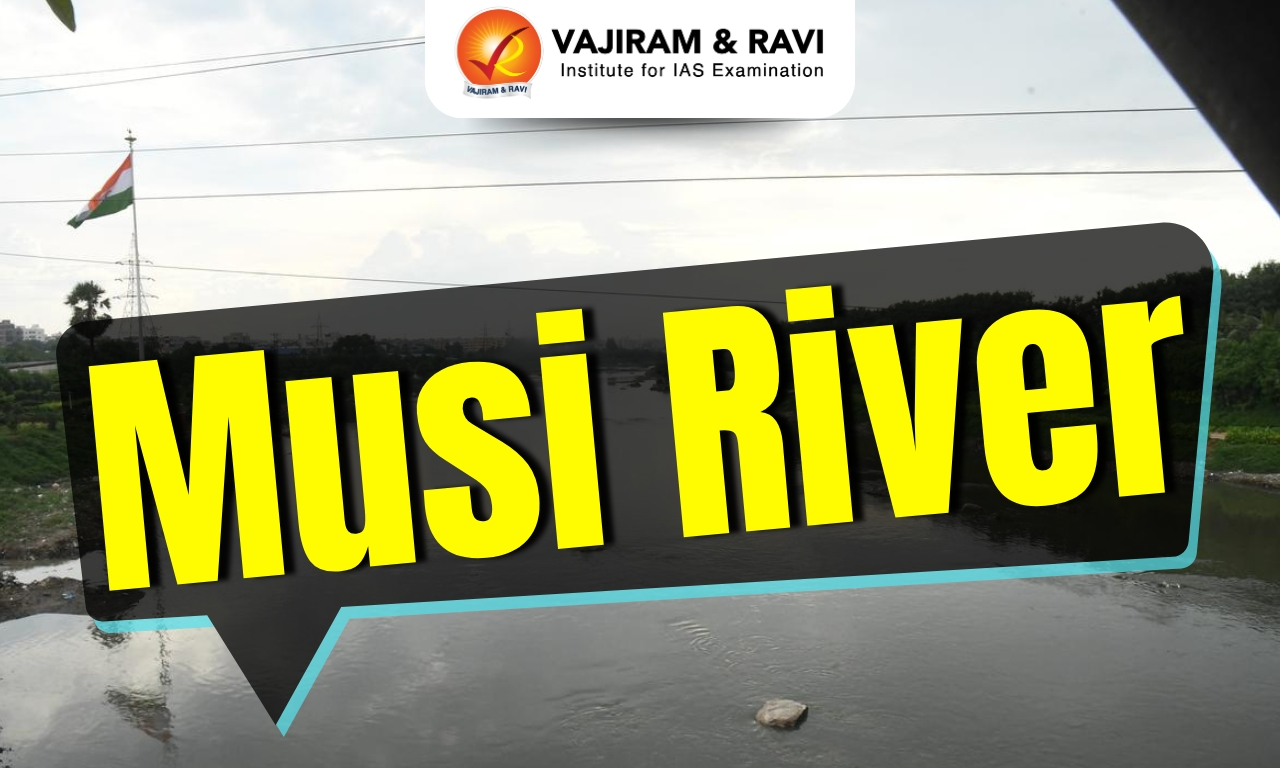
  • The Musi River, also known as the Muchukunda or Musunuru River, is a significant tributary of the Krishna River in the Deccan Plateau, flowing through Telangana.
  • The river gained prominence in the late 16th century when Muhammad Quli Qutb Shah, the founder of Hyderabad, established the city along its banks.
  • Course:
    • It originates from Anantagiri Hills in Vikarabad district on the outskirts of Hyderabad, about 100 km away from the city. 
    • The river is formed by the merging of two small rivulets: Esi (8 km) and Musa (13 km).
    • After originating, the Musi River flows in an eastward direction, cutting through the heart of Hyderabad city, where it historically divided the Old City from the New City.
    • The river then continues its journey through the southern Telangana plains.
    • It ultimately joins the Krishna River near Wazirabad in Nalgonda district.
  • Total Length: 240 kilometers.
  • Dams Across the Musi River:
    • Osman Sagar:
      • Built in 1920 after the 1908 Hyderabad floods.
      • Acts as a major source of drinking water for Hyderabad.
      • Also supports irrigation and flood control.
    • Himayat Sagar:
      • Constructed in 1927.
      • Forms another essential reservoir contributing to Hyderabad’s water supply.
    • Mir Alam Tank:
      • Built in 1806, predating both Osman and Himayat Sagar.
      • Historically supplied water to the city and remains a landmark.
  • Hussain Sagar Lake was built on a tributary of the River Musi. It was a lake of 24 kilometres, built to meet the water and irrigation needs of the city.
  • Several historic bridges and mosques line its banks, reflecting Qutb Shahi and Nizam-era architecture.
  • In 2025, the Musi River Historic Buildings in Hyderabad were listed in the World Monuments Watch, a prestigious global advocacy program by the World Monuments Fund (WMF). 
  • The Musi River has 24 diversion weirs for irrigation, locally known as kathwas.
  • Now, due to random urbanization and lack of planning the river has become a holder of all the unprocessed domestic and industrial waste drained out of Hyderabad.

News: IS

Musi River FAQs

Q1: The Musi River is a tributary of which major river?

Ans: Krishna River.

Q2: The Musi River flows through which Indian state?

Ans: Telangana.

Q3: From where does the Musi River originate?

Ans: Anantagiri Hills in Vikarabad district, Telangana.

Q4: Which major city is situated along the banks of the Musi River?

Ans: Hyderabad.

Q5: Who founded Hyderabad along the banks of the Musi River?

Ans: Muhammad Quli Qutb Shah.

Solomon Islands

Solomon Islands

Solomon Islands Latest News

Recently, the Prime Ministers of Australia and the Solomon Islands signed a bilateral security pact and the new treaty confirmed Australia's place as the Solomons' “primary security partner”.

About Solomon Islands

  • Location: It is located in the south-western Pacific Ocean. 
  • The Solomon Islands are two parallel chains of volcanic islands and small coral atolls.
  • These are situated to the southeast of Papua New Guinea and to the northwest of Vanuatu.
  • History: Once a British protectorate, the Solomon Islands achieved independence in 1978.
  • Capital: Honiara which is located on Guadalcanal, the largest island.
  • Government: It is a parliamentary democracy within the Commonwealth, with a unicameral Parliament and a ministerial system of government

Geographical Features of Solomon Islands

  • It consists of nearly 1,000 islands (6 large main islands and over 900 smaller islands), of which 147 are inhabited.
  • Topography: The country is mainly mountainous and covered in forests, although it has some extensive plains. 
  • Ethnic groups: Melanesian 93%, Polynesian 4%, Micronesian 1.5%, other 1.5%.

Bisleri Case – FSSAI Prosecution, Bromate, PAHs & Water Rules

Bisleri Case

Bisleri Case Latest News

  • FSSAI sanctioned prosecution against Bisleri International after a sample from its Goa facility was declared unsafe, a finding the company contests.

Background

  • The Food Safety and Standards Authority of India (FSSAI) is the apex food-safety regulator under the Food Safety and Standards Act, 2006. 
  • It has sanctioned prosecution against Bisleri after a packaged drinking water sample failed safety standards. 
  • Bottled water was the main drinking source for 15% of urban and 6% of rural households in 2023 (official data), so the case matters well beyond one company. 
  • Also, 333 of 1,300 enforcement samples failed in 2023-24, and 650 of 1,776 failed in 2022-23.

What Triggered the Legal Action

  • Initial finding: A sample of packaged drinking water (other than mineral water) from Bisleri's premises was non-compliant with the limit for bromate and was declared unsafe.
  • Referral lab: After the company's appeal, the Referral Food Laboratory also declared the sample unsafe, citing polynuclear aromatic hydrocarbons (PAHs).
  • Bisleri's position: 
    • The batch was made at its Goa plant in September 2025, one of 143 plants.
    • Of six samples collected on September 30, 2025, five met the standards.
    • The sixth showed bromate at 12 µg/L against a 10 µg/L limit.
    • The company says the referral lab found bromate within limits but separately detected PAHs.
    • It says an independent FSSAI-approved lab also found bromate within limits, and that it sent these results to FSSAI's Western Regional Office on February 2, 2026.
    • It heard nothing further and believed the matter was closed.

Health Risks of Bromate and PAHs

  • Bromate: 
    • An inorganic by-product of water treatment, formed when ozone used for disinfection reacts with bromide in source water.
    • IARC classifies it as possibly carcinogenic (Group 2B), based on animal studies linking it to kidney and thyroid tumours.
    • At high exposure, it can cause gastrointestinal distress, kidney injury, haemolytic anaemia and hearing loss (WHO).
    • WHO's provisional guideline value is 10 µg/L.
  • PAHs: 
    • Organic compounds from incomplete combustion of coal, oil and wood.
    • They enter water through industrial emissions, contaminated soil, or leaching from old coal-tar or bituminous pipe linings.
    • Effects vary across the group. Benzo[a]pyrene is carcinogenic to humans (IARC Group 1), and WHO's guideline for it is 0.7 µg/L.

Legal Framework Governing Packaged Water

  • Core law: Packaged water is "food" under Section 3(1)(j) of the 2006 Act. Section 16 lets FSSAI set standards, Section 31 requires licences, and Sections 26 and 27 fix compliance duties and liability on manufacturers and packers.
  • Standards: Regulations 2.10.8 (packaged drinking water) and 2.10.7 (natural mineral water) cover sources, treatment, containers, and chemical and microbiological parameters.
  • Packaging and labelling: The 2018 Packaging Regulations and 2020 Labelling and Display Regulations apply. Section 23 bars misleading labelling.
  • BIS change: FSSAI removed mandatory BIS certification in October 2024 but classed both categories as "high-risk food". This brings pre-licence inspection, annual inspection and yearly third-party audits for centrally licensed units.
  • Testing scheme from January 1, 2026: 
    • Test source water before use.
    • Run microbiological tests monthly, specified chemical tests quarterly and pesticide-residue tests every six months.
    • Test all parameters at least once every six months in an NABL-accredited lab.
    • Non-compliance triggers monthly testing until three consecutive batches comply.

Enforcement Process and Penalties

  • Food Safety Officers can inspect premises and collect samples (Sections 38 and 47). Samples are divided into four parts.
  • Disputed reports go to a Referral Food Laboratory (Section 43(2)), whose finding is final.
  • Under Section 42, the Designated Officer recommends prosecution to the State Commissioner of Food Safety for sanction.
  • Section 59 penalties for unsafe food: 
    • No injury: up to 6 months and a fine up to ₹1 lakh.
    • Non-grievous injury: up to 1 year and a fine up to ₹3 lakh.
    • Grievous injury: up to 6 years and a fine up to ₹5 lakh.
    • Death: at least 7 years, extendable to life, and a fine of at least ₹10 lakh.

What Happens Next

  • Sanction is not a finding of guilt. It is approval to start criminal proceedings, and the court will decide liability after trial.
  • Wider risks: Microplastics, nanoplastics, and chemicals such as antimony and phthalates can migrate from plastic bottles, especially with heat, sunlight or long storage.
  • Gaps and fixes: 
    • FSSAI and BIS standards do not yet require routine microplastic or plastic-derived contaminant testing.
    • Experts call for stronger municipal water infrastructure, affordable household filtration, public water-quality reports and more refill stations.

Significance

  • Millions rely on sealed bottles as a safety guarantee, yet failure rates in enforcement samples remain high.
  • The case tests the post-BIS regime of high-risk classification, mandatory testing and third-party audits.
  • It highlights the regulatory gap on microplastics and packaging-derived contaminants.
  • It shows the dispute process, where divergent lab results can complicate enforcement and prosecution.

Source: TH

Bisleri Case FAQs

Q1: Why has FSSAI sanctioned prosecution against Bisleri?

Ans: A sample from its Goa facility was declared unsafe for bromate, and the Referral Food Laboratory also cited PAHs. The company contests this.

Q2: Does the sanction mean Bisleri is guilty?

Ans: No. It only permits criminal proceedings to begin. Guilt is decided by the court after trial.

Q3: What are bromate and PAHs, and why are they harmful?

Ans: Bromate is a water-treatment by-product, possibly carcinogenic (IARC Group 2B). PAHs come from incomplete combustion, and some, such as benzo[a]pyrene, are carcinogenic.

Q4: How is packaged drinking water regulated in India?

Ans: Under the 2006 Act and Regulations 2.10.8 and 2.10.7, along with packaging and labelling rules. It is a high-risk food, with mandatory testing from January 1, 2026.

Q5: What other risks do plastic bottles pose?

Ans: Microplastics, nanoplastics, and chemicals such as antimony and phthalates can leach into water, especially in heat or sunlight. Current standards do not routinely test for them.

SEBI FPI Disclosure Rules: Balancing Foreign Investment and Transparency

SEBI FPI Disclosure Rules

SEBI FPI Disclosure Rules Latest News

  • The Securities and Exchange Board of India (SEBI) has proposed scrapping additional disclosure requirements for Foreign Portfolio Investors (FPIs) — rules originally introduced in August 2023 after the Hindenburg-Adani controversy. 
  • The move aims to make Indian markets more attractive to foreign capital, but raises fresh concerns about market transparency and the ability to trace the ultimate beneficial owners behind large foreign investments.

What Exactly Is SEBI Proposing?

  • SEBI released a consultation paper proposing to scrap the Additional Disclosure Framework (ADF) for FPIs — a day after SEBI Chairman announced plans to simplify FPI regulations.
  • Currently, under the ADF, certain FPIs must disclose detailed information about every entity invested in them, including individual investors, regardless of holding size.
  • This granular disclosure currently applies to: 
    • FPIs with more than 50% of their Indian portfolio concentrated in a single corporate group.
    • FPIs (individually or with their investor group) holding more than Rs 50,000 crore worth of Indian equities.
  • SEBI argues these rules impose considerable compliance costs, forcing global funds to: 
    • Undertake extensive investor identification exercises.
    • Sometimes create separate vehicles solely for Indian investments.
    • Repeatedly update disclosures as investors enter/exit pooled funds.
    • Struggle particularly with complex structures like fund-of-funds arrangements.
  • The proposal is open for public comments till December 11, 2026.

Why Was the ADF Introduced in the First Place?

  • The ADF emerged in August 2023, directly in response to the Hindenburg Research report on the Adani Group, which alleged that offshore FPIs were being used to conceal true beneficial ownership and potentially circumvent minimum public shareholding norms.
  • A Supreme Court-appointed expert committee found that SEBI's investigation into offshore entities investing in Adani stocks faced difficulty establishing ultimate ownership, partly because foreign regulators did not share requested information.
  • The ADF exempts certain FPI categories: foreign government/sovereign funds, foreign public retail funds, and entities listed in foreign markets.
  • Notably, SEBI later dropped allegations that offshore funds were effectively Adani-controlled vehicles used to breach shareholding norms in four Adani companies — making the current rollback proposal politically and regulatorily sensitive, since it dismantles a framework built directly from the Adani episode.

SEBI's Reasoning for Easing the Rules

  • SEBI argues that disclosure norms out of step with global practice put India at a competitive disadvantage against peer markets with more lenient rules.
  • Its consultation paper states that many foreign investors view granular disclosure as an added compliance burden, and may choose not to invest in India rather than comply.
  • SEBI also points out that existing safeguards — the Prevention of Money Laundering Act (PMLA) and the Press Note 2 (issued in March 2026) — already serve the ADF's original purpose.
    • Press Note 2 (2026 Series) amends India's Foreign Direct Investment (FDI) policy on investments from countries sharing a land border with India (LBCs).
  • Importantly, beneficial ownership disclosure will not disappear entirely: FPIs remain subject to beneficial ownership identification requirements under the Prevention of Money Laundering Rules. What's being removed is the additional, threshold-triggered, full-look-through disclosure specific to the ADF.
  • Market experts view: Called the move positive though not transformative, noting it widens FPI participation but doesn't stop SEBI from investigating individual cases if needed.

Transparency Concerns

  • FPIs operating through multi-layered offshore structures, pooled funds, and jurisdictions with limited disclosure norms can make it genuinely difficult to trace who ultimately controls capital flowing into Indian companies.
  • Removing the ADF's additional disclosure layer could weaken visibility into ownership chains, particularly for concentrated holdings or large investment positions — precisely the scenarios the ADF was designed to address.
  • Analysts note the irony: a framework built to address opacity concerns in 2023 is now being dismantled on grounds of being burdensome and globally out of step.

Will This Actually Attract More Foreign Investment?

  • Recent trend: FPIs bought a record $13 billion worth of Indian shares in November 2026.
  • However, concerns persist about sustainability: 
    • Between October 2024 and October 2026, FPIs had pulled out more than $60 billion from Indian equities.
    • This outflow added pressure on the rupee and markets, driven by the West Asia war, AI-related market disruption, high crude oil prices, and interest rate concerns.
  • While easing disclosure rules reduces compliance burden and brings India closer to global norms (like the US and other emerging markets), experts caution that actual foreign fund flows depend far more on geopolitical stability, corporate earnings, and relative valuations than on regulatory simplification alone.

Conclusion

  • SEBI's proposal reflects a deliberate trade-off: easing compliance to attract foreign capital at the potential cost of granular ownership transparency. 
  • With beneficial ownership rules under PMLA still intact, the regulator insists safeguards remain — but critics warn that dismantling the very framework born out of the Adani controversy could reopen the opacity concerns it was designed to close.

Source: IE | BL

SEBI FPI Disclosure Rules FAQ

Q1: What changes has SEBI proposed to its FPI disclosure rules?

Ans: SEBI FPI disclosure rules may be relaxed by scrapping the Additional Disclosure Framework, which requires detailed investor-level disclosures from certain foreign portfolio investors.

Q2: Why were the Additional Disclosure Framework rules introduced in 2023?

Ans: SEBI FPI disclosure rules were tightened after the Hindenburg-Adani controversy raised concerns about concealed beneficial ownership and possible violations of shareholding norms.

Q3: Which foreign portfolio investors currently face additional disclosure requirements?

Ans: SEBI FPI disclosure rules target investors with over 50% portfolio concentration in one corporate group or holdings exceeding ₹50,000 crore.

Q4: Why does SEBI want to ease additional disclosure requirements?

Ans: SEBI FPI disclosure rules are considered burdensome, potentially discouraging foreign investors and placing Indian markets at a disadvantage against competing global destinations.

Q5: Will easing disclosure requirements eliminate beneficial ownership transparency?

Ans: SEBI FPI disclosure rules may lose an additional disclosure layer, but beneficial ownership identification under the Prevention of Money Laundering Rules will continue.

Myanmar Genocide Verdict: A Landmark Ruling by the ICJ

Myanmar Genocide Verdict

Myanmar Genocide Verdict Latest News

  • The International Court of Justice (ICJ) has ruled that Myanmar committed genocide against the Rohingya ethnic group in its northern Rakhine State, making it the first sovereign State in history to be held directly responsible for genocide. 
  • The verdict arrives 78 years after the UN adopted the 1948 Genocide Convention and 82 years after lawyer Raphael Lemkin coined the term "genocide." 
  • The ruling carries significance well beyond Myanmar — including potential implications for the ongoing South Africa v. Israel case at the ICJ.

Why Holding a 'State' Responsible Is Historically Significant

  • The 1948 Genocide Convention defines genocide as acts including: killing members of a group, causing serious bodily/mental harm, deliberately inflicting conditions aimed at the group's destruction, preventing births within the group, and forcibly transferring children to another group.
  • Historically, international law has focused on individual criminal responsibility, not State responsibility: 
    • The 1945 London Charter (Nuremberg Tribunal) prosecuted individuals, not States, listing three crimes: Crimes Against Peace, War Crimes, and Crimes Against Humanity.
    • Even the Holocaust, though a genocide carried out as Nazi State policy, led to prosecution of individuals only.
    • The first Nuremberg Principle stated: "Crimes against international law are committed by men, not by abstract entities."
  • This individual-responsibility framework was later strengthened by the International Criminal Tribunals for Rwanda and Yugoslavia, and eventually codified in the 1998 Rome Statute establishing the International Criminal Court (ICC) — which still prosecutes only individuals.
  • The ICJ, by contrast, has jurisdiction over States, but historically applied an extremely high legal threshold to hold a State directly guilty of genocide.

The Legal Threshold: Why Proving Genocide Is Difficult

  • To establish a breach of the 1948 Convention, two elements must be proven:
    • Actus reus — the physical act itself.
    • Dolus specialis — the specific intent to commit genocide.
  • As per the ICJ jurisprudence, genocidal intent can only be inferred from circumstantial evidence if it is the only reasonable inference possible from that evidence — a very narrow standard.

Prior ICJ Genocide Cases: A History of Caution

  • Bosnia and Herzegovina v. Serbia and Montenegro (2007): The ICJ recognised the 1995 Srebrenica Massacre as genocide, but found Serbia's violation was limited to failing to prevent it — not direct responsibility.
  • Croatia v. Serbia (2015): The court found no dolus specialis, dismissing claims and counterclaims from both sides.
  • In both cases, the ICJ relied on findings already established by the Yugoslavia Tribunal.

What Made the Myanmar Case Different

  • In Gambia v. Myanmar, the ICJ built its reasoning independently, drawing on: 
    • The UN Independent Fact-Finding Mission on Myanmar.
    • The Independent Investigative Mechanism for Myanmar.
  • This evidence met the strict "only reasonable inference" test, allowing the court to hold Myanmar directly responsible for genocide under Article III of the 1948 Convention — distinct from merely "failing to prevent" genocide (which Myanmar was also found guilty of).
  • Crucially, the court did not lower its legal threshold — it simply found the evidence sufficient this time.

Implications for South Africa v. Israel

  • The ICJ is not a court of record — under Article 59 of its Statute, judgments bind only the parties to that specific case, with no automatic precedent for other cases.
  • The ruling itself was reached via a narrow 9-6 split among the 15 judges, reflecting continued disagreement over direct State responsibility for genocide.
  • Therefore, the Myanmar verdict has no predetermined legal bearing on the pending South Africa v. Israel (2023) case concerning Gaza.
  • However, the type of evidence the ICJ found persuasive could influence its reasoning in similar cases: 
    • Myanmar's 2017 "clearance operations" killed about 10,000 Rohingya, including over 2,000 children under five — and the court ruled that the presence of counter-insurgency objectives did not rule out simultaneous genocidal intent.
    • In Gaza, the 2026 UN Independent International Commission of Inquiry found that at least 20,179 children had been killed by Israeli actions since December 2023, with the commission stating "the essence of childhood has been destroyed" in Gaza.
    • Notably, in the Myanmar case, the killing of children was considered "foundational" to establishing genocidal intent — a parallel that could shape the ICJ's eventual approach to the Gaza case.

Conclusion

  • The Myanmar verdict breaks new ground by holding a State — not just individuals — directly accountable for genocide, while preserving the ICJ's traditionally rigorous evidentiary threshold. 
  • Though it sets no binding precedent for Gaza, its treatment of comparable evidence, particularly on child casualties and co-existing military objectives, may meaningfully shape how the world's highest court eventually judges Israel's actions.

Source: IE | TG

Myanmar Genocide Verdict FAQs

Q1: Why is the Myanmar genocide verdict historically significant?

Ans: The Myanmar genocide verdict is historic because the ICJ held a sovereign State directly responsible for genocide, moving beyond individual criminal accountability.

Q2: What are the two essential elements required to establish genocide?

Ans: The Myanmar genocide verdict applies two legal elements: actus reus, the physical act, and dolus specialis, the specific intent to destroy a protected group.

Q3: How did the ICJ establish Myanmar's responsibility for genocide?

Ans: The Myanmar genocide verdict relied on independent investigations and UN evidence that satisfied the strict legal test for inferring genocidal intent.

Q4: How does the Myanmar genocide verdict differ from earlier ICJ cases?

Ans: Unlike earlier cases, the Myanmar genocide verdict established direct State responsibility, rather than merely finding a failure to prevent genocide.

Q5: Will the Myanmar genocide verdict automatically determine the South Africa v. Israel case?

Ans: The Myanmar genocide verdict creates no binding precedent for Gaza, but its treatment of evidence may influence the ICJ's reasoning in similar proceedings.

Baliyatra Festival: President Extends Greetings for Odisha’s Historic Maritime Festival

Baliyatra Festival

Bali Jatra Festival Latest News

Recently, the President of India graced the Bali Jatra Festival 2026 at Kataka, Odisha.

About Bali Jatra Festival

  • It is celebrated annually in Cuttack, Odisha.
  • The term Bali Jatra literally means ‘Voyage to Bali’.
  • It is celebrated every year on Kartika Purnima that marks the day that the seafaring traders departed for the Indonesian islands.
  • Historical Significance of Baliyatra Festival
    • It is organised every year to commemorate the 2,000-year-old maritime and cultural links between ancient Kalinga (today’s Odisha) and Bali and other South and Southeast Asian regions like Java, Sumatra, Borneo, Burma (Myanmar) and Ceylon (Sri Lanka).
  • Celebration of Baliyatra Festival
    • The celebration features grand fairs, elaborate rides, food and dance.
    • Indian women perform ‘Boita Bandana’, they make boats of paper or banana leaf (sholapith) with lighted lamps inside and float them down the Mahanadi as a part of the celebrations.
    • The Bali Jatra celebrates the ingenuity and skill of those expert sailors who made Kalinga, one of the most prosperous empires of its time.

Source: PIB

Bali Jatra Festival FAQs

Q1: Bali Jatra Festival is celebrated in which state?

Ans: Odisha

Q2: When is the Bali Jatra Festival celebrated ?

Ans: It is celebrated every year on Kartika Purnima that marks the day that the seafaring traders departed for the Indonesian islands.

Indri Lemur: Scientists Study Gut Microbiome of Madagascar’s Critically Endangered Primate

Indri Lemur

Indri Lemur Latest News

Recently, a study showed how indri lemurs use the same method opera singers use to ensure their vocals reach the audience at the back.

About Indri Lemur

  • The indri (Indri indri ), also called the babakoto, is one of the largest living lemurs.
  • Distribution: It is found only in remote parts of northeastern Madagascar.
  • Habitat:  It resides in coastal and montane rainforest from sea level to 1,800 m.
  • Appearance
    • It is 60–70 cm (24–28 inches) long, with a rudimentary tail and large hands and feet. 
    • The round head has a pointed face and round, furry ears. 
    • Indris have smooth, silky fur covering their whole bodies. 
    • Its fur is black, with white on the head, throat, forearms, and buttocks; the relative proportions of white and black vary geographically. 
  • Life Span: In the wild, indris live between 15 and 18 years.
  • Behaviour: Active during the day and thoroughly arboreal, the indri clings to trees and climbs in an upright position.
  • Diet: It feeds on leaves, fruit, flowers, and other vegetation.
  • Conservation Status: IUCN Red List: ‘Critically Endangered’

Source: TH

Indri Lemur FAQs

Q1: Where do we find Indri Lemur ?

Ans: It is found only in remote parts of northeastern Madagascar.

Q2: What is the IUCN status of Indri Lemur ?

Ans: Critically Endangered’

Daily Editorial Analysis 25 November 2026

Daily-Editorial-Analysis

Who Pays for Climate Change is a Federal Question

Context

  • Climate change has emerged as a major global challenge, raising questions about environmental accountability, financial responsibility and federal governance.
  • Extreme weather events such as floods, wildfires, landslides and heatwaves impose enormous economic and social costs.
  • However, governments that bear the burden of climate disasters often lack the authority and financial resources to influence climate policies.
  • The central challenge is to establish climate justice, shared responsibility and cooperative federalism, ensuring that polluters and governments contribute fairly to addressing climate-related damage.

The Boulder Litigation: Holding Fossil Fuel Companies Accountable

  • In the 1990s, lawsuits against tobacco companies resulted in the 1998 Master Settlement Agreement, under which companies committed at least $206 billion over 25 years as compensation for health-related damages.
  • Inspired by this precedent, Boulder County in Colorado sued major oil and gas companies in 2018, seeking compensation for climate-related losses, including wildfires, floods and extreme heat.
  • The lawsuit invoked public nuisance and consumer protection laws.
  • In May 2025, the Colorado Supreme Court allowed the case to proceed, ruling that federal law did not pre-empt Boulder's claims under State law.
  • Oil companies, supported by the Trump administration, argue that the Clean Air Act and constitutional division of powers prevent States from imposing liability for global emissions.
  • The case has reached the U.S. Supreme Court, raising a fundamental question: Who should pay for climate disasters, and what role should States play in climate governance?

The Indian Nexus

  • India faces a similar imbalance, as States bear the consequences of climate disasters but depend heavily on the Union for financial assistance.
  • Wayanad landslides (2024)
    • The disaster caused 298 deaths and left 32 people missing. The Union took nearly five months to classify it as a disaster of severe nature.
    • Rehabilitation assistance of ₹529.50 crore was subsequently provided as a 50-year interest-free loan rather than a grant.
  • Himachal Pradesh floods (2023)
    • Against estimated losses of ₹9,042 crore, the Union released ₹633.73 crore for immediate relief and sanctioned ₹2,006.40 crore for reconstruction nearly two years later.
  • Punjab floods (2025)
    • Against the State's demand for ₹20,000 crore, the Union announced only ₹1,600 crore.

The Union Occupies the Field

  • The Air Act, 1981 and Environment Protection Act, 1986 were enacted following the Stockholm Conference of 1972.
  • Article 253 empowers Parliament to legislate on any subject to implement international agreements, allowing the Union considerable authority over environmental governance.
  • The Disaster Management Act, 2005, enacted using Concurrent List provisions, further strengthens centralisation.
  • Consequently, States have limited participation in policymaking despite their primary responsibility for disaster response.

India's Legal Framework for Climate Justice

  • K. Ranjitsinh vs Union of India (2024): Recognised protection against the adverse effects of climate change as a right under Articles 14 and 21.
  • C. Mehta vs Union of India (1987): Established absolute liability for hazardous industries.
  • Vellore Citizens Welfare Forum vs Union of India (1996): Recognised the polluter pays principle and precautionary principle.
  • National Green Tribunal Act, 2010: Empowered the tribunal to award compensation for environmental damage.
  • Despite these developments, actual polluters rarely bear the full costs of environmental degradation.
  • The gap between legal recognition and effective implementation remains substantial.

Sikkim High Court Suo Motu Proceedings: A New Direction in Climate Governance

  • In September 2026, the Sikkim High Court initiated suo motu proceedings titled In Re: Climatic Justice in the State of Sikkim, following flash floods in neighbouring Nepal.
  • The Court sought climate-risk assessments from government departments and all six districts.
  • It emphasised shifting from reactive disaster management to anticipatory and participatory climate governance.
  • For a Himalayan State vulnerable to glacial lake outburst floods and landslides, these proceedings offer an opportunity to clarify the financial and constitutional responsibilities of the Union and States.

The Way Forward: Sharing the Financial Burden

  • Climate-sensitive fiscal devolution: The Finance Commission should consider climate vulnerability and disaster exposure when distributing funds.
  • Disaster assistance through grants: States should receive grants rather than additional loans for rehabilitation and reconstruction.
  • Time-bound financial assistance: The Union must establish clear deadlines for releasing disaster relief.
  • Revenue sharing: Levies on coal and other fossil fuels should be shared with affected States.
  • Decentralised policymaking: States and local governments must participate meaningfully in climate policy, risk assessment and disaster preparedness.
  • Polluter accountability: Environmental laws must be effectively enforced to ensure industries bear the costs of environmental damage.
  • These reforms would strengthen cooperative federalism and improve India's capacity to address climate-related challenges.

Conclusion

  • Climate change is not merely an environmental issue but also a question of constitutional justice, fiscal federalism and institutional accountability.
  • The Boulder litigation raises the possibility of making fossil fuel companies financially responsible for climate damage, while India's experience exposes the financial and administrative weaknesses of centralised climate governance.
  • India must ensure equitable distribution of climate revenues, timely disaster assistance and effective polluter accountability.

Who Pays for Climate Change is a Federal Question FAQs

Q1. What was the objective of the Boulder litigation?

Ans. The litigation sought compensation from oil and gas companies for climate-related damages.

Q2. What is the significance of the 1998 Master Settlement Agreement?

Ans. It established financial accountability of tobacco companies for the harmful effects of smoking.

Q3. How does climate change affect Indian federalism?

Ans. States bear the costs of climate disasters but have limited financial resources and policymaking authority.

Q4. What did the Supreme Court establish in M.K. Ranjitsinh (2024)?

Ans. It recognised the right to protection against the adverse effects of climate change under Articles 14 and 21.

Q5. What reforms are needed for climate justice in India?

Ans. India needs decentralised climate governance, equitable revenue sharing, timely disaster grants and stronger polluter accountability.

Source: The Hindu


Transgender Women and Criminal Law - Why Legal Protection Must Go Beyond Biological Sex

Context

  • The Supreme Court (SC) is examining the constitutional validity of the Transgender Persons (Protection of Rights) Amendment Act, 2026.
  • Amid this, a related legal question has emerged: Can transgender women claim the same criminal-law protections as cisgender women (gender matches the sex assigned at birth) under statutes that use the term ‘woman’?
  • Two High Courts have adopted contrasting interpretations, highlighting the tension between biological sex, gender identity and equality before law.
  • Criminal-law protection should not be denied merely because a person's gender identity does not fit a narrow biological classification.

Two High Courts, Two Interpretations

  • Bombay HC: A transgender person identifying as a woman could invoke the pre-amendment Bharatiya Nyaya Sanhita (BNS) provision on outraging a woman's modesty, even without gender-affirming surgery.
  • Allahabad HC: Transgender women, even after gender-affirming surgery, were held outside the statutory definition of a woman in a case involving a false promise of marriage.
  • The central dilemma: Should legal protection depend on biological characteristics, surgical transition or self-perceived gender identity?

The Legal and Constitutional Framework

  • NALSA v. Union of India (2014): The SC recognised the right to self-identify one's gender as an essential aspect of dignity, autonomy and personal liberty.
  • Article 14: Guarantees equality before law and equal protection of laws. Arbitrarily excluding transgender women from relevant legal protections raises constitutional concerns.
  • Original legal framework: Under Section 7(1) of the Transgender Persons (Protection of Rights) Act 2019, a transgender person who undergoes gender-affirming surgery can seek a revised certificate recognising their gender.
  • Transgender Amendment Act, 2026: Its narrower definition of transgender identity raises additional concerns about the scope of legal recognition.

Why Transgender Women Should Be Included

  • Existing legal protection is inadequate:

    • The Transgender Persons Act provides limited penal provisions against abuse, coercion and exploitation.
    • These offences carry a maximum punishment of two years, considerably lower than punishments prescribed for several offences against women under the BNS.
    • Consequently, transgender women face a significant protection gap against sexual and gender-based violence.
  • Gender-based discrimination is not determined by biological sex alone:

    • Transgender women, including persons with intersex variations who identify as women, may experience discrimination because of their feminine gender identity.
    • Their experiences of disadvantage may differ from those of cisgender women, but this does not justify denying them legal protection.
    • Therefore, biological characteristics cannot be the sole determinant of access to gender-based legal safeguards.
  • The nature of the offence should determine protection:

    • Courts should examine whether the essential ingredients of a particular offence are satisfied rather than exclude victims solely on the basis of their sex assigned at birth.
    • For instance, where a transgender woman experiences non-consensual sexual acts falling within the statutory definition of rape, protection should not be denied merely because she is transgender.
    • This also strengthens the case for reforming sexual-offence laws towards a more gender-neutral framework.

The Way Forward - From Biological Classification to Substantive Equality

  • Inclusive judicial interpretation: Courts should interpret existing penal provisions in a manner consistent with constitutional guarantees of dignity, equality and gender identity.
  • Legislative clarity: Parliament should explicitly address the protection gap faced by transgender persons in sexual and gender-based violence.
  • Gender-neutral sexual-offence laws: Revisit existing definitions to ensure that protection is determined by the nature of the violation rather than the victim's gender classification.
  • Special protection against aggravated offences: The legislature can introduce specific provisions for crimes involving discrimination, coercion and violence against transgender persons.

Conclusion

  • The test of constitutional equality is not merely equal treatment of identical categories but protection against discrimination arising from different identities.
  • Recognising transgender women within relevant criminal-law protections would advance the constitutional values of dignity, autonomy and substantive equality.
  • The law must ensure that gender identity does not become a reason for denying justice.

Transgender Women and Criminal Law FAQs

Q1. How did the NALSA judgment (2014) transform the constitutional recognition of transgender identity?

Ans. It recognised gender self-identification as an essential component of dignity, autonomy, personal liberty and equality.

Q2. Why does the exclusion of transgender women from criminal-law protections raise concerns under Article 14?

Ans. It creates arbitrary discrimination by denying equal legal protection based solely on biological sex.

Q3. What is the major legal protection gap faced by transgender women against sexual violence?

Ans. The Transgender Persons Act provides inadequate protection compared to stronger safeguards available under the BNS.

Q4. Why should gender identity be considered while interpreting penal provisions concerning offences against women?

Ans. Because gender-based discrimination can arise from feminine identity itself.

Q5. What legal reforms are needed to strengthen protection of transgender persons?

Ans. Introduce inclusive definitions of victims in sexual-offence laws and enact specific safeguards against aggravated violence.

Source: IE


Revisiting Monthly Frequency of PLFS

Context

  • The Periodic Labour Force Survey (PLFS), launched in 2017-18 by the Ministry of Statistics and Programme Implementation, was designed to meet growing demand for frequent employment-unemployment data.
  • Since January 2025, its methodology was revamped to generate monthly estimates of key labour indicators for both rural and urban India — a move that required a massive expansion in sample size.
  • This article examines whether these monthly figures actually capture meaningful real-world change, or merely reflect statistical noise.

Original Objectives of PLFS

  • Annual estimates: Detailed labour force parameters based on a one-year reference period and a shorter one-week reference period — known as the Current Weekly Status (CWS) approach — for both rural and urban areas across States/UTs.
  • Quarterly estimates: Three key indicators — Labour Force Participation Rate (LFPR), Worker Population Ratio (WPR), and Unemployment Rate (UR) — as per CWS, for urban areas of 22 major States and all-India.
  • These parameters significantly strengthened India's labour market database since inception.

The 2025 Revamp: A Major Expansion

  • From January 2025, PLFS began producing monthly estimates of LFPR, WPR, and UR for both rural and urban areas at the national level, while also extending quarterly estimates to rural areas.
  • This required a substantial increase in sample size:
    • Households visited: Rose from about 1 lakh (old design) to around 2.7 lakh (PLFS-2025) for first-visit samples alone.
    • Sample locations (villages/urban blocks): Increased from about 12,700 to 22,594.
    • Under the revamped design, monthly data is now collected from nearly 4,100 villages and 3,400 urban blocks, covering about 49,000 rural and 40,000 urban households.

Do Monthly Numbers Actually Reflect Real Change?

  • Analysts analyzed WPR and UR (for persons aged 15+, rural and urban combined) across 10 months, January–October 2026:
    • UR estimates: 5%, 4.9%, 5.1%, 5.2%, 5.5%, 5.5%, 5.1%, 5%, 5%, 4.9%.
    • WPR estimates: 53.1%, 53.2%, 52.6%, 52.2%, 51.4%, 51.4%, 52.5%, 52.8%, 52.7%, 53%.
  • To test whether month-to-month movements are real or statistical fluctuation, they used Confidence Limits (CLs) and Confidence Intervals (CIs):
    • If two months' CIs overlap, the observed change between them is not statistically significant — meaning the "true" values could actually show no change, or even an opposite trend.

Key Finding: Most Monthly Changes Are Not Statistically Significant

  • None of the nine monthly UR changes from February to October 2026 were statistically significant compared to the preceding month.
  • Example: April 2026 (UR: 5.2%) vs. May 2026 (UR: 5.5%):
    • 95% Confidence Interval for April: 5%–5.4%.
    • 95% Confidence Interval for May: 5.3%–5.7%.
    • These ranges overlap — meaning the true UR could have been 5.4% in April and 5.3% in May, implying UR may have actually declined, despite published figures showing a rise.
  • For WPR, statistically significant monthly changes were found in only two months — May and July 2026 — out of the entire period studied.

The Core Problem

  • Despite a massive increase in sample size and survey cost, the revamped monthly PLFS largely fails to detect statistically meaningful month-to-month changes.
  • Detecting genuine monthly shifts would require an even larger sample size and a further overhaul of the sampling strategy — pushing costs higher still.
  • Given the high resource burden with limited statistical payoff, the author suggests a practical alternative: release only quarterly and annual estimates, with sample sizes calibrated appropriately for those frequencies, rather than persisting with resource-intensive monthly releases.

Conclusion

  • Frequent data isn't always meaningful data. This analysis shows that costly monthly PLFS estimates largely mirror statistical noise rather than real economic shifts — suggesting India's labour statistics system may serve citizens better by prioritising robust quarterly and annual estimates over expensive, inconclusive monthly snapshots.

Revisiting Monthly Frequency of PLFS FAQs

Q1. What were the original objectives of the Periodic Labour Force Survey (PLFS)?

Ans. PLFS aimed to generate annual labour market estimates and quarterly urban estimates of Labour Force Participation Rate, Worker Population Ratio and Unemployment Rate.

Q2. What changes were introduced in the PLFS methodology from January 2025?

Ans. The revamped PLFS introduced monthly estimates of LFPR, WPR and UR for rural and urban India, alongside quarterly rural estimates.

Q3. How does statistical significance help interpret monthly PLFS estimates?

Ans. Overlapping confidence intervals indicate that observed month-to-month changes may not be statistically significant, potentially reflecting sampling fluctuations rather than genuine labour market shifts.

Q4. What did the analysis of monthly unemployment estimates reveal?

Ans. None of the nine monthly unemployment rate changes between February and October 2026 was statistically significant compared with the preceding month.

Q5. What alternative does the article suggest for improving PLFS data quality?

Ans. The article recommends quarterly and annual PLFS estimates with appropriately calibrated sample sizes, reducing costs while prioritising statistically meaningful labour market information.

Source: TH

Daily Editorial Analysis 2026 FAQs

Q1: What is editorial analysis?

Ans: Editorial analysis is the critical examination and interpretation of newspaper editorials to extract key insights, arguments, and perspectives relevant to UPSC preparation.

Q2: What is an editorial analyst?

Ans: An editorial analyst is someone who studies and breaks down editorials to highlight their relevance, structure, and usefulness for competitive exams like the UPSC.

Q3: What is an editorial for UPSC?

Ans: For UPSC, an editorial refers to opinion-based articles in reputed newspapers that provide analysis on current affairs, governance, policy, and socio-economic issues.

Q4: What are the sources of UPSC Editorial Analysis?

Ans: Key sources include editorials from The Hindu and Indian Express.

Q5: Can Editorial Analysis help in Mains Answer Writing?

Ans: Yes, editorial analysis enhances content quality, analytical depth, and structure in Mains answer writing.

Key Facts about Ahom Dynasty

Key Facts about Ahom Dynasty

About Ahom Dynasty:

  • The Ahom Dynasty (1228–1826, called Kingdom of Assam in medieval times) was a medieval kingdom in the Brahmaputra valley in Assam that maintained its sovereignty for nearly 600 years and successfully resisted Mughal expansion in North-East India. 
  • It was able to establish its suzerainty over the Brahmaputra valley and had a profound effect on the political and social life in the region.
  • The Ahom dynasty was established by Sukaphaa, a Shan prince of Mong Mao who came to Assam after crossing the Patkai Mountains.
  • Though it came to be called the Ahom kingdom in the colonial and subsequent times, it was largely multi-ethnic, with the ethnic Ahom people constituting less than 10% of the population toward the end. 
  • The people of the kingdom used to call them 'Chaopha' or 'Swargadeo'.
  • The kingdom came under repeated Mughal attacks in the 17th century, and on one occasion in 1662,the Mughals under Mir Jumla occupied the capital, Garhgaon.
    • The Mughals were unable to keep it, and finally, during the battle of Saraighatin 1671, the Ahomsled by Lachit Borphukan successfully defeated the Mughals.
    • Borphukan is mainly known for his leadership in this battle. 
    • By 1682, the Mughal influence in the region was completely eradicated.
  • Following a period of confusion, the kingdom got itself the last set of kings, the Tungkhungia kings,established by Gadadhar Singha.
  • The kingdom became weaker with the rise of the Moamoria rebellion, and subsequently fell to a succession of Burmese invasions.
  • With the defeat of the Burmeseafter the First Anglo-Burmese War and the Treaty of Yandabo in 1826,control of the kingdompassed into British (East India Company) hands.

What are Moidams of Ahom dynasty?

  • The Moidams (also spelt as Maidam) are burial mounds of Ahom kings, queens, and noblesin Assam.
  • The name "Moidam" comes from the Tai words "Phrang-Mai-Dam" or "Mai-Tam," meaning to bury and the spirit of the dead.
  • These mounds are distinct for their architecture and reflect the Ahom’s foreign influences.
  • They are found throughout upper Assam, with Charaideo, the first Ahom capital, being the main necropolis.
  • Each Moidam has three main parts:
    • A vault or chamber where the body is placed.
    • A hemispherical earthen mound covering the chamber.
    • A brick structure (Chaw-chali) on top for annual offerings and an octagonal boundary wall with an arched gateway.
  • Originally, vaults were made of wooden poles and beams but were replaced with stone and brick during the reign of King Rudra Singha (CE 1696-1714).

Inside the vault, the dead were buried with their belongings, including clothes, ornaments, and weapons.


Q1: What is the United Nations Educational, Scientific, and Cultural Organization (UNESCO)?

It is a specialized agency of the United Nations. It was founded with the mission of contributing to peace and security by promoting international collaboration through education, science and culture.UNESCO cultural conventions and projects provide platforms for international cooperation and establish a holistic cultural governance system based on human rights and shared values. UNESCO has 193 member States and 11 associate members.

Source: UNESCO adds Assam’s Ahom Dynasty Moidams to World Heritage list

Enquire Now