Balakot Airstrike, Background, Operation & Strategic Significance

Balakot Airstrike

The Balakot Airstrike was a precision air operation conducted by the Indian Air Force on 26 February 2019 against a Jaish-e-Mohammed training camp at Balakot in Pakistan’s Khyber Pakhtunkhwa province in response to the Pulwama terror attack. It was the first Indian airstrike inside mainland Pakistan since the 1971 war.

Balakot Strike Background: The Pulwama Attack

On February 14, 2019, a convoy of Central Reserve Police Force (CRPF) vehicles was targeted by a suicide bomber on the Jammu-Srinagar National Highway near Pulwama, Jammu & Kashmir. The attack killed 40 CRPF personnel, making it one of the deadliest terrorist strikes on Indian security forces in decades.

The Pakistan-based terrorist organisation Jaish-e-Mohammed (JeM), led by Masood Azhar, claimed responsibility for the attack. The attacker, Adil Ahmad Dar, was a local recruit who had been radicalised and trained under JeM’s operational network operating from Pakistani soil. India’s immediate response included:

  • Withdrawal of Most Favoured Nation (MFN) status granted to Pakistan under WTO framework.
  • Imposition of 200% customs duty on Pakistani imports.
  • Intense diplomatic outreach to isolate Pakistan internationally and build a coalition against state-sponsored terrorism.
  • Demands for Pakistan to dismantle terrorist infrastructure operating on its territory.

Pakistan denied any state involvement in the Pulwama attack, a position that India and much of the international community found unconvincing given the established infrastructure of JeM on Pakistani soil.

About the Balakot Airstrike

In the early hours of February 26, 2019, the Indian Air Force (IAF) conducted a precision airstrike deep inside Pakistani territory, targeting a Jaish-e-Mohammed training camp in Balakot, located in the Khyber Pakhtunkhwa (KPK) province of Pakistan — well beyond the Line of Control (LoC). India justified the strike under Article 51 of the UN Charter, which recognises the right to self-defence in case of an armed attack. 

Key Operational Facts: 

  • Date of strike: 26 February 2019
  • Conducting force: Indian Air Force
  • Aircraft used: Mirage 2000 fighter jets
  • Weapons used: SPICE-2000 precision-guided munitions
  • Target: Jaish-e-Mohammed training camp at Balakot
  • Location: Khyber Pakhtunkhwa province, Pakistan
  • Duration: Approximately 20–21 minutes operation window

Strategic Significance of Location: The choice of Balakot was deliberately significant. 

  • Unlike the 2016 Surgical Strikes, which targeted terror launch pads across the Line of Control in Pakistan-Occupied Kashmir (PoK), the Balakot strike penetrated internationally recognised Pakistani territory in Khyber Pakhtunkhwa. 
  • This was the first Indian Air Force strike inside Pakistan proper since the 1971 war, marking a qualitative escalation in India’s response threshold.
  • India’s Foreign Secretary Vijay Gokhale described the strike as a “non-military pre-emptive action” — a carefully calibrated phrase designed to signal decisive intent while avoiding the language of conventional warfare, thereby limiting escalation pressure.

Pakistan’s Response to Balakot Strike

  • Pakistan denied India’s claim that the Balakot airstrike caused significant damage or casualties and stated that the strike violated its airspace.
  • On 27 February 2019, Pakistan carried out retaliatory air action under Operation Swift Retort, targeting Indian military positions across the Line of Control (LoC) in Jammu & Kashmir.
  • This led to an aerial engagement between the Indian and Pakistani Air Forces
  • During the encounter, an Indian MiG-21 Bison was shot down and Wing Commander Abhinandan Varthaman ejected and landed in Pakistani territory.
  • Pakistan claimed additional Indian aircraft were downed, which India denied.
  • The episode marked a sharp escalation in India–Pakistan tensions, which was later de-escalated after Pakistan released Wing Commander Abhinandan on 1 March 2019.

International Reactions after Balakot Strike 

India framed the Balakot strike as a counter-terrorism operation, not an act of war against the Pakistani state. This framing was strategically important — it sought international legitimacy under the right of self-defence while avoiding the legal and political complications of declaring a war footing.

India briefed all major powers — the United States, Russia, China, France, the United Kingdom, and Gulf states — within hours of the strike, demonstrating diplomatic preparedness alongside military action.

  • United States: Called for restraint from both sides while privately acknowledging India’s right to self-defence.
  • China: Urged de-escalation, reflecting its strategic partnership with Pakistan while avoiding open condemnation of India.
  • Gulf States (UAE, Saudi Arabia): Played an active mediatory role, engaging both Islamabad and New Delhi to prevent further escalation.
  • UNSC: No formal resolution was passed; the incident was discussed informally, with no consensus condemnation of India.

Balakot Strike Significance

The Balakot Airstrike represents the most significant shift in India’s counter-terrorism doctrine since independence. It reflected a transition from strategic restraint to proactive and calibrated military deterrence against cross-border terrorism.

  • For decades after major terrorist attacks such as the 2001 Parliament attack and the 2008 Mumbai attacks, India largely relied on diplomatic and political responses. Military retaliation across the international boundary was avoided due to concerns related to nuclear escalation, international pressure, and regional stability.
  • A shift began after the Uri attack in 2016, when India conducted surgical strikes across the Line of Control targeting terrorist launch pads in Pakistan-occupied Kashmir. 
  • The Balakot Airstrike in 2019 marked a further escalation in India’s response doctrine. By targeting a terror camp inside mainland Pakistan, India demonstrated its willingness to use air power beyond the LoC in response to major terrorist attacks, despite the risks of conventional escalation.
  • The doctrinal evolution further continued with Operation Sindoor in 2025, which involved coordinated multi-domain precision strikes on terrorist infrastructure across Pakistan and Pakistan-occupied Kashmir following the Pahalgam terror attack.
  • The Balakot strike also challenged the assumption that Pakistan’s nuclear capability would prevent India from undertaking military action across the international boundary. 
  • At the strategic level, the operation demonstrated India’s growing precision-strike capability, improved intelligence coordination, and integration of military and diplomatic responses in counter-terror operations.

Balakot Strike FAQs

Q1: What was the Balakot Airstrike?

Ans: The Balakot Airstrike was a precision air operation conducted by the Indian Air Force on 26 February 2019 against a Jaish-e-Mohammed training camp in Balakot, Pakistan.

Q2: Why was the Balakot strike strategically significant?

Ans: The strike targeted mainland Pakistani territory beyond Pakistan-occupied Kashmir, making it the first Indian airstrike inside Pakistan since the 1971 war.

Q3: Under which legal principle did India justify the strike?

Ans: India justified the operation under Article 51 of the UN Charter, which recognises the right to self-defence against armed attacks.

Q4: What was Operation Swift Retort?

Ans: Operation Swift Retort was Pakistan’s retaliatory air operation conducted on 27 February 2019 after the Balakot strike.

Q5: How did the Balakot strike change India’s counter-terrorism doctrine?

Ans: The strike marked a shift from strategic restraint to proactive and calibrated military deterrence against cross-border terrorism.
Dollar-Rupee Swap Auction, Meaning, Reasons, Advantages, Concerns

Dollar-Rupee Swap Auction

The Reserve Bank of India (RBI), recently announced a $5 billion dollar-rupee buy/sell swap auction for a tenor of three years to infuse durable liquidity into the banking system amid tight liquidity conditions and continued pressure on the rupee, which has slipped below the 96-mark against the US dollar.

About Dollar-Rupee Swap Auction

  • The Dollar-Rupee Swap Auction is a liquidity management tool used by the Reserve Bank of India (RBI) to inject durable liquidity into the banking system
  • The move comes amid tight liquidity conditions and a sharp depreciation of the rupee, which has weakened significantly against the US dollar due to global uncertainties, geopolitical tensions, and strong dollar demand.
  • In essence, the instrument allows the central bank to provide rupee liquidity to banks without permanently expanding money supply or significantly altering foreign exchange reserves.

Dollar-Rupee Swap Auction Working Mechanism

The dollar-rupee swap operates as a buy-sell foreign exchange arrangement. 

  • Under this mechanism, banks sell US dollars to the RBI in exchange for rupees at the start of the transaction.
  • Both sides enter into an agreement that the transaction will be reversed after a fixed period at a pre-agreed rate determined through auction premiums.
    • In the current case, banks will buy back the dollars after three years by returning the rupees to the RBI.
  • The RBI conducts the auction where participants bid the premium they are willing to pay, quoted in paisa terms up to two decimal places. 
  • The auction follows a multiple-price mechanism, meaning successful bidders pay their individual quoted premiums rather than a uniform rate.
  • The minimum bid size is $10 million, with additional bids allowed in multiples of $1 million
  • The final cut-off is determined based on competitive bidding.

Dollar-Rupee Swap Auction Reasons

  • The primary reason behind the swap is to address liquidity tightness in the banking system. Persistent global uncertainty and capital flow volatility have strained domestic liquidity conditions.
  • At the same time, the rupee has depreciated sharply, at one point slipping below the 96 mark against the US dollar. This reflects strong global dollar demand, higher interest rates in advanced economies, and geopolitical instability.
  • The RBI’s intervention through the swap aims to ensure adequate long-term rupee liquidity while maintaining stability in currency markets.
  • It also supports credit growth by improving the availability of funds for banks and strengthens monetary policy transmission.

Difference Between Dollar–Rupee Swap and Open Market Operations (OMO)

  • Open Market Operations involve the RBI buying or selling government securities in the domestic bond market to regulate short-term liquidity. 
  • OMOs primarily affect interest rates and rupee liquidity through bond markets.
  • In contrast, Dollar–Rupee swaps involve foreign exchange transactions where liquidity is injected by exchanging US dollars for rupees. This directly impacts forex reserves temporarily but does not permanently alter them.
  • While OMOs are domestic and rupee-centric, swap auctions are external-sector linked and help manage both liquidity and exchange rate pressures simultaneously.
  • OMOs generally address short-term liquidity mismatches, whereas swaps are often used for longer-term liquidity infusion, as seen in the three-year tenor announced in this case.

Dollar-Rupee Swap Auction Advantages

  • The swap mechanism provides durable liquidity to the banking system without permanently expanding the monetary base. This helps maintain macroeconomic stability while addressing liquidity shortages.
  • It  reduces pressure on short-term interest rates by ensuring smoother transmission of monetary policy.
  • It supports financial stability during periods of currency volatility, as it reduces immediate dollar demand in the market.
  • Since the swap is reversible, it does not permanently deplete foreign exchange reserves, making it a balanced tool for managing external and internal pressures.

Dollar-Rupee Swap Auction Concerns

Despite its benefits, the swap mechanism carries certain risks. 

  • One concern is the potential future pressure on foreign exchange reserves when banks repurchase dollars after the swap period ends.
  • There is also exchange rate risk, as future dollar repayment obligations may become more expensive if the rupee weakens further.
  • Additionally, excessive reliance on such instruments may indicate structural liquidity issues in the banking system rather than temporary mismatches.
  • Market distortion is another concern, as large-scale interventions can sometimes mask underlying volatility rather than resolve it.

Dollar-Rupee Swap Auction Way Forward

  • Going forward, the RBI may need to use a balanced mix of liquidity tools, including OMOs, variable rate repos, and forex swaps, depending on evolving market conditions.
  • Strengthening domestic capital inflows and reducing external vulnerabilities will also be crucial to stabilise the rupee in the long term.
  • Improving liquidity forecasting frameworks and enhancing transparency in intervention strategies can further strengthen market confidence.

Dollar-Rupee Swap Auction FAQs

Q1: What is a Dollar-Rupee Swap Auction?

Ans: It is a tool used by the RBI where banks exchange US dollars for rupees with an agreement to reverse the transaction after a fixed period, helping inject durable liquidity into the banking system without permanently affecting money supply or forex reserves.

Q2: Why does the RBI use Dollar-Rupee Swap Auction?

Ans: Dollar-Rupee Swap Auction is used to address liquidity tightness in the banking system, manage pressure on the rupee, and stabilise financial markets during periods of global uncertainty and volatile capital flows.

Q3: How does Dollar-Rupee Swap Auction work?

Ans: Under Dollar-Rupee Swap Auction, banks sell US dollars to the RBI and receive rupees, and later repurchase the same dollars after a fixed tenure at a rate discovered through competitive bidding in an auction-based mechanism.

Q4: How is Dollar-Rupee Swap Auction different from Open Market Operations (OMO) ?

Ans: Dollar-Rupee Swap Auction involves foreign exchange transactions that provide longer-term liquidity and manage external sector pressures, whereas Open Market Operations use government securities to manage short-term domestic liquidity conditions.

Q5: What are the key concerns related to Dollar-Rupee Swap Auction?

Ans: Key concerns of Dollar-Rupee Swap Auction include future dollar repayment pressure, exchange rate risk if the rupee weakens further, and the possibility that it reflects underlying structural liquidity stress in the banking system.

Rivers and Lakes in News 2025-2026, National and International

Rivers and Lakes in News 2025-2026

Rivers and Lakes in News 2025-2026 were highlighted globally because of climate change, pollution, dam construction, droughts, floods, ecological decline and water management concerns. These water bodies are important for biodiversity, agriculture, trade, transport, hydropower and human settlements. Many of them also highlight the growing impact of human activities on fragile freshwater ecosystems.

Rivers and Lakes in News 2025-2026

Many important Rivers and Lakes in News 2025-2026 are due to environmental stress, geographical importance, floods, droughts, conservation concerns and strategic infrastructure developments worldwide.

Kunar River

India supported Afghanistan’s proposed dam project on the transboundary Kunar River flowing through eastern Afghanistan and northern Pakistan.

  • The river originates from the Chiantar Glacier in the Hindu Kush Mountains near Gilgit-Baltistan and Chitral region of Pakistan.
  • Kunar River joins the Kabul River in Afghanistan and the combined waters later merge with the Indus River in Pakistan.
  • Major tributaries include Lutkho, Landai Sin, Shishi and Pech River, making it part of the larger Indus Drainage System.

Seine River

The Seine River became globally important after public swimming was permitted again for the first time since 1923.

  • The river flows completely within France and passes through Paris, where it is joined by the Marne River near the city.
  • Seine River empties into the English Channel at Le Havre and stretches nearly 775 kilometres across northern France.
  • Its drainage basin covers around 79,000-80,000 square kilometres, making it France’s second longest river after the Loire.

Zambezi River

The Zambezi River remained in news because of water concerns and its importance for hydropower generation in southern Africa.

  • It originates from the Kalene Hills in Zambia and flows through or borders Zambia, Angola, Botswana, Zimbabwe, Mozambique and DR Congo.
  • Victoria Falls lies on the Zambia-Zimbabwe border, while Kariba Dam forms one of the world’s largest reservoirs by volume.
  • Cahora Bassa Dam and Cahora Bassa Lake are important features located in Mozambique before the river drains into the Mozambique Channel.

Potomac River

The Potomac River gained attention due to rising pollution levels and high E. coli contamination from untreated wastewater discharge.

  • The river originates from Green Spring in West Virginia and drains into Chesapeake Bay along the Atlantic coast of the USA.
  • Washington D.C., the capital city of the United States, is situated along the banks of the Potomac River.
  • Potomac River was officially designated as the “Sister River” of Japan’s Arakawa River because both flow through national capital regions.

Arakawa River

Japan’s Arakawa River remained in discussions because of its ecological and cultural relationship with the Potomac River of the USA.

  • The river originates from Mount Kobushi in Japan and drains into Tokyo Bay near the Japanese capital region.
  • Tokyo is situated along the Arakawa River, similar to Washington D.C. being located on the Potomac River banks.
  • Cherry blossom landscapes along both rivers strengthened cultural exchange under the international “Sister River” partnership initiative.

Tapajós River

Brazil’s Tapajós River entered news due to historic drought conditions and severe decline in water levels linked to climate change.

  • The river is entirely located within Brazil and forms an important part of the Amazon River Basin system.
  • It originates in Mato Grosso and later joins the Amazon River before draining into the Atlantic Ocean.
  • Dredging plans and water scarcity emergency declarations in lower stretches triggered concerns among indigenous communities and environmental groups.

Mekong River

The Mekong River remained in focus because of sand mining, dam construction and ecological threats affecting Southeast Asia.

  • The river originates in China’s Tangula Mountains and flows through China, Myanmar, Laos, Thailand, Cambodia and Vietnam.
  • Intensive sand mining in the Vietnamese Mekong Delta disrupted natural sediment replenishment and damaged local ecosystems.
  • Tonlé Sap Lake in Cambodia, Southeast Asia’s largest freshwater lake, is also facing ecological stress due to upstream developments.

Paraná River

The Paraná River witnessed ecological and economic concerns because of declining water levels affecting transportation and trade activities.

  • The river basin spreads across Brazil, Paraguay, Argentina and Uruguay before draining into the Atlantic Ocean.
  • Falling water levels disrupted soybean oil transportation routes in Argentina and affected regional commercial navigation systems.
  • Important cities associated with the basin include Brasília, São Paulo, Asunción and Buenos Aires across South America.

Great Ruaha River

The Great Ruaha River in Tanzania faced severe environmental stress due to climate change and poor water management practices.

  • The river originates in the Kipengere Mountains and flows through wetlands of the Usangu Valley and Ruaha National Park.
  • Reports highlighted drying conditions in several stretches, threatening wildlife habitats and freshwater availability in the region.
  • It later joins the Kisigo and Kilombero Rivers before becoming part of the Rufiji River system draining into the Indian Ocean.

Colorado River

The Colorado River remained important because of major water loss linked to climate crisis, glacier melt and prolonged drought conditions.

  • The river originates in the Rocky Mountains of Colorado and drains into the Gulf of California near Mexico.
  • Over 10 trillion gallons of water have reportedly been lost from the basin during the past two decades.
  • Major American cities such as Las Vegas, Los Angeles and San Diego depend heavily on Colorado River water resources.

Yangtze River

China’s Yangtze River remained in international news because of flooding events and rising water levels near the Three Gorges Dam.

  • The river originates from the Tangula Mountains and flows eastward entirely within China before entering the East China Sea.
  • It is Asia’s longest river at nearly 6,300 kilometres and the third longest river in the world after the Nile and Amazon.
  • Fishing restrictions introduced on the river helped revive fish populations after years of ecological degradation and overexploitation.

Flint River

The Flint River in the United States witnessed environmental concern due to climate related stress, floods, droughts and human pressures.

  • The river originates in Georgia, USA and ultimately drains into the Apalachicola River through Lake Seminole.
  • It is recognised for rich biodiversity and ecological importance within the southeastern region of the United States.
  • Increasing climate variability and expanding human activities are placing growing pressure on freshwater ecosystems of the river basin.

Herbert River

Australia’s Herbert River became significant after severe flooding in North Queensland caused record rise in river water levels.

  • The river originates from the Great Dividing Range and later drains into the Coral Sea connected to the Pacific Ocean.
  • Extreme rainfall and flood events highlighted the growing frequency of climate linked hydrological disasters in Australia.
  • Floodwaters affected settlements, transportation networks and agricultural regions dependent on the river basin for livelihoods.

Lohit River

The Lohit River remained important because of proposed hydroelectric projects and ecological sensitivity in the eastern Himalayan region.

  • Lohit River is a major tributary of the Brahmaputra River and flows through Arunachal Pradesh and Assam.
  • It is sometimes called the “River of Blood” because of the reddish coloration observed in its waters.
  • The river basin supports habitats of the endangered White Bellied Heron and forms part of the eastern Himalayan river system.

Litani River

Lebanon’s Litani River gained geopolitical importance because of security concerns and defence activities near the river region.

  • Litani River is the longest river in Lebanon with an estimated length of nearly 170 kilometres.
  • The river has an annual water carrying capacity of around 750 million cubic metres supporting irrigation and water supply.
  • Israel’s defence measures near the river area increased attention on the strategic importance of southern Lebanon’s river systems.

Lake Sapanca

Lake Sapanca entered news due to water stress concerns and discussions over freshwater management in Türkiye.

  • It is a tectonic freshwater lake situated in Sakarya Province between the Gulf of İzmit and Adapazarı Meadow.
  • The lake lies parallel to Lake İznik and is surrounded by mountains in the south and smaller hills in the north.
  • Small streams from nearby mountains feed the lake, which serves as an important domestic and industrial freshwater source.

Lake Turkana

Lake Turkana remained in news because of climate change, falling water levels and geological activity associated with tectonic movements.

  • The lake lies mainly in Kenya’s Great Rift Valley, while its northern extension reaches southwestern Ethiopia.
  • It is the world’s largest permanent desert lake and largest alkaline lake, popularly called the “Jade Sea” due to turquoise waters.
  • Omo River contributes nearly 90 percent of total inflow, while Turkwel and Kerio Rivers are other important sources.
  • Lake Turkana gained conservation importance because of its ecological and anthropological significance in East Africa.
  • The Turkana Basin became a UNESCO World Heritage Site in 1997 because of exceptional natural and archaeological importance.
  • The region is known as the “Cradle of Humankind” because numerous hominin fossils have been discovered there.
  • Lake Turkana also supports the world’s largest breeding colony of Nile crocodiles within its fragile desert ecosystem.

Great Bitter Lake

Great Bitter Lake remained important because of its strategic location within Egypt’s globally significant Suez Canal system.

  • The lake is a saltwater body located between the Mediterranean Sea and Red Sea through canal connectivity.
  • It originally existed as a dry salt valley before construction activities transformed it into a navigable water body.
  • The Suez Canal route shortened maritime trade distance between Europe and Asia by nearly 7,000 kilometres.

Aral Sea

The Aral Sea continued to symbolise one of the world’s worst environmental disasters caused by excessive human intervention.

  • It is an endorheic saltwater lake situated between Kazakhstan in the north and Uzbekistan in the south.
  • The lake lost nearly three-fourths of its volume and almost half its surface area due to irrigation overuse and dam projects.
  • Diversion of Amu Darya and Syr Darya rivers for agriculture became the primary reason behind rapid shrinkage of the Aral Sea.

Lake Tulare

Lake Tulare in California returned to news after reappearing more than a century after its disappearance.

  • The lake revived during 2023 because of intense atmospheric river events and large inflows from nearby river systems.
  • Kings, Tule and Kern Rivers originating from Sierra Nevada Mountains contributed to the lake’s re-emergence.
  • Historically, it was considered the largest freshwater lake west of the Mississippi River in the United States.

Lake Chad

Lake Chad remained important because of rapid shrinkage linked to climate change, irrigation demand and prolonged drought conditions.

  • The lake is shared by Nigeria, Niger, Chad and Cameroon in the Sahel region of Africa.
  • Nearly 90 percent of the lake’s area has disappeared over past decades because of water overuse and declining rainfall.
  • Shrinking water availability increased migration pressures, socio-economic instability and competition over land and water resources.

Lake Kariba

Lake Kariba gained attention due to falling water levels affecting hydropower generation and regional energy security.

  • It is a large man made reservoir created on the Zambezi River during dam construction in the 1950s.
  • The reservoir is shared between Zambia and Zimbabwe and remains important for electricity generation in southern Africa.
  • Reduced inflows and drought conditions negatively impacted aquatic ecosystems and hydroelectric power production capacity.

Lake Retba

Lake Retba in Senegal remained significant because of environmental changes affecting its famous pink coloration and water levels.

  • The lake is popularly known as the “Pink Lake” because of halophilic algae thriving in highly saline conditions.
  • Rising temperatures and milder winters contributed to shrinking water levels and ecological stress within the lake.
  • Lake Retba demonstrates how climate change can threaten even unique natural phenomena dependent on delicate environmental balance.

Prespa Lakes

Prespa Lakes remained environmentally important because of shrinking water levels, pollution and transboundary conservation challenges.

  • These freshwater lakes are located between Greece, Albania and North Macedonia in southeastern Europe.
  • The lakes are recognised as Ramsar Sites because of their ecological significance and biodiversity importance.
  • Climate change and pollution pressures increased concerns regarding long term sustainability of the fragile freshwater ecosystem.

Lake Urmia

Lake Urmia in Iran continued to attract global concern because of severe shrinkage caused by drought and river diversion projects.

  • It is an endorheic salt lake and was once the largest saltwater lake in the Middle East.
  • Zarrineh and Simineh Rivers feed the lake, while high evaporation levels increase overall salinity concentration.
  • Nearly 95 percent of its water has disappeared because of dam construction, water diversion and prolonged climate stress. 
  • Lake Urmia remained ecologically important because of its wetland ecosystem and biodiversity despite severe environmental decline.
  • The lake is recognised as a Ramsar type wetland ecosystem with important ecological and conservation value.
  • High salinity conditions support specialised organisms and migratory bird species including flamingos.
  • Drying conditions increased dust storms and environmental health risks for nearby settlements in Iran.

Rivers and Lakes in News 2025-2026 FAQs

Q1: Why is the Aral Sea called an environmental disaster?

Ans: The Aral Sea is called an environmental disaster because excessive irrigation and river diversion caused major shrinkage of the lake and severe ecological damage.

Q2: Which lake is known as the Pink Lake?

Ans: Lake Retba in Senegal is known as the Pink Lake because of its naturally pink water caused by salt loving algae.

Q3: Which river is called the River of Blood in India?

Ans: The Lohit River in Arunachal Pradesh is called the “River of Blood” because of the reddish colour often seen in its waters.

Q4: Why is Lake Chad shrinking rapidly?

Ans: Lake Chad is shrinking rapidly because of climate change, low rainfall, irrigation overuse and increasing water demand in the Sahel region.

Q5: Which river is associated with Victoria Falls?

Ans: The Zambezi River is associated with Victoria Falls located on the border of Zambia and Zimbabwe in southern Africa.

4th Schedule of Indian Constitution, Provisions, States, Articles

4th Schedule of Indian Constitution

The 4th Schedule of Indian Constitution discusses how seats in the Rajya Sabha are allocated among various states and Union Territories. Out of the total 250 seats, 238 are elected members representing States and Union Territory, while 12 are nominated by the President for their expertise in fields like literature, science, art, and social service. Originally, the Constitution had just eight schedules. The total went up to twelve over time through amendments.

4th Schedule of Indian Constitution

The 4th Schedule of Indian Constitution deals with the allocation of seats in the Rajya Sabha (Council of States). It specifies how many seats each State and Union Territory allocated in the Rajya Sabha. Elected members (238) are chosen through indirect elections by the elected members of State Legislative Assemblies. 12 members are nominated by the President for their contribution to arts, science, literature, and social service. The allocation of seats is not uniform,  it usually varies based on the population of each State and Union Territory. Though the Rajya Sabha has a maximum strength of 250, the current strength is 245:

  • 233 are elected members from States and UTs
  • 12 are nominated members by the President

Also Check:

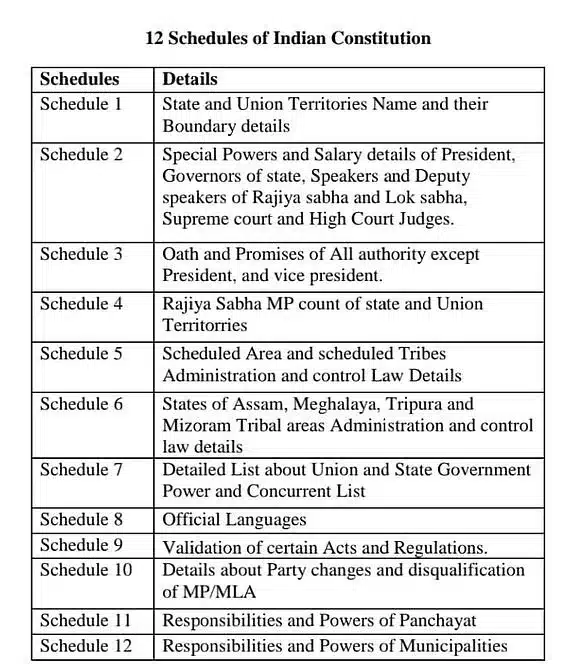
Schedule of Indian Constitution

The Constitution of India was adopted on January 26, 1950 which consists of 8 Schedules initially which expanded to 12 Schedule of Indian Constitution through amendment.

4th Schedule of Indian Constitution History

In 1949, when the Indian Constitution was adopted, the idea was to have 217 seats in the Rajya Sabha from which 205 elected and 12 nominated. By the time the Constitution of India came into force in 1950, the seats were adjusted to 216 seats, 204 elected and 12 nominated. Over the years, the number of elective seats has increased in response to new states being formed, territories reorganized and population changes:

  • 1954: 204 elected seats
  • 1956: Increased to 207
  • 1970: Increased again to 220
  • Present: 238 elective seats allotted; currently, 233 are filled

4th Schedule of Indian Constitution Articles

The 4th Schedule of Indian Constitution is linked to Articles 4(1) and 80(2).

  • Article 4(1) explains that when Parliament passes a law under Article 2 or 3 (which deals with the formation or alteration of states), it must also include changes to the First and Fourth Schedules, wherever necessary.
  • Article 80(2) deals with the Rajya Sabha (Council of States) and says that the number of seats allocated to each State and Union Territory must follow the structure laid out in the Fourth Schedule.

4th Schedule of Indian Constitution Provisions

  • The Rajya Sabha (Council of States) can have a maximum of 250 members.
  • Out of these, 238 seats are allocated to States and Union Territories, while 12 members are nominated by the President for their expertise in fields like literature, science, art, and social service.
  • As of now, the total strength of Rajya Sabha is 245 with 233 elected members from States and Union Territories and 12 nominated members.
  • The elected members are chosen by the elected MLAs (Members of Legislative Assemblies) of each State and Union Territory.
  • The election process follows the system of proportional representation by means of a single transferable vote, ensuring fair representation for political parties based on their strength in the State Assemblies.

List of Seats Allocated to State and Union Territory

The 4th Schedule of Indian Constitution outlines how seats in the Rajya Sabha are distributed among the States and Union Territories. Uttar Pradesh has the highest representation with 31 seats in the Rajya Sabha. Some Union Territories like Andaman and Nicobar Islands and Chandigarh have no seats allotted. The table below includes the List of Seats Allocated to State and Union Territory:

List of Seats Allocated to State and Union Territory
State/Union Territory Number of Seats

Total

233

Uttar Pradesh

31

Maharashtra

19

Tamil Nadu

18

West Bengal

16

Bihar

16

Karnataka

12

Madhya Pradesh

11

Gujarat

11

Andhra Pradesh

11

Rajasthan

10

Odisha

10

Kerala

9

Telangana

7

Punjab

7

Assam

7

Jharkhand

6

Chhattisgarh

5

Haryana

5

Jammu and Kashmir

4

Himachal Pradesh

3

National Capital Territory of Delhi

3

Uttarakhand

3

Arunachal Pradesh

1

Goa

1

Manipur

1

Nagaland

1

Mizoram

1

Meghalaya

1

Puducherry

1

Sikkim

1

Tripura

1

Lakshadweep

0

Daman and Diu

0

Dadra and Nagar Haveli

0

Andaman and Nicobar Islands

0

Chandigarh

0

4th Schedule of Indian Constitution FAQs

Q1: What does the 4th Schedule of the Constitution deal with?

Ans: It allocates seats to each state and union territory in the Rajya Sabha (Council of States).

Q2: Under which Article is the 4th Schedule covered?

Ans: It is mentioned under Article 4 and Article 80 of the Indian Constitution.

Q3: How many total seats are there in the Rajya Sabha?

Ans: The Rajya Sabha has a maximum strength of 250 members, currently 245.

Q4: On what basis are seats allotted to states?

Ans: Seats are allocated based on the population of each state and union territory.

Q5: Do Union Territories have representation in the Rajya Sabha?

Ans: Yes, some Union Territories like Delhi and Puducherry have Rajya Sabha representation.

UPSC Daily Quiz 23 May 2026

UPSC Daily Quiz

[WpProQuiz 166]

UPSC Daily Quiz FAQs

Q1: What is the Daily UPSC Quiz?

Ans: The Daily UPSC Quiz is a set of practice questions based on current affairs, static subjects, and PYQs that help aspirants enhance retention and test conceptual clarity regularly.

Q2: How is the Daily Quiz useful for UPSC preparation?

Ans: Daily quizzes support learning, help in revision, improve time management, and boost accuracy for both UPSC Prelims and Mains through consistent practice.

Q3: Are the quiz questions based on the UPSC syllabus?

Ans: Yes, all questions are aligned with the UPSC Syllabus 2025, covering key areas like Polity, Economy, Environment, History, Geography, and Current Affairs.

Q4: Are solutions and explanations provided with the quiz?

Ans: Yes, each quiz includes detailed explanations and source references to enhance conceptual understanding and enable self-assessment.

Q5: Is the Daily UPSC Quiz suitable for both Prelims and Mains?

Ans: Primarily focused on Prelims (MCQ format), but it also indirectly helps in Mains by strengthening subject knowledge and factual clarity.

Operation Navjeevan, Aim, Impact, Key Details

Operation Navjeevan

Under Operation Navjeevan, 27 Maoists, including commanders and strike squad members of the banned Communist Party of India (Maoist) and Jharkhand Jan Mukti Parishad (JJMP), surrendered before Jharkhand Police in Ranchi on May 21, 2026. The surrender marks a key success in Jharkhand’s anti-Naxal strategy.

About Operation Navjeevan

Operation Navjeevan is a surrender and rehabilitation-driven initiative of the Jharkhand Police aimed at - weakening maoist organisational structure, encouraging cadres to leave violence and reintegrating surrendered members into mainstream society

Operation Navjeevan Impact 

  • Maoists surrendered in Ranchi in the presence of senior police officials, including the Director General of Police. 
  • The surrendered group included sub-zonal commanders, area committee members, and squad members from Maoist-affected regions like Kolhan, Saranda, West Singhbhum (Chaibasa), and Gumla. Many of them were involved in several criminal cases. Their surrender weakens Maoist networks in these areas.
  • The group also surrendered weapons and ammunition, including rifles and large quantities of bullets. This has further weakened the operational capability of extremist groups in Jharkhand.
  • Officials believe that this development will help reduce Maoist influence in sensitive districts, especially West Singhbhum and adjoining forest regions, where Left Wing Extremism has been historically strong.

Also Read: Operation Polo

Operation Navjeevan FAQs

Q1: What is Operation Navjeevan?

Ans: Operation Navjeevan is a surrender and rehabilitation initiative of the Jharkhand Police aimed at encouraging Maoists to give up violence and return to mainstream society.

Q2: How many Maoists surrendered under Operation Navjeevan?

Ans: A total of 27 Maoists, including commanders and squad members of CPI (Maoist) and JJMP, surrendered before Jharkhand Police in Ranchi.

Q3: Which agencies carried out Operation Navjeevan?

Ans: The operation was conducted jointly by Jharkhand Police, Jharkhand Jaguar, and the COBRA unit of the CRPF.

Q4: Which areas were affected by the surrendered Maoists?

Ans: The surrendered cadres were active in Maoist-affected regions such as Kolhan, Saranda, West Singhbhum (Chaibasa), and Gumla.

Q5: What was the impact of the surrender?

Ans: The surrender weakened Maoist networks in Jharkhand and reduced their operational capacity in key forest and rural regions.

Tholpavakoothu Kerala’s Traditional Shadow Puppet Art

Tholpavakoothu

Tholpavakoothu represents one of Kerala’s oldest ritual performing traditions where shadow puppetry is integrated into temple worship, reflecting a deep blend of storytelling, devotion, and community-based cultural practice.

About Tholpavakoothu

Tholpavakoothu is a ritual-based shadow puppet theatre tradition of Kerala, performed mainly in Bhagavathy temples as an offering to Goddess Bhadrakali.

  • It literally means “leather puppet show” in Malayalam, where thole means leather, pava means puppet, and koothu means performance.
  • It is mainly practised in Thrissur, Palakkad, and Malappuram districts of Kerala.
  • The performance takes place inside a temple theatre structure called Koothumadam.
  • A white cloth screen is used, and shadows are created using oil lamps known as vilakku.
  • Puppets are made from treated animal hide, usually deer skin, and are finely carved and painted.
  • The traditional performers belong to the Pulavar community, and the lead performer is called the Pulavar.
  • The Pulavar sings, narrates, and controls the puppets simultaneously during performance.
  • The art form is based on stories from the Kamba Ramayanam, the Tamil version of the Ramayana by Kamban.
  • A full performance cycle can last 21, 41, or even 71 nights, making it one of India’s longest folk performances.
  • Musical instruments like chenda, ilathalam, shankhu, and kuzhal are used for accompaniment.
  • It is performed strictly as a ritual offering to the deity, based on the myth that Goddess Bhadrakali missed the war between Rama and Ravana because she was busy killing the demon Darika. 
  • It is recognised under India’s intangible cultural heritage framework and supported by the Sangeet Natak Akademi.
  • Major challenges include declining patronage, youth migration, and restrictions on traditional raw materials.

Tholpavakoothu FAQs

Q1: What is Tholpavakoothu?

Ans: Tholpavakoothu is a traditional shadow puppetry form of Kerala performed in Bhagavathy temples as a ritual offering to Goddess Bhadrakali.

Q2: Where is Tholpavakoothu mainly performed?

Ans: It is mainly performed in the Thrissur, Palakkad, and Malappuram districts of Kerala inside temple premises.

Q3: What is the Koothumadam in Tholpavakoothu?

Ans: Koothumadam is the dedicated temple theatre structure where Tholpavakoothu performances are staged using a screen and oil lamps.

Q4: Who performs Tholpavakoothu?

Ans: It is traditionally performed by the Pulavar community, with the lead performer called the Pulavar handling narration, singing, and puppetry.

Q5: What is the literary basis of Tholpavakoothu?

Ans: The performances are based on the Kamba Ramayanam, the Tamil version of the Ramayana by poet Kamban.

Maputo Protocol, Meaning, Achievements & Current Status in Africa

Maputo Protocol

The Maputo Protocol is a human rights agreement adopted in 2003 by the African Union to protect and promote the rights of women in Africa, ensuring equality, dignity, and freedom in all aspects of life.

About Maputo Protocol

  • The Maputo Protocol is a major human rights agreement adopted in July 2003 by the African Union in Maputo, Mozambique. It is officially part of the African Charter on Human and Peoples’ Rights and focuses specifically on protecting the rights of women across Africa.
  • It was created to address the long-standing problems faced by women such as discrimination, violence, lack of opportunities, and limited access to basic rights. The protocol aims to ensure that women live with respect, equality, and dignity in every sphere of life.
  • Over time, it has become one of the most progressive and comprehensive legal frameworks for women’s rights in the world, covering not just basic rights but also important areas like reproductive health, political participation, and economic independence.
  • Purpose and Key Objectives
    • The main goal of the protocol is to eliminate all forms of discrimination and violence against women and ensure equal treatment of men and women in society. It clearly directs governments to take active steps to protect women’s rights. It focuses on improving women’s conditions in several areas, such as:
      • Ensuring equal access to education and employment opportunities so women can grow and succeed.
      • Protecting reproductive and health rights, including access to proper healthcare services.
      • Encouraging women’s participation in politics and decision-making, so their voices are heard.
      • Promoting economic empowerment, helping women become financially independent..
  • Adoption and Ratification Status
    • The protocol was adopted on July 11, 2003, and became one of the fastest human rights treaties to come into force, showing strong initial support from African countries.
    • Out of 55 member countries of the African Union, 44 countries have ratified or accepted the protocol, making it one of the most widely accepted agreements in Africa.
    • However, not all countries have fully implemented it into their national laws, and some are yet to ratify it, which creates gaps in protection for women.
    • The African Union has set a goal of achieving universal ratification by 2028, but several countries still need to take action to meet this target.
  • Key Achievements Over the Years
    • In the last two decades, the Maputo Protocol has led to important improvements in women’s rights across many African countries.
    • There has been a noticeable increase in women’s participation in politics and leadership roles. For example, some countries like Rwanda have achieved very high representation of women in parliament.
    • The protocol has helped promote equal pay for equal work in several countries and has increased awareness about women’s economic rights.
    • It has also contributed to progress in healthcare services for women, especially in areas like maternal health and reproductive rights.
    • Overall, it has played a key role in changing laws, policies, and social attitudes towards women’s rights in Africa.
  • Findings from the 2023 Report
    • A major report released in 2023 by organizations like Equality Now highlighted the progress made over 20 years of the protocol.
    • The report shows that while progress has been made, it is not equal across all countries. Some nations have done very well, while others are still lagging behind.
    • Many countries have not fully included the protocol’s provisions into their national laws, which limits its real impact on people’s lives.
    • The report also pointed out that some countries have still not ratified the protocol, meaning women there do not enjoy the same level of protection.
  • Countries Yet to Ratify and the Need for Action
    • Around 12 African countries have not yet ratified the protocol, which remains a major concern.
    • Women and girls in these countries are more vulnerable as they do not have full legal protection under this framework.
    • There is an urgent need for these countries to commit to the protocol and implement its provisions to ensure equal rights for all women across the continent.
  • Challenges and Ongoing Issues
    • Despite progress, many challenges still exist:
      • Unequal pay and limited job opportunities for women continue in several countries.
      • Women’s participation in the labour force is still lower than that of men, and in some countries, it has even declined.
      • Serious issues like child marriage, gender-based violence, and discrimination still affect many women and girls.
    • Global challenges such as the COVID-19 pandemic, conflicts, and climate change have slowed down progress and made conditions worse in some areas.
    • The pandemic also increased the risk of child marriages and put pressure on healthcare systems, reducing access to maternal and reproductive health services.
  • Current Situation and Future Outlook
    • Even after more than 20 years, full gender equality has not yet been achieved in many parts of Africa.
    • In some regions, it may take many more years to reach equal status between men and women.
    • The Maputo Protocol still remains a powerful and important tool, but its success depends on how well countries implement it.
    • Stronger efforts, better policies, and greater commitment are needed to ensure that the rights promised under the protocol are fully realized in practice.

Maputo Protocol FAQs

Q1: What is the Maputo Protocol?

Ans: The Maputo Protocol is a human rights agreement adopted in 2003 by the African Union to protect and promote women’s rights in Africa. It aims to ensure equality, dignity, and freedom for women in all areas of life, including social, economic, and political spheres.

Q2: Why is the Maputo Protocol important?

Ans: The protocol is important because it provides a clear legal framework to address discrimination, violence, and inequality faced by women. It guides governments to take active steps to improve women’s access to education, healthcare, and equal opportunities.

Q3: What are the key objectives of the Maputo Protocol?

Ans: The main objectives include eliminating discrimination against women, ensuring equal rights in education and employment, protecting reproductive and health rights, and increasing women’s participation in decision-making and politics.

Q4: How many countries have ratified the Maputo Protocol?

Ans: Out of 55 African Union member states, about 44 have ratified the protocol. However, some countries are yet to adopt it, and in many cases, full implementation at the national level is still incomplete.

Q5: What progress has been made under the Maputo Protocol?

Ans: The protocol has led to progress such as higher participation of women in politics, better awareness of women’s rights, and improvements in healthcare and economic opportunities in several African countries.

Brain Drain in India, Key Causes, Economic Impact, Government Steps

Brain Drain in India

Brain Drain in India refers to the migration of educated and skilled people from the country to other nations. Many professionals such as doctors, engineers, scientists, and students move abroad in search of better job opportunities, higher salaries, and improved living conditions. This outflow of talent can affect India’s development, as the country loses valuable human resources that could have contributed to its growth.

About Brain Drain in India

  • Brain Drain refers to the migration of skilled and educated people from India to other countries in search of better opportunities, education, and living standards.
  • In India, it is mainly seen in students going abroad for higher education and often settling there, leading to loss of human capital.
  • Current Scenario of Student Mobility
    • India is facing a major imbalance in student mobility, where outbound students (Indians going abroad) are much higher than inbound students (foreign students in India).
    • For every 1 international student, nearly 25 Indian students go abroad, showing a serious gap.
    • In 2021-22, India had about 46,878 foreign students, while 11.59 lakh Indian students went abroad, increasing to 13.36 lakh by 2024, indicating a rising trend.
  • Key Findings of the Report
    • The NITI Aayog report highlights that India’s internationalisation is “skewed”, focusing more on outbound mobility rather than inbound mobility.
    • This trend is a major cause of brain drain, as India is unable to retain domestic talent or attract global students and researchers.
  • Reasons Behind Brain Drain
    • Students move abroad due to better quality education, advanced research facilities, and global exposure.
    • Other factors include higher salaries, better job opportunities, and improved lifestyle in developed countries.
    • Domestic challenges like limited research funding, rigid curriculum, and intense competition also act as push factors.
  • Challenges in Attracting Foreign Students
    • India faces issues like poor infrastructure, visa barriers, and lack of student support services.
    • Other challenges include rigid curriculum, limited scholarships, and low global visibility of institutions.
    • These factors reduce India’s ability to attract international students and faculty.
  • Recommendations by the Report
    • The report suggests “Internationalisation at Home”, focusing on bringing global standards and practices into Indian institutions.
    • It recommends schemes like Vishwa Bandhu Scholarship to attract foreign students with financial and academic support.
    • Strengthening initiatives like “Study in India” and promoting international summer schools can improve inbound mobility.
    • It also suggests improving research funding, career opportunities, and academic collaborations within India.
    • Learning from global models like China’s talent programmes can help in reversing brain drain.

Reasons for Brain Drain in India

  • Push Factors (Factors forcing people to leave India)
    • One major reason is the limited access to quality higher education in India. With very high cut-offs, intense competition, and limited seats in top institutions, many deserving students are unable to get admission, pushing them to look for opportunities abroad where entry systems are relatively flexible.
    • India also suffers from low investment in research and development (R&D), with spending stuck around 0.7% of GDP, which is quite low compared to other developing nations. Due to this, students and researchers often lack proper funding, infrastructure, and guidance, forcing them to move abroad to continue their work.
    • Another important push factor is the issue of lower income and limited career growth in certain sectors like healthcare, research, and academia. Many professionals feel that their efforts are not rewarded adequately in India, which encourages them to migrate.
    • There is also a problem of lack of recognition and appreciation of talent. In a highly populated country like India, it becomes difficult for individuals to stand out, and often merit is overshadowed by competition or lack of opportunities, leading talented people to seek recognition abroad.
    • Additionally, rigid education systems and outdated curriculum in some institutions limit creativity and innovation. Students who want practical exposure and interdisciplinary learning often prefer foreign universities.
    • Social factors also play a role, such as pressure to follow conventional career paths and lifestyles. Many young people feel restricted by societal expectations and prefer moving to countries where they have more freedom of choice and independence.
  • Pull Factors (Factors attracting people towards foreign countries)
    • One of the strongest attractions is the better standard of living offered by developed countries, including high-quality infrastructure, healthcare, education, and social security systems. This creates a strong motivation to settle abroad.
    • Foreign countries provide higher salaries and better remuneration, especially in fields like IT, medicine, engineering, and research, which significantly improves the financial condition of migrants.
    • There is also a clear difference in the quality of life, including better work-life balance, cleaner environment, efficient public services, and safety, which makes these countries more appealing.
    • Developed nations actively follow talent-attracting policies, such as easy visa rules, work permits, and permanent residency options, specifically designed to attract skilled professionals from countries like India.
    • Another key factor is the availability of world-class universities and research institutions, which offer advanced facilities, global exposure, and international collaborations, helping students build better careers.
    • Many students and professionals are also attracted by the culture of innovation and merit-based systems abroad, where talent is more likely to be recognized and rewarded fairly.
    • In addition, exposure to a more liberal and open society gives individuals greater personal freedom and lifestyle choices, which is appealing to many young Indians.

Effects of Brain Drain in India

  • Loss of Skilled Human Capital
    • One of the biggest impacts of brain drain is the loss of highly educated and skilled people such as doctors, engineers, scientists, and teachers.
    • This creates a shortage of talent in important sectors like healthcare, education, and technology, slowing down overall national development.
  • Financial Impact
    • There is a massive outflow of money due to students studying abroad under the Liberalised Remittance Scheme (LRS).
    • Spending increased from ₹975 crore (2013-14) to about ₹29,000 crore (2023-24), showing a sharp rise.
    • This amount is nearly 53% of India’s higher education budget, highlighting a significant economic loss.
  • Shortage of Healthcare Professionals
    • One of the most visible impacts of brain drain is the shortage of doctors and nurses in India. For many years, trained healthcare workers have been moving to countries like the Gulf nations (GCC), UK, USA, and others, leaving gaps in India’s healthcare system.
    • As a result, India has a low doctor-to-patient ratio (around 1:811) and only about 2.23 nurses per 1000 people. This puts extra pressure on the existing workforce.
  • Pressure on Public Healthcare System
    • Due to migration, government hospitals and rural health centres face severe staff shortages.
    • This leads to overworked doctors, long waiting times, and reduced quality of care, especially for poor and rural populations who depend heavily on public healthcare.
  • Weakening of Research and Innovation
    • When talented researchers and innovators leave, India’s ability to develop new ideas, technologies, and solutions gets affected.
    • Low investment in research and development (R&D) combined with migration leads to less innovation and fewer scientific breakthroughs.
  • Slower Economic Growth
    • Skilled professionals contribute significantly to the economy through their work, productivity, and spending.
    • When they migrate, the country loses productive workers, which results in slower economic growth and reduced efficiency.
  • Loss of Government Revenue
    • Highly paid professionals usually contribute more in taxes, which help the government fund infrastructure, healthcare, and welfare schemes.
    • When they leave, there is a decline in tax collection, affecting public development projects.
  • Increased Economic Inequality
    • Brain drain can widen the gap between rich and poor regions.
    • Wealthier and more educated individuals are more likely to migrate, leaving behind weaker communities with fewer skilled professionals to support development.
  • Pressure on Domestic Systems
    • The shortage of professionals increases the burden on those who remain.
    • For example, fewer doctors mean overcrowded hospitals, long waiting times, and reduced quality of services.
  • Financial Outflow (Foreign Exchange Loss)
    • A large number of Indian students go abroad for higher education, leading to a huge outflow of money from the country.
    • This spending on foreign education reduces India’s foreign exchange reserves and could have been invested in domestic institutions.
  • Underutilisation of Demographic Dividend
    • India has a large young population, which is considered a strength.
    • However, when skilled youth migrate, the country fails to fully utilise its human resource potential, weakening long-term growth prospects.
  • Dependence on Foreign Countries
    • With fewer skilled professionals at home, India may become more dependent on foreign technology, expertise, and services.
    • This can affect self-reliance and national development goals.
  • Regional Imbalance in Development
    • Brain drain often affects smaller cities and rural areas more, as talent moves first to big cities and then abroad.
    • This creates a development gap between regions, slowing balanced growth.
  • Decline in Productivity and Efficiency
    • When experienced professionals leave, industries face a shortage of expertise, leading to lower productivity and inefficiency.
    • Training new workers also takes time and resources, adding to the challenge.
  • Social and Psychological Impact
    • Continuous migration can create a feeling among youth that success lies only abroad, reducing confidence in domestic opportunities.
    • It may also lead to family separation and social changes within communities.

Government’s Stance on Brain Drain in India

  • Flexible Approach towards Citizenship and Migration
    • India does not allow dual citizenship, so people who take foreign citizenship must give up their Indian passport.
    • However, the government provides an alternative in the form of the Overseas Citizen of India (OCI) card, which allows them to live, work, and even run businesses in India.
    • This shows that the government is not completely against migration, but instead tries to maintain a connection with Indians living abroad.
  • Brain Drain Seen as Both Challenge and Opportunity
    • While brain drain leads to loss of talent, the government also recognizes that Non-Resident Indians (NRIs) contribute significantly through remittances, investments, and global networks.
    • India receives a large amount of foreign exchange through remittances, which supports the economy.
    • Because of this, the government’s approach is somewhat balanced rather than strictly restrictive.
  • Easy Exit but Limited Control Measures
    • The process to renounce Indian citizenship is simple and online, indicating that the government does not heavily restrict people from leaving.
    • Some steps have been taken to regulate migration (like certain certification requirements), but overall, India has not imposed strict barriers to stop brain drain.
  • Efforts to Bring Back Talent (Reverse Brain Drain)
    • The government has launched several schemes to attract Indian-origin scientists and professionals back to India, such as:
      • Ramanujan Fellowship and INSPIRE Programme to support young researchers and scientists returning from abroad
      • Ramalingaswamy Fellowship to provide research opportunities in India
    • These programs aim to create career opportunities and research support so that talented individuals can contribute within the country.
  • Strengthening Research and Innovation Ecosystem
    • Multiple initiatives have been introduced to improve research quality and academic environment in India, including:
      • SPARC (Scheme for Promotion of Academic and Research Collaboration)
      • STARS (Scheme for Transformational and Advanced Research in Sciences)
      • IMPRESS (Impactful Policy Research in Social Sciences)
    • These schemes focus on boosting India-specific research and global collaboration, making India a more attractive place for scholars.
  • Collaboration with Global Talent
    • Programs like:
      • GIAN (Global Initiative of Academic Networks)
      • VAJRA (Visiting Advanced Joint Research Faculty Scheme)
    • These allow foreign experts and Indian-origin scientists abroad to work with Indian institutions for short periods.
    • This helps in knowledge sharing without requiring permanent migration back to India.
  • Development of Research Infrastructure
    • The government is investing in Research Parks at IITs and IISc, where students and researchers can work on innovation, startups, and advanced research.
    • This is aimed at creating a strong research ecosystem within the country, reducing the need to go abroad.
  • Education Reforms (NEP 2020)
  • Three-Pronged Strategy to Tackle Brain Drain
    • The government broadly follows a three-part strategy:
      • Improving research infrastructure and academic environment
      • Creating opportunities for Indian-origin professionals abroad
      • Expanding postdoctoral and advanced research opportunities in India

Brain Drain in India FAQs

Q1: What is Brain Drain in India?

Ans: Brain Drain in India refers to the migration of skilled and educated people like doctors, engineers, and students to other countries for better jobs, education, and living standards, leading to loss of talent for the country.

Q2: What are the main causes of Brain Drain in India?

Ans: The key causes include limited quality education, low research funding, high competition, lower salaries, and lack of career growth in India, along with better opportunities, pay, and lifestyle abroad.

Q3: How does brain drain affect India’s economy?

Ans: Brain drain leads to loss of skilled workforce, reduces innovation and productivity, and causes financial outflow due to students studying abroad, impacting India’s long-term economic growth.

Q4: Why do Indian students prefer studying abroad?

Ans: Indian students go abroad for better education quality, advanced research facilities, global exposure, and higher job opportunities, along with more flexible and practical learning systems.

Q5: What is the impact of brain drain on India’s healthcare sector?

Ans: It causes a shortage of doctors and nurses, increases pressure on hospitals, and reduces the quality of healthcare services, especially in rural and public health systems.

3rd Schedule of Indian Constitution, Provisions, States, Articles

3rd Schedule of Indian Constitution

The 3rd Schedule of Indian Constitution includes the official oaths or affirmations taken by individuals assuming key constitutional positions in India. It’s linked to the following Articles: 75(4), 99, 124(6), 148(2), 164(3), 188, and 219. It applies to posts including Union and State Ministers, Members of Parliament and State Legislatures, Judges of the Supreme Court and High Courts and The Comptroller and Auditor-General of India (CAG).

Each oath contains specific phrases like “faithfully discharge the duties,” “bear true faith and allegiance to the Constitution,” and “uphold the sovereignty and integrity of India.”

Schedule of Indian Constitution

The Constitution of India was adopted on January 26, 1950 which consists of 8 Schedules initially which expanded to 12 Schedule of Indian Constitution through amendment.

Also Check:

3rd Schedule of Indian Constitution Provisions

The 3rd Schedule of Indian Constitution prescribes the Forms of Oaths or Affirmations for various constitutional authorities. These forms are legally binding and ensure allegiance to the Constitution and the sovereignty of India. Here’s the list of constitutional posts along with their corresponding Articles:

  • Union Ministers of India - Article 75(4)
  • Parliament Election Candidates
  • Members of Parliament (MPs) - Article 99
  • Supreme Court Judges - Article 124(6)
  • Comptroller and Auditor General - Article 148(2)
  • State Ministers - Article 164(3)
  • State Legislature Election’s Candidates
  • State Legislature Members - Article 188
  • High Court Judges - Article 219

Keywords Associated With Different Posts

The oaths or affirmations under the 3rd Schedule of Indian Constitution differ slightly based on the nature of the post which are discussed in the table below:

Keywords Associated With Different Posts
Post Key Phrases in the Oath

Union Ministers of India

Uphold the sovereignty and integrity of India; Oath of secrecy

Parliament Election Candidates

Uphold the sovereignty and integrity of India

Members of Parliament (MPs)

Uphold the sovereignty and integrity of India

Supreme Court Judges

Uphold the Constitution and the laws

Comptroller and Auditor General (CAG)

Uphold the Constitution and the laws

State Ministers

Uphold the sovereignty and integrity of India; Oath of secrecy

State Legislature Election Candidates

Uphold the sovereignty and integrity of India

State Legislature Members

Uphold the sovereignty and integrity of India

High Court Judges

Uphold the Constitution and the laws

3rd Schedule of Indian Constitution FAQs

Q1: What does the 3rd Schedule of the Constitution deal with?

Ans: It prescribes the Forms of Oaths or Affirmations for various constitutional posts in India.

Q2: Who takes oaths under the 3rd Schedule?

Ans: The President, Ministers, MPs, Judges, CAG, and State-level constitutional authorities take oaths under this Schedule.

Q3: How many oath forms are included in the 3rd Schedule?

Ans: There are 8 different oath forms mentioned for various constitutional functionaries.

Q4: Is the oath mandatory before assuming office?

Ans: Yes, taking the prescribed oath is a legal requirement before holding office.

Q5: What is the purpose of the oath in the 3rd Schedule?

Ans: To affirm allegiance to the Constitution and the duty to discharge responsibilities faithfully.

2nd Schedule of Indian Constitution, Provisions, States, Articles

2nd Schedule of Indian Constitution

The 2nd Schedule of Indian Constitution deals with the salaries, allowances, and privileges of key constitutional authorities. This includes the President, Governors of States, Speakers and Deputy Speakers of the Lok Sabha and State Legislative Assemblies, Chairpersons and Deputy Chairpersons of the Rajya Sabha and State Legislative Councils, Judges of the Supreme Court and High Courts, and the Comptroller and Auditor General of India (CAG). 

Schedule of Indian Constitution

The Constitution of India was adopted on January 26, 1950 which consists of 8 Schedules initially which expanded to 12 Schedule of Indian Constitution through amendment.

Also Check:

2nd Schedule of Indian Constitution Provisions

2nd Schedule of Indian Constitution is divided into various parts which includes provisions related to salaries, allowances and other benefits discussed below:

  • Part A: Part A: Deals with the President and Governors of States
  • Relevant Articles: 59(3), 65(3), 158(3)
  • Covers their salaries and allowances.
  • Part B: Omitted by the 7th Constitutional Amendment Act, 1956
  • Earlier related to Ministers for the Union and States.
  • Part C: Covers the Speaker and Deputy Speaker of the Lok Sabha, Chairman and Deputy Chairman of the Rajya Sabha, and similar posts in State Legislatures
  • Relevant Articles: 97, 186
  • Focuses on their salaries and entitlements.
  • Part D: Provisions related to Judges of the Supreme Court and High Courts
  • Relevant Articles: 125, 221
  • Part E: Deals with the Comptroller and Auditor-General of India (CAG)
  • Relevant Article: 148(3)

2nd Schedule of Indian Constitution FAQs

Q1: What does the 2nd Schedule of the Indian Constitution deal with?

Ans: It deals with the salaries, allowances, and privileges of constitutional authorities in India.

Q2: Which Articles are associated with the 2nd Schedule?

Ans: Articles 59, 65, 75, 97, 125, 148, 158, and 221 refer to the 2nd Schedule.

Q3: Who are covered under the 2nd Schedule?

Ans: The President, Governors, Judges, Comptroller and Auditor General, Speaker, Deputy Speaker, and others.

Q4: Does it apply to both Central and State officials?

Ans: Yes, it applies to top constitutional posts at both central and state levels.

Q5: How many parts are there in the 2nd Schedule?

Ans: It contains eight parts (Parts A to H), each dealing with different authorities.

1st Schedule of Indian Constitution, Provisions, States, Articles

1st Schedule of Indian Constitution

The Constitution of India initially included eight schedules, resulting in various amendments; currently there are twelve Schedules of Indian Constitution. These schedules were included to remove any sort of uncertainty and provide details to the articles of the Indian Constitution. The 1st Schedule of Indian Constitution includes the List of State and Union Territory and jurisdictions in accordance with their territorial region.

Schedule of Indian Constitution

The Constitution of India was adopted on January 26, 1950 which consists of 8 Schedules initially which expanded to 12 Schedule of Indian Constitution through amendment.

Also Read: 7th schedule of indian constitution

1st Schedule of Indian Constitution Provisions

The 1st Schedule of Indian Constitution outlines the names and territorial boundaries of both the States and Union Territories of India. It serves as the legal foundation for defining the political map of the country.

This Schedule is linked to Articles 1 and 4 of the Constitution. Article 1 declares India as a Union of States, and Article 4 provides the power to Parliament to make laws for the reorganization of states, including alterations in names, boundaries, or the formation of new states or Union Territories.

The 1st Schedule of Indian Constitution is essential for understanding the federal structure and administrative divisions of India.

1st Schedule of Indian Constitution Amendments

  • Any sort of changes in regional territory of a State or Union Territory or even the formation of any new State or Union Territory or even mergers of States or Union Territory, 1st Schedule of Indian Constitution will be amended.
  • Initial amendment in 1st Schedule of Indian Constitution was by 7th Constitutional Amendment in 1956 during the formation of Andhra Pradesh as a separate state.
  • Whereas the latest amendment in 1st Schedule of Indian Constitution was under Jammu and Kashmir Reorganisation Act in 2019 which removed Jammu and Kashmir from the State List and added it along with Ladakh to the Union Territory List.

1st Schedule of Indian Constitution FAQs

Q1: What does the 1st Schedule of the Indian Constitution deal with?

Ans: It lists all Indian States and Union Territories and defines their territorial extent.

Q2: How many parts are there in the 1st Schedule?

Ans: It has two parts: Part A (States) and Part B (Union Territories).

Q3: How many states are listed in the 1st Schedule?

Ans: As of 2025, there are 28 states listed in the 1st Schedule.

Q4: How many Union Territories are mentioned in the 1st Schedule?

Ans: There are 8 Union Territories mentioned in Part B of the 1st Schedule.

Q5: Which Articles are related to the 1st Schedule?

Ans: Articles 1 and 4 of the Indian Constitution refer to the 1st Schedule.

Sanghmitra Patrol Vessel

Sanghmitra Patrol Vessel

Sanghmitra Patrol Vessel Latest News

Recently, Indian Navy’s next generation offshore patrol vessel ‘Sanghmitra’ launched at GRSE Kolkata.

About Sanghmitra Patrol Vessel

  • It is indigenously built the Next Generation Offshore Patrol Vessel (NGOPV).
  • It was built at Garden Reach Shipbuilders & Engineers (GRSE) in Kolkata.
  • It is part of the Indian Navy’s ambitious programme to build 11 Next Generation Offshore Patrol Vessels simultaneously at two shipyards.
  • It is named ‘Sanghmitra’, after the daughter of King Ashoka.
  • The crest design of the ship depicts the constellation of Ursa Major and a red and white coloured lighthouse.
  • Features
    • The vessel measures around 113 metres in length and 14.6 metres in width, with a displacement of 3,000 tonnes
    • The ship, they added, has an endurance of 8,500 nautical miles at a cruising speed of 14 knots and can achieve a maximum speed of 23 knots.
    • Capabilities: It has a capability in surveillance and defence in area of interest, search and rescue, protection of offshore assets, HADR, and anti-piracy missions.

Source: DD News

Sanghmitra Patrol Vessel FAQs

Q1: What are the key capabilities of the NGOPV as per recent Defence Ministry releases?

Ans: It is capable of Surveillance, search & rescue, HADR, anti-piracy, protection of offshore assets

Q2: The crest design of the upcoming NGOPV depicts which constellation?

Ans: Ursa Major

Staten Island

Staten Island

Staten Island Latest News

A civilian has died and around 36 people have been injured following a fire and 2 powerful explosions at a shipyard on Staten Island in New York City.

About Staten Island

  • It is an island located in New York City, United States.  
  • It lies in New York Harbor south of Manhattan and between New Jersey and Brooklyn. 
  • It is connected with Manhattan by the Staten Island Ferry, which carries passengers and automobiles; with New Jersey by several bridges; and with Brooklyn by the Verrazano-Narrows Bridge. 
  • Roughly triangular, the island has about 56 km of waterfront and an area of almost 155 sq.km.  
  • Historically, Staten Island was home to Native American Lenape people before European settlement by the Dutch and English. 
  • Located in the geographic center of the island, historic Richmond town includes 30 restored buildings dating back to the 17th century, including houses, farms and schools. 
  • It is often called the “Borough of Parks” because a large portion of its land is covered by parks, forests, and green spaces. 

Source: REP

Staten Island FAQs

Q1: Where is Staten Island located?

Ans: Staten Island is located in New York City, United States.

Q2: Staten Island is situated between which two regions?

Ans: Staten Island is situated between New Jersey and Brooklyn.

Q3: Which Native American community historically inhabited Staten Island?

Ans: The Lenape people historically inhabited Staten Island.

Q4: Why is Staten Island called the “Borough of Parks”?

Ans: Staten Island is called the “Borough of Parks” because much of its land is covered by parks, forests, and green spaces.

Fort St. George

Fort St. George

Fort St. George Latest News

Tamil Nadu Chief Minister toured the Secretariat campus and several iconic places within the historic Fort St. George complex recently.

About Fort St. George

  • It is a historic fort located in Chennai, Tamil Nadu.
  • Built by the British East India Company in 1644, it was the first English fortress in India.  
  • It became both a trading base and a defensive outpost, protecting their interests along the Coromandel coast.  
  • It is made of brick & stone and has thick, tall walls to protect against attacks. 
  • The fort has a rectangular shape with strong, tall gates at the entrance. 
  • It includes important buildings like St. Mary’s Church, which is the oldest Anglican church in India, and the Fort Museum, which displays artifacts from the colonial period. 
  • The fortified settlement that grew around it served as the nucleus of Madras, which, in time, expanded and evolved into modern Chennai. 
  • Currently, it serves as the administrative centre of Tamil Nadu, with the Secretariat, Legislative Assembly, and other government offices housed within.

Source: TH

Fort St. George FAQs

Q1: Where is Fort St. George located?

Ans: Fort St. George is located in Chennai, Tamil Nadu.

Q2: Who built Fort St. George?

Ans: Fort St. George was built by the British East India Company in 1644..

Q3: Which is the oldest Anglican church in India located inside the Fort St. George?

Ans: St. Mary's Church

Q4: What role does Fort St. George serve today?

Ans: It serves as the administrative centre of Tamil Nadu.

Lake Kariba

Lake Kariba

Lake Kariba Latest News

After a decade of erratic rains and heatwaves that devastated Lake Kariba’s levels, new inflows from the upper Zambezi are lifting the reservoir and restoring hope.

About Lake Kariba

  • It is located in central Africa, along the border between Zambia and Zimbabwe.
  • It is located on the Zambezi River, about halfway between the river's source and mouth.  
  • It can be found 1300 kilometers upstream from the Indian Ocean.
  • It is the world’s largest artificial lake and reservoir by volume and the fourth largest by surface area. 
  • It is over 220 kilometers long and up to 40 kilometers in width. It covers an area of 5,200 sq.km.
    • Lake Kariba was filled between 1958 and 1963 after the completion of the Kariba Dam, which flooded the Kariba Gorge on the Zambezi River. 
    • The Kariba Dam consists of a double-arch wall. 
    • The dam wall is 128 m high and 617 m (2029 feet) long when measured along the horizontal arch of the wall. 
  • It provides considerable electric power to both Zambia and Zimbabwe and supports a thriving commercial fishing industry.
  • The lake encompasses a total of 102 islands, including well-known ones like Chete Island and Spurwing Island.
  • Chete Island boasts the world’s largest expanse of protected, undeveloped wetlands and hosts the largest single population of African elephants.

Source: DTE

Lake Kariba FAQs

Q1: Where is Lake Kariba located?

Ans: Lake Kariba is located in central Africa along the border between Zambia and Zimbabwe

Q2: On which river is Lake Kariba situated?

Ans: Lake Kariba is situated on the Zambezi River.

Q3: What distinction does Lake Kariba hold among artificial lakes?

Ans: It is the world’s largest artificial lake and reservoir by volume.

Q4: What type of structure is the Kariba Dam?

Ans: The Kariba Dam consists of a double-arch wall.

11th Schedule of Indian Constitution, Defines and Provisions

11th Schedule of Indian Constitution

The 11th Schedule of Indian Constitution was included in 1992 by the 73rd Constitution Amendment Act which includes the powers, authority, and responsibilities of the Panchayat System. It has 29 subjects such as Agriculture, Animal Husbandry, Fishery, etc.

11th Schedule of Indian Constitution Provisions

  • The state legislature is established to implement the laws which provide power and authority to the Panchayat to function effectively as units of local self government.
  • The 11th Schedule of Indian Constitution includes the scope of the responsibilities which lists 29 subjects that Panchayats may be entrusted with, ranging from agriculture and rural housing to education and social welfare which includes: 
    • Agriculture, including agricultural extension.
    • Land improvement, implementation of land reforms, land consolidation, and soil conservation.
    • Minor irrigation, water management, and watershed development.
    • Animal husbandry, dairying, and poultry.
    • Fisheries.
    • Social forestry and farm forestry.
    • The minor forest produces.
    • Small-scale industries, including food processing industries.
    • Khadi, village, and cottage industries.
    • Rural Housing.
    • Drinking water.
    • Fuel and fodder.
    • Roads, culverts, bridges, ferries, waterways, and other means of communication.
    • Rural electrification, including the distribution of electricity.
    • Non-conventional energy sources.
    • Poverty alleviation program.
    • Education, including primary and secondary schools.
    • Technical training and vocational education.
    • Adult and non-formal education.
    • Libraries.
    • Cultural activities.
    • Markets and fairs.
    • Health and sanitation including hospitals, primary health centers, and dispensaries.
    • Family welfare.
    • Women and child development.
    • Social welfare, including the welfare of the handicapped and mentally retarded.
    • The welfare of the weaker sections, in particular, of the scheduled castes and the scheduled tribes.
    • Public Distribution System.
    • Maintenance of community assets.
Also Check
2nd Schedule of Indian Constitution 3rd Schedule of Indian Constitution
4th Schedule of Indian Constitution 10th Schedule of Indian Constitution
11th Schedule of Indian Constitution

11th Schedule of Indian Constitution FAQs

Q1: What is the 11th Schedule of the Indian Constitution?

Ans: It lists the functions of Panchayats (rural local bodies) under Article 243G, empowering them with responsibilities in 29 subjects.

Q2: When was the 11th Schedule added to the Constitution?

Ans: It was added by the 73rd Constitutional Amendment Act, 1992.

Q3: Why was the 11th Schedule introduced?

Ans: To strengthen the Panchayati Raj system by formally assigning duties and subjects to local rural bodies.

Q4: How many subjects are included in the 11th Schedule?

Ans: It contains 29 subjects ranging from agriculture to social welfare, education, and health.

Q5: Does the 11th Schedule apply to urban areas?

Ans: No, it applies only to Panchayats in rural areas. Urban local bodies are covered under the 12th Schedule.

10th Schedule of Indian Constitution, Provisions, Anti-Defection Law Case

10th Schedule of Indian Constitution

The 10th Schedule of Indian Constitution, added through the 52nd Amendment in 1985, introduced as the Anti-Defection Law. It was the first time the term "political party" officially appeared in the Constitution. This law was brought in to curb political defections, a growing problem at the time and to ensure elected representatives remained loyal to the party on whose ticket they won.

What is Defection?

Defection happens when a member of a political party abandons their loyalty to the party either by resigning or switching sides. For example, a politician might quit their party in one state and join another in a different state, often for personal or political gain. This kind of party-hopping disrupts governance, weakens public trust, and raises serious concerns about the leader’s commitment to voters and party ideology.

10th Schedule of Indian Constitution Provisions

  • Definition: Defection happens when a legislator voluntarily gives up their party membership or votes against the party’s official line. It doesn’t have to be a formal resignation even actions or statements can signal defection.
  • Grounds for Disqualification: A member caught defying the party whip or switching sides without proper approval can be disqualified from their seat. This applies to both elected and nominated members.
  • What Doesn’t Count as Defection: There are exceptions. For example, if a legislator is elected as the Speaker of the House and then resigns from their party to maintain neutrality, they won’t be disqualified.
  • Role of Courts: While the Tenth Schedule tried to keep courts out of defection cases, the Supreme Court in Kihoto Hollohon vs Zachillhu (1992) made it clear: the Speaker’s decisions can be reviewed by the courts under Articles 32 and 226.
  • Framing the Rules: Each House, the Lok Sabha or a State Assembly can set its own rules for handling defection cases. The Speaker or Chairman gets the authority to do this, which gives some flexibility based on the House’s needs.

Also Check: 1st Schedule of Indian Constitution

Anti-Defection Law Process

When a legislator is suspected of defection, a petition can be filed before the Speaker or Chairman of the House. Contrary to popular belief, there's no requirement for one-third of party members to sign it, anyone, including another legislator, can raise the complaint.

The Speaker (or Chairman in the Rajya Sabha or State Councils) reviews the petition, examines the facts, and may seek explanations from the accused member. If satisfied that defection has taken place, the member is disqualified under the Tenth Schedule.

Here’s the thing: the Speaker’s decision is considered final within the House, but it isn’t above judicial review. The disqualified member can challenge the ruling in the High Court or Supreme Court and not appeal to the President. The part about the President and Election Commission only applies in cases involving disqualification under Articles 102 or 191, not defection.

Also Check: 4th Schedule of Indian Constitution

10th Schedule of Indian Constitution Merits

  • Stability in Governance: The 10th Schedule of Indian Constitution has helped prevent the chaos of frequent party-switching. By keeping legislators from jumping ship for personal gain or political bargains, it adds a layer of stability to both state and central governments. Fewer defections mean fewer mid-term collapses and smoother continuity in governance.
  • Preserving the Voter’s Mandate: The anti-defection law protects the spirit of the vote. When a candidate wins on a party ticket, they’re expected to stick with that party’s platform. Switching sides mid-term is seen as a betrayal not just of the party, but of the voters who backed that candidate. This law helps keep that trust intact.

10th Schedule of Indian Constitution Demerits

  • Weakening Independent Voices: One major criticism of the Anti-Defection Law is that it clips the wings of independent thinking within parties. Legislators who disagree with their party’s stance on key issues often stay silent not because they’re convinced, but because speaking out could cost them their seat. This stifles healthy debate and turns representatives into rubber stamps.
  • Tool for Political Control: The law, meant to curb opportunism, has sometimes been turned into a political weapon. Party leaders have used the threat of disqualification to silence dissent or force compliance. Instead of addressing genuine concerns from within, parties have used the law to enforce loyalty through fear.

Also Check: 7th schedule of indian constitution

Anti-Defection Law Case

The phrase “Aaya Ram Gaya Ram” became a political shorthand for party-hopping in India. It goes back to 1967, when Haryana MLA Gaya Lal famously switched parties three times in a single day. That moment exposed just how easily politicians could jump ship for personal or political gain. It was this kind of instability that pushed Parliament to introduce the Anti-Defection Law in 1985. Keep elected officials loyal to their party, reduce political chaos, and protect the spirit of democracy. So when someone says “Aaya Ram Gaya Ram,” they’re pointing to the deeper issue of political flip-flopping.

10th Schedule of Indian Constitution Recent Development

  • 91st Amendment Act, 2003: This amendment tightened the rules by disallowing splits in a party as a ground to avoid disqualification. Only mergers were recognized as valid, if at least two-thirds of members agree, the merger is legal and those members won’t face disqualification.
  • 97th Constitutional Amendment (Clarification): This doesn’t actually relate to the anti-defection law, it dealt with cooperative societies. The confusion might come from proposals or private members’ bills, but there’s no official 97th Amendment affecting the Tenth Schedule.

Time Limit on Defection Cases: While various court judgments and recommendations have pushed for a clear deadline (often suggesting three months), no constitutional amendment has officially fixed this time frame. It’s been a subject of debate but isn’t yet part of the law.

10th Schedule of Indian Constitution FAQs

Q1: What is the 10th Schedule of the Indian Constitution?

Ans: It deals with provisions relating to the disqualification of Members of Parliament and State Legislatures on grounds of defection.

Q2: When was the 10th Schedule added?

Ans: It was added by the 52nd Amendment Act in 1985 to curb political defections.

Q3: What is the purpose of the 10th Schedule?

Ans: To ensure political stability by preventing elected legislators from switching parties for personal gain.

Q4: Who decides disqualification under the 10th Schedule?

Ans: The Speaker or Chairman of the respective House decides disqualification under this schedule.

Q5: What is considered defection under the 10th Schedule?

Ans: Voluntarily giving up party membership or voting against party directives (whip) can lead to disqualification.

1st Constitutional Amendment Act, Features, Importance

1st Constitutional Amendment Act

The 1st Constitutional Amendment Act also known as the Constitutional (First Amendment) Act, was enacted in 1951, making many changes to the fundamental rights provisions of the Indian Constitution. This amendment brought in a meaning to restrict freedom of speech and expression, validation of zamindari abolition laws and provided a clarification for right to equality and a special consideration for weaker sections of society. In this article, we are going to cover all about the 1st Constitutional Amendment Act, 1951. 

First Constitutional Amendment Act 1951

The Constitution (First Amendment) Act, 1951 was introduced by Prime Minister Jawaharlal Nehru on 10 May and passed by Parliament on 18 June as the first major constitutional change in India. This amendment set a precedent for amending the Constitution of India to override judicial rulings that hindered the government's policy objectives especially in land reform and freedom of speech.

Important highlights of the amendment include:

  • Amendment to Fundamental Rights: It imposed reasonable restrictions on freedom of speech and expression on new grounds like public order, friendly relations with foreign states, and incitement to an offence.
  • Support for Land Reforms: Allowed abolition of zamindari and protected agrarian laws from being struck down by courts.
  • Explained Article 15: Allowed special provisions for weaker sections without violating the right to equality.
  • Article Additions: Introduced Articles 31A and 31B, and created the Ninth Schedule to shield specific laws from judicial review.
  • Trade and Business: Stated that nationalization or state trading cannot be challenged as violating the right to trade or business.

It amended Articles 15, 19, 85, 87, 174, 176, 341, 342, 372, and 376, reshaping India’s legal and political landscape.

Also Check: 103rd Constitutional Amendment Act

1st Constitutional Amendment Act Features

The First Amendment to the Indian Constitution was enacted to tackle legal and constitutional challenges faced by the nascent Republic. Its purpose was to adapt key constitutional provisions in line with the emerging socio-political realities and the State’s policy goals, particularly around land reforms and social justice.

  • Land Reform and Right to Property
    • Amended Articles 19(1)(f) and 31 to empower the State to impose reasonable restrictions on the right to property.
    • Enabled land reform and acquisition for public welfare, essential to dismantle the zamindari system.
  • Freedom of Speech and Expression
    • Revised Article 19(2) to expand the grounds for restrictions on free speech.
    • Included public order, security of the state, and foreign relations as valid reasons for imposing limitations.
  • Social Justice for SCs and STs
    • Inserted Articles 15(4) and 16(4) to allow reservations in education and employment for Scheduled Castes, Scheduled Tribes, and other socially and educationally backward classes.
  • Validation of Land Reform Laws
    • Added Article 31A to protect agrarian reform laws from being struck down for violating property rights.
    • Inserted Article 31B and the Ninth Schedule to insulate such laws from judicial review.
  • Directive for Upliftment of Weaker Sections
    • Strengthened Article 46, directing the State to promote the educational and economic interests of SCs, STs, and other weaker sections with special care.

1st Constitutional Amendment Act FAQs

Q1: What was the First Amendment Act of 1951?

Ans: It was the first change to the Indian Constitution, enacted to overcome judicial challenges and facilitate land reforms and social justice measures.

Q2: What was the main object of the First Constitutional Amendment in 1951?

Ans: To enable land reforms, impose reasonable restrictions on fundamental rights, and introduce reservations for backward classes.

Q3: What is Amendment 1 in the Indian Constitution?

Ans: The First Amendment added Articles 15(4), 31A, and 31B, and modified Articles 19 and 31 to support land reforms and social equity.

Q4: Why was the First Amendment Act 1951 implemented?

Ans: It was implemented to resolve legal obstacles in enforcing land reform laws and to clarify limits on fundamental rights like free speech and property rights.

Q5: What was the 2nd Amendment Act Features?

Ans: The Second Amendment (1952) modified Article 81(1)(b) to remove the population cap for Lok Sabha seat allocation, ensuring proportional representation.

Ethiopia

Ethiopia

Ethiopia Latest News

Recently, India and Ethiopia signed the bilateral accession protocol in the context of Ethiopia’s accession to the World Trade Organization (WTO) in Geneva.

About Ethiopia

  • It is a landlocked country in East Africa.
  • It lies entirely within tropical latitudes.
  • Bordering Countries: It is bordered by six countries namely Eritrea (North), Djibouti (Northeast), Somalia (East), Kenya (South), South Sudan and Sudan (West).
  • Capital City: Addis Ababa 

Geographical Features of Ethiopia

  • Topography: The five major topographic features of the country are the Rift Valley, Western and Eastern Highlands, and Western and Eastern Lowlands.
  • Climate: Most of Ethiopia has a tropical climate.
  • Highest Point: Mount Ras Dejen which is 4,533 m high
  • Major Rivers: The three main rivers in Ethiopia are the Blue Nile, the Omo River, and the Awash River. 
  • Lakes: Lake Tana which is located in the northwest of the Ethiopian Highlands.
  • Natural Resources: It has reserves of precious metals and other natural resources such as gold, potash, natural gas, copper, and platinum. 

Source: PIB

Ethiopia FAQs

Q1: The Grand Ethiopian Renaissance Dam (GERD) is built on which river?

Ans: Blue Nile

Q2: What is the Capital city of Ethiopia?

Ans: Addis Ababa 

12th Schedule of Indian Constitution, Provisions & Subjects

12th Schedule of Indian Constitution

The 12th Schedule of Indian Constitution discusses the powers, authority, and responsibilities of Municipalities. It was added through the 74th Constitutional Amendment Act of 1992, which marked a major step toward decentralising governance in urban areas. The amendment aimed to strengthen Urban Local Bodies (ULBs) by empowering them with the 3Fs, Functions, Funds, and Functionaries.

Schedule of Indian Constitution

The Constitution of India was adopted on January 26, 1950 which consists of 8 Schedules initially which expanded to 12 Schedule of Indian Constitution through amendment.

table

12th Schedule of the Indian Constitution Provisions

Article 243W of the Indian Constitution empowers municipalities to function as effective institutions of self-government. It allows the State Legislature to assign powers, authority, and responsibilities to municipalities through legislation. These powers include:

  • Preparing plans for economic development and social justice

  • Implementing schemes related to subjects entrusted to them, such as those listed in the 12th Schedule

This provision is the constitutional foundation for decentralised urban governance in India.

Types of Municipal Bodies under Article 243W:

  1. Nagar Panchayat - for transitional areas (moving from rural to urban)
  2. Municipal Council - for smaller urban areas
  3. Municipal Corporation - for larger urban areas

12th Schedule of Indian Constitution Subjects

The 12th Schedule of the Indian Constitution includes 18 functional items under the domain of municipalities:

  • Urban planning including town planning;
  • Regulation of land use and construction of buildings;
  • Planning for economic and social development;
  • Roads and bridges;
  • Water supply for domestic, industrial, and commercial purposes;
  • Public health, sanitation, conservancy, and solid waste management;
  • Fire services;
  • Urban forestry, protection of the environment, and promotion of ecological aspects;
  • Safeguarding the interests of weaker sections of society, including the handicapped and mentally retarded;
  • Slum improvement and up-gradation;
  • Urban poverty alleviation;
  • Provision of urban amenities and facilities such as parks, gardens, and playgrounds;
  • Promotion of cultural, educational, and aesthetic aspects;
  • Burials and burial grounds, cremations and cremation grounds, and electric crematoriums;
  • Cattle ponds, prevention of cruelty to animals;
  • Vital statistics including registration of births and deaths;
  • Public amenities including street lighting, parking lots, bus stops, and public conveniences; and
  • Regulation of slaughterhouses and tanneries.
Also Check
2nd Schedule of Indian Constitution 3rd Schedule of Indian Constitution
4th Schedule of Indian Constitution 10th Schedule of Indian Constitution
11th Schedule of Indian Constitution

12th Schedule of Indian Constitution FAQs

Q1: What is the 12th Schedule of the Indian Constitution?

Ans: It lists the functions of municipalities under Article 243W, added by the 74th Constitutional Amendment Act of 1992.

Q2: How many subjects are included in the 12th Schedule?

Ans: The 12th Schedule contains 18 functional items that municipalities are responsible for managing.

Q3: Which amendment introduced the 12th Schedule?

Ans: The 74th Constitutional Amendment Act, 1992 introduced the 12th Schedule to strengthen urban local governance.

Q4: What is the main purpose of the 12th Schedule?

Ans: It defines the scope of work for municipalities, ensuring effective urban planning and administration.

Q5: Which article relates to the 12th Schedule?

Ans: Article 243W relates to the 12th Schedule, empowering municipalities to perform functions listed in it.

Agni-1 Missile

Agni-1 Missile

Agni-1 Missile Latest News

Recently, India successfully tested the short-range ballistic missile Agni-1 from the Integrated Test Range in Balasore, Odisha. 

About Agni-1 Missile

  • It is a single-stage, solid-fuel missile.
  • It is a short-range ballistic missile (SRBM) with a heavy payload but can travel up to 1200 km with lighter payloads, which makes it a medium-range ballistic missile (MRBM).
  • Range: 700 km- 1200 km
  • It is powered by a solid-propellant booster based on the Indian Space Research Organisation's (ISRO) SLV-3.
  • Its nuclear-capable road-mobile missile was first deployed by the Indian Army's Strategic Forces Command in 2007.
  • The Agni-I is designed to be launched from rail-based platforms or road-mobile transporter erector launchers (TELs).
    • The Agni missile series includes missiles I–V, with the most advanced, Agni-V. In addition to the Agni-V, India currently has the following Agni missiles: Agni-I, Agni-II, Agni-III, and Agni-IV and Agni Prime.
    • The Agni-I originated from India’s 1983 Integrated Guided Missile Development Program (IGMDP).

Source: TH

Agni-1 Missile FAQs

Q1: Which organization developed the Agni-1 missile?

Ans: Defence Research and Development Organisation

Q2: What is the operational range of Agni-1 missile?

Ans: 700-900 km

Myopia

Myopia

Myopia Latest News

Recently, Myopia has become a major global public health concern and it was estimated that nearly half the world’s population are expected to be myopic by 20250.

About Myopia

  • It is a common vision condition in which close objects look clear but far objects look blurry. The medical term for nearsightedness is myopia.
  • How does it occur?
    • For people with normal vision, light passes through the clear cornea at the front of the eye and is focused by the lens onto the surface of the retina.
    • People who are having myopic typically have eyeballs that are too long from front to back.
    • As a result, light entering the eye is focused too far forward, in front of the retina instead of on its surface.
    • It is this change that causes distant objects to appear blurry.
    • The longer the eyeball is, the farther forward light rays will be focused and the more severely nearsighted a person will be.
  • Eye experts are still unsure of the exact cause of myopia, but believe it to be a mix of hereditary and environmental factors.
  • It usually begins in childhood or adolescence. 
  • It tends to worsen with age until adulthood, when it may stop getting worse (stabilize). In some people, nearsightedness improves in later adulthood.
  • Symptoms: Nearsightedness can lead to squinting, eyestrain, headaches, and significant visual impairment.
  • Treatment
    • Glasses or contact lenses can correct myopia in children and adults.
    • For adults only (with rare exceptions for children), there are several types of refractive surgeries that can also correct myopia.
    • Negative (minus) powered lenses are used to correct nearsightedness.

Source: TH

Myopia FAQs

Q1: In a myopic eye, where is the image of a distant object formed?

Ans: In front of the retina

Q2: Which type of lens is used to correct myopia?

Ans: Concave lens

42nd Constitutional Amendment Act, Provisions, Key Details

42nd Constitutional Amendment Act

42nd Constitutional Amendment Act, 1976 is the most important constitutional amendment and also known as the ‘mini constitution’ of India. Indira Gandhi was heading the Indian Congress when these changes were implemented. In this article, we are going to cover the 42nd Constitutional Amendment Act, 1976 and its importance and major changes that were implemented. 

42nd Constitutional Amendment Act, 1976

The 42nd Constitutional Amendment Act, 1976 introduced some major changes in the Constitution of India. Also known as the constitution act, 1976, this act made the following changes in the constitution: 

  • Reduce the power of the supreme court and the high court
  • Laid down fundamental duties for citizens
  • Terms- socialist, secular and integrity were added to the Preamble 

42nd Constitutional Amendment as a ‘Mini Constitution’

The 42nd Constitutional Amendment Act 1976 altered the basic structure of the Constitution of India. The changes include: 

Changes in Provisions by the 42nd Amendment Act

Details of the Amendment

Preamble

  • For the words “Sovereign Democratic Republic”, the words “Sovereign
    Socialist Secular Democratic Republic” was substituted
  • For the words “unity of the Nation”, the words “unity and
    integrity of the Nation” was substituted.

7th Schedule

Transferred five subjects from the state list to the concurrent list:

  1. Education
  2. Forests
  3. Weights & Measures
  4. Protection of Wild Animals and Birds
  5. Administration of Justice

Article 51A

10 Fundamental Duties added for the citizens. (The Fundamental Duties of citizens were added upon the recommendations of the Swaran Singh Committee that was constituted by the government in 1976)

Parliament

  1. Made President bound to the advice of the cabinet
  2. Allowed Centre to deploy central forces in State to deal with the conflicting situations of law and order (Article 257A)
  3. Gave special discretionary powers to the speaker of  the Lok Sabha and Prime Minister (Article 329A)
  4. Directive Principles were given precedence over Fundamental Rights and any law made to this effect by the Parliament was kept beyond the scope of judicial review by the Court

Judicial Powers of HC

Curtailed the judicial review power of the High Courts

Articles 323A and 323B, Part XIV-A 

Part XIV-A added entitled as ‘Tribunals dealing with Administrative matters’ and ‘Tribunals for other matters’

DPSPs 

Three new DPSPs (Directive Principles of State Policy) were added to the existing list of DPSPs and one was amended:

  1. To secure opportunities for the healthy development of children (Article 39)
  2. To promote equal justice and to provide free legal aid to the poor (Article 39 A)
  3. To take steps to secure the participation of workers in the management of industries (Article 43 A)
  4. To protect and improve the environment and to safeguard forests and wildlife (Article 48 A)

42nd Constitutional Amendment Act FAQs

Q1: What is the 42nd amendment of India?

Ans: It is the Constitutional (42nd Amendment) Act, 1976, which made extensive changes to the Indian Constitution during the Emergency.

Q2: Which words are added in the Preamble by the 42nd amendment?

Ans: The words "Socialist", "Secular", and "Integrity" were added to the Preamble.

Q3: When was the 42nd amendment Act implemented?

Ans: It came into effect on 3 January 1977.

Q4: What were the major changes of the 42nd Constitutional Amendment?

Ans: It added Fundamental Duties, strengthened Directive Principles, curtailed judicial review, extended legislatures’ terms, and altered the Preamble.

Q5: Why is the 42nd amendment act also called a mini constitution?

Ans: The 42nd Constitutional amendment brought the most comprehensive and wide-ranging changes to the Constitution since its adoption.

India Cyprus Bilateral Relationship Elevated to Strategic Partnership

India Cyprus Bilateral Relationship

India Cyprus Bilateral Relationship Latest News

  • India and Cyprus have elevated their bilateral relationship to a strategic partnership during the visit of President Nikos Christodoulides to New Delhi, signing pacts on defence cooperation, counter-terrorism, and connectivity.

India-Cyprus Bilateral Relations

  • India and Cyprus share a longstanding partnership built on shared democratic values, mutual respect for sovereignty, and growing cooperation across multiple sectors. 
  • Cyprus, a small island nation strategically located in the eastern Mediterranean, has been a steady supporter of India in international forums and serves as a key bridge between India and the European Union.

Historical Background

  • Diplomatic relations between India and Cyprus were established in 1962, soon after Cyprus gained independence from British colonial rule in 1960. 
  • Both countries shared common experiences of colonial rule and were active members of the Non-Aligned Movement (NAM), which fostered strong political ties from the outset.
  • Indian leader Archbishop Makarios, the first President of Cyprus, was a close friend of Indian Prime Minister Jawaharlal Nehru, and this personal rapport laid the foundation for warm bilateral relations. 
  • India consistently supported Cyprus's struggle for independence and territorial integrity, including its position on the Cyprus problem following the Turkish invasion of northern Cyprus in 1974.

Strategic and Diplomatic Engagement

  • The strategic dimension of India-Cyprus relations has grown significantly in recent years:
  • EU Gateway: Cyprus, as an EU member since 2004, serves as an important gateway for India's engagement with the European Union.
  • UN Cooperation: Both nations collaborate at the United Nations, with Cyprus supporting India's bid for permanent membership of a reformed UN Security Council.
  • Counter-Terrorism: Cyprus has consistently expressed solidarity with India in its fight against cross-border terrorism.

Economic and Trade Relations

  • Bilateral Trade: Bilateral trade between the two countries was USD 140.47 million for April 2024- March 2025.
  • Investments: Cyprus is one of India's top 10 foreign investors, with significant cumulative FDI inflows. Cypriot investment routes have been used by global investors to access the Indian market.
  • India-EU FTA: The recently concluded India-EU Free Trade Agreement opens new opportunities, with Cyprus positioned as a key access point.

Indian Diaspora in Cyprus

  • There are around 15,500 Indians living and working in Cyprus (April 2026). 
  • The Indian diaspora mainly consists of professionals working primarily in shipping, IT, Fintech, farmhands, domestic workers and students.

News Summary: Cypriot President's Visit to India

  • The visit of Cypriot President Nikos Christodoulides to India marked a significant milestone in bilateral relations, with both nations elevating their partnership to a strategic partnership
  • Cyprus currently holds the Presidency of the Council of the European Union, adding strategic significance to the visit.

Defence Cooperation Roadmap

  • MoU between Cyprus Defence and Space Industries Cluster and Society of Indian Defence Manufacturers, paving the way for industrial collaboration.
  • Cyprus expressed interest in purchasing items from the Indian defence industry.
  • Strengthening cooperation in cyber security, maritime security, and emerging technologies.
  • Increased military exchanges and training cooperation between the two countries.
  • Establishment of a cybersecurity dialogue to address contemporary threats.

Counter-Terrorism Pact

  • Both leaders reiterated their zero-tolerance approach to terrorism, rejecting double standards, state-sponsored terrorism, and any justification for such acts. Key outcomes include:
    • Signing of an MoU establishing a Joint Working Group on Counter-Terrorism.
    • Strong condemnation of cross-border terrorism, including the Pahalgam terror attack.
    • Cyprus expressed solidarity and unwavering support to India in its fight against cross-border terrorism.
Economic and Investment Outlook

  • PM Modi described Cyprus as an "investment gateway" between India and Europe:
    • Cyprus is among India's top 10 investors.
    • Both sides aim to double bilateral investment in the next five years.
    • New opportunities for Indian companies in Cyprus's infrastructure, energy, and agriculture sectors.
    • New investment opportunities in India's growing shipping and maritime sectors.
    • Direct flights between India and Cyprus to be launched soon.

India-Middle East-Europe Economic Corridor (IMEEC)

  • A significant focus of the visit was the India-Middle East-Europe Economic Corridor (IMEEC). Cyprus has positioned itself as a key partner in this transformative initiative:
    • Cyprus has formed a 'Friends of IMEEC' grouping within the EU.
    • The country is offering transhipment facilities to address supply chain disruptions caused by the US-Israel war against Iran.
    • Both sides discussed establishing a Bilateral Connectivity Dialogue.
    • IMEEC is seen as transformational for global trade, connectivity, and prosperity.
    • Both nations emphasised promoting stability in the Eastern Mediterranean and the wider Middle East.

Significance of the Visit

  • EU Engagement: Reinforces India's growing engagement with the European Union through Cyprus.
  • Indo-Mediterranean Connectivity: Strengthens India's presence in the eastern Mediterranean.
  • IMEEC Acceleration: Cyprus's active role can help operationalise this transformative connectivity project.
  • Counter-Terrorism Solidarity: Strengthens India's global coalition against terrorism.
  • Defence Industrial Ties: Opens new markets for India's defence exports.
  • Migration Framework: Provides structured opportunities for Indian professionals and students.

Source: TH | TOI

India Cyprus Bilateral Relationship FAQs

Q1: When were diplomatic relations between India and Cyprus established?

Ans: Diplomatic relations between India and Cyprus were established in 1962.

Q2: What is the new level of India-Cyprus partnership?

Ans: The two countries have elevated their bilateral relationship to a strategic partnership.

Q3: What is the significance of Cyprus in India's EU engagement?

Ans: Cyprus serves as an investment gateway between India and the European Union and currently holds the Presidency of the Council of the EU.

Q4: What is the IMEEC initiative discussed during the visit?

Ans: The India-Middle East-Europe Economic Corridor (IMEEC) is a transformational connectivity project aimed at promoting global trade and prosperity, with Cyprus playing a key role as a transhipment hub.

Q5: What major counter-terrorism agreement was signed?

Ans: Both countries signed an MoU establishing a Joint Working Group on Counter-Terrorism to strengthen cooperation against cross-border terrorism.
RBI’s Dividend Transfer – Fiscal Relief Amid Global Uncertainty

RBI’s Dividend Transfer

RBI’s Dividend Transfer Latest News

  • The Reserve Bank of India (RBI) has approved a record surplus transfer of Rs 2.87 lakh crore to the Central Government for FY 2025–26. 
  • The move comes at a time when rising geopolitical tensions in West Asia, volatile crude oil prices, and pressure on the rupee are straining India’s fiscal and external sector position.

Framework of RBI’s Dividend Transfer

  • Overview:
    • The RBI transfers its surplus profits to the Central Government under the RBI Act, 1934
    • Governed by the revised Economic Capital Framework (ECF), the RBI retains funds for risk provisions and transfers the remaining net income to the central government.
  • Legal and policy frameworks:
    • RBI Act, 1934: Section 47 mandates that after making provisions for bad and doubtful debts, depreciation in assets, and staff contributions, the net profits of the RBI must be transferred to the government. 
    • ECF: The ECF determines how much of the RBI's capital needs to be held as buffers against risks versus how much can be distributed as dividend RBI ‘surplus’ transfer to the government.
    • Bimal Jalan committee (2018): It designed the current framework and recommended categorizing the RBI’s reserves into two parts -
      • Realized equity: Acts as the primary risk buffer ECF of the RBI.
      • Revaluation balances: Highly volatile buffers based on currency and gold valuations ECF of the RBI.
    • Contingent Risk Buffer (CRB): The CRB acts as the RBI’s financial safety cushion to absorb risks arising from currency volatility, interest-rate shocks, financial instability, market losses, external sector pressures, and operational risks.
  • Mechanics of the transfer:
    • Income calculation: The RBI calculates its gross income primarily from interest on domestic/foreign bonds and revaluation gains on foreign exchange/gold transactions.
    • Provisioning: Deductions are made for operational expenses, and the necessary amount is allocated to maintain the CRB.
    • Surplus distribution: If the CRB is above the required target, the entire residual net income is transferred to the Government. 

Record Surplus Transfer by RBI

  • The RBI approved a dividend transfer of Rs 2,86,588 crore, the highest ever surplus transfer to the government. 
  • This is higher (by around 6.7%) than Rs 2,68,590 crore transferred in FY 2024–25, and significantly above the transfers of Rs 2,10,874 crore in FY 2023–24, and Rs 87,416 crore in FY 2022–23.
  • The surplus is expected to provide substantial fiscal support to the Centre.

Reasons Behind Higher RBI Earnings

  • Forex market intervention and trading gains:
    • A major contributor was the RBI’s large-scale sale of US dollars to stabilise the rupee amid depreciation pressures. 
    • These foreign exchange operations generated significant trading gains for the central bank.
  • Higher returns on foreign assets: Elevated global interest rates increased returns on the RBI’s overseas securities and foreign currency assets, boosting its income position.
  • Revised Economic Capital Framework (ECF):
    • The surplus transfer was calculated under the revised ECF, which allows flexibility in maintaining the Contingent Risk Buffer (CRB) between 4.5% and 7.5% of the RBI balance sheet.
    • The RBI maintained the CRB at 6.5%, reflecting a cautious and prudent approach.

Why was the CRB Increased?

  • The RBI transferred Rs 1,09,379 crore to the CRB in FY 2025–26, sharply higher than Rs 44,862 crore in the previous year.
  • The is due to -
    • Escalating conflict in West Asia
    • Risks of crude oil price spikes
    • Volatility in global bond and currency markets
    • Uncertain global macroeconomic conditions
  • Analysts noted that the RBI could have transferred over Rs 3.5 lakh crore to the government if it had maintained last year’s lower CRB level. 
  • However, strengthening the buffer enhances the central bank’s ability to intervene during financial stress.

Fiscal Implications for the Government

  • Relief to fiscal deficit management:
    • The higher dividend provides the government with additional non-tax revenue, easing fiscal pressures at a time of rising global uncertainty.
    • The RBI surplus alone constitutes nearly 90.8% of the budgeted non-tax revenue under the “dividend/surplus” category for FY27.
  • Greater fiscal space: The transfer is expected to support infrastructure and capital expenditure, finance sectors like transport, energy, urban development, and logistics, and reduce pressure for additional government borrowing.
  • Impact on bond market:
    • Lower borrowing requirements could help contain bond yields, reduce upward pressure on interest rates, and support financial stability.
    • The benchmark 10-year government bond yield currently stands around 7.09%.

Broader Economic Significance

  • The record transfer reflects the growing role of the RBI in supporting macroeconomic stability during periods of external shocks. 
  • At the same time, the higher CRB indicates the central bank’s emphasis on maintaining institutional resilience rather than maximising immediate transfers.
  • The episode also highlights the interconnectedness between monetary policy, exchange rate management, fiscal policy, and global financial conditions.

Conclusion

The balance between supporting government finances and preserving financial stability underscores the RBI’s evolving role in safeguarding India’s macroeconomic resilience.

Source: IE

RBI’s Dividend Transfer FAQs

Q1: How does the RBI’s surplus transfer support the Union Government’s fiscal management?

Ans: It increases non-tax revenue, reduces borrowing pressure, and creates fiscal space for infrastructure and welfare expenditure.

Q2: What is the significance of the Contingent Risk Buffer (CRB) maintained by the RBI?

Ans: CRB acts as a financial safeguard against risks arising from currency volatility, financial instability, and external shocks.

Q3: Why did the RBI increase the CRB in FY 2025–26?

Ans: The RBI increased CRB due to geopolitical tensions, crude oil price risks, and volatility in global financial markets.

Q4: How did RBI’s foreign exchange interventions contribute to higher surplus earnings?

Ans: Large-scale dollar sales to stabilise the rupee generated substantial trading gains for the RBI.

Q5: What is the importance of the Economic Capital Framework (ECF) for the RBI?

Ans: It provides a framework for balancing surplus transfers to the government with adequate risk provisioning and financial stability.

Rising Bond Yields: A Warning Sign for the Economy Explained

Rising Bond Yields

Rising Bond Yields Latest News

  • Governments across the world are finding it increasingly costly to borrow money, with interest rates demanded by lenders reaching their highest levels since the Global Financial Crisis of 2008. 
  • What makes this particularly alarming is not just the level of these rates but the sharpness of the rise — a sudden spike in borrowing costs that has cascading consequences for governments, businesses, and ordinary citizens alike.

Why Do Governments Borrow

  • In most countries, governments cannot meet their expenditures through taxation and other revenue sources alone. The gap between what a government earns and what it spends is called the fiscal deficit — and it is bridged through borrowing.
  • This borrowing need is typically higher in developing countries because poorer countries do not have enough people in the well-off bracket to generate sufficient tax revenues. 
  • However, repeated crises have pushed even developed countries into higher levels of borrowing — not just in absolute terms but also as a percentage of their GDP — as economic growth has slowed and welfare expenditures have risen.

How Do Governments Borrow — The Bond Market Explained

  • Governments borrow in a unique and standardised way — by issuing bonds. 
  • A government bond is essentially an "I Owe You" (IOU) statement — the government borrows a fixed sum of money for a fixed period of time and promises to pay a fixed annual return (called a coupon) and repay the principal at maturity.

A Simple Example

  • Suppose a government issues a bond — borrowing $100 for 10 years with an annual coupon of $5. The yield (effective annual return) on this bond is 5%. 
  • Now, if the government launches a war — inflation rises, economic prospects decline, and the government needs to borrow more. Investors now perceive higher risk and demand a higher return — say $10 per year on new bonds. 
  • This makes the old bonds (paying only $5) look unattractive. Holders rush to sell old bonds — but to sell them, the price must fall enough to make the effective yield equal to the new rate of 10%. 
  • So, the old bond price falls from $100 to $50. This illustrates the fundamental inverse relationship between bond prices and bond yields — when yields rise, bond prices fall, and vice versa.

What Government Bonds are Called in Different Countries

  • USA – Treasurys 
  • UK – Gilts
  • Germany – Bunds
  • India - G-Secs (Government Securities)
  • Japan - JGBs (Japanese Government Bonds)

Why Are Bond Yields Rising Now

  • Across the world, several factors are simultaneously pushing government bond yields higher. 
  • War and geopolitical uncertainty — particularly the West Asia conflict — are raising risk perceptions. 
  • Rising inflation is eroding the real value of fixed coupon payments, making investors demand higher yields as compensation. 
  • Higher government borrowing needs — as governments spend more on defence, energy security, and welfare — are flooding markets with new bonds, pushing prices down and yields up. 
  • The sharpness of the rise is itself a problem — sudden spikes in borrowing costs leave governments and businesses with little time to adjust.

What Rising Yields Mean — The Real-World Impact

  • For Governments
    • Higher bond yields mean governments must spend more of their annual budgets on interest payments — leaving less money for everything else. 
    • This creates a painful choice between cutting spending in areas like welfare schemes and defence or raising taxes — both of which are politically and economically costly. 
    • Countries that have large existing debt stocks are particularly vulnerable because they must refinance old debt at new, higher rates — creating a debt servicing spiral.
  • For Common People and Businesses
    • Government bonds are the least risky loans in any economy. 
    • All other interest rates — for home loans, car loans, business loans, and personal credit — are priced above government bond yields. 
    • When government yields rise, borrowing costs for everyone rise — often by an even greater degree. 
    • This means higher EMIs on home and car loans, more expensive business credit, and reduced consumer spending — all of which slow economic growth.
  • For Developing Countries Like India
    • Developing countries face a double burden. 
    • Rising global yields attract capital away from emerging markets to safer developed-country bonds — causing capital outflows, currency depreciation, and further inflation. 
    • This forces their own central banks to raise interest rates defensively — slowing domestic growth even further.

Source: IE

Rising Bond Yields FAQs

Q1: Why are Rising Bond Yields considered a warning sign for the economy?

Ans: Rising Bond Yields signal higher borrowing costs, investor risk concerns, inflation pressures, and potential economic stress affecting governments, businesses, and consumers.

Q2: What causes Rising Bond Yields in the current global environment?

Ans: Rising Bond Yields are being driven by geopolitical uncertainty, inflation, increased government borrowing needs, and weakening investor confidence in long-term fiscal sustainability.

Q3: How do Rising Bond Yields affect government finances?

Ans: Rising Bond Yields make government borrowing more expensive, widening fiscal pressure and reducing fiscal space for welfare spending, infrastructure, and economic support measures.

Q4: What is the relationship between Rising Bond Yields and bond prices?

Ans: Rising Bond Yields cause bond prices to fall because older bonds with lower returns become less attractive compared to newly issued higher-yield bonds.

Q5: How can Rising Bond Yields impact ordinary citizens?

Ans: Rising Bond Yields can increase loan interest rates, slow business investment, weaken economic growth, and indirectly raise financial stress for households and consumers.

India’s FDI Data 2025-26: Why Record Inflows Mask a Bigger Concern

India’s FDI Data 2025-26

India’s FDI Data 2025-26 Latest News

  • The Reserve Bank of India (RBI) released data showing that India's gross Foreign Direct Investment (FDI) inflows rose to a record high of $94.53 billion in 2025-26 — up 17% from the previous year. 
  • However, despite this record gross figure, net FDI inflows stood at a mere $7.65 billion — revealing a significant and concerning gap between headline numbers and actual retained investment.

Understanding the Key Terms

  • Gross FDI — The total amount of foreign investment that flows into India before any deductions.
  • Net FDI — Gross FDI minus the money repatriated (taken back) by foreign companies minus overseas investments made by Indian companies. It represents the actual net addition to India's investment stock.
  • Repatriation — When foreign companies take back money they had previously invested in India — in the form of profits, dividends, or sale of assets.
  • Foreign Portfolio Investment (FPI)FPI is investment by foreign entities in a country’s financial assets like stocks and bonds. It is a passive, short-term investment, unlike FDI, which involves ownership and control of businesses.

The Gross vs Net FDI Gap — The Real Story

  • Despite record gross inflows, net FDI has been extremely low in the past two years because of two simultaneous trends — foreign investors increasingly repatriating previously invested capital and Indian companies investing more abroad. 
  • Together, these two outflows nearly cancel out the record gross inflows — leaving very little net addition to India's investment base.

Why Are Foreign Investors Repatriating

  • Repatriation at $53.58 billion — the highest in at least three years — reflects several concerns among foreign investors including:
    • global risk-off sentiment, 
    • the West Asia war disrupting supply chains and raising uncertainty, 
    • rupee depreciation (making rupee-denominated returns less attractive in dollar terms), and 
    • profit-booking after years of strong Indian market performance.

Impact on the Rupee

  • The weak net FDI inflows have been a significant contributor to pressure on the Indian rupee
  • The rupee came close to breaching the 97-per-dollar mark earlier in the week — a record low — before the RBI intervened to stabilise it. 
  • The rupee ended the week at 95.69 per dollar and is down 5% since the West Asia war began on February 28.

RBI's Forex Market Interventions — The Scale of Defense

  • The RBI has been intervening aggressively in forex markets to defend the rupee. 
  • In March 2026 alone, RBI sold $29.6 billion of foreign currency on a gross basis — the highest in 13 months and the most since it sold $46.65 billion in February 2025.
  • While gross forex sales in 2025-26 were less than half of the previous year, net forex sales were significantly higher — indicating that the RBI was buying back less in the forward market, reflecting a more defensive posture. 
  • The RBI also intervened far more heavily in the forward market last year.

The FPI Exodus — Foreign Capital Fleeing India

  • Since the West Asia war began, Foreign Portfolio Investors have been exiting Indian shores in large volumes:
    • March 2026 — FPI net outflows of $13.6 billion
    • April 2026 — FPI net outflows of $7.56 billion
    • May 2026 (so far) — FPI net outflows of $2.62 billion
  • This scale of capital flight — combined with weak net FDI — is putting enormous pressure on India's Balance of Payments, forex reserves, and the rupee.

Conclusion

  • The record gross FDI figure is reassuring at the headline level but masks serious structural concerns. India's ability to retain foreign investment (net FDI) has weakened significantly. 
  • The rising trend of repatriation and outward FDI suggests that foreign companies are becoming more cautious about India's near-term environment. 
  • The West Asia war has emerged as the single biggest external shock to India's capital flows — triggering both FPI outflows and forex reserve depletion simultaneously. 
  • The RBI's aggressive intervention in forex markets has helped stabilise the rupee but at the cost of drawing down India's foreign exchange reserves. The distinction between gross and net FDI is therefore critically important — headline numbers can be misleading without understanding what lies beneath.

Source: IE | ToI

India’s FDI Data 2025-26 FAQs

Q1: What does India’s FDI Data 2025-26 reveal about foreign investment trends?

Ans: India’s FDI Data 2025-26 reveals record gross FDI inflows of $94.53 billion, but weak net FDI due to rising repatriation and outbound investments.

Q2: Why is net FDI low in India’s FDI Data 2025-26 despite record gross inflows?

Ans: India’s FDI Data 2025-26 shows net FDI remained low because foreign firms repatriated large sums while Indian companies increased overseas investments significantly.

Q3: How does India’s FDI Data 2025-26 affect the rupee?

Ans: Weak net inflows in India’s FDI Data 2025-26 have increased pressure on the rupee, forcing RBI interventions to stabilise the currency market.

Q4: What role does repatriation play in India’s FDI Data 2025-26?

Ans: In India’s FDI Data 2025-26, high repatriation of profits and capital by foreign investors significantly reduced the actual net addition to India’s investment stock.

Q5: Why is India’s FDI Data 2025-26 important for policymakers?

Ans: India’s FDI Data 2025-26 highlights the need to focus not just on headline inflows but on retaining stable long-term foreign investment for economic resilience.

Ayushman Bharat Digital Mission

Ayushman Bharat Digital Mission

Ayushman Bharat Digital Mission Latest News

The Ayushman Bharat Digital Mission (ABDM) has achieved a major milestone with over 100 crore health records successfully linked with Ayushman Bharat Health Accounts (ABHA). 

About Ayushman Bharat Digital Mission

  • It was launched to build a comprehensive digital health ecosystem for the country.
  • The mission aims to develop the backbone necessary to support the integrated digital health infrastructure of the country.
  • Time Period: The flagship scheme was launched with an outlay of ₹1,600 crore for 5 years from 2021-2022 to 2025-2026.
  • It is implemented by the National Health Authority under the Ministry of Health and Family Welfare.

Key Components of Ayushman Bharat Digital Mission

  • Ayushman Bharat Health Account (ABHA) Number: It is a 14 digit health ID for hassle-free method of accessing and sharing your health records digitally. 
  • Healthcare Professionals Registry (HPR): It is a comprehensive repository of all healthcare professionals involved in delivery of healthcare services across both modern and traditional systems of medicine.
  • Health Facility Registry (HFR): It includes both public and private health facilities including hospitals, clinics, diagnostic laboratories and imaging centers, pharmacies
  • Health Information Exchange and Consent Manager (HIE-CM): It empowers citizens to securely access and share their health records, ensuring that data exchange is driven by informed consent.
  • Unified Health Interface (UHI):  It is envisioned as an open protocol for various digital health services. UHI Network will be an open network of End User Applications (EUAs) and participating Health Service Provider (HSP) applications.
  • National Health Claims Exchange (NHCX): It enables exchange of standardized health claim-related information between payers, providers, beneficiaries, and other relevant entities.

Source: PIB

Ayushman Bharat Digital Mission FAQs

Q1: Which organization is the implementing agency for ABDM?

Ans: National Health Authority

Q2: What is the main objective of Ayushman Bharat Digital Mission?

Ans: To create a digital health ecosystem with longitudinal health records.

Sickle Cell Disease

Sickle Cell Disease

Sickle Cell Disease Latest News

A recent study by the AIIMS Bhopal has stressed the need for early and advanced health screening in children suffering from sickle cell disease (SCD).

About Sickle Cell Disease (SCD)

  • It is a group of inherited blood cell disorders that affect hemoglobin, the molecule in red blood cells (RBCs) that delivers oxygen to cells throughout the body. 
  • SCD can cause episodes of severe pain and lead to life-threatening complications. 
  • The most common and severe type of SCD is sickle cell anemia.
  • How Does it Affect Blood Flow?
    • Normally, RBCs are disc-shaped and flexible enough to move easily through the blood vessels.
    • People with SCD have atypical hemoglobin molecules called hemoglobin S, which can distort RBCs into a sickle, or crescent, shape.
    • When RBCs sickle, they do not bend or move easily and can block blood flow to the rest of the body.
    • The sickle-shaped cells can also stick to vessel walls, causing a blockage that slows or stops the flow of blood.  
  • What causes it?
    • The cause of SCD is a defective gene, called a sickle cell gene.
    • A person will be born with SCD only if two genes are inheritedone from the mother and one from the father.
    • If you are born with one sickle cell gene, it's called sickle cell trait. People with sickle cell trait are generally healthy, but they can pass the defective gene on to their children. 
  • Symptoms:
    • Signs and symptoms of sickle cell disease usually begin in early childhood. 
    • Early stage: Extreme tiredness or fussiness from anemia (low number of RBCs), painfully swollen hands and feet, and jaundice.
    • Later stage: Severe pain, anemia, organ damage, and infections.
  • Treatments:
    • A bone marrow transplant (stem cell transplant) can cure SCD.
    • However, there are treatments that can help relieve symptoms, lessen complications, and prolong life.
    • Gene therapy is also being explored as another potential cure.
    • The UK recently became the first country to approve gene therapy treatment for SCD.

Source: NDTV

Sickle Cell Disease FAQs

Q1: What is Sickle Cell Disease (SCD)?

Ans: Sickle Cell Disease is a group of inherited blood cell disorders that affect hemoglobin in red blood cells.

Q2: What is the function of hemoglobin in the body?

Ans: Hemoglobin delivers oxygen to cells throughout the body.

Q3: How do sickle-shaped red blood cells affect blood flow?

Ans: Sickle-shaped red blood cells can block blood flow by not bending or moving easily through blood vessels.

Q4: What are some early symptoms of Sickle Cell Disease (SCD)?

Ans: Early symptoms include extreme tiredness, fussiness, swollen hands and feet, and jaundice.

Q5: Which treatment can cure Sickle Cell Disease?

Ans: A bone marrow transplant (stem cell transplant) can cure SCD.

Daily Editorial Analysis 23 May 2026

Daily-Editorial-Analysis

Interpreting the ‘Rise’ of the Cockroach Janta Party

Context

  • The rapid rise of the Cockroach Janta Party demonstrates the growing power of digital politics in shaping contemporary political participation.
  • Within days, online campaigns driven by memes, Instagram reels, and viral content attracted support that traditional political organisations often take years to build.
  • Similar developments in Bangladesh and Nepal reveal how youth mobilisation and collective outrage can challenge established systems through emotionally charged online networks.
  • However, while digital platforms can rapidly create emotional unity, they often struggle to sustain long-term political commitment and meaningful collective organisation.

The Rise of Reactive Digital Politics

  • Emotional Participation Through Social Media
    • Digital platforms allow isolated individuals to experience moments of shared political intensity.
    • A slogan, meme, or viral campaign can create the feeling of collective participation within hours.
    • This explains the rapid popularity of decentralised political movements that rely on emotional energy rather than traditional organisational structures.
    • Unlike conventional politics based on ideology, leadership, and institutional continuity, modern online mobilisation is frequently driven by immediate reactions and symbolic enemies.
    • Synchronised outrage spreads quickly because anger is easier to communicate digitally than patience, organisation, or long-term responsibility.
  • Synchronisation vs Solidarity
    • Digital media is highly effective at producing emotional alignment among large groups of people.
    • Millions can react simultaneously to a shared event or enemy. However, emotional synchronisation is temporary.
    • True solidarity requires continuity, shared memory, trust, and sustained participation. It depends upon durable social relationships rather than momentary emotional intensity.
    • While synchronisation creates excitement, solidarity builds enduring political communities capable of surviving beyond moments of crisis.

The Erosion of Collective Social Life

  • Decline of Public Institutions
    • The deeper crisis lies in the weakening of collective social life. Earlier political movements developed through institutions such as trade unions, campuses, neighbourhood associations, and civic organisations.
    • These spaces encouraged long-term participation and collective identity.
    • Modern societies, however, increasingly produce highly individualised citizens who seek belonging but lack the social structures necessary to sustain it.
    • As traditional forms of participation decline, individuals become more dependent on digital platforms for emotional connection and political expression.
  • Modernity and Individualisation
    • This condition reflects a contradiction within modernity itself. Following the French Revolution, ideas of liberty and emancipation were linked to collective self-rule and public participation.
    • Over time, especially within consumer societies shaped by fossil-fuel-driven development, freedom became associated with personal consumption, competition, and private aspiration.
    • As public life weakened and private life expanded, societies became increasingly fragmented.
    • People remained emotionally hungry for collective belonging, making them more vulnerable to emotionally charged online mobilisation.

Cross-Country Comparisons and Structural Contradictions

  • Limits of Decentralised Movements
    • Comparisons with Bangladesh and Nepal require caution because decentralised political energy rarely remains decentralised indefinitely.
    • In both countries, reactive movements were eventually redirected, institutionalised, or exhausted.
    • This suggests that the broader problem extends beyond individual nations and reflects global trends such as weakening institutions, social fragmentation, and emotional isolation.
    • Sustainable collective action requires historical memory, shared commitment, and durable symbolic attachment.
  • Lacan and the Problem of Authority
    • The ideas of Jacques Lacan provide an important insight into revolutionary politics.
    • During the May 1968 protests in France, Lacan warned revolutionaries that they would ultimately produce a master.
    • Revolt against one authority often creates another form of authority rather than genuine liberation.
    • Movements organised mainly around opposition depend heavily on the existence of an enemy.
    • However, once movements enter governance, contradictions emerge, compromises become necessary, and emotional clarity weakens.
    • Sustaining collective political life becomes far more difficult than sustaining anger.

The Contradiction of Centralisation

  • Modern societies rely upon highly centralised systems such as digital platforms, logistics networks, financial institutions, and megacities.
  • Even the technologies that facilitate decentralised political mobilisation remain controlled by concentrated centres of economic and technological power.
  • This creates a fundamental contradiction within contemporary anti-establishment politics.
  • People increasingly desire decentralisation emotionally while living within systems structurally dependent on centralisation.
  • Crowds may challenge authority temporarily, but reorganising power requires engagement with material systems built around scale, concentration, and control.

Conclusion

  • The emergence of reactive digital politics demonstrates that decentralised political energy can develop rapidly in contemporary societies.
  • However, emotional synchronisation alone cannot produce lasting transformation.
  • The central challenge of modern politics is whether societies can transform moments of emotional mobilisation into lasting solidarity and enduring collective institutions.
  • Otherwise, every rupture may simply reproduce new forms of concentration, authority, and domination rather than genuine democratic renewal.

Interpreting the ‘Rise’ of the Cockroach Janta Party FAQs

Q1. What is reactive digital politics?
Ans. Reactive digital politics is a form of politics driven by online outrage, emotional reactions, and rapid social media mobilisation.

Q2. Why are young people attracted to online political movements?
Ans. Young people are attracted to online political movements because they feel disconnected from traditional political institutions and seek collective participation.

Q3. What is the difference between synchronisation and solidarity?
Ans. Synchronisation creates temporary emotional unity, while solidarity requires long-term commitment, trust, and shared responsibility.

Q4. Why do decentralised political movements often weaken over time?
Ans. Decentralised political movements often weaken because they struggle to maintain unity and organisation beyond moments of emotional intensity.

Q5. How does modern consumer society contribute to political fragmentation?
Ans. Modern consumer society encourages individualism and private aspiration, which weakens collective social bonds and public participation.

Source: The Hindu


Cyber Warfare is Outpacing Global Legal Accountability

Context

  • Recent tensions involving the United States, Israel, and Iran reveal a significant transformation in the nature of warfare.
  • Modern conflicts are no longer fought only through conventional military action but increasingly through cyber operations targeting communication systems, digital infrastructure, and the information environment.
  • Cyberattacks on news websites, applications, and essential services demonstrate how digital tools are now integrated into military strategy.

Rise of Cyber Warfare in Modern Conflict

  • States and non-state actors use hacking, digital disruption, and information manipulation to weaken opponents before or alongside physical attacks.
  • Such operations target infrastructure, defence systems, and communication networks, thereby extending conflict beyond traditional battlefields.
  • Groups such as the Handala Hack Team have reportedly carried out attacks on foreign organisations, including a U.S.-based medical technology company.
  • These incidents demonstrate how cyber conflict affects civilian, commercial, and governmental sectors simultaneously.
  • Unlike traditional warfare, cyberattacks can occur across borders without direct military confrontation, making them difficult to control or regulate.

The Difficulty is Establishing Threshold

  • Applicability of International Law
    • The prohibition on the use of force under Article 2(4) of the United Nations Charter and the doctrine of state responsibility provide a legal basis for addressing cyberattacks.
    • If a cyber operation causes severe disruption to critical systems or essential services, it may qualify as an internationally wrongful act.
    • However, determining the legal threshold remains extremely difficult.
    • Cyberattacks often create indirect, temporary, or non-physical damage that is harder to measure than conventional military destruction.
    • As a result, deciding when a cyber operation becomes serious enough to constitute a prohibited use of force remains uncertain.
  • Gap Between Law and Practice
    • Although international law theoretically allows affected states to seek accountability and compensation, legal remedies are rarely successful in practice.
    • This creates a growing gap between legal principles and real-world enforcement.
    • Cyber incidents frequently cause significant disruption, yet they seldom lead to meaningful legal consequences.

Concerns that hinder litigation

  • The Problem of Attribution
    • Cyber operations are usually conducted through hidden networks and multiple jurisdictions, making it difficult to identify the actual perpetrator.
    • Governments may possess intelligence indicating responsibility, but transforming such information into legally admissible evidence is highly challenging.
    • This creates a divide between political certainty and legal proof. Without reliable attribution, holding states accountable under international law becomes nearly impossible.
  • Lack of Effective Judicial Forums
    • International institutions such as the International Court of Justice generally require state consent before hearing disputes, which states involved in cyber operations rarely provide.
    • Domestic courts also face limitations because foreign governments are often protected by sovereign immunity.
    • As a result, victims of cyberattacks have very limited opportunities to pursue legal remedies or compensation.
  • Political and Strategic Constraints
    • States often avoid legal proceedings due to political and strategic concerns.
    • Pursuing litigation may escalate tensions, expose sensitive intelligence capabilities, or provoke retaliation.
    • Consequently, many cyber incidents are addressed through diplomacy and political negotiations rather than through courts.
  • Challenges Related to Evidence
    • Cyber litigation also faces evidentiary difficulties. Cyberattacks involve complex technical data, classified intelligence, and complicated chains of causation.
    • Courts frequently struggle to establish who conducted the operation, how much damage occurred, and how the attack caused specific harm.
    • This makes legal proceedings uncertain and difficult.

International Efforts and Their Limitations

  • International initiatives such as the Budapest Convention on Cybercrime and the United Nations Convention against Cybercrime aim to improve cooperation against cybercrime.
  • However, these frameworks mainly focus on criminal activities and law enforcement rather than geopolitical conflict or state-sponsored cyber warfare.
  • As cyber operations become more frequent and damaging, the absence of strong international mechanisms for accountability highlights the limitations of current global legal systems.

India’s Necessity and Role in Shaping Cyber Norms

  • India’s Growing Vulnerability
    • For India, the issue is especially important because of its increasing dependence on digital infrastructure in sectors such as finance, governance, communication, and energy.
    • Greater digital connectivity also increases vulnerability to cyber threats and attacks on critical systems.
  • Need for Active International Engagement
    • India must strengthen its cyber resilience while also participating actively in global discussions on accountability, attribution, and responsible state behaviour in cyberspace.
    • Developing stronger legal standards and international cooperation is essential for addressing future cyber conflicts effectively.

Conclusion

  • Cyber warfare has become an inseparable part of modern conflict, operating alongside traditional military force.
  • Although international law formally applies to cyberspace, practical barriers such as attribution problems, lack of judicial forums, political constraints, and evidentiary difficulties prevent effective enforcement.
  • If cyber operations continue to expand without credible mechanisms of accountability, the gap between law and reality will continue to widen, creating a dangerous environment in which significant harm occurs beyond the effective reach of legal systems.

Cyber Warfare is Outpacing Global Legal Accountability FAQs

Q1. What is cyber warfare?
Ans. Cyber warfare is the use of digital attacks and cyber operations during conflicts to disrupt communication, infrastructure, or information systems.

Q2. Why is attribution difficult in cyberattacks?
Ans. Attribution is difficult because cyber operations are conducted through hidden networks and multiple jurisdictions.

Q3. Which international law applies to cyber operations?
Ans. Article 2(4) of the United Nations Charter and the doctrine of state responsibility apply to cyber operations.

Q4. Why do states avoid legal action in cyber conflicts?
Ans. States avoid legal action because it may escalate tensions and expose sensitive intelligence information.

Q5. Why is cyber security important for India?
Ans. Cyber security is important for India because the country increasingly depends on digital infrastructure in finance, governance, and energy sectors.

Source: The Hindu

Daily Editorial Analysis 2026 FAQs

Q1: What is editorial analysis?

Ans: Editorial analysis is the critical examination and interpretation of newspaper editorials to extract key insights, arguments, and perspectives relevant to UPSC preparation.

Q2: What is an editorial analyst?

Ans: An editorial analyst is someone who studies and breaks down editorials to highlight their relevance, structure, and usefulness for competitive exams like the UPSC.

Q3: What is an editorial for UPSC?

Ans: For UPSC, an editorial refers to opinion-based articles in reputed newspapers that provide analysis on current affairs, governance, policy, and socio-economic issues.

Q4: What are the sources of UPSC Editorial Analysis?

Ans: Key sources include editorials from The Hindu and Indian Express.

Q5: Can Editorial Analysis help in Mains Answer Writing?

Ans: Yes, editorial analysis enhances content quality, analytical depth, and structure in Mains answer writing.

Pashupatinath Temple

Pashupatinath Temple

Pashupatinath Temple Latest News

India recently gifted a special type of sandalwood to the Nepal government to be used at the Pashupatinath temple on Kathmandu’s outskirts.

About Pashupatinath Temple

  • It is a Hindu temple located on both banks of the Bagmati River on the eastern outskirts of Kathmandu, Nepal. 
  • It is dedicated to Lord Shiva in his form as Pashupati, protector of animals.  
  • There has been a religious foundation here since at least the 5th century BCE, though the oldest recorded temple dates from 400 CE.  
  • The original, mainly wooden, buildings were eaten by termites and replaced by the current stone and metal structures in the 15th century CE. 
  • In 1979, the temple was declared a UNESCO World Heritage Site.

Pashupatinath Temple Features

  • The main temple is designed in the Nepalese pagoda style, with a tiered roof and plinth.
  • It is a cubic construction with four main doors, all covered with silver sheets.
  • The two-storied roof is made from copper and is covered with gold.
  • The temple has two interior rooms where the Pashupatinath idol is placed.
  • One of the most astonishing decorations of the temple is the huge golden statue of Nandi, Shiva’s bull.

Source: DEVD

Pashupatinath Temple FAQs

Q1: Where is the Pashupatinath Temple located?

Ans: It is located on the eastern outskirts of Kathmandu, Nepal.

Q2: Which river flows beside the Pashupatinath Temple?

Ans: The Bagmati River flows beside the temple.

Q3: In which year was the Pashupatinath Temple declared a UNESCO World Heritage Site?

Ans: The temple was declared a UNESCO World Heritage Site in 1979.

Q4: In which architectural style is the Pashupatinath Temple designed?

Ans: The main temple is designed in the Nepalese pagoda style.

7th Schedule of Indian Constitution, Provisions, States, Articles

7th Schedule of Indian Constitution

The Constitution of India establishes a clear framework for the distribution of legislative powers between the Union and the States, reinforcing the Federal System of India. A key component of this framework is the 7th Schedule of Indian Constitution, which discusses the division of subjects into three lists: the Union List, the State List, and the Concurrent List. Each list defines the areas in which the respective governments can legislate, ensuring clarity and preventing overlap in responsibilities. This structured division plays an important role in governance, policy formulation, and legal interpretation, making it an essential feature of India’s constitutional design.

7th Schedule of Indian Constitution History

The concept of the 7th Schedule of Indian Constitution has its discussion in the Government of India Act, 1935, which introduced a three-fold division of legislative subjects into:

  • Federal List
  • Provincial List
  • Concurrent List

This model was later adopted and modified by the Constitution of India in 1950. While drafting the Constitution, the Constituent Assembly took into account India’s complex realities such as its cultural diversity, need for unity, and uneven levels of development.

Hence, the Seventh Schedule was included to maintain a functional balance between the powers of the Centre and the States. India is a quasi-federal country with a strong unitary bias, unlike classical federations like the United States. The Constitution allows the Centre to step into State affairs under specific conditions, a provision that became especially important in the early post-Independence period, when ensuring national integration was critical.

Article 246

Article 246 of the Indian Constitution discusses the division of legislative powers between the Union and State governments based on the Seventh Schedule. It establishes a hierarchical structure among the three lists:

  • Clause (1): Parliament has exclusive authority to legislate on subjects listed in the Union List.
  • Clause (2): Both Parliament and State Legislatures can legislate on matters in the Concurrent List.
  • Clause (3): State Legislatures have exclusive powers over subjects in the State List.
  • Clause (4): Parliament holds the right to legislate on State List matters for Union Territories.

In case of conflict or overlap, the lists follow a priority order: Union List > Concurrent List > State List. If there’s any inconsistency between Central and State law on Concurrent subjects, the Parliament’s law exists.

7th Schedule of Indian Constitution Structure

The 7th Schedule of Indian Constitution plays a central role in defining the federal structure of governance. It clearly defines the areas of legislation between the Union and State governments through three distinct lists. The below table includes 7th Schedule of Indian Constitution Structure:

7th Schedule of Indian Constitution Structure
List Subject Count Examples Significance Special Provisions

Union List (List I)

Originally 97, now ~100

Defence, Atomic Energy, Foreign Affairs, Railways, Banking, Insurance, Citizenship, Currency, Interstate Trade

  • Centralizes control of key national areas
  • Maintains national unity
  • Ensures uniform foreign policy and economic strategy

Parliament has exclusive authority

State List (List II)

Originally 66, now 61

Police, Public Order, Local Government, Public Health, Land, Agriculture, Fisheries, Betting and Gambling

  • Strengthens state autonomy
  • Encourages decentralised governance
  • Reflects regional priorities and diversity

Parliament can legislate during:• National Emergency (Art. 250)• Rajya Sabha Resolution (Art. 249)• States' Consent (Art. 252)• To implement International Agreements (Art. 253)

Concurrent List (List III)

Originally 47, now ~52

Criminal Law, Marriage & Divorce, Education, Forests, Economic and Social Planning, Trade Unions, Bankruptcy

  • Balances national interest with state flexibility
  • Support Centre-State coordination
  • Encourages cooperative federalism

If State law conflicts with Union law, Union law prevails unless State law has Presidential assent (Art. 254)

Union List (List I)

The Union List contains subjects on which only the Parliament of India can make laws. These matters are of national importance such as defense, foreign affairs, atomic energy, and railways. It currently includes 100 subjects under the Seventh Schedule of the Indian Constitution.

Key Subjects under Union List Description
Defence and Armed Forces Management and control of India’s defense system.
Foreign Affairs Diplomatic relations, treaties, and international organizations.
Atomic Energy Regulation of nuclear power and research.
Railways Development and operation of the national railway network.
Currency and Banking Control over the Reserve Bank of India and monetary policy.
Citizenship and Naturalization Rules governing Indian citizenship and immigration.

State List (List II)

The State List includes subjects on which state legislatures have the exclusive power to make laws. These topics primarily concern local or regional governance and welfare. The list contains 61 subjects, such as police, public health, and agriculture.

Key Subjects under State List Description
Police and Public Order Maintenance of law, order, and internal security within the state.
Public Health and Sanitation Regulation of hospitals, healthcare, and sanitation systems.
Agriculture Policies related to farming, irrigation, and crop management.
Local Government Administration of municipalities and panchayats.
State Taxes Collection of taxes on land, electricity, and goods within the state.
Prisons and Reformatories Management of jails and correctional facilities.

Concurrent List (List III)

The Concurrent List contains subjects on which both Parliament and state legislatures can make laws. In case of a conflict, the Central law prevails. It includes 52 subjects, focusing on areas requiring cooperative federalism such as education, forests, and labor welfare.

Key Subjects under Concurrent List Description
Education Policies for schools, universities, and technical education.
Forests and Wildlife Conservation and regulation of natural resources.
Marriage and Divorce Uniform laws governing marriage, divorce, and succession.
Criminal Law and Procedure Penal codes and criminal justice administration.
Labor Welfare Working conditions, trade unions, and industrial disputes.
Social Security Welfare schemes for workers, women, and children.

Article 248

The Constitution gives Parliament the exclusive power to make laws on subjects not covered in any of the three lists. These are called residuary subjects. This setup tilts power toward the Centre and ensures it can step in to handle new, evolving issues as they arise.

Examples: Cyber laws, space exploration, digital currencies, artificial intelligence.

7th Schedule of Indian Constitution Major Amendments

The Federal System of India has undergone significant transformation through constitutional amendments. Among them, the 42nd and 101st Amendment Acts stand out for their deep impact on Centre-State relations. While the 42nd Amendment expanded the Centre’s legislative domain by shifting key subjects to the Concurrent List, the 101st Amendment reshaped India’s fiscal landscape through the introduction of the Goods and Services Tax (GST). The table below highlights the 7th Schedule of Indian Constitution Major Amendments.

7th Schedule of Indian Constitution Major Amendments
Amendment Key Provisions Impact

42nd Amendment Act, 1976

Shifted 5 subjects from State List to Concurrent List: 

  • Education
  • Forests
  • Weights & Measures
  • Administration of Justice
  • Protection of Wild Animals & Birds
  • Enhanced Centre’s legislative power
  • Triggered debates on State autonomy erosion

101st Amendment Act, 2016 (GST)

Introduced GST; added Article 246A for concurrent taxation powers; removed State List sales tax entries

  • Unified indirect tax regime
  • Reduced State’s fiscal autonomy
  • Established GST Council

7th Schedule of Indian Constitution FAQs

Q1: What is the 7th Schedule in the Constitution?

Ans: It defines subjects for Union, State, and both governments via Union List, State List, and Concurrent List.

Q2: How many subjects are in the Union List?

Ans: There are 97 subjects in the Union List.

Q3: How many subjects are in the State List?

Ans: There are 66 subjects under the State List.

Q4: What is the Concurrent List?

Ans: It contains 47 subjects where both Union and State governments can make laws.

Q5: Who can amend the 7th Schedule?

Ans: Parliament can amend it through a constitutional amendment under Article 368.

Enquire Now