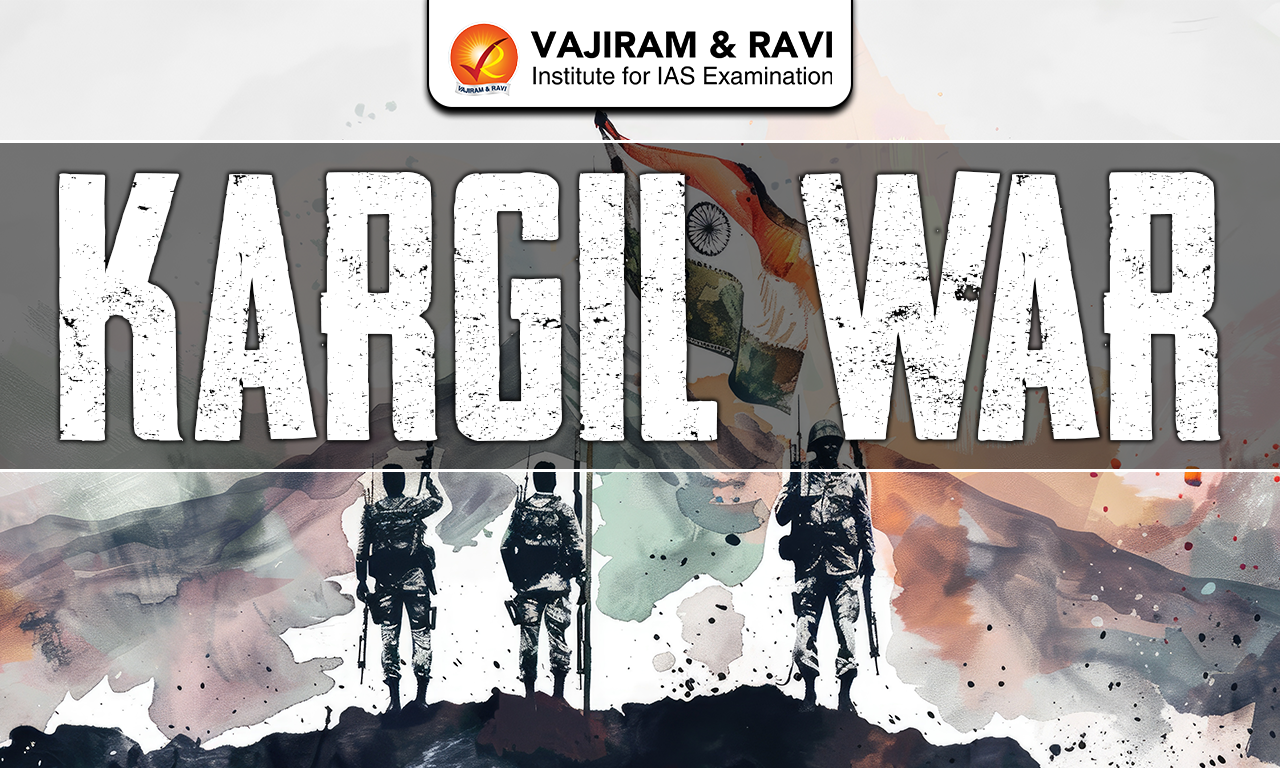
The Kargil War was a high altitude conflict fought between India and Pakistan started on 3 May till 26 July 1999 for the duration of 2 months, 3 weeks and 2 days (85 days) in the Kargil district of Ladakh. It took place along the Line of Control in the disputed Kashmir region and is considered one of the rare conventional wars between two nuclear armed nations. The Kargil War stands as a significant military episode marked by extreme terrain, strategic challenges and remarkable acts of bravery by soldiers on both sides.
Kargil War Background and Reasons
The Kargil War developed from long standing India and Pakistan tensions and strategic miscalculations that escalated into a limited but intense conflict in 1999. The timeline for the reasons that resulted into the war has been listed below:
- Partition and Kashmir Dispute: The roots of the Kargil War lie in the Partition of India 1947, which led to disputes over Accession of Jammu and Kashmir to India, triggering the first India Pakistan War.
- Continued Hostilities: The Indo-Pak War 1965 and 1971 deepened mistrust, while the 1972 Simla Agreement established the Line of Control but failed to permanently resolve territorial tensions in Kashmir.
- Rise of Insurgency: During the 1980s and 1990s, Kashmir witnessed insurgency and cross border infiltration, increasing military engagement and instability along the Line of Control.
- Nuclear Context: In 1998, both India and Pakistan conducted nuclear tests, making the Kargil War a rare instance of direct conflict between nuclear armed states under global scrutiny.
- Lahore Declaration: In February 1999, both countries signed an agreement to resolve disputes peacefully, but the spirit of cooperation soon broke due to covert military actions.
- Pakistani Infiltration: In early 1999, Pakistani troops and militants infiltrated across the Line of Control under a planned strategy to occupy high altitude posts in Kargil.
- Strategic Objective: The aim was to cut off the Srinagar-Leh highway, weakening India’s supply line and forcing negotiations on the Kashmir issue.
- Terrain Advantage: Pakistani forces occupied higher peaks, giving them a tactical advantage to observe and target Indian troop movements below.
Also Read: Carnatic Wars
Kargil War Course
The Kargil War unfolded through a clear timeline of infiltration, detection, counterattack and eventual withdrawal under pressure.
- Initial Infiltration: Pakistani troops secretly occupied Indian positions in February 1999, taking advantage of winter conditions when posts were lightly held.
- Detection of Intrusion: On May 3, 1999, local shepherds reported unusual movements, leading to confirmation of infiltration by Indian forces on May 5.
- Launch of Operation Vijay: India initiated a large scale military operation on May 10 to push back intruders and reclaim occupied territories.
- Air Support Begins: On May 26, the Indian Air Force launched Operation Safed Sagar to assist ground troops with aerial strikes and reconnaissance missions.
- Diplomatic Efforts: Talks between foreign ministers on June 12 failed, while international pressure gradually built against Pakistan’s actions.
- Capture of Tololing: On June 13, Indian forces recaptured Tololing peak after intense fighting, marking a turning point in the Kargil War.
- Victory at Tiger Hill: On July 4, Indian troops successfully retook Tiger Hill, a strategic peak that significantly shifted momentum in India’s favor.
- Withdrawal Announcement: On July 11, Pakistan agreed to withdraw its troops under international pressure, especially after diplomatic engagement with global powers.
- Declaration of Success: On July 14, India declared Operation Vijay successful after regaining major positions along the Line of Control.
- End of Conflict: The Kargil War officially ended on July 26, 1999, which is now commemorated annually as Kargil Vijay Diwas in India.


Kargil War Battles and Operations
The Kargil War witnessed several high altitude battles and coordinated military operations that determined the outcome of the conflict.
- Battle of Tololing: Tololing peak, over 16,000 feet high, was recaptured after a three week assault, marking a critical early success for Indian forces.
- Battle of Tiger Hill: This fierce battle involved intense combat at 16,500 feet, where Indian troops reclaimed the peak after sustained and coordinated attacks.
- Battle of Point 4875: Located in the Dras sector, this strategic peak allowed monitoring of the highway and was recaptured after heavy fighting.
- Operation Vijay: The Indian Army’s primary mission focused on reclaiming occupied positions through coordinated infantry assaults, artillery support and strategic planning.
- Operation Safed Sagar: The Indian Air Force conducted precision strikes using Mirage 2000 aircraft and laser guided bombs to destroy enemy bunkers.
- Operation Talwar: The Indian Navy ensured maritime security and strategic deterrence, positioning fleets to signal readiness for escalation if required.
India’s Response in Kargil War
India’s response during the Kargil War combined military precision, strategic restraint and diplomatic efforts to achieve success.
- Military Strategy: India focused on evicting intruders without crossing the Line of Control, maintaining strategic discipline and international legitimacy.
- Infantry Operations: Soldiers undertook dangerous climbs on steep slopes under enemy fire, engaging in close combat to recapture peaks.
- Air Power Utilization: The Indian Air Force carried out precision strikes, reconnaissance and logistical support, significantly enhancing operational effectiveness.
- Logistical Support: Supplies such as food, ammunition and medical aid were airlifted to high altitude positions, ensuring continuous operational capability.
- Intelligence and Surveillance: Use of satellite imagery, UAVs and ground intelligence helped identify enemy positions and plan targeted attacks.
- Diplomatic Campaign: India highlighted Pakistan’s violation of the Line of Control, gaining global support and isolating Pakistan diplomatically.
- Psychological Warfare: Efforts were made to demoralize enemy troops through broadcasts and strategic communication about India’s military strength.
- Joint Operations: Coordination between the Army, Air Force and Navy ensured unified execution of operations and effective battlefield outcomes.
- High Altitude Warfare: Battles occurred at extreme altitudes around 16,500 feet, requiring specialized training, acclimatization and resilience under harsh conditions.
- Artillery: Bofors FH-77B howitzers played a decisive role by targeting enemy positions and providing covering fire for advancing troops.
Also Read:- Operation Safed Sagar
Kargil War Impacts and Aftermath
The Kargil War had significant military, political and diplomatic consequences for both India and Pakistan.
- Casualties: Over 500 Indian soldiers lost their lives, while Pakistani losses ranged between 400 and 4,000, reflecting the intensity of the conflict.
- Territorial Outcome: India successfully recaptured all occupied positions by July 26, restoring control over its territory along the Line of Control.
- Strategic Lessons: The war exposed gaps in surveillance and intelligence, leading to reforms in defense preparedness and border monitoring systems.
- Political Impact in Pakistan: The conflict led to tensions between civilian leadership and the military, culminating in a coup later in 1999.
- International Reaction: Global powers largely supported India’s stance and criticized Pakistan for violating the Line of Control.
- Nuclear Concerns: The war raised fears of escalation into nuclear conflict, prompting international diplomatic intervention to de-escalate tensions.
- Strengthening Diplomacy: India’s restraint and diplomatic outreach enhanced its global image and strengthened future international partnerships.
- National Unity: The Kargil War generated strong public support and patriotism across India, bringing attention to the sacrifices of soldiers.
Kargil War Heroes
The Kargil War is remembered for extraordinary bravery displayed by soldiers who made significant contributions during the conflict.
- Capt. Vikram Batra: He led successful assaults on Points 5140 and 4875 under heavy fire and was awarded the Param Vir Chakra posthumously.
- Capt. Yogendra Singh Yadav: Despite multiple bullet injuries, he climbed Tiger Hill and played a crucial role in capturing enemy bunkers, earning the Param Vir Chakra.
- Capt. Manoj Kumar Pandey: He led an attack on Khalubar Ridge, destroying enemy bunkers despite injuries and was posthumously awarded the Param Vir Chakra.
- Rifleman Sanjay Kumar: He fought face to face combat, captured enemy weapons and turned them against intruders, receiving the Param Vir Chakra.
- Major Rajesh Adhikari: He led operations during the Tololing battle and sacrificed his life while neutralizing enemy positions, and was awarded Maha Vir Chakra (Posthumous).
- Captain Anuj Nayyar: He destroyed multiple enemy bunkers during the assault on Pimple II before being killed in action, earning the Maha Vir Chakra.
- Lieutenant Clifford Nongrum: He led attacks on steep slopes and inspired troops to capture key positions despite sustaining fatal injuries, received Maha Vir Chakra.
- Major Vivek Gupta: He played a key role in the Tololing assault, breaking enemy defenses despite being critically wounded, and was awarded Maha Vir Chakra (Posthumous).
- Captain Vijyant Thapar: He led the assault on Knoll in Dras sector, destroyed multiple enemy bunkers despite injuries, and was martyred near the objective, earning the Vir Chakra (Posthumous).
Kargil War Awards
The Kargil War witnessed exceptional bravery and dedication, with numerous soldiers being honoured for their courage, leadership and service under extreme combat conditions.
- Param Vir Chakra (PVC): 4 soldiers were awarded India’s highest gallantry award for displaying the most exceptional bravery in the face of the enemy.
- Maha Vir Chakra (MVC): 9 soldiers received this award for acts of conspicuous gallantry during intense combat operations.
- Vir Chakra (VC): 55 personnel were honoured for their courage and valour in battlefield conditions.
- Sarvottam Yudh Seva Medal (SYSM): 1 soldier was awarded for exceptional service during wartime operations.
- Uttam Yudh Seva Medal (UYSM): 6 personnel were recognised for distinguished service of a high order in operational roles.
- Yudh Seva Medal (YSM): 8 soldiers were awarded for notable service in operational situations.
- Sena Medal (SM): 83 personnel received this award for individual acts of bravery and devotion to duty.
- Vayu Sena Medal (VSM): 24 personnel of the Air Force were honoured for distinguished service and courage during aerial operations.
Kargil War Memorial
The Kargil War Memorial stands as a tribute to the soldiers who sacrificed their lives during the conflict and symbolizes national pride and remembrance.
- Location: The memorial is located in Dras, about 60 kilometers from Kargil, near the battlefield where intense fighting took place.
- Construction: Built by the Indian Army, the memorial features pink sandstone walls inscribed with names of soldiers who died during the war.
- Symbolic Structure: It includes a central monument with soldiers depicted holding the national flag, representing courage, sacrifice and victory.
- Commemoration: Every year on July 26, Kargil Vijay Diwas is observed at the site to honor the martyrs of the Kargil War.
- Emotional Significance: Visitors experience a deep sense of respect and reflection while walking through the memorial and reading the names of fallen soldiers.
- Cultural Importance: The memorial has become a symbol of patriotism and serves as a reminder of the sacrifices made to protect the nation’s sovereignty.

 Last updated on Oct, 2026
→ UPSC 2027 Notification will be released on 13 January 2027 at upsconline.nic.in.
→ Check Nobel Prize 2026 Winners List here.
→ Download PIB PRiSM Monthly Magazine 2026 here.
→ Check UPSC Monthly Current Affairs Magazine The Recitals here.
→ Check out the latest UPSC Syllabus here.
→ Download UPSC Model Answers for Mains 2026
→ UPSC Mains Question Paper 2026 is out now for Essay & GS Paper 1, 2, 3 & 4.
→ UPSC Calendar 2027 has been released.
→ Enroll in Vajiram & Ravi’s UPSC Mains Test Series 2027 for structured answer writing practice, expert evaluation, and exam-oriented feedback.
→ Join Vajiram & Ravi’s UPSC Mentorship Program 2027 for personalized guidance, strategy planning, and one-to-one support from experienced mentors.
→ Go through the UPSC Mains Previous Year Papers to enhance your preparation.
→ UPSC has released UPSC Toppers List 2025 with the Civil Services final result on its official website.
→ Also check Best UPSC Coaching in India
Kargil War FAQs
Q1. What was the Kargil War?+
Q2. Why did the Kargil War happen?+
Q3. What was Operation Vijay 1999 that took place during the Kargil War?+
Q4. When is Kargil Vijay Diwas observed?+
Q5. Who were the major heroes of the Kargil War?+
Tags: defence and military studies history kargil war