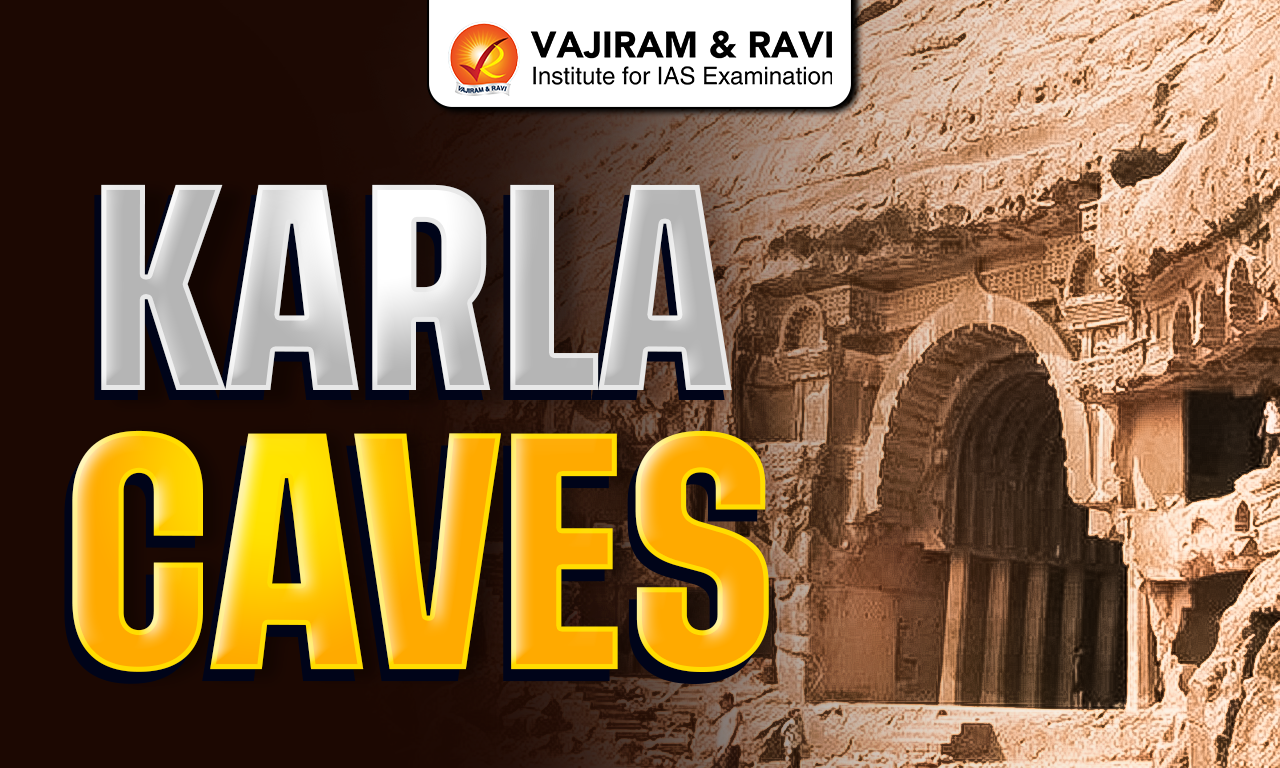
The Karla Caves are ancient rock-cut caves that reflect India’s rich cultural and historical heritage. They were created many centuries ago and are known for their impressive craftsmanship and simple yet beautiful design. These caves were used as places for religious activities and rest by people in the past. Today, they stand as an important historical site, helping us understand the art, architecture, and traditions of ancient times. Karle Caves Location, Background and Key Features has been discussed in detail in this article.
Karla Caves Historical Background
- The Karla Caves have a rich history that goes back to ancient times, showing the development of early Buddhist culture and architecture.
- The earliest cave at the site was a natural cave, but later many caves were carefully carved by humans using advanced techniques of that time.
- The Karla Caves in Maharashtra were built between the 2nd century BCE and the 5th century CE, mainly with the support of the Satavahana rulers, along with contributions from traders, monks, and nuns.
- These caves are associated with the Mahasanghika sect of Buddhism, which was popular in this region and received strong support from followers and traders.
- The site developed into an important Buddhist monastery around the 2nd century BC, where monks lived, prayed, and carried out religious activities.
- Most of the construction of the caves took place between 50 CE and 120 CE, during the rule of the Western Satrap ruler Nahapana, who also mentioned the caves in inscriptions.
- The Karla Caves are one of the oldest rock-cut Buddhist sites in Maharashtra, and they are especially famous for their Grand Chaitya (prayer hall).
- The chaitya hall is known as one of the largest and best-preserved prayer halls of its time and contains detailed carvings and impressive sculptures.
- The construction of these caves was supported by traders, craftsmen, and rulers like the Satavahanas, showing a close connection between religion and trade.
- The caves were built near important trade routes, which made them convenient resting places for traveling merchants and monks.
- Because of this, the caves served not only as religious centers but also as social and commercial hubs in ancient India.
Karla Caves Key Features
- Time Period of Construction: The Karla Caves were developed over a long period, mainly from the 2nd century CE to around the 5th-6th century CE, showing continuous use and expansion.
- Largest Chaitya Hall: Karla Caves are famous for having one of the largest rock-cut Chaitya (prayer hall) in India, making it an important example of early Buddhist architecture.
- Grand Chaitya (Main Prayer Hall): The main Chaityagriha is extremely large, measuring about 148 feet in length and 45 feet in width, and reaching a height of around 46 feet, making it one of the most impressive structures of its time.
- Wooden Roof Structure: One unique feature is the ancient wooden, arched roof, which is over 2,000 years old and still preserved, showing the advanced skills of ancient builders.
- Beautiful Pillars and Carvings: Inside the hall, there are rows of tall pillars, each decorated with detailed carvings of elephants, riders, and human figures, reflecting high artistic quality.
- Central Stupa: At the end of the Chaitya hall, there is a large stupa, which served as a place for meditation and worship, and is an important symbol in Buddhism.
- Horseshoe-Shaped Window (Chaitya Arch): The caves have a distinct horseshoe-shaped arch window at the entrance, which allows natural light to enter and brighten the interiors.
- Sculptures and Exterior Design: The outer walls and entrance are decorated with large and detailed sculptures, including human figures (Mithuna), showing the richness of ancient art.
- Viharas (Monk Residences): Apart from the main hall, there are smaller caves called viharas, which were used as living spaces by Buddhist monks.
- Pillars Outside the Cave: There were originally two tall pillars (around 15 meters high) at the entrance, though only one remains today, topped with carvings of four lions.
- Religious Importance (Ekveera Temple): The site also includes the Ekveera Temple, which is an important pilgrimage place, especially for the local community.
- Location and Natural Setting: The caves are located in the Western Ghats, offering beautiful views of the surrounding hills and valleys, which adds to their historical and scenic importance.
- Three-Part Layout of Chaitya Hall: The Chaitya hall is divided into three sections: a central hall and two narrow side passages separated by two rows of beautifully carved pillars, with about 15 pillars in each row.
- Decorated Pillar Capitals: The tops of the pillars (capitals) are richly decorated with carvings of men and women riding elephants and figures paying respect to Buddha, showing fine artistic work.
- Addition of Buddha Images: Around the 7th century CE, images of Buddha were added, reflecting changes in religious practices over time.
- Unique Wooden Ceiling: Unlike many other caves, the ceiling of one of the main caves is made of wood instead of stone, which is a rare feature.
- Stupa at the End of Hall: At the far end of the Chaitya hall, there is a stupa with an umbrella-like structure above it, used for meditation and worship.
- Sculptures Inside and Outside: Sculptures can be seen both on the pillar tops inside the hall and in the verandah area, showing detailed craftsmanship.


 Last updated on August, 2026
→ UPSC Mains 2026 commenced on 21st August 2026 and will continue through 30th August 2026, as per the official examination schedule.
→ UPSC Mains Question Paper 2026 is out now for Essay & GS Paper 1, 2, 3 & 4.
→ UPSC Mains GS Paper 1 2026 is out now.
→ UPSC Mains GS Paper 2 2026 is out now.
→ UPSC Mains GS Paper 3 2026 is out now.
→ UPSC Mains GS Paper 4 2026 is out now.
→ UPSC Mains Indian Language Paper & English Compulsory Paper are out now.
→ Check out the latest UPSC Syllabus 2026 here.
→ UPSC Mains Admit Card 2026 is now out.
→ Enroll in Vajiram & Ravi’s UPSC Mains Test Series 2027 for structured answer writing practice, expert evaluation, and exam-oriented feedback.
→ Join Vajiram & Ravi’s UPSC Mentorship Program 2027 for personalized guidance, strategy planning, and one-to-one support from experienced mentors.
→ Go through the UPSC Mains Previous Year Papers to enhance your preparation.
→ Download UPSC Mains Essay Paper 2025, UPSC Mains GS Paper-I 2025, UPSC Mains GS Paper-II 2025, UPSC Mains GS Paper-III 2025, UPSC Mains GS Paper-IV 2025, UPSC Mains English (Compulsory) Paper 2025, UPSC Mains Hindi (Qualifying) Paper 2025 here.
→ UPSC has released UPSC Toppers List 2025 with the Civil Services final result on its official website.
→ UPSC Calendar 2027 has been released.
→ Also check Best UPSC Coaching in India
Karla Caves FAQs
Q1. What are the Karla Caves famous for?+
Q2. Where are the Karla Caves located?+
Q3. When were the Karla Caves built?+
Q4. Who built the Karla Caves?+
Q5. What is the Grand Chaitya in Karla Caves?+
Tags: art and culture art and culture notes karla caves