Goldilocks Economy Latest News
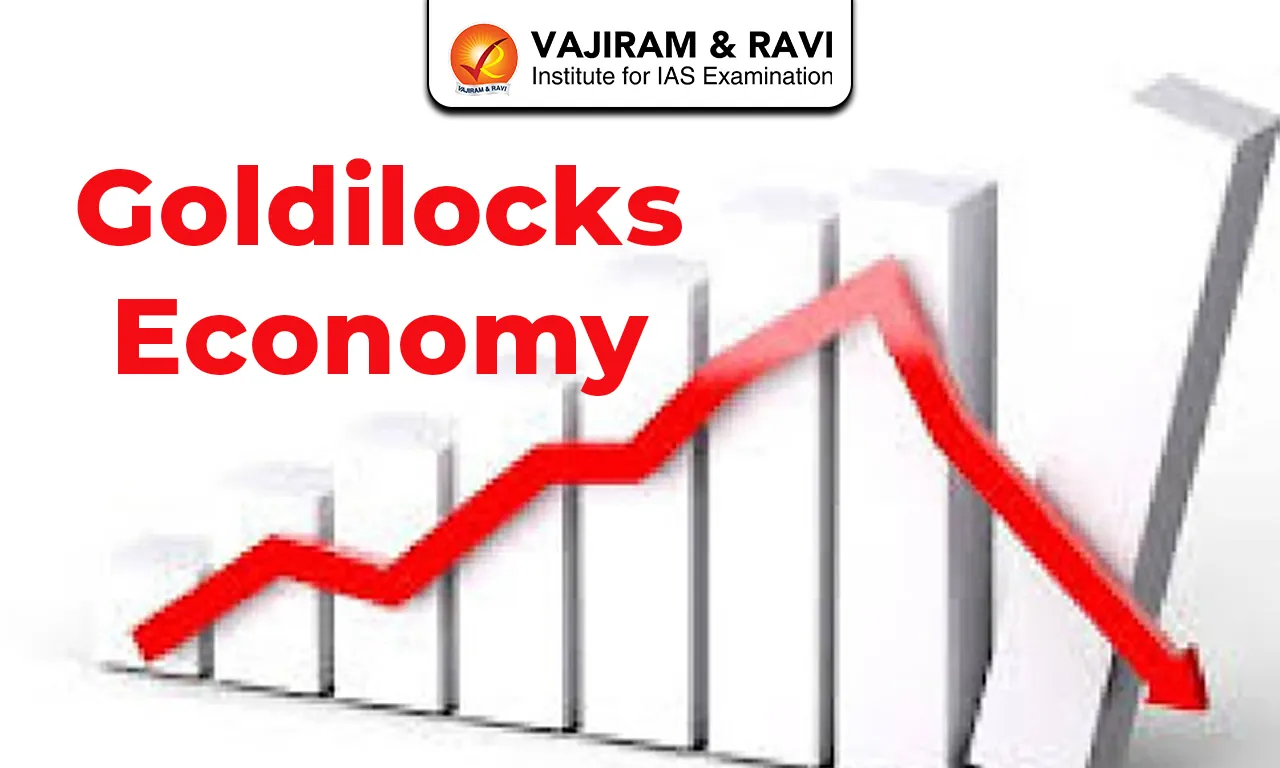
- When the Union Budget 2026-27 was presented, a widely held belief was that India had entered a “Goldilocks period” — a phase where economic conditions are ideal — steady growth, low inflation, and low unemployment.
- This phrase, used by the RBI Governor Sanjay Malhotra, suggested that the Indian economy was well-balanced and resilient.
- However, recent developments have challenged this optimism, triggering an important debate: Was India really in a Goldilocks phase, or was the economy weaker than projected?
Recent Developments
- GDP calculation revision with a new base year (2022-23) revealed that earlier estimates (base year 2011-12) had overstated GDP.
- Global geopolitical instability, especially the US-Iran conflict, raised concerns over oil prices and supply disruptions.
- The Indian rupee weakened further against the US dollar.
- Japan and the UK overtook India in nominal GDP rankings.
- Rising concerns of slower growth with higher inflation (stagflationary risks) emerged.


Understanding the Growth Reality
- Deceleration in nominal GDP growth:
- Key trends of nominal GDP (measures output at current prices) – Compounded annual growth rate (CAGR) is just above 10% (2014–2026), while it is around 12.3% (2004–2026), and 9.5% (2019–2026).
- Interpretation: India’s nominal GDP growth has steadily slowed over time, indicating weakening economic momentum.
- Moderate real GDP growth:
- Real GDP removes the impact of inflation and better reflects actual output growth. Key trends are a CAGR of above 12% since 2004, 6.2% (2014–2026), and below 5.5% (2019–2026).
- Interpretation: This growth rate is modest, especially for a developing country aspiring to become a developed nation by 2047.
Why the “Goldilocks” Narrative May Be Misleading?
- The base effect trap:
- A critical methodological caution, for example, cherry-picking post-COVID years distorts the true picture.
- The sharp rebound in 2021-22 and 2022-23 reflected recovery from the low base of the 2020 contraction, not genuine structural acceleration.
- Citing only these figures creates a false goldilocks narrative — misleading both public discourse and policymaking.
- Growth inadequacy for developed nation status:
- A real GDP growth rate of barely 5.5% over seven years is insufficient for India to achieve Viksit Bharat (Developed India) by 2047.
- Economists broadly agree that India needs sustained 8–9% real growth annually for such a transformation.
- Weak corporate earnings: Modest GDP growth has directly translated into underwhelming corporate earnings, reducing India’s attractiveness to both domestic and foreign investors.
- Negative net FDI and rupee weakness:
- Net Foreign Direct Investment (FDI) has turned negative, reflecting diminished investor confidence.
- The resultant capital outflow is a major structural reason for the rupee’s depreciation — notably, the rupee is weakening even as the dollar itself weakens against most global currencies, signalling an India-specific confidence deficit.
- GDP revision downgrades India’s economic size:
- The new GDP series has effectively shrunk India’s measured economy, meaning India is a smaller economy in absolute terms than previously believed.
- This is a significant setback to narratives around India’s imminent rise to the world’s third-largest economy.
- Energy import vulnerability: India’s near-total dependence on energy imports via the Strait of Hormuz makes it acutely vulnerable to West Asian geopolitical instability, threatening both the current account and inflation management.
Way Forward
- Structural reforms: Targeting manufacturing competitiveness, labour markets, and land acquisition are urgently needed to meaningfully lift the sustainable growth rate.
- Improving the investment climate: Through regulatory predictability and ease of doing business (EoDB) is essential to reversing the negative FDI trend.
- Energy diversification: Accelerating the transition to renewables and diversifying import sources — can reduce geopolitical exposure.
- Honest economic assessment by policymakers: Avoiding base-effect-driven optimism is necessary for designing credible long-term strategy.
- Transparent GDP methodology: And timely data revisions should be institutionalised to ensure policy decisions rest on accurate ground realities.
Conclusion
- The recent data suggests that India’s economy may not have been in a true Goldilocks phase, but rather in a period where headline numbers masked deeper structural slowdowns.
- For India to realise its long-term ambitions, policymakers must move beyond celebratory narratives and undertake hard reforms that generate sustained growth, jobs, investment, and resilience.
- Only then can India transition from a large economy to a genuinely prosperous one.
Source: IE

 Last updated on August, 2026
→ UPSC Mains 2026 commenced on 21st August 2026 and will continue through 30th August 2026, as per the official examination schedule.
→ UPSC Mains Question Paper 2026 is out now for Essay & GS Paper 1, 2, 3 & 4.
→ UPSC Mains GS Paper 1 2026 is out now.
→ UPSC Mains GS Paper 2 2026 is out now.
→ UPSC Mains GS Paper 3 2026 is out now.
→ UPSC Mains GS Paper 4 2026 is out now.
→ UPSC Mains Indian Language Paper & English Compulsory Paper are out now.
→ Check out the latest UPSC Syllabus 2026 here.
→ UPSC Mains Admit Card 2026 is now out.
→ Enroll in Vajiram & Ravi’s UPSC Mains Test Series 2027 for structured answer writing practice, expert evaluation, and exam-oriented feedback.
→ Join Vajiram & Ravi’s UPSC Mentorship Program 2027 for personalized guidance, strategy planning, and one-to-one support from experienced mentors.
→ Go through the UPSC Mains Previous Year Papers to enhance your preparation.
→ Download UPSC Mains Essay Paper 2025, UPSC Mains GS Paper-I 2025, UPSC Mains GS Paper-II 2025, UPSC Mains GS Paper-III 2025, UPSC Mains GS Paper-IV 2025, UPSC Mains English (Compulsory) Paper 2025, UPSC Mains Hindi (Qualifying) Paper 2025 here.
→ UPSC has released UPSC Toppers List 2025 with the Civil Services final result on its official website.
→ UPSC Calendar 2027 has been released.
→ Also check Best UPSC Coaching in India
Goldilocks Economy FAQs
Q1. What is meant by a Goldilocks economy?+
Q2. Why was India’s recent economic phase questioned “Goldilocks” claims?+
Q3. How does the distinction between nominal GDP and real GDP help in assessing economic performance?+
Q4. Why is the revision of GDP base year significant for economic policymaking? +
Q5. What structural reforms are necessary for India to achieve sustained high economic growth? +
Tags: goldilocks economy mains articles upsc current affairs upsc mains current affairs