Strait of Hormuz History Latest News
- The Strait of Hormuz has emerged as the central flashpoint in the ongoing West Asia conflict, with Iran restricting passage after US-Israeli strikes and the Donald Trump administration responding with a naval blockade.
- However, the strait’s importance is not new.
- Owing to its strategic location controlling global energy flows, it has historically been a site of intense imperial competition, especially during the 18th and 19th centuries when colonial powers like United Kingdom used naval strength and diplomacy to dominate trade routes through the region.
16th Century: Portuguese Conquest and Control
- The Strait of Hormuz was originally controlled by the wealthy Kingdom of Hormuz, a major trade hub linking India, Persia, Arabia, and East Africa.
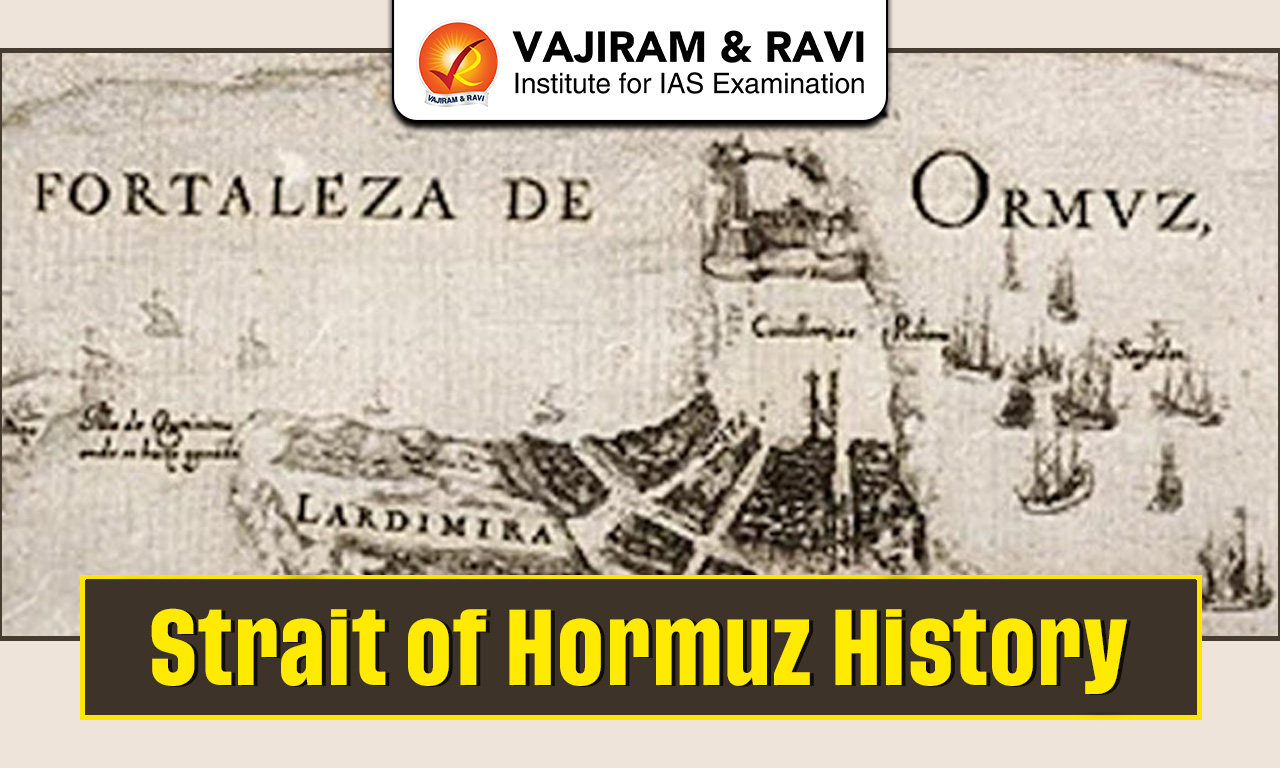
- In 1515, the Portuguese Empire seized Hormuz Island and transformed it into a fortified toll point, dominating and taxing lucrative spice and silk trade routes throughout the 16th century.
- By the early 17th century, rising competition led the English East India Company to challenge Portuguese control.
- In 1622, a strategic alliance between the British, the Dutch East India Company, and the Safavid ruler Shah Abbas I successfully defeated the Portuguese, ending nearly a century of Iberian dominance over the strait.


7th–18th Century Rivalry in the Strait of Hormuz
- After the fall of Portuguese control, the Strait of Hormuz entered a phase of intense rivalry between the English East India Company and the Dutch East India Company.
- The Dutch, operating as a quasi-sovereign power with military authority, dominated the region during much of the 17th century from their base in Bandar Abbas, leveraging a strong navy and aggressive trade practices to control the spice trade.
- By the 18th century, the Dutch East India Company weakened due to overextension, internal corruption, and high administrative costs in its Asian territories.
- The situation worsened after the Fourth Anglo-Dutch War, which pushed the company into financial collapse.
- Its eventual withdrawal from the Persian Gulf created a power vacuum, enabling the British to expand their influence and establish dominance in the region.
British Hegemony in the Strait of Hormuz
- After the exit of European rivals, the United Kingdom focused on controlling the Strait of Hormuz to safeguard maritime routes to British India.
- To ensure safe passage to Bombay, Britain launched naval campaigns in 1809 and 1819 against the Al Qawasim confederation, accusing them of piracy and destroying their fleets.
- The Al Qawasim (also known as Al Qasimi) was a powerful 18th-century maritime confederation of Sunni tribes based in the southern Gulf.
Treaty System and Indirect Control
- Rather than direct rule, Britain established control through treaties with local Arab rulers, restricting their foreign relations and trade while allowing internal autonomy.
- These arrangements effectively turned the region into British protectorates.
- The treaty-bound Sheikhdoms came to be known as the Trucial States, which later evolved into the United Arab Emirates.
- This system ensured long-term British dominance over the strait without heavy administrative costs.
Models of Control in the Strait of Hormuz
- The Portuguese Empire relied on direct military dominance over the Strait of Hormuz, constructing large fortifications like the Castelo de Nossa Senhora da Conceição and imposing taxes on passing trade.
- However, this heavily militarised system proved costly and unsustainable over time.
- In contrast, the United Kingdom adopted a more cost-effective and strategic approach, combining naval power with diplomacy.
- By integrating local rulers into the Trucial system, Britain allowed internal autonomy while controlling foreign policy, defence, and trade.
- This indirect model enabled Britain to secure the strait efficiently, ensuring control over a key global chokepoint.
- It facilitated the flow of resources from India while promoting the export of British goods, consolidating long-term economic and geopolitical dominance.
20th Century Shift: Oil and Strategic Control in the Strait of Hormuz
- At the turn of the 20th century, British priorities in the Strait of Hormuz shifted from trade protection to energy security.
- In 1901, financier William Knox D’Arcy secured oil exploration rights in Persia, leading to a major breakthrough in 1908 when George Bernard Reynolds discovered oil at Masjed Soleyman—the first large commercial strike in the region.
Formation of Anglo-Persian Oil Company and State Control
- Following this discovery, the Anglo-Persian Oil Company was established in 1909.
- Recognising oil’s strategic importance, especially after Winston Churchill shifted the navy from coal to oil, the British government acquired a 51% stake in the company by 1914, ensuring direct control over energy resources.
Transformation of the Strait’s Role
- The strait evolved from a trade chokepoint into a critical energy corridor, facilitating the transport of West Asian oil to Britain.
- This marked a major shift in global geopolitics, aligning with the growing importance of petroleum during and after the First World War.
- Through treaty-based control over Gulf states, Britain maintained its dominance in the region until 1971, when it formally withdrew its military presence, marking the end of the Trucial States era.
Source: IE

 Last updated on Oct, 2026
→ UPSC 2027 Notification will be released on 13 January 2027 at upsconline.nic.in.
→ Check Nobel Prize 2026 Winners List here.
→ Download PIB PRiSM Monthly Magazine 2026 here.
→ Check UPSC Monthly Current Affairs Magazine The Recitals here.
→ Check out the latest UPSC Syllabus here.
→ Download UPSC Model Answers for Mains 2026
→ UPSC Mains Question Paper 2026 is out now for Essay & GS Paper 1, 2, 3 & 4.
→ UPSC Calendar 2027 has been released.
→ Enroll in Vajiram & Ravi’s UPSC Mains Test Series 2027 for structured answer writing practice, expert evaluation, and exam-oriented feedback.
→ Join Vajiram & Ravi’s UPSC Mentorship Program 2027 for personalized guidance, strategy planning, and one-to-one support from experienced mentors.
→ Go through the UPSC Mains Previous Year Papers to enhance your preparation.
→ UPSC has released UPSC Toppers List 2025 with the Civil Services final result on its official website.
→ Also check Best UPSC Coaching in India
Strait of Hormuz History FAQs
Q1. Why is the Strait of Hormuz historically important?+
Q2. How did the Portuguese control the Strait of Hormuz?+
Q3. What role did the British play in Strait of Hormuz history?+
Q4. How did oil change Strait of Hormuz history?+
Q5. What was the Anglo-Dutch rivalry in Strait of Hormuz history?+
Tags: mains articles Strait of Hormuz history upsc current affairs upsc mains current affairs