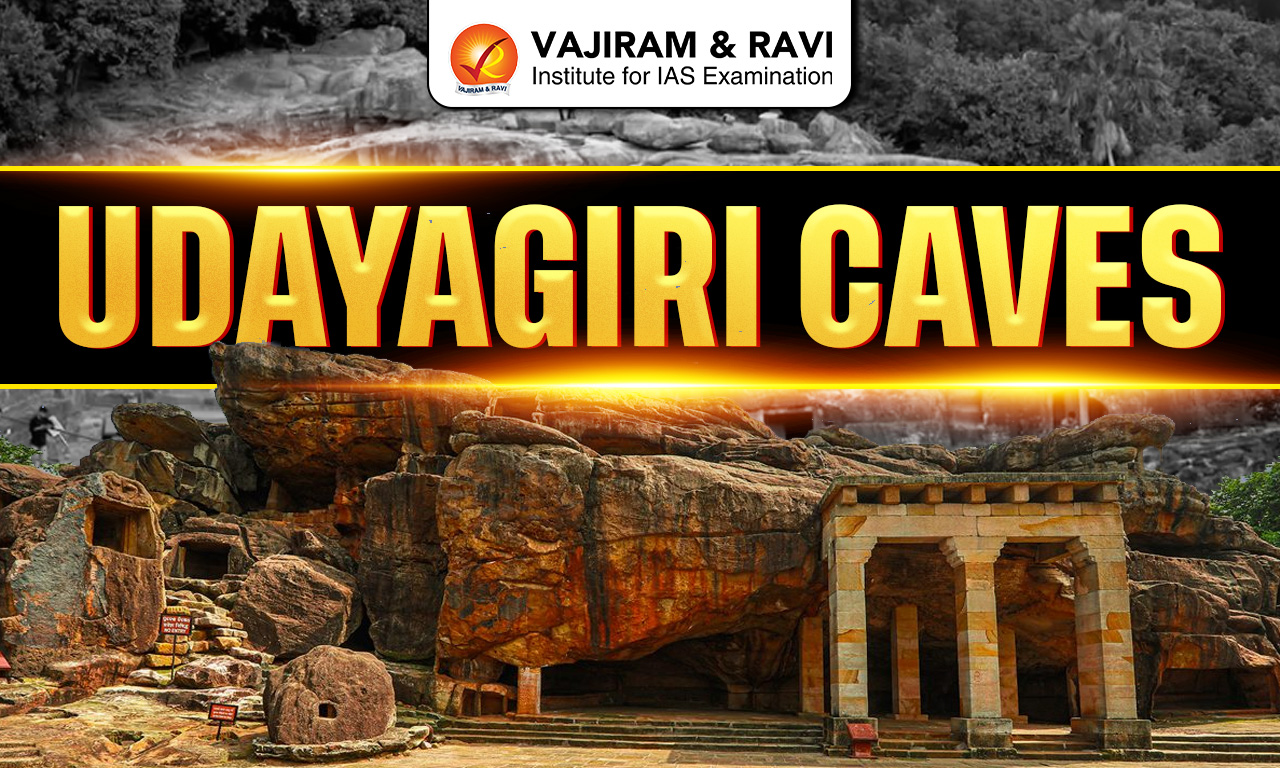
The Udayagiri Caves are a group of twenty rock cut caves carved in sandstone hills near Vidisha, dating mainly between the 3rd and 5th centuries CE. These caves represent some of the earliest surviving Hindu temple architecture in India and are closely linked with the Gupta Empire, especially the reign of Chandragupta II. The Udayagiri Caves showcase rich iconography of Vishnu, Shiva and Jain traditions, along with inscriptions, sculptures and early temple designs that mark a significant phase in Indian art and religious history.
Udayagiri Caves Features
The Udayagiri Caves display early temple architecture, inscriptions, sculptures and astronomical alignment, reflecting religious diversity and Gupta artistic excellence.
- Location: The Udayagiri Caves are situated on sandstone hills near Betwa and Bes rivers, about 6 km from Vidisha, Madhya Pradesh.
- Rock Cut Architecture: The caves are carved into horizontal sandstone layers forming square sanctums and mandapas, representing earliest structural models of Hindu temples in North India.
- Varaha Relief Sculpture: Cave 5 houses a monumental Varaha panel showing Vishnu rescuing Earth, with detailed depictions of gods, sages and Gupta king Chandragupta II.
- Gupta Inscriptions: Sanskrit inscriptions dated 401 CE and 425 CE provide direct evidence of Gupta rulers like Chandragupta II and Kumaragupta I.
- Religious Diversity: Majority caves are Hindu, while one is Jain; iconography includes Vaishnavism, Shaivism and Shaktism traditions in a single complex.
- Early Ganesha Representation: Cave 6 includes one of the earliest known images of Ganesha holding Modaka, indicating the rising importance in Hindu worship.
- Shankha Lipi Inscriptions: Undeciphered conch shaped scripts carved on rocks suggest pre Gupta literacy and earlier cultural activity at the site.
- Astronomical Alignment: Located near the Tropic of Cancer, the site likely observed sun overhead during solstice, linking it with ancient astronomical practices.
- Water Systems and Structures: Presence of rock cut tanks, channels and habitation mounds indicates advanced planning and long term settlement in the region.
- Sculptural Themes: Several sculptures depict dieties like Narasimha, Durga slaying Mahishasura, Shiva linga and reclining Vishnu, showing mythological narratives in stone.
- Lion Capital Artifact: The Udayagiri Lion Capital, dated around 2nd century BCE or Gupta period, reflects Mauryan influence and early imperial symbolism.
Udayagiri Caves List
The Udayagiri Caves consist of twenty excavated rock cut chambers with diverse religious affiliations, artistic styles and inscriptions reflecting Gupta period patronage.
- Cave 1: Southernmost cave with square sanctum and mandapa traces, built using sandstone layers; original deity lost due to damage but shows early temple plan features.
- Cave 2: Small cave with eroded interior and partial pilasters; once had a structural mandapa and doorway carvings, now mostly weathered.
- Cave 3: Shaivism cave featuring Skanda (Kartikeya) sculpture on a monolithic plinth, showing early Gupta sculptural style though partially damaged.
- Cave 4: Known as Vina Cave, dedicated to Shiva with ekamukha linga; includes carvings of musicians, river goddesses and matrikas indicating Shakti influence.
- Cave 5: Famous Varaha Cave displaying colossal relief of Vishnu as boar rescuing Bhudevi, considered the iconographic centerpiece of the Udayagiri Caves.
- Cave 6: Multi religious cave with Vishnu, Shiva, Durga Mahishasuramardini and early Ganesha figure, along with inscription of Chandragupta II dated 401 CE.
- Cave 7: Contains damaged figures of eight mother goddesses and traces of Kartikeya and Ganesha, representing Shaktism themes.
- Cave 8: Dome shaped cave with lotus carving on ceiling and Sanskrit inscription linking it to Chandragupta II and minister Virasena.
- Caves 9-11: Small caves with Vishnu carvings; simple rectangular niches showing Vaishnavism influence in compact forms.
- Cave 12: Features Narasimha avatar of Vishnu with Sankha Lipi inscriptions, indicating earlier habitation and literacy before cave excavation.
- Cave 13: Displays Anantasayana Vishnu reclining on serpent, with figures identified as Chandragupta II and his minister in devotion.
- Cave 14: Partially preserved chamber with water channel, indicating functional architectural planning in caves.
- Caves 15-18: Smaller caves showing early Ganesha, Durga and Shaiva elements, with geometric ceiling designs and simple sanctum plans.
- Cave 19: Largest cave known as Amrita Cave, featuring Samudra Manthan sculpture, Shiva lingas, pillars and inscriptions from 11th century CE.
- Cave 20: Only Jain cave dedicated to Parshvanatha, containing inscription dated 425 CE and multiple chambers with Jaina iconography.


Udayagiri Caves Significance
The Udayagiri Caves hold immense historical, religious and architectural importance as early examples of Hindu temple art and Gupta political symbolism.
- Earliest Hindu Temples: The caves represent one of the oldest surviving examples of Hindu temple architecture with sanctum and mandapa layout.
- Gupta Political Symbolism: Inscriptions and sculptures link the site directly with Chandragupta II, making it a rare site associated with a specific ruler.
- Development of Iconography: Fully developed forms of Vishnu avatars like Varaha and Narasimha indicate maturity of Hindu mythology by 4th-5th century CE.
- Religious Coexistence: Presence of Hindu and Jain caves reflects tolerance and coexistence of multiple religious traditions during Gupta period.
- Astronomical and Sacred Site: Its alignment with solar movements and name meaning “sunrise mountain” highlight its role in ritual and calendar systems.
- Artistic Benchmark: The caves define early Gupta artistic style, influencing later temple construction at sites like Sanchi and Tigawa.
- Epigraphic Importance: Inscriptions provide data on language, script evolution, administration and religious practices of ancient India.
- Cultural Continuity: Evidence of habitation from 6th century BCE to medieval period shows long term cultural and religious importance of the region.
- Archaeological Value: Excavations revealed settlement patterns, inscriptions and artifacts, making it a key site for understanding ancient Indian civilization.
- Symbol of Dharma: Varaha panel symbolizes restoration of cosmic order, linking kingship with divine duty and reinforcing political theology of Gupta rulers.

 Last updated on Oct, 2026
→ UPSC 2027 Notification will be released on 13 January 2027 at upsconline.nic.in.
→ Check Nobel Prize 2026 Winners List here.
→ Download PIB PRiSM Monthly Magazine 2026 here.
→ Check UPSC Monthly Current Affairs Magazine The Recitals here.
→ Check out the latest UPSC Syllabus here.
→ Download UPSC Model Answers for Mains 2026
→ UPSC Mains Question Paper 2026 is out now for Essay & GS Paper 1, 2, 3 & 4.
→ UPSC Calendar 2027 has been released.
→ Enroll in Vajiram & Ravi’s UPSC Mains Test Series 2027 for structured answer writing practice, expert evaluation, and exam-oriented feedback.
→ Join Vajiram & Ravi’s UPSC Mentorship Program 2027 for personalized guidance, strategy planning, and one-to-one support from experienced mentors.
→ Go through the UPSC Mains Previous Year Papers to enhance your preparation.
→ UPSC has released UPSC Toppers List 2025 with the Civil Services final result on its official website.
→ Also check Best UPSC Coaching in India
Udayagiri Caves FAQs
Q1. Where are the Udayagiri Caves located?+
Q2. How many caves are there in Udayagiri Caves?+
Q3. Which is the most famous sculpture in Udayagiri Caves?+
Q4. Which dynasty is associated with Udayagiri Caves?+
Q5. What is the time period of the Udayagiri Caves?+
Tags: ancient indian history archaeology udayagiri caves