Vikram VT 21 Latest News
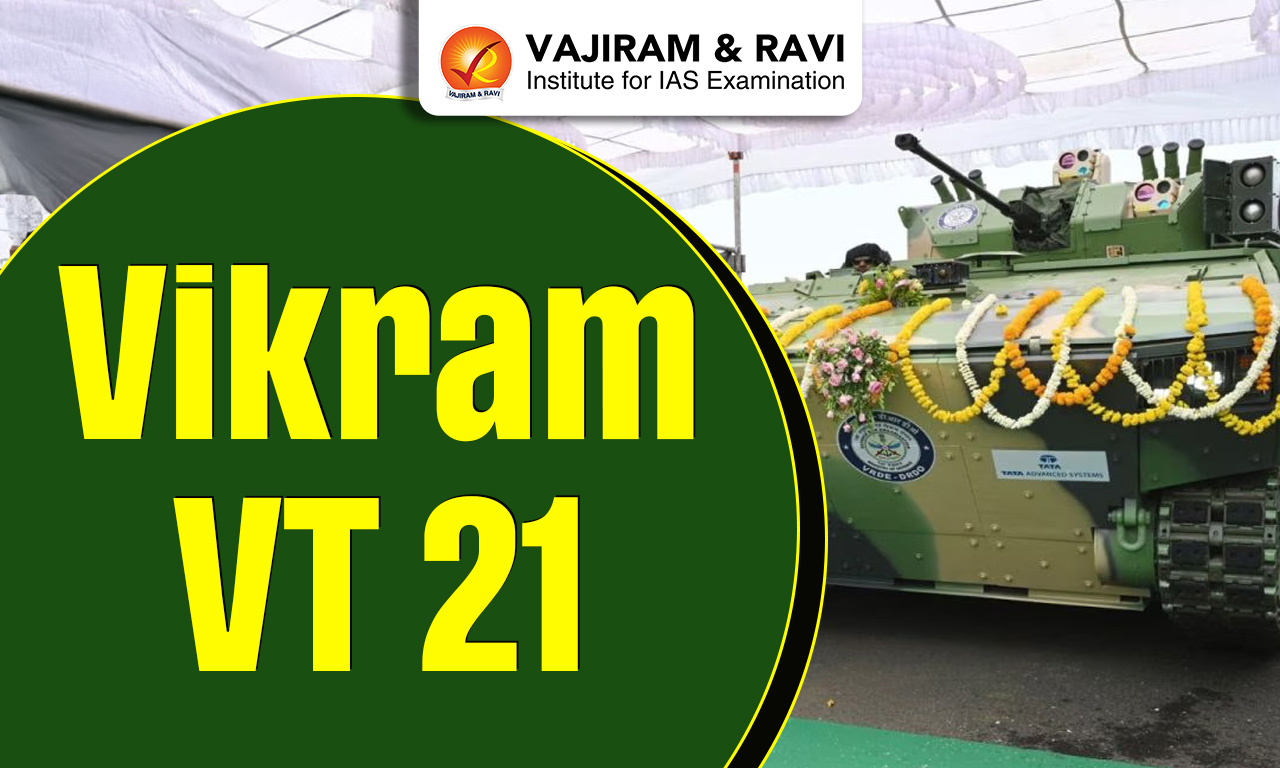
- The Defence Research and Development Organisation has launched the Vikram VT 21 project featuring two Advanced Armoured Platforms—wheeled and tracked.
- These are designed to meet the Indian Army’s need for a Futuristic Infantry Combat Vehicle (FICV).
- The platform aims to replace the ageing BMP-2 fleet by offering improved mobility, protection, and adaptability across varied terrains, positioning it as a next-generation solution for modern battlefield requirements.
Vikram VT 21: Advanced Armoured Platform by DRDO
- The Vikram VT 21 is an Advanced Armoured Platform (AAP) developed by the DRDO, designed as a modern infantry combat vehicle.
- It features enhanced armour protection capable of withstanding projectiles, blasts, and shrapnel, along with integrated weapons and surveillance systems.
- The platform also offers high mobility across diverse terrains, making it suitable for modern battlefield operations.
Two Variants: Wheeled and Tracked
- The project includes two variants:
- Wheeled variant: Runs on tyres, offering higher speed, easier maintenance, and suitability for urban, semi-urban, and road conditions.
- Tracked variant: Moves on continuous tracks like tanks, providing better grip, stability, and performance on rough, uneven, and off-road terrain.
Collaborative Development
- The platform has been co-developed by the Vehicles Research and Development Establishment, a DRDO facility, in partnership with Bharat Forge Limited and Tata Advanced Systems Limited, with support from multiple MSMEs and other DRDO units.


Vikram VT 21: Features, Mobility, Armour and Weaponry
- The Vikram VT 21 is equipped with an indigenously designed 30 mm crewless turret, a remotely operated system that enhances firepower, protection, and operational safety.
- It is paired with a 7.62 mm PKT machine gun and can launch third-generation Nag Anti-Tank Guided Missiles (ATGMs), enabling it to effectively engage heavily armoured targets with precision.
High Mobility and Performance
- Powered by a high-capacity engine and automatic transmission, the platform offers a strong power-to-weight ratio, ensuring superior speed, agility, and manoeuvrability.
- It can climb steep gradients and navigate difficult terrains, including trenches and uneven surfaces.
- Additionally, its amphibious capability, supported by hydro jets and water propulsion systems, allows seamless movement across rivers and water bodies.
Robust Armour and Protection
- The vehicle provides STANAG Level 4 and 5 protection, adhering to NATO standards for resistance against heavy gunfire, explosions, and artillery fragments.
- It also features modular blast and ballistic protection, enhancing survivability in diverse combat scenarios.
Modularity and Indigenous Development
- Designed as a modular platform, it can be adapted for multiple roles such as troop transport, reconnaissance, and combat support.
- Currently, about 65% of the system is indigenously developed, with plans to increase this to 90%, strengthening India’s defence manufacturing ecosystem.
Futuristic Infantry Combat Vehicle (FICV): Need and Strategic Importance
- The Indian Army requires a Futuristic Infantry Combat Vehicle (FICV) to replace its ageing BMP-2 fleet, which has been in service since the 1980s.
- The need arises from evolving threats and the shift towards modern, technology-driven warfare.
Role in Network-Centric Warfare
- FICV is designed for network-centric warfare, where military units, sensors, and command systems are digitally connected.
- This enables real-time information sharing, faster decision-making, improved coordination, and enhanced situational awareness, significantly boosting operational effectiveness.
Operational Importance in High-Threat Areas
- With enhanced mobility, protection, and firepower, FICVs are critical for infantry operations in high-risk zones, particularly along borders with China and Pakistan.
- They support rapid deployment, combined arms operations, and integration of advanced surveillance and communication systems.
Way Forward: Trials and Induction
- Before induction, the platform must undergo development trials, user trials, and approval by the Indian Army, followed by large-scale production.
- DRDO has expressed confidence that these stages can be completed within three years.
Source: IE

 Last updated on Sep, 2026
→ UPSC 2027 Notification will be released on 13 January 2027 at upsconline.nic.in.
→ Check out the latest UPSC Syllabus here.
→ Download UPSC Model Answers for Mains 2026
→ UPSC Mains Question Paper 2026 is out now for Essay & GS Paper 1, 2, 3 & 4.
→ UPSC Calendar 2027 has been released.
→ Enroll in Vajiram & Ravi’s UPSC Mains Test Series 2027 for structured answer writing practice, expert evaluation, and exam-oriented feedback.
→ Join Vajiram & Ravi’s UPSC Mentorship Program 2027 for personalized guidance, strategy planning, and one-to-one support from experienced mentors.
→ Go through the UPSC Mains Previous Year Papers to enhance your preparation.
→ UPSC has released UPSC Toppers List 2025 with the Civil Services final result on its official website.
→ Also check Best UPSC Coaching in India
Vikram VT 21 FAQs
Q1. What is Vikram VT 21? +
Q2. Why is Vikram VT 21 important for India?+
Q3. What are key features of Vikram VT 21?+
Q4. How does Vikram VT 21 support modern warfare?+
Q5. What challenges remain for Vikram VT 21 induction?+
Tags: mains articles upsc current affairs upsc mains current affairs Vikram VT 21