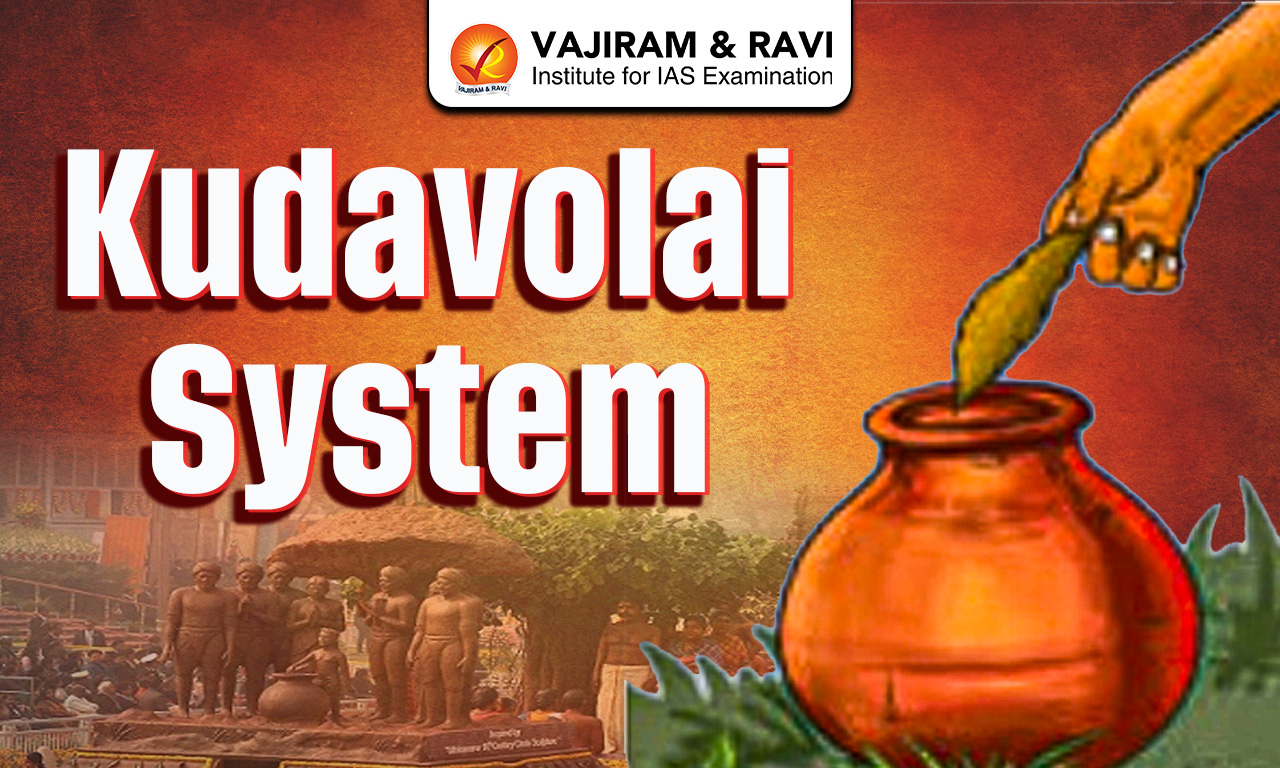
The Kudavolai System was an early method of local self-government used in South India during the time of the Chola Dynasty. In this system, people chose their village representatives by drawing names from a pot, making the process fair and transparent. It showed how villages managed their own administration with public participation. Overall, it is seen as an early example of democratic practices in India. Kudavolai System, Process of Election, Eligibility, Disqualification and other details are discussed in this article.
About Kudavolai System
- The Kudavolai system was an early method of election used in village assemblies during the time of the Chola Dynasty. It was mainly followed in Brahmadeya villages of ancient Tamil Nadu.
- The term comes from Tamil words where “Kudam” means pot and “Olai” means palm leaf, describing the unique voting method used in this system.
- Process of Election
- Names of eligible candidates were written on palm leaves and placed inside a pot.
- A young boy, selected for his honesty and impartial nature, would draw one leaf in front of the entire village.
- The person whose name was picked became a member of the village assembly (Sabha).
- This method was not just random selection but a well-respected public process that ensured transparency and fairness.
- Historical Evidence
- The system is clearly described in the Uttaramerur Inscriptions in Kanchipuram district.
- These inscriptions belong to the reign of Parantaka Chola I (10th century CE) and give detailed rules about elections and administration.
- Similar inscriptions found in other regions show that this system was widely practiced in South India.
- Eligibility of Candidates
- Candidates had to own land and regularly pay taxes to the state.
- The age limit was generally between 35 and 70 years.
- They were expected to have knowledge of Vedas, scriptures, or administrative work.
- A good character was necessary, and they should not have any criminal record or immoral behavior.
- Disqualification Criteria
- People who did not repay debts or were involved in habits like alcoholism were not allowed to participate.
- Close relatives of current members were disqualified to prevent concentration of power.
- Those found guilty of corruption, misuse of public funds, or neglect of duties could be removed and banned from future roles.
- Administration and Committees
- The village administration was divided into different committees for areas like agriculture, education, trade, irrigation, and temple maintenance.
- Members of these committees were selected through the Kudavolai system.
- Regular audits and strict rules ensured that officials worked honestly and responsibly.
- Significance
- The Kudavolai system is considered one of the earliest examples of democratic practices in India.
- It promoted public participation, transparency, and accountability in local governance.
- Even today, it is remembered as an advanced and well-organized system of village administration in ancient India.
Chola Democratic System & Administration
- The Chola Dynasty followed a well-organised and decentralised system of administration, where power was shared between the central authority and village-level institutions.
- Two important village assemblies formed the base of local self-government:
- Sabha – Found in Brahmadeya villages (settlements given to Brahmins), it included only Brahmin male members. It worked through different committees (variyams) like garden, tank, and justice committees, and members were often chosen through the Kudavolai system.
- Ur – Found in non-Brahmin villages, mainly peasant settlements. The members (called Urar) were landholders who managed temple upkeep, irrigation, water systems, revenue collection, and law and order. It had a less formal structure but played a key role in administration.
- These local bodies were not just symbolic; they had real powers over revenue, irrigation, temple management, and even justice. Regular audits were conducted to ensure accountability.
- The empire was divided into provinces (Mandalams), districts (Valanadus and Kottams), and villages (Nadus), which helped in smooth and efficient governance.
- The Cholas also supported trade by encouraging merchant guilds like Manigramam and Ayyavole, which boosted economic growth and connectivity.
- Although the system was efficient, it was not fully equal, as women, landless people, and labourers were excluded from participation.
- The Cholas were also strong in military strategy. Under rulers like Rajendra Chola I, they carried out successful naval campaigns and expanded their influence.
- The Uttaramerur Inscription gives detailed information about their administration and electoral practices like the Kudavolai system, showing an early form of organised local governance in India.


 Last updated on Oct, 2026
→ UPSC 2027 Notification will be released on 13 January 2027 at upsconline.nic.in.
→ Check Nobel Prize 2026 Winners List here.
→ Download PIB PRiSM Monthly Magazine 2026 here.
→ Check UPSC Monthly Current Affairs Magazine The Recitals here.
→ Check out the latest UPSC Syllabus here.
→ Download UPSC Model Answers for Mains 2026
→ UPSC Mains Question Paper 2026 is out now for Essay & GS Paper 1, 2, 3 & 4.
→ UPSC Calendar 2027 has been released.
→ Enroll in Vajiram & Ravi’s UPSC Mains Test Series 2027 for structured answer writing practice, expert evaluation, and exam-oriented feedback.
→ Join Vajiram & Ravi’s UPSC Mentorship Program 2027 for personalized guidance, strategy planning, and one-to-one support from experienced mentors.
→ Go through the UPSC Mains Previous Year Papers to enhance your preparation.
→ UPSC has released UPSC Toppers List 2025 with the Civil Services final result on its official website.
→ Also check Best UPSC Coaching in India
Kudavolai System FAQs
Q1. What is the Kudavolai System?+
Q2. How did the Kudavolai election process work?+
Q3. What are the main features of the Kudavolai System?+
Q4. What is the historical evidence of the Kudavolai System?+
Q5. Who could participate in the Kudavolai System?+
Tags: history history notes kudavolai system