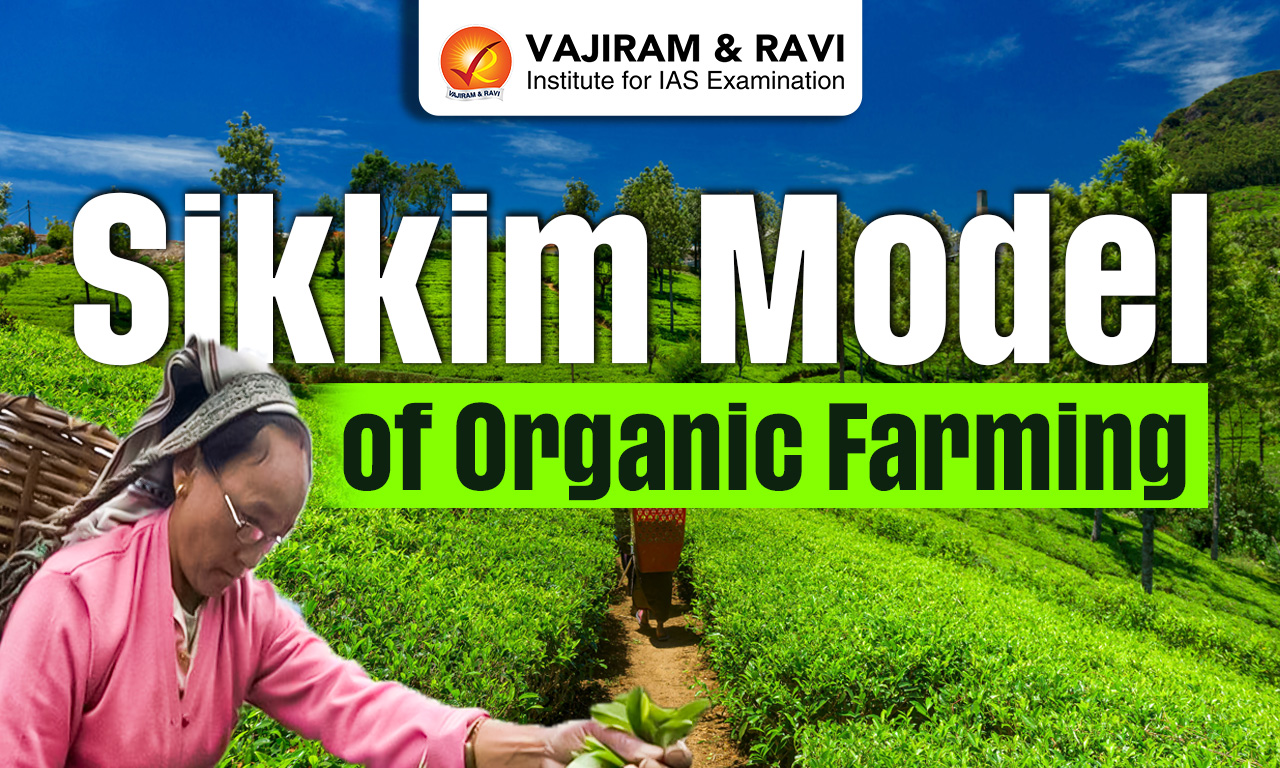
The Prime Minister, while addressing the 50th year of Sikkim’s Statehood celebrations in Gangtok, praised Sikkim for adopting organic farming ahead of the rest of the country by nearly a decade. He described Sikkim’s organic farming system as a model for India’s sustainable agriculture mission.
Sikkim Model of Organic Farming
Sikkim became the world’s first 100 per cent organic state in 2016, after completing a phased transition away from synthetic fertilisers and pesticides. The overall objective was to protect soil health, biodiversity, and fragile mountain ecosystems.
Key Pillars of the Sikkim Model of Organic Farming
The Sikkim Organic Model is built on a structured combination of phased transition, legal enforcement, institutional support, and farmer-focused interventions that enabled the state to achieve 100% organic farming status.
- Phased Transition (2003-2016): Sikkim followed a gradual reduction approach, cutting chemical fertilisers and pesticides by around 10% annually from 2003. This step-by-step process allowed farmers to adjust to organic methods, leading to a complete ban on synthetic inputs by 2014 and full organic certification by 2016.
- Legal Backing: The state enforced a strict legal ban on the use and sale of chemical fertilisers and pesticides, supported by penal provisions including fines and imprisonment to ensure compliance and prevent illegal use of synthetic inputs.
- Institutional Framework: The Sikkim Organic Mission, established in 2010, acted as the nodal agency responsible for planning, coordination, training, and implementation of organic farming across the state.
- Farmer Training: Training programmes were conducted for thousands of farming households on composting, natural pest management, and organic cultivation practices. However, the reach and effectiveness of training remained uneven across regions.
- Certification System: The Sikkim State Organic Certification Agency was set up to certify farms in line with national organic standards under the National Programme for Organic Production, ensuring credibility, traceability, and quality assurance.
- Organic Practices: Farmers adopted sustainable methods such as composting, vermicomposting, crop rotation, intercropping, and botanical pesticides like neem-based formulations to replace chemical inputs and maintain soil health.
- Market Strategy: The state focused on high-value crops such as large cardamom, ginger, turmeric, kiwi, and avocado, targeting niche domestic and international markets. However, weak market integration limited consistent price benefits for farmers.
- Support Measures: The government provided compost pit construction, livestock support for manure production, bio-input distribution, and training infrastructure to strengthen on-farm organic capacity, though access remained uneven in practice.


Ecological Significance of the Sikkim Model of Organic Farming
The Sikkim Model of Organic Farming has contributed significantly to environmental sustainability by aligning agricultural practices with ecological principles.
- Reduced Chemical Pollution: Elimination of synthetic fertilisers and pesticides has reduced contamination of soil and water resources
- Improvement in Soil Health: Increased use of organic manure has enhanced soil fertility, structure, and microbial activity
- Biodiversity Conservation: The model supports rich Himalayan biodiversity by maintaining natural habitats and reducing ecological stress
- Climate-Friendly Agriculture: Organic farming practices have lowered greenhouse gas emissions and promoted sustainable land use
- Water Resource Protection: Reduced chemical runoff has improved the quality of surface and groundwater
- Ecosystem Stability: The shift to natural inputs has strengthened ecological balance and resilience in farming systems
- Preservation of Traditional Practices: Revival of indigenous farming methods has supported sustainable and low-input agriculture
- Support to Pollinators and Soil Organisms: Reduced chemical use has helped restore populations of beneficial insects and soil fauna
Overall, the model demonstrates how agriculture can be aligned with environmental conservation, especially in ecologically sensitive regions like the Himalayas.
Challenges in the Sikkim Model of Organic Farming
While Sikkim’s transition to fully organic agriculture is a significant achievement, its implementation has revealed several structural, economic, and technical challenges.
- Decline in Crop Productivity: Many farmers reported reduced yields in crops such as ginger, pulses, and maize after the withdrawal of chemical fertilisers and pesticides
- Pest and Disease Management Issues: Increased incidence of pests and diseases due to limited availability and effectiveness of organic alternatives
- Inadequate Farmer Training: Training programmes were conducted, but their reach and quality remained uneven, leaving many farmers without proper technical guidance
- Limited Availability of Organic Inputs: Insufficient supply of bio fertilisers and bio pesticides constrained effective adoption of organic practices
- Weak Market Linkages: Farmers often struggled to access reliable markets and were unable to secure premium prices for organic produce
- Dependence on Middlemen: Lack of organised marketing systems led to continued reliance on intermediaries, reducing farmer income
- High Certification Costs: Significant financial resources were spent on certification processes, diverting funds from farmer support and capacity building
- Food Security Concerns: Declining productivity and focus on cash crops led to continued dependence on external states for food supply
- Inadequate Infrastructure: Weak storage, transportation, and processing facilities limited value addition and market expansion
- Lack of Data and Research Support: Insufficient scientific data on pest attacks, productivity trends, and soil health affected policy refinement
- Implementation Gaps: Differences in policy design and ground-level execution created gaps in achieving intended outcomes
These challenges indicate that while the Sikkim model is environmentally progressive, its long-term success depends on addressing issues related to productivity, market systems, and farmer support.
Key Lessons for India from the Sikkim Model of Organic Farming
The Sikkim experience offers important insights for designing and scaling sustainable agriculture policies across diverse regions in India.
- Gradual Transition: A phased approach, rather than a sudden shift, helps farmers adapt to organic practices without severe economic shocks
- Strong Political Will: Consistent policy commitment and leadership are critical for implementing large-scale agricultural transformation
- Institutional Support: Dedicated agencies and coordinated governance mechanisms are needed for effective implementation
- Farmer-Centric Approach: Continuous training, technical guidance, and input support must be prioritised for farmers
- Focus on Soil Health: Long-term sustainability depends on improving soil fertility and biological activity
- Market Linkages Must Be Strengthened: Organic farming can succeed only if farmers receive assured markets and fair price premiums
- Balance Between Sustainability and Productivity: Ecological goals must be aligned with maintaining adequate crop yields and food security
- Research and Innovation: Scientific support is required for pest management, crop productivity, and climate resilience
- Region-Specific Adaptation: The model cannot be directly replicated; it must be adapted to local agro-climatic and socio-economic conditions
- Integrated Approach Required: Organic farming should be linked with tourism, value addition, and rural development for broader impact
These lessons highlight that while Sikkim provides a strong model, successful replication across India requires careful planning, institutional strength, and farmer-focused implementation.

 Last updated on Sep, 2026
→ UPSC Mains Question Paper 2026 is out now for Essay & GS Paper 1, 2, 3 & 4.
→ UPSC Mains GS Paper 1 2026 is out now.
→ UPSC Mains GS Paper 2 2026 is out now.
→ UPSC Mains GS Paper 3 2026 is out now.
→ UPSC Mains GS Paper 4 2026 is out now.
→ UPSC Mains Indian Language Paper & English Compulsory Paper are out now.
→ Check out the latest UPSC Syllabus 2026 here.
→ UPSC Mains Admit Card 2026 is now out.
→ Enroll in Vajiram & Ravi’s UPSC Mains Test Series 2027 for structured answer writing practice, expert evaluation, and exam-oriented feedback.
→ Join Vajiram & Ravi’s UPSC Mentorship Program 2027 for personalized guidance, strategy planning, and one-to-one support from experienced mentors.
→ Go through the UPSC Mains Previous Year Papers to enhance your preparation.
→ Download UPSC Mains Essay Paper 2025, UPSC Mains GS Paper-I 2025, UPSC Mains GS Paper-II 2025, UPSC Mains GS Paper-III 2025, UPSC Mains GS Paper-IV 2025, UPSC Mains English (Compulsory) Paper 2025, UPSC Mains Hindi (Qualifying) Paper 2025 here.
→ UPSC has released UPSC Toppers List 2025 with the Civil Services final result on its official website.
→ UPSC Calendar 2027 has been released.
→ Also check Best UPSC Coaching in India
Sikkim Model of Organic Farming FAQs
Q1. When did Sikkim become a fully organic state?+
Q2. Why did Sikkim adopt organic farming?+
Q3. What are the ecological benefits of the Sikkim model?+
Q4. What are the major challenges in the Sikkim model?+
Q5. What is the main lesson from the Sikkim model?+
Tags: sikkim model of organic farming