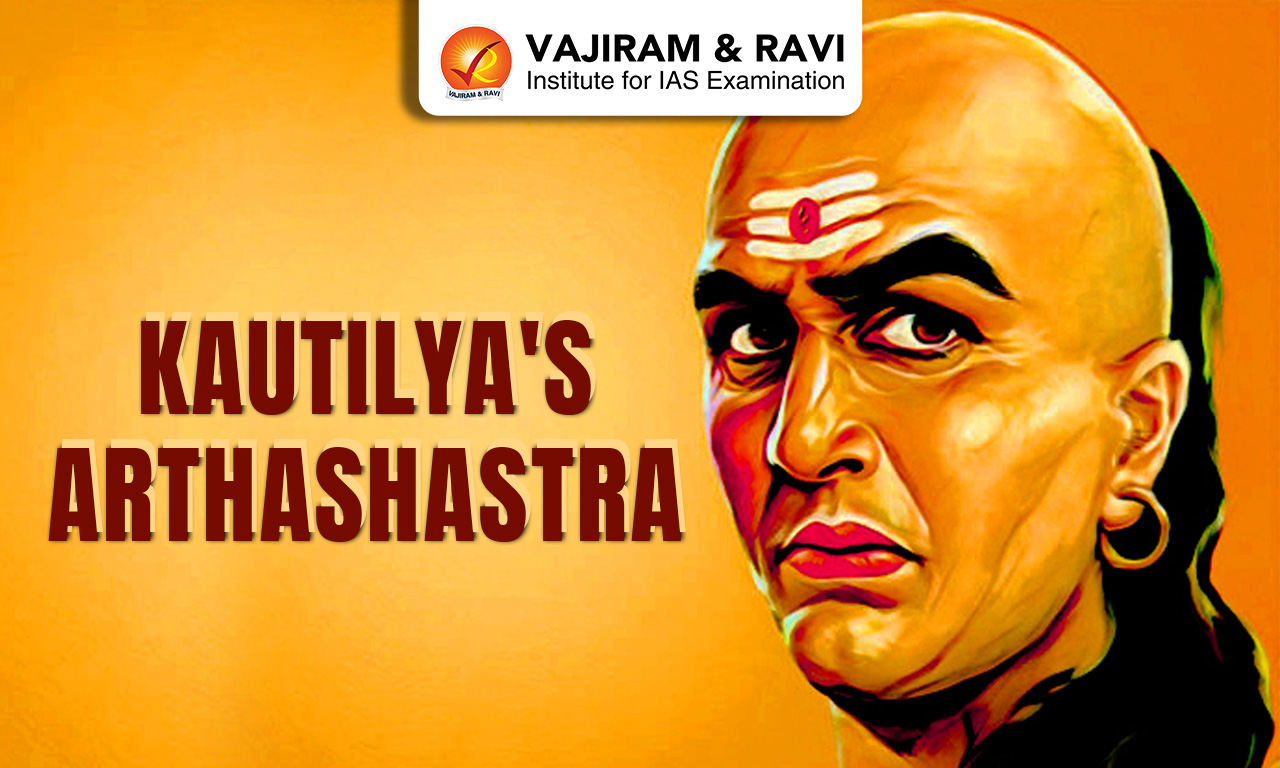
Kautilya’s Arthashastra is one of the most important ancient Indian texts on governance, economics, politics, and strategy. It was written by Kautilya (also known as Chanakya or Vishnugupta), who was the chief advisor to Chandragupta Maurya, the founder of the Maurya Empire.
This text acts as a complete manual for ruling a state, covering administration, law, diplomacy, taxation, military strategy, and social order.
Kautilya’s Arthashastra
The term Arthashastra comes from two Sanskrit words, Artha meaning wealth, prosperity, or material well-being, and Shastra, meaning science or treatise. Thus, Arthashastra means “The Science of Wealth and Statecraft.” It was written by Kautilya around the 4th century BCE and serves as a comprehensive guide for rulers.
Kautilya’s Arthashastra Key Features
Kautilya’s Arthashastra is a comprehensive and practical guide that explains governance, economy, diplomacy, and military strategy in a systematic way.
- Comprehensive Treatise on Statecraft: Covers politics, administration, economics, military strategy, and social organization in a unified framework by Kautilya.
- Role in Mauryan Establishment: Kautilya played a key role in establishing the rule of Chandragupta Maurya and shaping early imperial governance.
- Saptanga Theory of State: Defines seven essential elements of a state: King, Ministers, Territory, Fort, Treasury, Army, and Allies.
- Strong Administrative System: Emphasizes efficient governance through trained officials, proper hierarchy, and strict supervision.
- Economic Management: Focuses on agriculture, trade, taxation, and state control over key industries to ensure economic stability.
- Taxation Policy: Advocates fair and systematic tax collection without overburdening citizens.
- Espionage System: Introduces a well-organized spy network to monitor internal administration and external threats.
- Law and Justice: Promotes strict legal systems with defined punishments to maintain order and discipline.
- Foreign Policy (Mandala Theory): Explains inter-state relations, alliances, and rivalries based on strategic interests.
- Military Strategy: Highlights the importance of a strong army, planning, and use of tactics in warfare.
- Public Welfare Focus: Encourages development of infrastructure, irrigation, trade routes, and citizen welfare.
- Concept of Slavery: Mentions that individuals could become slaves through means such as judicial punishment. It also provided certain rights; if a female slave bore her master’s son, she could gain freedom, and the child was entitled to legal recognition.
- Practical and Realistic Approach: Unlike idealistic texts, it focuses on real-world governance, power management, and decision-making.


Administration in Kautilya’s Arthashastra
- Centralized Administration: Kautilya advocated a strong centralized system where the king was the supreme authority, but governance was carried out through a structured bureaucracy.
- Role of the King: The king was the head of administration and responsible for law, order, security, and welfare of the people. He was expected to be disciplined, accessible, and guided by advisors.
- Council of Ministers (Mantriparishad): A group of wise and experienced ministers assisted the king in decision-making. Policies were formed through consultation and collective wisdom.
- Well-Defined Bureaucracy: Arthashastra describes a detailed administrative system with officials like:
- Amatyas (Ministers)
- Samaharta (Revenue Collector)
- Sannidhata (Treasurer)
Each official had clearly defined roles and responsibilities.
- Departmental Administration: The state was divided into various departments such as:
- Agriculture
- Trade and commerce
- Mining
- Forests
- Defense
Each department was supervised by a superintendent (Adhyaksha).
- Provincial and Local Administration: The empire was divided into provinces, districts, and villages for better governance. Local officers managed day-to-day administration and reported to higher authorities.
- Revenue Administration: Efficient tax collection was a key feature. The state collected revenue from:
- Agriculture
- Trade
- Customs duties
- Mines and forests
- Law and Order System: Strict laws and punishments were enforced to maintain discipline. Officials were responsible for preventing crime and ensuring justice.
- Espionage and Intelligence System: A strong network of spies was used to monitor:
- Officials
- Public opinion
- Enemy activities
This helped in maintaining internal security and preventing corruption.
- Anti-Corruption Measures: Kautilya emphasized strict supervision of officials. Regular audits and severe punishments were used to control corruption.
- Record Keeping and Accountability: Detailed records of revenue, expenses, and administrative activities were maintained. Officials were held accountable for their performance.
- Public Welfare Administration: The state was responsible for:
- Building roads and irrigation systems
- Supporting farmers and traders
- Managing disasters and crises
- Military Administration: A separate administrative system managed the army, including recruitment, training, and logistics.
- Judicial Administration: Courts and judges were appointed to handle disputes. Justice was expected to be fair but strict.
- Efficiency and Discipline: Overall administration focused on efficiency, discipline, and stability, ensuring smooth functioning of the state under rulers like Chandragupta Maurya.
Importance of Arthashastra
- Foundation of Political Science in India: The Arthashastra by Kautilya is one of the earliest and most systematic works on governance, making it a cornerstone of ancient Indian political thought.
- Practical Guide to Governance: Unlike purely philosophical texts, it provides real-world solutions on administration, law, taxation, and state management, helping rulers govern effectively.
- Insight into Mauryan Administration: It offers a detailed understanding of how the Maurya Empire functioned under Chandragupta Maurya, including bureaucracy and decision-making.
- Economic Planning and Resource Management: Arthashastra explains taxation, trade regulation, agriculture, and state control over resources, making it an early text on economic policy.
- Development of Foreign Policy Concepts: Concepts like the Mandala Theory provide insights into diplomacy, alliances, and international relations, many of which are still relevant today.
- Emphasis on Law and Order: It highlights the importance of a strong legal system with clear rules and punishments to maintain stability in society.
- Focus on Public Welfare: The text stresses that the king’s duty is the welfare and happiness of his people, including infrastructure development and disaster management.
- Use in Modern Administration and Strategy: Many ideas from Arthashastra are still applicable in public administration, management, and strategic planning.
About Kautilya (Chanakya)
- Identity and Names: Kautilya was also known as Chanakya and Vishnugupta in ancient texts.
- Time Period: Lived around the 4th century BCE, a crucial period in Indian history.
- Author of Arthashastra: Wrote the famous Arthashastra, a detailed guide on governance, economics, and statecraft.
- Advisor to Chandragupta Maurya: Served as the chief mentor and strategist to Chandragupta Maurya.
- Role in Empire Building: Played a key role in the establishment of the Maurya Empire.
- Political and Economic Thinker: Known for his deep understanding of administration, diplomacy, and economic policies.
- Strategic Mindset: Famous for practical, result-oriented strategies rather than idealistic theories.
- Association with Education: Believed Zto be linked with the ancient university of Takshashila.
- Focus on Governance: Emphasized discipline, efficient administration, and welfare of the people.
- Lasting Legacy: His ideas still influence modern governance, management, and political studies.
UPSC CSE Prelims PYQs
According to Kautilya’s Arthashastra, which of the following are correct?
- A person could be a slave as a result of a judicial punishment.
- If a female slave bore her master a son, she was legally free.
- If a son born to a female slave was fathered by her master, the son was entitled to the legal status of the master’s son.
Which of the statements given above are correct?
- 1 and 2 only
- 2 and 3 only
- 1 and 3 only
- 1, 2 and 3

 Last updated on Sep, 2026
→ UPSC 2027 Notification will be released on 13 January 2027 at upsconline.nic.in.
→ Check out the latest UPSC Syllabus here.
→ Download UPSC Model Answers for Mains 2026
→ UPSC Mains Question Paper 2026 is out now for Essay & GS Paper 1, 2, 3 & 4.
→ UPSC Calendar 2027 has been released.
→ Enroll in Vajiram & Ravi’s UPSC Mains Test Series 2027 for structured answer writing practice, expert evaluation, and exam-oriented feedback.
→ Join Vajiram & Ravi’s UPSC Mentorship Program 2027 for personalized guidance, strategy planning, and one-to-one support from experienced mentors.
→ Go through the UPSC Mains Previous Year Papers to enhance your preparation.
→ UPSC has released UPSC Toppers List 2025 with the Civil Services final result on its official website.
→ Also check Best UPSC Coaching in India
Kautilya's Arthashastra FAQs
Q1. Who wrote Kautilya’s Arthashastra?+
Q2. What is Arthashastra about?+
Q3. When was Arthashastra written?+
Q4. Why is Arthashastra important?+
Q5. What is the main objective of Arthashastra?+
Tags: indian history kautilya's arthashastra