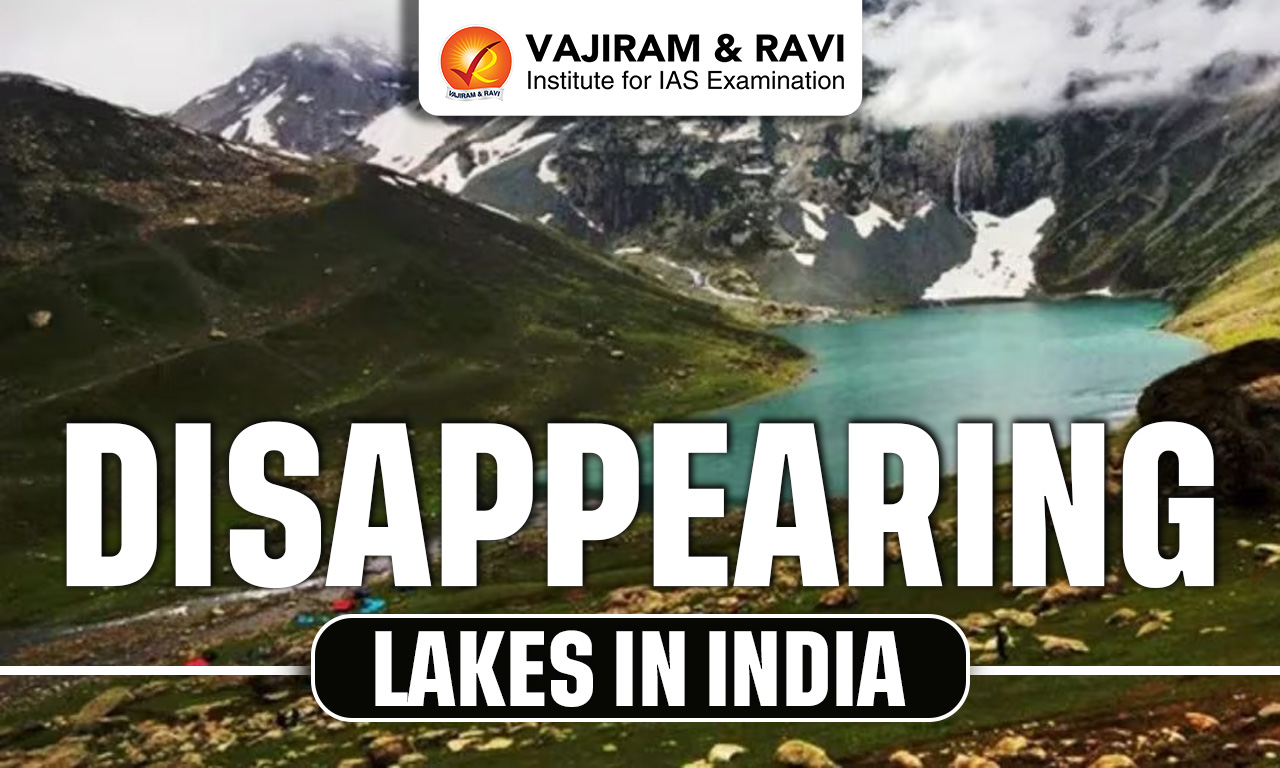
Lakes are among the most important freshwater ecosystems on Earth, yet they are rapidly shrinking, degrading, or disappearing due to increasing human interference in natural systems in the Anthropocene era.
State of Lakes in India and the World
According to the International Glossary of Hydrology, a lake is an inland body of water of considerable size, either natural or artificial.
- According to a recent Comptroller and Auditor General of India (CAG) report on Conservation and Management of Lakes, 518 out of 697 lakes recorded in 1967 in Jammu and Kashmir have either disappeared or significantly shrunk.
- The report further notes that 315 lakes have completely vanished up to March 2022 in the region.
- This pattern is not confined to Jammu and Kashmir but reflects a wider trend across India, where lakes are under increasing pressure from urbanisation, pollution, and encroachment, leading to their shrinkage and disappearance.
- Globally, around 117 million lakes cover nearly 4 per cent of the Earth’s land surface and collectively hold about 90 per cent of the world’s surface freshwater, making them critical for ecological balance and water security.
Ecological and Socio-Economic Significance of Lakes
Lakes are not merely scenic water bodies; they are life-supporting ecological systems. Their importance can be understood through six key functions:
- Groundwater Recharge: Lakes act as natural reservoirs that recharge groundwater systems. In India, where a large share of drinking water and irrigation depends on groundwater, lakes play a crucial role in sustaining long-term water security.
- Flood Regulation: During heavy rainfall, lakes function as natural buffers by absorbing excess runoff. This reduces surface flooding and protects downstream settlements from extreme hydrological events
- Biodiversity Hotspots: Lakes provide critical habitats for aquatic plants, fish species, birds, and migratory fauna. For example, Chilika Lake in Odisha, the largest brackish water lagoon in the world, supports thousands of migratory birds every winter, making it a globally significant biodiversity site.
- Socio-Economic Value: Lakes directly support livelihoods through fisheries, irrigation, agriculture, and domestic water supply. They also contribute to local economies through tourism and recreation, especially in urban centres.
- Cultural and Spiritual Significance: In India, lakes often hold deep cultural importance. Dal Lake in Jammu and Kashmir and Pushkar Lake in Rajasthan are not only ecological assets but also sacred and cultural spaces integrated into local traditions.
- Fresh water supply: Lakes provide 90% of the world’s surface fresh water – making their conservation directly tied to global water security.
Thus, the degradation of lakes is not only an environmental issue but also a socio-economic and cultural concern.


Major Factors Responsible for Disappearing Lakes in India
The disappearance of lakes is driven by multiple interconnected anthropogenic pressures:
- Pollution and Waste Dumping: Inadequate waste management has turned many lakes into dumping grounds for sewage and solid waste. Urban lakes such as Bellandur Lake in Bengaluru have become highly toxic due to industrial and domestic pollution.
- Eutrophication: Excessive nutrient loading from sewage and agricultural runoff leads to eutrophication. This triggers algal blooms and oxygen depletion, making aquatic life unsustainable. Hussain Sagar Lake in Hyderabad and Dal Lake in Srinagar are notable examples.
- Encroachment and Land-Use Change: Rapid urbanisation and rising land values have led to large-scale encroachment of lake areas. Lakes are increasingly viewed as real estate rather than ecological infrastructure, as highlighted in the CAG report.
- Illegal Mining Activities: Unregulated sand and gravel mining from lakebeds disrupts hydrological balance and weakens lake ecosystems. Balsamand Lake in Rajasthan and Surajkund Lake in Haryana are affected by such practices.
- Unregulated Tourism and Religious Practices: Tourism pressure leads to waste generation and habitat disturbance.
- Cultural and Religious Practices: Some cultural and religious practices, such as idol immersion, also degrade water quality and intensify ecological stress on these water bodies.
Impacts of Disappearing Lakes
The rapid degradation and disappearance of lakes is triggering wide-ranging ecological, economic, and social consequences across regions.
- Groundwater depletion due to loss of recharge capacity, reducing long-term water availability
- Increased urban flooding as natural water storage and drainage buffers are destroyed
- Biodiversity loss caused by destruction of aquatic and wetland habitats
- Public health risks arising from polluted and contaminated water bodies
- Economic losses in fisheries, agriculture, and tourism-dependent livelihoods
- Decline in ecosystem services such as water purification and nutrient cycling
- Urban climate imbalance including increased heat stress and reduced local humidity regulation
- Infrastructure stress due to unmanaged runoff and waterlogging in cities
The worsening ecological and socio-economic impacts of lake degradation highlight that the crisis is not merely environmental but deeply rooted in governance and institutional inefficiencies.
Governance Challenges: Public Trust Doctrine Perspective
The Public Trust Doctrine establishes that the state is the trustee of natural resources and must protect them for present and future generations.
- Despite this constitutional obligation, lake governance in India remains weak and fragmented.
- The persistence of encroachment, pollution, and degradation reflects gaps in institutional accountability and enforcement.
- The Supreme Court in Swachh Association vs State of Maharashtra (2025) expanded the doctrine to include artificial water bodies that serve ecological functions, strengthening the legal responsibility of the state.
However, the gap between judicial principles and ground-level implementation continues to undermine lake conservation efforts. To understand the structural roots of these governance gaps, it is important to examine the constitutional and legal position of water bodies in India.
Constitutional and Legal Framework for Lake Conservation
- Under the Indian Constitution, water falls under the State List. Therefore, primary responsibility for conservation and management of lakes lies with state governments.
- India does not have a comprehensive central legislation exclusively for lake conservation. Regulation is largely dependent on fragmented frameworks.
- Some states have attempted specific lake conservation laws. Karnataka enacted a lake conservation law in 2015 but later repealed it in 2018, reflecting policy instability.
- The Wetlands (Conservation and Management) Rules, 2017 under the Environment Protection Act, 1986 provide a regulatory framework for wetland protection, but their coverage is limited to notified wetlands and Ramsar sites.
This results in diffused accountability and weak enforcement, as also observed by the CAG.
Policy Framework for Lake Conservation in India
India has implemented several programmes for lake and wetland conservation.
- The National Lake Conservation Programme (NLCP), launched in 2001, focused on restoring water quality and ecological health of lakes.
- In 2013, NLCP was merged with the National Wetlands Conservation Programme (NWCP) to form the National Programme for Conservation of Aquatic Ecosystems (NPCA), a centrally sponsored scheme aimed at integrated conservation of wetlands and lakes.
However, the effectiveness of these programmes is constrained by selective coverage, dependence on state nominations, funding limitations, and weak monitoring mechanisms.
Way Forward: Strengthening Lake Conservation in India
A sustainable framework for lake conservation requires multi-dimensional reforms:
- India needs a dedicated national legislation for lake protection that sets uniform standards and clearly defines institutional responsibilities.
- A statutory nodal authority can ensure coordinated governance and reduce fragmentation.
- Scientific tools such as GIS mapping and remote sensing should be used for real-time monitoring of lake boundaries, encroachments, and water quality.
- Strict enforcement of pollution control laws is essential to prevent untreated sewage and industrial discharge into lakes.
- Community participation must be strengthened to ensure local stewardship, while urban planning should integrate lakes as critical ecological infrastructure rather than vacant land.
- Integration
- Lakes must be recognised as critical urban ecological infrastructure, not vacant land for construction or expansion.

 Last updated on Sep, 2026
→ UPSC 2027 Notification will be released on 13 January 2027 at upsconline.nic.in.
→ UPSC Mains Question Paper 2026 is out now for Essay & GS Paper 1, 2, 3 & 4.
→ UPSC Mains GS Paper 1 2026 is out now.
→ UPSC Mains GS Paper 2 2026 is out now.
→ UPSC Mains GS Paper 3 2026 is out now.
→ UPSC Mains GS Paper 4 2026 is out now.
→ UPSC Mains Indian Language Paper & English Compulsory Paper are out now.
→ Check out the latest UPSC Syllabus 2026 here.
→ UPSC Mains Admit Card 2026 is now out.
→ Enroll in Vajiram & Ravi’s UPSC Mains Test Series 2027 for structured answer writing practice, expert evaluation, and exam-oriented feedback.
→ Join Vajiram & Ravi’s UPSC Mentorship Program 2027 for personalized guidance, strategy planning, and one-to-one support from experienced mentors.
→ Go through the UPSC Mains Previous Year Papers to enhance your preparation.
→ Download UPSC Mains Essay Paper 2025, UPSC Mains GS Paper-I 2025, UPSC Mains GS Paper-II 2025, UPSC Mains GS Paper-III 2025, UPSC Mains GS Paper-IV 2025, UPSC Mains English (Compulsory) Paper 2025, UPSC Mains Hindi (Qualifying) Paper 2025 here.
→ UPSC has released UPSC Toppers List 2025 with the Civil Services final result on its official website.
→ UPSC Calendar 2027 has been released.
→ Also check Best UPSC Coaching in India
Disappearing Lakes in India FAQs
Q1. What does the CAG report reveal about lake loss?+
Q2. Why are lakes disappearing in India?+
Q3. Which Indian lakes are heavily polluted or degraded?+
Q4. What is the ecological significance of lakes?+
Q5. What is the Public Trust Doctrine in relation to lakes?+
Q6. What are the key laws governing lakes in India?+
Q7. What are the key institutional challenges in lake management?+
Tags: disappearing lakes in india