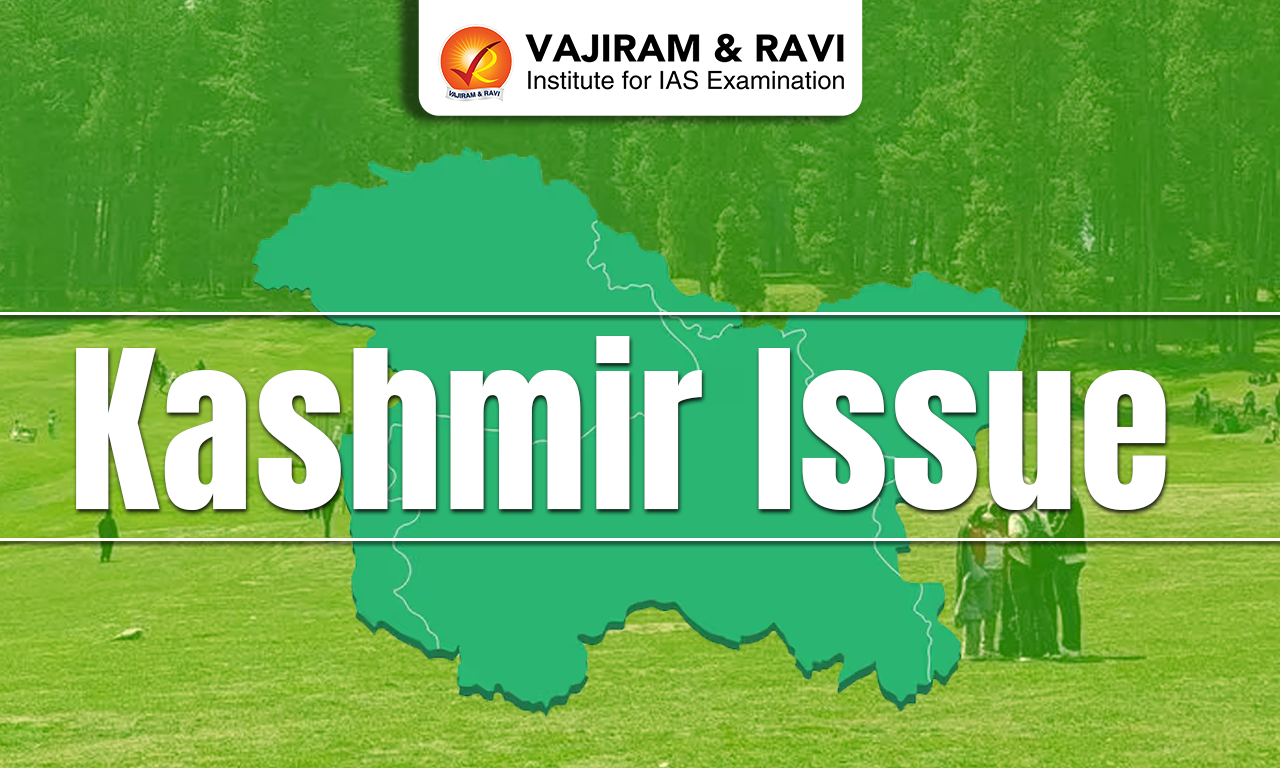
The Kashmir issue is a long-standing conflict over Jammu and Kashmir between India and Pakistan since 1947. It began after the region’s accession to India, leading to disputes and wars between the two countries. Over time, it has become a complex issue involving security, politics, and people’s rights. Today, it remains a key topic for peace and stability in South Asia.
History of Jammu and Kashmir Issue
- Early History of Kashmir
- Kashmir has a very rich and long history, and one of the earliest written records about it comes from the famous book Rajatarangini written by Kalhana. This text gives us valuable information about ancient rulers and events.
- In ancient times, Kashmir, along with regions like Jammu, Ladakh, and Gilgit, was mainly ruled by Hindu and Buddhist kings. It was also an important center for both religions, attracting scholars, monks, and learners.
- Several powerful dynasties such as the Gonanditya, Karkota, and Lohara ruled Kashmir for many years. These rulers helped shape the culture, traditions, and political system of the region.
- Shift in Rule and New Dynasties
- Hindu rule in Kashmir continued for a long time, but a major change happened in 1339 when Shah Mir became the first Muslim ruler. This marked the beginning of the Shah Mir dynasty.
- This shift from Hindu to Muslim rule brought many cultural and administrative changes, and over time, both communities contributed to the region’s unique identity.
- Mughal, Sikh and Later Rule
- In 1587, Kashmir came under the control of the Mughal Empire when Akbar conquered it. The Mughals influenced art, architecture, and governance in Kashmir.
- Later, Kashmir was ruled by Afghan rulers, and then by the Sikh Empire under Ranjit Singh. This shows that different communities ruled the region at different times.
- Dogra Rule Begins
- In the mid-19th century, Jammu and Kashmir came under the rule of Gulab Singh, who belonged to the Dogra dynasty. His rule marked the beginning of a new political phase for the region.
- In 1846, an important agreement called the Treaty of Amritsar was signed between Gulab Singh and the British East India Company. This agreement played a key role in shaping the future of Jammu and Kashmir.
- As part of this treaty, Gulab Singh paid a large sum of money (around 75 lakh rupees) to the British. In return, he received control over Kashmir and nearby areas. This helped bring different regions like Jammu, Kashmir, and Ladakh under one unified rule.
- After this agreement, Jammu and Kashmir became a princely state. This means it was ruled by its own king (the Dogra ruler), but it was also under the overall influence and control of the British.
- Last Ruler Before Independence
- In 1925, Hari Singh became the ruler of Jammu and Kashmir. He was the last king of the princely state.
- During his rule, important political changes took place, especially around the time of India’s independence in 1947.
- It was under Hari Singh that the historic agreement (Instrument of Accession) was signed with India, which decided the future of the region.
Background of Kashmir’s accession to India
- At the time of India’s independence in 1947, Jammu and Kashmir was one of the many princely states. These states were given three choices: join India, join Pakistan, or remain independent.
- The ruler of J&K, Hari Singh, did not want to immediately join either country. He hoped to keep the state independent and maintain control over it.
- To manage day-to-day matters while delaying a final decision, he proposed a Standstill Agreement to both India and Pakistan. This agreement meant that existing arrangements like trade, communication, and travel would continue as they were.
- Pakistan agreed to this proposal on 15 August 1947. India, however, suggested that further discussions were needed before making any decision.
- Meanwhile, the people of Kashmir were also politically active. Many supported the freedom movement and wanted a better future, not just freedom from British rule but also relief from the old feudal system under the Dogra rulers.
- Tribal Invasion and Crisis
- Despite agreeing to the Standstill Agreement, Pakistan supported a tribal invasion in October 1947. Thousands of armed tribal fighters entered Kashmir from the north.
- These attackers caused violence and captured several areas, creating panic and instability in the region.
- This sudden invasion made the situation very serious, and the Maharaja found it difficult to protect the state on his own.
- Appeal to India and Signing of Accession
- Facing this emergency, Maharaja Hari Singh asked India for military help. He also sent Sheikh Abdullah to Delhi to support his request.
- The Indian government agreed to help, but on one condition: the state had to officially join India.
- On 26 October 1947, Hari Singh signed the Instrument of Accession, making Jammu and Kashmir a part of India.
- According to this agreement, India would take control of important matters like defence, foreign affairs, and communications, while the state could manage its internal affairs.
- Immediately after the signing, on 27 October 1947, India responded quickly by sending its troops to Kashmir through airlifting, and within a short time, these forces were able to stop the invading forces and protect major parts of the region.
- Political Changes After Accession
-
- In March 1948, Maharaja Hari Singh announced the formation of an interim government to give people more representation.
- Sheikh Abdullah became the Prime Minister of this new government, marking a shift towards more democratic governance.
- Later, Hari Singh transferred his powers to his son Karan Singh, who became the Regent (temporary ruler).
- Despite the accession, Pakistan did not accept this move, which led to the outbreak of the First Kashmir War, as both sides tried to gain control over different areas of the region.
- On the advice of Lord Mountbatten, in January 1948, India took the issue to the United Nations Security Council, stating that Pakistani-backed forces had illegally entered and occupied parts of Kashmir.
- India requested international help to ensure that these forces withdraw and peace is restored in the region.
- The UN proposed a ceasefire, demilitarization (removal of troops), and a plebiscite to let people decide their future.
- A ceasefire was successfully implemented, but further steps could not be completed.
- The plebiscite did not take place because India and Pakistan could not agree on key conditions, especially regarding troop withdrawal.
- A ceasefire was finally declared on 1 January 1949, which stopped the fighting but also resulted in the division of the region along what came to be known as the Line of Control, with India controlling about two-thirds of the territory while Pakistan held the remaining areas, including Gilgit and Baltistan.


Delhi Agreement (July 1952)
- The Delhi Agreement was signed in July 1952 to define the relationship between Jammu and Kashmir and the Indian Union while maintaining the state’s special status.
- Jammu and Kashmir was given residuary powers, meaning powers not mentioned in the Constitution remained with the state, unlike other states where they belong to the Centre.
- People of the state were recognized as Indian citizens, but the state could grant special rights and privileges to its permanent residents.
- The state was allowed to have its own flag along with the national flag, without challenging the authority of the Union flag.
- The head of the state, called Sadar-i-Riyasat, was to be elected by the state legislature, instead of being appointed by the Centre.
- There were debates on applying Fundamental Rights, especially because of land reforms led by Sheikh Abdullah.
- The Supreme Court of India had limited jurisdiction initially, mainly for appeals.
- Emergency provisions (Article 352) could apply, but for internal issues only with the state’s consent, while Articles 356 and 360 were not applied.
Article 370 of the Indian Constitution
- Article 370 was a special provision in the Constitution (Part XXI) that gave Jammu and Kashmir a unique status within India.
- It was drafted with the involvement of Sheikh Abdullah to address the region’s specific political and historical situation at the time of accession.
- Under this article, only matters like defence, foreign affairs, finance, and communications were directly under the Centre, while other laws required approval of the state government.
- Jammu and Kashmir had its own constitution, flag, and governance system, including earlier positions like Prime Minister and Sadar-i-Riyasat.
- The state followed separate laws, especially regarding property rights and local privileges for residents.
- A 1954 Presidential Order defined which parts of the Indian Constitution would apply to the state.
- The article could be revoked only with the recommendation of the state’s Constituent Assembly, but since it was dissolved without doing so, the provision continued for many years.
- While it aimed to protect the region’s identity and autonomy, it remained debated, with differing views on its impact on national integration.
Article 35A (1954)
- Article 35A was added in 1954 through a Presidential Order under Article 370, mainly for Jammu and Kashmir.
- It allowed the state government to define who qualifies as a “permanent resident” and to give them special rights and privileges.
- While Article 370 gave special status to the state, Article 35A focused on giving special benefits to its residents.
- These special rights included government jobs, property ownership, settlement rights, and scholarships.
- People from other states of India were not allowed to buy property, settle permanently, or access state benefits in Jammu and Kashmir.
- The definition of permanent residents could only be changed by the state assembly with a two-thirds majority.
- As per state rules, a permanent resident was someone who was a state subject before May 14, 1954, or had lived there for a long time and owned property legally.
- There were also rules about people who migrated during partition and later returned with proper permission.
- Earlier, there were concerns that women might lose property rights after marrying outsiders, but a 2002 High Court ruling protected their rights.
- The article gave the state government power to decide who gets privileges, but it also remained debated, with some people supporting it for protecting local identity and others questioning its constitutional validity.
Threats and Challenges Faced by Jammu and Kashmir
- Jammu and Kashmir faces rising terrorism and violence, which continues to disturb peace and daily life.
- Cross-border infiltration and support from Pakistan make the security situation more complex.
- Porous borders and LoC crossings allow militants to enter the region easily.
- Public dissatisfaction and local grievances sometimes add to unrest and instability.
- The rise of lone-wolf attacks and use of drones has made it harder for security forces to predict and prevent threats.
- Development challenges, including gaps in healthcare, education, and governance, affect the overall stability of the region.
- At times, militants get local support or sympathy, which makes it difficult to track and arrest them quickly.
Major Changes in 2019
- In August 2019, Home Minister Amit Shah announced in the Rajya Sabha the revocation of Article 370.
- A new Presidential Order was issued, which replaced the 1954 order and allowed the full application of the Indian Constitution to Jammu and Kashmir.
- This step also led to the removal of Jammu and Kashmir’s separate constitution and its special status.
- The decision was taken with the approval of the state’s Governor (acting on behalf of the state government at that time).
- After this, the Jammu and Kashmir Reorganisation Act, 2019 was passed, which divided the state into two Union Territories – Jammu & Kashmir and Ladakh.
- From 31 October 2019, Jammu & Kashmir became a Union Territory with a legislature, while Ladakh became a Union Territory without a legislature.
Government Initiatives for Jammu & Kashmir Development
- The Government of India is making strong efforts to develop Jammu and Kashmir by focusing on infrastructure, economy, and social welfare to improve people’s lives.
- Major projects like the Udhampur-Srinagar-Baramulla Rail Link (USBRL) are helping connect the Kashmir Valley with the rest of India, including important structures like the Chenab Bridge. At the same time, better roads, highways like NH-44, tunnels, and improved air travel (including new routes such as Srinagar-Sharjah) are boosting connectivity.
- To grow the economy, the government launched the New Central Sector Scheme (NCSS) 2021, which provides financial support and incentives to encourage industries and create jobs.
- There has been a strong push for digital development, with better internet services like 4G connectivity and improved access in rural areas, making communication and services easier.
- In the agriculture sector, programs like the Holistic Agriculture Development Program, along with schemes such as PM-Kisan and crop insurance, are helping farmers increase their income and adopt modern methods.
- The government is improving healthcare and education by setting up new hospitals, medical colleges, and institutions like AIIMS to provide better facilities.
- Special focus is being given to women empowerment, with programs that support self-help groups and encourage women-led development.
- Investments in sports infrastructure are helping youth get better training and opportunities at national and international levels.

 Last updated on Oct, 2026
→ UPSC 2027 Notification will be released on 13 January 2027 at upsconline.nic.in.
→ Check Nobel Prize 2026 Winners List here.
→ Download PIB PRiSM Monthly Magazine 2026 here.
→ Check UPSC Monthly Current Affairs Magazine The Recitals here.
→ Check out the latest UPSC Syllabus here.
→ Download UPSC Model Answers for Mains 2026
→ UPSC Mains Question Paper 2026 is out now for Essay & GS Paper 1, 2, 3 & 4.
→ UPSC Calendar 2027 has been released.
→ Enroll in Vajiram & Ravi’s UPSC Mains Test Series 2027 for structured answer writing practice, expert evaluation, and exam-oriented feedback.
→ Join Vajiram & Ravi’s UPSC Mentorship Program 2027 for personalized guidance, strategy planning, and one-to-one support from experienced mentors.
→ Go through the UPSC Mains Previous Year Papers to enhance your preparation.
→ UPSC has released UPSC Toppers List 2025 with the Civil Services final result on its official website.
→ Also check Best UPSC Coaching in India
Kashmir Issue FAQs
Q1. What is the Kashmir issue?+
Q2. Why did Jammu and Kashmir join India in 1947?+
Q3. What was Article 370 and why was it important?+
Q4. What is Article 35A?+
Q5. What major changes happened in Jammu and Kashmir in 2019?+
Tags: kashmir issue polity