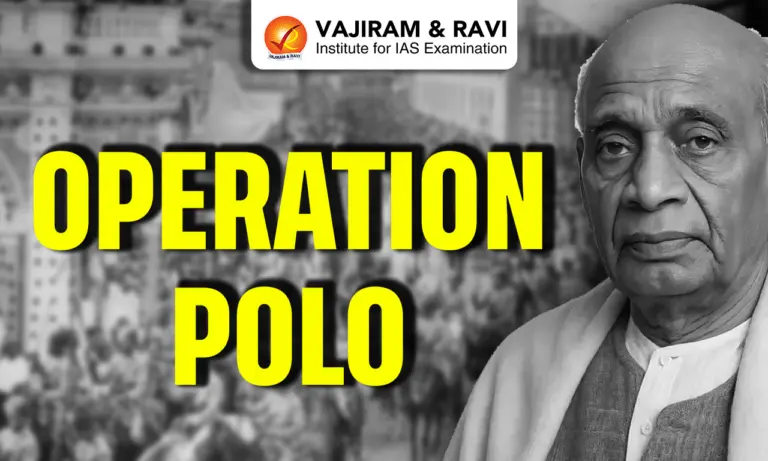
Operation Polo was the military action launched by the Government of India between 13 September and 17 September 1948 to integrate the princely state of Hyderabad into the Indian Union. The Operation is popularly called the “Police Action” and “Operation Caterpillar.” The operation ended the Nizam’s attempt to remain independent after Indian independence. The campaign involved the Indian Army, Air Force and armoured divisions under Major General J. N. Chaudhuri. Hyderabad’s surrender marked a decisive phase in India’s political and territorial consolidation after 1947.
Operation Polo Historical Background
After British withdrawal in 1947, Hyderabad attempted to remain independent despite being located in the centre of India.
- Indian Independence Act 1947: The British ended the system of Subsidiary Alliance and allowed Princely States to join India, Pakistan or remain independent. Hyderabad chose neither India nor Pakistan, creating a serious constitutional and political dispute.
- Strategic Position of Hyderabad: Hyderabad covered more than 80,000 square miles and had nearly 16 million people. Its location between northern and southern India made Indian leaders fear disruption of territorial continuity and internal security.
- Nizams of Hyderabad: Hyderabad was ruled by Mir Sir Osman Ali Khan, Asaf Jah VII, one of the world’s wealthiest rulers. Although nearly 85% of the population was Hindu, political and administrative authority remained concentrated among Muslim elites.
- Demand for Independence: On 15 August 1947, the Nizam declared Hyderabad an independent state. He rejected accession to India and attempted to secure sovereign recognition through diplomatic negotiations with Britain and other countries.
- Join Indian Union Movement: In August 1947, there was an uprising demanding for the accession of Hyderabad to India through a campaign launched as Join Indian Union Movement.
- Standstill Agreement: Hyderabad signed a Standstill Agreement with Mountbatten (India) on 29 November 1947 for one year for status quo and administration. India managed defence, communications, foreign affairs and currency while Hyderabad retained internal administration during negotiations.
- Violations of Agreement: Soon after signing the agreement, Hyderabad allegedly violated its conditions by importing arms, expanding irregular militias, restricting Indian currency circulation and establishing secret foreign contacts with Pakistan and Britain.
- British Mediation Efforts: Mountbatten attempted to resolve the issue peacefully through negotiation. In June 1948, he proposed the “Heads of Agreement” giving Hyderabad autonomous Dominion Status within India, but the Nizam rejected it.
- Patel’s Firm Position: Sardar Vallabhbhai Patel considered Hyderabad’s independence dangerous for India’s unity. He described it as “an Ulcer in the Heart of India” and strongly supported immediate military intervention to end separatist ambitions.
- Nehru’s Reservations: Prime Minister Jawaharlal Nehru initially opposed military action because he feared communal violence, international criticism and damage to India’s image as a peaceful democratic nation after independence.
- Internationalisation Attempts: Hyderabad attempted to seek intervention from the United Nations and appealed to foreign governments including the United States and Britain. Sir Walter Monckton (British Lawyer) supported Hyderabad diplomatically during negotiations.
- Growing Security Crisis: By mid 1948, border violence, Razakar attacks, peasant uprisings and increasing instability convinced Indian leaders that diplomatic efforts had failed and military action became unavoidable for restoring order.
History of Hyderabad
Hyderabad developed into a wealthy Deccan kingdom under successive dynasties before becoming a princely state under British protection.
- Quli Qutb Shah established Golconda after taking control from the Bahamani Kingdom in 1512.
- EMohammed Quli Qutub Shah founded Hyderabad in 1591 as the new capital of the Qutb Shahi Dynasty.
- Aurangzeb captured Golconda in 1687 after a prolonged siege. Hyderabad then became part of the Mughal Empire.
- Asaf Jah I declared independence from the declining Mughal Empire in 1724 and founded the Asaf Jahi Dynasty.
- In 1798, Hyderabad became the first princely state to enter the Subsidiary Alliance system with the British East India Company.
- Hyderabad developed its own railways, postal network, currency arrangements, radio services and military establishment.
- Around 85% of Hyderabad’s population was Hindu, mainly Telugu, Marathi and Kannada speaking communities. However, higher administrative, military and political positions remained dominated by Muslim aristocracy.
- By the 1940s, Hyderabad faced agrarian unrest, linguistic movements, communist mobilisation and demands for democratic reforms, especially in Telangana villages suffering under feudal landlord structures (Telangana Movement 1946).


Operation Polo Reasons
Several political, military, economic and communal developments compelled the Government of India to launch Operation Polo in September 1948.
- Threat to National Unity: Hyderabad’s independence in the geographical centre of India threatened communication routes between northern and southern regions and created fears of political fragmentation soon after independence.
- Expansion of Razakars: The Razakars, led by Kasim Razvi and supported by Ittehad-ul-Muslimeen, rapidly expanded during the Standstill Agreement period. These groups launched violent attacks on villages, political workers, communists and Hindu communities.
- Foreign Connections: The Nizam attempted to establish links with Pakistan and sought international support from Britain and the United Nations. India feared possible external interference in internal affairs.
- Loan to Pakistan: The Nizam reportedly transferred ₹20 crore from Hyderabad’s treasury to Pakistan, alarming Indian authorities and strengthening suspicions regarding Hyderabad’s political intentions and foreign alignments.
- Failure of Negotiations: Several rounds of discussions involving Lord Mountbatten, Sir Walter Monckton, K. M. Munshi and Hyderabad representatives failed because the Nizam continued insisting on complete independence.
- Kodad Skirmish: Armed clashes between Indian troops and Hyderabadi forces near Kodad strengthened Patel’s argument that Hyderabad posed a military threat requiring immediate and decisive action.
- Humanitarian Concerns: Violence against civilians caused displacement of thousands of residents, especially Hindus fleeing to neighbouring provinces. India justified intervention partly on grounds of restoring peace and protecting civilians.
Annexation of Hyderabad
The integration of Hyderabad into India occurred through military action, political surrender and constitutional accession during September 1948.
- Launch of Operation Polo: The Government of India formally launched Operation Polo on 13 September 1948. The campaign was described as a “Police Action” because India considered Hyderabad an internal constitutional matter.
- Indian Military Strength: Nearly 36,000 Indian troops participated in the operation. The campaign involved infantry brigades, armoured divisions, engineering units, artillery support and Hawker Tempest aircraft squadrons.
- Goddard Plan: Indian military planners adopted the Goddard Plan involving two major thrusts from Solapur in the west and Vijayawada in the east to quickly overwhelm Hyderabad’s forces.
- Hyderabadi Military: Hyderabad possessed nearly 24,000 troops but only about 6,000 were properly trained and equipped. The state army included Arabs, Rohillas, Pathans and irregular militia formations.
- Razakars: Hyderabad also relied on nearly 200,000 Razakars under Kasim Razvi. However, most carried outdated weapons, swords and muzzle loading firearms, limiting their battlefield effectiveness.
- Rapid Indian Advance: Indian forces captured key towns, forts, communication centres and highways within days. Speed, superior coordination, armour support and air power overwhelmed Hyderabadi resistance across multiple fronts.
- Surrender of Hyderabad: On 17 September 1948, the Nizam announced a ceasefire through Deccan Radio and ordered Hyderabad’s forces to surrender to the Indian Army.
- Instrument of Accession: After surrender, the Nizam signed the Instrument of Accession, officially integrating Hyderabad into the Indian Union and recognising Indian sovereignty over the state.
- Withdrawal of UN Complaint: On 22 September 1948, Hyderabad withdrew its complaint before the United Nations Security Council, ending international legal disputes regarding the merger with India.
- Military Administration: Hyderabad remained under military administration under Major General J. N. Chaudhuri until December 1949 before transition toward civilian governance and later the First General Election in 1951-52.
Operation Polo Events
Operation Polo involved coordinated military offensives, strategic captures, aerial operations and rapid territorial advances between 13 and 17 September 1948.
- Beginning of Offensive: Indian forces entered Hyderabad at 4 a.m. on 13 September 1948. The operation began simultaneously from multiple directions to prevent regrouping of Hyderabadi and Razakar forces.
- Battle of Naldurg Fort: The first major engagement occurred at Naldurg Fort on the Solapur-Secunderabad highway. Indian troops used surprise attacks, mobility and superior firepower to capture Naldurg Fort quickly.
- Jalna Occupation: A company from 3/11 Gurkha Rifles occupied Jalna while the remaining Indian forces continued advancing toward Latur and Mominabad to cut off Hyderabadi resistance networks.
- Urban Ambushes by Razakars: Razakar groups attempted guerrilla style attacks inside urban settlements, using narrow streets and local terrain to delay Indian columns moving toward strategic communication centres.
- Eastern Sector Operations: Major General Ajit Rudra’s eastern column advanced steadily from Vijayawada with Gurkha Rifles, Poona Horse units and engineering detachments securing communication routes and supply lines.
- Capture of Bidar: In the early hours of 17 September, Indian troops entered Bidar while additional columns simultaneously secured towns including Chityal and Hingoli during coordinated offensives.
- Collapse of Hyderabadi Defence: By 17 September, Hyderabad’s military command recognised that Indian forces had routed state troops and Razakars across all fronts with severe battlefield losses.
- State of Emergency: The Indian government declared emergency measures in Hyderabad during the campaign fearing communal disturbances elsewhere in India as large scale troop deployment proceeded into Hyderabad territory.
Operation Polo Leaders
Several political leaders, military commanders, diplomats and administrators played decisive roles during Operation Polo and Hyderabad’s integration into India.
- Sardar Vallabhbhai Patel: As Deputy Prime Minister and Home Minister, Patel strongly advocated military intervention. He viewed Hyderabad’s independence as a major danger to India’s territorial integrity and national consolidation.
- Jawaharlal Nehru: Prime Minister Nehru initially preferred diplomatic negotiations because of concerns regarding communal violence and international criticism, but eventually approved military action after negotiations failed completely.
- Lord Louis Mountbatten: The last Viceroy and first Governor General of independent India attempted peaceful settlement through negotiations and proposed the “Heads of Agreement” compromise plan during 1948.
- V. P. Menon: As secretary in the States Ministry, V. P. Menon assisted Patel in negotiating accession with princely states and coordinated constitutional arrangements concerning Hyderabad’s integration.
- Mir Osman Ali Khan: The seventh Nizam of Hyderabad attempted to preserve Hyderabad’s independence through diplomacy, international appeals, military preparations and negotiations with India, Britain and Pakistan.
- Kasim Razvi: Leader of Ittehad-ul-Muslimeen and commander of the Razakars, Kasim Razvi promoted militant resistance, Muslim political dominance and armed opposition against Hyderabad’s merger with India.
- Mir Laik Ali: Hyderabad’s Prime Minister represented the Nizam during negotiations and later approached the United Nations alleging Indian interference in Hyderabad’s internal affairs before Operation Polo.
- Major General J. N. Chaudhuri: Commander of the Indian Army’s western offensive during Operation Polo, Chaudhuri later became Hyderabad’s Military Governor and subsequently served as Chief of Army Staff.
- K. M. Munshi: India’s Agent General in Hyderabad, K. M. Munshi monitored developments inside the state and represented Indian political interests during negotiations with Hyderabad authorities.
- C. Rajagopalachari: India’s Governor General during the operation, Rajagopalachari approved the military campaign alongside Nehru and Patel to restore order and integrate Hyderabad into the Union.
- T. T. Moor: A former British army officer, Moor assisted Hyderabad’s efforts to strengthen military production by helping establish gunpowder manufacturing facilities before Operation Polo.
- Havildar Bachhitar Singh: The Sikh soldier displayed extraordinary bravery during the advance toward Naldurg and became the first recipient of Independent India’s Ashoka Chakra Gallantry Award posthumously.
Operation Polo Results
Operation Polo ended Hyderabad’s independence and transformed the political structure of the Deccan region under Indian administration.
- End of Independent Hyderabad: Operation Polo completely ended Hyderabad’s existence as an independent princely state and brought it constitutionally within the sovereign framework of the Indian Union.
- Defeat of Razakars: The operation dismantled the Razakar militia and ended their armed dominance in Hyderabad’s politics, administration and communal mobilisation across rural and urban regions.
- Retention of Nizam: Despite surrender, the Nizam continued as ceremonial Rajpramukh under the Indian Union for some time, similar to arrangements adopted for several other princely rulers.
- Symbol of State Integration: Operation Polo became one of the most significant examples of post independence princely state integration alongside Junagadh and Kashmir in shaping modern India’s boundaries.
- Hyderabad Liberation Day: The integration of Hyderabad is commemorated as “Mukti Diwas” or Hyderabad Liberation Day on September 17th in Telangana, Maharashtra and Karnataka.
- Casualty: Indian forces reportedly suffered 32 deaths and 97 injuries, while Hyderabad’s side recorded approximately 490 deaths and 122 wounded during the military campaign.
Operation Polo Significance
Operation Polo played a defining role in India’s political integration, administrative consolidation and national security during the immediate post independence period.
- Preservation of National Unity: Hyderabad’s integration prevented fragmentation of India’s territory and secured communication links between northern and southern regions during the fragile years after independence.
- Integration of Largest Princely State: Hyderabad was among the largest and wealthiest princely states with 16 million people and strategic central location, making its accession critically important for India.
- Assertion of Sovereign Authority: Operation Polo demonstrated that the Government of India would not tolerate secessionist ambitions or parallel sovereign entities within the territory of independent India.
- Success of Patel’s Integration Policy: The operation reflected the determination and effectiveness of Sardar Vallabhbhai Patel’s policy of integrating more than 500 princely states into the Indian Union.
- Strengthening of Secularism: Hyderabad’s merger into India reinforced the constitutional principle of secular governance despite communal tensions and the princely state’s Muslim political leadership.
- National Security: Hyderabad’s strategic location meant foreign influence or hostile alliances could threaten India internally. Operation Polo removed these geopolitical and security concerns permanently.

 Last updated on Oct, 2026
→ UPSC 2027 Notification will be released on 13 January 2027 at upsconline.nic.in.
→ Check Nobel Prize 2026 Winners List here.
→ Download PIB PRiSM Monthly Magazine 2026 here.
→ Check UPSC Monthly Current Affairs Magazine The Recitals here.
→ Check out the latest UPSC Syllabus here.
→ Download UPSC Model Answers for Mains 2026
→ UPSC Mains Question Paper 2026 is out now for Essay & GS Paper 1, 2, 3 & 4.
→ UPSC Calendar 2027 has been released.
→ Enroll in Vajiram & Ravi’s UPSC Mains Test Series 2027 for structured answer writing practice, expert evaluation, and exam-oriented feedback.
→ Join Vajiram & Ravi’s UPSC Mentorship Program 2027 for personalized guidance, strategy planning, and one-to-one support from experienced mentors.
→ Go through the UPSC Mains Previous Year Papers to enhance your preparation.
→ UPSC has released UPSC Toppers List 2025 with the Civil Services final result on its official website.
→ Also check Best UPSC Coaching in India
Operation Polo FAQs
Q1. What was Operation Polo?+
Q2. Why was the Annexation of Hyderabad important to India?+
Q3. Who led Operation Polo?+
Q4. Who were the Razakars in Hyderabad?+
Q5. When did the Nizam surrender during Operation Polo?+
Tags: geography geography notes operation polo 1948