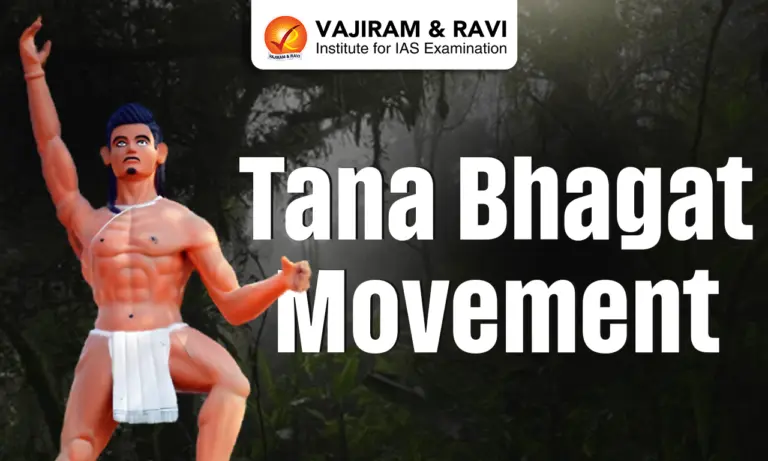
The Tana Bhagat Movement was a significant tribal reform and anti colonial movement started in April 1914 in the Chotanagpur region of present day Jharkhand under the leadership of Jatra Bhagat of the Oraon tribe. Initially, it focused on religious and social reforms within the Oraon community, but it later developed into a political movement against British rule, zamindari exploitation, forced labour and unjust taxation. The movement became closely associated with Gandhian principles of truth, non violence, civil disobedience and self rule.
Tana Bhagat Movement Background
The Tana Bhagat Movement is a major Tribal Uprising emerged because of social reforms, economic exploitation, religious purification and resistance against colonial oppression in Chotanagpur region. Various reasons leading to the movement has been discussed below:
- Religious Reform Movement: Jatra Bhagat claimed he received a divine message from Dharmesh, the supreme deity of the Oraon Community, to purify tribal religion by removing practices like animal sacrifice, exorcism, ghost worship and alcoholism from society.
- Exploitation by Zamindars: Oraon peasants suffered under excessive land rent demands imposed by zamindars and feudal landlords, creating deep dissatisfaction among tribal communities dependent on agriculture and forest resources for livelihood.
- Forced Labour System: Landlords compelled tribal people to perform unpaid labour and coolie services, which increased resentment against local authorities and strengthened collective resistance among the Oraon population.
- Opposition to Village Elites: The movement opposed the influence of pahan priests and mahto village representatives because followers believed these groups promoted superstitions, ghost beliefs and exploitative traditional practices within tribal society.
- Land Alienation Policies: British Land Policies led to gradual transfer of tribal lands to outsiders, moneylenders and landlords, causing insecurity among Oraon cultivators and weakening traditional community ownership systems.
- Influence of Birsa Movement: The Tana Bhagat Movement is regarded as an extension of the earlier Birsa Movement because both movements aimed to protect tribal identity, resist exploitation and challenge British authority in Chotanagpur.
- Desire for Swaraj: For the Tana Bhagats, Swaraj meant freedom from British Rule along with liberation from the oppression of zamindars, dikku outsiders, banias and exploitative administrative systems.
Tana Bhagat Movement Events
The Tana Bhagat Movement gradually transformed from a tribal religious reform campaign into a major non violent anti colonial political mobilisation between 1914 and 1920.
- Formation of the Movement: In April 1914, Jatra Bhagat formally launched the movement among the Oraon tribes in Chotanagpur with the objective of social purification, religious reform and resistance against exploitation.
- Adoption of Religious Discipline: Followers adopted strict moral discipline by prohibiting alcohol consumption, rejecting animal sacrifices, abandoning superstitions and promoting a simple spiritual lifestyle based on purity and collective unity.
- Resistance Against Landlords: Tana Bhagats openly challenged exploitative zamindars by refusing unfair rents, opposing feudal practices and in several areas discontinuing cultivation on lands controlled by oppressive landlords.
- Refusal to Perform Forced Labour: Members collectively stopped working as unpaid labourers and coolies for landlords and colonial authorities, which directly challenged the economic foundations of local exploitation.
- Tax Resistance Campaigns: The movement opposed taxes imposed by British authorities and organised early forms of Satyagraha and civil disobedience even before Mahatma Gandhi launched nationwide anti colonial campaigns.
- Spread of Non Violent Methods: Unlike many earlier tribal uprisings, the Tana Bhagats strongly believed in Ahimsa and peaceful resistance, making non violence a central principle of their movement and social organisation.
- Association with Gandhian Politics: After 1920, the movement became integrated with the Indian Nationalist Movement and supported Gandhi’s Non Cooperation Movement while maintaining complete commitment to peaceful protest methods.
- Participation in Congress Activities: Followers of the movement attended Congress sessions at Calcutta, Gaya and Lahore, demonstrating the growing connection between tribal political consciousness and the wider national struggle for independence.


Tana Bhagat Movement Impacts
The Tana Bhagat Movement produced major religious, social, economic and political changes within the Oraon society and strengthened anti colonial resistance in eastern India.
- End of Animal Sacrifice Practices: The movement successfully discouraged animal sacrifices and ritual violence within the Oraon community, promoting simplified worship and ethical religious practices centred on social discipline.
- Prohibition of Alcohol Consumption: Tana Bhagats completely banned alcohol drinking among followers, considering it socially harmful and a major cause of poverty, exploitation and moral decline in tribal society.
- Decline of Superstitious Practices: Belief in ghosts, spirit worship, exorcism and magical rituals gradually reduced as the movement encouraged rational faith and spiritual purification among tribal communities.
- Assertion Against Colonial Taxes: Collective resistance against British taxes strengthened tribal political awareness and inspired organised opposition against unjust colonial administrative policies in the Chotanagpur region.
- Demand for Self Governance: The movement gradually shifted towards political demands for self rule and freedom from colonial authority, making tribal aspirations part of the wider Indian independence struggle.
Tana Bhagat Movement Significance
The Tana Bhagat Movement became historically significant because it connected tribal resistance with Gandhian nationalism and introduced organised non violent protest among tribal communities.
- Integration with National Movement: The Tana Bhagats joined the Indian nationalist struggle after 1920 and actively participated in the Satyagraha, Non Cooperation and Civil Disobedience movements against British rule.
- Influence of Gandhian Ideology: Followers accepted Mahatma Gandhi’s principles of truth, Ahimsa, simplicity and peaceful protest, making the movement one of the earliest tribal examples of Gandhian political mobilisation.
- Unique Tribal Freedom Struggle: Unlike violent tribal rebellions, the movement adopted disciplined non violent resistance, giving it a distinctive place among tribal uprisings during colonial rule in India.
- Protection of Tribal Culture: The movement attempted to preserve the cultural identity, religious traditions and social dignity of the Oraon tribe against colonial interference and exploitative outside influences.
- Contribution to Independence Struggle: By participating in Congress activities and nationalist campaigns, the Tana Bhagats linked regional tribal issues with the larger objective of ending British colonial domination in India.
- Continuing Gandhian Legacy: Even today, many members of the Oraon community associated with the Tana Bhagat tradition continue to follow Gandhian values of simplicity, truthfulness, self discipline and non violence.

 Last updated on Sep, 2026
→ UPSC 2027 Notification will be released on 13 January 2027 at upsconline.nic.in.
→ Check out the latest UPSC Syllabus here.
→ Download UPSC Model Answers for Mains 2026
→ UPSC Mains Question Paper 2026 is out now for Essay & GS Paper 1, 2, 3 & 4.
→ UPSC Calendar 2027 has been released.
→ Enroll in Vajiram & Ravi’s UPSC Mains Test Series 2027 for structured answer writing practice, expert evaluation, and exam-oriented feedback.
→ Join Vajiram & Ravi’s UPSC Mentorship Program 2027 for personalized guidance, strategy planning, and one-to-one support from experienced mentors.
→ Go through the UPSC Mains Previous Year Papers to enhance your preparation.
→ UPSC has released UPSC Toppers List 2025 with the Civil Services final result on its official website.
→ Also check Best UPSC Coaching in India
Tana Bhagat Movement FAQs
Q1. Who started the Tana Bhagat Movement?+
Q2. Where did the Tana Bhagat Movement take place?+
Q3. What were the main objectives of the Tana Bhagat Movement?+
Q4. What social reforms were introduced by the Tana Bhagats?+
Q5. How did the Tana Bhagats oppose British rule?+
Tags: modern indian history modern indian history notes tana bhagat movement