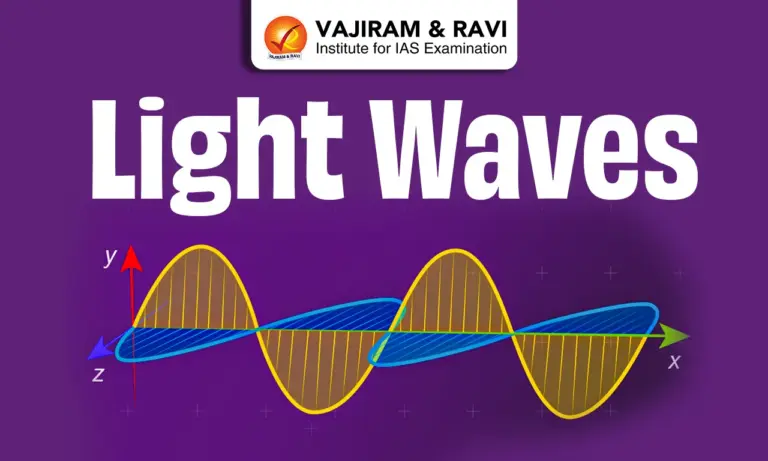
Light Waves are a form of electromagnetic radiation visible to the human eye. They are fundamental to modern science, communication, astronomy, mapping and imaging technologies. They travel in transverse form with the fastest speed known in the universe. Light shows both wave and particle like behaviour.
Light Waves
Light Waves display unique physical properties such as reflection, refraction, diffraction, interference, polarisation and dispersion, making them essential in optics, lasers, communication and remote sensing technologies.
- Speed of Light: Light travels at nearly 3 × 10⁸ m/s in vacuum. It reaches the Moon in nearly 1.3 seconds and the Sun in around 8 minutes, forming the basis of relativity and satellite communication systems.
- Visible Spectrum: Human eyes detect visible light roughly between 400 nm and 700 nm wavelengths. Violet light has the shortest wavelength and bends most in a prism, while red light has the longest wavelength and bends least.
- Dispersion of White Light: A glass prism separates white light into VIBGYOR colours because each wavelength refracts differently. Violet around 400 nm refracts strongly whereas red near 700 nm experiences minimum deviation during dispersion.
- Wave-Particle Duality: Light behaves both as waves and particles called photons. Diffraction and interference prove wave nature, while Einstein’s explanation of the photoelectric effect established photon behaviour and earned the 1921 Nobel Prize.
- Reflection Property: Light follows the law where angle of incidence equals angle of reflection. Mirrors reflect nearly 100% light, while water and dark asphalt reflect nearly 5%.
- Refraction of Light: Light changes direction when moving between media like air, glass and water because its speed changes. Frequency remains constant, while wavelength changes, enabling lenses, fibre optics, microscopes and telescopes to function.
- Diffraction and Interference: Light bends around obstacles and combines constructively or destructively to form bright and dark patterns. These effects are used in holography, anti reflection coatings and X ray crystallography for molecular structure studies.
- Polarisation: Light Waves can oscillate in a specific direction through polarisation. This principle is used in sunglasses, LCD screens, photography filters, stress analysis and communication technologies involving electromagnetic radiation.
- Laser Technology: LASER means Light Amplification by Stimulated Emission of Radiation. Lasers produce coherent, monochromatic and highly collimated beams, allowing precise applications in surgery, communication, defence systems and remote sensing.
- Light and Vegetation: Chlorophyll absorbs red and blue wavelengths but reflects green around 530 nm, making plants appear green. Healthy vegetation strongly reflects near infrared radiation, enabling satellite monitoring through NDVI based agricultural assessments.
Electromagnetic Waves
Light Waves are a small visible portion of the electromagnetic spectrum, which includes radio waves, microwaves, infrared, ultraviolet, X rays and gamma rays carrying different energies.
- Electromagnetic Nature: Light Waves consist of oscillating electric and magnetic fields perpendicular to each other and the propagation direction. Maxwell mathematically predicted electromagnetic waves, later experimentally verified by Hertz.
- Electromagnetic Spectrum: The spectrum ranges from radio waves with kilometre wavelengths to gamma rays below 0.01 nm. Visible light occupies only a tiny middle section between infrared and ultraviolet radiation.
- Infrared Waves: Infrared radiation spans from nearly 700 nm to 1 mm and is associated with heat. It is widely used in thermal imaging, fibre optics, LiDAR systems, remote controls and astronomical observations.
- Ultraviolet Radiation: Ultraviolet waves range between 10-400 nm and possess higher energy than visible light. UV radiation supports sterilisation, ozone studies, fluorescence analysis, water purification and industrial curing technologies.
- X rays and Gamma Rays: X rays and gamma rays are highly energetic ionising radiations. X rays support medical imaging and crystallography, while gamma rays are used in cancer treatment, nuclear research and food sterilisation.
- Radio and Microwave Waves: Radio waves support broadcasting, navigation, MRI, Wi-Fi and satellite communication. Microwaves are used in RADAR, GPS, mobile networks, weather forecasting and microwave heating technologies.


Light Waves Applications
Light Waves support advanced technologies in mapping, medicine, communication, transportation, defence, agriculture, astronomy and industrial systems through highly precise optical and electromagnetic applications.
- LiDAR Technology: LiDAR uses near infrared laser pulses around 905 nm or 1,064 nm to measure distances with nearly ±10 cm accuracy. It creates 3D terrain models, flood maps, forest surveys and archaeological reconstructions.
- Remote Sensing: Satellites use reflected visible and infrared light to monitor vegetation, drought, urbanisation, glaciers and water bodies. NDVI calculations using near infrared reflectance help assess crop health and forest conditions.
- Optical Fibre Communication: Optical fibres use total internal reflection to transmit light signals over long distances with minimal loss, supporting high speed internet, telecommunications, submarine cables and modern digital connectivity infrastructure.
- Medical Applications: Light Waves are essential in LASIK surgery, endoscopy, phototherapy, radiography, CT scans, PET scans and sterilisation systems, enabling non invasive diagnosis, precision surgery and advanced therapeutic procedures.
- Astronomy and Space Research: Infrared and visible light observations help study galaxies, nebulae, exoplanets and stellar formation. The James Webb Space Telescope mainly observes infrared radiation to study early universe evolution.
- Defence and Navigation: Laser guided weapons, RADAR, night vision systems, Doppler weather radars and satellite navigation rely on electromagnetic wave principles for surveillance, targeting, weather prediction and aviation safety.
- Industrial and Scientific Uses: X ray diffraction, spectroscopy, fluorescence analysis, barcode scanners, laser cutting, holography and semiconductor manufacturing all depend on the controlled behaviour of light and electromagnetic radiation.

 Last updated on Sep, 2026
→ UPSC 2027 Notification will be released on 13 January 2027 at upsconline.nic.in.
→ Check out the latest UPSC Syllabus here.
→ Download UPSC Model Answers for Mains 2026
→ UPSC Mains Question Paper 2026 is out now for Essay & GS Paper 1, 2, 3 & 4.
→ UPSC Calendar 2027 has been released.
→ Enroll in Vajiram & Ravi’s UPSC Mains Test Series 2027 for structured answer writing practice, expert evaluation, and exam-oriented feedback.
→ Join Vajiram & Ravi’s UPSC Mentorship Program 2027 for personalized guidance, strategy planning, and one-to-one support from experienced mentors.
→ Go through the UPSC Mains Previous Year Papers to enhance your preparation.
→ UPSC has released UPSC Toppers List 2025 with the Civil Services final result on its official website.
→ Also check Best UPSC Coaching in India
Light Waves FAQs
Q1. What are Light Waves?+
Q2. What is the visible Light Wavelength range?+
Q3. Why does white light split in a prism?+
Q4. What is LiDAR technology?+
Q5. What is the dual nature of Light Wave?+
Tags: light waves physics