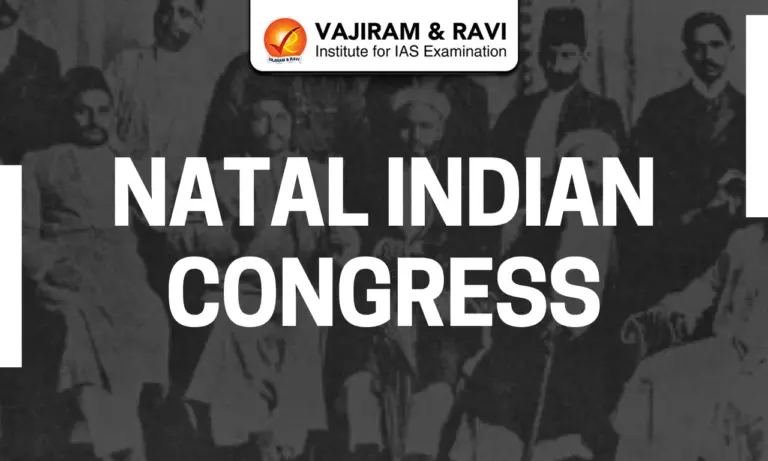
Natal Indian Congress was founded in August 1894 in Natal Colony, South Africa, to protect Indians from racial discrimination and political exclusion. The organisation became the first major political body of Indians in South Africa and played a decisive role in developing organised resistance against colonial racial policies. Established on Mahatma Gandhi’s proposal of 1894, the organisation completed 130 years on 22 August 2024. It united merchants, labourers, professionals, Hindus, Muslims, Parsees and Christians under a common political platform.
Natal Indian Congress Background
Growing racial discrimination against Indians in Natal during the late nineteenth century created conditions for establishing a permanent political organisation which eventually formed Natal Indian Congress.
- Indian migration to Natal: Thousands of Indians migrated to Natal as indentured labourers and free traders during the nineteenth century, mainly from Gujarat and Tamil regions, to work on sugar plantations, trade, transport and clerical services.
- Discriminatory colonial policies: Indians faced restrictions on voting rights, trade licences, land ownership, mobility, taxation and residence despite being British subjects under the British colonial system in South Africa.
- Gandhi’s arrival in South Africa: Mohandas Karamchand Gandhi arrived in South Africa in May 1893 as a young lawyer representing an Indian merchant and soon experienced institutional racial discrimination personally.
- Pietermaritzburg railway incident: On 7 June 1893, Gandhi was thrown out of a first class railway compartment at Pietermaritzburg station despite possessing a valid ticket, deeply influencing his future political direction.
- Threat of disenfranchisement: The Natal Legislative Assembly planned legislation to remove Indians from voting rights, alarming the Indian merchant and professional communities settled in Natal Colony.
- Need for political unity: Indians in Natal were divided by religion, language, class and occupation, creating difficulties in resisting discriminatory laws without a unified representative organisation.
Natal Indian Congress Features
Natal Indian Congress functioned as a disciplined political organisation combining petitions, civic mobilisation, public education and organised resistance against racism.
- Founder: Mahatma Gandhi founded the Natal Indian Congress on 22 August 1894 in Durban after proposing the creation of a permanent organisation on 22 May 1894.
- Membership structure: Initial membership required heavy subscriptions including five shillings monthly, later converted into a minimum annual subscription of £3 to improve organisational financial stability.
- Composition: The organisation included Hindus, Muslims, Parsees and Christians, with nearly 300 members joining within one month through extensive recruitment campaigns across Natal.
- Organisational meetings: Congress meetings were held monthly or weekly when necessary, discussing political developments, finance, sanitation, education and public discipline while training Indians in public speaking and debate.
- Financial discipline: Gandhi insisted on maintaining accurate accounts, advance subscriptions, receipt systems and avoidance of debt, making the organisation financially transparent and administratively efficient.
- Educational activities: The Colonial born Indian Educational Association operated under Congress guidance to encourage educated Indian youths through debates, papers, discussions, libraries and civic awareness programmes.
- Publications: Gandhi published pamphlets including An Appeal to Every Briton in South Africa and The Indian Franchise- An Appeal explaining racial discrimination using detailed evidence and statistics.
- Radical transformation in leadership: During the 1930s and 1940s, leaders like Dr. G.M. Naicker transformed the organisation into a more militant anti racial movement demanding wider political cooperation.
- Alliance building approach: The organisation later collaborated with African and Coloured political bodies, particularly the African National Congress, breaking racially exclusive political mobilisation traditions.
- Revival after repression: Though not officially banned, state harassment halted activities during the 1960s before revival in 1971 mainly focusing on civic and anti apartheid campaigns.
Also Check: Indian and South Africa Relations


Formation of Natal Indian Congress
The Natal Indian Congress emerged from organised Indian resistance against political disenfranchisement and racial discrimination in the Natal Colony.
- Farewell meeting decision: During Gandhi’s farewell dinner in 1894, he learned about plans to disfranchise Indians and immediately advised organised resistance against the proposed legislation.
- Formation of temporary committee: Indians attending the meeting persuaded Gandhi to remain in Natal and lead the struggle, resulting in creation of a temporary political committee the same night.
- Petition campaign against legislation: Within one month, Gandhi organised a petition carrying nearly 10,000 signatures which was submitted to Lord Ripon, the Colonial Secretary of Britain.
- British response and legislation: The agitation temporarily forced the British Government to reject the disfranchisement proposal, though modified legislation was ultimately enacted in 1896 targeting non European populations indirectly.
- Evolution into permanent organisation: The temporary committee gradually transformed into the Natal Indian Congress to continue sustained political agitation and represent Indian interests permanently.
- First organised Indian political agitation: The movement marked the first major instance where Indians collectively organised a structured political campaign outside India against discriminatory colonial legislation.
- Durban Session: The Congress was formally established in Durban in August 1894 in a crowded public gathering attended by leading Indian merchants and community representatives.
Role of Gandhi in Natal Indian Congress
Mahatma Gandhi transformed the Natal Indian Congress into a disciplined political platform and developed his philosophy of satyagraha through South African struggles.
- Organisational leadership: Gandhi served as secretary and principal strategist of the Congress, drafting its constitution, supervising finances, conducting campaigns and coordinating petitions against racial laws.
- Community mobilisation efforts: Gandhi united divided Indian communities including traders, labourers, Hindus, Muslims, Parsees and Christians, creating collective political consciousness among overseas Indians.
- Legal and constitutional campaigns: He prepared detailed memorials and petitions to the Natal Legislature, British Parliament and Colonial Office highlighting racial discrimination against Indians using constitutional arguments.
- Natal Satyagraha inspiration: Gandhi’s humiliation at Pietermaritzburg railway station inspired his commitment toward nonviolent resistance and eventually contributed to development of satyagraha philosophy.
- Passive resistance movements: Gandhi encouraged Indians to oppose discriminatory laws peacefully, including public burning of registration certificates during resistance against the Asiatic Registration Act of 1906.
- Launch of first satyagraha: In 1906 at Johannesburg, Gandhi initiated his first organised satyagraha campaign against compulsory Asian registration, fingerprinting and movement restrictions imposed by Transvaal authorities.
- Establishment of settlements: Gandhi established Phoenix Settlement near Durban in 1904 and Tolstoy Farm near Johannesburg in 1910 to promote self reliance, communal living and training of satyagrahis.
- Ambulance Corps organisation: During the Anglo-Boer War of 1899-1902, Gandhi organised an Indian Ambulance Corps hoping loyal service would improve treatment of Indians under British administration.
- Leadership in 1913 campaign: Gandhi led protests against poll taxes, marriage restrictions and pass laws in 1913, involving large participation by Indian women including Kasturba Gandhi.
- Development of global influence: Gandhi’s South African experiences shaped later nonviolent movements worldwide and influenced leaders such as Nelson Mandela and Martin Luther King Jr..
Natal Indian Congress Activities
Natal Indian Congress carried out political, educational, legal and mass mobilisation campaigns against racial discrimination and apartheid policies in South Africa.
- Petition against disfranchisement: The Congress organised large scale signature campaigns and petitions opposing attempts to remove Indians from electoral rolls in Natal during the 1890s.
- Defence of Indian traders: The organisation protected Indian traders and professionals facing discriminatory licensing regulations, police harassment, trade restrictions and limitations on property ownership.
- Public awareness campaigns: Gandhi and Congress leaders used newspapers, pamphlets, public meetings and international communication networks to expose racial discrimination in South Africa globally.
- Resistance to Asiatic Registration Act: Indians organised through passive resistance associations publicly burned registration certificates opposing compulsory fingerprinting and registration requirements imposed on Asians.
- 1908 and 1913 movements: Major satyagraha campaigns mobilised large sections of the Indian community against registration laws, poll taxes, marriage restrictions and discriminatory pass systems.
- Educational and civic work: Congress activities promoted sanitation, public discipline, debating culture, literacy, civic consciousness and social reform among Indians living across Natal settlements.
- Passive Resistance Campaign 1946: Under Dr. G.M. Naicker, the organisation participated in the Indian Passive Resistance Campaign opposing the Asiatic Land Tenure and Indian Representation Act.
- Defiance Campaign participation: Through the South African Indian Congress alliance, the organisation joined the African National Congress in the 1952 Defiance Campaign against apartheid laws.
- Anti apartheid mobilisation: During the 1980s, the Congress organised campaigns against the South African Indian Council and the Tricameral Parliament’s House of Delegates structure.
- United Democratic Front formation: The organisation played a key role in forming the United Democratic Front during the mid 1980s to promote a non racial and united South Africa.
Natal Indian Congress Impacts
The Natal Indian Congress produced long term political, social and ideological impacts on anti racial struggles in South Africa and later global civil rights movements.
- Political representation for Indians: The organisation provided Indians in South Africa with their first permanent political platform capable of collectively defending civil and economic rights.
- Internationalisation of racial issues: Congress campaigns brought global attention to racial discrimination in South Africa and generated sympathy in India, Britain and other parts of the world.
- Development of satyagraha philosophy: Gandhi’s experiences within the organisation helped formulate principles of truth, nonviolence, discipline and civil disobedience later applied in India’s freedom struggle.
- Growth of inter racial cooperation: Alliances with the African National Congress and other liberation organisations promoted broader anti apartheid unity beyond racial and ethnic boundaries.
- Influence on future movements: The Congress inspired later global civil rights struggles and significantly influenced Anti Apartheid Movements led by Nelson Mandela and Martin Luther King Jr.
- Strengthening diaspora activism: The organisation demonstrated how overseas Indian communities could politically organise, preserve identity and collectively resist discriminatory colonial systems.
- Institutional legacy in South Africa: The Natal Indian Congress remained one of the most influential Indian political organisations in twentieth century South African history until integration with broader ANC structures after 1990.

 Last updated on Oct, 2026
→ UPSC 2027 Notification will be released on 13 January 2027 at upsconline.nic.in.
→ Check Nobel Prize 2026 Winners List here.
→ Download PIB PRiSM Monthly Magazine 2026 here.
→ Check UPSC Monthly Current Affairs Magazine The Recitals here.
→ Check out the latest UPSC Syllabus here.
→ Download UPSC Model Answers for Mains 2026
→ UPSC Mains Question Paper 2026 is out now for Essay & GS Paper 1, 2, 3 & 4.
→ UPSC Calendar 2027 has been released.
→ Enroll in Vajiram & Ravi’s UPSC Mains Test Series 2027 for structured answer writing practice, expert evaluation, and exam-oriented feedback.
→ Join Vajiram & Ravi’s UPSC Mentorship Program 2027 for personalized guidance, strategy planning, and one-to-one support from experienced mentors.
→ Go through the UPSC Mains Previous Year Papers to enhance your preparation.
→ UPSC has released UPSC Toppers List 2025 with the Civil Services final result on its official website.
→ Also check Best UPSC Coaching in India
Natal Indian Congress FAQs
Q1. Who founded the Natal Indian Congress?+
Q2. Why was the Natal Indian Congress established?+
Q3. What was Gandhi’s role in the Natal Indian Congress?+
Q4. What was the connection between NIC and ANC?+
Q5. When was the Natal Indian Congress revived?+
Tags: history history notes natal indian congress