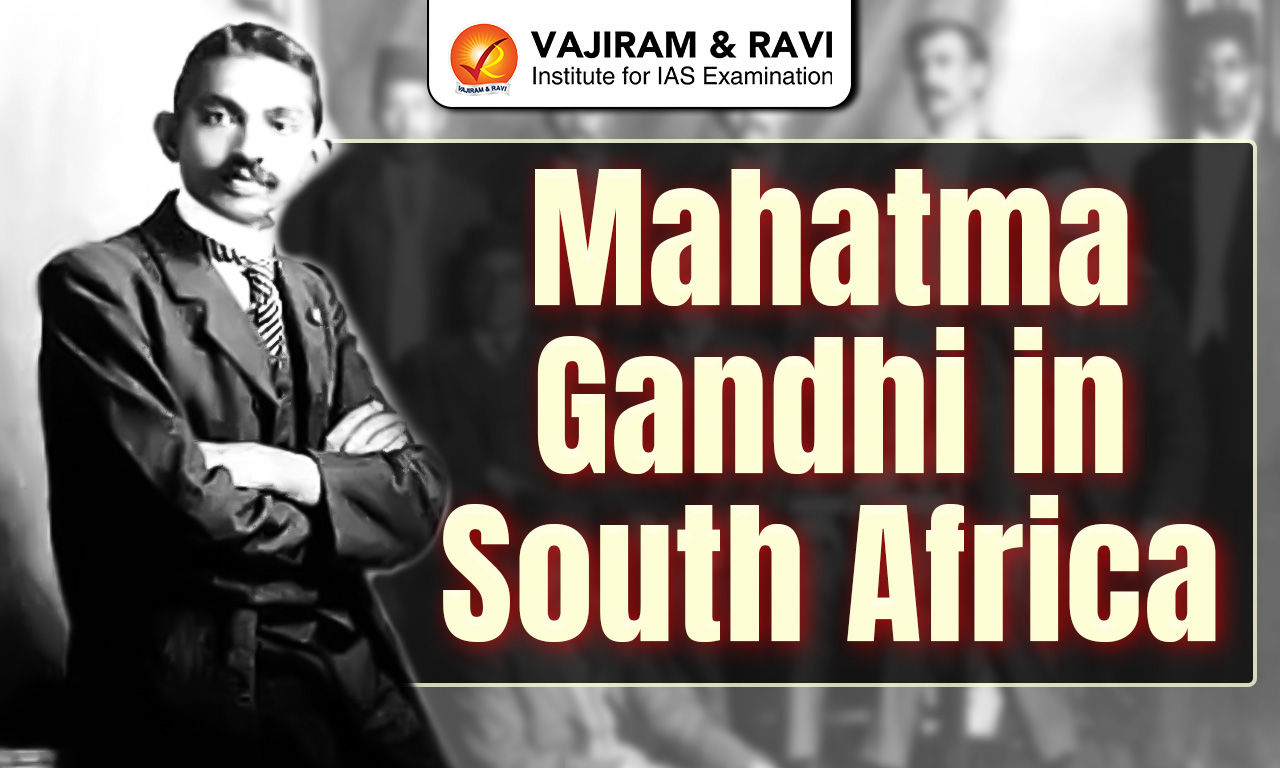
Mohandas Karamchand Gandhi spent 21 transformative years in South Africa (1893-1914), where he evolved from a young lawyer into a global symbol of nonviolent resistance. His experiences during this period shaped the philosophy of Satyagraha and laid the foundation for India’s freedom struggle as well as global civil rights movements. This article explains about Mahatma Gandhi in South Africa.
Gandhi’s Association with South Africa
Mohandas Karamchand Gandhi went to South Africa in 1893 as a young lawyer, but the harsh racial discrimination he faced changed his life completely. His experiences there made him aware of injustice and inspired him to fight for the rights of Indians. During his 21-year stay, he developed leadership qualities and the idea of Satyagraha.
- Arrival in 1893: Gandhi reached Durban on 24 May 1893 to handle a legal case for Dada Abdullah Jhaveri.
- Train Incident: Thrown out of a train at Pietermaritzburg railway station despite having a first-class ticket, which became a turning point in his life.
- Realization of Racism: Understood the deep racial discrimination faced by Indians and Africans in South Africa.
- Decision to Stay: Instead of returning to India, he decided to stay back and fight for justice.
- 21-Year Stay (1893–1914): This long period helped him grow from a lawyer into a mass leader.
- Development of Ideas: Formed the foundation of truth, nonviolence, and civil rights activism.
- Global Impact: His experiences later influenced movements in India and across the world.
Gandhi’s Contribution to South Africa
Gandhi made significant contributions to improving the condition of Indians in South Africa. He used peaceful methods like petitions, protests, and Satyagraha to fight injustice. His efforts not only brought reforms but also created a strong sense of unity and political awareness among Indians.
- Pietermaritzburg Train Incident (1893): Mohandas Karamchand Gandhi was thrown out of a first-class compartment at Pietermaritzburg railway station despite having a valid ticket. This humiliation became the turning point that inspired him to fight racial discrimination through nonviolent means.
- Realization of Racial Injustice: Gandhi observed that Indians and Africans were treated as inferior and denied basic civil rights in South Africa. This realization pushed him to dedicate his life to fighting inequality and injustice.
- Political Awakening of Indians: Gandhi educated Indians about their rights and encouraged them to unite against discrimination. He transformed a divided and unaware community into a politically conscious group.
- Use of Petitions and Legal Methods: He initially used petitions and legal appeals to the governments of Natal, Britain, and India. These efforts helped bring attention to Indian grievances at both local and international levels.
- Formation of Natal Indian Congress (1894): Gandhi founded the Natal Indian Congress to represent Indian interests. It became the first organized political platform to fight for civil rights through peaceful means.
- Role of Indian Opinion Newspaper (1903): Gandhi started Indian Opinion to spread awareness. It highlighted discrimination, connected communities, and promoted unity and Satyagraha.
- Durban Mob Attack (1896): Gandhi was attacked and injured by a white mob when he returned from India. He refused to take revenge, showing his commitment to nonviolence and moral strength.
- Participation in Second Boer War: Gandhi organized an Indian Ambulance Corps of about 1100 volunteers to assist the British. He hoped this service would improve Indian conditions, but discrimination continued.
- Shift from Legal to Mass Struggle: Gandhi realized that legal petitions alone were not enough to bring change. He began organizing mass movements based on unity and moral pressure.
- Phoenix Settlement (1904): Inspired by John Ruskin, Gandhi established a community near Durban. It promoted simple living, equality, and became a center for training Satyagrahis.
- Development of Satyagraha (1906): Gandhi introduced Satyagraha as a method of nonviolent resistance against unjust laws. It focused on truth, self-discipline, and peaceful protest rather than violence.
- First Satyagraha Campaign (1906): He launched the first movement against the Transvaal Asiatic Ordinance. This marked the beginning of organized civil disobedience in South Africa.
- Mass Participation in Movements: Gandhi mobilized thousands of Indians including workers, traders, and women. This unity gave strength and visibility to the movement.
- Imprisonment and Sacrifice (1908 onwards): Gandhi was jailed multiple times for leading protests against unjust laws. He accepted punishment willingly to show moral courage and inspire others.
- Negotiations with Jan Smuts: Gandhi held discussions with government officials to resolve issues peacefully. Though agreements often failed, he continued dialogue along with protest.
- Pass Burning Movement (1908): Gandhi led a campaign to burn registration passes as a protest. This act symbolized rejection of unjust laws and strengthened resistance.
- Tolstoy Farm (1910): Established with Herman Kallenbach, it trained Satyagrahis. It focused on discipline, self-reliance, and collective living.
- Struggle Against Marriage Laws (1913): Gandhi protested laws that invalidated non-Christian marriages. This issue affected Indian families deeply and became a major movement.
- 1913 Mass Movement and March: Gandhi led around 2,000 Indians across Transvaal in protest against injustice. This peaceful march gained national and international attention.
- Role of Women in Movement: Women actively participated in protests and faced imprisonment. Kasturba Gandhi and others strengthened the movement’s moral force.
- Indian Relief Act (1914): After long struggle, the government passed reforms benefiting Indians. It included recognition of marriages and removal of certain taxes.
- 21 Years of Continuous Effort: Gandhi spent over two decades fighting injustice in South Africa. This period shaped his ideology and leadership style.
- Influence on Future Movements: His methods inspired later anti-apartheid struggles and civil rights movements. Leaders like Nelson Mandela followed similar principles.
- Global Legacy of Nonviolence: Gandhi’s South African experience gave the world the idea of peaceful resistance. Satyagraha became a powerful tool used in movements across the globe.


About Natal Indian Congress (NIC)
The Natal Indian Congress was established by Mohandas Karamchand Gandhi in 1894 to protect the rights of Indians in South Africa.
- First Organized Political Body: NIC was the first structured organization for Indians in South Africa. It provided a common platform for traders, workers, and professionals.
- Leadership of Gandhi: Gandhi played a key role in organizing and guiding the NIC in its early years. He used it to promote unity, discipline, and nonviolent protest.
- Drafting of Constitution: A formal constitution was adopted on 22 August 1894. It defined objectives, membership rules, and methods of functioning.
- Methods of Protest: NIC mainly used petitions, memorandums, and peaceful protests. It appealed to British authorities in India and London for justice.
- Fight Against Discrimination: Opposed laws restricting Indian voting rights, movement, and trade. Highlighted racial injustice faced by Indians in South Africa.
- Promoting Unity Among Indians: Brought together Indians from different religions, languages, and regions. Helped reduce divisions and build a collective identity.
- Link with Wider Movements: Later collaborated with African National Congress. This broke racial barriers and promoted joint struggle against oppression.
- Role in 20th Century Politics: Continued as a major Indian political body throughout the 1900s. Became part of the South African Indian Congress (SAIC).
- Leadership of G. M. Naicker: In the 1940s, NIC adopted more active and militant protest strategies. It became stronger in resisting apartheid policies.
- Repression and Challenges: Many NIC leaders were jailed during the 1950s–60s movements. Government pressure limited its activities.
- Revival and Later Role: Revived in 1971 with a focus on civic and social work. Played an important role in forming the United Democratic Front (UDF) in the 1980s.
- Historical Significance: NIC laid the foundation for organized political resistance by Indians. It also influenced broader anti-apartheid movements in South Africa.

 Last updated on Oct, 2026
→ UPSC 2027 Notification will be released on 13 January 2027 at upsconline.nic.in.
→ Check Nobel Prize 2026 Winners List here.
→ Download PIB PRiSM Monthly Magazine 2026 here.
→ Check UPSC Monthly Current Affairs Magazine The Recitals here.
→ Check out the latest UPSC Syllabus here.
→ Download UPSC Model Answers for Mains 2026
→ UPSC Mains Question Paper 2026 is out now for Essay & GS Paper 1, 2, 3 & 4.
→ UPSC Calendar 2027 has been released.
→ Enroll in Vajiram & Ravi’s UPSC Mains Test Series 2027 for structured answer writing practice, expert evaluation, and exam-oriented feedback.
→ Join Vajiram & Ravi’s UPSC Mentorship Program 2027 for personalized guidance, strategy planning, and one-to-one support from experienced mentors.
→ Go through the UPSC Mains Previous Year Papers to enhance your preparation.
→ UPSC has released UPSC Toppers List 2025 with the Civil Services final result on its official website.
→ Also check Best UPSC Coaching in India
Mahatma Gandhi in South Africa FAQs
Q1. When did Mahatma Gandhi go to South Africa?+
Q2. Why did Gandhi go to South Africa?+
Q3. What incident changed Gandhi’s life in South Africa?+
Q4. How long did Gandhi stay in South Africa?+
Q5. What is Satyagraha and where did Gandhi start it?+
Tags: general knowledge mahatma gandhi in south Africa modern indian history