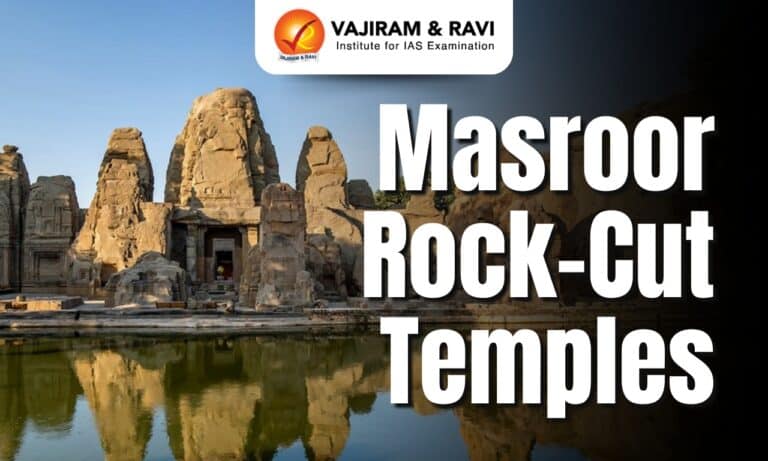
Masroor Rock-Cut Temples Latest News
Tucked away in the hills of Himachal Pradesh’s Kangra Valley lies Masroor Rock-Cut Temples, an extraordinary piece of Indian heritage that is mostly ignored.
About Masroor Rock-Cut Temples
- Masroor Rock-Cut Temples, also referred to as Masroor Temples, is an early 8th-century complex of rock-cut Hindu temples in the Kangra Valley of the Beas River in Himachal Pradesh.
- They are often referred to as the Ellora of Himachal and the Himalayan pyramid.


Masroor Rock-Cut Temples History
- Archaeological surveys say that they have been built around the 8th century — almost 1200 years ago — due to their resemblance to the “Gupta style of architecture” from the same period.
- However, there is no mention of the temple in any of the scriptures or historical records.
- The temple complex was first reported by Henry Shuttleworth in 1913, bringing it to the attention of archaeologists.
- They were independently surveyed by Harold Hargreaves of the Archaeological Survey of India in 1915.
Masroor Rock-Cut Temples Architecture
- The 15-monument temple complex resembles the North Indian Nagara architecture style and is dedicated to Lord Shiva, Lord Ram, Goddess Sita, and Lord Lakshmana.
- Unlike other Hindu temples in the country that face the east, this one faces northeast towards the Dhauladhar mountains.
- The temples were carved out of monolithic rock with a shikhara and provided with a sacred pool of water.
- The temple complex follows a symmetrically laid-out square grid.
- The main temple, with a square plan, is surrounded by smaller temples arranged in a mandala pattern.
- Three entrances adorn the temple, facing northeast, southeast, and northwest. Interestingly, evidence points towards a planned but unfinished fourth entrance, often overlooked in historical records.
- The Masrur Temples display elaborate reliefs portraying significant Vedic and Puranic deities.
- These reliefs are accompanied by captivating friezes that narrate ancient tales from Hindu texts.
- Much of the Masroor temple’s sculpture and reliefs have been lost. They were also quite damaged, most likely from earthquakes.
News: TOI

 Last updated on Oct, 2026
→ UPSC 2027 Notification will be released on 13 January 2027 at upsconline.nic.in.
→ Check Nobel Prize 2026 Winners List here.
→ Download PIB PRiSM Monthly Magazine 2026 here.
→ Check UPSC Monthly Current Affairs Magazine The Recitals here.
→ Check out the latest UPSC Syllabus here.
→ Download UPSC Model Answers for Mains 2026
→ UPSC Mains Question Paper 2026 is out now for Essay & GS Paper 1, 2, 3 & 4.
→ UPSC Calendar 2027 has been released.
→ Enroll in Vajiram & Ravi’s UPSC Mains Test Series 2027 for structured answer writing practice, expert evaluation, and exam-oriented feedback.
→ Join Vajiram & Ravi’s UPSC Mentorship Program 2027 for personalized guidance, strategy planning, and one-to-one support from experienced mentors.
→ Go through the UPSC Mains Previous Year Papers to enhance your preparation.
→ UPSC has released UPSC Toppers List 2025 with the Civil Services final result on its official website.
→ Also check Best UPSC Coaching in India
Masroor Rock-Cut Temples FAQs
Q1. Where are the Masroor Rock-Cut Temples located?+
Q2. The Masroor Rock-Cut Temples are believed to have been built around which century?+
Q3. Why are the Masroor Rock-Cut Temples often referred to as the “Ellora of Himachal”?+
Q4. Which architectural style do the Masroor Rock-Cut Temples resemble?+
Q5. What type of layout does the Masroor Temple complex follow?+
Tags: masroor rock-cut temples prelims pointers upsc current affairs upsc prelims current affairs