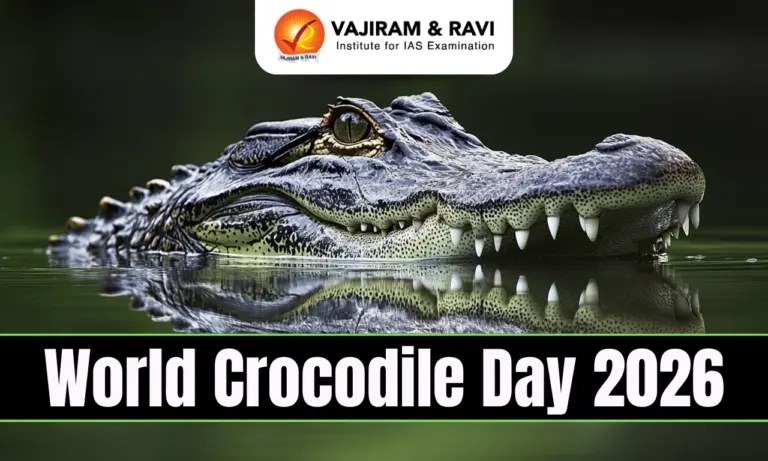
World Crocodile Day is observed every year on 17 June to spread awareness about crocodiles and the need to protect them. The day highlights the importance of conserving crocodiles, gharials, alligators, and other crocodilian species that play a vital role in maintaining healthy aquatic ecosystems. In 2026, World Crocodile Day will be celebrated on 17 June across the world.
World Crocodile Day 2026 Theme
The theme of World Crocodile Day 2026 is “Legacy in Every Scale.” Observed annually on 17 June, this global awareness campaign focuses on the conservation of crocodiles, gharials, alligators, and other crocodilian species. The theme highlights the rich evolutionary history of these ancient reptiles and emphasizes the importance of protecting their populations for future generations.
World Crocodile Day 2026 Importance
World Crocodile Day 2026 is an important global observance that raises awareness about crocodile conservation, protects aquatic ecosystems, and encourages efforts to safeguard endangered crocodilian species and their habitats.
- Promotes awareness about crocodile conservation and wildlife protection.
- Highlights the importance of wetlands, rivers, lakes, and mangrove ecosystems.
- Encourages the protection of endangered crocodilian species across the world.
- Supports biodiversity conservation by protecting species that share crocodile habitats.
- Educates people about the ecological role of crocodiles as apex predators.
- Raises awareness about threats such as habitat loss, pollution, and climate change.
- Promotes scientific research and monitoring of crocodile populations.
- Encourages community participation in wildlife conservation programs.
- Helps reduce human-crocodile conflicts through education and awareness.
- Supports the conservation of aquatic and coastal ecosystems.
- Encourages governments to strengthen wildlife protection laws and policies.
- Inspires students and young people to participate in environmental conservation efforts.
- Highlights the need for sustainable management of natural resources.
- Promotes global cooperation for the protection of threatened reptile species.


Major Threats Faced by Crocodiles
Crocodiles face several threats due to human activities and environmental changes, which have led to the decline of many crocodilian populations across the world.
- Habitat Loss: Destruction of rivers, wetlands, mangroves, and swamps due to urbanization and development projects.
- Wetland Degradation: Shrinking and pollution of aquatic habitats reduce suitable living and breeding areas.
- Illegal Hunting and Poaching: Crocodiles are hunted for their skin, meat, and body parts.
- Human-Wildlife Conflict: Encounters between humans and crocodiles often result in injury or death to crocodiles.
- Pollution: Industrial waste, plastic pollution, and chemical contaminants harm crocodiles and their habitats.
- Climate Change: Rising temperatures and changing rainfall patterns affect nesting and breeding success.
- Loss of Nesting Sites: Sand mining, riverbank erosion, and human activities destroy important nesting areas.
- Overfishing: Excessive fishing reduces the availability of prey for crocodiles.
- Accidental Entanglement: Crocodiles may get trapped in fishing nets and other aquatic equipment.
- Encroachment of Human Settlements: Expansion of agriculture and settlements near wetlands increases habitat disturbance.
- Disturbance from Tourism: Unregulated tourism activities can disrupt crocodile behavior and breeding.
- Invasive Species: Non-native species can compete with crocodiles for food and habitat resources.
Crocodile Conservation Efforts in India
India has been a global leader in crocodile conservation and has successfully revived crocodile populations through habitat protection, captive breeding programs, scientific research, and community participation. These efforts have helped protect the country’s three crocodilian species, the Mugger Crocodile, Saltwater Crocodile, and Gharial.
- The Government of India launched the Crocodile Conservation Project in 1975 to protect declining crocodile populations.
- The project focused on captive breeding, rehabilitation, and habitat conservation of crocodilian species.
- Several crocodile breeding and rearing centers were established across the country.
- Special efforts were made to conserve the critically endangered Gharial in major river systems.
- Important crocodile habitats were brought under the protection of National Parks, Wildlife Sanctuaries, and Protected Areas.
- Bhitarkanika National Park (Odisha) became a major center for Saltwater Crocodile conservation.
- The National Chambal Sanctuary was established to protect Gharials and other aquatic wildlife.
- Conservation programs include regular population monitoring and scientific surveys.
- Authorities protect nesting and breeding sites during the reproductive season.
- Awareness campaigns educate local communities about the importance of crocodile conservation.
- Efforts are being made to reduce human-crocodile conflict through community participation and safety measures.
- Wetland, river, and mangrove restoration projects help improve crocodile habitats.
- Crocodiles receive legal protection under the Wildlife (Protection) Act, 1972.
- Research institutions and wildlife organizations conduct studies on crocodile ecology and behavior.
- Conservation initiatives have significantly increased crocodile populations in several parts of India.
About Crocodile
Crocodiles are large, carnivorous reptiles that belong to the order Crocodylia. They are among the oldest living animals on Earth and have existed for more than 200 million years, making them one of the few species to survive major extinction events.
- They are often called “living fossils” because their body structure has changed very little over millions of years.
- Crocodiles are found in tropical and subtropical regions of Asia, Africa, Australia, and the Americas.
- They are cold-blooded (ectothermic) animals and depend on external heat sources to regulate their body temperature.
- Crocodiles are carnivores and feed on fish, birds, reptiles, and mammals.
- They possess one of the strongest bite forces in the animal kingdom.
- Their eyes, ears, and nostrils are located on top of the head, allowing them to stay mostly submerged while watching for prey.
- Crocodiles are excellent swimmers and use their powerful tails for movement in water.
- They can remain underwater for long periods by slowing their heart rate.
- Female crocodiles lay eggs and protect their nests until the hatchlings emerge.
- Crocodile mothers often carry their young to the water in their mouths for protection.
- These reptiles play an important role as apex predators, helping maintain ecological balance in aquatic ecosystems.
- Crocodiles can live for 50–70 years or more, depending on the species.
- The Saltwater Crocodile (Crocodylus porosus) is the largest living reptile in the world.
- Crocodiles have highly developed senses, including excellent night vision and hearing.
- Crocodiles are considered keystone species because they help maintain healthy aquatic ecosystems.

 Last updated on August, 2026
→ UPSC Mains 2026 commenced on 21st August 2026 and will continue through 30th August 2026, as per the official examination schedule.
→ UPSC Mains Question Paper 2026 is out now for Essay & GS Paper 1, 2, 3 & 4.
→ UPSC Mains GS Paper 1 2026 is out now.
→ UPSC Mains GS Paper 2 2026 is out now.
→ UPSC Mains GS Paper 3 2026 is out now.
→ UPSC Mains GS Paper 4 2026 is out now.
→ Check out the latest UPSC Syllabus 2026 here.
→ UPSC Mains Admit Card 2026 is now out.
→ Enroll in Vajiram & Ravi’s UPSC Mains Test Series 2027 for structured answer writing practice, expert evaluation, and exam-oriented feedback.
→ Join Vajiram & Ravi’s UPSC Mentorship Program 2027 for personalized guidance, strategy planning, and one-to-one support from experienced mentors.
→ Go through the UPSC Mains Previous Year Papers to enhance your preparation.
→ Download UPSC Mains Essay Paper 2025, UPSC Mains GS Paper-I 2025, UPSC Mains GS Paper-II 2025, UPSC Mains GS Paper-III 2025, UPSC Mains GS Paper-IV 2025, UPSC Mains English (Compulsory) Paper 2025, UPSC Mains Hindi (Qualifying) Paper 2025 here.
→ UPSC has released UPSC Toppers List 2025 with the Civil Services final result on its official website.
→ UPSC Calendar 2027 has been released.
→ Also check Best UPSC Coaching in India
World Crocodile Day 2026 FAQs
Q1. When is World Crocodile Day 2026 observed?+
Q2. What is the theme of World Crocodile Day 2026?+
Q3. Why is World Crocodile Day celebrated?+
Q4. Which animals are included in the crocodilian family?+
Q5. Why are crocodiles important for ecosystems?+
Q6. How old are crocodiles as a species?+
Q7. Which crocodile species are found in India?+
Tags: important days in 2026 world crocodile day 2026