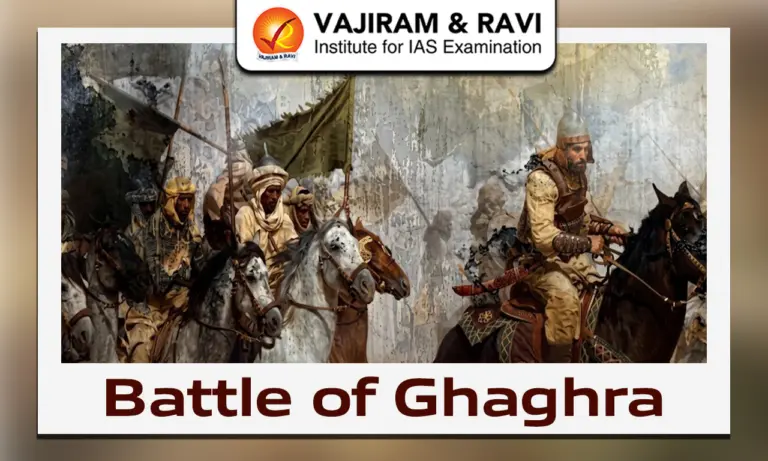
The Battle of Ghaghra, fought on 6 May 1529, was the last major battle fought by Babur in India. It was fought between Babur and the Afghan Confederacy led by Mahmud Lodi, with support from Sultan Nusrat Shah of Bengal, on the banks of the Ghaghra River in present-day Bihar. The battle ended organised Afghan resistance against the Mughals and completed Babur’s conquest of North India.
Baburnama, Babur’s autobiography, is the principal contemporary source for the Battle of Ghaghra. It describes Babur’s eastern campaign, his military strategy, and the peace settlement with Bengal.
|
Date |
6 May 1529 |
|
Location |
Ghaghra (Gogra) River near its confluence with the Ganga, Bihar |
|
Between |
Babur vs. Mahmud Lodi and Afghan Confederacy supported by Bengal |
|
Outcome |
Mughal Victory |
|
Importance |
Last major battle of Babur; completed Mughal consolidation |
Battle of Ghaghra Background
Babur defeated Ibrahim Lodi at the First Battle of Panipat (1526) and established Mughal rule in Delhi. However, many Afghan nobles refused to accept his authority. They rallied behind Mahmud Lodi, brother of Ibrahim Lodi, who continued to claim the throne of Delhi.
After the Mughal victories in the Battle of Khanwa (1527) against Rana Sanga and Battle of Chanderi (1528) against Medini Rai, Babur had largely overcome Rajput resistance. But eastern India, particularly Bihar and Jaunpur, became the new centre of Afghan resistance.
Mahmud Lodi gathered Afghan chiefs under his leadership and occupied much of Bihar. He also received support from Nusrat Shah, the Sultan of Bengal, who wanted to prevent Mughal expansion towards Bengal.
Realising that Mughal rule would remain insecure as long as the Afghans controlled eastern India, Babur decided to launch a final campaign against them.
Causes of the Battle of Ghaghra
Babur attacked Ghaghra for several reasons.
- To eliminate Afghan resistance: Even after Panipat, the Afghans continued to challenge Mughal authority under Mahmud Lodi.
- To secure Bihar and eastern Uttar Pradesh: These regions had become strongholds of Afghan power and posed a threat to Mughal rule.
- To counter Bengal’s support
- Nusrat Shah allowed Afghan chiefs to operate from his territory, strengthening the anti-Mughal alliance.
- To complete Mughal conquest: Babur wanted to remove the last major obstacle before establishing complete control over North India.


Course of the Battle of Ghaghra
Babur marched from Agra towards Bihar in early 1529. His army crossed the Yamuna and advanced through Allahabad, Chunar and Varanasi before reaching the banks of the Ghaghra River.
The Afghan army was positioned on one side of the river, while the Bengal army supported it from nearby positions. Since the battle was fought around rivers, Babur had to combine land operations with river-based warfare.
Babur divided his army into different groups. His son Askari Mirza crossed the Ghaghra with one division, while Babur led another attack from the opposite side. Mughal artillery and cavalry worked together to break the Afghan positions.
The disciplined Mughal army gradually gained the upper hand. Several Afghan chiefs deserted Mahmud Lodi during the battle, weakening the confederacy. Unable to resist the Mughal assault, the Afghan-Bengal alliance was defeated.
Outcome of the Battle of Ghaghra
The Battle of Ghaghra ended in a decisive Mughal victory.
- Mahmud Lodi was defeated, ending his claim to the Delhi throne.
- The Afghan Confederacy was dispersed, bringing organised Afghan resistance to an end.
- Nusrat Shah signed a peace treaty with Babur and agreed not to support Afghan rebels.
- Babur recognised the independence of Bengal, avoiding further conflict in the east.
- Mughal authority was firmly established from Delhi to Bihar.
Significance of the Battle of Ghaghra
The Battle of Ghaghra completed Babur’s conquest of North India and secured the future of the Mughal Empire.
- Completed Mughal Consolidation: The victories at Panipat, Khanwa, Chanderi and Ghaghra together transformed Babur from a conqueror into the ruler of a stable empire.
- Ended Afghan Resistance: The defeat of Mahmud Lodi brought an end to the Lodi dynasty’s attempts to regain power during Babur’s reign.
- Established Mughal Supremacy in North India: After Ghaghra, no major military power remained capable of challenging Babur in northern India.
- Beginning of Mughal–Bengal Relations: Instead of annexing Bengal, Babur adopted a diplomatic approach by recognising Nusrat Shah’s rule. This ensured peace on the eastern frontier for the time being.
- Demonstrated Military Superiority: The battle showcased Babur’s effective use of artillery, cavalry and river transport, highlighting the growing importance of gunpowder and combined military operations.
- Prepared the Ground for Future Expansion: By securing North India, Babur laid the foundation on which Humayun and especially Akbar later built a vast Mughal Empire.
Chronology of Babur’s Campaigns
| Battle | Year | Significance |
|
First Battle of Panipat |
1526 |
Defeat of Ibrahim Lodi; foundation of Mughal rule |
|
Battle of Khanwa |
1527 |
Defeat of Rana Sanga; Mughal military supremacy |
|
Battle of Chanderi |
1528 |
Ended major Rajput resistance in Central India |
|
Battle of Ghaghra |
1529 |
Ended organised Afghan resistance and completed Mughal consolidation |

 Last updated on Oct, 2026
→ UPSC 2027 Notification will be released on 13 January 2027 at upsconline.nic.in.
→ Check Nobel Prize 2026 Winners List here.
→ Download PIB PRiSM Monthly Magazine 2026 here.
→ Check UPSC Monthly Current Affairs Magazine The Recitals here.
→ Check out the latest UPSC Syllabus here.
→ Download UPSC Model Answers for Mains 2026
→ UPSC Mains Question Paper 2026 is out now for Essay & GS Paper 1, 2, 3 & 4.
→ UPSC Calendar 2027 has been released.
→ Enroll in Vajiram & Ravi’s UPSC Mains Test Series 2027 for structured answer writing practice, expert evaluation, and exam-oriented feedback.
→ Join Vajiram & Ravi’s UPSC Mentorship Program 2027 for personalized guidance, strategy planning, and one-to-one support from experienced mentors.
→ Go through the UPSC Mains Previous Year Papers to enhance your preparation.
→ UPSC has released UPSC Toppers List 2025 with the Civil Services final result on its official website.
→ Also check Best UPSC Coaching in India
Battle of Ghaghra FAQs
Q1. Who fought the Battle of Ghaghra and what was its outcome?+
Q2. Why was the Battle of Ghaghra fought?+
Q3. Which historical source provides the most authentic account of the Battle of Ghaghra?+
Q4. What was the significance of the Battle of Ghaghra?+
Q5. How did the Battle of Ghaghra contribute to Mughal consolidation?+
Tags: battle of ghaghra