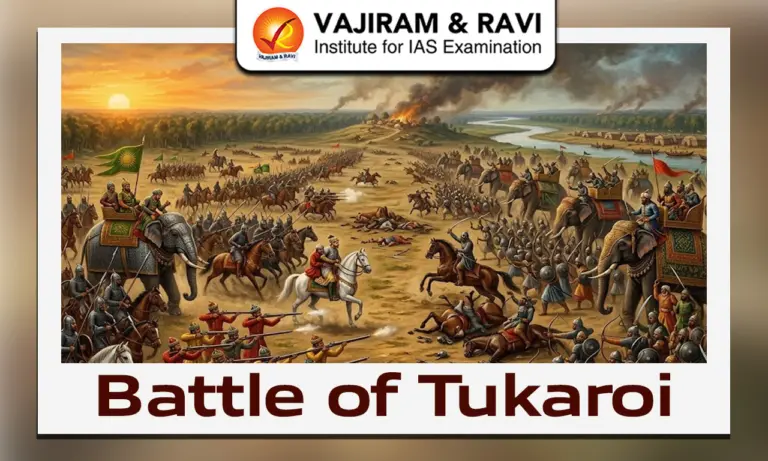
The Battle of Tukaroi, fought on 3 March 1575, was a decisive battle between the Mughal Empire under Akbar and the Karrani Sultanate of Bengal under Daud Khan Karrani. Although Akbar did not personally command the army, the Mughal forces led by Munim Khan and Raja Todar Mal defeated the Afghans, leading to the Treaty of Katak (Cuttack). The battle marked the beginning of Mughal control over Bengal and Bihar and paved the way for the final defeat of the Karrani dynasty at the Battle of Rajmahal (1576).
|
Date |
3 March 1575 |
|
Location |
Tukaroi (near present-day Balasore, Odisha; some sources place it in present-day West Bengal) |
|
Between |
Mughal Empire vs Karrani Sultanate of Bengal |
|
Commanders |
Munim Khan & Raja Todar Mal vs Daud Khan Karrani |
|
Outcome |
Mughal Victory |
Battle of Tukaroi Background
The Battle of Tukaroi was the outcome of Akbar’s policy of extending Mughal authority over eastern India.
After overthrowing the Sur Empire and consolidating control over North India, Akbar turned his attention towards Bihar and Bengal, two of the richest provinces in the subcontinent. At that time, Bengal was ruled by the Karrani dynasty, founded by Taj Khan Karrani and later strengthened by Sulaiman Khan Karrani. After Sulaiman’s death, his son Daud Khan Karrani became the ruler of Bengal. Unlike his father, Daud refused to accept Mughal suzerainty and pursued an independent policy.
In 1574, Akbar personally led the initial campaign into Bihar, capturing Hajipur and Patna. Thereafter, he returned to Fatehpur Sikri, entrusting the eastern campaign to his experienced generals Munim Khan, Raja Todar Mal, and Shaham Khan.
The Mughal army advanced towards Bengal and occupied Tanda, the Bengal capital, forcing Daud Khan to retreat towards Odisha. Determined to recover his kingdom, Daud reorganised the Afghan forces and confronted the Mughal army near Tukaroi.
Causes of the Battle of Tukaroi
- Challenge to Mughal Supremacy: Daud Khan refused to accept Mughal overlordship and attempted to preserve Bengal as an independent Afghan kingdom.
- Strategic Importance of Bengal: Bengal and Bihar were among the wealthiest regions of India, known for fertile agriculture, flourishing ports and extensive trade. Their control was essential for Akbar’s imperial expansion.
- Capture of Mughal Territory: Daud Khan seized the Mughal frontier fort of Zamania, providing Akbar with an immediate reason to launch military action.
- Consolidation of Eastern India: Akbar aimed to eliminate the last major Afghan power in eastern India and integrate Bengal into the Mughal Empire.


Course of the Battle of Tukaroi
The two armies met near Tukaroi on 3 March 1575. The Mughal army was commanded by Munim Khan, assisted by Raja Todar Mal, while Daud Khan Karrani personally led the Afghan forces.
The battle began with a fierce Afghan attack. During the initial phase, Munim Khan was seriously wounded, and for a time the Afghan army appeared to gain the upper hand.
However, the Mughal commanders maintained discipline and reorganised their forces. Raja Todar Mal coordinated the Mughal cavalry, which launched a powerful flanking attack on the Afghan army. This manoeuvre disrupted the Afghan formations and gradually shifted the momentum in favour of the Mughals.
A major turning point came when Gujar Khan, Daud Khan’s most trusted commander, was killed during the fighting. His death weakened Afghan morale and created confusion within their ranks.
Unable to withstand the sustained Mughal assault, Daud Khan fled towards Cuttack (Katak) in Odisha with the remaining troops. The Mughal army secured a decisive victory, effectively breaking Afghan resistance in Bengal.
Outcome of the Battle of Tukaroi
The Battle of Tukaroi significantly strengthened Mughal authority in eastern India.
- The Mughal Empire secured a decisive victory over the Karrani Sultanate.
- Daud Khan retreated to Odisha after suffering heavy losses.
- The Treaty of Katak (12 April 1575) was concluded between Daud Khan and Munim Khan.
- Under the treaty of katak , Bengal and Bihar were ceded to the Mughal Empire, while Daud retained Odisha as a Mughal vassal.
- The treaty provided only temporary peace, as Daud soon violated its terms and resumed resistance.
- The conflict finally ended with Daud’s defeat and execution at the Battle of Rajmahal (1576).
Significance of the Battle of Tukaroi
The Battle of Tukaroi was not the final conquest of Bengal but the decisive turning point in Akbar’s eastern campaign. Together with the Treaty of Katak (1575) and the Battle of Rajmahal (1576), it ended the rule of the Karrani dynasty and firmly integrated Bengal into the Mughal Empire. This greatly enhanced Mughal political authority, administrative reach and economic strength in eastern India.
- Beginning of Mughal Rule in Bengal: The victory brought Bengal and Bihar under effective Mughal control and marked the decline of independent Afghan rule in eastern India.
- Decline of the Karrani Dynasty: Although Daud Khan temporarily retained Odisha under the Treaty of Katak, the battle irreversibly weakened the Karrani Sultanate and prepared the way for its final defeat at Rajmahal.
- Consolidation of Akbar’s Empire: The conquest secured the eastern frontier of the Mughal Empire and integrated one of India’s richest regions into the imperial administration.
- Expansion of Mughal Administration: Following the conquest, Bengal was organised as a Mughal Subah, enabling efficient revenue collection and strengthening imperial governance.
- Strengthening the Mughal Economy: Control over Bengal’s fertile agricultural lands, textile production, river routes and maritime trade substantially increased Mughal revenues and supported further imperial expansion.
- Demonstration of Mughal Military Superiority: The battle highlighted the effectiveness of disciplined cavalry, coordinated command and superior battlefield organisation in overcoming the Afghan forces.

 Last updated on Oct, 2026
→ UPSC 2027 Notification will be released on 13 January 2027 at upsconline.nic.in.
→ Check Nobel Prize 2026 Winners List here.
→ Download PIB PRiSM Monthly Magazine 2026 here.
→ Check UPSC Monthly Current Affairs Magazine The Recitals here.
→ Check out the latest UPSC Syllabus here.
→ Download UPSC Model Answers for Mains 2026
→ UPSC Mains Question Paper 2026 is out now for Essay & GS Paper 1, 2, 3 & 4.
→ UPSC Calendar 2027 has been released.
→ Enroll in Vajiram & Ravi’s UPSC Mains Test Series 2027 for structured answer writing practice, expert evaluation, and exam-oriented feedback.
→ Join Vajiram & Ravi’s UPSC Mentorship Program 2027 for personalized guidance, strategy planning, and one-to-one support from experienced mentors.
→ Go through the UPSC Mains Previous Year Papers to enhance your preparation.
→ UPSC has released UPSC Toppers List 2025 with the Civil Services final result on its official website.
→ Also check Best UPSC Coaching in India
Battle of Tukaroi FAQs
Q1. When and between whom was the Battle of Tukaroi fought?+
Q2. Why was the Battle of Tukaroi fought?+
Q3. What was the immediate outcome of the Battle of Tukaroi?+
Q4. Which battle finally ended the Karrani dynasty after the Battle of Tukaroi?+
Q5. Why is the Battle of Tukaroi considered a turning point in Mughal history?+
Tags: battle of tukaroi