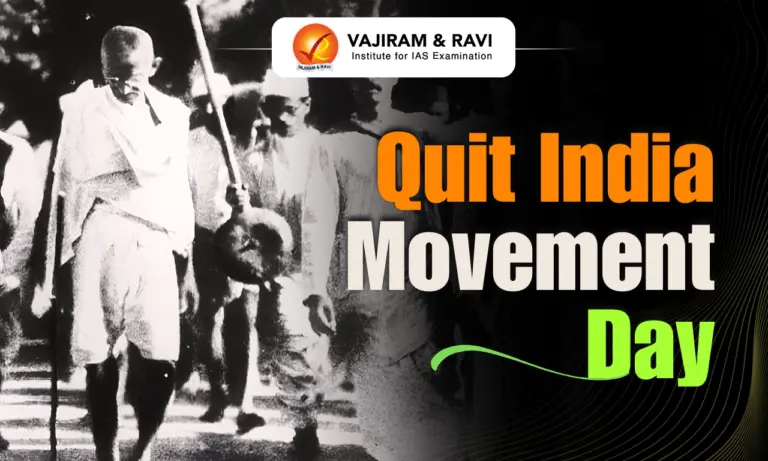
Quit India Movement Day 2026 will be observed on 8 August 2026 to commemorate the launch of the historic Quit India Movement (Bharat Chhodo Andolan) by Mahatma Gandhi in 1942. The movement marked one of the most decisive phases of India’s freedom struggle, calling for an immediate end to British colonial rule. Every year, the day is observed to remember the sacrifices of freedom fighters and inspire citizens with the values of patriotism, unity, and democracy.
Quit India Movement Day 2026 Theme
Quit India Movement Day (August Kranti Diwas), observed every year on 8 August, does not have an officially announced national theme. Instead, the observance is dedicated to commemorating the historic Quit India Movement of 1942, honouring the sacrifices of India’s freedom fighters, and reaffirming Mahatma Gandhi’s powerful “Do or Die“ call that inspired millions to fight for India’s independence.
History of the Quit India Movement
The Quit India Movement, also known as the August Movement (August Kranti), was launched on 8 August 1942 by the Indian National Congress under the leadership of Mahatma Gandhi to demand the immediate end of British rule in India.
- Launched on: 8 August 1942 during the Bombay Session of the All India Congress Committee (AICC).
- Venue: Gowalia Tank Maidan (now August Kranti Maidan), Bombay (Mumbai).
- Reason: The failure of the Cripps Mission (1942) and growing dissatisfaction with British rule during World War II.
- Leader: Mahatma Gandhi, who gave the historic “Do or Die” call.
- Objective: To compel the British to leave India immediately and achieve complete independence.
- British Response: Gandhi and other Congress leaders were arrested on 9 August 1942, soon after the movement began.
- Public Participation: Students, workers, farmers, women, and ordinary citizens participated in protests, strikes, and underground activities across the country.
- Historical Importance: Although suppressed by the British, the movement became a turning point in India’s freedom struggle and accelerated the path to Independence in 1947.


Causes of the Quit India Movement
Several political, economic, and wartime developments led to the launch of the Quit India Movement in 1942, as Indians demanded an immediate end to British colonial rule.
- Failure of the Cripps Mission (1942): The British proposals did not promise immediate self-rule, leading to widespread disappointment among Indian leaders.
- India’s Involvement in World War II: Britain declared India a participant in the war without consulting Indian political representatives.
- Demand for Complete Independence: The Indian National Congress intensified its demand for Purna Swaraj (Complete Independence) instead of limited constitutional reforms.
- Economic Hardships: Wartime inflation, food shortages, unemployment, and rising prices caused severe public distress.
- Repressive British Policies: Frequent arrests of nationalist leaders, censorship, and restrictions on civil liberties increased public anger.
- Growing Nationalist Sentiment: Decades of freedom movements had strengthened the desire for self-governance among people across the country.
- Japanese Advance in Asia: The rapid expansion of Japanese forces during World War II exposed Britain’s weakening control and encouraged Indian leaders to press for immediate independence.
- Mahatma Gandhi’s Leadership: Gandhi believed that British rule had become morally and politically unacceptable, leading him to give the historic “Do or Die” call on 8 August 1942.
Major Leaders of the Quit India Movement
The Quit India Movement was led by Mahatma Gandhi and supported by several prominent freedom fighters who organized protests, underground resistance, and mass mobilization across India.
- Mahatma Gandhi: Launched the Quit India Movement and gave the historic “Do or Die” call on 8 August 1942.
- Jawaharlal Nehru: A senior Congress leader who actively supported the movement and was arrested soon after its launch.
- Sardar Vallabhbhai Patel: Mobilized public support and encouraged nationwide participation in the movement.
- Maulana Abul Kalam Azad: Then President of the Indian National Congress, he played a key role in adopting the Quit India Resolution.
- Aruna Asaf Ali: Hoisted the Indian National Flag at Gowalia Tank Maidan after senior leaders were arrested, becoming a symbol of resistance.
- Ram Manohar Lohia: Organized underground activities and spread nationalist messages despite British repression.
- Jayaprakash Narayan: Escaped from prison and led underground resistance against British rule.
- Usha Mehta: Operated the secret Congress Radio, which broadcast patriotic messages and movement updates across the country.
- Achyut Patwardhan: Helped coordinate underground networks and resistance activities.
- Yusuf Meherally: Coined the slogan “Quit India” and played an important role in mobilizing public support for the movement.
Quit India Movement Day 2026 Significance
Quit India Movement Day commemorates one of the most significant milestones in India’s freedom struggle. It honours the courage, unity, and sacrifices of millions of Indians who participated in the Quit India Movement of 1942 and reaffirms the nation’s commitment to the ideals of freedom and democracy.
- Honours Freedom Fighters: Pays tribute to the countless individuals who sacrificed their lives and endured imprisonment for India’s independence.
- Commemorates the Quit India Movement: Marks the launch of the historic Bharat Chhodo Andolan on 8 August 1942 under Mahatma Gandhi’s leadership.
- Promotes Patriotism: Encourages citizens, especially the youth, to appreciate India’s freedom struggle and uphold national values.
- Highlights National Unity: Recognizes how people from different regions, communities, and backgrounds came together with a common goal of independence.
- Strengthens Democratic Values: Reinforces the importance of freedom, justice, equality, and constitutional principles in modern India.
- Inspires Civic Responsibility: Motivates citizens to actively contribute to nation-building and protect the country’s democratic institutions.
- Preserves Historical Legacy: Ensures that future generations remain aware of the events and sacrifices that shaped India’s journey to independence.
| Related Post | |
| Aligarh Movement | Wahabi Movement |
| Faraizi Movement | Deoband Movement |
| Ahmadiyya Movement | Akali Movement |
| Young Bengal Movement | Temple Entry Movement |

 Last updated on Sep, 2026
→ UPSC 2027 Notification will be released on 13 January 2027 at upsconline.nic.in.
→ Asian Games 2026 are being held in Aichi-Nagoya, Japan, from 19 September to 4 October.
→ Check out the latest UPSC Syllabus here.
→ Download UPSC Model Answers for Mains 2026
→ UPSC Mains Question Paper 2026 is out now for Essay & GS Paper 1, 2, 3 & 4.
→ UPSC Calendar 2027 has been released.
→ Enroll in Vajiram & Ravi’s UPSC Mains Test Series 2027 for structured answer writing practice, expert evaluation, and exam-oriented feedback.
→ Join Vajiram & Ravi’s UPSC Mentorship Program 2027 for personalized guidance, strategy planning, and one-to-one support from experienced mentors.
→ Go through the UPSC Mains Previous Year Papers to enhance your preparation.
→ UPSC has released UPSC Toppers List 2025 with the Civil Services final result on its official website.
→ Also check Best UPSC Coaching in India
Quit India Movement Day 2026 FAQs
Q1. When is Quit India Movement Day 2026 observed?+
Q2. Why is Quit India Movement Day celebrated?+
Q3. Who launched the Quit India Movement?+
Q4. What was the famous slogan of the Quit India Movement?+
Q5. Where was the Quit India Movement launched?+
Q6. What was the main objective of the Quit India Movement?+
Tags: important days important days in 2026 important days in august 2026 quit india movement day 2026