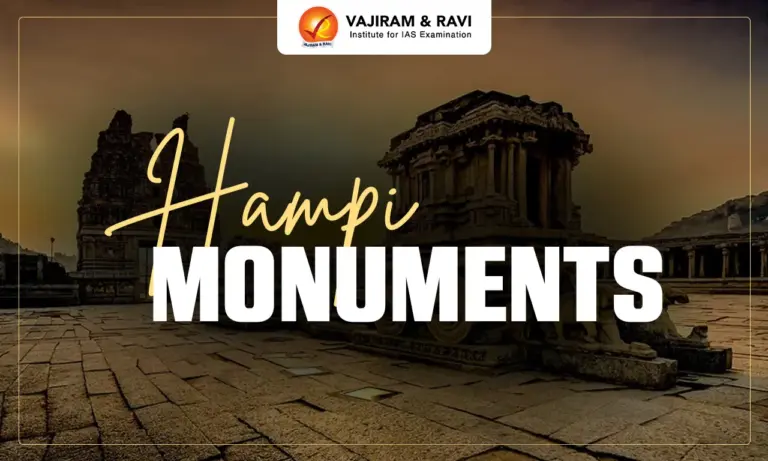
Hampi Monuments are the surviving remains of Vijayanagara, the capital of the Vijayanagara Empire in present day Karnataka. The site covers 4,187.24 hectares in the Tungabhadra basin of Ballari district. Hampi developed mainly between the 14th and 16th centuries CE. Its landscape combines granite hills, plains and the Tungabhadra River. More than 1,600 surviving remains show the city’s advanced religious, royal, military, residential and water management systems.
Hampi Monuments
Hampi Monuments developed as a large planned capital with strong religious, royal, civil and defensive systems integrated with its natural landscape.
- Location: Hampi lies in the Tungabhadra basin of Central Karnataka, amid rocky hill ranges, granite boulders and open plains.
- Vijayanagara Empire:
- Capital: The site represents the remains of the capital city of the Vijayanagara Empire, which flourished mainly between the 14th and 16th centuries CE.
- Founding: Vijayanagara was established in 1336 CE by Harihara I and Bukka Raya I of the Sangama Dynasty. Hampi later became its principal imperial capital.
- Major Ruler: The empire reached its peak under Krishna Deva Raya of the Tuluva Dynasty, who ruled from 1509 to 1530 CE.
- Historical Decline: The Battle of Talikota in 1565 CE caused extensive destruction of Vijayanagara. The capital was subsequently pillaged and largely abandoned.
- Surviving Remains: More than 1,600 remains include temples, forts, gateways, royal complexes, shrines, Mandapas, stables, defence structures, memorials and water systems.
- Urban Planning: Large Dravidian temples were surrounded by bazaars, subsidiary shrines, residential areas and tanks. Suburban townships were linked with roads and defensive structures.
Hampi Monuments Archeological Sites list
The major Hampi Monuments represent religious devotion, royal authority, ceremonial life, advanced engineering and the mature form of Vijayanagara architecture. Hampi’s surviving heritage includes temples, sacred complexes, sculptures, royal structures, etc. highlighted below:
Temples and Temple Complexes
- Virupaksha Temple: The Virupaksha Temple is dedicated to Lord Shiva and Pampadevi. It is one of Hampi’s oldest structures, with references to Shiva in inscriptions from the 9th and 10th centuries CE. It has three Gopuras and remains in continuous worship.
- Vitthala Temple Complex: The Vitthala Temple represents the culmination of Vijayanagara temple architecture. Its core existed during the reign of Deva Raya II, while Krishna Deva Raya made substantial additions. The complex contains the main shrine, Devi shrine, Kalyana Mandapa, Utsava Mandapa, hundred pillared Mandapa, three Gopurams and the Stone Chariot.
- Krishna Temple Complex: The Krishna Temple Complex is one of Hampi’s major sacred complexes. It forms part of the extensive temple building activity of the Vijayanagara rulers and reflects the development of large Dravidian temple complexes within the capital.
- Achyutaraya Temple Complex: The Achyutaraya Temple Complex is one of the important sacred complexes of Hampi. It demonstrates the scale of Vijayanagara religious architecture and the integration of temples with surrounding urban and commercial spaces.
- Pattabhirama Temple Complex: The Pattabhirama Temple Complex is among the major temple complexes identified within Hampi. Its large scale construction reflects the development of monumental Dravidian architecture under the Vijayanagara Empire.
- Hemakuta Group of Temples: The Hemakuta Group of Temples forms an important part of Hampi’s sacred landscape. The group demonstrates the concentration of religious structures within the wider planned capital.
Sculptures and Monolithic Structures
- Lakshmi Narasimha: The Lakshmi Narasimha is a 6.7 metre high monolithic sculpture depicting the man-lion form of Vishnu seated on a seven hooded serpent. It is carved from the locally available granite.
- Sasivekalu Ganesha: Sasivekalu Ganesha is a major monolithic sculpture at Hampi. It demonstrates the large scale granite craftsmanship used for religious images and monumental structures across the Vijayanagara capital.
- Stone Chariot: The Stone Chariot stands within the Vitthala Temple Complex and represents a Garuda shrine fashioned as a granite ratha. Its design imitates a processional chariot and reflects Hampi’s chariot festival traditions.
Also Read: Vijayanagara Architecture
Royal and Ceremonial Structures
- Mahanavami Dibba: Mahanavami Dibba is a massive three tiered ceremonial platform in the royal centre. Its granite reliefs depict royal activities, battles and festivities, showing the ceremonial character of the Vijayanagara court.
- King’s Balance: The King’s Balance is associated with the Tulapurusha dana ritual, in which the king was ceremonially weighed against precious materials. It consists of two carved granite pillars supporting a stone beam.
Secular and Royal Complexes
- Lotus Mahal Complex: The Lotus Mahal is a distinctive secular structure within Hampi. It has two levels, with open pavilions at the lower level and balconies above, reflecting the diverse architectural character of the royal area.
- Elephant Stables: The Elephant Stables are an imposing secular structure with arched entrances and multiple domes. They were associated with the housing of royal elephants and show Indo-Islamic architectural influences.
- Queen’s Bath: The Queen’s Bath is a major secular structure that demonstrates the adoption of Indo-Islamic architectural elements in Vijayanagara buildings. It forms part of Hampi’s evidence of a multi religious and multi ethnic society.
Mandapas and Associated Structures
- Kalyana Mandapa: The Kalyana Mandapa forms part of the Vitthala Temple Complex. It has an elevated moulded platform at its centre and was associated with the ceremonial marriage of the god and goddess.
- Utsava Mandapa: The Utsava Mandapa is an associated structure within the Vitthala Temple Complex. It reflects the importance of ceremonial and festival activities within Vijayanagara religious architecture.
- Ranga Mantapa: The Ranga Mantapa is a prominent hall of the Vitthala Temple Complex. It is associated with the famous musical pillars and forms an important part of the complex’s elaborate architectural design.
- Vasantotsava Mandapa: The Vasantotsava Mandapa stands at the centre of the large Pushkarani in the Vitthala Temple Complex. It served as a ceremonial pavilion associated with the temple’s water architecture.
Water Structures
- Pushkarani: Pushkaranis are stepped water tanks integrated into Hampi’s religious and urban planning. The Vitthala complex contains a large Pushkarani connected with wells and a network of water channels.
- Lokapavani Tank: The Lokapavani is a rectangular tank situated towards the eastern end of the Vitthala Temple area. A series of pillared pavilions surrounds the tank.
- Water Channels: Hampi developed an extensive network of water channels and irrigation systems. These systems connected water sources with fields, tanks and urban areas and remain evidence of advanced hydraulic planning.
Urban and Defence Structures
- Bazaars and Chariot Streets: Hampi’s large temple complexes were connected with broad bazaar streets and wide chariot streets. Rows of pillared Mandapas lined these routes and supported religious and commercial activities.
- Fortification Walls: Hampi’s massive fortification walls were constructed with irregularly cut stones. Their cores were filled with rubble masonry without binding material, forming part of the city’s defensive system.
- Gateways and Gopurams: Monumental gateways and Gopurams formed important entrances to Hampi’s sacred and royal complexes. Temple Gopurams used stone and brick and became characteristic features of Vijayanagara architecture.
- Defence Check Posts: Defence check posts formed part of Hampi’s wider military infrastructure. They demonstrate how the planned capital integrated defensive arrangements with its natural landscape and urban settlement.


Hampi Monuments Art and Architecture Style
The Architecture of Hampi Monuments combines mature Dravidian forms, monumental granite construction, temple town planning and selected Indo-Islamic elements in secular buildings.
- Dravidian Architecture: Massive dimensions, enclosed courtyards, decorated pillars and lofty entrance towers are major features of Hampi’s mature Dravidian architectural tradition.
- Construction Materials: Local granite, burnt bricks and lime mortar were widely used. Stone masonry and post and lintel systems were important construction techniques.
- Gopurams: Temple entrances feature large Gopurams constructed using stone and brick. Their scale became a defining feature of Vijayanagara temple architecture.
- Mandapas: Pillared Mandapas served religious and ceremonial purposes. Wide chariot streets were lined with such structures for festivals and processions.
- Water Architecture: Pushkaranis, wells and channels were carefully integrated with temples and urban spaces, showing sophisticated hydraulic planning.
- Indo-Islamic Architecture: Structures such as the Queen’s Bath and Elephant Stables demonstrate the adoption of Indo-Islamic architectural elements in secular buildings.
- Hampi Monuments on Note: The stone chariot of the Vitthala Temple Complex became a widely recognised representation of Hampi. The ₹50 Indian Currency Note, introduced in August 2017, features Hampi’s Granite Stone Chariot on its reverse side.
Hampi Monuments Protection and Conservation
Hampi Monuments received World Heritage recognition in 1986, with conservation focused on protecting monuments, landscape, authenticity and the wider cultural heritage area.
- UNESCO Recognition: The Group of Monuments at Hampi was inscribed as a UNESCO World Heritage property in 1986 for its exceptional artistic, historical and architectural significance.
- Legal Protection: Protection operates under the Ancient Monuments and Archaeological Sites and Remains Act 1958, its 2010 amendment and Karnataka’s 1961 heritage legislation.
- Conservation Agencies: The Archaeological Survey of India and Karnataka authorities manage protected monuments and coordinate conservation activities across the heritage area.
- HWHAMA: Hampi World Heritage Area Management Authority was created to improve coordination between agencies and regulate development within the World Heritage Area.
- Integrity Challenges: Encroachments, changing land use, commercial agriculture, modern infrastructure and inappropriate development can affect the landscape and physical stability of monuments.
- Conservation Planning: Master plans, GIS based mapping, conservation plans, risk preparedness measures and public use planning are important for sustainable management of the property.
- Significance: Continued temple rituals, festivals, pilgrimage, agriculture and traditional occupations require sensitive management alongside protection of the archaeological remains.

 Last updated on Oct, 2026
→ UPSC 2027 Notification will be released on 13 January 2027 at upsconline.nic.in.
→ Check Nobel Prize 2026 Winners List here.
→ Download PIB PRiSM Monthly Magazine 2026 here.
→ Check UPSC Monthly Current Affairs Magazine The Recitals here.
→ Check out the latest UPSC Syllabus here.
→ Download UPSC Model Answers for Mains 2026
→ UPSC Mains Question Paper 2026 is out now for Essay & GS Paper 1, 2, 3 & 4.
→ UPSC Calendar 2027 has been released.
→ Enroll in Vajiram & Ravi’s UPSC Mains Test Series 2027 for structured answer writing practice, expert evaluation, and exam-oriented feedback.
→ Join Vajiram & Ravi’s UPSC Mentorship Program 2027 for personalized guidance, strategy planning, and one-to-one support from experienced mentors.
→ Go through the UPSC Mains Previous Year Papers to enhance your preparation.
→ UPSC has released UPSC Toppers List 2025 with the Civil Services final result on its official website.
→ Also check Best UPSC Coaching in India
Hampi Monuments FAQs
Q1. What are the major Hampi Monuments?+
Q2. Where are the Hampi Monuments located?+
Q3. When was Hampi Monuments declared a UNESCO World Heritage Site?+
Q4. Which Hampi Monuments are shown on the ₹50 Note?+
Q5. What architectural style is found in Hampi Monuments?+
Q6. Who built the Hampi Monuments?+
Q7. Who founded the Vijayanagara Empire?+
Q8. Which ruler contributed greatly to the Group of Monuments at Hampi?+
Q9. Who built the Stone Chariot at Hampi?+
Q10. Why are Hampi Monuments famous?+
Tags: hampi hampi monuments