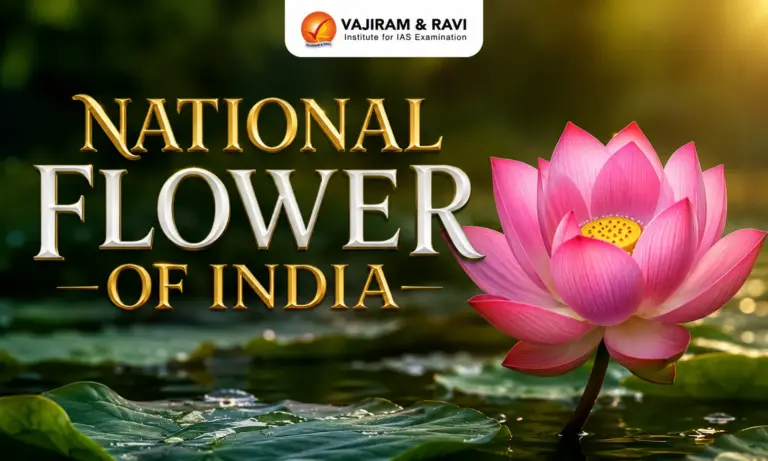
National Symbols represent India’s identity, heritage and values. They include symbols chosen to reflect the country’s cultural and natural heritage. The designation of a national flower gives recognition to a plant with deep historical and cultural importance. The National Flower of India is widely considered to be the Lotus. However, the Government has clarified through an RTI response that the Botanical Survey of India has not officially named any flower as the national flower.
National Flower of India
Lotus is widely recognised as the National Flower of India because of its cultural, religious and symbolic importance.
- Scientific Name: The scientific name of Lotus is Nelumbo nucifera Gaertn. It is a rhizomatous aquatic perennial belonging to the family Nelumbonaceae.
- Habitat: Lotus grows in freshwater ponds, lakes, wetlands and slow moving water bodies, especially in warm and semitropical climatic conditions.
- Distribution: It is native to South, East and Southeast Asia, with natural populations also extending into northern Australia. It is widely cultivated in other regions.
- Appearance: Lotus is an aquatic perennial with large emergent leaves and prominent flowers. Its flowers occur in white, red, blue, pink and purple shades.
- Uses: Lotus has food, medicinal and ornamental uses. Its seeds, rhizomes, leaves and leaf stalks are edible and traditionally used in India.
- Significance: Lotus symbolises beauty, knowledge, enlightenment and non attachment. It holds an important place in Indian art, mythology, Hinduism and Buddhism.
Why was Lotus Adopted as National Flower of India?
Lotus is widely accepted as the National Flower of India as it has been associated with Indian culture, spirituality and traditional symbolism for centuries.
- Cultural Symbolism: Lotus represents beauty, knowledge, enlightenment and non attachment. It is also associated with Goddess Saraswathi and occupies an important place in Indian religious traditions.
- National Emblem: The State Emblem of India, adopted on 26 January 1950, stands on a full bloomed inverted Lotus, reflecting its cultural significance.
- Official Acceptance:Lotus is not formally designated by the authorities as India’s National Flower, but several government websites and portals identify it as the National Flower.


 Last updated on Oct, 2026
→ UPSC 2027 Notification will be released on 13 January 2027 at upsconline.nic.in.
→ Check Nobel Prize 2026 Winners List here.
→ Download PIB PRiSM Monthly Magazine 2026 here.
→ Check UPSC Monthly Current Affairs Magazine The Recitals here.
→ Check out the latest UPSC Syllabus here.
→ Download UPSC Model Answers for Mains 2026
→ UPSC Mains Question Paper 2026 is out now for Essay & GS Paper 1, 2, 3 & 4.
→ UPSC Calendar 2027 has been released.
→ Enroll in Vajiram & Ravi’s UPSC Mains Test Series 2027 for structured answer writing practice, expert evaluation, and exam-oriented feedback.
→ Join Vajiram & Ravi’s UPSC Mentorship Program 2027 for personalized guidance, strategy planning, and one-to-one support from experienced mentors.
→ Go through the UPSC Mains Previous Year Papers to enhance your preparation.
→ UPSC has released UPSC Toppers List 2025 with the Civil Services final result on its official website.
→ Also check Best UPSC Coaching in India
National Flower of India FAQs
Q1. What is the National Flower of India?+
Q2. Why is Lotus the National Flower of India?+
Q3. When was Lotus officially declared as the National Flower of India?+
Q4. What colours are Lotus flowers found in?+
Q5. What is the significance of Lotus in Indian culture?+
Tags: national flower national flower of india