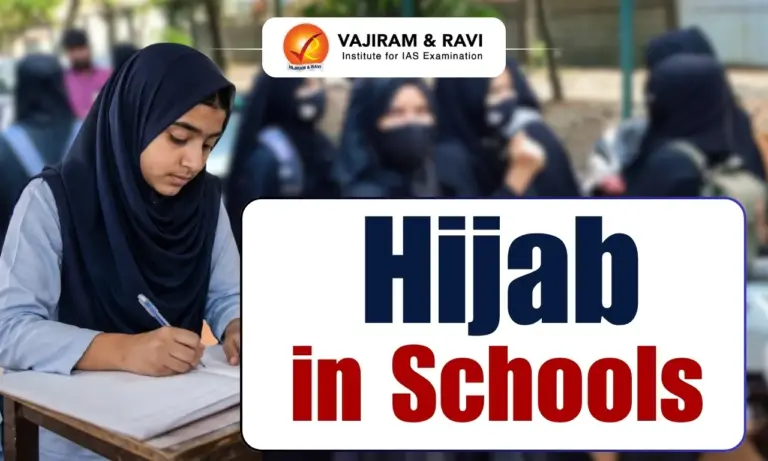
Hijab in Schools Latest News
- The Allahabad High Court has rejected a Muslim student’s challenge to her school’s dress code, ruling that years of attending classes in a headscarf did not entitle her to continue doing so. In its, the Division Bench held that her claim of religious necessity rested on a “bare assertion” unsupported by evidence.
- The ruling is the latest in a series of judgments turning on the “essential religious practice” test under Article 25 of the Constitution — a question that has travelled through multiple High Courts and remains pending before a larger Supreme Court bench.
Background of the Case
- The petitioner, a minor student at a school in Prayagraj, had studied there from Class VI to Class X wearing a headscarf, with photographs and ID cards on record showing her in uniform with the scarf throughout those years.
- She argued that since she had worn it without objection for years, she should be permitted to continue.
- The school countered that the scarf violated its dress code and that other students from her own religious community complied without it, adding that permitting the scarf would affect “the administration of the School.”
- The student, who belongs to the Muslim Shia community, argued that the headscarf is integral to her faith.
- She contended that since the school permits “formal and decent” attire, singling out the scarf effectively treated it as improper, and that the refusal violated her right to free expression under Article 19(1)(a) and affected her dignity and bodily integrity.


What the Court Held
- On prior tolerance: The bench held that years of wearing the headscarf without objection created no enforceable right going forward.
- The school’s earlier silence could be attributed to “lethargy, inaction, lack of will, non-enforcement of the uniform policy, even courtesy or hesitation” — none of which barred the school from enforcing its dress code later.
- On institutional authority: The bench held that so long as a dress code is “uniform, bona fide, non-discriminatory and intended to maintain discipline and institutional identity,” the choice of uniform lies primarily with the school.
- Permitting even minor departures, the court said, “would militate against the idea of a uniform” and would shift disciplinary authority from the institution to individual students.
- On the religious claim: The court found the petitioner’s case to be a “bare assertion,” noting the absence of any authoritative religious text, expert material, or other evidence establishing that wearing a headscarf inside the classroom was religiously obligatory, or that omitting it would alter the fundamental character of her faith.
Judicial Precedents Underpinning the Ruling
- The Allahabad High Court situated its decision within a consistent judicial trend treating school uniforms as matters for educational institutions to decide, while requiring students claiming religious protection to prove the practice is obligatory to their faith.
- Karnataka High Court (2022): The Court relied heavily on the Karnataka High Court’s Full Bench judgment, which held that wearing a hijab does not constitute an essential religious practice in Islam, and that uniform requirements do not violate Articles 14, 15, 19, or 21.
- Supreme Court (2022) — Split Verdict: This Karnataka ruling reached the Supreme Court in October 2022, where a two-judge bench delivered a split verdict:
- Justice Hemant Gupta held that a student cannot claim the right to wear a headscarf in a secular school as a matter of right, since students must follow prescribed uniforms in state-run institutions.
- Justice Sudhanshu Dhulia (dissenting) approached the issue through the lens of choice and access to education, holding that a girl’s right to wear the hijab does not stop at the school gate, and that fundamental rights do not become “derivative rights” inside a classroom.
- Owing to this split, the matter was referred to the Chief Justice of India for constitution of a larger bench — a decision still pending.
- Kerala High Court (2018): Went further, ruling that permitting a headscarf is “purely within the domain of the institution,” and that courts cannot even direct an institution to consider such a request.
- Since the Supreme Court has yet to deliver an authoritative ruling, the Allahabad High Court treated the Karnataka judgment and similar High Court decisions as “persuasive authority of great value.”
Conclusion
- The Allahabad High Court’s ruling reinforces a consistent judicial pattern: absent Supreme Court clarity, High Courts have generally upheld institutional authority over dress codes and required strict evidentiary proof for claims of religious obligation under Article 25.
- With the issue still pending before a larger Supreme Court bench following the 2022 split verdict, the essential religious practice test for the hijab remains constitutionally unsettled — leaving the tension between individual religious expression and institutional discipline unresolved at the highest judicial level.
Source: IE

 Last updated on August, 2026
→ UPSC Mains 2026 commenced on 21st August 2026 and will continue through 30th August 2026, as per the official examination schedule.
→ UPSC Mains Question Paper 2026 is out now for Essay & GS Paper 1, 2, 3 & 4.
→ UPSC Mains GS Paper 1 2026 is out now.
→ UPSC Mains GS Paper 2 2026 is out now.
→ UPSC Mains GS Paper 3 2026 is out now.
→ UPSC Mains GS Paper 4 2026 is out now.
→ Check out the latest UPSC Syllabus 2026 here.
→ UPSC Mains Admit Card 2026 is now out.
→ Enroll in Vajiram & Ravi’s UPSC Mains Test Series 2027 for structured answer writing practice, expert evaluation, and exam-oriented feedback.
→ Join Vajiram & Ravi’s UPSC Mentorship Program 2027 for personalized guidance, strategy planning, and one-to-one support from experienced mentors.
→ Go through the UPSC Mains Previous Year Papers to enhance your preparation.
→ Download UPSC Mains Essay Paper 2025, UPSC Mains GS Paper-I 2025, UPSC Mains GS Paper-II 2025, UPSC Mains GS Paper-III 2025, UPSC Mains GS Paper-IV 2025, UPSC Mains English (Compulsory) Paper 2025, UPSC Mains Hindi (Qualifying) Paper 2025 here.
→ UPSC has released UPSC Toppers List 2025 with the Civil Services final result on its official website.
→ UPSC Calendar 2027 has been released.
→ Also check Best UPSC Coaching in India
Hijab in Schools FAQs
Q1. What is the Allahabad High Court ruling on Hijab in Schools?+
Q2. Why did the court reject the student's claim on Hijab in Schools?+
Q3. Can schools regulate Hijab in Schools through uniform rules?+
Q4. What is the essential religious practice test in Hijab in Schools cases?+
Q5. Is the Supreme Court's position on Hijab in Schools settled?+
Tags: Hijab in Schools mains articles upsc current affairs upsc mains current affairs