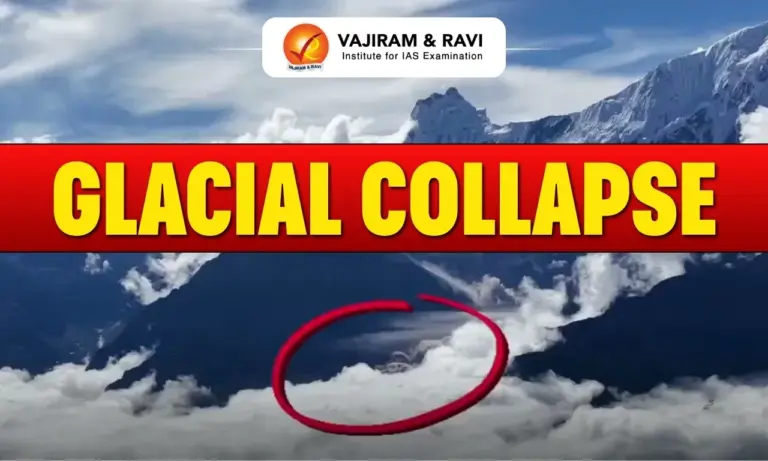
Glacial Collapse Latest News
- Flash floods devastated Nepal’s Rasuwa district and parts of Tibet this week. Officials initially suspected an earthquake. Experts and the US Geological Survey later confirmed the seismic signal was a result of a glacial collapse — not its cause.
- This raised a key question: what exactly is a glacial collapse, and how frequent are such events?
What Is a Glacial Collapse?
- A glacial collapse is the sudden detachment of a large mass of ice, rock, and water from a glacier.
- It occurs on steep mountain slopes. Sometimes millions of cubic metres of material break away. This mass can transform into a fast-moving, ice-rich avalanche or debris flow.
- The term is not a formal scientific definition in glaciology. It is, however, widely used to describe such events.
- The journal Earth System Science Data describes this broader category as gravity-driven failures of glacier ice. It includes ice avalanches, glacier detachments, and rock-ice avalanches.


How a Glacier Forms and Collapses
- A glacier forms when snow builds up and survives several melting seasons. These layers compress into firn — a stage between fresh snow and solid glacial ice. Over time, firn recrystallises into ice, becoming part of the glacier.
- Once the glacial mass grows heavy enough, it begins to flow outward. Steep mountain gradients cause this outward flow, which can trigger collapse.
- Warming temperatures add to the risk. Melted water collects in channels beneath the glacier. When the glacier’s lower portion collapses, these channels open suddenly, releasing water in large volumes.
- As the ice mass moves over uneven terrain, stress builds up. This stress can exceed the ice’s structural strength, causing fractures.
- Surface melting adds further weakness: water seeps into cracks, and repeated freeze-thaw cycles force these cracks apart until the ice splits through.
Role of the Glacier’s Base
- What lies beneath a glacier also matters. Many Himalayan glaciers rest on soft mud or clay — known as “wet-base” glaciers.
- In these cases, water collects in large quantities at the glacier’s base, sometimes connected through internal tunnels.
- When such glaciers collapse, the sudden rush of water mixes with loose dirt, rock, and riverbed material. This debris-laden torrent can race down narrow valleys at very high speed.
- Collapsed ice and rock can also block river channels, forming temporary natural dams.
- When such dams break under pressure, they trigger a second wave of flooding — exactly what happened in Nepal this week.
How Common Are Glacial Collapses?
- Glacial collapses remain rare and highly unusual, according to scientists and geologists.
- Only a handful of such events have been documented over the past decade — though Tibet has emerged as a hotspot for some of the world’s largest recorded cases.
- Notable past instances include:
- July 2016, Aru Range, Tibet: A valley glacier’s lower section detached, releasing about 68 million cubic metres of ice and killing nine herders and hundreds of animals. A nearby glacier collapsed two months later, releasing about 83 million cubic metres — NASA called it a rare occurrence.
- 2018, Sedongpu Basin, Tibet: Two ice-rock avalanches spilled debris into the Yarlung Tsangpo River (upper Brahmaputra), blocking it and forming a dangerous temporary lake.
- November 2022, Bukadaban Feng glacier, Kunlun Mountains: About 40 million cubic metres of ice detached, crashing into a lake below and creating a 13-metre wave. It went unnoticed initially due to the remote location.
- 2018, Ronti Peak, Uttarakhand, India: About 27 million cubic metres of rock and glacier ice collapsed, killing over 200 people — though this was classified more as a rock avalanche coupled with ice.
- May 2025, Blatten, Switzerland: A cascade of rock, soil, and ice buried much of the village. Experts linked the collapse to climate change in the Alps.
The Climate Change Question
- Experts noted that climate change in the Himalayas shows increased heatwaves, glacial retreat, and permafrost reduction — all of which can drive landslides and glacial outburst floods.
- Glaciers across the Hindu Kush Himalaya region — spanning Afghanistan, Bangladesh, Bhutan, China, India, Myanmar, Nepal, and Pakistan — lost ice 65% faster between 2011-2020 than in the previous decade.
- Nepal’s glaciers alone have lost nearly one-third of their ice volume over roughly three decades, according to a 2023 UN assessment.
- Hydrologists flagged a critical warning-system challenge: the absence of rainfall before such events defeat most operational flood warning systems, which typically rely on precipitation data.
- By the time a mud flow becomes visible, it is often too late to escape — the fast-moving mixture behaves “like liquid concrete.”
Conclusion
- Glacial collapses remain rare geological events, but their consequences can be catastrophic — as seen in the Nepal-Tibet floods.
- While scientists resist attributing any single event directly to climate change, the broader pattern of accelerated Himalayan glacial melt raises the risk of such collapses recurring.
- This underscores the urgent need for improved seismic and satellite monitoring, early-warning systems attuned to non-rainfall triggers, and greater regional cooperation to protect downstream communities.

 Last updated on August, 2026
→ UPSC Mains 2026 commenced on 21st August 2026 and will continue through 30th August 2026, as per the official examination schedule.
→ UPSC Mains Question Paper 2026 is out now for Essay & GS Paper 1, 2, 3 & 4.
→ UPSC Mains GS Paper 1 2026 is out now.
→ UPSC Mains GS Paper 2 2026 is out now.
→ UPSC Mains GS Paper 3 2026 is out now.
→ UPSC Mains GS Paper 4 2026 is out now.
→ Check out the latest UPSC Syllabus 2026 here.
→ UPSC Mains Admit Card 2026 is now out.
→ Enroll in Vajiram & Ravi’s UPSC Mains Test Series 2027 for structured answer writing practice, expert evaluation, and exam-oriented feedback.
→ Join Vajiram & Ravi’s UPSC Mentorship Program 2027 for personalized guidance, strategy planning, and one-to-one support from experienced mentors.
→ Go through the UPSC Mains Previous Year Papers to enhance your preparation.
→ Download UPSC Mains Essay Paper 2025, UPSC Mains GS Paper-I 2025, UPSC Mains GS Paper-II 2025, UPSC Mains GS Paper-III 2025, UPSC Mains GS Paper-IV 2025, UPSC Mains English (Compulsory) Paper 2025, UPSC Mains Hindi (Qualifying) Paper 2025 here.
→ UPSC has released UPSC Toppers List 2025 with the Civil Services final result on its official website.
→ UPSC Calendar 2027 has been released.
→ Also check Best UPSC Coaching in India
Glacial Collapse FAQs
Q1. What is Glacial Collapse?+
Q2. How does Glacial Collapse occur?+
Q3. What role does a glacier's base play in Glacial Collapse?+
Q4. How common are Glacial Collapse events?+
Q5. Is Glacial Collapse caused by climate change?+
Tags: Glacial Collapse mains articles upsc current affairs upsc mains current affairs